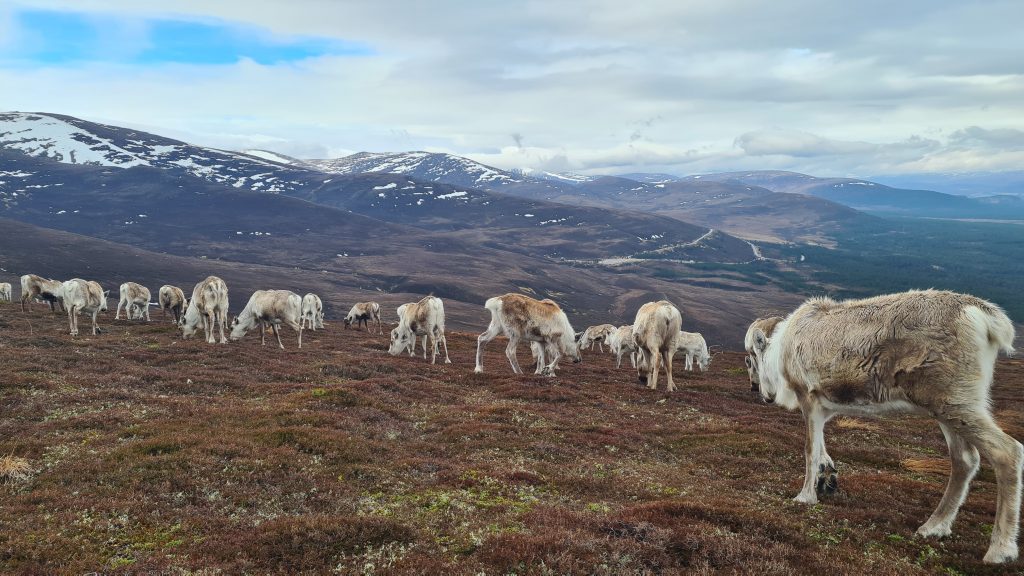
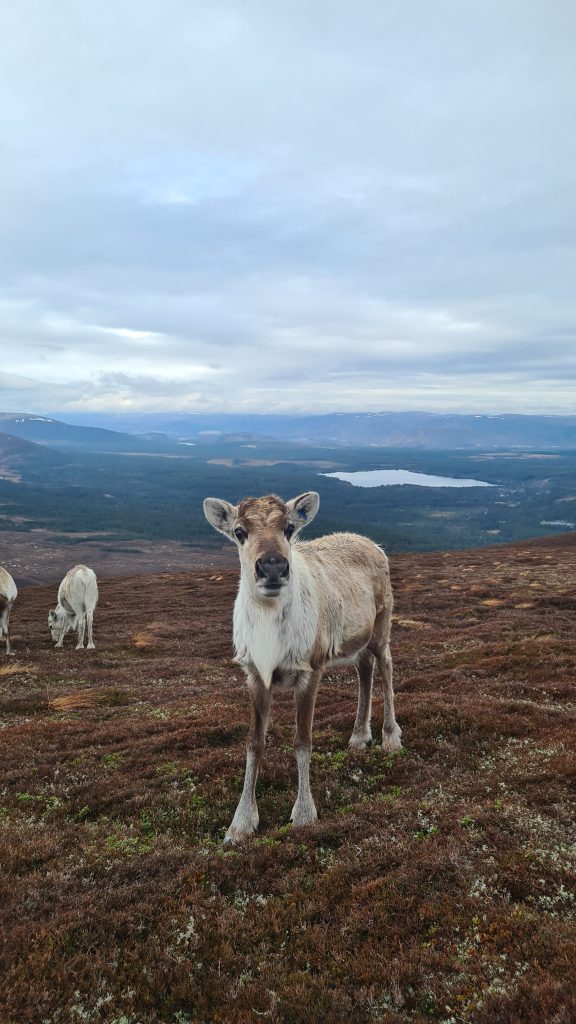
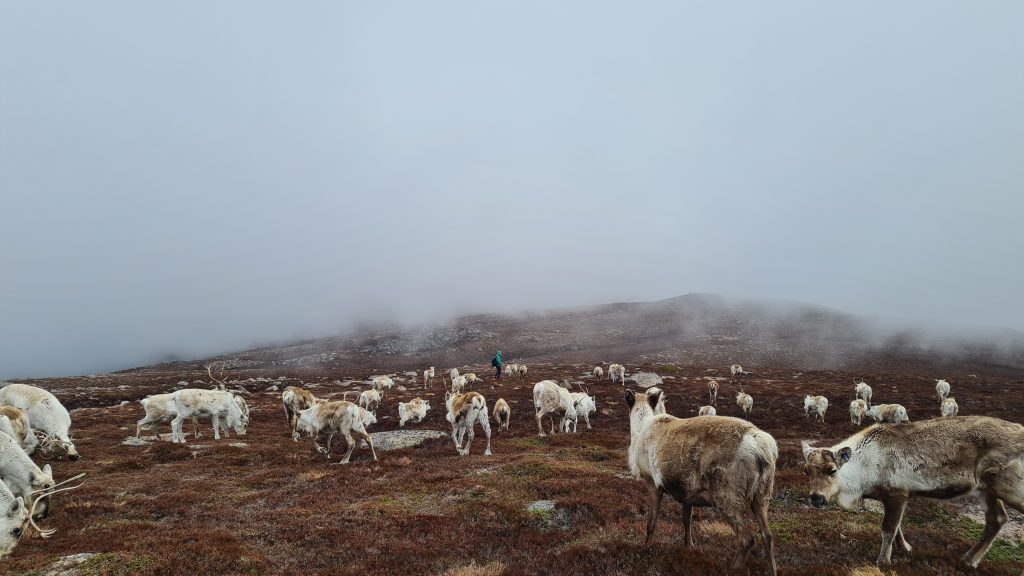
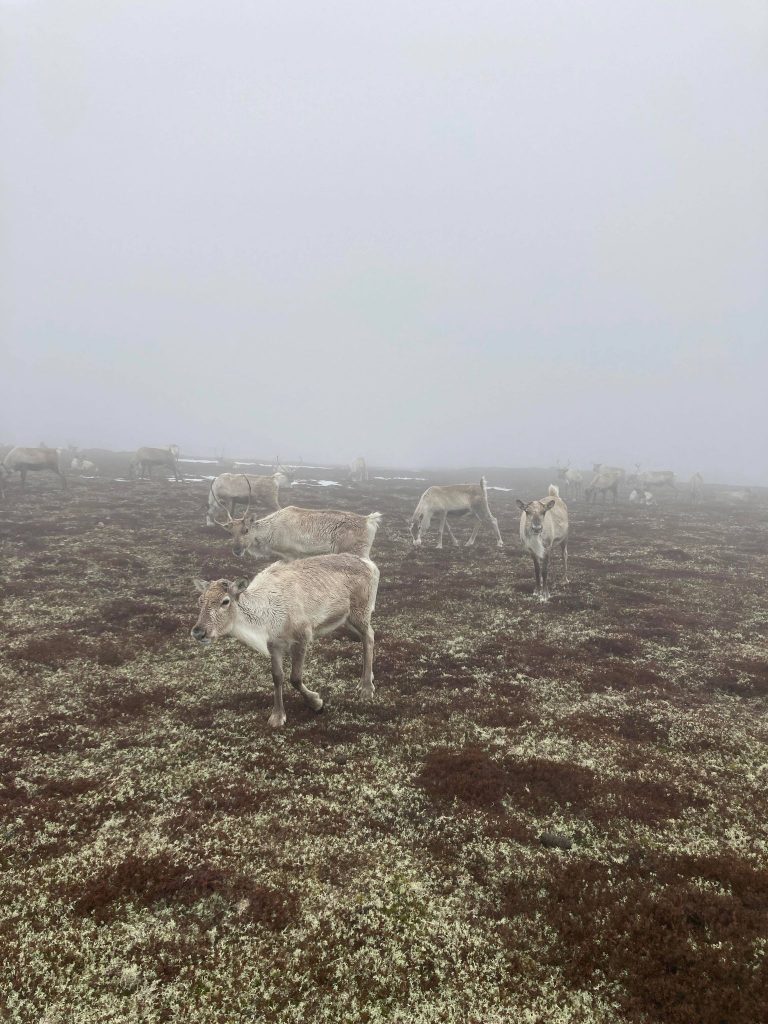
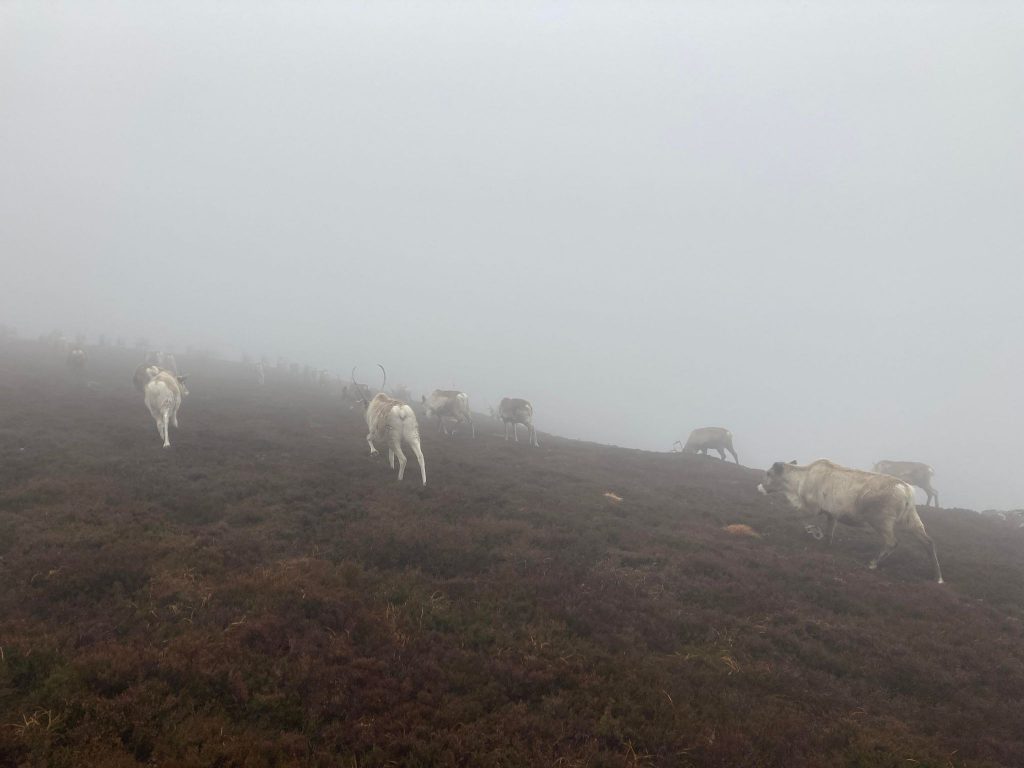
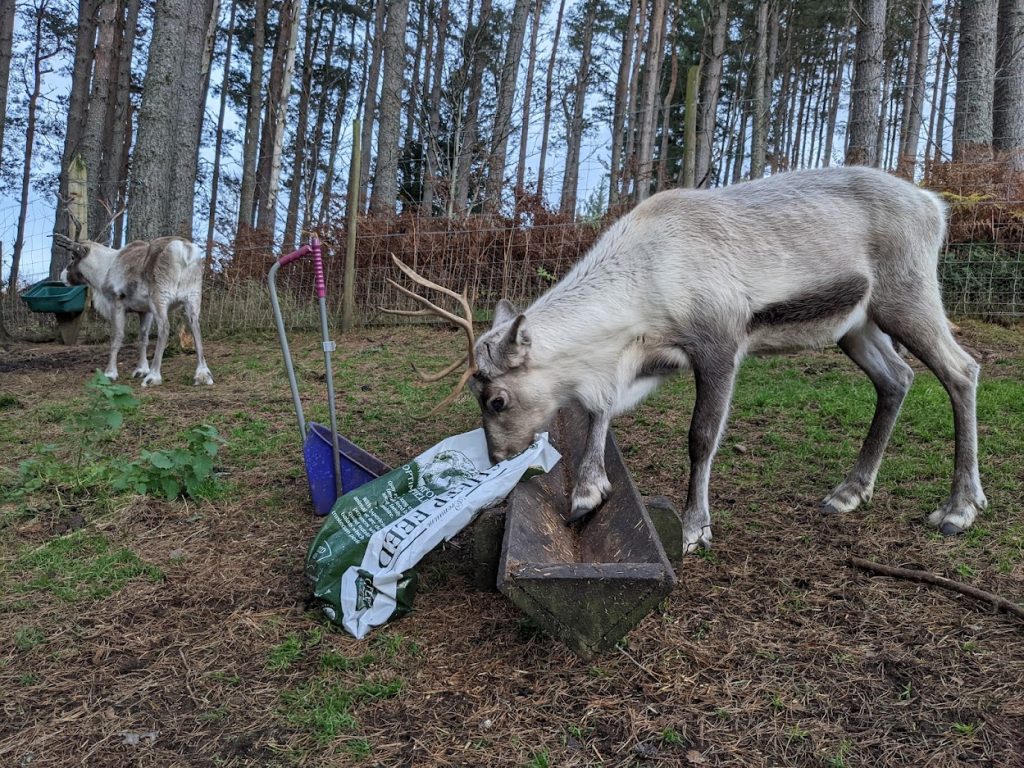
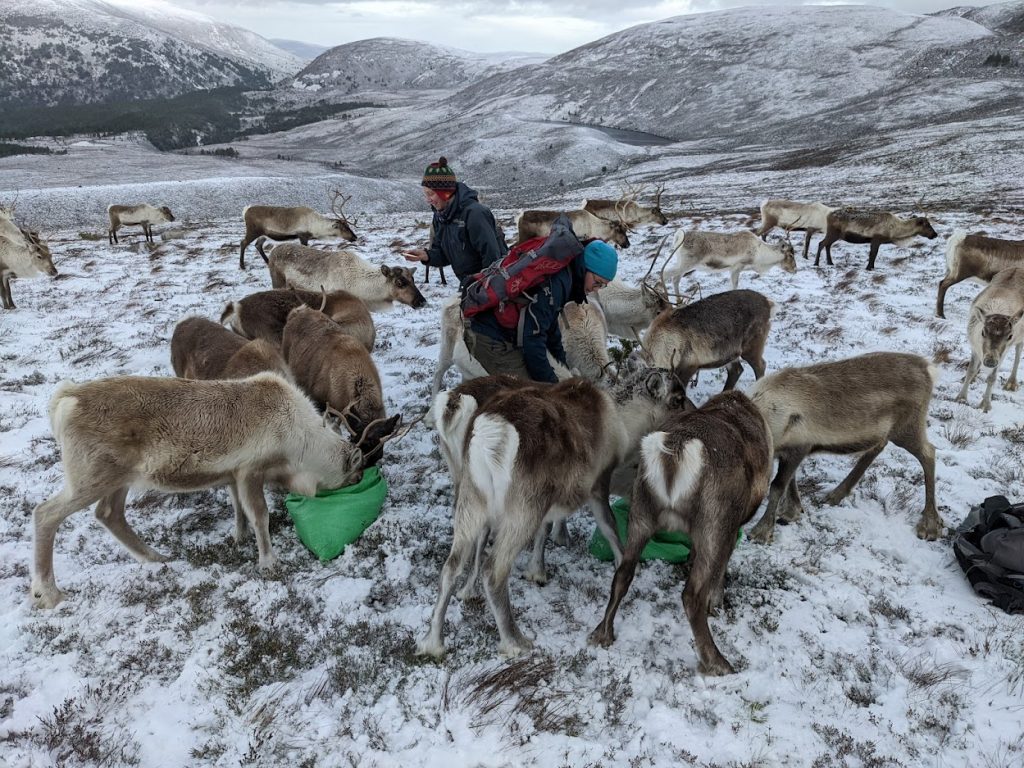
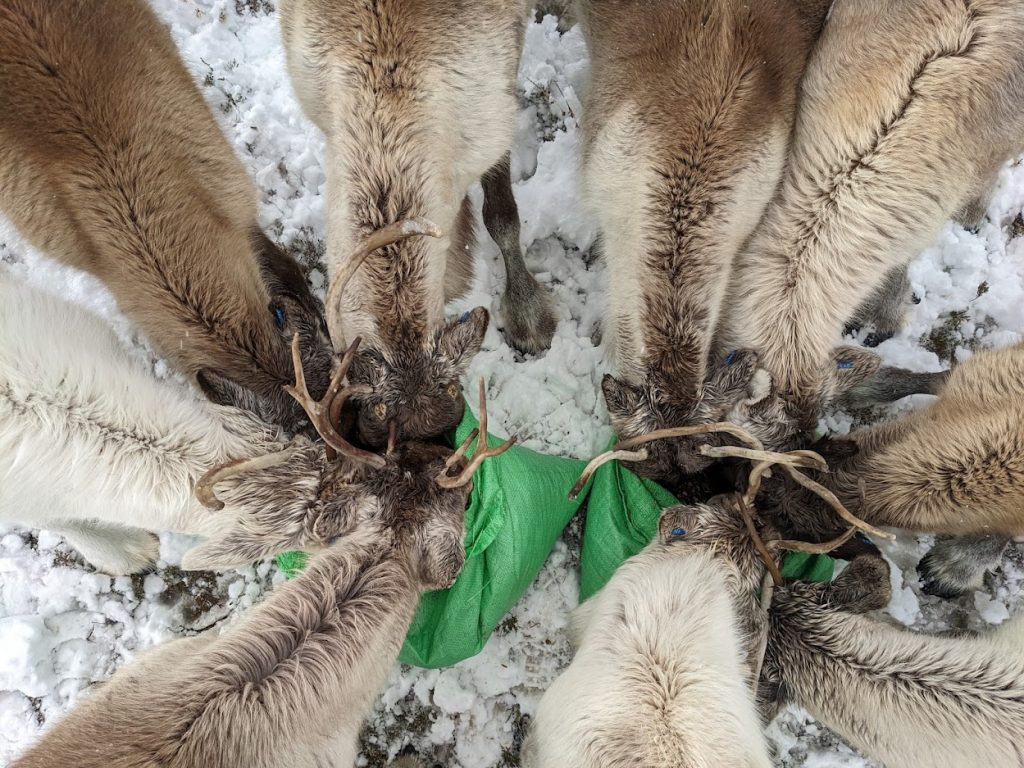
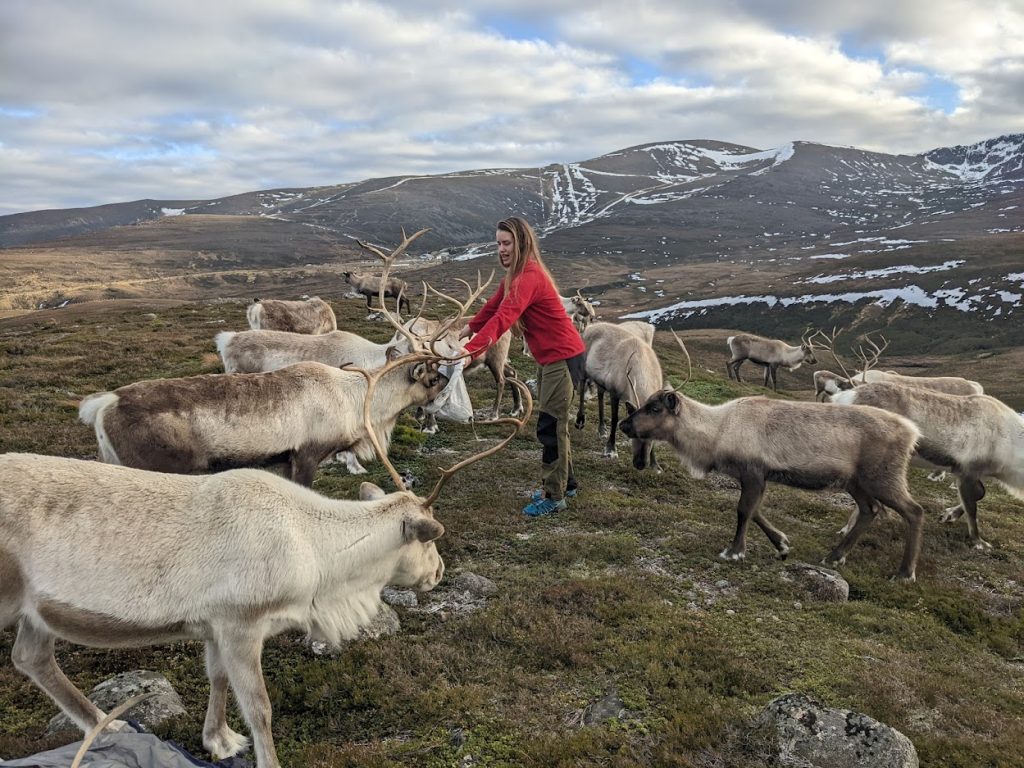
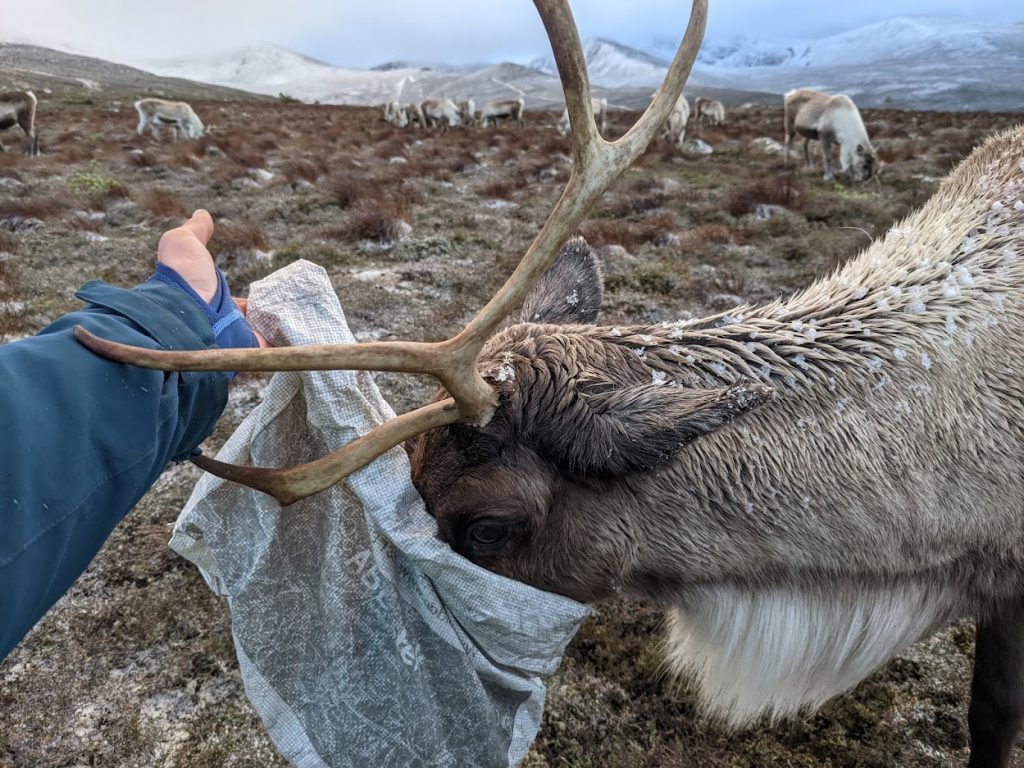
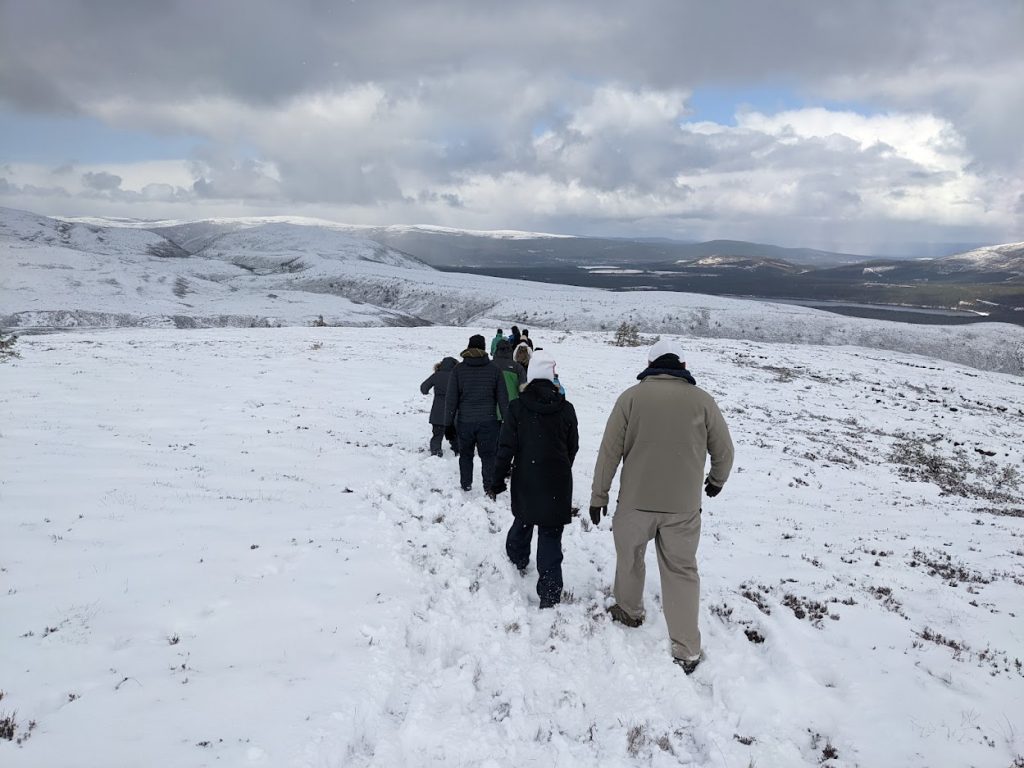
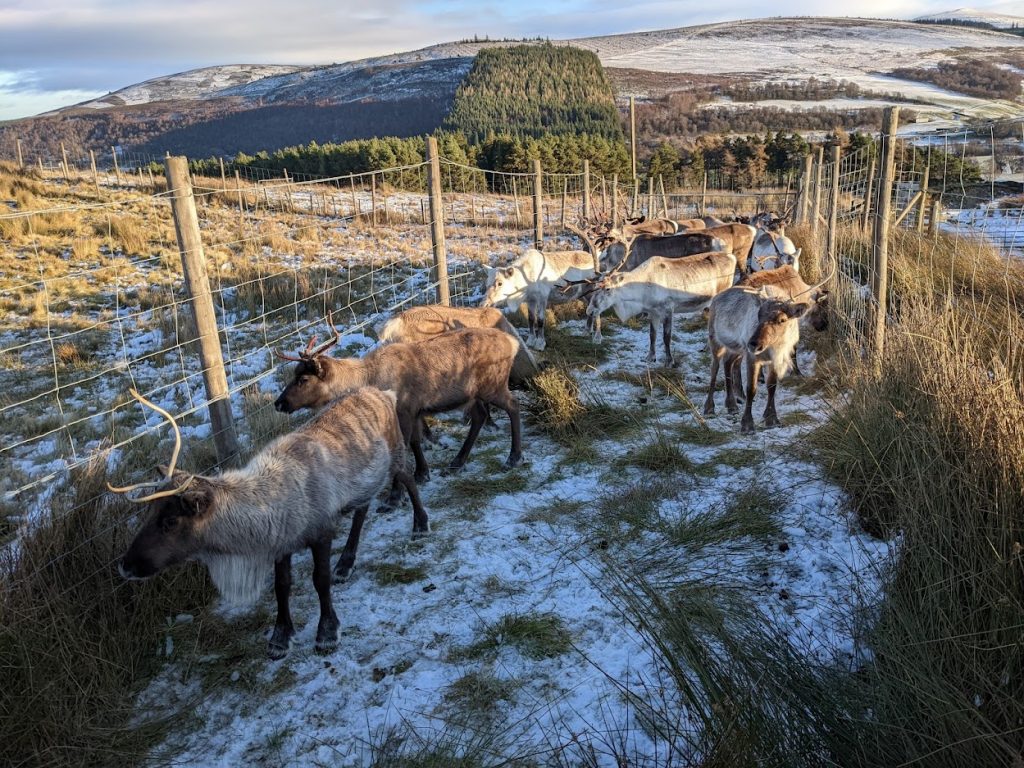
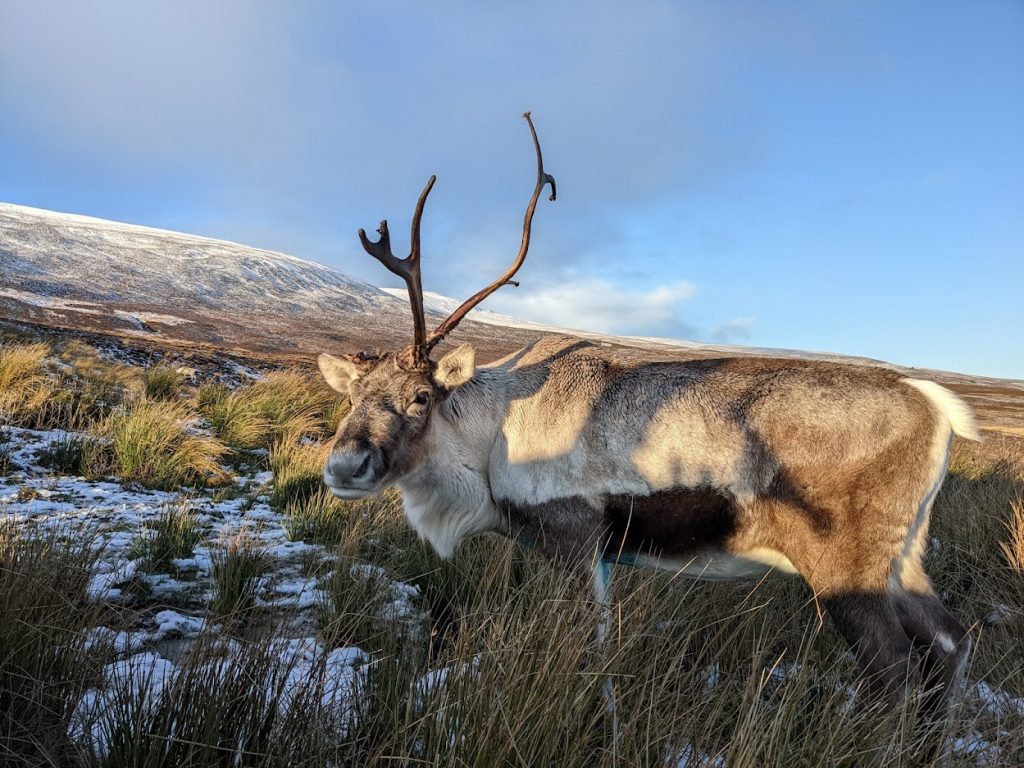
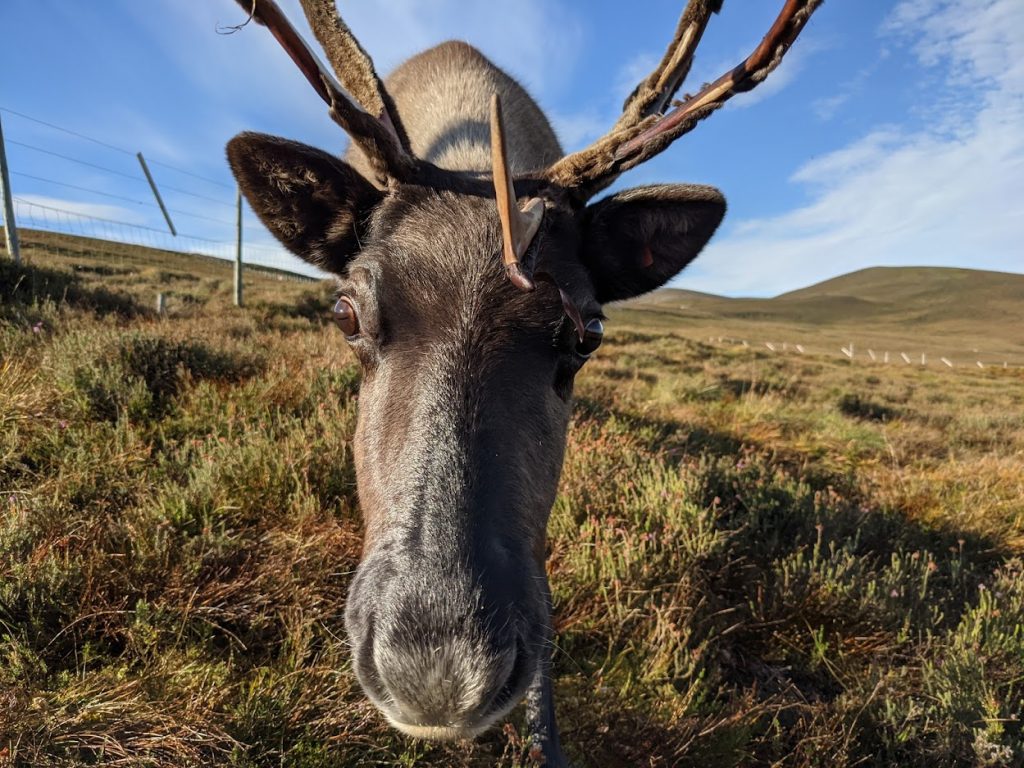
After sitting at the computer for what seemed like an age trying to think of a topic for a blog which could include lots of reindeer pictures, I finally stumbled across one which means you guys get to look at numerous pictures of reindeer bottoms!
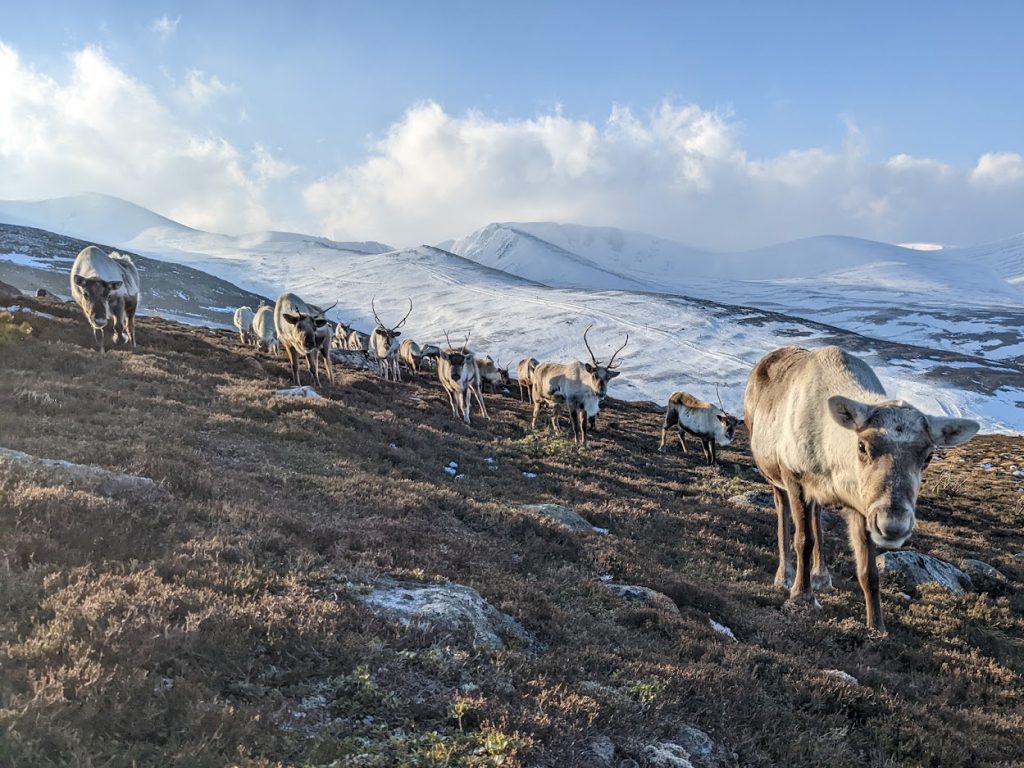
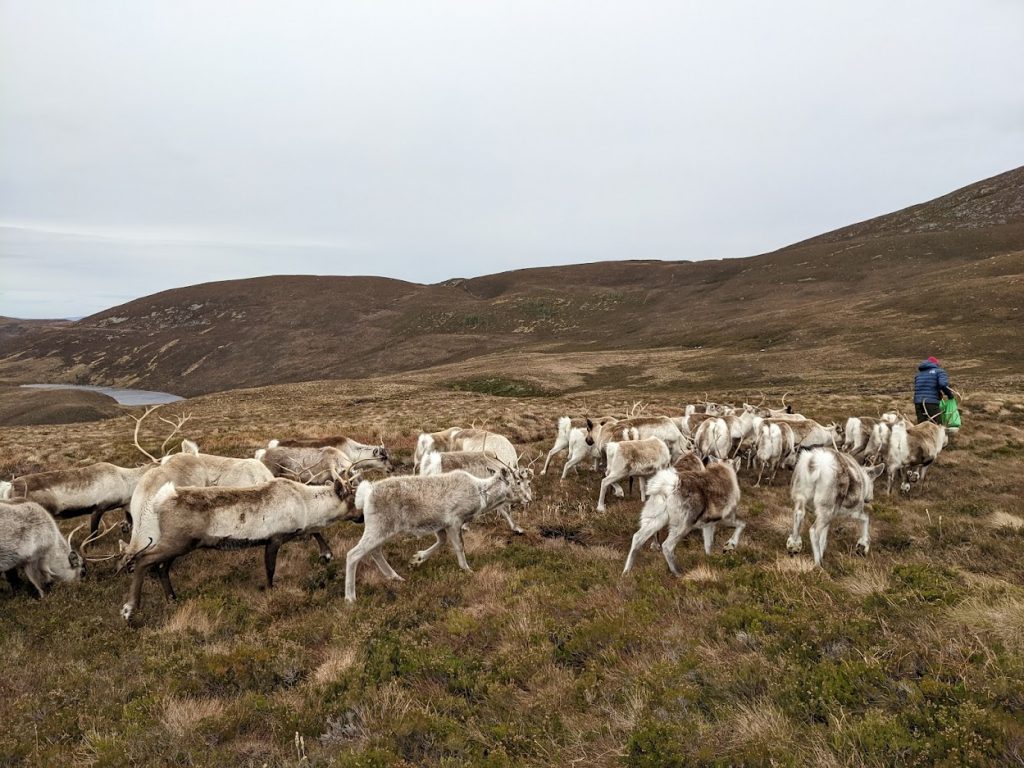
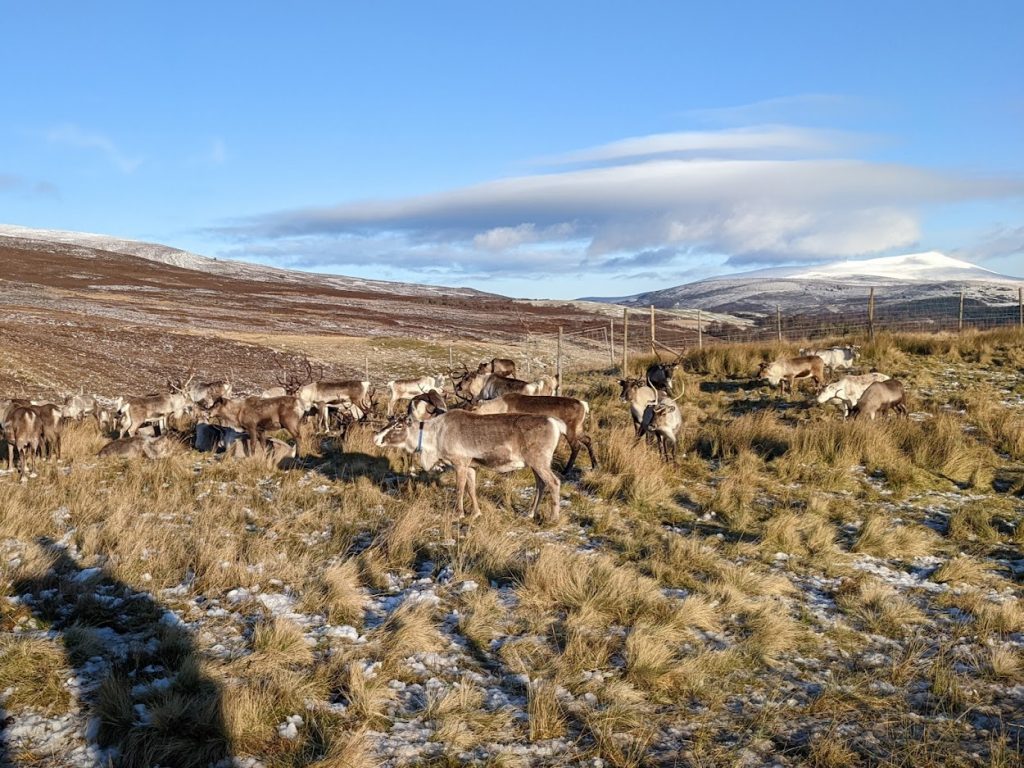
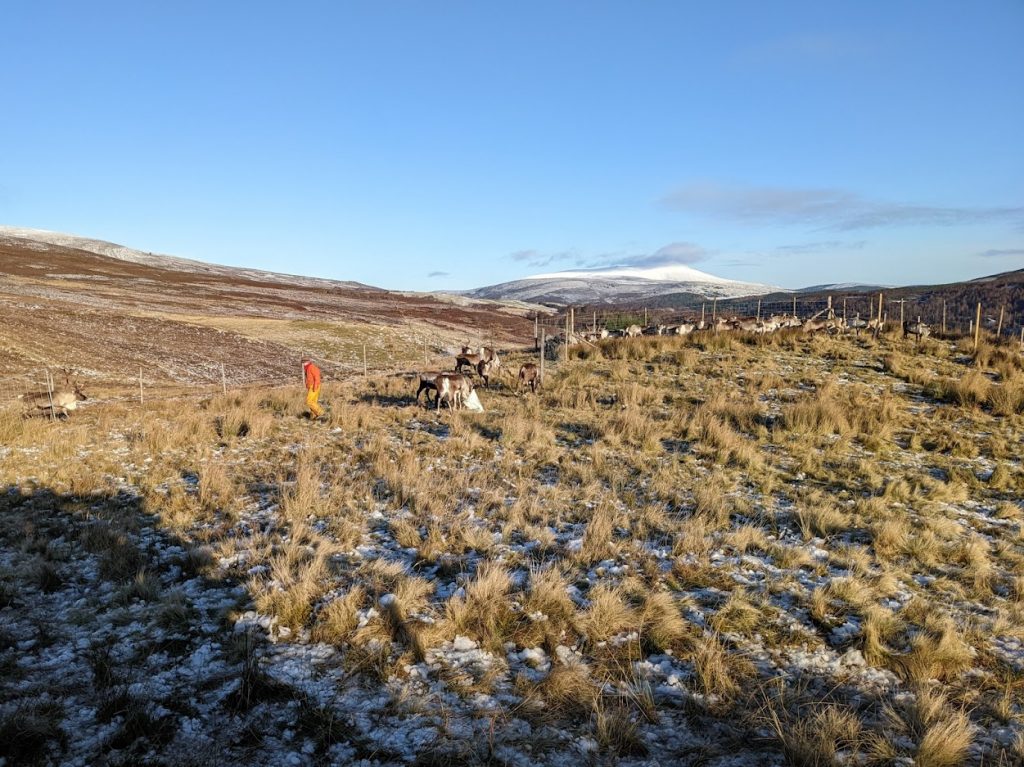
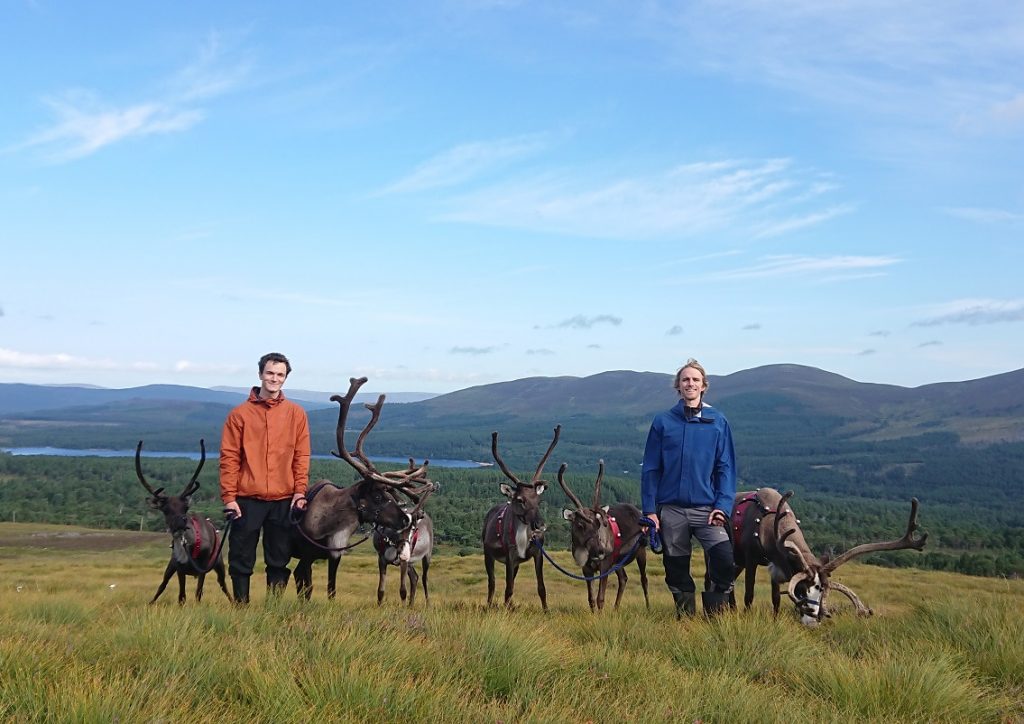
“Acting sheepdog” is a term us herders use when we are trying to manoeuvre the reindeer. Depending on how willing the reindeer are we might only need one person to call and bribe them with food to a new position or if the reindeer are more reluctant two of us can go out with one leading the herd and the other staying behind the herd making sure that they do not stray off in the wrong direction, because once one reindeer wanders off in a different direction they all can go! We can also use this sheepdog technique to our advantage when the reindeer are lethargic and don’t feel like moving far. All we must do is put a head collar on a friendly individual that we know is a pro at leading and the rest of the herd aren’t long in following.
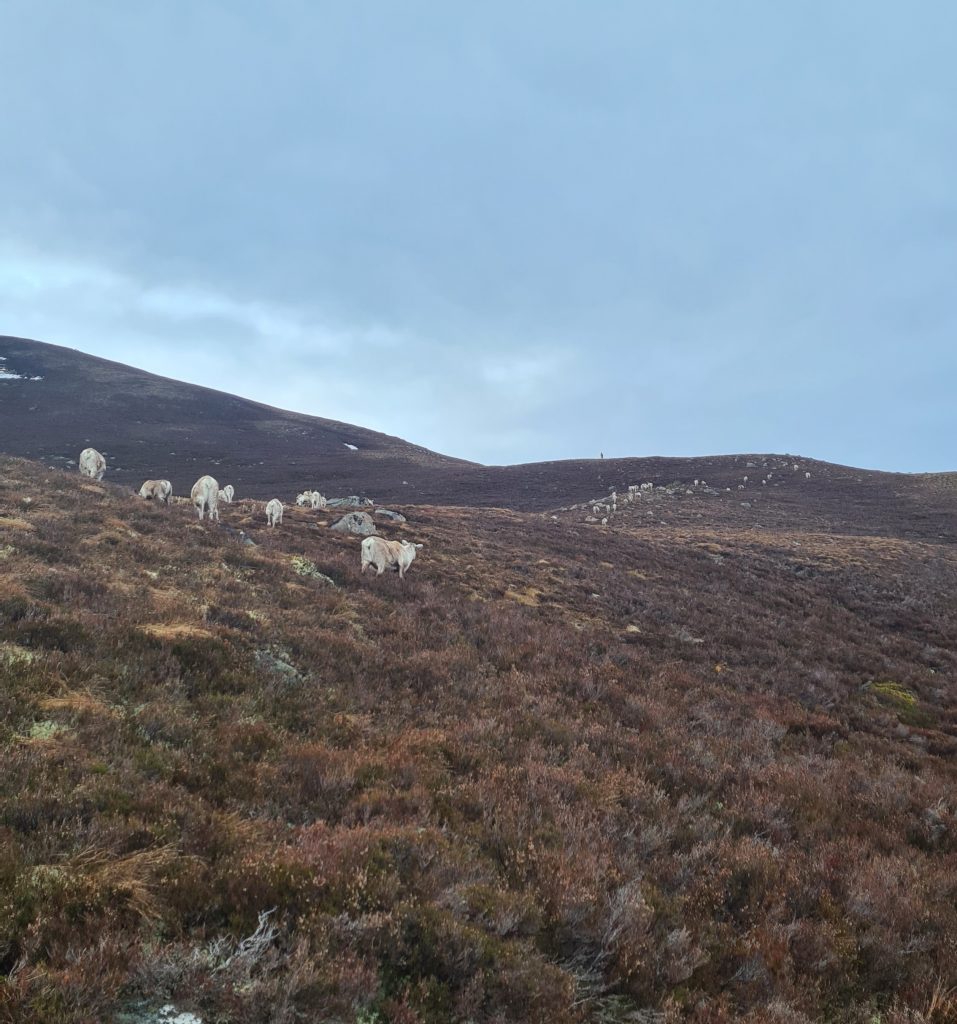
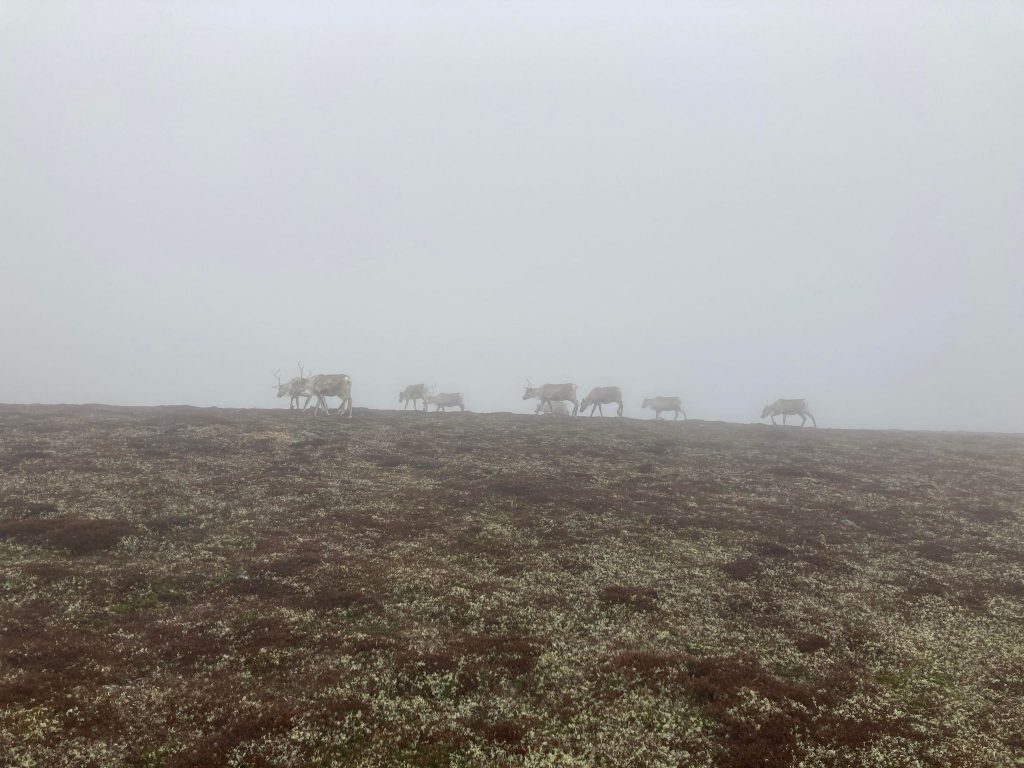
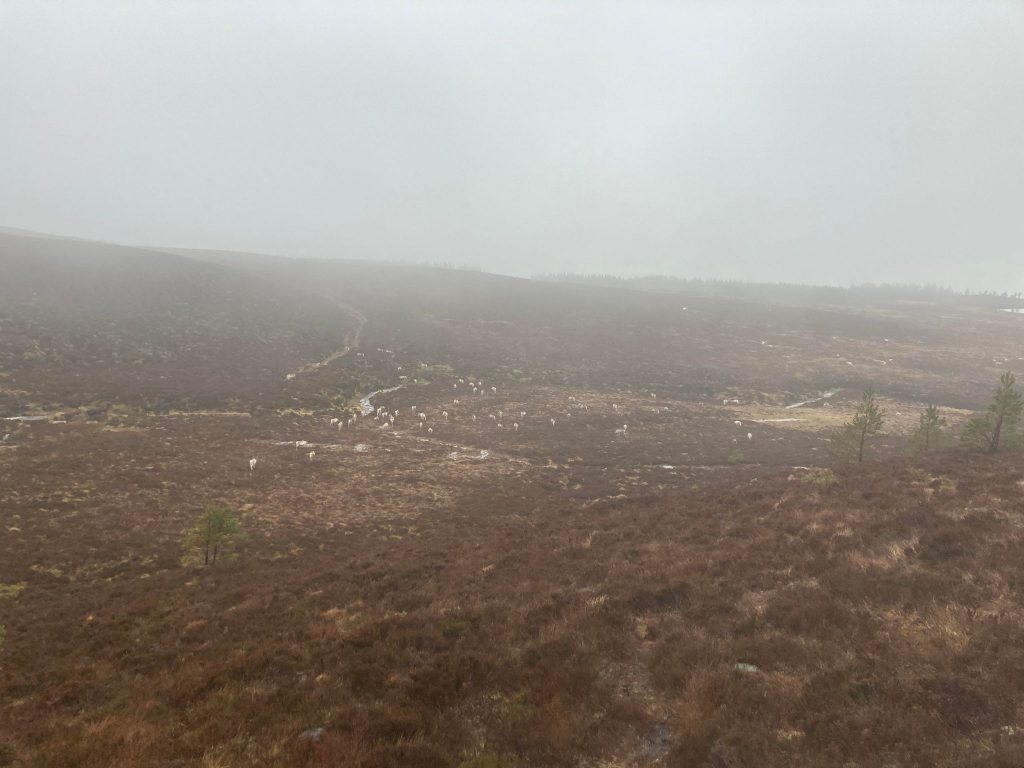
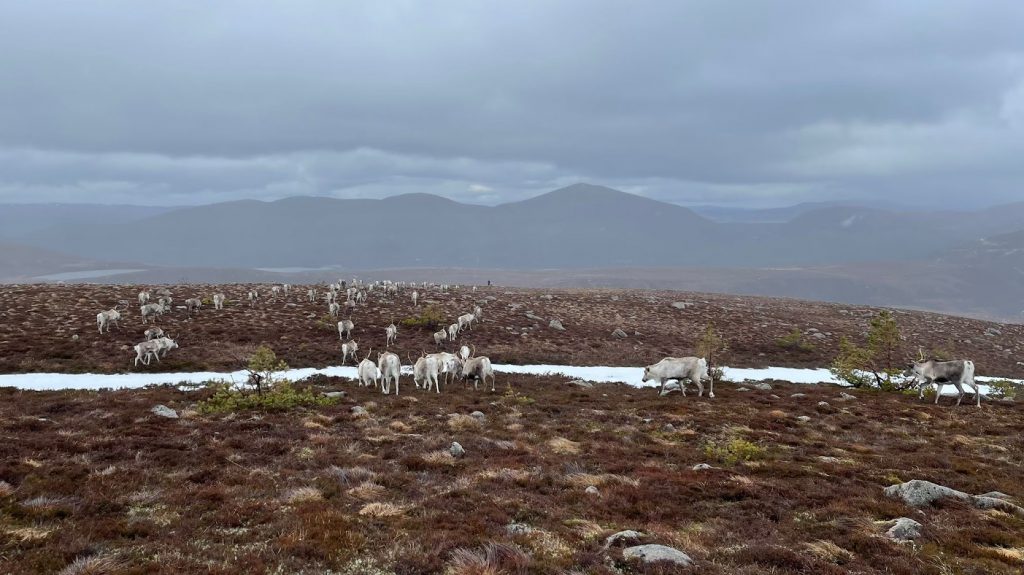
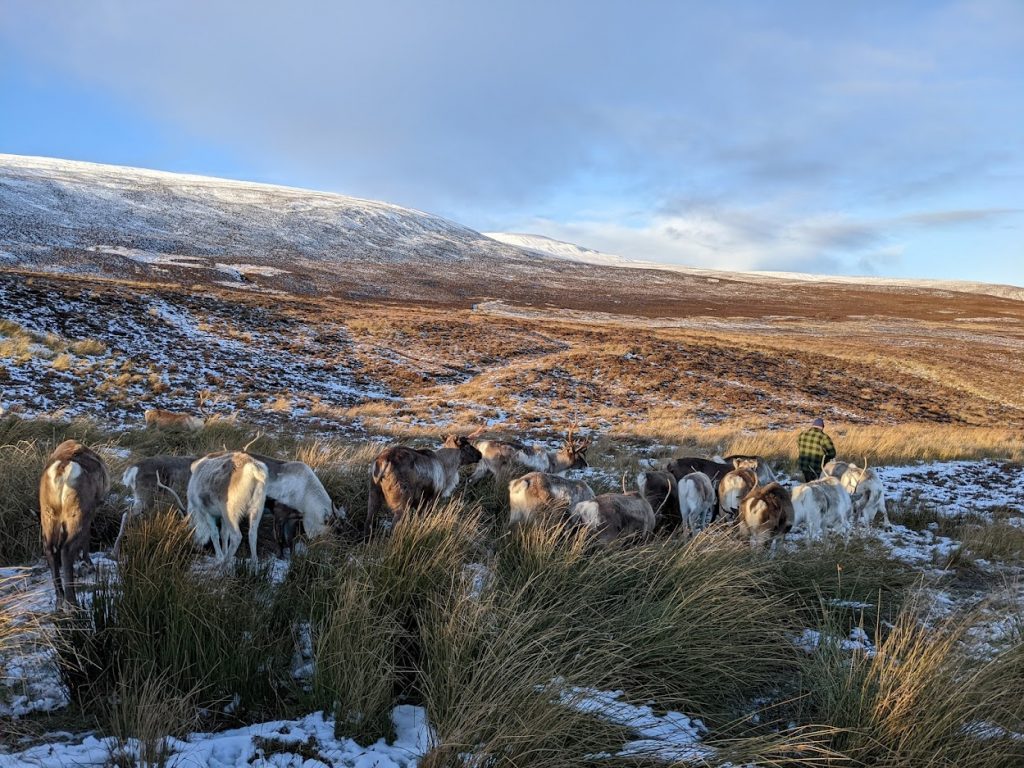
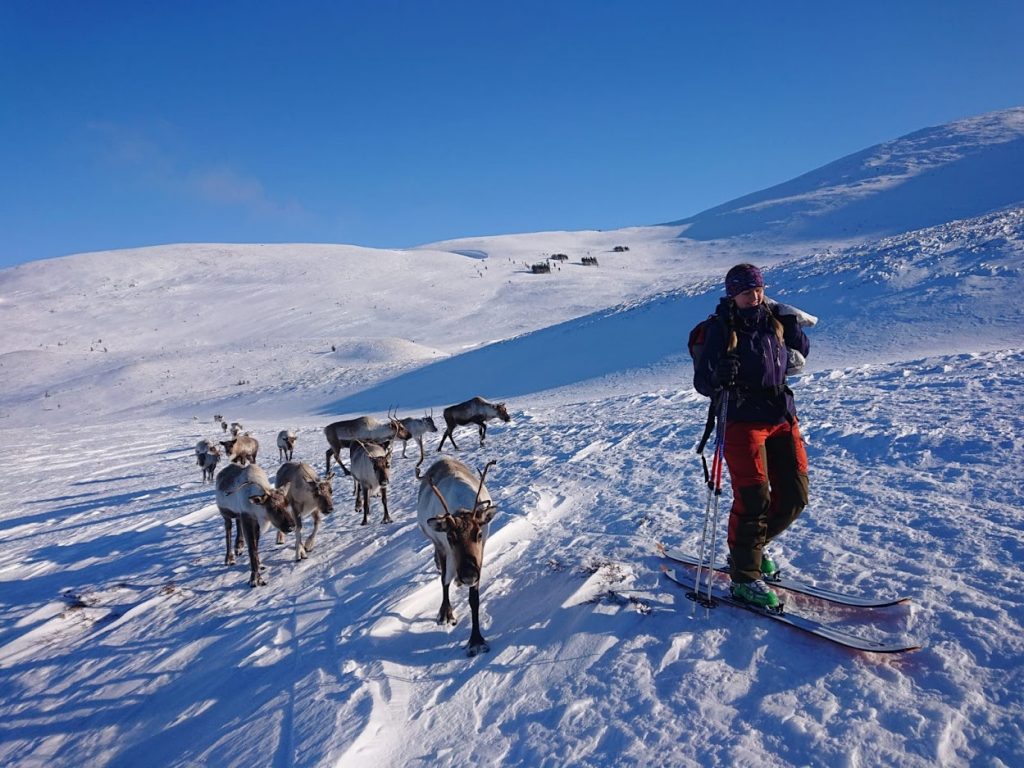
Lotti (just visible on the skyline) leading the herd.
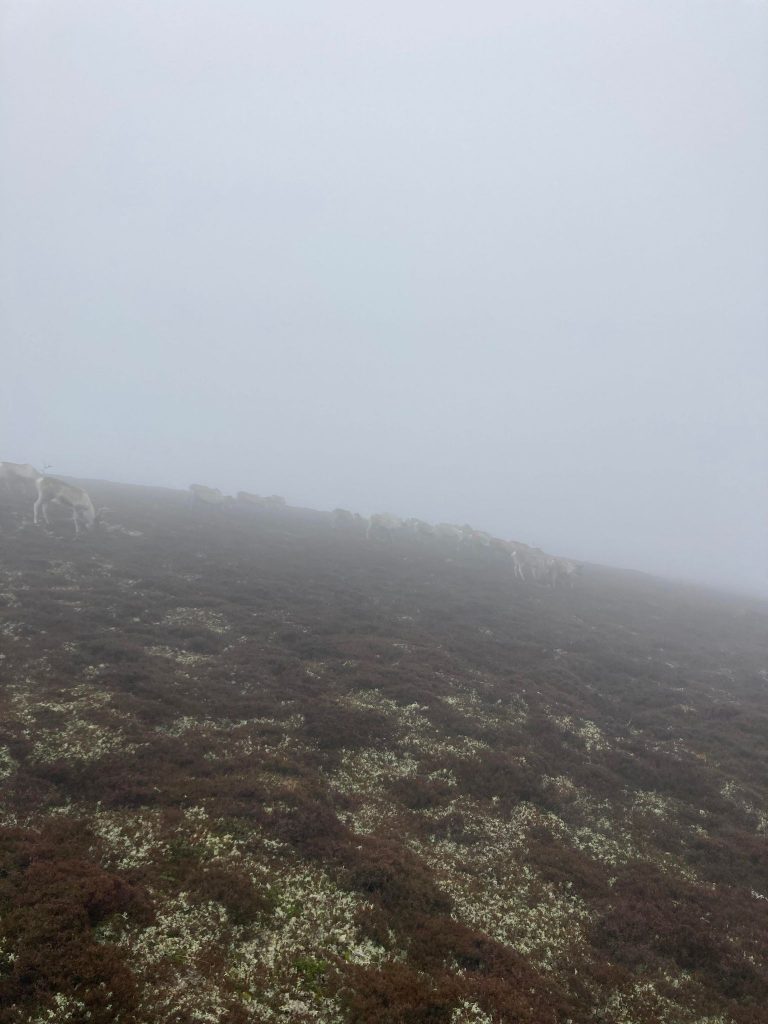
My preference out of the two roles is to be at the back of the herd, in this position your job can either be a breeze or you’re racking up your daily miles trying to ensure the reindeer stay on the right path! The picture above was from a day where the reindeer were not playing ball and Lotti had to put one of the girls on a head collar and lead the herd to our destination, however once we got to the top of the hill at the left-hand side of the picture, the herd found a good lichen spot, so I had my work cut out trying to move them again. This leads me on to my first reason for liking being at the back of the herd and “acting sheepdog”, which is that it gives you a good chance to take lots of photos! Below is a picture of Witch wondering why I’m so red in the face.
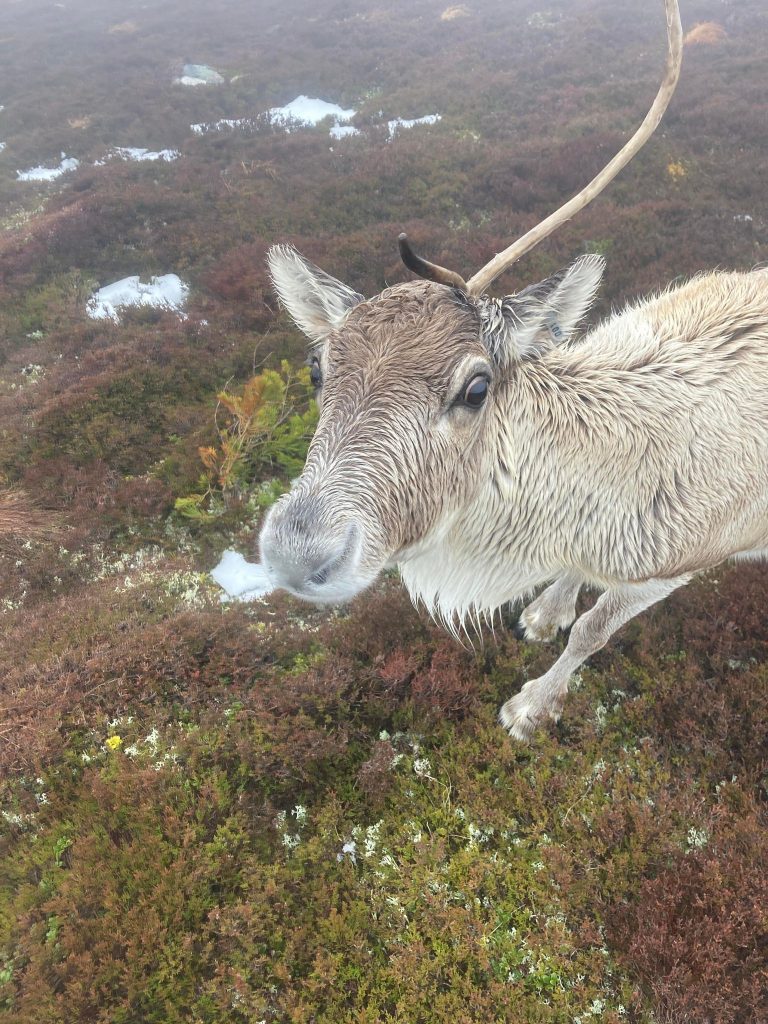
The girls munching lichen when they should be marching! Witch, stopping to see what I’m up to.
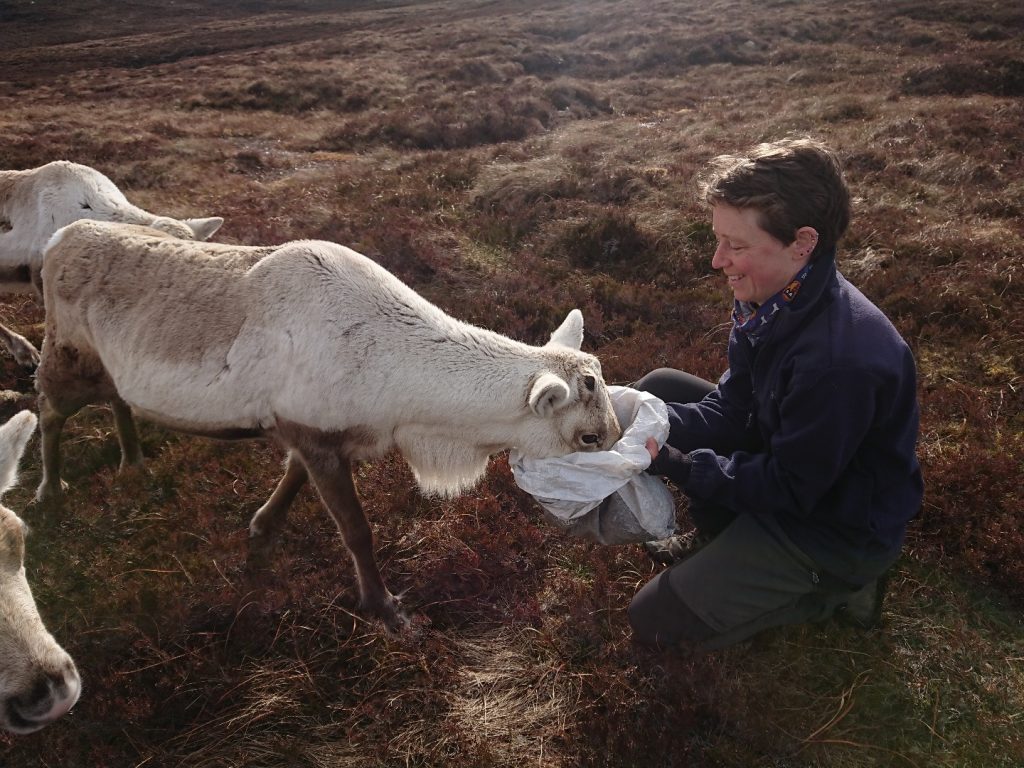
Being relatively new to the job I find that walking along behind the herd gives me a chance to look at and notice what defining characteristics each reindeer has, for example, Witch on the left here has the typical reindeer colouring but I find her easy to distinguish as she has quite a narrow face. It also gives you a chance to see how the reindeer behave around one another – who’s a “bossy boots” or who is more timid in nature and sticks to the outskirts of the herd. My final reason for preferring to be at the back of the herd is because currently my navigational skills are rubbish and on cloudy days when you can’t really see where you are going I don’t want to be responsible for getting myself lost as well as a herd of reindeer! [Editor’s note: Amy’s nav skills are better than she thinks!].
The eagle-eyed amongst you, or those who have followed us on social media for a long time, might have noticed a reindeer named Sika popping up on our pages once or twice in the last few months, having never heard of her before. So where has she come from? Is she ‘new’?!
Sika in 2016
In fact, she’s not remotely new – actually she’s rather old. Sika was born in 2008 and has been here her whole life, but this winter there’s been a bit of a turnaround in her character, which has taken all of us rather by surprise. Let me explain…
In 2008 we named our calves after ‘horned and antlered animal species’, and the name we picked for Malawi’s wee female calf was Impala. But time passed and Malawi and Impala weren’t seen for ages, and whilst winter crept on and all the other calves came into the hill enclosure and got used to being handled and were halter-trained, there was still no sign of the two. Eventually, Malawi showed up but she was alone, with no sign on Impala. Frustrated, we wrote off Impala as one of the losses that year – not every calf makes it to adulthood sadly.
And then in January 2009, a report reached us of a reindeer calf alone at the far end of the Kincardine hills, at the edge of the Cairngorms but not in a spot that reindeer normally stray to. Off we went to investigate, and there was a wee calf – alone and very shy. Eventually she was captured with the aid of some makeshift fencing and a small group of tame adult reindeer acting as decoys – but who was she? Process of elimination led us to realise she must be Impala, separated from Malawi accidentally at some point and then lost by herself in an area she didn’t know. But as we had had to ‘seek her’ (geddit?), and the name Sika hadn’t been used in that year’s naming theme, ‘Impala’ fell by the wayside and ‘Sika’ joined the herd instead.
Sika in her younger days
Christmas is the time that our calves receive most of their formative handling, transforming from effectively wild animals to tame ones well used to being around people. But Sika had missed this window, and while we did initially halter-train her, she remained very wild still in character compared to others, and quickly became a reindeer that we didn’t even consider trying to put a halter on in adult life. She lived her life up on the Cairngorms, never being brought down to our Paddocks or moved across to our alternative winter grazing range as moving her just wasn’t an option. A ‘background’ reindeer – never noticed by visitors (and often barely by us!), just there in the herd but never really featuring much or making any great impact on any of our lives. She has never even had an adopter – one of the very few reindeer in the herd with this dubious accolade.
In the hill enclosure for the rut a couple of years back, with Caterpillar and Cottage following on
Over the years Sika produced a couple of calves, but in general we avoiding breeding her to some extent as breeding a wild streak into our herd is not ideal. Her calves, few and far between, also turned out rather shy too, although not as bad as Sika herself. The one anomaly was Bordeaux, her only female calf, who was born in 2019 and is an absolute sweetie! We have no idea really why she has turned out the way she has – she certainly didn’t get her trust in humans from her mum!
Bordeaux – Sika’s mini-me
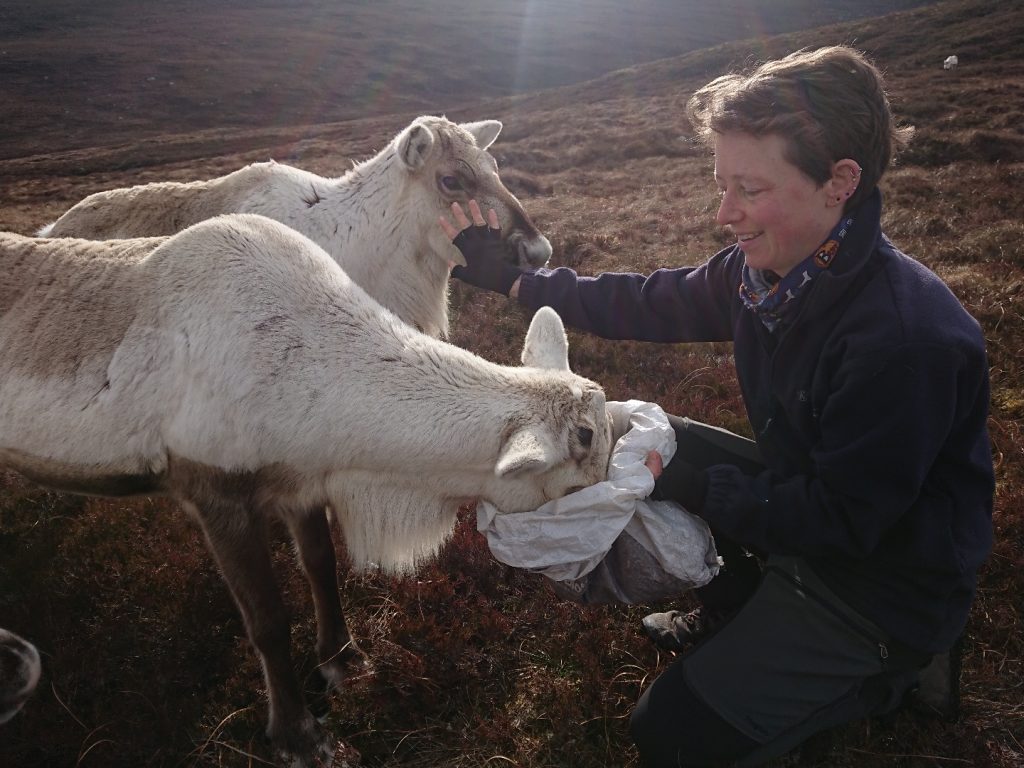
In the last 3 or 4 years we have put a lot more effort in to training our reindeer to come and put their heads into a feed bag and allowing us to touch them, in order to make it easier to catch and halter them when necessary. All winter when we’ve walked out to the herd first thing in the morning, before putting feed down on the ground for them we have wandered around the shyer reindeer, offering a bit of bribery in return for any positive behaviour towards us. For most reindeer this has worked wonders, and some characters that we could never have considered catching in the past (or at least whilst out in a large open space) are now easily won over – Inca, Suidhe and Roule have been our particular success stories! But as for Sika… she was a reindeer that would never really make eye contact but just turn away whenever a herder optimistically proffered a bag.
Looking beautiful, but always keeping her distance…
Fast forward to January 2022, and I snorted ‘Hmphh. Good luck!’ at Andi as she tried to catch Sika’s attention with the feed bag once again. But something was different. Just for a second she looked, before turning away again. Andi is like a dog with a bone in these situations, and I know I can push her to keep at something by telling her it isn’t worth bothering about (god bless you, reverse psychology) and sure enough she kept persisting. I almost fell over in surprise when, 5 minutes later, Sika had got to the point where she was stretching her neck out towards the feed bag, although not yet bold enough to put her nose right in it. This behaviour persisted from day to day until finally she snatched a mouthful… and a light-bulb went on somewhere in her little brain!
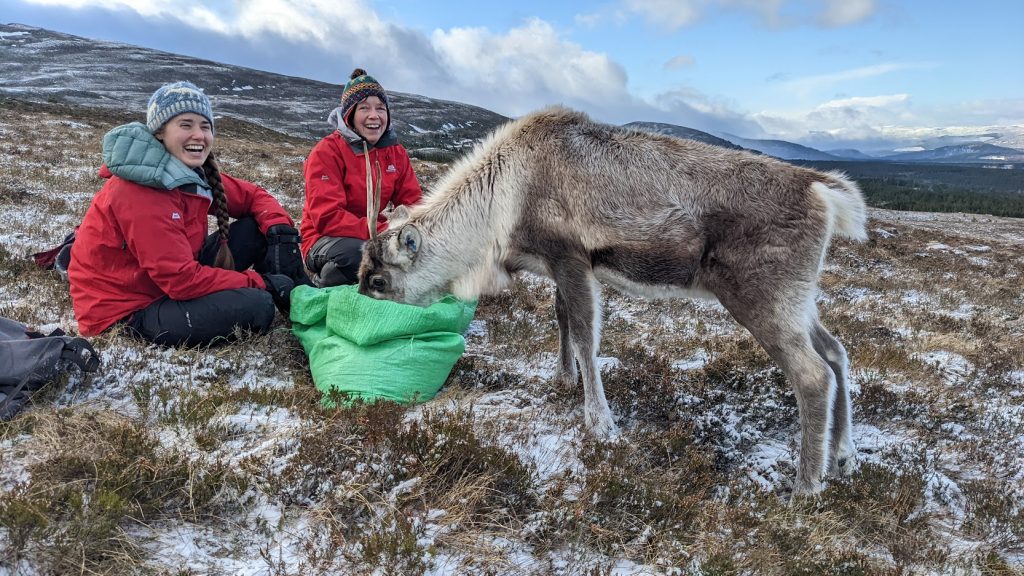
Success! Andi’s smile says it all 😀
Now, Sika is one of the first reindeer over to us each morning, actively hunting down the feed bag and keeping a close eye on it until she’s offered a wee extra nibble. I love to look around at the herd, patiently hanging around waiting for us, catch her eye and rustle the bag a tiny bit… and see that head lift a bit, her eyes widen and a lick of the lips in anticipation! All her attention is on us the whole time – so different from the years of ignoring, or even actively avoiding – us.
At the front of the herd and leading them in for feed, earlier this winter
She is still quite jumpy around us however, and is definitely not a reindeer we’re about to try and actually catch and put a halter on, but at 14 years old there’s no need to. We are just enjoying finally getting to know her after a lifetime of obscurity! I can’t express enough how surprised we all are to find out that Sika is actually a lovely character, after all these years…
Shy reindeer sometimes need defending whilst they grab a mouthful from the pushier members of the herd – ironically this intruder is Malawi, Sika’s mum! Malawi is now the oldest reindeer in the entire herd, at 17 years old, and of the opinion that any feed bag is presumably therefore all for her.
From when we close in January through until around the end of April, most of the reindeer here at Cairngorm will be out free-ranging. This is great for them as they get to roam wherever they please (mostly) and spend time in their natural habitat, where they are at their most comfortable. But it does mean that before every Hill Trip during this time, we must head up into the hills to find the herd.
Generally getting to the reindeer is a pretty simple process but getting them back to whichever site we are running the Hill Trip from can be more complicated – they don’t always want to follow us!
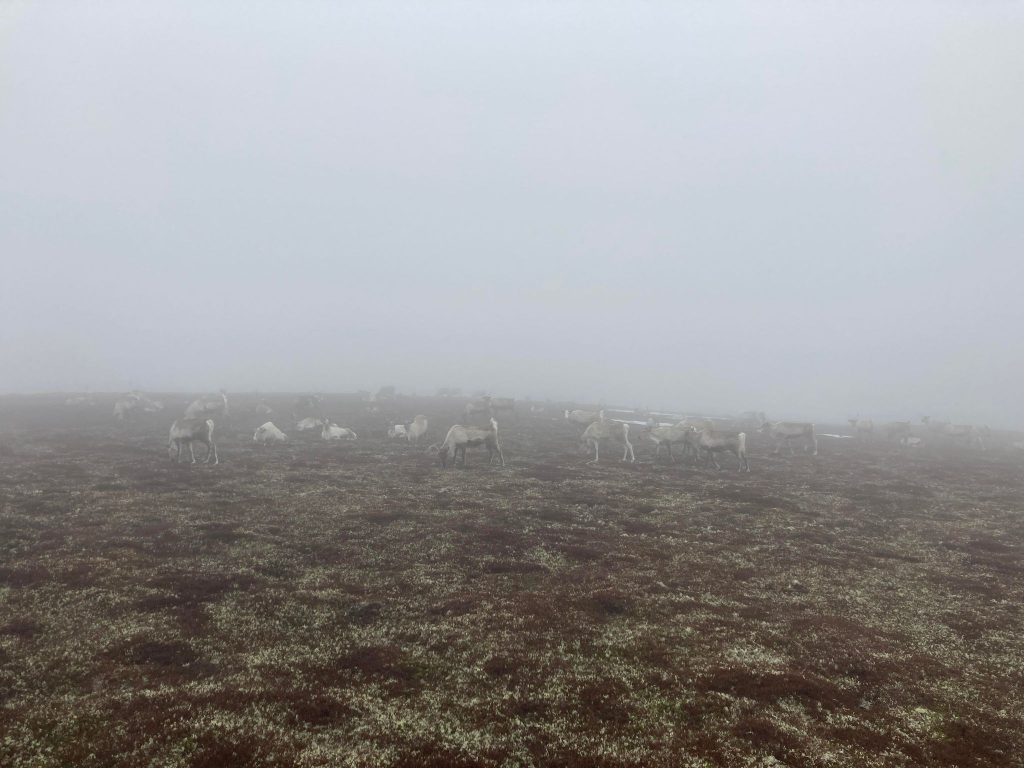
Around the beginning of April, we had a morning collecting reindeer that were a little more difficult than usual. The cloud was extremely low and thick, and they were in an area of the hills with almost no established paths, only a handful of trodden trails at best. It’s also not an area we go too all that much and there are very few proper landmarks to navigate by. All this is a way of saying that it was quite a difficult morning of reindeer herding!
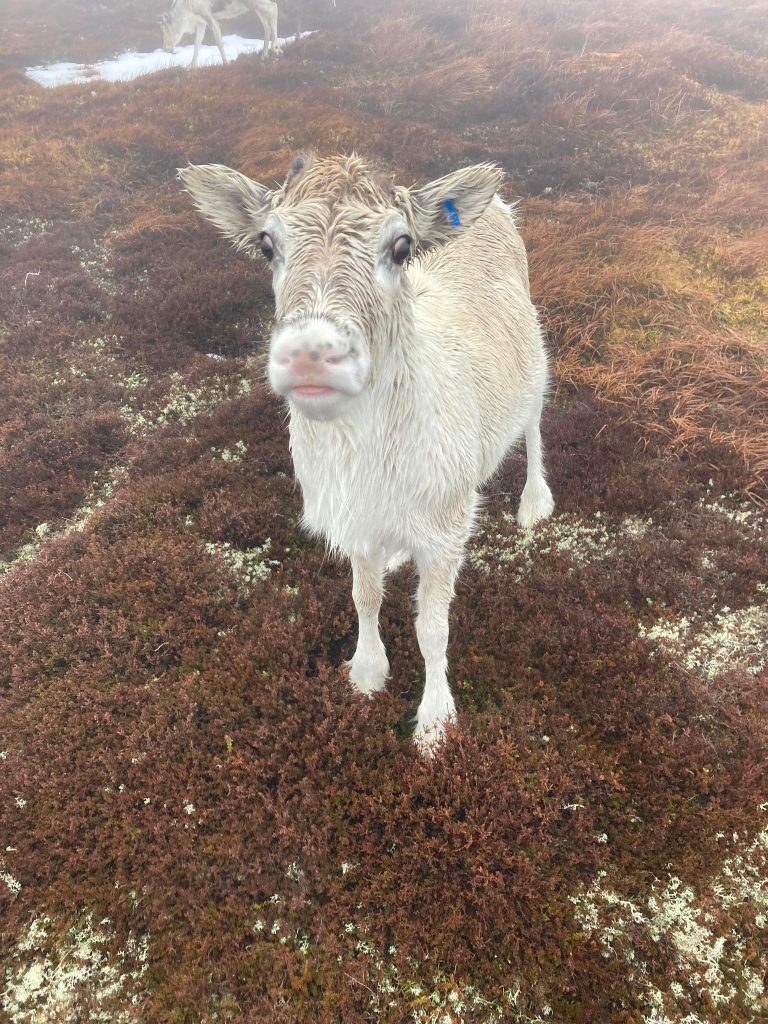
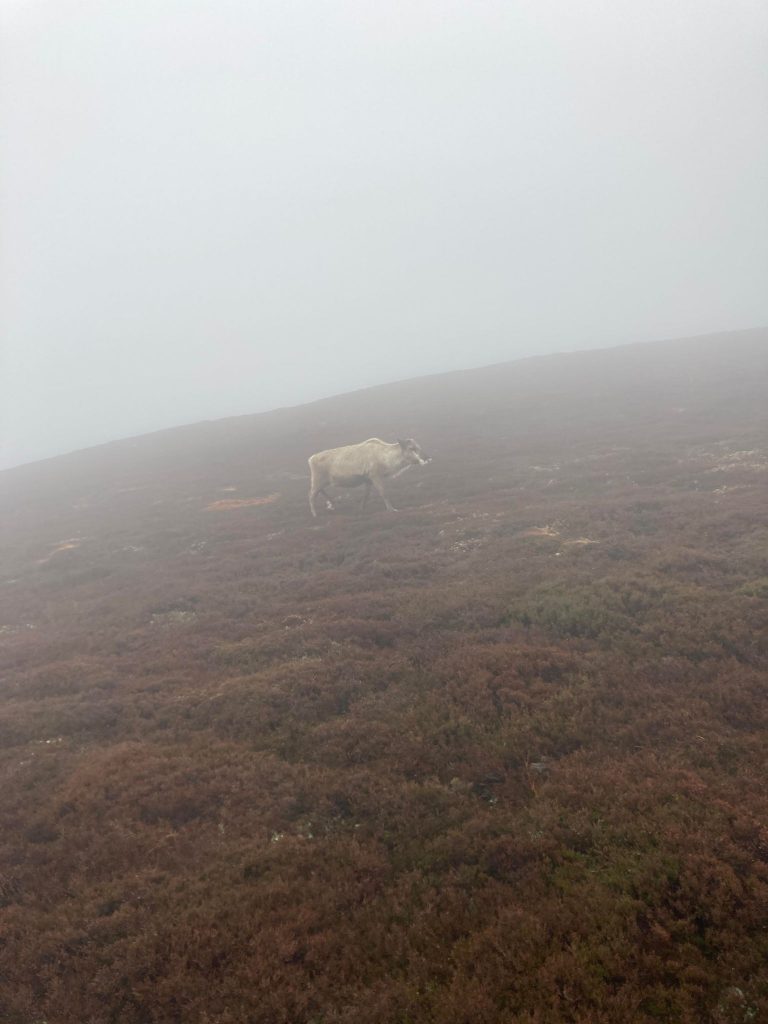
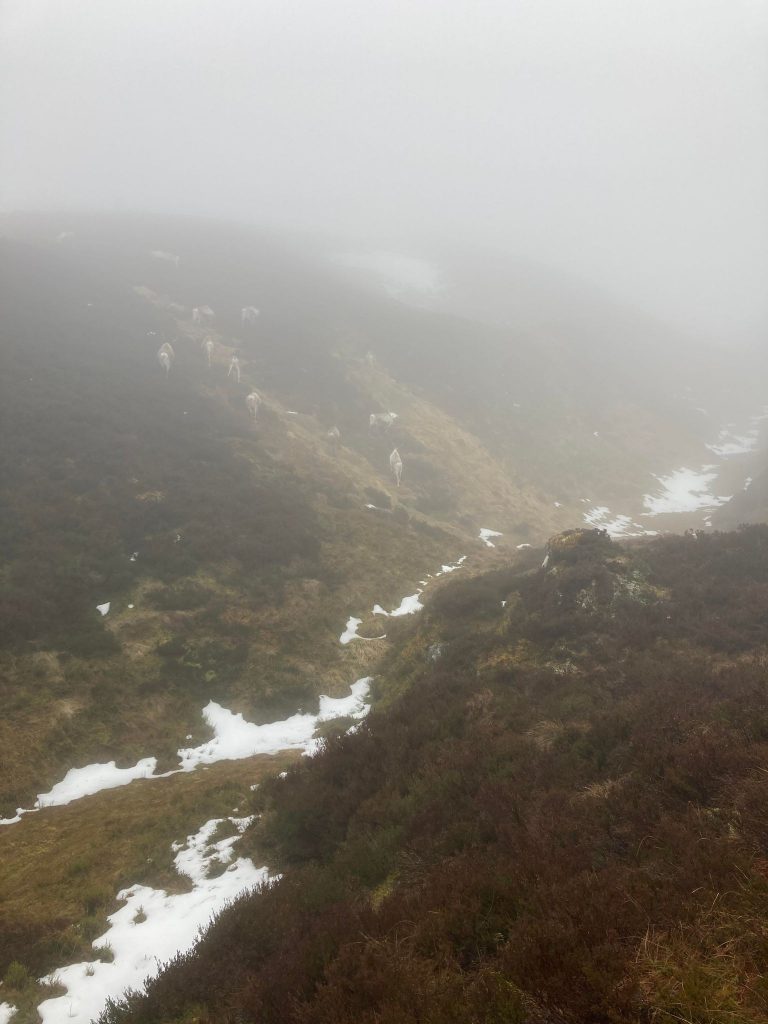
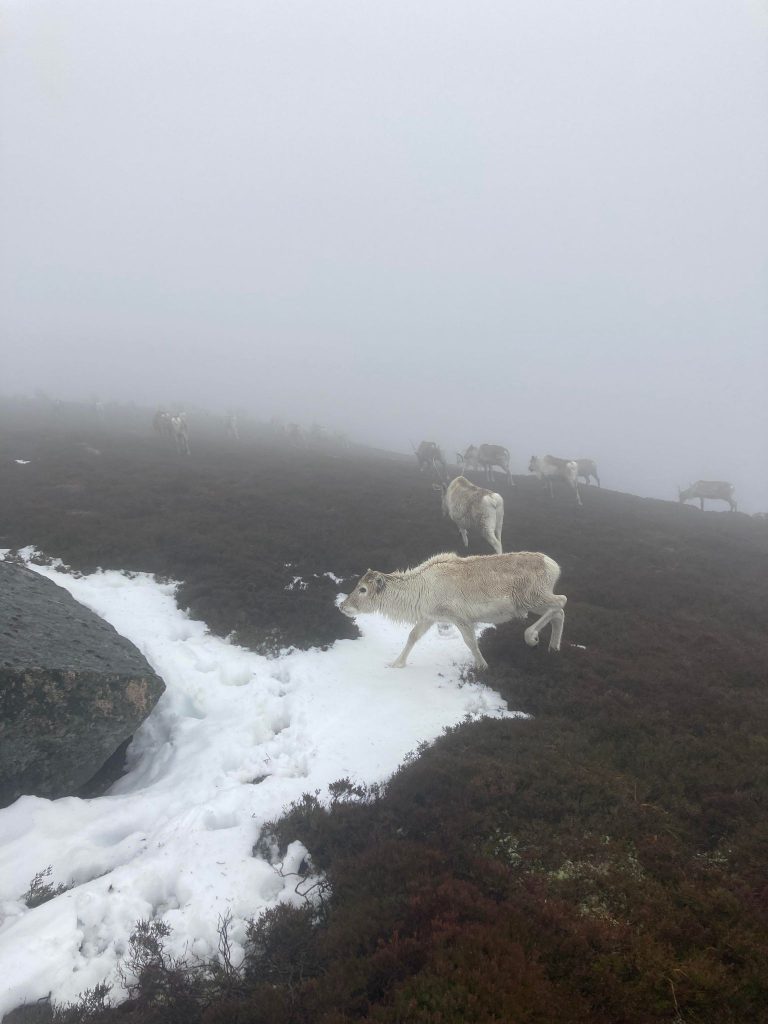
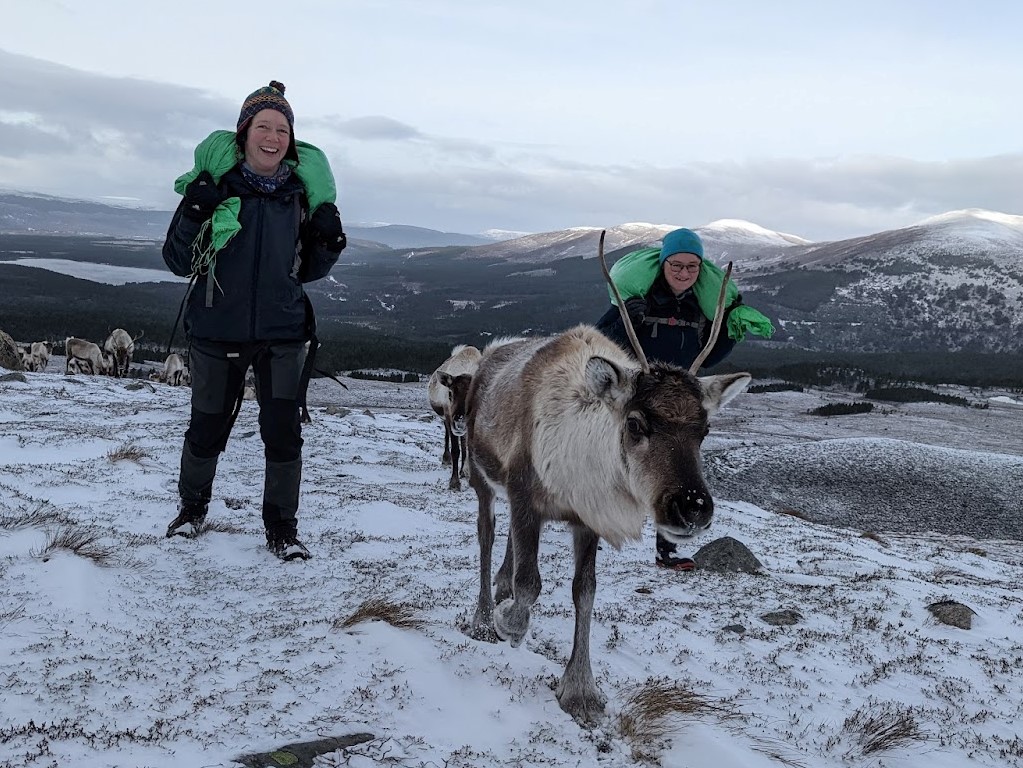
Me and Fiona had to split up to cover more ground once we reached the last GPS point, but luckily….….we stumbled right onto the reindeer!It took them a little while to notice that we’d arrived, but we soon got them up and moving.Very atmospheric, if a little worrying about losing sight of them all.I was on sheepdog duty at the back of the herd.Spot the reindeer!Very curious Beanie suddenly materialised – I think I gave her a fright coming out of the cloud. Look at that face!Beanie’s mum Gloriana hanging back a little more.The herd making their way through a gully on their way towards the Hill Trip location.Always interested, Beanie stops to check out some last remnants of snow.Another familiar face appears through the fog. Holy Moley!The home stretch, the herd crossing the final burn before reaching the site where we give them their breakfast before the morning Hill Trip.
During the Hill Trips us reindeer herders will often be asked questions such as “what will you do with the rest of your day?” or “is doing the Hill Trips the best part of the job?”
During the Hill Trips us reindeer herders will often be asked questions such as “what will you do with the rest of your day?”
In this week’s blog I will chronologically outline a ‘typical’ day for a reindeer herder. However, it is worth noting that it’s almost impossible to predict how a day may take shape. The job tends to be incredibly variable and diverse. There are time-dependent jobs that may suddenly arise, such as moving reindeer from where they’re not meant to be to. For example, when they venture down from the mountains on to the road. There are also plenty of seasonal-dependent jobs, such as gardening or leading additional hill trips in the summer months. Or in the winter months you may need to clear footpaths to keep them free from snow and ice. Not to mention the early starts that occasionally occur. These tend to be in the calving season or on the epic days when reindeer need to be moved across the Cairngorms. It’s possible that you could be helping Tilly over at Wild Farm as well, transporting reindeer from the farm to the Cairngorms and vice versa, or helping with the other animals there. The list of possibilities is vast.
Nonetheless, the skeleton of a ‘typical’ reindeer herding day is as follows:
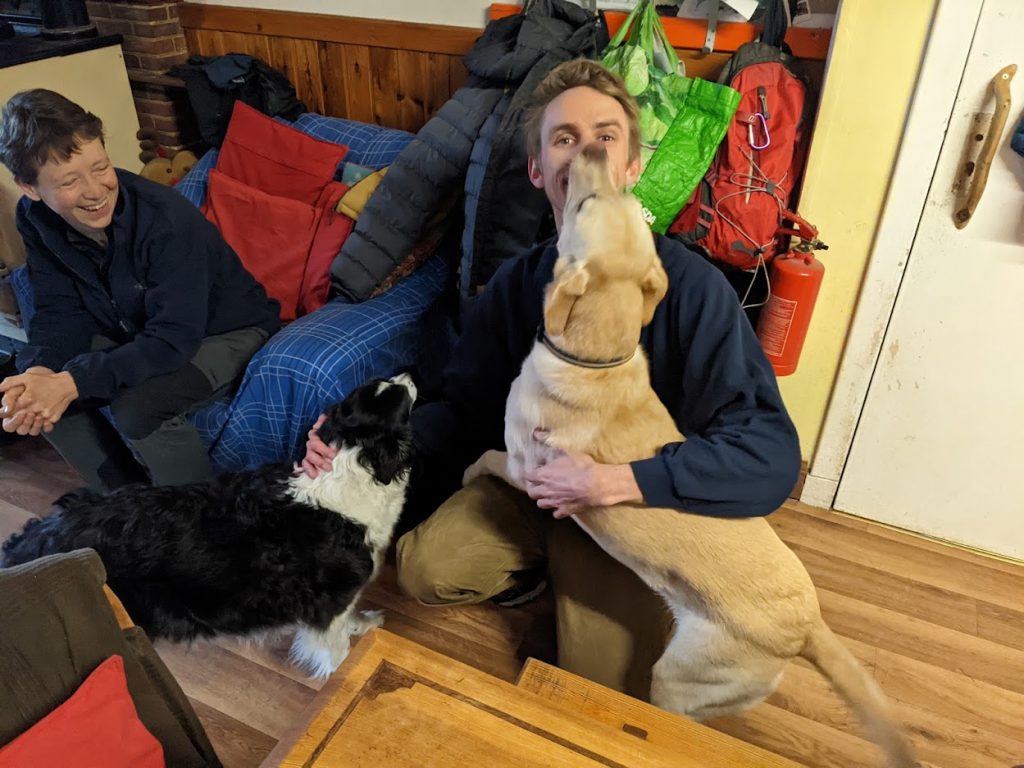
08:00 (summer) or 08:30 (winter): Work starts. Turn up and prepare to be greeted by the dogs.
How every morning starts – getting greeted by the dogs!
There typically may be anywhere between 4 and 7 herders working on a day, depending on the business of the season. Half of us will initially head up to feed the herd their breakfast whilst half of us will stay down at the Centre.
Those of us which stay down at the Centre will be responsible for feeding the paddock reindeer their breakfast, poo picking, cleaning the exhibition, answering emails and any phone calls, cleaning the shop and office, as well as opening the shop and checking in guests after 10am.
Flax lending a hand/hoof in the Paddocks.
The cohort of herders which head up the mountain to feed the herd will initially have to locate the herd. The difficulty of which can depend on weather conditions and whether the reindeer are free-roaming or in the hill enclosure. As I write this – at the end of February 2022 – it took Andi and I three hours to venture out in the snow to where the reindeer were located and then lead them closer to where the 11am hill trip would be.
Moving the free-range herd to a suitable location for a Hill Trip.
It is at this point in the day which we’re most likely to check the temperature of a reindeer – if we suspect illness – and administer any appropriate treatment. Before the morning feed is put down in a straight line (easier to count) with spaces of approximately 1m in between each pile (to try to stop fighting) there may be a spot of preferential feeding. The young calves are encouraged to come and feed out of the bags whilst one herder will circulate around the herd enticing the less tame reindeer to hand-feed. This preferential feeding is very important for the management of reindeer when they become ill. Catching reindeer can be a long ordeal but it’s important if a reindeer is ill that we can get close enough to help them, so by enticing them into the smaller hand-food bag throughout the year they hopefully won’t always associate the food bag with feeling rubbish. The preferential feeding also allows the young, growing calves to get a bit of extra food from the main bag as they are likely to be lower in the pecking order when it comes to feeding from the line and can get the sustenance they need to continue growing.
Morning feed – Joe putting out a long line of food ready to count the herd.Routine temperature checks are often done in the morning, before our visitors arrive. Note Andi armed with the thermometer!Preferential feeding – making sure the calves get some extra food!Lotti offering the white bag of tasty snacks to our shyer reindeer.Dixie getting some preferential feeding. Definitely not a shy girl, but at almost 16 she deserves spoiling!
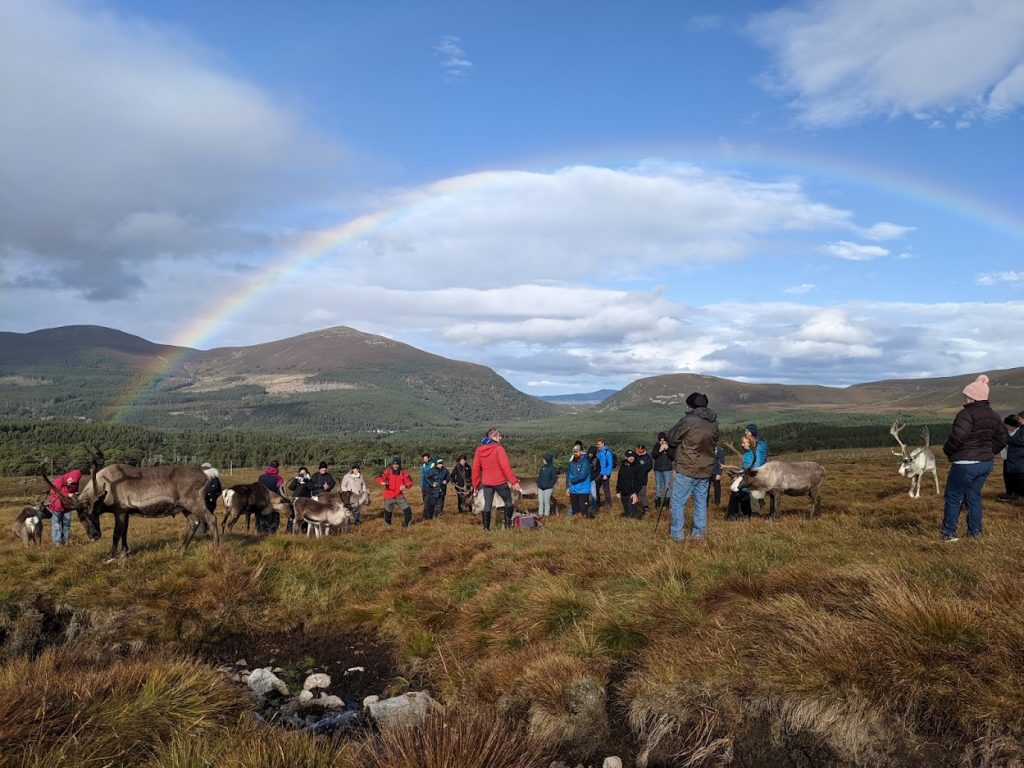
11:00: Hill Trip. This is the time when some of our herders are let loose to come and meet yourselves and serenade you with some interesting reindeer-related facts and some terrible reindeer-related jokes. This typically lasts for an hour and a half to two hours, depending on the weather.
Heading out to meet the reindeer on a free-range Hill Trip.
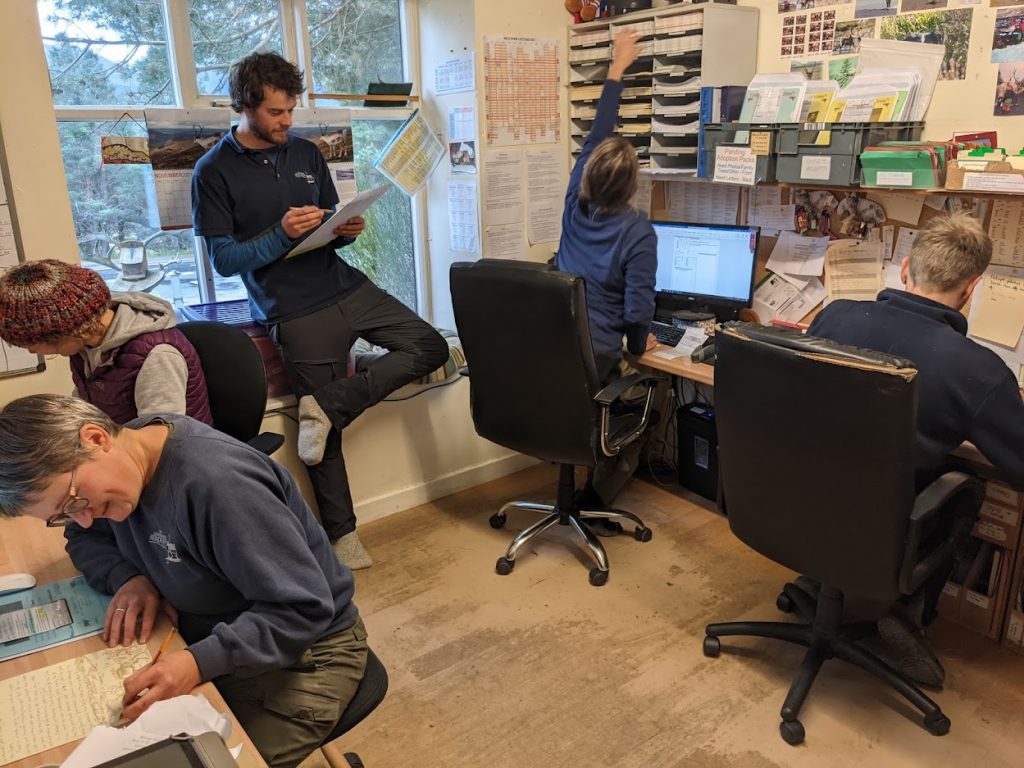
Those herders that don’t participate in the hill trip will be responsible for staying at the Centre and minding the shop, dealing with phone calls and emails, compiling adoption packs for our loyal adopters, mixing reindeer food or even, writing blogs.
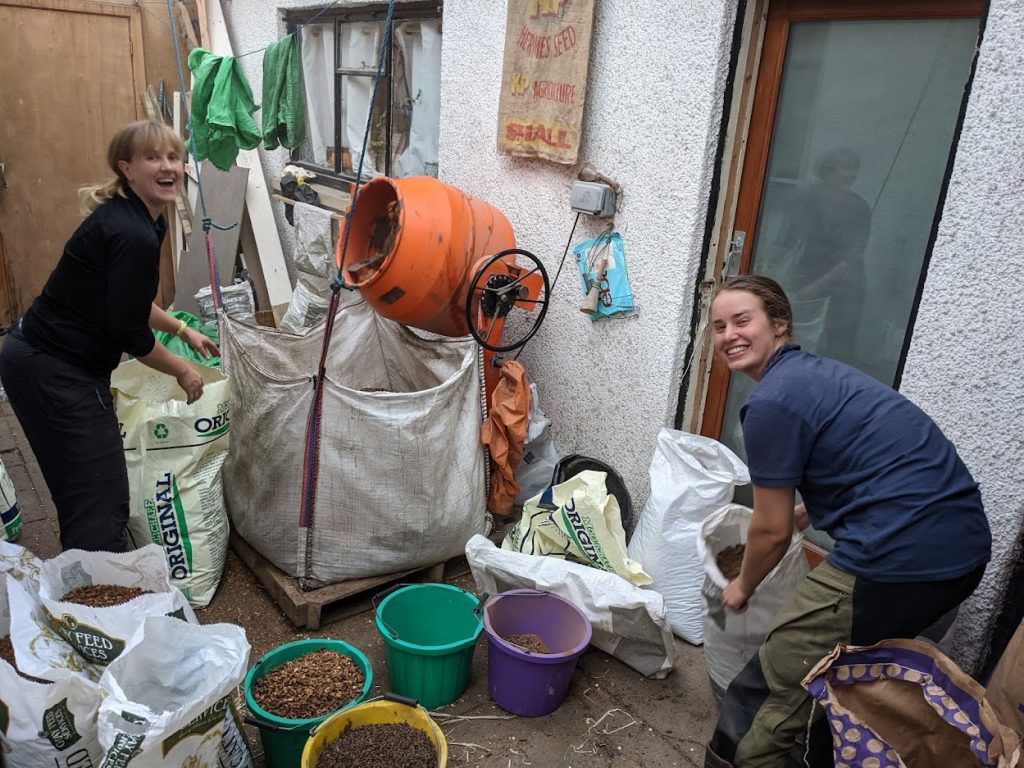
A full office – renewals, letting writing, emails, writing the daily diary, generally looking busy… Fiona and Lotti doing a mammoth food mix!
12:30 – 2: The herders stagger their lunches to ensure someone is always free to mind the shop. Shop visitors can often be caught commenting on the lovely smells coming from the kitchen.
The afternoon: Whilst the morning of a reindeer herder is fairly constant and predictable year-round, the afternoon can vary depending upon the time of year. From May to September there is an additional hill trip at 2:30. During these months the hill trips take place in our hill enclosure so the chance of seeing reindeer is almost definite, and the walk out to see them is shorter and less exposed to the elements. The reindeer herding day generally runs to 5pm, although in July and August we run a third daily tour at 3:30. So for a couple of months the day runs until 5:30.
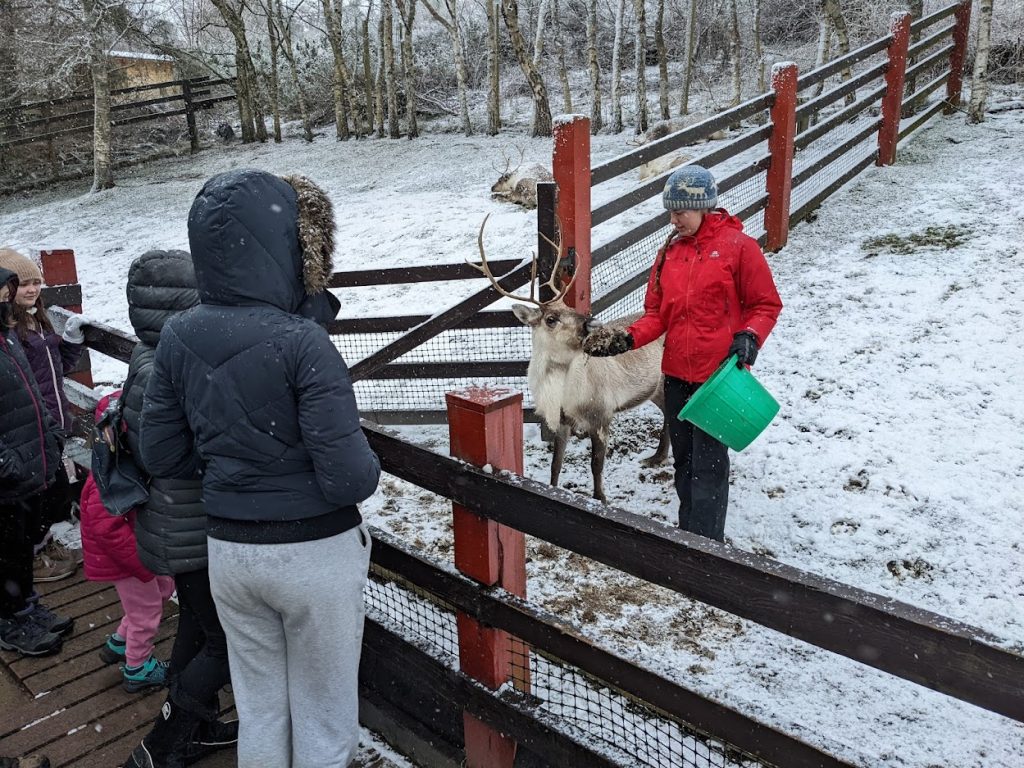
Recently, we’ve also started been doing ‘Seasonal Herder Talks’ during the school holidays. This means throughout the afternoon one of the reindeer herders will be out in the paddocks talking to visitors about the reindeer and answering any questions.
“Winter Herder Talks” were trialed this February half-term – here’s Lotti with Marple.
Close: At about 4:45 the herders will start to perform the closing dance. This involves one of us cashing up the totals from the shop whilst another herder will head out to the woods located behind the paddock area and put food out for the paddock reindeer. Just before 5 o’clock the reindeer will be let through to the woods area whilst the herder closes and wipes down the exhibition area. The shop will also be shut and wiped down at 5pm. You can always tell it’s 5 o’clock as the dogs begin to stir. They become more energetic and boisterous as they realise the working day is ending and there is now a high chance of them heading out on a walk or run with at least one herder.
Approximately half of the reindeer herders live on-site at the Centre, whilst half of us journey in from the local area. Having some staff on-site means that on the very rare occasion where there is a reindeer emergency after hours, there is staff that can stick their capes on and come to the rescue.
After the busy Christmas season the entire reindeer herd free-range, either here on the Cairngorms or on the second site over near Glenlivet. The staff working at the Reindeer Centre take care and deal with any reindeer related antics on the Cairngorms. Meanwhile the reindeer free-ranging on the second site are looked after predominantly by Tilly and the farm crew.
On the days when Tilly needs an extra pair of hands, the shout goes out and one of us herders drive around the hills to help out, never quite knowing what the day will involve until we’re there! I answered the call to help in early January, and what a great day I had! By the time I arrived Tilly had already been out to call in the reindeer. Thankfully reindeer are ruled by their stomachs, so the offer of a free meal was too tempting as Tilly had successfully managed to call almost all of the herd into the corral. Little did they know it happened to be routine temperature checking day…!
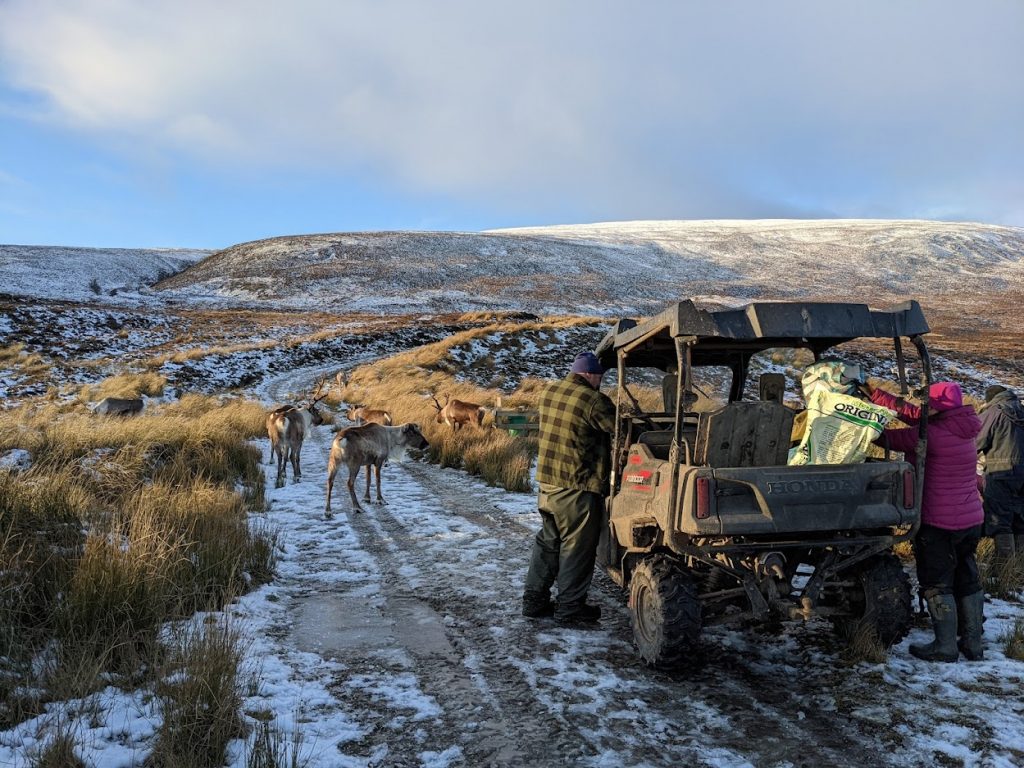
After a quick de-tour to help feed the pigs, five of us headed on to the hills on quad bikes. Tilly, Colin S, volunteers Davey and Christine, plus myself. The small number of reindeer who hadn’t come to Tilly’s earlier call, clearly decided they were missing out as they were waiting for us when we arrived.
Reindeer waiting in the corral after Tilly had called them down earlier that morning.
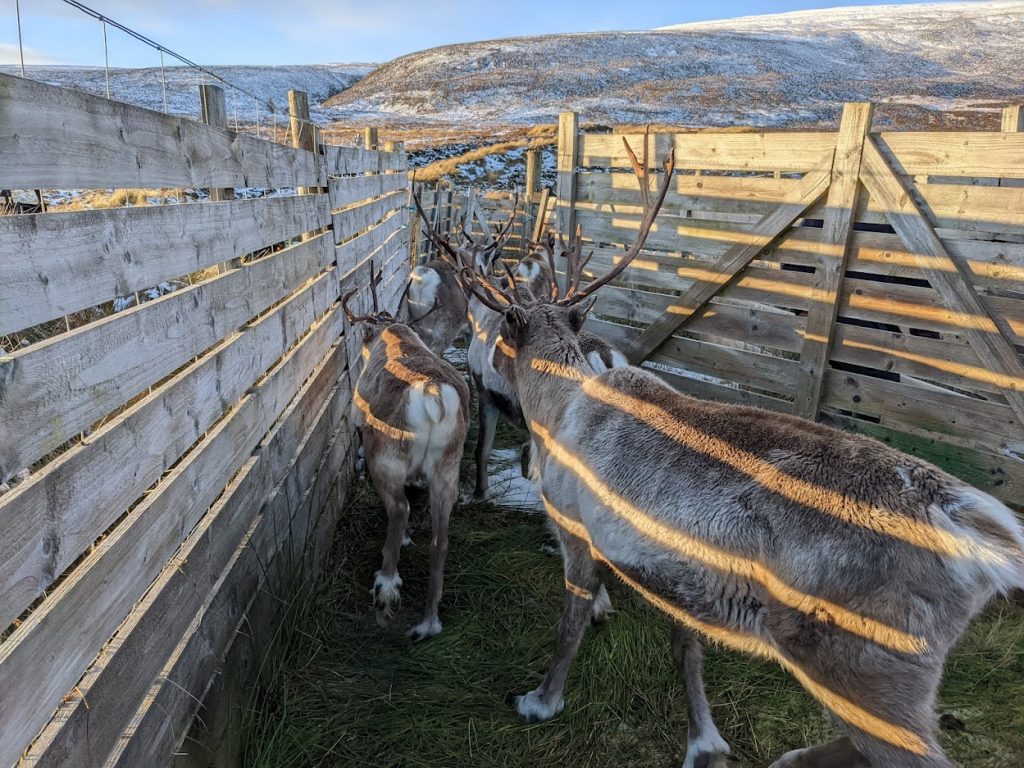
I’ve never been to Sweden, or any other reindeer herding nation, maybe it was just the blue sky, cold temperature and low sunlight, but it felt like I was somewhere further afield than the Cromdales! I can imagine the corral that Alan has built up on the hill would be little like the one Sami people might use. It’s more rustic than the enclosure on Cairngorm where we take our Hill Trips, but does it’s job perfectly.
There is a corridor which goes around the main corral so the five of us were able to gently push the reindeer out of the corral and into the corridor. This allowed us to open the external gate to the hill allowing the latecomers to enter, whilst not letting any suspicious reindeer out!
Reindeer patiently waiting in the corridor for their turn to meet the thermometer!Tilly calling the latecomers in to the corral, whilst the others wait in the corridor.
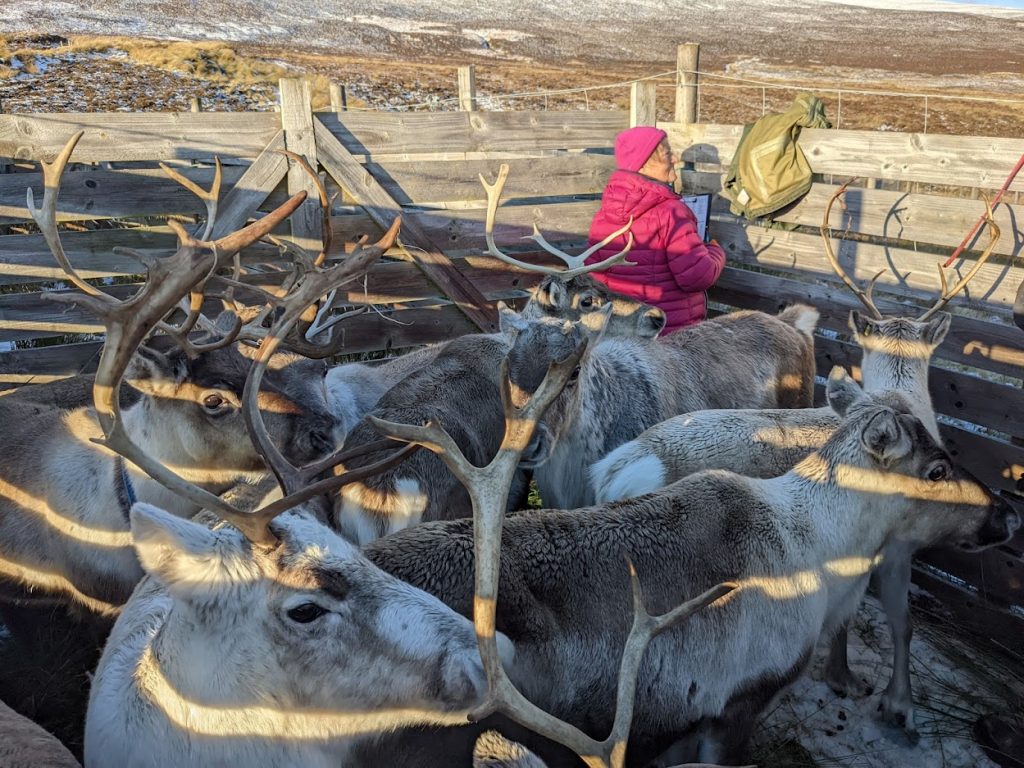
We gently pushed the reindeer in batches along the corridor into a small pen at the end where we took the temperatures of all the reindeer, calling out their names to Christine who was armed with a list of the herd and a clipboard, checking everybody off and keeping us right. Once each batch of reindeer had a thermometer in the bottom and was sprayed between the legs with a treatment to prevent ticks from biting they were released back on to the hill. They can’t have had a bad experience as they didn’t dash for the high tops, rather they just milled around the outside waiting for the rest of the herd, and most importantly for their well-deserved dinner! It was a very fun way to spend a day and thankfully all the reindeer were fine and well.
Christine ready with her clipboard.Scully on the left and Butter in the middle waiting for their turn – looking a bit suspicious!Released back on to the hill after their quick health check!They didn’t wander off too far as they knew they’d be rewarded with a tasty meal!Colin S feeding the herd after everybody was checked and released back out on to the Cromdales. Elvis, the oldest male in the herd at almost 16 years old, very used to routine temperature checks!
Emm is one of our wonderful regular volunteers, and has written many blogs for us in the past. You can find out more about Emm by reading one of her previous blogs here: how reindeer herding changes me.
I was last with the reindeer in October/November 2021 for 10 days. It was so brilliant seeing all the reindeer, herders and dogs again. I hadn’t seen them since October 2020 due to Covid. I thought I would tell you what I did when I was with them over this time.
Emm and Dr Seuss.
When I was up in October 2020, they were bringing in parts for the new Utsi’s bridge into the valley by helicopter. So this time I was excited to see the new Utsi’s bridge. I got to see the new completed bridge and go over it lots of times. It is wider than the old bridge and has steps either side and the reindeer go over it quite well. Another change is that on the walk to the reindeer with the hill trips, we don’t stop at the bridge anymore.
Being up at this time of year, I get to see the bulls with their girls. It was nearing the end of the rut. In one part of the hill enclosure, there was Poirot and his girls and in another part of the hill enclosure was Spartan and his girls. When you go and feed the bulls with their girls, you have to be careful as the bulls can be territorial and protective of their girls. With Poirot and his girls, we put the food out first and then let them in to the part of the enclosure where the food was where they will spend the day or night. Spartan and his girls were in a part of the enclosure called Silver Mount a big hill in the hill enclosure. A lot of reindeer have their calves on Silver Mount and it was my first time seeing a bull with their girls over in Silver Mount. We had to walk a little way across the hill enclosure to Silver Mount with your bags of feed.
Poirot – safely on the other side of a fence!
It was my 1st time being there when the rut has finished. Poirot and Spartan came off the hill and went back to the farm. All the reindeer in the hill enclosure got separated into 2 groups; one group was castrated males and the other group were females. A few females had their 6 month old calves with them too. Some females hadn’t seen each other in a long time, so there was a lot of clashing antlers and charging around to sort out the new pecking order. Kipling even had lost an antler in a tussle. It was the first time I had seen the females being feisty with each other. The next day, some of the females were released onto the free range.
Holy Moley at the front, with some calves and ‘Christmas Reindeer’ in the background.
It was also the 1st time for me having a bull in the paddocks as Morse was in there as he jumped a fence and had hurt himself so they had pulled him out of the rut and were keeping an eye on him in the paddocks. When he was better, he went back to the farm.
Morse in the Paddocks, along with Cowboy and Jimmy.
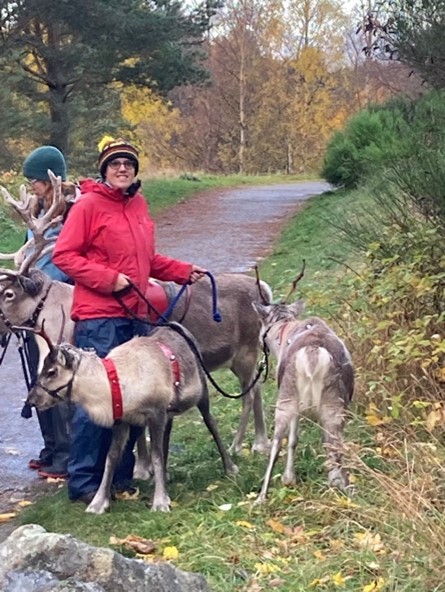
Another thing being up this time of year is that walking calves and Christmas sleigh training happens. It is very exciting. We have to look out for dogs as the reindeer are scared of dogs as they think they are wolves. We walked the calves (2 at a time) with 2 adult reindeer. The adult reindeer are the role models for the calves and are a calming influence on them. I looked for lichen lollipops along the way to give the calves which they enjoyed. People sometimes came over to us to say hello. Handling the calves at this age gets them used to people and used to being handled.
Emm holding on to the calves during a sleigh training session in Glenmore, Trilby closest to the camera.
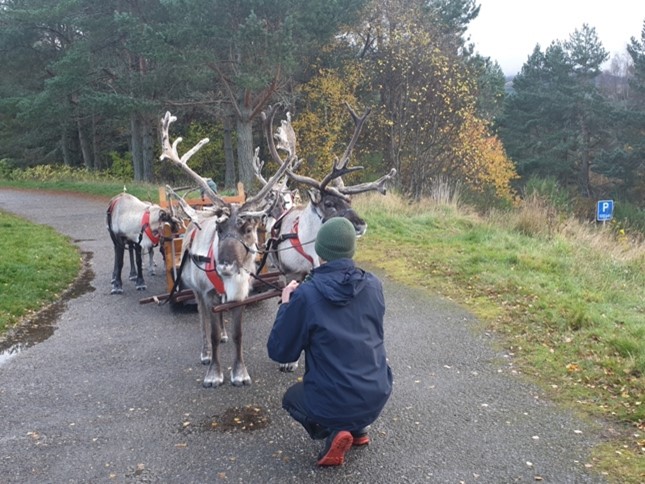
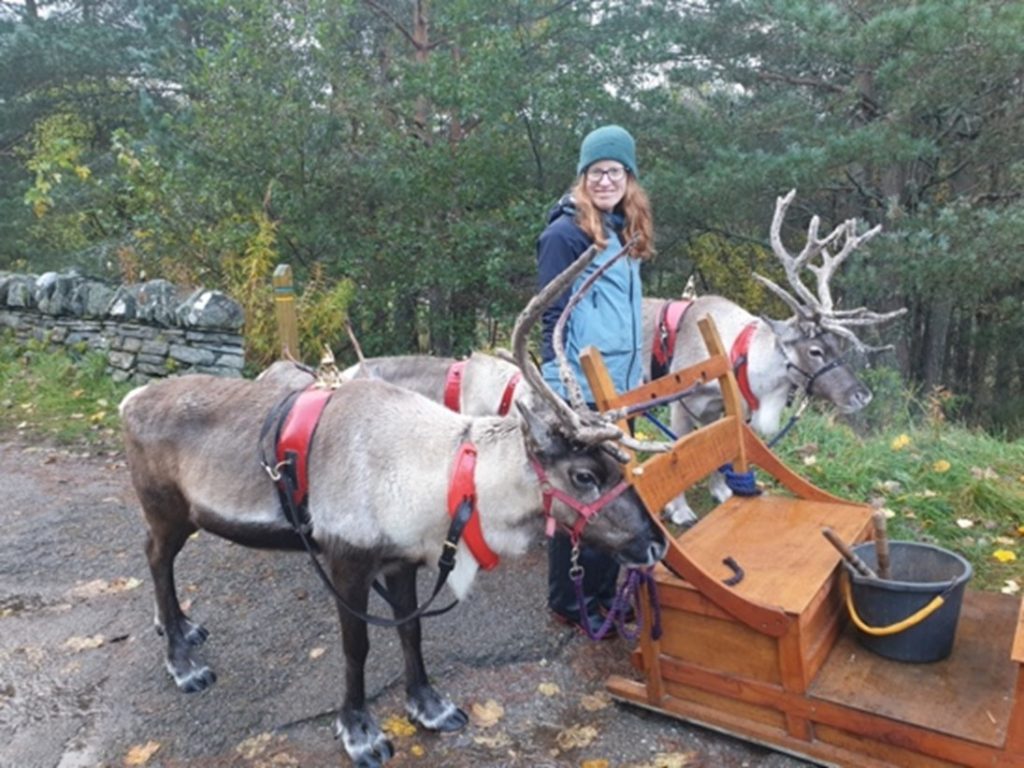
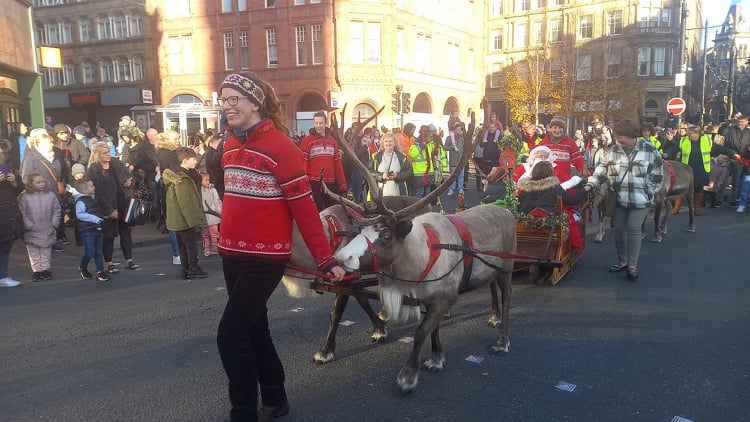
Before we start Christmas sleigh training, we get the reindeer warmed up by walking them and running with them along the path. In the training, the experienced reindeer are buddied up with inexperienced reindeer at the front of the sleigh or the back of the sleigh. There are 2 reindeer pulling the sleigh at the front and 4 reindeer (2 are calves) are at the back of the sleigh. The experienced reindeer are training the inexperienced ones. The Christmas reindeer are usually the castrated boys. Sometimes people come over to watch and this is also good experience for the calves. It is lovely to see the calves having bell harness on for the first time.
Sleigh training – Anster and Houdini at the front.
Sometimes the reindeer and the sleigh go in the road. We have to have hi-vis bibs on. It is funny to see the people’s faces in the cars as they drive past the reindeer and the sleigh. They look very surprised and excited.
Ruth with Olmec and Aztec.
The reindeer go around the UK in November and December. There are lots of teams and they do Christmas events, garden centres and Christmas parades.
When the calves come off the hill to go into the paddocks to have their walks and to do Christmas sleigh training, it is the first time they get separated from their mum and wear a headcollar. They are fed lichen from a bucket whilst someone puts the headcollar on. The mums comes off the hill with them into the paddocks and then the mums goes back into the lorry to go back up the hill leaving the calves in the paddocks. They are normally separated for a few days. It was the 1st time I had seen the calves come off the hill with their mums.
The calves have their shiny new ear tags put in at this time of year. I saw Andi put Cowboy’s and Jimmy’s ear tags in.
When I was up this time 2 people got married up on the hill surrounded by the reindeer which was lovely. Olly made sure the reindeer behaved themselves although I heard that Holy Moley stuck her antler up the bride’s dress !!!!!
I also helped out in the office. I helped pack Christmas cards, stuck the information onto the photos which went with the October newsletter, put the October newsletters and information photos in the envelopes, made up the 1st year adoption packs and packed up the adoption gifts for each adoption pack. It really helps the herders when they do the adoptions of the reindeer.
A busy office! From L-R: Emm, Lisette, Lotti, Ben B and Olly.
I also helped do the feed mixing making up the reindeer feed. We do the feed mixing in a big cement mixer. We mix lots of ingredients together by measuring them out in buckets and then putting them in the mixer. The ingredients we use are barley, sugar beet, ewe and lamb mix, dark grains and haymix. We also put calcium powder in and oil to help mix the calcium powder in. We use lots of reindeer feed this time of year as there is lots of reindeer up on the hill as it is the rutting season. Feed mixing happens every 1 – 2 days this time of year as it runs out quickly.
I also led reindeer up the hill which came from the farm or when we switch the reindeer around from the paddocks. When you lead a reindeer, it is different from leading a horse. You wrap the rope around your hand and mustn’t let go even if the reindeer pulls. When you walk the reindeer should be behind you or at the side of you but mustn’t try to get past or pull you. We must look out for dogs as well as we are on a path.
Stenoa having a snooze after a Hill Trip.
When I was there, it was Hen’s birthday. I went to Reindeer House for Hen’s birthday meal. It was a really good night with very yummy food and really good company. There were 7 dogs and when we sang Happy Birthday to Hen, the dogs sung too by howling and barking. Lol.
I am so looking forward to my next trips in 2022 !!!!
A few weeks ago I wrote a blog about Kipling, one of the reindeer born in 2017 (click here to read the first installment). This week I will write about two more reindeer born in that year and given names belonging to the theme famous authors and poets.
Dr Seuss
Dr Seuss was the first calf I ever got to know due to his unmistakable white face passed down from his mother Merida. From a young age he was full of cheek and character and also had a large appetite for food. As a little dumpy chubster he was probably the reindeer I gave the most fuss to during my first winter in the form of food and cuddles, although the latter I enjoyed more than him. Reindeer aren’t ones for being fussed but it was hard to resist for this little man.
Dr Seuss and his mum Merida in September 2017 – both with very distinctive face markings.Joe (with flowing long locks!) and Dr Seuss.Dr Seuss in February 2018.
Being a male, Dr Seuss went through his 1st and 2nd year in true teenage fashion, spending most of his time at the farm and tussling the other young bulls his age during the autumn. In the summer months he would be in our hill enclosure fattening up and meeting visitors. He’s always loved his food and will never let an opportunity go a miss if he spots the white handfeed bag.
Teenage Dr Seuss in September 2019.
At 3 years old and fully grown Dr Seuss was trained to become one of our Christmas reindeer and pull the sleigh on events. Being so relaxed and friendly by this point he took to it very well and looked super impressive with his distinctive large, wide antlers. He was so good, he also featured on the Channel 4 programme ‘A Baby Reindeer’s first Christmas’ as one of the stars of the show pulling Santa’s sleigh with a team which included his fellow co-star and reindeer celebrity, Holy Moley. Since then Dr Seuss has featured in a couple of other film or photography events but I don’t believe I am allowed to reveal them just yet. Dr Seuss is one of our friendliest and still most distinctive reindeer, he’s a lovely lad who all herders have taken a strong liking too. From a small round calf he’s now a whopping size with a huge backside that’s important fat reserves for the winter. That’s my excuse for him anyway.
Dr Seuss pulling the sleigh in November 2021 in the middle of Bradford – what a star!Back on the snowy hills in December 2021, after a weekend away on sleigh-pulling duty!
Christie
Caddis and Christie as a young calf. Christie aged 4 months old – check out those antlers! She certainly takes after her mum.
From a young age Christie has always been a very pretty reindeer with her white spotted face and legs. Her mother Caddis was a true great of our reindeer herd and it was actually her who caught my attention when I first started getting to know the herd. At the time Caddis was more or less the matriarch of the herd, she was one of the biggest females in both size of body and antlers and for as long as I knew her, always seemed to produce the biggest calf each year. With all her majesty though, she never seemed too pushy with the other reindeer and was very tame. As a young female Christie never left her side until eventually Caddis had another calf, now known as Sherlock, a year later and Christie was naturally pushed away. Unlike her mother, Christie in nature is a lot shyer. As a yearling she spent almost a whole year free- ranging and although I rarely saw her I was always interested to see how she was getting on. Unfortunately Caddis sadly passed away before Christie was 2 years old and as her last female calf, I wanted Christie to one day take after her mother and become as big and strong as she was. As a two year old Christie did spent more time in the enclosure during the winter when I moved to the Reindeer Centre. Like Kipling I would often try to give her a little extra feed and handling to encourage her to be more tame but she’s never quite become completely relaxed around people. I do see her sometimes handfeed from visitors and stand in and amongst groups of people more but not as regularly as our tame or greedier reindeer. I’ve began to enjoy this characteristic about Christie though, I know she’ll never be like her mum was with regards to how she acted around people but with a little encouragement Christie will still accept your presence and a tasty handful of food. This year I was so excited to see Christie become a mum and give birth to her first healthy calf. A surprisingly dark male called Akubra, who we named after our hat themed year. Like Caddis once did, Christie has produced the largest calf of the year and has also grown an incredible set of antlers for a mother. It’s really nice to see that Christie has taken after her mother in this way and has carried on the legacy of family genetics. I still think the best of Christie is yet to come and although she may not be the tamest of reindeer, I’ll keep doing my best give her that extra bit of food during the coming winter months and see if she grows in confidence as time goes on.
Looking fabulous free-ranging in August 2020.Christie and her young calf that we later named Akubra – May 2021. Joe and Christie – March 2022.
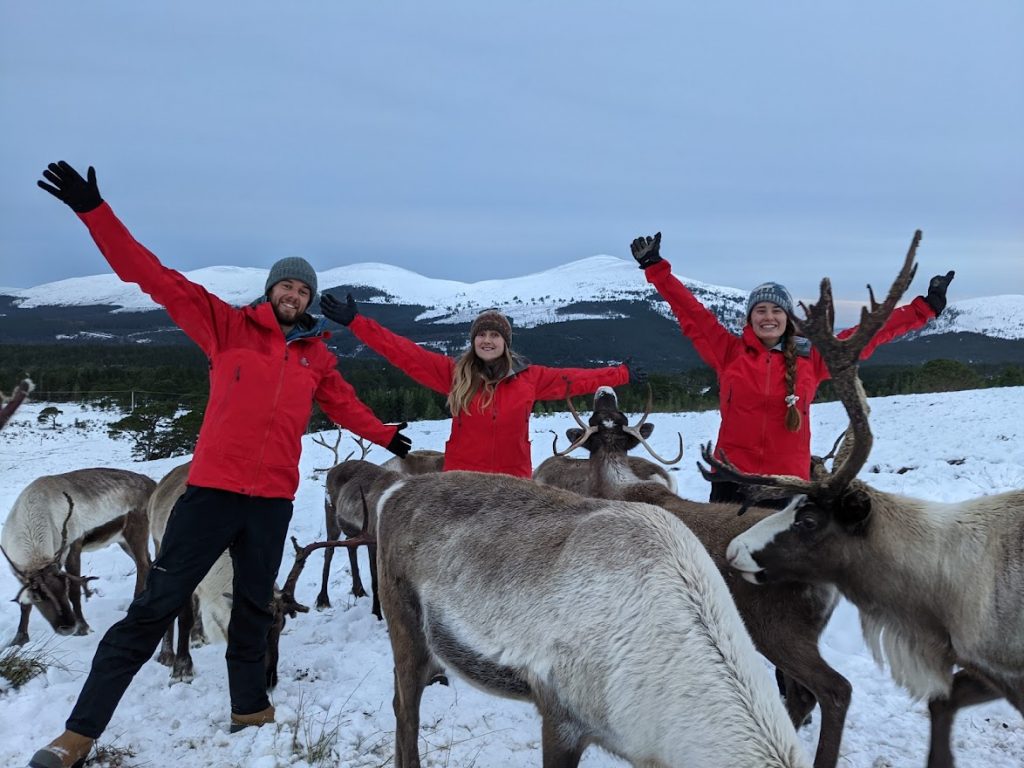
Joe, Fiona and Lotti modelling our new kit on their first outing!
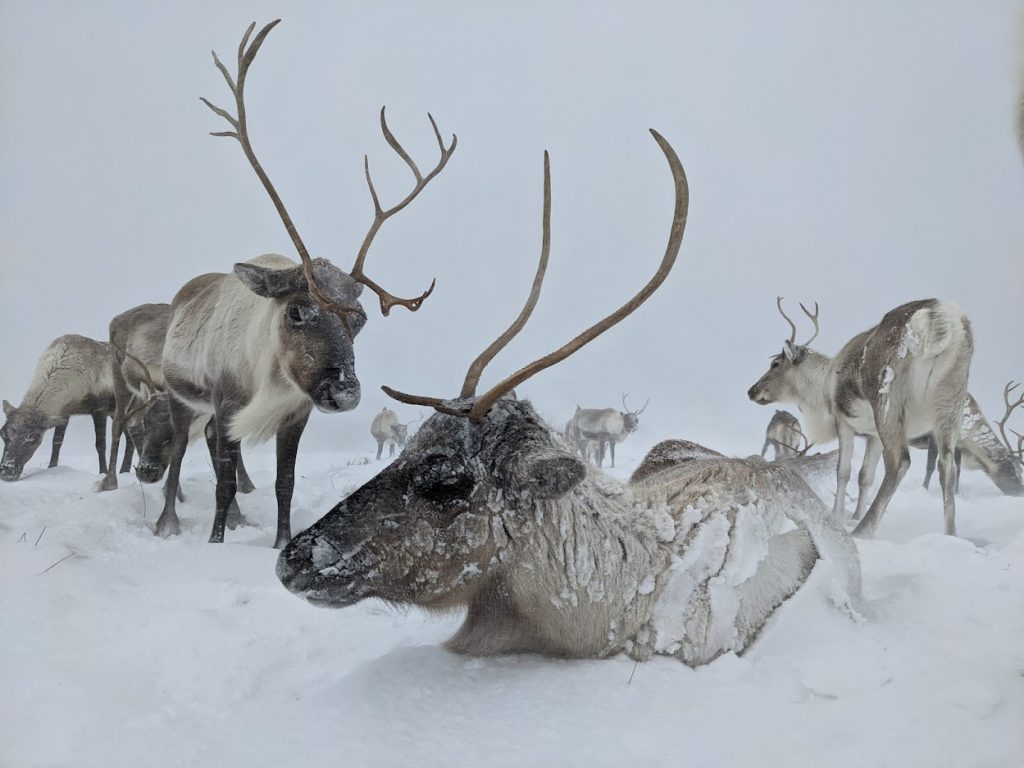
If anyone is a regular viewer of our social media pages, you will have seen that there are days on the hill when the weather can be absolutely wild! Particularly during winter months, it can often be very cold and windy, with stormy blizzard conditions. Luckily this sort of weather doesn’t bother the reindeer in slightest, in fact winter is the reindeer’s favourite season. With thick winter coats, they don’t feel the cold until -35 degrees Celsius and have been known to survive down the extreme temperature of -72°C!
A blizzard is nothing for young Pumpkin!
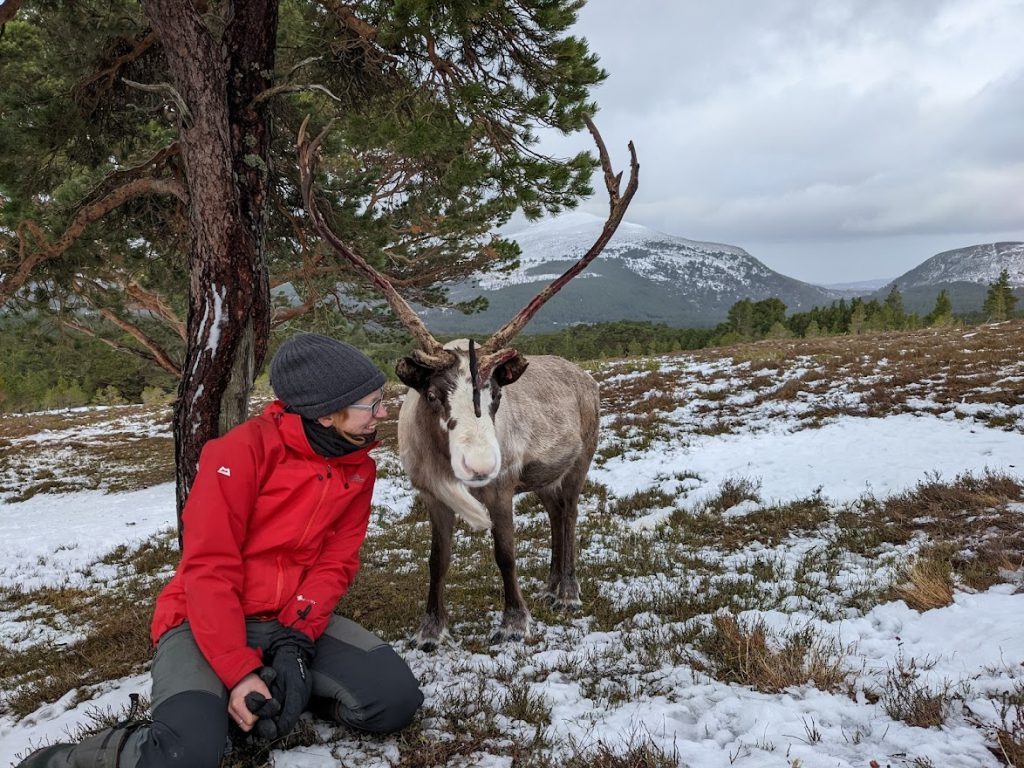
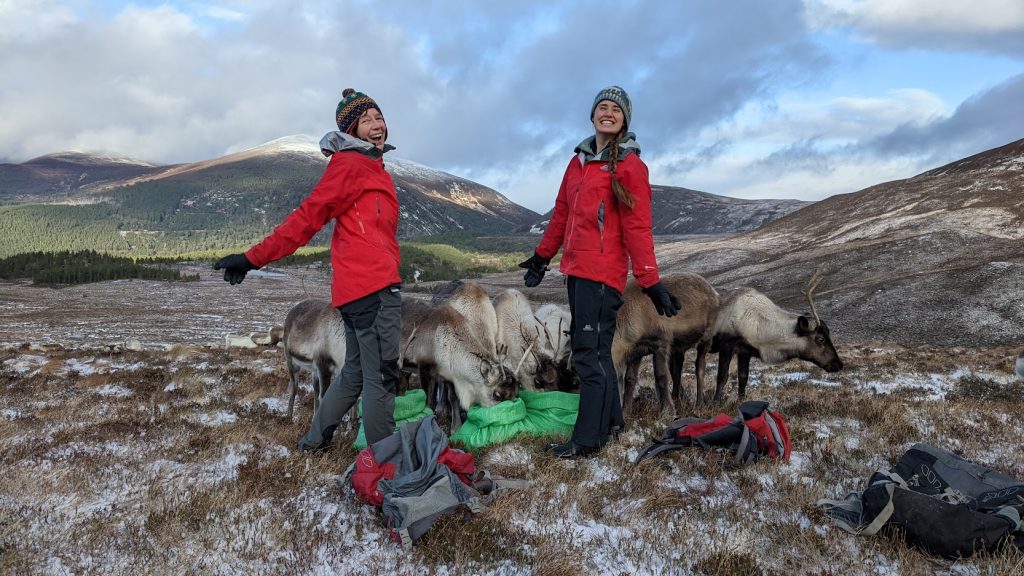
Some people may think we herders are hardy folk but there is no way we could last even 5 minutes on a stormy winter’s day without the right clothing. Thankfully as of this year, Mountain Equipment have been kind enough to sell some of their best waterproofs to protect us against the elements at a seriously discounted rate. From now on we will be wearing their clothing during hill trips and filming. With all our old jackets starting to come to the end of their lives, it’s nice to wear something that actually keeps us dry again. Our old red jackets will be retired to the muckier jobs! Mountain Equipment is an outdoor brand based near Manchester and it’s nice to wear clothing which is made for the worst of the British weather. Keeping to tradition we’ve gone for red jackets to help us stand out on the hill, at the moment they are looking shiny and new but I suspect carrying dirty feedbags will put a stop to that, all of my own personal jackets have a reindeer food stain to them these days. We have gone for the Rupal jacket and Saltoro pants as our waterproof top and bottoms which have been great during the recent stormy weeks and we couldn’t recommend them enough. Here is a link to Mountain Equipment’s website to learn more about them: https://www.mountain-equipment.co.uk/
We think Dr Seuss approves of Ruth’s new jacket.Andi and Lotti making sure the calves get a bit of extra feed whilst looking very fancy and bright!Lotti and Andi again, with Witch. Just because it’s a lovely photo!
For now we are more than happy to put our new clothing to the test during the rest of the winter. Hopefully there will be plenty of snow forecast to keep reindeer and herders happy for the rest of the season.
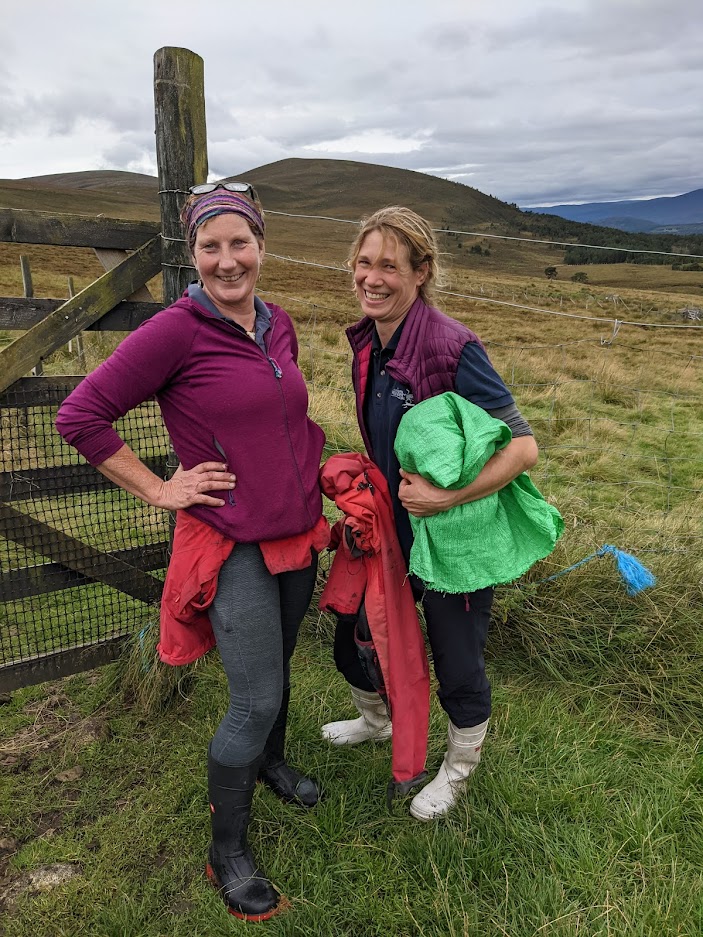
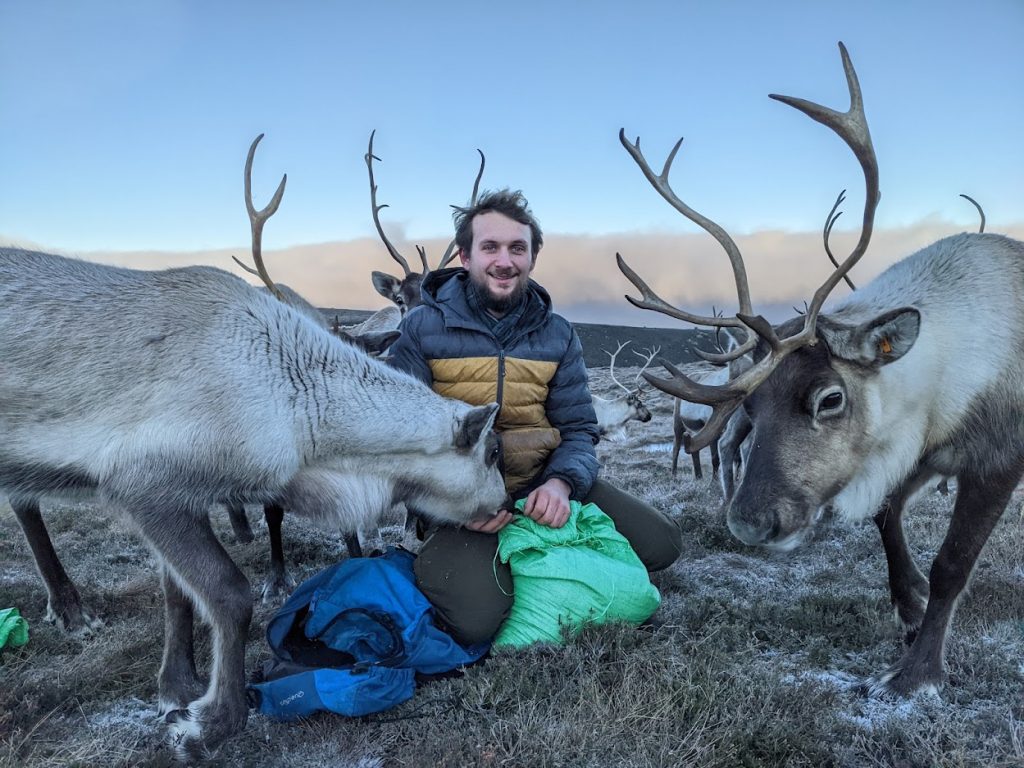
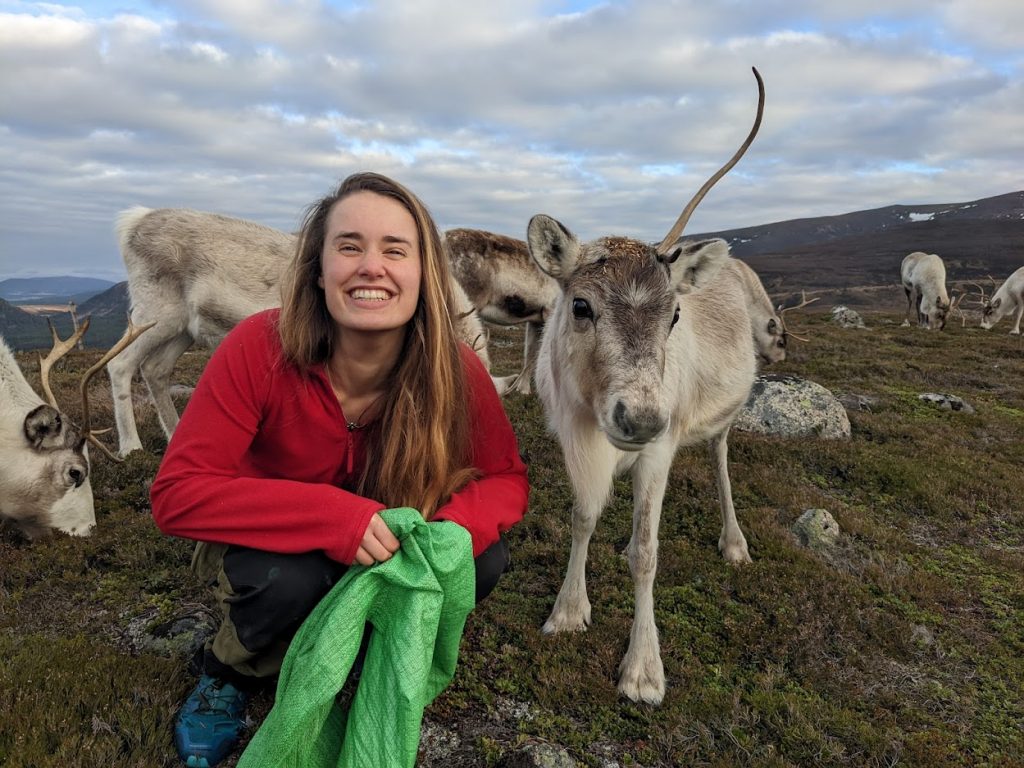
Throughout the year The Reindeer Centre has its core staff with a mix of full time and part time Reindeer Herders. Many of you will know us well, so we’ve got – Fiona, Hen, Andi, Lotti, Ben B, Ruth, Olly, Sheena and Lisette. We also have our hill farm contingent consisting of Alan, Tilly, Derek and Colin. We are here all year round seeing the reindeer (and other animals on the farm) through the different seasons, however we cannot manage all the work ourselves… that would be impossible!
Editor’s note (Ruth): not every herder features in the photos, please do not be offended if I’ve missed any of you lovely herders out! Check out this page on the website for more info and photos about who we all are: Who’s who – The Cairngorm Reindeer Herd
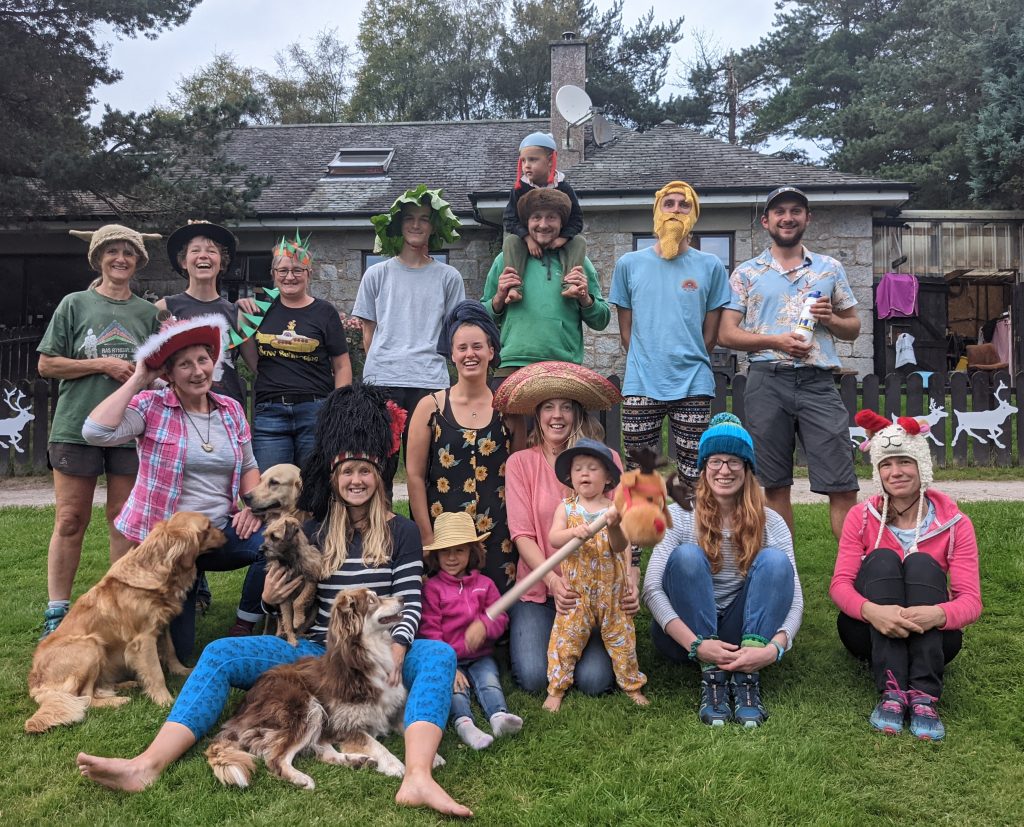
A gathering or reindeer herders for the annual calf naming night – September 2021.Fiona and two of her favourite things – reindeer and skiing!Andi and Hen (with Witch stealing the limelight!) in January 2022.Sheena and Lisette after a particularly wonderful Hill Trip, by the size of their smiles!The multi-talented Olly with Juniper and Scully – December 2021. Seasonal herder Harry and Ben B doing a spot of harness training – summer 2021. Lotti, with the famous Holy Moley – January 2021.
So we call upon seasonal staff who dot in and out throughout the year to help out. The parts of the year that can be busy are: February half term, Easter holidays then of course right through the summer with schools breaking up in Scotland first and English schools going back at the beginning of September. Although we aren’t so busy with tourists through September it is the start of our rutting season so we are busy with reindeer management. At this time of year we are carrying a lot of feed up the hill so it’s a reindeer herders work out! We usually have around 4 different groups of reindeer in various enclosures either running with a bull or the herd of Christmas reindeer and females we aren’t breeding from so plenty to keep us on our toes. Its busy through October half term just before we gear up in preparation for Christmas and our own Christmas tour which runs through November and December. We can all breath a big sigh of relief in January when we take a month off and close the doors to the public. We do however keep the office and reindeer management ticking over amongst the core staff.
Seasonal staff that worked throughout these busy periods in 2021 consisted of – Joe, Nell, Harry, Kate, Mel, Izzy, Colin D, Ben H, Dave, Manouk and Leonie. We even roped in ex reindeer herders Jack and Eve for a busy weekend in December… Once a reindeer herder, always a reindeer herder!
Seasonal herder Nell with her favourite reindeer Ryvita – August 2021.Ben H was new to the team in November 2021 and is helping out this winter. I’m sure we’ll be seeing him again!
If you’ve been up to visit us in 2021 you’ll have no doubt bumped into a few of these herders both core and seasonal along the way. We are very lucky with our team here at the Reindeer Centre. Everyone works well together, is great with the public and of course fab with the reindeer. Every day we are learning more when it comes to reindeer management but we all take it in our stride and everyone mucks in which is the important thing
Surprisingly I’ve been involved with working at the Reindeer Centre for over four years now. Time has certainly flown by and I would never have expected to be living at the Centre or even in the Highlands when I first began back in November 2017.
When I joined the team, the calves were already 6 months old and had been named under the theme of famous poets and authors. Back then they were still little fuzz balls on legs with small sticks for antlers and sometimes even then, a little mischievous. I quickly got to know them individually over a couple of weeks and eventually Kipling, Dr Seuss and Christie became my favourite reindeer calves. Over the four years I’ve had great joy watching them grow into the adults and characters that they have become now and I feel privileged to have known them all their lives up to this point.
In this blog I will write a little about Kipling, look out for a future blog about Dr Seuss and Christie.
Joe and Kipling in winter 2020-21.
I can shamelessly say that Kipling is probably my favourite reindeer in the entire herd. Is it bad to have my favourite? Should I treat them all equally? Maybe, but over the years Kipling has been so much fun to work with and get to know. As a calf, I remember her looking slightly different to the others of her year. She was dark in colour but with an almost silvery sheen to her coat. Her mother, Hopscotch, is quite tame and rather greedy and this instantly rubbed off on her daughter. Kipling has certainly always enjoyed her food!
Kipling as 4 month old calf.
During the first 2 years of her life, I only worked at the Reindeer Centre through the winter time but would still visit at least once during the summer months and I remember seeing her on the free-range as a young female. By the time I would start work in October for the season, Kipling would be in our hill enclosure and it was during this time her obsession with food grew. Handfeed is certainly one of her favourite foods and she would inhale it out of the hands of our visitors before they could even take her picture. She also became extremely tame and friendly during this time and sometimes behaved more like a dog than a reindeer, brushing up against people and didn’t even mind being stroked. Through the coldest winter months when all the reindeer were free-ranging I would always make sure to give her a few extra handfuls of food to keep her happy. Some of the herders were not too pleased to see me do this as over time this has made her quite pushy when it comes to a food bag and has now lost all manners when it comes to waiting to be fed!
Kipling in September 2019, now 2 years old.
Kipling was so tame as a two year old that she even came on Christmas events with us. We visited Milngavie, Keswick, Bedford and Windsor while on tour and she was so ridiculous when on display in the pen, brushing up against the fence to say hello to people and telling off dogs when they came too close.
Herder Fiona and Kipling on tour.Kipling on Christmas tour in Windsor.
At 3 years old Kipling became a mother and I was lucky enough to be the first person to see her after giving birth. In classic Kipling style, she was so food orientated that during her first year of being a mother she would pay more attention to what she could eat rather than keep her calf close by. I got to name the calf after the peas, seeds and beans theme that year and landed on the name Pip after my first family pet dog Pippin. Pip herself is more shy in nature than Kipling but has grown in confidence over the last year and is still close to her mother.
Joe, Kipling and new-born calf who was later named Pip – May 2020.Kipling, her daughter Pip and her littler sister Juniper free-ranging in December 2021. An inseparable trio!
In more recent times Kipling has become a well known regular to visitors on our Hill Trips. She’s usually the first reindeer to come in and hand feed but has sometimes got a little too pushy in her greed and has been known to be a bit too boisterous for some. I feel that after all the extra food and attention I have given to Kipling over the years I have played my part in creating a food monster. But like people can be around their loved one, I look past this and only see the fun, friendly reindeer that I’ve become so fond of.
Kipling in September 2021. A standard photo of her – way too close to the camera for a nice shot!