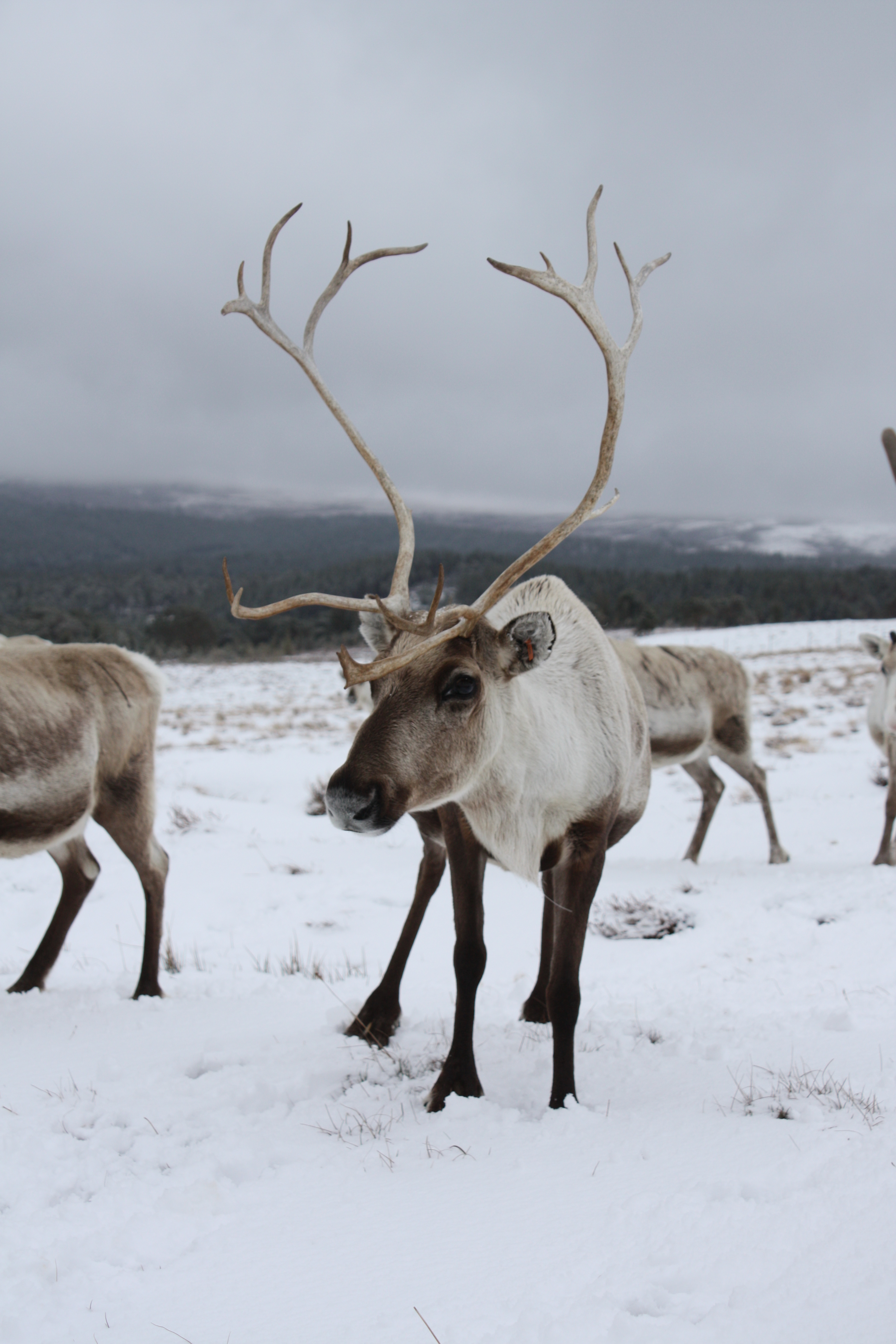
I’m almost at a complete reindeer year now, having worked through late summer, the rut, Christmas, and free range season, the last for me to complete the set – calving season! I was ready to be inundated with calves everytime I went up the hill each morning, but this May saw a steady trickle of calves, keeping all of us herders on tender hooks for which cows would calve next.
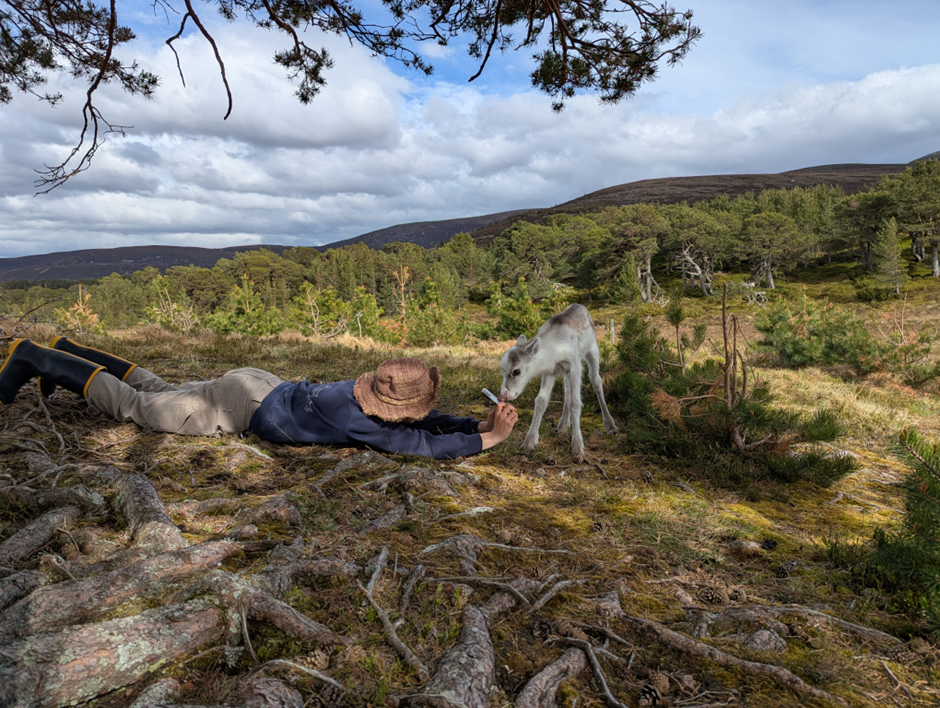
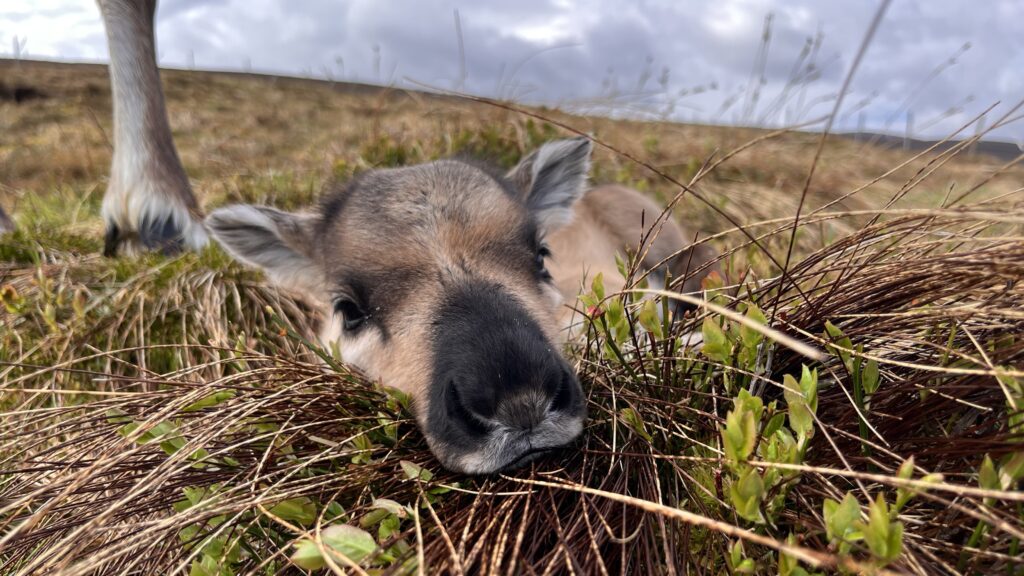
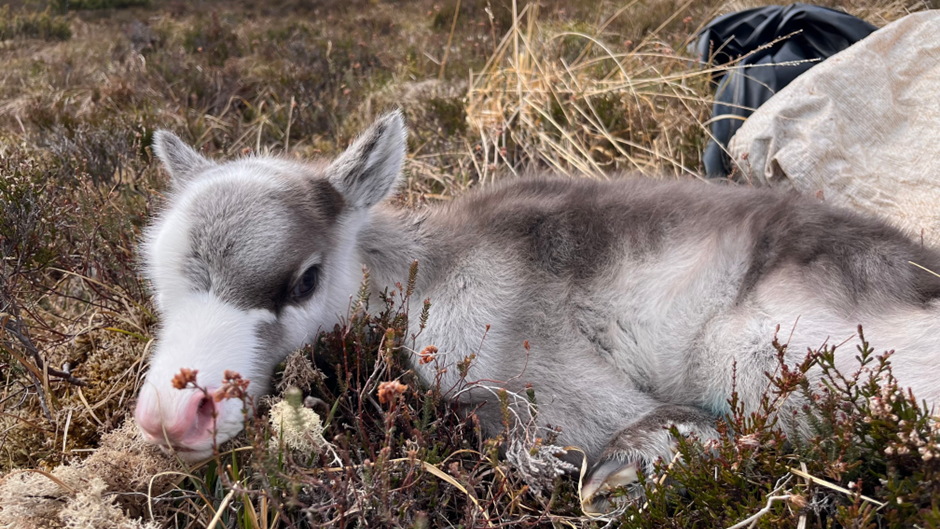
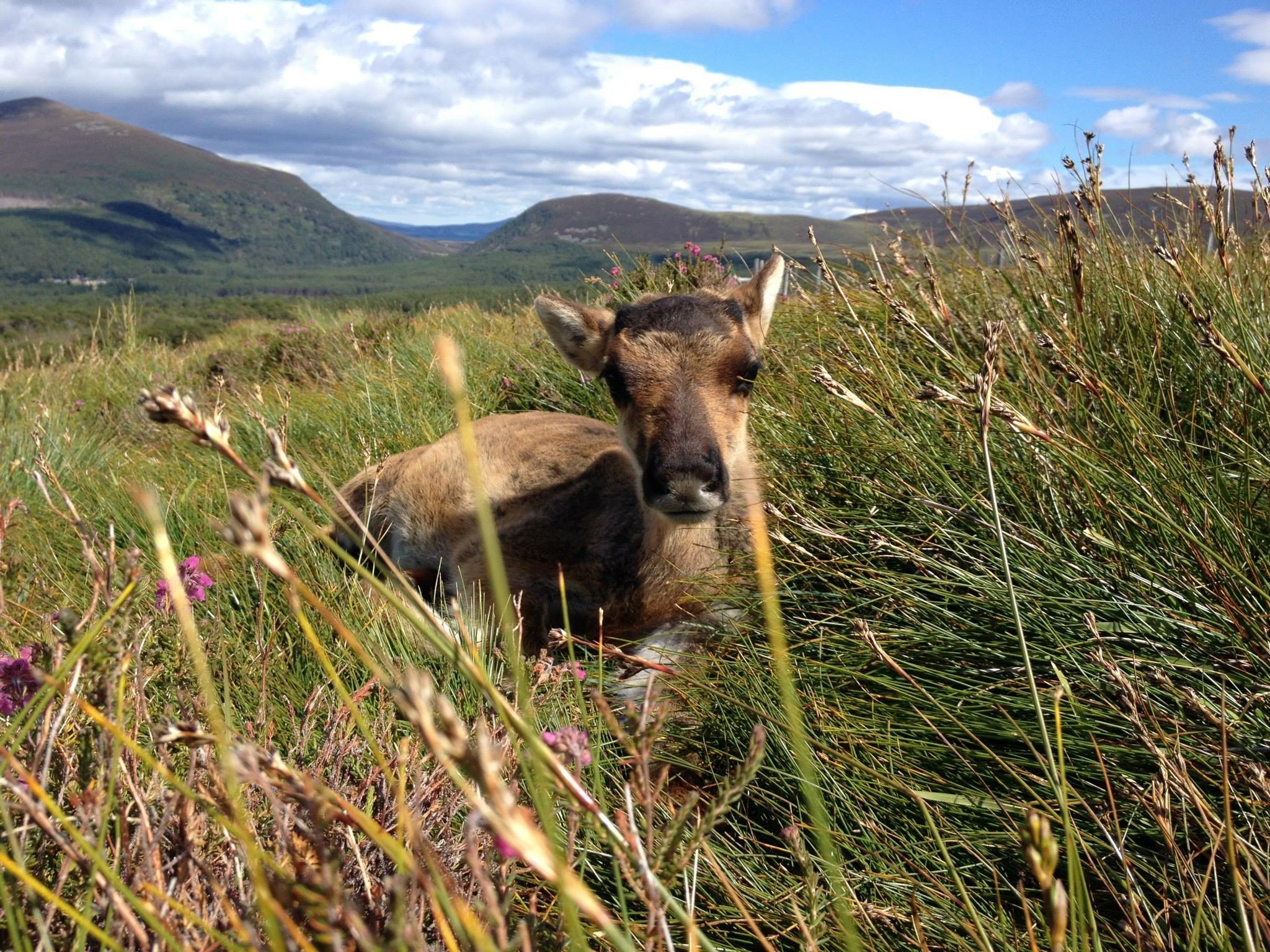
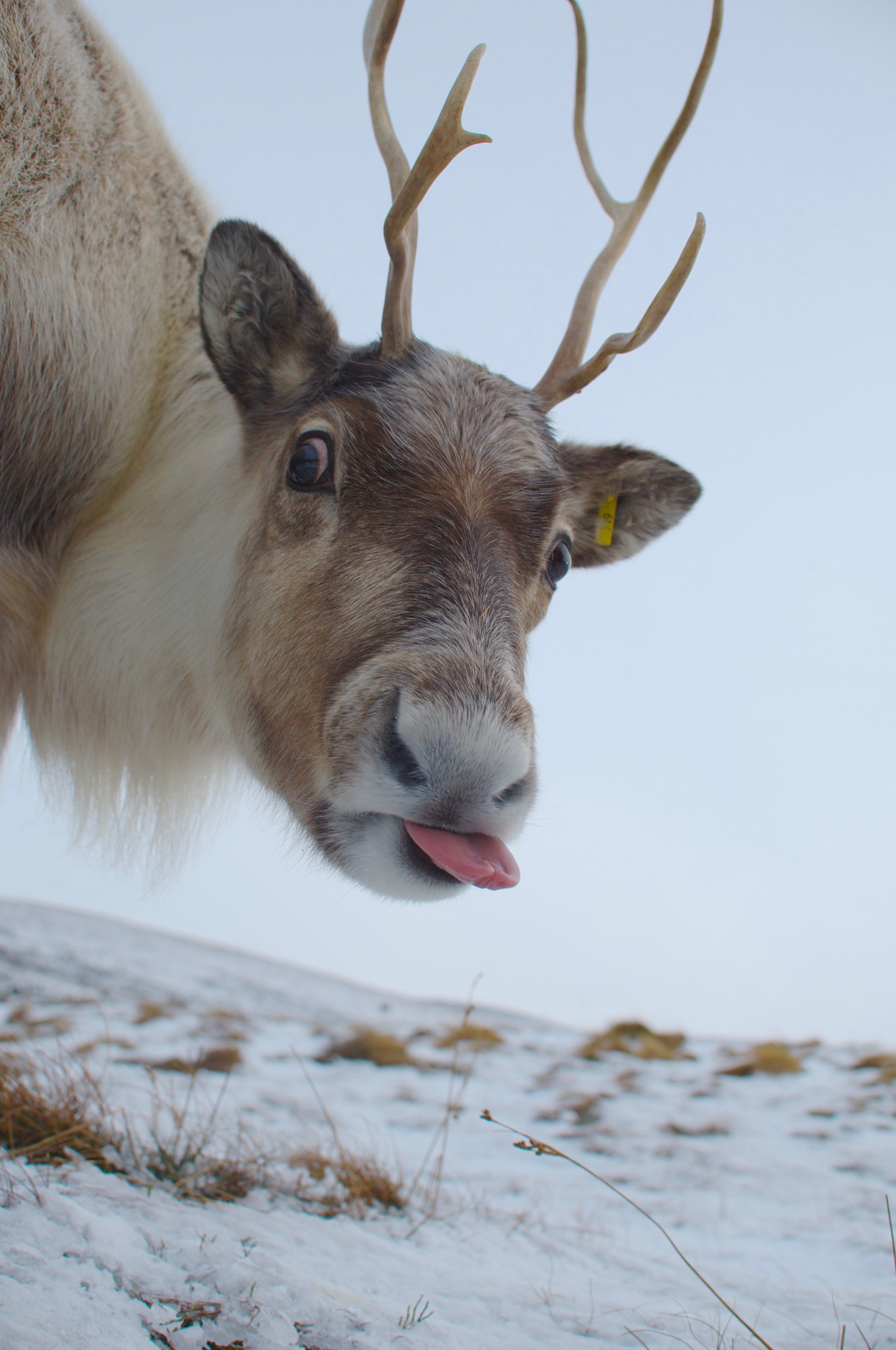
Some of the calves are incredibly tame right from day one, maybe because their mums are very friendly, or sometimes, in the case of this little guy – they’re just very curious about the world! (And maybe slightly dopey…)
My first trip up the hill at the very start of May left me disappointed to find that no cows had gone off to have their calves overnight. But I didn’t have to wait long for my first calf of my first calving season! (As we wait to let our adopters know which cows have calved this year, I won’t give away any of the wonderful mums at this time, but that doesn’t have to stop us from admiring all their beautiful babies!)
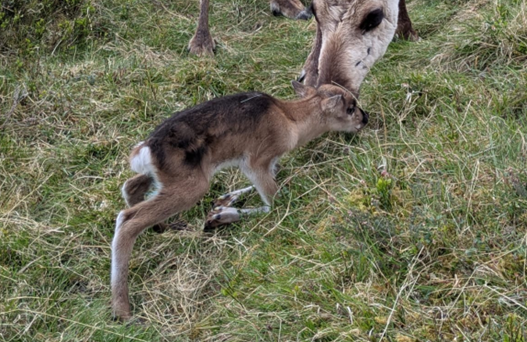
My first calf was a very small female with lovely, what we call ‘normal’ colouring. She did very well following her mum for quite a distance, while Amy, Kate and I gently pushed her from a distance towards the calving pen. The reason we do this is to put all our cows and calves together into a nursery area for the first couple of weeks of the calf’s life. From there they then return to the herd for a week or two before setting out onto the free range as a mini herd of mums and youngsters, set to return from the mountains in autumn.
An instant favourite reindeer for me, my first calf!
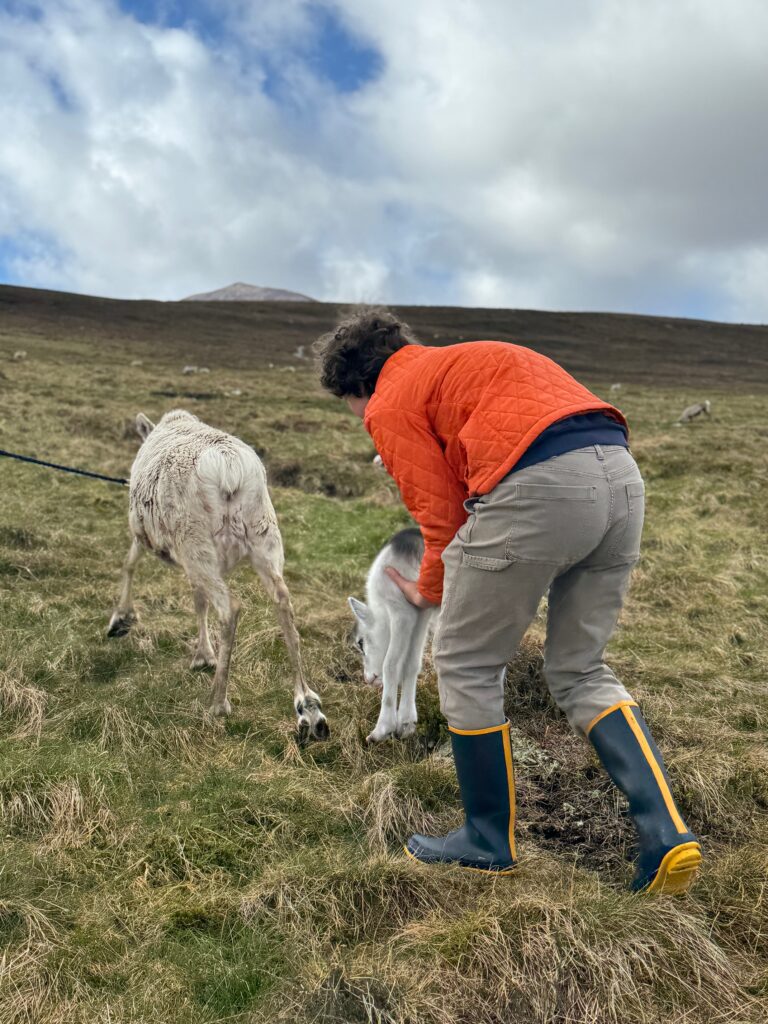
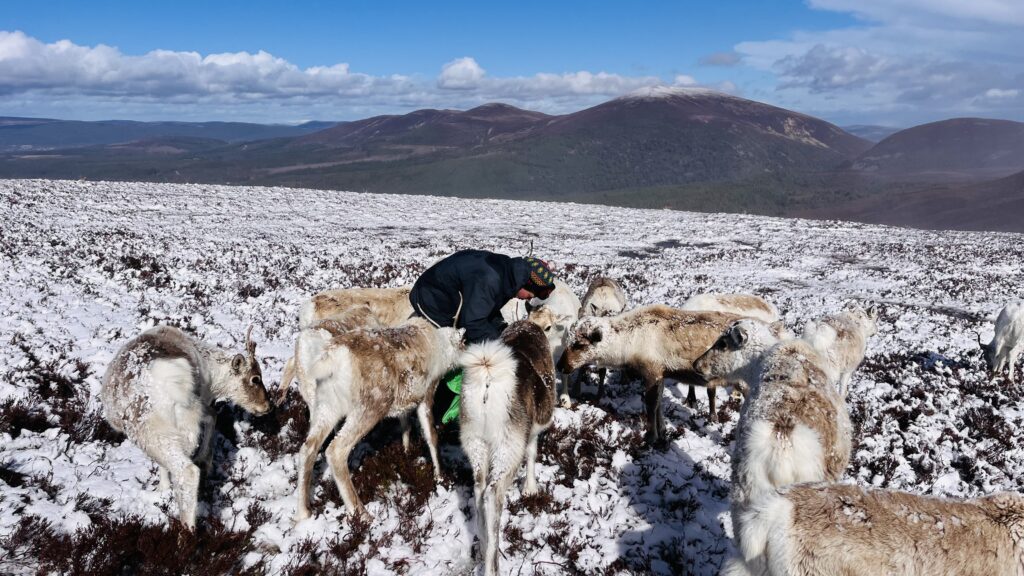
Calf number one of my top three calves this season, made it as far as she could before she flumped down tired into the grass and mum started to graze. Amy was then tasked with the awful responsibility of carefully carrying the calf alongside her mum into the calving pen – what a nightmare…
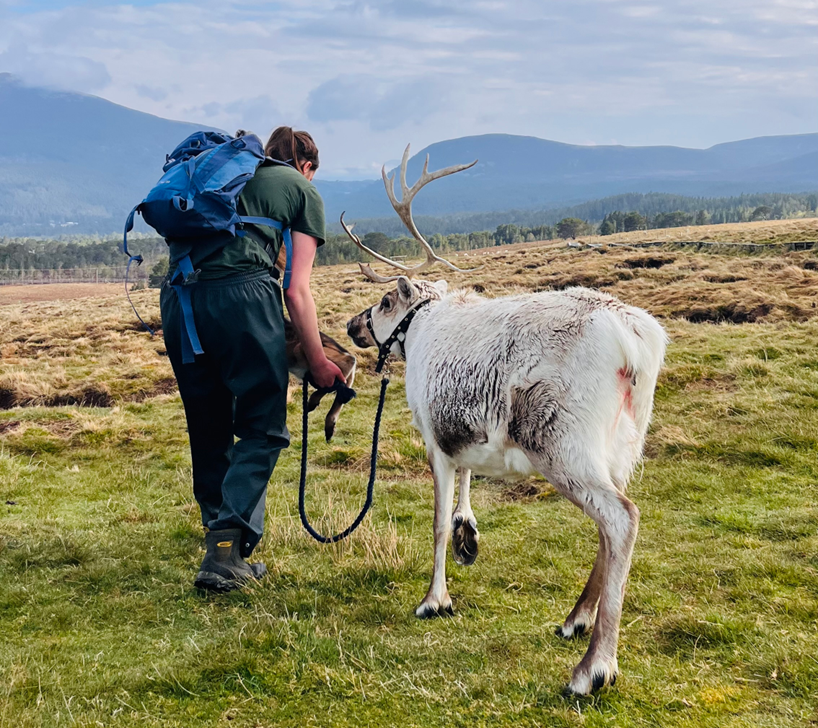
Amy juggling mum and baby, making sure to keep them close together and give them all the time they need while we make our way across the Hill Enclosure.
It’s really important when we’re moving the calves like this that we take it slow, allow lots of moments for the mum to be able to nuzzle her calf and for us to keep the calf right next to her. This could be by carrying her slightly in front, next to her face, or it could be by bending right over and carrying the calf by the mum’s back legs. These methods keep the mum calm knowing her baby is right where it should be and the calf can be constantly reassured by smelling, feeling, or hearing its mum.
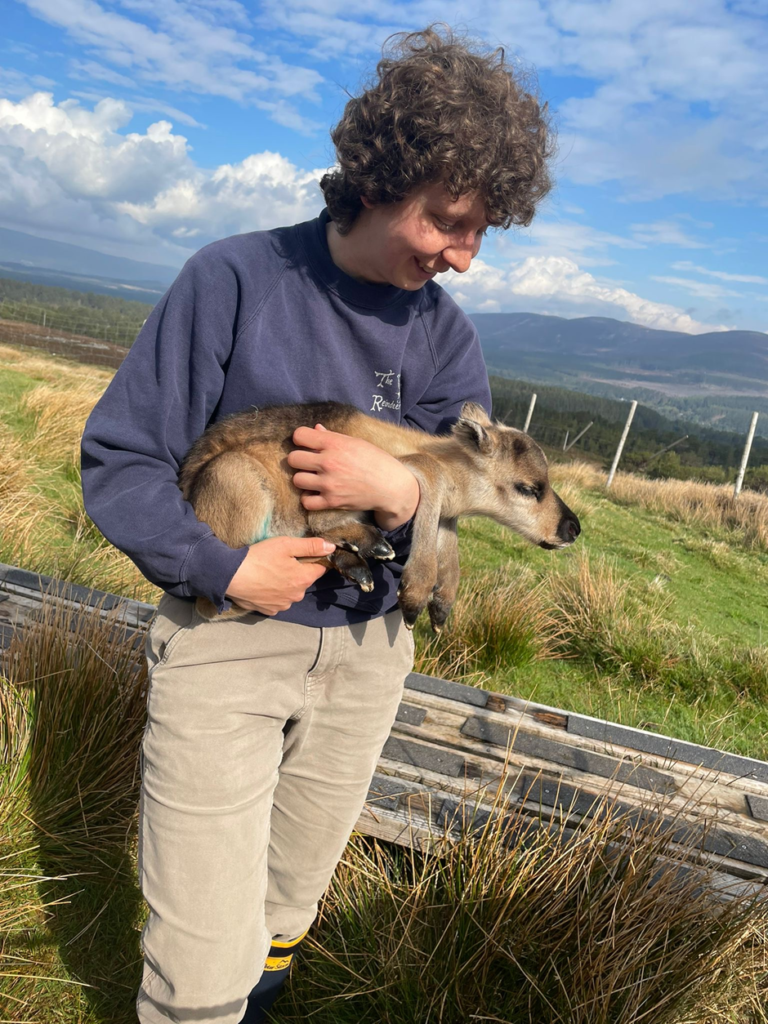
Once we had got the calf over to the calving pen, we have to treat the calf. We use an antiseptic spray on the remainder of the umbilical cord (which leaves the calves bright blue), and we treat the calves with spot on, giving them protection straight away from the ticks that can be found on the hillsides. While Amy treated the calf, I held her close by mum before we put them both in with the other cows and calves that were mere days older than this one.
It’s a tough job being a reindeer herder.
With the excitement of finding my first calf over, the others started to come in a steady stream. As did the exciting moments up the hill. From hanging out daily with the growing calves – both in size and confidence, to setting out on my own for the first time to find a mother and her new calf in order to treat the calf. Thankfully, my first go of solo catching a calf to treat was one born to a very experienced mother who was very calm while I did everything I needed to. Calf number two was a success and I left mum and baby in a quiet spot with a very large pile of feed and lichen for a well deserving mother.
A great experience dealing with this adorable little guy!
My final top calving moment, and calf number three was my long awaited calving bet!… Every calving season, us herders will all pick a cow we want to back for calving season who hopefully won’t be the last cow to calve. The loser (whose cow is the last to have her calf that year) has to bake a cake for the many victors for calf naming night later in the year. It had become a running joke how much I didn’t want to bake the cake, and as the calves were born and the days ticked by – the joke was losing its steam and I’d begun planning recipes. But, I was saved at the very last moment, coming in second to last, my chosen reindeer had saved me from the jaws of baking and a wonderful female calf joined the herd! (Cue the celebration…)
Saved from baking – another favourite reindeer for me that’s for sure!
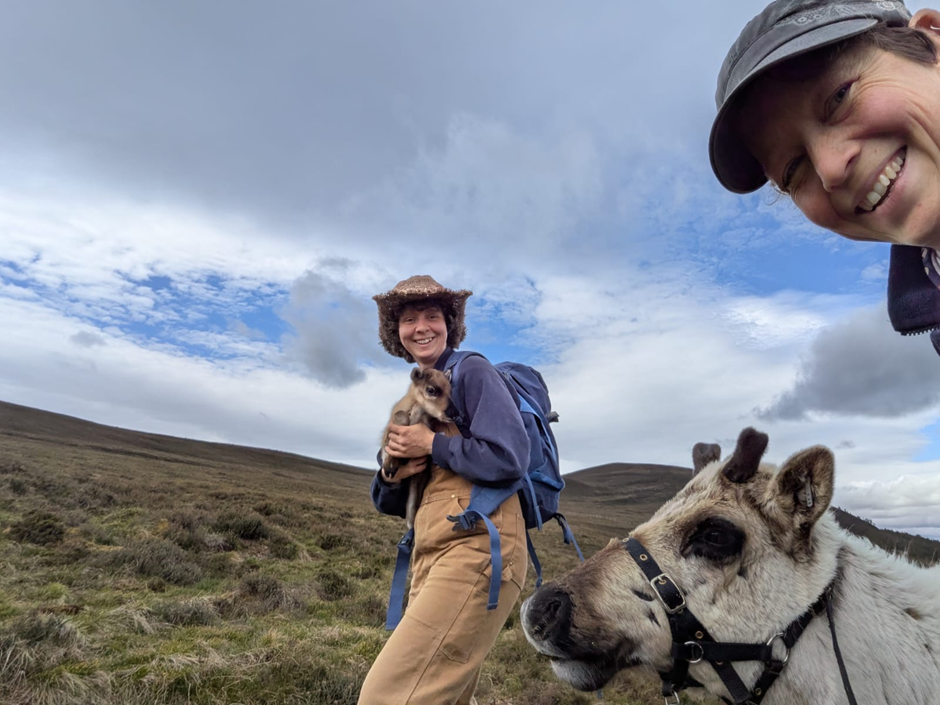
The next day after she was born and had been treated, it was time to bring mum and my saviour into the calving pen, so I set out following Andi across the enclosure to track down mum and calf and hopefully push them in. They had quite a walk to move them across the hill and it was pretty clear right from the first few steps that the calf was going to struggle to move through all the deep heather that mum had settled them both in. So, incoming that awful task that no one wants to do… I volunteered as tribute to carry lucky calf number three across the enclosure.
The walk took quite a while and required a lot of stopping to let the mum lick her calf’s face and to check on her. The calf was very relaxed and sleepy for the entire walk, but like any animal, they’re all different and need different allowances, and this particular female can be quite… grumpy is probably the best word. So we kept them close together and made sure that mum was in control. Finally we made it to the calving pen and they joined the nursery herd, much to the cow’s delight – nursery pen meant lots of lichen!
Anyone order a calf taxi?
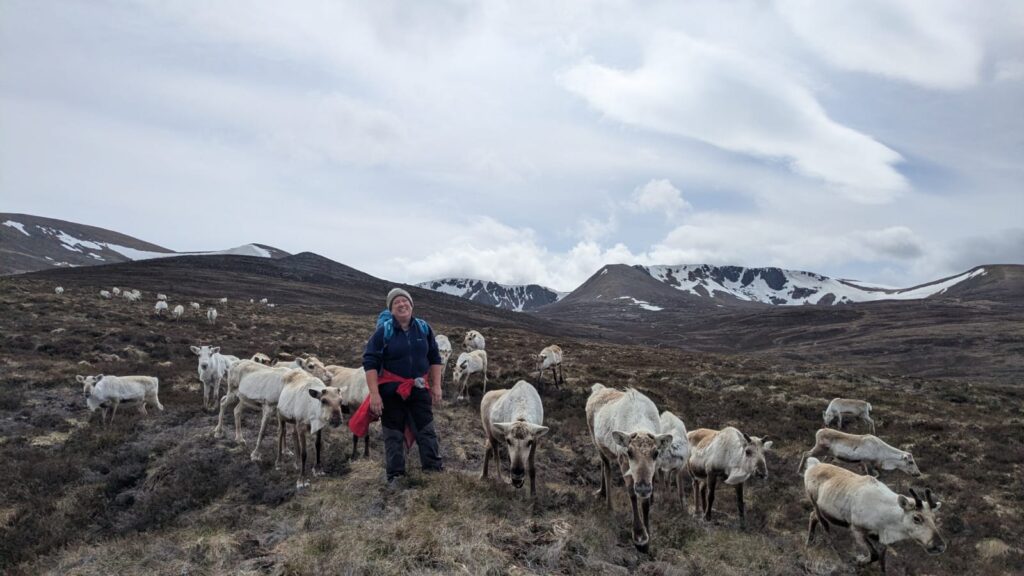
So, as June starts, calving season comes to an end and it’ll soon be time to walk the cows and calves out onto the free range. Having had the oppertunity to help with that in the start of June last year as a volunteer, it feels like a full circle moment. Maybe I can ditch the ‘L’ plates now…
This May I returned to the Cairngorms as a volunteer for the second time, drawn by the potential for beautiful weather and the prospect of tiny hoof prints. Whilst there is so much I could tell you about my week, with every single day being amazing, I think there’s one day that might stay in my mind for a while.
The day before, with the free rangers.
The day began with a trip up the hill with Lotti, Daisy and Maisy (the herders have such beautiful names!). Lotti and Maisy went to check on the latest arrival, a sweet little boy calf whose identity is currently protected to allow for more formal announcements to expectant adopters.
Daisy and I went on to do a full inventory of the herd in the enclosure. This involved some facial recognition (no apps involved, just the catalogue held in Daisy’s head) and then some ear tag number checking and ticking off against the list held in the office.
Why is this done? Well, at this time of year any of the herd that has decided to go solo is likely to be a Mum-to-be and may either be ‘faffing’ (which when witnessed is just like it sounds… that day you spend getting nothing done because you just can’t settle) or might be with calf in a remote corner of the enclosure.
After identifying the location of all the herd, including a faffer in the distance, Daisy and I went into the area where Lotti and Maisy were with the newborn, as the decision had been made to move them into their own space for a little while. Now, this might sound simple but moving a worried mum and a very teeny wobbly thing with back legs that seem almost twice the length of its front legs is not an easy task. It took 4 of us… although I was mainly the emotional and photographic support.
There was a very steep hill to climb and little baby needed a little help, whilst mum was constantly checking, encouraging and teaching. There were multiple suckling stops, an occasional poop on baby’s head and lots of encouraging grunting. Daisy’s back must have hurt as she had to pick up baby on the steepest parts of the epic journey but keep the calf in sight of mother at all times, which meant adopting a stooped position and walking in the side eyeline of the adult reindeer.
Daisy with the calf. Keeping the calf only a few inches off the ground ensures the mum can always see her baby.
At one point the previous year’s calf came to chat with mum, a slightly heart wrenching moment as we all realised that the yearling must now become independent and was nuzzled out of the way to make room for the new baby.
When we got to the final destination, we all stood back to watch mother and baby and, after a quick lick of all crucial parts, baby was settled down for a rest with mum guarding him. She was such a good mum!
And so we returned to Reindeer House for a cuppa.
I then spent a little time helping mix feed, checking on the paddock, watering some newly laid turf which the 3 boys in the paddock were greedily eyeing, and sweeping the inside and outside of the centre. I checked Santa’s Bothy but he was still out….
After lunch I went with Kate and Maisy to help with the afternoon Hill Trip – a great bunch of people who told me of their road trip plans and experiences whilst I helped identify reindeer and shared the few facts I have picked up.
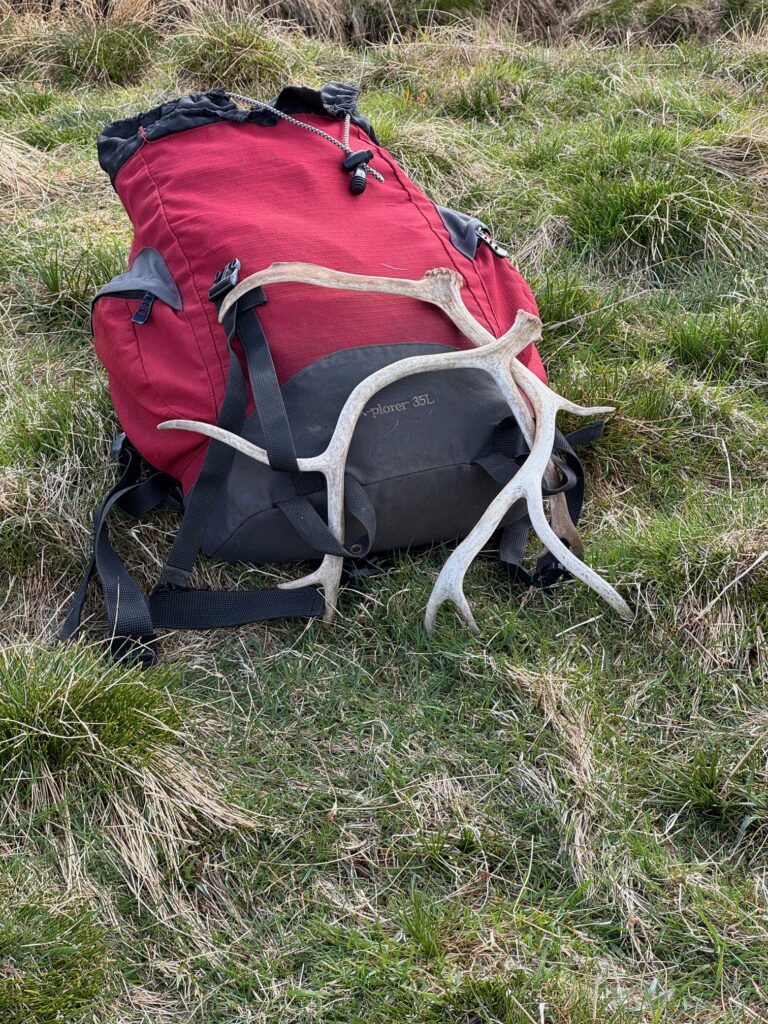
Whilst Kate was talking to the group, one of a nearby female reindeer’s antlers popped off in front of us all! And a few minutes later one of our visitors found another antler, but not from the same cow. This casting of antlers happens when the females are pregnant and no longer have to fight off the advances of the males. We put the antlers safely in the rucksack as sometimes adopters like to buy them.
A bag full of antlers.
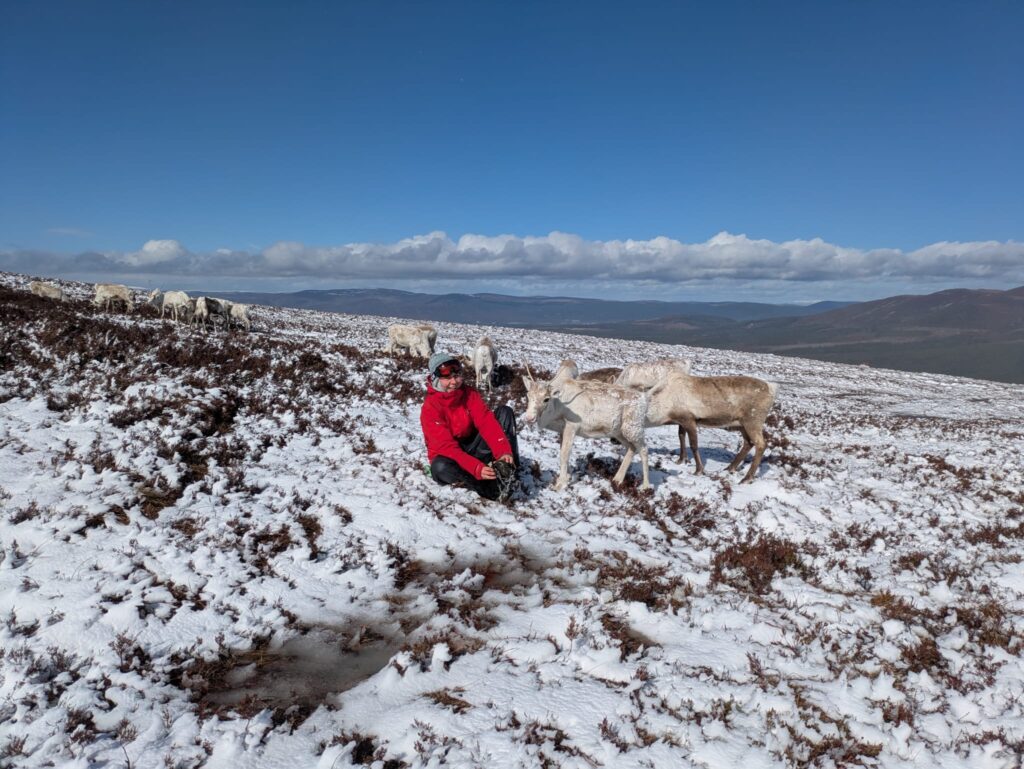
We then laid out a little feed to supplement the natural feed for the new mums, which is done from a distance so as not to disturb them and their calves too much, though we did check that each little calf was standing or chose to stand while we observed.
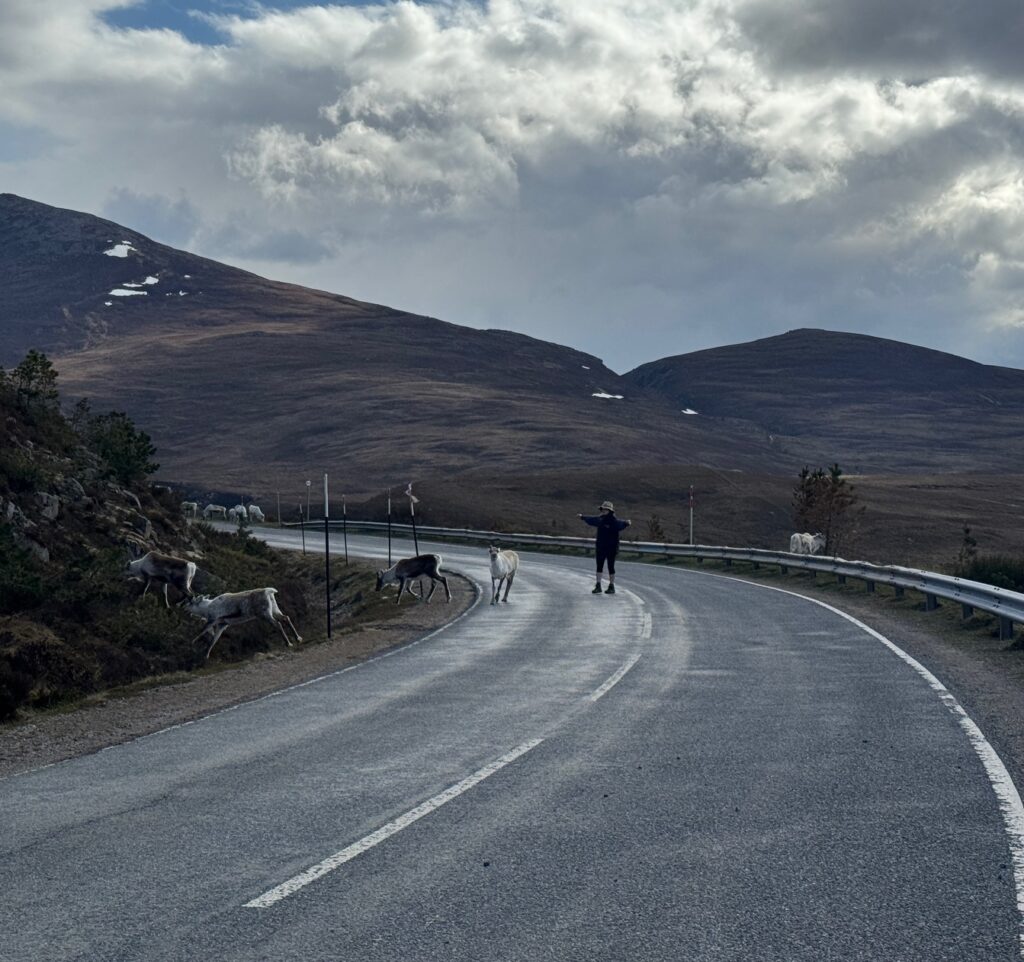
On our way back to reindeer house we drove up towards the Cairngorm Mountain Railway car park to check on the free ranging reindeer. Lotti and I had moved them away from that area the day before, down the valley quite a distance. They had seemed happy to follow us and stay there at the time. But guess who we found crossing the road? It seems the new grass covered with salt on the verges is as tempting to a reindeer as a salty snack is to us!
Out of the van we jumped. The strategy formed was to move them upwards this time. Maisy (part mountain goat I suspect) was sent up the steep rock face to call from above, whilst Kate encouraged the herd to move out of the road.
Kate directing the reindeer traffic.
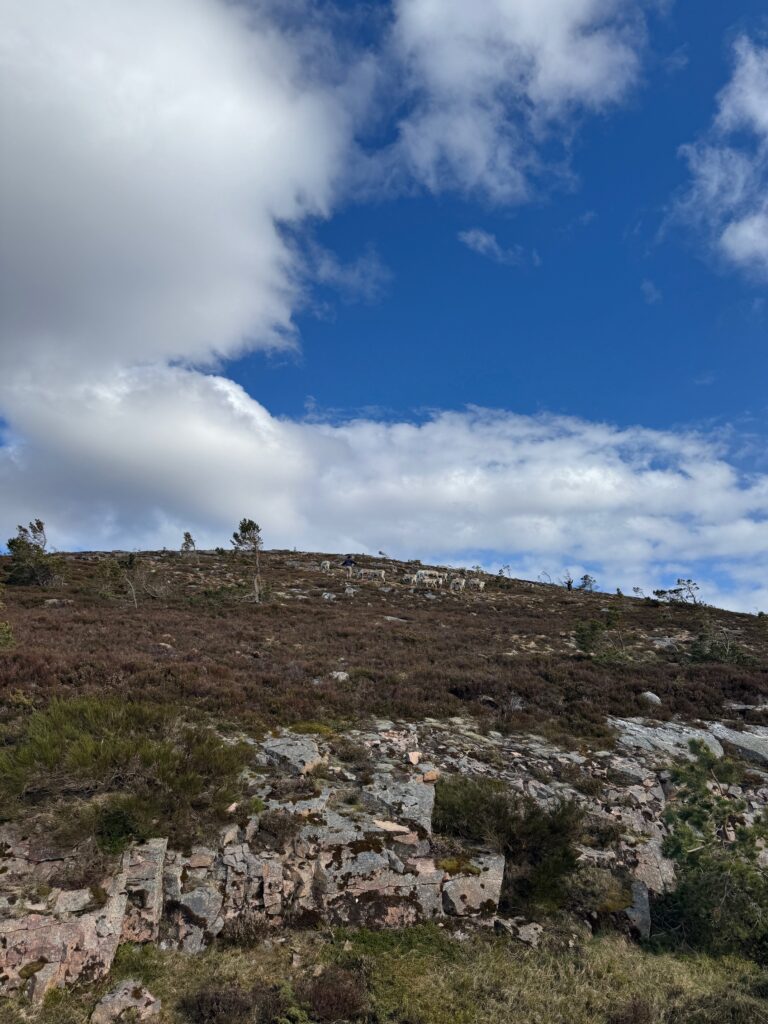
I was sent to the bend in the road to slow down and explain what was happening to oncoming traffic. “Yes, we came to watch!” was one of the responses, with most people intrigued or happy to drive slowly past and take some good holiday snaps. The free rangers weren’t being entirely cooperative and soon Daisy and Sheena came to help, with a chain of herders up the hill calling and persuading.
Maisy and Daisy are up there somewhere.
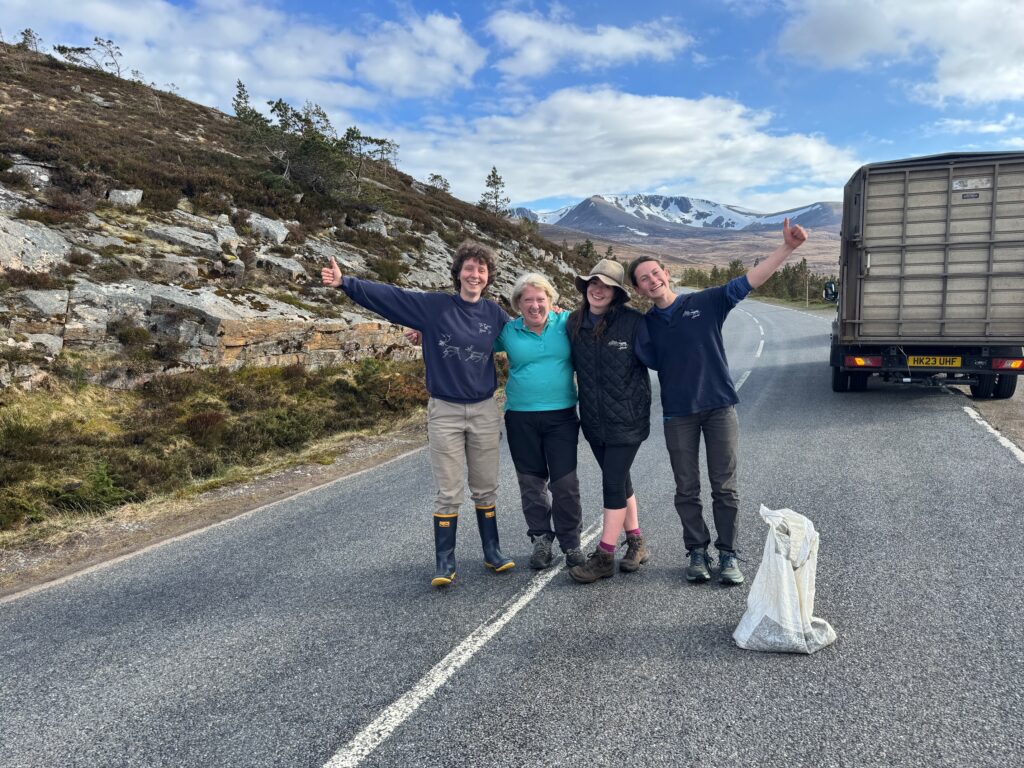
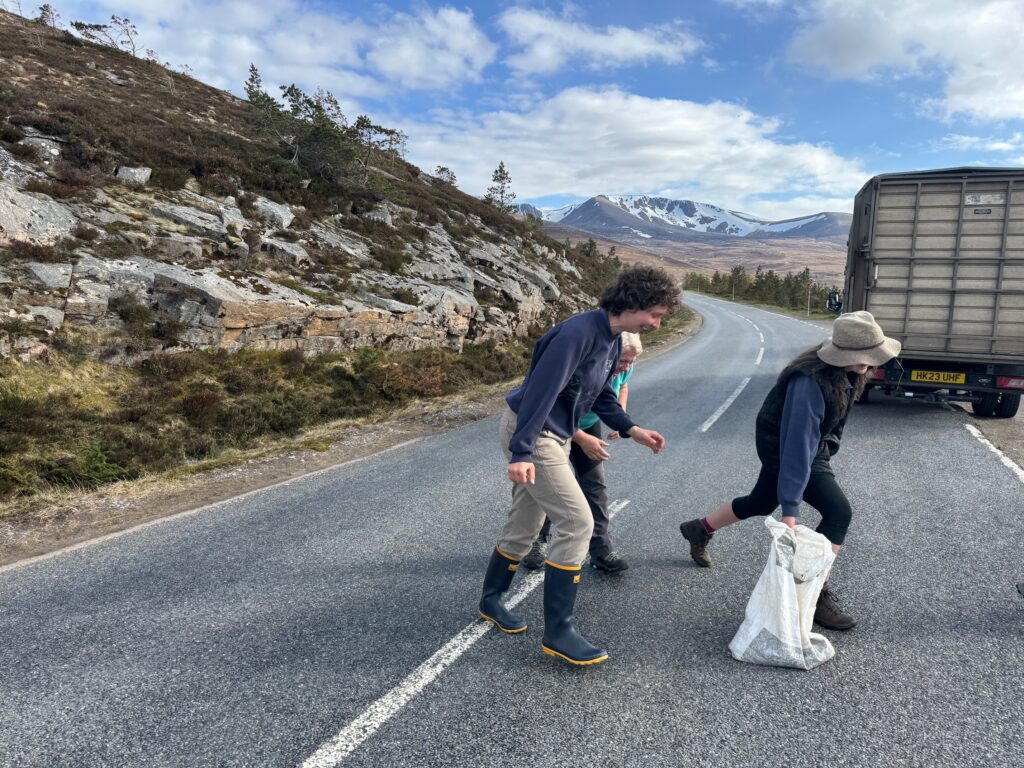
When at last the final reindeer was moved safely onwards, Sheena took our photo in the middle of the clear road until we were surprised by a camper van rounding the corner, and scattered, giggling.
Our Abbey Road style moments.
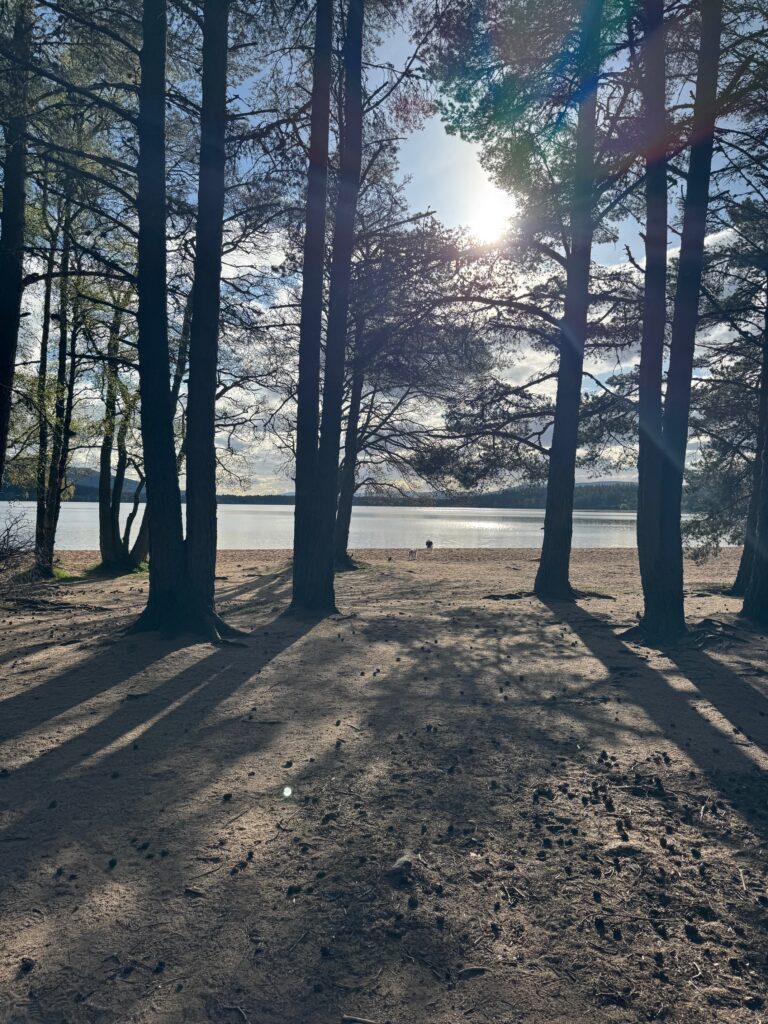
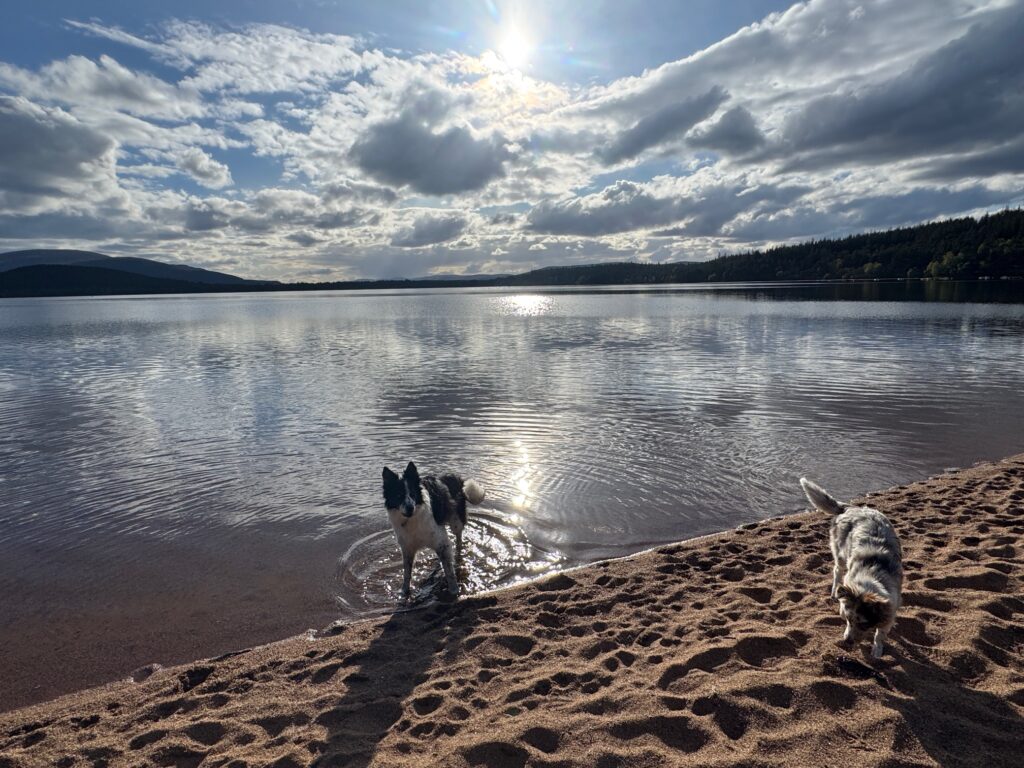
That evening, straight after work, Daisy took me for a walk with her dogs on the banks of Loch Morlich. It was a stunning evening and showed off the beautiful surroundings that Daisy is incredibly proud to live and work in.
Loch Morlich as the sun was slowly going down.
In fact Daisy had to use her fire prevention knowledge to help put out a fire that had been made illegally that afternoon and it was clear how much she cared that her local area was not put at risk. Seeing the beauty of the woodland, and experiencing the peace of the beach by the loch, I understood completely.
Editor’s Note: Sorry to hijack your blog Kathy… This wonderful blog was written back in May, before the horrific wildfire that hit Glenmore in July. It goes to show how important this bylaw is. It’s wonderful to share the reindeer’s home with so many people that love and respect the outdoors – so please help us protect it in future.
Echo and Asta go for a paddle.
We met Maisy on our way back and stopped at the Pine Marten bar for some refreshments and much needed sustenance. While the others had soft drinks, I wanted to try a local ale which went well with a very good burger with fries (my salty snack of choice)! We chatted about the day of adventure and reminisced about road trips to lands of northern lights and reindeer.
Feeling thoroughly contented, I took a small detour on my way back to my lodgings, popping up to the top to look at the sunset over the loch. And who should I see on my way up? A small group of salty snackers at the side of a car park, watched by a lady from Germany who looked at me with tear filled eyes and said “It’s just magical!”
And I agree. What a day. What a week. I can’t wait till next year….
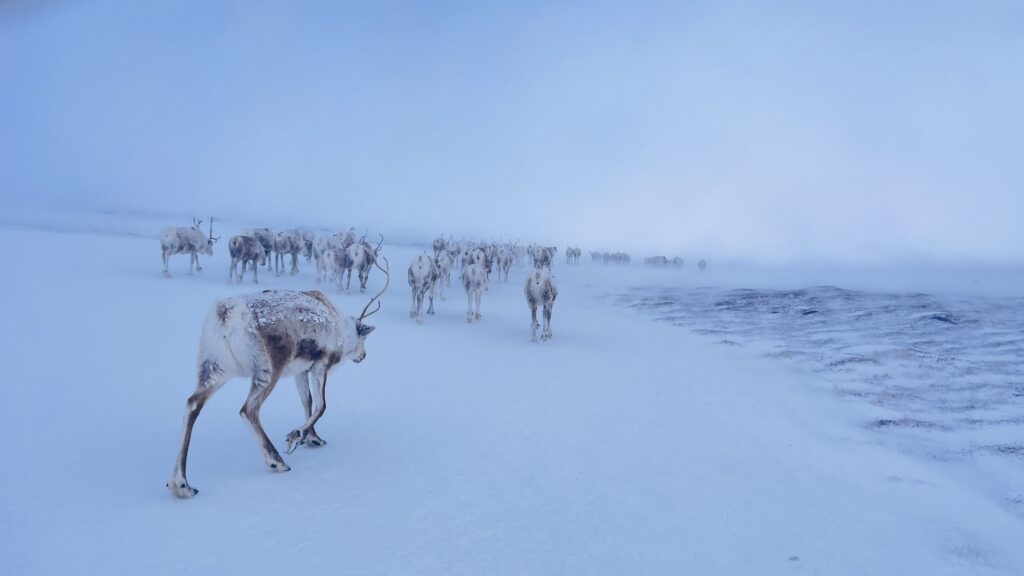
Daisy: It was morning briefing in mid April and we were contacted to inform us the reindeer had moved right up onto the mountain plateau not too far from Ptarmigan Station. This was going to be a pretty long walk for us to make it up to the reindeer, find them in some pretty interesting conditions, and then herd them down off the mountains to one of our free range visit spots. Thankfully, Cairngorm Mountain staff came to the rescue!
Andi: A quick phone call to Cairngorm Mountain and they were happy to help us with a ride up on the shiny Funicular Railway – a unique scenic ride which is a destination in itself. For us, this would save us around an hour of uphill walking in blizzard conditions, and made the difference between needing to abandon our Hill Trip plans (with lots of hopeful visitors already booked) and hopefully managing to retrieve our reindeer in time for everyone to enjoy meeting them.
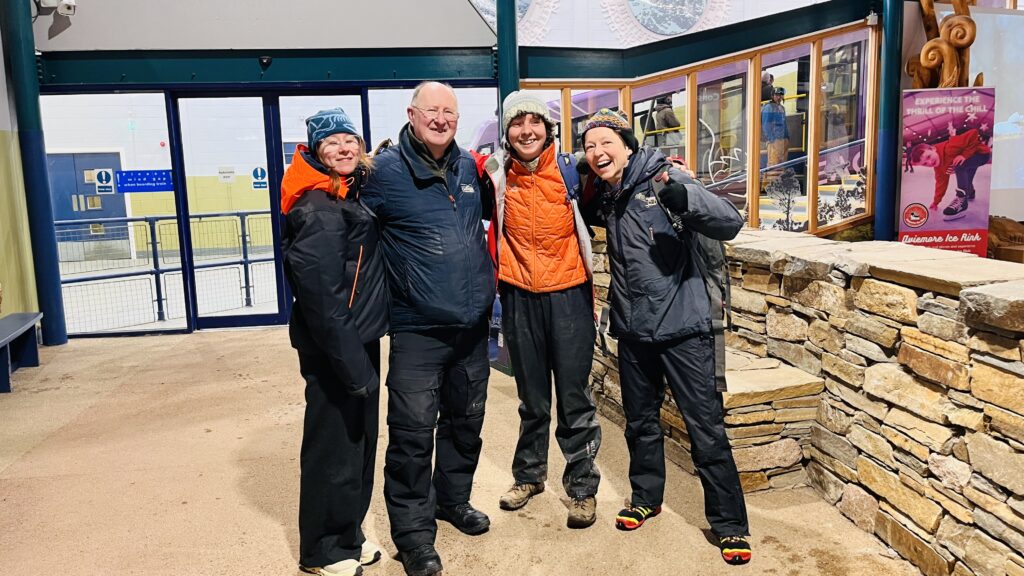
Thank you so much to the Cairngorm Mountain staff who let us hitch a ride on the Funicular to the top of the mountain!
Daisy: It certainly felt like setting off on an expedition that morning with Andi. We had all our gear on, map and compass in our bags alongside lots of reindeer food, and jumped on the mountain railway. A really cool way to start off a herding trip for the day! I actually had never riden the train up the mountain before so we grabbed a front spot and watched the snow get deeper and the visibility worse.
Andi: Travelling from Glenmore, where it felt like spring, to the ski car park, where it was cold and wintry with a little snow, it felt like we were going to a different world as the train took us into the cloud and the weather closed in. Definitely a day where knowing that you have a storm shelter in the bag is reassuring!
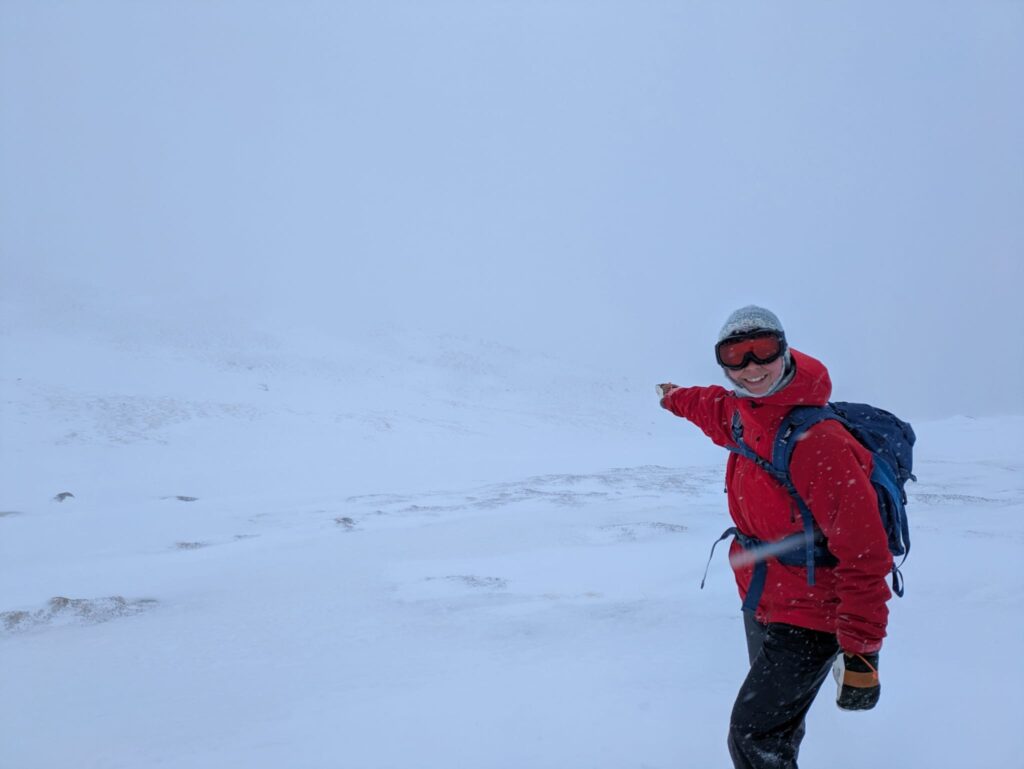
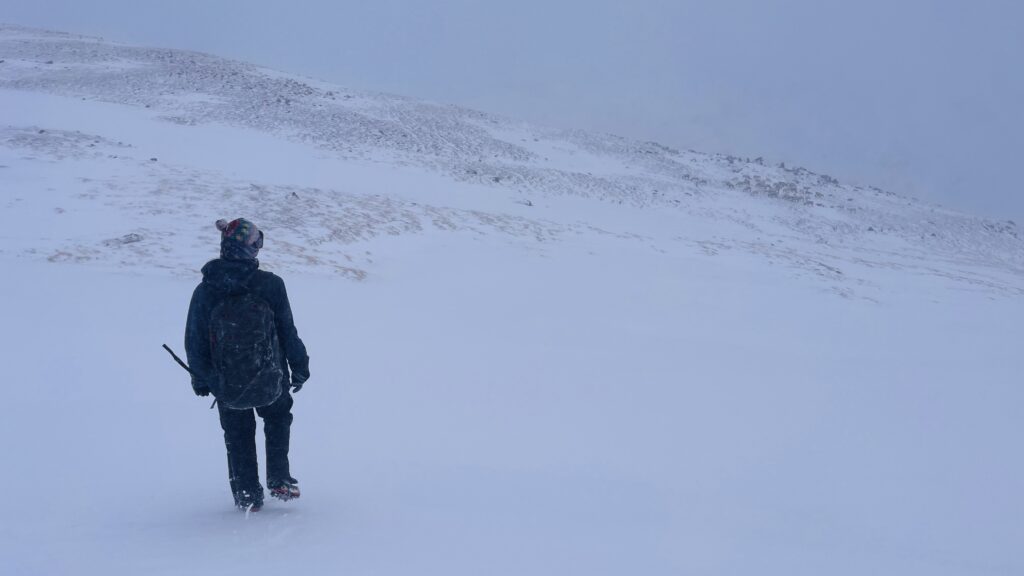
Daisy: As soon as we stepped out of Ptarmigan, we were hit by a pleasant enough breeze carrying some of the snow down the mountain. I pulled my microspikes onto my boots and my ski goggles over my eyes, and followed Andi along a snow fence and up away from the restaurant and Cairngorm summit. A few patches of deeper snow to stumble through, and a lot of frozen ground and sheets of ice that made for nice walking with the spikes on. We crossed past the final lift before the plateau and set off into a frozen, snowy, rocky landscape with little to no visibility. It’s funny to think how many people wander the plateau and hike these beautiful mountains throughout the year, because in that moment it was like we were the first people to explore what felt like a different planet.
Andi: Whilst I’m pretty familiar with our local mountains, having pottered around after reindeer for the past 15 years, it is a whole different ball-game in a blizzard. Visibility was between 10 and 30 metres, and it is so easy to see how people get completely disorientated. It takes a lesson in trust to believe the compass bearing when your brain can play tricks on you, making you think you’re heading in the opposite direction.
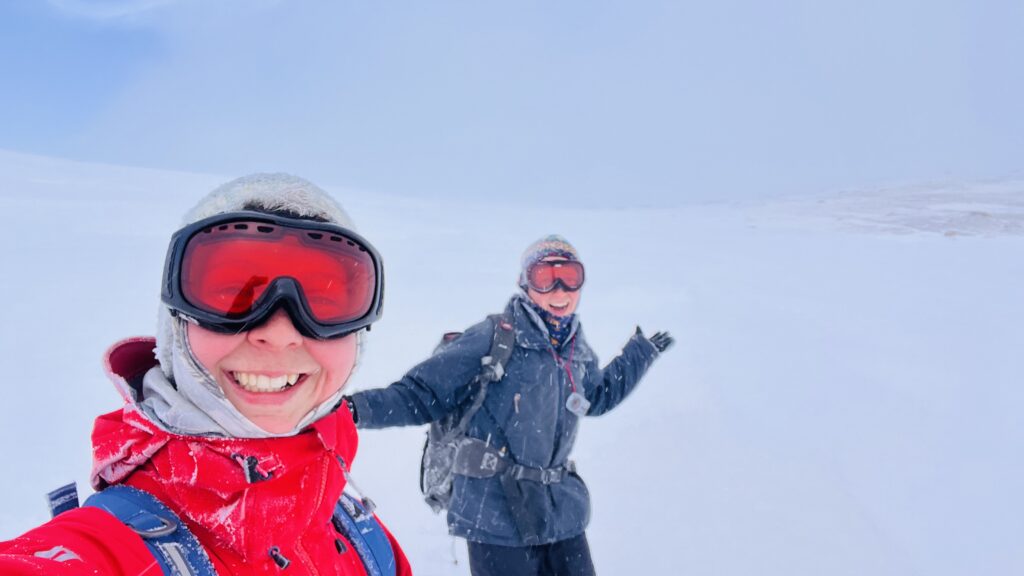
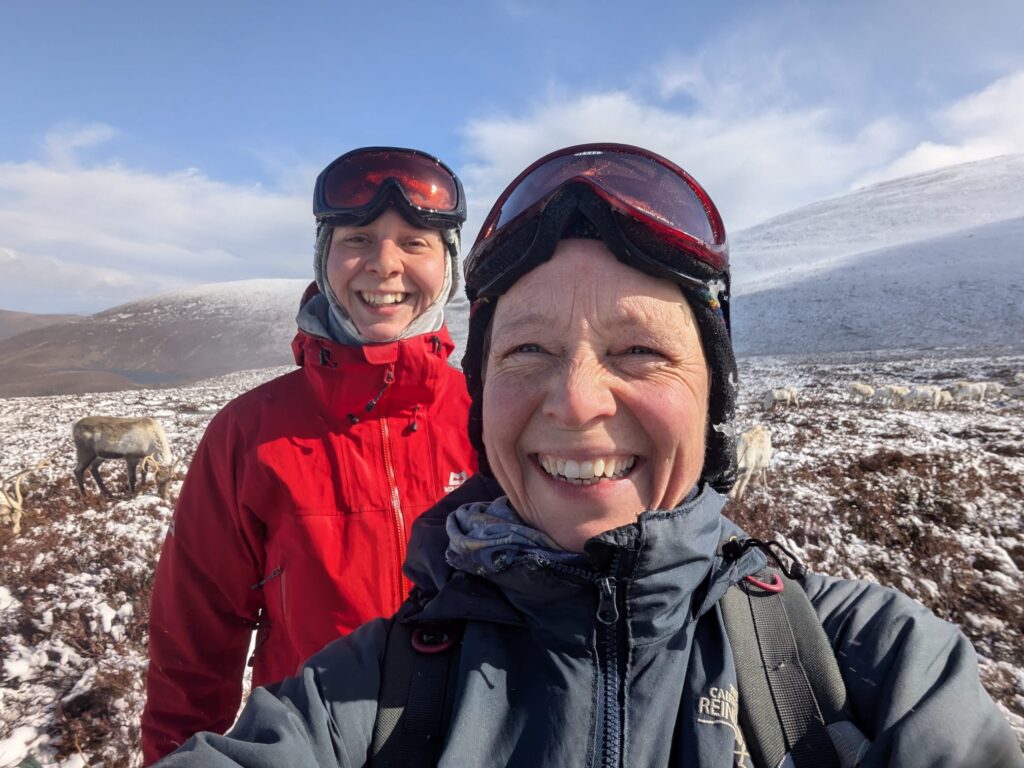
All smiles navigating to the reindeer in white out conditions on the Cairngorm Plateau.
Daisy: We used a combination of a good old trusty compass and Google Maps to navigate through the white out. Despite the freezing temperatures and snow that was blowing up off the ground, we were actually nice and toasty in very excited high spirits the entire time. Looking at the satellite imagery on Google Maps of roughly where we knew they were, I made up names for all the features I couldn’t see in front of me, and was probably really reassuring to Andi when I kept repeating “the reindeer should be at the bottom of the orange segment just in front of us”.
Andi: Between Daisy using the tech to pinpoint where the reindeer should be, and me keeping us on a compass bearing with the old-school methods, it felt like we had a plan! It was reassuring having two brains on it, keeping each other right and cross-referencing to ensure we were on track. Most of our reindeer herding is not done in a white-out, so it was a fun challenge to be testing out our nav skills.
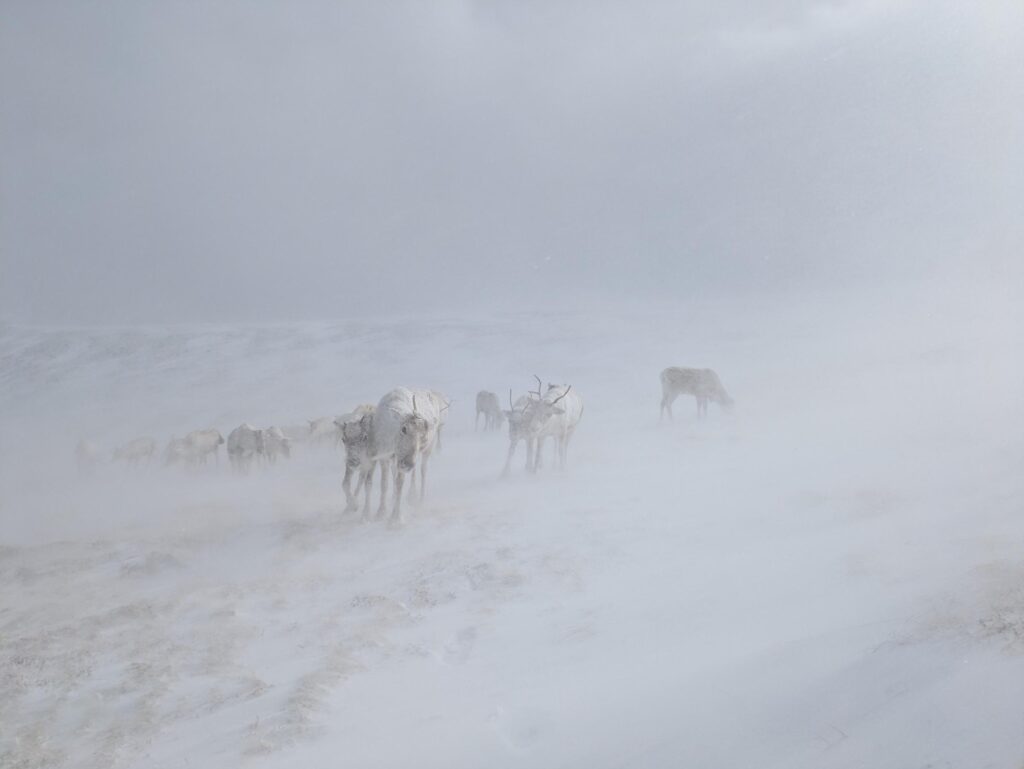
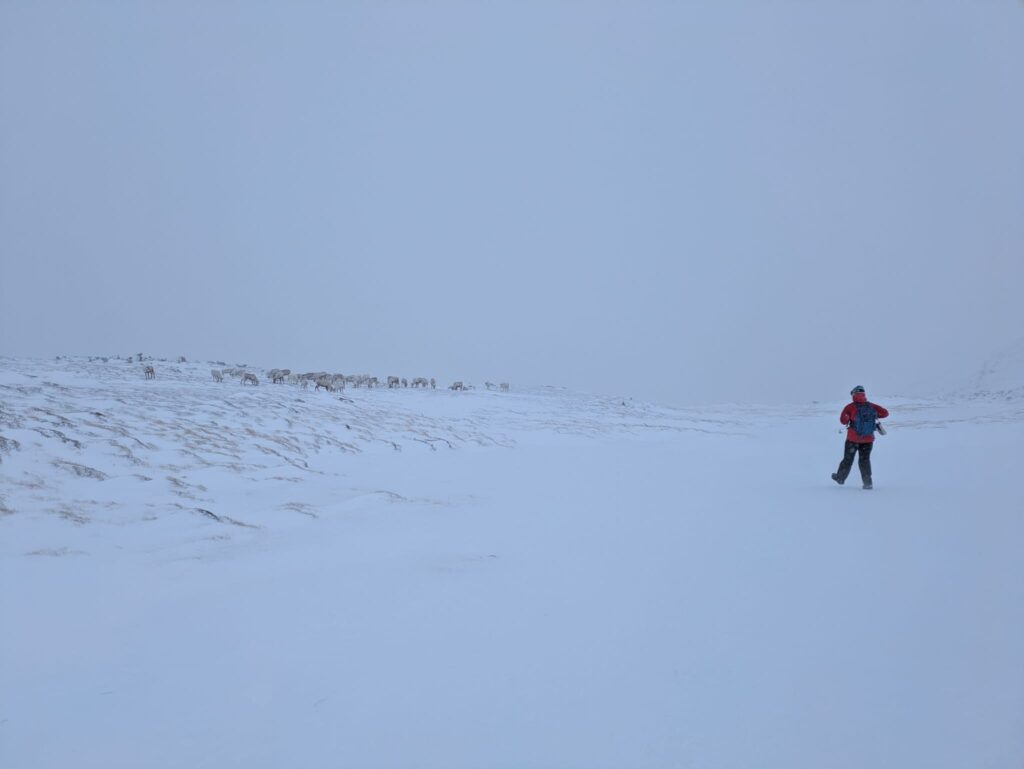
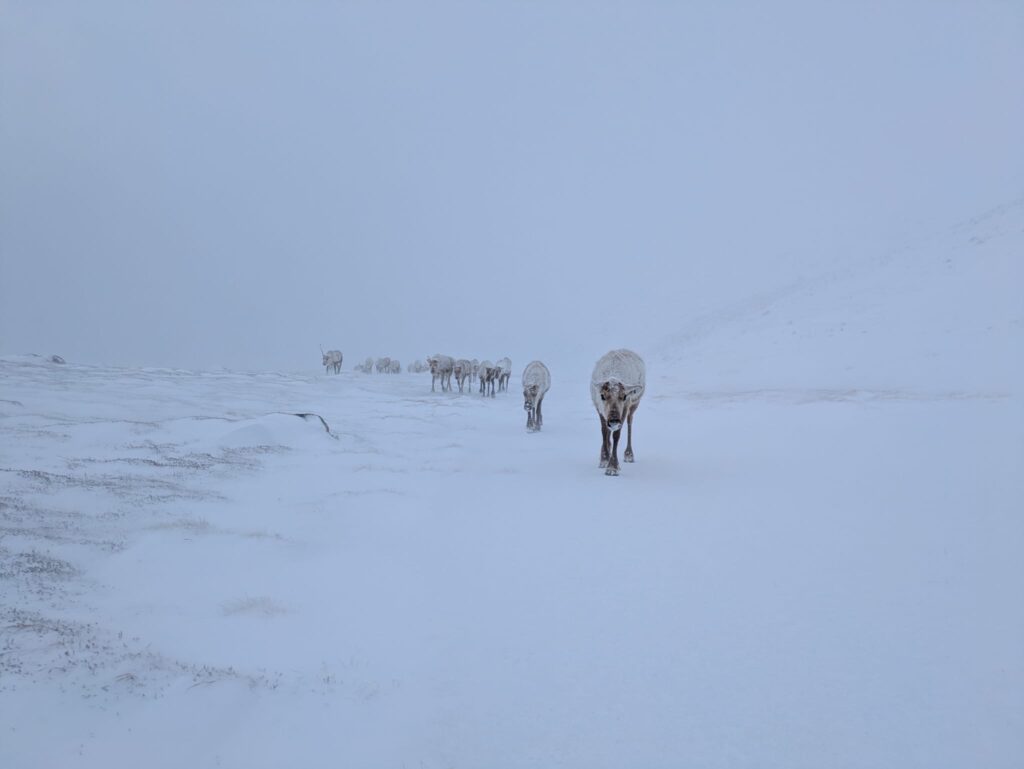
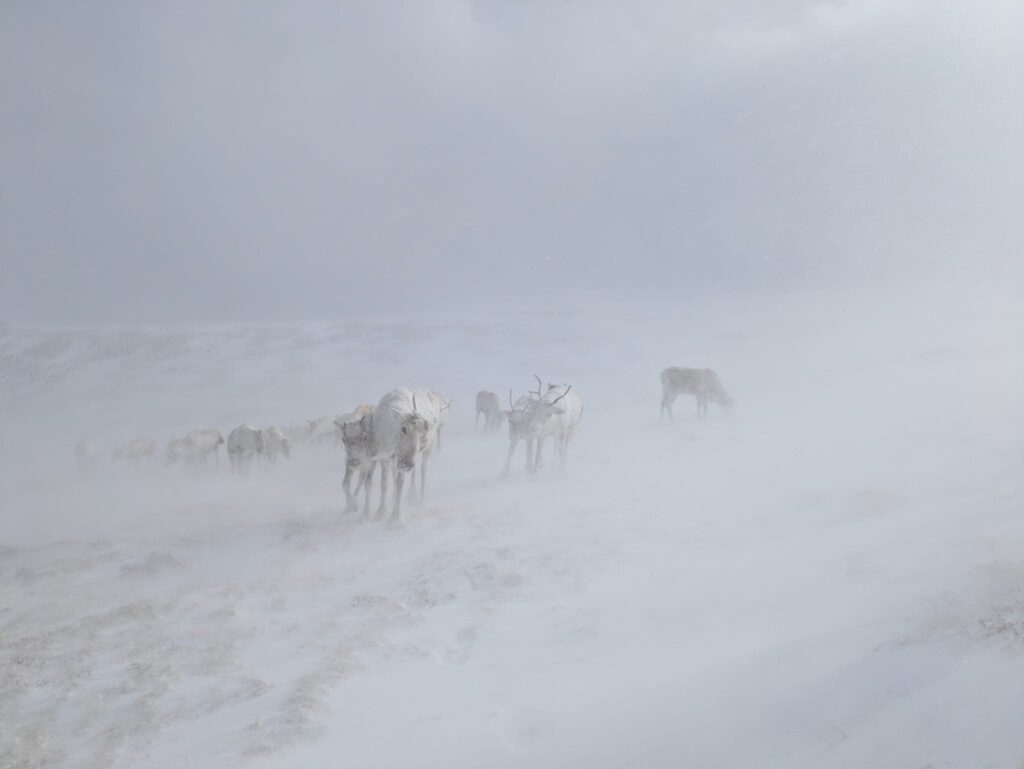
We found the herd! (Trust us, they are in the photo…)
Daisy: We came to a stop and scanned the landscape, the reindeer should have been metres from us at that point. Then like magic, some cloud lifted and Andi pointed off into the distance: “Reindeer!”. There they were, 73 reindeer hunkering down on a hill edge. Several cheers followed as we dug our spikes in to descend a small ice sheet to get to them.
Andi: I was glad to have a fair bit of experience picking out a herd of reindeer on a hillside, as their camo was excellent, but something in the shape/shade of these particular bumps ticked the box of not just being rocks! It felt like such a prize to have managed to follow our bearings directly to them.
Can you spot the reindeer? The hard part’s over right?…
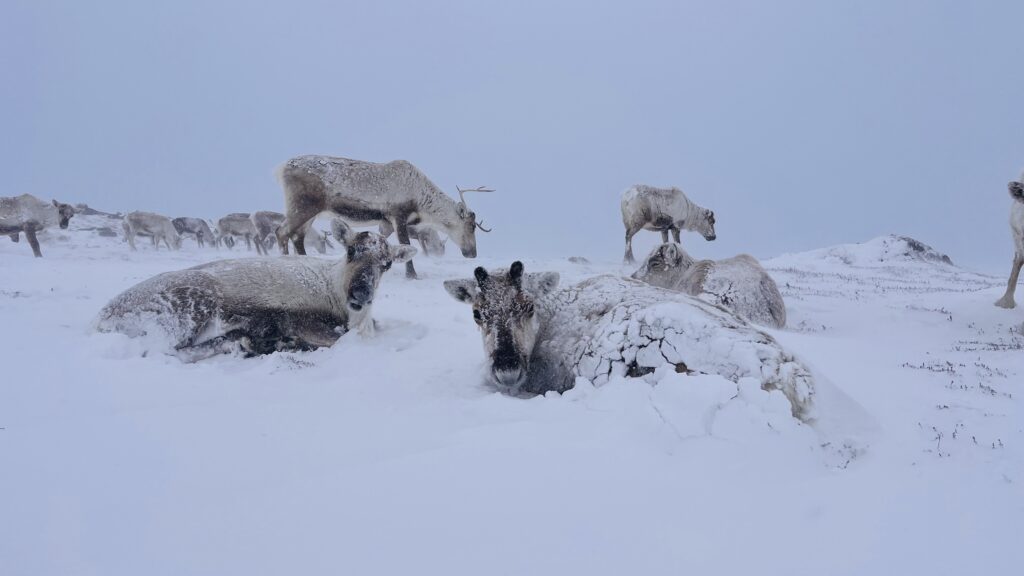
Daisy: It was my first time seeing how effective a reindeer’s coat is against heavy snow and winds and it was amazing to see the snow piling up against them. As I got nearer and walked around the back of the herd to encourage them up, I could see just how cold it must have got overnight with all the frozen snow and ice on them – not bothering them at all!
Andi: It amuses me how reindeer are so blase about weather, actively choosing to wander up to exposed ridges in the worst of conditions. There is actually method in their madness, as wind will blow snow off the ridgeline, meaning they have to dig less for food, and there is also less risk of getting stuck in a snow drift. But still!
Thanks to the hollow guard hairs that make up the outer layer of a reindeer’s coat, the snow doesn’t melt on them. This keeps them warm on mornings like this, lying in the snow at -4.
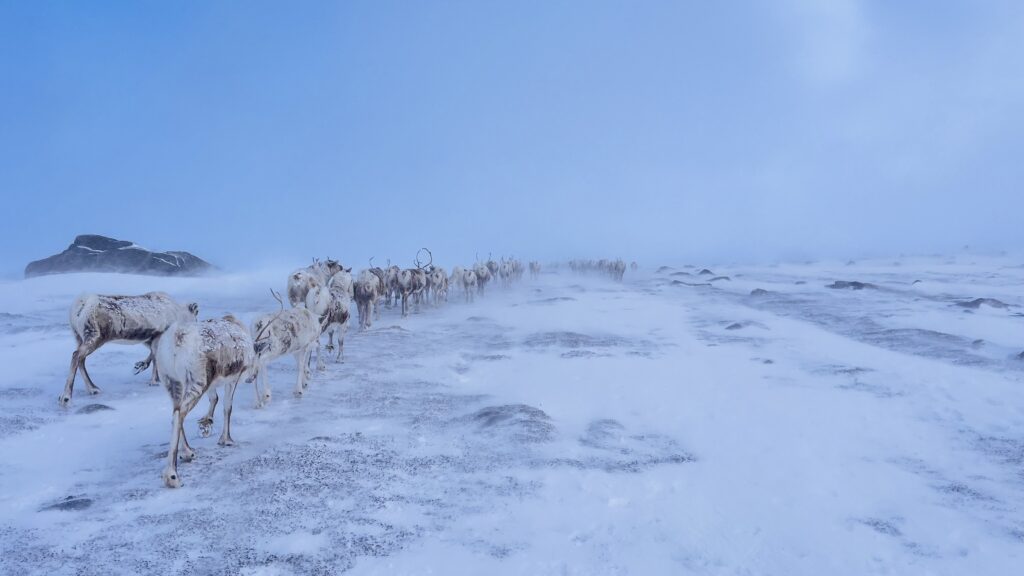
Daisy: With the herd up and already eager to follow Andi, we set off into the white to move the reindeer off the mountains and down to much lower ground. It wasn’t long before the winds started to pick up and throw quite a bit of snow at us. The herd stuck together really well and I got my first experience of how they stay together in low visibility. Usually they spread themselves out a fair bit when on the move, some will stop to graze and take their time – but in the harsh windy conditions and terrible visibility they were staying close as a herd the entire time.
Andi: The herd were in a very co-operative mood and as I set off in the right direction, shaking a bag of food, they all trotted after me. I tried to set a pace where the herd were close enough to me that I could still see Daisy, who was following at the back. It felt sensible to be able to keep an eye on each other!
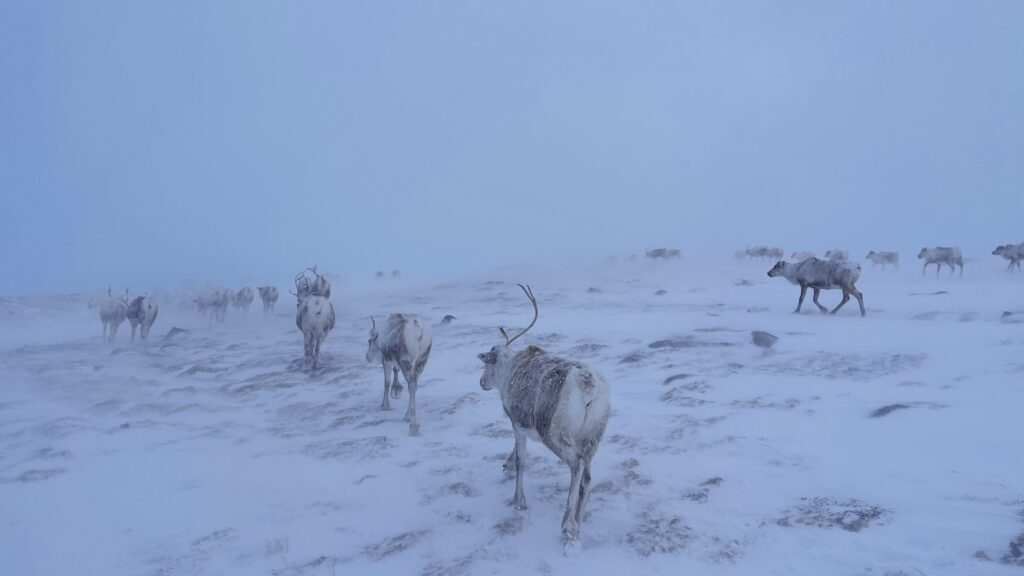
The winds started to pick up as we got lower, here you can see gusts of snow blowing up from the ground and gusting into the herd.
Daisy: I’m glad that it was actually probably the easiest herding I’ve ever done, the reindeer wanting to get off the windy plateau as fast as we did. It gave me plenty of time for photos and to take in how amazing the experience was. Plus I was able to focus on my own struggles in the wind – like making sure I didn’t get blown over every 30 seconds!
Andi: As the wind buffeted us, humans and reindeer alike, I had to stop myself from feeling guilty that the reindeer were in these conditions, reminding myself that they had chosen to come up this high themselves!
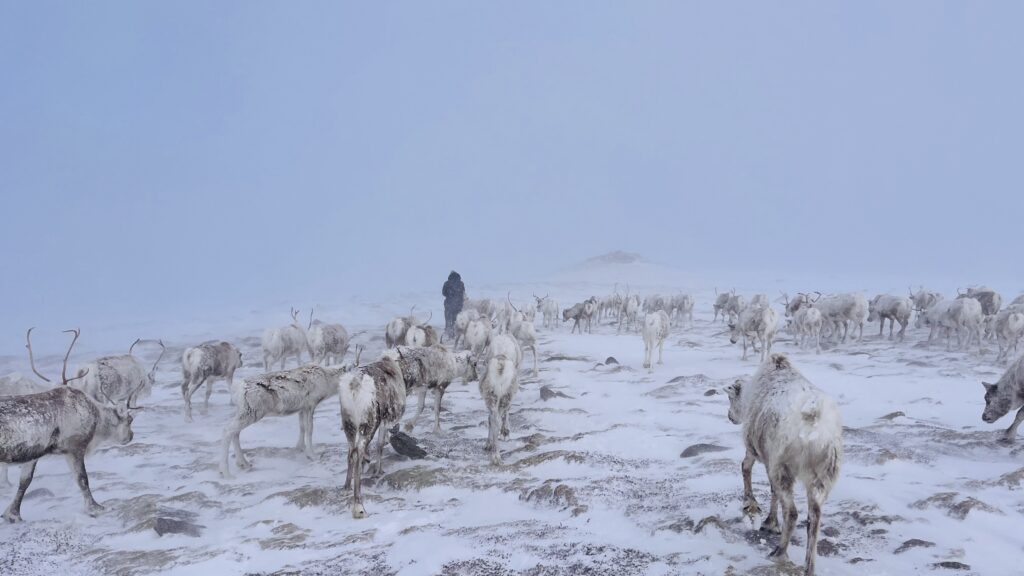
Daisy was pushing the reindeer from the back, watching them disappear into the snowy winds ahead. As Daisy watched them disappear, Andi watched them steadily appear following her to lower ground.
Daisy: I was so grateful to be at the back! Apart from making sure I kept up with the herd, (which did involve the occasional sprint whenever they ran on ahead to regroup around Andi – slightly stressful as I’m much slower than a reindeer!) I at least didn’t have to worry about navigating. Andi had to lead 73 reindeer and one herder down off the mountains following just compass bearings!… I did not envy that task at all.
Andi: When fetching the herd, we generally take turns at either leading or pushing. Today Daisy had volunteered me to lead, as I knew the hills better than her so there was some theory that I would pick a good route. In reality, I’ve found it’s a case of heading in roughly the right direction, glancing back at which way the savvy reindeer are going, and repositioning yourself to be in front of them, which makes it look like you knew exactly what you were doing… The reality is that the reindeer spend their whole lives in these mountains and know them far better than any human. Once you have the herd on side, the job of leading becomes much more straightforward, though it is the first time I have brought reindeer in whilst using a compass!
The visibility continued to get worse, but thankfully Winnie (seen in the middle here) kept Daisy company at the back the whole way and made sure she didn’t get left behind!Andi leading the herd solely using compass bearings!!
Daisy: The further we got and the lower we started to descend, the higher the wind speed increased and the snow began to feel like needles being fired at us. I quickly lost any feeling in my face, and loved watching how the reindeer turned themselves into the wind, the cows with their calves sheltered alongside them. While I struggled to stay balanced on my feet and really starting to feel the cold bite – the reindeer were in their element! Sticking together as a herd and following the hoof prints of the reindeer in front of them.
Andi: Whilst the reindeer made it all look easy, the conditions were not so easy for us humans. As we began descending we encountered more deep banks of snow, which resulted in a couple of complete face plants for me! The look of confusion from the reindeer at how useless us two-legged-creatures are was pretty funny!
Andi’s view of the reindeer fighting against the wind gusts as we dropped off the plateau. The wind speed was gusting up to 72mph during our herding mission!
Daisy: We had finally made it low enough that the cloud cover began to lift and I could see all the recognisable land marks to suggest we had nearly made it! We had one last push over a steep bit of rocky ground that proved quite difficult to navigate in the high winds and deep snow – at this point I had stopped bothering with my count of how many times I’d fallen over in suprise patches of knee deep snow. The reindeer were even bracing the final harsh whips of wind for some lichen grazing! The last stretch to the visit spot they picked up pace downhill towards Andi and I watched as they swapped to a very wide gait in the way they were running. It looked pretty comical – their legs so far out to the sides as if they were going to skid on their bellies at any moment, but worked perfectly. Their hooves hardly made a dent in the snow and they kicked through patches of powder at speed. I did attempt my own version to see how effective it would be for a person, and even tried to keep my boots in their hoof prints. You guessed it… I built up a lot of speed before hitting the snow hard and my arms disappearing in front of me. Thankfully only Winnie saw, who gratefully had kept me company the entire walk. I won’t be trying to run like a reindeer again anytime soon!
Andi: By the time we reached our ‘visit spot’, we were low enough to drop down out of the cloud, the skies were clear and there was only a smattering of snow on the ground. We fished out the reindeer feed from our backpacks and the calves tucked in – we give them a brief preferential feed through the winter. The adults know the drill and waited patiently, then we popped out a line of feed for everyone. A quick headcount – everyone was present and correct.
Andi couldn’t get the bag of feed open quick enough for the hungry calves after the long journey. Look at the difference in the weather at a couple of hundred metres lower altitude.Boogie helping Daisy get frozen spikes from her hiking boots.
Daisy: We had done it! Thanks to Andi’s amazing navigation, we had successfully led the herd of 73 reindeer from the mountain plateau down just in time for the days Hill Trip! We fed the hungry reindeer and checked we had everyone and they were all looking happy and healthy and then had a moments breather to chat about how amazing the experience had been. I can confidently say, that herding adventure was the best experience I’ve ever had! Being in such harsh conditions with the wind, the snow, the lack of visibility – it felt like being on a different planet. Experencing the kind of conditions the reindeer are built, not only to endure, but to happily live in felt like such a privilege. Stumbling and running after them at points to keep up, gave me even more respect for how incredible animals’ adaptations are to their home environment, and how much of a privilege it is to experience nature at its best!
Andi: Many visitors assume that being a reindeer herder means you’re incredibly fit and spend all of your time running round the mountains. The reality is that a lot of our job is actually based in the office, shop, and working with visitors. Yes, we do get to roam around on the mountains too, but the weather is not usually quite so gnarly! We had so much fun testing our skills and experiencing the extremes that the reindeer are so at home in, and were buzzing for the rest of the day! It really felt like we’d voyaged to a different planet…
We all have favourite reindeer in the herd and over the years I had a very special reindeer, Beauty, who I hand-reared, back in 1993. Beauty’s mother Sorrel died when Beauty was born and I became her mother, a relationship which lasted her whole life even though she had calves of her own. Indeed I felt a bit like a granny as a result!
Beauty
Beauty died an old lady and for many, many years there was never really a reindeer for me who filled the gap. There have been some great characters since Beauty but none of them were really special enough to replace her. Various reindeer were hand-reared, but not solely by me and although each reindeer has a distinct character there was no real favourite. But over the last 4 years a reindeer has grown on me and now I can honestly say, I have a favourite again.
Baby Olympic
Olympic was born in 2012, in the year of the London Olympics, hence his name. His mother Glacier came from a long line of white reindeer and so when Olympic was born dark coloured, that was a bit of a surprise to say the least.
Olympic with mother, Lilibet
So he was the ‘black sheep of the family’. He grew tame and friendly like all the other calves once they are handled, indeed Olympic became quite outrageous when it came to hand-feeding, terrorising many an unsuspecting visitor on the hill visits. Which meant, in time Olympic was banished to the quieter life at our Glenlivet Farm, where visitors to the herd are less frequent and so life with Olympic and hand-feeding became manageable.
Strangely enough although Olympic is a very bold reindeer and eagerly comes up to us, amongst the reindeer he seems to be quite low down in the pecking order, almost to the point that he is a little bullied! Although he is a big strong reindeer he is just a big softy and another reindeer only has to so much look at him and he’s off. So Olympic often seeks out human companionship and whenever I am bringing the reindeer down off the hill for the daily feed Olympic is often right there beside me. So we have developed a close relationship and as time has gone on Olympic has grown on me and become my new special reindeer.
Olympic as a yearling
Last autumn we trained Olympic to harness and he joined the teams at Christmas time. Handling reindeer, gaining their confidence and harnessing them to pull a sleigh is a real joy for me. I love the close contact with the Christmas reindeer, feeling so responsible for them when away from home and proud of them as they delight the crowds who come to see them. Olympic was a delight to train and looks fantastic in full harness. He is as much at ease pulling the sleigh alongside another reindeer as pottering along at the back of the sleigh with the 6 month old calves. And I think Fiona, who organises Christmas now and decides which reindeer goes where made sure I had Olympic in my team! Thanks Fi!
Throughout much of the western world, the creation story known is that of Adam and Eve, and perhaps this is the most well-known. The Sámi, however, believe that in the beginning there was only the Sun and the Earth. The Sun was the father, and the Earth the mother, and together they created a Son. The home of the Son of the Sun did not have any females, so he set out on a boat to the land of Giants to find a wife. There, he fell in love (or lust), with the daughter of the blind Giant King. With the help of the daughter, he won a game of finger pulling against her father and earned the right to marry her. They were then intimate, and then sailed away. However, they were pursued by her angry brothers who wanted her back. The couple defeated the brothers with her magical handkerchief and the Son’s hot rays, burning the men to death, essentially. They were married, and she soon gave birth to the ancestors of the Sámi, the Gállá-bártnit, who were hunting sons and passed their hunting knowledge down to the Sámi.
There aren’t many pictures to go with this blog, so I thought I would just put some pretty reindeer as eye candy. This is the beautiful Wapiti.
The Sun and the Earth also had a daughter, which the Sámi believe came to earth to live with the Sámi. She gave the Sámi their reindeer to herd, and looked after them. When she was on her deathbed, she talked about wanting to see her Father, the Sun, again, because the darkness was coming in and she worried for the Sámi people. The story of the Son is all about optimism for the future, whereas the poem about the Daughter is about uncertainty and the need to pray to ensure the future of the Sámi way of life.
The Evenkis of Russia and China believe that the earth was all water and was not inhabited by people, until a maiden with an eight legged reindeer created the land. All the people lived in heaven, and when she refused to marry an old man, she was cast out of heaven, because such refusal was a great sin to the people in heaven. Her late father had left her one reindeer, an eight legged beast who she took with her when she was banished. She cried and cried, and fell asleep on the reindeer as they flew to earth. When she woke up, she realised her reindeer was not flying, but falling. The reindeer spoke to her, telling her to pull out his fur and throw it into the ocean below. She did as was told and logs appeared. The reindeer landed on the biggest one. He told the girl to tie them together to make a raft, so she did. There they floated on the ocean of earth, fishing with hair from the reindeer’s neck made into nets and loops, until the reindeer grew old.
Realising he would soon die, he told the girl to kill him. She wept, not wanting to kill her only friend, but he warned that if she didn’t she too would die. The girl reluctantly did as the reindeer wished. She lay his skin on the water, and it became land. His fur became forests and his skull became mountains. His lice became wild reindeer and his broken bones turned into crackling thunder. Before she lay down to sleep that night, she placed his heart on her left side and his lungs on her right. His heart became a hero and his lungs a boy and a girl. His last breath became the wind.
The herd running for food
I hope you’ve enjoyed having a read of these little stories and I hope I have told them well. If you know of any others, tell us in the comments below.
They say you should avoid filming with children and animals and there is no doubt that both can be unpredictable. However in the case of our reindeer I think there is an exception to the rule and whether we are filming with celebrities or for natural history our reindeer are always very amenable, willing and predictable. As long as there is a reward – food.
A couple of years ago we were approached by a TV company, Maramedia, with a view to filming our reindeer as part of a four part series on the natural world of the Highlands – Scotland’s Wild Heart. We were really pleased to be considered as part of the Highland fauna because our reindeer are a re-introduced species to Scotland and so ‘purists’ may feel reindeer should not have been included. But the Cairngorm reindeer are truly living in their natural habitat and as the filming showed, highly adapted to the Cairngorms, Britain’s only arctic environment.
The film crew decided to focus on our reindeer in the autumn and winter, seasons when reindeer are looking at their very best. The rutting season in autumn is always a spectacular affair and every year we have a number of breeding bulls who sometimes ‘fight it out’ to decide who will be ‘top dog’.
In 2014 the two main bulls were Bovril and Gandi and they were very evenly matched. They were also quite different colouring and so in the narration Ewan McGregor referred to them as the pale bull ( Gandi ) and the dark bull ( Bovril ). It made me smile because it sounded like something out of a western!
Fiona starring in Highlands Book
When reindeer bulls fight it is head on and locked antlers and a trial of strength, a bit like arm wrestling but with more action! Size, strength and experience (which comes with age) all come into the equation.
The film crew then returned a few more times over the winter to film reindeer living in arctic conditions. Of course reindeer are past masters at this and a bed of snow is extremely comfortable for a reindeer, who have such a dense insulating coat they don’t even melt the snow they are lying on! At a preview night where the makers of the series showcased the series to a local audience the camera man who came to film mentioned it was the coldest he had been when filming the reindeer in winter. He should have had a reindeer coat on.
Tilly
The “Highlands: Scotland’s Wild Heart” book
We currently have the beautiful book which accompanies the Highlands: Scotland’s Wild Heart series in stock in our shop. You can pop into the shop in Glenmore and pick it up for only £25, or order by emailing or telephoning us here at the Centre. P+P on request.
Recently we attended the Kincraig Fayre. We threw a few reindeer in the trailer and drove down the road. Kincraig is only 15 miles from the Centre so we headed out for the afternoon. Kincraig is a small highland village in the Strathspey, and every year we attend the Kincraig fayre; it is a great way to meet some of the local people.
Preparation for a reindeer event needs to happen first thing in the morning. We need to bring the reindeer down from the hill so we head up first thing to hand pick some friendly reindeer. We decided on four reindeer to bring down from the enclosure. All of our reindeer are trained to walk on a halter. So we shepherd Strudel, Jonas, Cambozola and Aonach into a small pen, where we put a halter on each. We can now walk them along out of the enclosure and down the path to the road. It is quite funny walking a reindeer, imagine you are out walking your dog, now imagine your dog is three feet tall, with giant antlers and wants to eat all the leaves off the trees! Once we are at the road we can load the reindeer into our special transport truck. Then the short drive down to the centre to unload the reindeer into the paddocks where they will spend the time socialising with the tourists and the paddock reindeer until it is time for the fayre.
So as it happens we decide to load the paddock reindeer into the truck and take them to the fayre for a change of scenery. The paddock reindeer on this day were Fergus, Scrabble, Sooty and Matto. With the reindeer loaded, we gathered some food for them, along with buckets for water. We loaded several hurdles which we will use to build a temporary fence to enclose the reindeer. Down the road we drive, past Loch Morlich and on towards Aviemore before joining the B Road south. We shortly arrive in Kincraig and are greeted with waves and children shouting excitedly “Look, the reindeer are here!”
We spent a lovely afternoon in the sun, speaking with local people about our reindeer. The four reindeer are enclosed on a patch of grass next to the Community Hall. The reindeer curiously wondered around the enclosure munching grass and occasionally allowing people to pat them and feel their warm coats. The reindeer ate plenty of mix and had water to drink, while we made sure to sample the cake and the candy floss. The event passed by without drama. We did keep a pretty close eye on Fergus though as we half expected him to try and jump over the fence. But even Fergus behaved and event came to a close around 4.30pm.
Well, he stole the hearts of many a visitor last year and we are often asked for updates on the boy, so I thought I’d do a quick blog about the naughty man. I am, of course, talking about the darling little Fergus!
Fergus looking angelic on the hill
In June 2015, Foil gave birth to a baby boy. She was a relatively old mother at 13 and unfortunately became ill only a few days after having her calf. We did our best to look after her, but sadly she passed away. The average life span of a reindeer is around 12-14 years, and the vet thinks that Foil had a heart problem, probably linked to old age. This left us with a baby reindeer to hand rear and the prospect of it both excited and dismayed us. Looking after a little reindeer is great, but when they need constant feeding and they decide to poo in your living room, sometimes it can be a little trying. I’m sure you parents out there are scoffing at our patheticness but none of us herders here at the centre have babies, and after this experience I’m sure it will be a while before any of us are having our own!
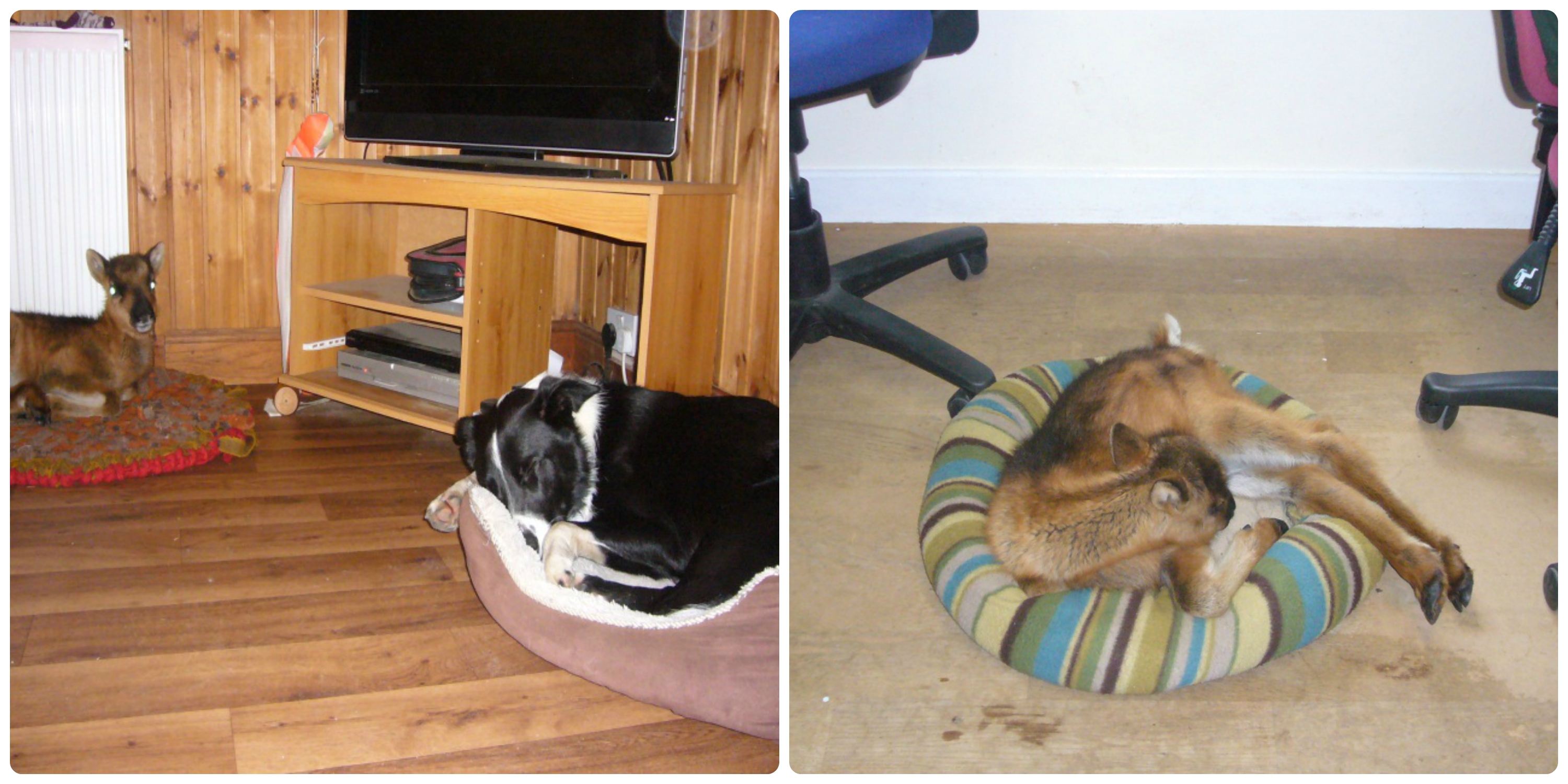
Fergus sleeping in a feed bowl, inside Reindeer House.
So, from 10 days old, Fergus lived at the Centre with a few of the herders. Luckily for them he spent most of his time in the paddocks, but herder Mel took a real shine to him and he was often found napping in her room on her rare days off. Fergus needed feeding 5 times a day, and he soon got to know the times to expect a bottle. He would often be found at the end of the paddocks closest to the house, grunting his little heart out for 5 minutes before his goat milk and growth powder formula arrived. It was always fun for our visitors to see him getting his bottle.
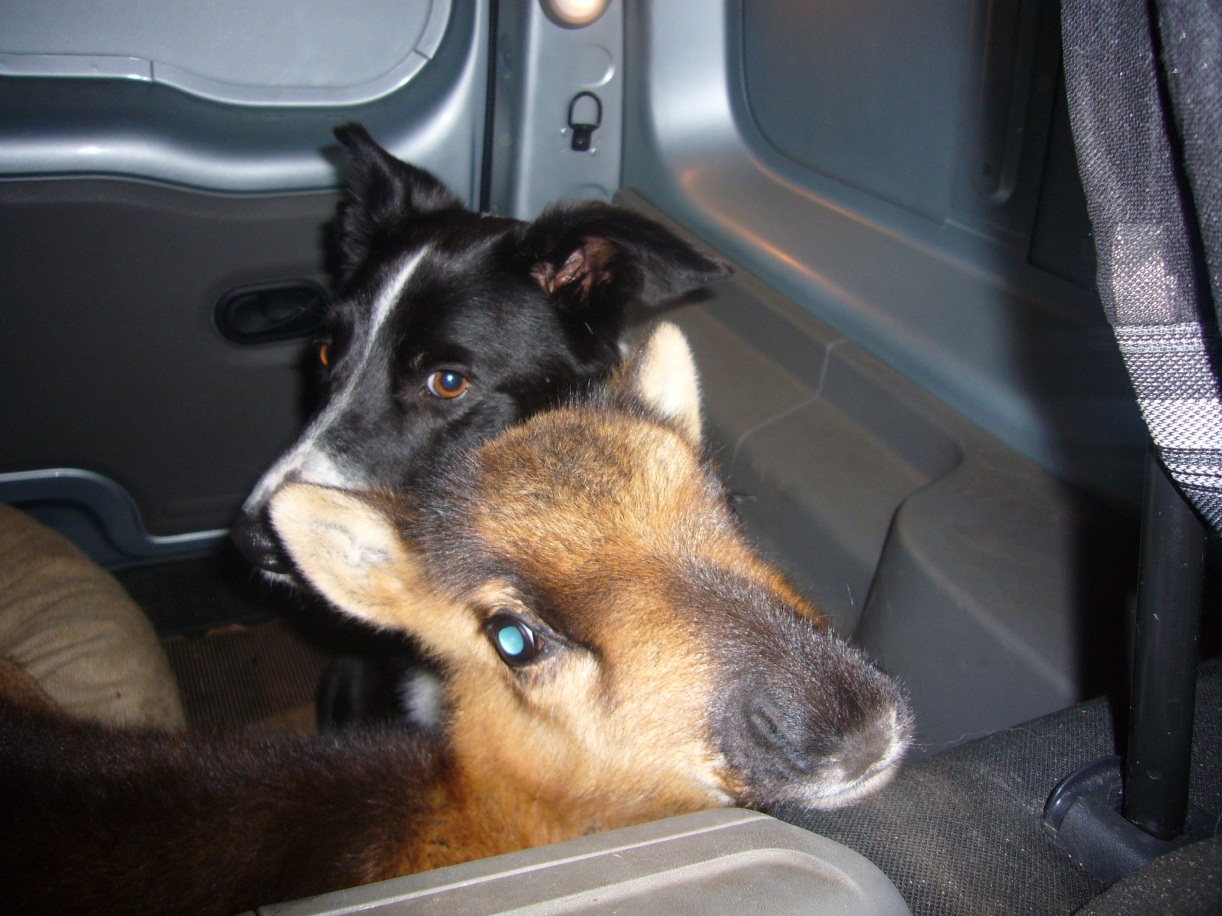
Fergus grew up with dogs around him so is not too worried by the resident reindeer house dogs – Tiree, Murdo and Sookie – who used to cuddle up with him. Murdo always loved to lick Fergus, making it look like Murdo had adopted the little reindeer! Fergus loved to sleep in the dog beds too.
Fergus and Tiree guarding the door
Murdo and Fergus on a ride up to the hill
Trying some different beds out for size
Fergus was quite the star last year, ending up in the Press and Journal, our local newspaper. He was even on the front page!
Fergus in the news and up on the hill
In the autumn, Fergus spent more time up in our hill enclosure, eventually living up there full time and just getting a few bottles a day whilst we were doing visits and feeding the other reindeer. Our other calves came back off the free-range and we started to train them to wear a headcollar. Fergus was already adept at this as we had been leading him on and off the hill earlier in the year, and he was a good role model for some of the other calves who were a little shyer around us.
Little Fergus ‘helping out’ on a trek in 2015
Fergus then went off on Christmas tour and of course, he went in Mel’s team. He is pretty naughty and managed to steal mince pies on one of his events, and was trying to nab some Celebrations chocolate on his posh Windsor event as well!
Fergus having a cuddle with ‘mum’ Mel
Then the day came when Mel had to say bye to Fergus, at least for a little while. He had tried bonding with the females way back in autumn, but didn’t really have any success, so had to go onto the Cromdale hills with our other boys to free-range for winter. Fergus had been living in the hill enclosure for a while before we took him and the last remaining boys from the enclosure over to the farm to be led onto the free-range. Mel was upset to see her baby boy head off, but it was the best thing for him.
Soon enough the winter was over and Fergus came off the free-range with the other boys, not a care in the world and ready to get fat over summer. He’s grown a lot since he was a calf, so has spent most of the year over at the farm as he has a tendency to jump on unsuspecting children and give them a fright.
Cheeky devil!
Fergus looking great at 1.5 years old
He has been to the Centre for a couple of flying visits, staying in the paddocks, and delighting our visitors. In April, Mel ran the Paris marathon and as a surprise Fergus was brought over here as a well done for her. We made him a little paper collar, congratulating Mel on her run and I’m sure she enjoyed having him round again! He’s been in the house a couple of times over the summer, but he is now far too big for the dog beds he used to sleep in. It’s also not quite so cute anymore when he does his business in the house!
Now Fergus is a cheeky reindeer as you know. His level of foolishness was put up a notch a few weeks ago while we were out painting. Dave was out in the paddocks painting the posts a new and shiny coat of red. Well, you guessed it; he turned his back for only a few moments and Fergus is rubbing his big nose up and down a freshly painted post. And sure enough he turns his face, proudly exhibiting a bright red nose. Though apparently, even with a red nose, Fergus cannot fly. Thanks for the entertainment Ferg!
He’s a hilarious little reindeer who will no doubt make us laugh for many a year to come. Hopefully he’ll get to come up on the hill in a few years, once he’s learnt some manners!
Exploring the meanings of unusual words and the Reindeer hoose Office wall…
To explain this rather dubious title, in our humble office here at Reindeer House there is a list of rather obscure words stuck to our wall: things like Jargogles, Apricity and Twattle. the latter meaning to gossip or talk idly – a lot of that goes on in our office to be sure!
Quite a few of these words we feel are quite apt for a few of our fluffy friends up on the hill so I’m going to introduce you to a few choice selections!
Snoutfair – A good looking person.
I feel this would obviously be quite apt for all the reindeer as they are such gorgeous beasts but Cheese obviously thinks very highly of themselves here!
Cheese being silly!
Cockalorum – A little man with a high opinion of himself.
If there was ever a reindeer that fit this description it would be Mo, Mo is a cheeky little fella and at four years old he’s definitely one of the smallest males in the herd and he more than makes up for it in attitude!
Handsome little thug, Mo
Lethophobia – The fear of oblivion
So this is a tad dramatic but definitely applies to one of my favourite reindeer Shinty. Shinty is originally Swedish and was imported back in 2011. He’s a super sweetie (I think) but painfully shy and often looks apologetic for just turning up in the morning. If any reindeer were to fear oblivion it would be him!
Shinty looking a little wide eyed and worried, as usual
Hugger mugger – To act in a secretive manner
To be honest this applies very well to the female reindeer during the winter months – at this time of year we have to find the reindeer every day and we do all of our visits out on the open hillside. The amount of times we’ve walked out for miles to then turn around and have an entire herd of reindeer smugly behind you is definite hugger muggery if you ask me!
The girls in winter, sneaking off to hide for the night
Jollux – Slang for being a wee bit on the chubby side.
Without a doubt the Jollux of the herd is Magnus, the lovely magnus loves nothing more than chowing down – unfortunately it’s rather hard to put a reindeer on a diet as the hillsides are covered in lovely grazing. This also brings me onto another great word – Callipygian: to have beautifully shaped buttocks. Magnus most definitely gives Beyonce a run for her money!
Magnus looking majestic and pretty tubby!
The final word, one used almost daily here at Reindeer House is Groaking – To silently watch someone eating, hoping to be invited to join them. Every time lunch hour hits there’s some person with a fantastic looking lunch….
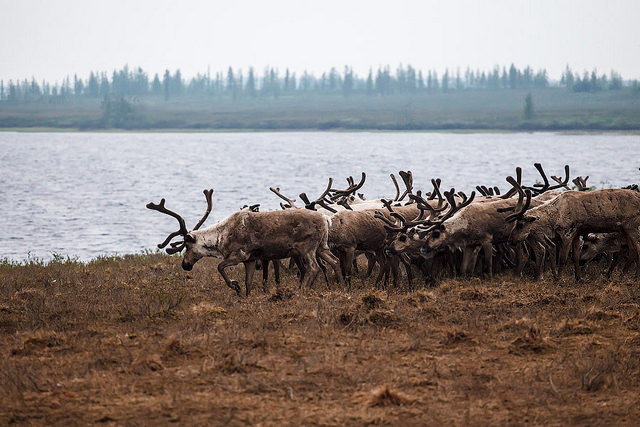
Recently via Twitter we were moved at the news of an anthrax outbreak in Western Siberia, the Yamalo-Nenets region, which has hospitalised over 90 reindeer herders and caused the deaths of almost 2,500 reindeer. The nomadic families herding reindeer across the area were evacuated or vaccinated – authorities are aiming to vaccinate over 40,000 reindeer. In the last few days, a 12-year old boy and his granny have both died.
It is thought that melting permafrost exposed the carcass of a long-dead reindeer, and dormant anthrax contained within it was exposed and became active. In cold temperatures the spores contained within the ground are capable of surviving up to 150 years; in warmer temperatures they morph into a more infectious state.
The melting of the permafrost is unusual, both in its location and its extent. Warming of the tundra this year has been unusually high, with temperatures of 35 degrees. Climate change is something you hear of more and more in reindeer literature and research around the world.
The habitats are changing – flora and fauna increase or decrease as ecosystems fluctuate due to climate, disease or human influence – for example, millions of hectares of birch forest are defoliated by outbreaks of moth now confined to northern latitudes due to climate; wildfires are more common as habitats’ defences weaken; lichens are reduced due to increased pressure on remaining areas and competition; more oil is piped out, disrupting migratory patterns; politics confine reindeer to particular boundaries; and as a way of life reindeer herding becomes more economically challenging.
In Yakutia, to the east of Yamalo-Nenets, there are around 200 burial grounds of cattle which died from anthrax. Perhaps hoping that they won’t be affected isn’t enough.
As a small Scottish reindeer ‘family,’ it is sobering to wonder about the slowly unfolding systemic impact on reindeer and herders around the world – but of course this is just a small part of a very large story, and we mustn’t lose sight of this larger picture that affects us all.