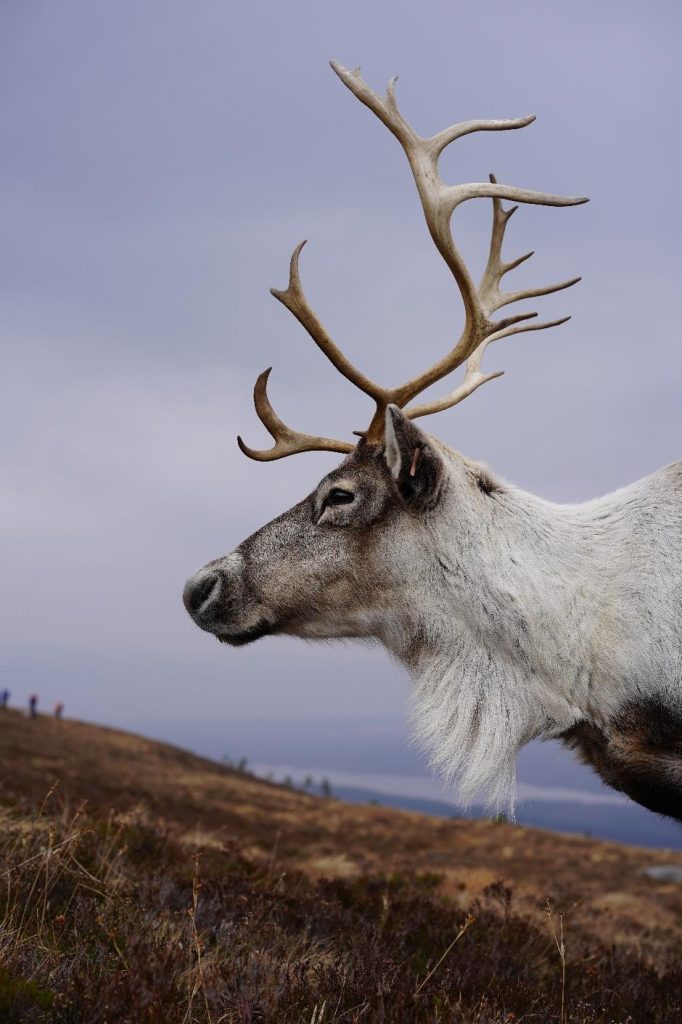
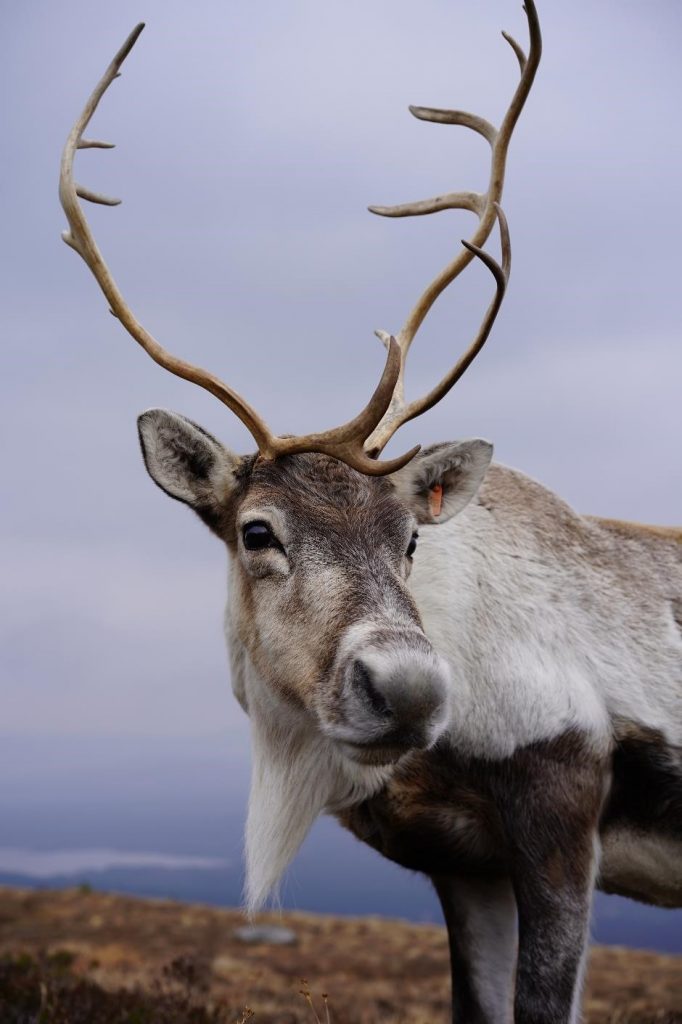
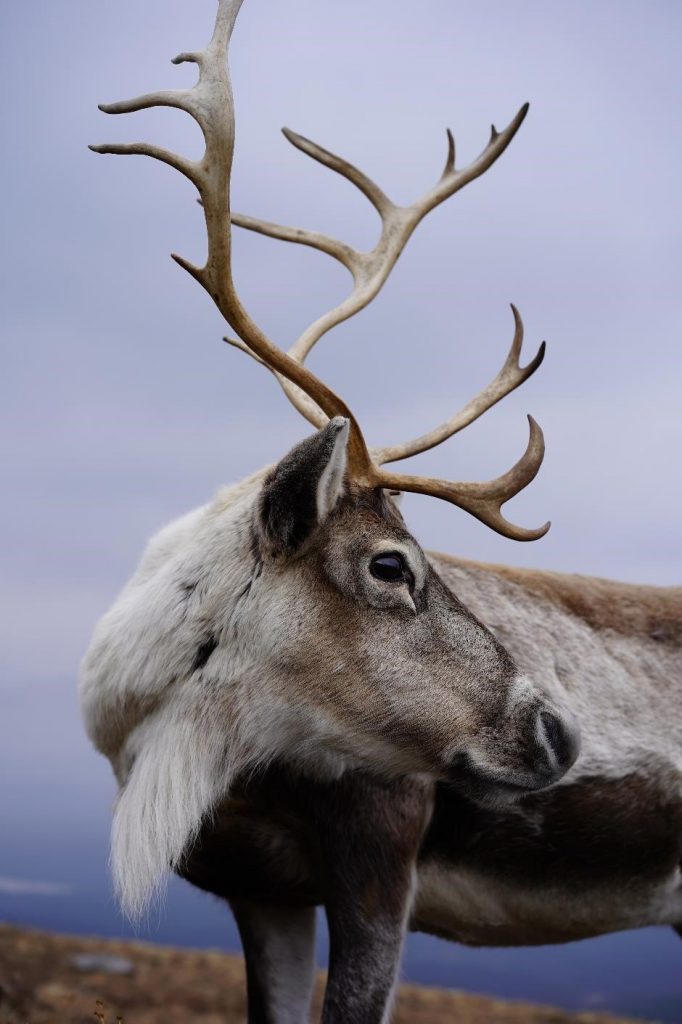
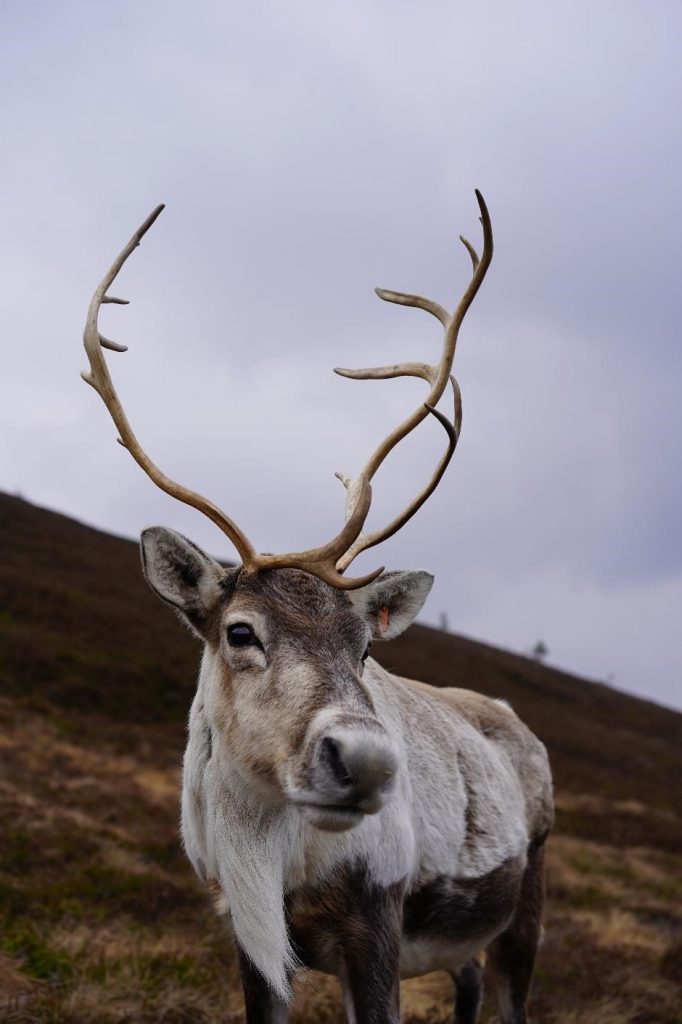
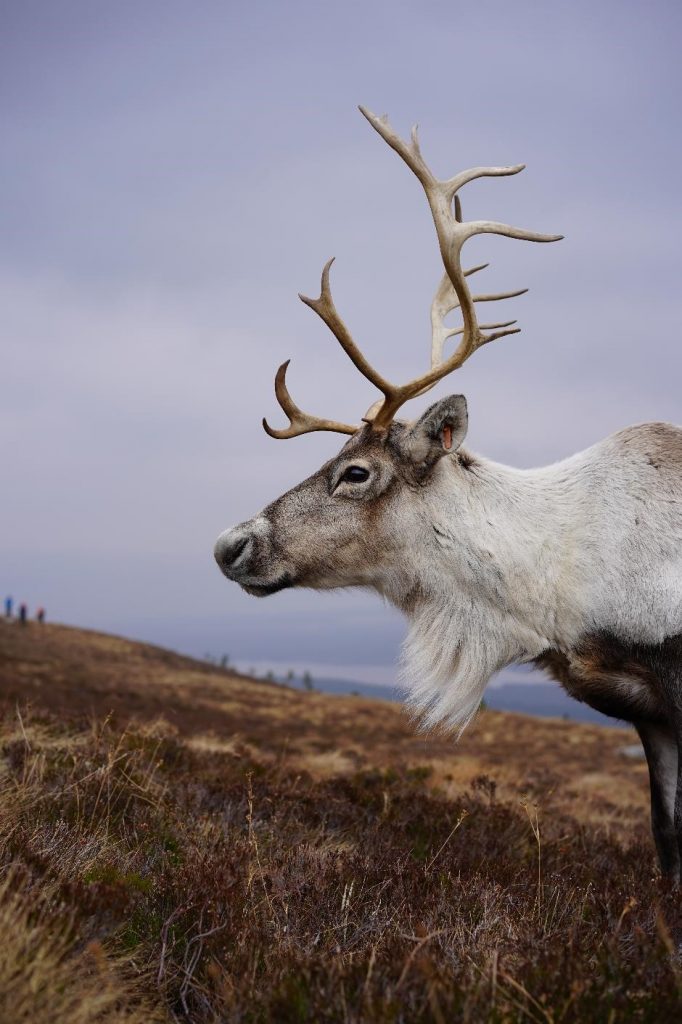
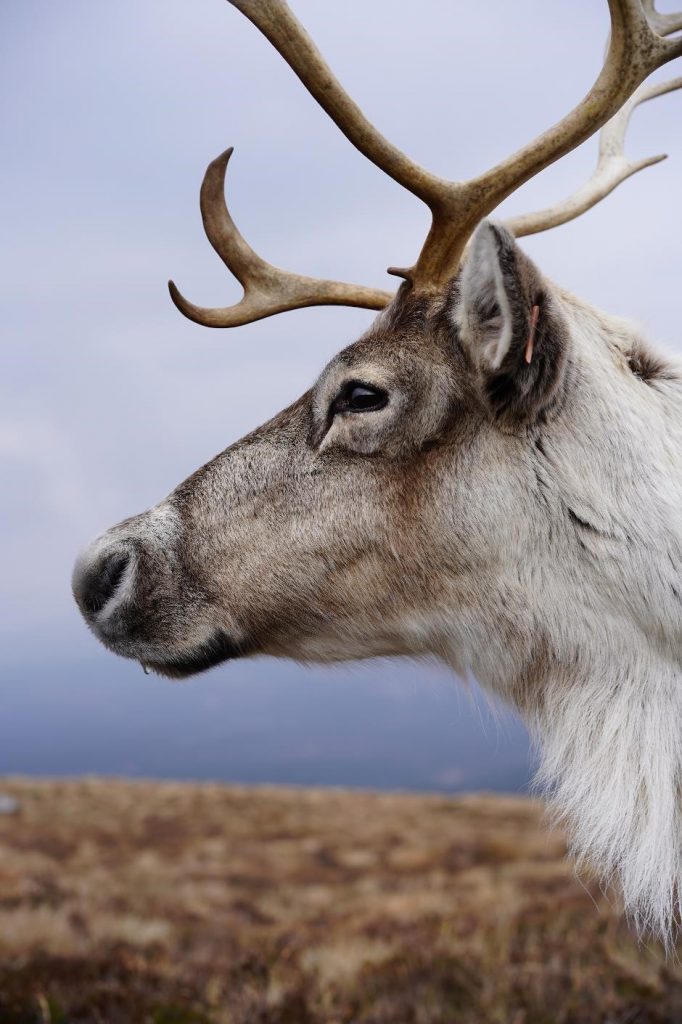
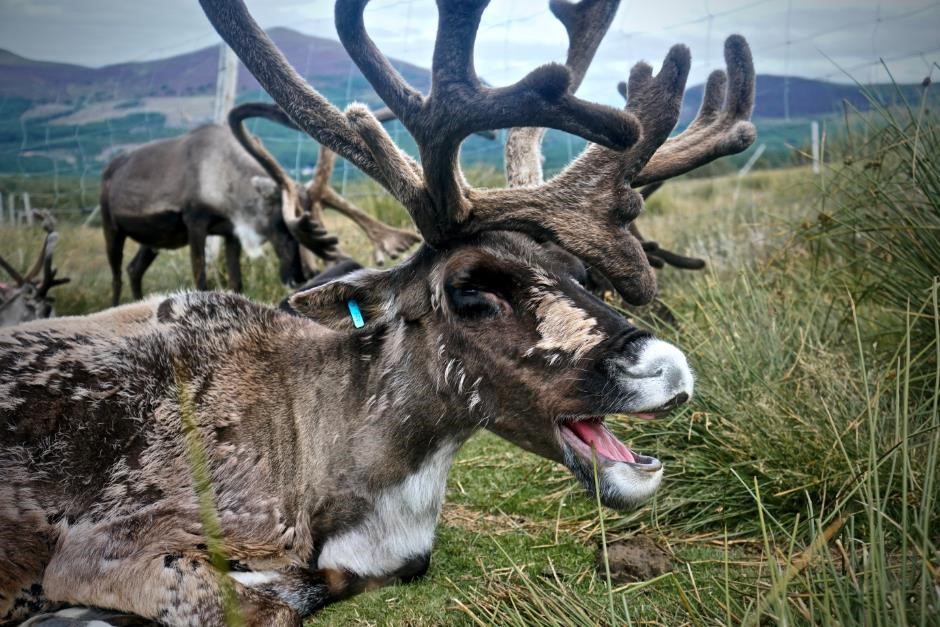
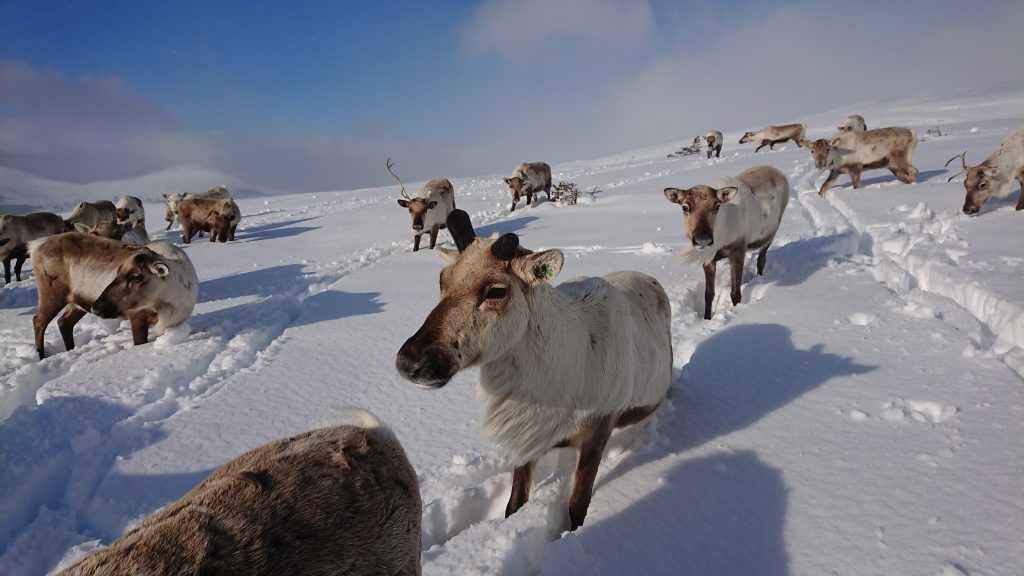
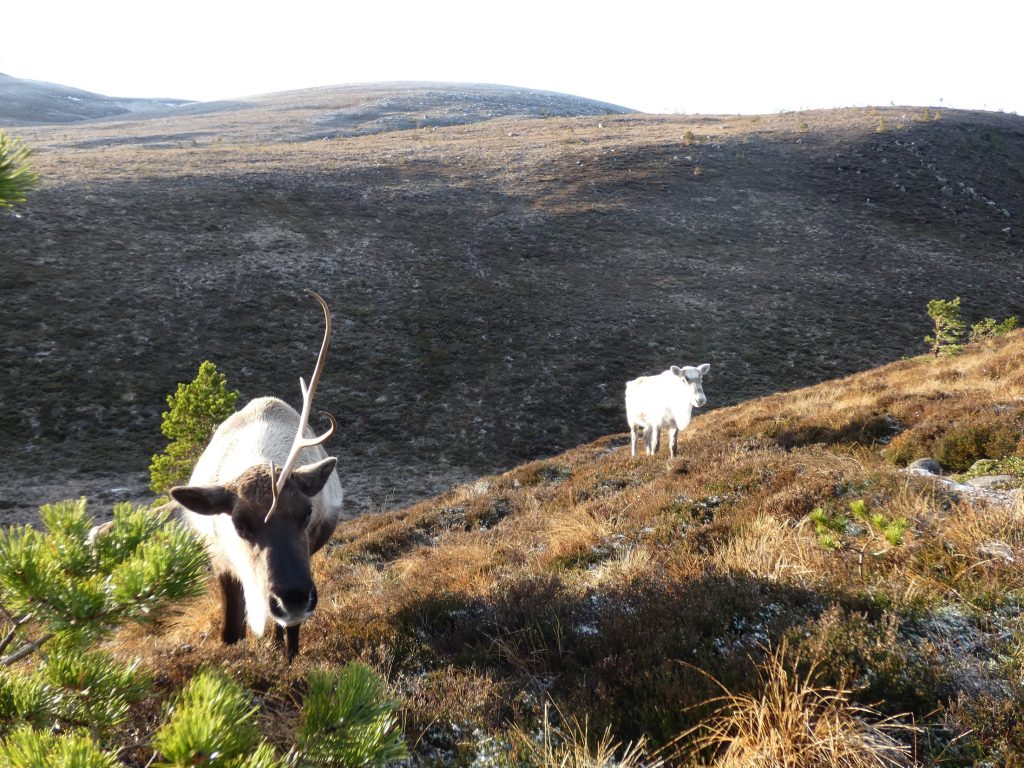
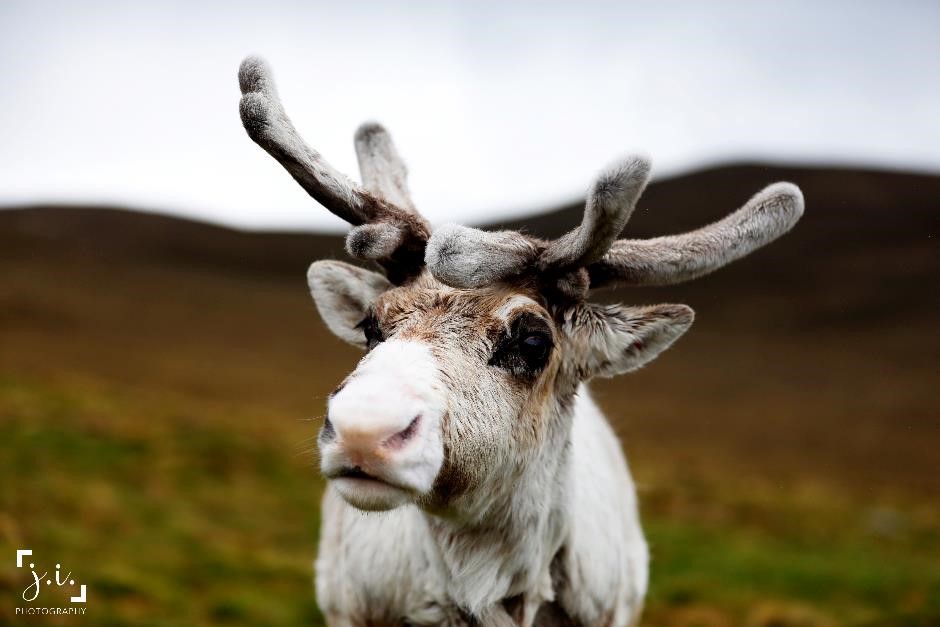
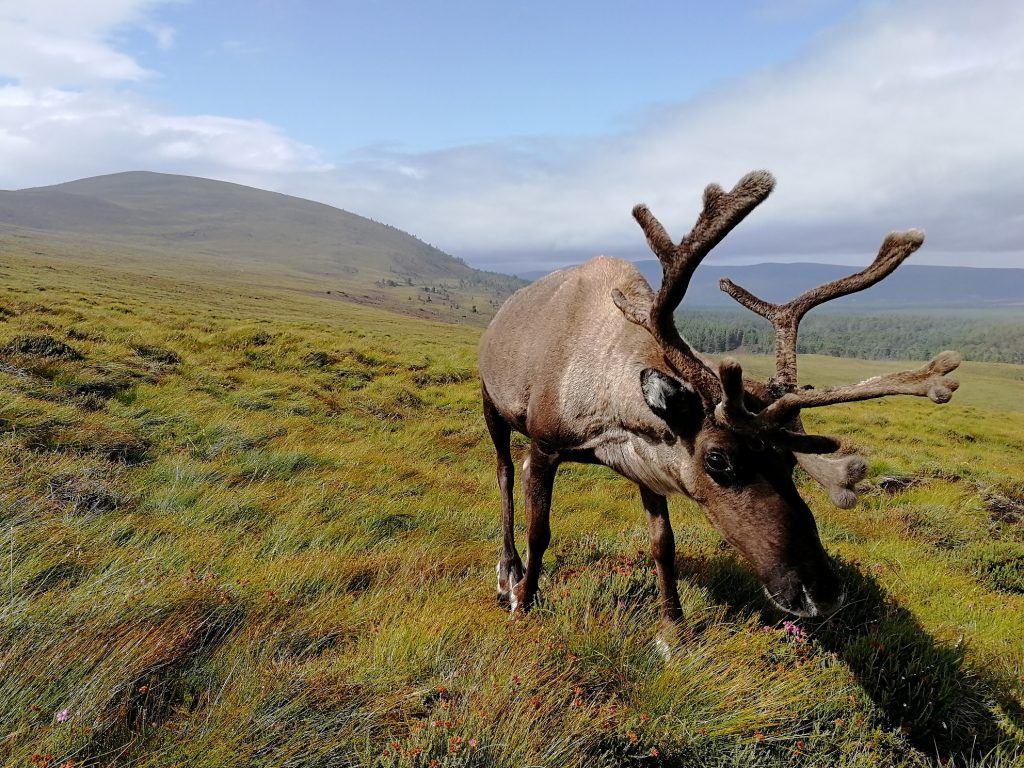
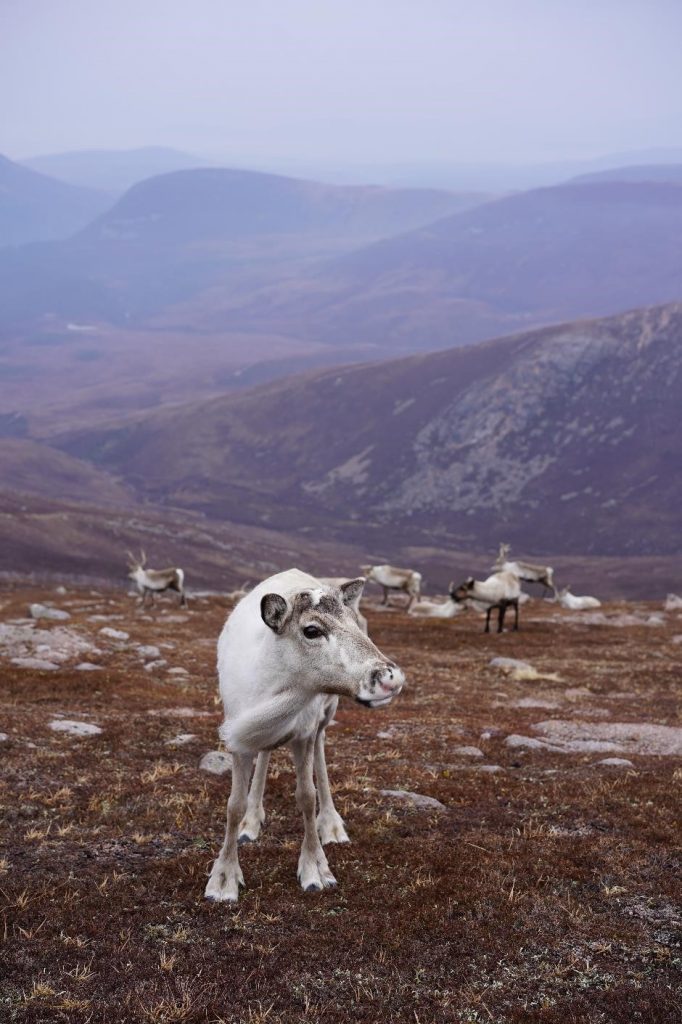
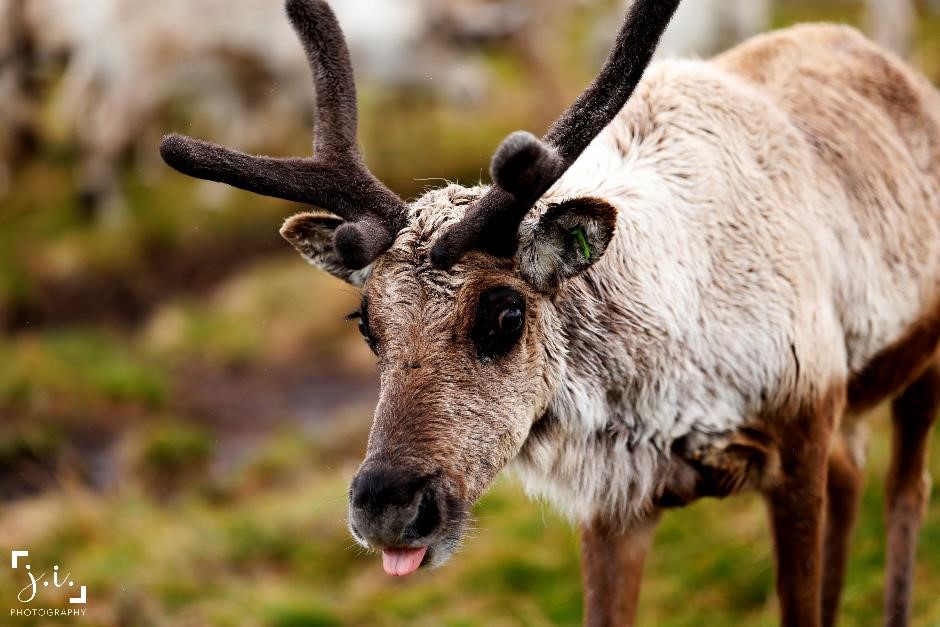
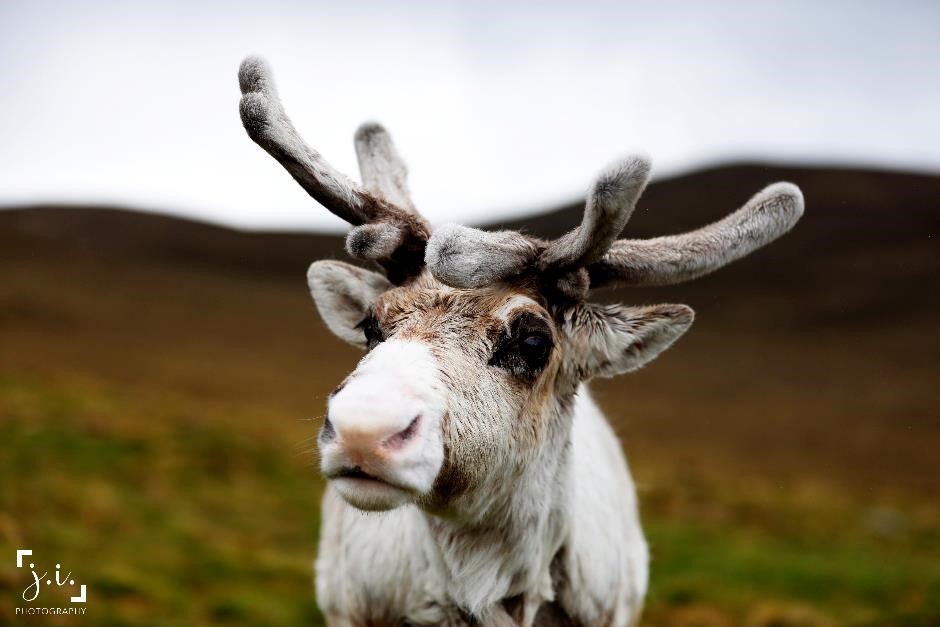
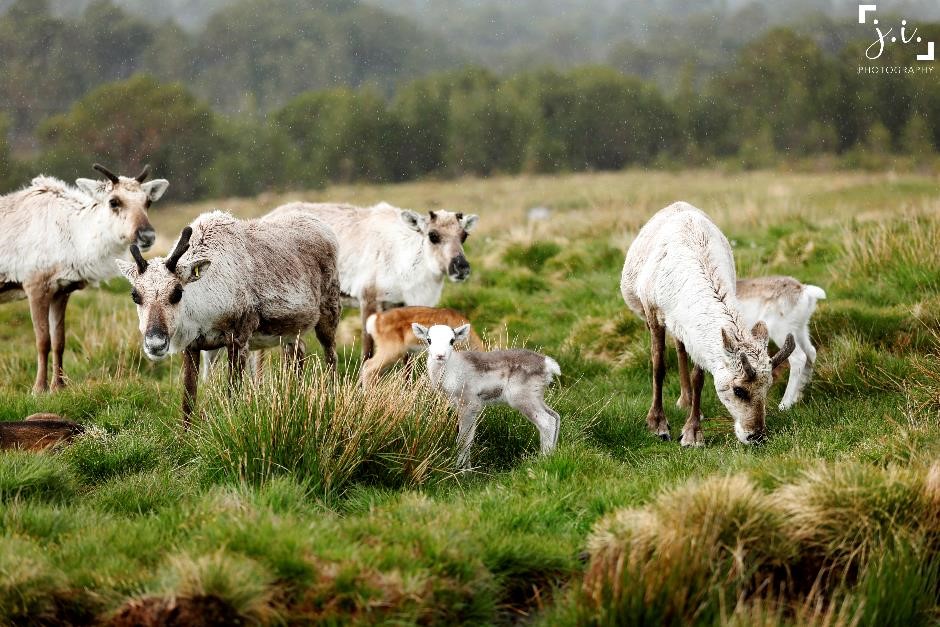
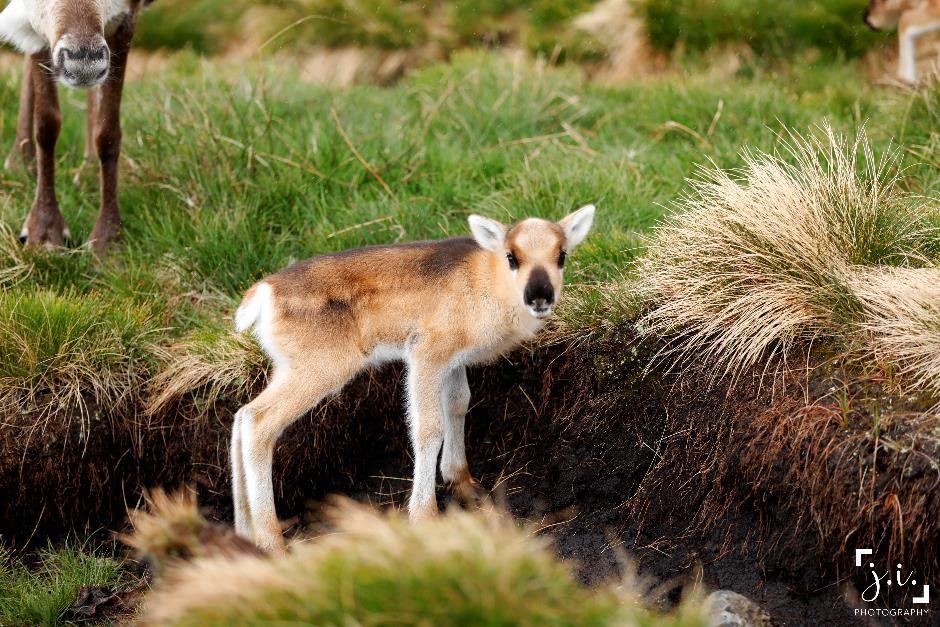
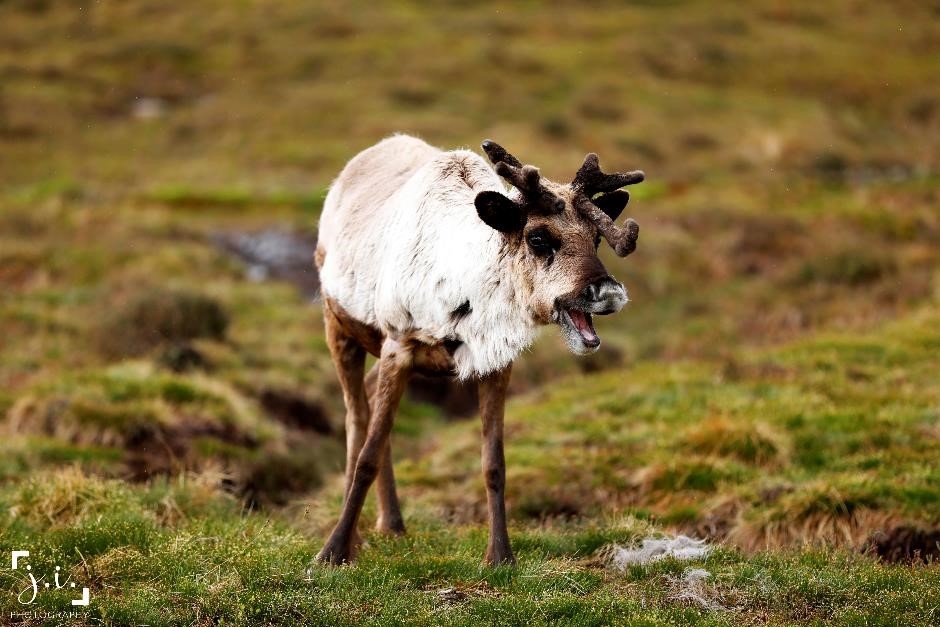
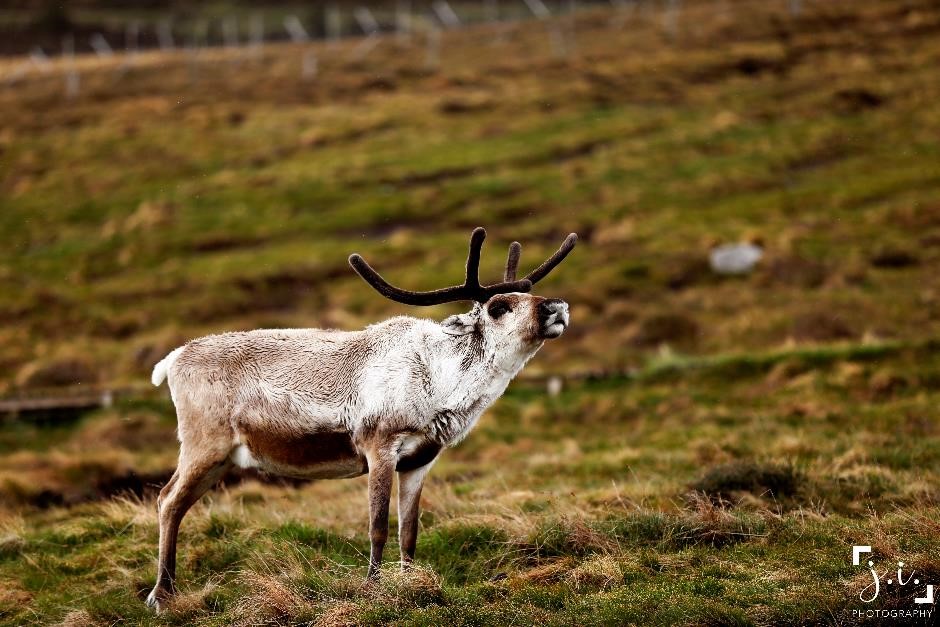
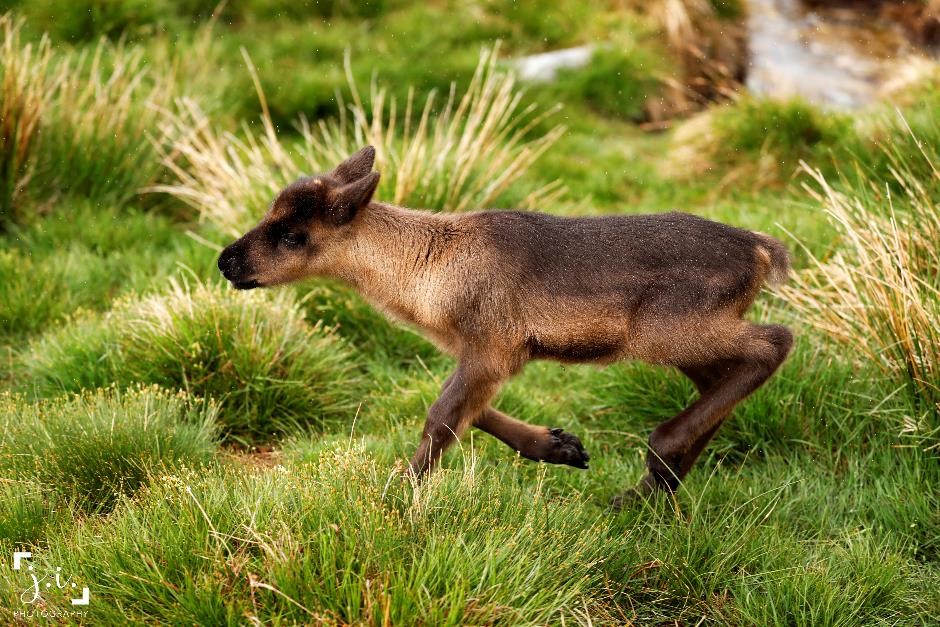
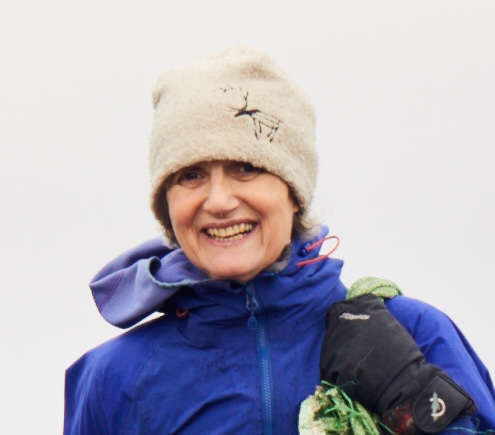
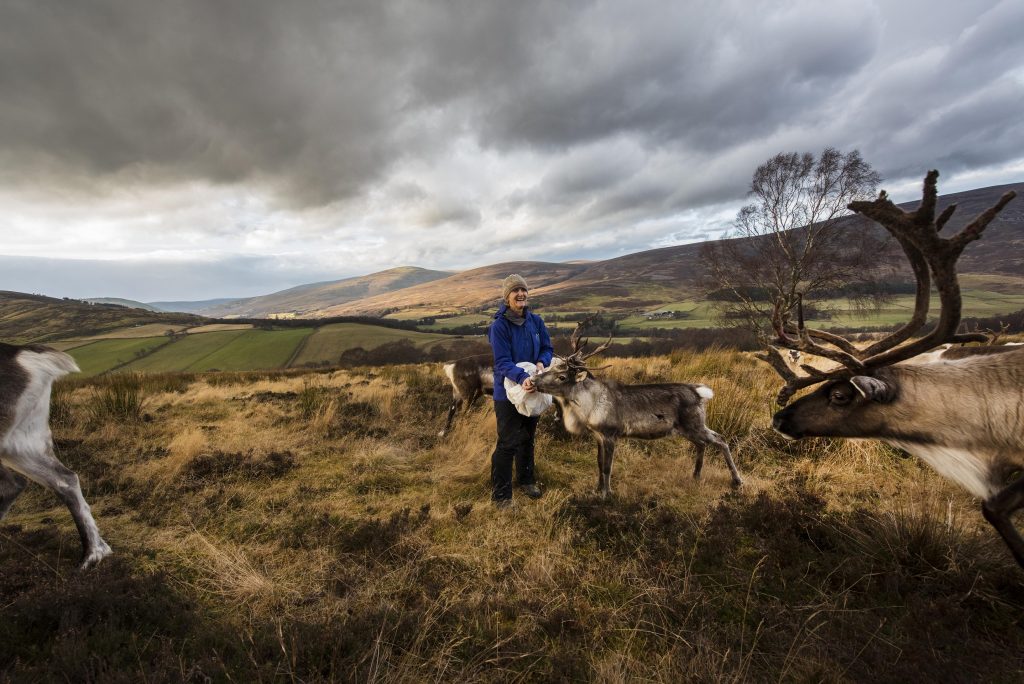
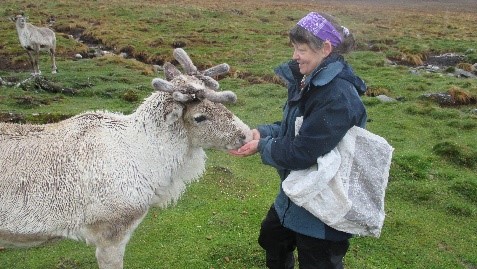
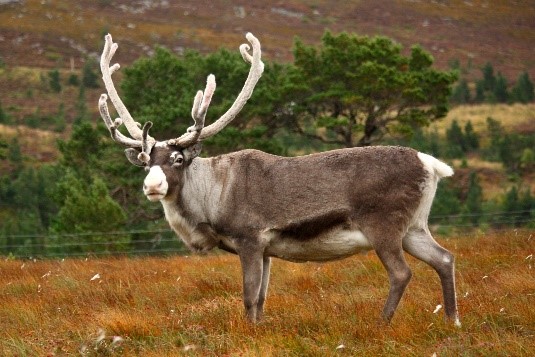
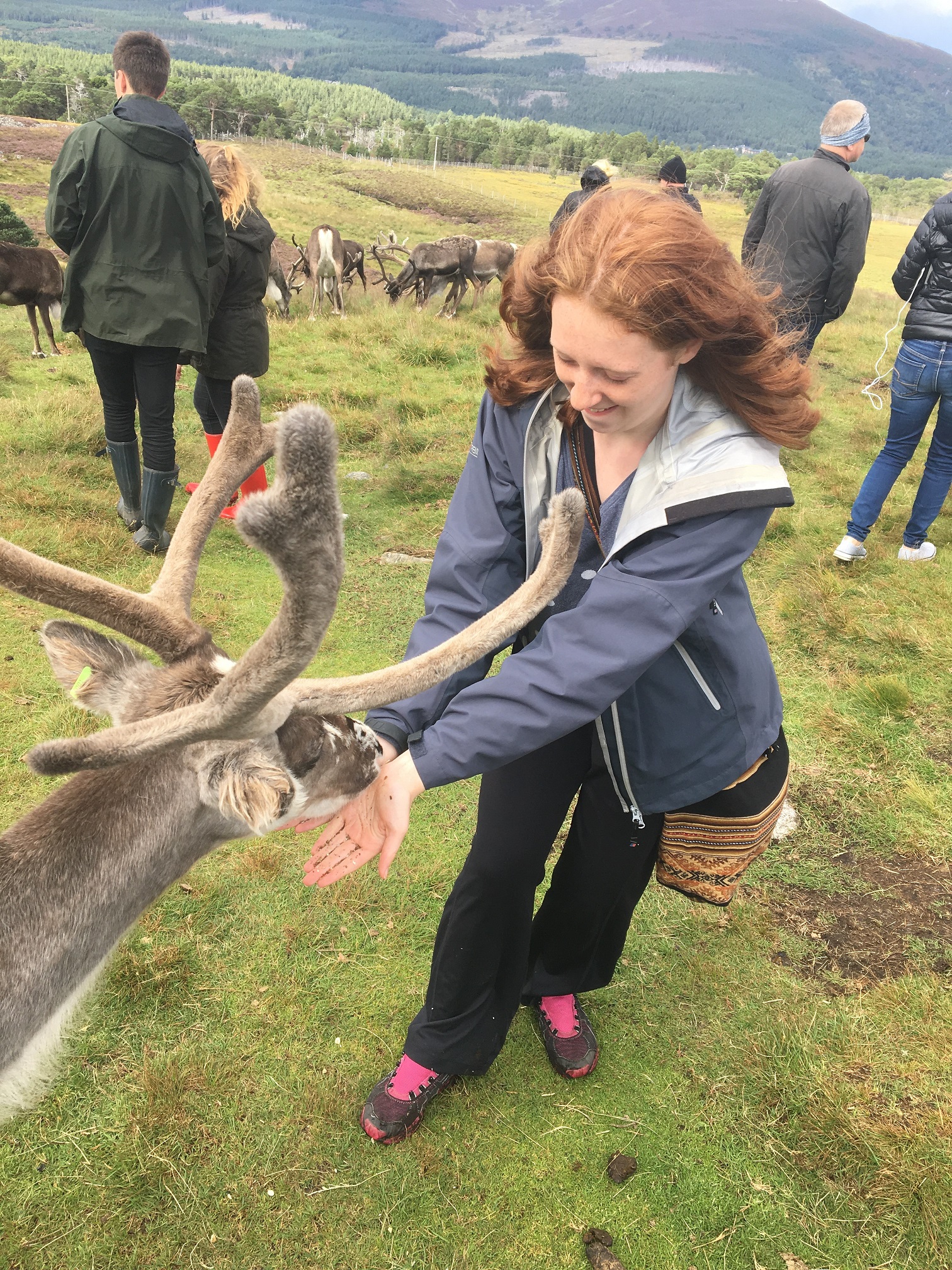
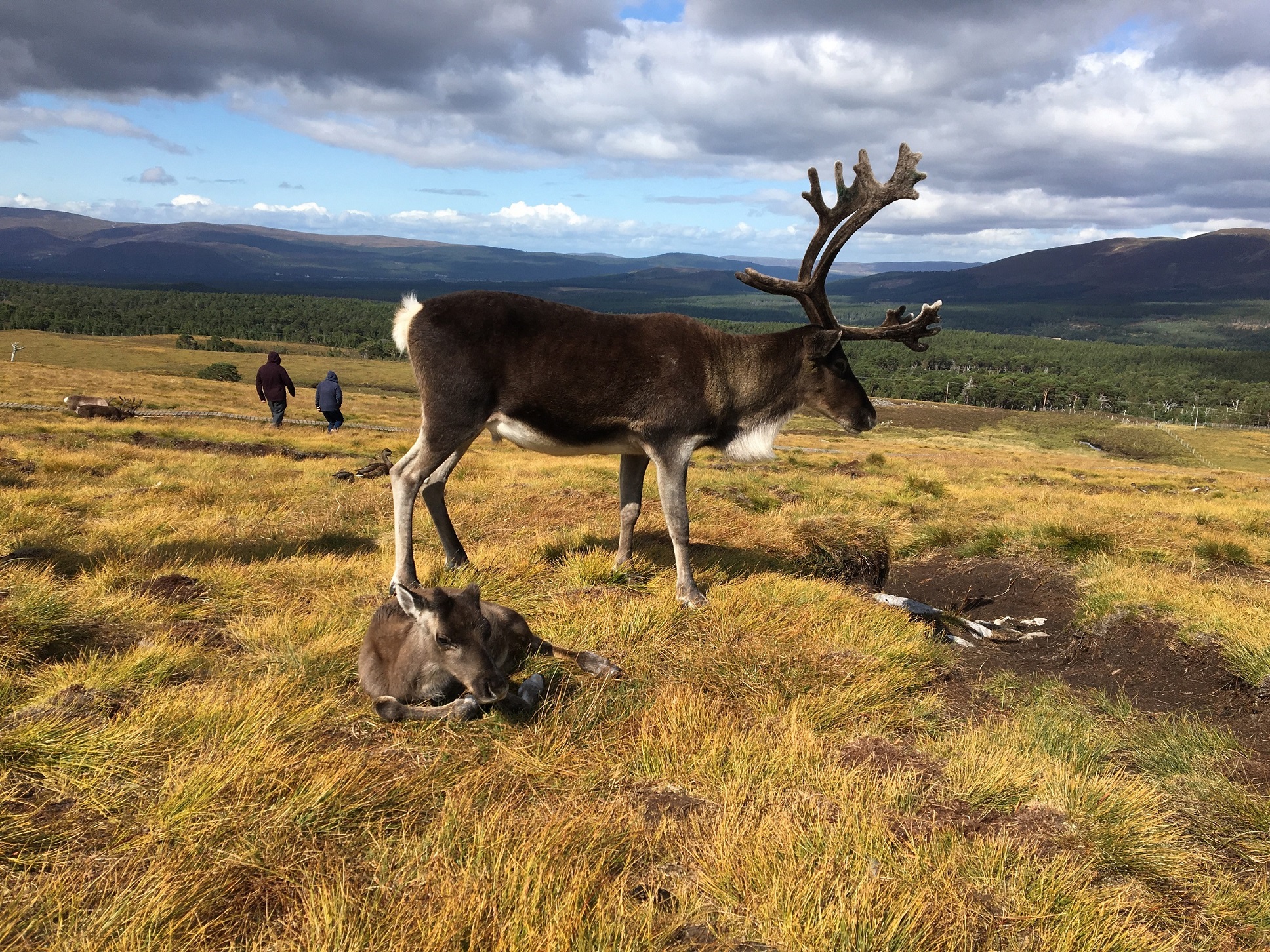
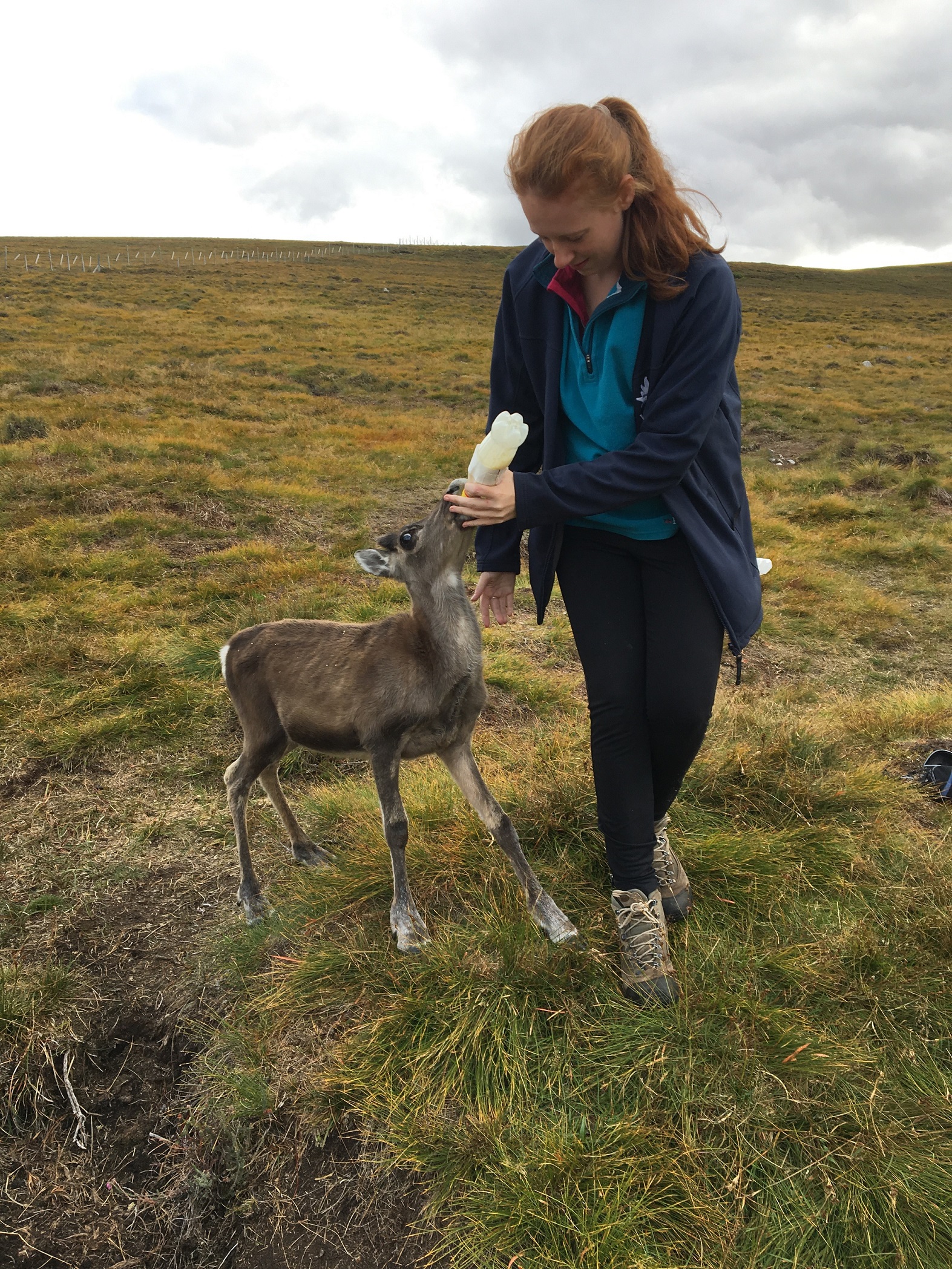
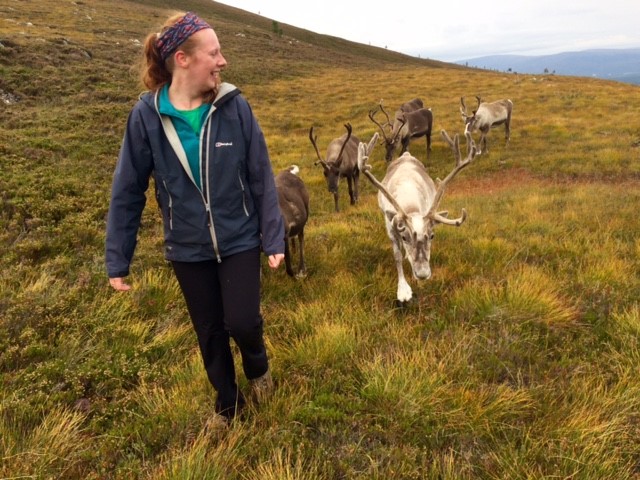
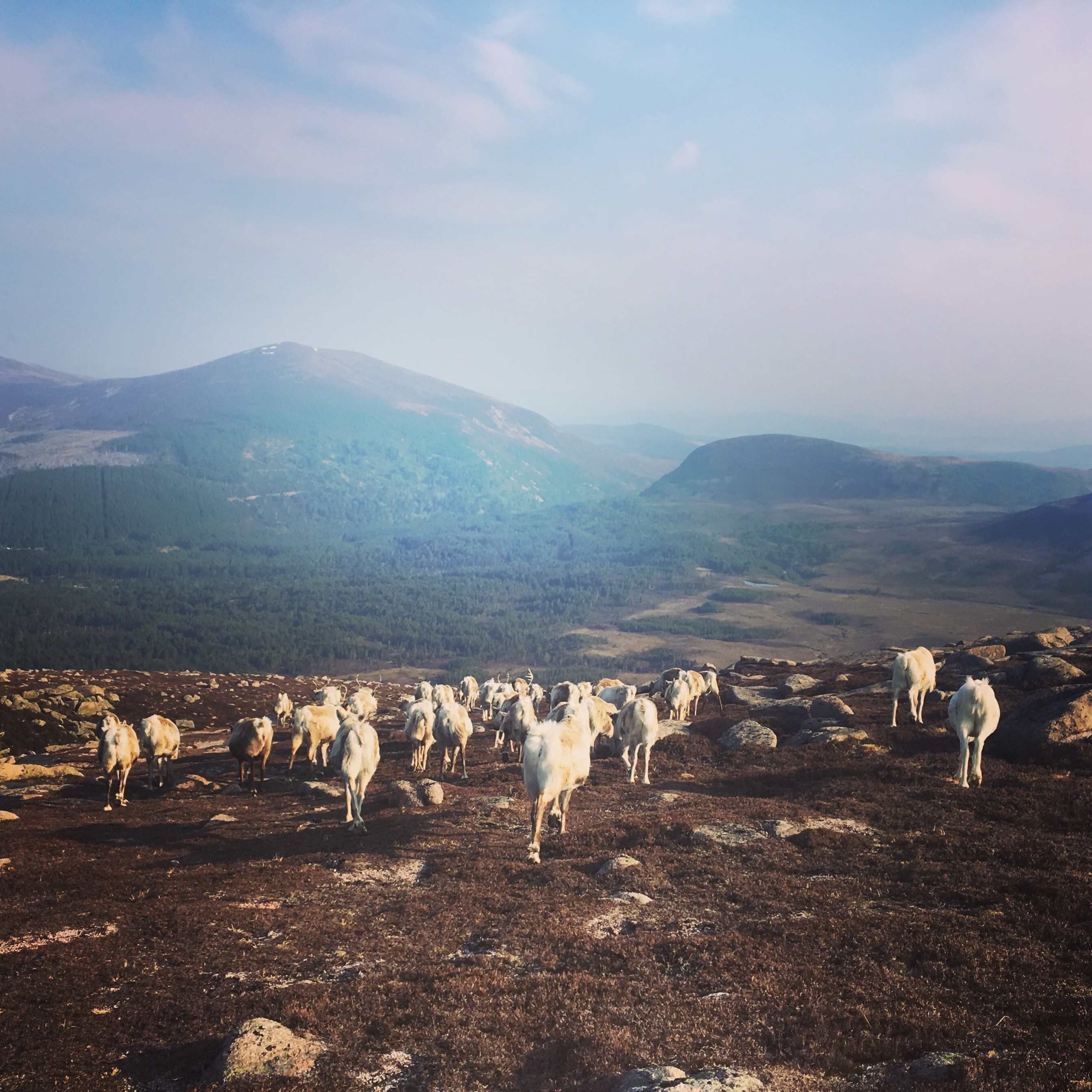
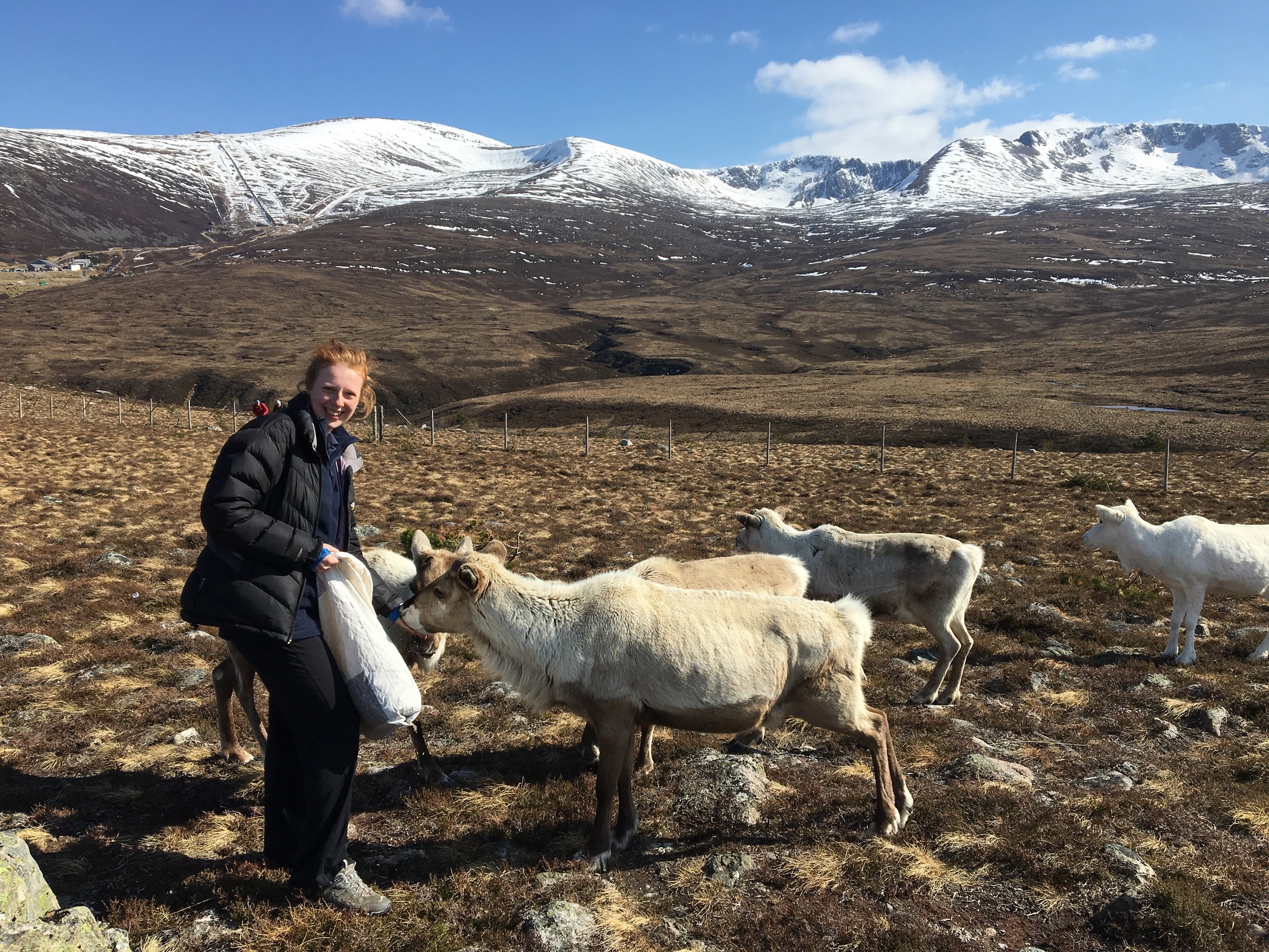
I was sorting through some free range photos taken by Manouk’s friend, Lidowij Meijer, from back in March and realised Okapi look liked she was having her own personalised photo shoot. What a perfect opportunity for a blog I thought!
Okapi is one of the more popular reindeer amongst us herders. Whenever we meet up with her on the free range she is always happy to put her head in a bag of food and help lead the rest of the herd to wherever we need to be. Although she is getting on a little, currently 11, she was in fantastic condition over last winter and so made a fantastic model.
When I first arrived here, however, Okapi wasn’t always at the top of my favourite reindeer list. On a few occasions I caught her walking up behind people and giving them a good poke with her antlers. Initially this was a bit stressful when leading large groups of people in amongst the herd but later on whenever I did catch Okapi shaking her head at anyone it always seemed to be the visitors who don’t listen to our clear instructions about how to behave around the reindeer that were told off by Okapi!
Anyway, enjoy the first part of Lidowij’s free range photo blog.
Feel free to check out her pages here, in the name of Jumping Jackdaw:
A frequently asked question on the hill is what noises the reindeer make. Whilst they are mostly fairly quiet animals but there are a few fascinating reindeer noises.
Clicking Feet
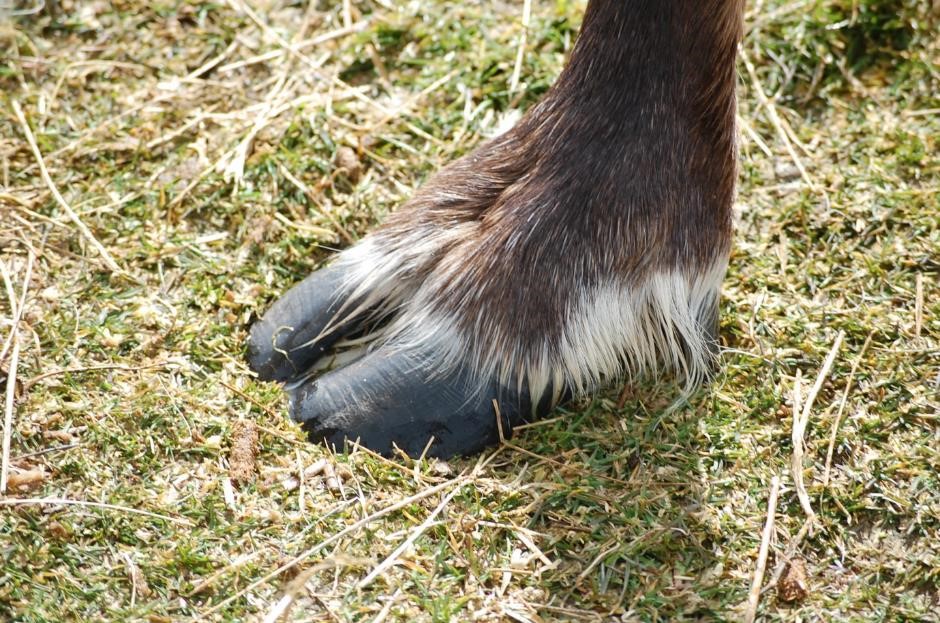
For any of you who have been on the hill trip you will have heard the clicking noise coming from the back feet of the reindeer. Unlike the forest dwelling Roe deer, the reindeer do not have long enough legs to outrun their predators, instead they survive using safety in numbers. They are of course a herd animal. Whilst our reindeer no longer have any predators in the UK they have maintained the mechanism for staying together as a herd. The click is produced by the friction from a tendon slipping over a bone in their back feet. It happens with every single step that the reindeer take and cannot be switched off and on. The calves will have a very quiet click whereas the big bulls will have a quite a loud click, the noise of the whole herd moving is quite amazing. This means that even in the harshest of weather conditions, where they certainly wouldn’t want to open their eyes and wouldn’t be able to see through the blizzard if they did they can still hear where the rest of the herd are. If they were to grunt then opening their mouths would lose heat, the clicking doesn’t use energy or heat so is the perfect communication devise.
Grunting
Another important reindeer noise is grunting. There are two times of year where the reindeer grunt, the first is the calving season in the spring where the cows will grunt to their calves if they are not close by. The second time of year where the reindeer grunt is during the breeding season, the rutting bulls will grunt to the cows. The reindeer grunt is a bit less majestic than the famous Red deer roaring in the glens or the Roe deer barking in the woods. If you want to read a bit more about the noises of all the native deer species, Tilly wrote a wonderful blog about it last year. https://cairngormreindeer.wordpress.com/2018/01/12/calling-all-deer/
Crackle grunting during the rut. Photo by Laurie Campbell.
Yawning
I have saved the best reindeer noise till last, the reindeer yawn. When reindeer yawn they make a lovely creaking noise which is followed by a chin wiggle. Since I first started working with the reindeer I have been trying to record a reindeer yawning as I think it would be the best possible either alarm or text message tone. If anyone has managed to record this fantastic noise, please do get in touch! There seems to be much discussion over the purpose of a yawn. Popular opinion is that animals yawn to remind the rest of the group that they are tired and thus less alert for danger and this is why it is more common amongst social mammals. Recent research shows that the yawn may in fact be to cool down the brain, the long inhalation of air cools down the blood in the vessels close to the surface in the nose and mouth and the stretching of the jaw increases the blood flow to the brain. The blood then cools down the brain making it function better and the animal feel more alert. This would perhaps explain why the reindeer seem to yawn more than normal on a particularly hot day.
Spider mid-way through losing his winter coat, having a yawn. Photo by Julia Kenneth.
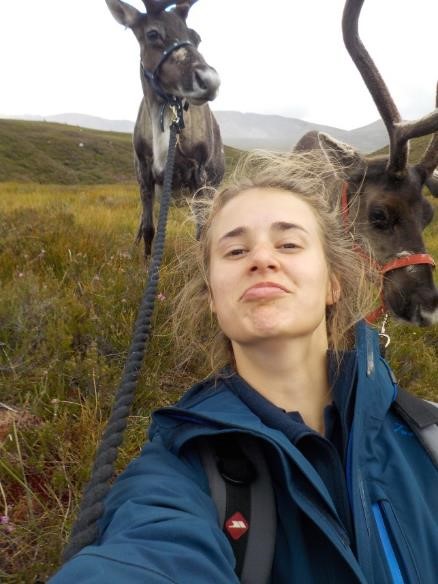
One day last summer I was leading Okapi and Ryvita from the Cas flats to the reindeer enclosure. I was just about to cross the burn that is crossed by Utsi bridge further down the hill when with one misplaced step I found myself thigh deep in bog. What followed consisted of much giggling (from both me and the reindeer), a serious struggle to get my leg out and a very wet arm having had to reach down into the bog to retrieve my welly. As a squelched my way to the reindeer enclosure I started thinking about the different plants that grow in a bog, especially the indicator plants that could have helped me avoid my rather soggy fate.
Stuck in a bog
Sphagnum moss
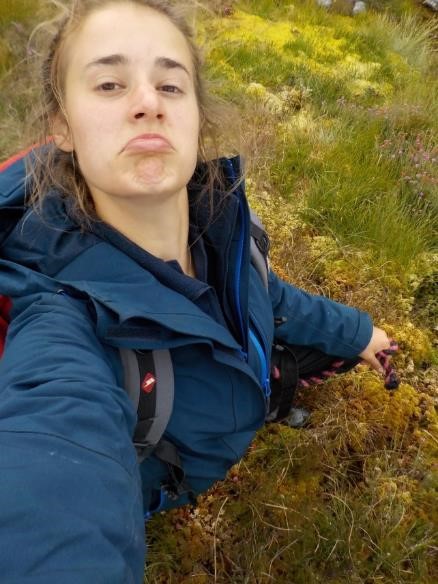
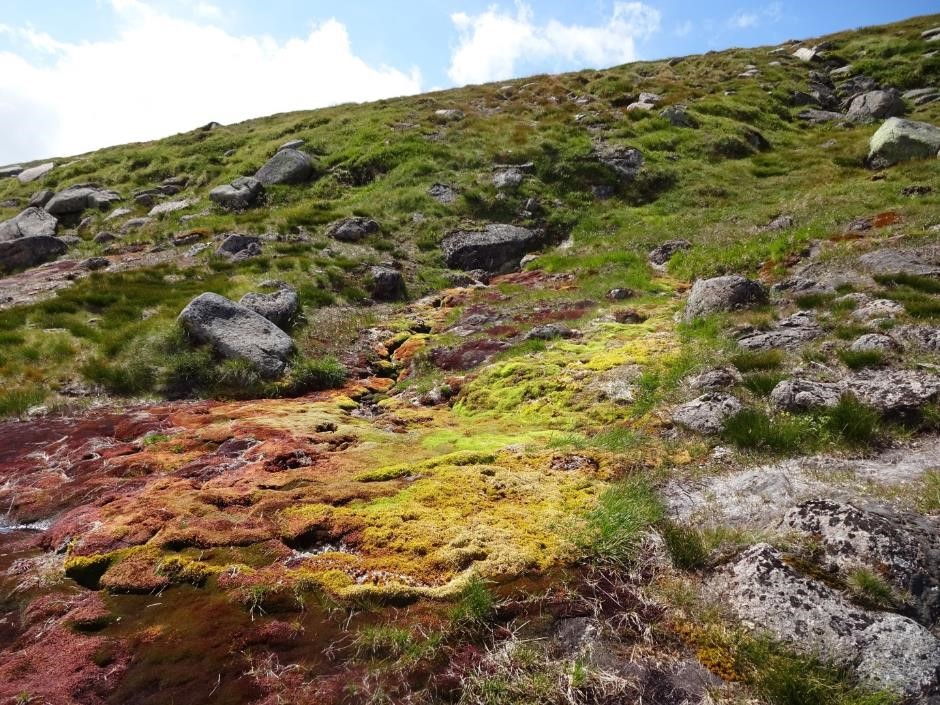
Sphagnum moss is probably the most important plant to look out for. Also known as peat mosses, this group of plants can retain an incredible amount of water (up to 26 times their dry weight). It is so absorbent that it was even used by native North American babies in nappies. This means that standing on this bright green moss (notice it behind me in my bog selfie) will almost always leave you in a similar predicament as I was in. Sphagnum mosses have two types of cells that make up the plant; small living cells and large dead cells. It is the dead cells which have a large water holding capacity. (Disclaimer: if you have no interest in biochemistry then please skip the next sentence or two) Sphagnum mosses are very good at out competing the surrounding plants by carrying out a process called cation exchange, in which nutrients such as potassium and magnesium are taken up and hydrogen ions are released. The increase in concentration of hydrogen ions in the surrounding environment is responsible for making it more acidic and stopping other species from growing there. The acidic conditions along with the layering of the sphagnum produces the peat that we see on the mountains.
Sphagnum
Bog cotton
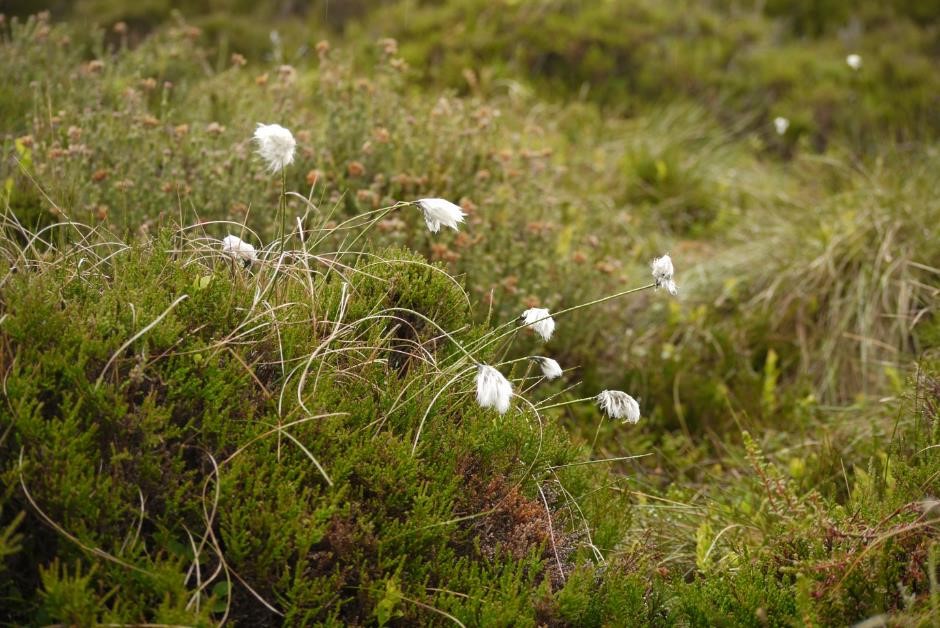
Bog cotton is a good indicator of a boggy area as its seed head stick up above the ground and warn you of the wet area beneath. Its white cotton-like seed heads can often be seen bobbing in the wind. Unlike regular cotton, bog cotton cannot be weaved into fabric, however in northern Europe it has been used to produce paper, pillows, candle wicks and wound dressings.
Bog Cotton
Bog asphodel
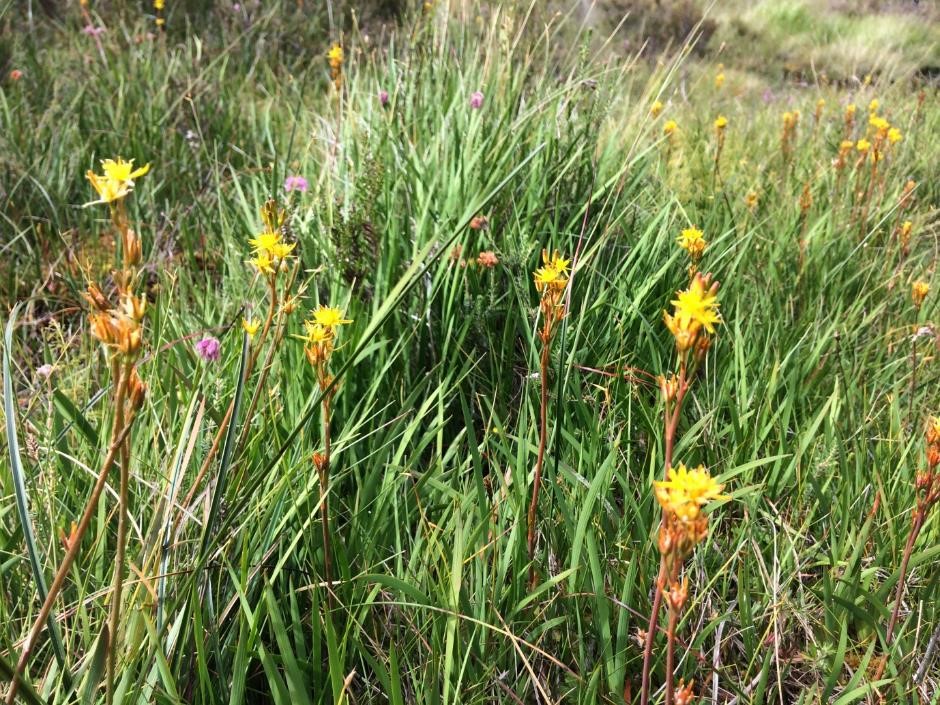
For those of you who have been on the hill trip, you may have seen the yellow spiky flowers of the bog asphodel plant. The Latin name for bog asphodel means ‘bone-breaker’ due to the belief that when sheep eat it then develop brittle bones. However it is more likely that it is correlation rather than causation as sheep eating a low calcium diet are prone to bone weakness and bog asphodel grows in calcium deficient soil. Our reindeer however have no problem getting calcium, as displayed by the wonderful antlers that they grow each year.
Bog Asphodel
Sundew and butterwort
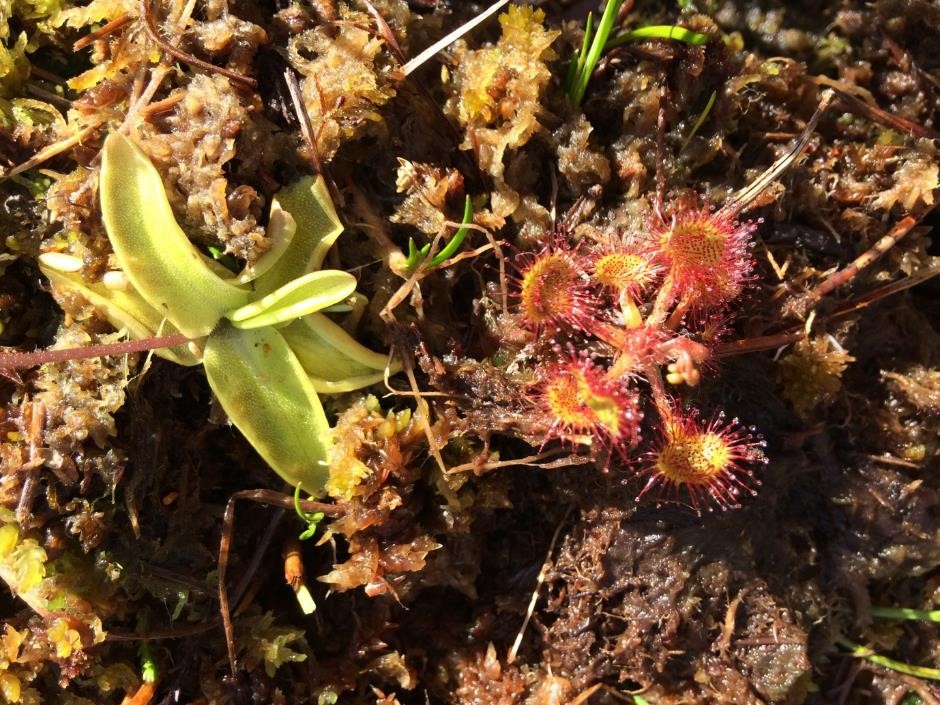
The most vicious of all the plants I have described are these two carnivorous plants. They both survive the harsh environment that they live in by catching insects to eat. Sundew catches insects by sensing their movement and elongating the cells on one edge of the leaf and retracting the cells on the other surface of the leaf causing the leaf to curl around the unsuspecting fly. Butterwort uses a different hunting method, the insects stick to its sticky glandular leaves and are then digested by the plant. If you ask me, the plants up on the hill are not working nearly hard enough to catch the midges this summer.
Which reindeer would make the best prime minister?
Fiona = Dragonfly! But not for the reasons that prime ministers become prime ministers…he thought about everything he did & he was very intelligent. I’ve trained a lot of reindeer but he did everything with precision and thought
Hen = Yeah I think Topi would have been a good candidate, he was quite…well, everyone liked him but he was also quite forthright and offered more hope of leading without dividing the country…unlike our current government.
Andi = Hmmm, it would have to be the late Topi. He was such a likeable character but certainly no pushover.
Manouk = Bovril because he’s been through so much in his life, and I think this has made him into someone who can make adequate decisions at the right time. And by a lot…I mean castration.
Chris = Kipling – she’s a woman of the people!
Lotti = Well Boris would make the worst prime minister. But politics aside…I think Kota would be the best. He seems quite wise and respected but not so showy-offy and the problem with politics at the moment is that it’s all turning so showy-offy.
Ben = Well I think what you need is intelligence, perception and a calm demeanour and Atlantic gives you that. He’s been through some hardships in his life, losing a toe early on, but he’s learnt to live with this, making him stronger, and he’s such a calm reindeer. Calm without being a push-over, even when he was a breeding bull he was pretty level-headed. Plus some of the current world leaders may recognise his impressive antlers as a sign of manliness which could give him a head start. Saying that, I definitely think that females generally best occupy positions of power but being summer staff I don’t really know the females as well as I’d like.
Dave = Fly because she knows how to lead.in an inclusive and respectful way.
Fly on the free range
Izzy = Kipling because she’d make sure everyone had food and housing. She’s friends with everyone and she’s young, so she could run for office twice. Although, she might neglect her duties if someone put lichen down in front of her.
Bobby = Fly because she establishes a nice dominance over the herd. She’s quick to take control and seems like a really good leader.
Nell = Galilee, she’s the one that often seems to lead the herd through. She’s very….well, she’s a leader.
Which reindeer would be the best/worst reindeer herder?
Fiona = I think Olympic could make a great reindeer herder if he was human, but he definitely wouldn’t if he was still a reindeer. So he’s a bit of a loner which doesn’t quite fit the reindeer herding criteria, but he’s greedy and loves his food, which certainly does fit the reindeer herding criteria. He’s an overall good egg.
Hen = Sequin would have been an excellent reindeer herder because no one had a bad thing to say about her.
Andi = Blondie wouldn’t be the best seeing as a) she’s fairly ditsy and b) would struggle to hear where the rest of the herd are on account of her deafness.
Manouk = Dixie would make the best reindeer herder because all the reindeer already follow her, also, she LOVES her food, and that’s an important quality in a reindeer herder.
Dixie
Chris = Fly or Okapi would be the best – they’re often leading the girls when we’re with them. Plus, Okapi isn’t afraid to use her antlers if needed.
Lotti = Probably one of the Swede’s would be the worst aye. Because they’d be so terrible with a crowd. Spike’s a nervous nelly, he wouldn’t particularly thrive off of taking summer hill trips with 25 car loads of visitors.
Ben = Druid would be the worst; he’d just neglect his duties in favour of heading out ‘mushrooming’. He’d be far better placed as a café owner in Amsterdam.
Dave = Blondie would be the worst because she’s deaf.
Izzy = Inca would definitely be the worst because she’d end up running at the reindeer and completely scattering them. She just wouldn’t be good at getting reindeer from place to place, she’s too wild.
Bobby = Stuc would be the worst because he seems pretty shy and low on confidence.
Nell = Sherlock would be the worst because he kicks people and you couldn’t have a tour where the reindeer herder’s kicking people.
Which reindeer would you most/least like to be stuck on a desert island with?
Fiona = For good chats, social drinking and fun times it’d be the late Grunter, but for practically reasons it’d have to be Stenoa and/or Scrabble – the fatties. Just because they’d make great burgers. Haha, it sounds like it’d be Grunter and I eating Stenoa and Scrabble doesn’t it?
Hen = Well, I better start naming some living reindeer now…can I name a reindeer who would feed me for the longest? I probably shouldn’t should I? I’ll name Olympic for the companionship and the chats…plus, he’s not too skinny either.
Andi = I’m going to say Strudel because he’s always the first one to locate and break in to a bag of food. So, that has the benefit of him being able to help in finding the food, however I’d then have the problem of trying to get him to share. But hey, at least he’s friendly.
Manouk = Svalbard because after looking at the size of his belly, I reckon he won’t need to eat for a while.
Chris = Svalbard or Scrabble because I mean, come on…look at those bellies.
Svalbard. Photo courtesy of Jamie Isaacs Photography
Lotti = Ooo, these are great questions Ben (thanks Lotti). Well, you’d want to be stuck with someone a little bit fun who you could interact with but not be a real pain. You’d want to be with someone who’s pretty bomb-proof so that they could deal with the situation. Hmmm…Olympic, he’d make me feel happy.
Ben = It’s gotta be Olympic, he’s very social which would be great and with that wagon that he’s dragging, an Olympic sized cuddle would provide me with a lot of warmth. But I think he’d be a popular choice, so if his diary was full then I’d opt for Crowdie. He’s such a sweet reindeer, plus my Dad adopts him so it’d be a nice reminder of my great family.
Crowdie
Dave = It would have to be a tame one. You wouldn’t wanna be stuck with a flighty one who wouldn’t come near you because how’s that for company? So, maybe…Scrabble.
Izzy = I would love to get stuck on a desert island with Olympic. I’d need to make sure he didn’t eat ALL of the food but I reckon we’d have some good conversations and he’d make an awesome spooning partner.
Bobby = Ochil. I would very much not like to be stuck on a desert island with Ochil because she always seems to give me a hard time….and has no mercy when she does so. (Editor’s note: Ochil once kicked Bobby in the middle of a Hill Trip in his crown jewels…)
The extremely dangerous Ochil (to Bobby only)
Nell = I’d most like to be stuck with Hook because he runs away so often and I think it’d be great exercise chasing him around the island.
Recently we were sent some photo’s by one of our visitors, Jamie Isaacs, who visited back in May. We really enjoyed them so thought we’d share some for this week’s blog.
Thank’s to Jamie for sending them in, you can check out his photography pages here.
Reindeer are good swimmers and today we’ll find out why and how.
Reindeer have spent millennia migrating across continents to access seasonal pastures. Their habitat grows relatively coarse fodder meaning they must travel vast distances for grazing. These migrations tackle many obstacles and one particularly challenging is water. This water body was often a river but also small sections of ocean between the mainland and an island perhaps. Either way the reindeer needed to swim. And Swim they did. And this is how they do it…
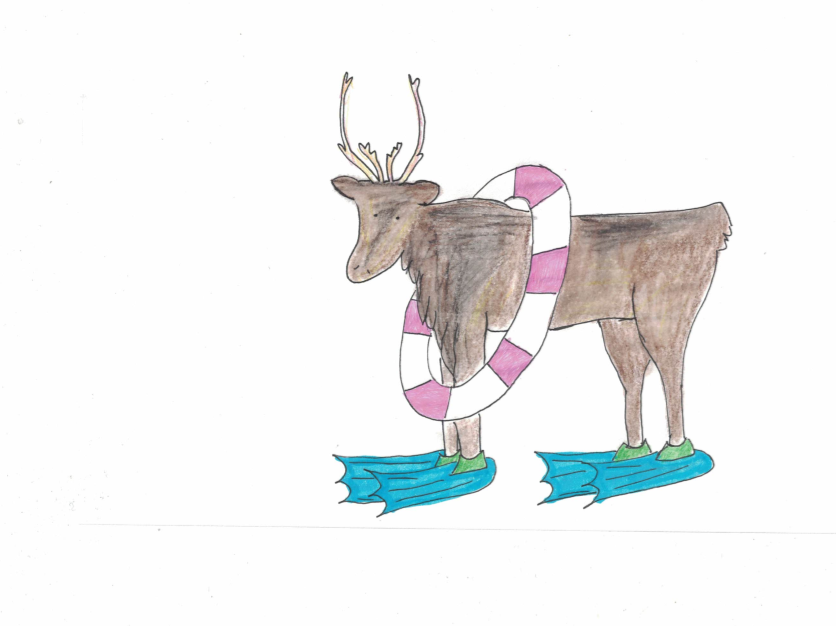
Reindeer have miraculous hooves. Their hooves can be used as snowshoes or spades in the winter for dealing with all that snow and flippers for swimming! Their action is a doggy paddle stroke and I feel we should rename this stroke and call it ‘reindeer paddle’.
We know their fur is hollow trapping air to insulate them from winters’ frosts but did we know this air fill coat also acts as a buoyancy aid! How fantastic is that?!
Manouk’s interpretation of a swimming reindeer
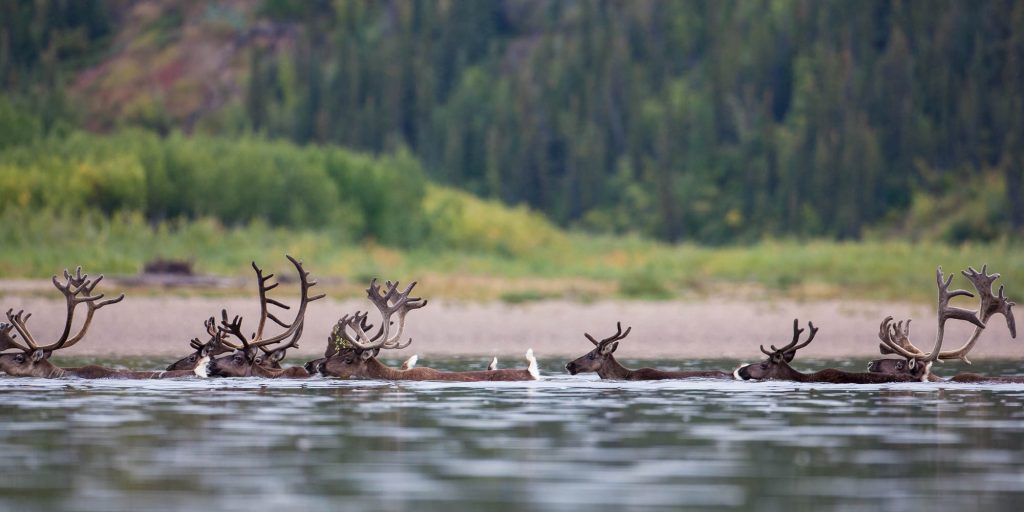
I know what you’re thinking. You’re thinking yea ok reindeer can cross a river, so can I. I swam across the Spey River once. No, they can really swim. The herds in North America are known for especially large migration routes. These herds swim across huge rivers. The Yukon river flows for over 3000km the Spey just 170km. The Yukon has a volume of 6428 cubic metres per second almost exactly 100 times larger than the Spey. These rivers are big and anything that could swim across would need to be a strong swimmer.
Caribou swimming across the Porcupine river, Yukon. Photo credit: Niclolas Dory, www.nicolasdory.com
Some people answer to just one name, others like me have a proper name and a nickname. Although given the name Elizabeth as a baby, I was nicknamed Tiddly because I was the youngest ( and so smallest ) in our family of four children.
Tiddly got shortened to either Tids or Tilly and now many 10’s of years on from being Tiddly I am almost universally known as Tilly, although I do sometimes use my ‘real’ name Elizabeth when I want to sound ‘official’.
Having two names has worked to my advantage. Many years ago, when I was still organising all the Christmas Events with our reindeer ( thankfully our daughter Fiona does all that now ) I received a phone call from one of our clients regarding their event. After our conversation I said to the Centre Manager, ‘ I am going away for a couple of weeks and so if you have any other queries it may be best to wait till I get back’. To which the lady replied ‘ that’s no problem if you are not available, I will just ask for Tilly!’ I didn’t let on, but was amused that in this Centre Manager’s eyes there was a Tilly and an Elizabeth!
Tilly, in action. Photo credit: John Paul
Tilly was not a common name when I was a child but in recent years I have met quite a few young Tillys! I am not someone who keeps up with changing fashions, indeed my mother used to despair of me always wearing jeans and never putting on makeup! But it would seem that I was ahead of the game when it came to my nickname!
As well as other people being called Tilly I have known of various animals with my name. Years ago I was driving up the Ski road from Aviemore back to Reindeer House and there was a chap with his ‘3 legged black labrador’ trying to hitch a lift. Feeling sorry for the dog I drew up and jumped out to let the dog jump in the back. The chap said ‘ jump in Tilly ‘ which rather took me aback before I realised he was talking to his dog!
In the mid 1980’s we became acquainted with a farmer and his wife from Keilder in Northumberland who ran a small open farm. We became best friends and over the years they both looked after reindeer for us at their farm and helped out with our reindeer events at Christmas time. John was a great stockman and could turn his hand to all types of livestock. He acquired some fallow deer and when the doe had her fawn, she wouldn’t raise it and so John and Shirley hand reared the little mite. The wee fallow became incredibly tame and was a winner with all their visitors. I was well chuffed when they announced they had called her, yup you guessed ——-‘Tilly’.
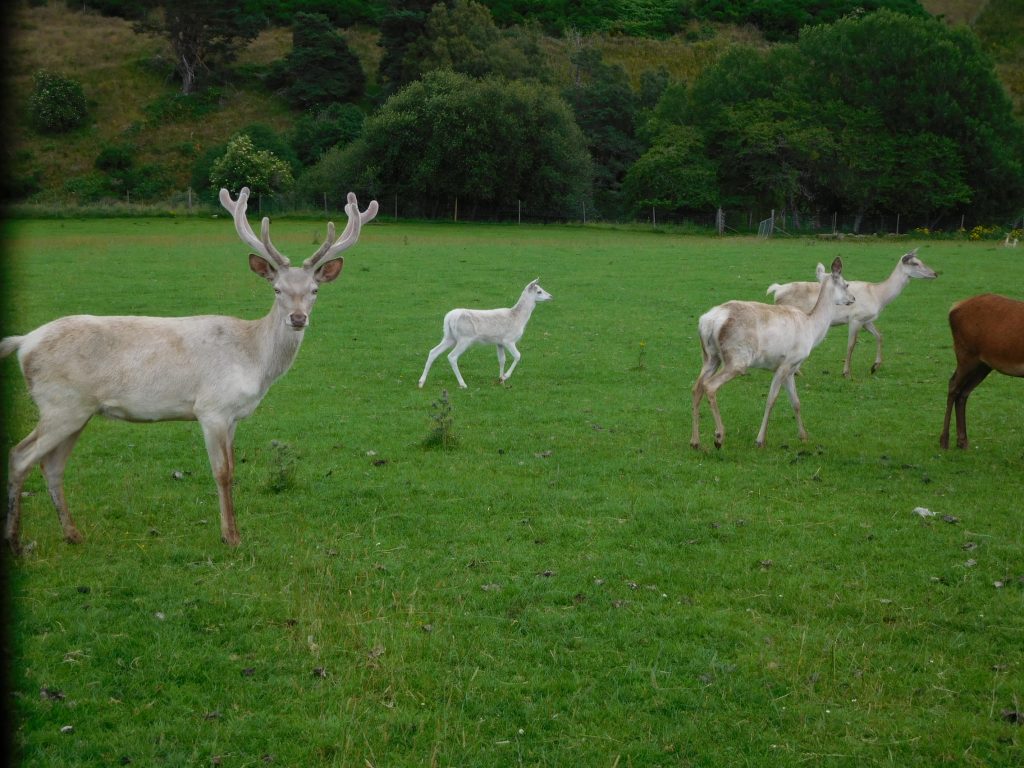
A few of the Wild Farm fallow deer
Not only do we name all our reindeer, but we also name our pedigreed Belted Galloway cattle that live on our farm at Glenlivet. When we name our reindeer calves we choose a theme for that year. Last year it was TV/film detectives, before that poets and authors, ancient civilisations etc etc. But with the cattle we go through the alphabet and in 2018 the letter was T. So strangely enough one of our heifers ( young cows ) is called Balcorrach Tilly.
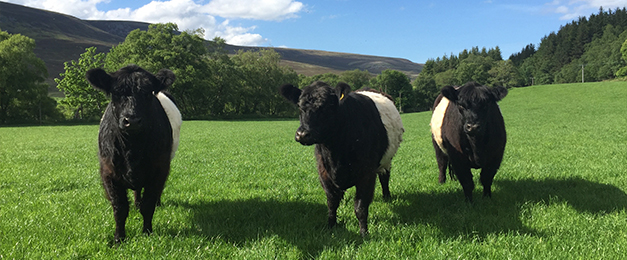
Some of Tilly’s Belted Galloways, but not Belted Galloway Tilly…
And then today we received an email from a lady in the USA who had recently bought a copy of my latest book Reindeer, An Arctic Life. It transpires that she has a reindeer farm and this is what she wrote in her email:
‘Your book just arrived today and I am only one chapter in, but I already know I absolutely LOVE it. We would be honored to feature this book in our gift shop at our reindeer farm———– Already planning to name our next calf Tilly.’
So there we go. I don’t think I ever imagined that I would have namesakes that were as diverse as a 3 legged dog, a fallow deer, a Belted Galloway cow and potentially a reindeer. What an honour. And to cap it all, very close friends had a little girl 2.5 years ago and not only did they ask me to be her Godmother but they also named her Tilly!
On our kids quiz in the Paddocks is the question ‘Name a sub-species of reindeer’, and I notice it’s often the one that people get stuck at (despite the fact that the answers are there on the display boards). I’ve realised over the years however, that this is often down to a basis lack of understanding of a percentage of the population of the concept of species and sub-species, rather than anything else. So therefore, allow me to explain.
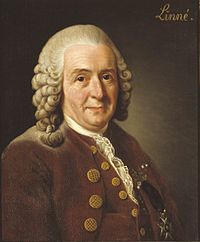
As a zoology student (all too many years ago, so bear with me if my science is rusty), the classification of all organic species using a system of ‘taxonomic rank’ was drilled into us. The system still in use today was founded by Swedish botanist Carl Linnaeus in the 16th Century and brought order and clarity to the then chaotic and disorganised way of naming and categorizing all types of life. No wonder I loved learning about taxonomy – lists and organisation? My kinda thing.
Carl Linnaeus (1707 – 1778)
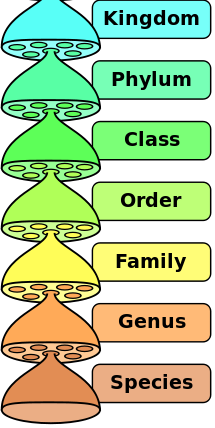
The Linnaean system breaks down all living things into 7 major kingdoms, animals being one and plants another, and then each kingdom is broken down further, into different phyla. Then phyla are broken down once more to the next level, which is class, and the system carries on through order; family, genus and finally species. So reindeer can be categorized as such:
Kingdom: Animalia (Common name: Animals)
Phylum: Chordata (Chordates – meaning ‘possessing a nerve cord’)
Class: Mammalia (Mammals)
Order: Arteriodactyla (Even-toed hooved mammals)
Family: Cervidae (the Deer family)
Genus: Rangifer
Species: tarandus
Biological classification chart
The two part ‘binomial’ name Rangifer tarandus is perhaps more commonly known as a ‘Latin name’, and every species in the world has one. You will be familiar with ours as Homo sapiens, and like humans, reindeer are the only species within their genus, Rangifer. A regular question from visitors is ‘So….how are reindeer different from deer?’ Bizarrely, it can be quite hard explaining to people that reindeer are deer. My usual analogy is to get people to think about lions and tigers. Both obviously cats, so therefore members of the cat family (‘Felidae’), but at the same time both clearly different species from each other. So while reindeer are a member of the deer family, they are a different species from other types of deer. For example, moose, red deer and muntjac – all clearly distinguishable in looks from one another, but crucially also genetically different.
But then, as with most things, it all gets a little more complicated. Not content with 7 major divisions, scientists introduced sub-divisions in order to break down everything further. So now there are, among others, sub-classes, sub-families, sub-genera etc. Arghh! While Rangifer has no sub-genus, there are some subspecies to contend with, and this is the relevant info that we hope people will track down in our Paddocks. All seven subspecies of reindeer and caribou are all still Rangifer tarandus, so effectively all genetically the same animal, but a subspecies is shown by adding a third name after the binomial. Just to clarify too, reindeer and caribou are the same animal, but reindeer are the domesticated version of caribou. The differences are also geographical, in that reindeer are found in Europe and Asia, while caribou are found in North America and Greenland.
So back to our seven subspecies. We have:
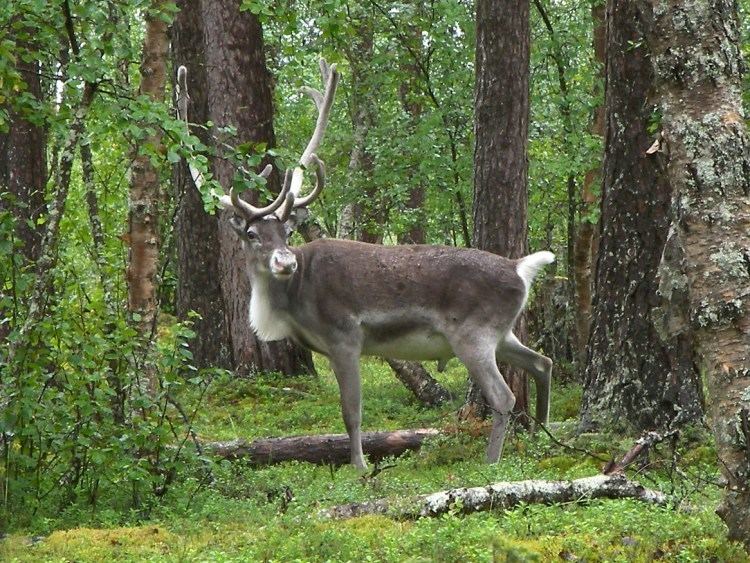
Eurasian Tundra reindeer (Rangifer tarandus tarandus): Open-ground dwelling subspecies, which the majority of all domesticated reindeer belong to, including ours.
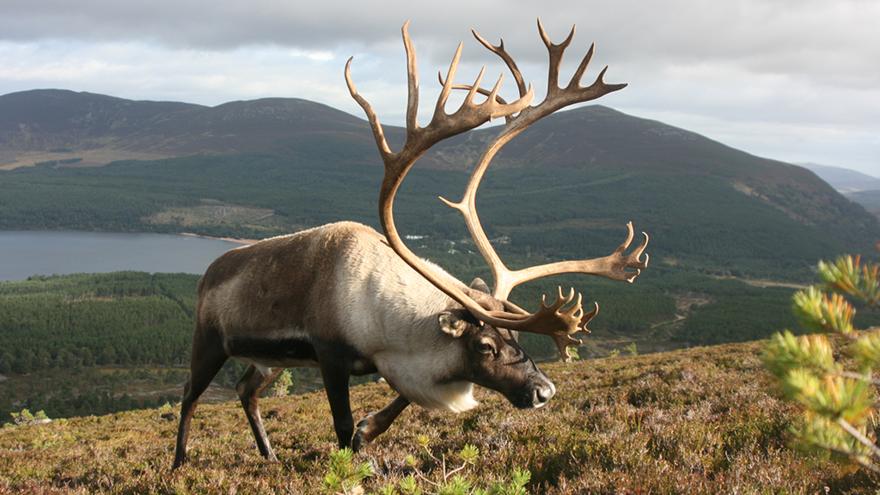
Our big bull Crann, a ‘tundra reindeer’
Eurasian Forest reindeer (Rangifer tarandus fennicus): Boreal forest dwelling subspecies, typically taller than tundra reindeer.
Forest reindeer
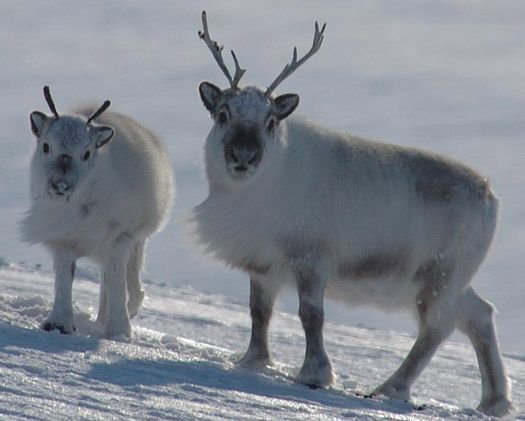
Svalbard reindeer (Rangifer tarandus platyrhynchus): Smallest subspecies, endemic to the arctic archipelago of the Svalbard islands. Short legged!
Svalbard reindeer
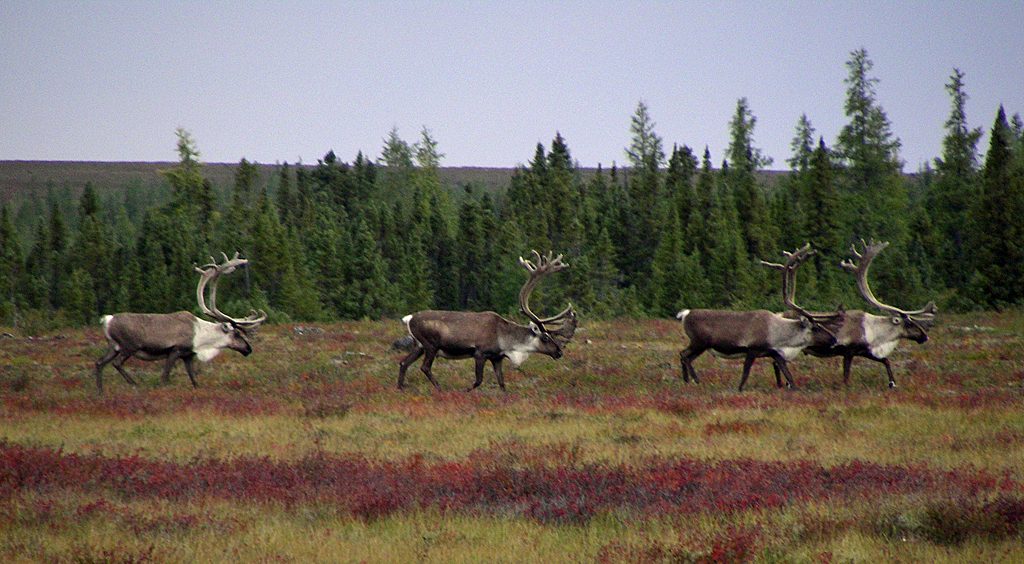
Barren-ground caribou (Rangifer tarandus groenlandicus): Migratory subspecies of open ground. The most similar of the caribous to our tundra reindeer.
Barren-ground caribou
North American woodland caribou (Rangifer tarandus caribou): Largest caribou subspecies, often darker in colour. As the name suggests, they live in forests, and generally don’t migrate.
Woodland caribou Copyright Paul Sutherland
Peary caribou (Rangifer tarandus pearyi): Smallest of the caribou subspecies.
Peary Caribou Copyright Trent University
Alaskan or Porcupine caribou (Rangifer tarandus granti): Migratory subspecies most closely resembling the barren-ground caribou, and named after the Porcupine river, which runs through much of their range. The longest migrating land mammal on Earth.
Porcupine caribou
There have been two other subspecies in the past but these have now died out – the East Greenland Caribou and the Queen Charlotte Island Caribou.
So there you go, a brief taxonomy lesson, and congratulations to anyone who has stuck with me, as well as apologies for some slight over-simplifications for any scientists amongst you. Hopefully you’ll have all learnt something though – I’m a big believer of sneaking in educational blogs among the pretty pictures and funny stories we often post! And if it’s all too much and you’d just prefer something a bit more light-hearted, head off and google pictures of Svalbard reindeer. You’ll not be disappointed.
People often ask me ‘why do you adopt a reindeer of all things?’ Little do they know I could spend the next 6 hours explaining why; just how lovely they are, relaxing to be with and such gentle creatures to watch. You get free hill trips where you can walk on to the hill and hand feed them, you get certificates and photographs and surprise goodies in your adoption packs every year. You get newsletters twice per year and the adoption money goes straight to supporting the herd, I could go on……but I don’t.
If the truth be known I’ve never adopted a reindeer – they always adopt me, I just pay for the privilege. My first adoptee was Indigo back in 2003. A calm and lovable character who always had her nose in my pocket even when all feed had disappeared from my hands. I fell in love with her at first sight and continued with the adoption until her sad demise. I was lucky enough to be offered one of Indigo’s antlers which my husband, Colin, made a pair of earrings out of for me – I will treasure those forever. After Indigo died I adopted Cheer in 2014, Indigo’s great granddaughter. A very quiet and shy reindeer, not an enthusiastic hand feeder like Indigo but easy to spot, which for me is a distinct advantage! For the past 3 years I have adopted Bumble, as far as I’m concerned one of the best reindeer there has been in the herd.
The mighty Bumble. Favourite reindeer of Andi, Chris and Sharon of course
However, Colin disagrees as his adopted reindeer is the majestic Olympic who adopted Colin at a Lincoln Christmas event in 2017. On this occasion Colin and I just have to agree to disagree.
Olympic
This month I have adopted another impressive character Svalbard. I have spent these two weeks volunteering by hand feeding him and getting to know his lovable if not occasionally grumpy ways with people. He’s an enthusiastic hand feeder but when the food has gone he’s on his way, thank you! Although his antlers aren’t yet up to his normal impressive spread they are growing so fast you could almost sit and watch them grow to maturity.
Sharon
Svalbard, another greedy hand feederSvalbard with a full set of antlers
I am currently a student at Salford University in greater Manchester, where I study wildlife conservation and practical conservation. At the university I was part of the climbing club and use to go climbing regularly to the cCairngorm National Park during the summer and winter months. During our time up there I had always wanted to visit the Cairngorm Reindeer Herd, but just never really had the opportunity to go visit the centre and the herd.
Until around two summers ago, me and my mum had been travelling the north east coast of Scotland and were making our way up to Inverness. Once we had reached Aviemore I finally got the chance to visit the reindeer up in the hill enclosure. The first reindeer herders that I met were Dave and Lottie and the first reindeer that I fully remember meeting were Glenshee and Viking.
Who doesn’t love handfeeding?Glenshee looking as magnificent as ever.
After visiting I wanted to spend more time with the reindeer and the people who managed the herd, so I applied to be a volunteer. Whilst I was a volunteer I had amazing hands on experience with the reindeer and learnt more about how they can live and thrive in the Cairngorm Mountains. I was lucky enough to spend time with the reindeer twins, as well as with some of the male reindeer during the time the velvet was beginning to strip from their antlers.
Giving Starsky a bottle
Leading the girls
After my week volunteering I went on my university placement year, and managed to finish my 9 months of placement earlier than expected, and therefore I could accept a job at the reindeer centre. I am currently working as a reindeer herder for the summer. I have been living and working at the centre now for a couple of months now and I absolutely love it.