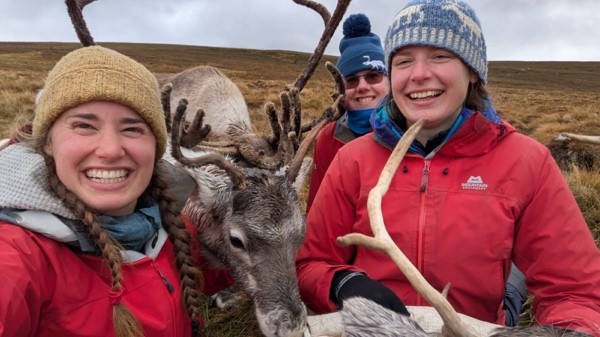
Taking the Funicular to find the reindeer

A free range season adventure!
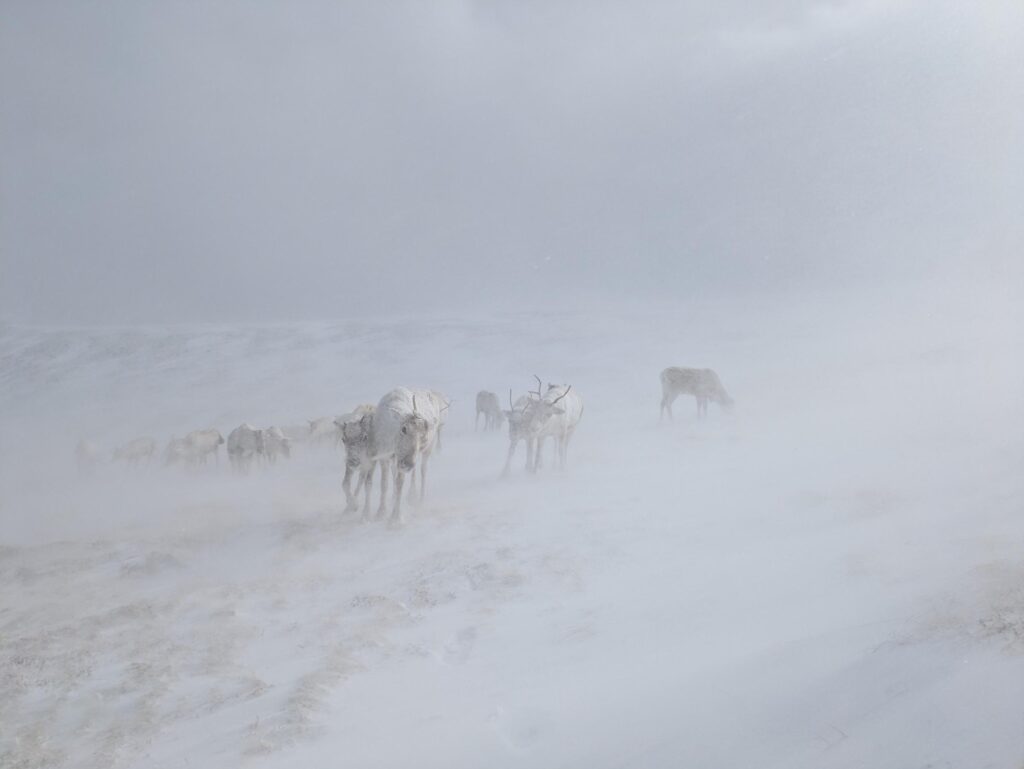
Daisy: It was morning briefing in mid April and we were contacted to inform us the reindeer had moved right up onto the mountain plateau not too far from Ptarmigan Station. This was going to be a pretty long walk for us to make it up to the reindeer, find them in some pretty interesting conditions, and then herd them down off the mountains to one of our free range visit spots. Thankfully, Cairngorm Mountain staff came to the rescue!

Andi: A quick phone call to Cairngorm Mountain and they were happy to help us with a ride up on the shiny Funicular Railway – a unique scenic ride which is a destination in itself. For us, this would save us around an hour of uphill walking in blizzard conditions, and made the difference between needing to abandon our Hill Trip plans (with lots of hopeful visitors already booked) and hopefully managing to retrieve our reindeer in time for everyone to enjoy meeting them.
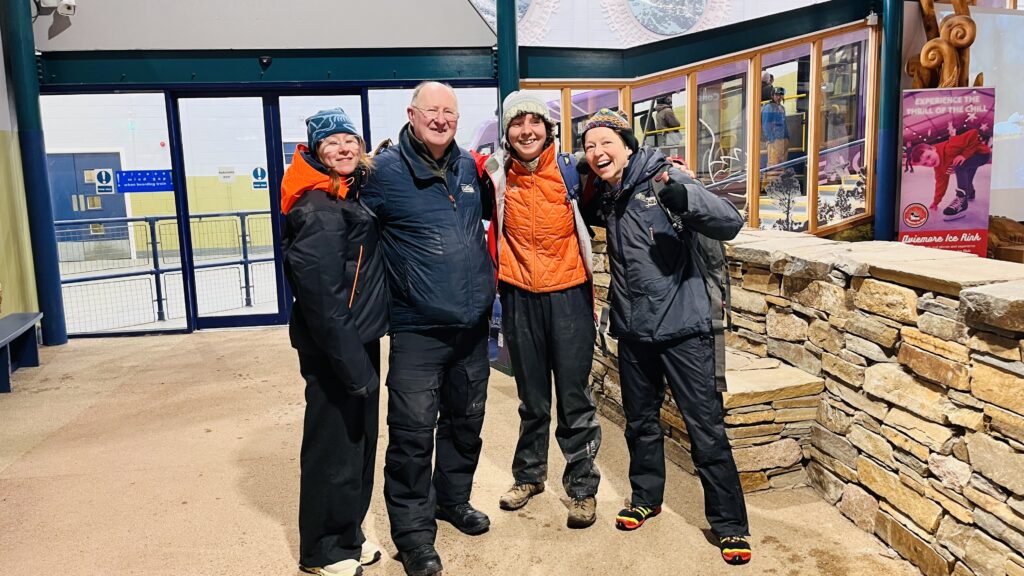
Thank you so much to the Cairngorm Mountain staff who let us hitch a ride on the Funicular to the top of the mountain!

Daisy: It certainly felt like setting off on an expedition that morning with Andi. We had all our gear on, map and compass in our bags alongside lots of reindeer food, and jumped on the mountain railway. A really cool way to start off a herding trip for the day! I actually had never riden the train up the mountain before so we grabbed a front spot and watched the snow get deeper and the visibility worse.

Andi: Travelling from Glenmore, where it felt like spring, to the ski car park, where it was cold and wintry with a little snow, it felt like we were going to a different world as the train took us into the cloud and the weather closed in. Definitely a day where knowing that you have a storm shelter in the bag is reassuring!

Daisy: As soon as we stepped out of Ptarmigan, we were hit by a pleasant enough breeze carrying some of the snow down the mountain. I pulled my microspikes onto my boots and my ski goggles over my eyes, and followed Andi along a snow fence and up away from the restaurant and Cairngorm summit. A few patches of deeper snow to stumble through, and a lot of frozen ground and sheets of ice that made for nice walking with the spikes on. We crossed past the final lift before the plateau and set off into a frozen, snowy, rocky landscape with little to no visibility. It’s funny to think how many people wander the plateau and hike these beautiful mountains throughout the year, because in that moment it was like we were the first people to explore what felt like a different planet.

Andi: Whilst I’m pretty familiar with our local mountains, having pottered around after reindeer for the past 15 years, it is a whole different ball-game in a blizzard. Visibility was between 10 and 30 metres, and it is so easy to see how people get completely disorientated. It takes a lesson in trust to believe the compass bearing when your brain can play tricks on you, making you think you’re heading in the opposite direction.
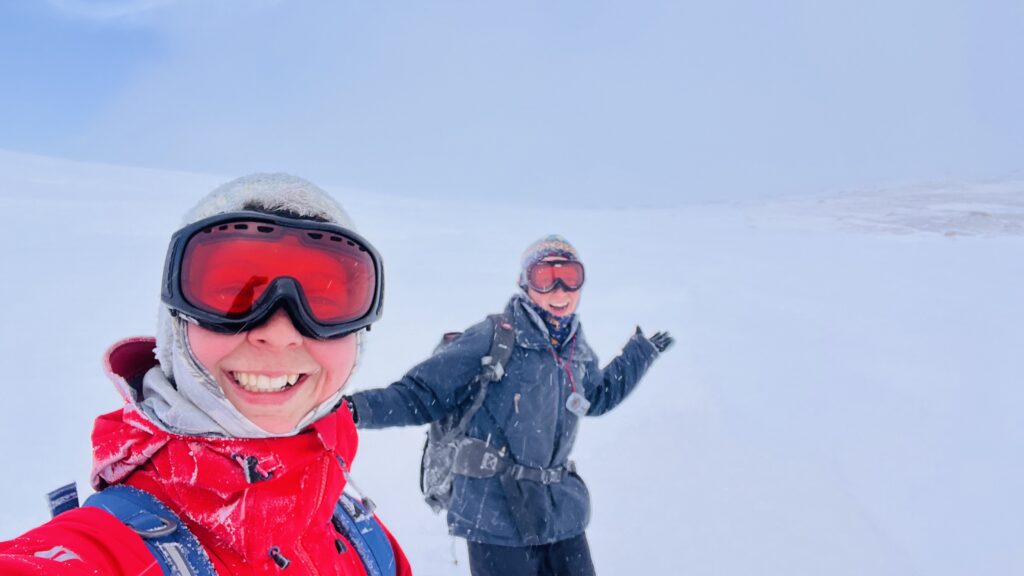
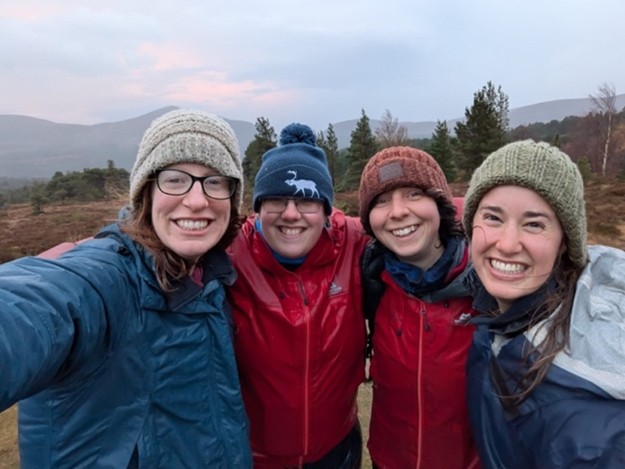
All smiles navigating to the reindeer in white out conditions on the Cairngorm Plateau.

Daisy: We used a combination of a good old trusty compass and Google Maps to navigate through the white out. Despite the freezing temperatures and snow that was blowing up off the ground, we were actually nice and toasty in very excited high spirits the entire time. Looking at the satellite imagery on Google Maps of roughly where we knew they were, I made up names for all the features I couldn’t see in front of me, and was probably really reassuring to Andi when I kept repeating “the reindeer should be at the bottom of the orange segment just in front of us”.

Andi: Between Daisy using the tech to pinpoint where the reindeer should be, and me keeping us on a compass bearing with the old-school methods, it felt like we had a plan! It was reassuring having two brains on it, keeping each other right and cross-referencing to ensure we were on track. Most of our reindeer herding is not done in a white-out, so it was a fun challenge to be testing out our nav skills.
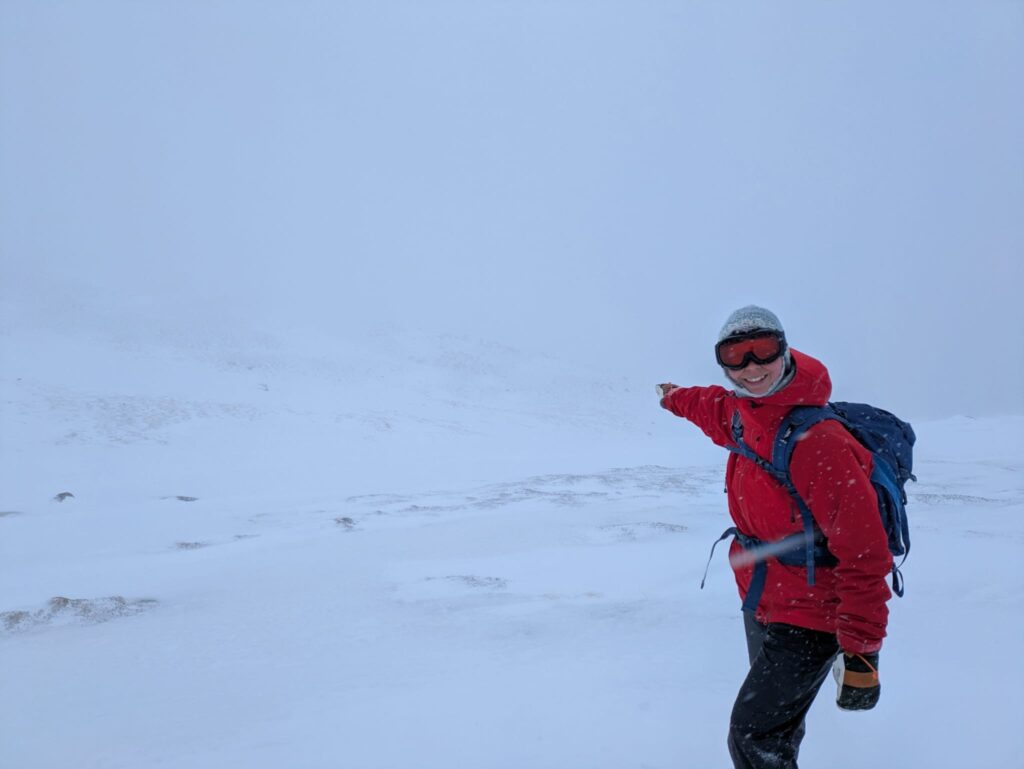
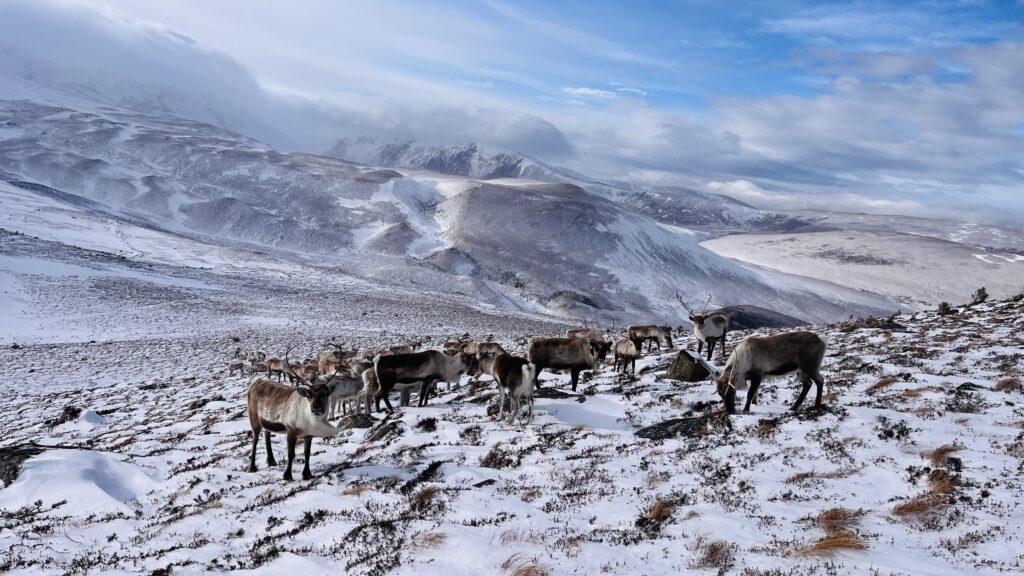
We found the herd! (Trust us, they are in the photo…)

Daisy: We came to a stop and scanned the landscape, the reindeer should have been metres from us at that point. Then like magic, some cloud lifted and Andi pointed off into the distance: “Reindeer!”. There they were, 73 reindeer hunkering down on a hill edge. Several cheers followed as we dug our spikes in to descend a small ice sheet to get to them.

Andi: I was glad to have a fair bit of experience picking out a herd of reindeer on a hillside, as their camo was excellent, but something in the shape/shade of these particular bumps ticked the box of not just being rocks! It felt like such a prize to have managed to follow our bearings directly to them.
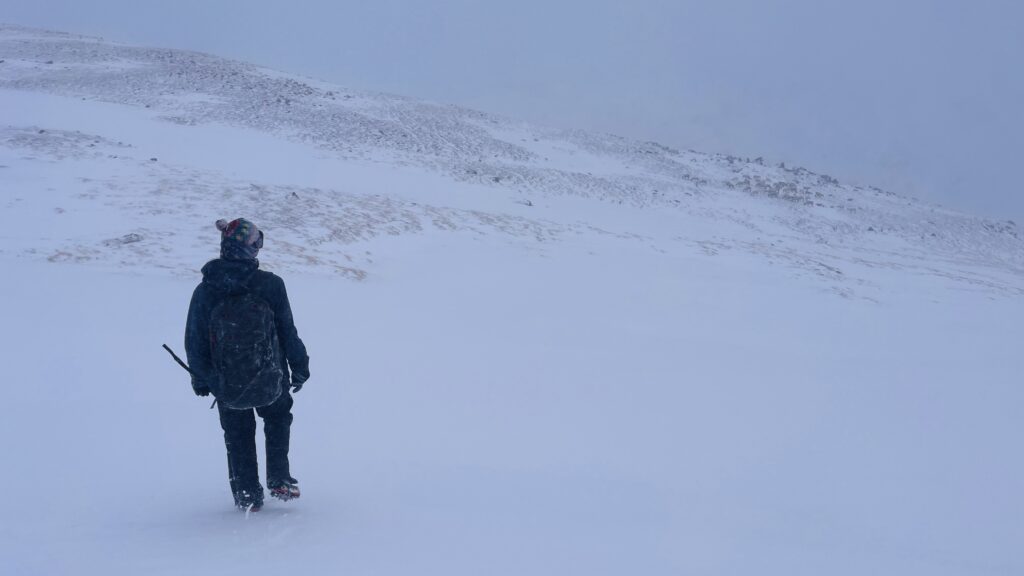
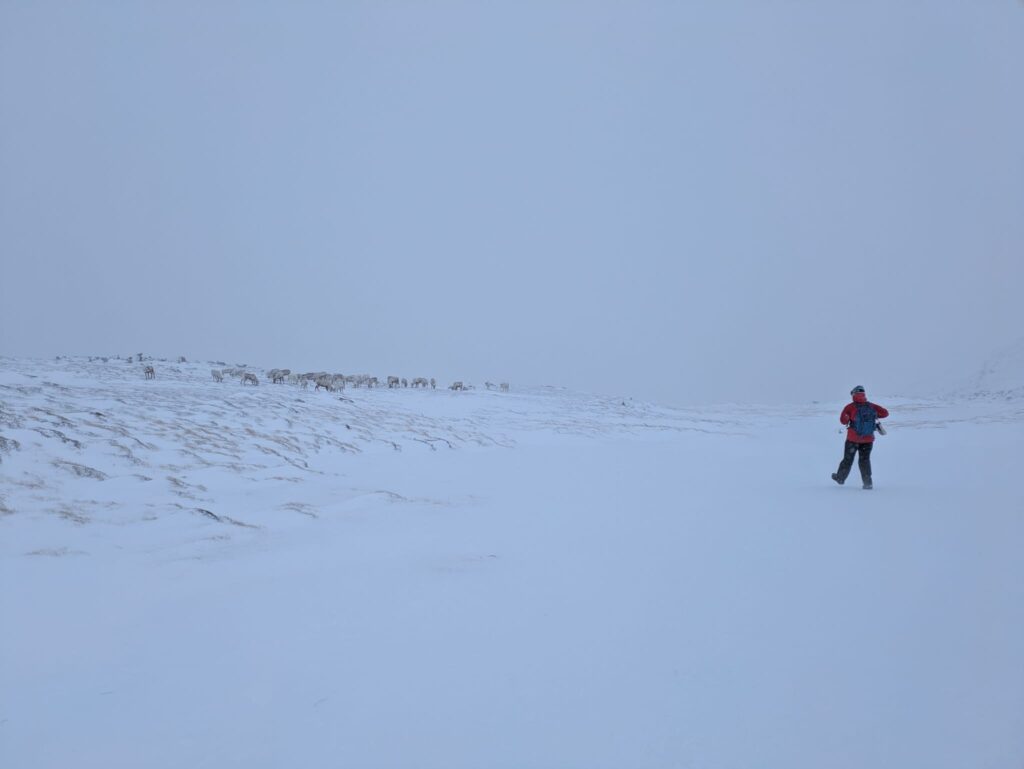
Can you spot the reindeer?
The hard part’s over right?…

Daisy: It was my first time seeing how effective a reindeer’s coat is against heavy snow and winds and it was amazing to see the snow piling up against them. As I got nearer and walked around the back of the herd to encourage them up, I could see just how cold it must have got overnight with all the frozen snow and ice on them – not bothering them at all!

Andi: It amuses me how reindeer are so blase about weather, actively choosing to wander up to exposed ridges in the worst of conditions. There is actually method in their madness, as wind will blow snow off the ridgeline, meaning they have to dig less for food, and there is also less risk of getting stuck in a snow drift. But still!
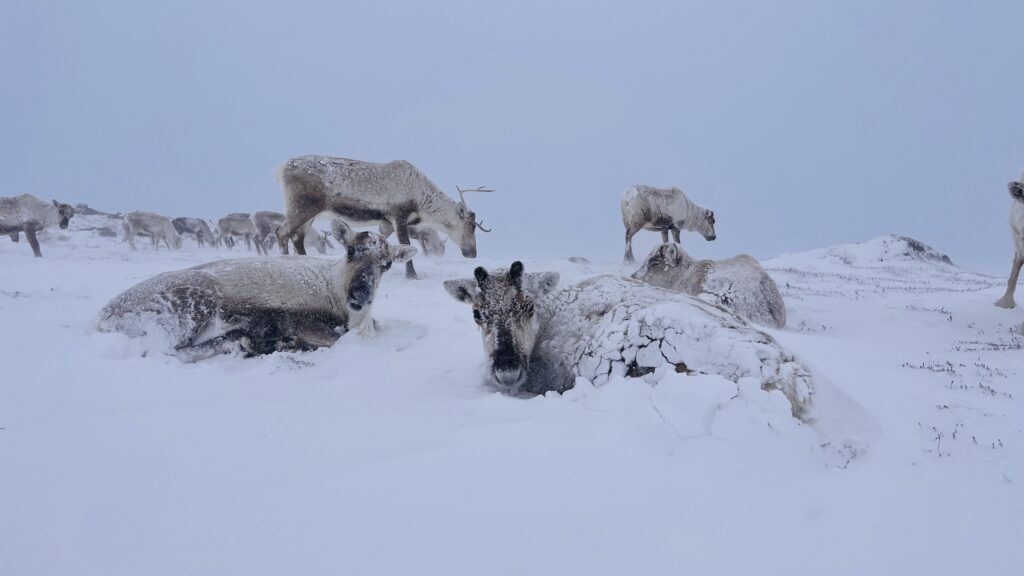
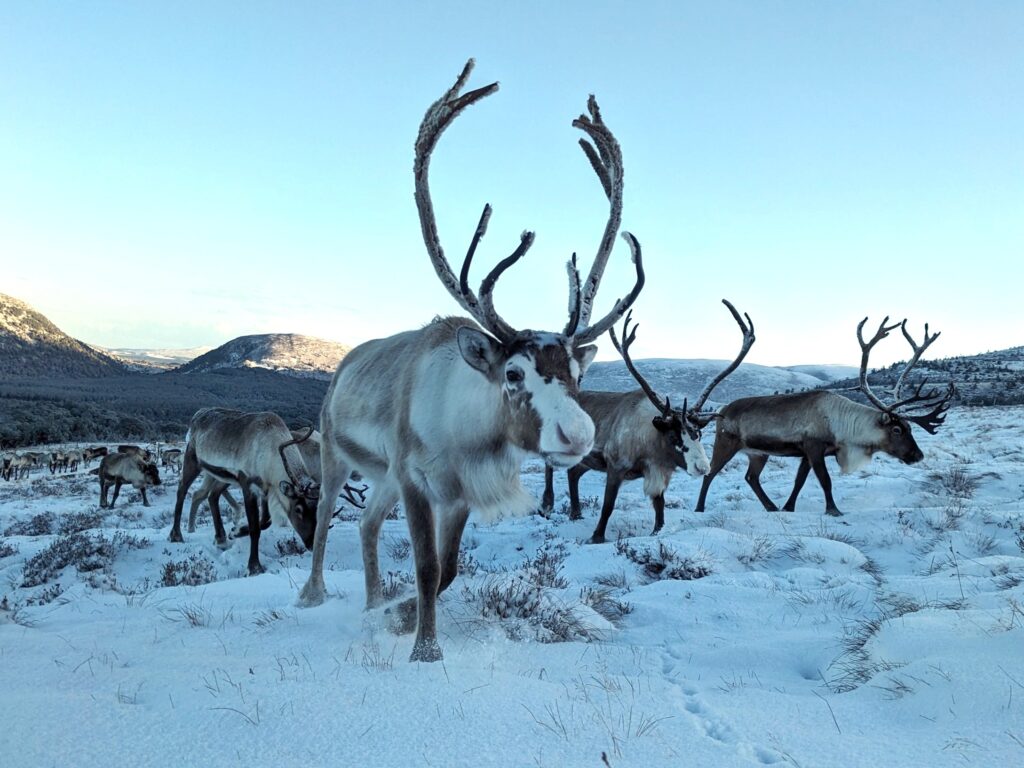
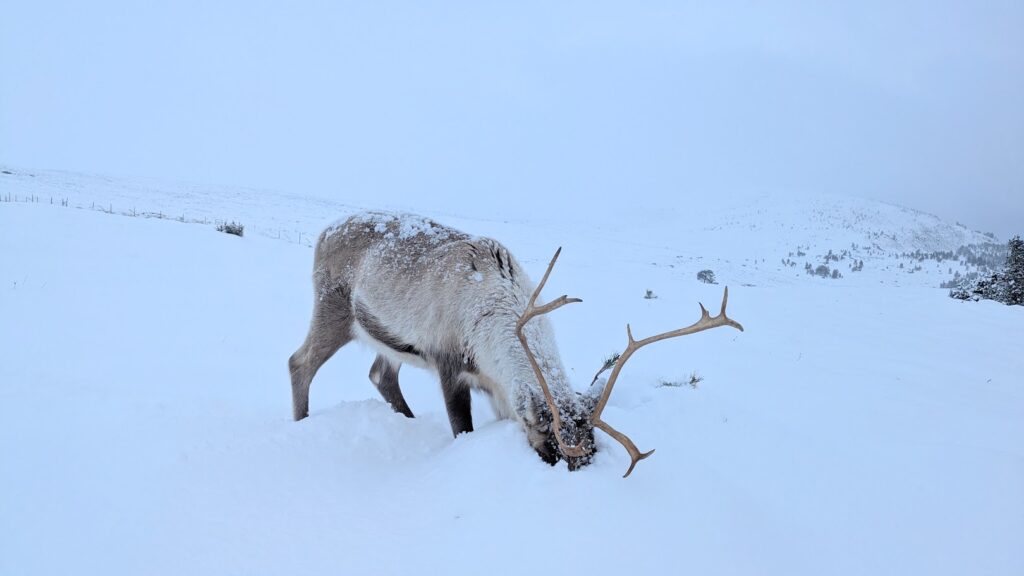
Thanks to the hollow guard hairs that make up the outer layer of a reindeer’s coat, the snow doesn’t melt on them. This keeps them warm on mornings like this, lying in the snow at -4.

Daisy: With the herd up and already eager to follow Andi, we set off into the white to move the reindeer off the mountains and down to much lower ground. It wasn’t long before the winds started to pick up and throw quite a bit of snow at us. The herd stuck together really well and I got my first experience of how they stay together in low visibility. Usually they spread themselves out a fair bit when on the move, some will stop to graze and take their time – but in the harsh windy conditions and terrible visibility they were staying close as a herd the entire time.

Andi: The herd were in a very co-operative mood and as I set off in the right direction, shaking a bag of food, they all trotted after me. I tried to set a pace where the herd were close enough to me that I could still see Daisy, who was following at the back. It felt sensible to be able to keep an eye on each other!
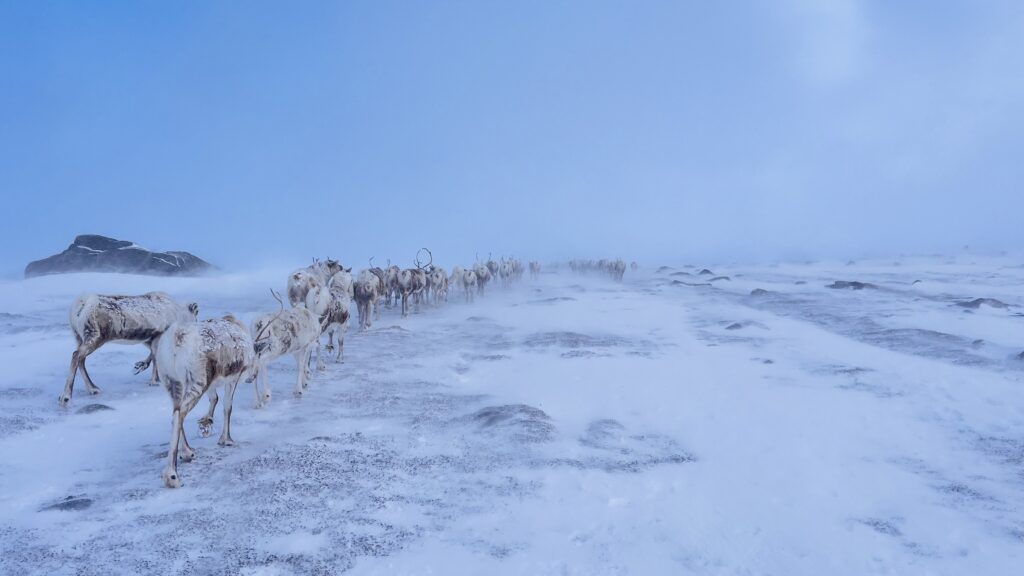
The winds started to pick up as we got lower, here you can see gusts of snow blowing up from the ground and gusting into the herd.

Daisy: I’m glad that it was actually probably the easiest herding I’ve ever done, the reindeer wanting to get off the windy plateau as fast as we did. It gave me plenty of time for photos and to take in how amazing the experience was. Plus I was able to focus on my own struggles in the wind – like making sure I didn’t get blown over every 30 seconds!

Andi: As the wind buffeted us, humans and reindeer alike, I had to stop myself from feeling guilty that the reindeer were in these conditions, reminding myself that they had chosen to come up this high themselves!
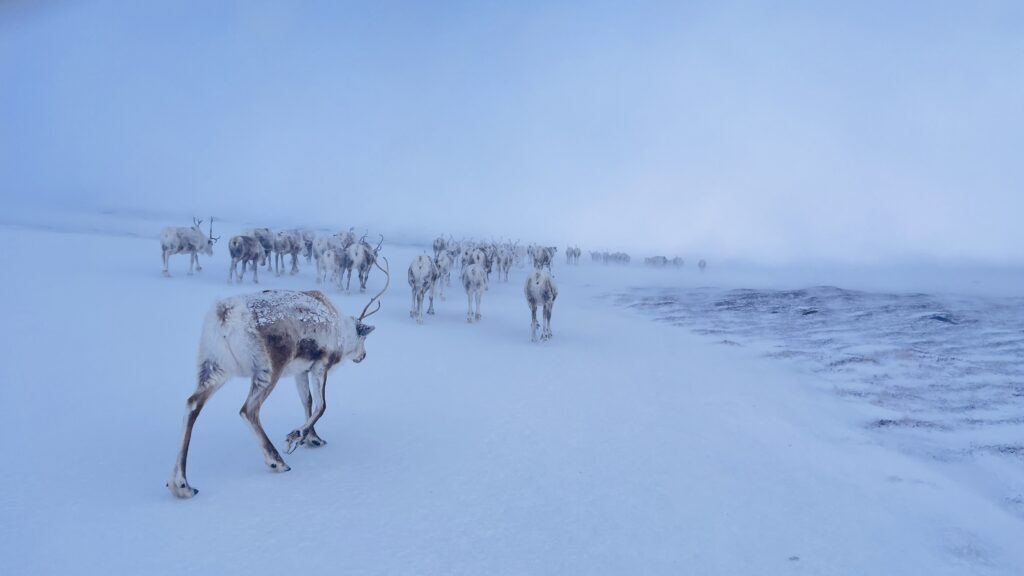
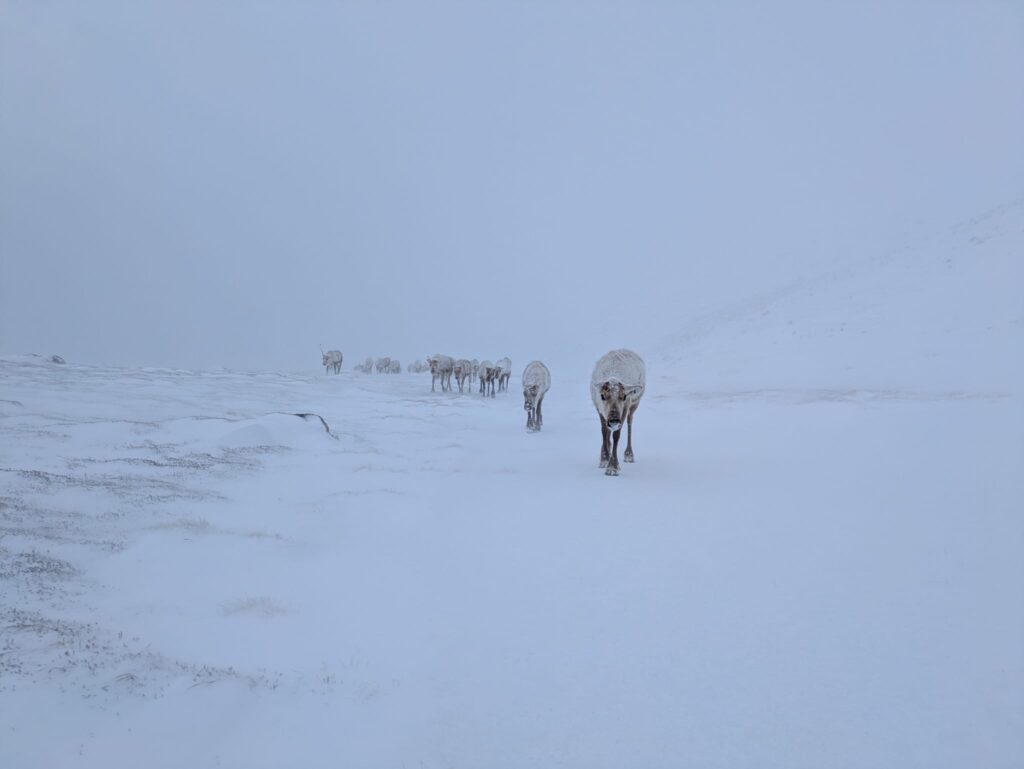
Daisy was pushing the reindeer from the back, watching them disappear into the snowy winds ahead.
As Daisy watched them disappear, Andi watched them steadily appear following her to lower ground.

Daisy: I was so grateful to be at the back! Apart from making sure I kept up with the herd, (which did involve the occasional sprint whenever they ran on ahead to regroup around Andi – slightly stressful as I’m much slower than a reindeer!) I at least didn’t have to worry about navigating. Andi had to lead 73 reindeer and one herder down off the mountains following just compass bearings!… I did not envy that task at all.

Andi: When fetching the herd, we generally take turns at either leading or pushing. Today Daisy had volunteered me to lead, as I knew the hills better than her so there was some theory that I would pick a good route. In reality, I’ve found it’s a case of heading in roughly the right direction, glancing back at which way the savvy reindeer are going, and repositioning yourself to be in front of them, which makes it look like you knew exactly what you were doing… The reality is that the reindeer spend their whole lives in these mountains and know them far better than any human. Once you have the herd on side, the job of leading becomes much more straightforward, though it is the first time I have brought reindeer in whilst using a compass!
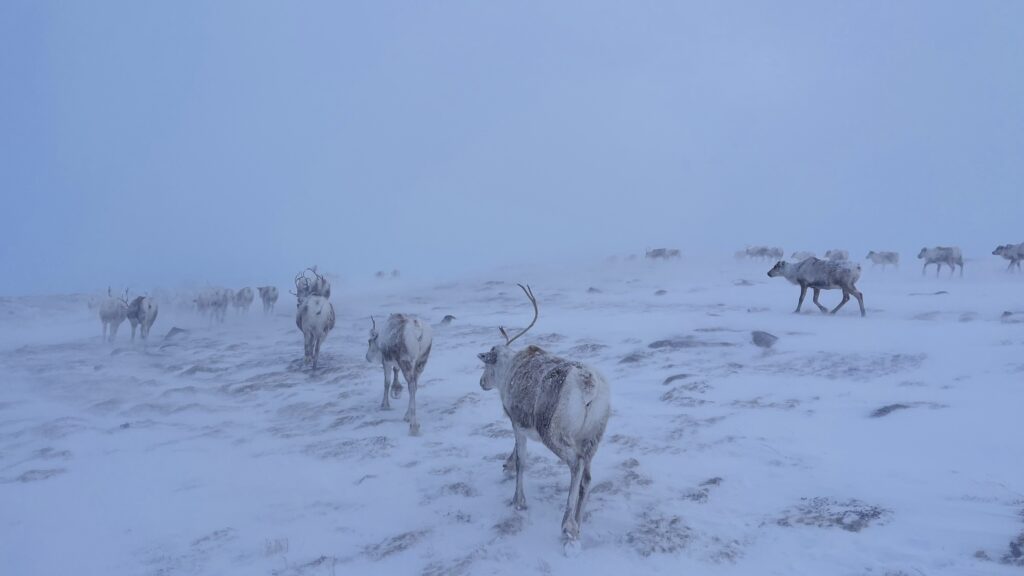
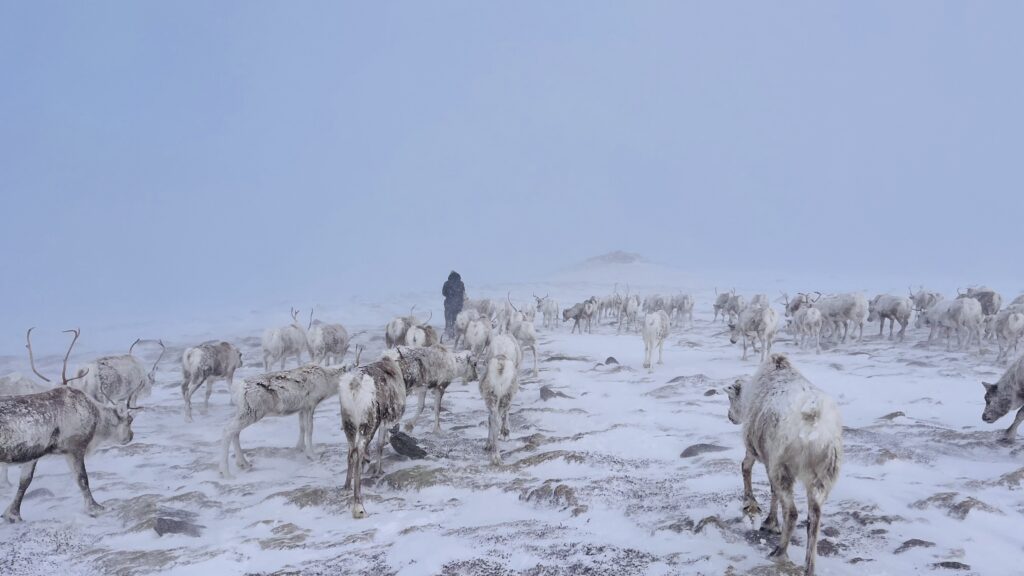
The visibility continued to get worse, but thankfully Winnie (seen in the middle here) kept Daisy company at the back the whole way and made sure she didn’t get left behind!
Andi leading the herd solely using compass bearings!!

Daisy: The further we got and the lower we started to descend, the higher the wind speed increased and the snow began to feel like needles being fired at us. I quickly lost any feeling in my face, and loved watching how the reindeer turned themselves into the wind, the cows with their calves sheltered alongside them. While I struggled to stay balanced on my feet and really starting to feel the cold bite – the reindeer were in their element! Sticking together as a herd and following the hoof prints of the reindeer in front of them.

Andi: Whilst the reindeer made it all look easy, the conditions were not so easy for us humans. As we began descending we encountered more deep banks of snow, which resulted in a couple of complete face plants for me! The look of confusion from the reindeer at how useless us two-legged-creatures are was pretty funny!
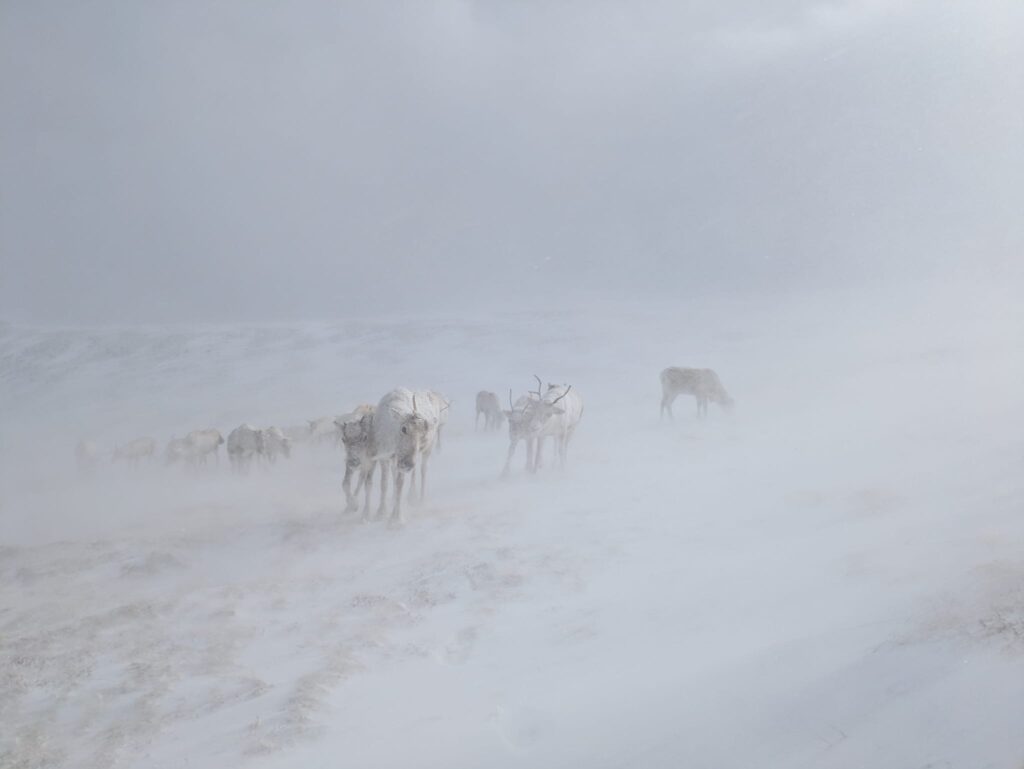
Andi’s view of the reindeer fighting against the wind gusts as we dropped off the plateau. The wind speed was gusting up to 72mph during our herding mission!

Daisy: We had finally made it low enough that the cloud cover began to lift and I could see all the recognisable land marks to suggest we had nearly made it! We had one last push over a steep bit of rocky ground that proved quite difficult to navigate in the high winds and deep snow – at this point I had stopped bothering with my count of how many times I’d fallen over in suprise patches of knee deep snow. The reindeer were even bracing the final harsh whips of wind for some lichen grazing! The last stretch to the visit spot they picked up pace downhill towards Andi and I watched as they swapped to a very wide gait in the way they were running. It looked pretty comical – their legs so far out to the sides as if they were going to skid on their bellies at any moment, but worked perfectly. Their hooves hardly made a dent in the snow and they kicked through patches of powder at speed. I did attempt my own version to see how effective it would be for a person, and even tried to keep my boots in their hoof prints. You guessed it… I built up a lot of speed before hitting the snow hard and my arms disappearing in front of me. Thankfully only Winnie saw, who gratefully had kept me company the entire walk. I won’t be trying to run like a reindeer again anytime soon!

Andi: By the time we reached our ‘visit spot’, we were low enough to drop down out of the cloud, the skies were clear and there was only a smattering of snow on the ground. We fished out the reindeer feed from our backpacks and the calves tucked in – we give them a brief preferential feed through the winter. The adults know the drill and waited patiently, then we popped out a line of feed for everyone. A quick headcount – everyone was present and correct.
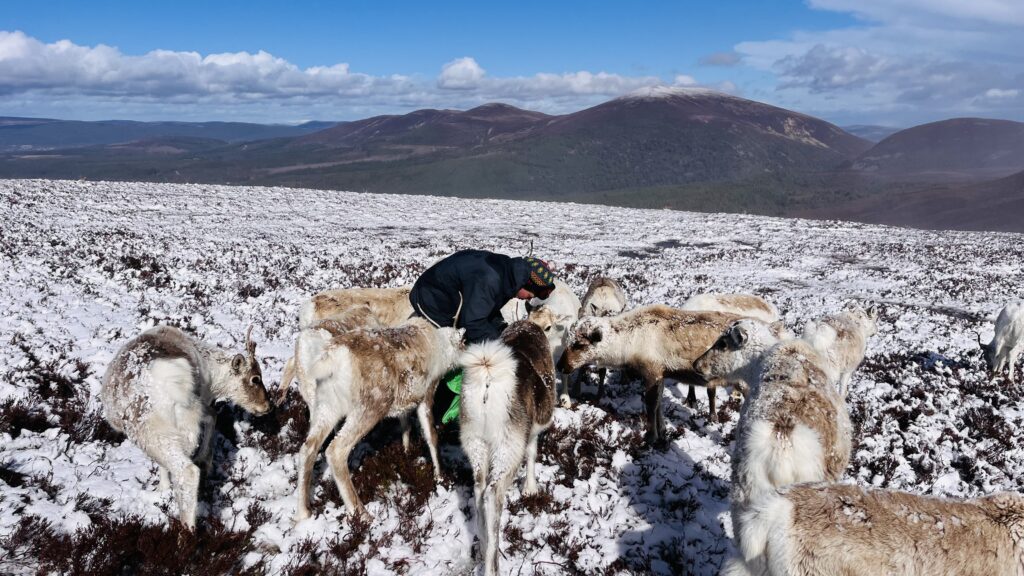
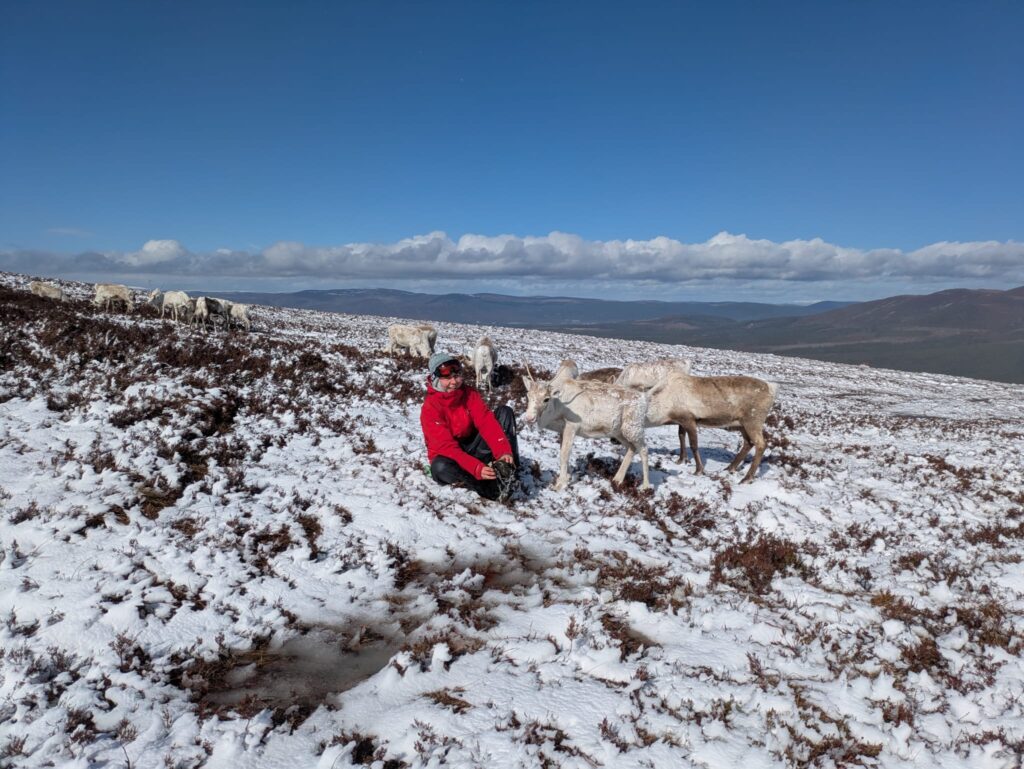
Andi couldn’t get the bag of feed open quick enough for the hungry calves after the long journey. Look at the difference in the weather at a couple of hundred metres lower altitude.
Boogie helping Daisy get frozen spikes from her hiking boots.

Daisy: We had done it! Thanks to Andi’s amazing navigation, we had successfully led the herd of 73 reindeer from the mountain plateau down just in time for the days Hill Trip! We fed the hungry reindeer and checked we had everyone and they were all looking happy and healthy and then had a moments breather to chat about how amazing the experience had been. I can confidently say, that herding adventure was the best experience I’ve ever had! Being in such harsh conditions with the wind, the snow, the lack of visibility – it felt like being on a different planet. Experencing the kind of conditions the reindeer are built, not only to endure, but to happily live in felt like such a privilege. Stumbling and running after them at points to keep up, gave me even more respect for how incredible animals’ adaptations are to their home environment, and how much of a privilege it is to experience nature at its best!

Andi: Many visitors assume that being a reindeer herder means you’re incredibly fit and spend all of your time running round the mountains. The reality is that a lot of our job is actually based in the office, shop, and working with visitors. Yes, we do get to roam around on the mountains too, but the weather is not usually quite so gnarly! We had so much fun testing our skills and experiencing the extremes that the reindeer are so at home in, and were buzzing for the rest of the day! It really felt like we’d voyaged to a different planet…
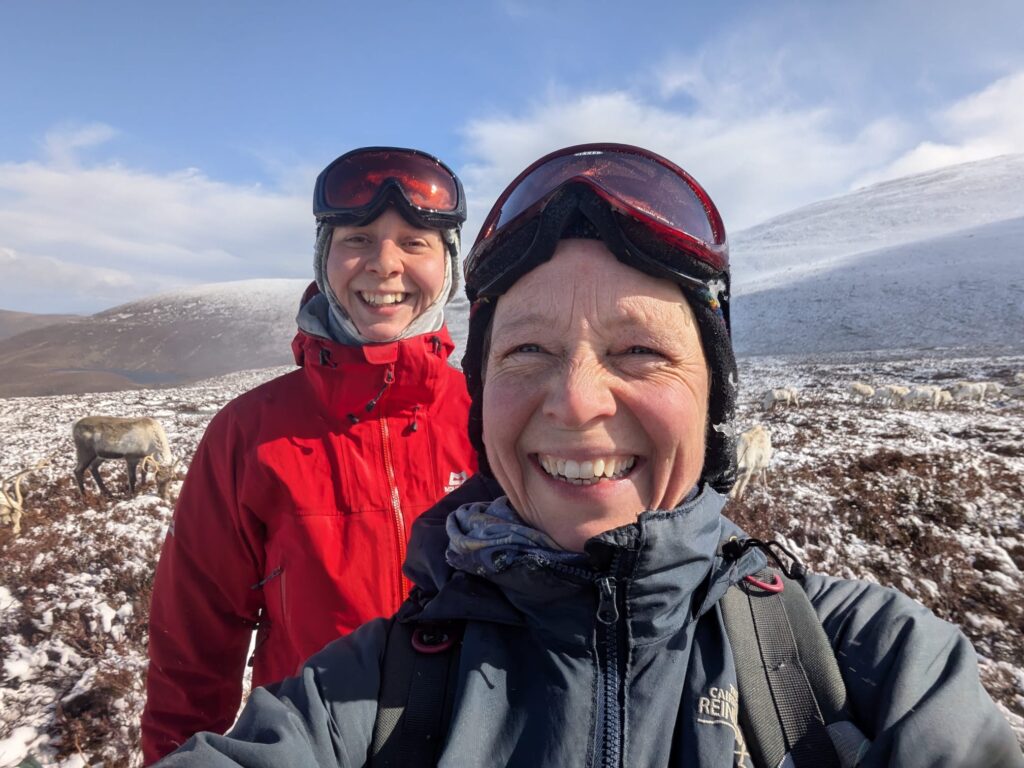
Mission accomplished! Now time for a cup of tea…

Daisy and Andi
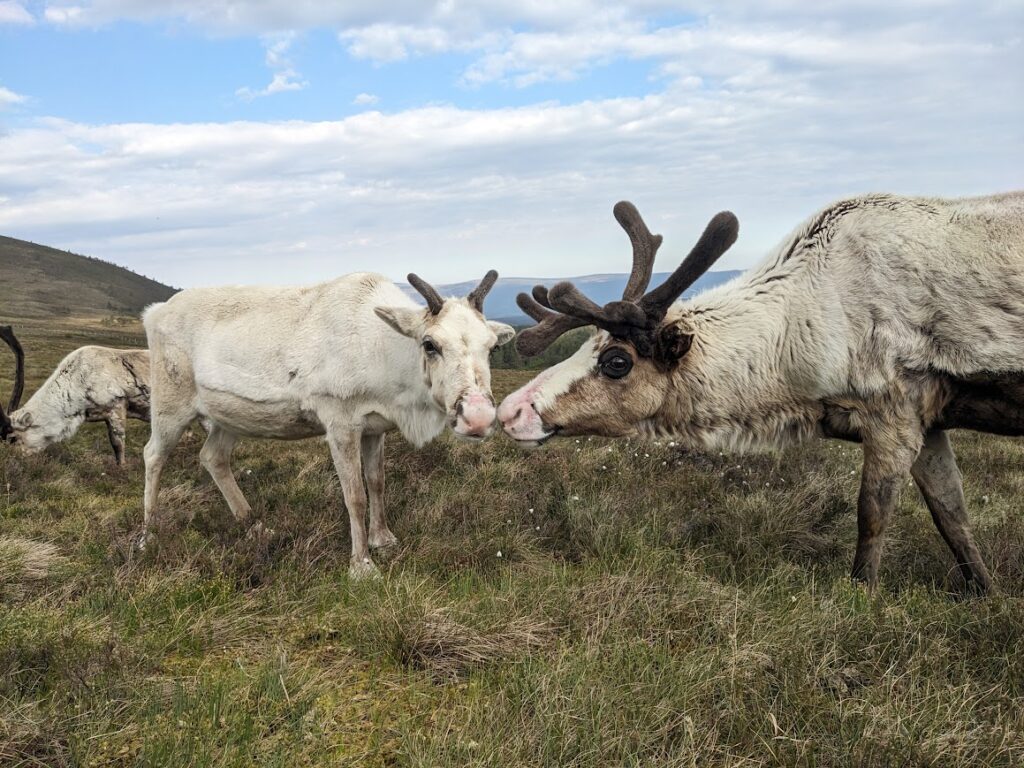
Reindeer Metabolism and How it Changes Throughout the Year

The bodies of reindeer go through many changes allowing them to cope with huge temperature difference throughout the seasons. In summer reindeer can cope with temperatures above 30 degrees and the lowest recorded temperature that reindeer have been know to survive is -72 degrees Celsius. Reindeer have two different coats, a thick white winter coat as well as a fine, dark summer coat. Their antlers grow in an annual cycle and the different times of growing and shedding them allows different animals to be dominant at different times of year. One of the most interesting, and important, changes to a reindeer though, you can’t see – their metabolism.

Magnum in his winter coat.
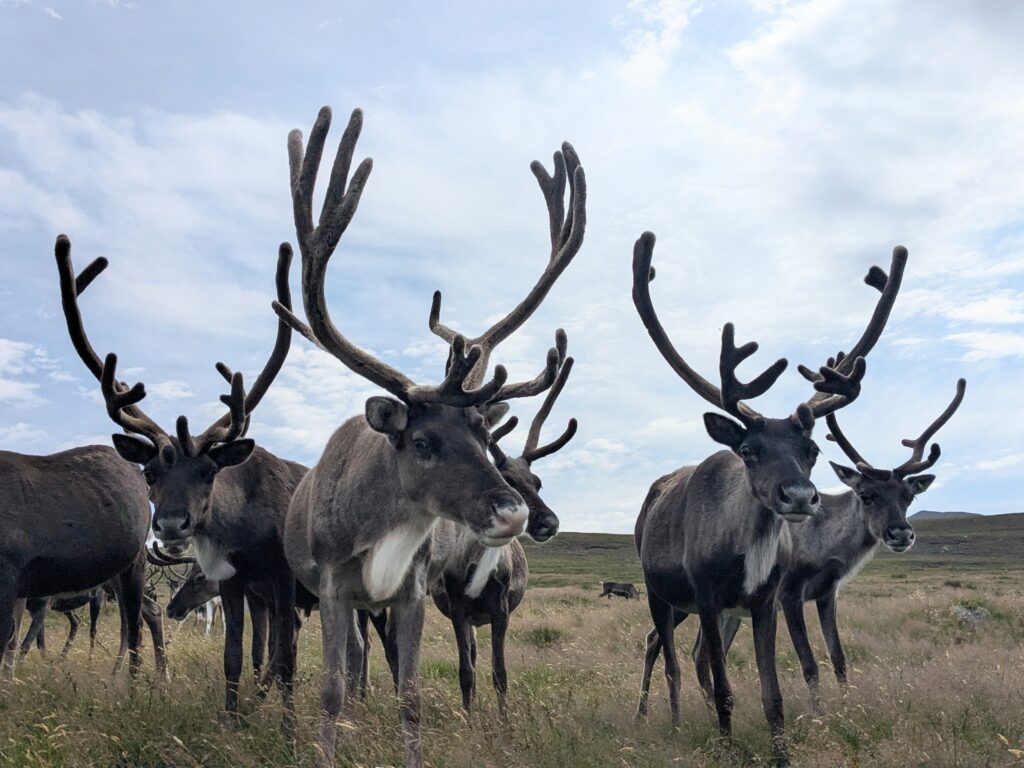
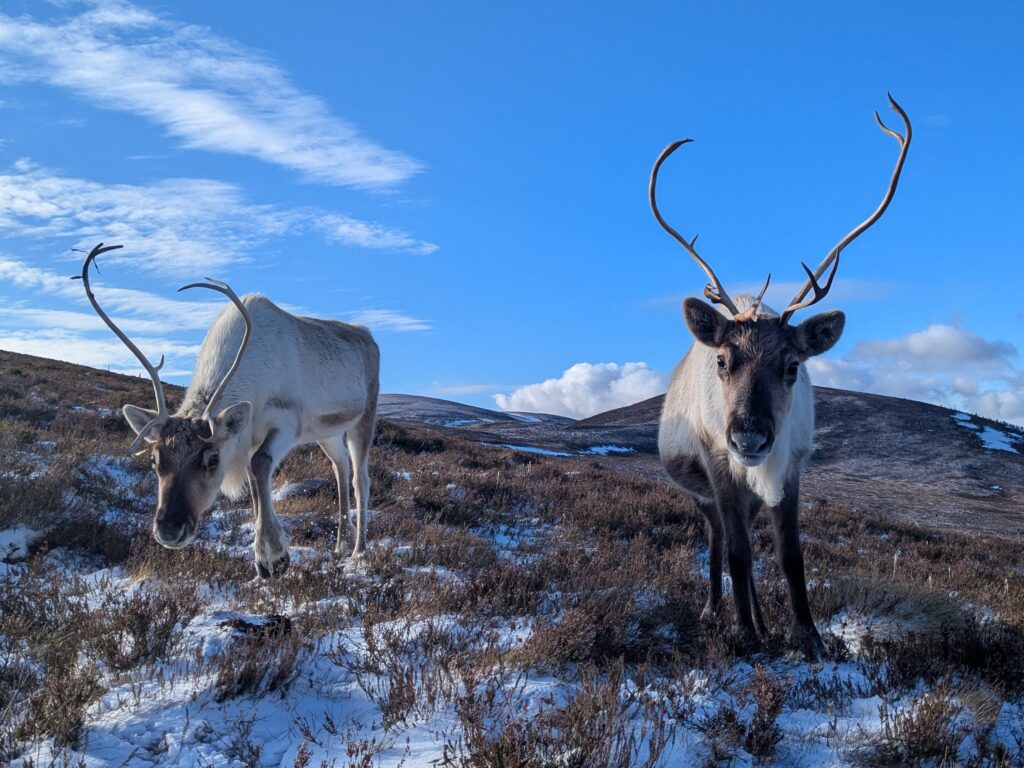
Colorado, Iskrem, Yangtze looking smart in their summer coats.

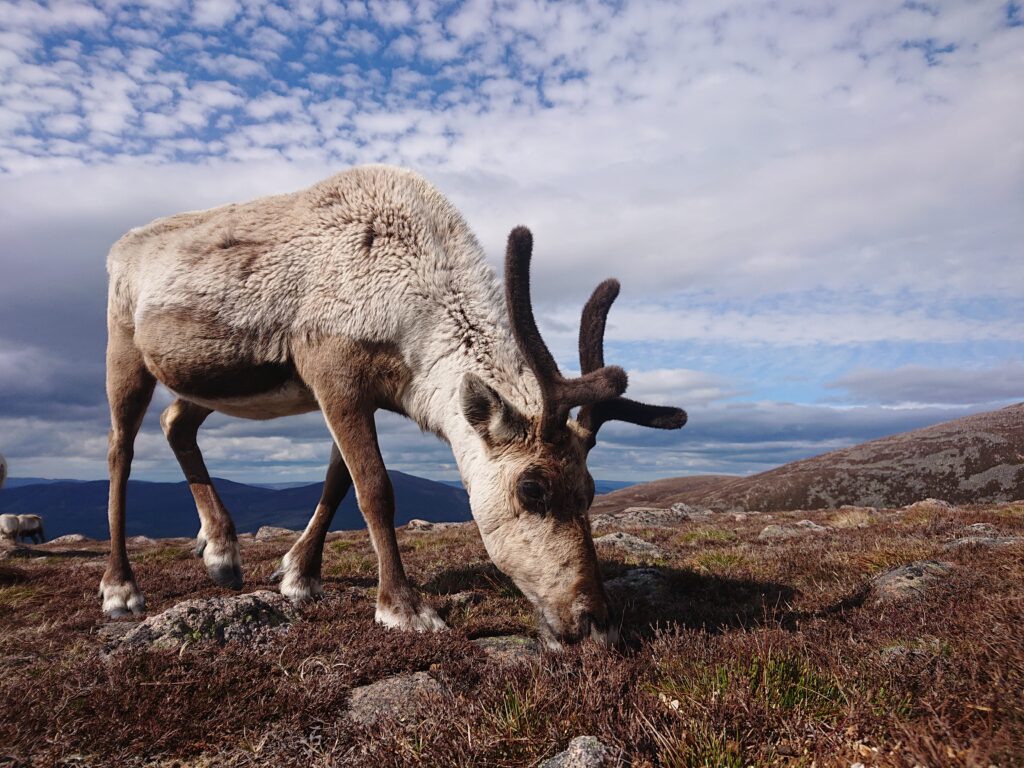
Reindeer have adapted to eat vast amounts of food throughout the spring, summer and autumn to gain enough weight to survive the winter, when food is scarce. To cope with these changes in food availability their metabolism changes too. In the summer reindeer will graze around the clock, eating a huge variety (between 200 and 300 different species) of plants which are high in nutrition. This allows each individual to grow a new set of antlers, they start to grow in the spring and are fully grown by the end of august and the heaviest set we have had in our herd, weighed a whopping 8.9 kgs. The summer is also the time that the young reindeer grow in body size. Finally, every reindeer will need to gain body fat which will act as reserves over the winter. All these things require their digestive system to work in overdrive converting the food they are eating into energy that can be used by their body to create protein, bone, fat, and whatever is needed.

Ryvita grazing and growing her beautiful antlers.
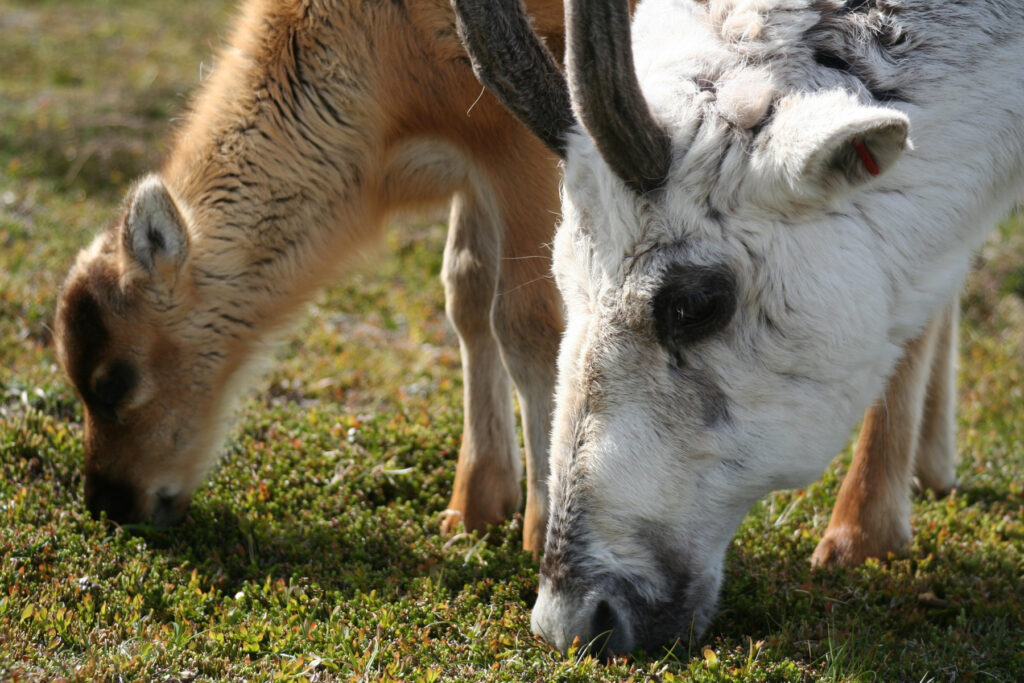
Cow and calf grazing on the high plateau plants.

On the contrary, winter is all about survival. During the winter most of the plants will have died under the snow and 70% of a reindeer’s diet is made up of lichen. Lichen is a symbiosis of fungi and algae and is very resistant to extreme changes in temperature. Over the winter lichen won’t grow but it will stay dormant, preserved under the snow. Reindeer will then dig down through the snow to reach the lichen. But lichen is relatively low in nutrients, just enough to sustain the reindeer through the winter and their metabolism shifts in line with this. In fact, even if you gave a reindeer a big pile of food, during the winter, they just aren’t as hungry and wouldn’t eat it all.

Winnie eating lichen under the snow.

During the winter reindeer are no longer growing their antlers, they won’t increase their body size at all, a calf will grow lots in the first 6 months of their life and then stay the same size for the next 5 months, until the following spring. They will survive the winter by using their fat reserves. The one important growth that does happen in winter is that of a growing foetus. This is the reason that the females grow antlers and keep them after the males have shed them, as it gives them a physical advantage during the time that they are pregnant and therefore they get first dibs on the food.

Vienna and Amazon showing off their beautiful antlers right through the winter.
A group of our males in the winter having cast their antlers.

But how does a reindeer know that it’s time for spring? Rather than responding to food availability or temperature which may well change year by year, the changes in their metabolism are triggered by the changes in daylight. The increased daylight associated with spring is detected by specialised receptor cells in their eyes which then convert to a hormonal signal using melatonin. Melatonin is synthesised during the dark period each day and then synthesis stops during daylight. This means that the amount of melatonin varies based on the time of year. The concentration of melatonin has many effects. In terms of metabolism, in the spring as melatonin decreases, this increases the appetite of the reindeer. In the autumn, as melatonin increases, this decreases the appetite of the reindeer and increases the breakdown of fat stores. The changing melatonin levels also controls their antler growth and release of sex-hormones but that may be another blog in the future.

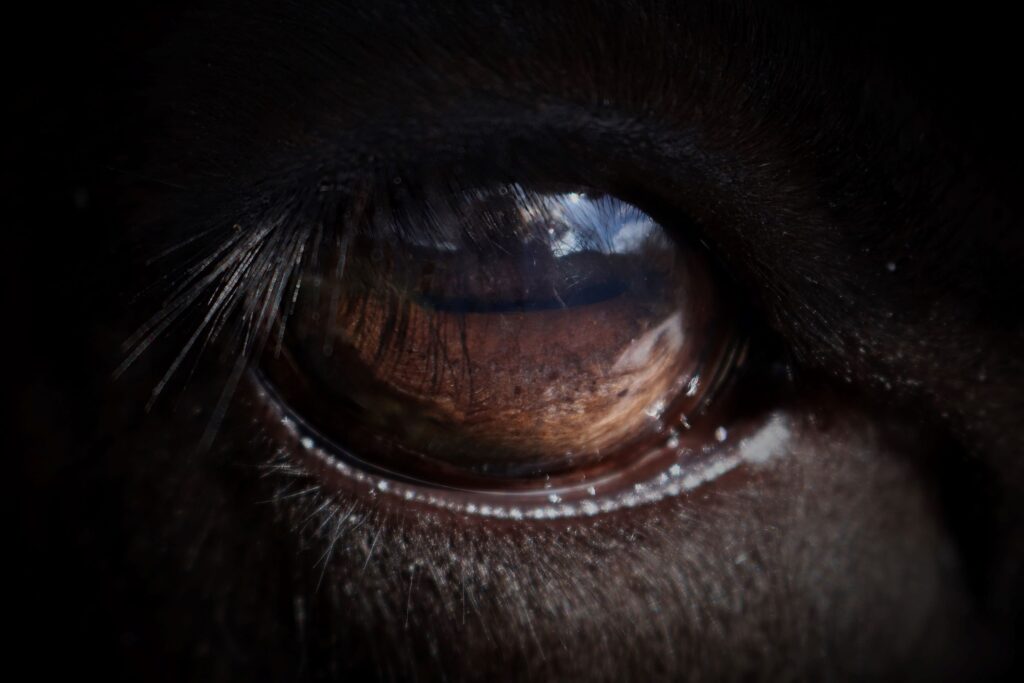
Eye of a reindeer.

For anyone particularly interested in a much more in-depth description of the physiology behind these changes, I would highly recommend reading this article.


https://septentrio.uit.no/index.php/rangifer/article/download/335/327/1280

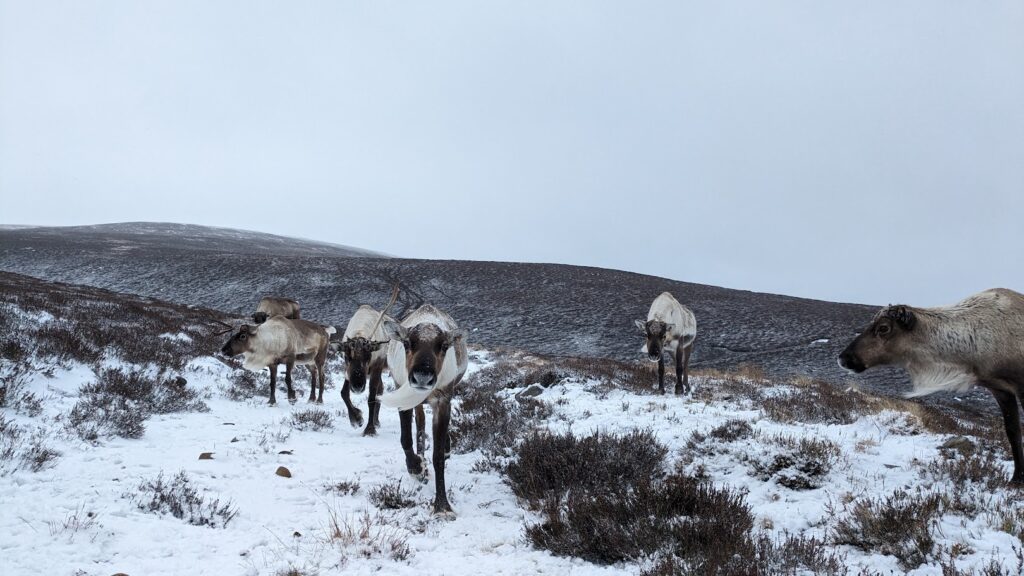
Glacee, Salsa and the herd enjoying a snowy day!

If you have made it this far, thanks for reading my very nerdy reindeer biology blog! Hopefully you have learnt something and enjoyed the pictures of the reindeer along the way.

Lotti

Merida

Following on from a blog I recently wrote all about Cheer, I thought I’d write another blog about another white-faced reindeer born in 2012 – Merida!

I first met Merida in May 2017 when she was five years old. It was my very first week as a reindeer herder and I have a very strong memory of sitting in the hill enclosure with Sally who was showing me the ropes. Two cows and calves were in a smaller part of the enclosure and we were spending time observing how they were getting on – what a tough job! Merida and her new born calf were there, and whilst Merida herself was fairly uninterested in us, her calf came right up to me and starting nuzzling my shoe laces. It was instant love! This tiny reindeer calf grew into the mighty Dr Seuss, who everyone knows is the best reindeer ever. As the ‘mother of the greatest’ I am also very fond of Merida, so this blog is full of photos of her.

Merida has a very distinctive hourglass pattern on her face and therefore one of the first reindeer I learnt to identify. She is friendly around people and enjoys hand feeding. She has been an excellent mother over the years and has three surviving sons – Dr Seuss, Ärta and Mr Whippy.

Merida and her newborn calf – who later was named Dr Seuss. This was around the time I first met them both.

I left the Reindeer Centre in March 2018 for another opportunity, but missed the herd (and my colleagues!) too much so returned to herding in March 2021. Most of these pics are therefore of Merida, and her offspring, over the last 5 years or so.

2021

Catching up with Merida whilst she’s out free ranging in the hills. With no calf at foot in 2021 she was able to put more energy into herself and grow lovely big antlers.
Merida looking beautiful with her beard blowing in the breeze in October 2021. Camembert is the reindeer in the background.
Spartan doing his best to woo Merida. She looks a bit unsure but it must’ve worked as the following spring Merida had a male calf.

2022

Dr Seuss and his mum in early January 2022, hanging out together – both waiting in line for the hand feed.
A heavily pregnant reindeer in April 2022. Her new antler is just beginning to grow.
Merida and newborn calf in May 2022. We later named him Mr Whippy! You can see the antler that had a head start (see above photo) is taller than the other.
Merida and her calf the day they were released out on to the free range for the summer.
Torch & mum Magnum and Mr Whippy & mum Merida in September 2022 after coming back into the hill enclosure.

2023

Merida and Mr Whippy back out free ranging in the hills in January 2023.
Merida enjoying herself on the free range in early August. She looks a bit scruffy as she’s moulting the final bits of her old winter coat. She’s grown another set of cracking antlers!
Merida on the end of the feed line in October 2023 with a lovely rainbow behind.

2024

Merida in February 2024 with her epic antlers!
In May 2024 Merida had a new male calf. When Merida grunted for her new calf, her 7 year old son Dr Seuss would come running over!
Merida and new calf with older son Dr Seuss (mid-moult with a sunburnt nose). Dr Seuss was often by his mum’s side for the few weeks they all overlapped in the hill enclosure. Very sadly Merida’s calf picked up a tick-bourne illness in August and despite receiving medication and all our best efforts he sadly didn’t survive.
Ärta in October 2024 – Merida’s son born in 2020. I can’t resist including this photo – he looks so magestic! Whilst Merida has never had a female calf, son Ärta has been bred from so her line continues.
Merida in October 2024 with rather silly antlers. Merida invested so much energy into her calf that her own antlers were a rather poor show this year.

2025

Merida in March 2025 – just beginning to grow her antlers. Her old winter coat is quite faded so harder to see the distinctive hourglass pattern on her face.
Merida in August 2025 looking great in her short summer coat. She’s now retired from breeding so will spend most of her days free ranging in the hills and enjoying life!

2026

Cameron’s photo of Merida enjoying free ranging in February 2026. She’s in a big herd which includes her three sons – Dr Seuss, Ärta and Mr Whippy.

Ruth

Free – range season of 2026 comes to an end…

Since the first week of January, our wonderful herd of reindeer have been out free – ranging the mountains. Our females and smaller male calves from last Spring roamed the hills here in the Cairngorms, while our males, bigger male calves and their mums free roamed the hills not too far from our farm. Free – range season is a chance for all our reindeer to enjoy the good grazing and open plains of the sub-arctic tundra we find ourselves in here, and to grab a well earned rest after our busy Christmas season.

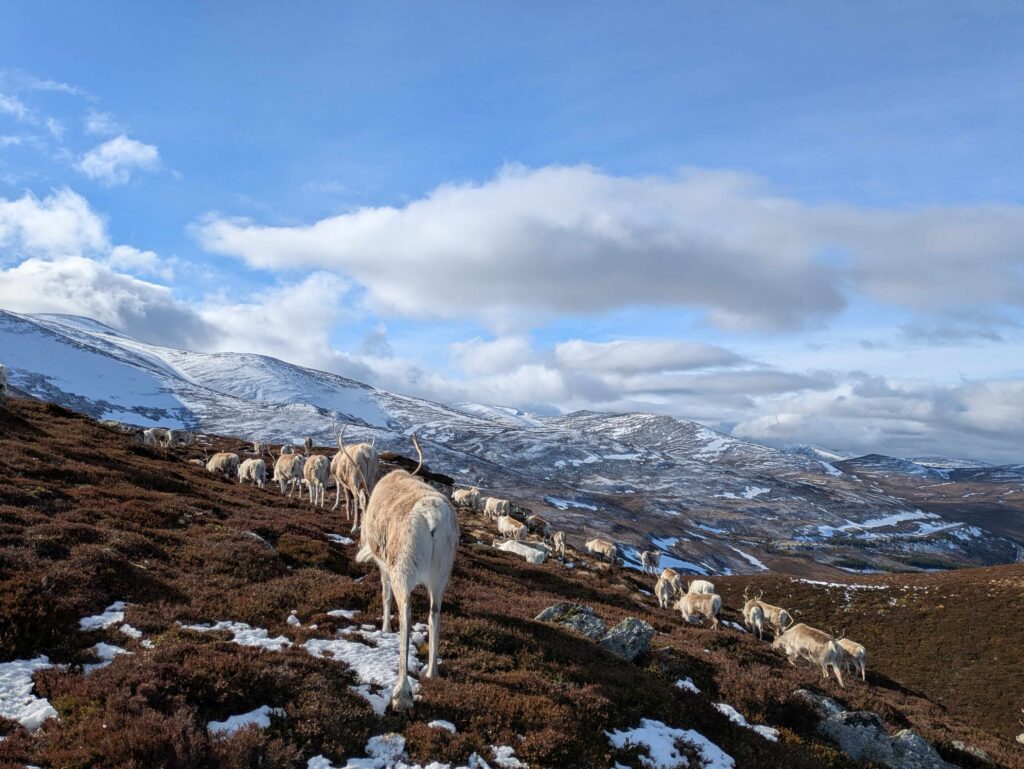
Free – ranging season provides the most stunning views of the reindeer with the backdrop of the beautiful Cairngorm mountains.

It’s also a fantastic time of year for us herders, getting to move the reindeer around the hills every morning, and take guests out to see them in their natural habitat with no fences. So, as free – range season draws to a close for 2026, it’s time to look back on our herders favorite moments.

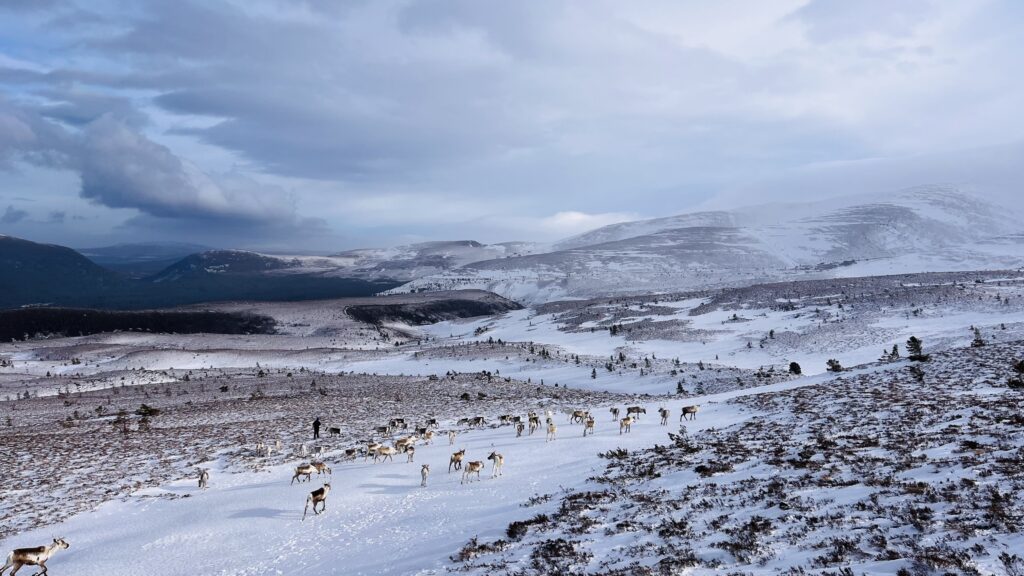
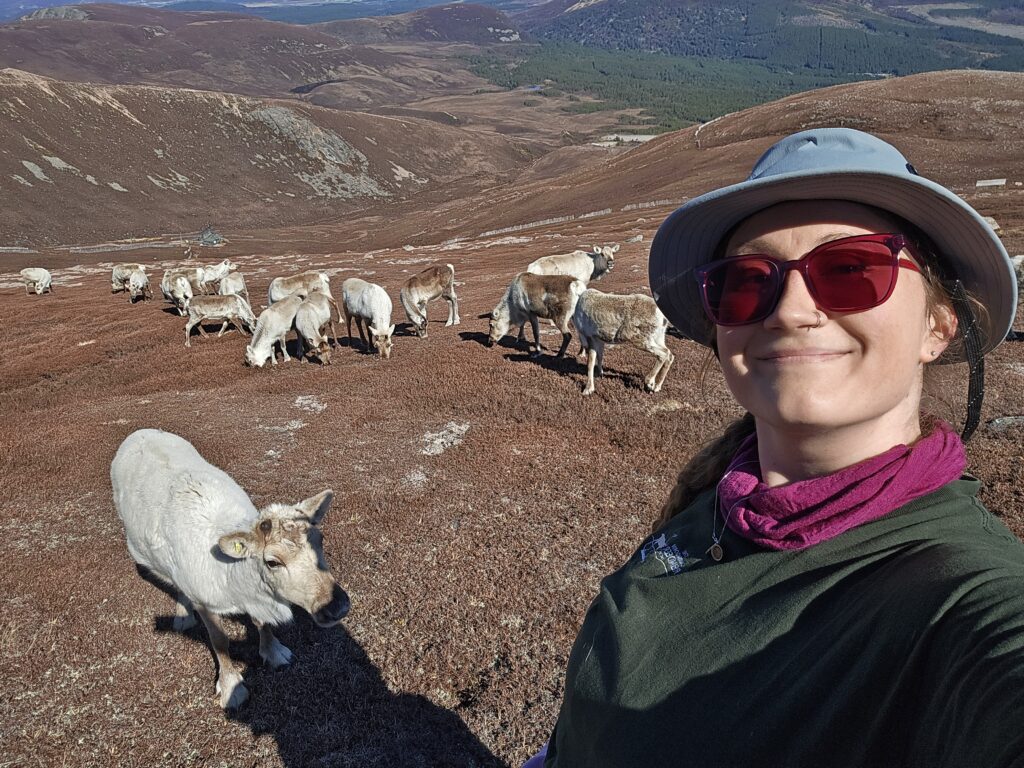
Can you spot the herder amongst the herd?…

Lotti

Looking back over the last few months, one morning fetching the reindeer immediately sprung to mind as a highlight. To set the scene, the previous day, Andi and I had fetched the reindeer for the morning visit, and both agreed that the reindeer had been slower and more difficult to herd than either of us had EVER seen! Fast forward to the following day, I was feeling tired and whilst the morning walk out to find the reindeer is usually my favourite job, after the day before I was quite happy to do a hill trip instead. But alas, it was not meant to be. As it turned out Daisy was the only herder with enough beans to volunteer to walk out to find the reindeer. At this time of year it takes two of us, one at the front and one at the back, so reluctantly I joined her.
Poor Daisy had to cope with a distinct lack of enthusiasm from me on the walk out which finished with an uphill, off path trudge through the snow. When we reached the top of the hill though, we were greeted with the most wonderful sight, the herd on a snowy hillside with the beautiful mountains of the Cairngorm’s behind them. I have lived and worked here for a wee while, but a view like this still has the ability to take my breath away – I hope that never changes.

Of course, on that day the reindeer were good as gold, and we had the most wonderful time walking them in. I often find that the days when I’m feeling less joie de vivre than usual are the days that the reindeer and the mountains really show off and have the ability to completely change my mood. I couldn’t wipe the grin off my face for the rest of the day!

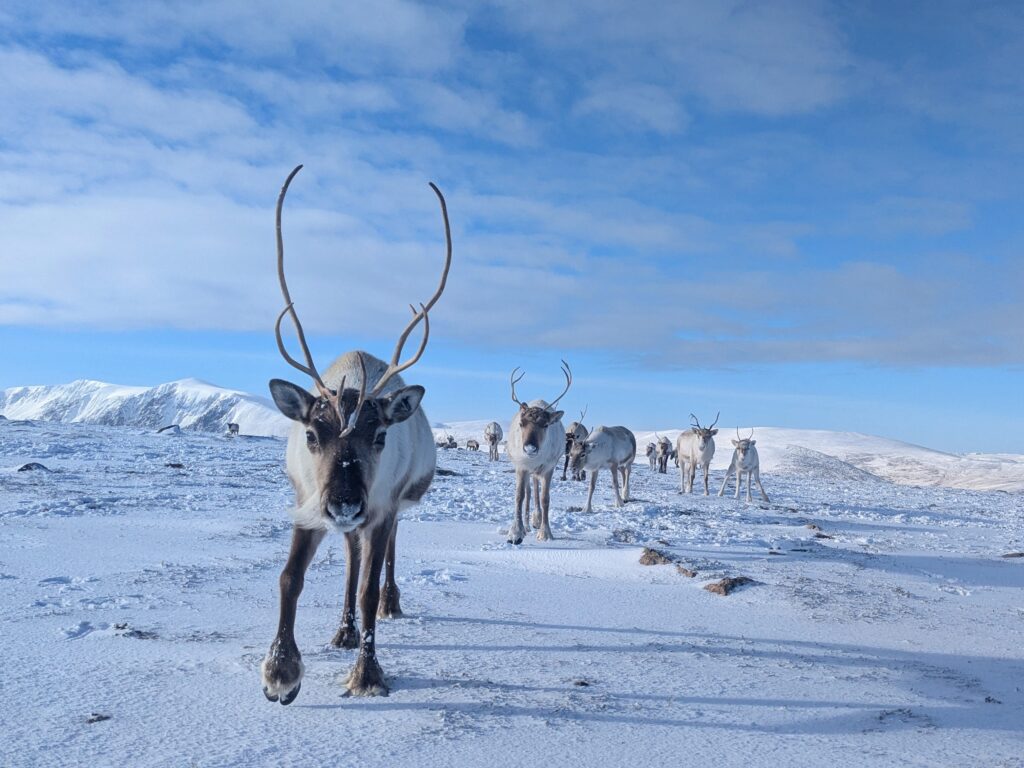
Orinoco leading the herd across the snowy hillside.

Amy

My favorite day from this winter free range was collecting the reindeer at the start of March. Myself and Hen had walked out to where the reindeer where and it was decided that I would be the person that would walk infront of the reindeer and lure them to the visit spot, whilst Hen would stay at the back of the herd and make sure that we didn’t leave any stragglers behind. At the front I could see that lovely Vienna was very determinedly trudging up the hill behind me, along with the sweetheart that is Ryvita, plus Christie and Cheer had taken a small group of reindeer on a questionable detour into a snowy crevice and Bordeaux was walking off very purposefully in the completely wrong direction. Given Bordeaux’s nature, it is very unusual for her to decide that she isn’t going to follow the herd, so I sat back for a brief second to see how things were going to play out and Bordeaux continued in the direction she was heading- away from myself.

Eventually, I rustled the white bag of hand-feed I was carrying to see if I could catch her attention and then it became evident that Bordeaux was confused about what direction I was going in. You could quite literally see in her face the moment she realised where I was and that I wasn’t in the direction she was expecting. I also loved the urgency she had when she walked off in the wrong direction, there was so much hope that just over the skyline she would be able to snack on some yummy handfood.

Whilst we were waiting for Bordeaux, Vienna is trying to persuade me to give up some hand feed.

Hen

My memory links directly to Amy’s, as I trailed along at the back of the herd keeping them moving in the right direction, like a sheepdog. Unfortunately my short stumpy legs cannot go uphill nearly as fast as a reindeer – or downhill, to be honest – so this role is often somewhat unneccessary when they are moving well as I’m struggling to keep up and can’t do much about stopping them going in the wrong direction anyway. On this particular day the herd had been quite hard work already, really preferring to stay put grazing, but once they were finally moving I clocked Bordeaux heading off in the wrong direction, leading multiple other reindeer with her. We were crossing a really rocky bit of ground and Amy was partway down the hill the other side already, and I remember yelling something rude at Bordeaux… Perhaps she realised at that point she was going the wrong way, or perhaps she’s well-versed in my swearing, but a minute or two later she appeared back in sight, now heading the right way…

I’m not sure this is necessarily my favourite memory, but it’s the one springing to mind right now, and the morning is one I actually have a photo from (although involving the random dog-leg of Bordeaux’s route).

Andi
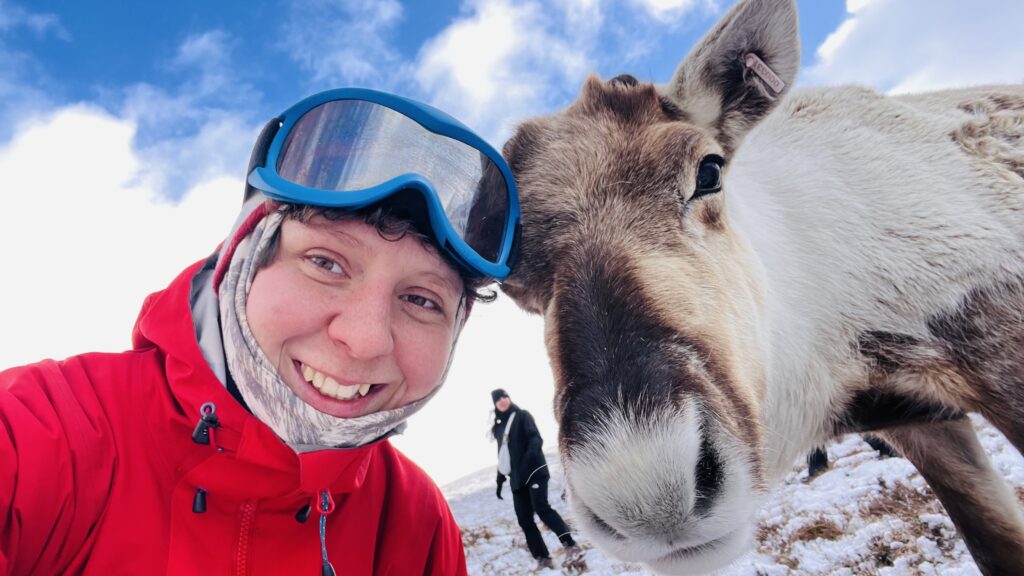
My highlight of this year’s free-range season was fetching the herd from high on the mountain in a white-out, and having to use a compass bearing to navigate our way down out of the cloud – the first time in my 15 years of herding that I’ve had to rely on a compass whilst leading the herd! You will find out more about that experience in a few months time… keep following the blog!

The cows battling the high winds and snow gusts, protecting their calves in the harsh conditions.

Daisy

One of my most memorable moments from my first free-range season has to be the wild weather Saturday of moving reindeer in a blizzard! The day had started with hardly any clouds and blue skies when I first dropped Cam and Sheena off to move the reindeer that morning. But, by the time Andi, Emm and I set off for the Hill Trip, a white out blizzard had struck. I only managed to locate Cam and Sheena thanks to their bright waterproofs! As I waited for Andi, Emm and the Hill Trip guests enough snow had settled against my ski googles that I could hardly see past Juniper stood next to me. The snow was quite short lived though and the guests had the most amazing blue skies and calm breeze with a fresh layer of snow settled on the reindeer for their trip. The hills looked amazing!

After the guests had gone we had the task of moving the reindeer across flats, jump a burn, over the road, and up onto a new set of hills. We set off as the mornings blizzard returned and the winds picked up! It was my second go of leading the reindeer, and seemed quite daunting given the lack of visibility. But the combination of Andi’s hand signals from the back of the herd and Ryvita leading the charge and following my calls, meant we successfully crossed the burn and got them up onto the road. With a cluster of cars parked up in the middle of the road, everyone hanging out their windows to record the reindeer – the entire female herd of 73 steadily came into view as they ran across the road and up onto the bank of the next hill in a quick single file. I never get over how fantastic it is to see the reindeer rush over the road, and how excited all of the passing drivers are, but with the snow falling and having just herded them through a blizzard – it was pure magic. From there it was up onto the flat of the next hill and to give the reindeer some well deserved food, and then back to the centre for a hot cup of tea (and several custard creams)!

Chilling with Ryvita before the blizzard returned.

Maisy

My favourite moment in this winter free range was when Cam and I went out to fetch reindeer for the morning visit at the start of April. It was a stunner of a day with most of the snow gone which was meant to make it easy walking, however Cam decided to take us through deap heather and across a large river from the snow melt. Thank god I had my big wellies on! We headed along then up to where we thought the reindeer were. We arrived for where we last spied the herd, but they were nowhere to be seen. We had lost our 73 reindeer! I thought they had gone back the way we came, but Cam said that they probably carried on round the side of the hill. I suggested for us to split up to cover more area, so off we went in oposite directions with our walkie talkies turned on. All I could hear as I was walking back round the direction we came from was silence from Cams end. I was thinking about heading back and looking else where until I saw them! I was right. Cam was wrong… The reindeer had gone the way we wanted them to. Cam made us walk straight past them! Once Cam evantually caught me up with the reindeer (he took ages), I lead the herd up towards the visit spot (this was actually my first time leading reindeer on the free range!). Some were more enthusiastic than others to follow. We made it to the spot and awaited for Daisy’s arrival in the sun (which took longer than expected as she also got lost… what can you do?).

Can you spot Cam miles in the distance?…

Cameron

Erm… That’s not how I remember it!

Editor’s Note: This is all we could get out of Cam for his offical response.

Fiona

Being an old timer when it comes to reindeer herding I often end up leading the herd in for their morning feed rather than being the sheep dog at the back to keep them moving. This year we had a few newbies herders join our team and this was their first winter fetching reindeer so I took this on board and mostly lead the herd, even though everyone’s favourite job is at the back. At the back you just get to hang out, at a sensible pace and you don’t have to choose the route so when given the choice this is where most herders would want to be. Mid March I went out with Amy (another old timer) and this time I didn’t give her the choice, I opted for following along at the back. It was a glorious day, blue skies, sunshine and snow… Just perfect! I spent most of the time taking videos and photo’s and sending them to everyone I knew working an office job that day boasting about my morning. It’s days like this that make you forget about the wet, windy and claggy days that end up being a total mission and therefore restoring your faith in Scottish winters!

Nice butt(s)!

Kate

Free-range season is a real mix. The weather can be truly awful, and on days the reindeer are feeling stubborn, moving them can be a long and difficult slog. But sometimes, you get a bluebird day when the sun is out and the reindeer are hungry and cooperative, and these are some of my favourite mornings throughout the whole year. Me and ‘The Aisies’ (that’s Daisy and Maisy) headed out on a lovely blue-sky day in March to move the herd. We wouldn’t be returning by the same path, so Cam kindly dropped the morning feed at our destination (thanks, Cam!). We could see him from a distance, making his way to drop the bag. “He looks like a tick!” Daisy said. I then had to explain to her how perspective works and that things look smaller at a distance… Walking out without a heavy bag always nice. We found the herd at the crest of the hill, a few were up and picking through the snow to graze, but most were dozing in the sunshine. They were initially slow to get going, and split into two groups which can make things difficult, but having three herders is a luxury and made it much easier to keep the herd moving in the right direction. I led, the Aisies herded at the back, and we skirted around the slopes easily enough, until we hit some big snow patches and the reindeer started to pick up speed. Eventually, Emmental decided she knew exactly where we were going and passed us. The herd followed, and most of them rushed over the snow to gather ahead, where the feed was waiting. I waited for Daisy and Maisy to catch up and we enjoyed having the last few minutes of the walk to just enjoy the sunshine and chat.

A lot of our most memorable days on the free-range are the big adventures, when it’s difficult, and you feel exhausted but accomplished at the end of it, but I always love the calm mornings, when things are easy, the sun is out, and you have enough time to stop for a moment and appreciate the reindeer and the incredible place we live.

Emmental and her son, Oro, leading the herd, 7th March 2026

Sheena

I think we all love heading out to look for reindeer in the morning when they are free ranging on the high slopes of Cairngorm. My most memorable walk out this year was with Cameron, just at the end of winter start of spring. Our biggest challenge was what to wear. The weather was sunny one minute and then full on winter  blizzard… So a  full set of winter waterproofs, gloves, hats, hoods and last minute went back for ski goggles! We had a long walk and luckily we spotted them just before the weather changed into a white out snow storm. Goggles on time.   

We had several challenging stream crossings, the first one had a big snow drift over it and was very dodgy spring soft snow, so we went for a crossing area up stream, with a good helping hand from Cameron when I jumped over, so no wet boots for me. After locating the reindeer Cameron lead the way as our plan was to move the reindeer to  an area easier for our visitors on the hill trip, it took 30 mins in white out condition. Just as we got near our Hill Trip spot, we saw a hill walker on the hill  path who unfortunately had a very noisey dog and, two barks later the reindeer turned on their hoofs and headed back up the hill! Luckily the sun came out, blue sky and we caught up with the herd not too much higher and changed our visit location as the weather was now sunny. It was now a safe option for our visitors. Cameron and I had a good work out and I wish I had a step counter that day – it would have been miles.

You may have caught the wonderful video of Sheena and our lovely Holy Moley post blizzard hike! If not you can watch it on our facebook page here.

Alicia

March has been my first taste of the free-range season, and thus has been host to many small ‘firsts’ for me! First time leading free-range Hill Trips, first time seeing the girls out in the mountains (leading them off the road in December doesn’t count!), first time out with radios trying to bring the girls to a nice spot for the Hill Trip in the mornings…

My favourite memory from this season was also my most trying morning. Fiona and I hiked out in the morning, braving blue skies but 30+ mph winds (which is quite a lot when you’re carrying a lot of reindeer feed on your back!). The cows and calves were happily resting in a little gully when we came upon them, and they were very much not in the mood for moving on! I was the ‘sheep-dog’ at the back of the herd trying to encourage some rather stubborn lassies on from the nice patches of lichen they had found, all the while unsuccessfully dodging boggy sections of ground. After finding a safe way to cross the river, I gave a quick celebratory ‘Yes!’, before promptly falling into a bog on my next step…

All smiles pre bog fall…

——————

Hope you enjoyed all our favourite moments from 2026, and here’s to free – range season 2027!

The Cairngorm Reindeer Herders

Volunteer Blog: Emm’s Visit – October 2025 (Part 2)

Time for part two of Emm’s wonderful blog, picking up where we left off last time – a broken Brenda and reindeer to herd!…

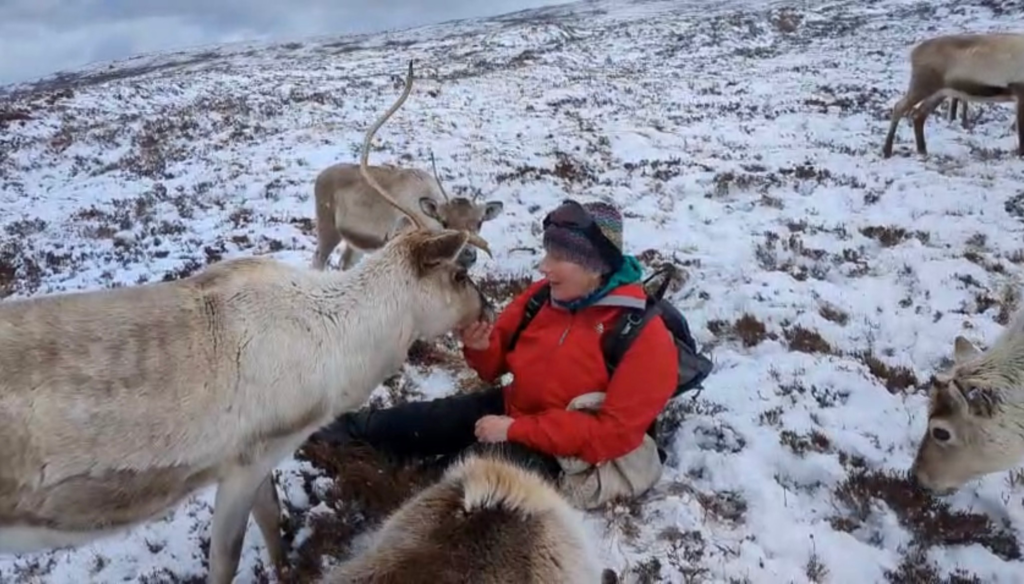
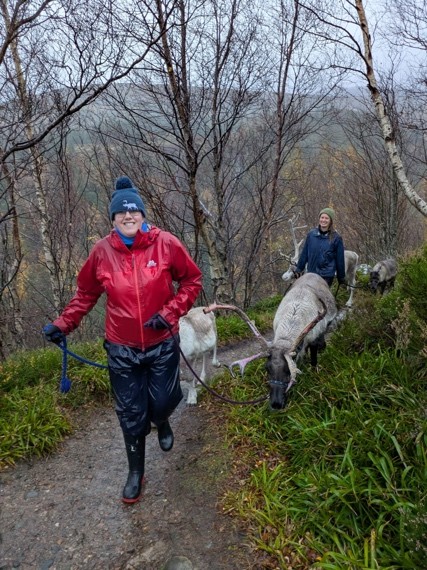
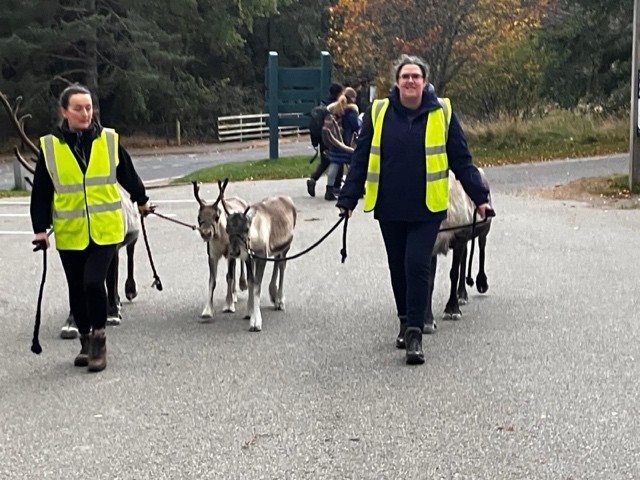
The next day I helped Lotti and Ruth walk the calves Oro and Flamenco around Glennmore. Akubra and Kulfi were the adult reindeer who came with us. I walked in front to make sure there were no dogs coming as reindeer are scared of dogs. They think that they are wolves. I also picked up the reindeer poo too if they went to the toilet.

Daisy and I did a very wet, windy and cold Hill Trip. We took the visitors to the Hill Trip spot but the reindeer were high near the ridge and were not coming down. So Daisy went up to encourage them down while I did the hand feed talk to the visitors and talked to them about reindeer facts and told them their names and naming themes. We then were able to feed the reindeer when they had come down with Daisy. We were splitting Sundae off because she is in season. I stayed with Sundae for most of the Hill Trip to keep an eye on her.

After the Hill Trip, I met Ruth and Lotti by the Sugar Bowl carpark and helped take Akubra, Kulfi and 2 calves called Disco and Foxtrot up to the hill enclosure. We were doing a Paddock swap as Disco and Foxtrot had finished their calf training school.

Emm walking Akubra and Foxtrot back to the hill enclosure.

I got very wet and soggy and had water in my wellies. It was like a loch in my wellies. Lol.

A very soggy team of herders! Ruth, Emm, Daisy and Lotti, still smiling despite the miserable weather.

Another day up on the hill, Vienna was looking miserable and sad and she kept going away from the other reindeer.  So we put her in the shed area and pen with a friend and kept an eye on her and checking her temperature. The vet came to check her and did some treatments to see if they helped her and to see if it made her feel better. Along with Ruth I joined Daisy and Kate near the end of the Hill Trip. We needed to take Ceilidh’s temperature. We couldn’t catch her so Kate led Glacée, Ceilidh’s mum,  and with Ruth I herded Ceilidh from behind to a smaller bit of the enclosure called the temporary corral. Daisy managed to catch Ceilidh to find she did have a temperature so Daisy injected Ceilidh to bring it down. Me and Kate took Glacée and Ceilidh to the shed to keep an eye on Ceilidh. Kate led them and I herded behind.

Glacée and a much brighter Ceilidh after spending some time being cared for by the herders.

The inside jobs I did were sweeping and hoovering around the Reindeer Centre. I also mopped the floor downstairs. I washed the wellies and put them up to dry then away later. I put a sticky label with the reindeer herds news on the back of each newsletter photo. I also put the newsletter and the newsletter photo into envelopes. I put the 1st year adopt packs together and I also did some shredding. I did feed mixing and hand feed mixing too, poo picking in the Paddocks and also let the reindeer through into their daytime Paddock area for their breakfast. In the evening I put them to bed and give them their tea in the night time Paddock area. I also got taught how to lock the Reindeer Centre’s carpark and swept the steps outside the Reindeer Centre, behind the lift and outside the front.

It is lovely meeting the visitors too on the Hill Trips. It is lovely seeing their reactions when they are amongst the reindeer and when they get to hand feed a reindeer. On most of the Hill Trips, I did the hand feed talk and on one of them I did the introduction talk. I also got to see my adopted reindeer Scully and Zoom while visiting which was fantastic. I met Scully’s calf called Rumba which I was very excited about.

Emm taking a selfie with the lovely Scully and Rumba.

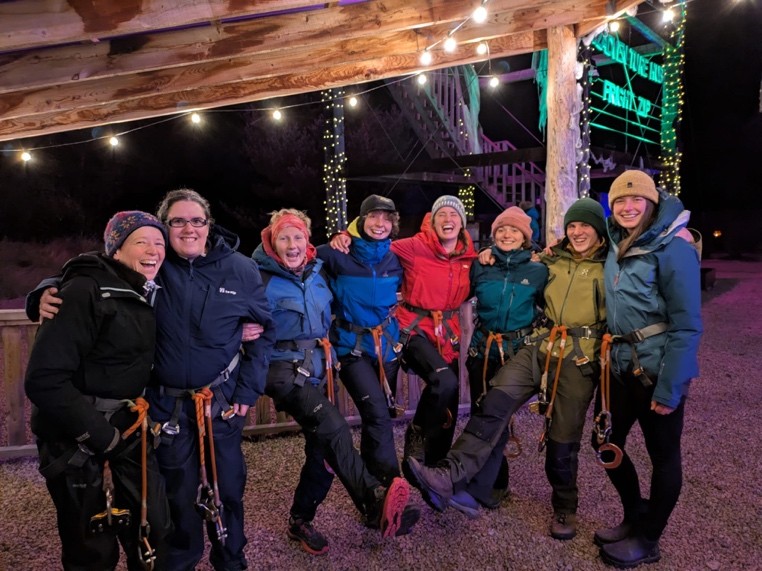
Away from the visitors and Hill Trips and I was able to enjoy spending time with the herders. While I was there they went on a zipwire trek (run by local company G2 Outdoor) on one of the dark evenings and I was very lucky to be invited to join them. It was very exciting. When you went in, a pretend big spider suddenly came down on you and there was a ghost in the toilet. It had lights and Halloween things when you went around. You went over rivers and through trees. You had to do a torch flash saying the next person can go. I had a race with Andi at the end and I went so fast. I really enjoyed myself. It was such great fun. Thank you ever so much everyone for letting me come.
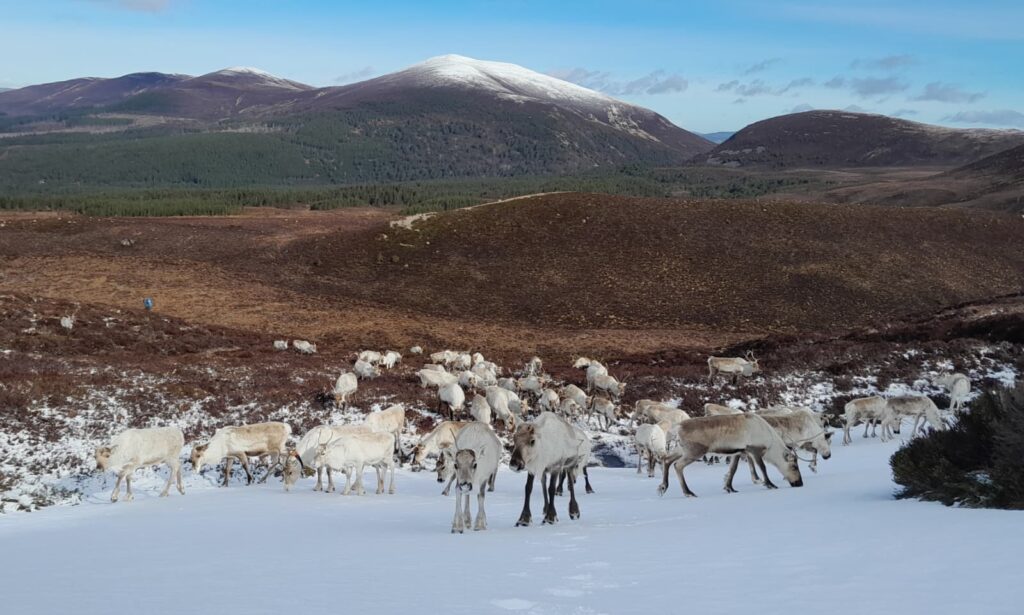
A night of zipping through the trees for the reindeer herders! All smiles from Andi, Emm, Sheena, Daisy, Lotti, Kate, Cameron, and Amy.

On another evening, my reindeer herding friends came around to our holiday cottage for a curry night which was great fun. My Dad and Mum had made lots of curry and we ate and chilled out and I gave them a tour of the holiday cottage. Sheena had brought around a great spider target game which we played. The spiders were sticky and they ended up hanging of the ceiling and one even dropped into Ruth’s curry. Lol.

A wonderful evening of delicious food, great company, and sticky spiders!

Another day I went on a lovely walk with Lotti by Pityoulish Loch and we had cups of tea and sat and chilled out on the pontoon and watched the wildlife. It was a lovely spot.

Lotti and Emm enjoying a lovely walk wildlife spotting.

I met Daisy who works at the Reindeer Centre and her lovely dog Echo who is very clever and we went on a lovely walk to Green Loch and then up through the trees at the back of the Reindeer Centre. I also met Fiona’s and Joe’s lovely puppy called Sanna who is very cute and I also met Alicia who works part time at the Reindeer Centre. 

Echo teaching Sanna how to sneak up on the herders and steal the reindeer food!

It was so lovely to spend my spare time with such special friends doing things we all enjoyed. I can’t wait to go back in March 2026. I am counting down to the day. I am so excited.

Emm

Volunteer Blog: Emm’s Visit – October 2025 (Part 1)

In this latest blog I would like to share some memories from my visit in October 2025. It was very exciting as the new reindeer exhibition was open to visitors with lots of interactive things, videos, information and photo displays. It is so brilliant. The visitors will learn lots of things about reindeer and the history of the herd.

Emm is back, and we’re so thrilled! Emm, Lotti, Amy, and Jig all posing for a team photo!

On my first morning, I walked the calves around Glenmore with EK and Cameron. The calves this year (born in spring 2025) are named after types of dances so I had a lot of fun learning all their names. We walked Ballet and Polka with 2 adult reindeer.

Emm and EK walking Ballet and Polka during calf training.

We were getting them used to everyday things like people, traffic, being led and being handled. Afterwards, Cameron showed me his shed he had built for the reindeer poo bags so they don’t get wet and it is named the poo shed, and it is really good.

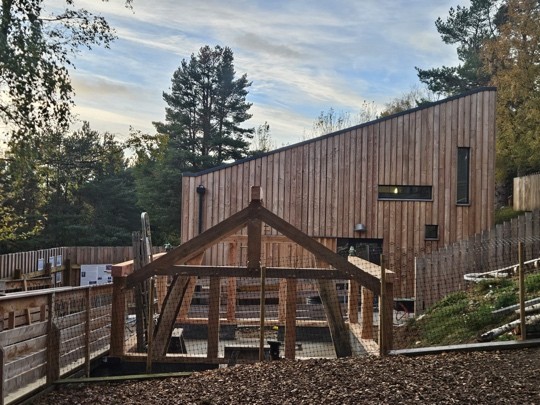
There were some new things in the Paddocks. The Santa’s bothy was being built by Alex and Cameron, and they were hoping it would be ready for Christmas. There was also an extended area for the reindeer in their daytime paddock area in the trees.

Santa’s Bothy under construction!

Jimmy the bull, who had been over on Silvermount in the hill enclosure with his group of girls, had finished his job with them so one morning Lotti, Ben and Cameron led him off the hill as he was going to go back to Tilly’s farm.  We were also taking Gazelle off the hill to go back to the farm that morning too.

Boogie relaxing with some of our older boys.

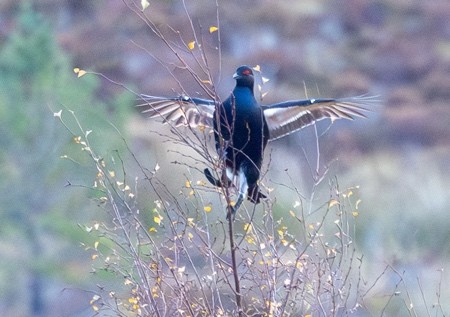
I led Gazelle off the hill to Brenda (the truck we transport reindeer in). Ruth and I went to find Vienna one of Iskrem’s girls as they had been moved into a different part of the hill enclosure and she had become separated from them. Iskrem is a very calm bull. We found Vienna and we had to herd her up the hill, as she didn’t want to be caught, to join Iskrem and his girls. Then we moved them as a group to a different part of the hill enclosure. We were very lucky that day as we saw 6 Black Grouse lekking.

Our hill enclsoure isn’t just home to reindeer.

The day after, I went with Kate, Ruth and Daisy back to Silvermount in the hill enclosure so we could move Jimmy’s girls to where they were meant to be next. Nuii and Fab were missing so Kate went to look for them. We let a few of them out to be with the main herd in the east enclosure in the hill enclosure and I helped Daisy and Ruth take 5 reindeer across the hill enclosure from Silvermount to a different part of the hill enclosure, as they were going to go out onto the free-range soon. I led Orinoco and Suebi. Meanwhile Kate had found Nuii and Fab and brought them back to join the group.

Emm leading Orinoco and Suebi across the hill enclosure.

One day, the free-ranging reindeer were put in a part of the hill enclosure for a few hours so Amy could take Alba off the free-range, who needed to come into the enclosure for a short while.

Meanwhile Kate had gone to find 4 missing reindeer in the hill enclosure as they hadn’t turned up for breakfast or for the 2 Hill Trips and had been missing for the day. They were Pinto and her calf Quickstep and Borlotti and her calf Morris. Morris is such lovely natured and laid-back calf and is pure white meaning he is leucistic. Like some leucistic animals, Morris is deaf.

Emm and Morris relaxing on the hill.

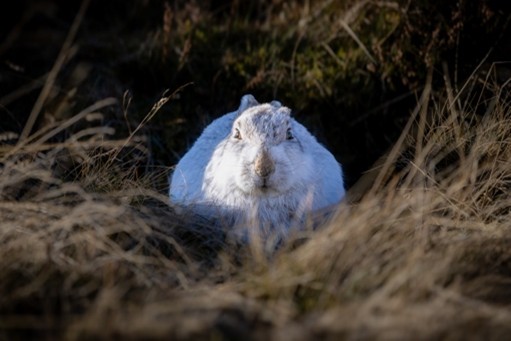
I helped Amy put the free-range reindeer back out. We took them to the top ridge on the free range, Amy led and I was at the back. Then we went to help Kate who had found the 4 reindeer on Silvermount in the hill enclosure. Pinto had found a bag of handfeed and was eating out of the bag when Kate found them. We led Pinto and Borlotti on halters and their calves followed and I helped Amy herd at the back. We led them across the hill enclosure and took them to the shed to check them out and take their temperatures as reindeer being away from the herd might mean they are ill. Whilst out leading them we were lucky enough to see a mountain hare.

A mountain hare in winter colours.

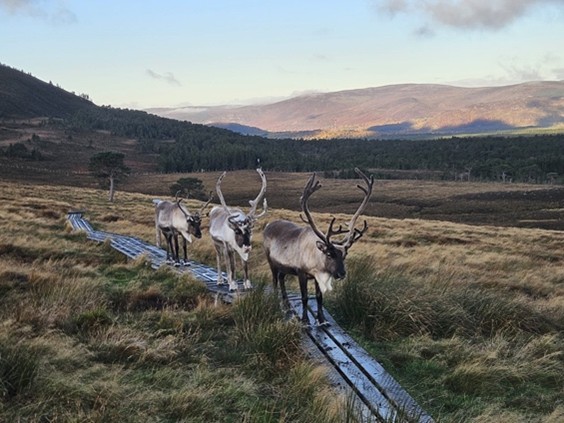
One morning, the reindeer were slow coming down for breakfast in the hill enclosure. Some of the herd were with us and the rest were on Silvermount. As I helped Ruth call them down, Andi went up and herded them down from the top. We were then able to get them in position for the later Hill Trip.
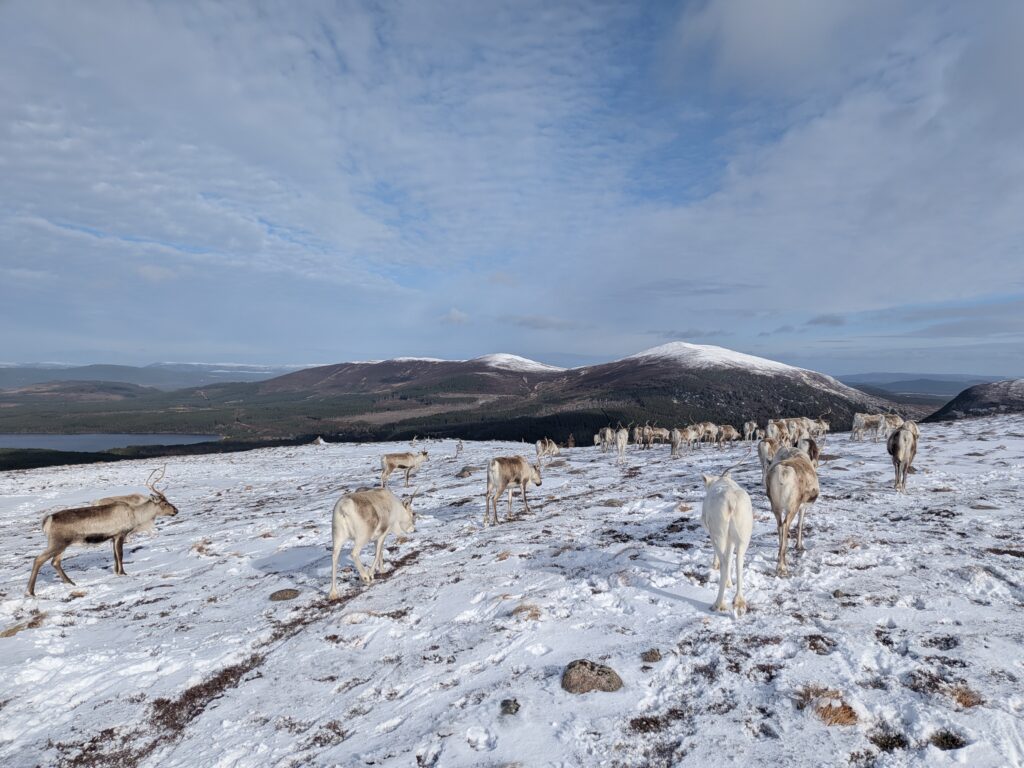
Busby leading the way along the board walk ready for the days Hill Trip.

Unfortunately on our way back down at the end of the day Brenda broke down near the Sugar Bowl car park. The next day, she was towed away to be fixed, a sad sight!

Stay tuned for part two of Emm’s visit in October!

Emm

Memorable reindeer: Porjus

Time for another installment of our – rather sporadic – memorable reindeer series. This time it is Porjus’ turn for stardom!

What a handsome chap!

Back in 2004, we imported a batch of male reindeer, mostly calves and yearlings, from Sweden in order to bring in new bloodlines, and one of these yearlings was Porjus. He was named after a settlement up inside the Arctic circle in northern Sweden just north of the town of Jokkmokk, where our founder Mikel Utsi was from. His name was pronounced ‘porr-e-us’, though we frequently referred to him as ‘Gorgeous Porjus’, sounding the ‘j’ so the words rhymed!
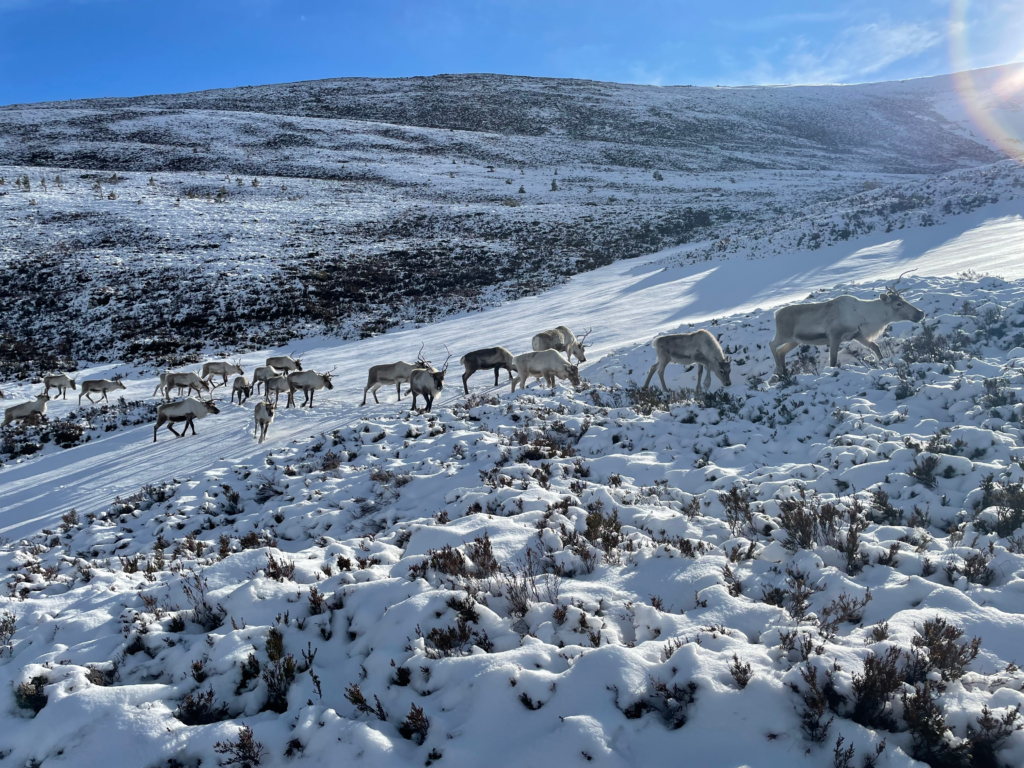
Porjus, at the farm not long after he arrived from Sweden. He’s around 1 and 3/4 years old here.

By the time I started here in late 2007, Porjus was an adult and had just been used as a breeding bull in his second rut, going on to breed during the next three ruts too, his last crop of calves born in 2011. His genetics remain in the herd today, most prominently through the descendants of his daughter Chelsea (who include the lovely Winnie, Zap, Diamond – and somewhat less lovely Pumpkin (a reindeer with a serious attitude issue!)) and daughter Jenga, whose son is Jelly. Whilst Porjus fathered lots of offspring over the years, not every calf survives long term, but some of his better known male offspring were Gnu, Topi, Horse, Origami and Svalbard, though these lads didn’t follow in dad’s hoofprints and breed themselves.

Strutting his stuff in the 2010 rut, with Joni and Fiddle behind.

Porjus was a big, bulky reindeer, the ‘normal’ (average) colour for a reindeer, but with a distinctive paler forehead. Throughout each summer he always got incredibly fat – there was never any issue with his appetite – so much so we once tried to put him on a diet briefly (with hopeless results), but it never really mattered as bulls lose a lot of weight during the rutting season. A fat bull at the start of the rut is one that will go into winter in at least ok condition, as opposed to being underweight by the time the rut is over and winter arrives.

Fast asleep – saving his energy for the upcoming rut. Look at that belly!

Looking at our database, Porjus’ entry includes notes saying ‘A friendly boy’ and ‘well behaved during the rut’, and I certainly never remember being particularly wary around him during the autumn, though obviously we always give any bull a lot of respect at this time. Grandson, Jelly, would have done well to have considered Grandpa Porjus’ gentlemanly tendencies though – we planned to breed from him (Jelly) in 2023 and by less than halfway through the rut had changed our minds and castrated him instead!

Porjus’ grandson Jelly, looking like butter wouldn’t melt…

It is pretty unusual for a mature breeding bull to die in early autumn as they are in robust health ahead of the rut. However, Porjus did just that, dying extremely suddenly in September 2011 from an unknown cause (most probably tick-related), much to our dismay. However, whilst he left his mark in the form of his genetics in the last 20 years’ worth of reindeer born into our herd, he’s left another legacy too.

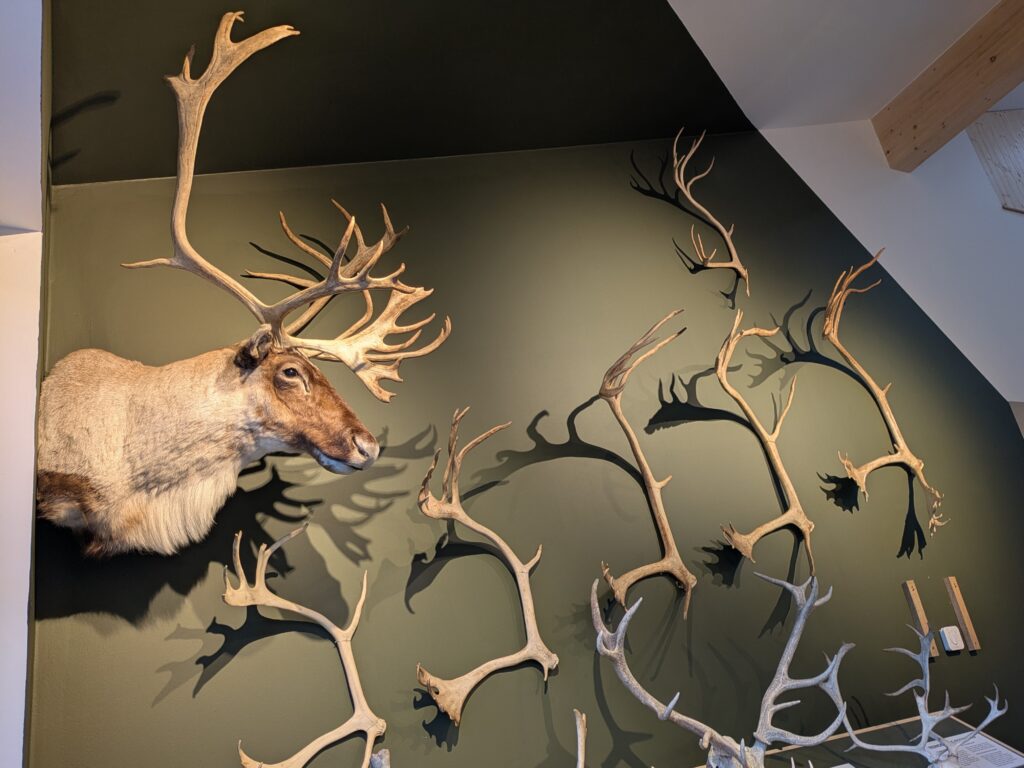
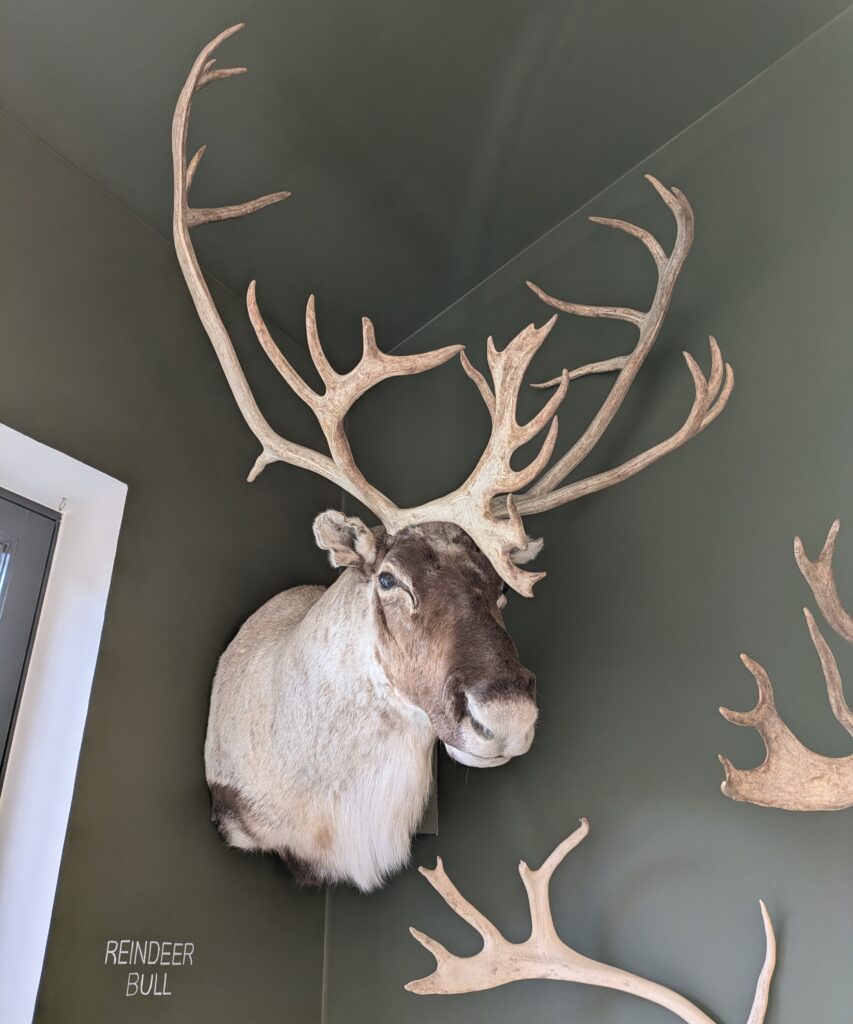
His is the incredible huge head in our Exhibition, gazing serenely over the thousands of people that come through our doors every year. Early autumn is the time of year reindeer look at their absolute best, with fresh thick winter coats and full grown antlers stripped of their velvet skin, so we therefore took the opportunity to have his head taxidermied. The only other taxidermied bull head we have hangs in Tilly’s house, having been brought from Sweden by Mr Utsi back in the 50s. For the last 14 years he and Porjus have gazed at each other across the room, but Porjus is so beautiful it would have been a waste for him to remain at the farm with hardly anyone seeing him.

So Porjus has found his rightful place back here at the Reindeer Centre – he was always a handsome lad during his lifetime, and now he is an awe-inspiring sight with his majestic look and his enormous antlers. I’m glad I knew him, and I’m glad to be able to admire him every time I come to work still.

Hen

Cheer!

I thought I would write a blog to celebrate Cheer the reindeer.

She has a very distinctive white patchy face and often reindeer with white noses or faces stand out from the herd and get lots of attention. But in general I would say Cheer has avoided the spot-light for most of her life as naturally she is quite shy around people, preferring to keep her distance, and she’s not super dominant towards other reindeer either. On Hill Trips she’ll often be more in the distance and definitely not muscling her way in for the hand feed amongst the greediest of reindeer.

Cheer in September 2021 looking beautiful.

Cheer will turn 14 in the spring so definitely falls into the ‘old girl’ category and has been retired from breeding after her last calf was born in 2024. This means she now can spend the vast majority of her year out free ranging enjoying a peaceful life.

I don’t really remember encountering Cheer when I first came to be a herder for around 10 months in 2017 – 2018 (sorry, Cheer!). However, when I returned to reindeer herding in 2021 I got to know her much better. She had a calf in 2022 (Choc-ice), 2023 (Shannon) and 2024 (Chai) which meant Cheer spent a bit more time in our hill enclosure (as opposed to free ranging out in the mountains) during the calving season in the spring and again in the autumn so she was around more.

I’ve now got a real soft spot for her. She is greedy and does love feeding from the hand feed bag but only if there’s no pushy reindeer around and she’s confident that we herders don’t want to ‘do anything’ to her! Then her shy and suspicious nature kicks in.

So here’s just lots of photos of her, and her offspring, taken over the past few years. Enjoy.

2021

One of my first photos of Cheer, when I bumped into her on the free range in August 2021. She’s the one in the background looking a bit suspicious of me! Addax is closest to camera.
Cheer back in the enclosure for the rut in October 2021. Still an uncertain look in her eye.
December 2021 – Cheer is back out free ranging and curious to know what’s in the feed bag!

2022

Cheer and her calf Choc-ice out free ranging in August 2022. Unfortunately they didn’t want anything to do with me! Still nice to see them looking good and enjoying themselves in their mountain home. She grew small antlers over the summer as she diverted more energy into her son.
As soon as we brought Choc-ice and Cheer back into the enclosure in September 2022 it became apparent Choc-ice had not inherited Cheer’s shy character! He has a naturally tame and bold personality.

2023

September 2023 – Cheer back in the enclosure and clearly has been in the feed bag looking at the crumbs on her nose!
Shannon and mum Cheer in November 2023.

2024

March 2024 – Shannon and Cheer free ranging together.
Cheer and daughter Chai – October 2024. Both are back in the hill enclosure after free ranging all summer.
Cheer (and Chai just behind) in December 2024. Clearly not feeling shy today!

2025

Shannon in March 2025. It appears she has inherited Cheer’s shyer characteristics, but she’s also greedy so she’s becoming more and more confident the more we gently work with her.
Cheer and Chai in May 2025, as Chai turned from calf to yearling.
Chai and Cheer in August 2025 – the pair have remained bonded and are often seen together whilst out free ranging.
I bumped into Chai and Cheer again in September 2025, free ranging together, but today Cheer was feeling suspicious of me! and perfectly happy to be left in peace.
Choc-ice stripping the velvet from his antlers in September 2025. He was one of our main breeding bulls in the rut the following month, so fingers crossed he’ll have passed on his and Cheer’s genes to the next generation of reindeer calves, greatly expanding Cheer’s dynasty.
Chai enjoying the snow in November 2025.

Ruth

Lichen – what is it and why does it taste good? If you’re a reindeer anyway…

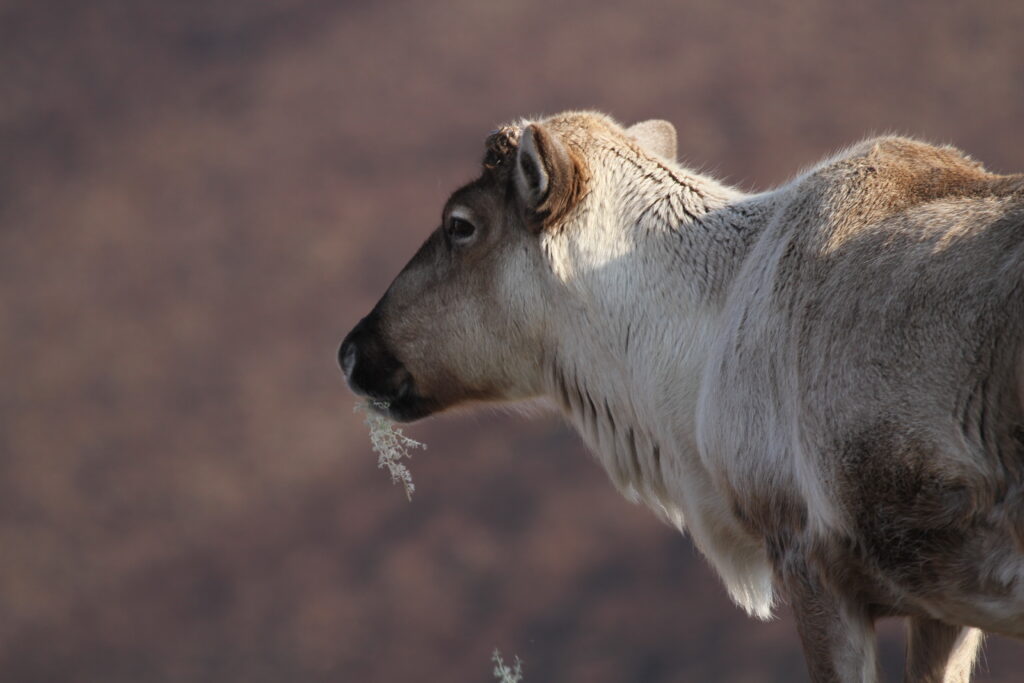
Mangetout with a mouthful of lichen.

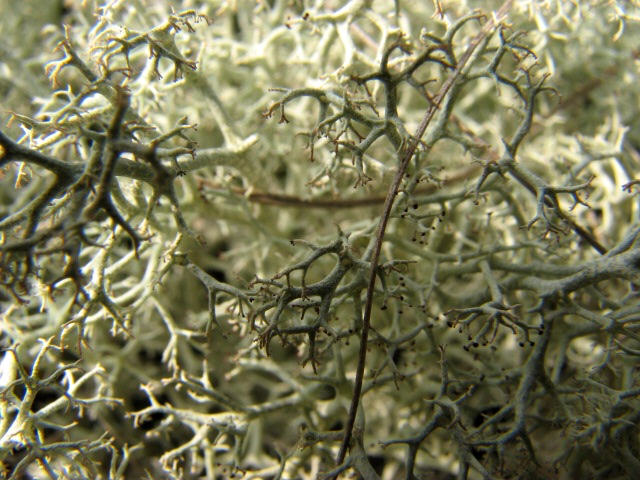
“Lichen, any of about 15,000 species of plant-like organisms that consist of a symbiotic association of algae (usually green) or cyanobacteria and fungi (mostly ascomycetes and basidiomycetes)” (Britannica, 2025). Now that’s a lot of big words and what do they actually mean? What really is a ‘symbiotic association of algae’? And why is lichen so important for reindeer?

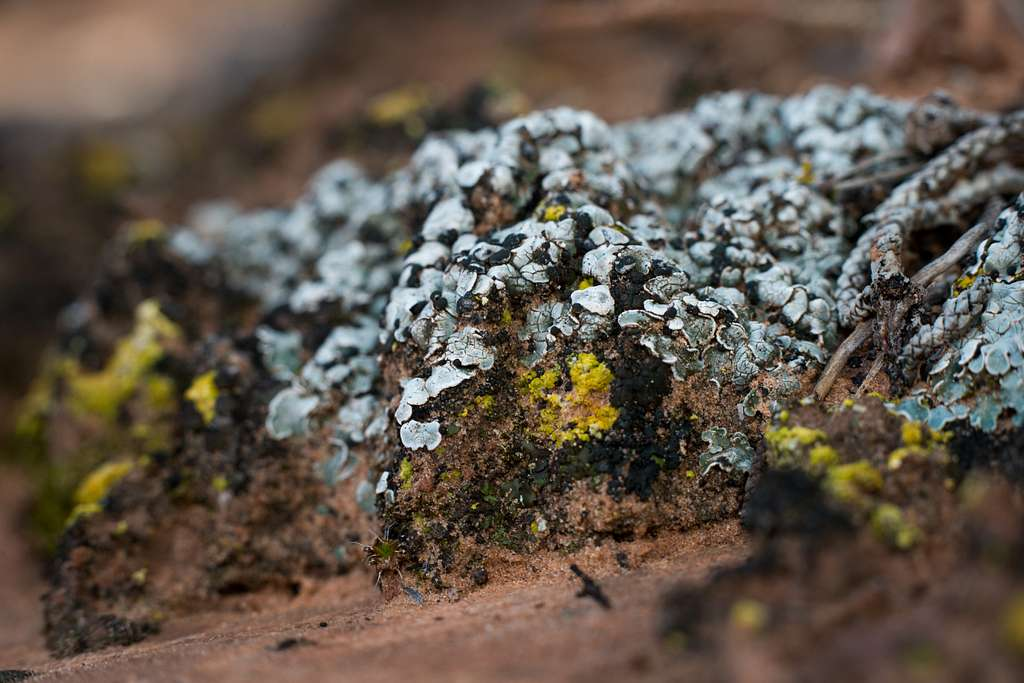
Lichen (AKA reindeer moss). Photo by Evelyn Simak

Let’s look at the bigger picture to start. Cast your minds to the vast open landscape that makes up a subarctic tundra ecosystem. Excitingly enough, we can talk about our very own Cairngorm mountains for this, as our reindeer live in the only ecosystem of its kind in the UK.

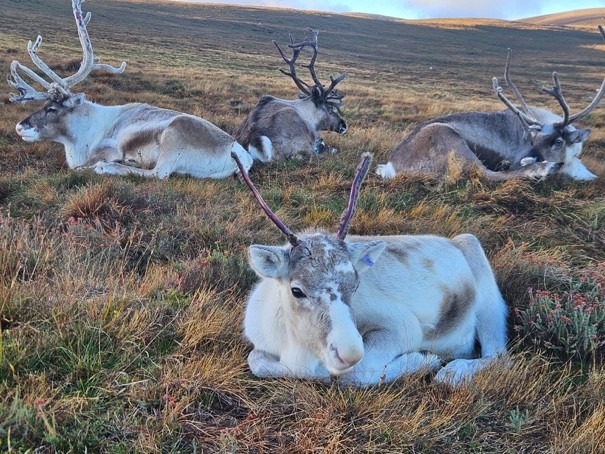
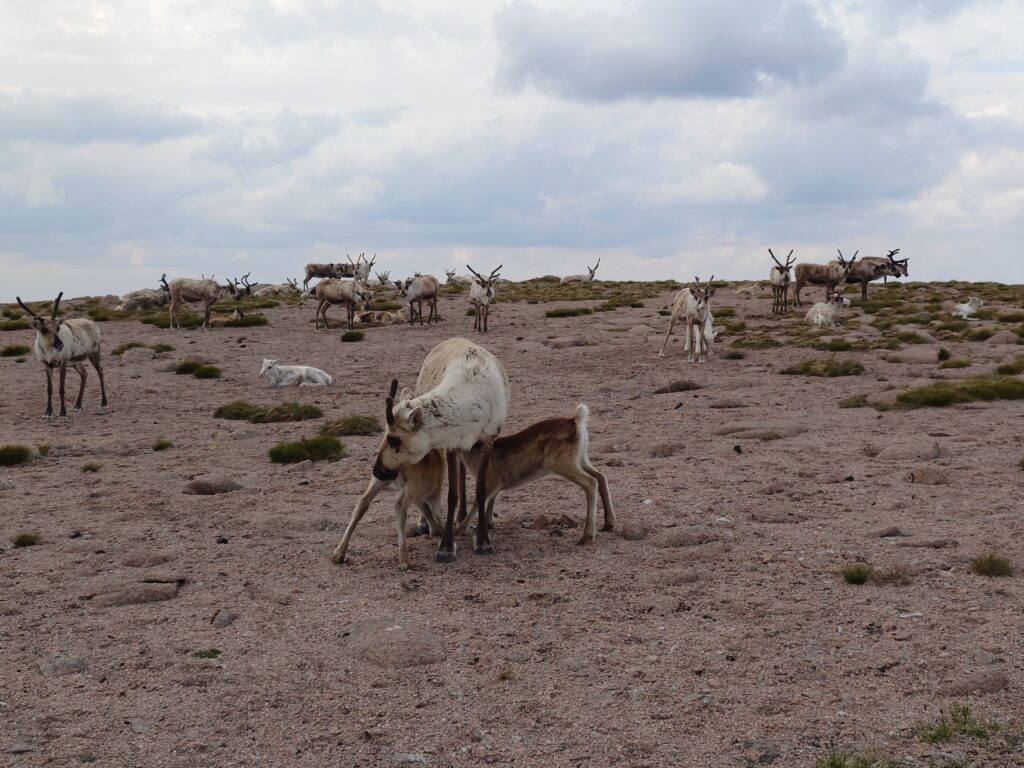
The Cairngorm reindeer free roaming in the mountains.

A subarctic tundra ecosystem falls south of the Arctic Circle line and includes treeless habitats of permafrost and generally short flora growing seasons due to harsh weather and low temperatures. It can include fragmented plant growth, like rocky mountainous peaks with scatterings of low growing vegetation including mosses, grasses, dwarfed shrubs, and lichens.

These harsh conditions mean that lichen do not have to compete for space or light with other forms of vegetation, enabling the lichen to grow in blankets across mountain plateaus. Due to their unique differences to other plant life, they are also able to grow on exposed rocks and as part of biological soil crusts. These soil crusts are found in cold and dry areas and make up the majority of all living ground cover in these almost uninhabitable places. The crusts are made of living material that sit on the top few millimetres of ground, meaning larger plants are unable to root and grow due to the ground conditions.

An example of biological soil crust.

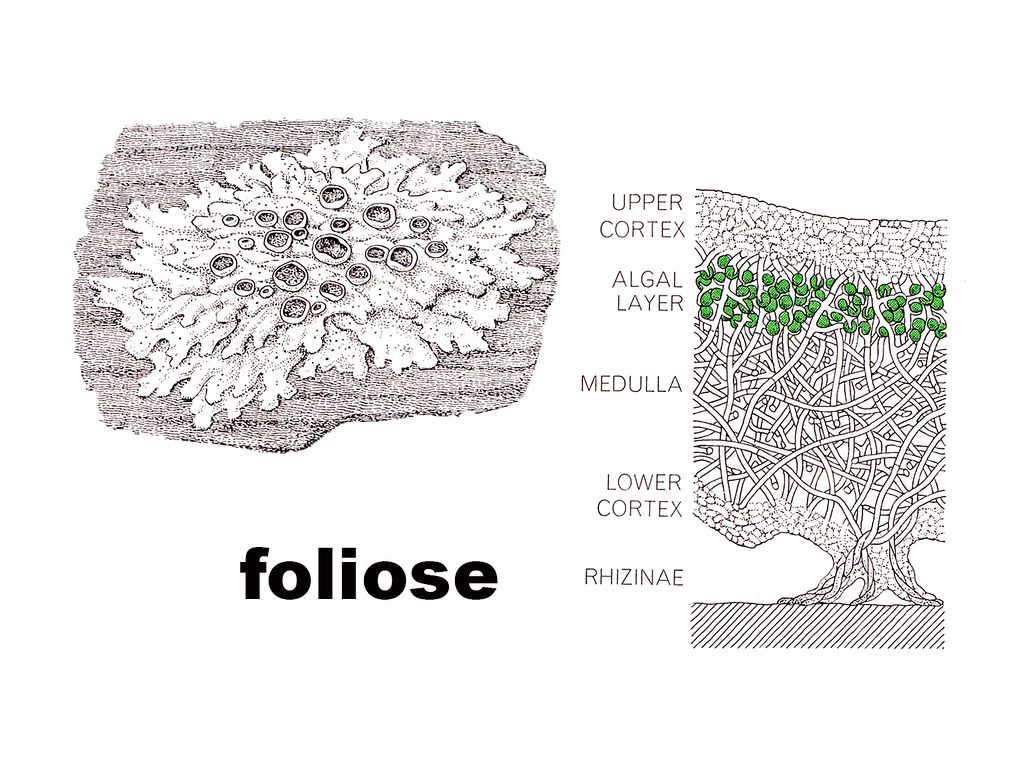
So that brings us back to our opening question, what is a symbiotic association of algae? What is lichen? From what we understand of lichen, it is a community of living organisms from both the fungi and the algae family. The fungi provide the water and minerals, as well as giving the lichen its structure, and the algae provides the food in the relationship, through photosynthesis. This happy partnership allows the lichen to grow and cope with harsh conditions that a normal single organism may not be able to thrive in.

The perfect partnership.

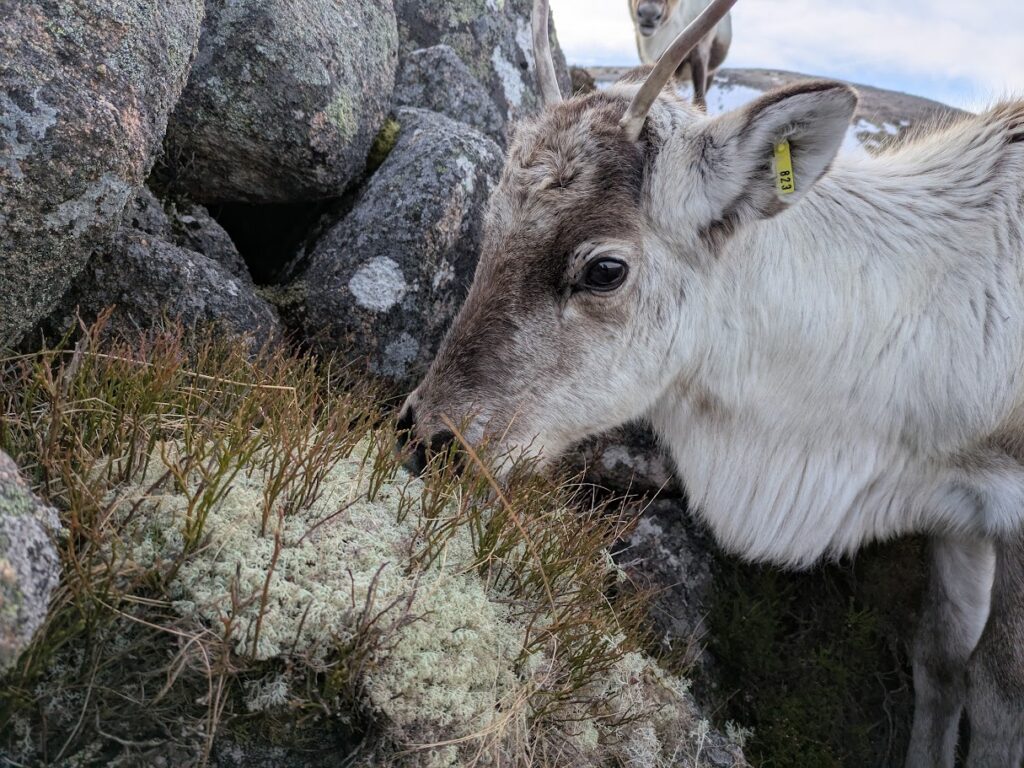
Now let’s add the reindeer into the mix! Reindeer rely heavily on lichen, consuming so much that it can make up to 70% of their annual food intake. This is because those harsh landscapes we spoke about earlier have very little choice available for the reindeer, but they can always rely on the lichen to grow all year round. Reindeer even have specialised gut floras to be able to properly digest the carbohydrates lichen contains.

Winter lichen for our free ranging reindeer.

Maybe it’s not that it tastes good then, maybe it’s because they have little other choice?…

But if you asked our reindeer, they would tell you it’s the best thing on the menu!

Delicious!
Dixie enjoying a mouthful of lichen.
Macchiato with a lovely big patch.
Mocha with a bit of lichen hanging from her bottom lip!

Daisy

Resources to learn more:

https://www.britannica.com/science/reindeer-lichen: Lichen – what is it and why does it taste good? If you’re a reindeer anyway… https://www.britannica.com/science/biological-soil-crust: Lichen – what is it and why does it taste good? If you’re a reindeer anyway… https://britishlichensociety.org.uk/learning/what-is-a-lichen: Lichen – what is it and why does it taste good? If you’re a reindeer anyway…

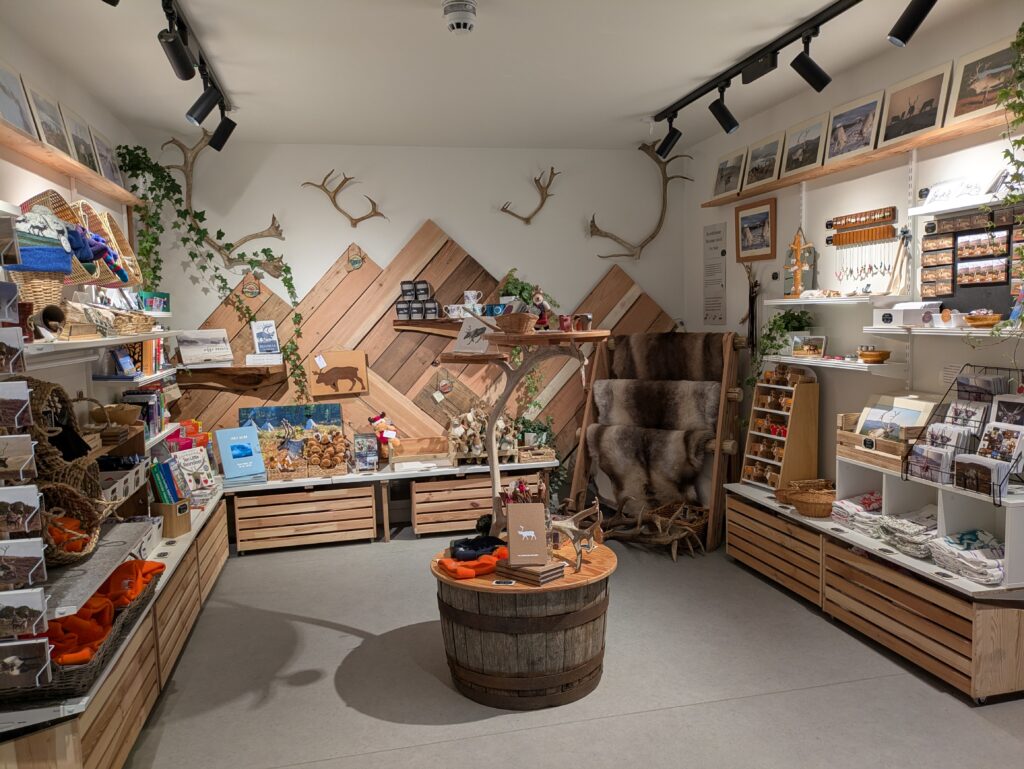
A Shopful of Delights

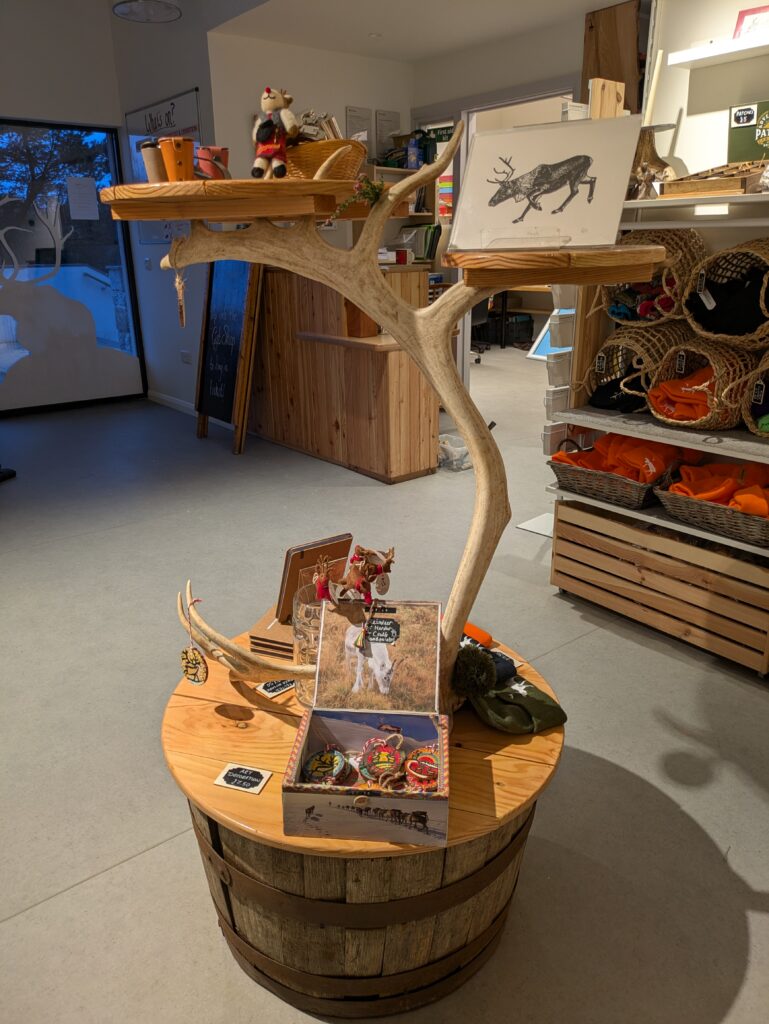
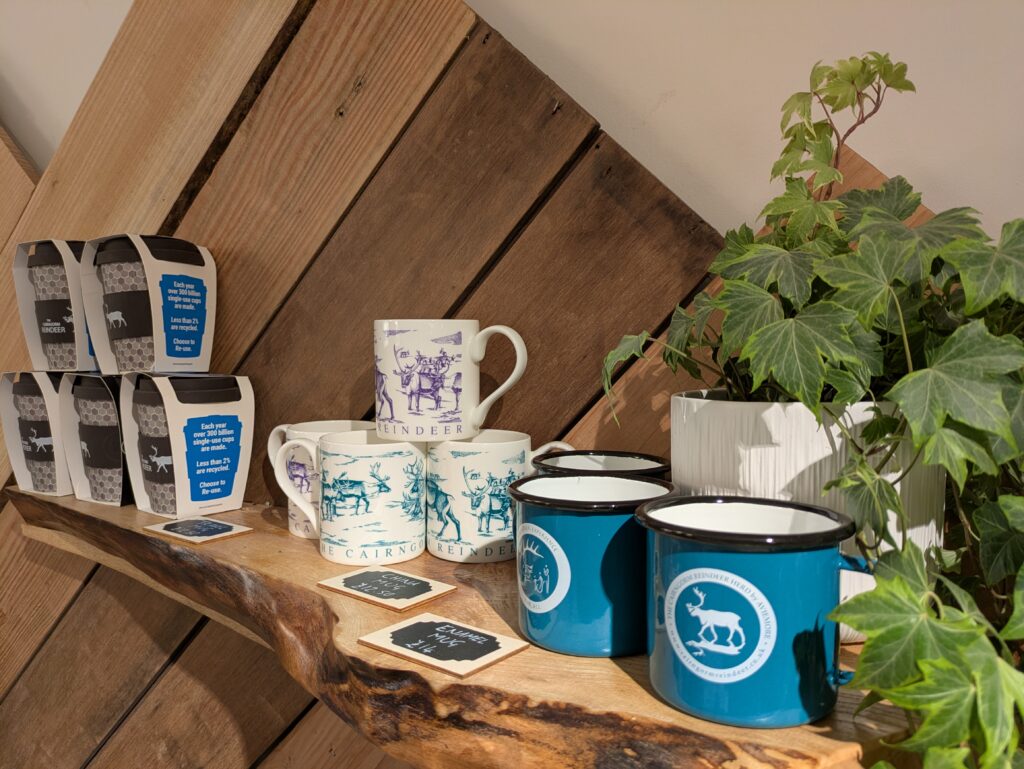
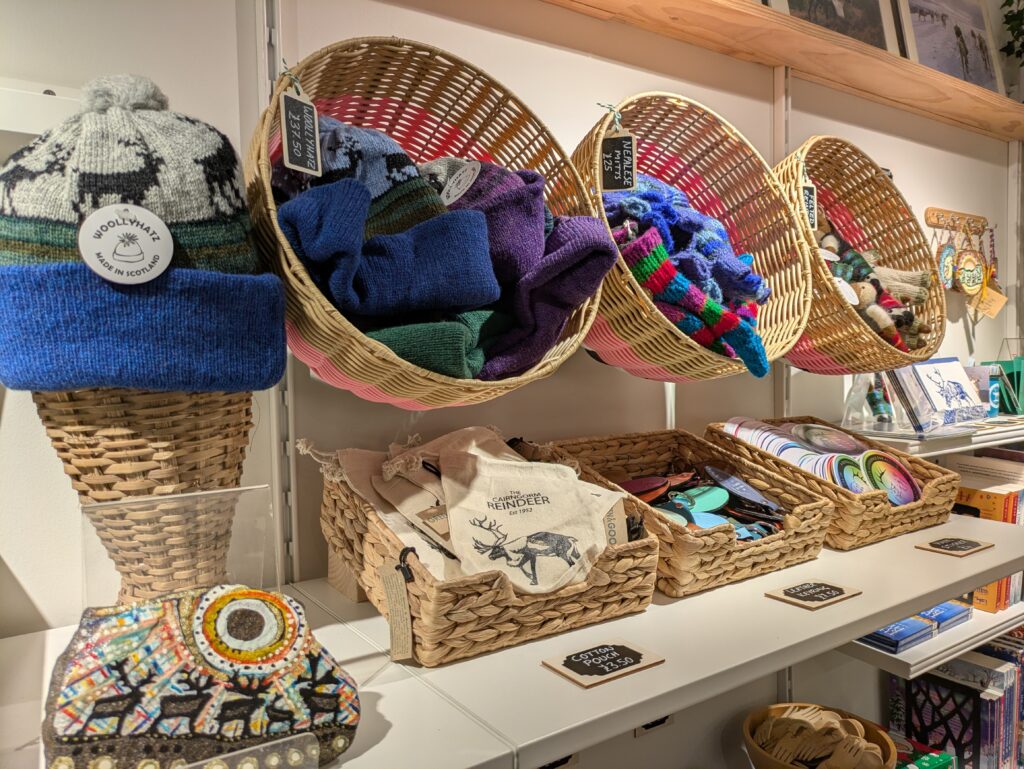
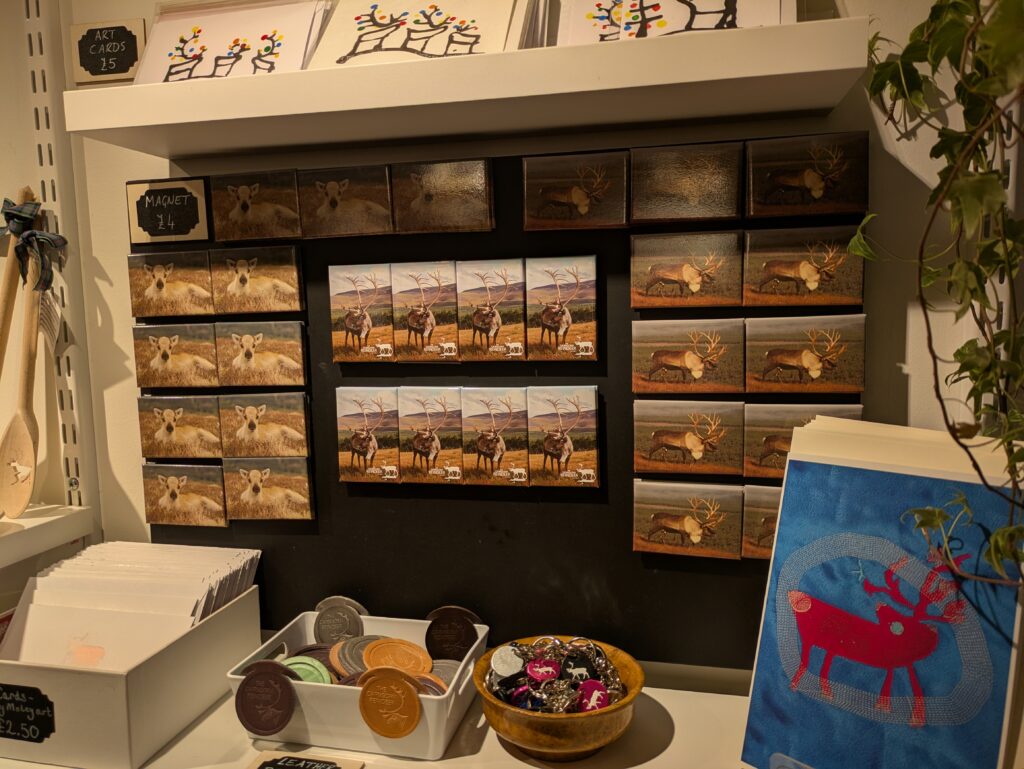
Our beautiful new shop – packed-full of lots of wonderful reindeer related goodies.

Since moving into our shiny new Centre, we’ve had a brand new shop space to play with. It may look a little different to our very rustic, wood clad shop of old, but we’ve kept a few nods to the old style.

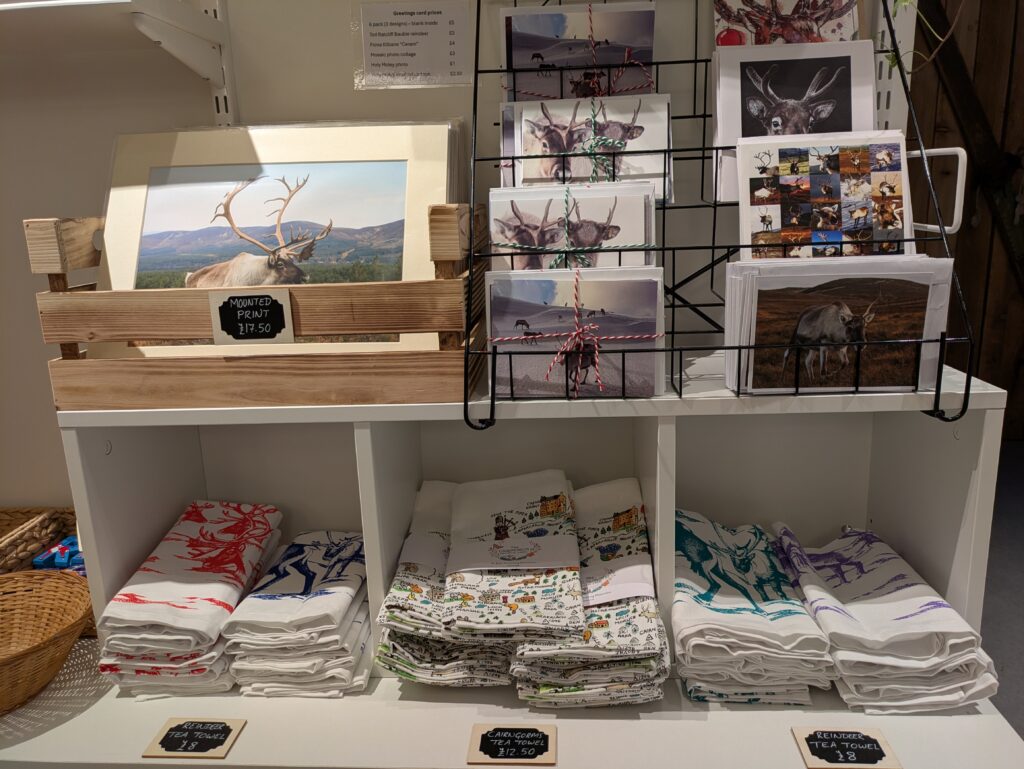
Our rule-of-thumb with a pretty small space is that any product we sell has to feature reindeer (with the odd bending of the rule…) and we try to find as many unique/local products as possible.

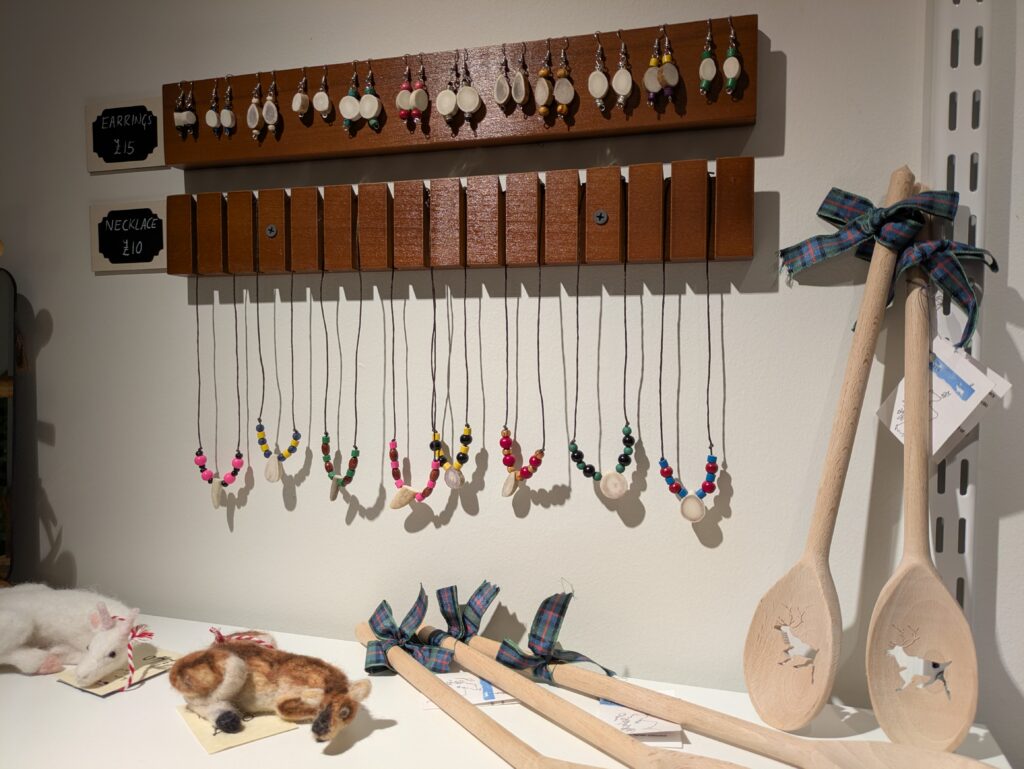
Herder Fiona crafts with naturally cast antler to make beautiful jewellery, and there is often bespoke artwork by herders Kate, Ruth and Sheena .

Some of Fiona’s jewellery, with sections of real antler, along with a few of Kate’s needle-felted reindeer.

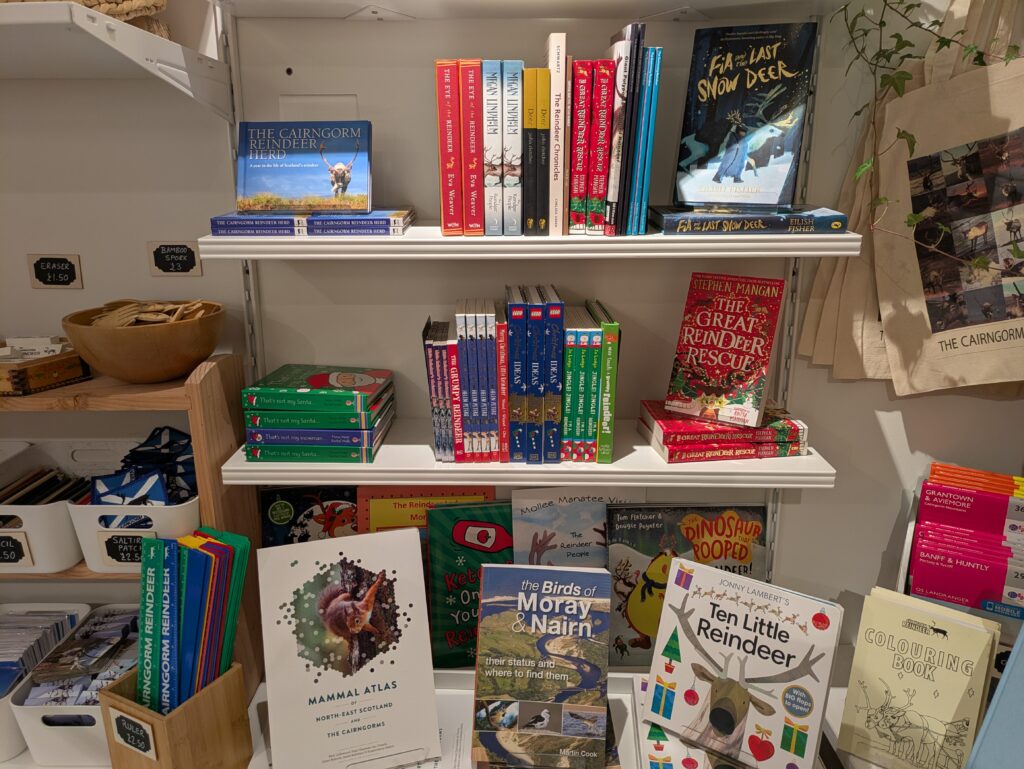
I’ve been particularly excited to find space to stock a much bigger range of books, the best antidote to too much screen time!

Our reindeer library – something for everyone – children and adults.

Look at this beautiful centrepiece, created from one of Sherlock’s antlers and an old whisky barrel!

One of Sherlock’s antlers is proudly displayed in the centre of the shop – adorned with lots of wonderful items.

If you aren’t planning a visit soon, you will find most of our products online on our shop at https://store.cairngormreindeer.co.uk/ We aren’t able to list more unique products like Ruth’s lino prints and Sheena’s art, so if there is something that you’d like that’s not on there then do drop us an email and we can show you what is currently available and send through a payment link.

If you live in the EU, unfortunately we can’t post to you due to legislation, but elsewhere in the world we can create a custom order if you email to let us know what you’d like and your address.

Andi
Book Now