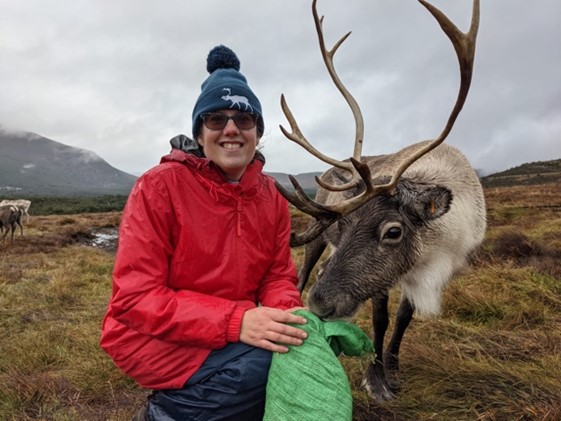
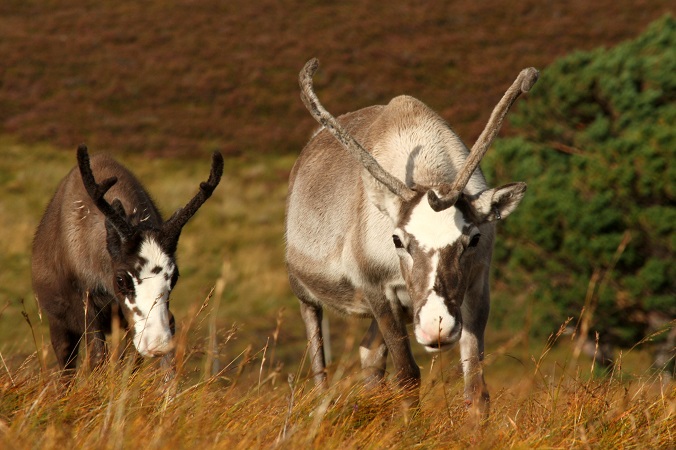
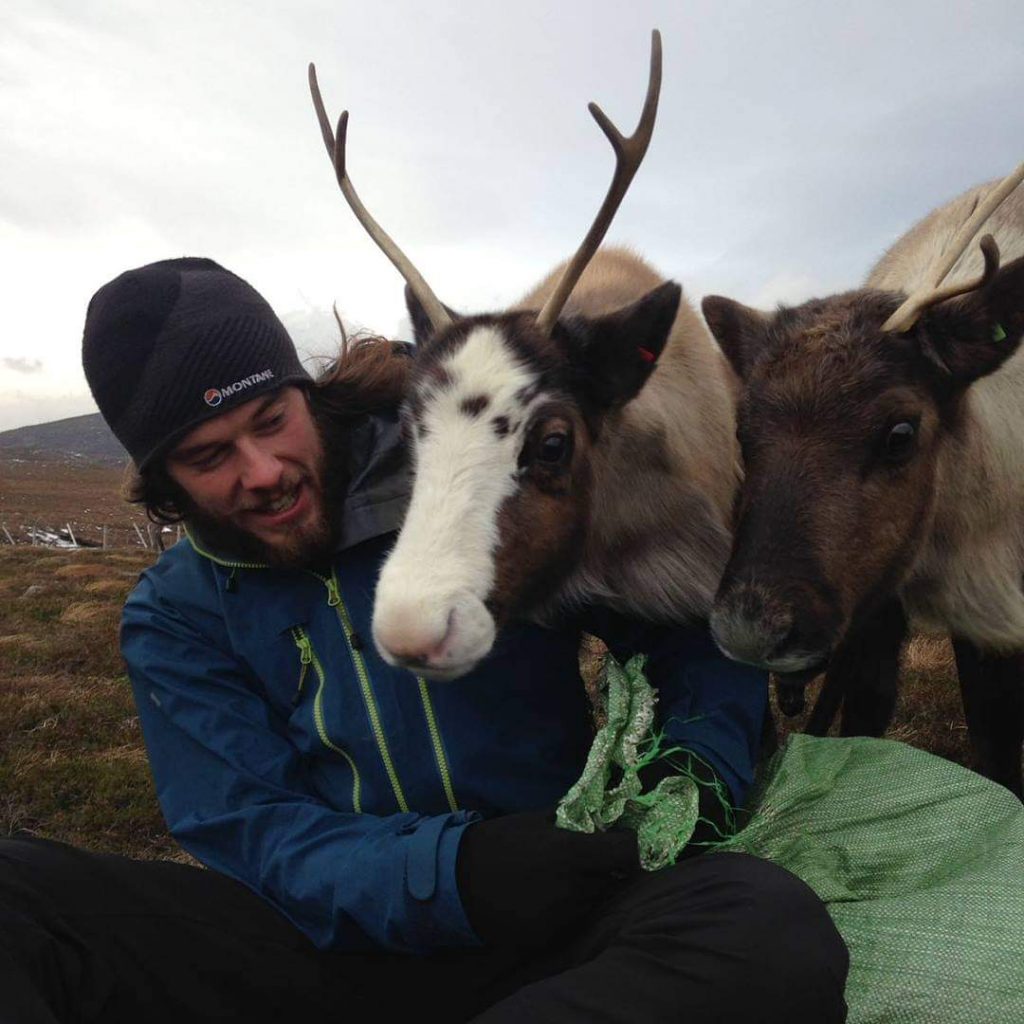
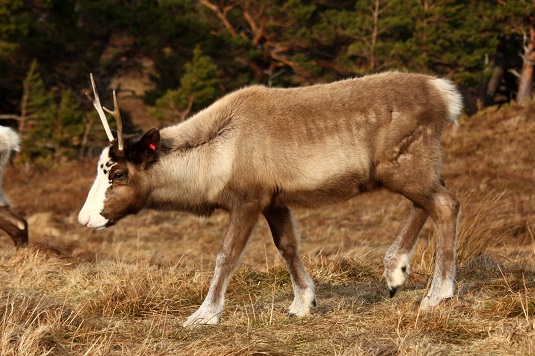
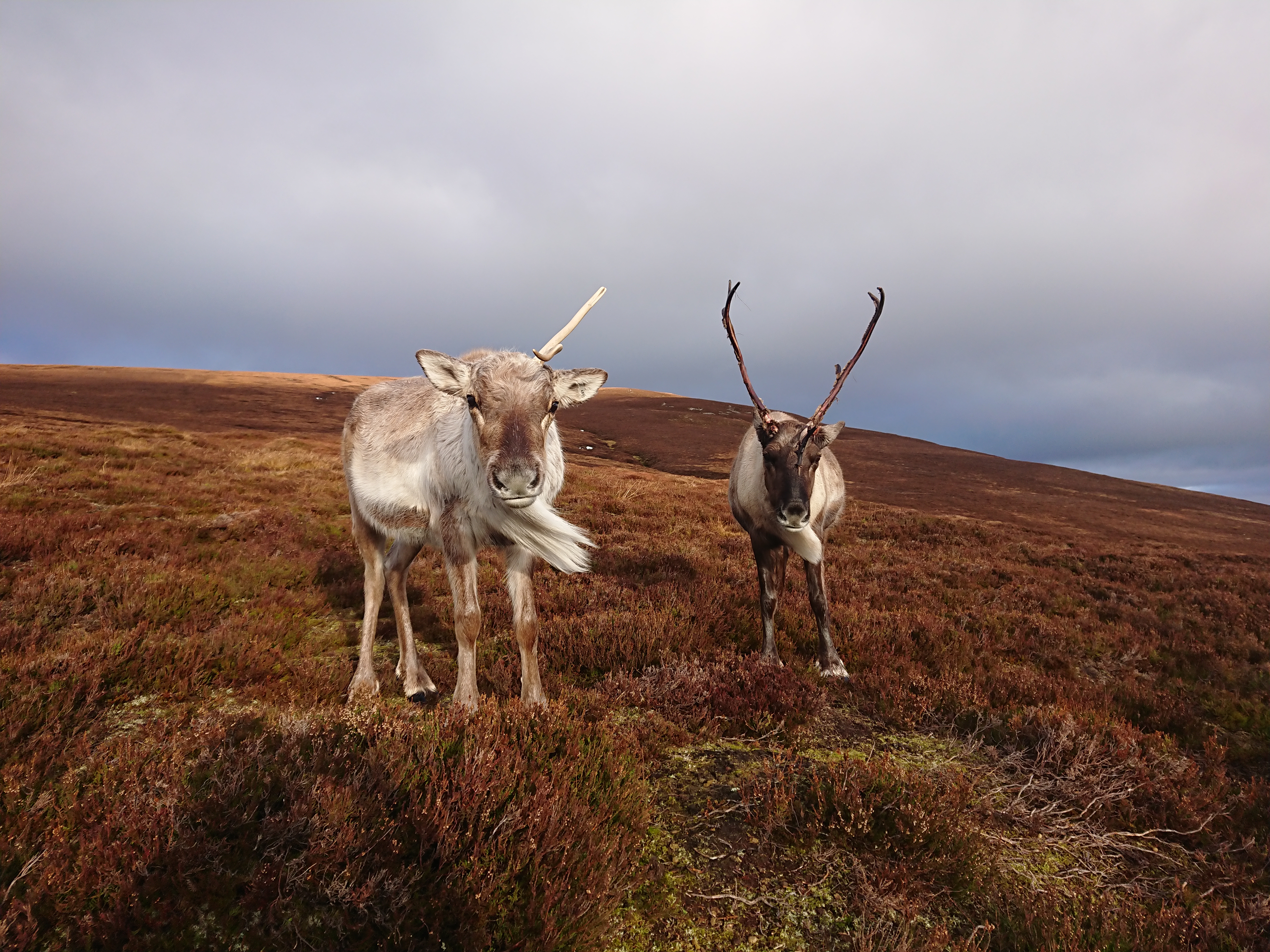
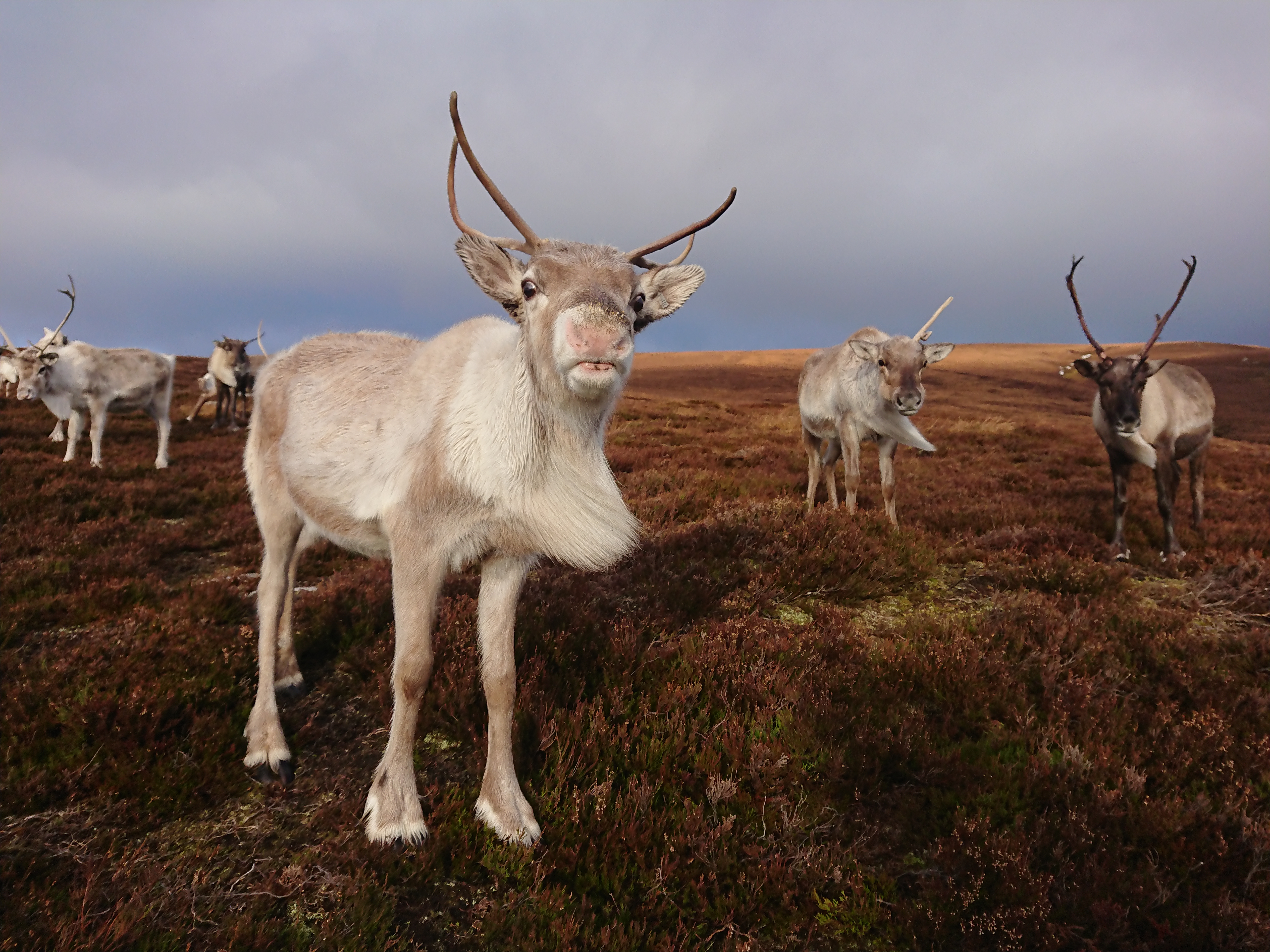
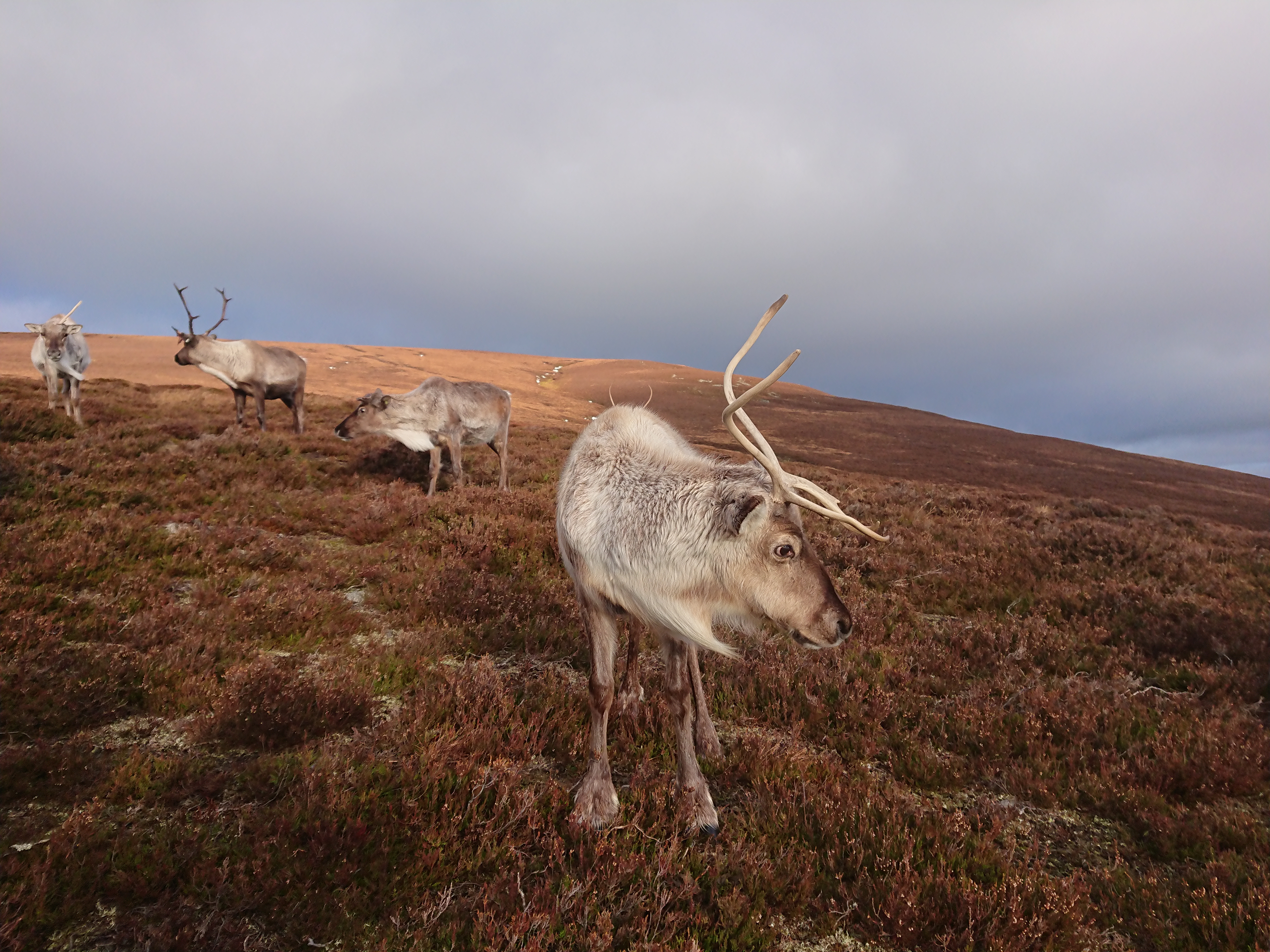
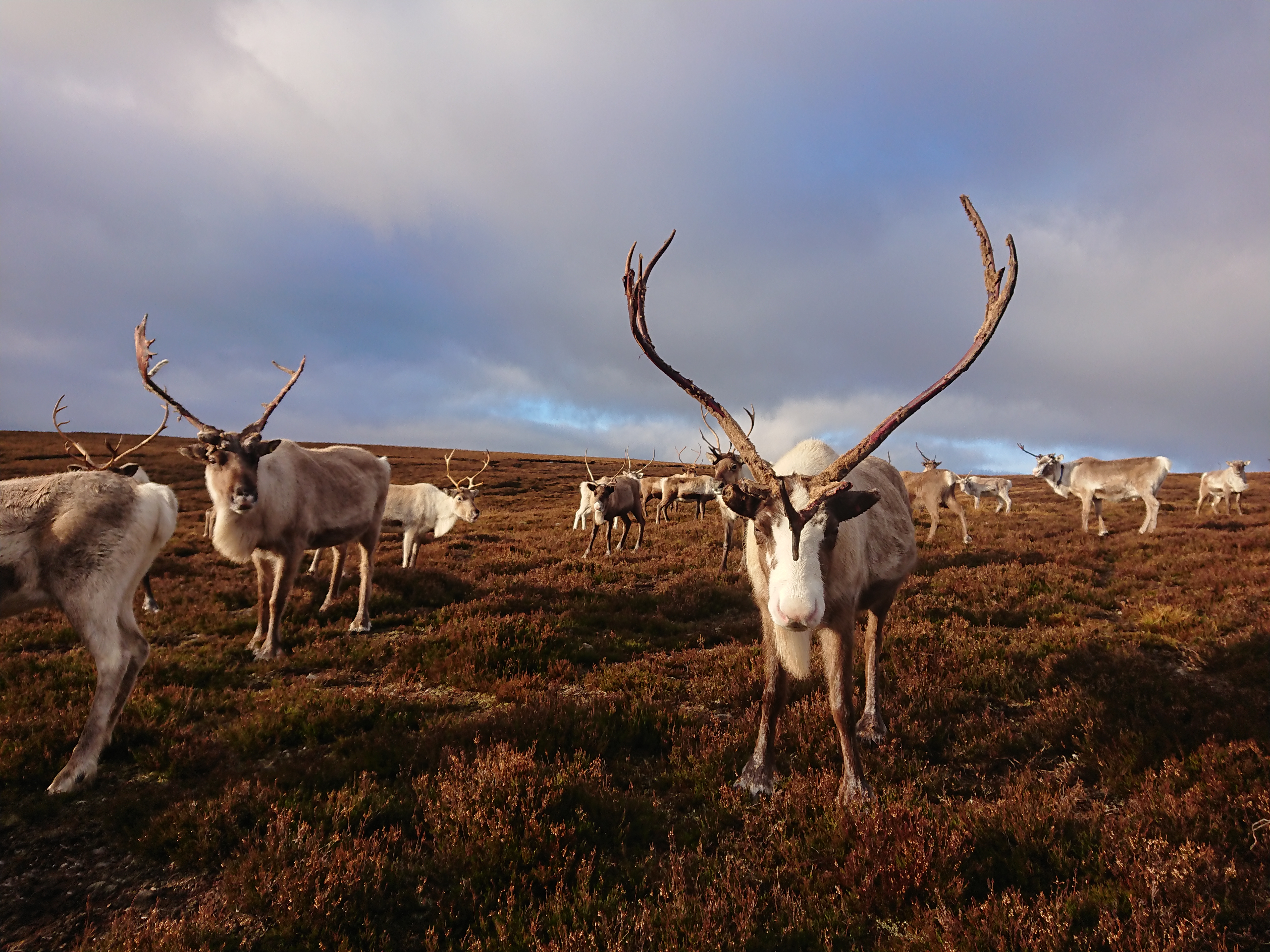
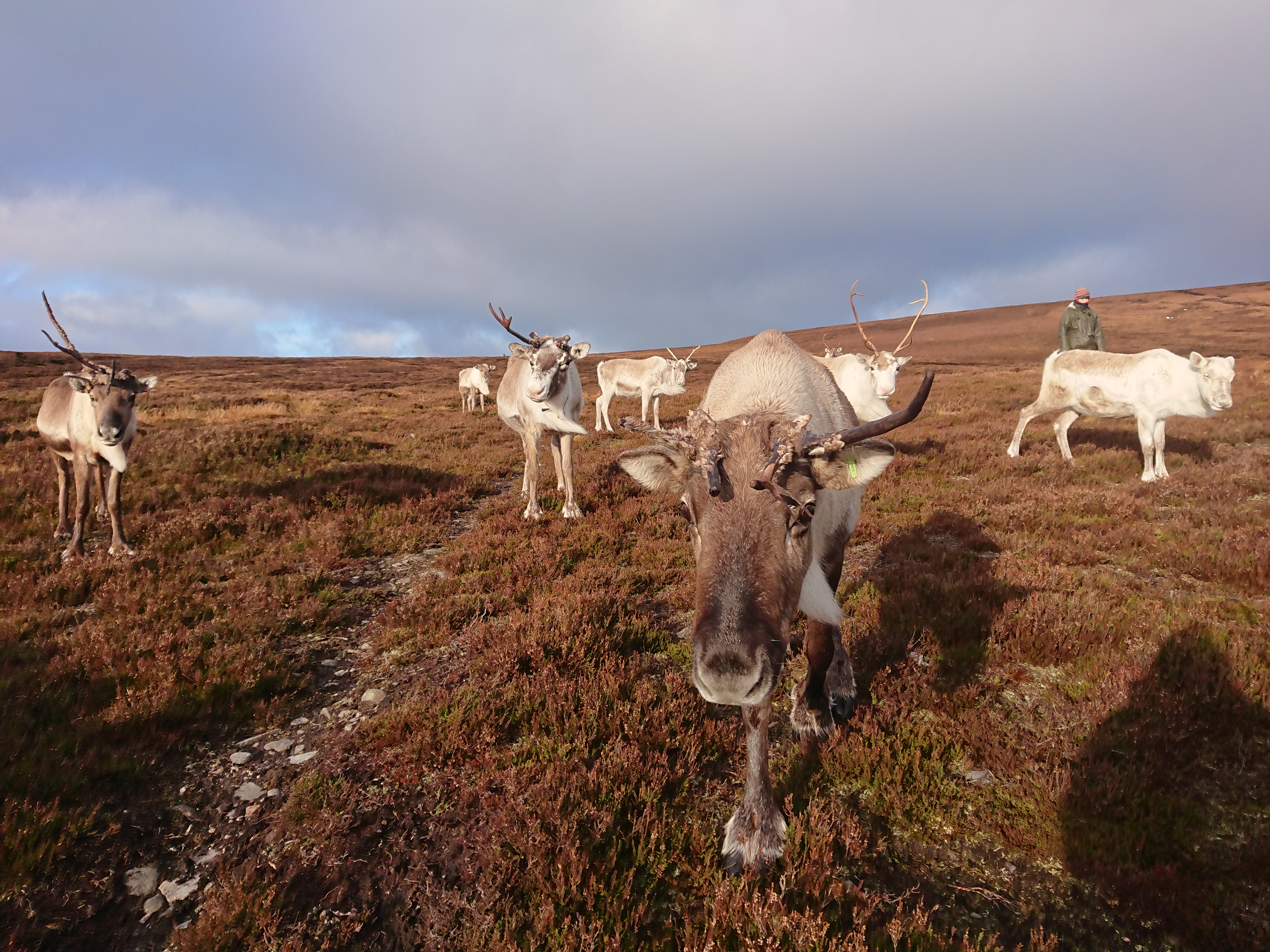
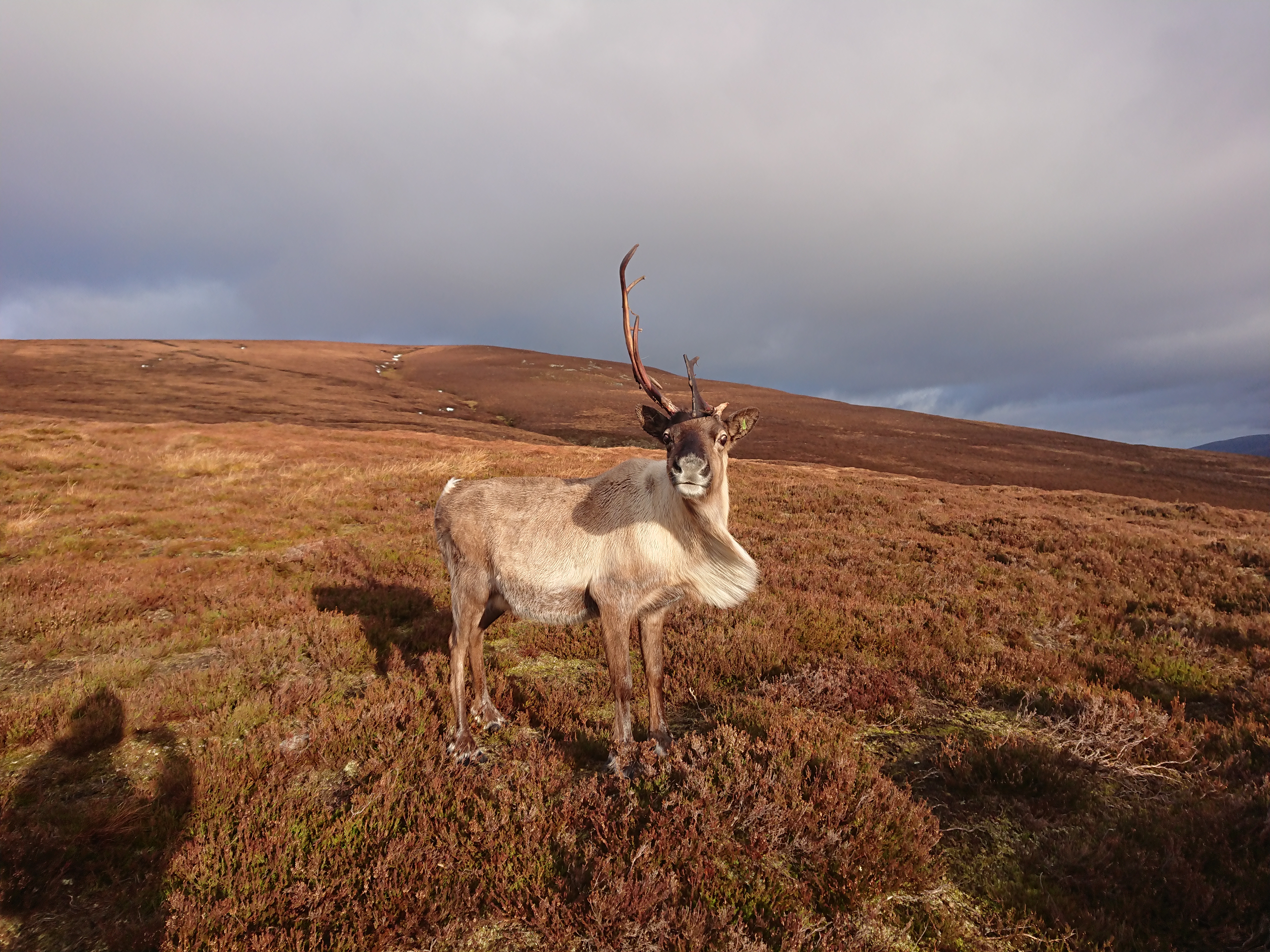
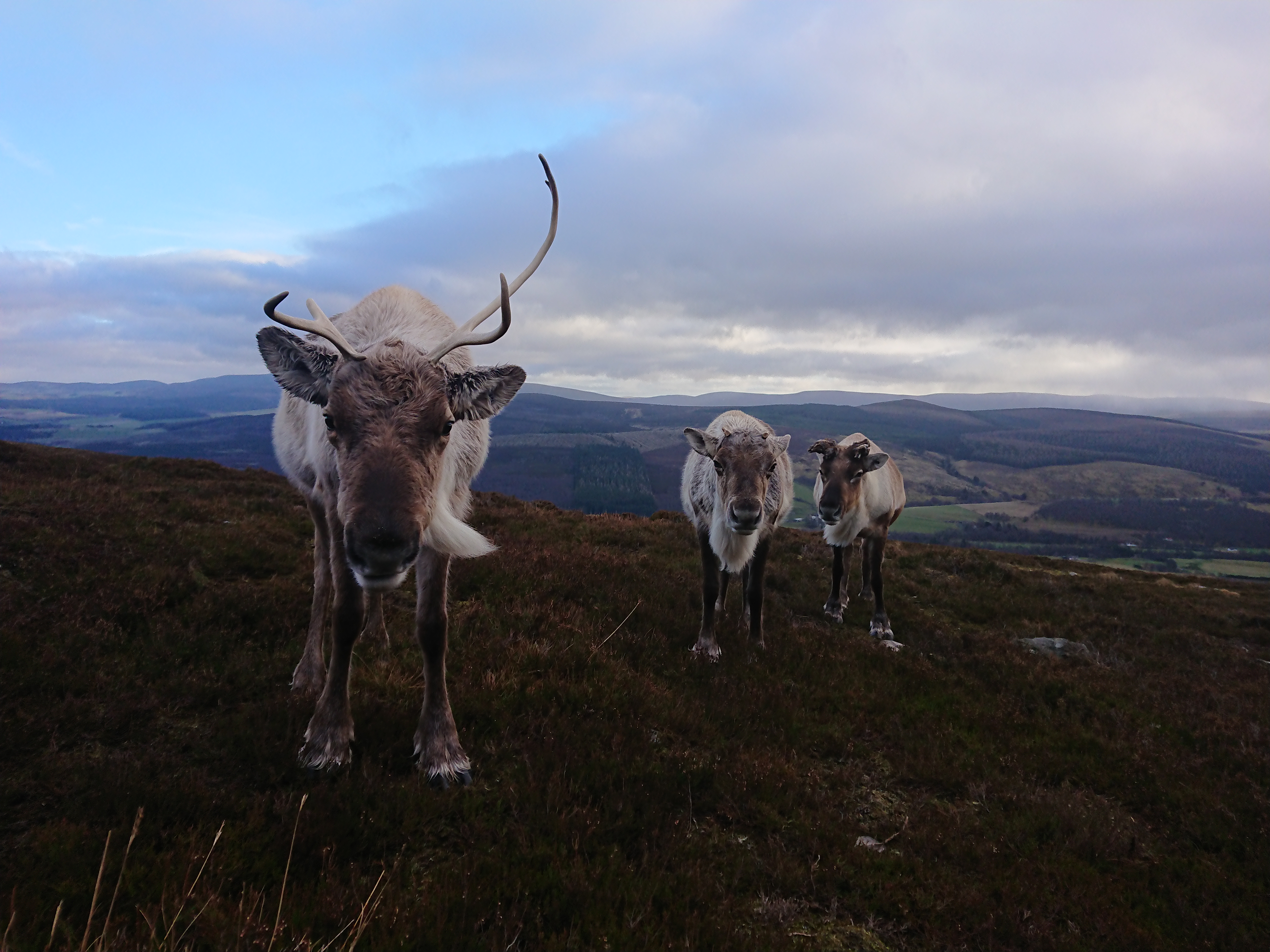
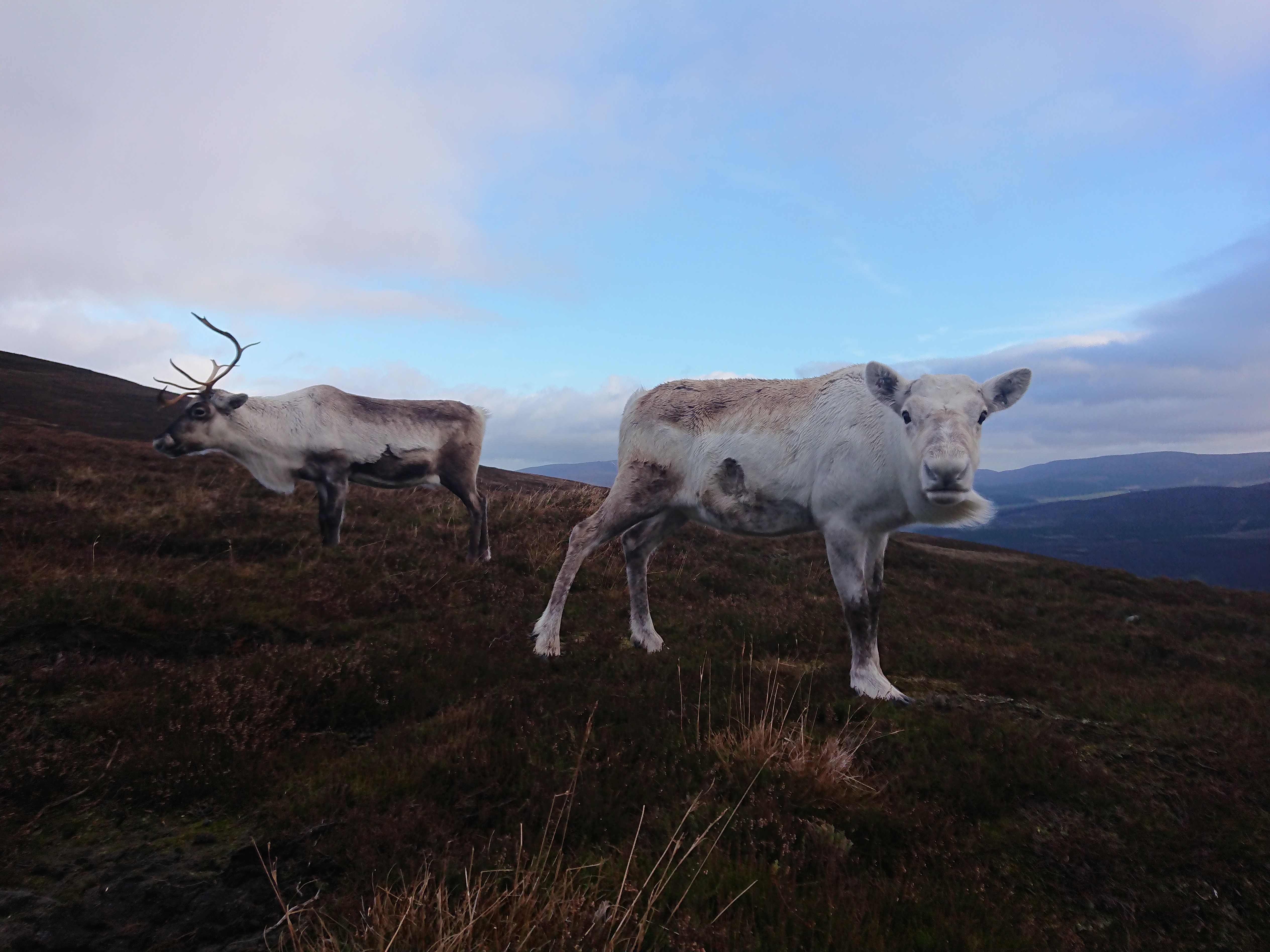
It’s a wrap!

Holy Moley on Christmas Day morning.

Well, that is Christmas here at the Cairngorm Reindeer Centre done for another year and I have to say it has been A LOT busier than 2020 when COVID restrictions didn’t allow us to go about our usual business. Although it wasn’t as busy as the years before COVID-19 I think this year has been an eye opener for us and how we go forward in the future. The income we receive over the November/December period through Christmas events is something we once completely relied on to help support the reindeer herd and running costs for the rest of the year but nowadays we are busier than ever and as a result the income through the Centre now provides a bigger ratio than it once did, so I think a quieter Christmas tour in years to come could actually be better in the long run, concentrating more on what we have here at home. I’m not saying we won’t carry on with our Christmas tour completely, but I will look into downsizing, which it has naturally done this year anyway and it’s been very manageable.

We went through all the normal training with the reindeer through the October period. The 5-6 month old calves being trained to wear and walk on a head collar and the new young male Christmas reindeer being trained to wear harness and pull the sleigh. They all did great and I think gold stars in particular go to Christie’s calf Akubra, who I can only describe as a born Christmas reindeer and Frost, our 3 year old who pulled the sleigh like he’d done it his whole life, taking part in some huge events and taking it all in his stride. They make you so proud when out and about on tour its hard not to shout their praises from the roof tops!

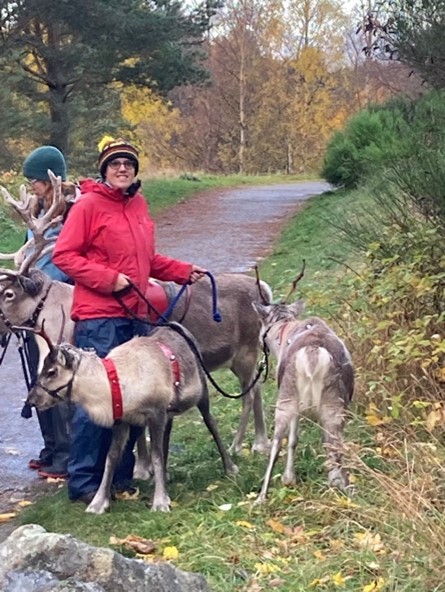
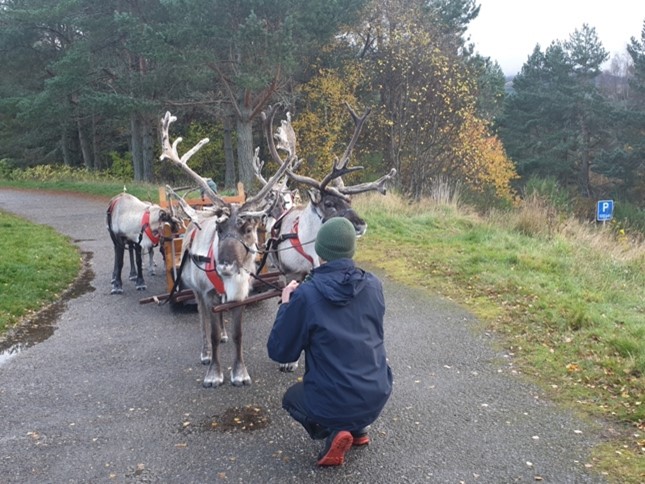
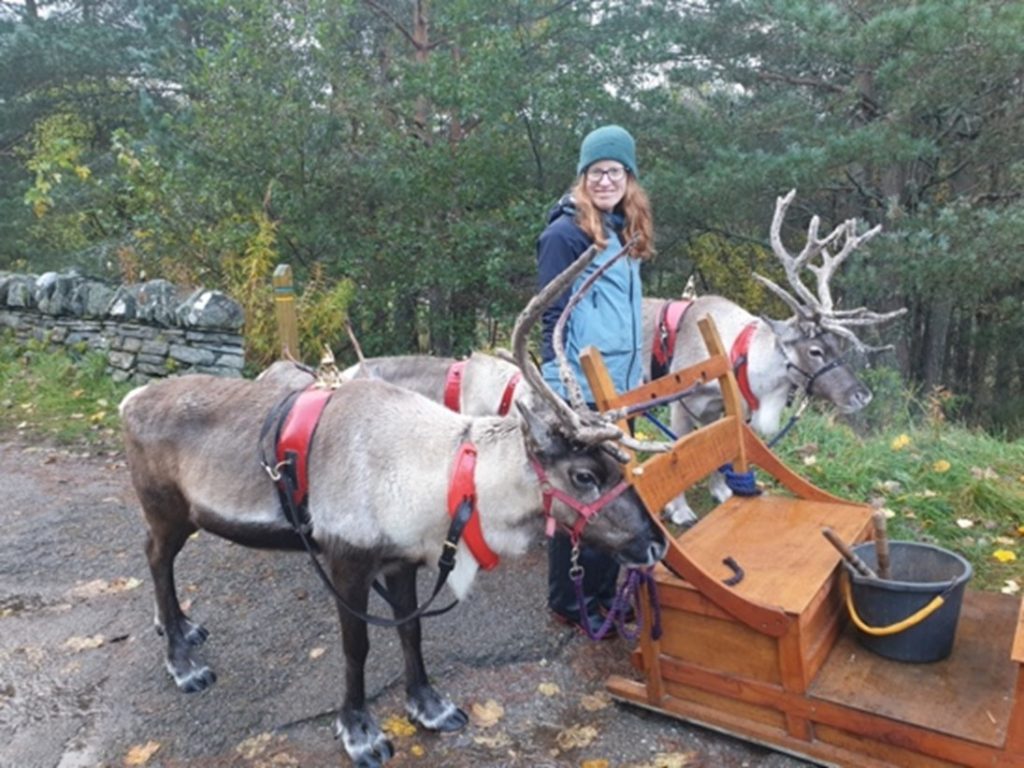
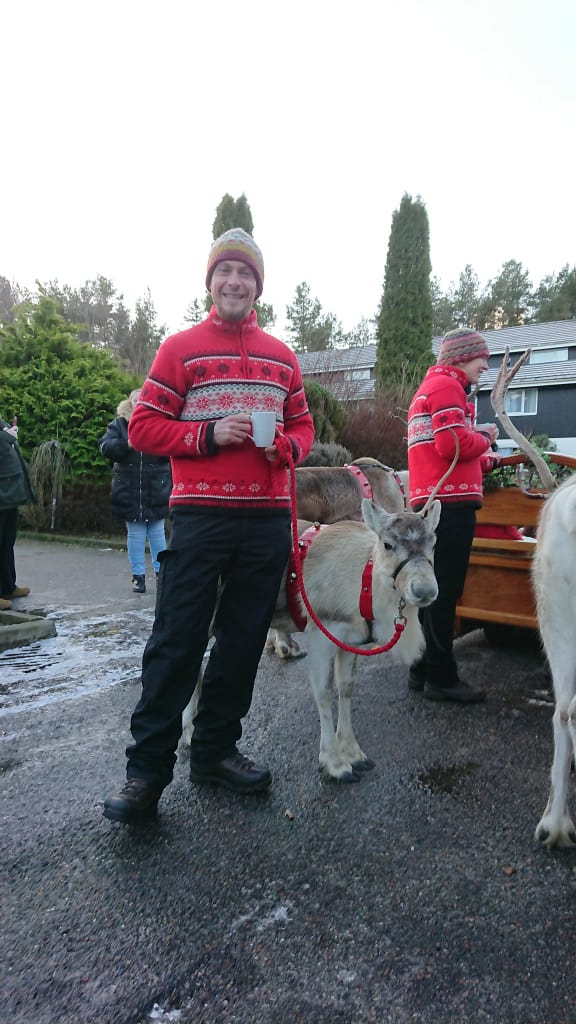
A training session in Glenmore back in the autumn, coincidentally the 4 adult reindeer featured are our Christmas Eve and Christmas Day team!
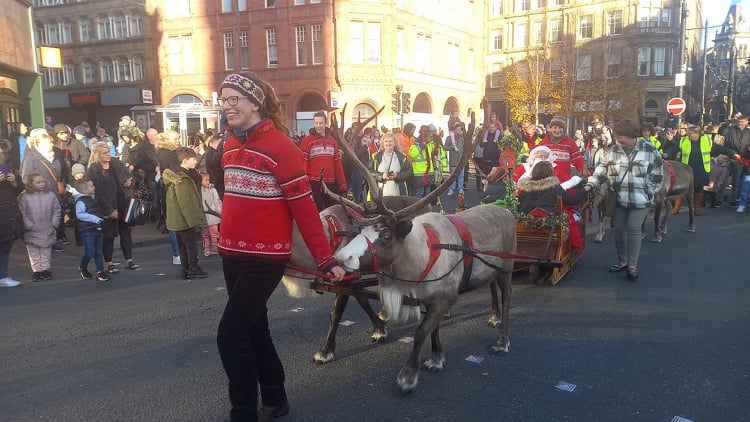
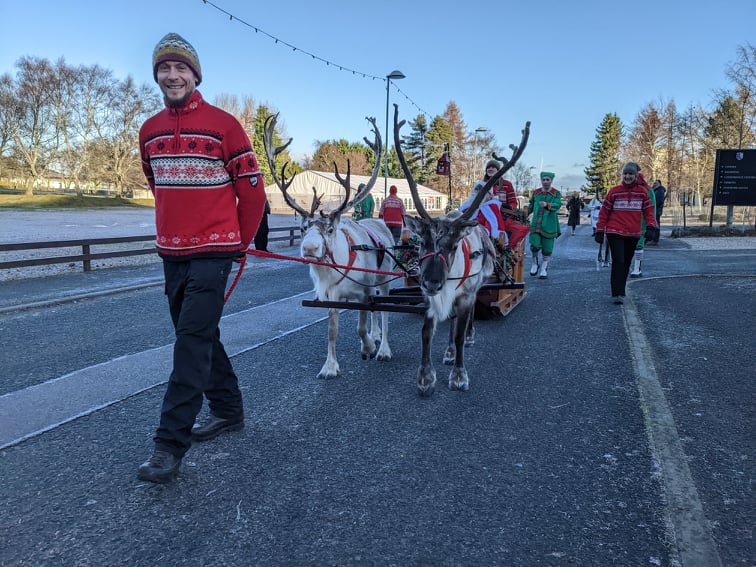
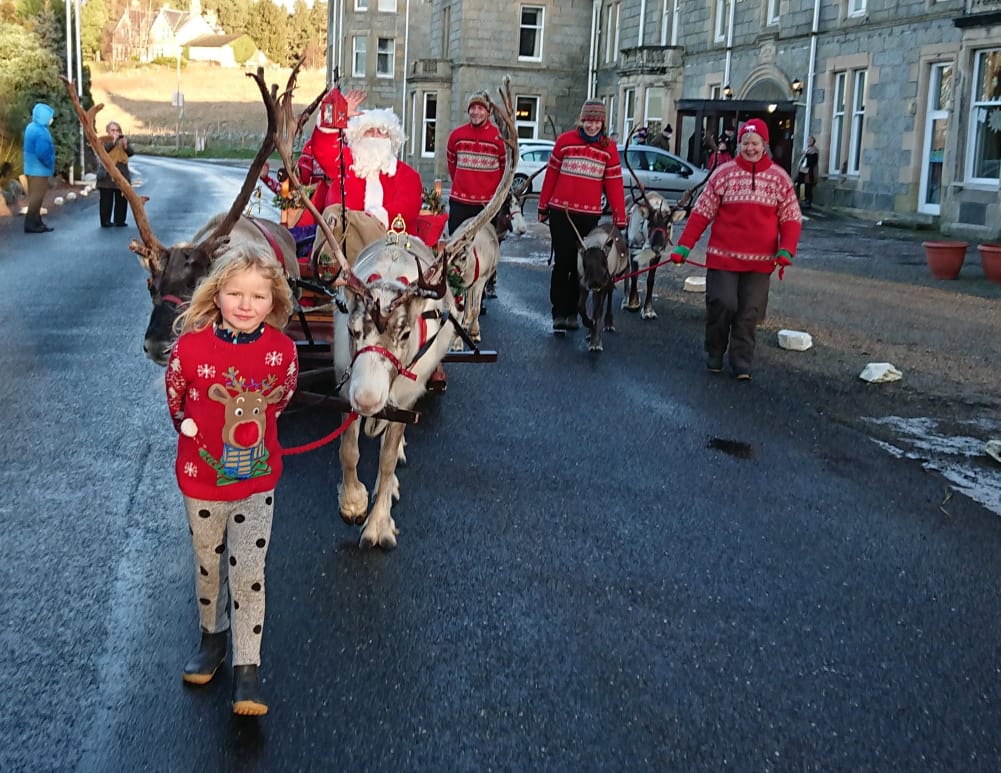
3 year old Frost and 6 year old Scolty pulling the sleigh in Aviemore on Christmas Day.

I also have to sing the praises of all our wonderful reindeer herders including core employees, seasonal reindeer herders and volunteers. Without this ridiculously capable team of folk we would not be where we are today. It takes input from every single one of us to make it work so thank you to everyone! I have to mention one person in particular who I know won’t want me to make a fuss, but I am going to anyway, because she has been a total super star. Carol thank you so much for just being you. Your kind and caring nature not to mention a special way you have when talking to the public about reindeer is wonderful to watch and you are an asset to our already great team. I know the reindeer also bring a huge amount of joy to Carol as well so I think it works both ways.

Carol and 7 month old Akubra – the most chilled-out of all our calves this year!

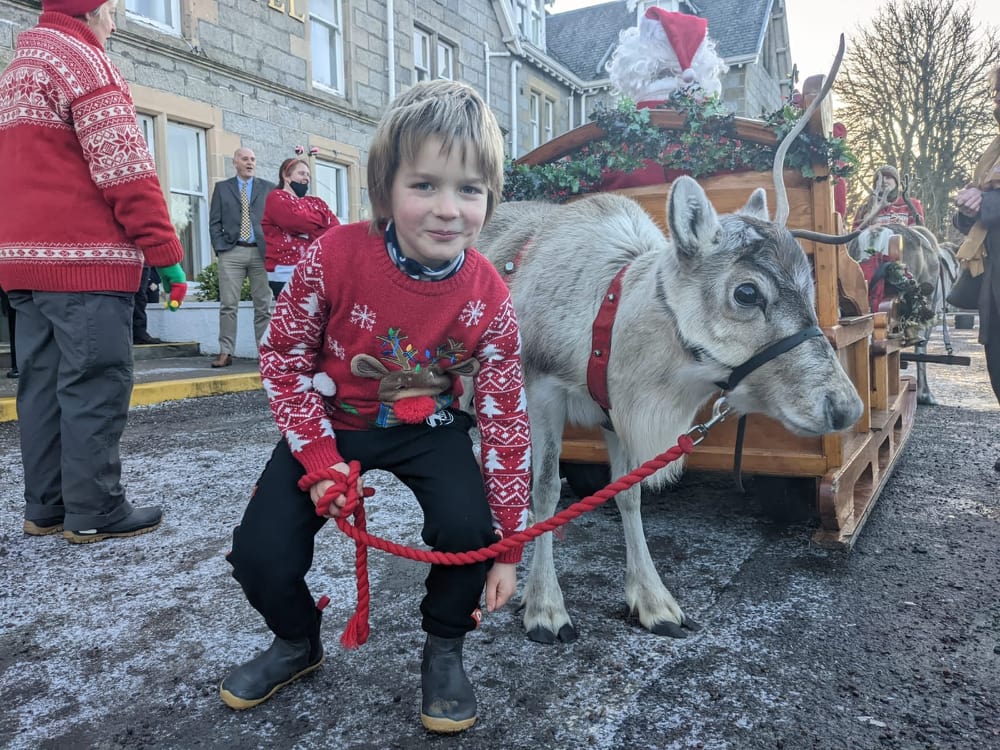
We finished off Christmas with 6 events on Christmas Eve and Christmas Day. The team of reindeer were quite a young bunch with the oldest being 6 years, but what a team they were! Scolty, Dr Seuss, Frost, Clouseau, Holy Moley and Akubra. Handlers over the two days consisted of Tilly, Fiona, Joe, Ben Hester, Ruth, Carol and Aurélien. Although icy and cold the weather was kind to us bringing bright blue skies and sunshine on Christmas day. The public were delighted to see the reindeer bringing huge smiles to both adults and kids… and herders of course. Carol was in charge of 7 month old Akubra all day and the two of them got on really well. Introducing him to lots of people delighted to see the reindeer over this festive time. Though Akubra was a little tired by the 4th event so he took a wee nap mid performance! What a dude! Aurélien and Holy Moley were on top form, although Holy Moley can sometimes be a little bossy with small children so Aurélien did a great job of anger management… she’s a wee toerag!

Aurélien and Holy Moley were a great double act.

At our second last event of Christmas day a couple of our youngest reindeer herders joined us and even mucked in helping to handle the reindeer. Oscar and Tilly (little Tilly, not big Tilly) were excellent in taking instruction when it came to leading and handling the reindeer… I see a couple of future reindeer herders in these two for sure! Newbie Christmas reindeer Frost and Clouseau both pulled the sleigh at three of the events each alongside role models Dr Seuss and Scolty. A-star team so bravo boys and girls… you all get an extra handful of lichen… the favourite food of a reindeer.

[Little] Tilly leading the reindeer and sleigh in Nethy Bridge.
Oscar and Holy Moley at the back of the sleigh doing a superb job.

So that is it for another year and when I thought at the beginning of November that the end was nowhere near in sight. Suddenly Christmas is over. I’d worried that the reindeer would forget what to do on events having had a year off but that was absolutely not the case. If anything it was the humans that needed reminding and reassuring that they knew what to do, the reindeer were fab.

Fiona

A summary of December 2021

Merry Christmas everyone. As you may well imagine, when you have a herd of reindeer, December is a busy time of the year. And this year has been no different. In this blog, I’ll provide a summary of what happens at the Reindeer Centre throughout December.

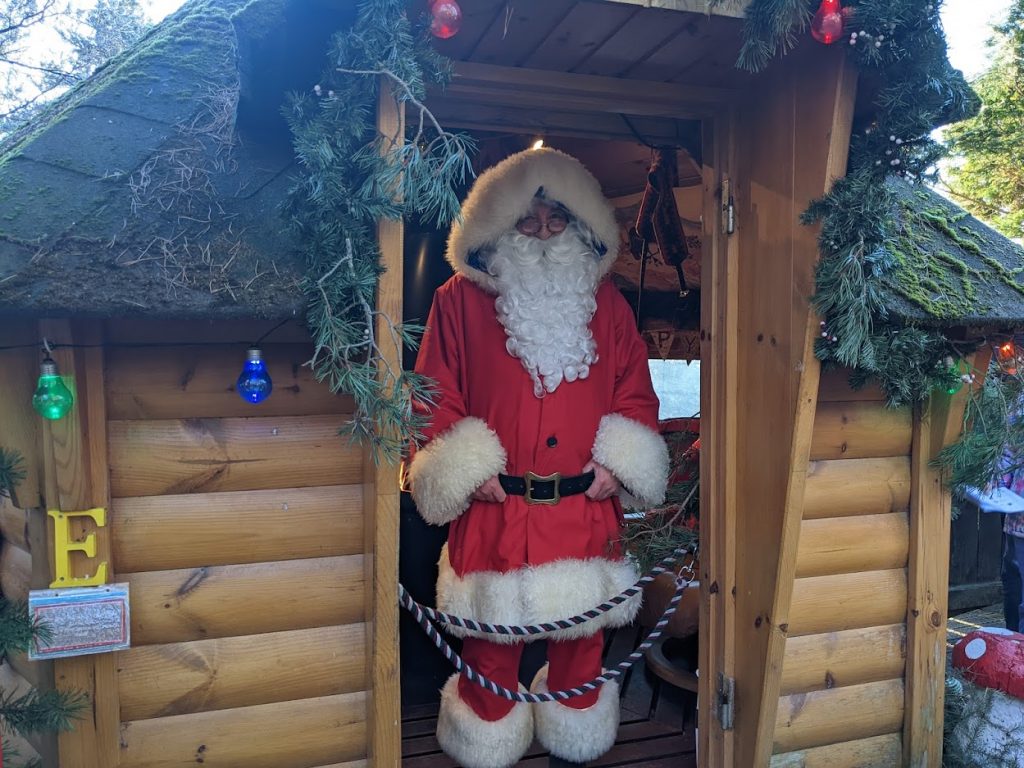
We’ve been having plenty of ‘Christmas Fun’ in the Paddocks and Exhibition area. This has taken place every December weekend as well as every day this past week in the build up to Christmas Day. Here we’ve had Santa Claus in his cosy, fire-lit grotto as well as arts and crafts, a special Christmas activity booklet for the kids to complete and plenty of herder talks out in the paddocks alongside the reindeer. We hope you’ve enjoyed chatting to us herders and seeing Santa!

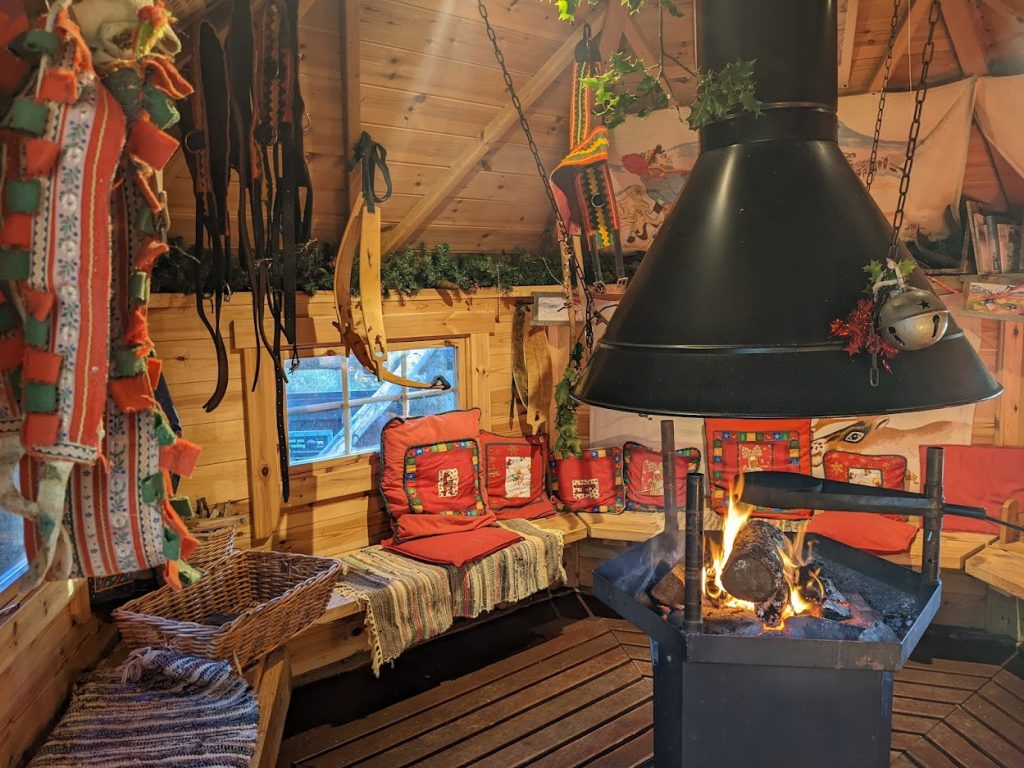
The BBQ hut warm and cosy, ready for Father Christmas!
The main man himself! Delighted to have him join us every weekend in December.

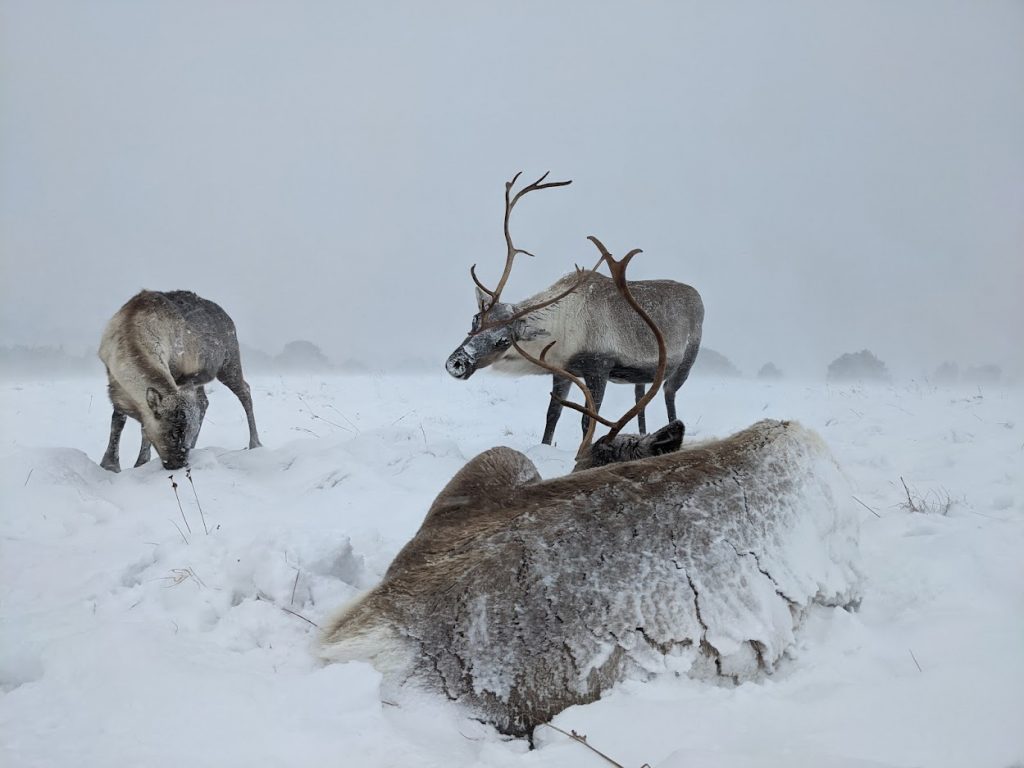
The weather hasn’t always played ball with our plans. In fact, the start of December brought some pretty wild weather. We had over 10cm of snow. The reindeer were delighted and could often be seen dancing with joy, which can be seen in the video below. However, the Ski Road leading up to the car park had to be closed on occasion due to dangerous, icy conditions and a few Hill Trips were subsequently cancelled.

Reindeer dancing with joy in the snow!
Blizzard conditions led to several Hill Trips being cancelled earlier in the month.

The snow melted about halfway through the month due to a mild spell of weather and we now have just a bit of frost on the ground in all areas except the very tops of the mountains. The weather didn’t put you hardy folks off visiting though and we had lots of visitors wrapping up warm and braving the elements on our hill trips. In fact, the December weekend hill trips were all booked up before December even started!

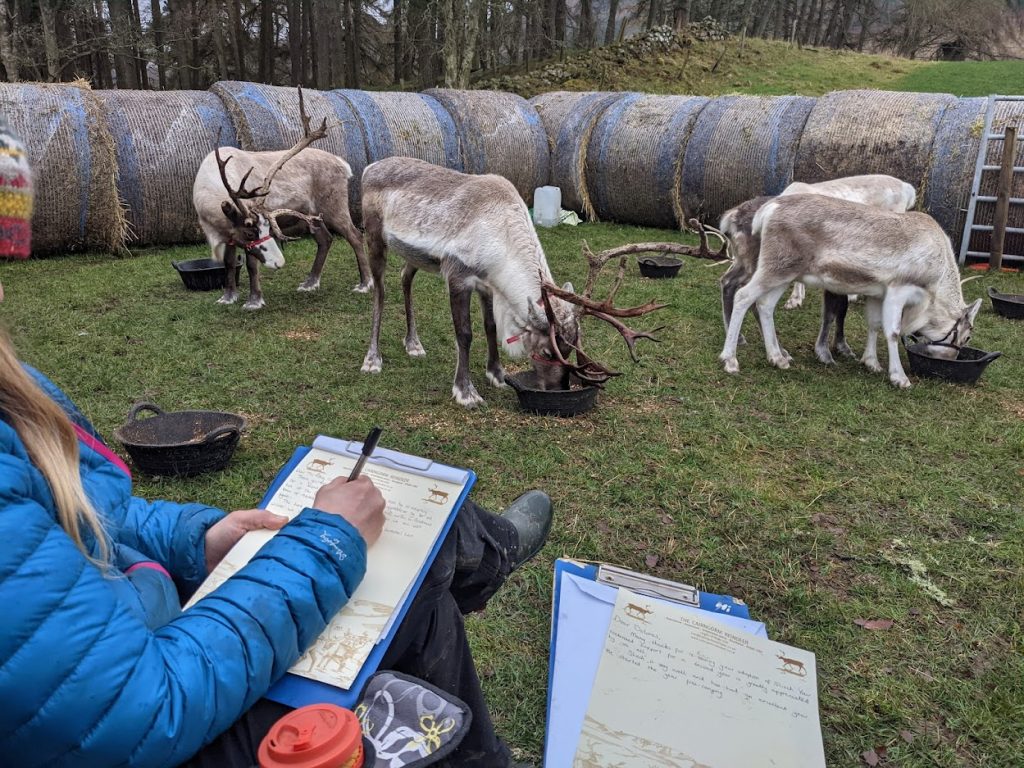
December is also the busiest month for our adoption scheme. As such we’ve been wading through seemingly never-ending torrents of incoming adoptions. All the herders have gallantly pulled long shifts of office work and about a week before Christmas Day we managed to paddle through the swell and get through the backlog of adoptions. No adoption was waiting more than a couple of days after being received so we hope that you receive your packages in a timely manner. During the busiest times, herders were writing letters whilst on tour and we recruited help from Linda and Tina who have been fantastic at writing letters for us from their homes.

Fiona and Ruth writing letters on an event, whilst waiting for people to visit the reindeer.

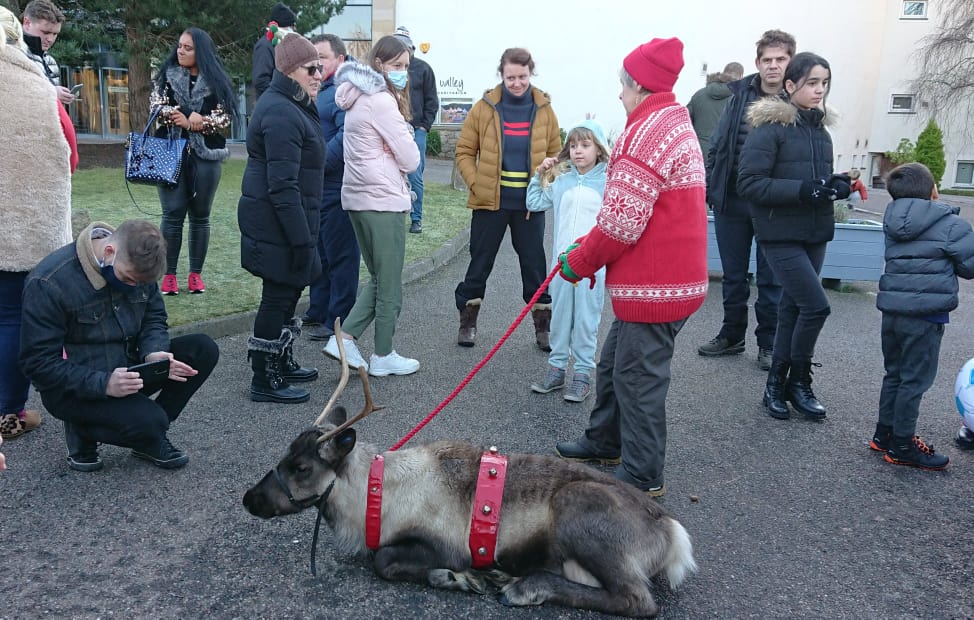
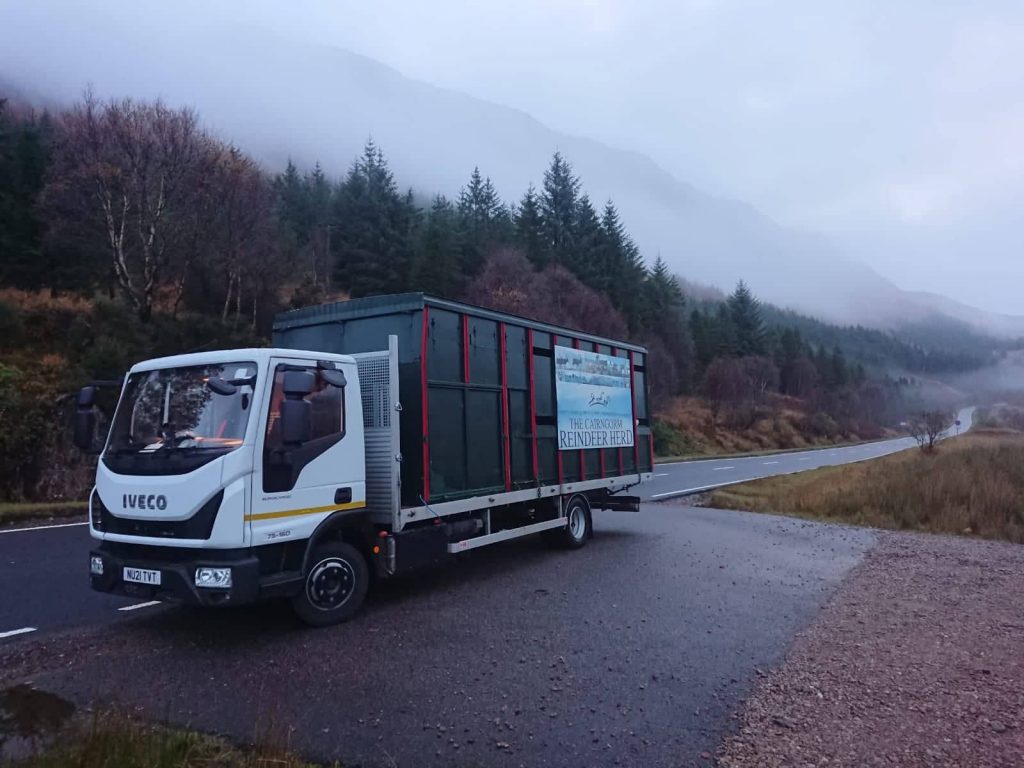
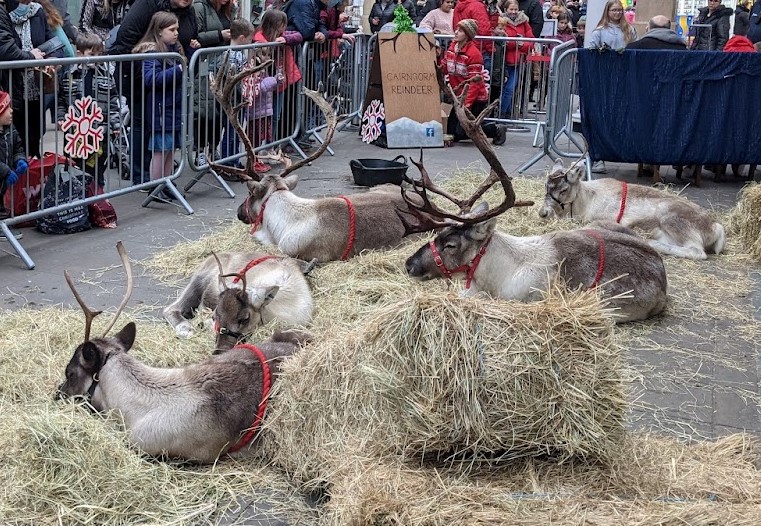
One of the other events that happens over November and December is that a selection of trained reindeer may go out on tour around the nation. Events are often relatively local, however we reached as far south as Windsor this year and went as far away as Llanelli in South Wales. Training for the reindeer occurs throughout summer and really hots up during the autumn. The reindeer may be in a display pen or participating in a sleigh procession. It varies from event to event. The team and their herders will stay at overnight bases throughout the UK, and they will travel in big lorries with lots of space which means that the reindeer will often lie down on the straw when travelling or as some of you may have seen, they may also lie down when they’re in a pen. They like to relax whenever possible. Our calves have even had a bit of exposure to Christmas events and overall, they’ve been absolute champions.

One of our Christmas lorries on the road, containing two herders and six reindeer (usually 4 adult males and 2 calves).
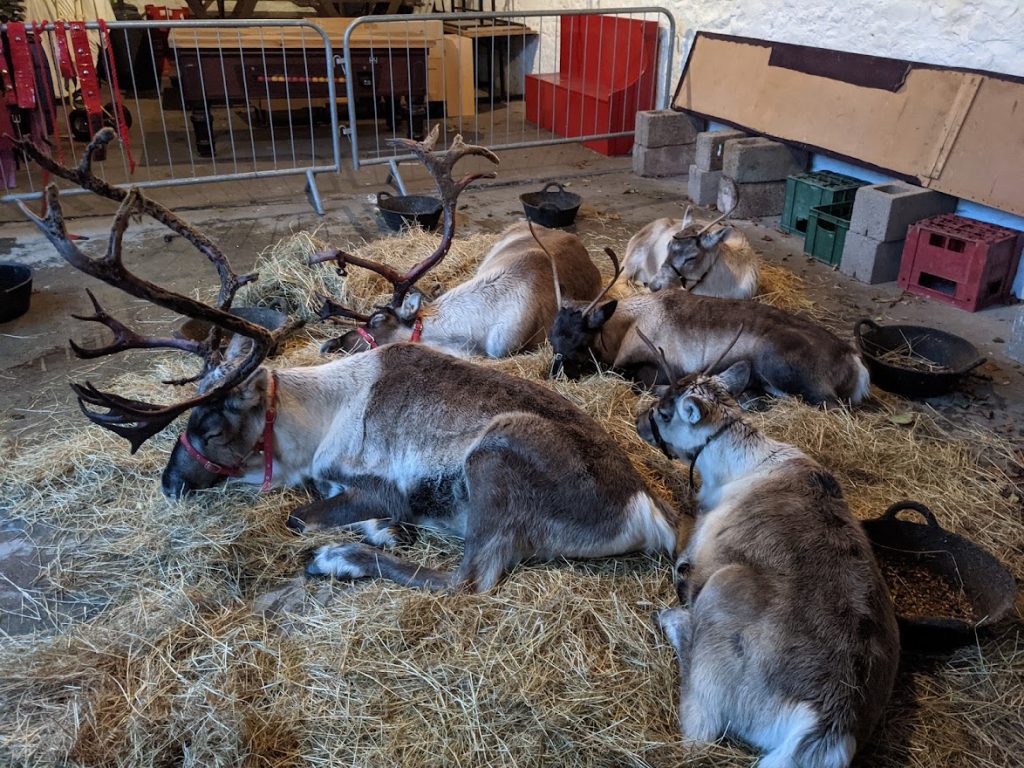
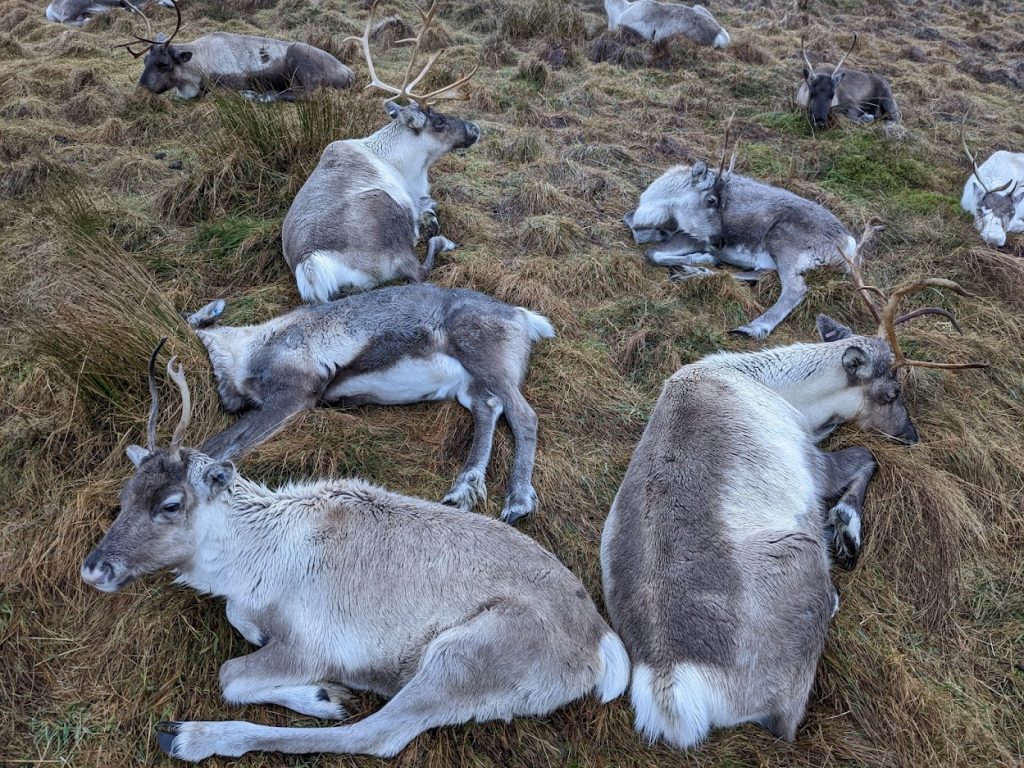
Bond, Clouseau, Holy Moley, Trilby and Akubra lying down in a pen in Lancaster earlier this month.

Colin D (we have two Colins!) has clocked up the most miles of all of us herders and that’s good news for the rest of us as he produces the funniest videos. Here is Colin narrating Dr Seuss’ gardening skills. Stay tuned for more of Colin’s videos in a future blog/social media posts…

Colin Delap and Dr Seuss with a special Christmas offer…

We are still open as usual until the 6th of January 2022. The Centre will then close until the 12th of February, re-opening in time for the February half-term. The entire herd will soon be free-ranging either on the Cairngorms or the Cromdales, fingers crossed for another cold and snowy winter. Thank you for all our wonderful visitors, supporters, blog-readers, and adopters throughout 2021. Merry Christmas and a Happy New Year, from all the reindeer herders!

Ben

Summer mornings

A while ago I wrote a blog about how Reindeer House managed to cope with its temporary hitch back in the summer, when its resident staff caught Covid. I mentioned then that Andi and I (who live outside of Reindeer House and managed to stay unaffected) were responsible throughout for the 8am morning check of the herd on the hill, so I thought I’d perhaps explain a little more about what we do in the mornings, before visitors arrive, in another blog. So I have put fingers to keyboard and here we are.

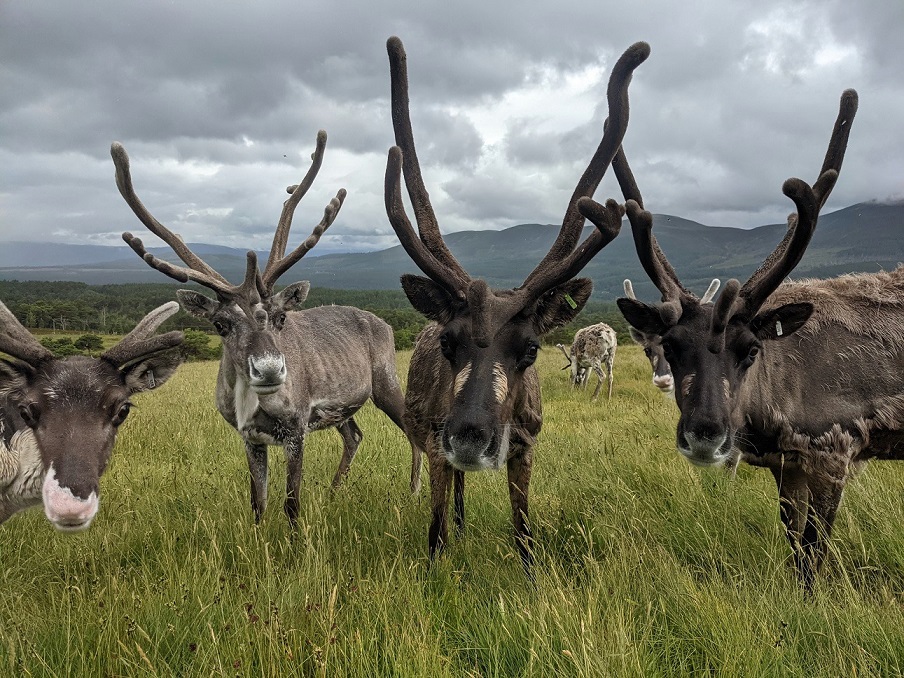
Typical scruffy summer reindeer! Butter, LX, Druid and Slioch (left to right)

Throughout the whole summer we run the guided Hill Trips up to meet the reindeer in our hill enclosure at 11am and 2.30pm, but the herd are actually fed 3 times a day. By doing the first feed bright and early, it gives us time to check everything is shipshape and ready for the day, allowing us to then concentrate on making sure our visitors have as good a visit as possible, with us safe in the knowledge that all the reindeer are happy and healthy.

Usually 2 or 3 of us will head up early doors, and in the summer there is usually only one group of reindeer in the enclosure to deal with. By comparison right now as I’m writing this (early October), there are reindeer in 5 separate areas of the enclosure, all needing checking and feeding at least twice daily! One group only is much more straightforward and seems like a distant dream right now.

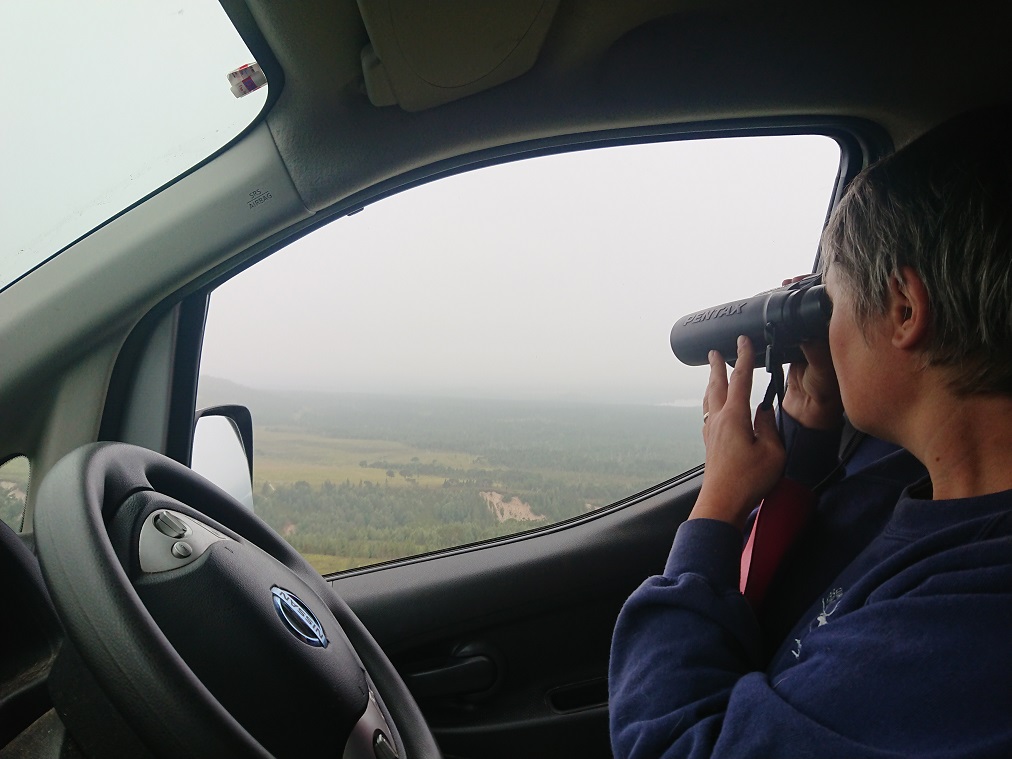
The very first job of the day, before heading to the hill enclosure, is to drive up to the ski centre to check none of the free-ranging reindeer are nearby. Right in the middle of summer this would be unusual, but they do sometimes surprise us, so it’s always worth a check! A convenient layby also gives us a bird’s eye view of much of the enclosure, so we have a quick scan over it too.

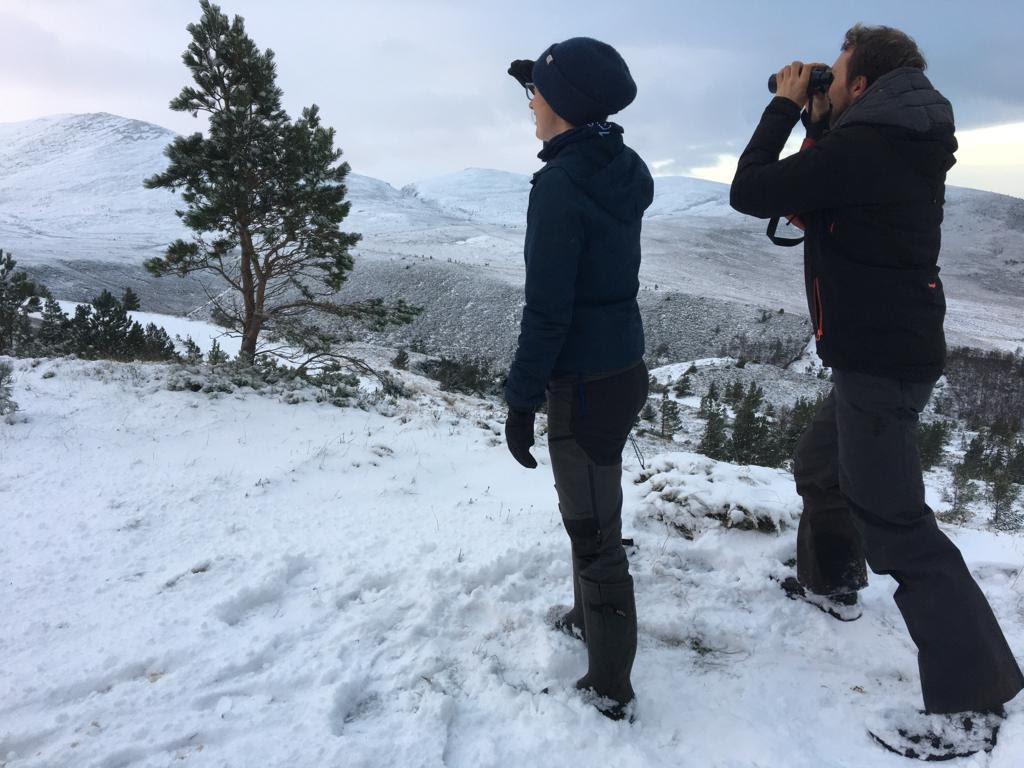
Spying with binoculars on a rather murky day.
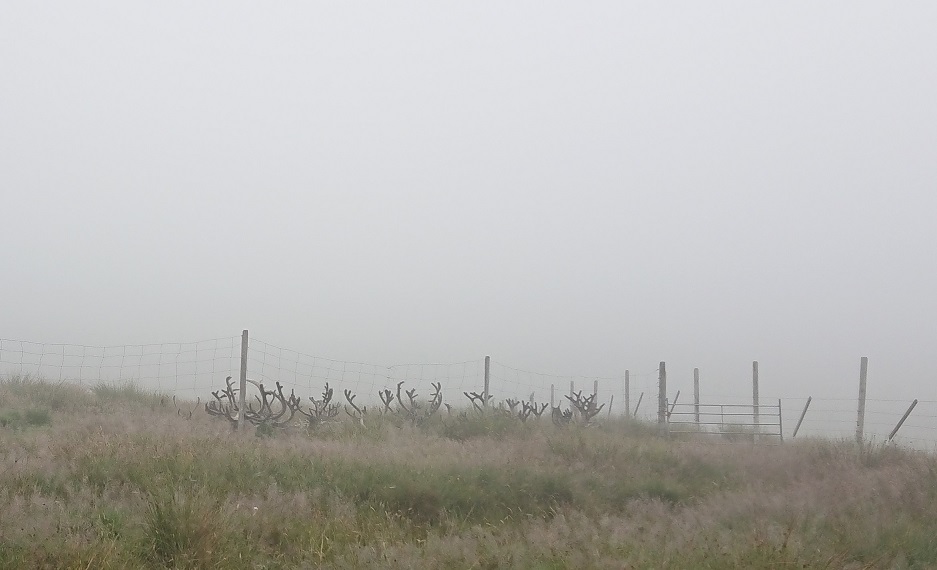
Even when the herd is waiting for their breakfast in their usual spot, they can be difficult to spot from afar. But antlers give them away sooner or later!

The hill enclosure is around 1200 acres in size; about 2km in length. The nearest end of it consists of several smaller areas, and our first job of the day is to bring the herd through to the nearest area, the ‘bottom corridor’, and to see if everyone walks through cheerfully and willingly. A reindeer who is off colour will lose their appetite and is quite likely to trail through a distance after the others, less enthusiastic about the prospect of breakfast, so that is the first clue of someone feeling under the weather.

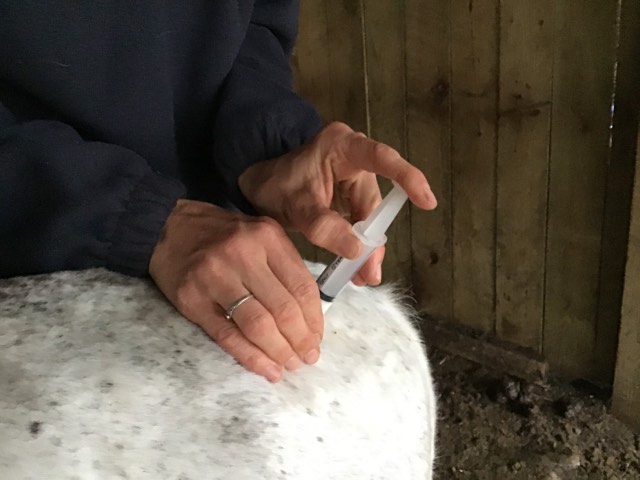
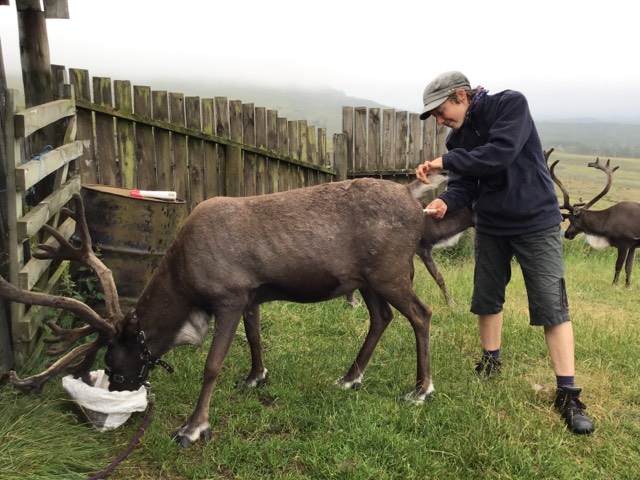
If we are suspicious any reindeer is not quite themselves, the first thing we do then is to check their temperature – so it pays not to be the last reindeer through the gate, otherwise there could be a thermometer up your bum before you know what’s happening! However, a high temperature indicates a tick-borne fever, and a shot of antibiotics is the next step, which should nip any infection in the bud.

Injecting a long-acting general antibiotic – something every herder learns to do early on it their reindeer herding career.

Once every week or so in the summer we’ll get the whole herd up to our shed and work our way through the whole herd, checking temperatures, as some reindeer are very good at not showing any symptoms at all even when they have a roaring fever. This type of fairly intensive routine monitoring isn’t necessary in the winter months as there are no ticks about then, but the warmer weather brings them out and so reindeer do get very used to regular violations of their dignity…

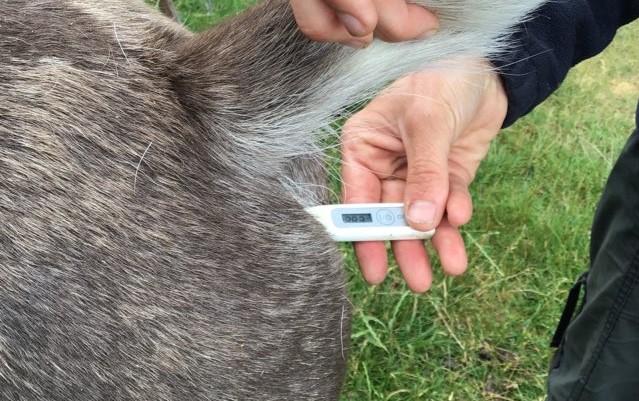
Temperature checking. Dr Seuss couldn’t give a stuff, as long as there’s a bag of bribery in it for him…
…and all good! A temperature of 38.3, as seen in this photo, is fine, the average being around 38.9 for a reindeer.

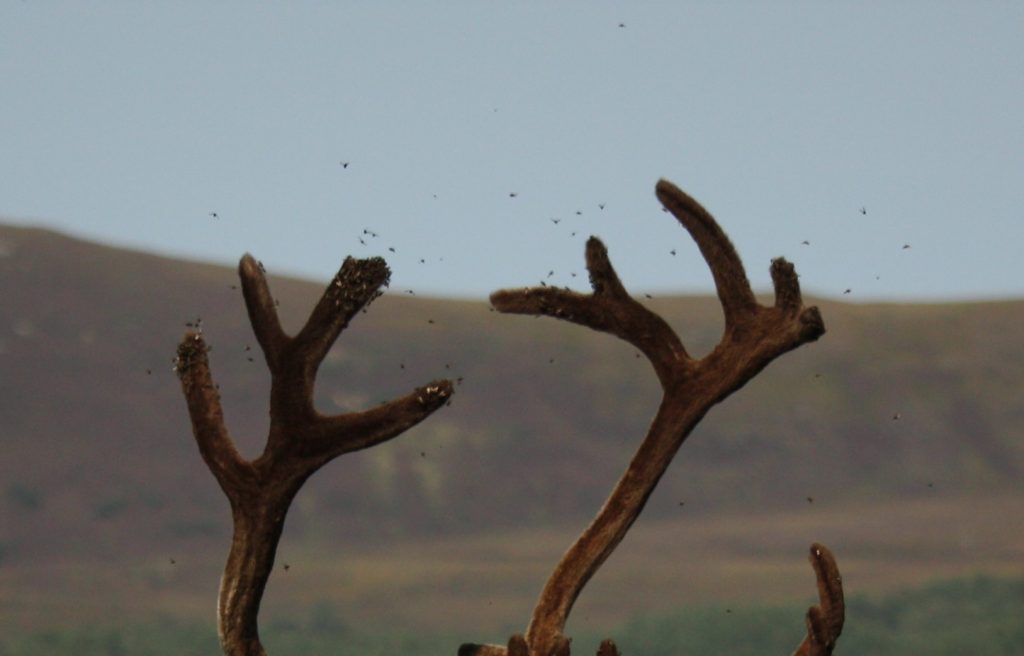
Something else that needs doing regularly of a summer’s morning, even daily at times, is fly-spraying. Like with any animal, flies will buzz around the reindeer on sunny days, and whilst they don’t generally cause any real problem, they drive the reindeer mad at times. No-one likes having flies buzzing round their face! With the reindeer, the flies tend to aim for the antlers, clustering around the soft growing tips where the blood supply is richest. If a tiny nick in the velvet skin is made, the flies will feed on the blood and this brings with it the risk of infection.

Flies around antlers.

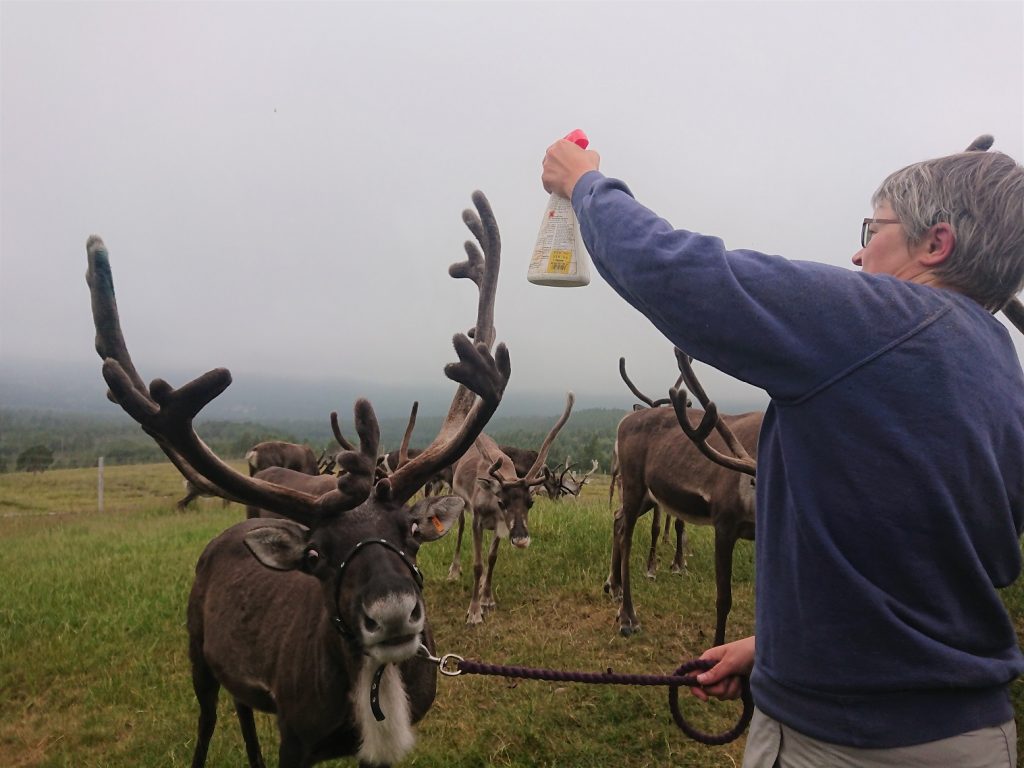
So we spray the antlers to help keep the flies off, using a DEET-based spray that is designed for horses. But unfortunately we can’t wipe the spray on with a cloth as reindeer hate their antlers being touched whilst they are growing (and also it would take forever to do 40-odd reindeer this way!), so we have to just spray it on, accepting that – from a financial point of view at least – an upsettingly large percentage of it is lost or misses it’s target. Reindeer very rarely stand quietly to have their antlers sprayed, either doing their best to pull away from us, or rushing around in circles if contained in the shed. But there’s no way around it – antlers need spraying and it’s better for the herd to be rather flustered for a few minutes each morning than spend the day charging around to get away from the flies.

Myself spraying Bond’s antlers – and getting a beady look in return!

On an average summer’s morning, at this point it’s breakfast time! Just like on the Hill Trips, we tip the bag of feed out into small piles in a big long line, count to check every reindeer is present and correct, and make sure every is eating enthusiastically. And then – just as importantly – head back down to the Reindeer Centre and stick the kettle on…

Me feeding the herd.
Andi counting the line to check the numbers match.

This first couple of hours of the morning is also when we do any ‘movement’ of reindeer if needed, such as letting reindeer out to free-range on the mountains outside the enclosure, or swapping over the reindeer in the Paddocks with those up in the hill enclosure. We also regularly poo-pick the nearer areas of the enclosure where the reindeer congregate, or do maintenance jobs on the fencing and boardwalks. I suspect people sometimes wonder why we don’t open any earlier than 10am, but these couple of hours are sacred to us – the time flies by all too quickly and we’re still often left scrabbling around trying to get finished and back to the Centre in time to open on schedule!

Hen

Ever changing reindeer – a photo blog

Whilst sorting through the photos on my phone recently, I thought it might be fun to show how the reindeer change in appearance over the summer months so I put together this little blog. This could have turned in to the longest blog ever but I have tried to restrain myself picking just a handful of reindeer; Camembert, Dr Seuss, Kiruna, Sherlock, Beanie and Christie and her calf Akubra.

Camembert 1 – on the 21st of June (Summer Solstice) Lisette and I walked Camembert and some other cows out on to the free-range for the summer. Here she is growing her antlers, still to moult last year’s winter coat, and determined Lisette still has some food for her!
Camembert 2 – This was the next time I saw her, on the 14th of September after my lovely colleagues successfully brought her and a large group of cows back in to the hill enclosure. She’s clearly had a great summer free-ranging, she looks totally fantastic and is still fat as butter.
Dr Seuss 1 – it’s no secret that I have a wee soft spot for Dr Seuss so my phone is predominantly full of pictures of him! Here he is on the 20th May, he’s just beginning to moult his winter coat from around his eyes, and his lovely antlers and growing well.
Dr Seuss 2 – here’s the big boy again on the 5th of July looking almost ready for summer in his short coat, with a slightly pink nose!
Dr Seuss 3 – how smart does he look here?! This was the 8th of September. His winter coat is now beginning to grow through around his neck and he’s had a busy summer growing lovely big antlers, and a big tummy after hoovering up all that tasty hand-food!
Kiruna 1 – Here’s two year old Kiruna after hearing one of Ben’s jokes. This was on the 8th of July, his antlers are rapidly going and he’s moulted most of last year’s winter coat.
Kiruna 2 – Here’s Kiruna stripping the velvet on the 28th August. His paler winter coat is growing through quickly on his neck and flank.
Kiruna 3 – What a handsome lad! Here he is leading the herd in for breakfast on the 7th of September.
Sherlock 1 – Three year old bull Sherlock on the 11th of June, rapidly growing his antlers and just beginning to moult his winter coat from around his eyes and on his nose.
Sherlock 2 – 1st of August, looking smart in his short, dark summer coat. He’s grown enormous antlers for a three year old!
Sherlock 3 – 29th of August, just before his velvet started to strip.
Sherlock 4 – Just one day later, here he is midway through stripping his velvet on the 30th of August.
Sherlock 5 – Handsome boy on the 1st of September, with beautiful clean antlers.
Beanie – The palest calf of 2021, Beanie, this picture was taken on the 20th May, just one day old. What a cutie!
Beanie 2 – What a fantastic job Gloriana has done! This was taken on the 15th of September. After a summer spent free-ranging Gloriana and her daughter are now back in the hill enclosure. She’s already getting used to being around people on our Hill Trips and quickly learning big green bags = food!
Akubra 1 – Christie in the background with her thick winter coat, you can still make out her freckly nose. Photo taken on the 27th May when her calf was just over three weeks old (born 4th of May).
Akubra 2 – I was delighted to catch up with Christie and her calf on the free-range on the 15th of August. Christie has done a fabulous job and has produced a nice big strong boy, well done Christie!
Christie 3 – Looking beautiful on the free-range with her huge calf on the 15th of August.
Christie 4 – Photo taken on the 15th of September midway through stripping the velvet from her large antlers. Not only has she produced a large calf this summer, she’s also grown big antlers herself and is in excellent condition. Go Christie! Her winter coat has grown in a lot over the last month.

Ruth

Through the Eyes of a Reindeer

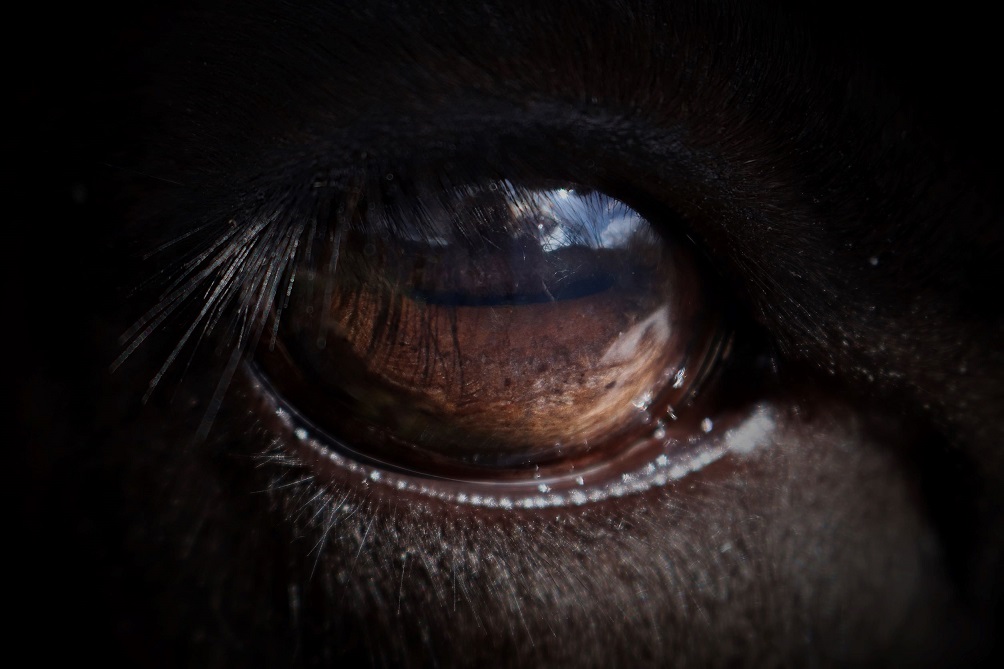
A visitor recently asked me why reindeer have horizontal pupils. The question had me thinking about the importance of vision to reindeer. It is easy to forget that many animals don’t see the world the same way we do, and reindeer eyes are in many ways different from our own.

Reindeer live in arctic and sub arctic regions that experience hugely variable light levels. Above the arctic circle, they’ll experience 24 hour darkness in winter and 24 hour sun in summer, and no matter how dark it is, they still need to be able to find their food and see predators coming. So how do reindeer eyes cope with their environment?

Origami – Photo by Kate Brown

When you look at a reindeer, the most obvious thing about their eyes is that they are placed on the side of their heads. This is common in prey animals, and it gives them a wide field of vision that means they can see danger coming from almost any direction. The placement of their eyes does mean they have a blind spot right in front of their noses, but aside from this it’s very hard to sneak up on a reindeer!

Ladybird – Photo by Kate Brown

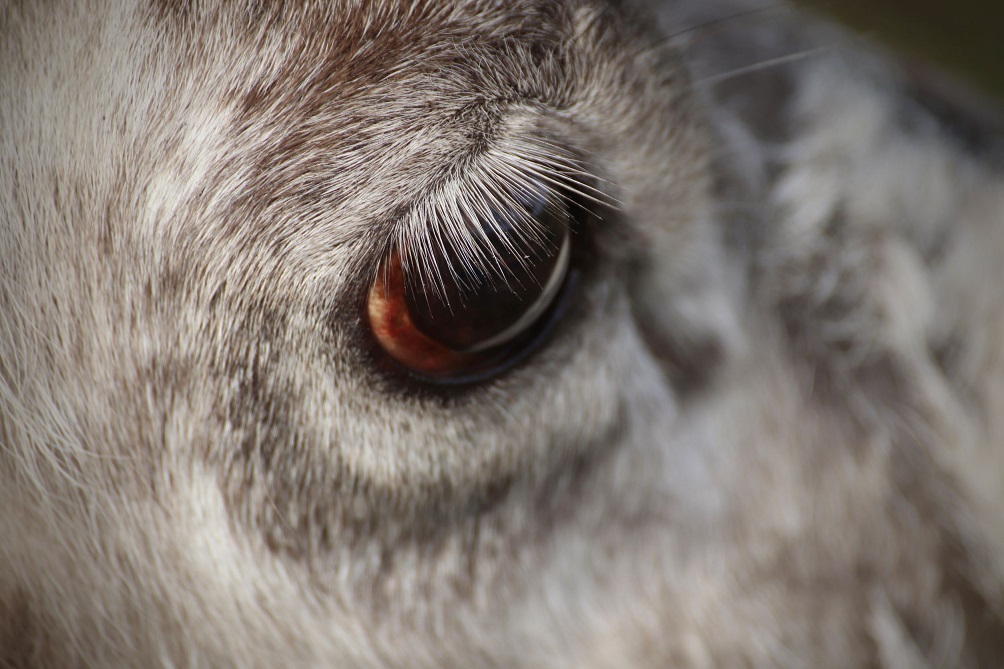
If you look a bit closer, the next thing you might notice – aside from their beautiful eyelashes – is that they have long,  horizontal pupils. This adaption helps focus a reindeer’s sense of sight at the ground level and the horizon – where their food and their predator’s are found. These horizontal pupils also help compensate for the placement of their eyes and reduce the size of that blind spot in front of a reindeer, so that they can see forwards – vital for finding an escape route when on the run from a predator.

Dr. Seuss – Photo by Kate Brown

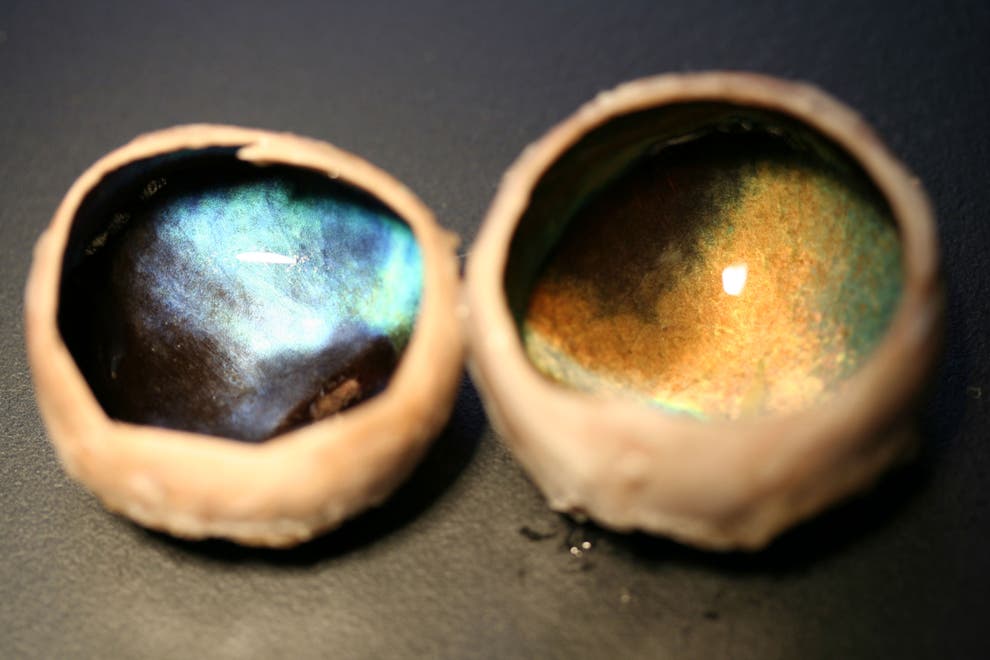
If you looked deeper into a reindeer’s eyes, you would find even more amazing adaptions. In 2013 scientists discovered that reindeer eyes actually change colour with the seasons! A layer of tissue in the retina changes from a golden colour in summer to a deep blue in winter. This change means that less light is reflected back out of the eye, helping reindeer keep their vision sharp even in the long dark winter months. This is the first time this kind of colour change in a mammalian eye has been found. It is thought the colour change might be caused by increased pressure in the eye in winter. The pupil is permanently dilated in the dark, and this reduces the space in the collagen structure of the retina, which in turn changes the reflectiveness of the retina and shortens the wavelengths of light being reflected.

Two dissected reindeer eyes, the left taken from a reindeer that died in winter, the right from one that died in summer. Photo by Glen Jeffrey (The Independent).

Reindeer vision is made even more interesting by the fact that they can see into the UV range. There are high levels of UV light present in the polar regions of the world due to the reflections from snow and ice. Many lichens – the favoured winter food of reindeer – are very effective at absorbing UV. Wolf fur as well is also shown to absorb UV, so being able to see UV wavelengths helps reindeer pick out both their food and their predators in the snow (see here for a previous blog on UV vision).

Reindeer seem to view the world quite differently to us, and it’s clear their eyes have had to adapt to many challenges. They’ve had to adapt to pick out predators and hard to find food, to cope with extreme seasonal changes in light, and to deal with the large amount of UV present in the arctic. Their eyes are just another example of how well adapted reindeer are for their environments.

Kate

Sources:

Why do animal eyes have pupils of different shapes? | Science Advances (sciencemag.org)

Arctic reindeer extend their visual range into the ultraviolet | Journal of Experimental Biology | The Company of Biologists

Shifting mirrors: adaptive changes in retinal reflections to winter darkness in Arctic reindeer | Proceedings of the Royal Society B: Biological Sciences (royalsocietypublishing.org)

Thank you all!

Following the TV programme on Channel 4, ‘A Baby Reindeer’s First Christmas‘, we have been overwhelmed with lovely letters of support, incredibly generous donations and new ‘adopters’. It really has been a fantastic lifeline for us here at the Cairngorm Reindeer Centre and I can honestly say our lovely reindeer have touched the hearts of many, both at home and abroad.

TV stars Dr Seuss and Holy Moley at the Strathspey Railway event. Photo: Justin Purefoy/Maramedia

The lovely letters we have received have been incredibly varied and while protecting people anonymity I thought it would be nice to share some of the contents of these letters.

A young lass from the Midlands sent a wonderful letter, written and illustrated by herself. Her attention to detail was amazing and I can’t resist sharing her lovely drawings with you.

If any of you budding young reindeer enthusiasts would like to also send in anything we would love to receive it. Getting letters through the post is always special and here at The Cairngorm Reindeer Centre we would love to receive any works of art or prose! Our postal address and email address can be found on the Contact Us page of our website.

Quite a number of letters and cards came from people reminiscing about days gone by, maybe an occasion when they met the original owners of the herd, Mikel Utsi and Dr Lindgren. Although we have a considerable archive here at Reindeer House of the history of the herd, many of the stories recalled were new to me and so all the more interesting.

I smiled at the recollection of one couple who attended a talk given by Dr Lindgren and described her as ‘large’ (not fat) and very straight backed and a loud voice. Well I certainly chuckled at this description! Dr Lindgren indeed a very tall lady and the above description hits the nail on the head. I knew Dr Lindgren well in her latter years and I was terrified of her! She was so worldly, intelligent and dominant, but she was also kind and considerate when necessary. I would love to hear from anyone who knew her personally and has a story to tell – she was quite a character and had many different interests and skills, other than reindeer.

And then there was a lady who met Mr Utsi, in North Sweden, before the first reindeer came to Scotland in 1952. This was a lovely encounter, which was described in detail to us. Back in 1951, the lady who wrote to us went on a skiing expedition with her school to Swedish Lapland.  Many of them had never skied before, but quickly got to grips with the sport and by all accounts had lifetime memories from their time there. While there they were taken to see a herd of reindeer and the owner Mikel Utsi told them that he was introducing his reindeer to Scotland! What a wonderful memory and I am so glad this lady was able to see the TV programme on Christmas Eve and see just how it is all those years later!

There was a strong common theme through the many letters we received with comments as follows:

best viewing ever over the Festive season

Thank you for adding ‘animal magic’ to a home alone Christmas

A Baby Reindeer’s First Christmas was absolutely brilliant and a stroke of genius – wonderful publicity, informing such a wide audience of all the great work you are doing for the community

The programme brought back lovely memories of when we used to visit you in your early days

So thank you from the bottom of my heart to everyone you has been in touch to reminisce, donate and adopt reindeer. It has been a huge help to us and most importantly ‘put a smile on our faces’.

Tilly feeding young bull Sherlock. Photo: Justin Purefoy/Maramedia

Tilly

The Real Rudolph

The Real Rudolph: A Natural History of the Reindeer was the second book I wrote and this time was commissioned by Sutton Publishing. The publisher had already come up with the title and they were looking for a book of ‘hard facts’.  Packed full of juicy info about reindeer and caribou (which are actually the same species, but coming from different parts of the world), I combined a lot of research with personal experiences and I was lucky to know a number of good photographers who kindly provided amazing photos which are littered through the book.

In Mongolia – Photo by Alex Smith

The photo on the front cover is from a picture I took of a reindeer bull in Outer Mongolia and I dedicated a chapter to my trip there in 2005 and also various excursions to Swedish Lapland, which ultimately led to us bringing new breeding stock back from there.

The first half of the book is all about their world distribution as a species, seasonal nature, arctic adaptations, how they fit into the ‘Deer Family’ and their domestication.  I did have one gentleman get in touch to say it was the most interesting and entertaining textbook of reindeer he had ever read!

But I was always conscious that readers would also be interested in the Cairngorm Reindeer Herd, particularly since I would be selling it here at the Reindeer Centre and so the second half of the book was not just about my personal experiences of far flung ‘reindeer places’ but also some stories closer to home.

Rather closer to home… at home in fact! Here I am a couple of years ago on the hill ground of my farm with yearling bulls Burns and Dr Seuss. Photo: John Paul

Published for the Christmas market in 2006 it is now sadly out of print, but it can be acquired, very cheaply, on Amazon!! It is (although I say it myself) a very informative book, is well produced with high quality paper and photos inserted into the text, rather than clumped together in sections as they were in my first book, Velvet Antlers, Velvet Noses. That book is also out of print now, but my latest book Reindeer: An Arctic Life is in print and available on our online shop (please click here to have a look), along with several other books and items. Many are suitable for stocking fillers!

Tilly

All the colours of the rainbow (Part two)

Following on from my previous blog about reindeer coloration, I thought I’d highlight some of the funky face patterns in our herd today. White face markings are super helpful at aiding us in identification of the reindeer, as they don’t change much throughout the year (or their lives). Though they can be harder to make out when the reindeer are in their late winter coats, as they are less distinct.

Addax with her calf Parmesan

Anster showing off his white nose tip!

Boris with his patchy white face and squiffy nose

Cheer has one of the whitest faces in the herd.

Christie with her white “smile”

Merida with a white hourglass, followed by her calf Dr Seuss with his striking white face.

Gloriana’s mark makes us think of the Joker!

Wee Hemp has a speckly nose and white spot on his forehead.

Jonne with his yin-yang white nose

Oatcake has random splodges all over

In winter, Ochil’s markings are less noticeable.

Spartan looks like he’s dipped his nose in white paint!

Svalbard showing off his white nose and forehead.

Texel has a white face with two darker dots.

Andi

When good photos go wrong…

Other than the few reindeer still out free-ranging who I haven’t seen lately, I’ve otherwise managed to get nice ‘adopt’ photos of everyone in the herd in the last few weeks. These photos are to go on the certificates that go out to all the lovely people who support us by adopting a reindeer, and as autumn is when reindeer look at their best, it is therefore when I take all the photos.

I realise (after sitting down to write this) that I’ve actually written a blog about photos before (to be fair, that was 5 years ago and I have a rubbish memory at times…) but hey, what’s wrong with repetition?! But actually I thought I’d just show you some of the ‘outtake’ photos, ‘cos everyone likes to see photos of reindeer looking daft, don’t they?

Most photos that don’t make the grade are just because of open mouths or closed eyes:

Beastie

Camembert


A classic of Merida from a couple of years ago!

But after my trip over to our farm last month to photograph the reindeer there, I realised that I’d mainly just taken photos of Olympic looking ridiculous!

Possibly my favourite…

Then there’s just the odd ones:

Morven looking like she’s just remembered something she’d rather forget…

Looking attractive, Athens!

Background? Check. Good light? Check. Camera in focus? Check. Dr Seuss looking handsome and majestic? Che… oh. No.

Reindeer often need encouragement to look alert for their photo, with ears pricked. This results in my photography assistant (Andi) doing a lot of dancing in the background while making a lot of noise, or sprinting back and forth shaking a feed bag…

…resulting in photos like this, where there’s been crossed wires about which reindeer I’m actually trying to photograph at the time…

And sometimes we resort to throwing things at the reindeer (well, nearby anyway) to get their attention!

Horse many years ago, steadfastly ignoring us.

Most of the time it seems, this is what the reindeer think of me and my camera!

Russia many years ago

Hen

Experiencing the Four Seasons (Part Two)

Emm volunteers with us several times a year usually, and has been doing so for years now. Here’s her story of working in the summer and autumn seasons! Her recent blog about the winter and spring can be found here.
Summer

In summer I have been up in both July and August. The visitors are meeting the male reindeer in the hill enclosure. The female reindeer and the calves are free ranging on the Cairngorm Mountains.

The reindeer’s antlers have done the majority of their growth and the velvet is getting ready to strip away at the end of August. The reindeer are looking smart in their dark summer coats.

Dr Seuss and Pratchett in the hill enclosure

The weather can be hot in the summer. The flies bother the reindeer by flying noisily around them, sometimes the reindeer rush around to try to get away from the flies which tend to sit on their antlers as they can sense the blood supply in their growing antlers. We spray the reindeer’s antlers with citronella spray to protect them from the flies. Midges are also a problem in the summer for both reindeer and humans.

Monopoly in his summer coat

In one part of the enclosure, the reindeer have access to a shed for shade. One time when we got up there with the visitors, the reindeer were nowhere in sight. All 41 of them had gone into the small shed. The shed doesn’t look like it can fit 41 reindeer in but it is does, it is like a Doctor Who’s Tardis. One Hill Trip, I was herding them out of the shed, I realised that I hadn’t seen Blue – I found him in a small part of the shed asleep. Blue, who was deaf, didn’t hear his reindeer friends move on. The reason Blue was deaf is because he was leucistic (pure white with blue eyes). Leucism is a condition in which there is partial loss of pigmentation.  Leucistic reindeer are camouflaged in the snow.

Selfie with Glenshee, back in 2016

There are three Hill Trips a day (during the week) in the hill enclosure and last year we did ‘Summer Fun’ in the Paddocks which involved feeling the weight of antlers, feeling the weight of a feed sack, Paddock reindeer talks and much more fun (N.B. This will return in 2021!). Reindeer House is busier as the seasonal summer staff are working as there is a lot going on with three Hill Trips a day and Summer Fun in the Paddocks.

One of the jobs in the summer is to water the garden as it is hot.

Last July, Olympic would stand by the gate like he was guarding it and wouldn’t let visitors out of hill enclosure. I kept having to go over to him and move him on.

Olympic

Autumn

In the Autumn, I normally come in October half term. The scenery is changing with leaves changing colour and leaves falling off the trees.

The reindeer’s winter coat is growing and most of the velvet has stripped off revealing the hard bone antler underneath.

It is the rutting and breeding season. Normally in different areas of the hill enclosure there is a bull with his girls. My two favourite breeding bulls are Houdini and Kota as they have massive magnificent antlers. When we feed the breeding bulls with their girls we have to be careful as they can be protective over their girls. We don’t take the visitors in with the bulls and their girls.

Breeding bull Kota

We do one Hill Trip a day in the hill enclosure. Normally in the afternoons we do sleigh training with the ‘Christmas reindeer’. We put the harnesses on them and harness them up to the sleigh. The reindeer pull the sleigh around Glenmore (where the Reindeer Centre is based). They even go on the road. It is so funny to see people’s faces when they drive past reindeer pulling a sleigh.

Sleigh training

We also get to handle the calves to get them used to people. We sometimes take them on a walk around Glenmore in the morning.

Calves Athens and Helsinki in October 2019

I am busy learning the calves names and if I hadn’t been up in May, I am learning which calf belongs to who and meeting all of them. The calves are also getting their new ear tags.

One year, I was lucky enough to help out at a early Christmas parade at the very start of November which was very special. It was at The Cairngorm Mountain. We wore red Christmas jumpers and woolly hats with reindeer on them. The reindeer team were Mo, Spike, Sooty, Aonach and calves Morse and Poirot. Mo and Spike pulled the sleigh with Santa in it. It was so wet and so windy. The wind was 60 miles per hour. Santa was holding his hat on in the sleigh. Not many people turned up. We had to tie things on to the pen railings otherwise they would have flown away.

Holding Mo and Spike after the parade

One of the other jobs in the autumn is to sweep up the leaves. At 4 o’clock it is starting to get dark. So we put the Paddock light on in the Paddocks so the visitors can still see the reindeer. When we put the reindeer to ‘bed’ in the woods and give them their tea, I normally put my head torch on.

My 2 Favourite Seasons

I have two favourite seasons which are autumn and spring.

Sleigh training with Slioch and North

In the autumn, I love doing the Christmas sleigh training, helping the calves get used to being handled, learning the calves names and seeing the reindeer with their newly formed antlers.

With the cows and calves

In the spring, I love seeing the newly born calves, seeing the reindeer being mums and hearing the grunts between mum and calf.

Emm
 

Book Now