Memorable Reindeer of the Past: Bumble

It’s been a while since I’ve written about a “Memorable Reindeer” and I thought we were overdue a bit of reminiscing. And who better to talk about than Bumble? 
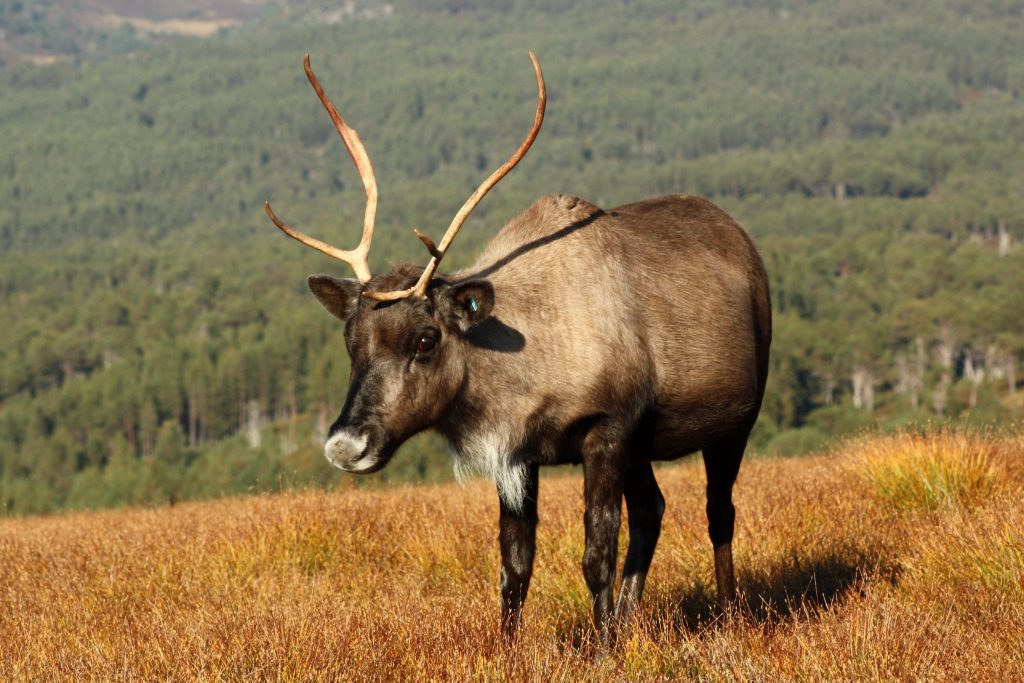
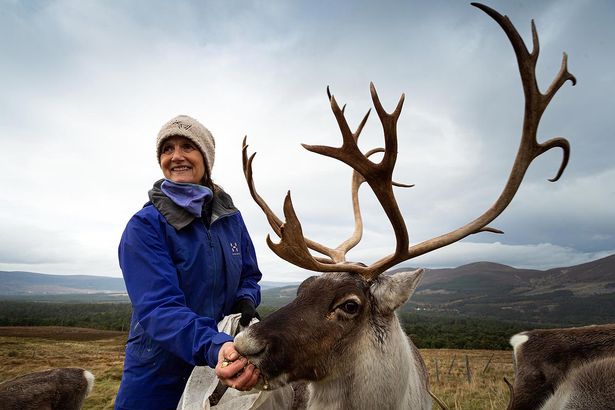
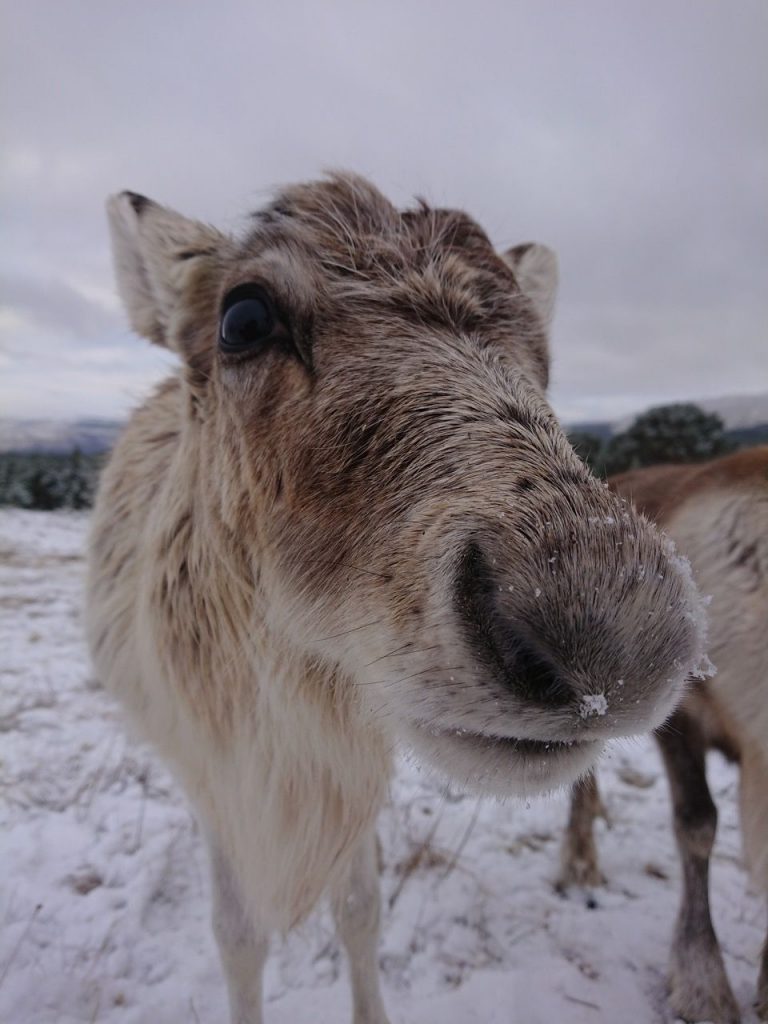
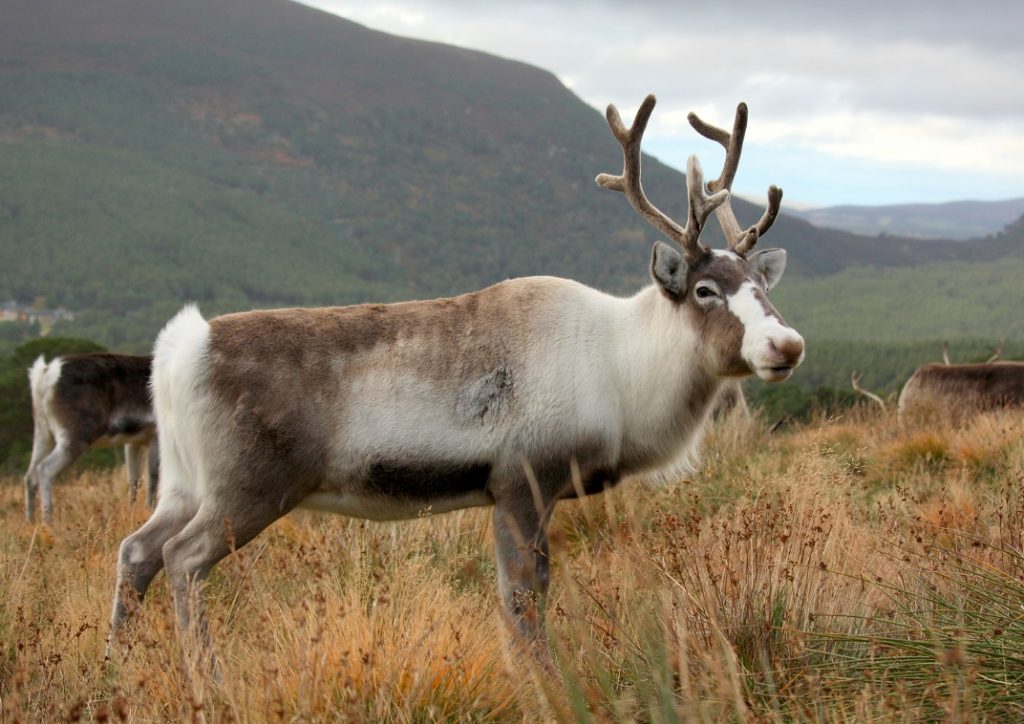
Bumble in her prime, 2015

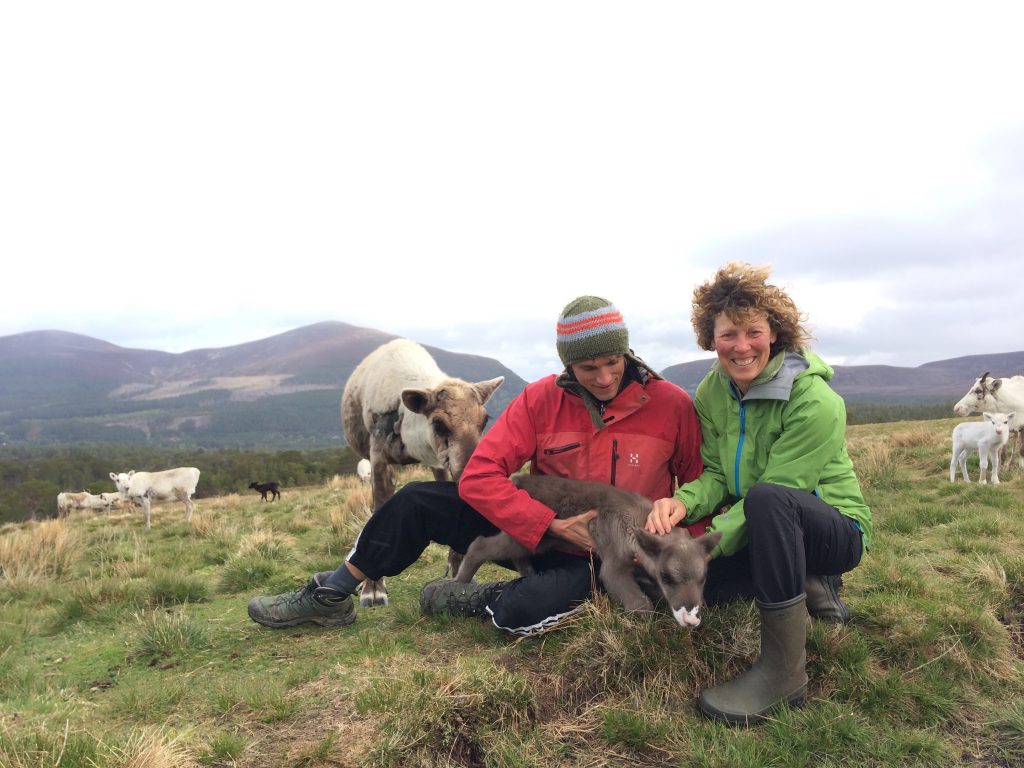
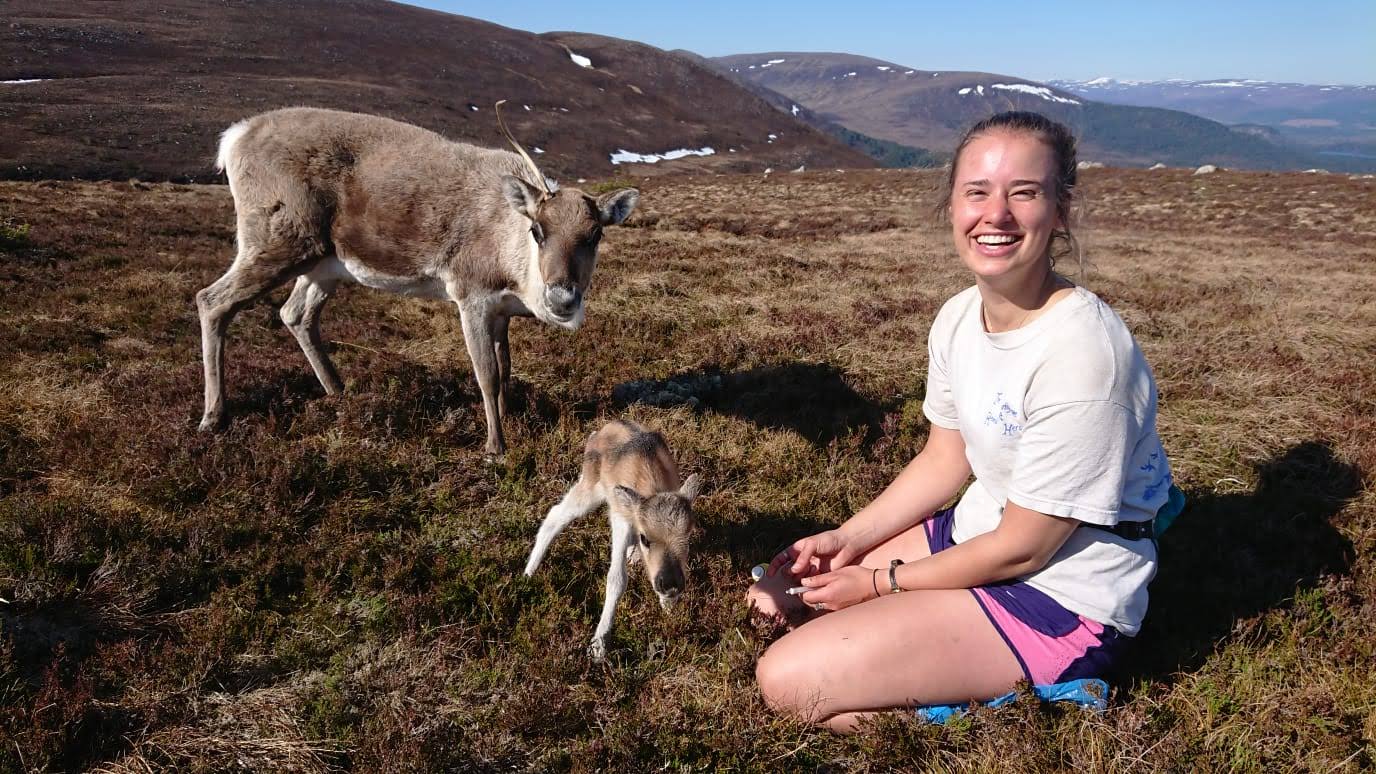
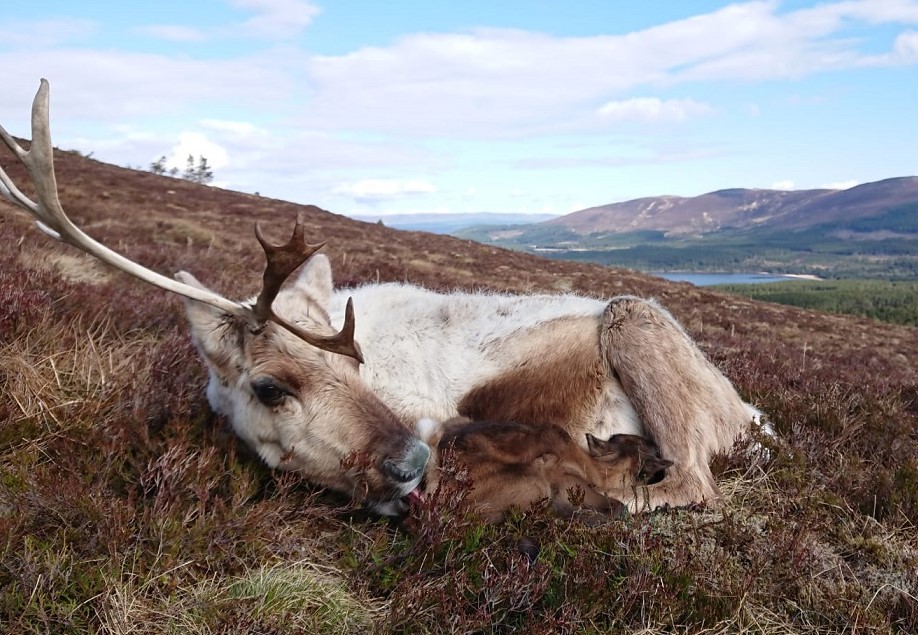
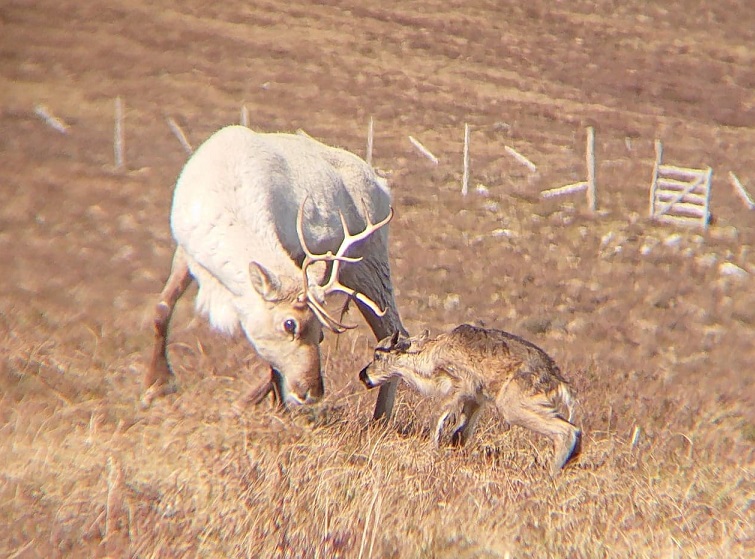
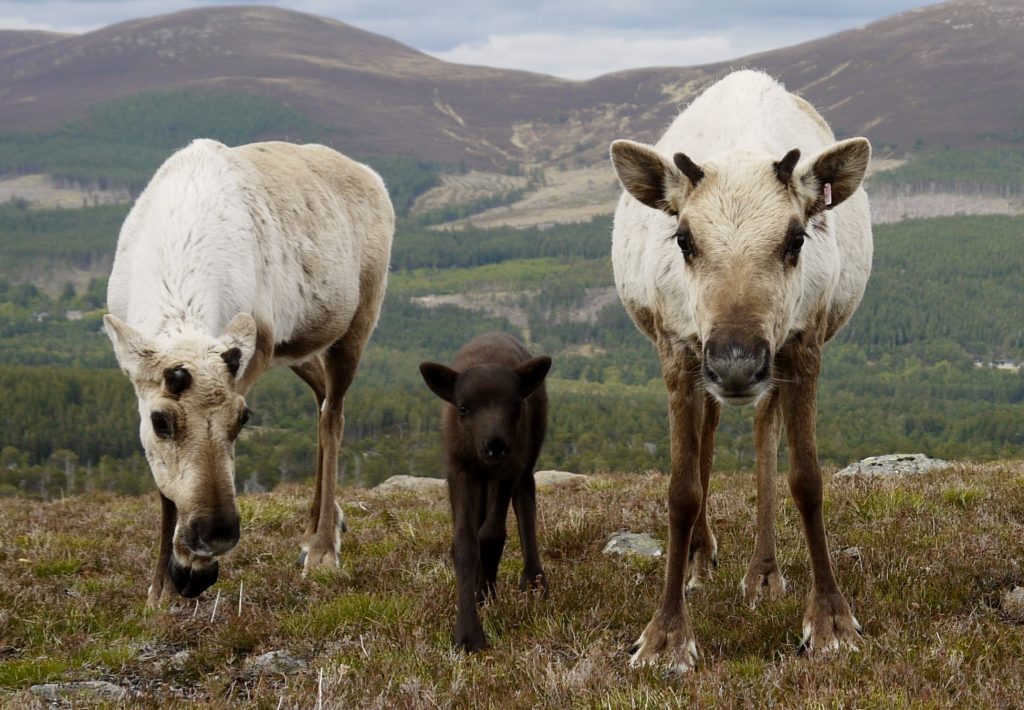
Bumble was born in May 2010, to mum Tjakko. Jack had just started volunteering with the herd, and managed to film the whole birth. By the time the other herders arrived, they found the new mum and calf, along with Jack, all curled up asleep in the heather. It set the scene for how tame Bumble would be for the rest of her life, completely at home in the company of people. Indeed, most of her family are similarly friendly and greedy – including older sisters Dixie and Ibex.
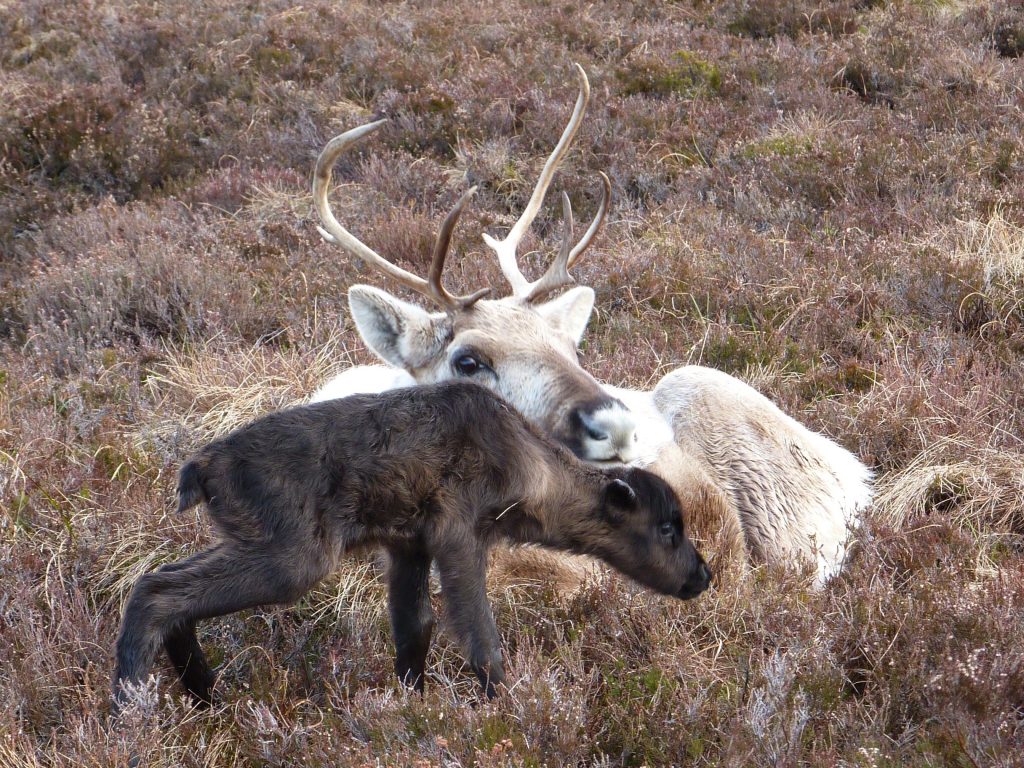
Newborn Bumble with mum Tjakko

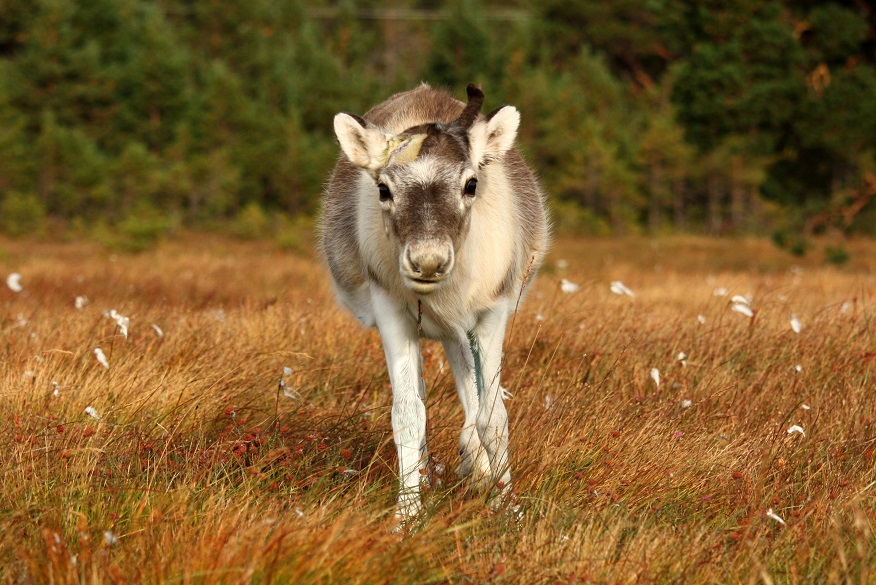
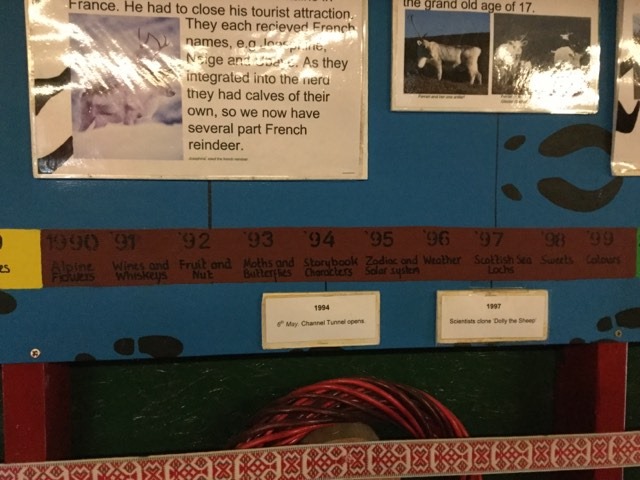
That autumn, as the cows and calves began returning from the high tops of the mountain free-range, one unknown little calf came in without her mum. Alone though she was, she didn’t seem scared of us, and was straight into the food. A process of elimination quickly identified her as Tjakko’s calf, orphaned over the summer. We named her Bumble – fitting in the “Bugs and Beasties” theme – and following on from Tjakko’s 2009 calf Crumble. With her silvery legs and confident character, she quickly won us round and stole my heart.
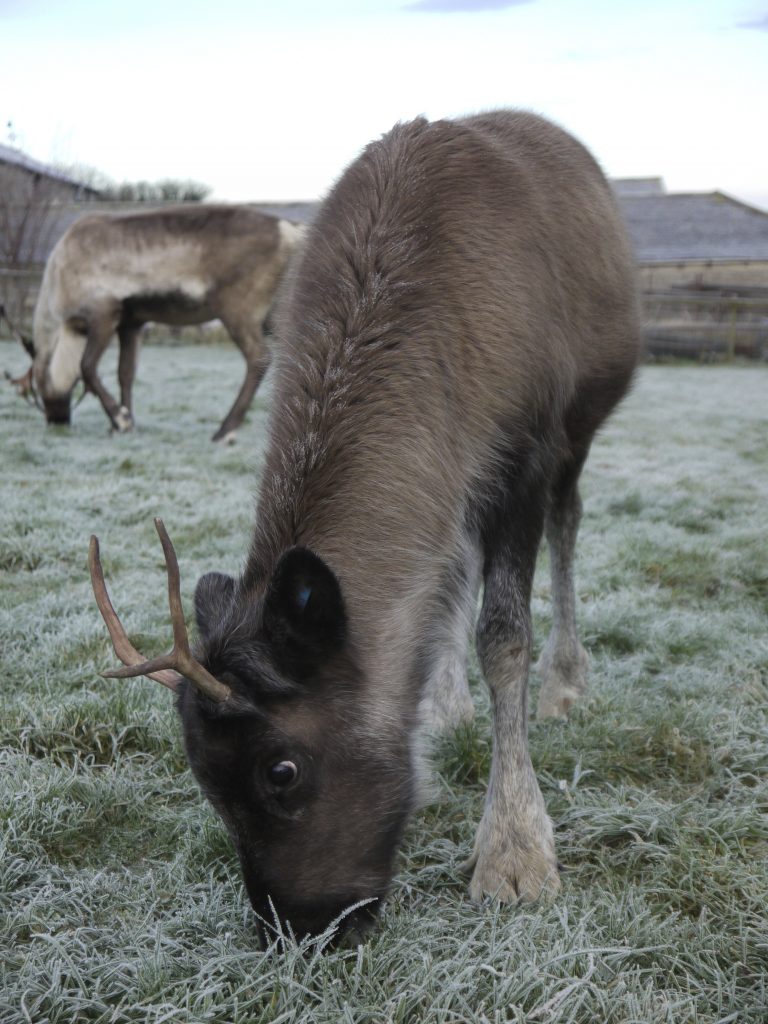
Bumble as a calf, November 2010

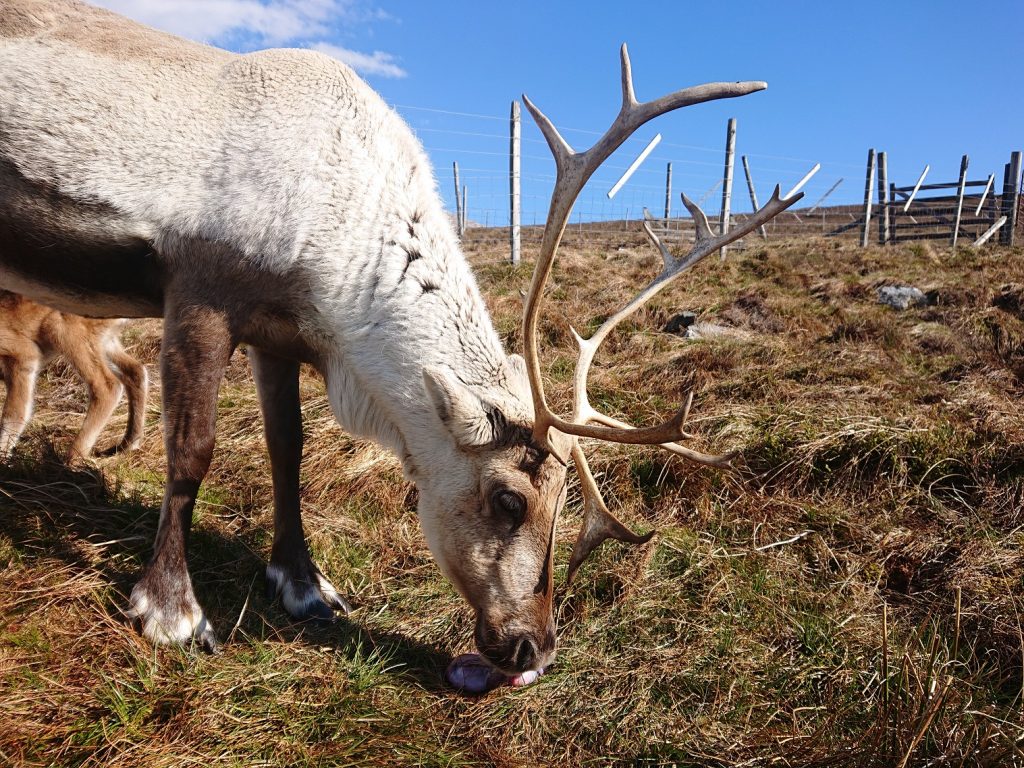
Bumble was a marmite reindeer – her confidence and persistence in trying to break into every bag of food either frustrated or amused herders. I found her hilarious. She never grew a “good” set of antlers – they were always simple with basic points pointing in every direction like radio antennae. It just added to her air of goofiness. In general, reindeer aren’t keen on being touched, but Bumble had no sense of personal space and was quite happy being scratched and petted. She even had a starring roll in a commercial we did for Tuffphone, pawing at a food bag and standing squarely on the phone to prove how sturdy it was as if on cue.
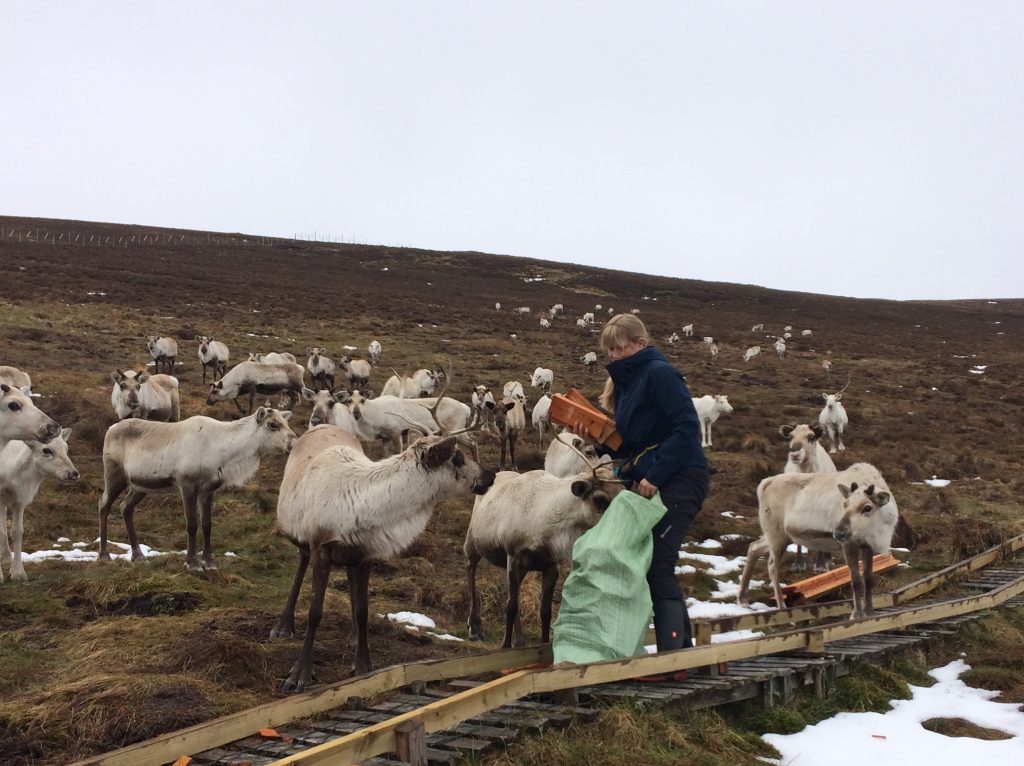
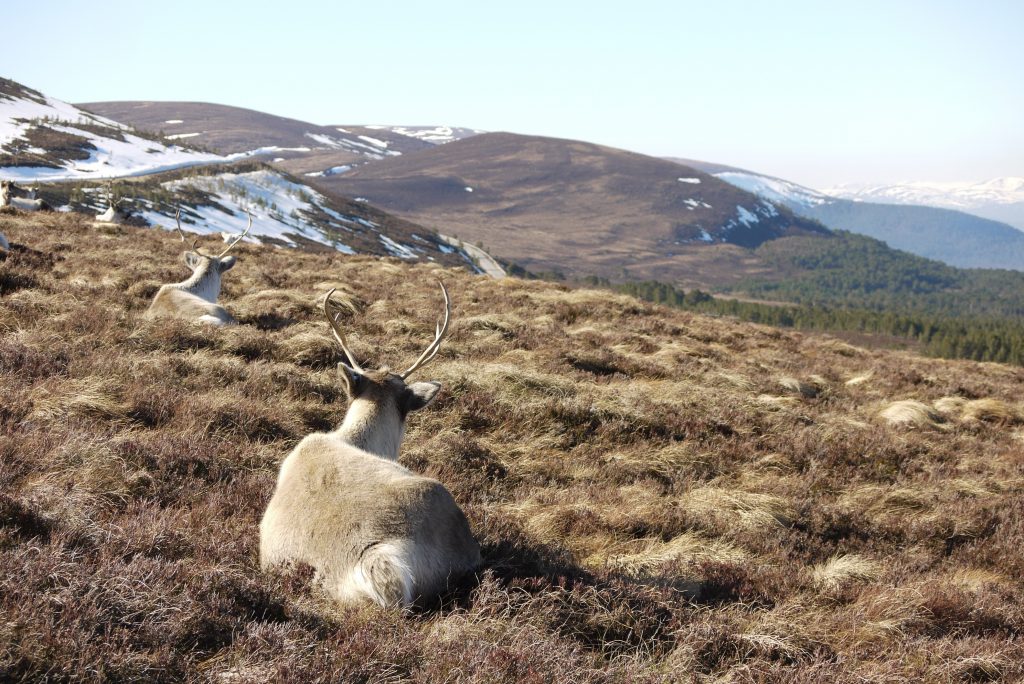
If there’s a bag, it has to be checked for food…
Bumble had a reputation for her ample “booty”, earning her the nickname of Beyonce.


Typical sighting of Bumble, moving at full pelt towards the feed bag

Like her mum, Bumble had a real stubborn streak, and leading her on a headcollar could be… interesting. Indeed I remember several times being told, “She’s your favourite, you have to lead her”. Thankfully as she got older she became better behaved, but it was definitely unwise to starting a tugging war with her, as she would just dig in her heels!
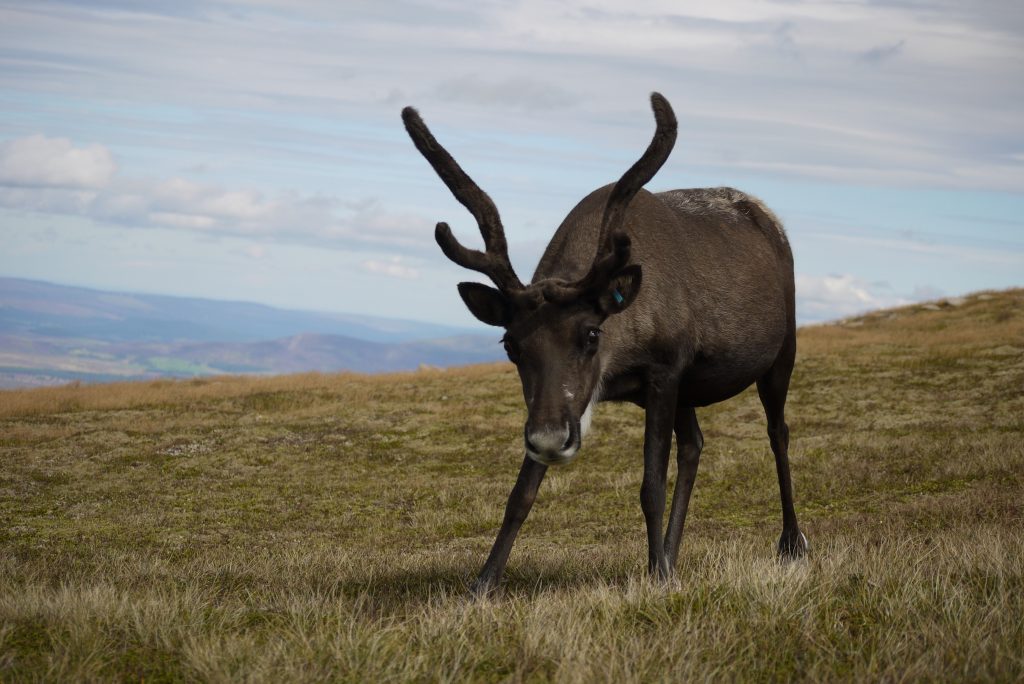
On the freerange in her summer coat

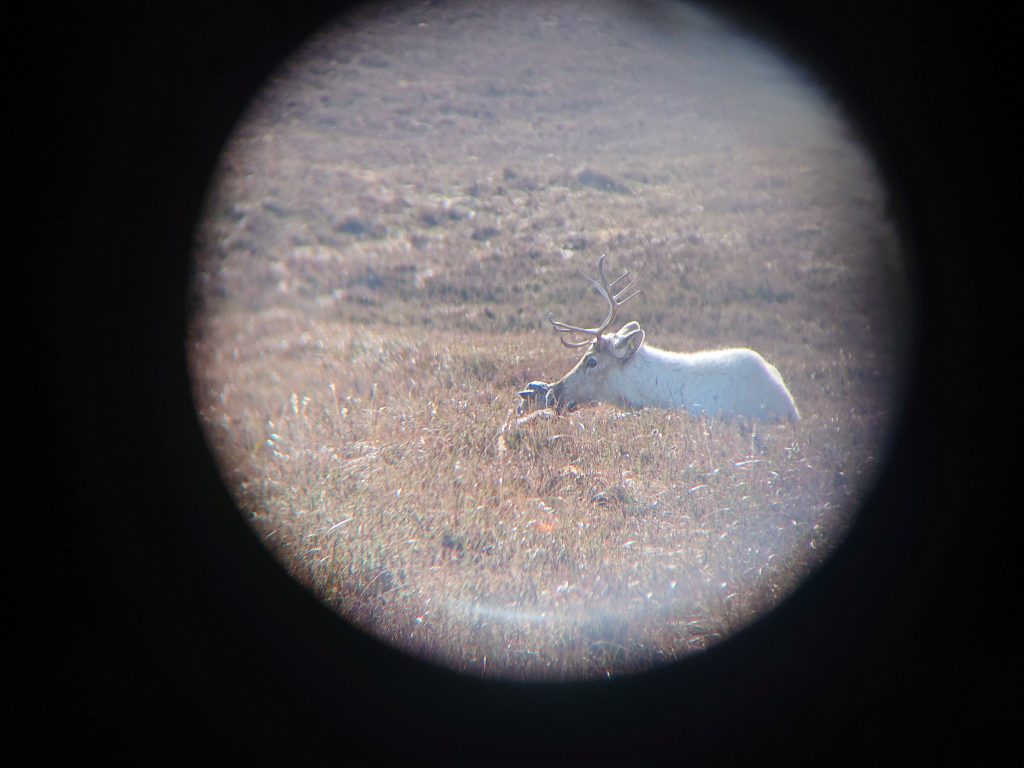
Bumble had several calves in her life, the first being Biscay, in 2014. While most cows head away from the herd to calve in private, Bumble didn’t think it was worth risking missing a feed, and tended to give birth within sight of the enclosure gate. Her carefree attitude about human company meant she was utterly unphased by us being nearby during and immediately after the birth, and I was lucky enough to watch her give birth to her second calf, using binoculars from a discreet distance. 
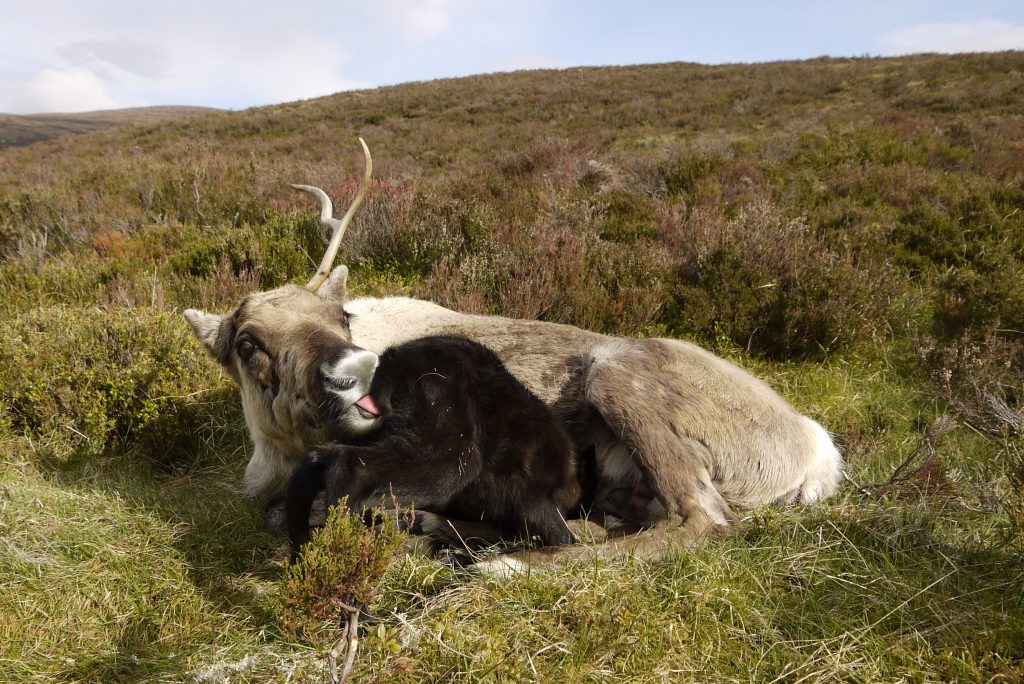
Bumble completely unphased by motherhood – with her newborn calf Biscay.
Sally teaching Ben how to check over a new calf, with Bumble lending young Spartan for practice – she’s keeping a close watch to check everything is done correctly.

It’s always fun catching up with the females on the free-range in summer, and one year I found a group including Bumble, who was at the “extreme moulting” stage of the year, and whilst she occupied herself with the bag of food I’d brought, I proceeded to groom off virtually all of the loose fur, leaving her rather lighter and cooler for the hot summer days! If any walkers came across the pile of discarded fur, goodness knows what they’d have thought!
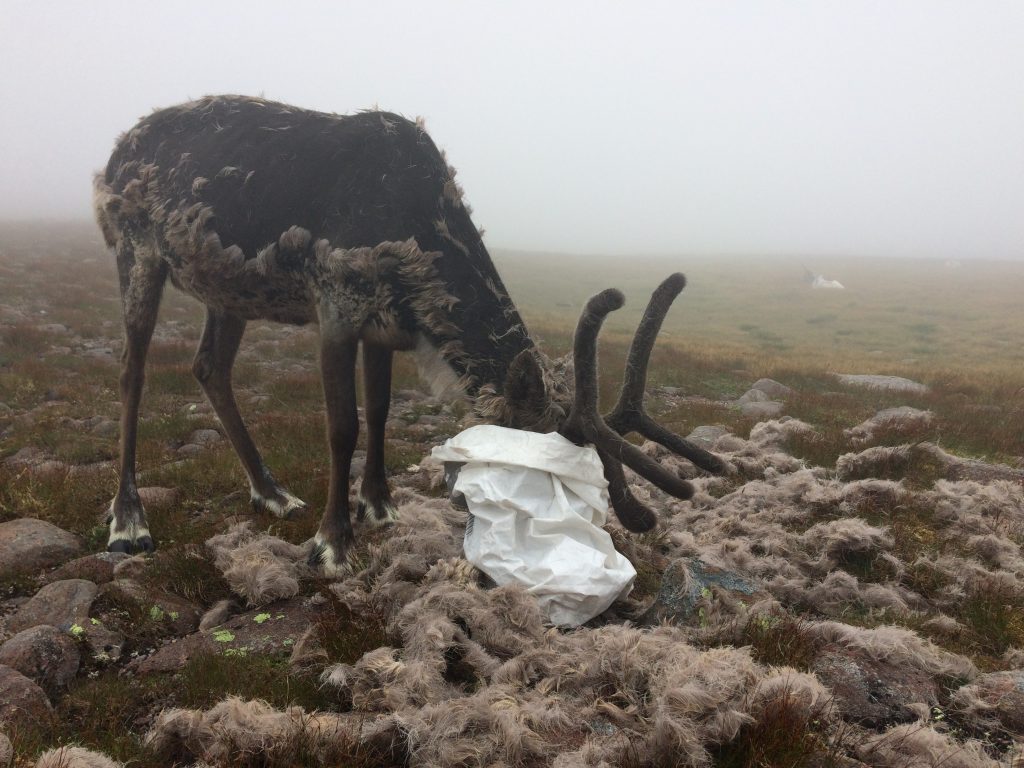
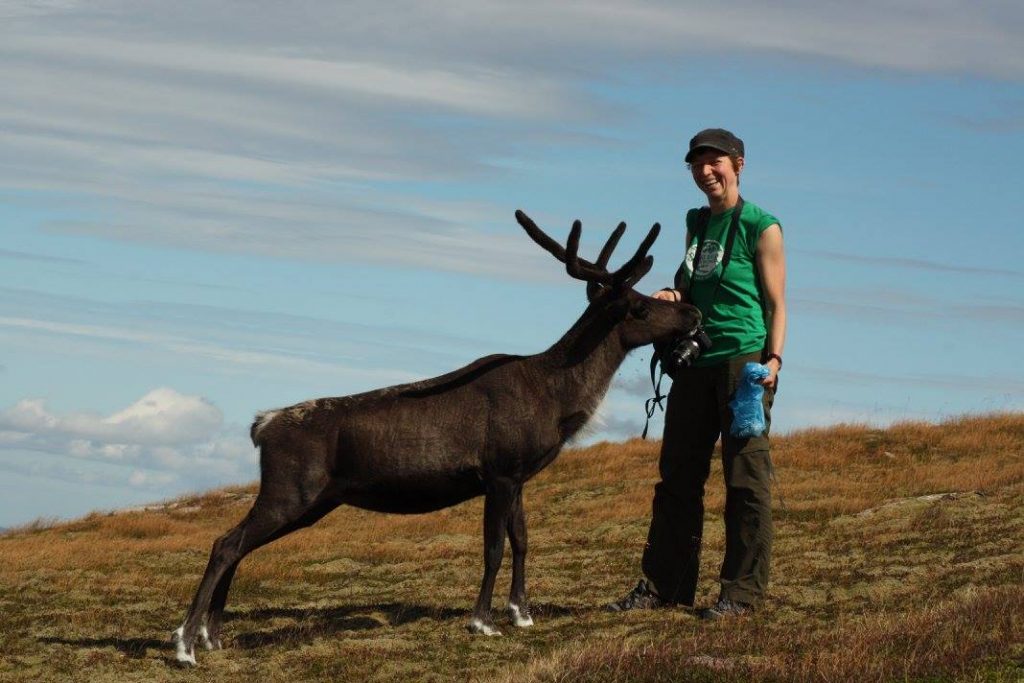
Bumble on the summer free range occupying herself with some food whilst I groomed off her excess old winter coat.
I was always delighted to catch up with Bumble.

Bumble was last seen on the free-range in late 2018, in great condition and her usual cheeky self. The next time that group was seen she wasn’t with them, and whilst I held out hope that she was just off doing her thing and would turn up, it wasn’t to be and, despite searching, she was never seen by us again. It was one of those frustrating occasions where we will never know exactly what happened – she was a big strong lass in the prime of her life and not a reindeer we would expect to lose – but there are risks on the mountains, and it is the payoff for the wonderful natural life our herd lead that occasionally one is unlucky. 
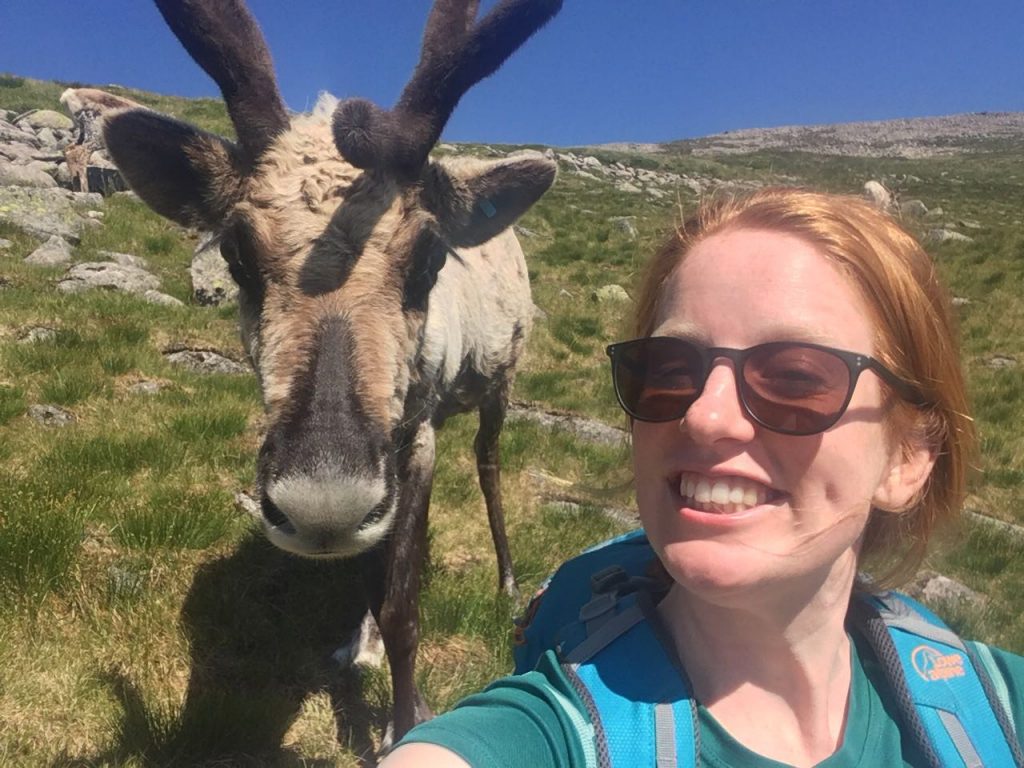
One of the last photos of Bumble, out on the summer free-range – sent to me by Ruth as a “Look who weve found”
Weathering the storm – Bumble in a blizzard.

For me, Bumble was one in a million and there is a little less joy in the herd without her – when I decided to get a new tattoo it was her crazy antlers that I chose to have tattooed on my side. But her line continues through her son Spartan, who ran as a breeding bull in 2019 and fathered a lovely batch of calves. Among them are several unexpectedly tame calves (from shyer mums) who I see a little bit of Bumble in. Life in the herd goes on.
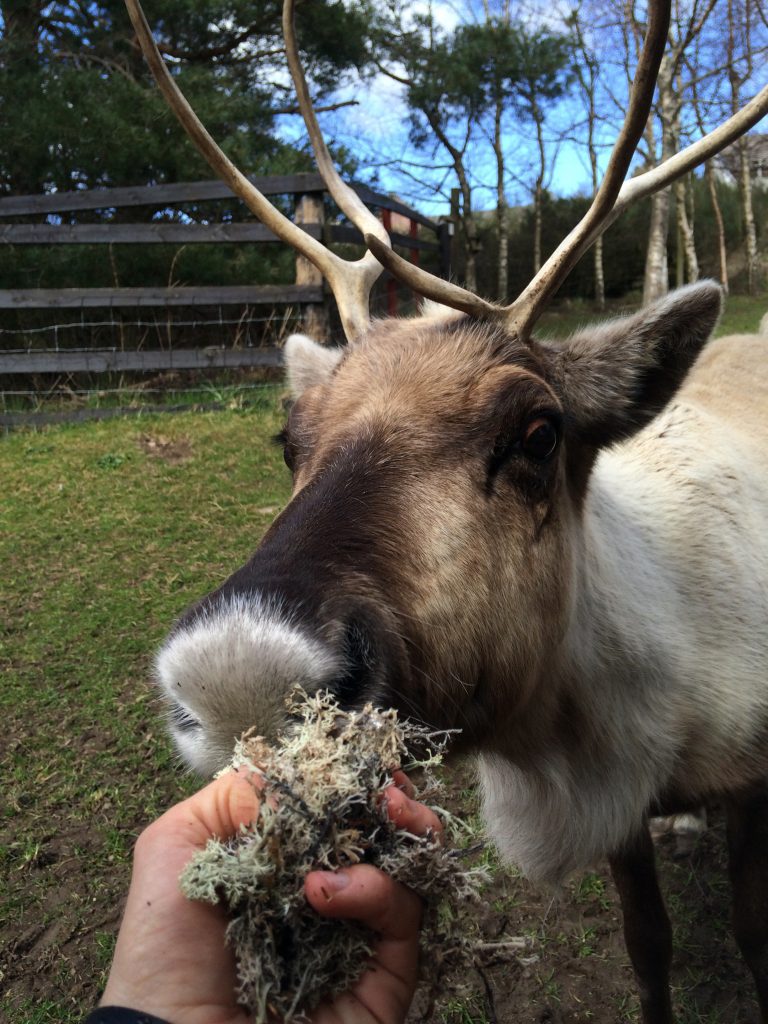
Greedy but gorgeous.

Andi
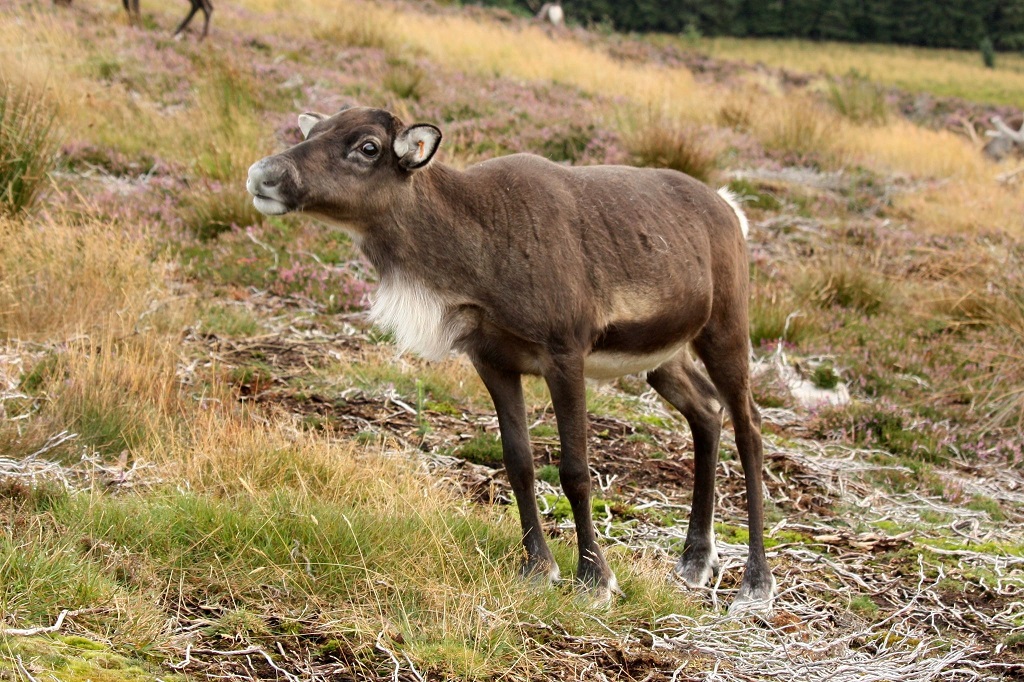
Meeting Snowflake – one of the first white reindeer

This week’s blog is by Sharon Hudgins, and tells of a very memorable stay in a stone house in the Cairngorms, many years ago… As ever, if you also have a memorable story that you think might make a nice blog, please email it over to us! We love to publish contributions from others if we can.

I discovered the Cairngorm Reindeer Centre in 2017, while doing research for a book I’m writing about the Scottish Highlands. I should really say “re-discovered” the Reindeer Centre, because, to my surprise, research revealed that I’d actually been there once before, nearly half a century earlier.

In 1969, as a young American university student on my first trip abroad, I traveled by train around England and Scotland with my college roommate. Early in the trip, our route took us to Aviemore in the Cairngorms, because my roommate was an avid skier. We rode the ski lift up to the ski area, but that second week of May there was no snow suitable for skiing. It was just cold and sleeting on top of the mountain, cold and raining when we got back down to the bottom.

We needed to find a bed-and-breakfast where we could stay for the night and dry out our wet clothes. But it was already 6 p.m., and we had no idea where to go. That area wasn’t as developed for tourism as it is now. We finally found a tiny grocery store and asked the lady behind the counter if she knew a B&B where we might stay. She didn’t—but she asked the people standing in line, waiting to pay for their groceries, if any of them knew someone who could take us in for the night.

A man at the back of the line said we could stay at his place. We normally wouldn’t have accepted such an offer from a strange man. But we were soaking wet and didn’t seem to have any other options. Besides, everyone in the store seemed to know him, so it seemed like a pretty safe bet.

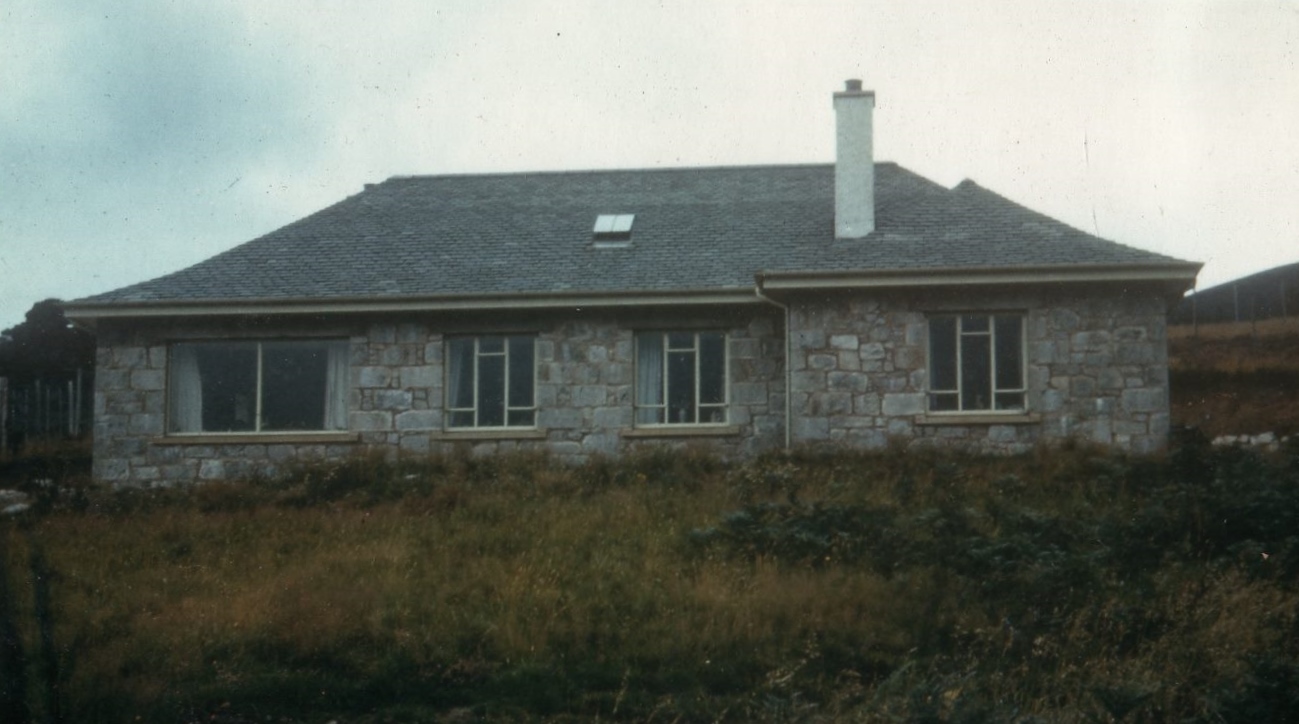
Reindeer House as it was back in the 60s

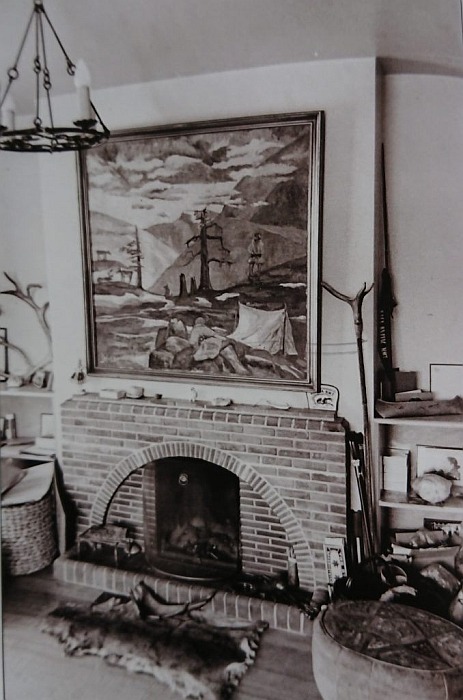
When we arrived at his grey stone house, we were surprised to find that his wife was an American. She seated us in front of the blazing fire in the sitting room, fed us a hot supper there, and chatted with us about our travels in Britain and our studies in the U.S., before fixing up two beds for us to sleep in that night.

The fireplace where we warmed up that evening

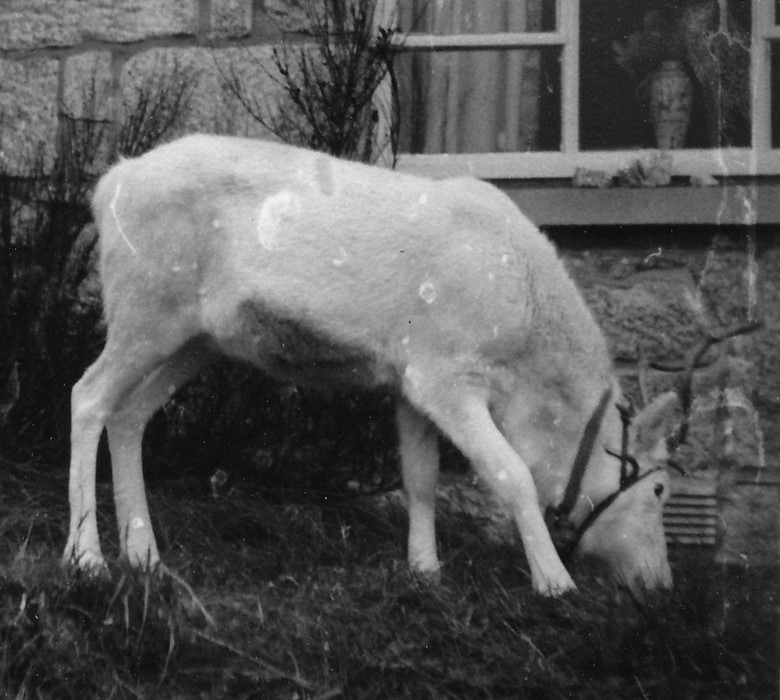
But the most memorable part of that chance encounter in the Cairngorms happened the next morning. After we’d eaten a hearty Scottish breakfast, the man took us out to the paddock behind the house to meet his reindeer—including a pure white reindeer which he said was the only white reindeer in Britain. I thought it was really cool to have reindeer in your backyard—especially a white one—and I never forgot that unusual experience.

Fast forward to 2017, when I was planning a journey around the Scottish Highlands to gather material for my book, retracing the exact route I had taken on that first trip in 1969. While researching “Aviemore” on the Internet, I came across a map showing the Cairngorm Reindeer Centre in that area. And I wondered if there was some connection with the reindeer owners I’d met there nearly 50 years before.

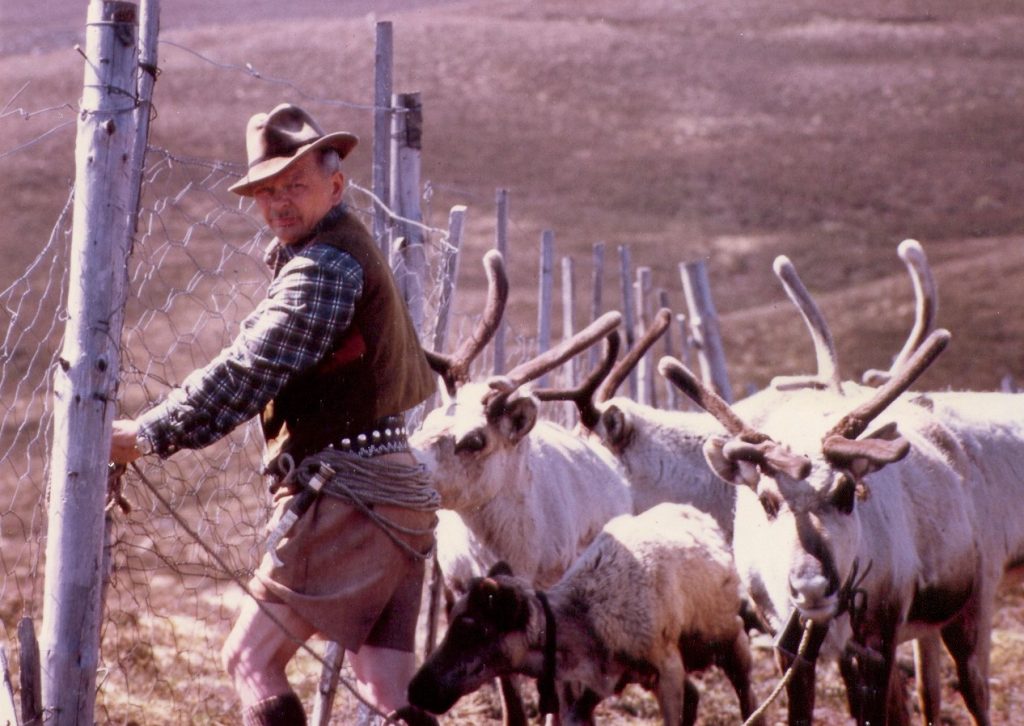
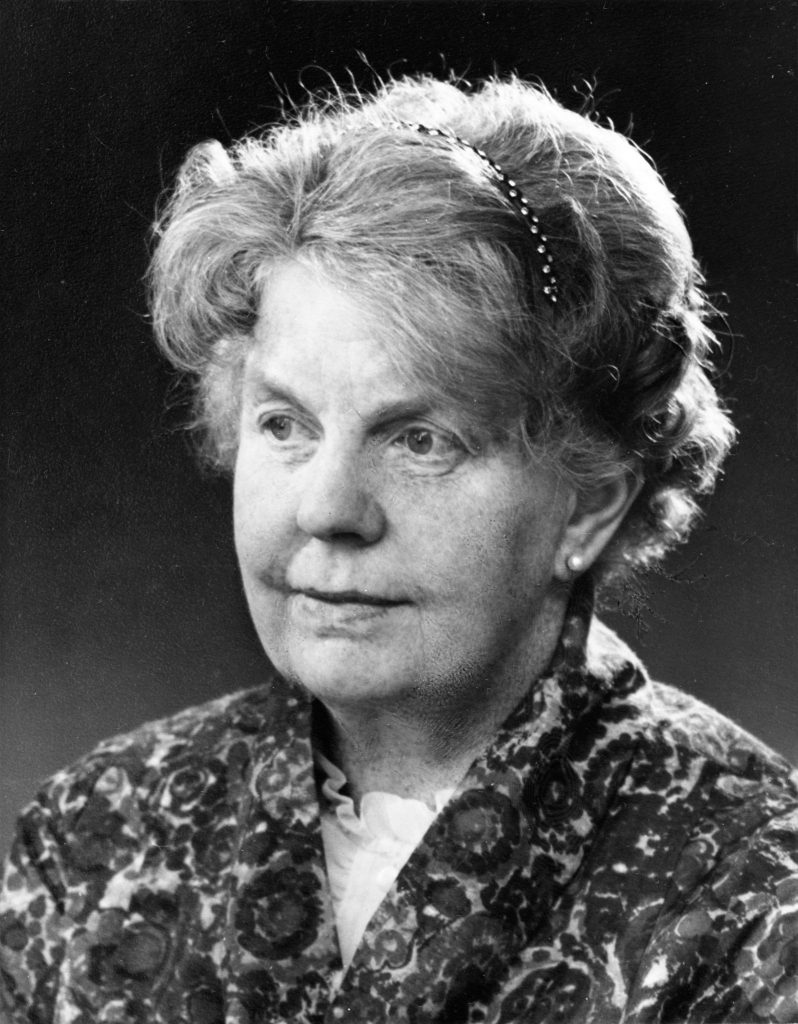
Through emails with Hen, one of the Centre’s herders, I discovered that the couple who had taken us in on that rainy night were Mikel Utsi, who had first introduced free-ranging reindeer to Scotland in 1952, and his wife Dr. Ethel Lindgren, who was also a reindeer expert.

Mikel Utsi
Dr Ethel Lindgren

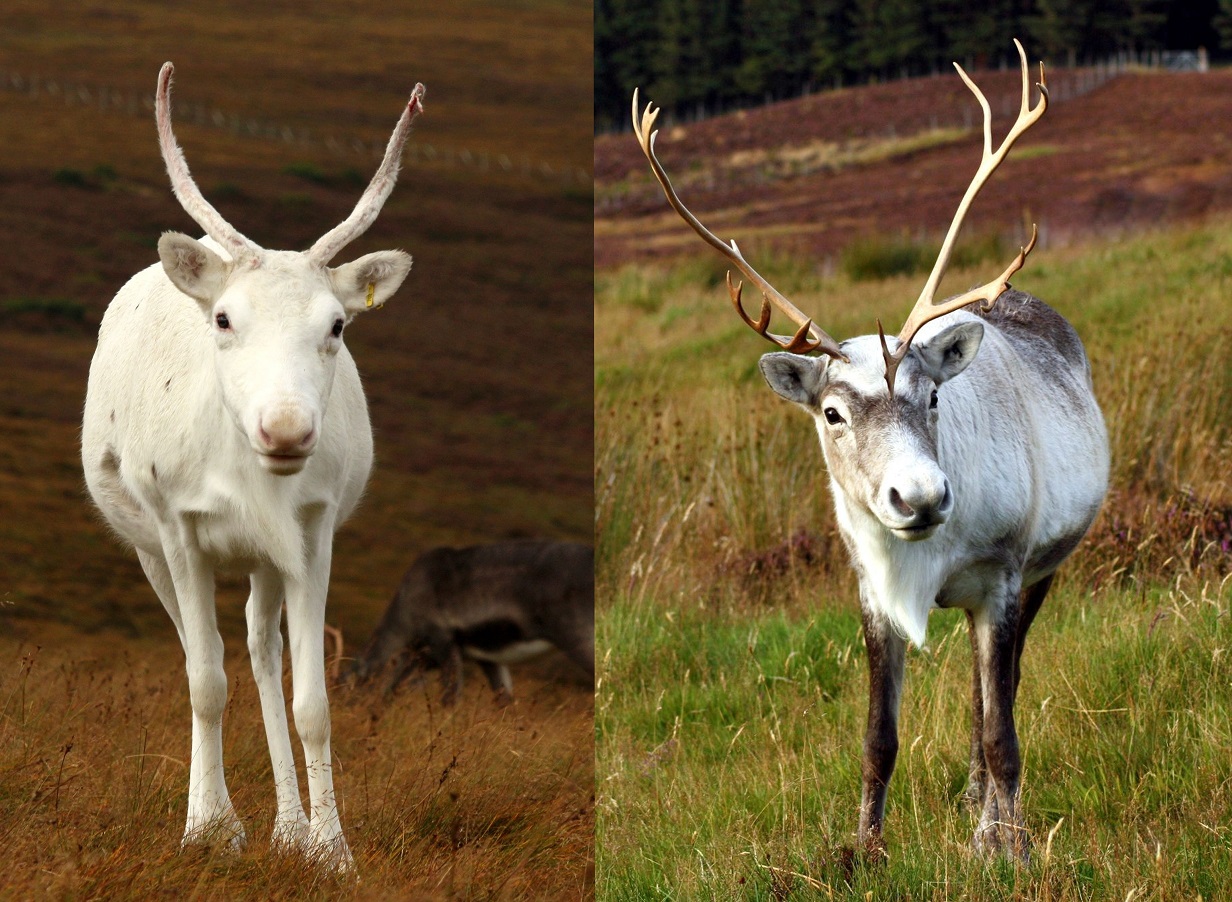
I also learned that the white reindeer I had met in 1969 was named Snowflake, the first pure white reindeer born in the herd – and her distinctive white descendants are still part of the herd today.

Snowflake was just one year old when I met her.

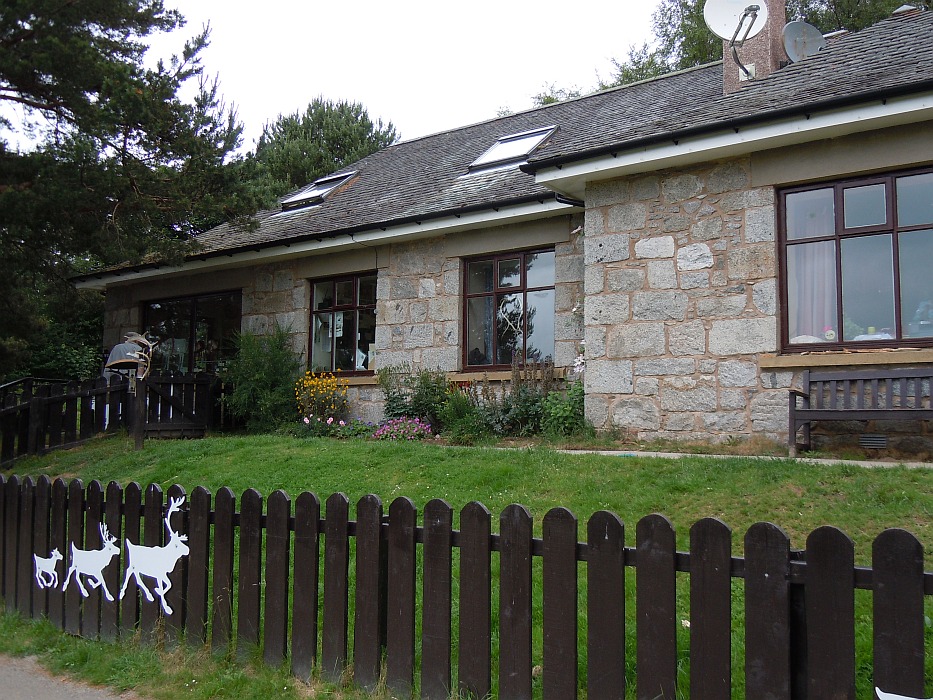
When my husband and I visited the Reindeer Centre in the summer of 2017, I was delighted to see the same stone house where I’d once stayed overnight, with its reindeer paddock still out back. Although our travel schedule precluded a hike up into the hills to see the main herd, we did get to visit some of the reindeer kept inside the fencing behind the house. And I also stocked up on reindeer books and souvenirs in the Centre’s gift shop—which was originally the room where I’d dried out in front of the Utsi-Lindgren’s fireplace.

The stone house where I stayed in 1969.
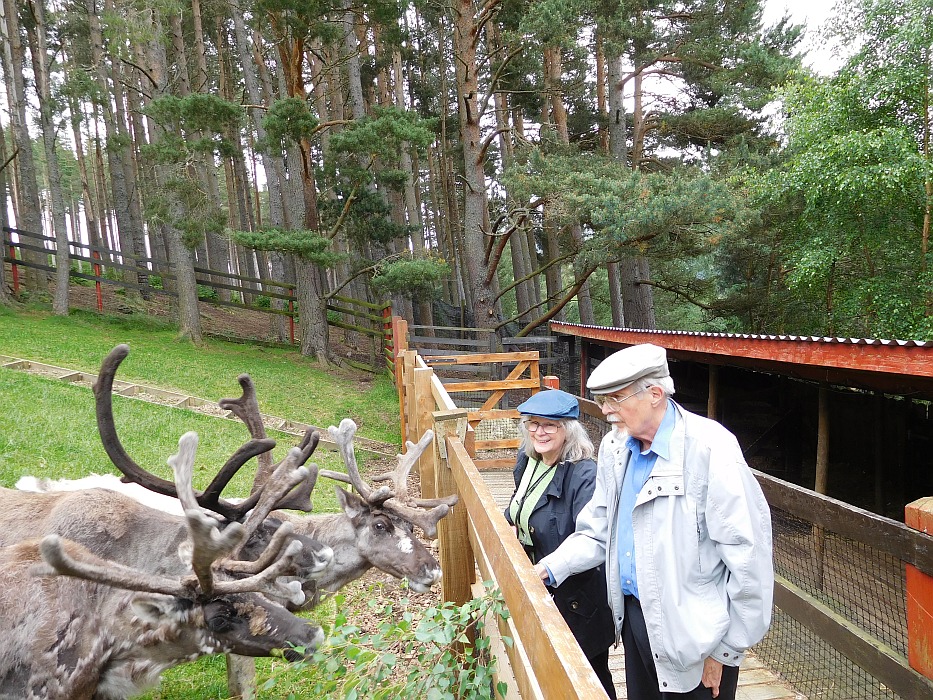
My husband and I meeting the (very scruffy moulting!) reindeer in 2017.

My husband and I are also happy to have become supporters of the Cairngorm Reindeer Centre by adopting two reindeer, LX and Mozzarella, direct descendants of that beautiful white Snowflake that I’d met so long ago, when she was only one year old. Whenever it’s safe to travel again, we look forward to visiting the herd up on the hills, meeting “our” two reindeer, and letting them know that once I’d even met their great-great-great-great-etc. grandmother, too.

My adoptees Mozzarella and LX

Sharon Hudgins is an American author who has written books about Siberia and Spain. She is now working on a memoir about the Scottish Highlands. See www.sharonhudgins.com

Long time, no reindeer

It’s been a bit snowy here in the Cairngorms this winter.

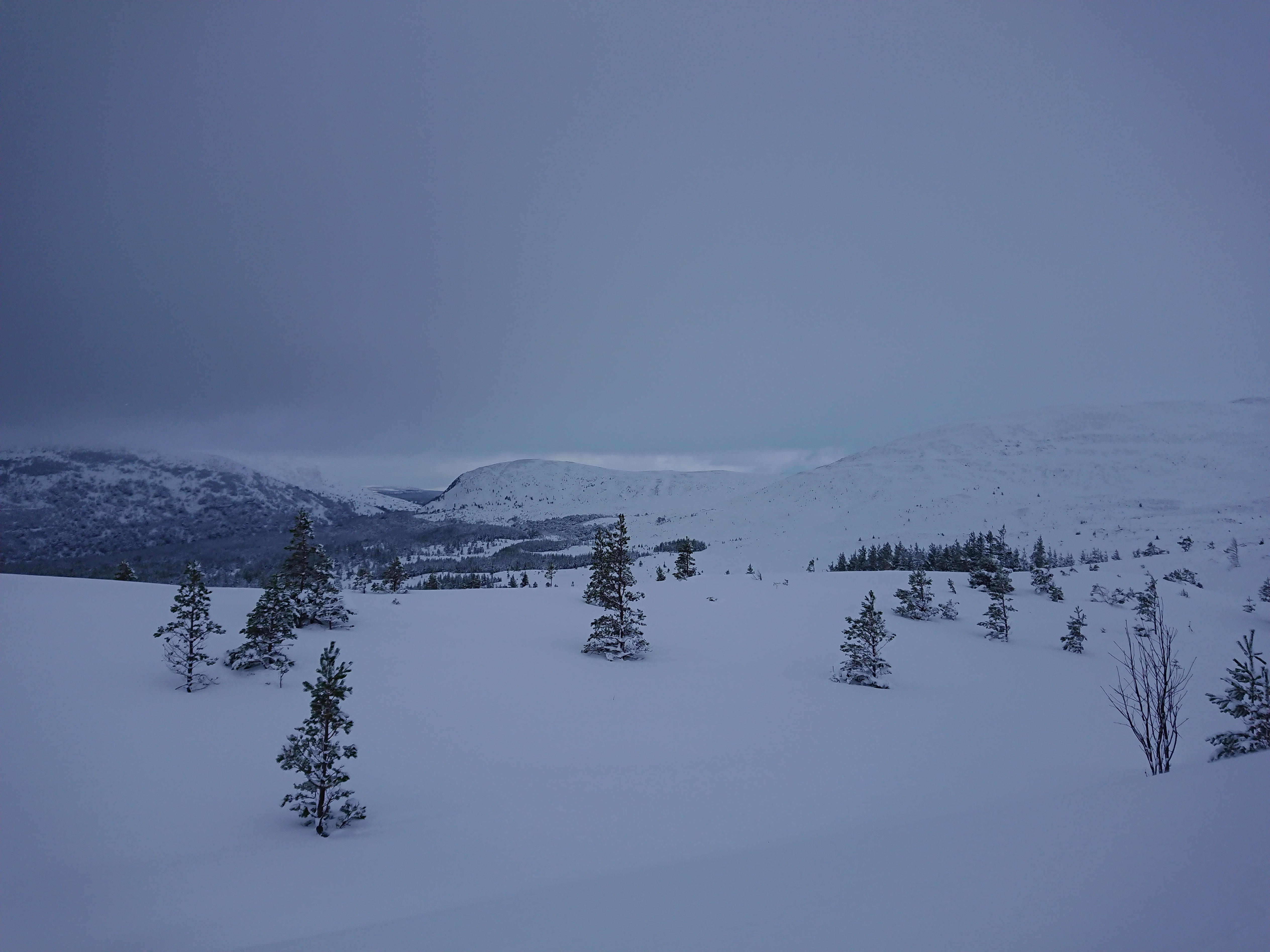
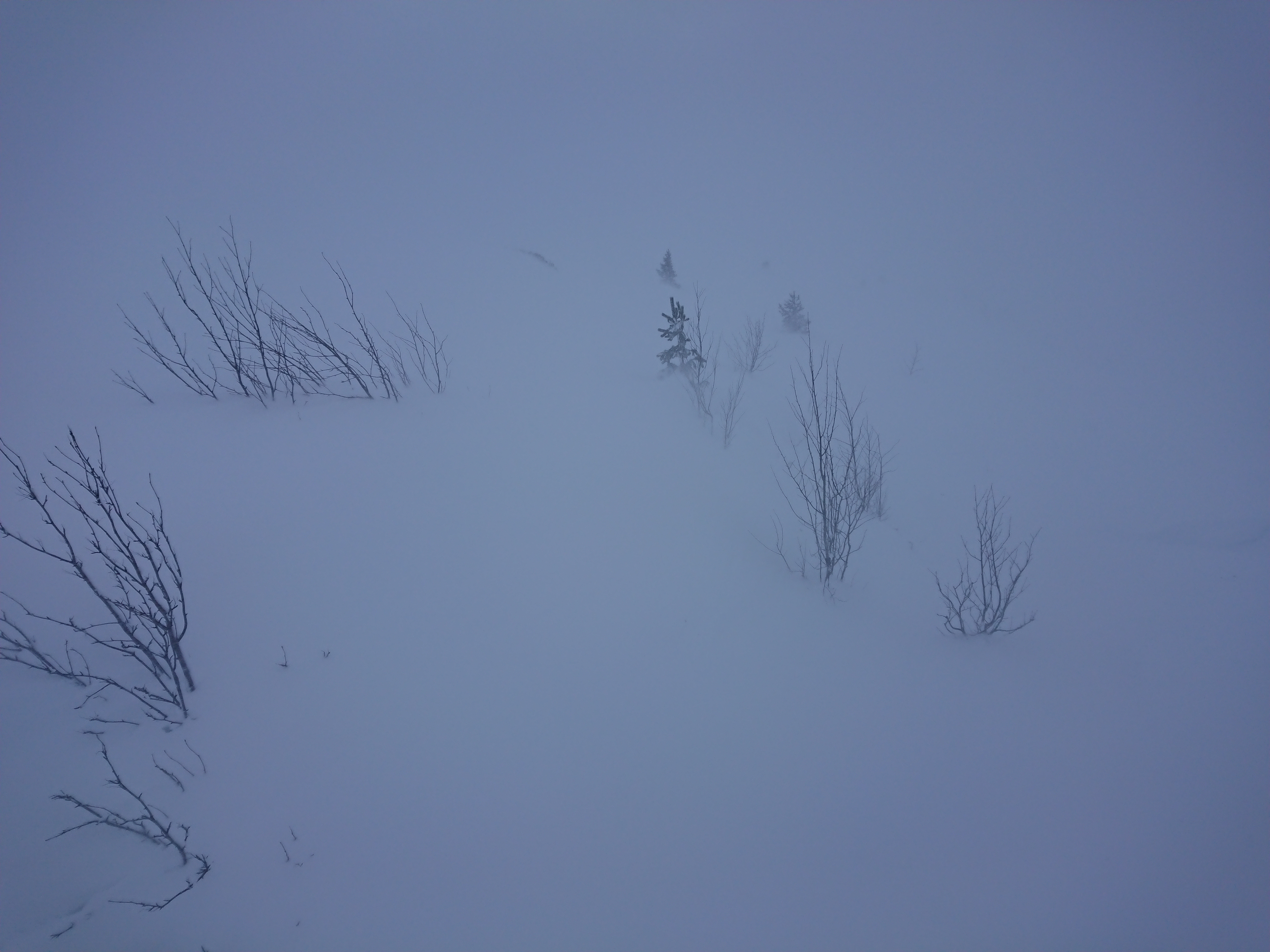
The Cairngorms is unique within the UK in offering a sub-arctic ecosystem, which coupled with the wide expanses of mountainside, make it perfect for our reindeer. In most winters, we get weeks of snow cover on the mountains,  but it’s less common to have such sustained cover as we’ve experienced this year. From Christmas through to mid February, the norm was snow, both on the hills and in the glens. Perfect for the reindeer, great for all of the snowsports enthusiasts who happen to live within reach of the mountains, but I have to confess the novelty of relentless snow began to wear… a little thin for me. I lost count how many times we cleared our drive at home of snow – all that snow shovelling definitely made up for the gyms being closed!

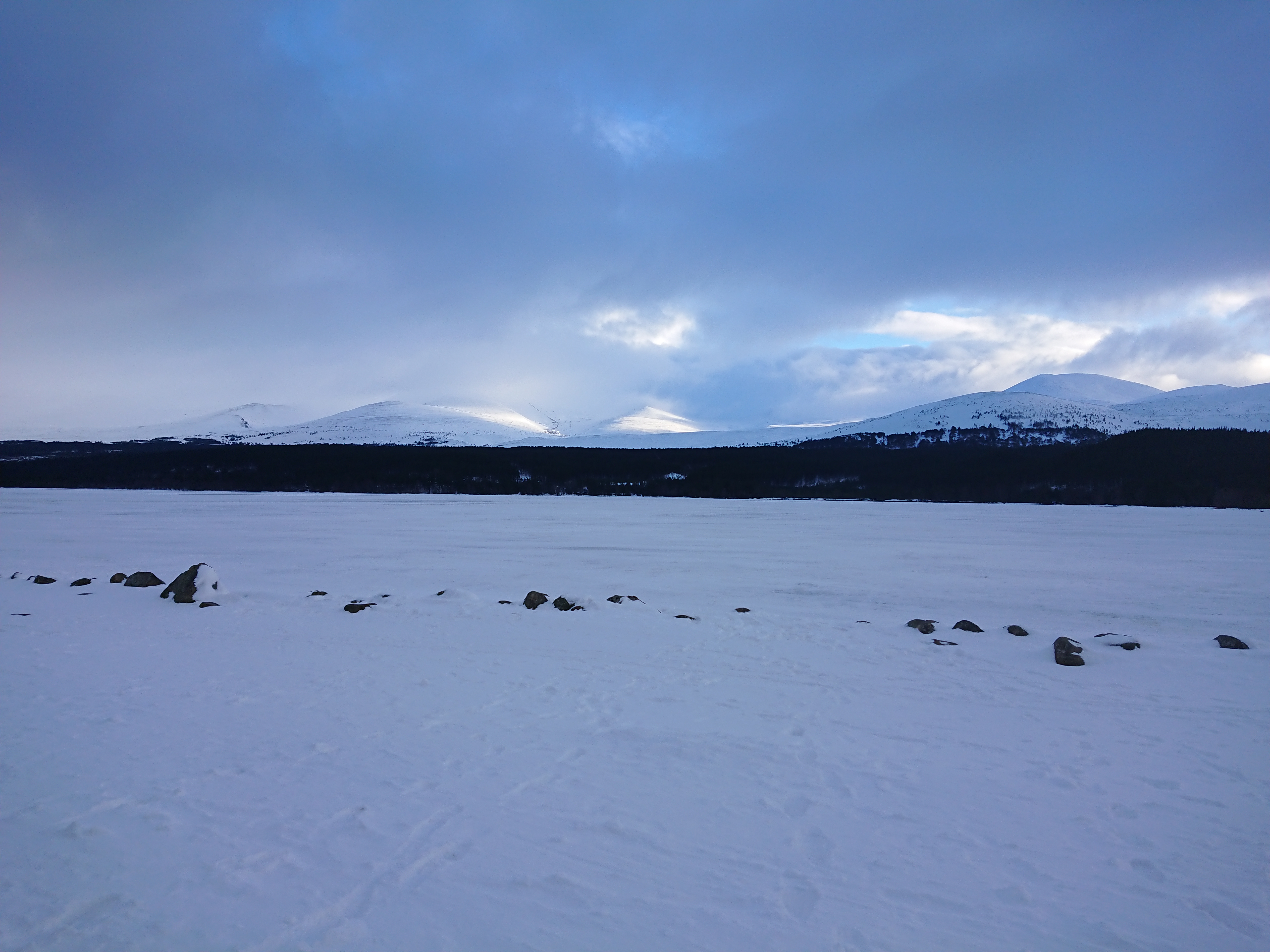
There’s a loch there somewhere! Loch Morlich froze solid enough that some people skied right across it.

If you follow our social media accounts, you’ve probably  enjoyed all those beautiful photos of reindeer in the snow under a bright blue sky, herders skiing out onto stunning mountains to cuddle reindeer, giving the impression that that is our every day experience. But alas, social media photos can be scheduled for the future. With the current situation, we’ve all just been working two/three days a week, keeping the essentials ticking over, which also means that we can work in separate households.

Our path off the car park blocked by a 10 ft drift. No reindeer today then…

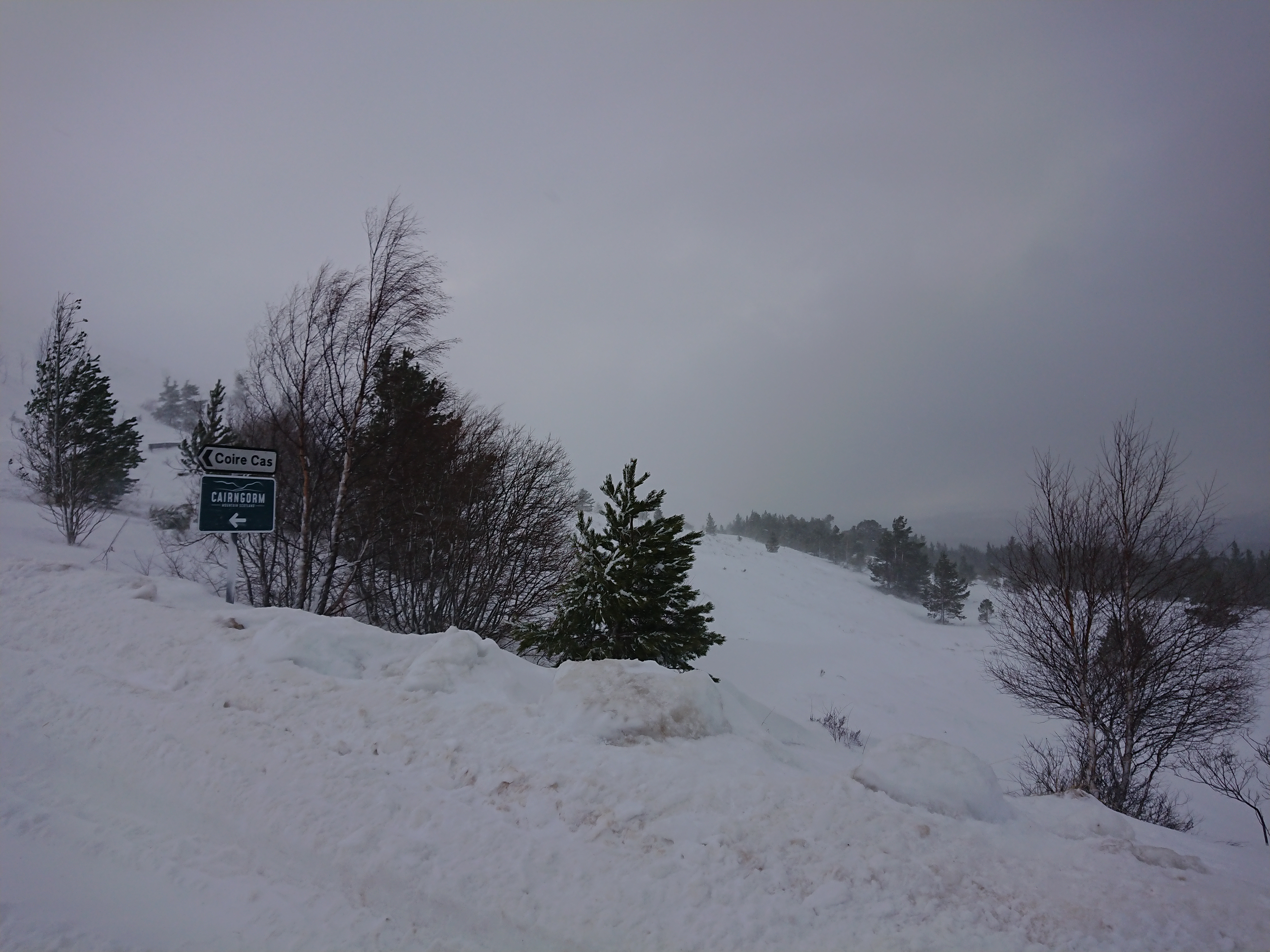
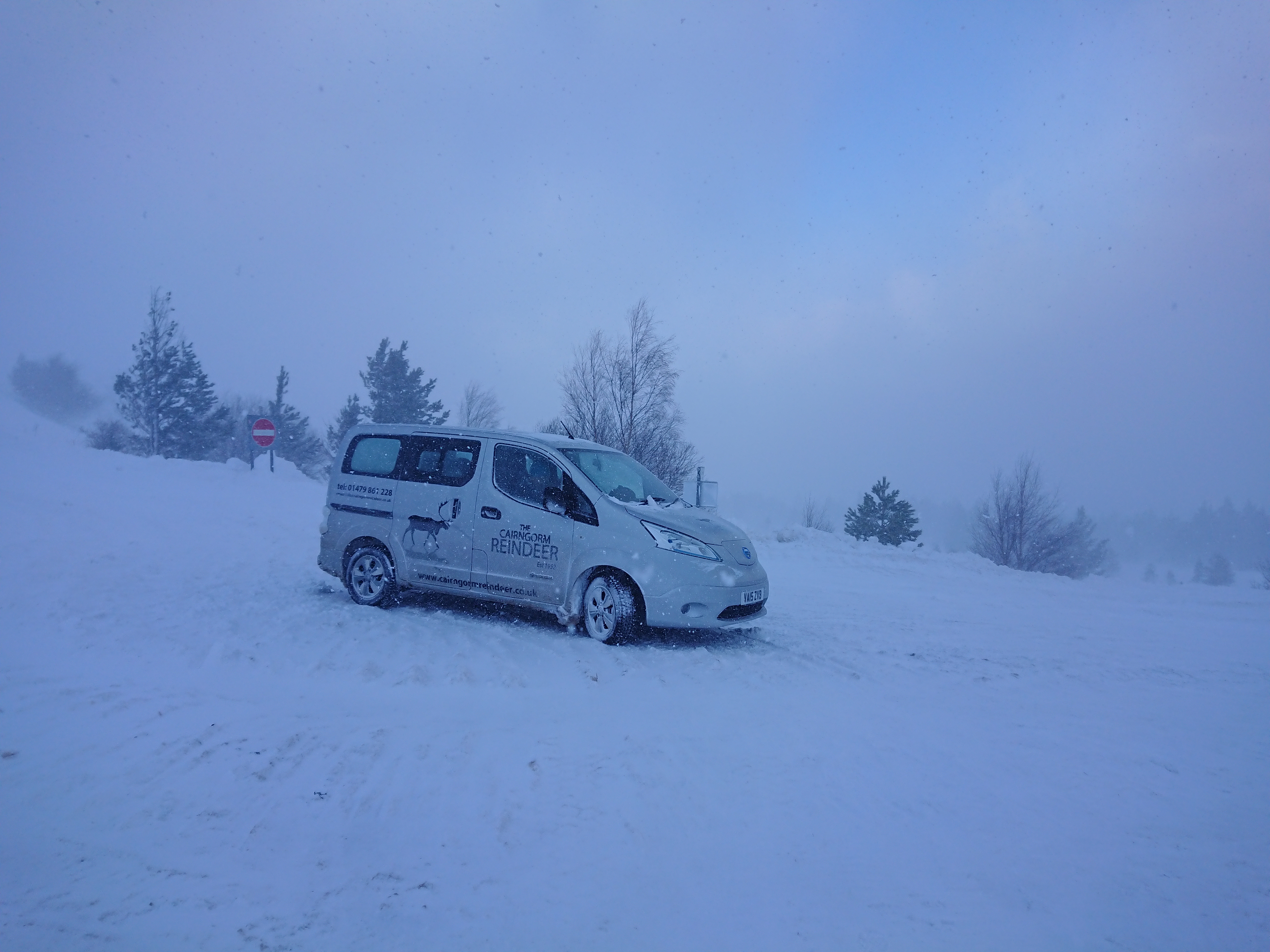
So every Friday and Saturday, Hen and me had our turn to feed the herd. As January rolled into February, with unerring precision, every day we were scheduled to work also appeared to be the scheduled day for a blizzard, a storm, or generally horrific weather. The reindeer were perfectly equipped, and with their appetites very reduced they would be a fair distance away, not fussed about seeking us out for food. Each time, we would drive up the ski road – a mission in itself as the snow was only cleared enough to allow Cairngorm Mountain’s essential staff access. We would wend our way up the closed road in our wee van, driving as far as we could, debating the safety of walking out to try to find the herd. And each time we would be forced to turn back.

The main ski road.
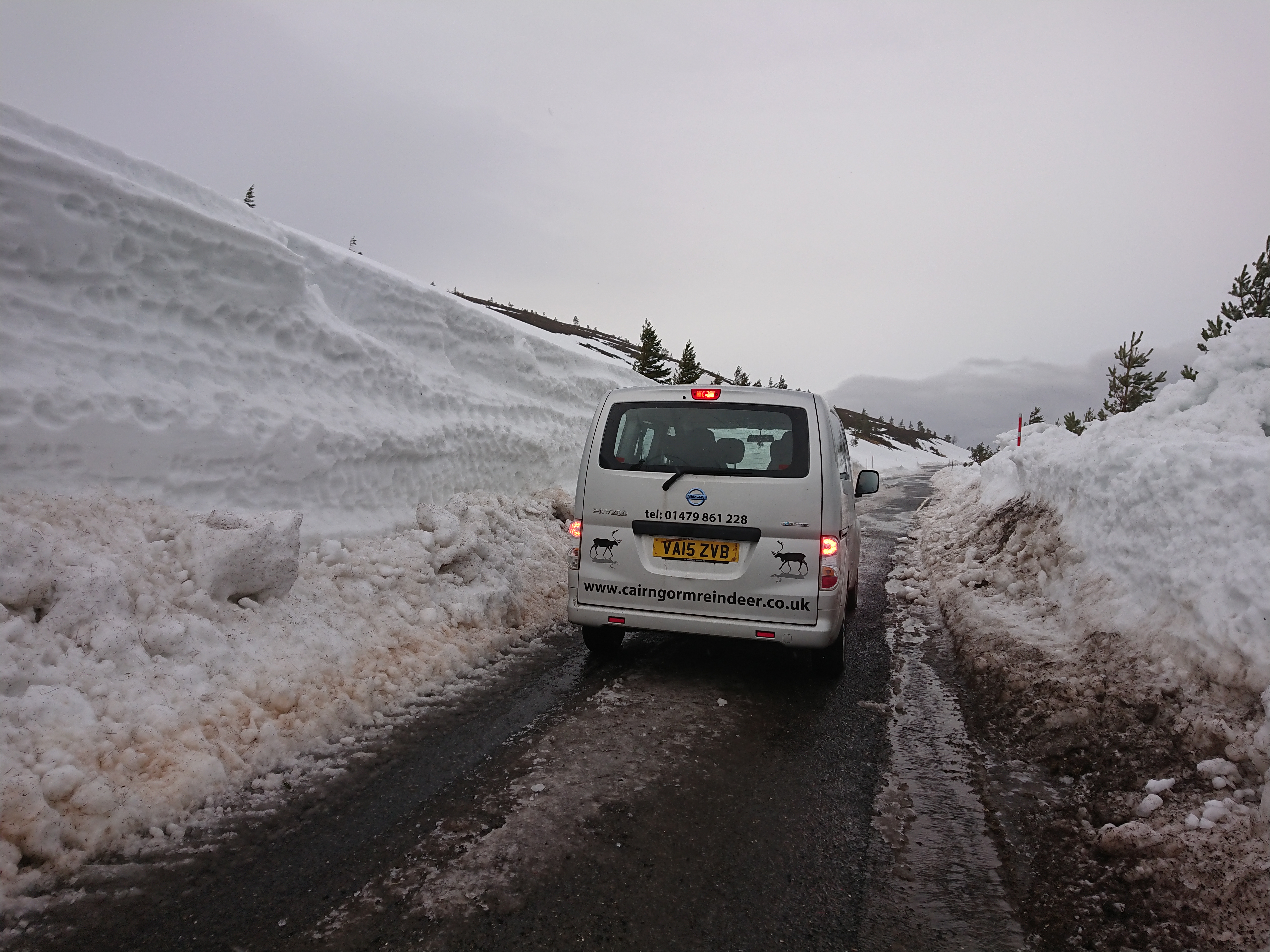
A passage cleared through drifts higher than the van.

Over the course of the next week, our colleagues would be gifted with better weather than us, and would catch up with the reindeer. More glorious photos for Facebook, then as we watched the forecast for our days, the harsh weather returned. The temperature plummeted to -19C, the Spey froze over. A second work “week” of seeing no reindeer, again foiled by the weather, the deep snow, and the distant reindeer. Now I know we can’t complain too much, when we have the privilege of getting to work with these awesome creatures, but by now we were starting to feel a little less like “Reindeer Herders” and a little more like office staff…

Our wee van excelled itself at being a snow van. That’s the main ski road that we’re stopped on…

It was now nearly three weeks since we’d seen the herd ourselves, and with hope we looked at the forecast for our next Friday in – the thaw having finally started. Windy, still snowy, but not too bad… We loaded the van with feed, navigated the narrow cleared passage between the drifts (apparently the deepest for 40 years on the road in places), reached the car park and spied with binoculars.

Hen sights the reindeer just above the snow drift

Reindeer! Real live reindeer! Calling against the wind, they heard us, and Pagan led them down.

Call and they shall come (possibly)

Phew, we could feel like reindeer herders once again!

Wild weather but happy herders with hungry Holy Moley

Andi
Reindeer in Space? Not quite!

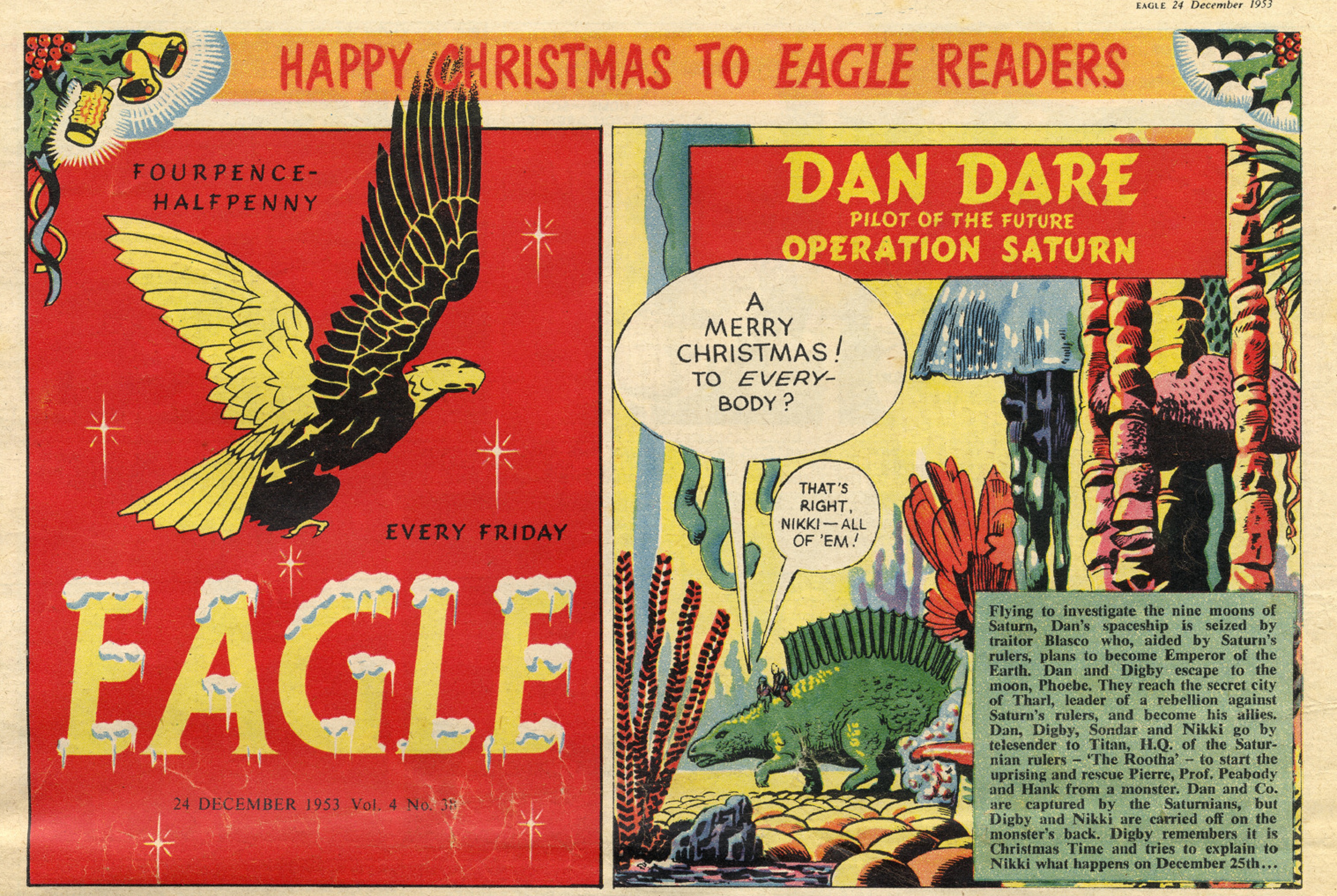
One of our adopters has brought it to our attention that the reindeer made an appearance in the Eagle comic, right back in December 1953, a mere 19 months after they first arrived in Scotland. He was kind enough to send us some scans and write a little bit for this week’s blog, so let me hand you over to John this week:
Published between 1950 to 1969, Britain’s Eagle comic was the creation of the Reverend Marcus Morris, an Anglican vicar, and Frank Hampson, who created its now world-famous space hero, ‘Dan Dare’. Alongside the famous space pilot, the weekly comic mixed a variety of other adventure and humour strips, and offered a range of features to appeal to its audience of largely teenage boys. (Publisher Hulton Press also published GIRL, for girls, and Swift and Robin, for younger readers, in similar formats).
Part of Eagle’s cover – dated 24th December 1953
Unusually, the comic had an editorial budget well in excess of what might be expected in comparison for a similar title today, and was able to commission a variety of articles – and send their in-house writing team (and freelancers) to all four corners of Britain to cover stories. Reporter Macdonald Hastings (who would go on to become a word-famous war correspondent) filed reports from far-flung parts of the world under the title of Eagle Special Correspondent reportedly making around £5000 pounds a year by 1952.
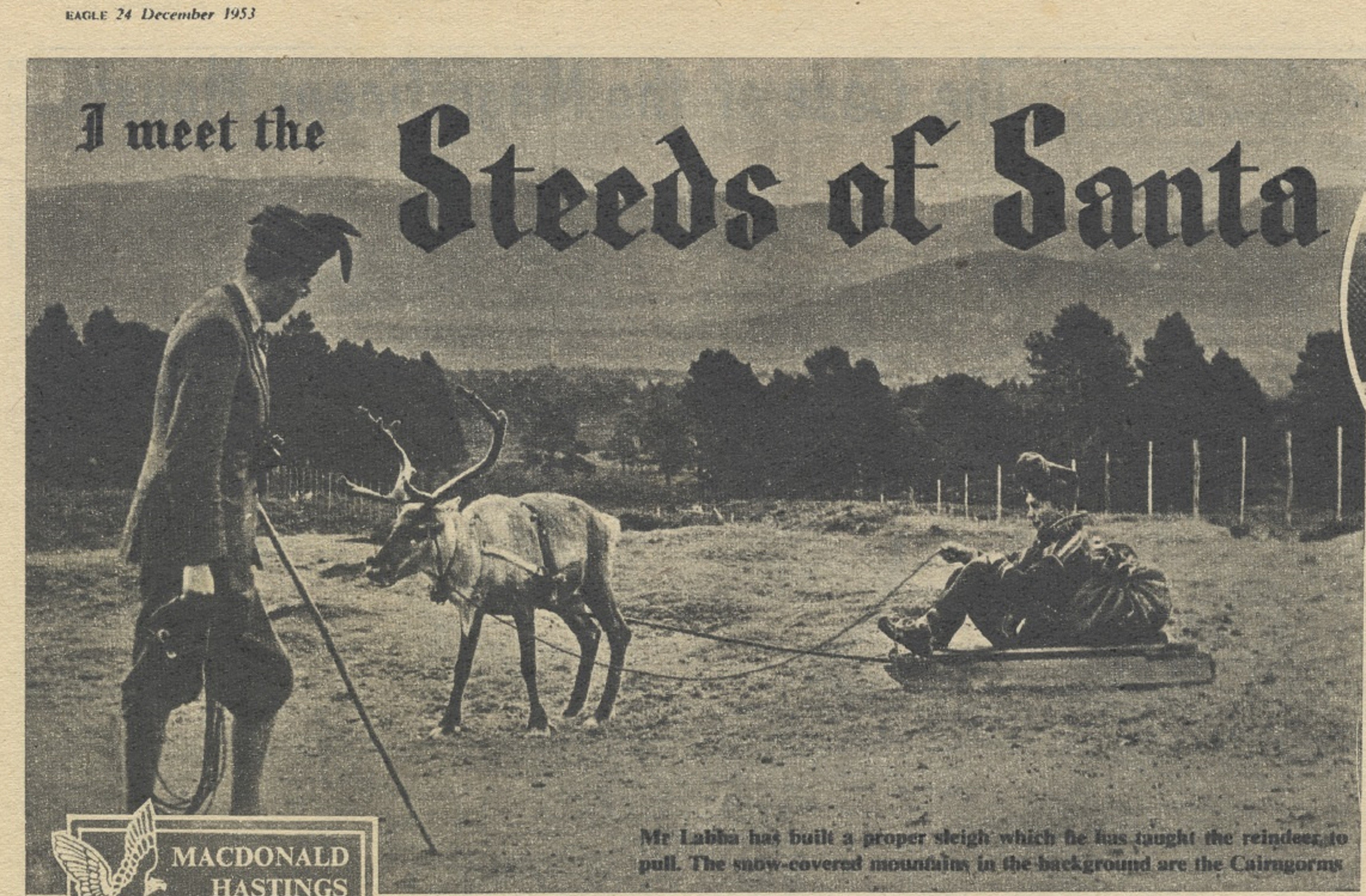
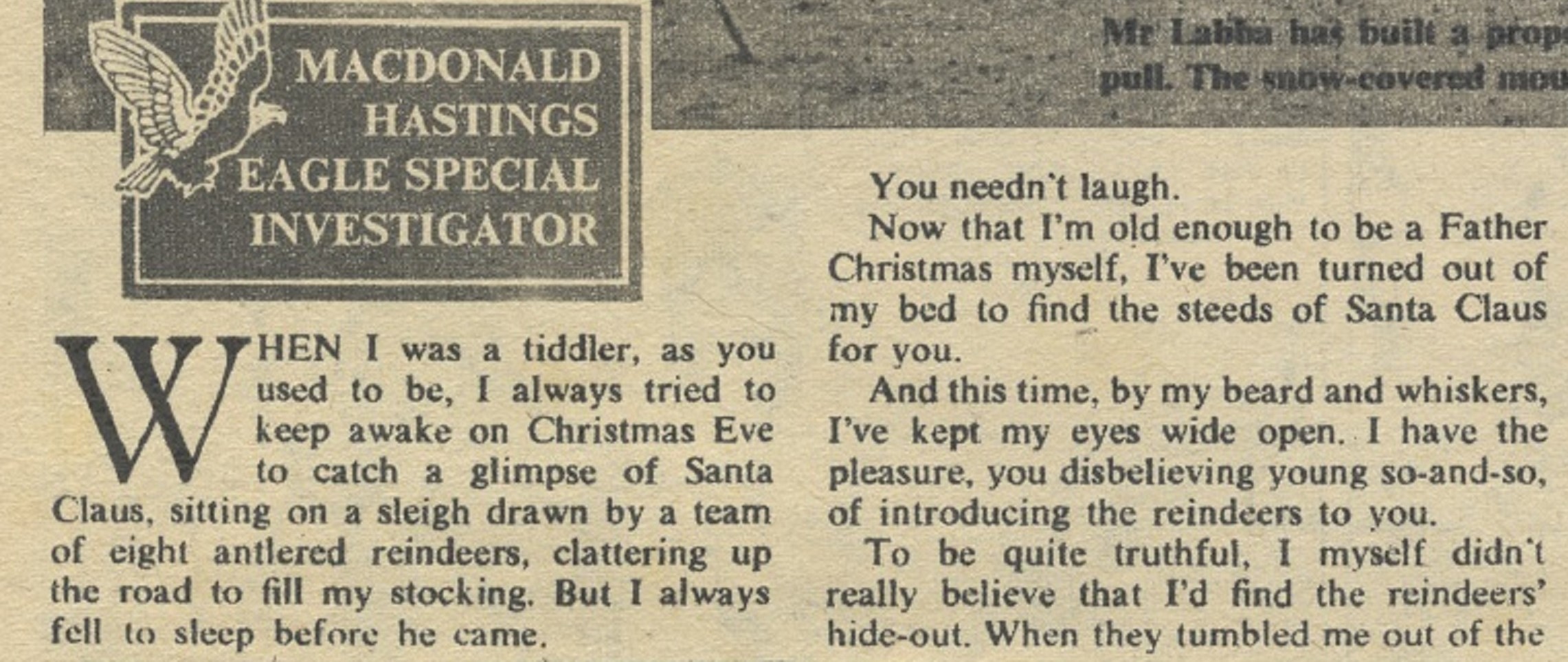
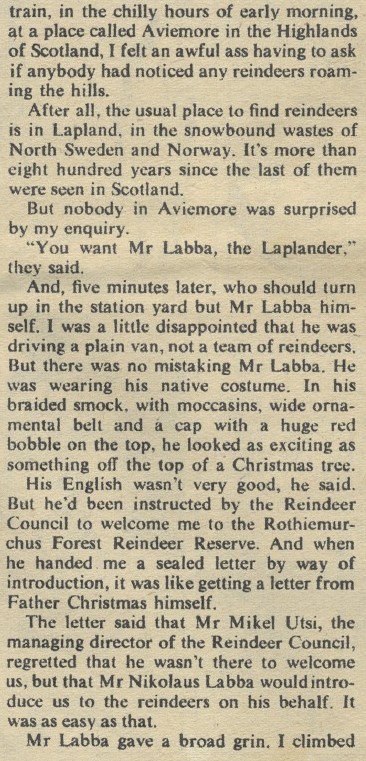
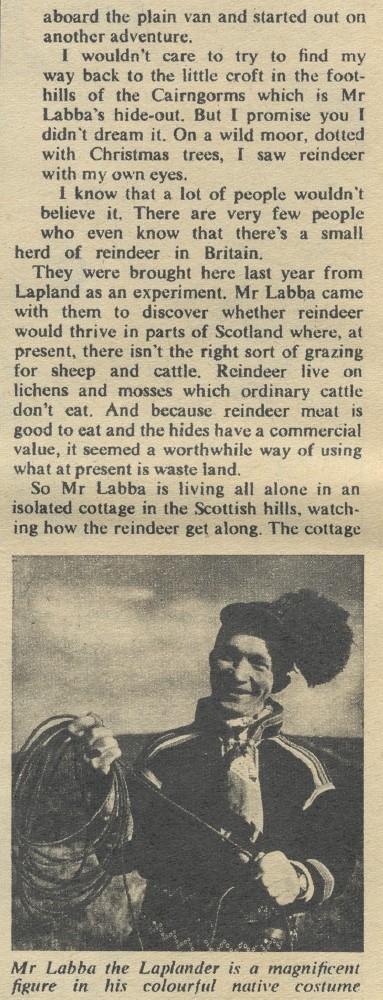
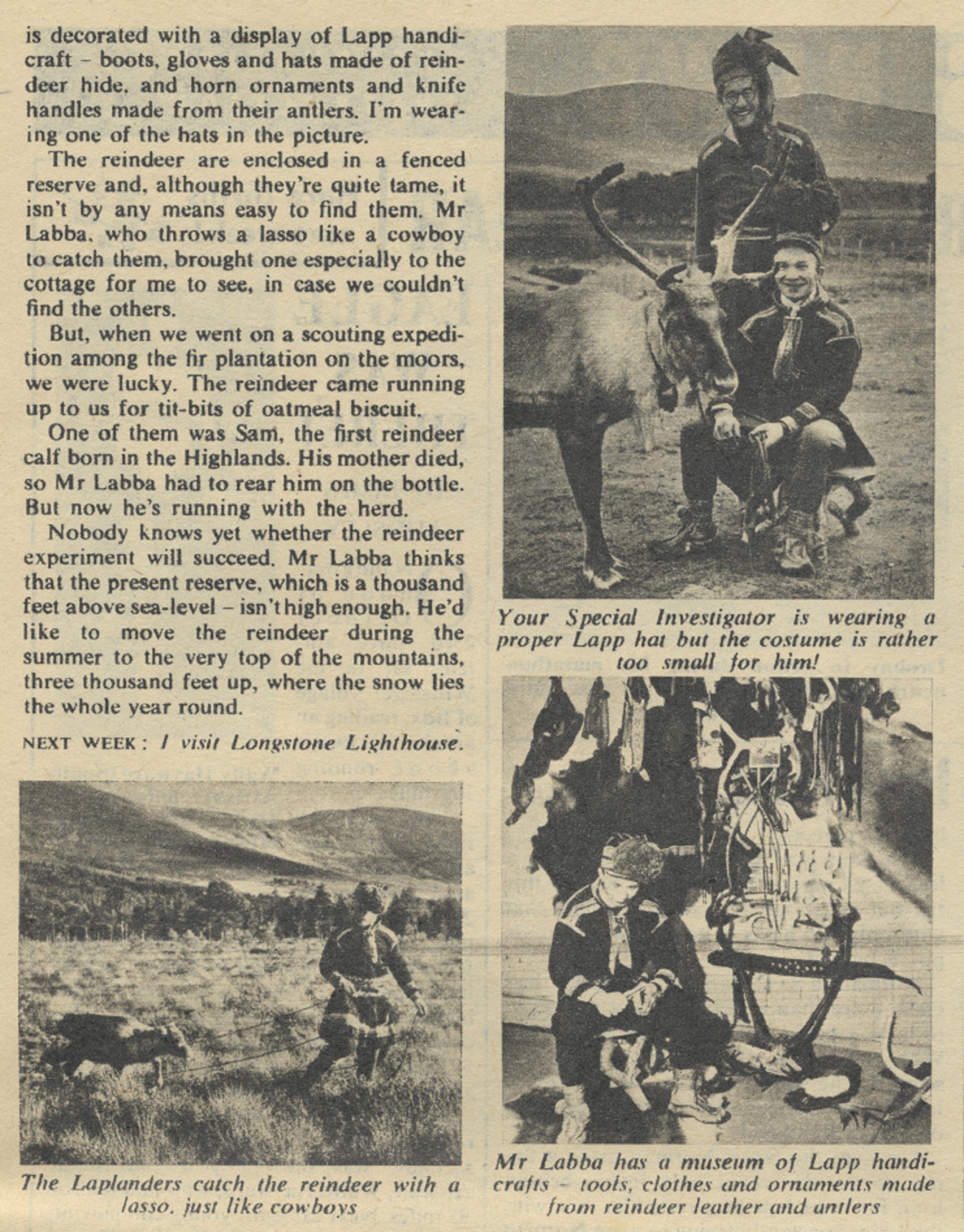
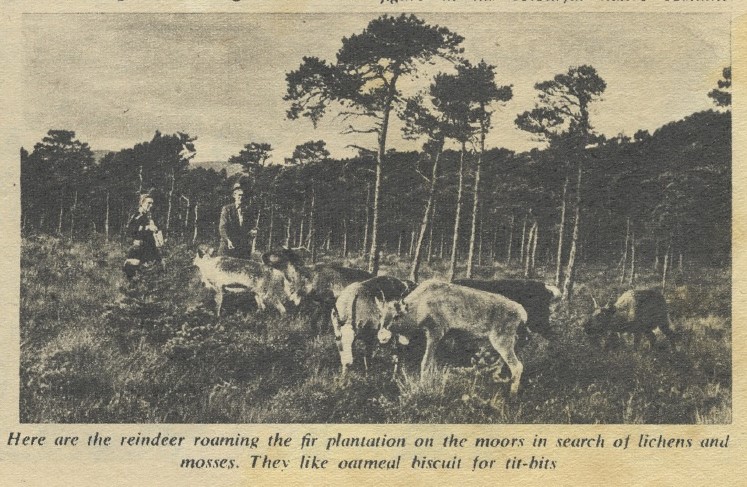
For Eagle’s 1953 Christmas issue, he was dispatched to the Cairngorms, to visit the Rothiemurchus Forest Reindeer Reserve, where he met Mr Nicolaus Labba the Laplander, who introduced Mr Hastings to some of the herd and offered some thoughts on the future of the project.
N.B. Scans of the whole pages won’t show up on our blog here big enough to read, so we’ve chopped up the article into separate sections so it can (hopefully!) be read easily enough:
So, yes, it’s true – the Cairngorm Reindeer really did rub shoulders with Dan Dare!
Eagle merged with another comic, Lion, in 1969 which in turn lasted until 1974.
John 
N.B. To add some more context, Nicolaus  Labba was a cousin of Mikel Utsi, the man who first brought the reindeer back to Scotland from Sweden in 1952, arriving with Mr Utsi in 1952 and spending the next few years as his assistant. 
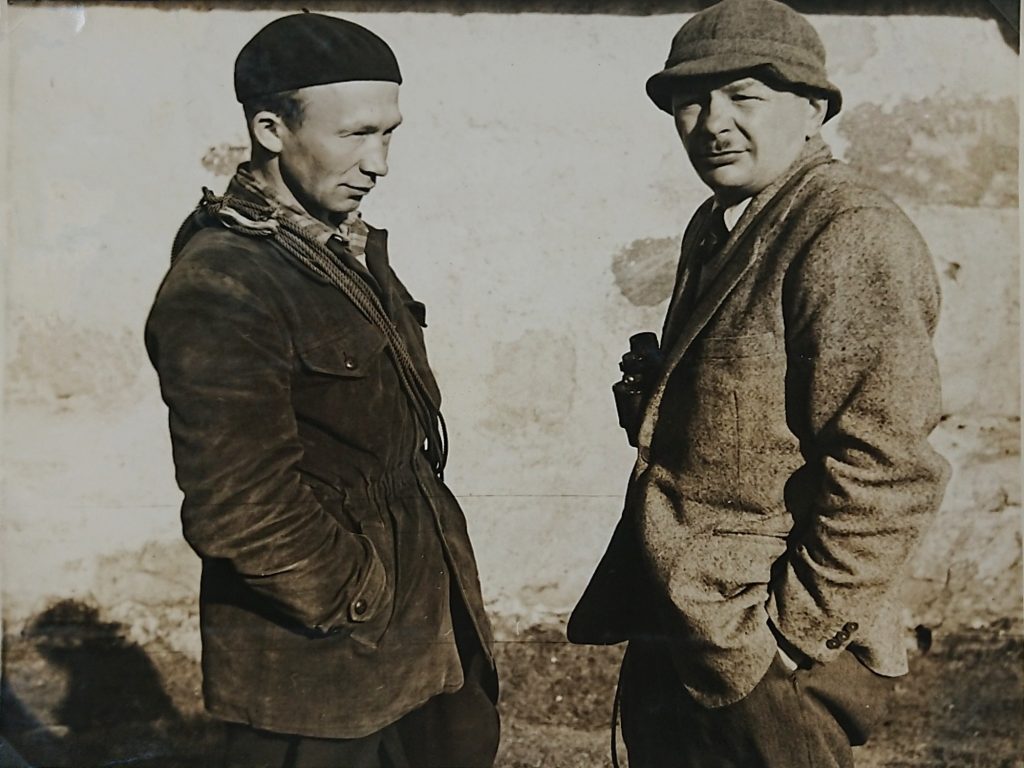
Nicolaus Labba and Mikel Utsi, 29th May 1952 – the day the reindeer first arrived in the Cairngorms after their journey from Sweden and subsequent quarantine at Edinburgh Zoo.
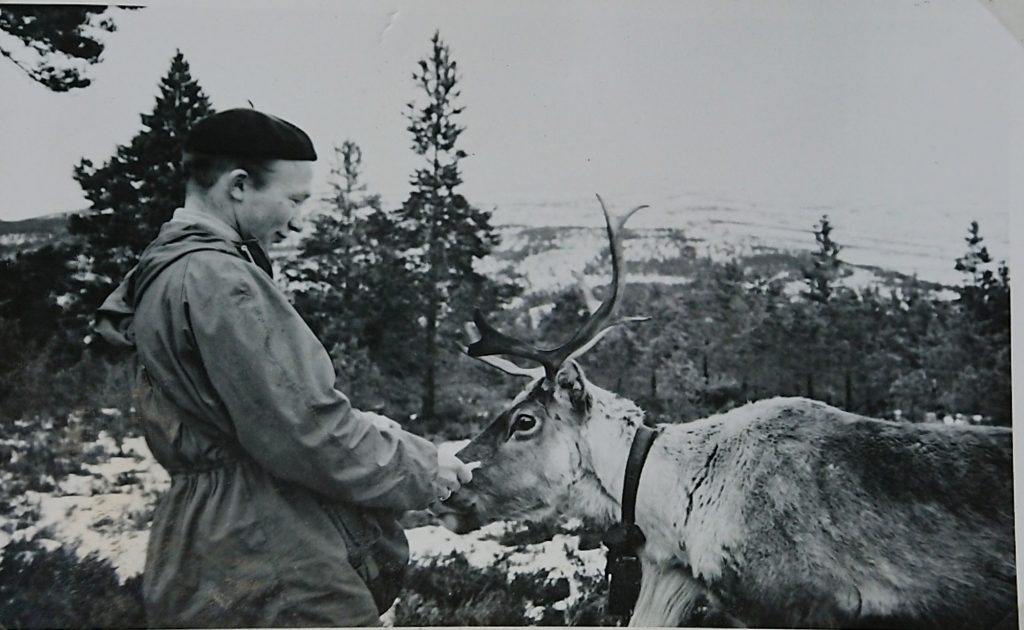
Labba with Sarek in Feb 1953.
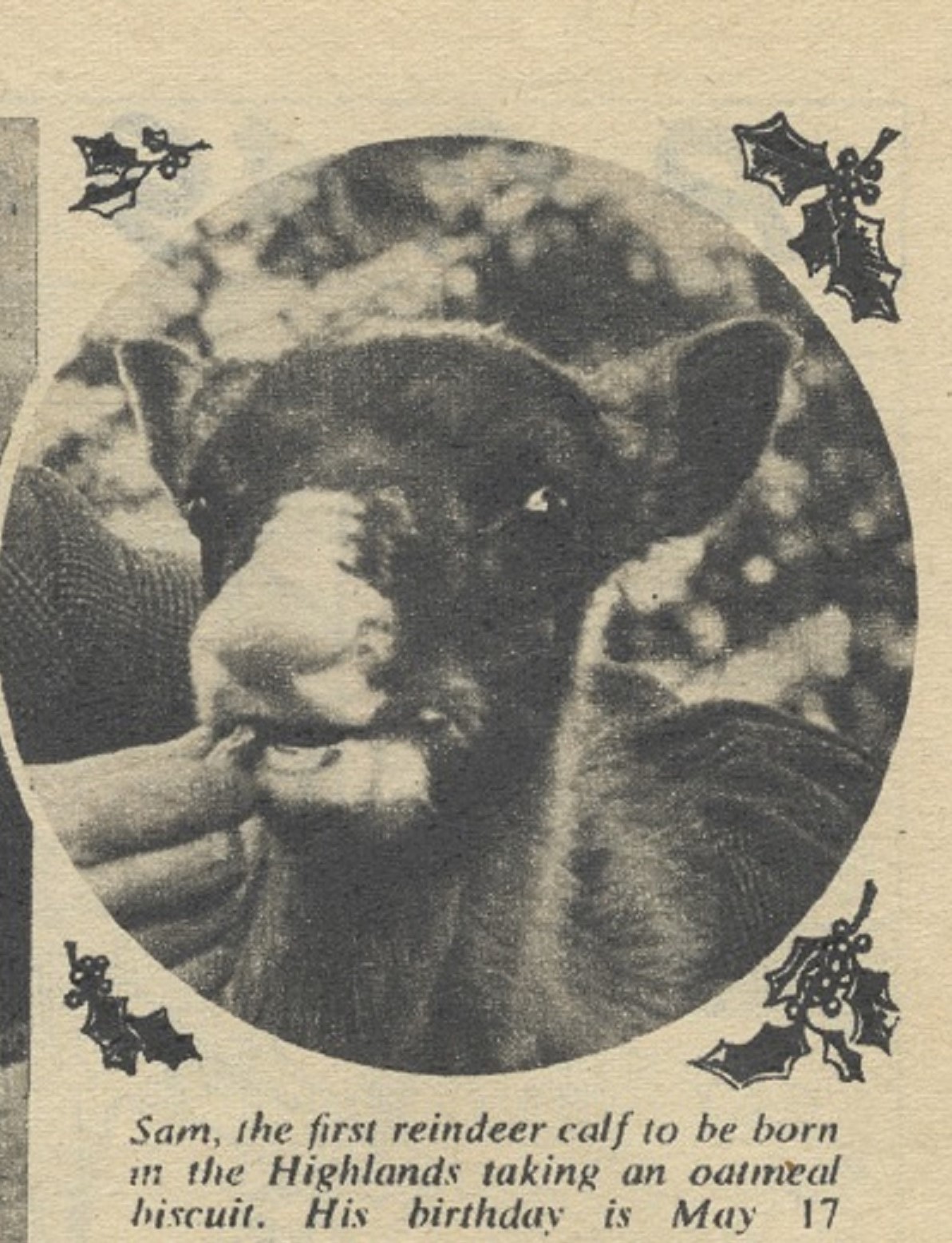
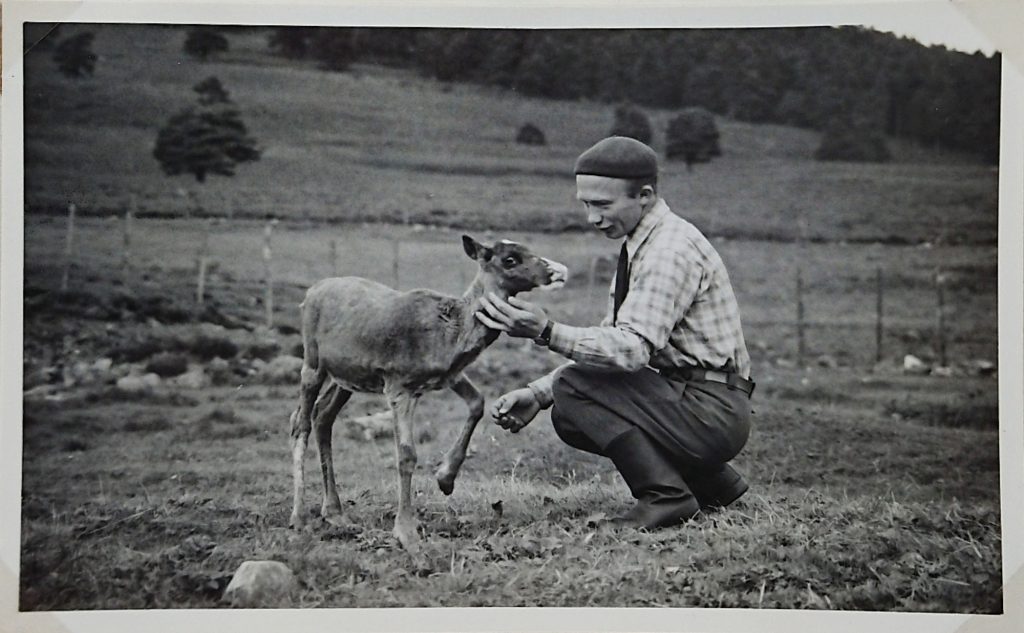
With Sam in August 1953, the calf who’s photo made it into the Eagle a few months later!

More information about Nicolaus Labba and the history of our herd here in Scotland can be found in our book Hoofprints, available here on our website. 

Ben and Lotti’s old phrases challenge

Since Lotti and I have been working at the Reindeer Centre there has been two and a half pages of old English phrases hanging up in the office. It seems to have been there since time immemorial and no one is quite sure how or why it’s up there. We saw this as an opportunity!! Could we enhance our ‘olde’ vocabulary? Well, we were keen to give it a go…we challenged each other to fit in a single word from the list below on each Hill Trip that we did together. Here are some of the words, their definition (followed by their origin), followed by how Lotti and I used them in our tour.

Callipygian – having beautifully shaped buttocks (1640’s).

“Ben and I know all the males in here by name, so we can tell you their name if you have a favourite. Some of the Bulls are so big by now that we can almost identify them by their callipygian bottoms”

Groaking – to silently watch someone whilst they are eating, in the hopes of being invited to join them (unknown origin).

“You might see the Reindeer groaking each other when we put the line of feed on the ground”

Editor’s Note – Groaking is probably the only word in this list that has become part of normal, everyday speech over the years at Reindeer House. Mainly because Hen is regularly accused of it.

Sluberdegullion – a slovenly, slobbering person (1650’s).

“A lot of reindeer adaptations are centred around energy conservation. As you’ve seen, they like to walk on the boardwalk with you and this is all part of the energy conservation instinct: it’s easier than walking along uneven grassland. And here is a good example, none like to conserve energy more than our very own sluberdegullion, Svalbard.”

Svalbard leading his buddies Druid, Jonas and Stuc across the moorland, through deep vegetation and over rough, uneven ground. Energy-sapping and hard going… oh wait, the sluberdegullions are all walking on a boardwalk!


Curmering – a low rumbling sound produced by the bowels (1880’s).

“Reindeer tend not to make too much noise. However, they do make a noise when moving. In fact, listen out for a noise whilst we walk through the enclosure alongside them, and Lotti will tell you more about that sound soon. I’ll give you a clue, it’s not a curmering.”

Snoutfair – a good-looking person (1500s).

“We run an adoption scheme so you can actually adopt the handsome Dr. Seuss or the fiery Scully here. Alternatively, you could try to adopt Ben here if you think he’s looking particularly snoutfair”

Scully – what a snoutfair!

Resistentialism – the seemingly malevolent behaviour displayed by inanimate objects (1940s).

“You might wonder what’s in these green bags at mine and Lotti’s feet. It’s essentially reindeer bribery! Reindeer love their food which is fortunate for us as reindeer herders. The reindeer certainly don’t think the bags have any resistentialism.”

Jargogles – to confuse, bamboozle (1690’s).

“It absolutely jargogles me how quickly the antlers grow on some of our big boys”

Look how quickly your antlers have grown, Domino! Jargogling.

Quockerwodger – a wooden puppet, controlled by strings (1850’s).

“We don’t want to treat you as if you were quouckerwodgers, so you can leave when you want, just give Lotti or me a wave and be sure to shut the gates.”

Lunt – walking whilst smoking a pipe (1820’s).

“We will feed the reindeer soon, after which they’re likely to graze the grass or lounge about. Perhaps they’ll even siesta. I’m sure if they were human, they’d love to have a post-work lunt.”

Twattle – to gossip, or talk idly (1600’s).

“So, without further ado, we will head into the enclosure to meet the reindeer. We will gather around one last time when we’re in there to listen to some interesting ways that reindeer have adapted to their environment. Then you’ll have as much time as you’d like to be with the reindeer. So that we remain as one big group, if we could avoid any dawdling or twattling until we’ve gathered around one final time, then that would be great.”

Hugger mugger – to act in a secretive manner (1530’s).

“Cars that are this high up don’t expect to see a big handsome group like us crossing the road, so don’t act all hugger mugger about it, be sure to pick your right moment to cross”.

Cockalorum – a little man with a high opinion of himself (1710’s).

“All of our reindeer do have a name. They are actually named after a different theme every year. This reindeer here is called Bond. He’s a got a history of being a bit of a cockalorum, although he has been behaving better so far this year”

Bond – one of life’s cockalorums.

Crapulous – to feel ill because of excessive eating/drinking (1530’s).

“We’re on the last Hill Trip of the day so the Reindeer here are getting quite a lot of food this afternoon, but they’ll make light work of that. Hopefully they don’t feel too crapulous afterwards. But they are ruminants, so they often have a bit of grass or sedge for dessert once the mix has finished.”

Lethophobia – the fear of oblivion (1700’s).

“The reindeer here live in some of the harshest environment that the U.K. offers. In winter, the temperatures can reach as low as -20 degrees Celsius and the wind speed can exceed 100mph. However, this doesn’t trouble the reindeer too much, it hasn’t led to them developing any lethophobia. They are hardy animals who love the cold.”

Elflocks – tangled hair as if matted by elves (1590’s).

“The reindeer’s coats help keep them warm in the winter – reindeer have been known to survive down to very low temperatures when they have to. They do this by having thousands of hairs per square inch, all of which are hollow, making them great at trapping a base layer of heat next to their skin. As you can see the hair is currently lovely and sleek; it stays like this throughout winter and sheds in the summer. If you saw them in July it would look like they’ve got Elflocks.”

Fine elflocks…

Curglaff – the shock one feels upon first plunging into cold water (Scots, 1800’s).

“Reindeer aren’t particularly tactile and some of them here today can be quite shy at times, so don’t be surprised if a reindeer looks curglaffed if you approached too far into their personal space.”

The A-team of guides, should you want an education on words from hundreds of years ago!

Ben and Lotti

Thank you all!

Following the TV programme on Channel 4, ‘A Baby Reindeer’s First Christmas‘, we have been overwhelmed with lovely letters of support, incredibly generous donations and new ‘adopters’. It really has been a fantastic lifeline for us here at the Cairngorm Reindeer Centre and I can honestly say our lovely reindeer have touched the hearts of many, both at home and abroad.

TV stars Dr Seuss and Holy Moley at the Strathspey Railway event. Photo: Justin Purefoy/Maramedia

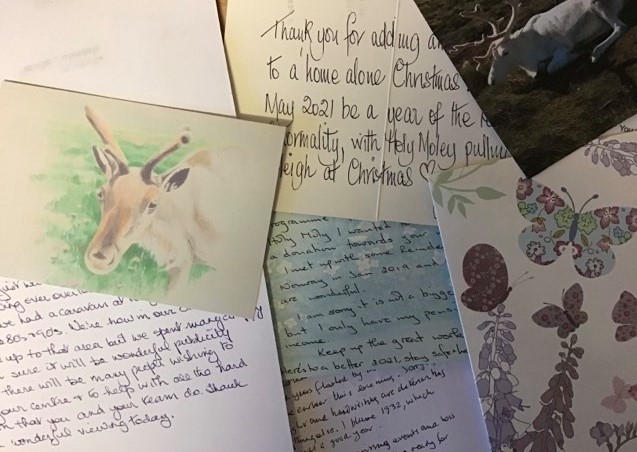
The lovely letters we have received have been incredibly varied and while protecting people anonymity I thought it would be nice to share some of the contents of these letters.

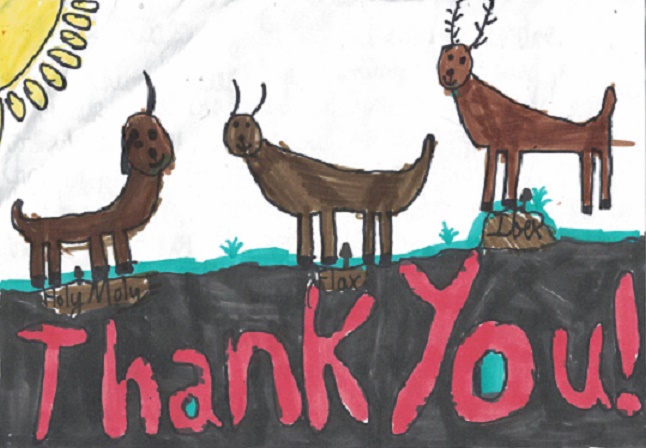
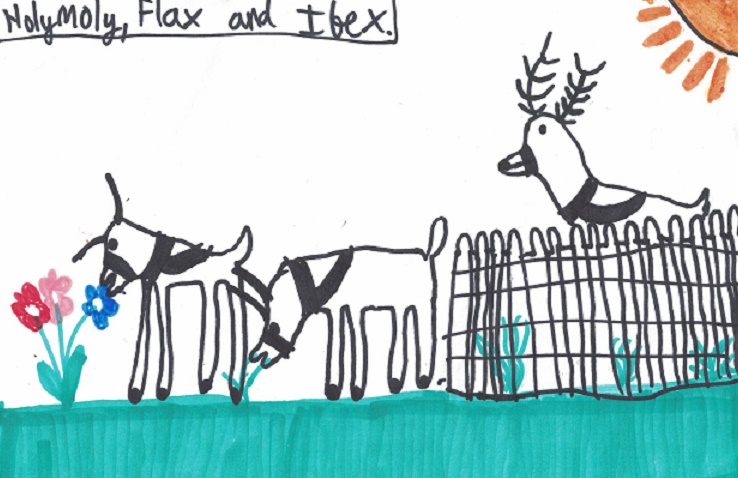
A young lass from the Midlands sent a wonderful letter, written and illustrated by herself. Her attention to detail was amazing and I can’t resist sharing her lovely drawings with you.

If any of you budding young reindeer enthusiasts would like to also send in anything we would love to receive it. Getting letters through the post is always special and here at The Cairngorm Reindeer Centre we would love to receive any works of art or prose! Our postal address and email address can be found on the Contact Us page of our website.

Quite a number of letters and cards came from people reminiscing about days gone by, maybe an occasion when they met the original owners of the herd, Mikel Utsi and Dr Lindgren. Although we have a considerable archive here at Reindeer House of the history of the herd, many of the stories recalled were new to me and so all the more interesting.

I smiled at the recollection of one couple who attended a talk given by Dr Lindgren and described her as ‘large’ (not fat) and very straight backed and a loud voice. Well I certainly chuckled at this description! Dr Lindgren indeed a very tall lady and the above description hits the nail on the head. I knew Dr Lindgren well in her latter years and I was terrified of her! She was so worldly, intelligent and dominant, but she was also kind and considerate when necessary. I would love to hear from anyone who knew her personally and has a story to tell – she was quite a character and had many different interests and skills, other than reindeer.

And then there was a lady who met Mr Utsi, in North Sweden, before the first reindeer came to Scotland in 1952. This was a lovely encounter, which was described in detail to us. Back in 1951, the lady who wrote to us went on a skiing expedition with her school to Swedish Lapland.  Many of them had never skied before, but quickly got to grips with the sport and by all accounts had lifetime memories from their time there. While there they were taken to see a herd of reindeer and the owner Mikel Utsi told them that he was introducing his reindeer to Scotland! What a wonderful memory and I am so glad this lady was able to see the TV programme on Christmas Eve and see just how it is all those years later!

There was a strong common theme through the many letters we received with comments as follows:

best viewing ever over the Festive season

Thank you for adding ‘animal magic’ to a home alone Christmas

A Baby Reindeer’s First Christmas was absolutely brilliant and a stroke of genius – wonderful publicity, informing such a wide audience of all the great work you are doing for the community

The programme brought back lovely memories of when we used to visit you in your early days

So thank you from the bottom of my heart to everyone you has been in touch to reminisce, donate and adopt reindeer. It has been a huge help to us and most importantly ‘put a smile on our faces’.

Tilly feeding young bull Sherlock. Photo: Justin Purefoy/Maramedia

Tilly

How Holy Moley got her name!

A lot of you may have already heard of Holy Moley, whether it be on one of our guided tours up here in the Highlands of Scotland, on our social media or most likely through the recent Channel 4 programme (‘A Baby Reindeer’s First Christmas’) where Holy Moley was the star reindeer! The programme takes you through her roller-coaster of a life so far but it didn’t actually explain why she was called Holy Moley in the first place so I’m going to take this opportunity to explain her name.

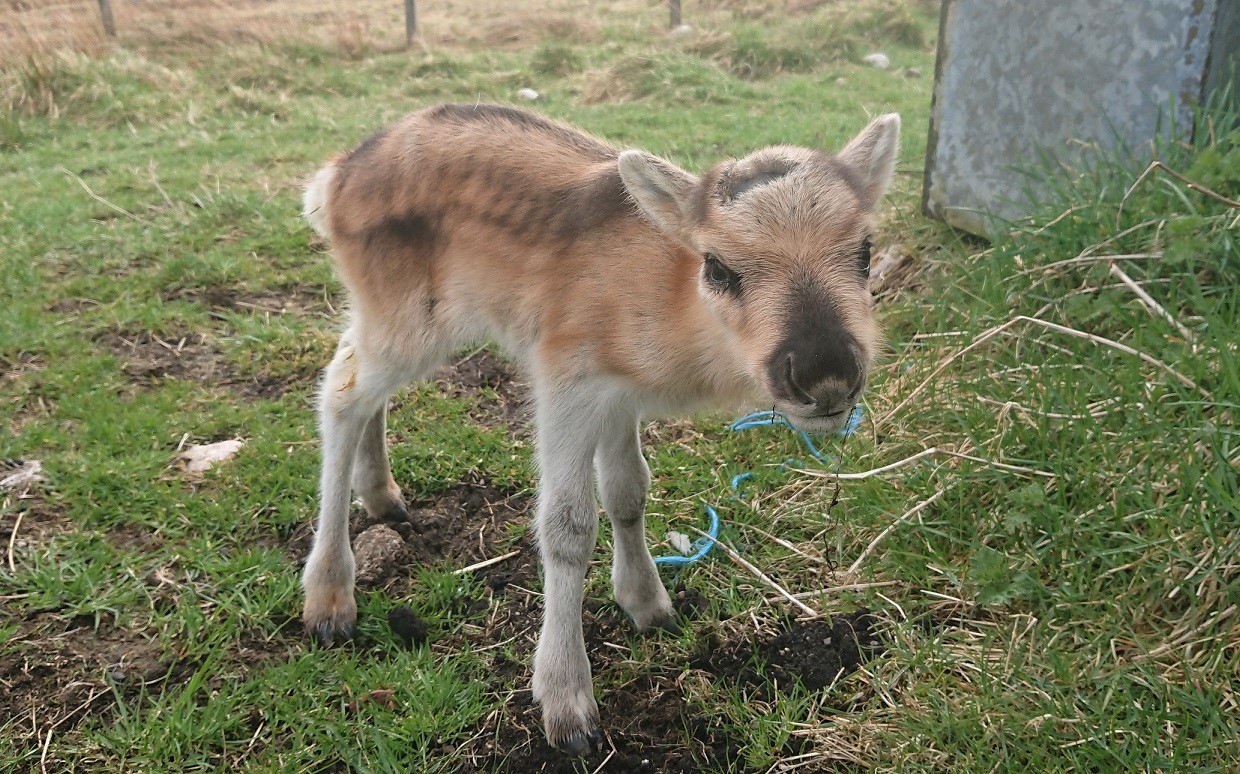
On the 25th April 2020 our first reindeer calf of the year was born. Lotti and myself headed out for about an hour’s hill walk to look for Galilee, a 6 year old very pregnant female reindeer who we spied from a distance through binoculars. On top of a hill called Silver Mount within our 1200 acre mountain enclosure, or Airgiod-meall in Gaelic,  we found her and her new calf. This was Lotti’s first calving season with us, so her first reindeer calf. However, like Galilee I was an old hand at this time of year so was passing on advice on approaching and treating new born calves correctly to Lotti. Galilee couldn’t have been more chilled out with our presence, in fact she was pretty delighted we brought her a tasty feed after what had probably been an exhausting few hours! Lotti was absolutely ecstatic! A smile beamed from ear to ear which of course was infectious so the two of us were on cloud nine. We sprayed the newborn’s navel to stop any infection and popped a wee bit of insecticide on her back to prevent ticks from biting and causing problems for the wee girl then left her to get to know her mum. As she was the first calf we weren’t in a hurry to bring her in closer to the herd into the smaller fenced area which becomes a ‘nursery’ through the spring, but thought we would wait until another female had calved so they could come in together.

Huge excitement!

We caught up with them the next day to feed Galilee and check her calf was well. Galilee this time decided that with her calf being much more mobile, that she wasn’t sticking around so again we left her to it, with no urgent hurry to bring them in. Then on the 27th April myself, Andi, Lotti and Joe headed out to bring Galilee and calf (and now also Dante and her calf) into an enclosure a bit closer so we could keep an eye on them. Andi and Lotti concentrated on Dante and calf while Joe and I headed over to where we could see Galilee, assuming her calf was with her.
As we approached Galilee she didn’t move away from us, as you would expect a new mum to do. I got closer and closer and realised quite quickly that things weren’t normal. Galilee was grunting a lot. A call she would use to communicate with her 2 day old calf but I couldn’t hear or see her calf anywhere. Galilee was right in amongst a pile of boulders which didn’t cover a big area but she was pretty adamant to stay close to a certain area, sticking her nose into a section where the boulders had big gaps between. My heart sunk when I realised her calf must have fallen down in between the gaps  somehow! Joe and I searched, treading carefully over the boulder field. After about 10 minutes (which felt like an hour) of searching we could then hear a very faint calf grunting back to her mother. This then confirmed whereabouts in the boulders she was, however she was so far down we couldn’t see her, let alone reach with our arms to get her out.

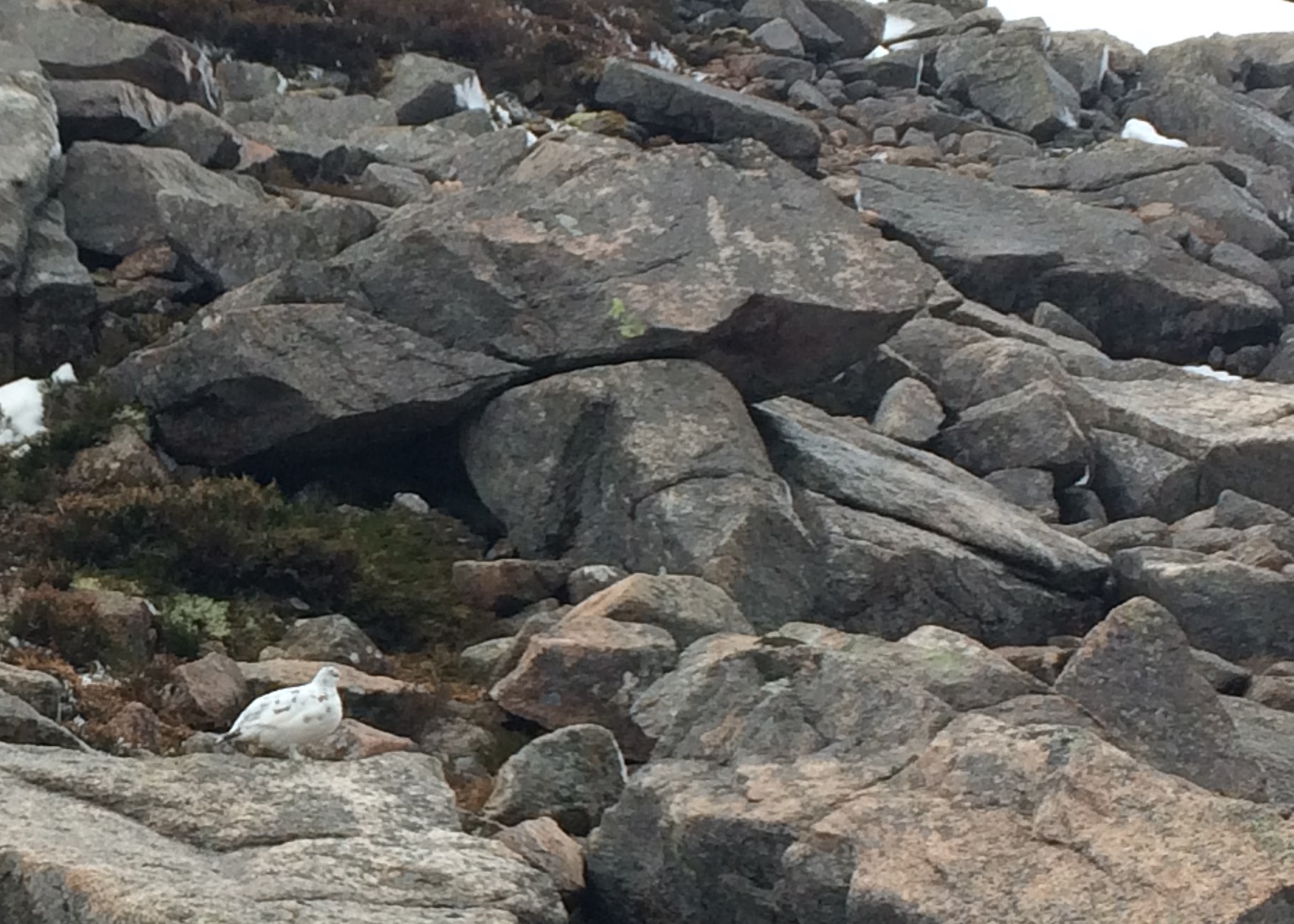
Unsurprisingly we didn’t stop to take any photos during the rescue, but here’s a different boulder field to give you an idea of the type of terrain. Bonus point for spotting the ptarmigan!

By this time we realised we needed more assistance – Joe and I alone weren’t strong enough to remove the very large and heavy stones. Olly was at the Centre so we called him to come up the hill with tools which could potentially act as leverage. We also called Lotti down from bringing in Dante for an extra pair of hands. By this point 15-20 minutes had passed and Galilee decided there was too much commotion for her to be sticking around so she went back and joined the main reindeer herd, leaving us to find her calf. After removing, with great effort, some very large boulders we got our first glimpse of the calf… she was about 5ft down, but alive! I managed to reach as far as I could and with the tips of my fingers I could feel her. With a bit of rummaging I got hold of her back legs and very gently pulled, cautious not to cause her any hurt or injury. In my first attempt to pull her out there was too much resistance, like something was stuck. I pushed her back down, moved her body around a bit more, hoping she would release whatever was stuck. I had to do all this by feel as she was so far below ground that we couldn’t see her. On my second attempt to pull her out she came much more easily, and once I could get a second hand on her I supported the rest of her body and head coming out the hole backwards.

The poor wee girl probably didn’t know what was going on and we have no idea how long she was down there. She had rubbed the hair from the knees on her front legs and also a patch on top of her head so with a few bald patches and a sore back leg I carried her the ½ mile across mountain ground back to her mum. While walking back she was nuzzling my armpit looking for some milk – she was obviously quite hungry. I popped her down in front of Galilee who without hesitation sniffed her and realised it was hers. I suspect the two of them immediately forgot the whole scenario, being animals I don’t suppose they think of the past or what just happened. But I will remember it for a long time yet. Having been cooped up in a hole for so long she was a bit staggery on her feet to begin with but the wee calf was absolutely fine.

Back at the nearer end of the hill enclosure and reunited with her mum – but complete with bald patch on her head and rather bumpy knees!

Once it was all over and we could breathe a sigh of relief one of us used a phrase quite common amongst us herders… “Holy Moley, what a day!” And from there she got her nickname – ‘Holy Moley, the calf who fell down a hole’. It was never intended to be her name forever but inevitably that has happened. Most reindeer who end up with a nickname from a young age keep hold of it for the rest of their life – Grunter, Hippo, Paintpot and Hamish to name a few.

With mum Galilee (right) on the summer free-range – Holy Moley’s missing calf coat on her head still making her easy to pick out amongst the other calves.

So there we have it, at two days old Holy Moley fell down a hole between boulders and without our assistance she would not be with us today. She’s had a pretty tough start to life as unfortunately we then lost Galilee, her mother, in the summer while the two of them were free-ranging in the Cairngorm Mountains. Holy Moley has managed to muscle through on her own by keeping herself with the herd, stealing milk from other females and I suspect by having a bit of fight in her she will go on to be a big strong female reindeer herself. She certainly didn’t give up in the hole and every time we catch up with her on the mountains she makes sure she’s first to get her head in a bag of feed… She knows we’ll look after her!

Holy Moley in September, complete (once again) with bald patch, this time after the vet had to remove her badly broken antler!

Fiona

The wonderful (and slightly disgusting) life of a reindeer mum

This year I was lucky enough to spend May looking after all the cows and calves during calving season, whilst most of the country was in lock-down. This was my first calving season and I found it really fascinating to watch how the behaviour of the reindeer changed once they had calved. Especially for the first-time mums who were acting purely on instinct, which amazed me how strong that is! There were a couple of things that I noticed a few of the mum’s doing in the hours and days after they had calved which I thought might be interesting to read about.

Licking their calf dry

The very first job of a reindeer once she has calved is to lick her calf dry. This year some of our calves were born in the snow so they want to get dry as quick as possible so that their fluffy calf coat can keep them warm. I was incredibly lucky to be able to watch Brie calve this year, I watched through binoculars as she carefully licked all the placenta off the calf, Cicero, until he looked like all the other calves I had seen at a couple of hours old – fluffy rather than slimy.

Eating the placenta

Being an arctic animal, every bit of nutrition reindeer can get is very important – placenta included. We found Ibex and her calf Flax when she was a couple of hours old, by which point Ibex was obviously feeling peckish. I can’t say that it looked particularly appetising to me but then I’m not a mother, nor a reindeer!

Licking their calf’s bum

To stimulate the calf suckling the mother must lick her calf’s bum. This all works in a cycle because the cow licking the calves’ bum stimulates the calf suckling and the more that the calf suckles the more milk that the cow will produce! All resulting in a good strong calf. It’s also very important to help keep the calf clean, their very first poo can be very sticky and a couple of the mums – mostly the ones who had had many calves before – didn’t do a very good job of licking their calves bottoms meaning we had to do it instead (cleaning it, not licking it….)! I can’t really believe how something so smelly can come out of something so sweet, so I guess I can’t really blame the cows. When the calf is really young the mum will also lift her leg so that the calf can suckle whilst lying down, here is Pagan demonstrating both very well with her calf Pumpkin!

Teaching the calves to walk  

The last thing that I found really interesting was the way that the mums get their newborn calves to start walking. As a prey animal it is very important that the reindeer are up on their feet as soon as possible. But how do they go from an incredibly wobbly newborn calf to the agile calves who can easily outrun me? The answer is lots of careful training from their mums. From when Cicero was about 20 minutes old, Brie started to stand up and walk a few metres away and wait for her calf to take a few wobbly steps over. The calf would then lie down exhausted for a while before she did the same again. Eventually the steps become less and less wobbly as the calves grow stronger.

Lotti

What’s in a name?

People who see our photos on social media without knowing much about us must wonder why some of our reindeer have such strange names. Where’s Dasher and Dancer? Prancer and Vixen? And Rudolph??? Where on earth have ‘Pavlova’, ‘Caterpillar’ and ‘Clouseau’ come from?!

Santa’s lesser known reindeer: Hopscotch, Kipling and Hobnob???

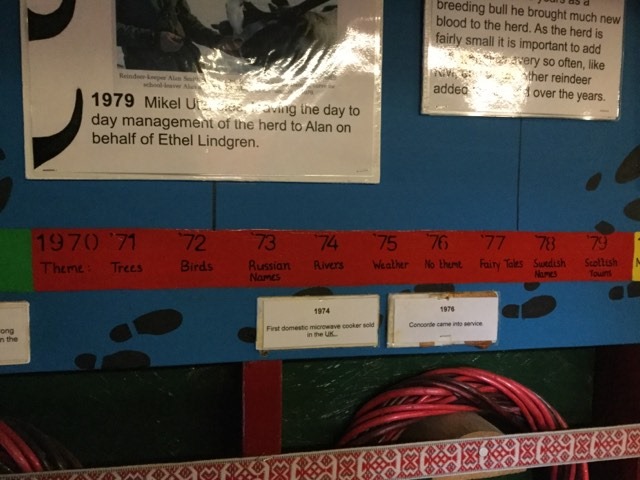
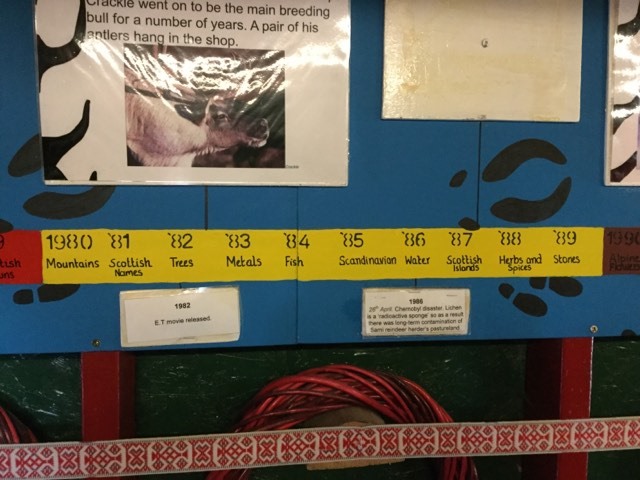
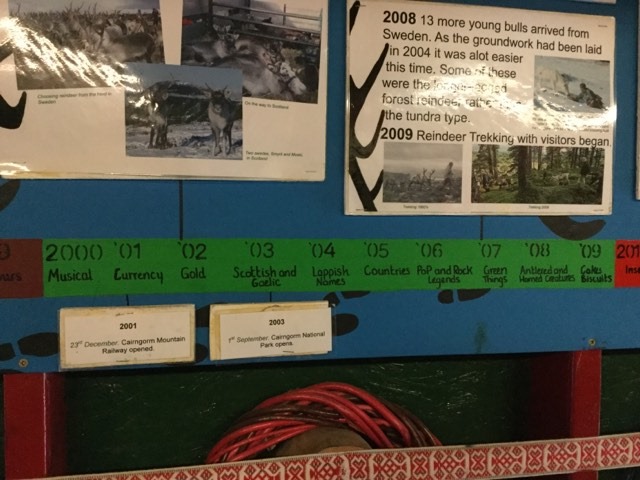
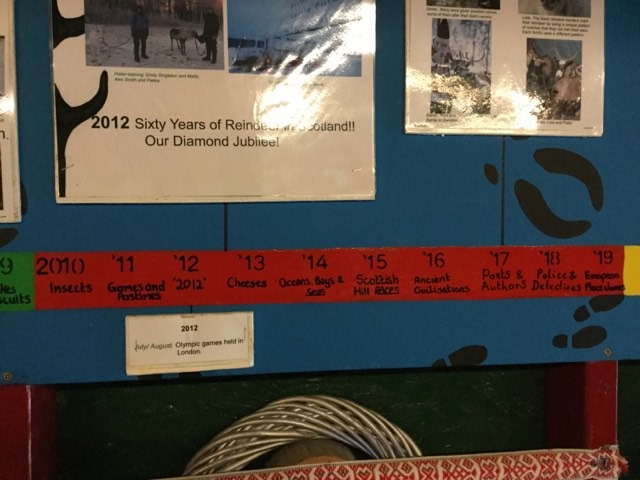
We’ve been naming the reindeer on a theme each year since the early 70s. As well as making life a bit easier for us coming up with 15 – 30 brand new names each year (where would you start otherwise?!), it has a very practical application in that it helps us remember the individual age of each reindeer, based on their moniker. For farmers naming animals is often done using words starting with a certain letter of the alphabet each year, but different themes is our chosen method.

Up until the early 70s Mr Utsi named his reindeer mainly just with human names, both English and Swedish in origin. However, in 1971, the calves were instead given names of different trees, such as Spruce, Larch and Alder. In 1972 it was birds: Raven, Wren and Hawk. And Tit (teehee).

Themes need to be chosen to have enough ‘good’ names; those not too long, not too complicated, not double-barrelled and either unisex or enough names suitable for a rough 50:50 split of male and female names within the theme. This rules out some ideas pretty quickly.

Camembert – no prizes for guessing her naming theme!

Over the years however, all the ‘obvious’ themes have now been done. Rivers; Butterflies; Countries; Sweeties – we’ve been there and done that. We do our best to never reuse a name as each reindeer is their own character and we feel they deserve an individual name, but also because it can cause confusion on the database if there’s more than one of the same. We do accidentally slip up however – I’m well aware that both Juniper and Frost in the herd are not the first of their kind. I think Lady holds the record – the Lady that I knew when I first started here turned out to be Lady the Third when I looked closely at the database…

So now we have to think outside the box, hence our slightly off-the-wall themes of later years. This year the calves are named after ‘Seeds, Peas and Beans’. We did ‘Police and Detectives’ recently. And before that ‘Ancient Civilisations’.

To an extent we try not to use themes that are too commercial, hence ‘car makes’ or ‘football clubs’ aren’t options. Something else we don’t do, or not nowadays at least, is to allow other people to name reindeer in our herd. This is quite a popular request, and most often comes from people wishing to name a reindeer in memory of someone in their family who really loved visiting the reindeer, or had some special connection with the herd for one reason or another. While this would seem a lovely tribute, sadly reindeer don’t live forever and we don’t want people to be too invested in a certain reindeer, only for it to pass away unexpectedly. Sod’s law is a big factor here – allow someone to name a reindeer in this manner and you can almost guarantee it will be the one to pop it’s clogs a week later… However, we like to accommodate people if possible, so we have in the past, in exceptional circumstances, allowed someone else to choose the theme (from a shortlist). We did it this year in fact – ‘Seeds, Peas and Beans’ was chosen in memory of a gentleman to whom gardening had been a very important part of his life.

While all the staff here are involved in naming the calves each year, the Smith family, who own the reindeer herd, have the final say in all names. And themes they don’t like won’t make the grade. Hence don’t bother asking us if ‘Game of Thrones’ will ever be the theme – I can tell you right now that it won’t. I did make a bid for ‘Sean’ for this years’ theme (think about it) but sadly it was out-ruled.

Just a gang of detectives… Sherlock, Poirot and Morse

Of course there end up being lots of exceptions to the rules and reindeer often end up with really random names, but I think some details of these can wait till a future blog (which I’ve now written!).

Hen

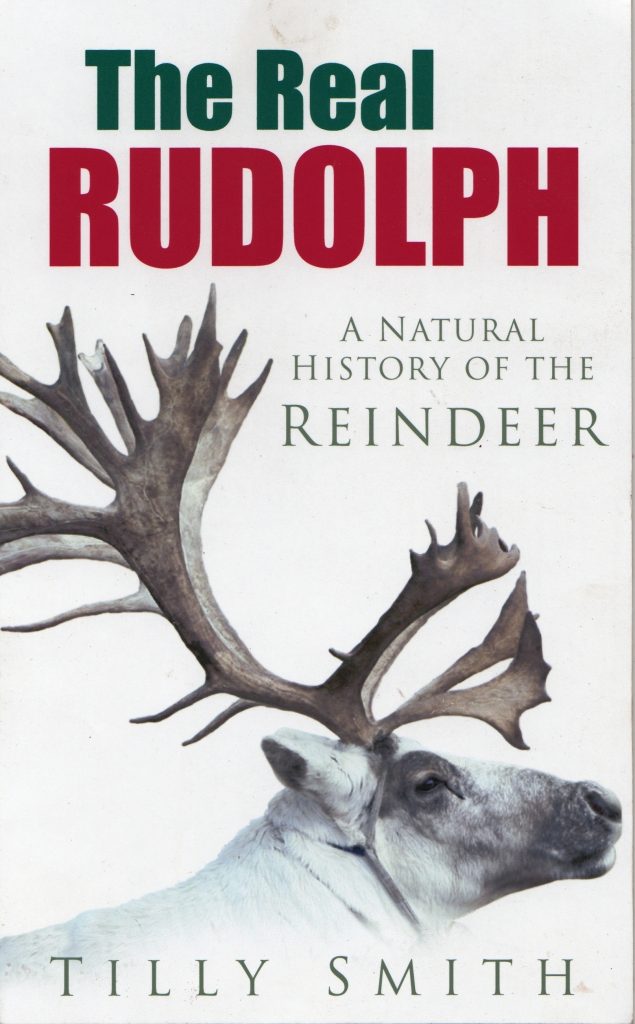
The Real Rudolph

The Real Rudolph: A Natural History of the Reindeer was the second book I wrote and this time was commissioned by Sutton Publishing. The publisher had already come up with the title and they were looking for a book of ‘hard facts’.  Packed full of juicy info about reindeer and caribou (which are actually the same species, but coming from different parts of the world), I combined a lot of research with personal experiences and I was lucky to know a number of good photographers who kindly provided amazing photos which are littered through the book.

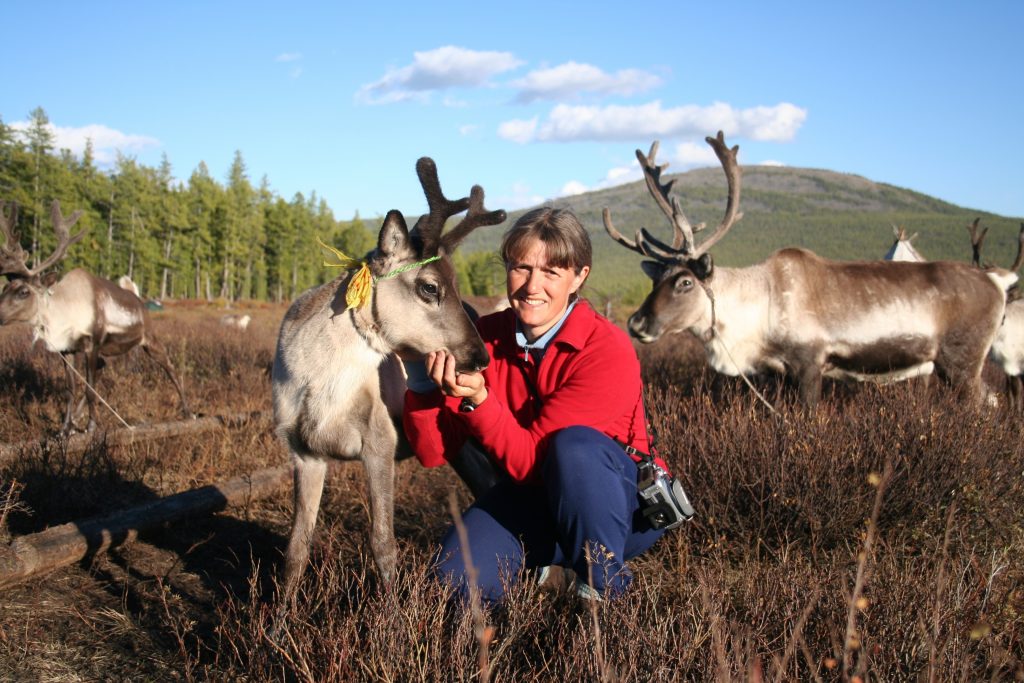
In Mongolia – Photo by Alex Smith

The photo on the front cover is from a picture I took of a reindeer bull in Outer Mongolia and I dedicated a chapter to my trip there in 2005 and also various excursions to Swedish Lapland, which ultimately led to us bringing new breeding stock back from there.

The first half of the book is all about their world distribution as a species, seasonal nature, arctic adaptations, how they fit into the ‘Deer Family’ and their domestication.  I did have one gentleman get in touch to say it was the most interesting and entertaining textbook of reindeer he had ever read!

But I was always conscious that readers would also be interested in the Cairngorm Reindeer Herd, particularly since I would be selling it here at the Reindeer Centre and so the second half of the book was not just about my personal experiences of far flung ‘reindeer places’ but also some stories closer to home.

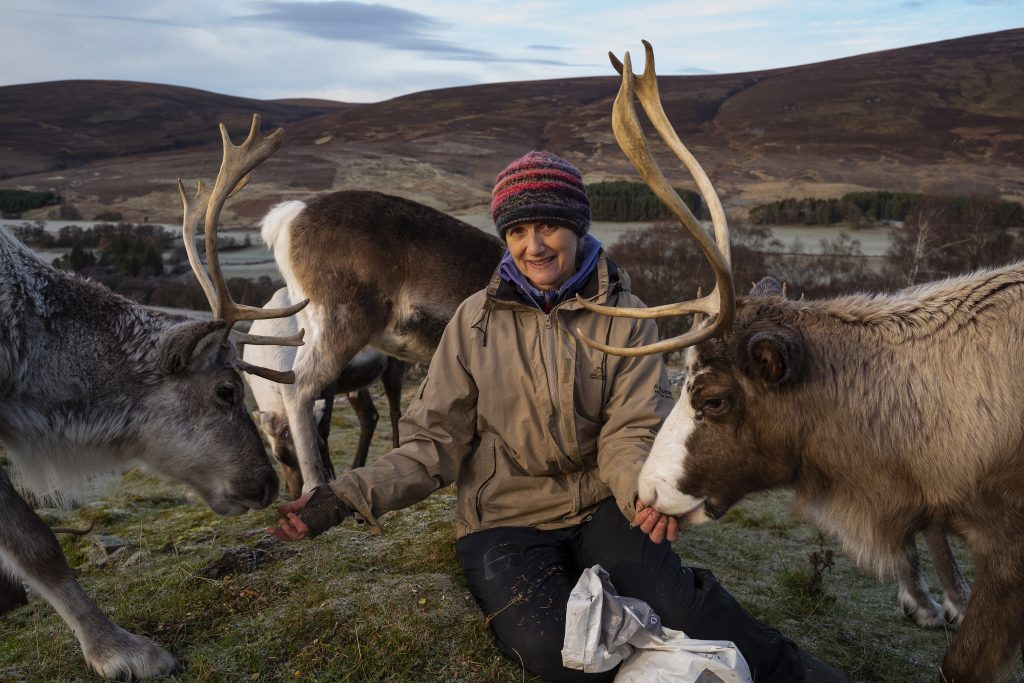
Rather closer to home… at home in fact! Here I am a couple of years ago on the hill ground of my farm with yearling bulls Burns and Dr Seuss. Photo: John Paul

Published for the Christmas market in 2006 it is now sadly out of print, but it can be acquired, very cheaply, on Amazon!! It is (although I say it myself) a very informative book, is well produced with high quality paper and photos inserted into the text, rather than clumped together in sections as they were in my first book, Velvet Antlers, Velvet Noses. That book is also out of print now, but my latest book Reindeer: An Arctic Life is in print and available on our online shop (please click here to have a look), along with several other books and items. Many are suitable for stocking fillers!

Tilly

Book Now