Volunteer Blog: Emm’s Visit – October 2025 (Part 2)

Time for part two of Emm’s wonderful blog, picking up where we left off last time – a broken Brenda and reindeer to herd!…

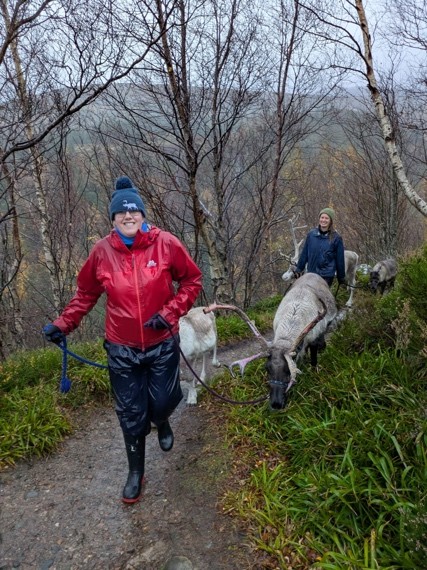
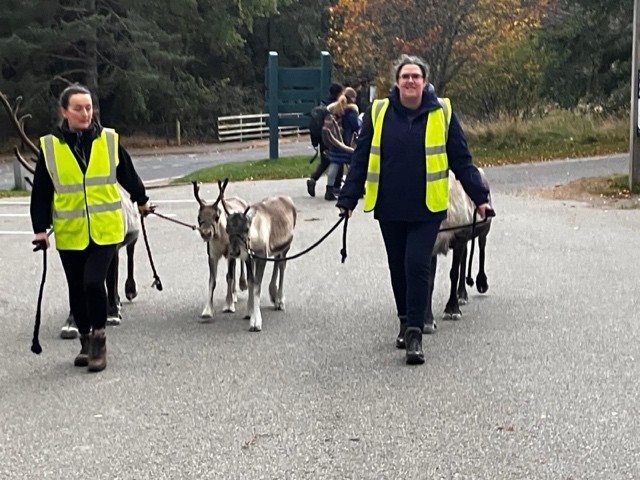
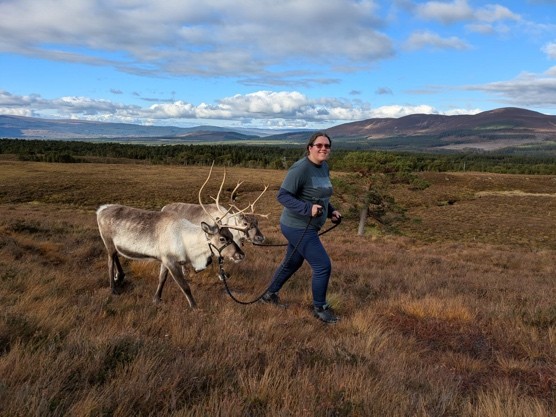
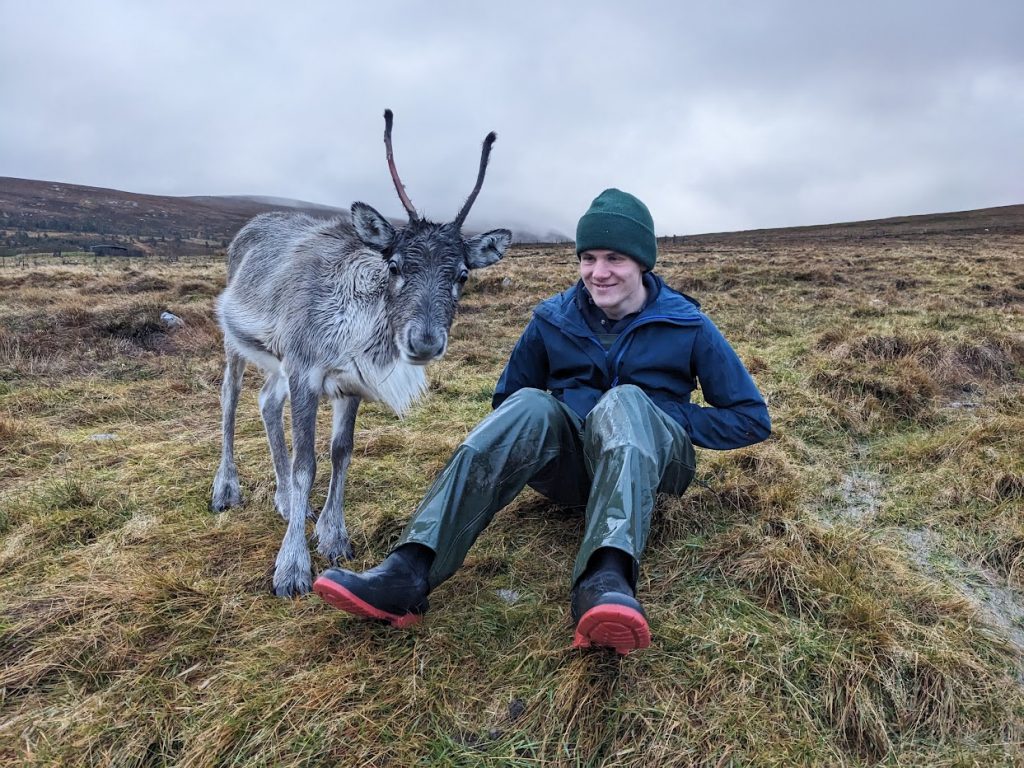
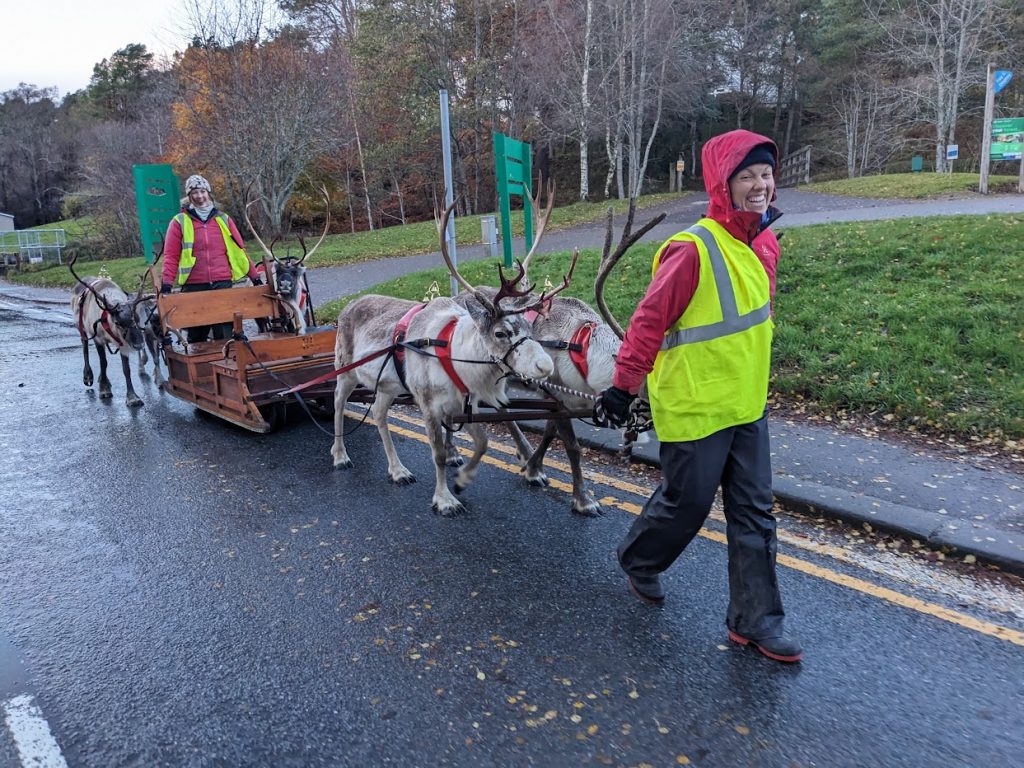
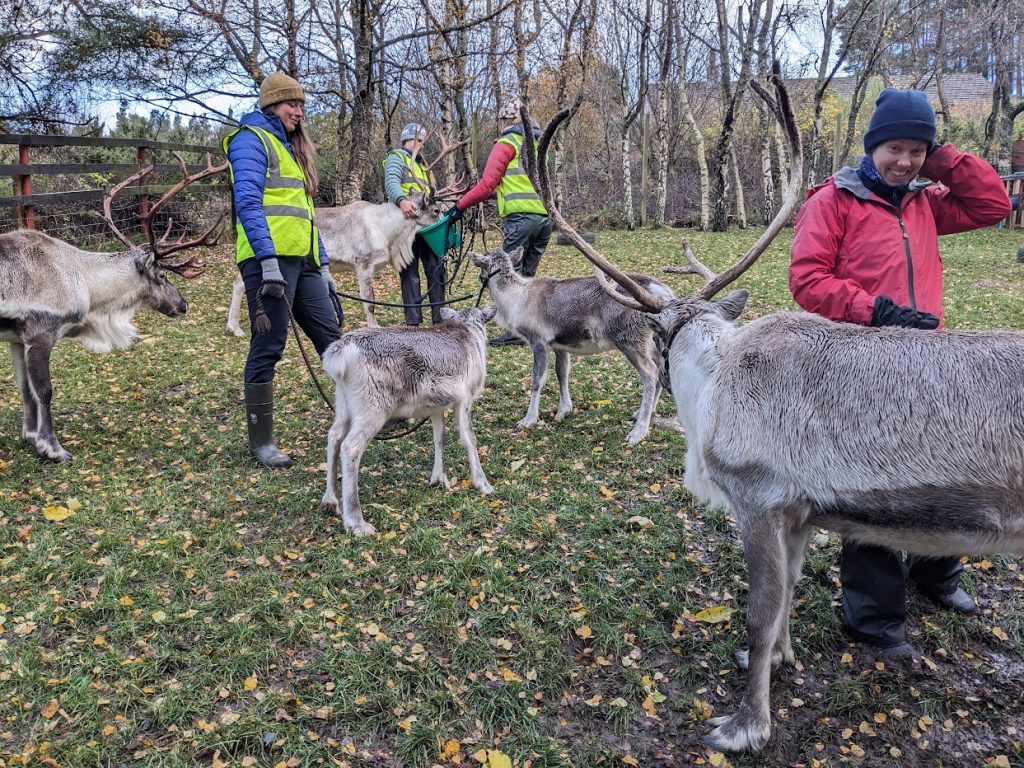
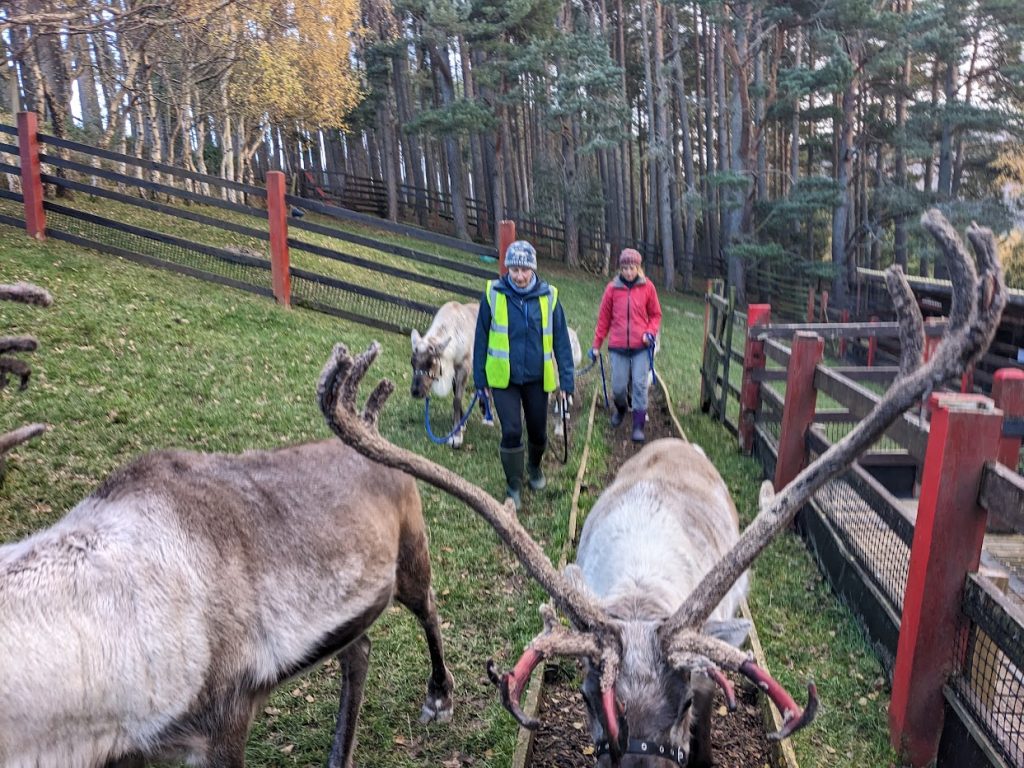
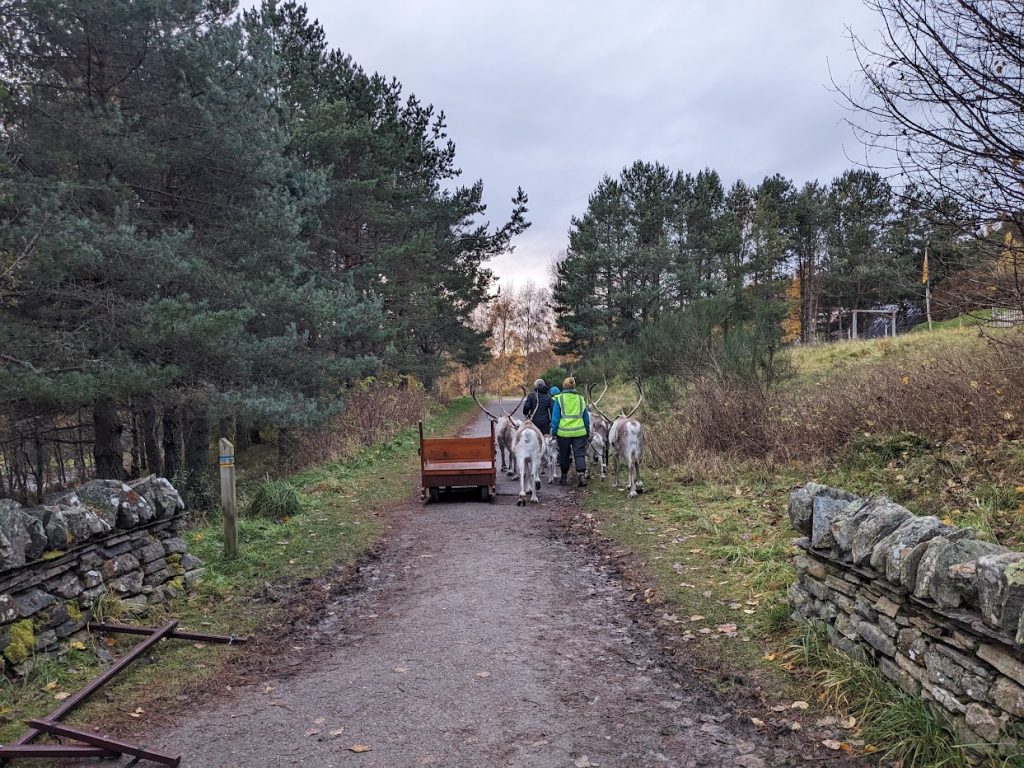
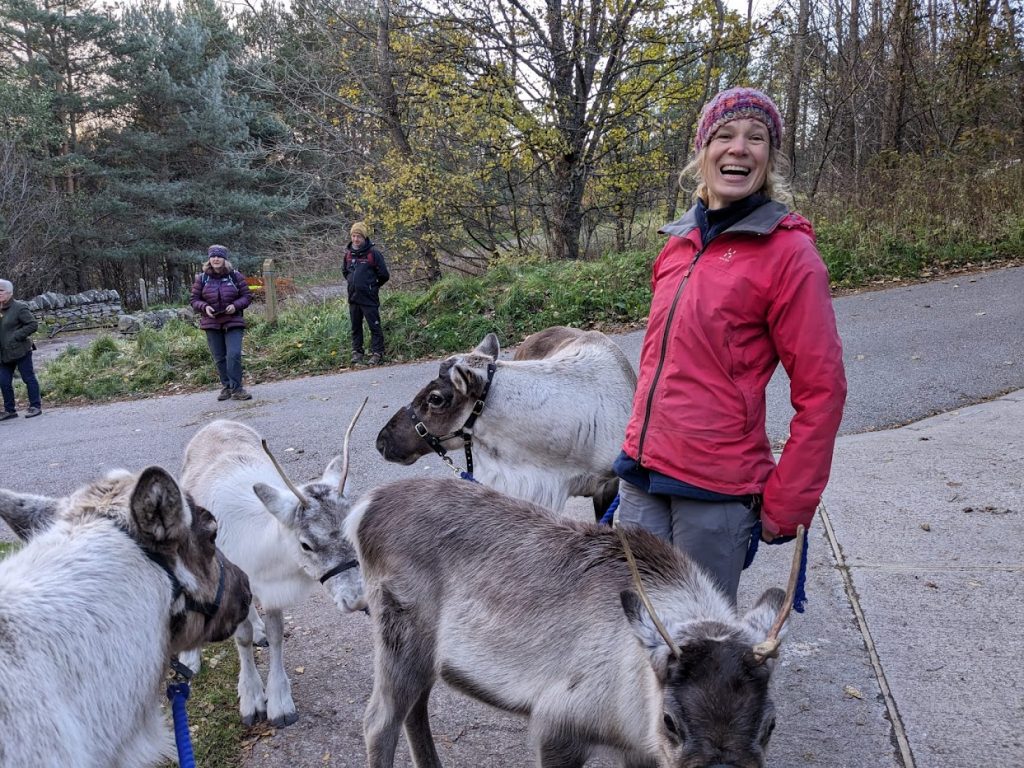
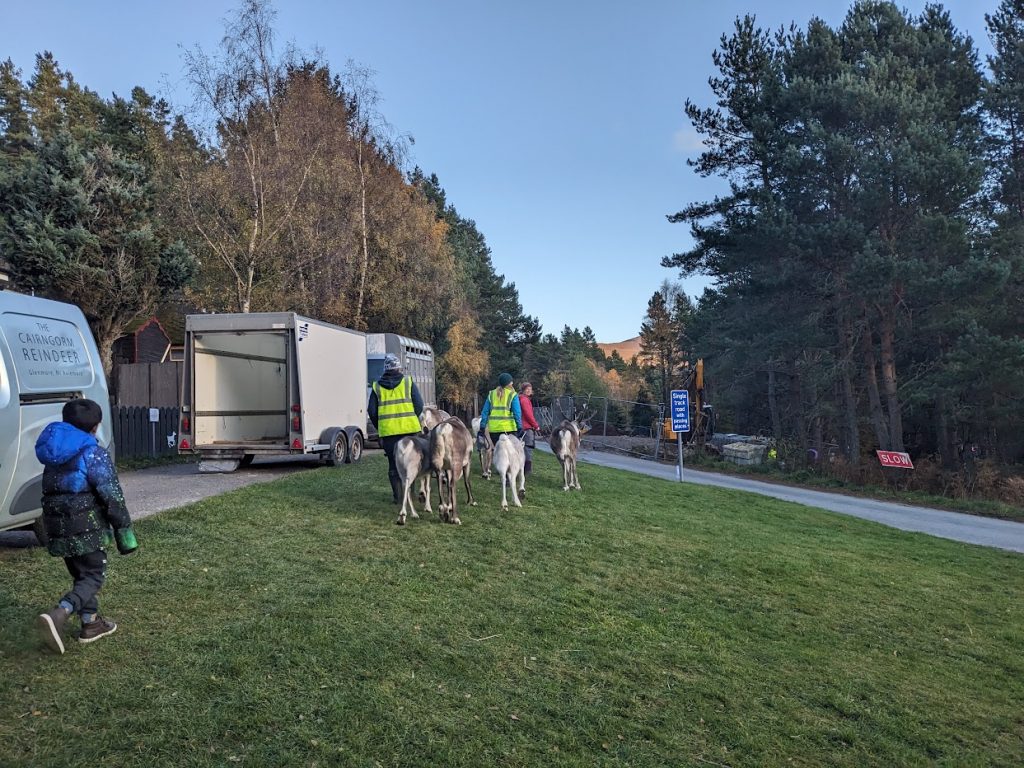
The next day I helped Lotti and Ruth walk the calves Oro and Flamenco around Glennmore. Akubra and Kulfi were the adult reindeer who came with us. I walked in front to make sure there were no dogs coming as reindeer are scared of dogs. They think that they are wolves. I also picked up the reindeer poo too if they went to the toilet.

Daisy and I did a very wet, windy and cold Hill Trip. We took the visitors to the Hill Trip spot but the reindeer were high near the ridge and were not coming down. So Daisy went up to encourage them down while I did the hand feed talk to the visitors and talked to them about reindeer facts and told them their names and naming themes. We then were able to feed the reindeer when they had come down with Daisy. We were splitting Sundae off because she is in season. I stayed with Sundae for most of the Hill Trip to keep an eye on her.

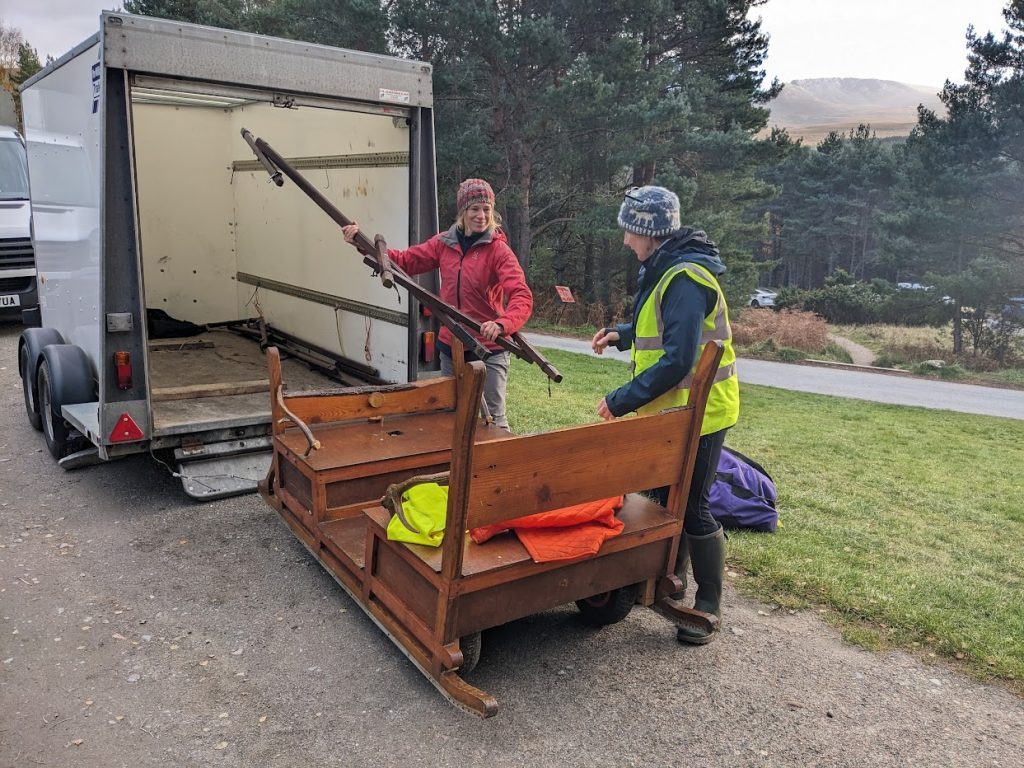
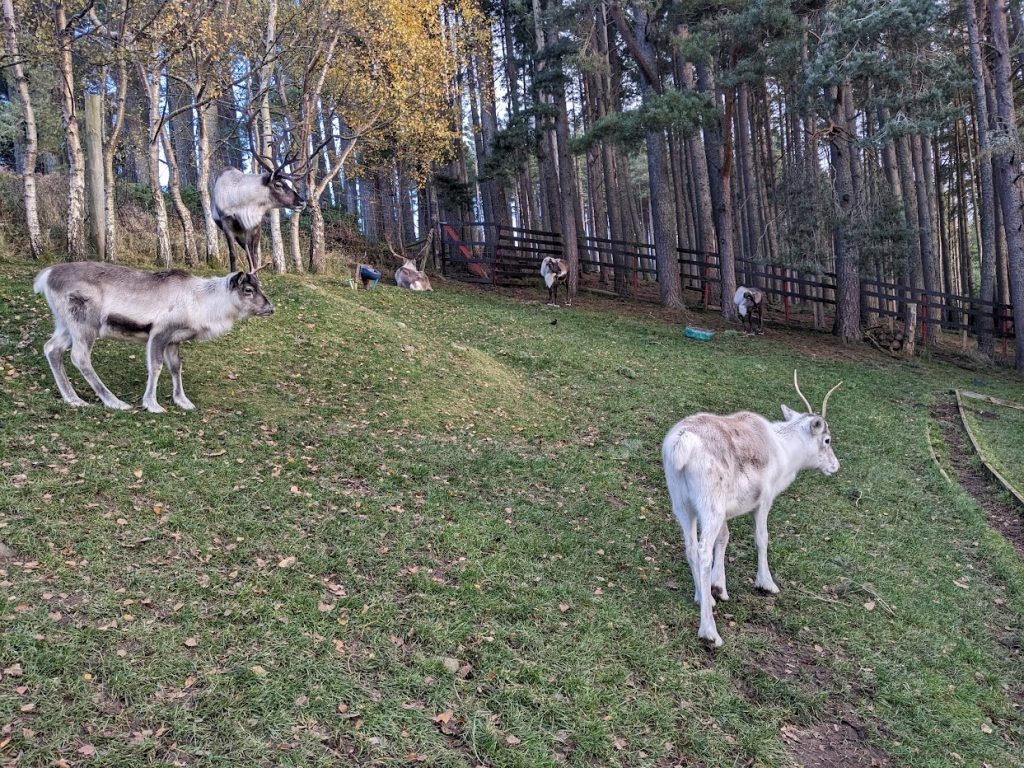
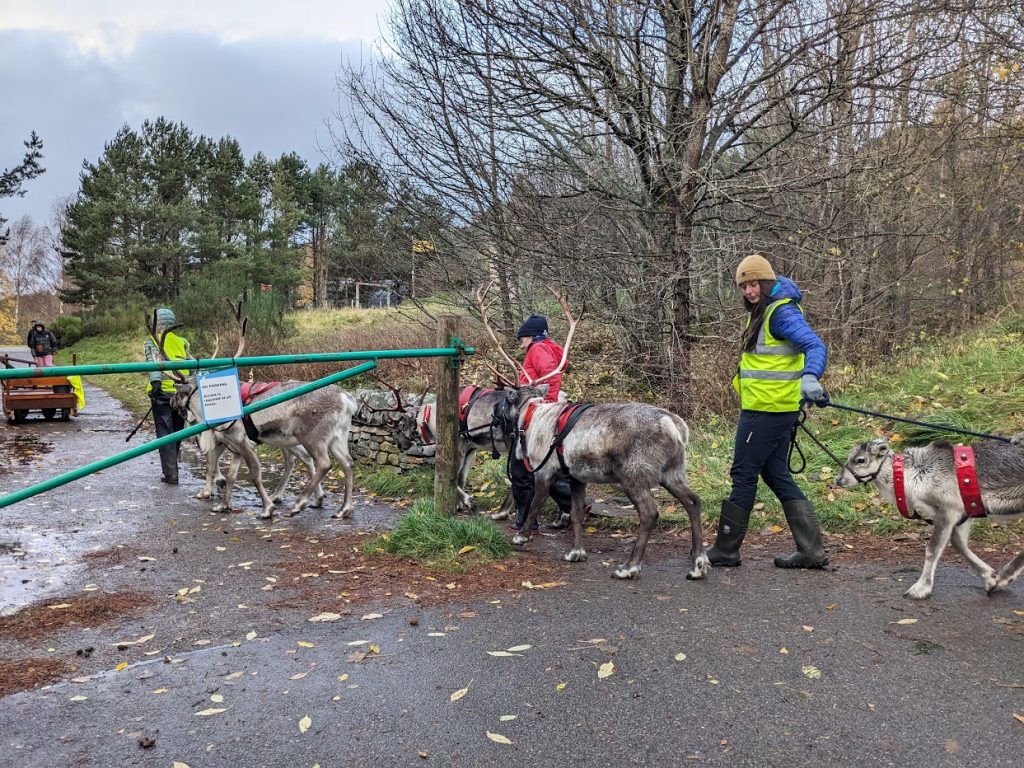
After the Hill Trip, I met Ruth and Lotti by the Sugar Bowl carpark and helped take Akubra, Kulfi and 2 calves called Disco and Foxtrot up to the hill enclosure. We were doing a Paddock swap as Disco and Foxtrot had finished their calf training school.

Emm walking Akubra and Foxtrot back to the hill enclosure.

I got very wet and soggy and had water in my wellies. It was like a loch in my wellies. Lol.

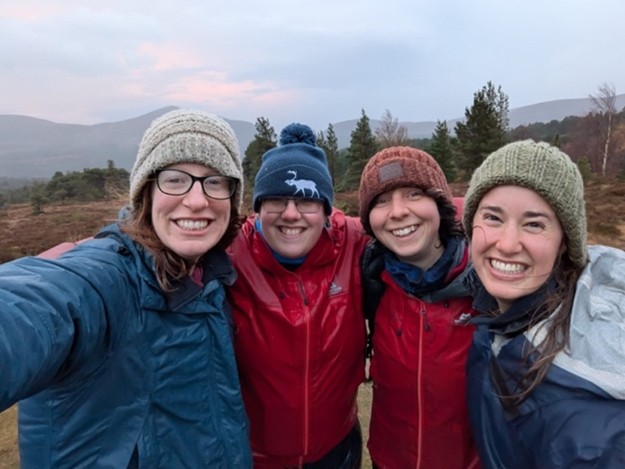
A very soggy team of herders! Ruth, Emm, Daisy and Lotti, still smiling despite the miserable weather.

Another day up on the hill, Vienna was looking miserable and sad and she kept going away from the other reindeer.  So we put her in the shed area and pen with a friend and kept an eye on her and checking her temperature. The vet came to check her and did some treatments to see if they helped her and to see if it made her feel better. Along with Ruth I joined Daisy and Kate near the end of the Hill Trip. We needed to take Ceilidh’s temperature. We couldn’t catch her so Kate led Glacée, Ceilidh’s mum,  and with Ruth I herded Ceilidh from behind to a smaller bit of the enclosure called the temporary corral. Daisy managed to catch Ceilidh to find she did have a temperature so Daisy injected Ceilidh to bring it down. Me and Kate took Glacée and Ceilidh to the shed to keep an eye on Ceilidh. Kate led them and I herded behind.

Glacée and a much brighter Ceilidh after spending some time being cared for by the herders.

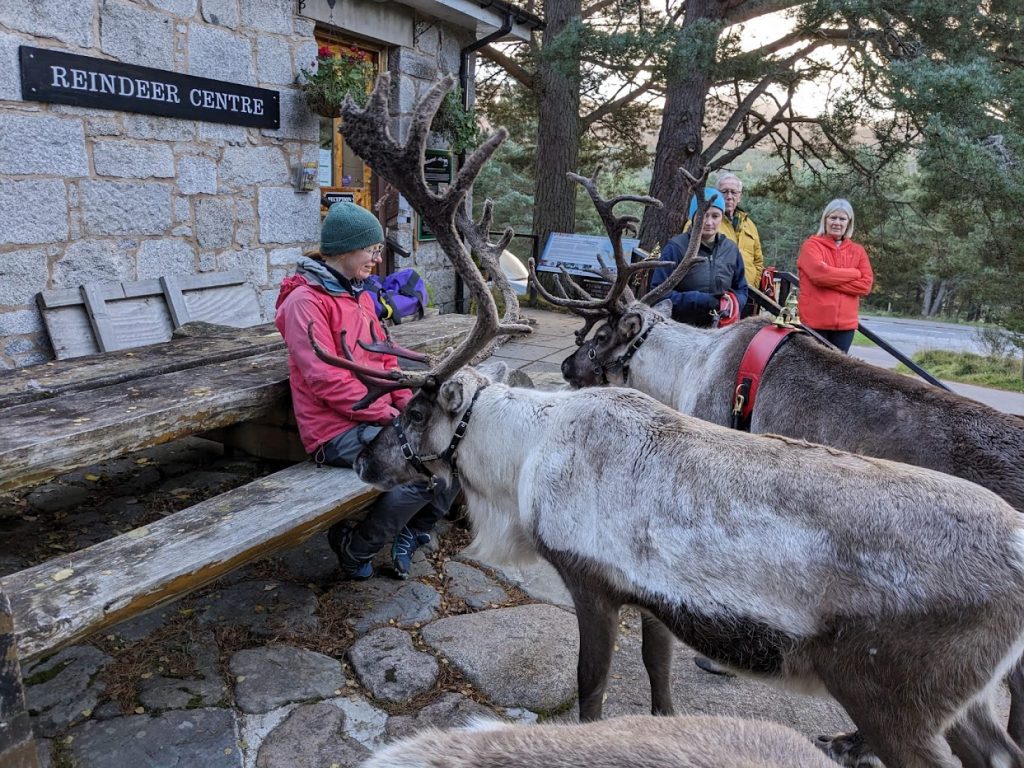
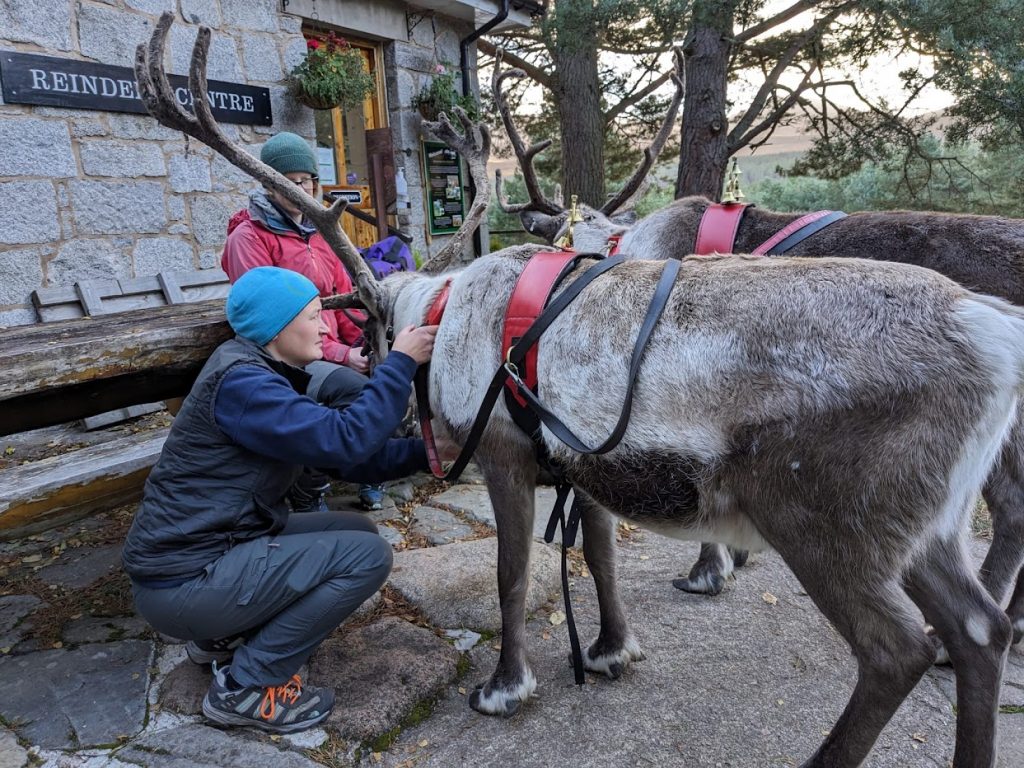
The inside jobs I did were sweeping and hoovering around the Reindeer Centre. I also mopped the floor downstairs. I washed the wellies and put them up to dry then away later. I put a sticky label with the reindeer herds news on the back of each newsletter photo. I also put the newsletter and the newsletter photo into envelopes. I put the 1st year adopt packs together and I also did some shredding. I did feed mixing and hand feed mixing too, poo picking in the Paddocks and also let the reindeer through into their daytime Paddock area for their breakfast. In the evening I put them to bed and give them their tea in the night time Paddock area. I also got taught how to lock the Reindeer Centre’s carpark and swept the steps outside the Reindeer Centre, behind the lift and outside the front.

It is lovely meeting the visitors too on the Hill Trips. It is lovely seeing their reactions when they are amongst the reindeer and when they get to hand feed a reindeer. On most of the Hill Trips, I did the hand feed talk and on one of them I did the introduction talk. I also got to see my adopted reindeer Scully and Zoom while visiting which was fantastic. I met Scully’s calf called Rumba which I was very excited about.

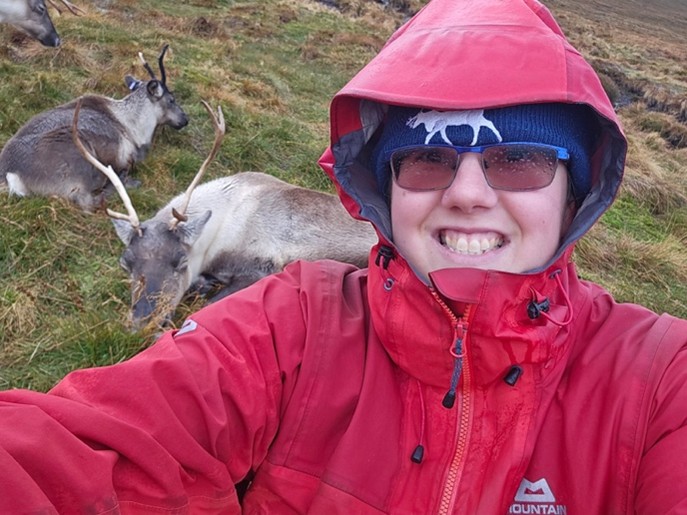
Emm taking a selfie with the lovely Scully and Rumba.

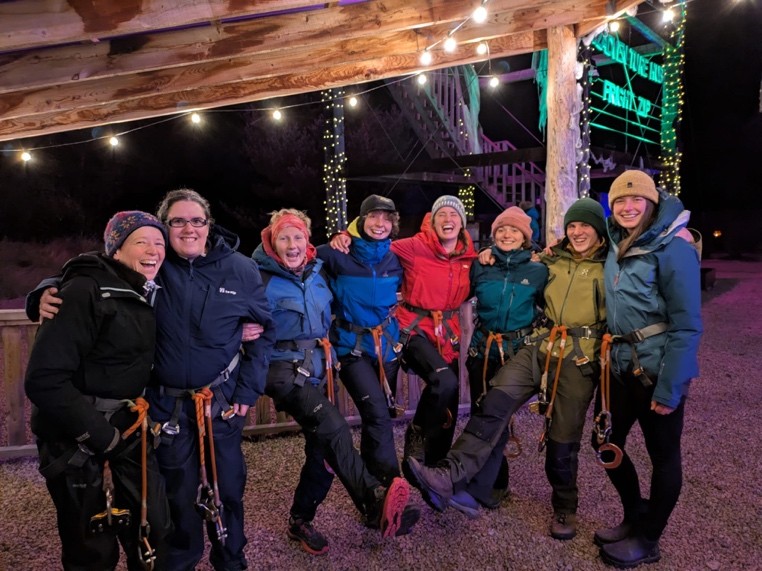
Away from the visitors and Hill Trips and I was able to enjoy spending time with the herders. While I was there they went on a zipwire trek (run by local company G2 Outdoor) on one of the dark evenings and I was very lucky to be invited to join them. It was very exciting. When you went in, a pretend big spider suddenly came down on you and there was a ghost in the toilet. It had lights and Halloween things when you went around. You went over rivers and through trees. You had to do a torch flash saying the next person can go. I had a race with Andi at the end and I went so fast. I really enjoyed myself. It was such great fun. Thank you ever so much everyone for letting me come.

A night of zipping through the trees for the reindeer herders! All smiles from Andi, Emm, Sheena, Daisy, Lotti, Kate, Cameron, and Amy.

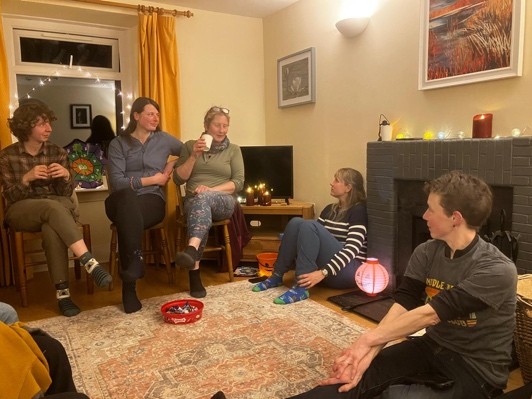
On another evening, my reindeer herding friends came around to our holiday cottage for a curry night which was great fun. My Dad and Mum had made lots of curry and we ate and chilled out and I gave them a tour of the holiday cottage. Sheena had brought around a great spider target game which we played. The spiders were sticky and they ended up hanging of the ceiling and one even dropped into Ruth’s curry. Lol.

A wonderful evening of delicious food, great company, and sticky spiders!

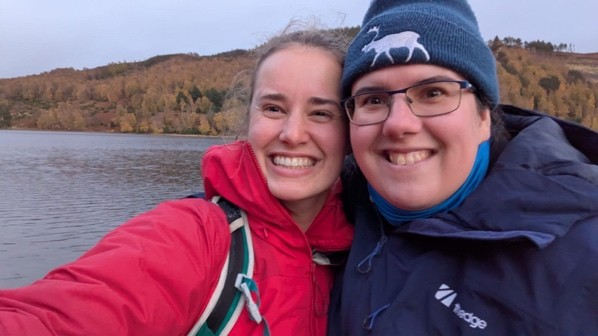
Another day I went on a lovely walk with Lotti by Pityoulish Loch and we had cups of tea and sat and chilled out on the pontoon and watched the wildlife. It was a lovely spot.

Lotti and Emm enjoying a lovely walk wildlife spotting.
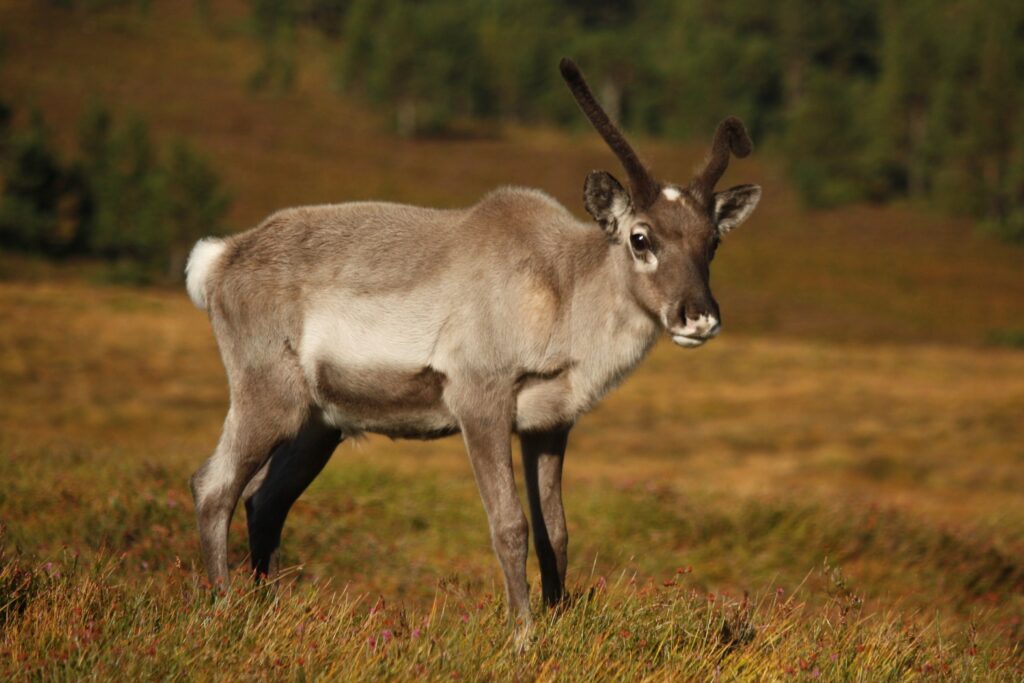
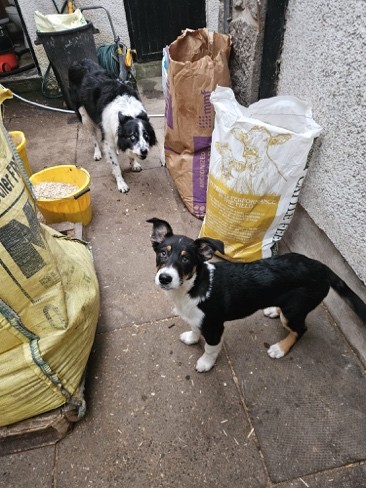
I met Daisy who works at the Reindeer Centre and her lovely dog Echo who is very clever and we went on a lovely walk to Green Loch and then up through the trees at the back of the Reindeer Centre. I also met Fiona’s and Joe’s lovely puppy called Sanna who is very cute and I also met Alicia who works part time at the Reindeer Centre. 

Echo teaching Sanna how to sneak up on the herders and steal the reindeer food!

It was so lovely to spend my spare time with such special friends doing things we all enjoyed. I can’t wait to go back in March 2026. I am counting down to the day. I am so excited.

Emm

Volunteer Blog: Emm’s Visit – October 2025 (Part 1)

In this latest blog I would like to share some memories from my visit in October 2025. It was very exciting as the new reindeer exhibition was open to visitors with lots of interactive things, videos, information and photo displays. It is so brilliant. The visitors will learn lots of things about reindeer and the history of the herd.

Emm is back, and we’re so thrilled! Emm, Lotti, Amy, and Jig all posing for a team photo!

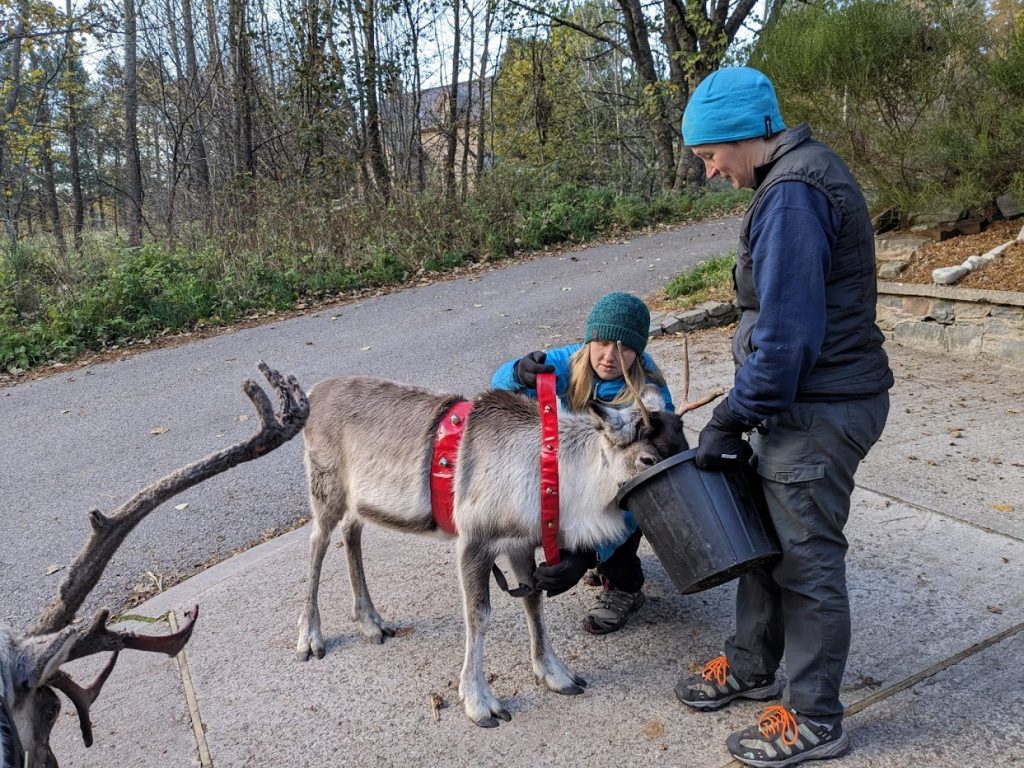
On my first morning, I walked the calves around Glenmore with EK and Cameron. The calves this year (born in spring 2025) are named after types of dances so I had a lot of fun learning all their names. We walked Ballet and Polka with 2 adult reindeer.

Emm and EK walking Ballet and Polka during calf training.

We were getting them used to everyday things like people, traffic, being led and being handled. Afterwards, Cameron showed me his shed he had built for the reindeer poo bags so they don’t get wet and it is named the poo shed, and it is really good.

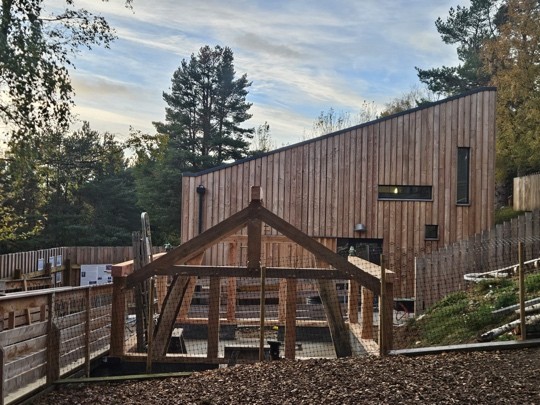
There were some new things in the Paddocks. The Santa’s bothy was being built by Alex and Cameron, and they were hoping it would be ready for Christmas. There was also an extended area for the reindeer in their daytime paddock area in the trees.

Santa’s Bothy under construction!

Jimmy the bull, who had been over on Silvermount in the hill enclosure with his group of girls, had finished his job with them so one morning Lotti, Ben and Cameron led him off the hill as he was going to go back to Tilly’s farm.  We were also taking Gazelle off the hill to go back to the farm that morning too.

Boogie relaxing with some of our older boys.

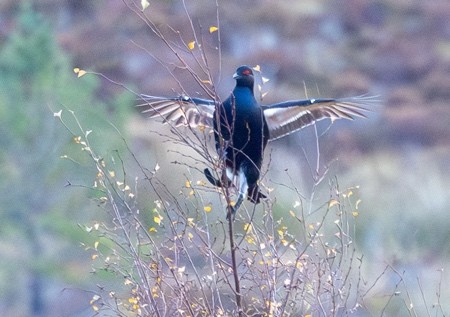
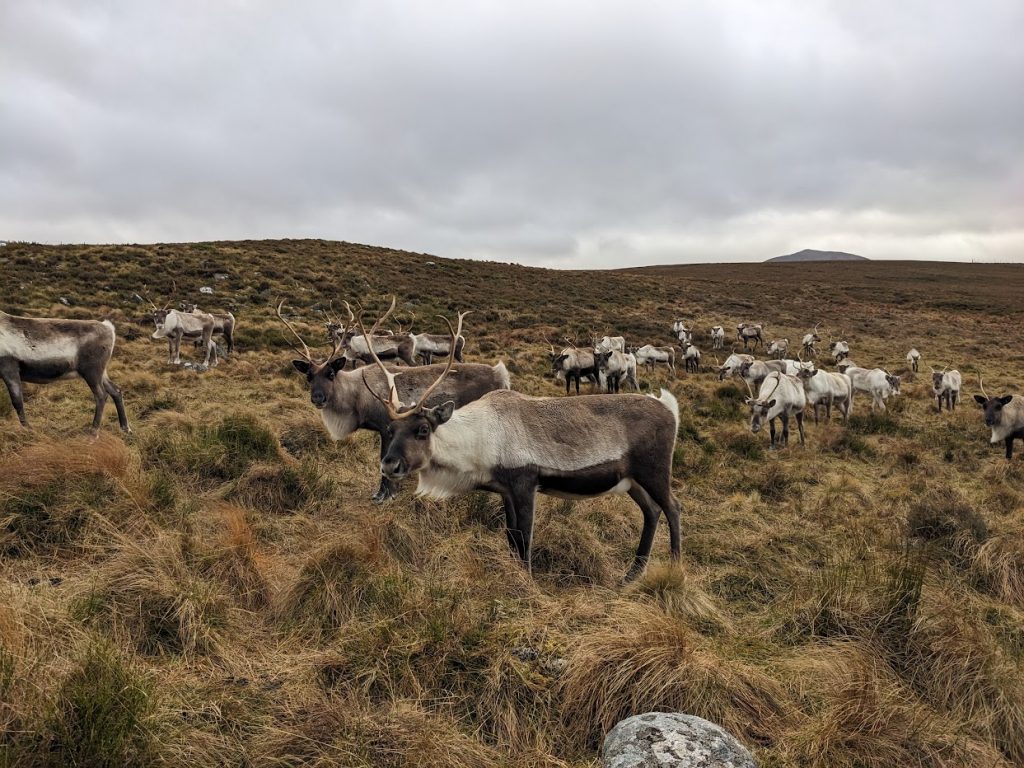
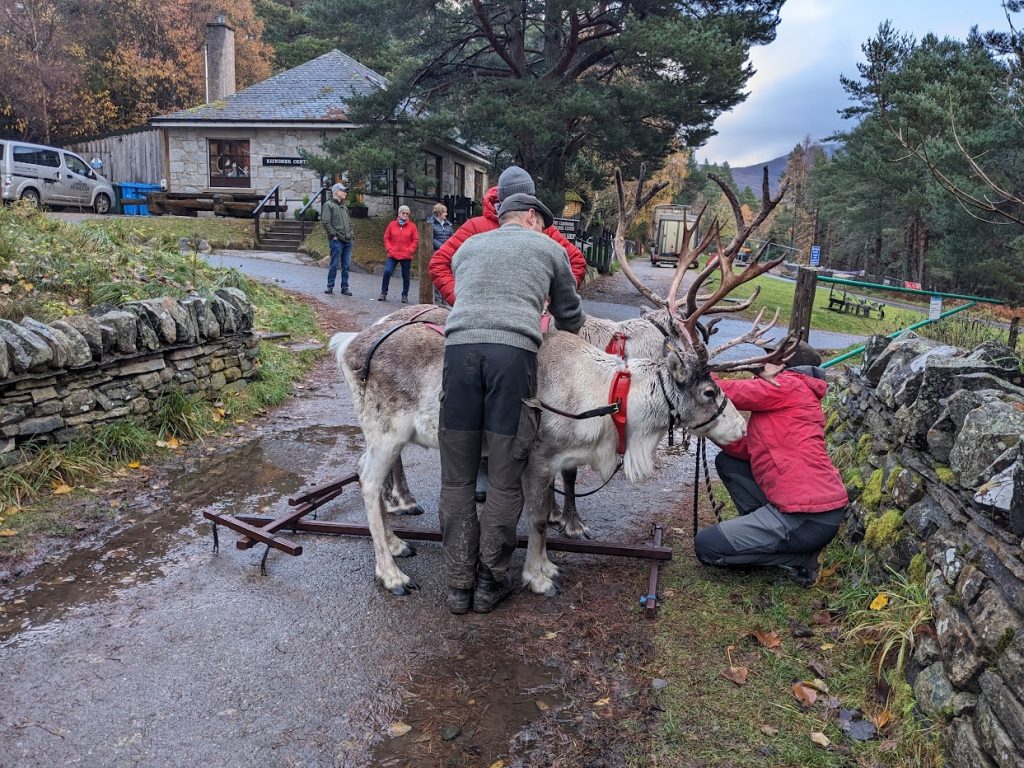
I led Gazelle off the hill to Brenda (the truck we transport reindeer in). Ruth and I went to find Vienna one of Iskrem’s girls as they had been moved into a different part of the hill enclosure and she had become separated from them. Iskrem is a very calm bull. We found Vienna and we had to herd her up the hill, as she didn’t want to be caught, to join Iskrem and his girls. Then we moved them as a group to a different part of the hill enclosure. We were very lucky that day as we saw 6 Black Grouse lekking.

Our hill enclsoure isn’t just home to reindeer.

The day after, I went with Kate, Ruth and Daisy back to Silvermount in the hill enclosure so we could move Jimmy’s girls to where they were meant to be next. Nuii and Fab were missing so Kate went to look for them. We let a few of them out to be with the main herd in the east enclosure in the hill enclosure and I helped Daisy and Ruth take 5 reindeer across the hill enclosure from Silvermount to a different part of the hill enclosure, as they were going to go out onto the free-range soon. I led Orinoco and Suebi. Meanwhile Kate had found Nuii and Fab and brought them back to join the group.

Emm leading Orinoco and Suebi across the hill enclosure.

One day, the free-ranging reindeer were put in a part of the hill enclosure for a few hours so Amy could take Alba off the free-range, who needed to come into the enclosure for a short while.

Meanwhile Kate had gone to find 4 missing reindeer in the hill enclosure as they hadn’t turned up for breakfast or for the 2 Hill Trips and had been missing for the day. They were Pinto and her calf Quickstep and Borlotti and her calf Morris. Morris is such lovely natured and laid-back calf and is pure white meaning he is leucistic. Like some leucistic animals, Morris is deaf.
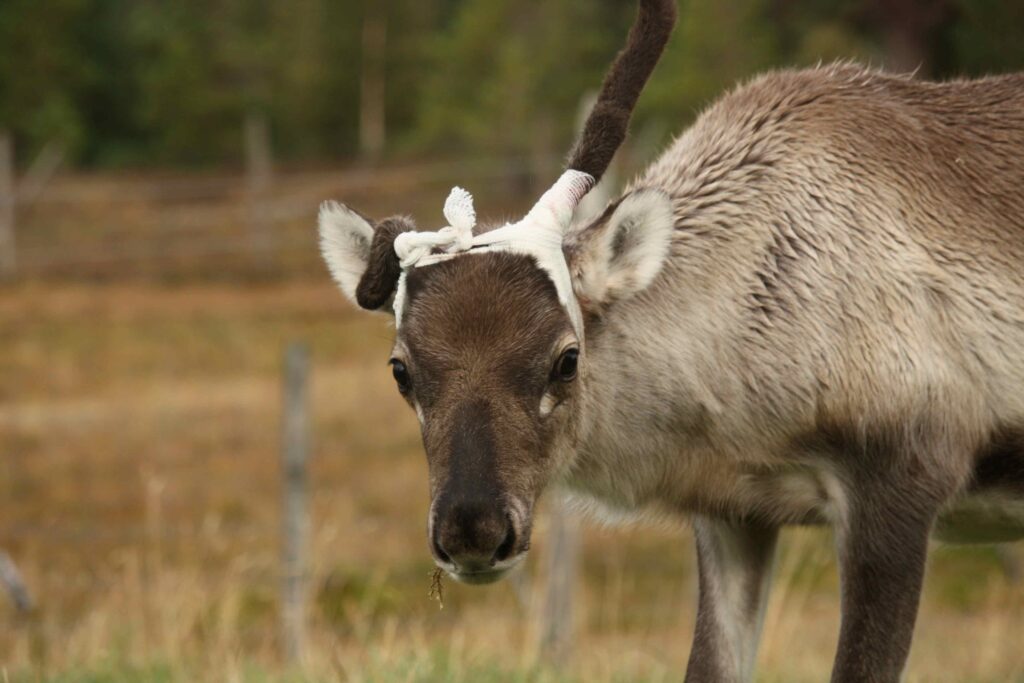
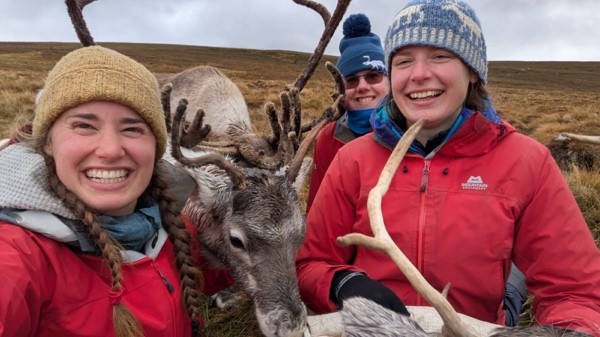
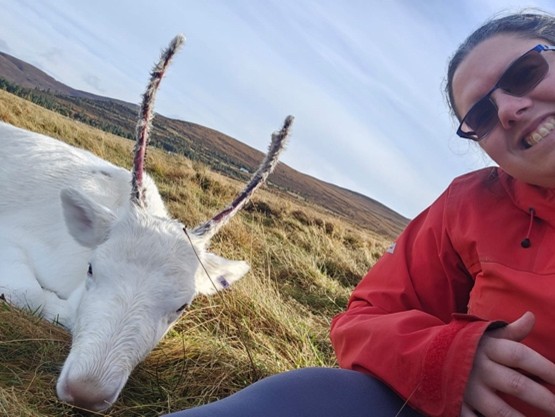
Emm and Morris relaxing on the hill.

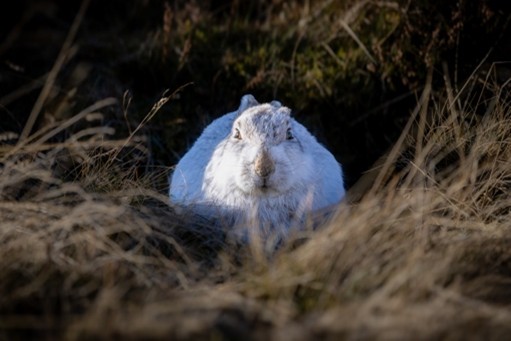
I helped Amy put the free-range reindeer back out. We took them to the top ridge on the free range, Amy led and I was at the back. Then we went to help Kate who had found the 4 reindeer on Silvermount in the hill enclosure. Pinto had found a bag of handfeed and was eating out of the bag when Kate found them. We led Pinto and Borlotti on halters and their calves followed and I helped Amy herd at the back. We led them across the hill enclosure and took them to the shed to check them out and take their temperatures as reindeer being away from the herd might mean they are ill. Whilst out leading them we were lucky enough to see a mountain hare.
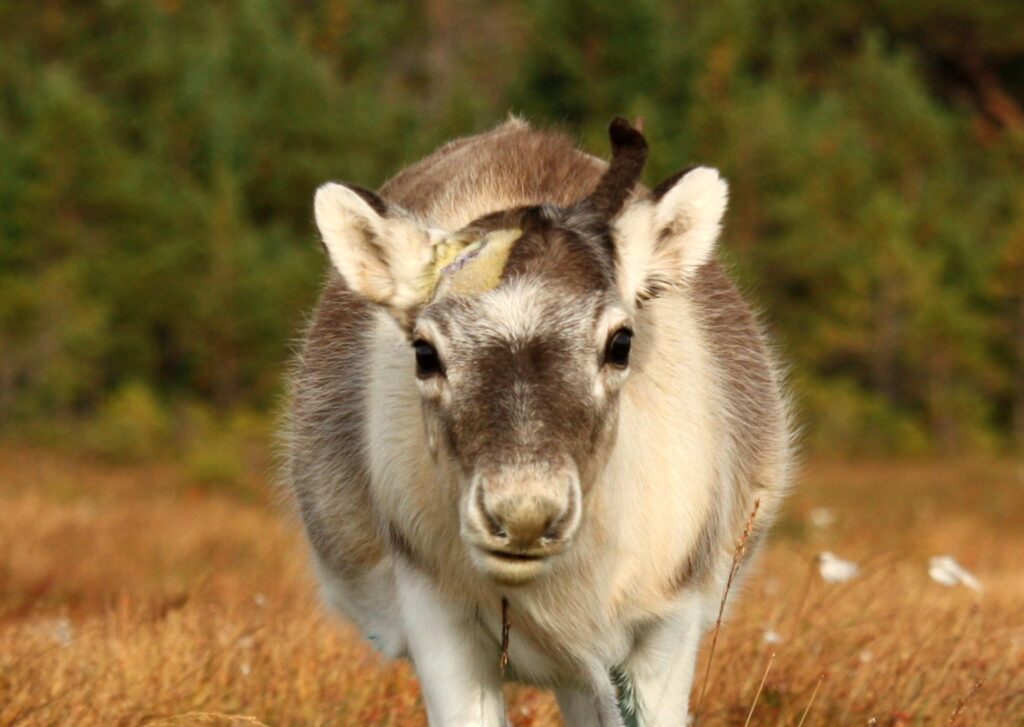
A mountain hare in winter colours.

One morning, the reindeer were slow coming down for breakfast in the hill enclosure. Some of the herd were with us and the rest were on Silvermount. As I helped Ruth call them down, Andi went up and herded them down from the top. We were then able to get them in position for the later Hill Trip.

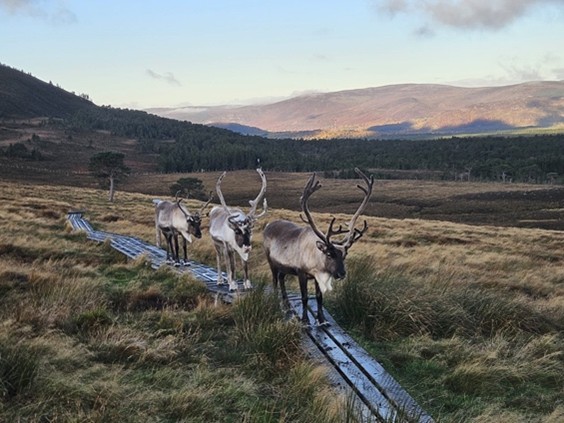
Busby leading the way along the board walk ready for the days Hill Trip.

Unfortunately on our way back down at the end of the day Brenda broke down near the Sugar Bowl car park. The next day, she was towed away to be fixed, a sad sight!

Stay tuned for part two of Emm’s visit in October!

Emm

Memorable reindeer: Porjus

Time for another installment of our – rather sporadic – memorable reindeer series. This time it is Porjus’ turn for stardom!

What a handsome chap!

Back in 2004, we imported a batch of male reindeer, mostly calves and yearlings, from Sweden in order to bring in new bloodlines, and one of these yearlings was Porjus. He was named after a settlement up inside the Arctic circle in northern Sweden just north of the town of Jokkmokk, where our founder Mikel Utsi was from. His name was pronounced ‘porr-e-us’, though we frequently referred to him as ‘Gorgeous Porjus’, sounding the ‘j’ so the words rhymed!

Porjus, at the farm not long after he arrived from Sweden. He’s around 1 and 3/4 years old here.

By the time I started here in late 2007, Porjus was an adult and had just been used as a breeding bull in his second rut, going on to breed during the next three ruts too, his last crop of calves born in 2011. His genetics remain in the herd today, most prominently through the descendants of his daughter Chelsea (who include the lovely Winnie, Zap, Diamond – and somewhat less lovely Pumpkin (a reindeer with a serious attitude issue!)) and daughter Jenga, whose son is Jelly. Whilst Porjus fathered lots of offspring over the years, not every calf survives long term, but some of his better known male offspring were Gnu, Topi, Horse, Origami and Svalbard, though these lads didn’t follow in dad’s hoofprints and breed themselves.

Strutting his stuff in the 2010 rut, with Joni and Fiddle behind.

Porjus was a big, bulky reindeer, the ‘normal’ (average) colour for a reindeer, but with a distinctive paler forehead. Throughout each summer he always got incredibly fat – there was never any issue with his appetite – so much so we once tried to put him on a diet briefly (with hopeless results), but it never really mattered as bulls lose a lot of weight during the rutting season. A fat bull at the start of the rut is one that will go into winter in at least ok condition, as opposed to being underweight by the time the rut is over and winter arrives.

Fast asleep – saving his energy for the upcoming rut. Look at that belly!

Looking at our database, Porjus’ entry includes notes saying ‘A friendly boy’ and ‘well behaved during the rut’, and I certainly never remember being particularly wary around him during the autumn, though obviously we always give any bull a lot of respect at this time. Grandson, Jelly, would have done well to have considered Grandpa Porjus’ gentlemanly tendencies though – we planned to breed from him (Jelly) in 2023 and by less than halfway through the rut had changed our minds and castrated him instead!

Porjus’ grandson Jelly, looking like butter wouldn’t melt…

It is pretty unusual for a mature breeding bull to die in early autumn as they are in robust health ahead of the rut. However, Porjus did just that, dying extremely suddenly in September 2011 from an unknown cause (most probably tick-related), much to our dismay. However, whilst he left his mark in the form of his genetics in the last 20 years’ worth of reindeer born into our herd, he’s left another legacy too.

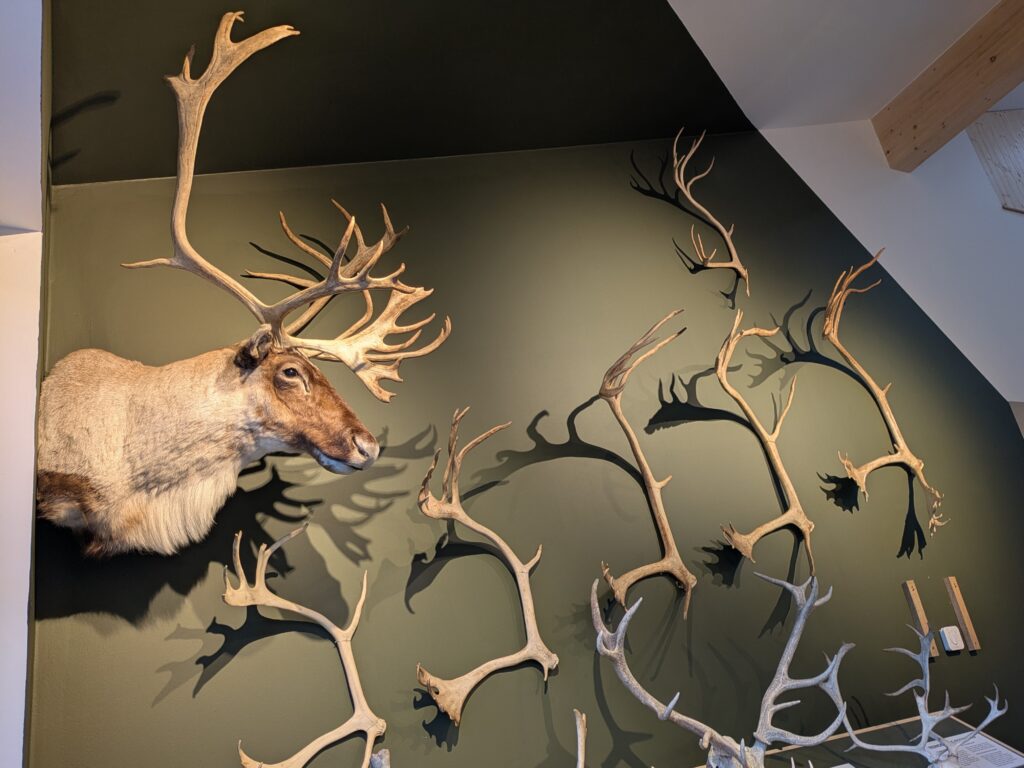
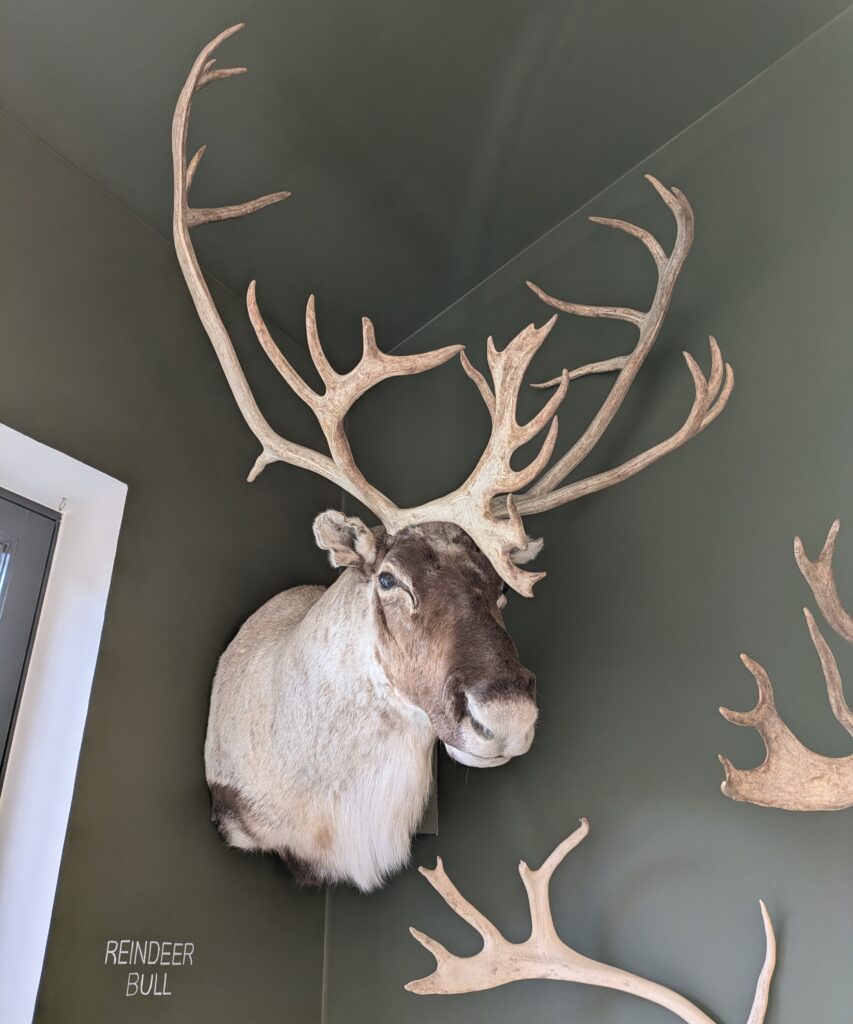
His is the incredible huge head in our Exhibition, gazing serenely over the thousands of people that come through our doors every year. Early autumn is the time of year reindeer look at their absolute best, with fresh thick winter coats and full grown antlers stripped of their velvet skin, so we therefore took the opportunity to have his head taxidermied. The only other taxidermied bull head we have hangs in Tilly’s house, having been brought from Sweden by Mr Utsi back in the 50s. For the last 14 years he and Porjus have gazed at each other across the room, but Porjus is so beautiful it would have been a waste for him to remain at the farm with hardly anyone seeing him.

So Porjus has found his rightful place back here at the Reindeer Centre – he was always a handsome lad during his lifetime, and now he is an awe-inspiring sight with his majestic look and his enormous antlers. I’m glad I knew him, and I’m glad to be able to admire him every time I come to work still.

Hen

Wee calfie antlers!

With autumn being the season that the calves return to the hill enclosure, along with their mums, it’s always exciting to see them and to start to get to know them as characters. Having spent all summer with males only in the enclosure, it’s suddenly a bit overwhelming to have a sea of ‘new’ reindeer to get to know once again! The calves are the hardest to learn who is who.

Last time we saw them properly, in late spring, they were tiny and heading out to free-range in their calf coats, which are quite different in colouration to an adult reindeer’s coat. By autumn they’ve moulted, grown their new winter coat, and are many times bigger – i.e. they look COMPLETELY different! Other than very obvious colour variation and face markings, their wee antlers are the easiest way to tell them apart. The photo below shows Macchiato at 4 months old, looking about as generic as is possible for a reindeer calf – very average size and shape antlers, along with being very much the ‘normal’ body colour. Difficult to tell one from t’other, looking like this!

Macchiato, aged 4 months

So I thought I’d show some of the antler shapes of calves over the years in this blog. The memorable ones tend to be the biggest ones, of which the outright winner – by a country mile – is Gandalf. However, he was born in Sweden, and many of the Swedish calves we’ve imported over the years (to increase our genetic diversity within the herd) have had very big antlers so maybe he should be disqualified my list…

But here’s a photo of Gandalf anyway. Compare those antlers to Macchiato’s in the photo above!

So… my winner for sheer height of antler is Jester, who definitely looked a bit out of proportion as a calf. He’s gone on to grow enormous adult antlers too, though tending towards wider rather than tall.

Jester.

Some calves have really complex antlers – not quite as tall as Jester’s but more elaborate with several points on each. Examples include:

Murray, born in 2012. Look at that headgear!
Christie (antlers still in velvet here) – exceptional as she is female. As an adult she’s gone on to have very big antlers each year, a family trait inherited from mum Caddis and granny Haze.
Cream – these calf antlers always reminded me of water divining rods!

Duke gets a bonus point for having a forward-pointing tine at the base of one of his calf antlers – perfectly normal in an adult reindeer, but rare in a calf.

Duke.

Whilst not the biggest calf antlers ever, Fez wins my ‘prettiest’ antlers award. Small and perfectly formed, with several points top and bottom. Beautiful!

Beautiful in antler – and face!

But sometimes, it all goes wrong. Calf antlers, being thinner than adult antlers, are easily broken, especially as adult reindeer show no love whatsoever for anyone else’s offspring other than their own, and are all too willing to whack a calf on the head with a hoof should they get in their way. This results in antlers breaking, and this happens whilst the antler is still growing, they will sometimes fuse at the break and the calf is left with a flopped-over broken point.

One of this year’s calves, Lochi, with the classic ‘been-walloped-on-the-head-by-a-hoof’ look.

If this happens early enough in the season, the antler will, once the break is fused and healed, start to grow upright once again from the break. Here’s Fava below, who had managed to break his right hand antler not once but twice, resulting in two downward pointing bits. His antler shows a centimetre of new, upward growth from the break – and then he ran out of time to grow any more!

Fava.
Hopscotch.

Antlers broken right at the base can cause a problem with obscuring vision, poor Hopscotch here had to have this disaster (above) sawn off once it had lost all feeling in the autumn, so she could see where she was going!

And sometimes, it all just goes terribly, terribly wrong…

Poor Heinz! Two broken antlers, bound in place to keep them as still as possible, waiting for the vet to arrive.
Holy Moley.

Holy Moley’s broken antler resulted in a shaved head after the vet had to remove the broken bit right at the base to prevent further damage. Some of you might remember watching her story on our Channel 4 documentary in 2020!

Hen

Thermal photos of reindeer

In early October, a few of us were up the hill with the reindeer at about 8pm (the time on the camera was set wrong – definitely wasn’t 3am!), when it was already pitch dark. One of our friends, Sam, had a thermal camera with him that he was playing with, so we thought a few of his photos would make an interesting blog subject.

We always talk about how good a reindeer’s coat is during the Hill Trips – up to 10,000 hairs per square inch of the skin, with a percentage of those hairs (the ‘guard hairs’) being hollow to trap in body heat, and the remaining hairs forming an incredibly dense undercoat. This coat is designed to keep reindeer alive in incredibly cold environments; the recorded coldest temperature that reindeer have been found alive in is -72 degrees Celsius. Thankfully in Siberia and not Scotland!

These are female reindeer Turtle and Mangetout in this picture. You can see that they don’t show up as much as you might expect, and this is down to that super efficient thick coat that is trapping their body warmth in. Most heat is lost around their eyes and muzzles, and you can see heat retained within their coats where the hair is slightly parted.

A little bit of heat is being lost around the base of Scully’s antlers too, but her antlers themselves are in hard bone just now, with no velvet skin covering them – as you can see there is no heat at all coming from them.

Another setting on the camera, showing in colour this time. Again the eyes and muzzle are most obvious, this time on Merida, along with her legs where her coat isn’t as thick.

This photo is interesting for a couple of reasons. This is me (Hen), and look at how much heat is being lost at my neck. My body is showing up relatively well too, although perhaps not as much as expected – however in this picture I’m wearing a long-sleeved thermal top, a t-shirt, a jumper, a bodywarmer and a waterproof jacket, as well as a neck buff and gloves (it was a very cold night, in my defense)! Yet still my body is showing up as warmer on average than a reindeer’s – with a couple less layers on I would have been glowing like the sun!

The other (more) interesting thing in this photo is the set of antlers in the middle of it, belonging to Pip’s big female calf, who’s grown amazing antlers for a calf this year. Unlike all the adult reindeer in these pics, the calf’s antlers are still covered with velvet skin – but one is dark and one is light. At this time of year the blood supply to the calves’ antlers is cutting off, so here the right hand antler is still vascular (has a blood supply) whilst the left hand one has already lost it’s supply. Sure enough when Sam pointed this out, I touched her antlers briefly and the right hand one was still warm but the left one stone cold. How cool – we’d have never have known without Sam’s camera!

The castrated male reindeer mostly still have velvet skin on their antlers just now, but unfortunately there were none in this group that we could point the camera at – it would be interesting to see how vascular they are still, if at all. Another time! In the meantime I’ll stand by my statement that antlers are one of the coolest things in the animal kingdom!

Many thanks to Sam Ecroyd for the use of his photos for this blog.

Hen

Sherlock’s Antlers

Sherlock in September 2022.

Despite spending the last 40+ years devoting my life to the Cairngorm Reindeer I am still fascinated by the annual cycle of reindeer growing their new velvet antlers, then stripping the velvet to reveal hard bony antlers and finally casting their antlers and growing a new set next year.

It is an amazing process, hugely demanding on their resources, but very beneficial to the individual whether they are males competing for females in the rut or females and young males competing for food in the winter.

The older mature males grow the most impressive antlers and for them the process of growing their new velvet antlers begins before the end of the winter and continues until they strip the velvet from the antlers around the middle of August, in preparation for the rutting season. The bigger the antlers the more likely they are to ‘win’ a fight and so claim a harem of females, so big antlers are important.

Sherlock – 8th of April 2023.
Sherlock – 9th of May 2023.
Sherlock – 6th of June 2023.

One of our main breeding bulls Sherlock showed all the signs of growing a pretty big set of antlers last year and by the autumn he didn’t disappoint us. Luckily for us he is a real gentleman among reindeer and although he sported these great weapons on his head, he was never aggressive towards us and we could still safely go in beside him and his breeding females on a daily basis to feed and check them all.

Sherlock – 29th of August 2023 – stripping the velvet.
Sherlock in the rut with Bordeaux in front of him on the 2nd of October 2023.

But their glory doesn’t last long and having spent 5 ½ months growing their antlers the breeding males are the first to cast their antlers at the end of the rut and before the winter sets in. So only about 10-12 weeks of glory with big hard antlers to fight with!

Spartan, who is a couple of years older than Sherlock was first to cast his antlers in the middle of November so I knew it wouldn’t be long before Sherlock was antlerless too. Two weeks later and off came one of Sherlock’s antlers making him very lopsided! Then a couple more days and the other one had fallen.

So now we are in 2024 and Sherlock, who was so dominant in the autumn, has been at the bottom of the pecking order over the winter.

Sherlock with no antlers in January 2024.
Sherlock just beginning to grow his antlers on the 28th February 2024.
Sherlock on the left on the with his lovely velvet antlers growing well, still free roaming in the hills – 30th of March 2024.
It’s in the genes! Sherlock’s mum, Caddis, grew very large antlers for a female.

Tilly

Well hello boys!

In the autumn, we move all of our entire males (apart from the 2 or 3 lucky chosen breeding bulls) over to our hill farm, away from the females and out of trouble for the duration of the breeding season. With no hint of love on the air, this keeps them calmer and easier to manage, though they still enjoy play-fighting. By December the rut is over and our breeding bulls have also joined them, so there is a slight vibe of an all-boys hangout. As Tilly is caring for these fellas every day, and she is less up on her social media, I thought I’d take the opportunity to grab some photos for you all this week when I was over at the hill farm.

Boys hanging out chilling in the sunshine on the hill
Tub heading over to see what’s up
Spartan is a picture of relaxation! Pure white yearling 99, and Cornetto are closest to camera.
Jester and Scoop resting up for winter
Yearling males 99, Kulfi, Cornetto and Zoom
The bulls spend a lot of time practicing their tussling skills – here’s a friendly bout between 99 and Zoom
2-year-old Akubra looks a bit sleepy for tussling just now!
2 year old Cowboy (centre) is certainly in charge of yearlings Calippo (left) and Iskrem (right)
Too close Calippo!
Pure white 99
The more mature bulls have already cast their antlers. Spartan and Sherlock are now getting a rest from carrying all that weight on their heads!
Look at that big fuzzy nose! Mr Morse.
Mr Whippy is the biggest of the yearlings
Like some of the other young bulls, Zap has broken parts of his antlers. He’ll grow back a full set next year after casting this set, a completely natural process.
Sunny, who we hand-reared last year. He’s grown into a very handsome fella.
Big Morse and young Kulfi enjoying the winter sun.

Andi

Photo Blog: November 2023

November has been a busy month. We’ve had the first decent snow higher up on the hills, the free ranging reindeer have been showing their beautiful faces at the hill enclosure every few days, adoptions are coming in thick and fast so lots of letters are streaming out of the office, sleigh training has continued in Glenmore and the first Christmas teams have been on the road! The ‘Christmas reindeer’ have all been totally super and have made us very proud. So this truly is a mixed bag of pics that I’ve taken over the past few weeks! Enjoy…

1st of November: Feeding a herd of free ranging cows. Caterpillar is closest to the camera.
3rd of November: Brie looking very soggy!
3rd of November: Poirot looking very handsome.
6th of November: Dante getting a close-up.
7th of November: Winnie and Cameron! Cameron did a lot of bottle feeding of Winnie and Alba (our hand-reared calves) over the summer months and is particularly fond of ‘his girls’.
8th of November: For Isla (back of sleigh) and Cassie (front of sleigh) this is their first Christmas season, but they are total naturals already. Frost is the reindeer with the patchy white face at the front.
12th of November: No reindeer in this pic but what a wonderful office we have above the clouds! You can just make out the thick layer of cloud hanging over Strathspey.
15th of November: 6-month-old Orinoco being gorgeous! She’s a sweet-natured lass who is growing in confidence. She’s definitely not as pushy as some of our calves this year!
16th of November: Marple and her lovely calf Mekong.
18th of November: My first Christmas event of the year. Here’s LX resting his chin before he pulls the sleigh.
19th of November: Another Christmas event for me. Here’s Olmec licking the rain off our sign.
22nd of November: Dr Seuss flanked by Haricot and Adzuki.
23rd of November: The free ranging herd brought themselves into the enclosure looking for a free lunch! Torch closest to the camera.

Ruth

Photo Blog: A Typical Sleigh Training Session

Our adult ‘Christmas reindeer’ (castrated males) are trained to harness at around 3 or 4 years old, so they can take part in a few events and parades in November and December each year, bringing in part of the income that then supports the herd for the rest of the year. About 25 of our males are trained so this enables them to take their turn at events, most of which are at weekends, and no-one is overworked at Christmas time (except, perhaps, us…)! Between weekends all the reindeer are back on the mountainside getting some good grazing and some downtime.

What happens during a training session? This photo blog will hopefully give you a taster of what we get up to during afternoons in October and early November here in Glenmore in preparation for Christmas tour.

These photos have all been collated over the past few days over several training sessions involving different reindeer and reindeer herders.

Step 1: Ready the sleigh! Here Lisette and Sheena are unloading the sleigh and trace. We also get the harness all laid out, ready to put straight on.
Step 2 (a): Retrieve your reindeer! We bring down reindeer from the hill enclosure and they spend a short spell in the Paddocks whilst we undertake sleigh training. At least two of the adults will be highly experienced sleigh-pullers who show the new recruits how it’s done. Here is a Christmas team (four adults and two calves) chilling in the Paddocks just before a training session.
Step 2 (b): Catching the slightly shyer reindeer in order to put halters on often involves a bucket of lichen! Thankfully their greed usually wins them over very quickly.
Step 3: Reindeer are caught, herders are attached to their ropes and off we go… Athens is the owner of the very wide antlers closest to the camera.
Step 4: Take them for a wee walk and jog to get rid of any extra energy they may have before putting their harness on.
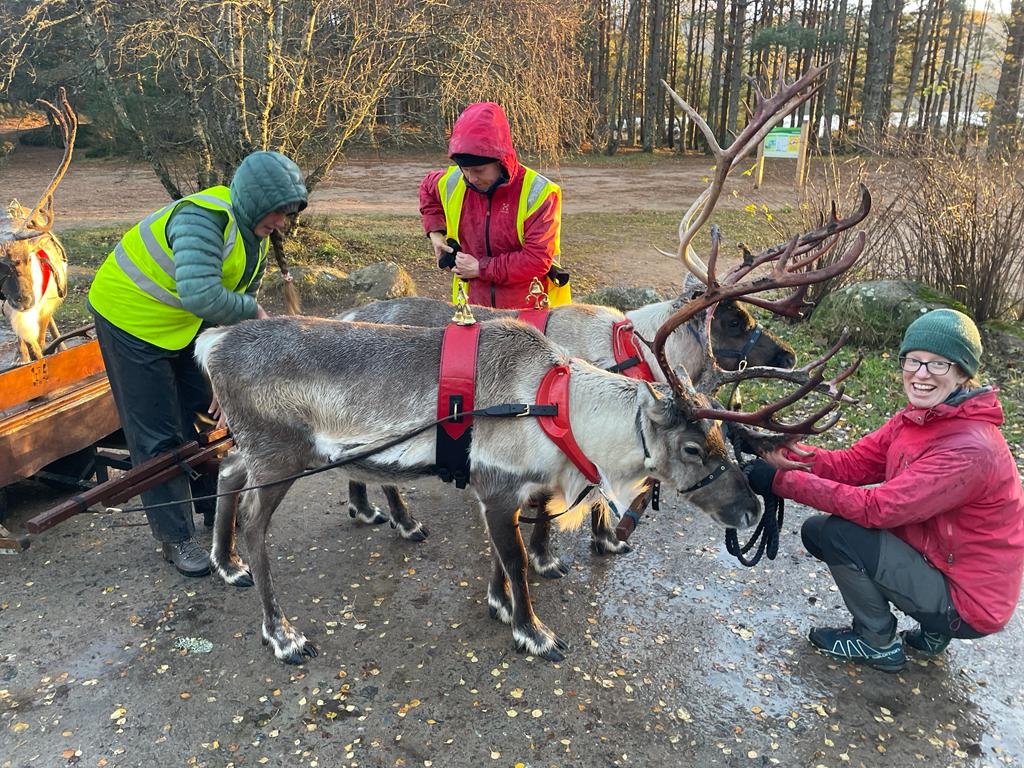
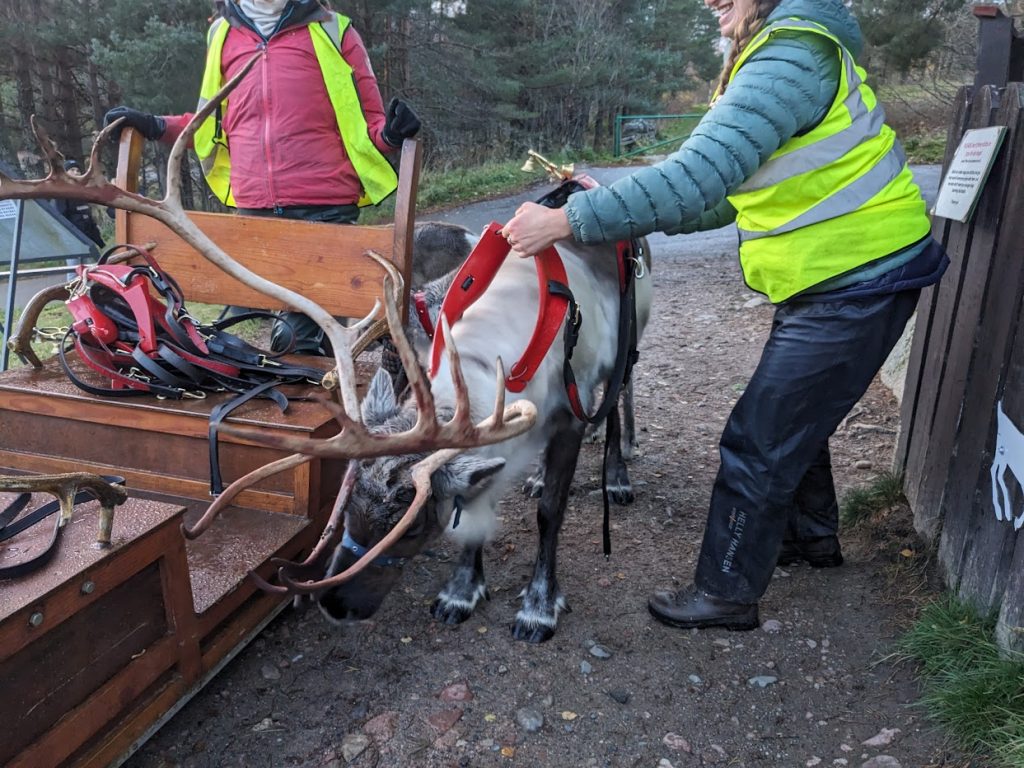
Step 5 (a): Harness gets put on outside the shop. The “trainer” is the most experienced reindeer who stands next to the less experienced reindeer. In this photo 8-year-old Scolty is teaching 4-year-old Athens that all is calm and there’s nothing to worry about whilst Hen puts on their harness.
Step 5 (b): With Scolty’s harness on, it’s now Athens’s turn.
Step 5 (c): Reindeer like to be together in herds so whilst Scolty and Athens are getting their harness on the other boys and calves are right behind, patiently waiting for their turn.
Step 5 (d): After getting used to wearing a halter and going for wee walks around Glenmore, we can put harness on the calves too. Having their heads in a bucket of tasty lichen definitely helps the process! This is 6-month-old Yangtze having harness on for the very first time – completely unfazed!
Step 6: Once all reindeer are wearing their harness we go for another short walk to give the reindeer the opportunity to get used to their bells and how everything feels. Alba is the calf at the back wearing her harness for the second time.
Step 7: Attach the two sleigh-pulling reindeer to the ‘trace’. Here Frost is closest to the camera. The trace then gets attached to the sleigh.
Step 8: The four ‘back reindeer’ now get tied to the sleigh. Here Sheena is at the back with Morse and Jelly (both of whom have cast their antlers already). The calves are sandwiched between the big boys to make them feel safe.
Step 9 (a): All attached and ready to go! But Clouseau is asleep already!
Step 9 (b): Off we go! Here we have Clouseau pulling closest to camera, and Frost at the back.
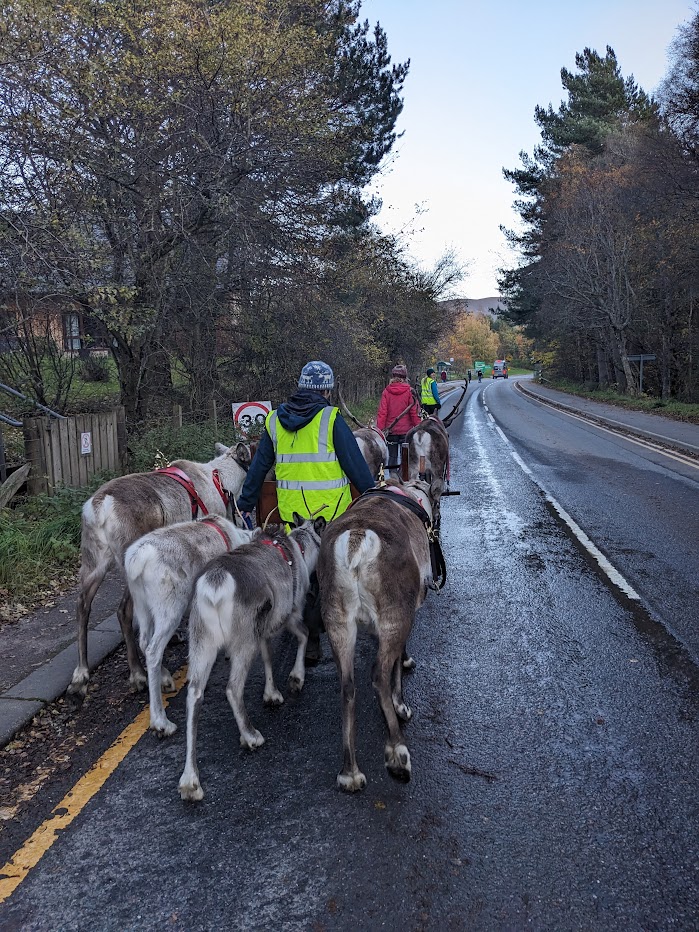
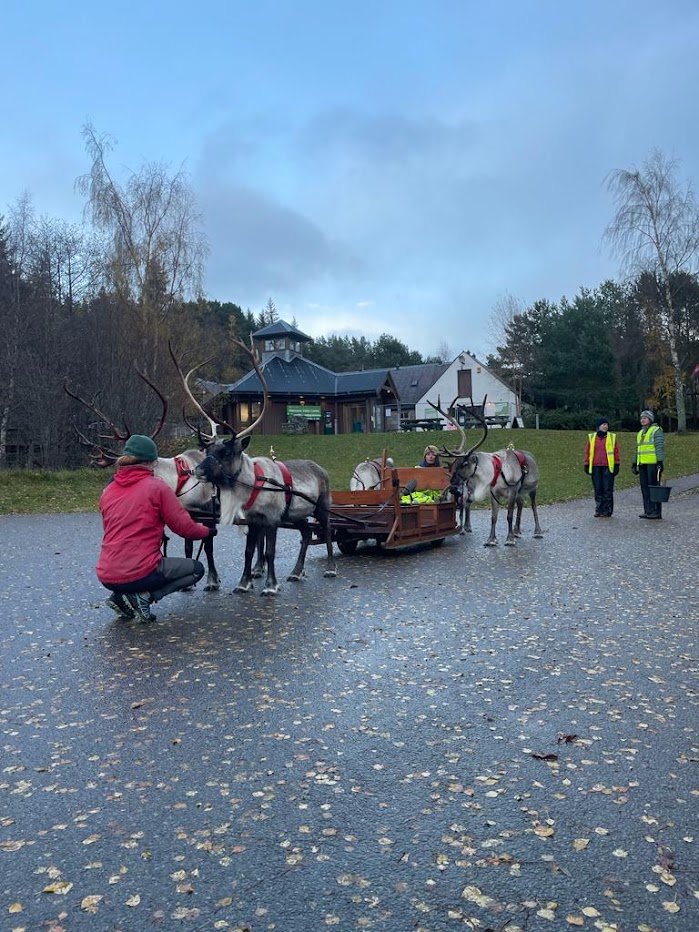
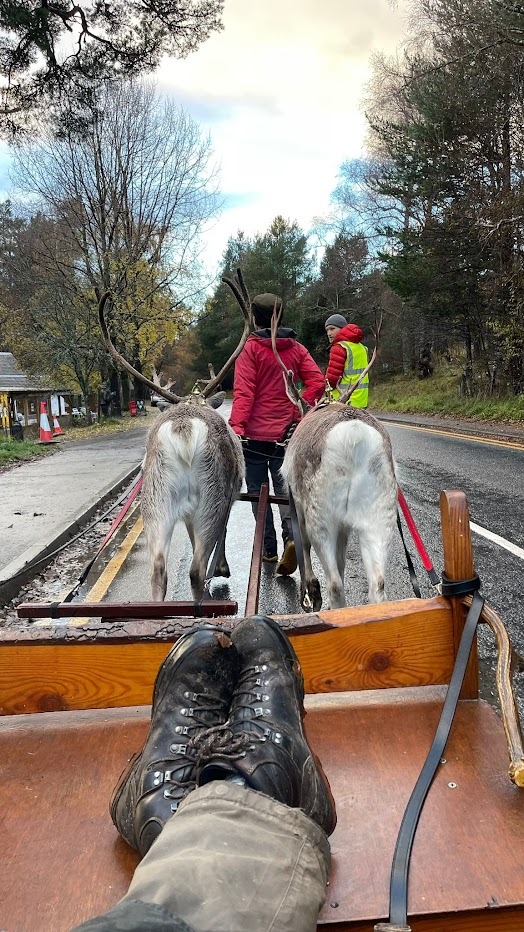
Step 9 (b): The view from behind – lots of lovely bottoms! Along with the two herders who walk at the front and back of the sleigh, one person walks ahead and one person walks behind in hi-vis slowing down any traffic.
Step 10: Having a pause. Practicing patience is equally as important as practicing walking. Here Lupin is closest to the camera and is doing a super job for his 4th ever go at pulling the sleigh.
Step 11: Add weight to the sleigh! If we have a fifth person helping us out, we sometimes get them to sit in the sleigh to make sure the front reindeer are actually pulling. On a real event they will have Father Christmas in the sleigh who can weigh quite a lot!
Step 12: All done for Lupin and Clouseau – time to get unattached from the trace. At this point, we usually switch the back boys to the front so all four adults can have a go at being the sleigh pullers.
Step 13: Once all the reindeer have had their go and we’re back at the Centre then the harness can come off, and the boys do their “Christmas shake”!
Step 14: Back to the Paddocks they go! Well done boys and herders! The adults usually have around three or four goes of this over several days and then head back to the hills. Such wonderful animals to work with!

Ruth

Photo Blog: October 2023

Here’s a selection of pics taken throughout the month, hopefully giving a snap shot of what we’ve been getting up to. It’s been full on with the rut taking place in the enclosure, our breeding bulls do now seem a bit less enthusiastic after a busy six weeks for them! We’ve also been bringing two calves at a time down to the Paddocks to halter train them. They usually spend around four days here in which we take them out on morning walks to get them used to seeing traffic, bikes, their own reflections in shiny windows and whatever else Glenmore can throw at us at 8am! Christmas sleigh training for our three year old Christmas Reindeer begins too. So far Adzuki, Haricot and Hemp have been trained and they’ve all been total pros. During the October holidays when our 11am Hill Trip sells out we’ve been putting on an afternoon Hill Trip too. Funnily enough, during the rain and wind of Storm Babet we did not require this attentional visit. But after the storm we’ve been treated to some gorgeous autumnal weather and the first decent snow on the hills of the season.

Amongst all of this we’ve also managed to get the October newsletter written, printed and sent out to our lovely adopters! Until it’s safely in the hands of our adopters I’ve left all calf names out of the blog.

2nd of October – Sherlock watching over Bordeaux whilst she eats her breakfast.
4th of October – Haricot puling the sleigh like a pro -his second time ever!
5th of October- Olympic looking very handsome pulling the sleigh with very special cargo on board – Tilly and her grand children!
7th of October – Fly looking very soggy on an incredibly wet day! She’s 16 and is now of of the oldest reindeer in our herd.
7th of October – Emm, our wonderful volunteer, is here brightening up even the wettest of days, alongside Holy Moley and calf.
10th of October – Druid, excellent at striking a pose!
12th of October – Cicero and Lupin vying for their moment in the blog.
13th of October – A morning at the farm to help Tilly feed the bulls. Here’s Busby, cheeky as ever!
18th of October – Checking in with some of the cows in Sherlock’s breeding group. Here we have Pumpkin, Torch and Pip.
19th of October – An incredibly wet Hill Trip. Gloriana and Borlotti closest to the camera with the herd behind, waiting for their lunch.
23rd of October – Blue skies!! Jenga, Sunflower and Feta posing beautifully.
24th of October – Borlotti and her cute calf with a big pile of breakfast.
26th of October – Ryvita, Sambar and Sika leading a lovely free range group of girls.

Ruth

Book Now