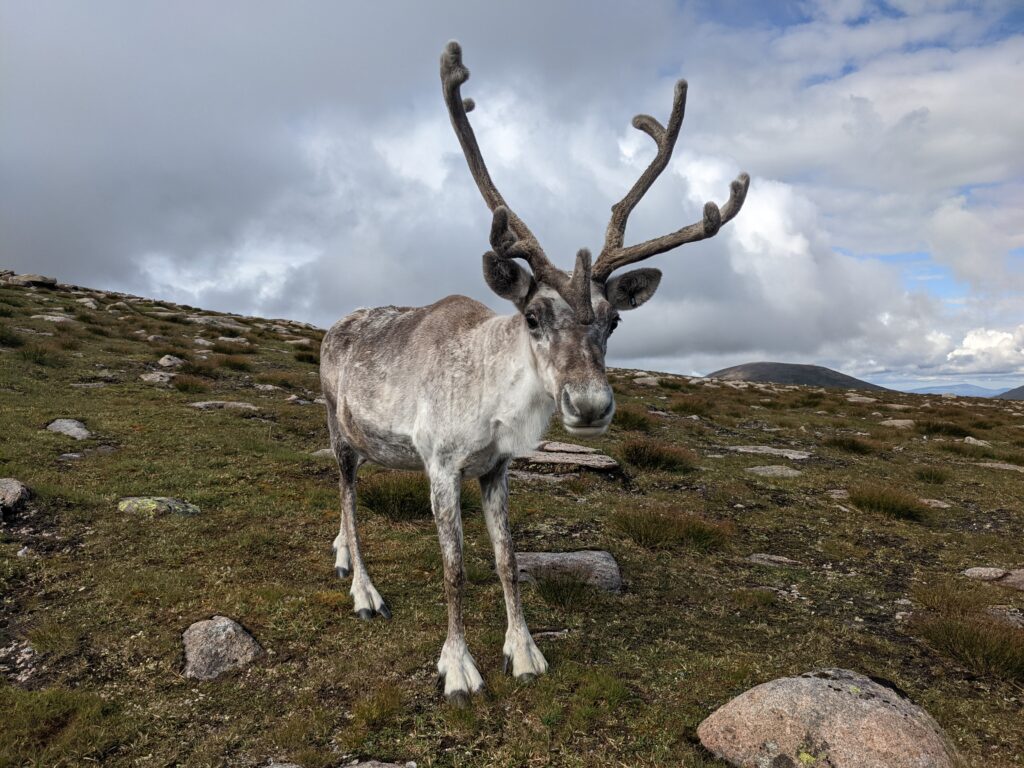
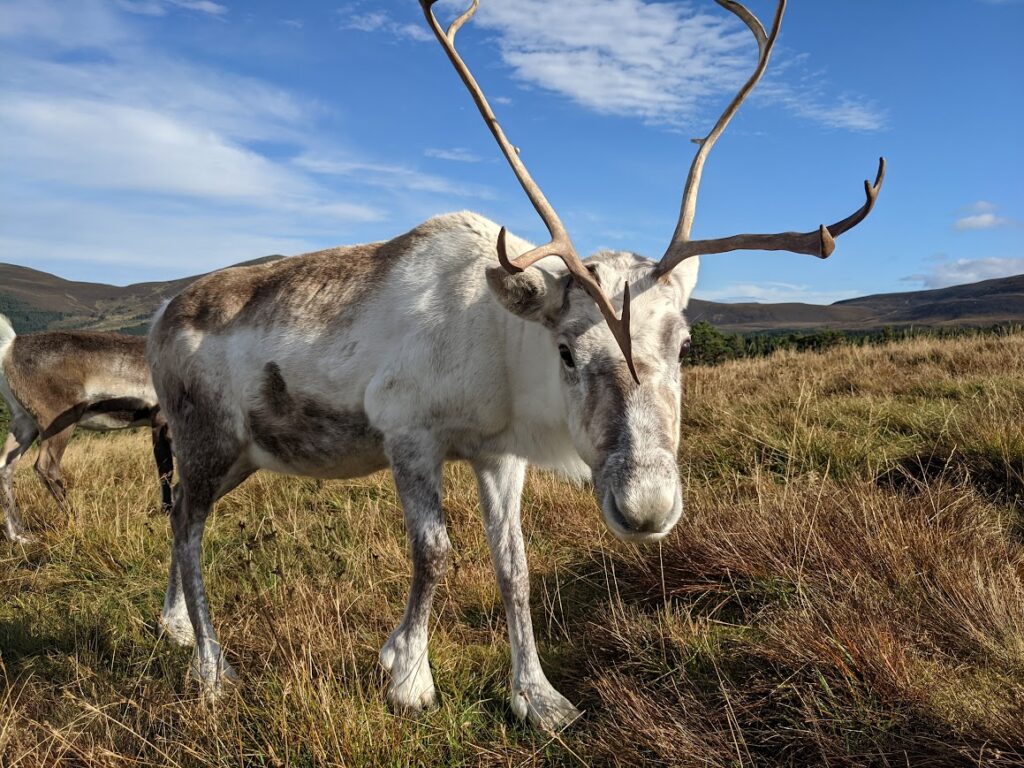
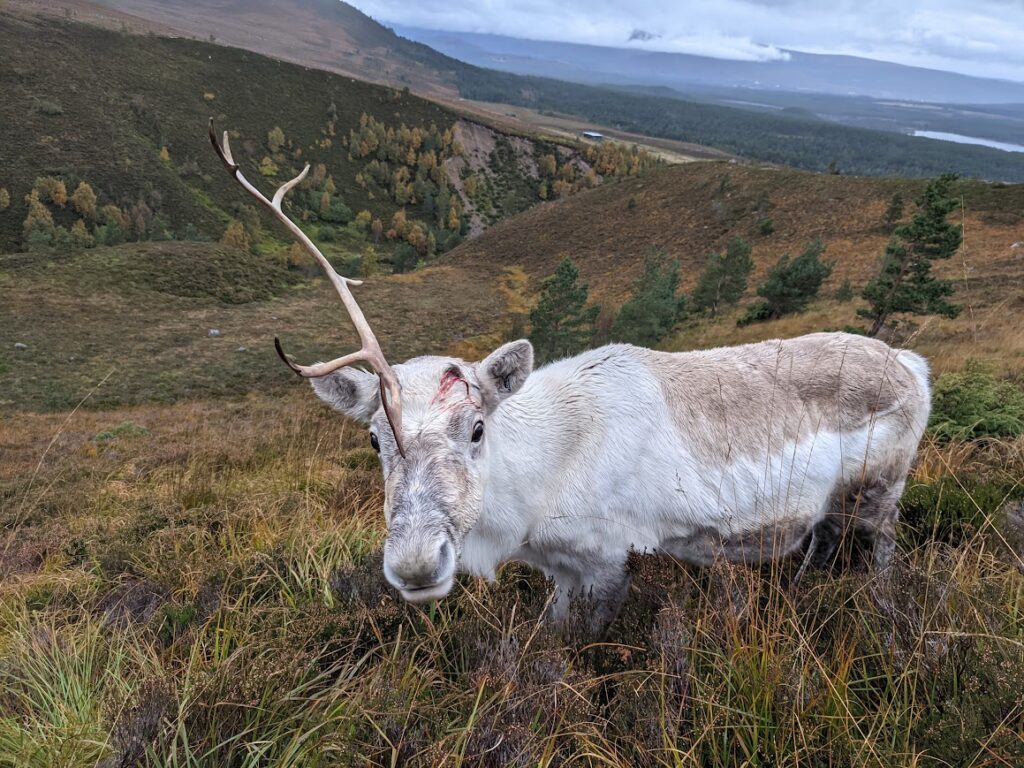
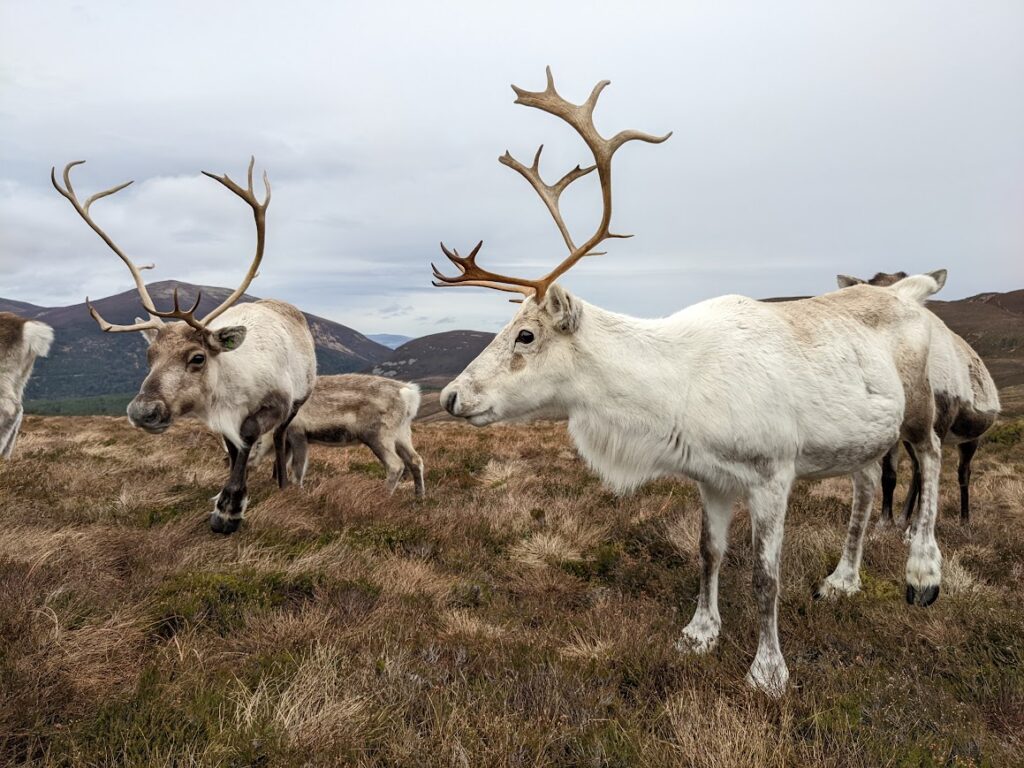
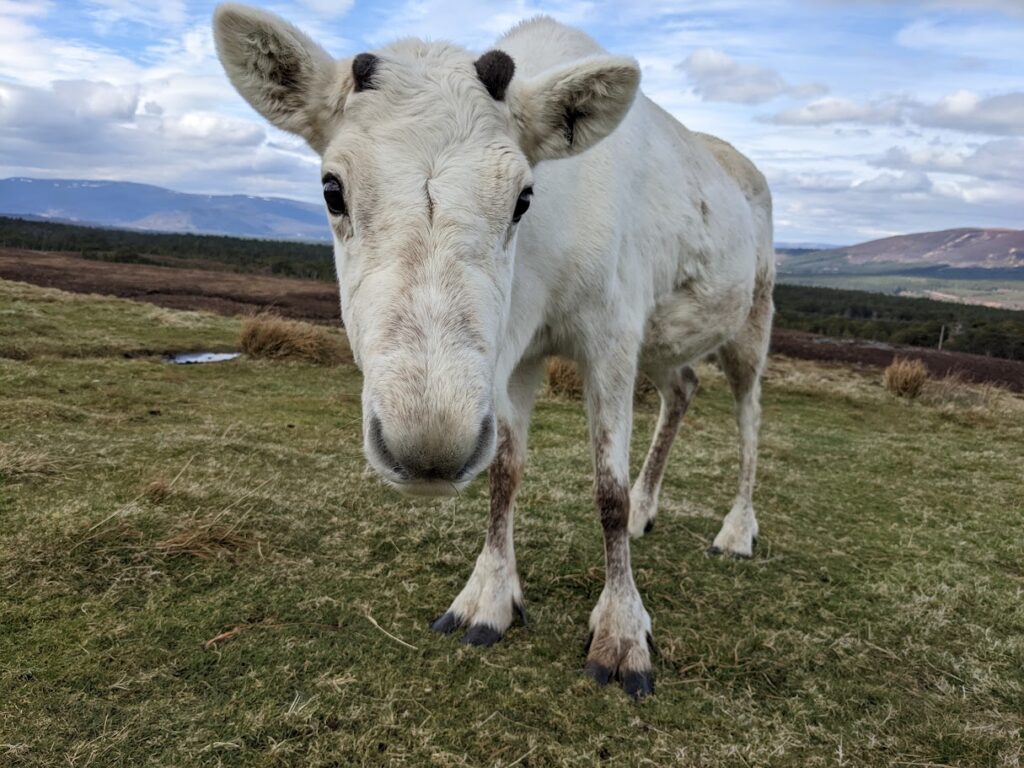
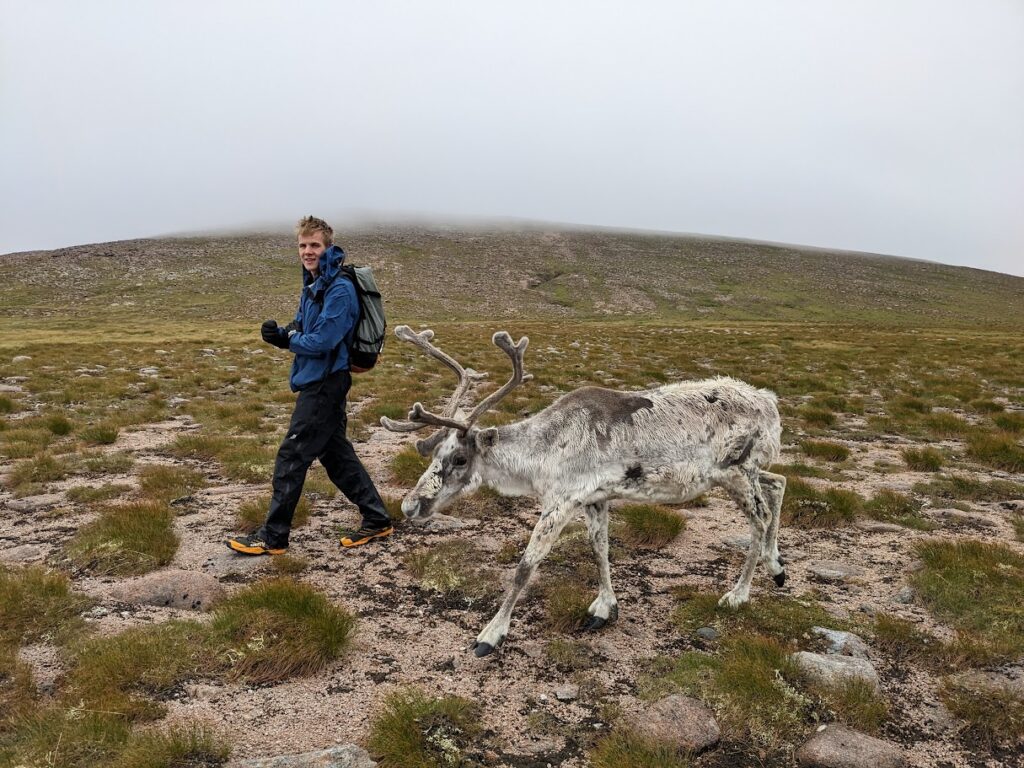
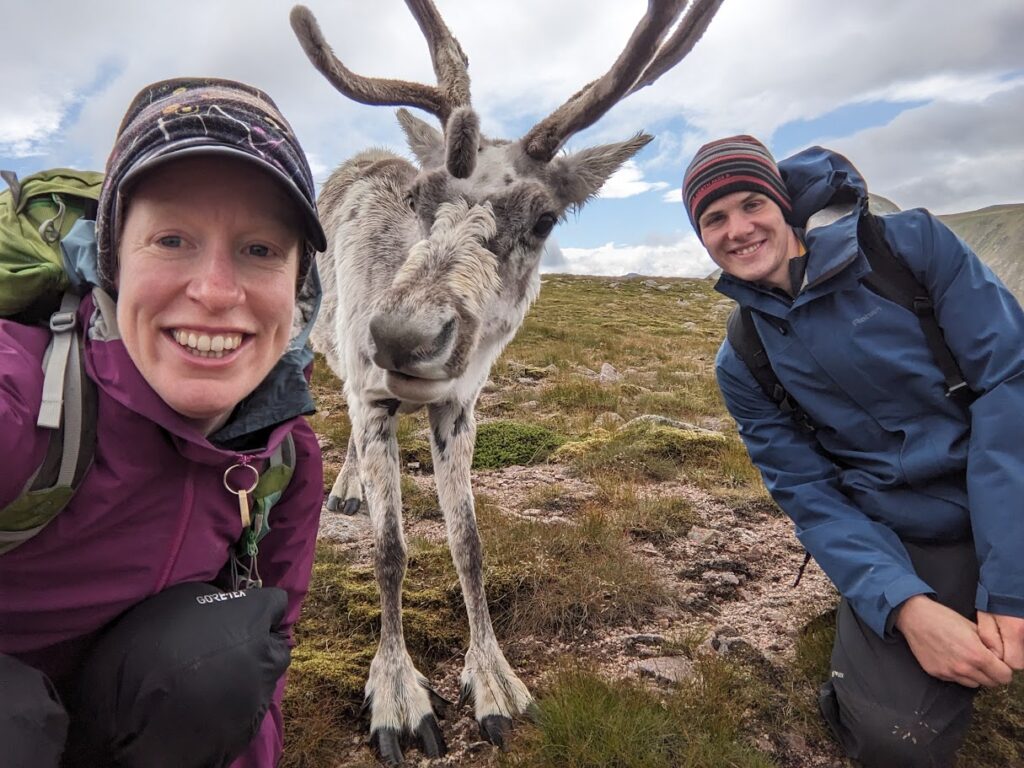
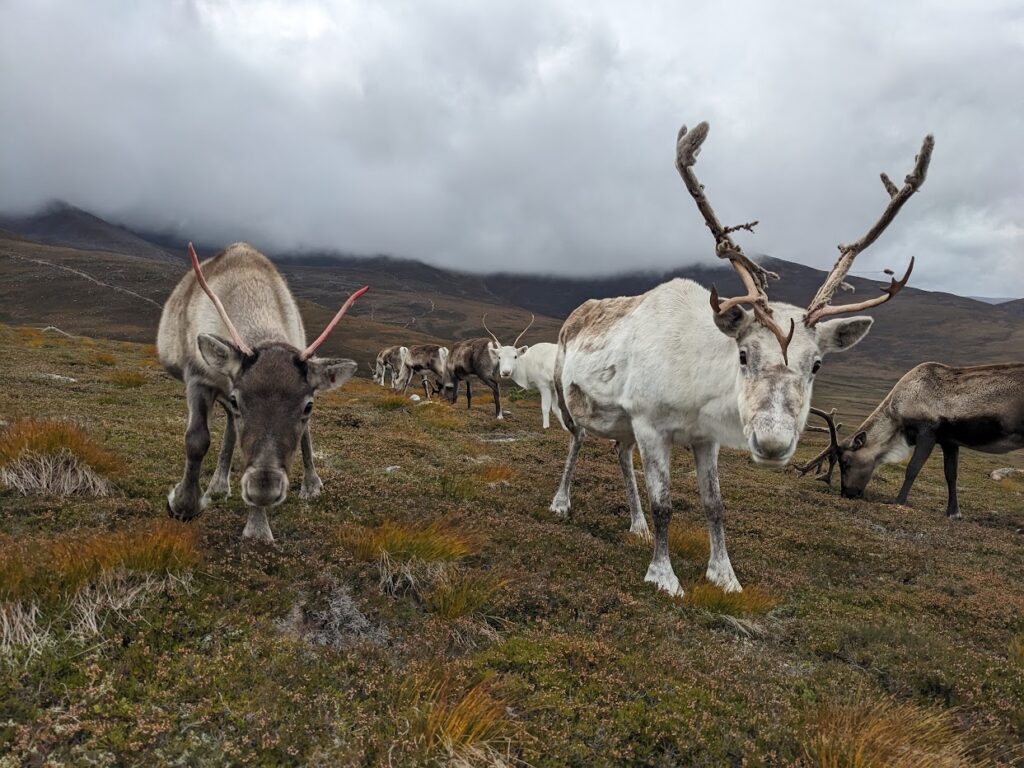
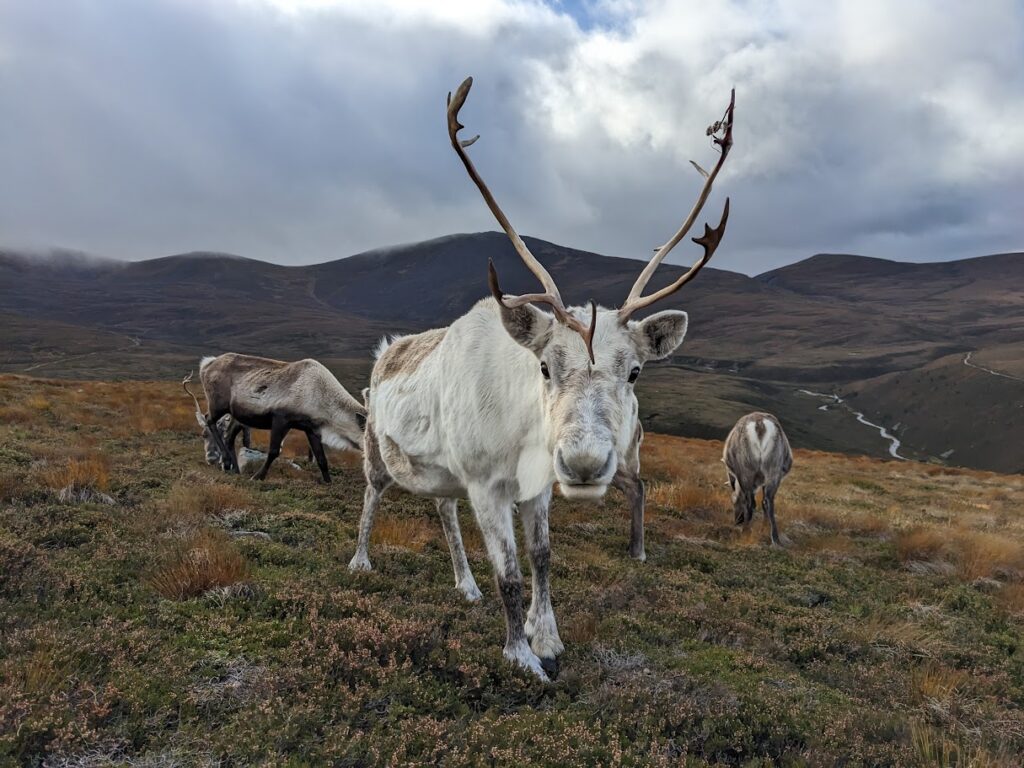
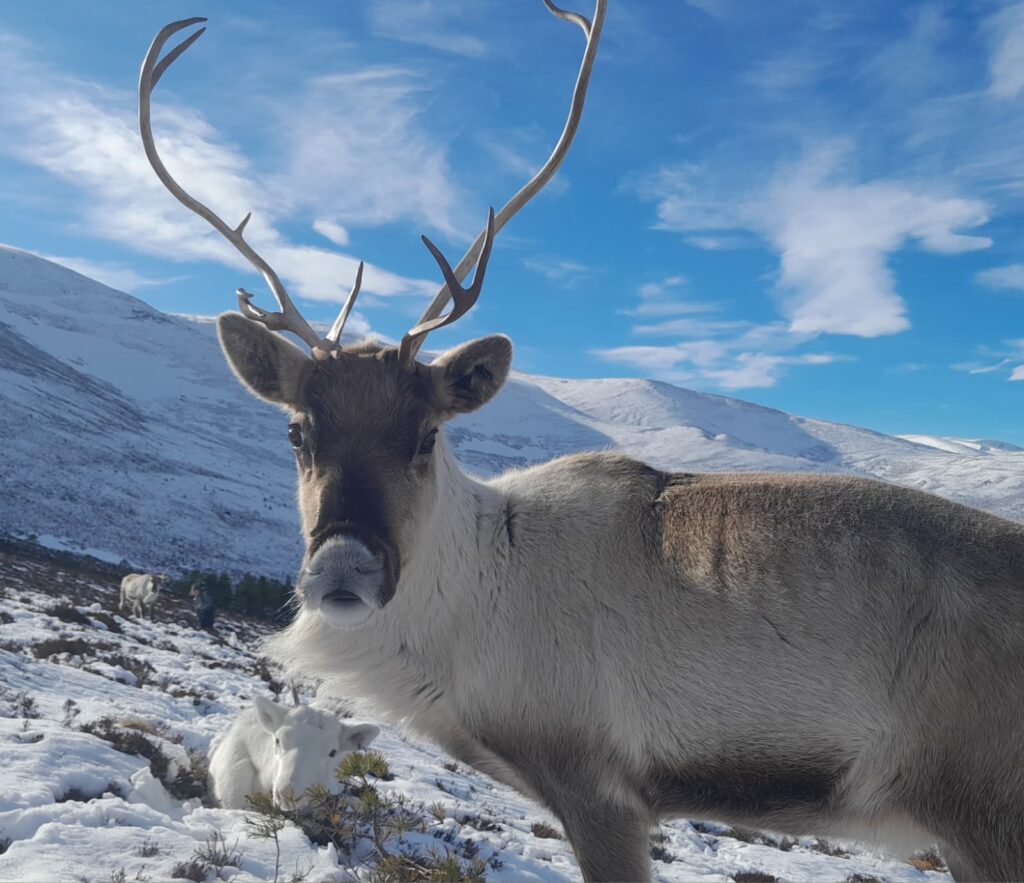
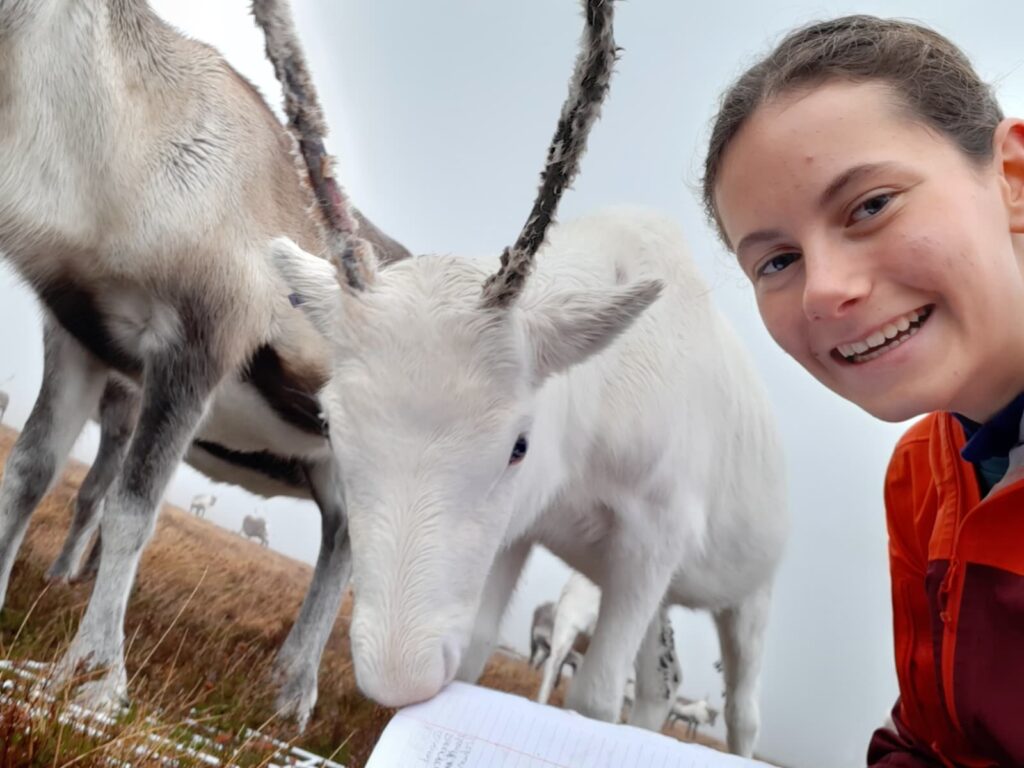
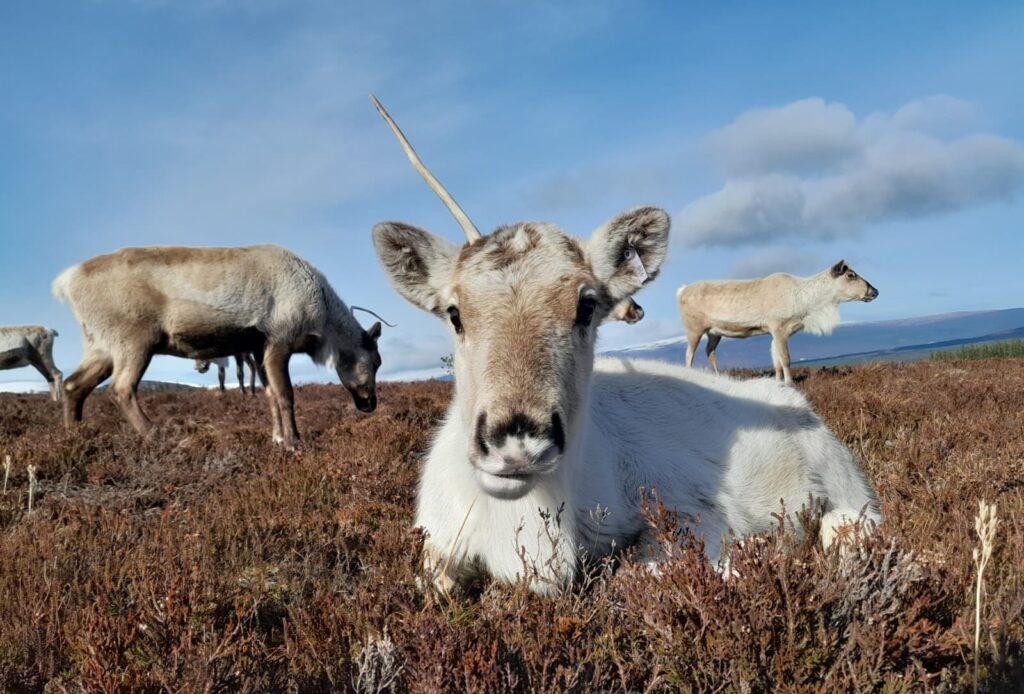
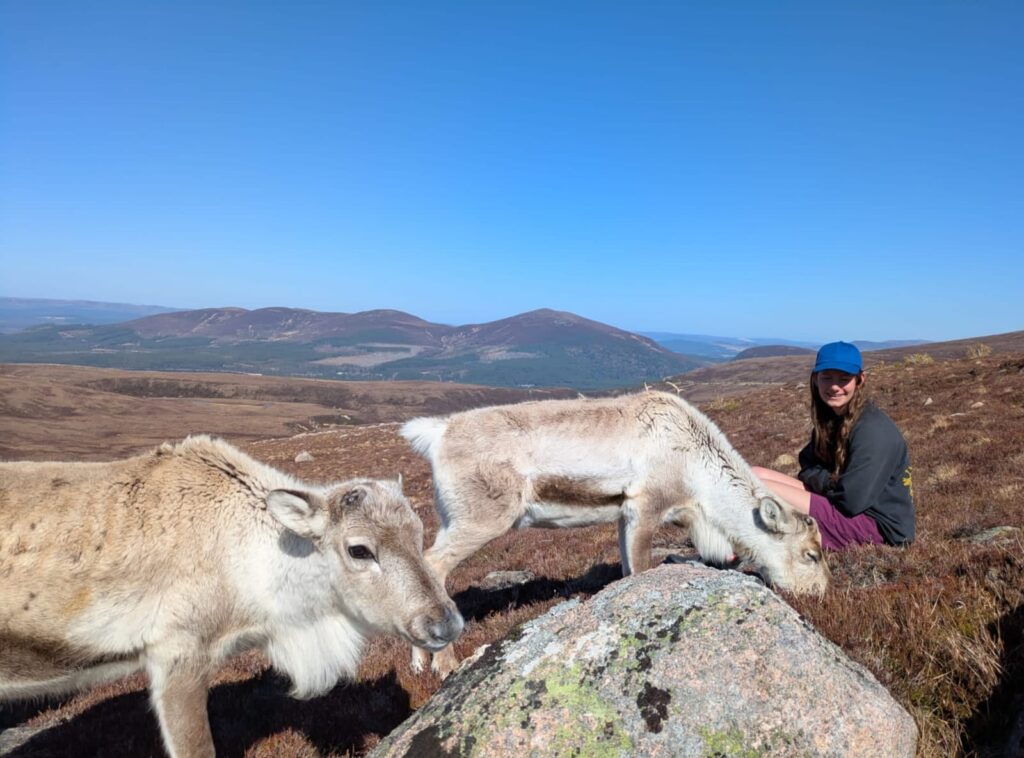
This weeks blog is time to talk about plants! We’re venturing out onto the flats and hills here in the Cairngorms to take at look at the sorts of plants the reindeer eat, and those they don’t.
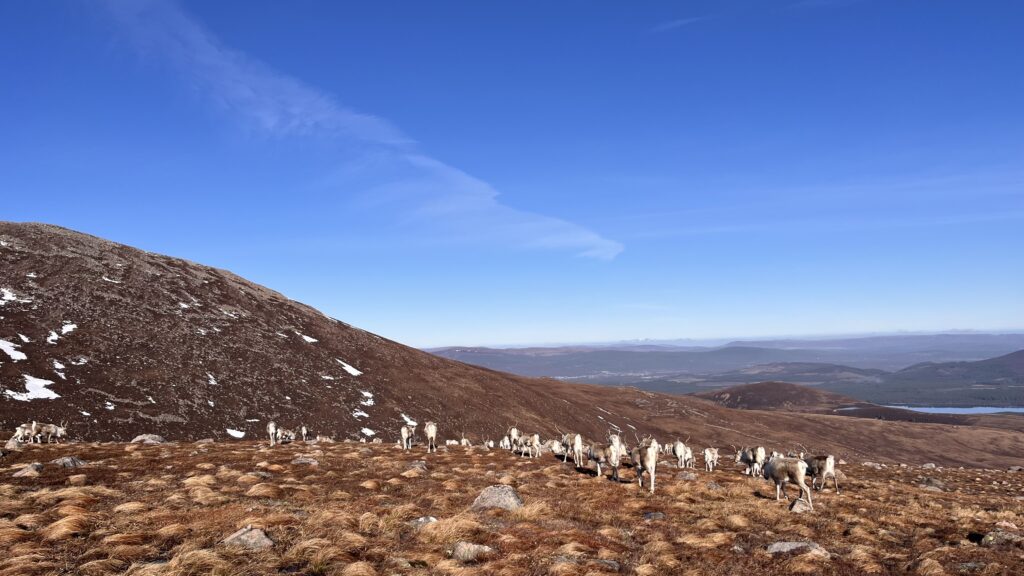
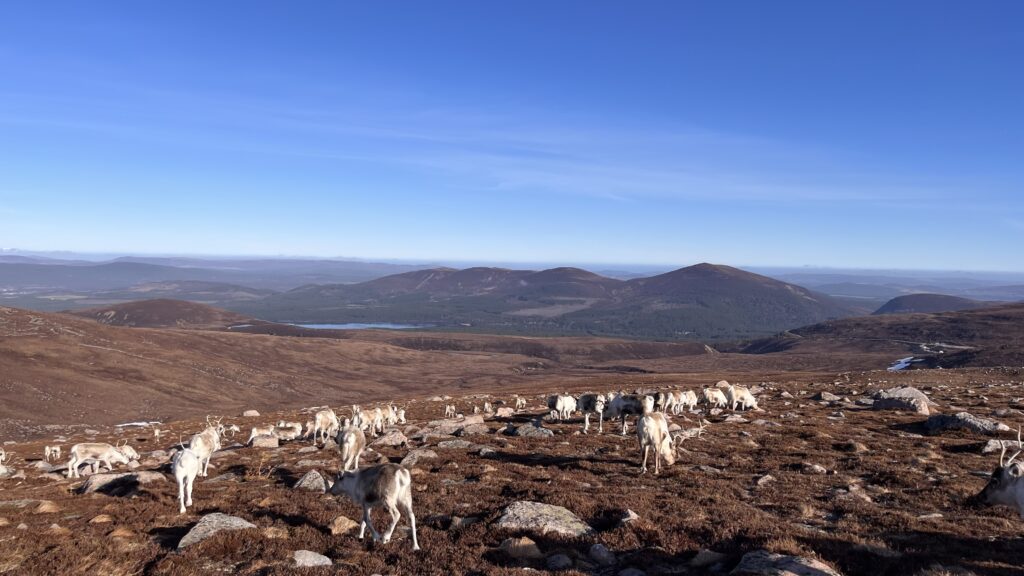
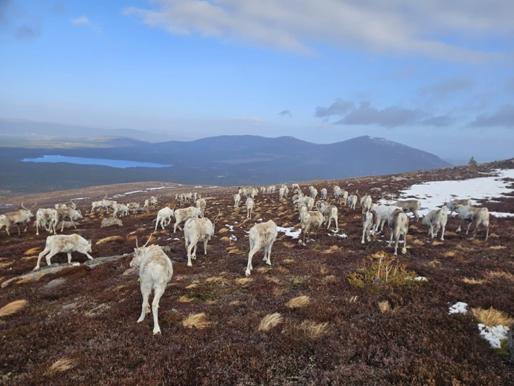
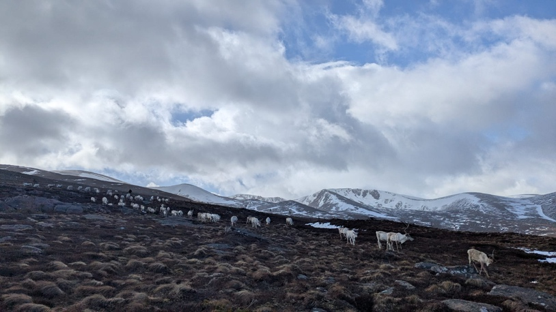
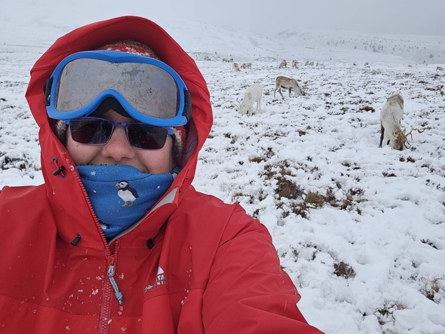
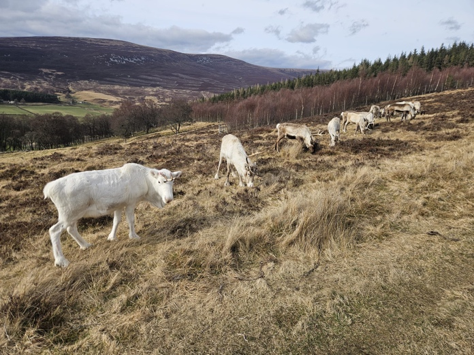
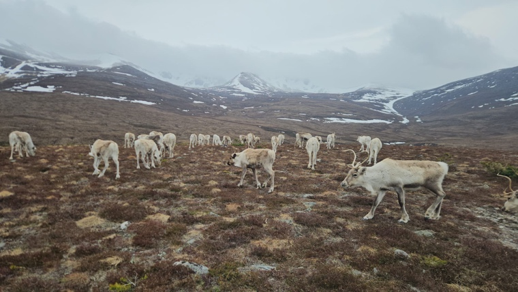
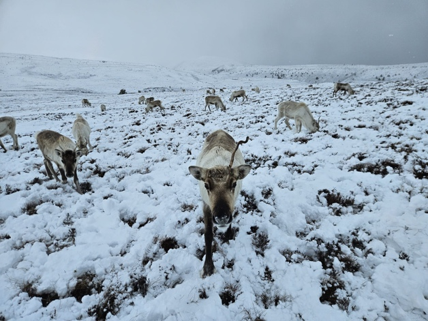
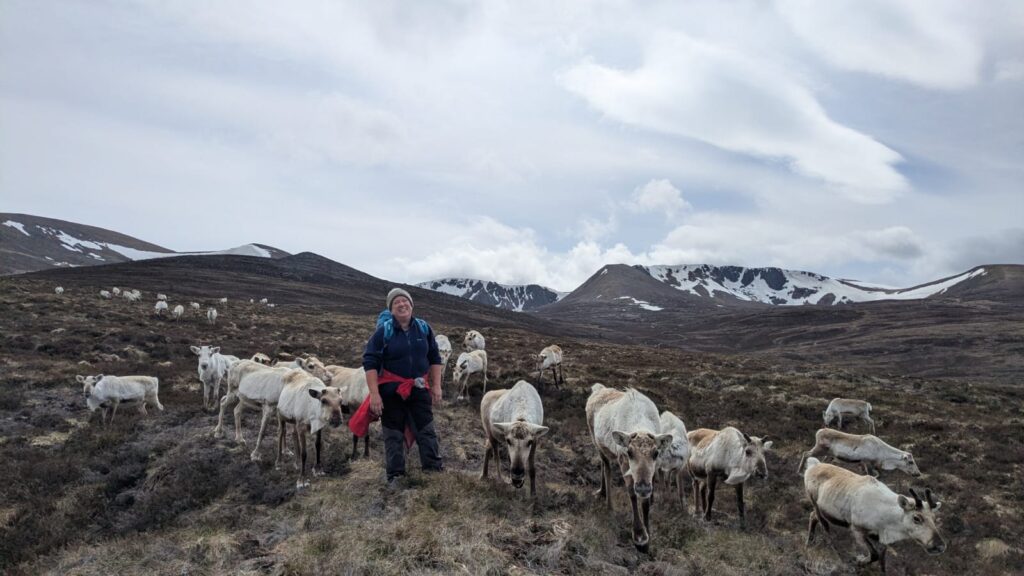
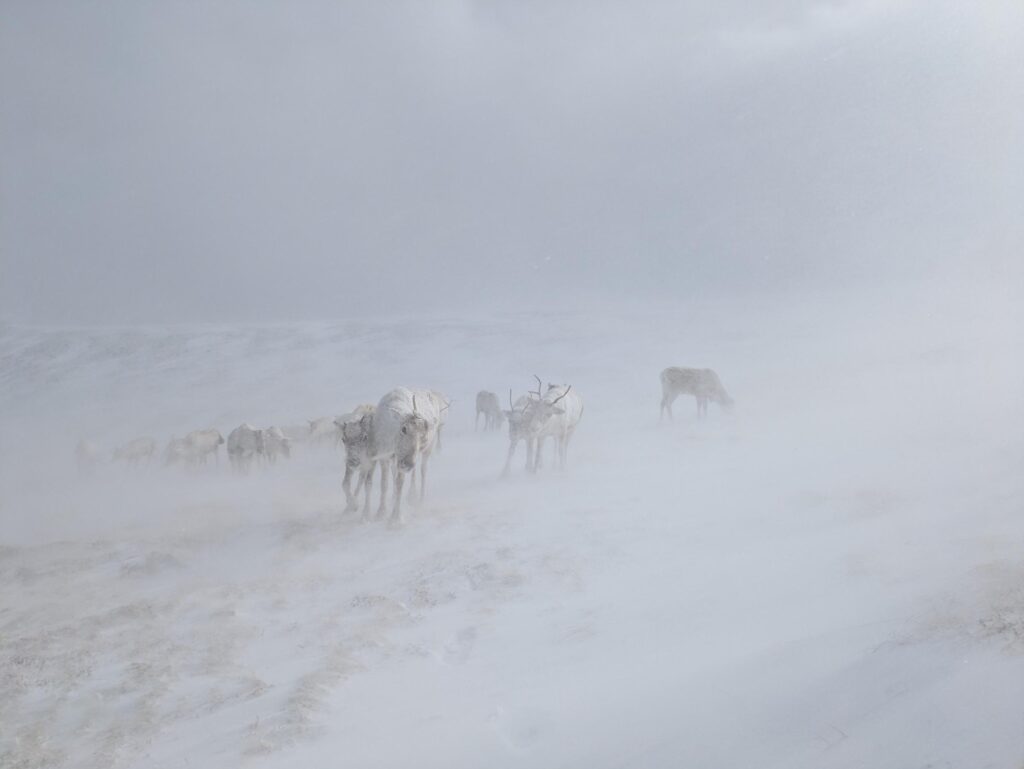
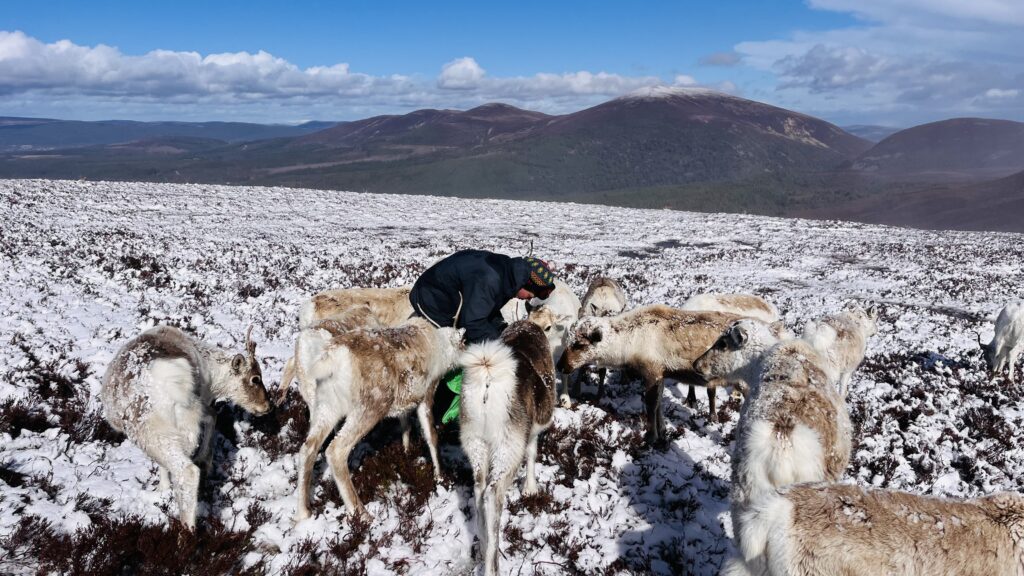
The herd travelling across the hills.
An ecosystem has many teeny, tiny moving parts. Every living thing has a role, providing something, maintaining something, preventing something, killing something. Every little cog is vital to keep the natural machine moving successfully. So, to begin let’s talk about what the reindeer’s role is in this machine to better understand their relationship with the plants growing under hoof.
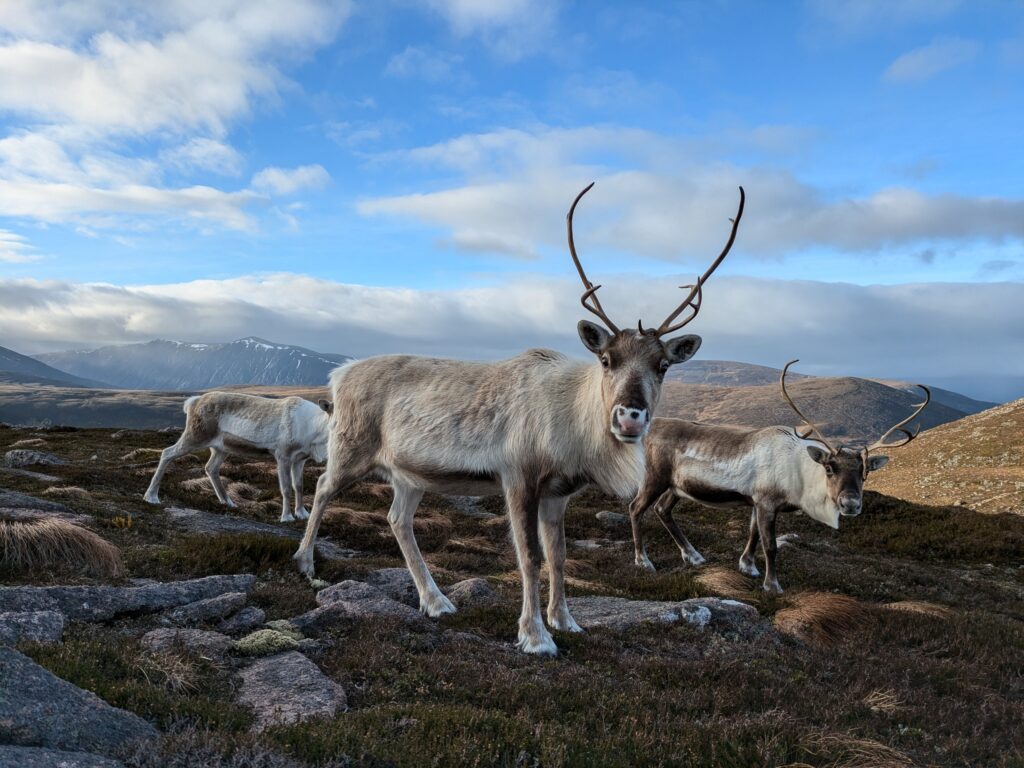
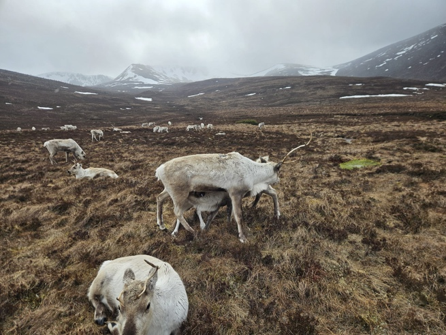
A rocky open landscape of low growing vegetation. Chickpea and Morven roaming the hills.
In the most basic terms, a reindeer is a gardener. They migrate vast distances on a daily and annual basis, trampling the ground as they go with their wide hooves, churning the vegetation and exposing spots of soil. Into which, their poop deposits! Reindeer, like many other animals that roam big distances, will not have a “toilet spot”. They’ll go as they move, effectively fertilising their own hoof prints!
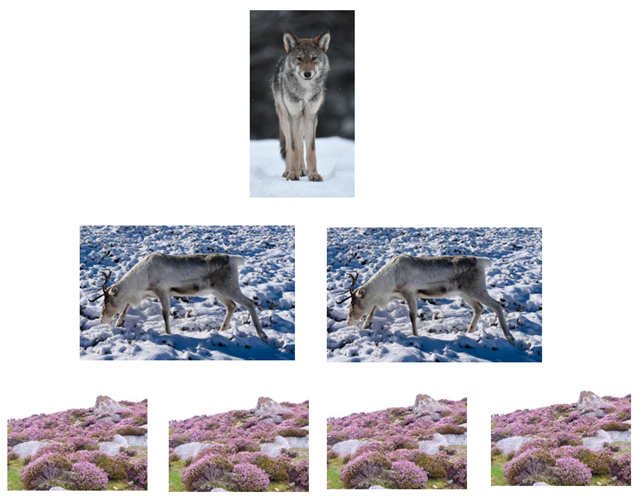
This behaviour rejuvinates the ground with seed dispersal from their food, keeping the ground alive and replacing what’s been grazed at. They also help keep the ecosystem moving as a prey species, their numbers being controlled by predators – never growing too large that they begin to over graze and over trample areas (you can see how it all starts to come together).
A balanced food chain is very important for making sure the ecosystem remains healthy, and not pressured at any level.
So now we know the reindeers’ job, lets see what keeps them fed and what they help to grow. Green thumbs at the ready!…
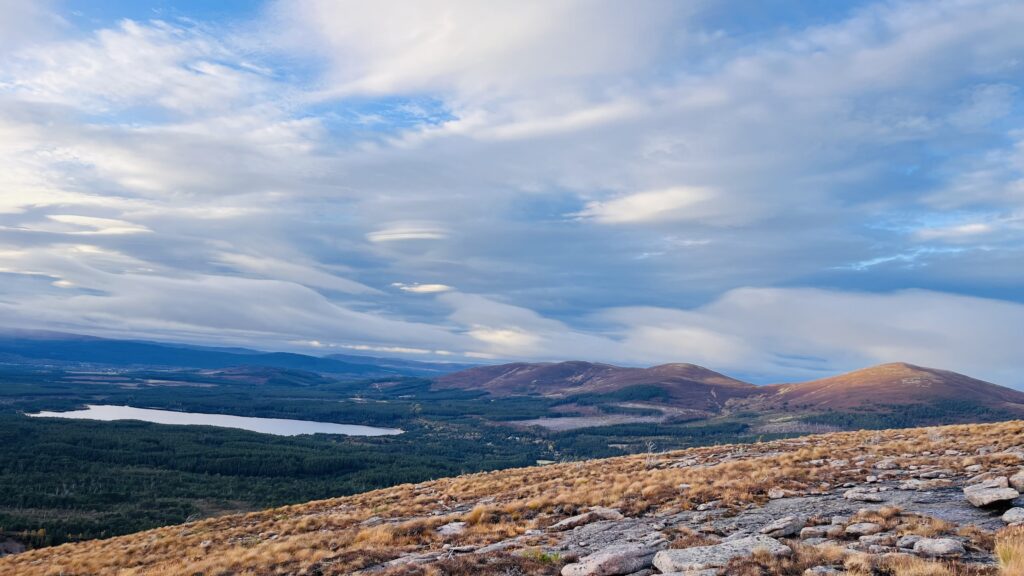
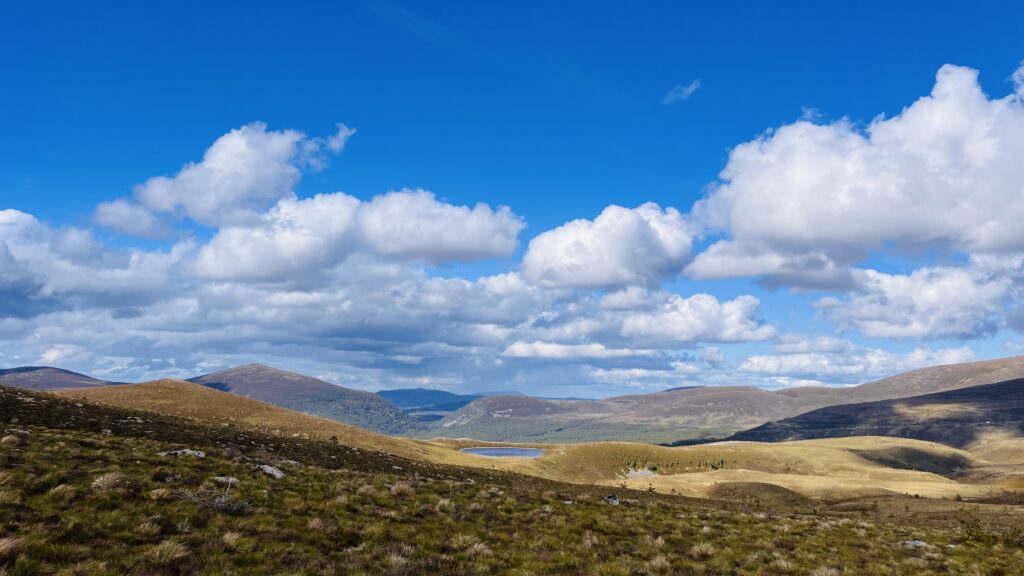
From Loch Morlich, through the forest and up out of the treeline. The reindeer home range is the expanse of higher hills. As you look around their chosen landscape you’ll notice all the low growth of vegetation, skirting close to the rocky ground.
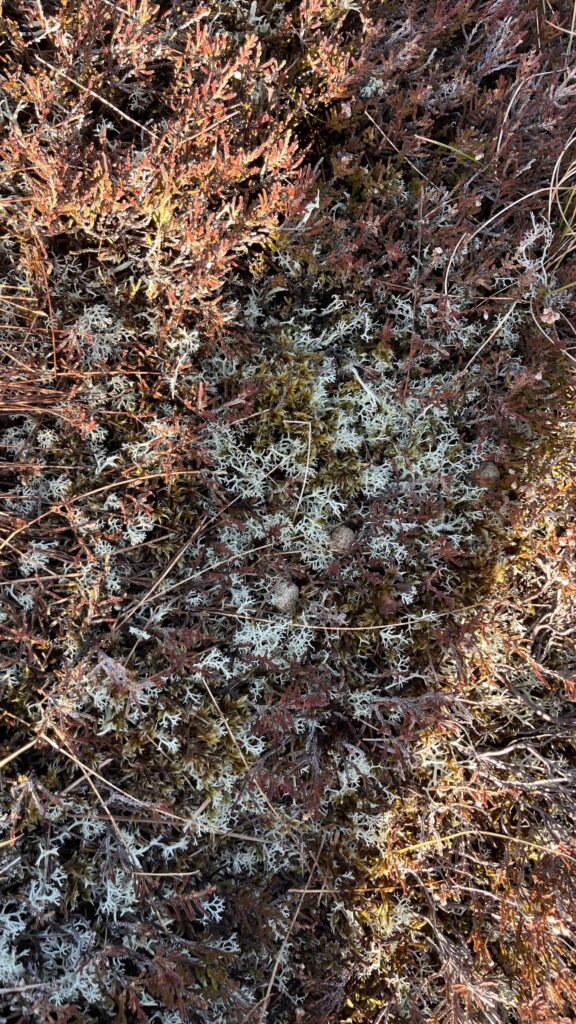
The ground is rocky, the temperature low, and high winds batter over the hills – what plant life is hardy enough to grow here? Let’s start with every reindeer’s faviourate snack, lichen. Easy to grow in many different conditions, the particular lichen (also known as reindeer moss) that is growing on the hills has no competition for light due to no trees or tall shrubs, can easily gorw in the rocky ground, and survives the intense winds, so is able to grow in large blankets. Like all the other plants we’re grateful for, carbon is a food source, so thank you lichen for your offsetting efforts! It makes up a very large portion of the reindeer diet, up to around 70% during winter months when most other plants lose a lot of their nutrition, or simply die back in the freezing conditions.
Pick out the lovely bright green sprigs of lichen here.
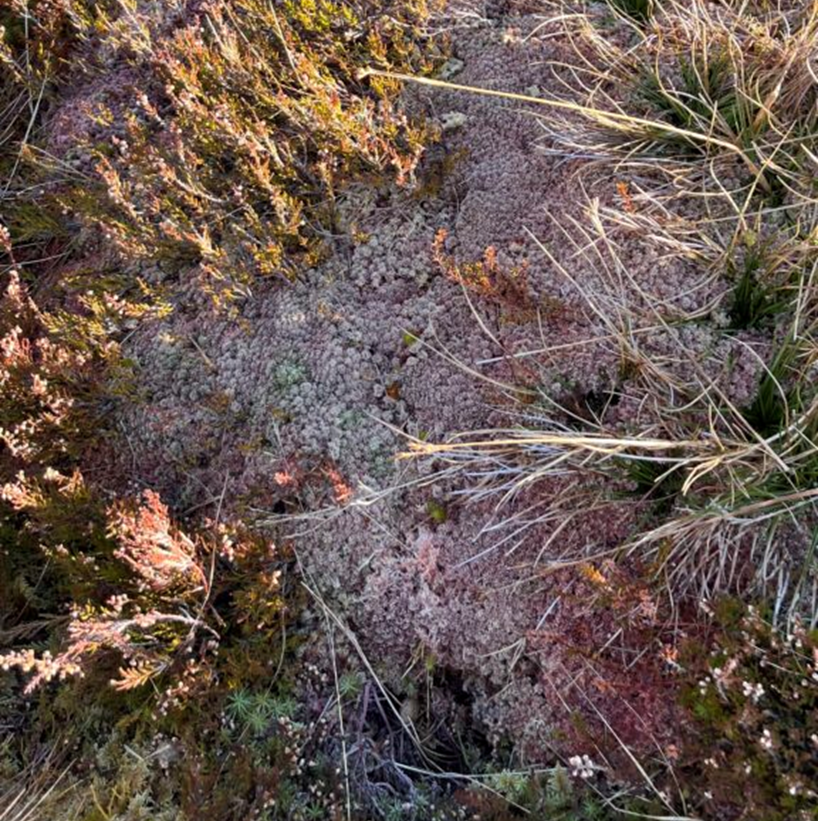
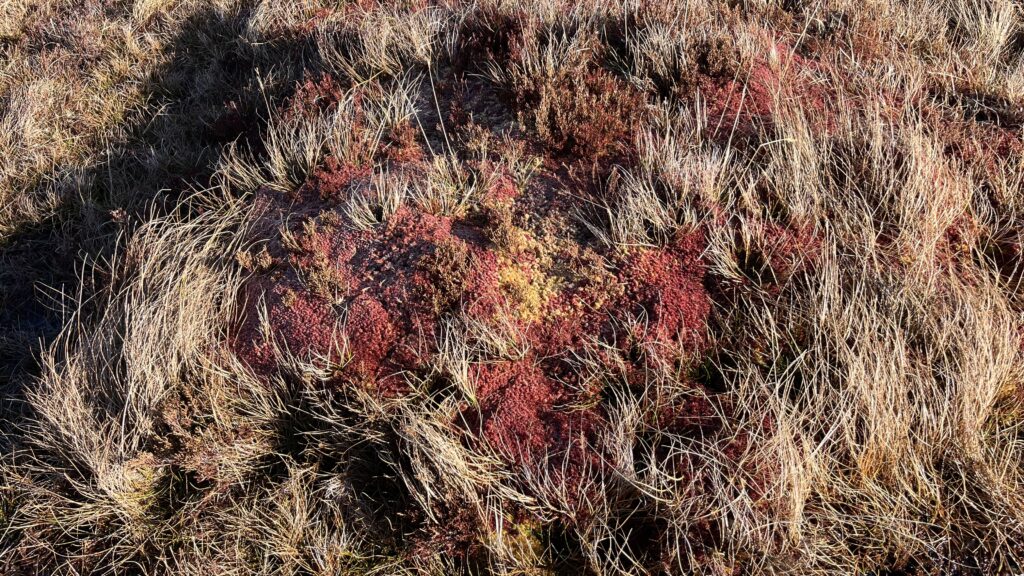
While we’re thanking the lichen for their carbon efforts, we have to talk about sphagnum moss. Jump off the squishy blankets of lichen and land yourself right into a peat bog! This amazing plant covers vast areas of the reindeer landscape we have in the Cairngorms. Growing up to 20 times its dry size when wet(!), sphagnum moss absorbs water and prevents plant matter from breaking down once in its water-logged form. This means that you can have layers and layers of boggy peat, all storing carbon. There are spots in Scotland where peat bog is as deep as 10m, holding thousands of years of carbon storage! Peatland is actually the largest terrestrial carbon sink on Earth, so an extremely important plant for all of us. Thank you peat bogs, we love you!
Swollen sphagnum moss holding a nice amount of water. Squishy hummock of sphagnum moss in amoungst some longer grasses.
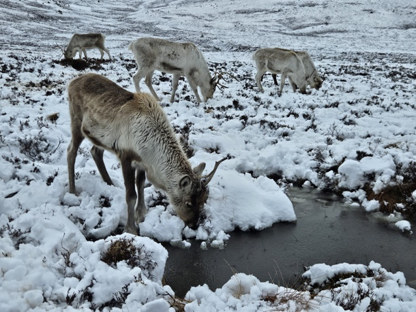
While we haven’t seen the reindeer ever nibbling away at the peat patches, they do sometimes squish their muzzles into them and drink the water the moss is retaining. During summer when the small and narrow streams begin to dry up, the sphagnum moss still retains a lot of water and can provide the reindeer with a good drink in the heat.
Lochs and burns lie along the flats, with water becoming less available as the reindeer travel along the much higher ground on the mountain tops.
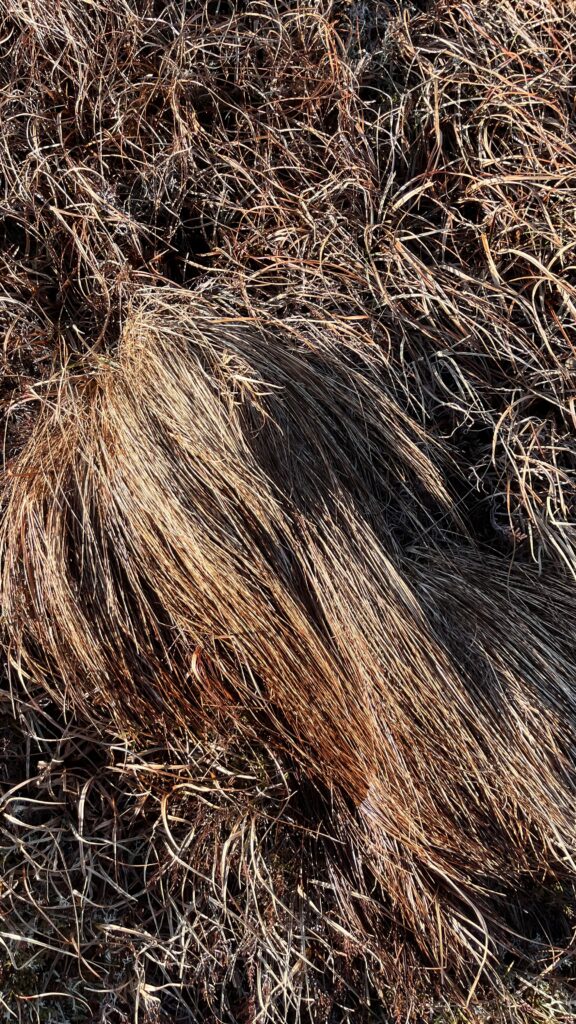
You’ll have noticed some longer grasses in the above photos of the sphagnum moss. These are clumps of deer grass. Deer grass is a type of sedge, thick and long, it is able to grow in areas of high winds and heavy rains, prefering a peaty landscape to grow. Acting as a stabiliser for the soil, the highly fibrous root system prevents erosion, holding everything together. This is one of the grazing plants for the reindeer, growing along the tops of the hills and down to the tree line.
Long growing deer grass lying flat to the ground. Like the other food sources for the reindeer, it’s easily burried in deep snow.
As we move more into the leafy vegetation found in the hills, we can talk about the ever abundant heather, and not so abundant lingonberry. The heather shrubs cover almost the entirety of the reindeers’ landscape, the other plants growing in between. Heather is another plant frequently grazed on by the reindeer, but is extremely resilient to feeding wildlife. It is quick to replace grazed buds and each plant is capable of producing a maximum of 15,000 seeds per germination season! That’s a lot of dispersing for the reindeer to be getting on with! Between the two of them, they’re very good at keeping the landscape nice and heather-y.
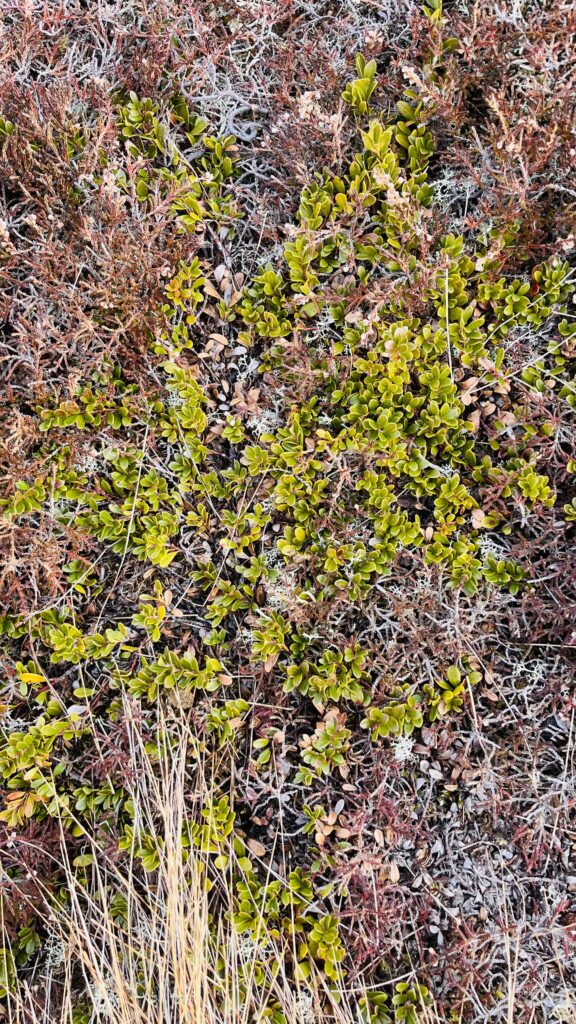
The lingonberry plants, like the heather, are very good at growing in bogs, and can cope positively with harsh cold, windy conditions like those found on mountain plateaus. Like the blaeberry that grows further down the hills in the woods and up to the tree line, the berries produced by the plants can also be a tasty treat for the reindeer.
Bright green leaves of the lingonberry plant stand out beautifully amoungst the lovely purple of the heather.
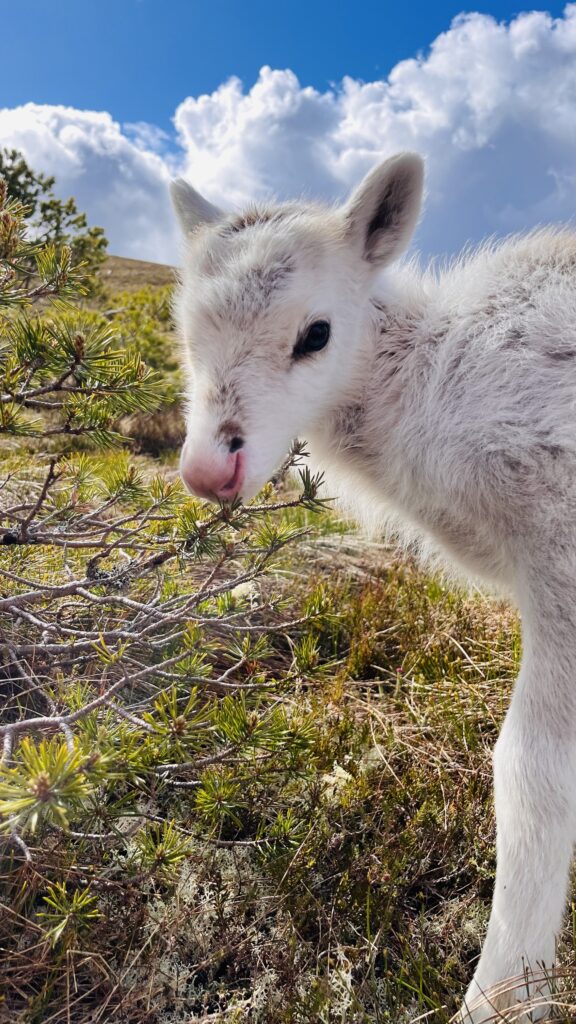
I realise that is a lot of information about plants! So, if you’ve stuck with me till the end I’ve included a final very cute photo below of baby Quickstep out on the free range last summer as a reward! It’s nice to take the time to learn more about our surroundings and not just appreciate the reindeer, but also their home, and how important each and every bit of it is.
Quickstep munching on a Juniper shrub high in the hills.
I’m almost at a complete reindeer year now, having worked through late summer, the rut, Christmas, and free range season, the last for me to complete the set – calving season! I was ready to be inundated with calves everytime I went up the hill each morning, but this May saw a steady trickle of calves, keeping all of us herders on tender hooks for which cows would calve next.
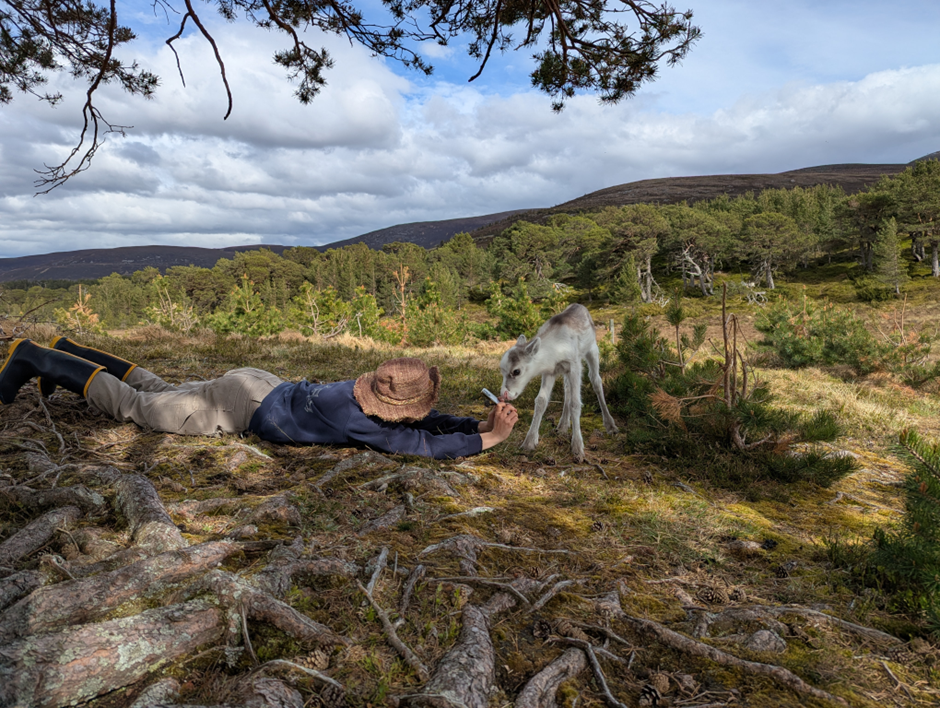
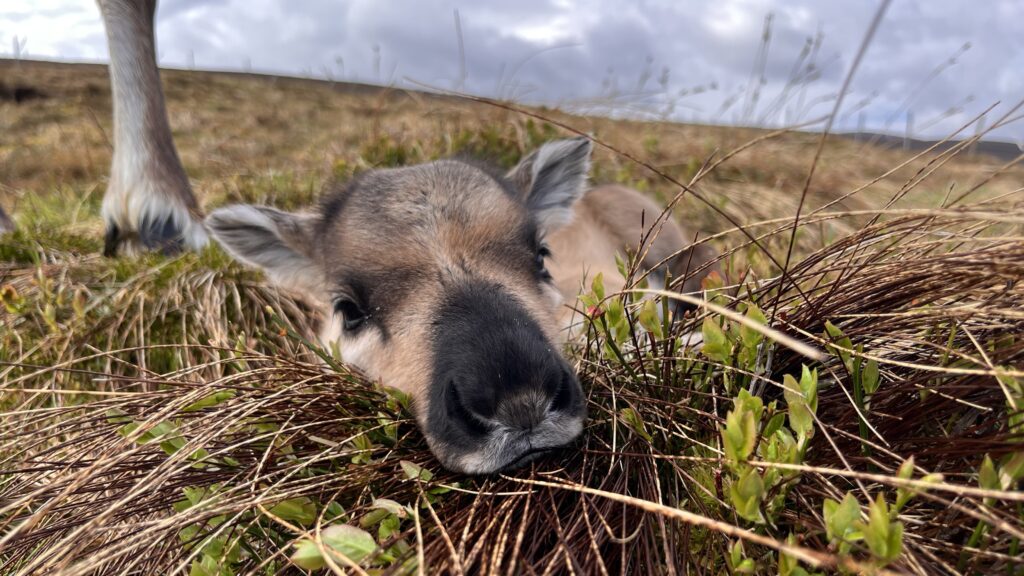
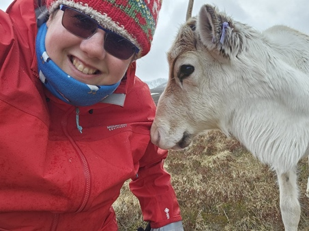
Some of the calves are incredibly tame right from day one, maybe because their mums are very friendly, or sometimes, in the case of this little guy – they’re just very curious about the world! (And maybe slightly dopey…)
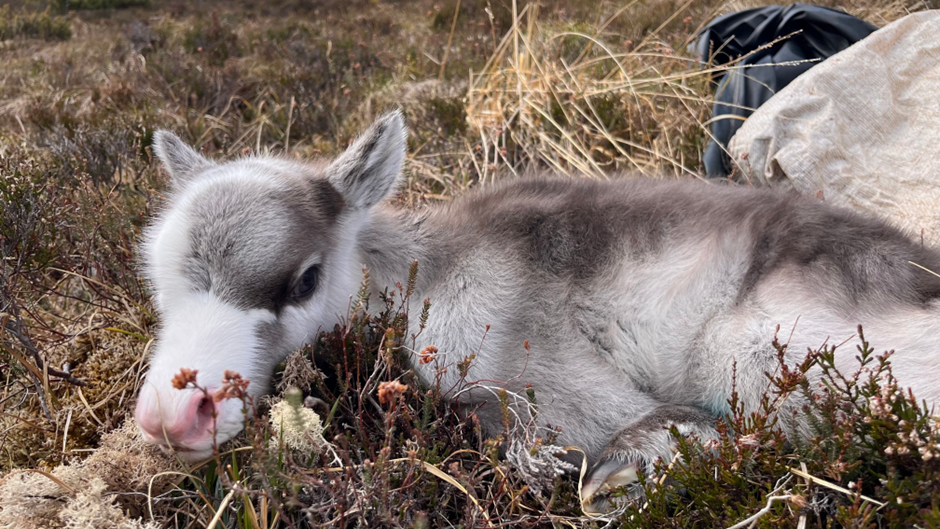
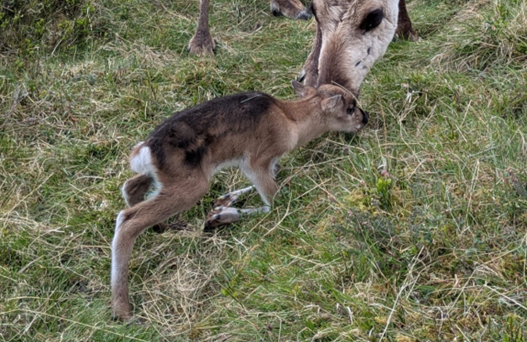
My first trip up the hill at the very start of May left me disappointed to find that no cows had gone off to have their calves overnight. But I didn’t have to wait long for my first calf of my first calving season! (As we wait to let our adopters know which cows have calved this year, I won’t give away any of the wonderful mums at this time, but that doesn’t have to stop us from admiring all their beautiful babies!)
My first calf was a very small female with lovely, what we call ‘normal’ colouring. She did very well following her mum for quite a distance, while Amy, Kate and I gently pushed her from a distance towards the calving pen. The reason we do this is to put all our cows and calves together into a nursery area for the first couple of weeks of the calf’s life. From there they then return to the herd for a week or two before setting out onto the free range as a mini herd of mums and youngsters, set to return from the mountains in autumn.
An instant favourite reindeer for me, my first calf!
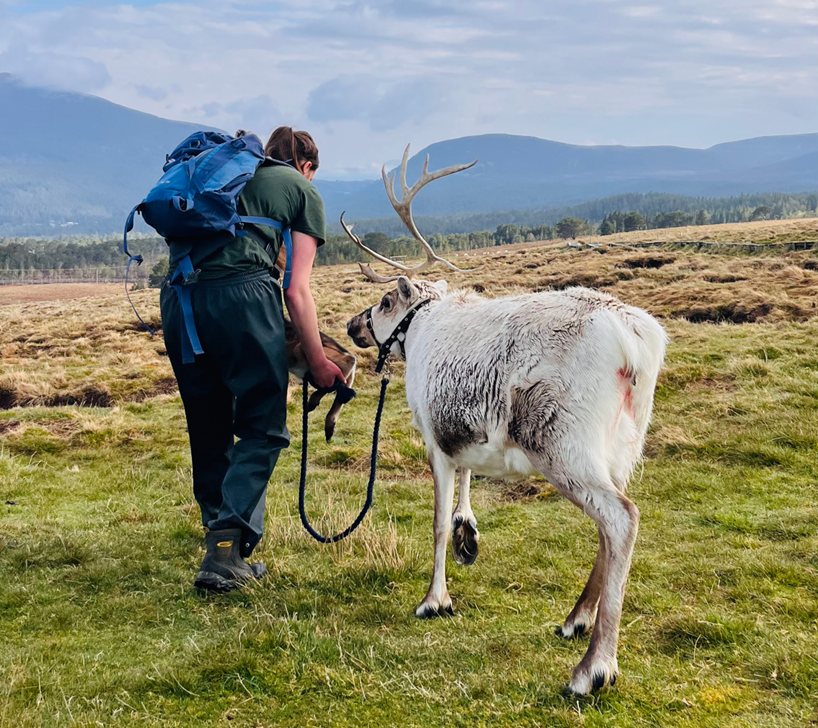
Calf number one of my top three calves this season, made it as far as she could before she flumped down tired into the grass and mum started to graze. Amy was then tasked with the awful responsibility of carefully carrying the calf alongside her mum into the calving pen – what a nightmare…
Amy juggling mum and baby, making sure to keep them close together and give them all the time they need while we make our way across the Hill Enclosure.
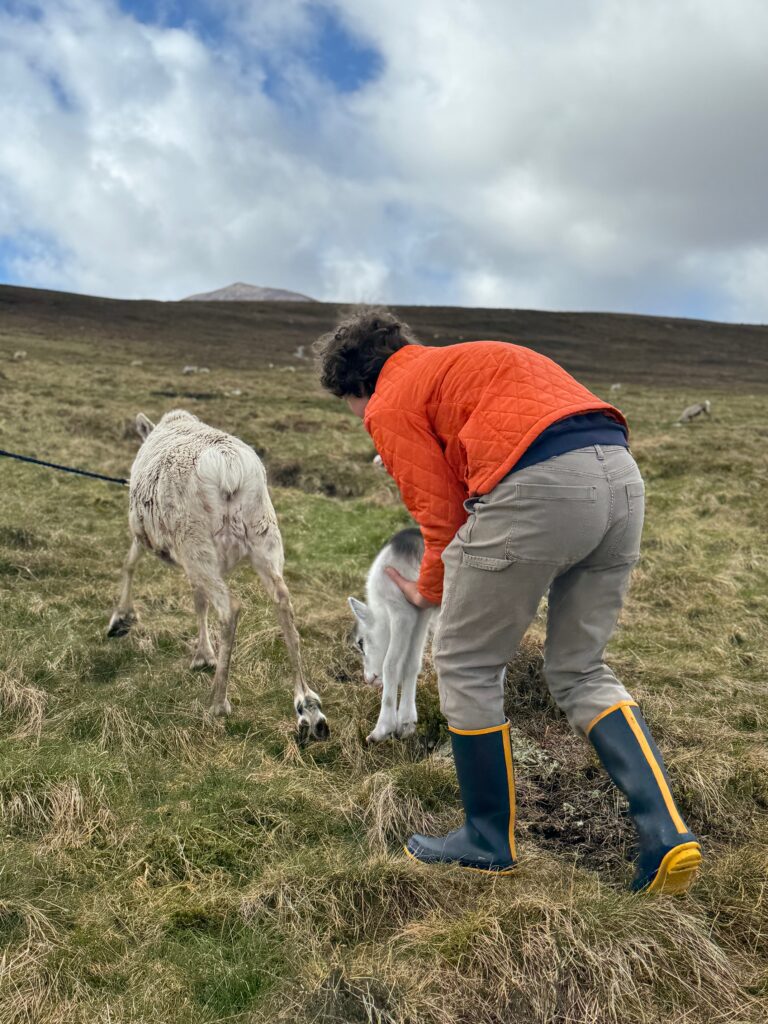
It’s really important when we’re moving the calves like this that we take it slow, allow lots of moments for the mum to be able to nuzzle her calf and for us to keep the calf right next to her. This could be by carrying her slightly in front, next to her face, or it could be by bending right over and carrying the calf by the mum’s back legs. These methods keep the mum calm knowing her baby is right where it should be and the calf can be constantly reassured by smelling, feeling, or hearing its mum.
Once we had got the calf over to the calving pen, we have to treat the calf. We use an antiseptic spray on the remainder of the umbilical cord (which leaves the calves bright blue), and we treat the calves with spot on, giving them protection straight away from the ticks that can be found on the hillsides. While Amy treated the calf, I held her close by mum before we put them both in with the other cows and calves that were mere days older than this one.
It’s a tough job being a reindeer herder.
With the excitement of finding my first calf over, the others started to come in a steady stream. As did the exciting moments up the hill. From hanging out daily with the growing calves – both in size and confidence, to setting out on my own for the first time to find a mother and her new calf in order to treat the calf. Thankfully, my first go of solo catching a calf to treat was one born to a very experienced mother who was very calm while I did everything I needed to. Calf number two was a success and I left mum and baby in a quiet spot with a very large pile of feed and lichen for a well deserving mother.
A great experience dealing with this adorable little guy!
My final top calving moment, and calf number three was my long awaited calving bet!… Every calving season, us herders will all pick a cow we want to back for calving season who hopefully won’t be the last cow to calve. The loser (whose cow is the last to have her calf that year) has to bake a cake for the many victors for calf naming night later in the year. It had become a running joke how much I didn’t want to bake the cake, and as the calves were born and the days ticked by – the joke was losing its steam and I’d begun planning recipes. But, I was saved at the very last moment, coming in second to last, my chosen reindeer had saved me from the jaws of baking and a wonderful female calf joined the herd! (Cue the celebration…)
Saved from baking – another favourite reindeer for me that’s for sure!
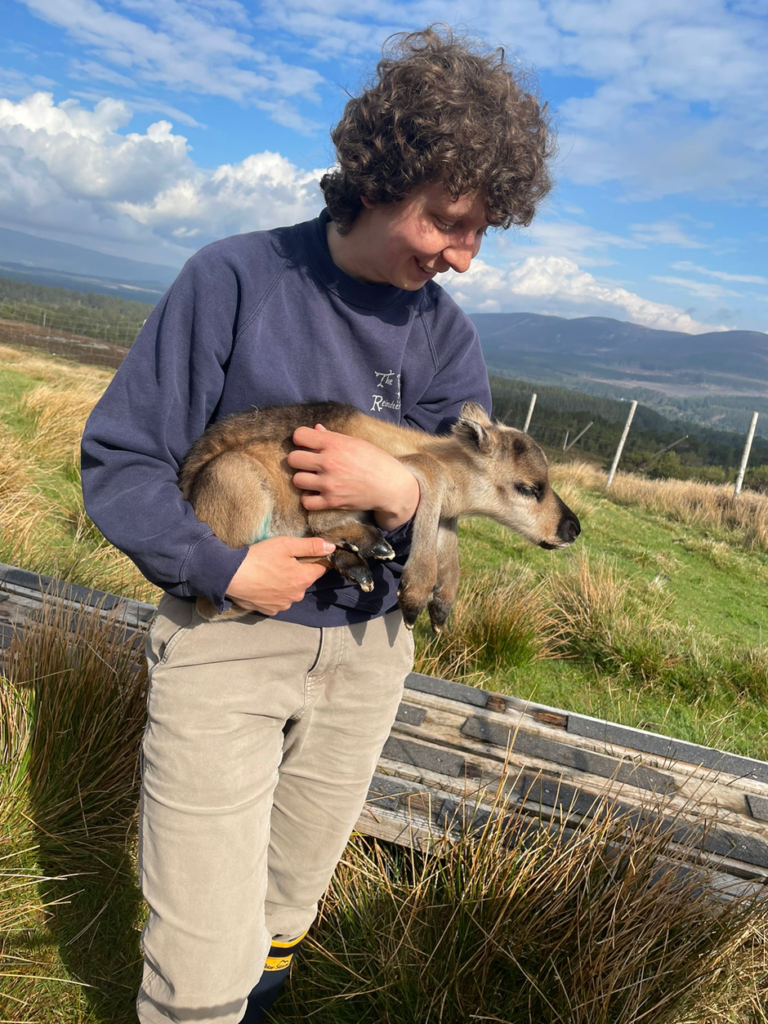
The next day after she was born and had been treated, it was time to bring mum and my saviour into the calving pen, so I set out following Andi across the enclosure to track down mum and calf and hopefully push them in. They had quite a walk to move them across the hill and it was pretty clear right from the first few steps that the calf was going to struggle to move through all the deep heather that mum had settled them both in. So, incoming that awful task that no one wants to do… I volunteered as tribute to carry lucky calf number three across the enclosure.
The walk took quite a while and required a lot of stopping to let the mum lick her calf’s face and to check on her. The calf was very relaxed and sleepy for the entire walk, but like any animal, they’re all different and need different allowances, and this particular female can be quite… grumpy is probably the best word. So we kept them close together and made sure that mum was in control. Finally we made it to the calving pen and they joined the nursery herd, much to the cow’s delight – nursery pen meant lots of lichen!
Anyone order a calf taxi?
So, as June starts, calving season comes to an end and it’ll soon be time to walk the cows and calves out onto the free range. Having had the oppertunity to help with that in the start of June last year as a volunteer, it feels like a full circle moment. Maybe I can ditch the ‘L’ plates now…
Over the past year and a half our new exhibition & paddocks have been a non-stop project. One thing we knew we wanted to achieve was to make the new and improved paddocks a haven for local wildlife.
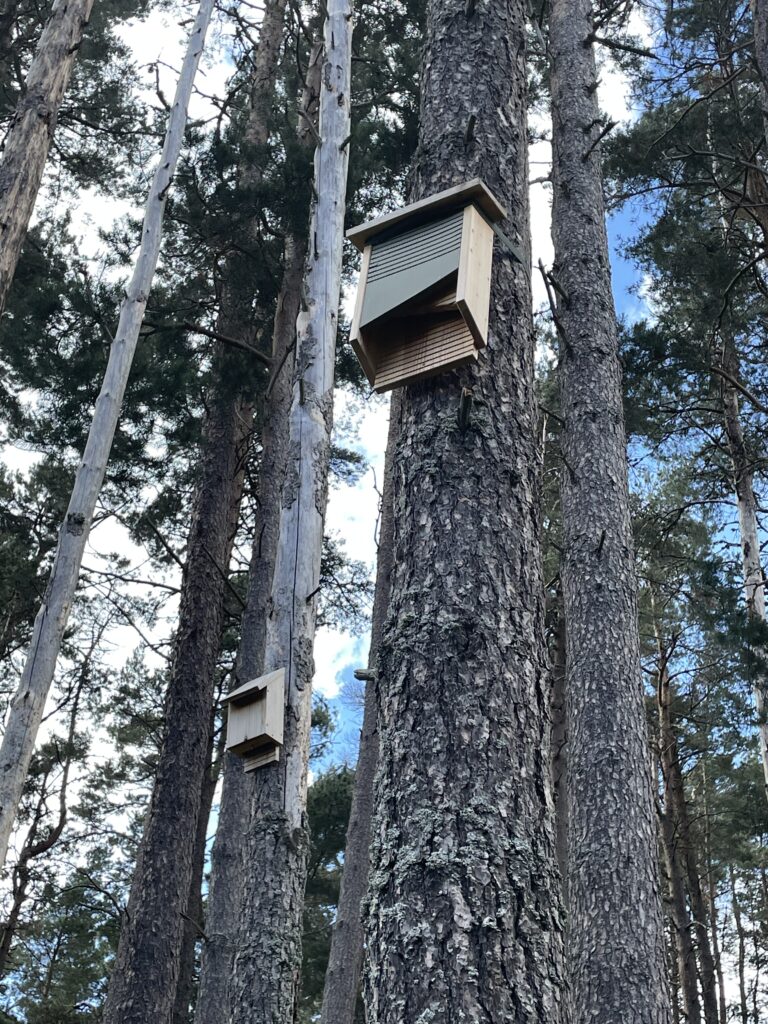
Our mission to make a home for wildlife within the paddocks started with some bat boxes. We strapped these to some trees and snags at the edge of the woods our paddock reindeer overnight in. With bat boxes, you want to make sure they are at least 4 metres off the ground, and that the bats will have a clear flight path to enter – so no low branches blocking them. A sheltered position that gets direct sun for a good portion of the day provides the cosy conditions the bats want. Somewhere undisturbed by artificial lighting is preferred too.
Bat boxes on trees.
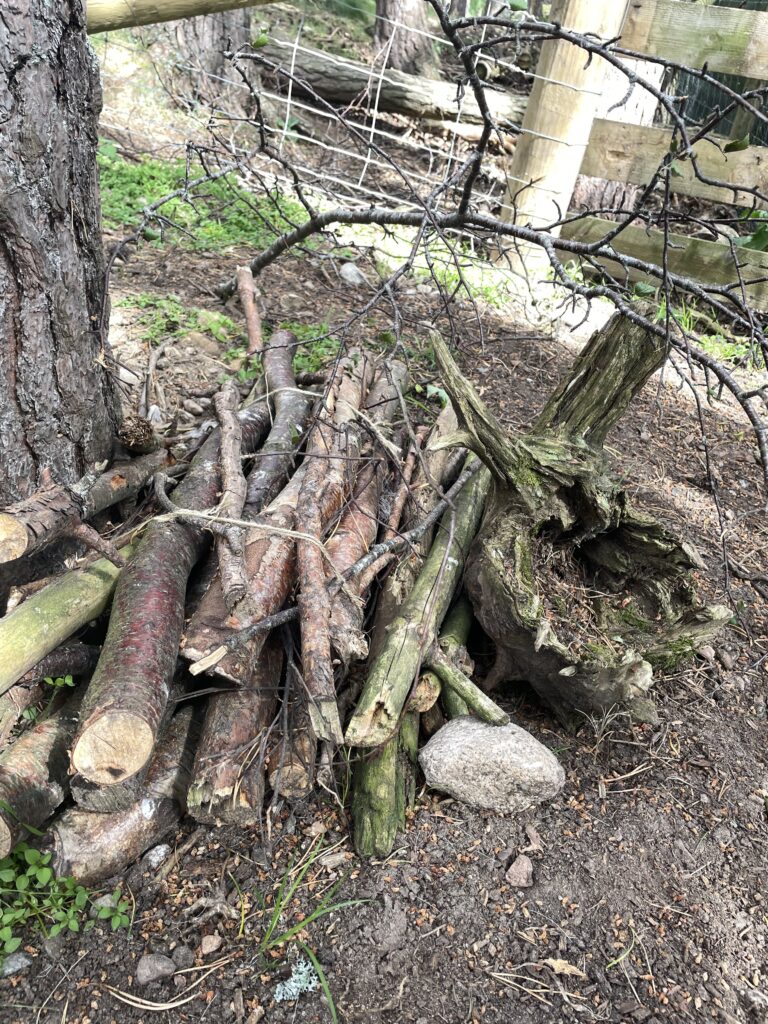
I put together some stacks of deadwood – these provide brilliant habitat for a whole host of invertebrates, and other small animals. These are pretty self-explanatory to make – and weren’t much effort as we have so much brash and deadwood on the ground from all the ongoing works in the paddocks, and the frequent windy weather that brings down branches from the pine woods.
Deadwood pile.
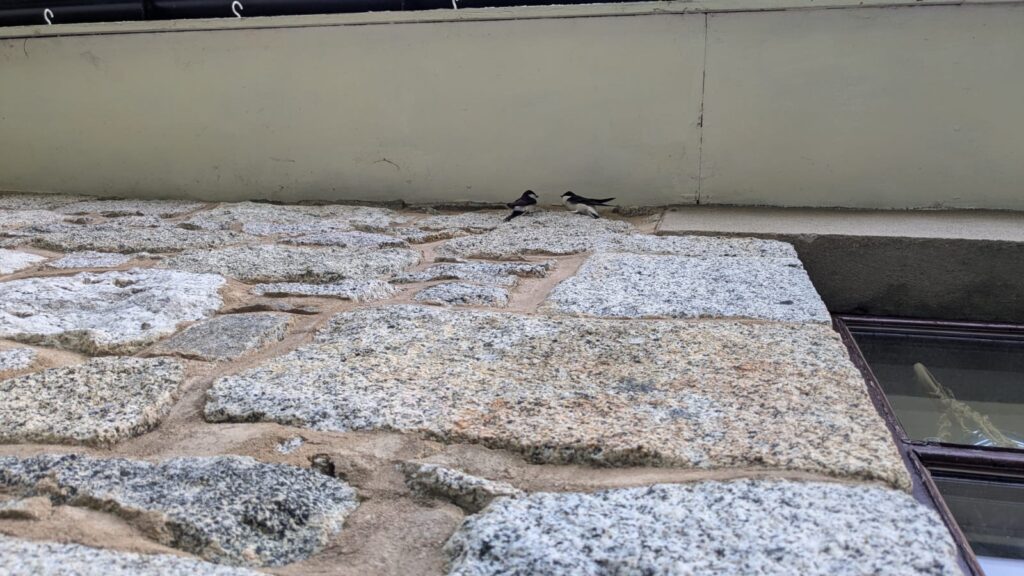
In 2024 Lotti put some house martin nest boxes on the old building – now exclusively staff residence, after seeing some house martins eyeing it up as a nesting site. This inspired us to do something with the new building. We decided it wasn’t suitable for house martins, but they aren’t the only birds suffering from a lack of nesting sites.
House martins on the old building.
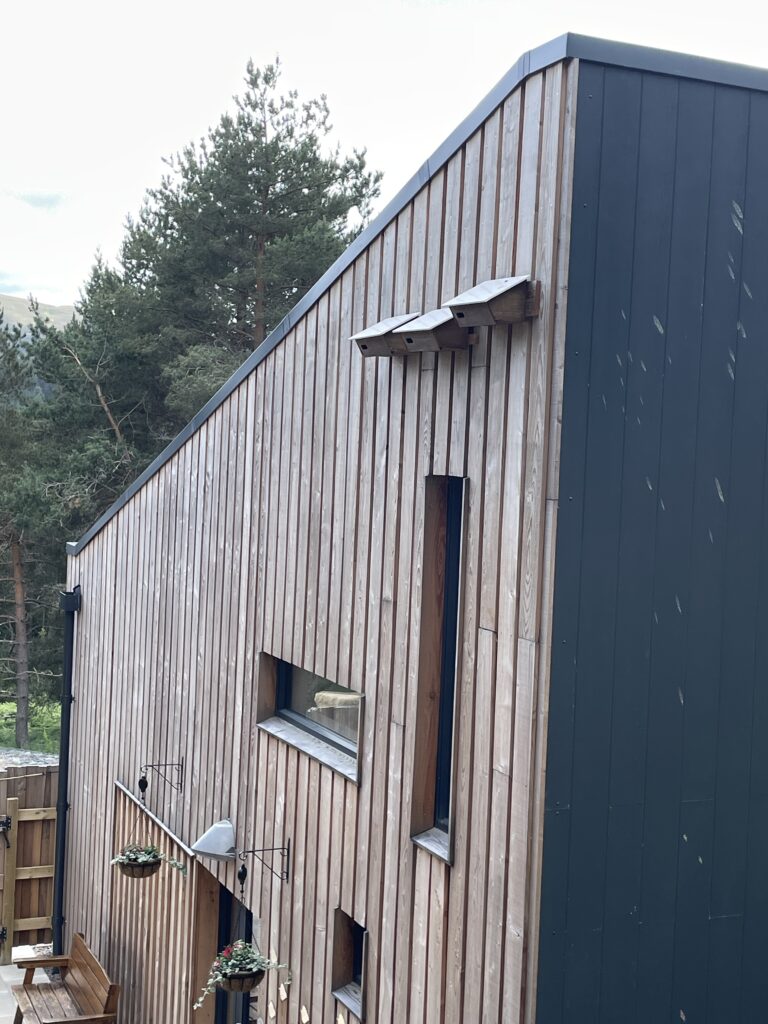
We were kindly donated some swift boxes by ex-herder Jack (thanks, Jack!). Me and Cam had an exciting (terrifying) time, taking turns at the top of a very tall ladder to get these up on the side of the main building. We managed three. Maybe one day we’ll pluck up the courage to put the rest of them up! Swift boxes should be placed close under the eaves of a building, as high as possible. Swifts want a clear flight path to swoop down and then up into their nests, so it’s important there are no nearby obstacles in their way. North or east facing placements are best, to avoid the worst of the afternoon summer heat.
Swift boxes on building.
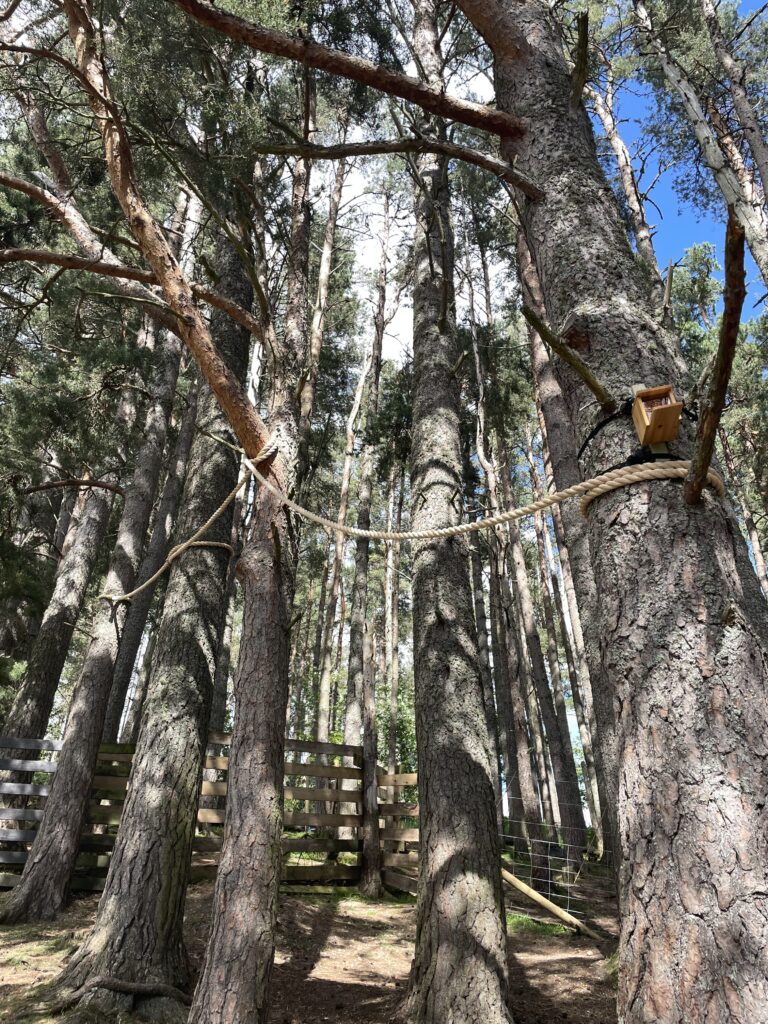
Daisy has recently been hard at work putting together a squirrel feeding station, with ropes for them to scamper tree-to-tree. Squirrel feeders are specially designed for just the squirrels to access, and you can buy special squirrel food blends that best resemble their natural diet.
Daisy’s squirrel station.Limpopo waiting for the squirrels to turn up.
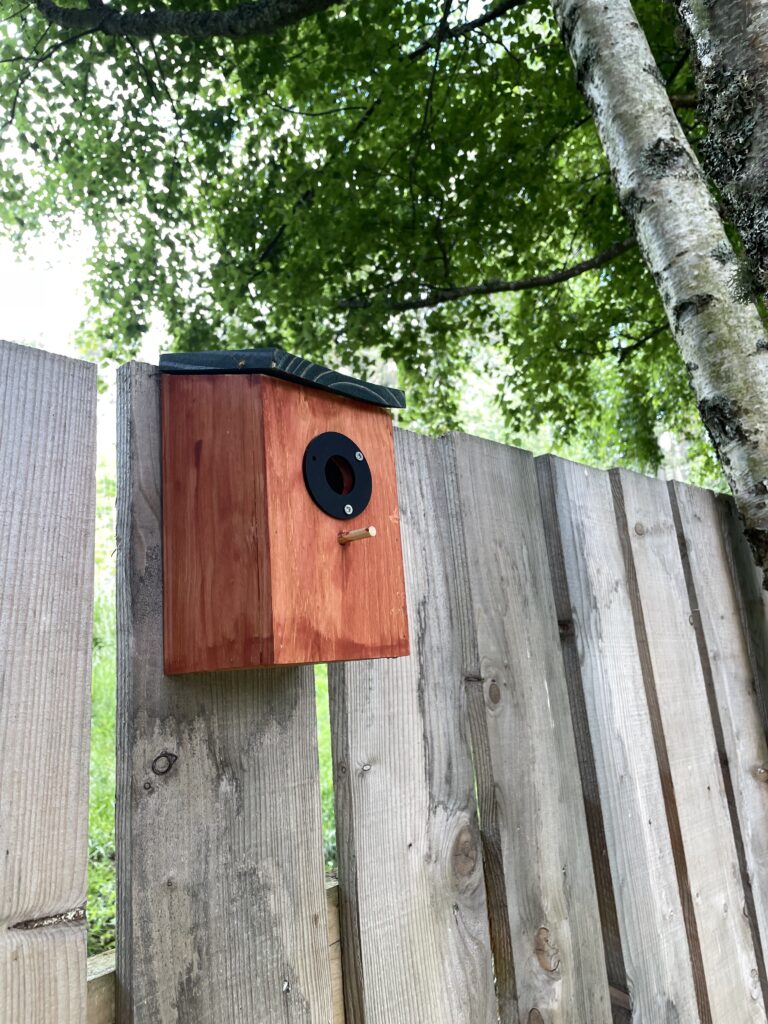
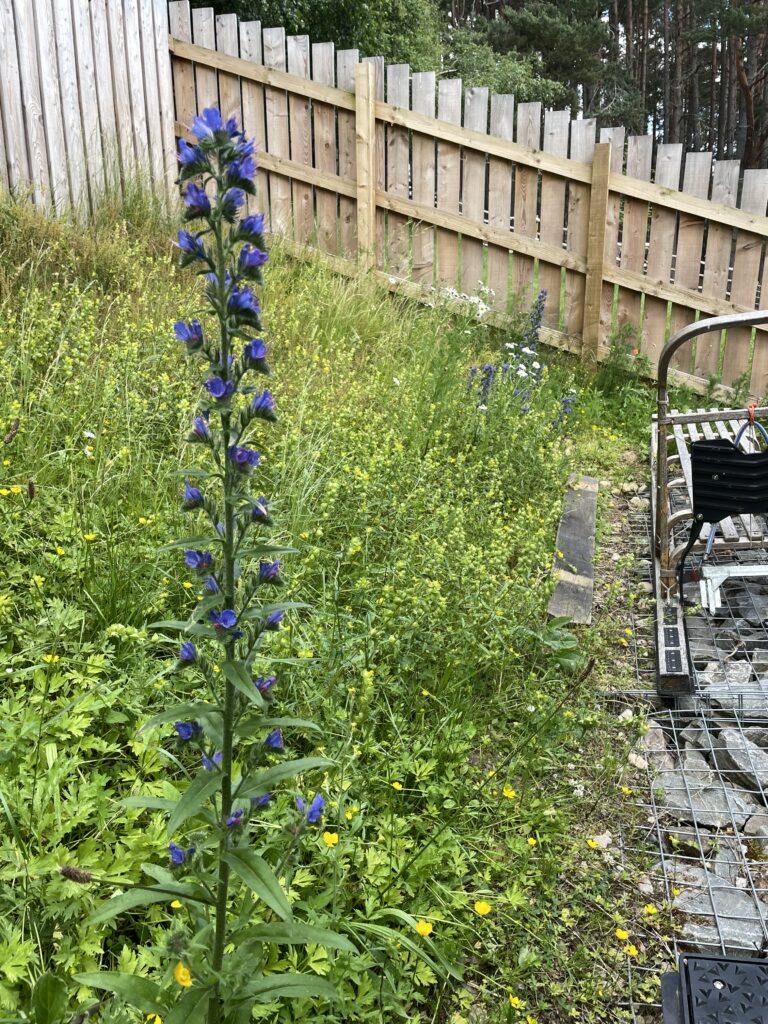
As well as these specific efforts, we’ve also put up multiple nesting boxes for small birds, and sowed a wildflower bank behind our staff room which should hopefully continue to flourish and improve over the coming years.
Bird boxes. Wildflowers behind the building.
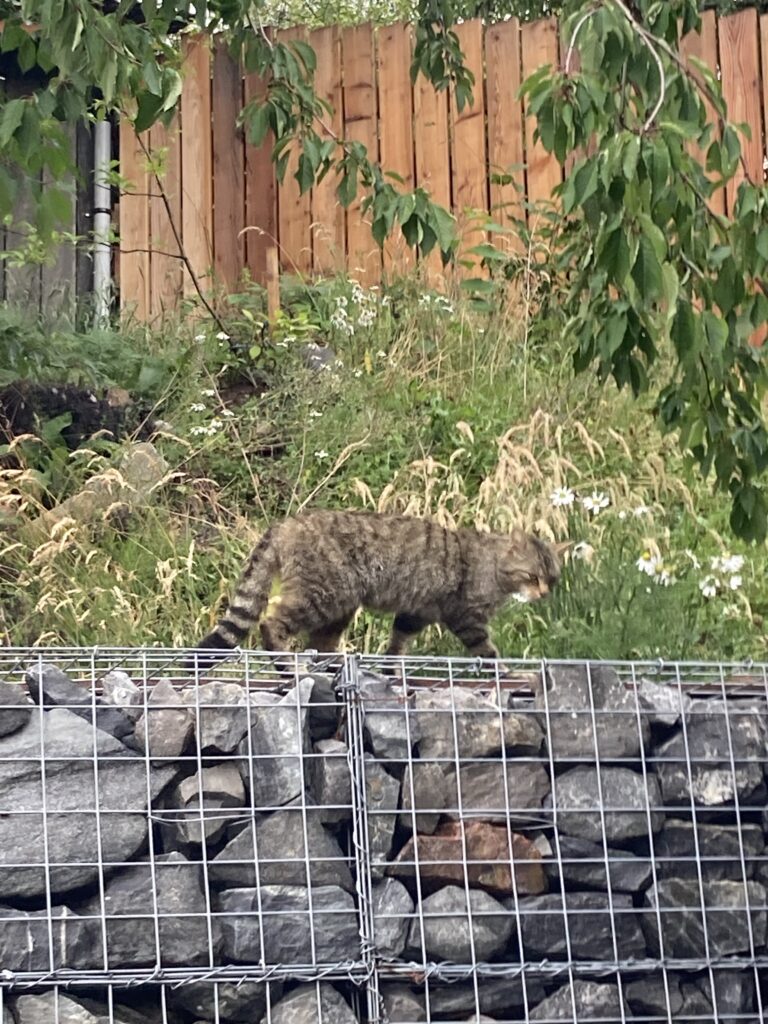
We’ve had some great wildlife sightings in the paddocks in the past year. We’ve had multiple visits from Callie the Scottish wildcat (part of a release scheme in the area), a resident badger in the woods last winter, and to my delight a beautiful male adder last summer! We also have an abundance of different bird species, small mammals like red squirrels, shrews, voles, and moles, and undoubtedly plenty of invertebrates. Hopefully our efforts in the paddocks will bring in even more, and we can make our wonderful local wildlife feel at home.
When we left off with part 1 of Emm’s visit back in March, the days had been filled with reindeer and herder antics! Enjoy part 2 below…
——–
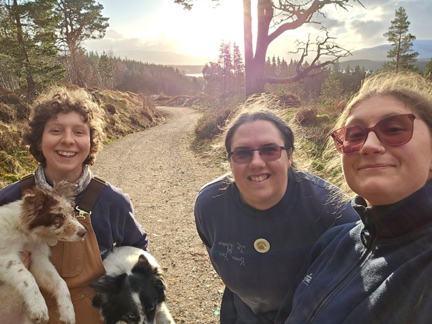
I had a great time catching up with all the dogs again. With Daisy and Alicia I went on a walk with Daisy’s dogs called Echo and Asta. This visit was the first time meeting the lovely Asta who is a 4-month-old collie. We went up the hill behind Reindeer House then down through the woods and onto a path going downhill. My herding friends call it ‘the wee loop’. We saw lovely views of the mountains and Loch Morlich. Daisy was showing us where to take the best photos of the lovely views. We all had a selfie too.
Asta, Daisy, Echo, Emm, and Alicia enjoying a walk as the sun set over Loch Morlich.
One time, I was locking up the car park at the Reindeer Centre when I noticed the dogs had got out of the front garden of Reindeer House. Echo, Asta and Sanna were running around and Tiree was standing in the front garden by the open top gate deciding whether to go and join the other dogs or stay in the front garden. I managed to get Atsa and pick her up and went to find Daisy to help and we rounded up Echo and Sanna, led them into the front garden and Daisy shut the gate. Another herding job completed!
After one of the hill trips, me, Lotti and Cameron went to find River, the 10-month-old calf. The reindeer had wandered over a bit of a distance after the hill trip. Whilst we were walking over there, Winnie, the hand-reared reindeer, had stayed with us and followed us over. We walked past a group of hill walkers. We must have looked a sight, three herders with one reindeer following. Winnie went over to the hill walkers to see if they had food for her which made them laugh and then continued following us.
We found River amongst the reindeer and she was limping being a bit sore from the vaccination. Cameron put her on a head collar and then distracted her with a bag of food whilst Lotti injected her with a painkiller. We noticed Dante’s antlers, which are quite big, had fallen off overnight. Lotti walked up to the top of the hill and across the top to the site where the reindeer had been to see if she could find them while Cameron and I headed down the hill back to the reindeer van. We picked up Lotti on the other side of the hill in the reindeer van but she hadn’t found any antlers.
More herding on the free range, looking over at the wonderful hills and loch below.
When on the free-range the reindeer can end up anywhere. One day Lotti dropped me off with Fiona at the carpark and we walked up a very steep hill to find the reindeer to bring them down to a visit spot. We found them at the top of the hill very high up all sitting down and dosing. Meanwhile Lotti had brought the reindeer van to the other side of the hill to another car park where we would finish our walk. Then she walked to the visit spot to drop the reindeer food off. Fiona led the reindeer and I herded from the back. When the reindeer were getting up and beginning to move, I noticed Morris who is a 10-month-old calf still asleep and dreaming because he was twitching and had his eyes closed. Morris is leucistic (a pure white coloured reindeer) who are sometimes born deaf and we think Morris is deaf so he sometimes doesn’t hear the herd move on. I gently woke Morris up and got him moving herding at the back, I looked for any antlers on the ground which might had fallen off as we went but I didn’t find any. Lotti joined me and helped me at the back. We walked down the hill to the visit spot. The 10-month-old calves fed out of the bag then we fed the others and counted them to make sure they were all there.
The greedy calves from last spring making sure they get their fill first.
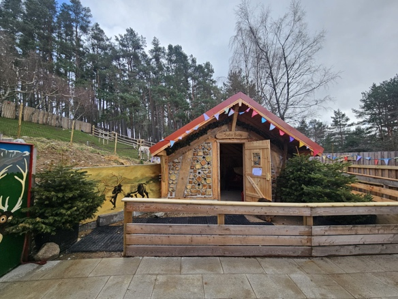
I helped at the Open Day for the Businesses. It was in the afternoon and there were hot and cold drinks, biscuits, homemade cakes and homemade scones in Santa’s Bothy where people helped themselves. The log burner was on in Santa’s Bothy too. There was bunting up and four reindeer in the paddocks who had come over the day before ready for the open day and the Easter Holidays. They were Kernal, Cicero, Iskrem and Cornetto. They were a good group of reindeer because Kernal and Cicero still had their antlers and Iskrem and Cornetto had started to grow their antlers. We could show the visitors the different stages of antler growth. Herders were there to talk to the visitors and answer questions.
Santa’s Bothy looking inviting with drinks and snacks inside during open day.
The new outdoor reindeer information signs had been put up ready in the morning. The paddocks, new exhibition and shop was open. I enjoyed talking to people and answering their questions. The day went very well so I passed on the star herders’ badge to Tilly and the team because of all the hard work they had done for the Open Day as well as with all the planning and completion of the new Reindeer Centre. They had given the reindeer herd such a positive future granting Mikel Utsi’s wish of someone successfully taking the reindeer herd on.
Tilly now repping the star herders badge.
One March trip was memorable as I went on my wettest and windiest trip ever to find the reindeer and feed them. Daisy and Andi had gone to fetch the reindeer and walk them across the hills, very high up, and they phoned down to the Reindeer Centre to stay it was too dangerous to bring visitors to see the reindeer that day and to cancel the hill trip. Amy, Hen and I went up the hill to take over from Andi and Daisy to take the reindeer to a different area in the hill. As we climbed up a very steep hill, it rained very heavily, but luckily was not as windy as Daisy and Andi had had it. I had a bag with a bucket of reindeer feed on my back and it was a bit hard going. We met Andi, Daisy and the reindeer and took over. Amy led the reindeer and, with Hen, I herded from the back. We got them to a different area and fed and counted them to make sure they were all there. It was still so windy and wet and, while I was counting the reindeer, I stepped in a deep bog again and got soaked! We then left the reindeer to it and the wind started to pick up again. Amy had to hold my arm when I did up my shoelace on a rock.
Herding the reindeer on a windy and wet day. Come rain or shine, the herders take to the hills.
On my next hill trip with Daisy and Hen to the free-range there was snow on the ground but the sun was shining. When we found the reindeer we started with the adaption talk to the visitors but suddenly a very snowy blizzard came in so we had to put our ski googles on. It was so amazing how quickly the weather changes in the mountains but the reindeer were loving the snow. After Hen and Daisy put the food out the visitors hand-fed the reindeer. Normally the reindeer then hang around after the hand-feed and the visitors can get close to them and take photos, but they started to wander off to explore the snow, led by Turtle. We had to herd them back whilst Daisy called them and it worked so the visitors got more time with them.
A fresh layer of snow to burry the heather again.
Near the end of my visit at the end of one day, we had a fire alarm test so Andi set it off. Unfortunately, the fire alarm then set off the security alarm and Andi didn’t know how to turn it off. It was very noisy!! Eventually with Cameron and Hen’s help and a phone call to the security company she was able to turn it off which was a great relief to all.
It was great to catch up with some of the calves and on one occasion I saw a 10-month-old reindeer calf Haka suckle from their mum Christie. This was unusual because they normally stop suckling at four or five months old and it was very cute to see. On another one of the hill trips, some of the 10-month-old calves and younger reindeer were running around so fast in the snow and chasing each other. They were very excited and seemed to be having lots of fun.
Haka suckling from mum Christie, so lovely to see the strong bond between cows and their calves.
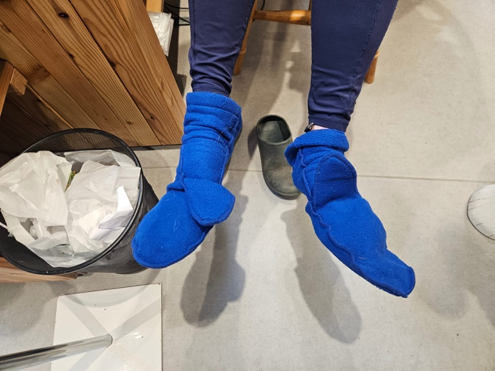
The visits were often in the snow this time. When Sheena was getting the reindeer to the visit spot one morning a snow blizzard blew through and her socks got very, very wet. When she got back to the Reindeer Centre, she realised that she didn’t have any spare socks so she improvised; she turned her gloves inside out and put them on her feet! Such a clever idea. I took a photo as she then walked around the Reindeer Centre in her gloves which worked.
Sheena’s problem solved mitten socks – coming soon to our shop…
Back at Reindeer House there was a new “Brenda”, the truck which we transport the reindeer in, and the electric van had been fixed. The electric van was in the garage being fixed on my last visit. As usual there were quite a few jobs to do. I met the new hoover, which was blue, and he is called Charles. He can hoover dry floors and wet floors so I swept, hoovered and mopped the floors and outside the Reindeer Centre. There were wellies to be washed and put them up to dry then put back in the welly rack. I dusted the shelves in the shop and restocked the shop and put the green bins out. My mum says I never do any of those jobs when I’m at home!
An important job is the feed mixing in the cement mixer where I put a few ingredients, sugar beet, cattle crunch, barley oats, dark grains, molichaff, calcium powder and a bit of cooking oil to make up the reindeer food. I helped Andi in the shop with a stock count, counting adoption gift packs, magnets, pin badges, pens, glasses cleaners and 5th year adoption photos, folded up the tea towels and separated the stickers for the children’s quiz. Children get a sticker when they bring the quiz back after doing it in the exhibition and paddocks at the Reindeer Centre. There are 4 separate picture stickers; Nuii sitting in the snow, Roman as a breeding bull, Torch looking up at you and Camomile as a calf.
There are jobs to do with the reindeer in the paddocks as well with poo-picking in the morning. Letting the reindeer through to the daytime area and giving them their breakfast and later in the day, as they spend the night time in the woods, I led them through to their night time area and give them their tea.
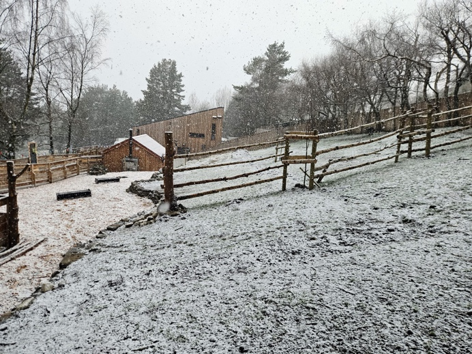
Another beautiful snowy day in Glenmore.
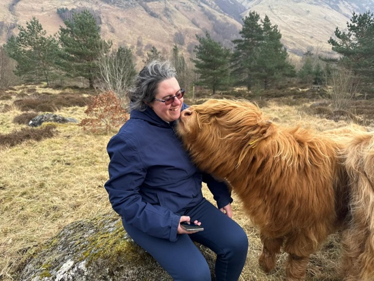
It is always nice to meet new faces and, on this visit, I met Jess who was a part-time reindeer herder recently joined and her lovely dog called Maui. I also met Alicia’s lovely dog called Iona which was a new dog for me. I try to catch up also with past herders when possible and I went to see Lisette and the Highland Cows who she now works with in Fort William. She is based in Glen Nevis and it is spectacular. It was so exciting seeing Lisette and meeting her Highland Cows. Each Highland Cow had a name and we met the four youngest first who were the calves from last year. They were curious and I sat on a rock and they came over and started licking my coat and one of them even licked my face. They explore by licking things with their tongue. We then went to meet the bull and his friend but we stayed on the other side of the fence just in case!
Emm the Highland cow whisperer!
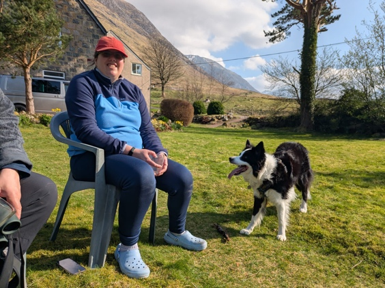
Then we went to meet the main herd. Most of them were sitting down chilling and my mum and I got to groom one of them which was very exciting. Some of the Highland Cows were pregnant one of whom was due to give birth in the following few days. Lisette gave us lots of brilliant information about Highland Cows and told us all about each one of them. After we met them, we managed a cup of tea in her garden and met her dog called Munro. It was so lovely seeing Lisette and catching up with her and seeing the Highland Cows and Munro.
Emm and Munro.
I am so excited about coming back to work with the reindeer and my special herding friends in September. I can’t wait. I am counting down the days.
The first few minutes of my stint working in March started with a bang! Daisy Kate and I got in the reindeer van to go to the hill enclosure. As Daisy drove away she forgot the drain pipe was on the ground outside Reindeer House and she drove over it and there was a loud bang and it sounded like the van floor was coming out. Daisy said “oh, no, we haven’t started well and this is going to go in Emm’s blog.” Lol. Well it has Daisy but I know you are the blog wrangler now and that it might be edited out. Lol.
Editors note: I could never cut anything from your blogs Emm. But I think what we should really be asking ourselves is who put that drain there in the first place?!…
Foxtrot, just as excited as the rest of us to have Emm back!
In March, the reindeer are normally free-ranging and we do hill visits on the free-range. When I got there, the reindeer were in the hill enclosure. The reason for that they were having their vaccinations. I helped in the shed in the hill enclosure by being a helpful set of hands, holding things. Every reindeer had their temperature done too. The reindeer who were there and who are normally free-ranging on the Cairngorms at this time of year are the females and the 10-month-old calves.
Arta, Earl Grey and Hobnob in the handling pen of our reindeer shed.
After the vaccinations, I went with Kate to Tilly’s farm. On the way we passed Kate’s house so she could quickly grab her lunch for work she had forgotton. I met her lovely cat called Kenji. We had our lunch in Tilly’s farmhouse, and I saw Tuva, Tilly’s lovely Border Terrier. We then went to the reindeer who were at the farm who were mainly males but a few females too and herded them into the shed. The female reindeer and the 10-month-old calves were being vaccinated and with the male reindeer having their temperature done. I helped by putting headcollars on them and holding them. They were all so good. I saw my 2 adopted reindeer called Scully and Zoom. I even saw Scully’s 10-month-old calf called Rumba. It was really nice seeing them all. With Kate we took the reindeer onto the hill area on the farm and fed them.
Feeding the male reindeer at the farm.
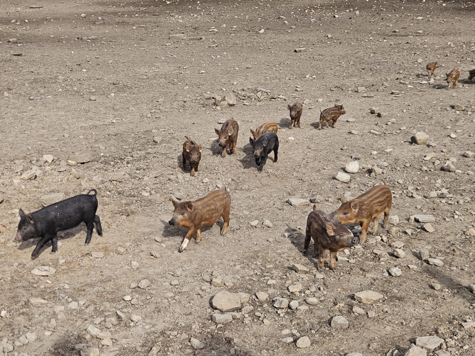
Tilly showed us the sheep and we went to get some food for the pigs which was barley and then Tilly fed the pigs and showed them to us. Some of the pigs had 1 month old piglets who were so cute. We filled some water containers for the pig’s water. The next job was to fill some bags with sugarbeet, an ingredient we use in the reindeer food mix, and put the bags into the back of the reindeer van. Whilst we were filling up the sugarbeet bags in the barn, the Red Deer who were in there were very interested in what we were doing and one was putting its head through the fence to try to get some. It was great to see all the different animals as well as the reindeer at the farm and we got around the farm on a quad bike which Tilly drove which was very exciting!
The lovely piglets at the farm.
The next morning, the reindeer were still in the hill enclosure. They stayed in there for a few days so we could keep an eye on them. I led them to a different part of the hill enclosure and called them. Andi and Amy herded them from the back. They were at the top ridge of the hill enclosure when we got there. We called them down and fed them their breakfast.
On the last day of the reindeer being in the hill enclosure, we did the hill trip at the very top of the top corridor in the hill enclosure. It was the first time I have ever done a trip in the top corridor. It was so windy and cold. After the hill trip, Andi and Kate and I sent the reindeer back on to the free-range. It was so lovely to see how excited they were as they went back into the hills.
Seeing the females back onto the free-range.
I wrote about Vienna in my last blog when I was up in October from my last visit. She was feeling sad and not wanting to interact with us and the other reindeer and wanted to be alone and not be in the herd. The vet was keeping an eye on her. But I am so glad to say she is much better and happier and back to her normal self now.
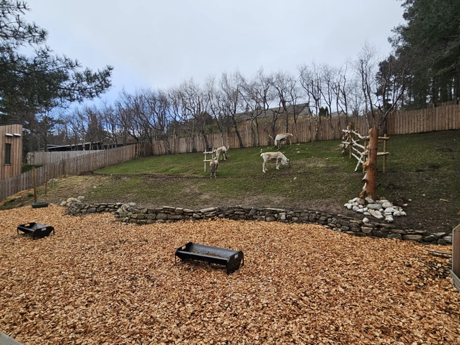
In the paddocks next to the new reindeer centre, a lot had changed since my last visit. Santa’s bothy with a log burner inside was up and running. There was a new fence up in the paddocks and a new stone wall plus a new big wooden reindeer with Roman’s antlers on it’s head! Very impressive.
We were getting the paddocks ready for an open day for the local businesses around the area planned for the weekend. I helped my herding friends by doing some landscaping in the paddocks with them. They brought me woodchip to spread across the bottom area of the paddocks and did lots of runs from trailer whilst I raked the new woodchip across the bottom area. I felt very proud of myself because I had never done this before. I also picked up twigs, stones and rocks from the ground and helped by building a cairn putting soil and mud into the new stone wall. The herders put some more fencing up in the paddocks and we moved things from the paddocks and tidied things away.
The new woodchip looking lovely in the paddock – fantastic job from Emm and the team.
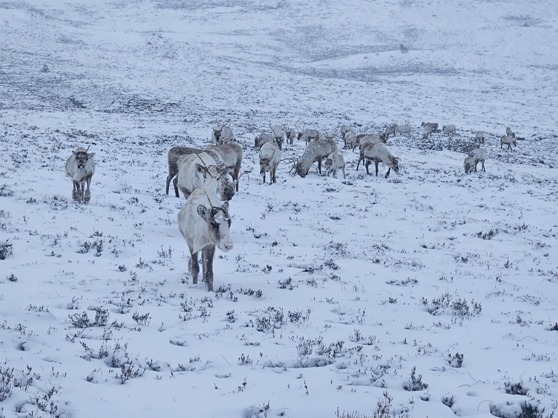
The reindeer were back on the free range which is very exciting. They can wander anywhere with no fences holding them back. Fiona, Daisy and I went to find the reindeer to bring them down to the nearest visit spot. They were near the footpath so we called them and they jumped over a burn and came wandering over to us. It was very exciting because there was lots of snow. It was so special seeing the reindeer in the snow, seeing their adaptions working in their natural weather and environment. Some of them walked in a line stepping in the same footprints to save energy just like me, Daisy and Fiona. We gave them their breakfast. In some places the snow was knee deep and I fell in two snow holes and Daisy got the evidence on video! Even more snow was falling too.
Waltz leading the herd in the snow on a wintery morning.
A little later, with Amy and Alicia, I did another hill visit in the snow. People were in awe of the reindeer in the snow and it was so lovely to see their faces as they were so happy to see the reindeer in their natural environment. It continued to snow hard so I had ski googles just in case there was a blizzard. Alicia went to find a missing walkie talkie leaving me and Amy talking to people on the hill visit. Amy then led some of the visitors off the hill to the footpath as they were unsure where to go and I stayed with the reindeer in the snow.
Hobnob keeping Emm company in the beautiful snowy hills.
When Amy got back, we began to move the reindeer to a different spot. Amy led and called them and I herded them from the back. The reindeer were being so slow. Each time they would move and then stop. I kept going up and down herding them trying not to fall in snow holes and bogs again! The reindeer were all spread out by this time as we took them up and over a hill and then down a very steep slope. I followed by sliding down it on my bottom on the snow in my waterproof trousers, like a slide. It was great fun. When I told Amy what I did afterwards, she said “that’s what waterproof trousers are for”.
There was a burn to cross at the bottom and the reindeer jumped over it and then it was my turn. I managed to jump over it without incident then up the very steep slope on the other side, across the ski road and then up another hill. The reindeer were still being slow and some of the reindeer were trying to go to the left (the wrong way) so Alicia came as back up for me. Alicia led Christie and Ryvita on head collars with both Amy and I herding at the back like sheep dogs. Christie and Ryvita did their job leading the reindeer to the top of the next hill with Alicia and we then fed them while Alicia went to get the reindeer van.
At this stage Fiona called Amy to make sure we were ok and it had just turned 3 o’clock. We had been herding them for 2 hours and it was way past our lunchtime. Time flies when you are having fun! We went back to the Reindeer Centre and had our lunch and Amy surprised me with the star herders’ badge for doing so well. I felt very proud of myself.
Emm repping the badge given to star herders!
Stay tuned for the part 2 of Emm’s March visit, coming soon!…
This May I returned to the Cairngorms as a volunteer for the second time, drawn by the potential for beautiful weather and the prospect of tiny hoof prints. Whilst there is so much I could tell you about my week, with every single day being amazing, I think there’s one day that might stay in my mind for a while.
The day before, with the free rangers.
The day began with a trip up the hill with Lotti, Daisy and Maisy (the herders have such beautiful names!). Lotti and Maisy went to check on the latest arrival, a sweet little boy calf whose identity is currently protected to allow for more formal announcements to expectant adopters.
Daisy and I went on to do a full inventory of the herd in the enclosure. This involved some facial recognition (no apps involved, just the catalogue held in Daisy’s head) and then some ear tag number checking and ticking off against the list held in the office.
Why is this done? Well, at this time of year any of the herd that has decided to go solo is likely to be a Mum-to-be and may either be ‘faffing’ (which when witnessed is just like it sounds… that day you spend getting nothing done because you just can’t settle) or might be with calf in a remote corner of the enclosure.
After identifying the location of all the herd, including a faffer in the distance, Daisy and I went into the area where Lotti and Maisy were with the newborn, as the decision had been made to move them into their own space for a little while. Now, this might sound simple but moving a worried mum and a very teeny wobbly thing with back legs that seem almost twice the length of its front legs is not an easy task. It took 4 of us… although I was mainly the emotional and photographic support.
There was a very steep hill to climb and little baby needed a little help, whilst mum was constantly checking, encouraging and teaching. There were multiple suckling stops, an occasional poop on baby’s head and lots of encouraging grunting. Daisy’s back must have hurt as she had to pick up baby on the steepest parts of the epic journey but keep the calf in sight of mother at all times, which meant adopting a stooped position and walking in the side eyeline of the adult reindeer.
Daisy with the calf. Keeping the calf only a few inches off the ground ensures the mum can always see her baby.
At one point the previous year’s calf came to chat with mum, a slightly heart wrenching moment as we all realised that the yearling must now become independent and was nuzzled out of the way to make room for the new baby.
When we got to the final destination, we all stood back to watch mother and baby and, after a quick lick of all crucial parts, baby was settled down for a rest with mum guarding him. She was such a good mum!
And so we returned to Reindeer House for a cuppa.
I then spent a little time helping mix feed, checking on the paddock, watering some newly laid turf which the 3 boys in the paddock were greedily eyeing, and sweeping the inside and outside of the centre. I checked Santa’s Bothy but he was still out….
After lunch I went with Kate and Maisy to help with the afternoon Hill Trip – a great bunch of people who told me of their road trip plans and experiences whilst I helped identify reindeer and shared the few facts I have picked up.
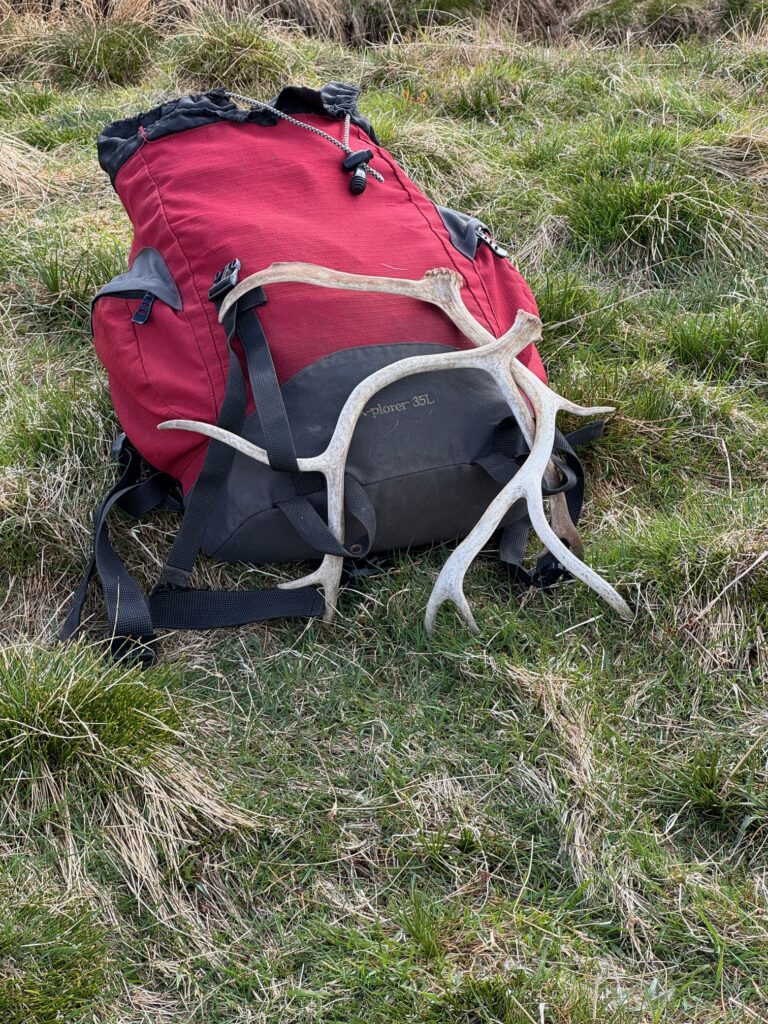
Whilst Kate was talking to the group, one of a nearby female reindeer’s antlers popped off in front of us all! And a few minutes later one of our visitors found another antler, but not from the same cow. This casting of antlers happens when the females are pregnant and no longer have to fight off the advances of the males. We put the antlers safely in the rucksack as sometimes adopters like to buy them.
A bag full of antlers.
We then laid out a little feed to supplement the natural feed for the new mums, which is done from a distance so as not to disturb them and their calves too much, though we did check that each little calf was standing or chose to stand while we observed.
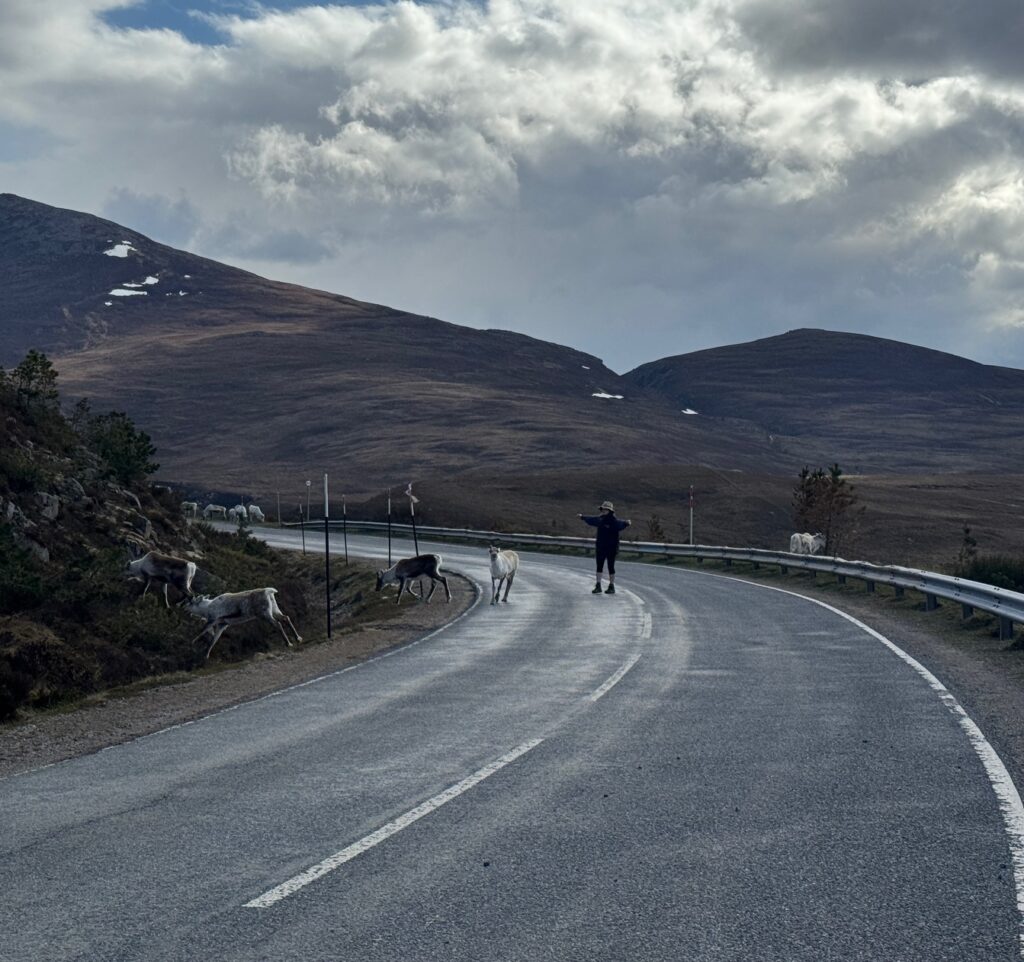
On our way back to reindeer house we drove up towards the Cairngorm Mountain Railway car park to check on the free ranging reindeer. Lotti and I had moved them away from that area the day before, down the valley quite a distance. They had seemed happy to follow us and stay there at the time. But guess who we found crossing the road? It seems the new grass covered with salt on the verges is as tempting to a reindeer as a salty snack is to us!
Out of the van we jumped. The strategy formed was to move them upwards this time. Maisy (part mountain goat I suspect) was sent up the steep rock face to call from above, whilst Kate encouraged the herd to move out of the road.
Kate directing the reindeer traffic.
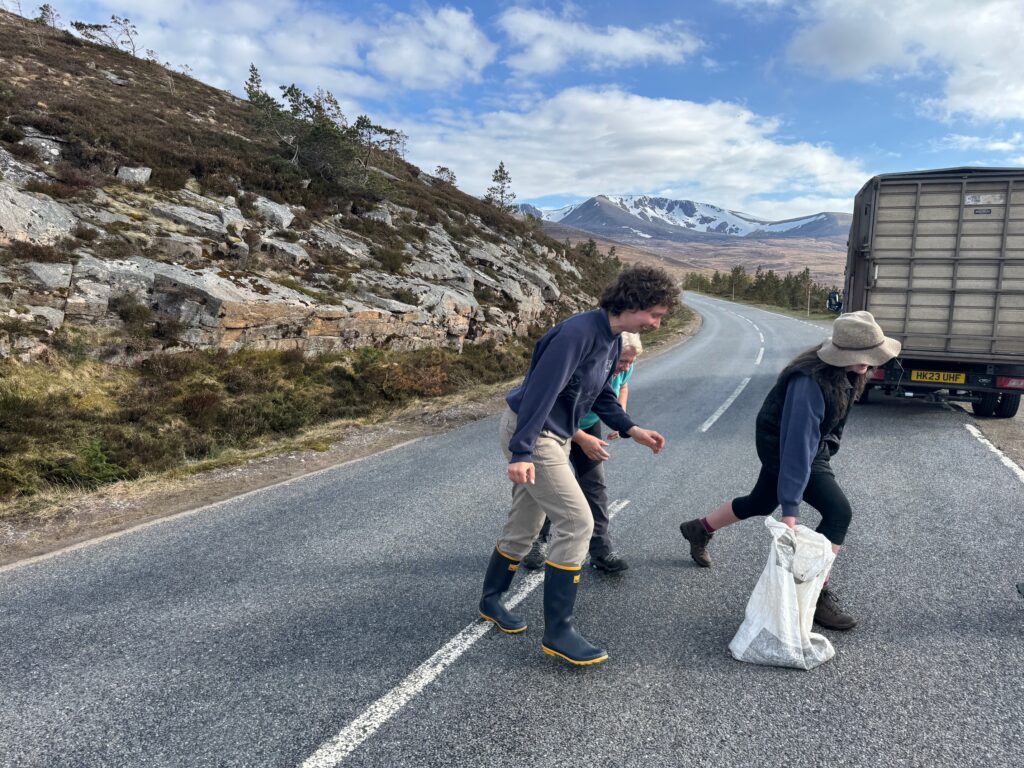
I was sent to the bend in the road to slow down and explain what was happening to oncoming traffic. “Yes, we came to watch!” was one of the responses, with most people intrigued or happy to drive slowly past and take some good holiday snaps. The free rangers weren’t being entirely cooperative and soon Daisy and Sheena came to help, with a chain of herders up the hill calling and persuading.
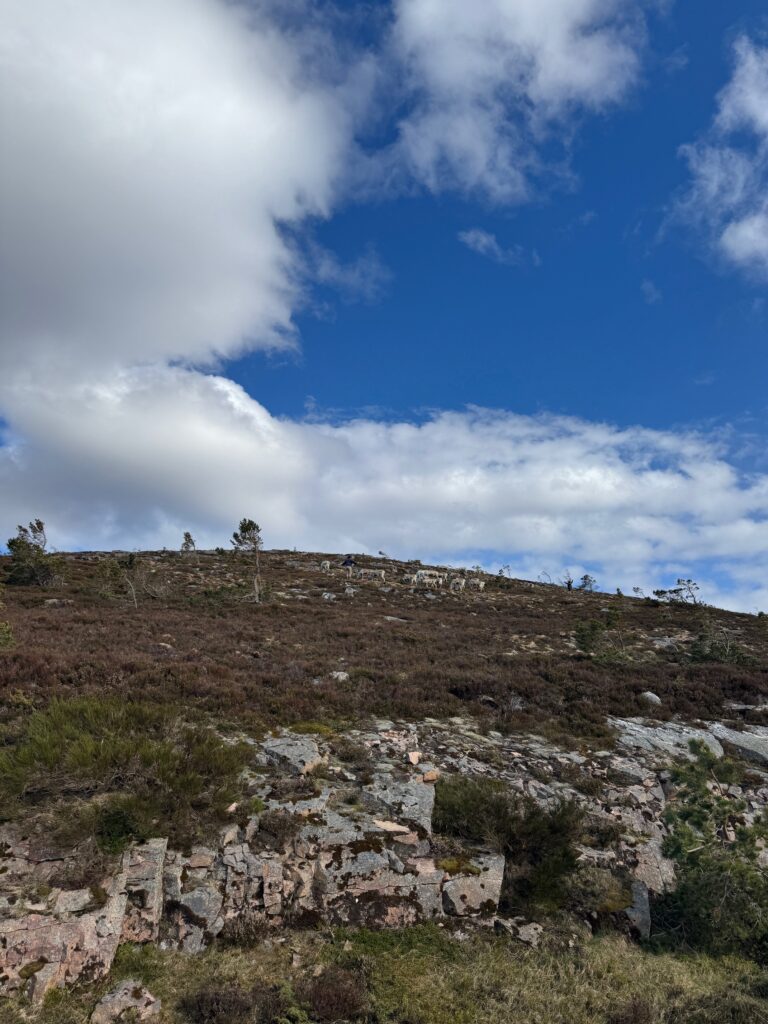
Maisy and Daisy are up there somewhere.
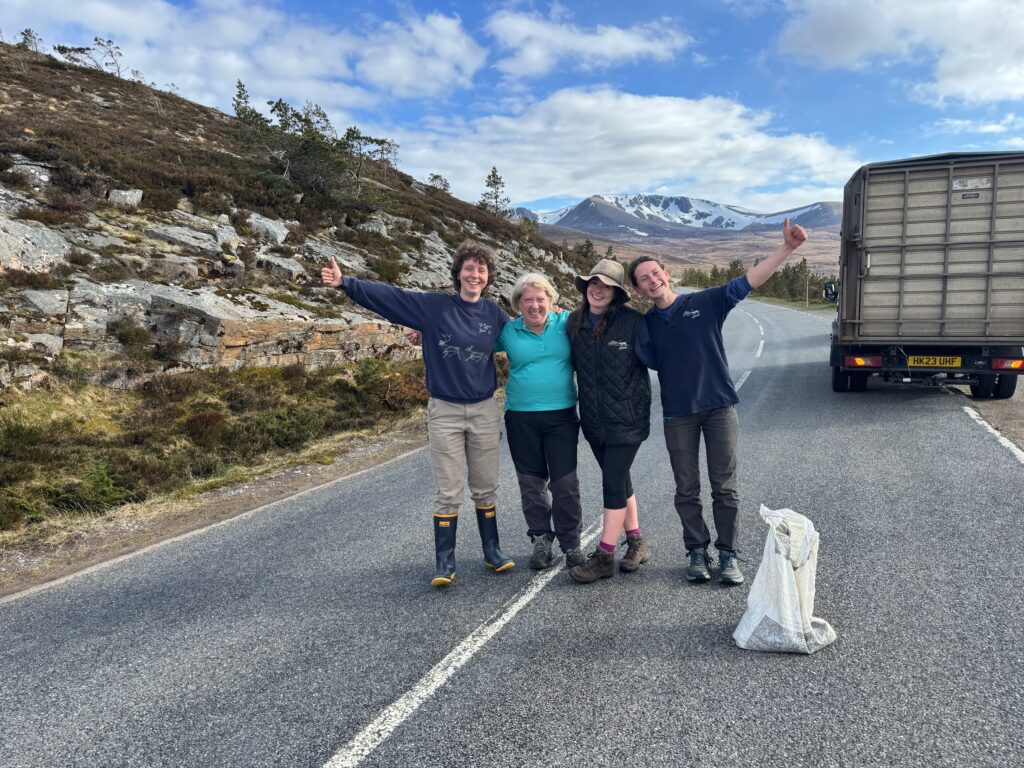
When at last the final reindeer was moved safely onwards, Sheena took our photo in the middle of the clear road until we were surprised by a camper van rounding the corner, and scattered, giggling.
Our Abbey Road style moments.
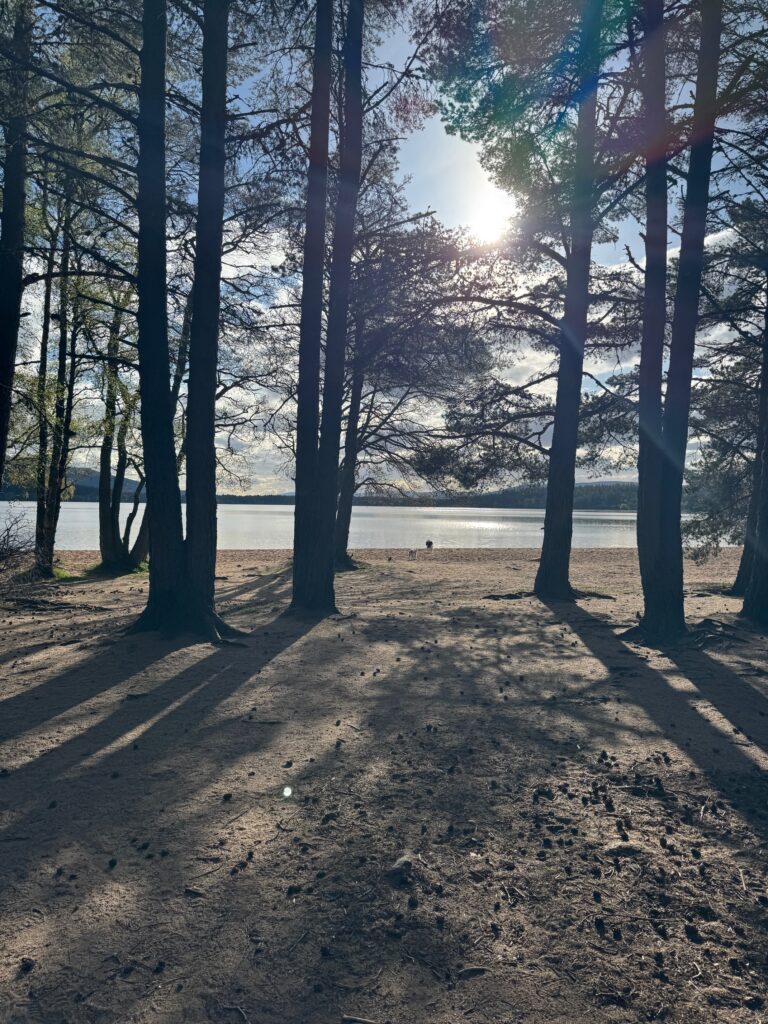
That evening, straight after work, Daisy took me for a walk with her dogs on the banks of Loch Morlich. It was a stunning evening and showed off the beautiful surroundings that Daisy is incredibly proud to live and work in.
Loch Morlich as the sun was slowly going down.
In fact Daisy had to use her fire prevention knowledge to help put out a fire that had been made illegally that afternoon and it was clear how much she cared that her local area was not put at risk. Seeing the beauty of the woodland, and experiencing the peace of the beach by the loch, I understood completely.
Editor’s Note: Sorry to hijack your blog Kathy… This wonderful blog was written back in May, before the horrific wildfire that hit Glenmore in July. It goes to show how important this bylaw is. It’s wonderful to share the reindeer’s home with so many people that love and respect the outdoors – so please help us protect it in future.
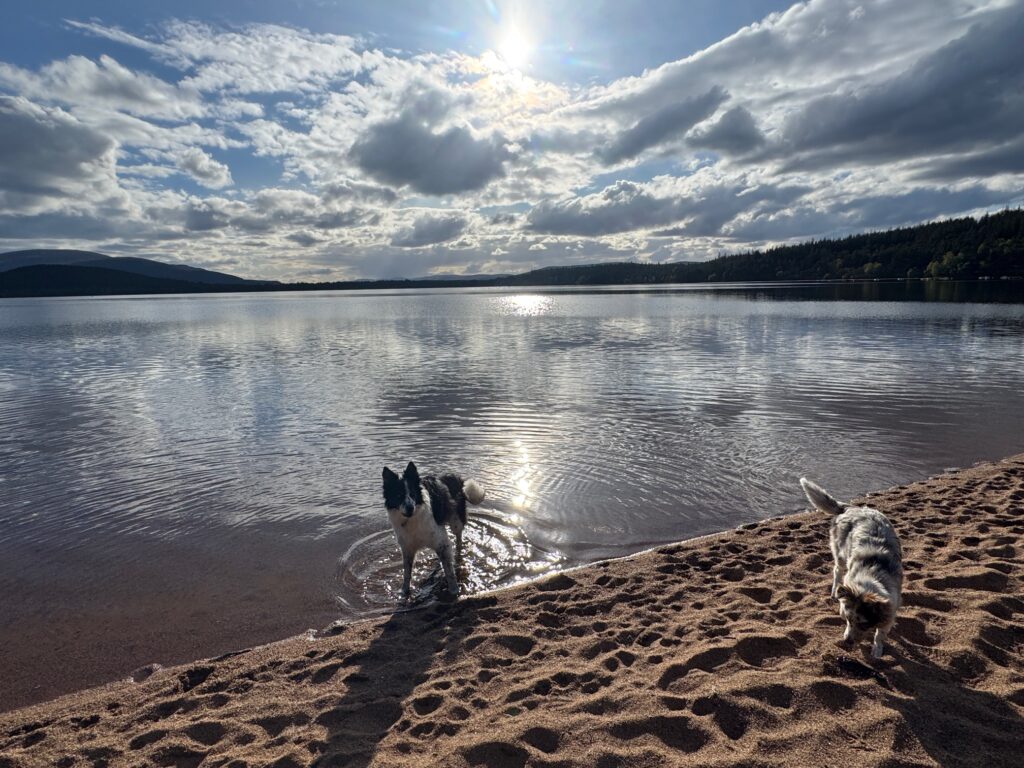
Echo and Asta go for a paddle.
We met Maisy on our way back and stopped at the Pine Marten bar for some refreshments and much needed sustenance. While the others had soft drinks, I wanted to try a local ale which went well with a very good burger with fries (my salty snack of choice)! We chatted about the day of adventure and reminisced about road trips to lands of northern lights and reindeer.
Feeling thoroughly contented, I took a small detour on my way back to my lodgings, popping up to the top to look at the sunset over the loch. And who should I see on my way up? A small group of salty snackers at the side of a car park, watched by a lady from Germany who looked at me with tear filled eyes and said “It’s just magical!”
And I agree. What a day. What a week. I can’t wait till next year….
I’m on a roll with writing blogs about some of our lovely older lassies born in 2012. This time it’s time to put Diamond in the spot light!
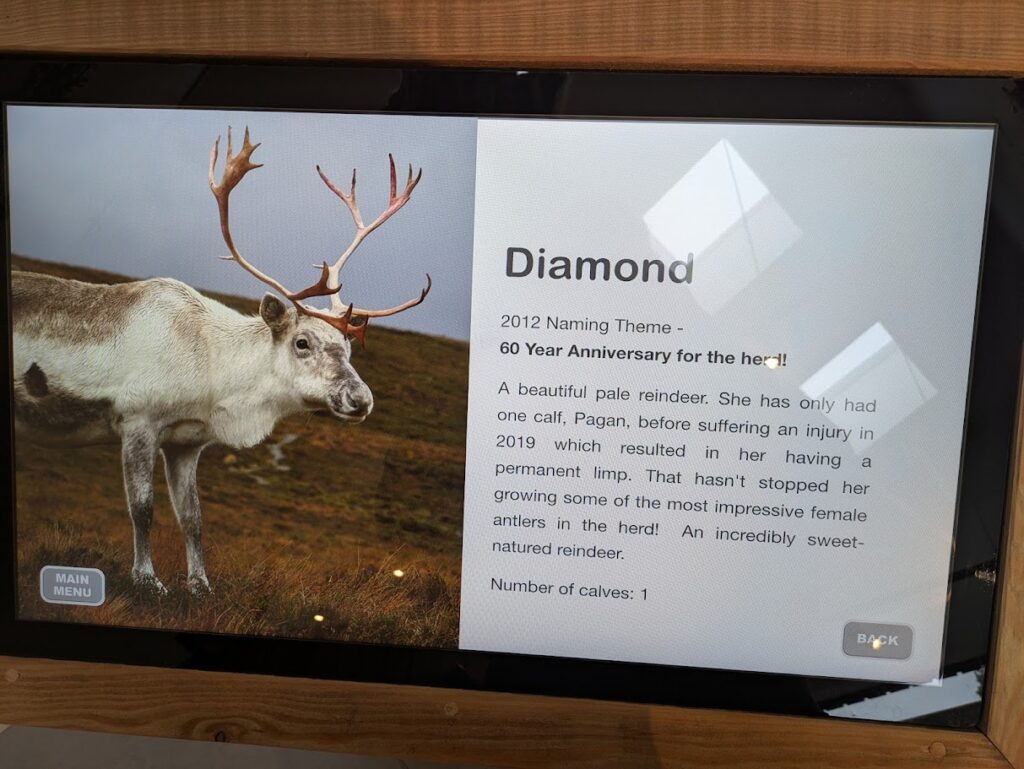
Diamond is well known to be one of the sweetest-natured reindeer in the entire herd. She gets a wee name check in a couple of blogs for being so lovely – see here and here!
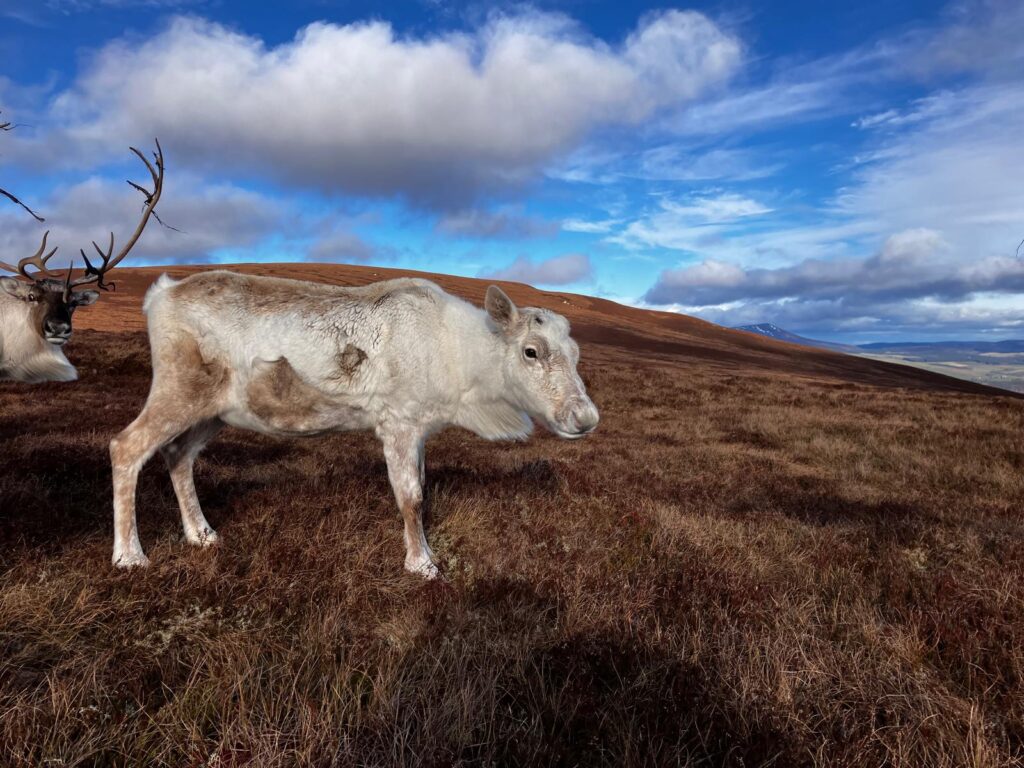
She’s only had one calf in her entire life, a notoriously bossy reindeer, called Pagan who was born in 2016. Pagan was the exact opposite to Diamond, in both character and looks! Diamond is a beautiful silvery coloured reindeer, and Pagan was ‘normal coloured’ with big bulging eyes and tones of attitude!
Diamond was found on the free range in April 2019 with an incredibly lame left fore. Vets diagnosed nerve damage and it’s left her with a permanent limp. She’s in no pain and gets around incredibly well, using her leg like a crutch. For this reason we have never run Diamond with a bull again as we don’t want her to carry any unnecessary weight on her leg.
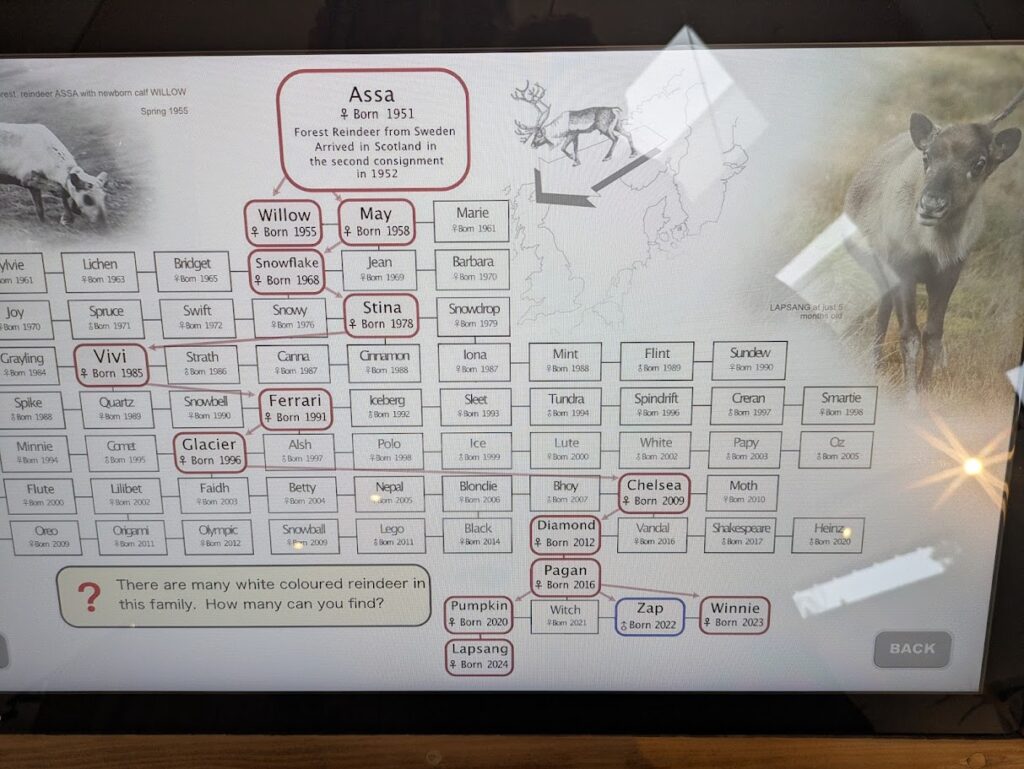
Pagan sadly passed away very suddenly in spring 2023, however she has several calves herself and therefore Diamond’s legacy continues with her grandcalves – Pumpkin (6), Zap (4) and Winnie (3) and great-grandcalf Lapsang (2). Hopefully there will be several new additions to the family line this spring too – exciting!
This blog is full of photos of encounters I’ve had with Diamond over the last 5 or so years, including one rescue mission! Some members of her family also feature.
2021
Diamond enjoying herself on the free range in August 2021.Diamond in September 2021 after stripping the velvet from her lovely antlers.Diamond in October 2021 after very recently casting an antler. Don’t worry, this is a completely natural process, she won’t be in pain, despite the wee bit of blood you can see.
2022
Chelsea on the right, Diamond’s mum, in January 2022. She was also a beautiful pale colour, similar in colour to Diamond.Diamond in April 2022. She’s just beginning to grow her new antlers and is looking very pale – her old winter coat has bleached to make her look even paler than usual.
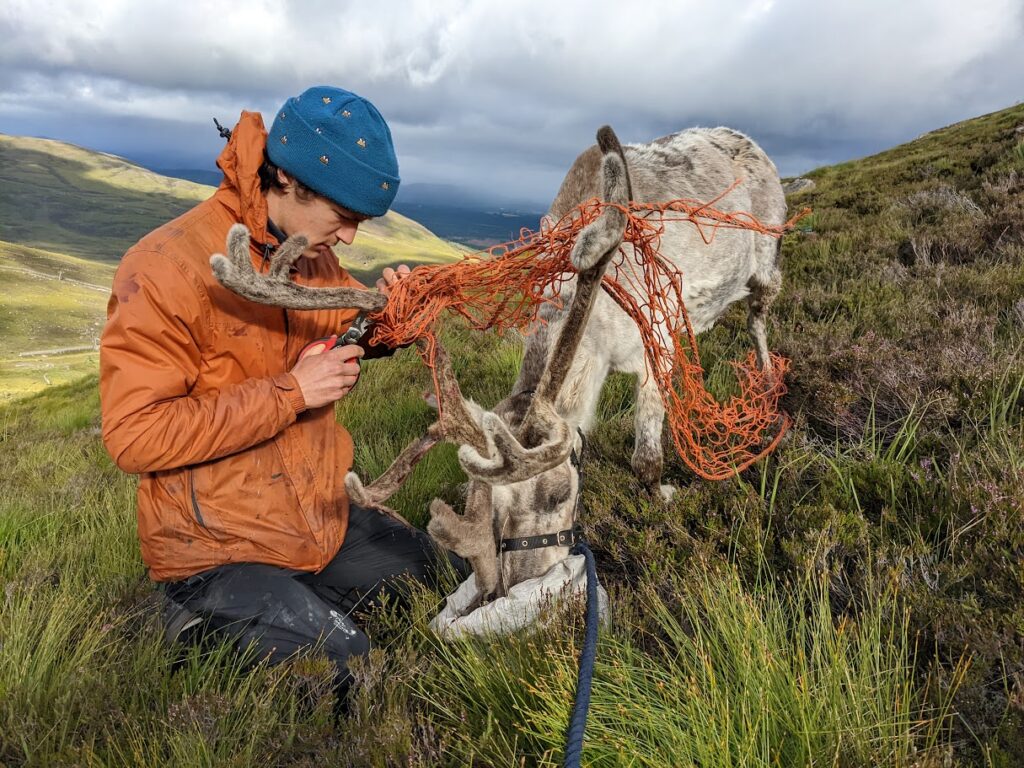
On one memorable occasion Harry and I were eating breakfast at Reindeer House before work and got a phone call from the lovely staff on Cairngorm Mountain reporting a reindeer with netting stuck in their antlers. We jumped in the Land Rover and drove up to Mid Station where we were directed to the reindeer in question. All the way up we were talking about the reindeer we would least like it to be – Sod’s law it would be one of the small number of fiesty or uncatchable girls we have in the herd! We both breathed a huge sigh of relief when we saw it was the lovely Diamond. She was very pleased to see us, came straight over, ate out of the hand feed bag whilst we were able to cut her free. She had damaged her velvet a little bit so we put some antibiotic blue spray on any potential sore bits, gave her a good pile of food and left her to it! Thankfully things like this happen very rarely.
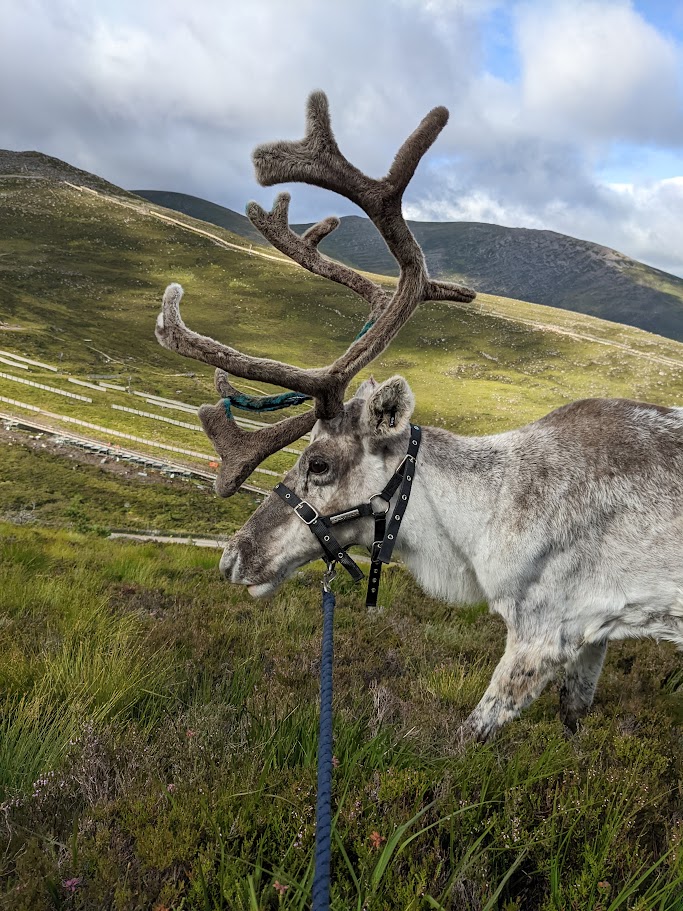
3rd of August 2022: Harry cutting the netting of Diamond’s antlers whiilst she enjoyed a good feed.Diamond sporting blue antlers – we applied an antibioic spray to the velvet to prevent any future infection. We let her off and she looked like nothing had happened, she remained out free ranging enjoying the hills.17th of August 2022: I was lucky enough to bump into Diamond again just a couple of weeks after our ‘rescue mission’ she looked fantastic and was in a small herd of other females.
2023
Diamond in May 2023 growing a new set of antlers.
Another story I have of finding Diamond on the free range is from July 2023. Cameron and I went up to see if we could find any reindeer. We did, just one, the beautiful Diamond! She was by herself which is slightly unusual for a reindeer as they are a herd animal but she seemed absolutely fine. As an older reindeer who knows the hills incredibly well Cameron and I were in no way worried about her and instead just enjoyed her company. We offered her a little bit of food and as soon as she realised we were reindeer herders she joined us on our walk. We were on our way back home so she followed us for a good couple of miles. We got some funny looks as we strolled past hill walkers who were doing double takes at our four-legged friend! When we were close to home and the footpath was getting busier with people and potentially dogs, we wandered to a nice quiet spot and left her to it with a big pile of food. What a sweetie! It is probably one of my favourite free range reindeer moments ever.
Cameron and Diamond joining us on our walk. She looks scruffy as she’s still moulting. Myself, Diamond and Cam stopping mid-walk for a wee selfie!September 2023 – Diamond free ranging in the hills, this time in a big group of other female reindeer (Mochi is on the left). Diamond is part way through stripping the velvet from the bony antlers beneath.Diamond the month later having stripped the velvet off her antlers pretty much completely.
2024
Shockingly, I don’t seem to have many photos of Diamond that I have taken myself over the last two years. So these are some I’ve nicked from other herders, and more that I’ve taken of her family members.
Andi found Diamond in a big herd, enjoying herself on the free range in July 2024 – again looking a bit scruffy as she’s mid-moult. She as beautiful as ever though!Diamond looking fantastic in September 2024. She’s obviously had a good summer as she looks very round! Pumpkin in October 2024 – Diamond’s granddaughter. Pumpkin has bags of attitude and often tells us off by waving her antlers at us if we walk too close to her.
2025
Winnie in March 2025, Diamond’s granddaughter, is so far also very sweet and much more like her granny in character than her mum Pagan, or sister Pumpkin. Time will tell if this remains the same!Lotti caught up with Diamond in July 2025. Sweet as ever, and ever hopeful for food!
2026
Diamond in February 2026 free ranging in the hills. Photo by Cameron. Scoop behind – still with his antlers!!Diamond’s family tree features on one of our brand new touch screens in the new Exhibition so you can come and learn all about her family.There’s the pretty lass on the touch screen for all to see!
I am the youngest Scottish reindeer herder. Although many people think I’m older than I really am and it happens on a regular basis. I’m either on a hill trip or doing a paddock talk and there is always someone asking me, “how did you end up being a reindeer herder?” When I give people my answer I often hear a gasp. “What, you’re still in school?!.” Yes I am, and only 2 years left then I’ll be free (Im counting down the days practically). Another question always follows this: what are you doing after school? I dunno, I’ll figure it out but I know one thing I ain’t sitting at a desk for ten hours a day. The reindeer herders have learnt that I ain’t sitting still.
Maisy feeding the herd during a snowy start to 2026.
Although most people are surprised about my age of only being 16, and are really interested in how I have such an interest in reindeer and the hills, the majority of the people I meet are supportive. But you’re always going to have a couple of people who treat you differently when they find out I’m at school still. I get a bit disappointed when people treat me differently after I tell them because all of a sudden there is a switch, “oh you do something so cool, but I still know better than you”. I do sometimes find it can be a struggle being young in a professional environment – but I enjoy this. I get a chance to show poeple my knowledge and it helps me build confidence.
Maisy and Winnie both enjoying the sunshine!
At first hanging out with the reindeer I was just an extra pair of hands carrying feed onto the hill and maybe chatting to a couple of visitors on the hill trips. I was nervous, only 13 and had no experience of talking to big groups of people with no knowledge of reindeer. Now I can easily chat to 50+ people because I now have a love for reindeer. I want to get everyone else to know all their fun facts to know why the herders are here and how important reindeer are to the Cairngorms ecosystem. However, saying this I still will not do a presentation in school! Reindeer I can talk all day about, but in other areas I’m still working on my confidence.
Dante and Disco relaxing out in the hills during this years free range season, during one of Maisy’s many long hikes out to see them.
A strong memory I have of the first time I talked in front of 20 people was in horrible weather with Joe. Joe asked me to talk about handfeeding but I did it only because I wanted to get off the hill and back to the centre as soon as possible! I’m glad for it now – sometimes you just need a little push out your comfort zone to see what you can do.
Reindeer have grown my confidence from now being able to talk to lots of people, work in the shop, give paddock talks, and even answer the phone… The thing I really don’t like is answering the phone! Mainly because you never know what you’re going to be asked on the other side. If it’s anything to do with officey things or on the computers I have no answer. There is always me handing the phone across the room when it’s ringing. If someone is busy in the shop however and only me to answer I have the dreaded task of answering. Slowly getting there but I am still not a fan.
Maisy feeding Cheer and Chai in August 2025 during a hike – Maisy always makes sure her backpack has all the neccassary gear for finding reindeer!
It is obvious that reindeer herding has boosted my confidence massively and I’m slowly gaining more responsibility and trust with the herders. At first I was just an extra person on a hill trip but now I get to help with the talks and help run them.
Amazon looking her absolute best on a morning free range mission in April!
In school they know I hang out with reindeer. This year I had the delight of giving my English teacher a 15 minute talk about The Cairngorm Reindeer Herd. Fun fact, my English teacher even taught Fiona… For my national 5 geography assignment I looked at how reindeer affect the vegetation cover and the different species of vegetation where there is a change in population of riendeer. My results showed that reindeer are creating more diversity of plant species. (If you want the results email us and I can send them over.) By doing this project it also meant I spent a few hours roaming on the hills. However it was revolting weather with no visablity whatsoever but it was still fun!
Morris helping Maisy with her studies of the vegetation growing along the top ridge of the Hill Enclosure.
A favourite memory of mine… In the summer on a Friday afternoon off the school bus, I was tying my shoelaces about to go for a run up Meall a’ Bhuachaille with Froach when Hen answers the phone from Amy saying she’s found some reindeer in Glenfeshie. Hen looked at me, “Maisy, what are you up to this afternoon?” There I was forgetting about Fraoch and my run and off we went up Glenfeshie to go find some calves and Amy. Not a bad Friday afternoon!
Lochi resting on a sunny day out in the hills. Maisy sitting with Winnie and Alba out in the hills after a free-range trip.
It took me a while to get used to being comfortable around the reindeer just because they are animals and I was still unsure of what their next steps were going to be. However now a few years down the line I’m comfortable with having reindeer brush up against me and try to calm a situation. From working with the reindeer my confidence has boosted and people in my life outside of reindeer can see that. This year was my first proper calving with working a lot more often during the weekend and my study leave. The calves are such sweeeties!
One of the first calves I met this year and my jaw dropped when I saw this guy. This is Texels calf and is just the sweetest little thing.
I think young people should get the chance to work outside with animals and in the outdoors more as so many young people are not getting opportunities to try many varied environments of work. I have found my own self confidence and knowing many young people struggle with this, it would benefit many. Working with reindeer has made me realize that I’m never going to want to get an inside office job mainly because I would probably explode if I were to sit still for 8 hours a day! I know there are lots of young people just like me that are meant for outdoor jobs and volunteering and working with animals gives you a chance to explore that. I’m also grateful for the resposibility and to find a group of people with interests just like mine. Sometimes you just find the right place where you belong!
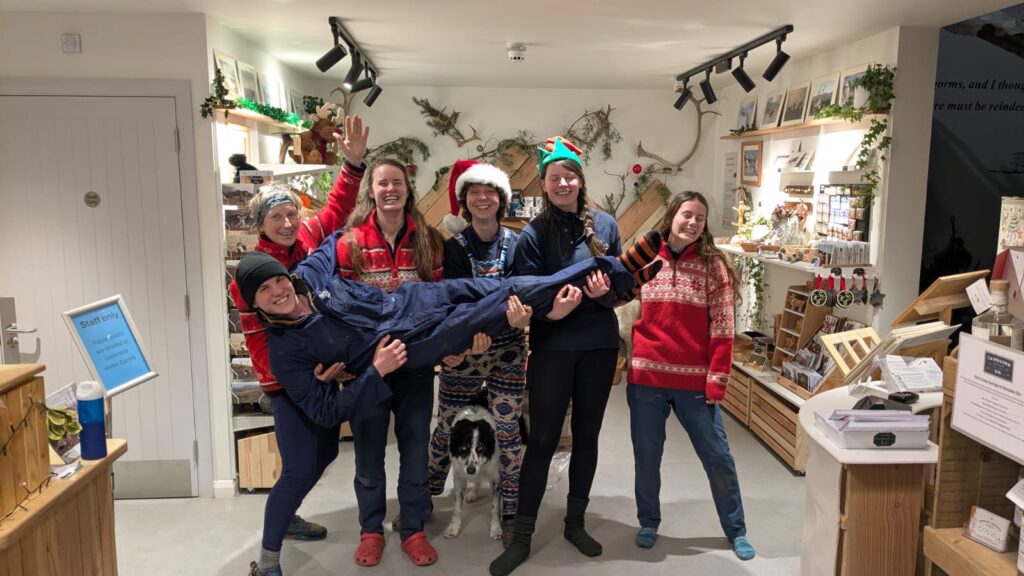
Cameron, Sheena, Lotti, Daisy, Echo, Amy, and Maisy – Christmas Fun Crew, 2025!
Daisy: It was morning briefing in mid April and we were contacted to inform us the reindeer had moved right up onto the mountain plateau not too far from Ptarmigan Station. This was going to be a pretty long walk for us to make it up to the reindeer, find them in some pretty interesting conditions, and then herd them down off the mountains to one of our free range visit spots. Thankfully, Cairngorm Mountain staff came to the rescue!
Andi: A quick phone call to Cairngorm Mountain and they were happy to help us with a ride up on the shiny Funicular Railway – a unique scenic ride which is a destination in itself. For us, this would save us around an hour of uphill walking in blizzard conditions, and made the difference between needing to abandon our Hill Trip plans (with lots of hopeful visitors already booked) and hopefully managing to retrieve our reindeer in time for everyone to enjoy meeting them.
Thank you so much to the Cairngorm Mountain staff who let us hitch a ride on the Funicular to the top of the mountain!
Daisy: It certainly felt like setting off on an expedition that morning with Andi. We had all our gear on, map and compass in our bags alongside lots of reindeer food, and jumped on the mountain railway. A really cool way to start off a herding trip for the day! I actually had never riden the train up the mountain before so we grabbed a front spot and watched the snow get deeper and the visibility worse.
Andi: Travelling from Glenmore, where it felt like spring, to the ski car park, where it was cold and wintry with a little snow, it felt like we were going to a different world as the train took us into the cloud and the weather closed in. Definitely a day where knowing that you have a storm shelter in the bag is reassuring!
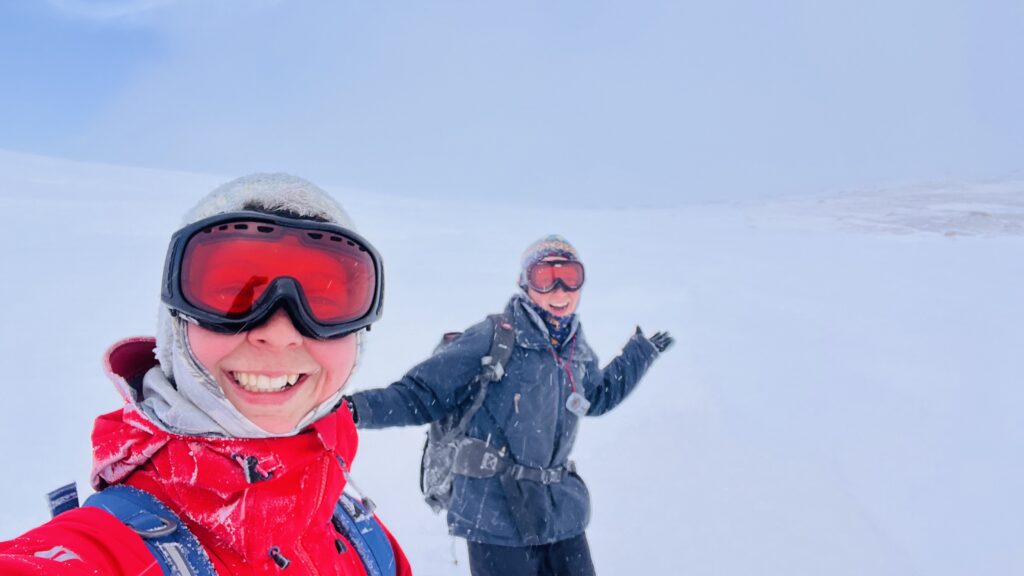
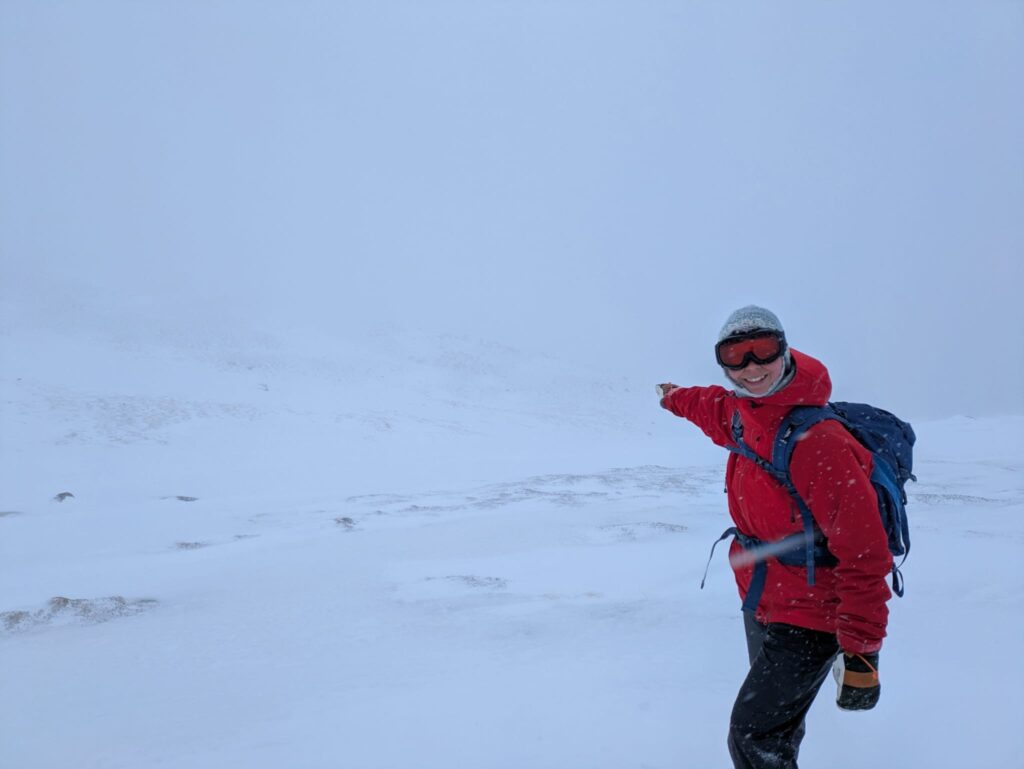
Daisy: As soon as we stepped out of Ptarmigan, we were hit by a pleasant enough breeze carrying some of the snow down the mountain. I pulled my microspikes onto my boots and my ski goggles over my eyes, and followed Andi along a snow fence and up away from the restaurant and Cairngorm summit. A few patches of deeper snow to stumble through, and a lot of frozen ground and sheets of ice that made for nice walking with the spikes on. We crossed past the final lift before the plateau and set off into a frozen, snowy, rocky landscape with little to no visibility. It’s funny to think how many people wander the plateau and hike these beautiful mountains throughout the year, because in that moment it was like we were the first people to explore what felt like a different planet.
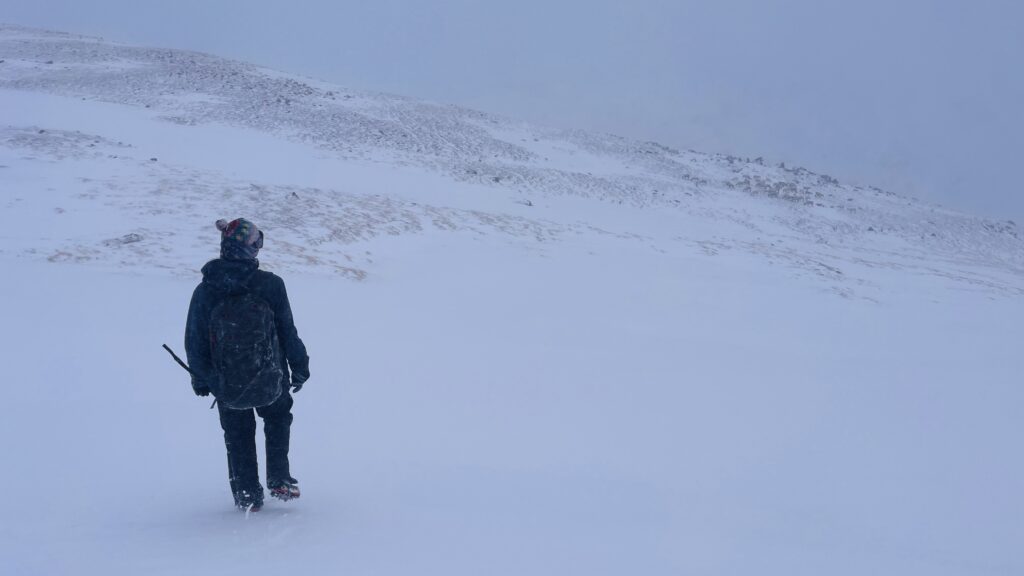
Andi: Whilst I’m pretty familiar with our local mountains, having pottered around after reindeer for the past 15 years, it is a whole different ball-game in a blizzard. Visibility was between 10 and 30 metres, and it is so easy to see how people get completely disorientated. It takes a lesson in trust to believe the compass bearing when your brain can play tricks on you, making you think you’re heading in the opposite direction.
All smiles navigating to the reindeer in white out conditions on the Cairngorm Plateau.
Daisy: We used a combination of a good old trusty compass and Google Maps to navigate through the white out. Despite the freezing temperatures and snow that was blowing up off the ground, we were actually nice and toasty in very excited high spirits the entire time. Looking at the satellite imagery on Google Maps of roughly where we knew they were, I made up names for all the features I couldn’t see in front of me, and was probably really reassuring to Andi when I kept repeating “the reindeer should be at the bottom of the orange segment just in front of us”.
Andi: Between Daisy using the tech to pinpoint where the reindeer should be, and me keeping us on a compass bearing with the old-school methods, it felt like we had a plan! It was reassuring having two brains on it, keeping each other right and cross-referencing to ensure we were on track. Most of our reindeer herding is not done in a white-out, so it was a fun challenge to be testing out our nav skills.
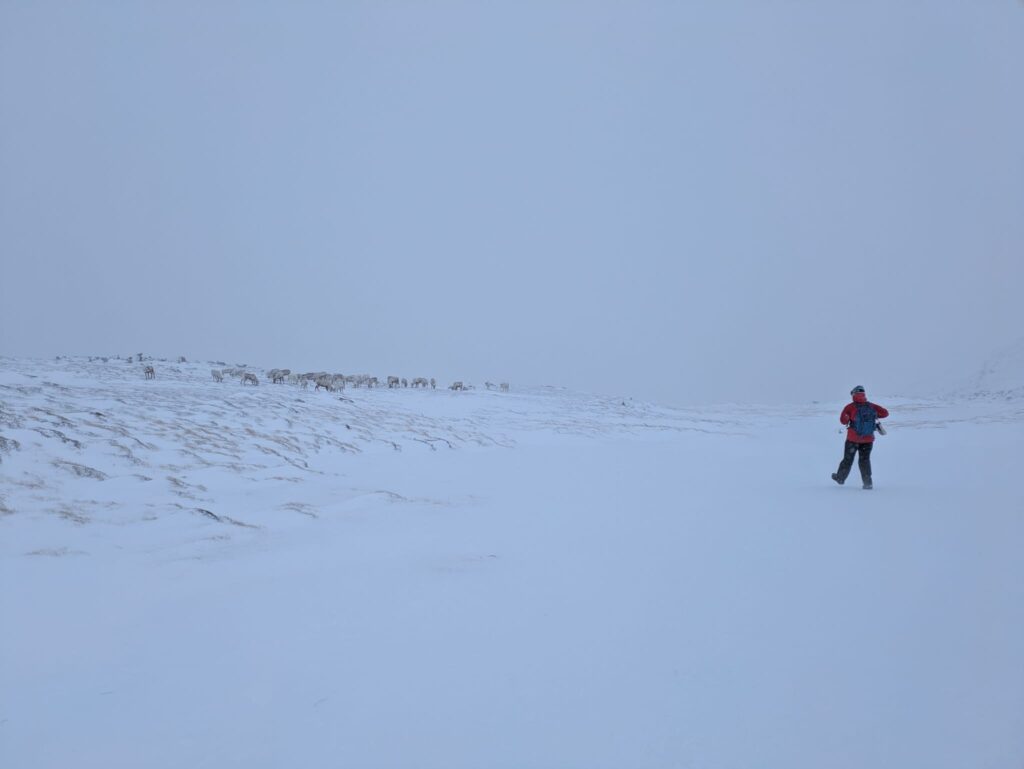
We found the herd! (Trust us, they are in the photo…)
Daisy: We came to a stop and scanned the landscape, the reindeer should have been metres from us at that point. Then like magic, some cloud lifted and Andi pointed off into the distance: “Reindeer!”. There they were, 73 reindeer hunkering down on a hill edge. Several cheers followed as we dug our spikes in to descend a small ice sheet to get to them.
Andi: I was glad to have a fair bit of experience picking out a herd of reindeer on a hillside, as their camo was excellent, but something in the shape/shade of these particular bumps ticked the box of not just being rocks! It felt like such a prize to have managed to follow our bearings directly to them.
Can you spot the reindeer? The hard part’s over right?…
Daisy: It was my first time seeing how effective a reindeer’s coat is against heavy snow and winds and it was amazing to see the snow piling up against them. As I got nearer and walked around the back of the herd to encourage them up, I could see just how cold it must have got overnight with all the frozen snow and ice on them – not bothering them at all!
Andi: It amuses me how reindeer are so blase about weather, actively choosing to wander up to exposed ridges in the worst of conditions. There is actually method in their madness, as wind will blow snow off the ridgeline, meaning they have to dig less for food, and there is also less risk of getting stuck in a snow drift. But still!
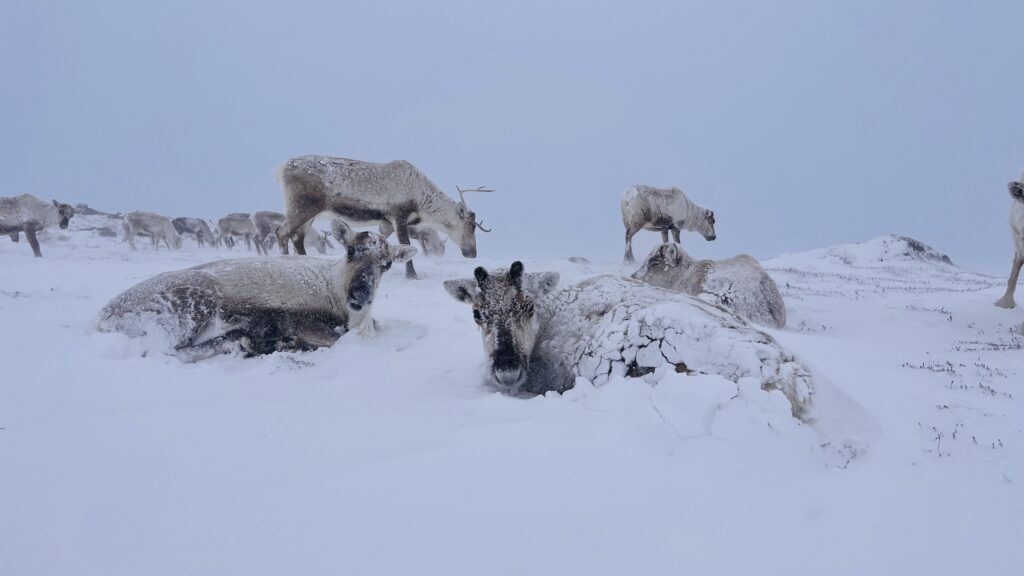
Thanks to the hollow guard hairs that make up the outer layer of a reindeer’s coat, the snow doesn’t melt on them. This keeps them warm on mornings like this, lying in the snow at -4.
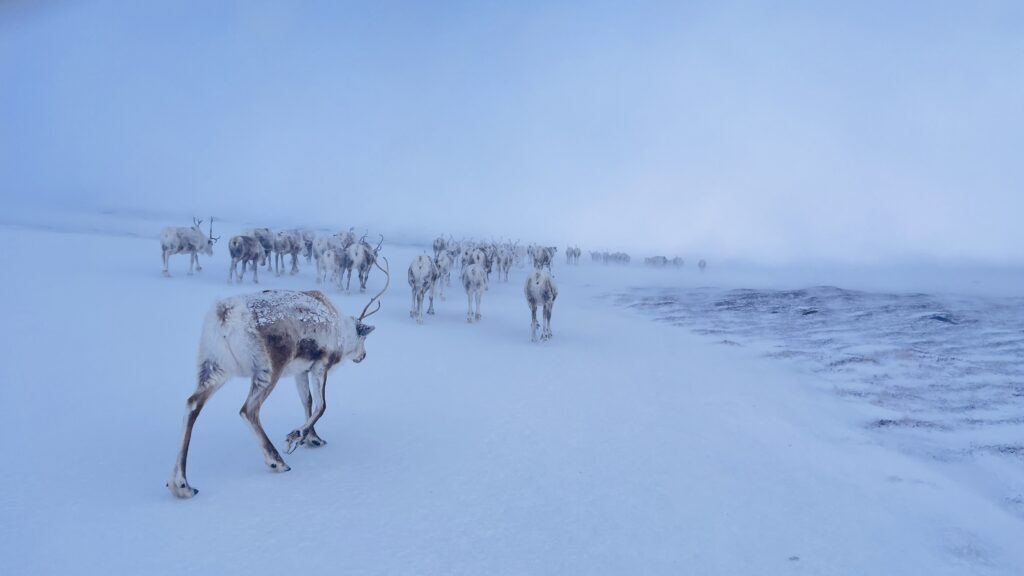
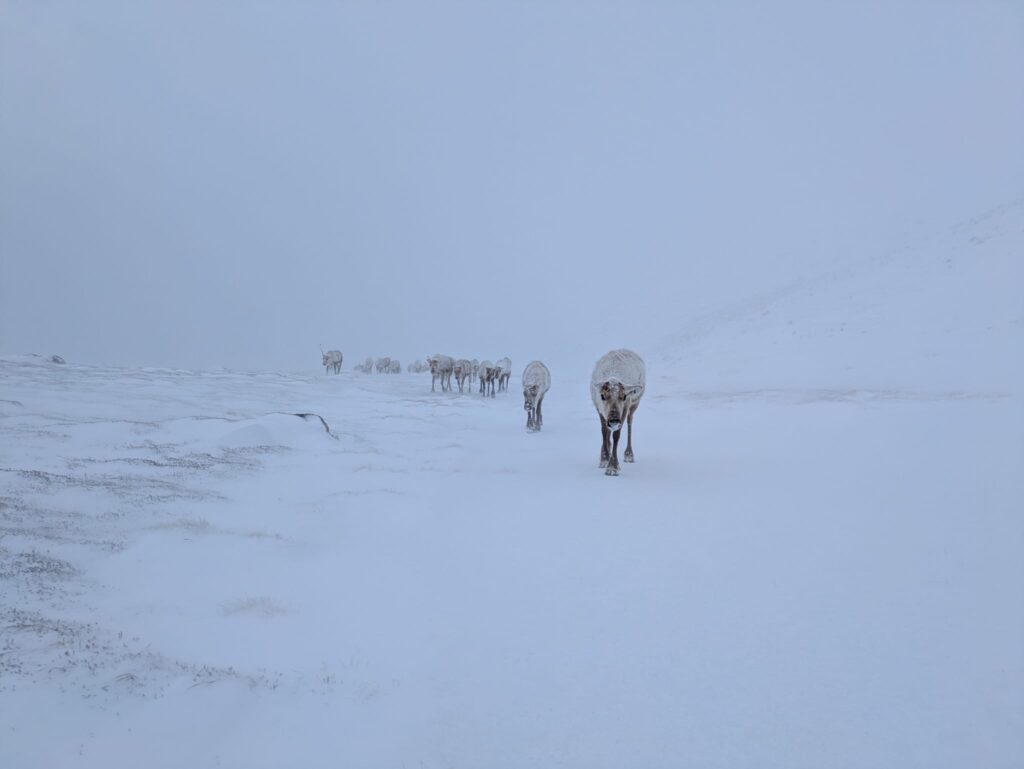
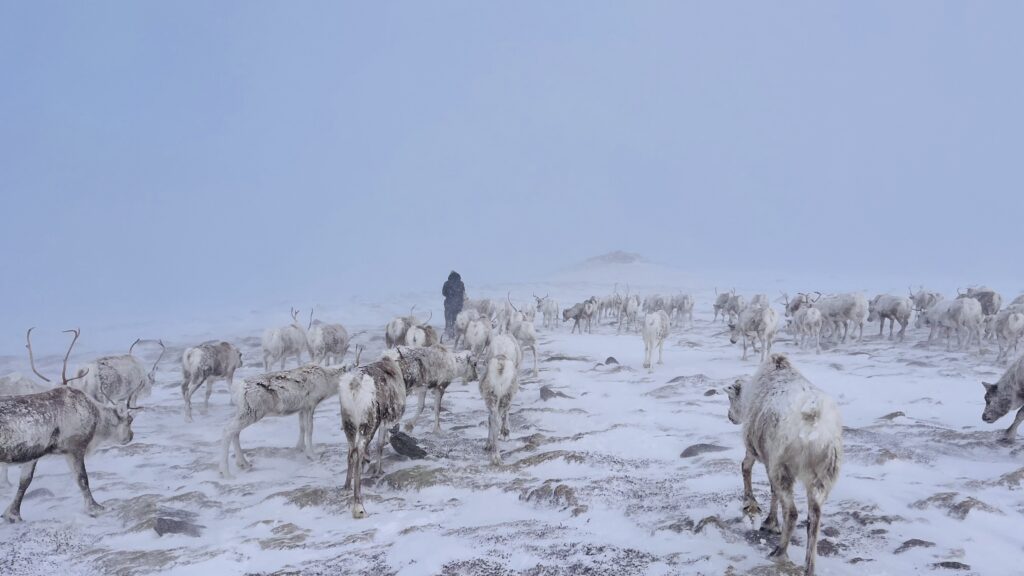
Daisy: With the herd up and already eager to follow Andi, we set off into the white to move the reindeer off the mountains and down to much lower ground. It wasn’t long before the winds started to pick up and throw quite a bit of snow at us. The herd stuck together really well and I got my first experience of how they stay together in low visibility. Usually they spread themselves out a fair bit when on the move, some will stop to graze and take their time – but in the harsh windy conditions and terrible visibility they were staying close as a herd the entire time.
Andi: The herd were in a very co-operative mood and as I set off in the right direction, shaking a bag of food, they all trotted after me. I tried to set a pace where the herd were close enough to me that I could still see Daisy, who was following at the back. It felt sensible to be able to keep an eye on each other!
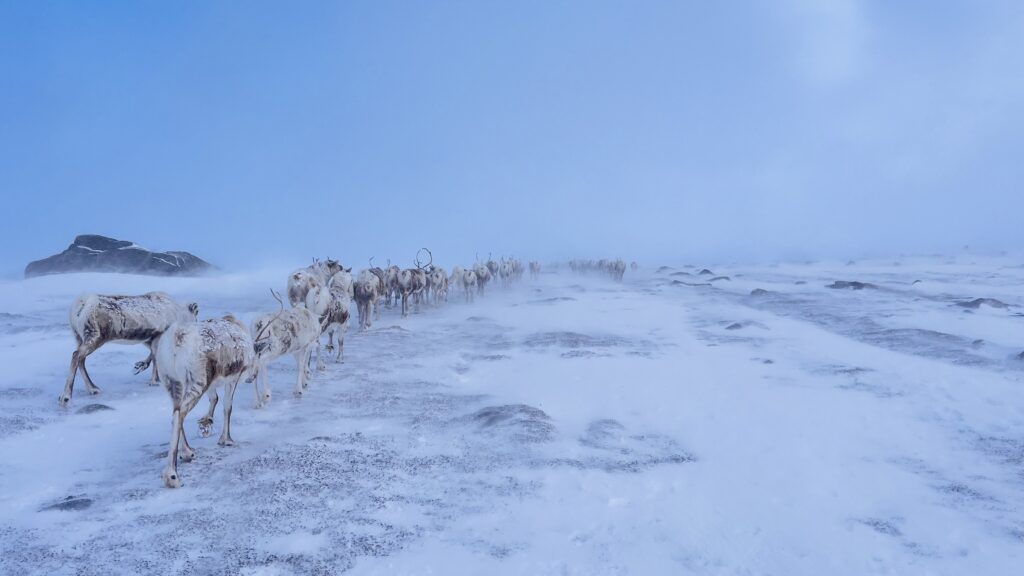
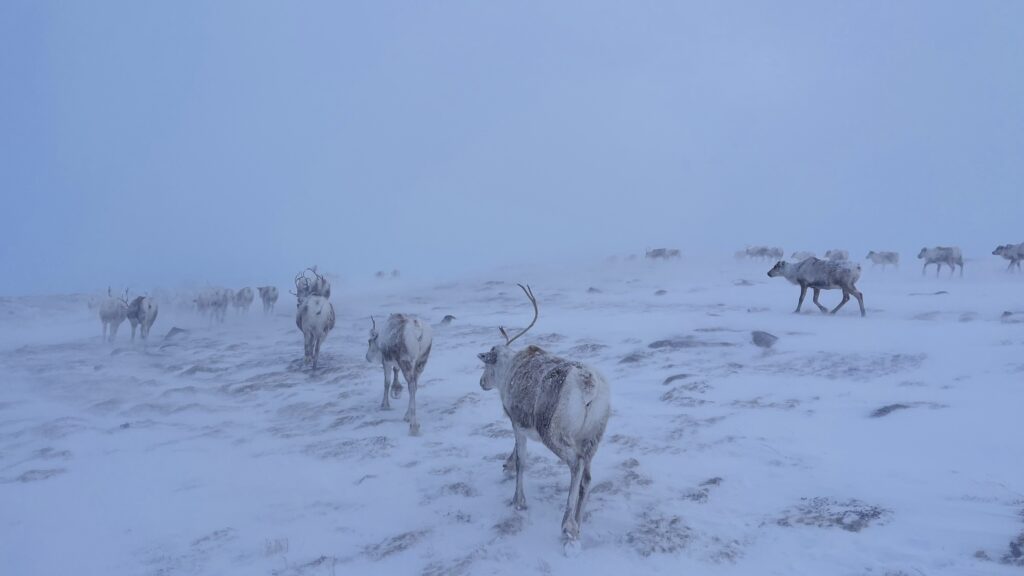
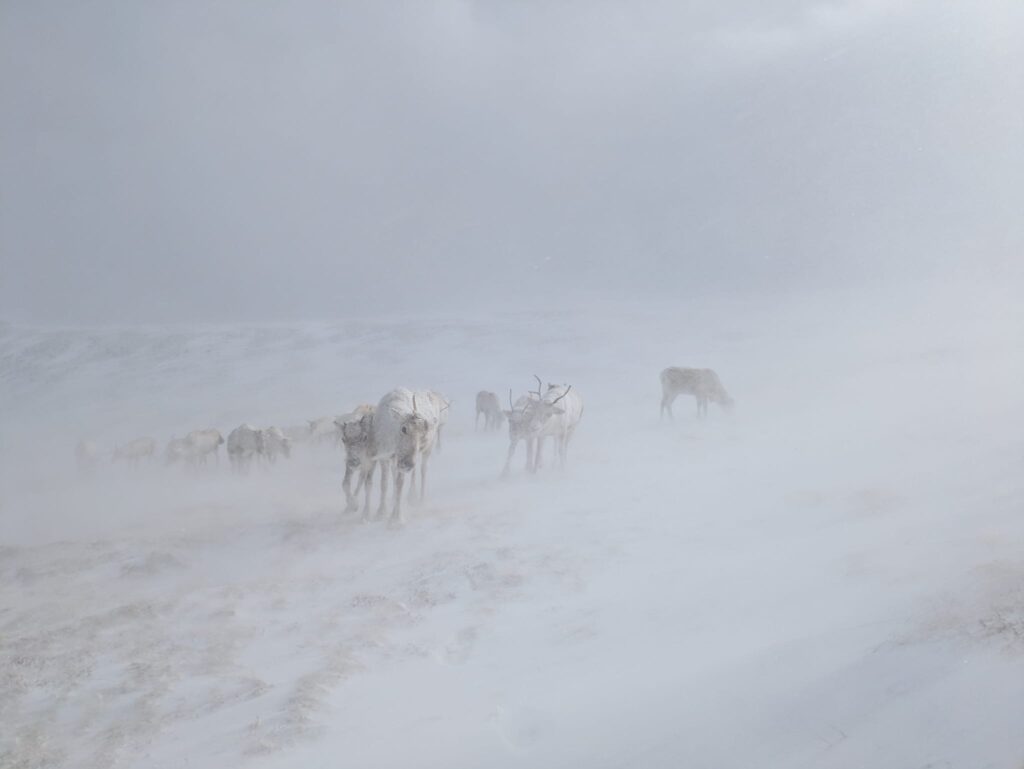
The winds started to pick up as we got lower, here you can see gusts of snow blowing up from the ground and gusting into the herd.
Daisy: I’m glad that it was actually probably the easiest herding I’ve ever done, the reindeer wanting to get off the windy plateau as fast as we did. It gave me plenty of time for photos and to take in how amazing the experience was. Plus I was able to focus on my own struggles in the wind – like making sure I didn’t get blown over every 30 seconds!
Andi: As the wind buffeted us, humans and reindeer alike, I had to stop myself from feeling guilty that the reindeer were in these conditions, reminding myself that they had chosen to come up this high themselves!
Daisy was pushing the reindeer from the back, watching them disappear into the snowy winds ahead. As Daisy watched them disappear, Andi watched them steadily appear following her to lower ground.
Daisy: I was so grateful to be at the back! Apart from making sure I kept up with the herd, (which did involve the occasional sprint whenever they ran on ahead to regroup around Andi – slightly stressful as I’m much slower than a reindeer!) I at least didn’t have to worry about navigating. Andi had to lead 73 reindeer and one herder down off the mountains following just compass bearings!… I did not envy that task at all.
Andi: When fetching the herd, we generally take turns at either leading or pushing. Today Daisy had volunteered me to lead, as I knew the hills better than her so there was some theory that I would pick a good route. In reality, I’ve found it’s a case of heading in roughly the right direction, glancing back at which way the savvy reindeer are going, and repositioning yourself to be in front of them, which makes it look like you knew exactly what you were doing… The reality is that the reindeer spend their whole lives in these mountains and know them far better than any human. Once you have the herd on side, the job of leading becomes much more straightforward, though it is the first time I have brought reindeer in whilst using a compass!
The visibility continued to get worse, but thankfully Winnie (seen in the middle here) kept Daisy company at the back the whole way and made sure she didn’t get left behind!Andi leading the herd solely using compass bearings!!
Daisy: The further we got and the lower we started to descend, the higher the wind speed increased and the snow began to feel like needles being fired at us. I quickly lost any feeling in my face, and loved watching how the reindeer turned themselves into the wind, the cows with their calves sheltered alongside them. While I struggled to stay balanced on my feet and really starting to feel the cold bite – the reindeer were in their element! Sticking together as a herd and following the hoof prints of the reindeer in front of them.
Andi: Whilst the reindeer made it all look easy, the conditions were not so easy for us humans. As we began descending we encountered more deep banks of snow, which resulted in a couple of complete face plants for me! The look of confusion from the reindeer at how useless us two-legged-creatures are was pretty funny!
Andi’s view of the reindeer fighting against the wind gusts as we dropped off the plateau. The wind speed was gusting up to 72mph during our herding mission!
Daisy: We had finally made it low enough that the cloud cover began to lift and I could see all the recognisable land marks to suggest we had nearly made it! We had one last push over a steep bit of rocky ground that proved quite difficult to navigate in the high winds and deep snow – at this point I had stopped bothering with my count of how many times I’d fallen over in suprise patches of knee deep snow. The reindeer were even bracing the final harsh whips of wind for some lichen grazing! The last stretch to the visit spot they picked up pace downhill towards Andi and I watched as they swapped to a very wide gait in the way they were running. It looked pretty comical – their legs so far out to the sides as if they were going to skid on their bellies at any moment, but worked perfectly. Their hooves hardly made a dent in the snow and they kicked through patches of powder at speed. I did attempt my own version to see how effective it would be for a person, and even tried to keep my boots in their hoof prints. You guessed it… I built up a lot of speed before hitting the snow hard and my arms disappearing in front of me. Thankfully only Winnie saw, who gratefully had kept me company the entire walk. I won’t be trying to run like a reindeer again anytime soon!
Andi: By the time we reached our ‘visit spot’, we were low enough to drop down out of the cloud, the skies were clear and there was only a smattering of snow on the ground. We fished out the reindeer feed from our backpacks and the calves tucked in – we give them a brief preferential feed through the winter. The adults know the drill and waited patiently, then we popped out a line of feed for everyone. A quick headcount – everyone was present and correct.
Andi couldn’t get the bag of feed open quick enough for the hungry calves after the long journey. Look at the difference in the weather at a couple of hundred metres lower altitude.Boogie helping Daisy get frozen spikes from her hiking boots.
Daisy: We had done it! Thanks to Andi’s amazing navigation, we had successfully led the herd of 73 reindeer from the mountain plateau down just in time for the days Hill Trip! We fed the hungry reindeer and checked we had everyone and they were all looking happy and healthy and then had a moments breather to chat about how amazing the experience had been. I can confidently say, that herding adventure was the best experience I’ve ever had! Being in such harsh conditions with the wind, the snow, the lack of visibility – it felt like being on a different planet. Experencing the kind of conditions the reindeer are built, not only to endure, but to happily live in felt like such a privilege. Stumbling and running after them at points to keep up, gave me even more respect for how incredible animals’ adaptations are to their home environment, and how much of a privilege it is to experience nature at its best!
Andi: Many visitors assume that being a reindeer herder means you’re incredibly fit and spend all of your time running round the mountains. The reality is that a lot of our job is actually based in the office, shop, and working with visitors. Yes, we do get to roam around on the mountains too, but the weather is not usually quite so gnarly! We had so much fun testing our skills and experiencing the extremes that the reindeer are so at home in, and were buzzing for the rest of the day! It really felt like we’d voyaged to a different planet…
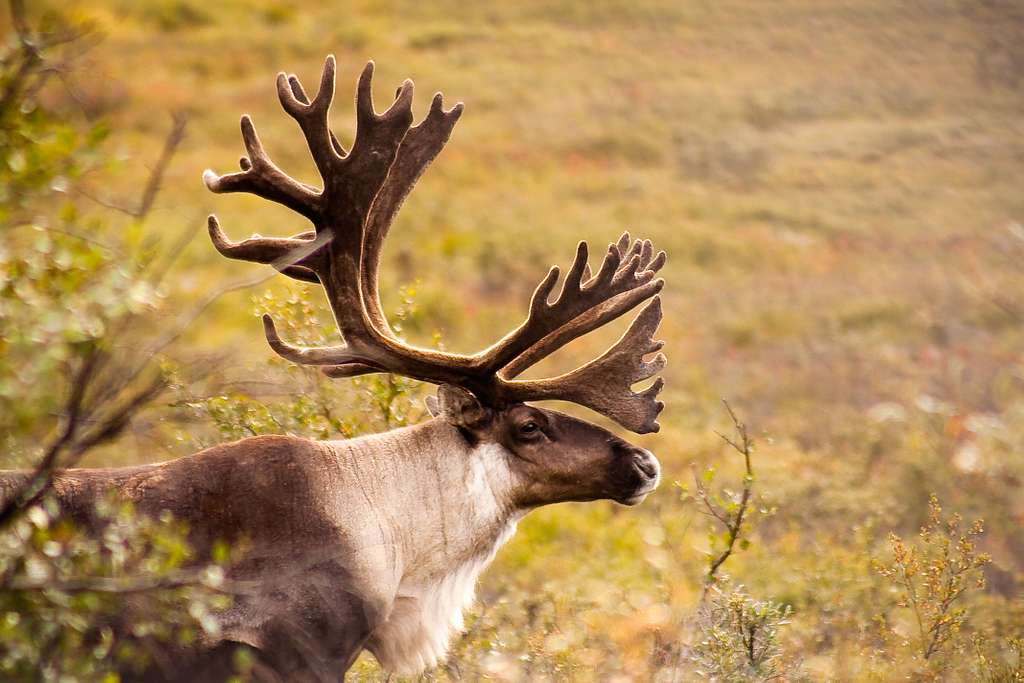
Welcome back to the final installment of Reindeer Around the World! For the last blog in the series we’re travelling west to look at the four subspecies of Caribou that cover Canada, Greenland and a few northern states and Alaska of the USA. So firstly, are caribou and reindeer the same animal? Short answer, yes. Long answer, no, they’re not.
The caribou: similar in nearly everyway to the Eurasian tundra and forest reindeer.
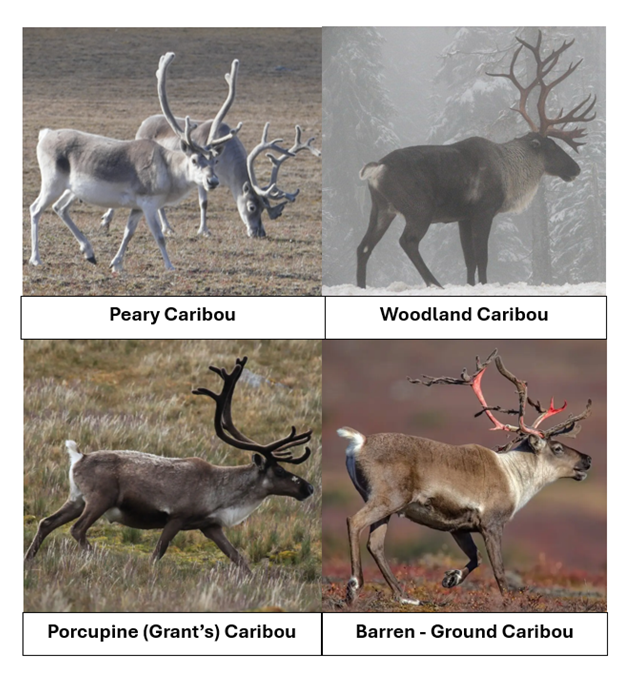
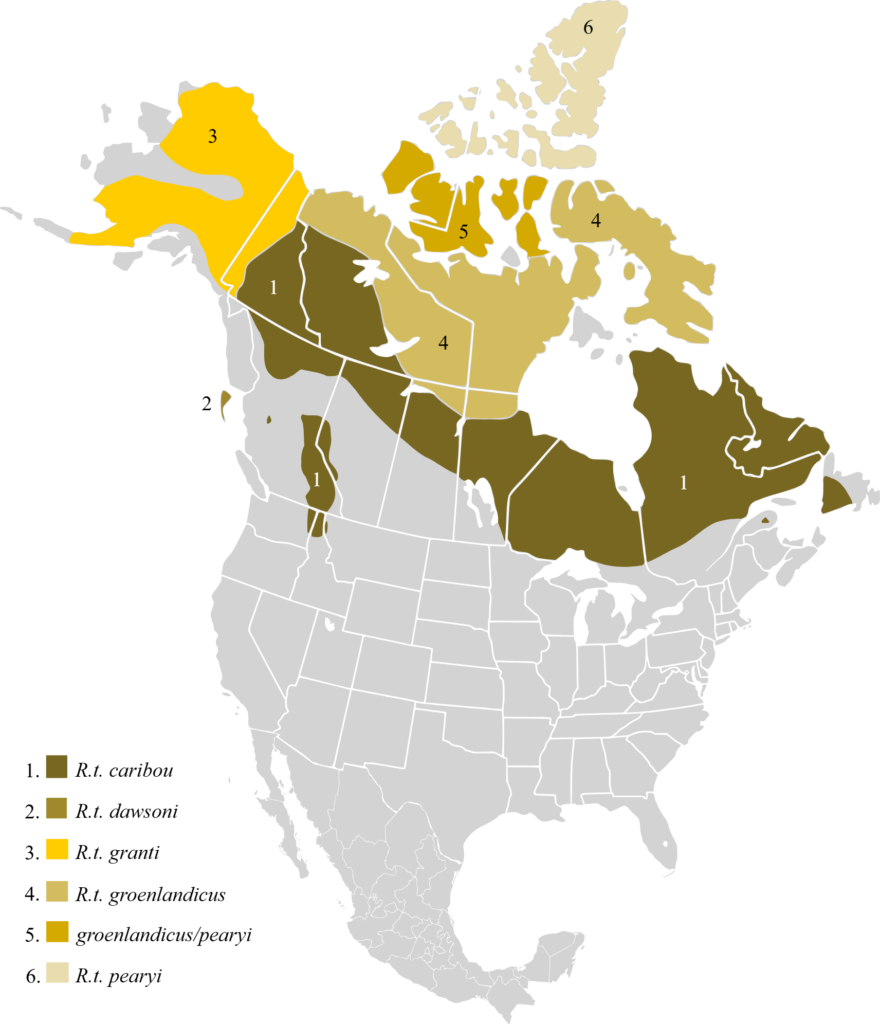
In North America, the reindeer populations are seen as two difference categories of animals: semi domesticated = reindeer, and wild = caribou. But from an ecological stand point, the caribou are broken down into four subspecies:
You’ll notice the similarity in scientific name with the European subspecies of reindeer we’ve previously looked at, confirming they are the same species, but each have slight differences. So, what makes each subspecies of caribou different to each other, and to the reindeer we know and love here in Scotland.
Population map of the four subspecies of caribou and smaller herd populations throughout North America. (Map credit: Cephas)
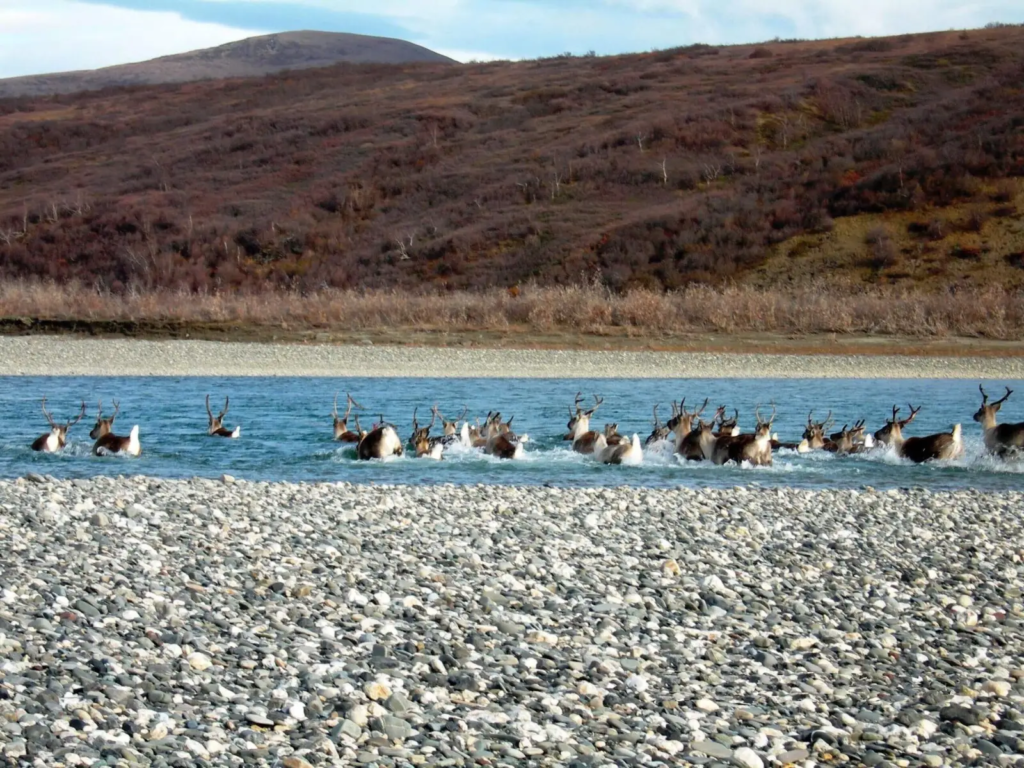
The Porcupine caribou closely resembles the barren-ground caribou, covering similar landscapes in the northern most territories seen on the above map. They cover a calving ground based on a river system including the Porcupine River – hence the name. They have a darker colouration to them, but their environmental adaptations and ecosystem role are what we’re familiar with throughout the other subspecies of reindeer we’ve been looking into.
Herd of porcupine caribou crossing a river (photo credit: Animalia.bio).
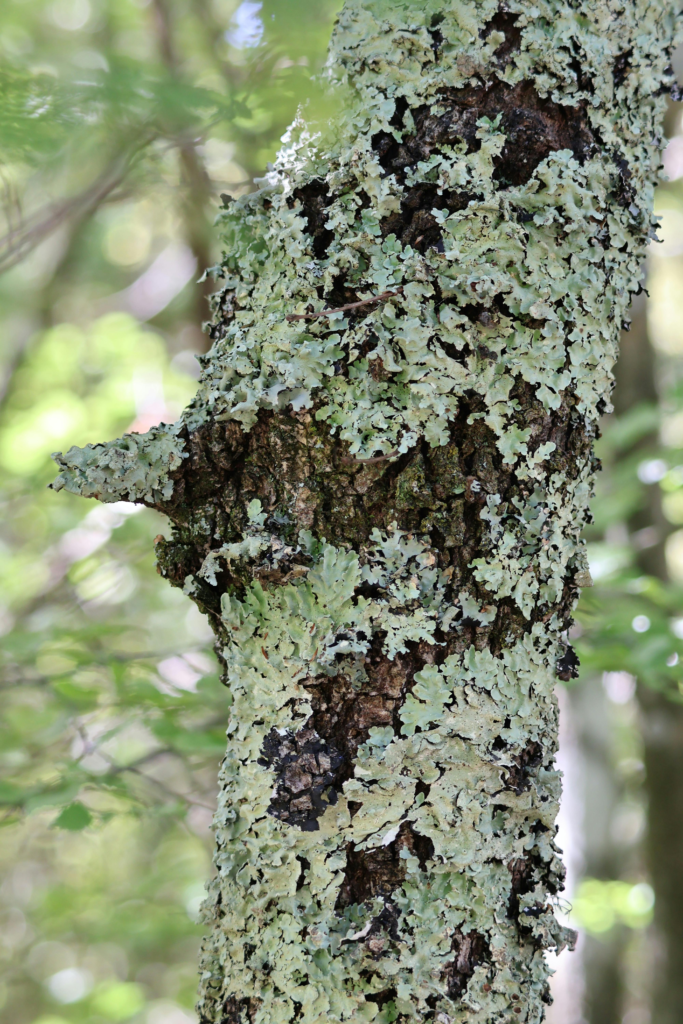
The woodland caribou is again very similar to what we imagine when we picture our tundra reindeer here at home. Adaptations for sub arctic habitats, dealing with deep snow and harsh temperatures, keeping on the move and fulfilling the same ecosystem role. The differences we know of with the woodland caribou are more to do with diet, it seems, than anything else. Inhabitating a lot of areas of old growth forest and smaller herds found in different rugid mountain ranges further south than any of the other populations, they have different species of fauna available to them to feed off. The woodland caribou feed almost exclusively from aboreal lichens for the colder half of the year, followed by dried grasses and some tree species throughout the warmer months.
An example of aboreal lichen, growing along the bark of a tree as opposed to carpets of lichen on the ground. These types of lichen are found at a lower altitude than the rocky mountainous ranges we expect to find reindeer, where they typically live above treelines amongst far shorter growing vegetation such as grasses and heathers.
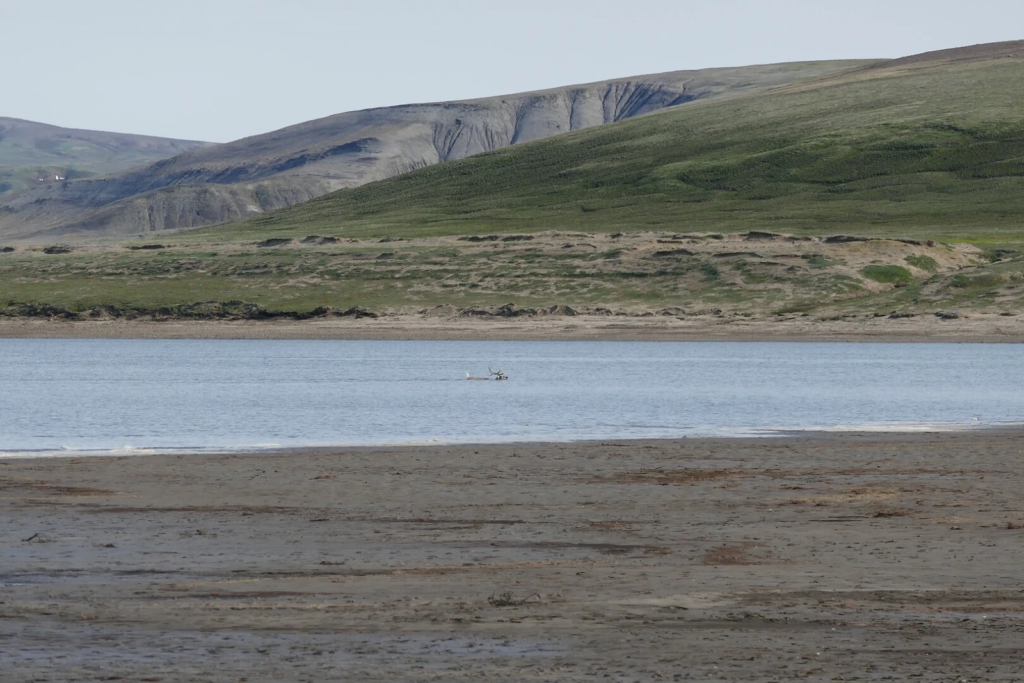
The Peary caribou are the smallest subspecies of caribou and are found in much smaller herds than any other. During winter time you are most likely only going to find up to four of them travelling together and this expands to maybe a dozen during the summer months. They feed on similar plant life to the other subspecies, having limited choice due to their sub arctic and arctic home ranges. But unlike the others, they predominantly feed on purple saxifrage which can stain their noses with a purple tint. Their migratory path is not as large as other subspecies of caribou, moving up to 150km between winter and summer home ranges, sometimes between islands (seen on the map above as number 6). Similarly to the others they are ready for anything winter can throw at them, but do choose to avoid areas of very deep and heavy snow, retreating instead to rocky mountainous outcroppings and beached areas.
Can you spot the Peary caribou? (Photo credit: Animalia.bio.)
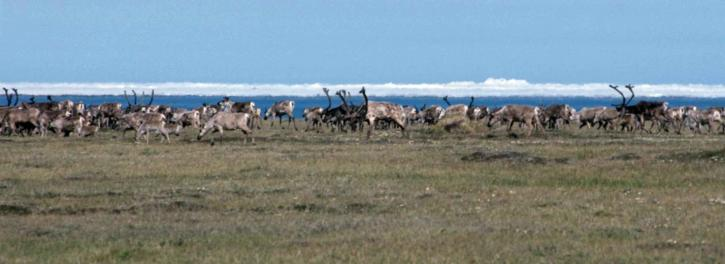
Finally, the last animal on our list to discuss… The barren-ground caribou. Maybe the best to last if that’s fair to say. Let’s meet the animal with the largest ground migratory path in the world! You heard that right, a bigger migration even than the wildebeest in the Serengeti. They migrate twice a year between summer and winter ranges with each journey potentially covering more than 1,000 km depending on the location of their calving grounds. They use higher spots for calving grounds, out of reach of predators such as the wolf, then descend to lower ground and migrate in large herds to areas for summer grazing. Their winter diet consits of some grasses, lichen and leaves from low growth trees. They share their other qualities and adaptations with the other subspecies of caribou, making them efficent at moving and feeding through shallow snow and coping with cold temperatures found in arctic regions.
Barren-ground caribou grazing.
And there we have it – we’ve learnt all about the different subspecies of reindeer all across the globe! Thanks for sticking with me, and I hope you’ve all enjoyed reading this blog series as much as I’ve enjoyed researching it. I feel it’s important to say there are other indivdual named herds that I haven’t covered, but to learn about the different adaptations and qualities, I think we’ve got all bases covered. Reindeer truly are a remarkable and wonderful animal, with clearly a lot more to them as a species than we may first realise.