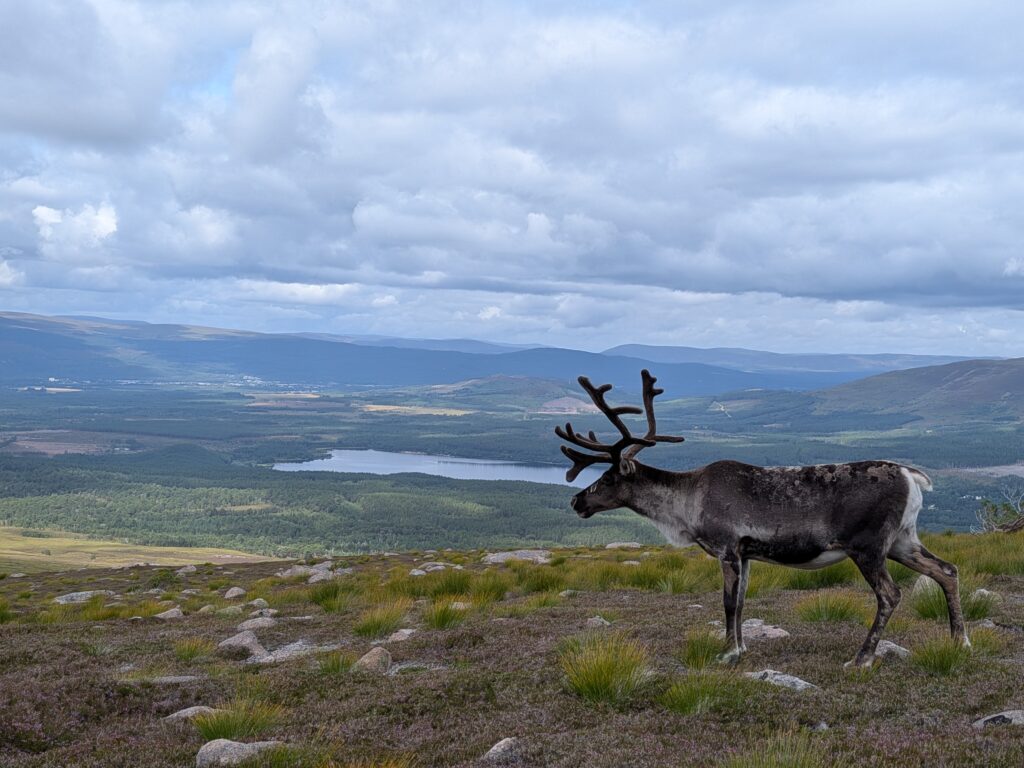
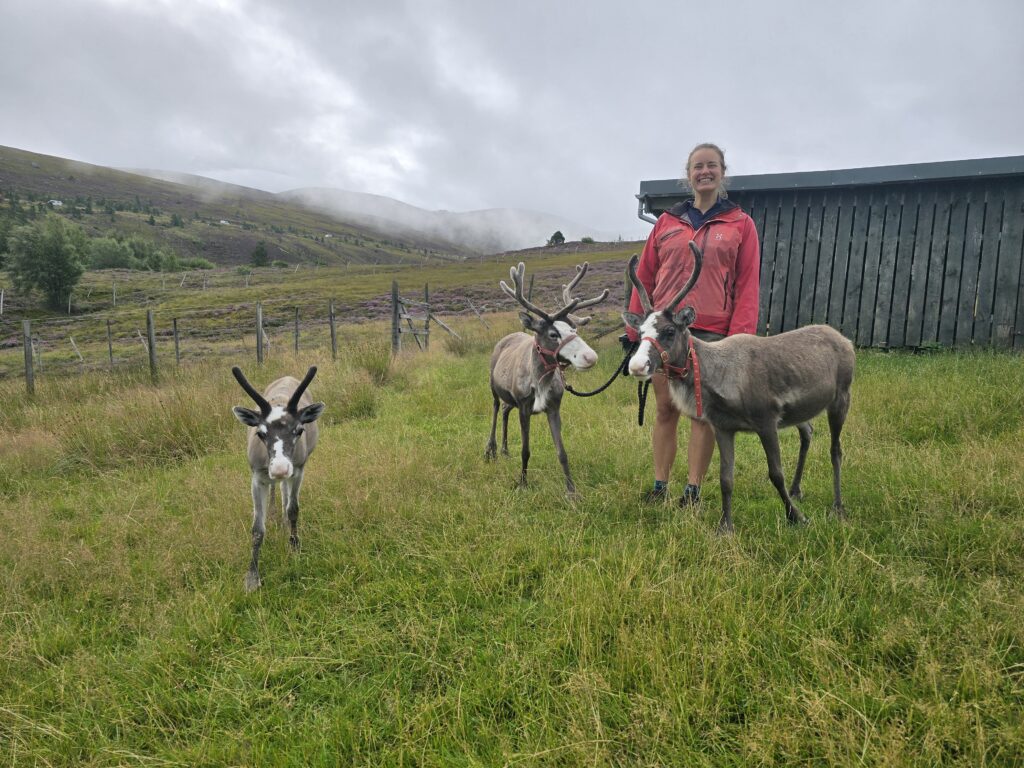
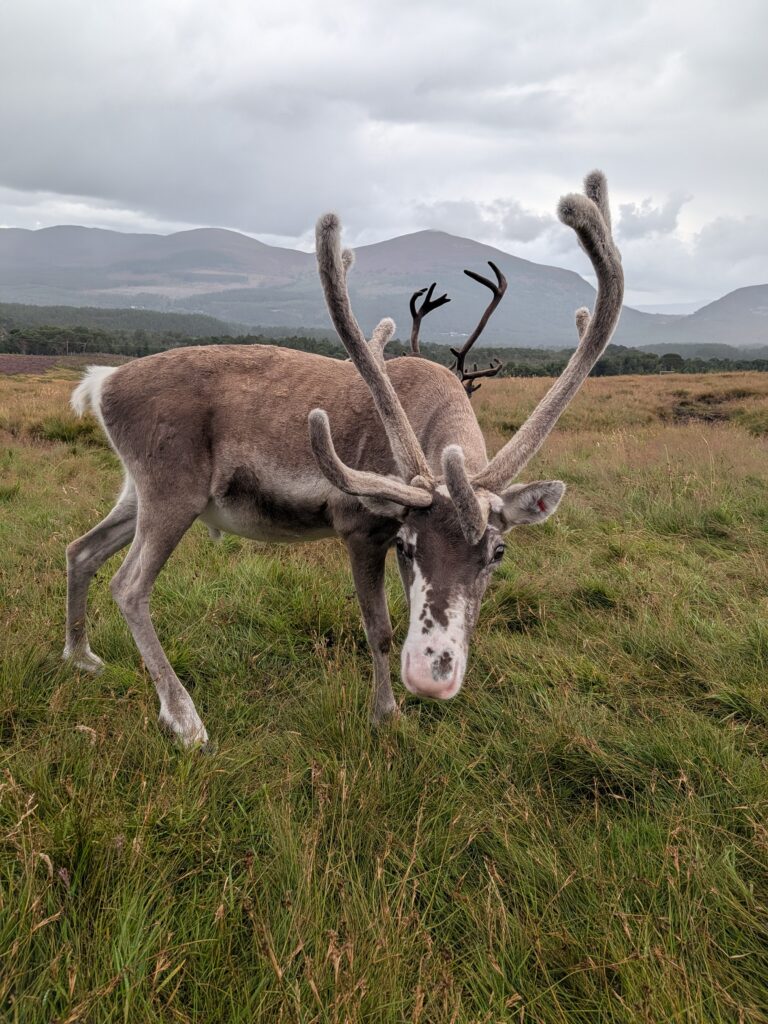
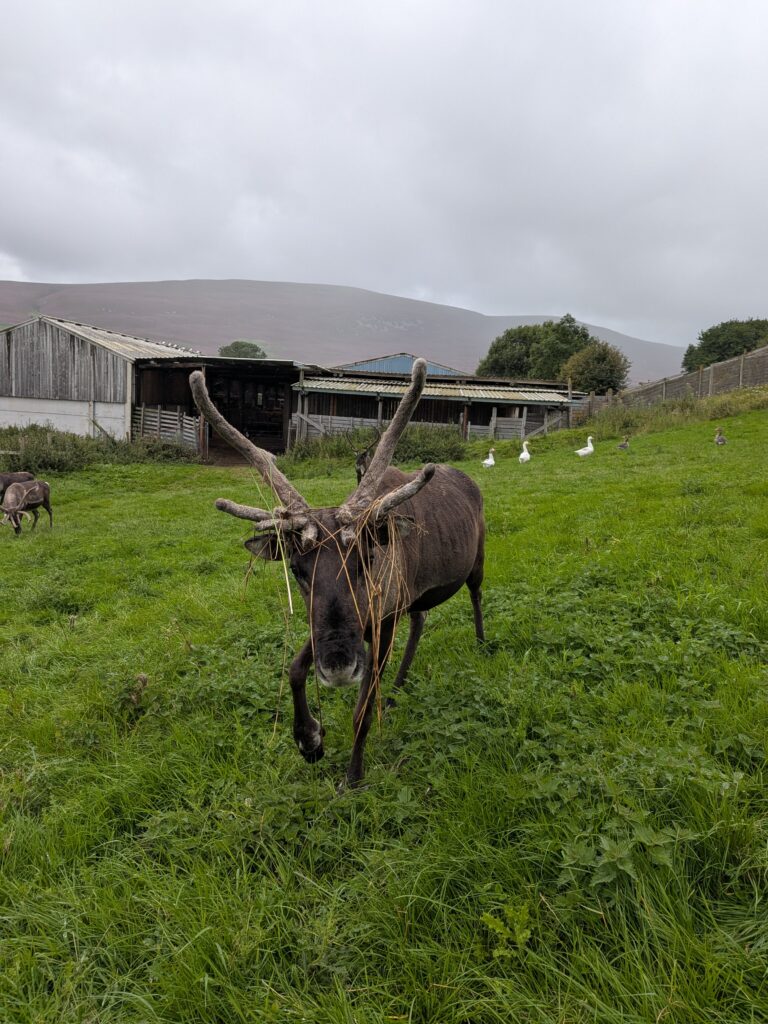
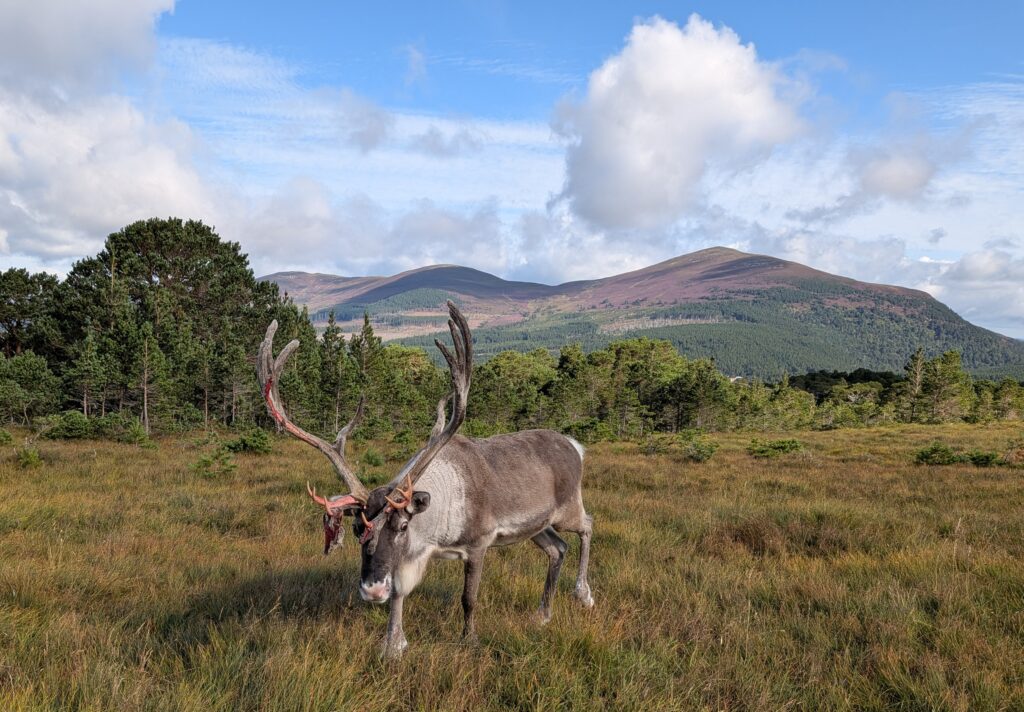
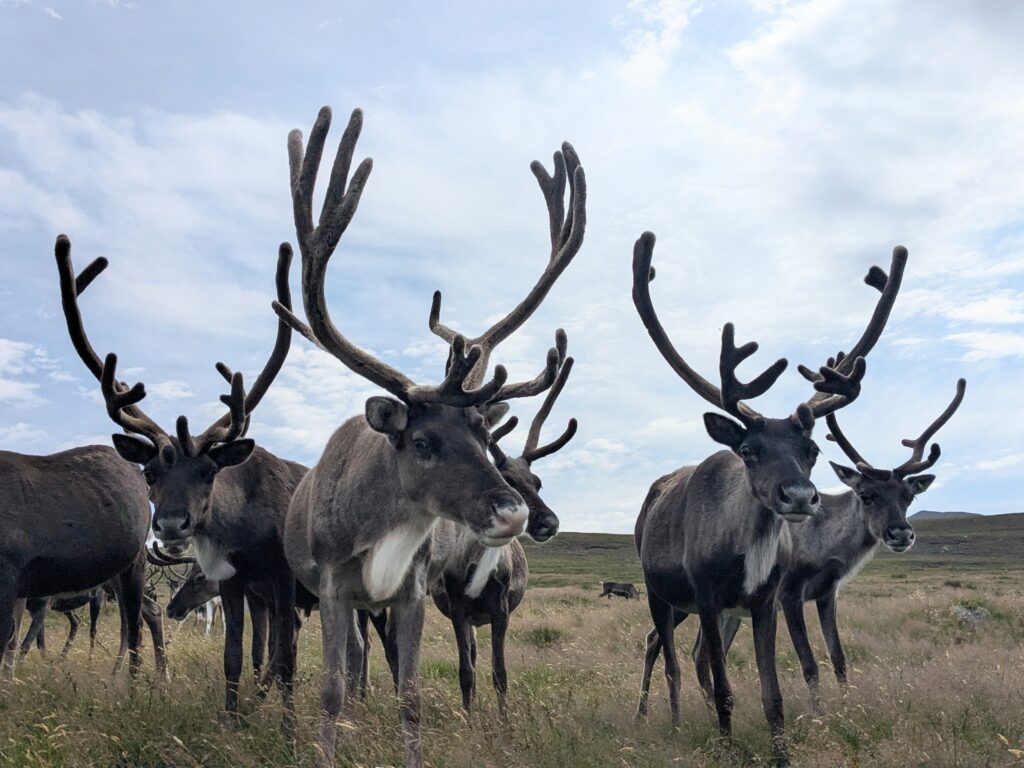
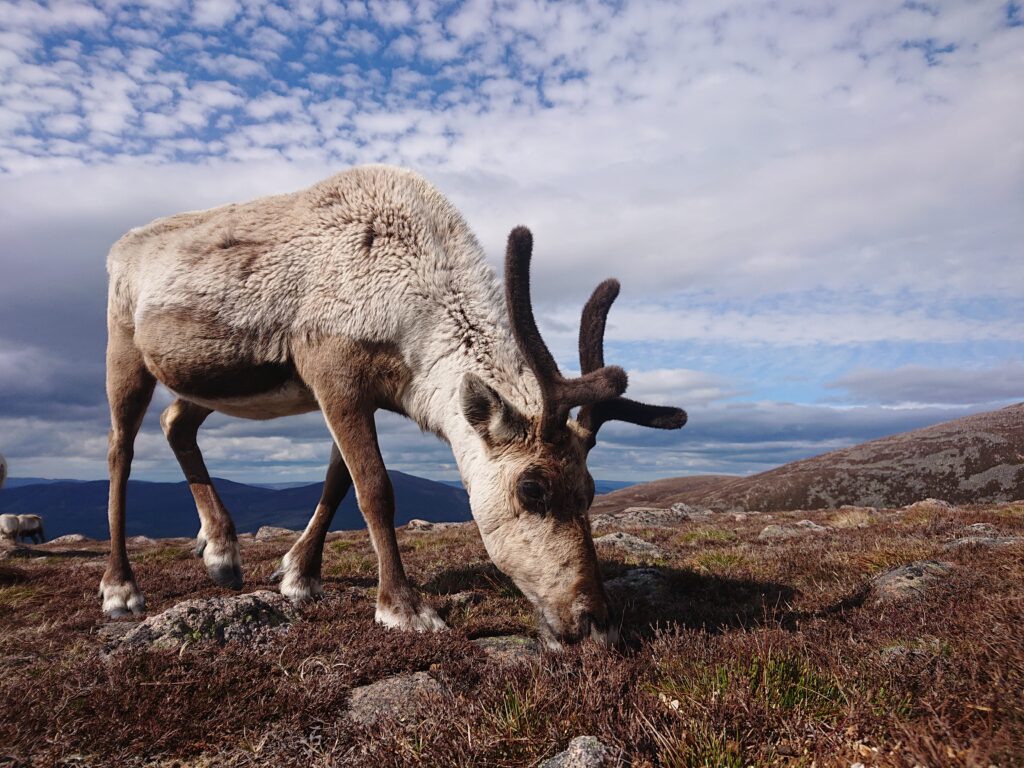
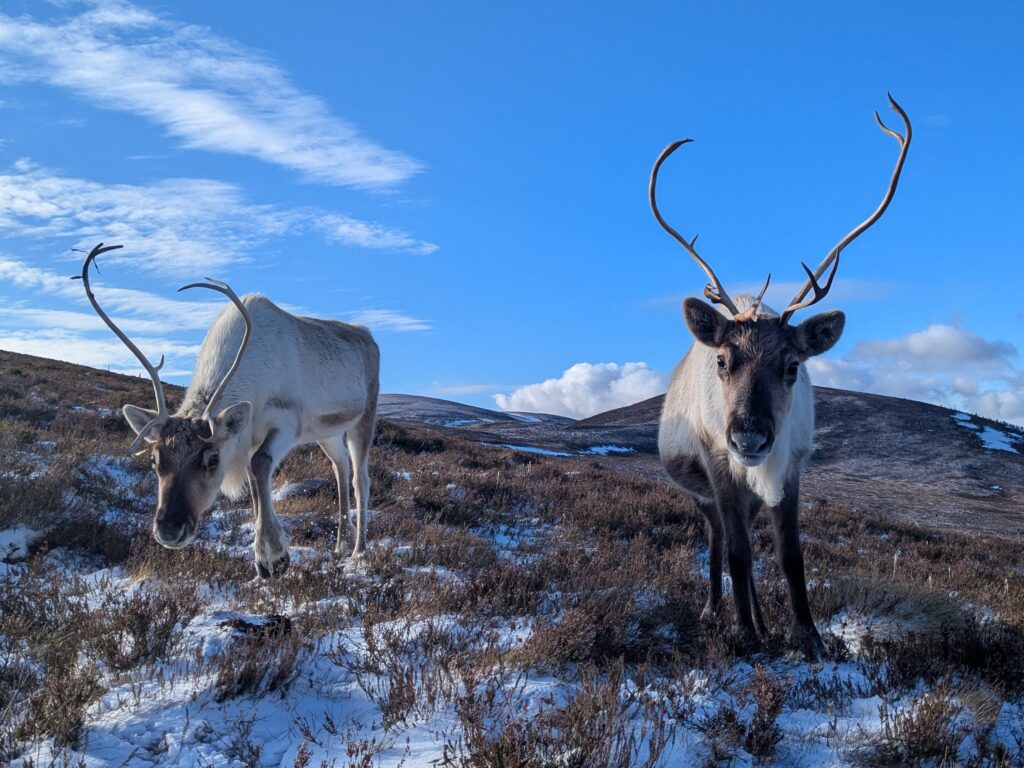
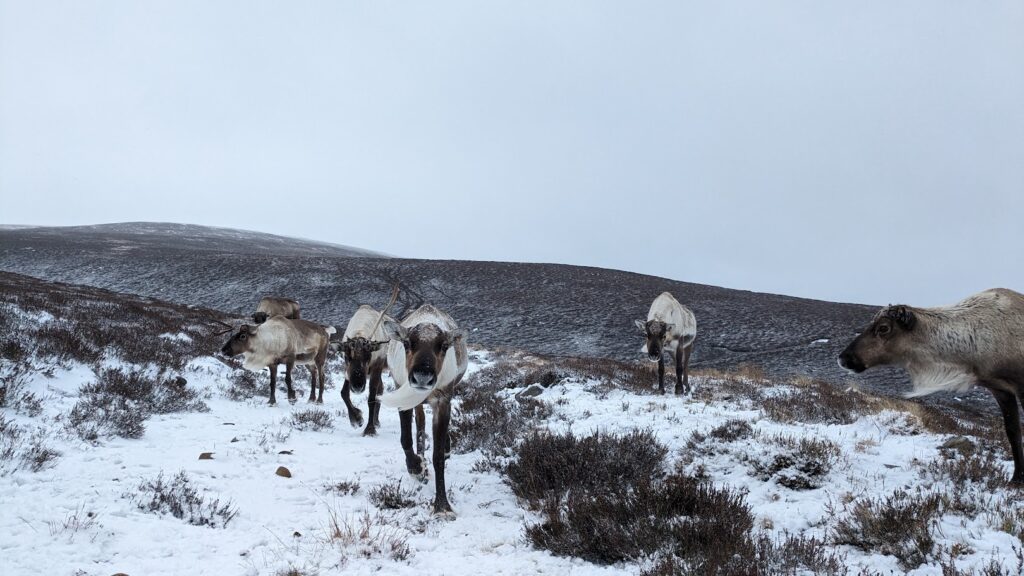
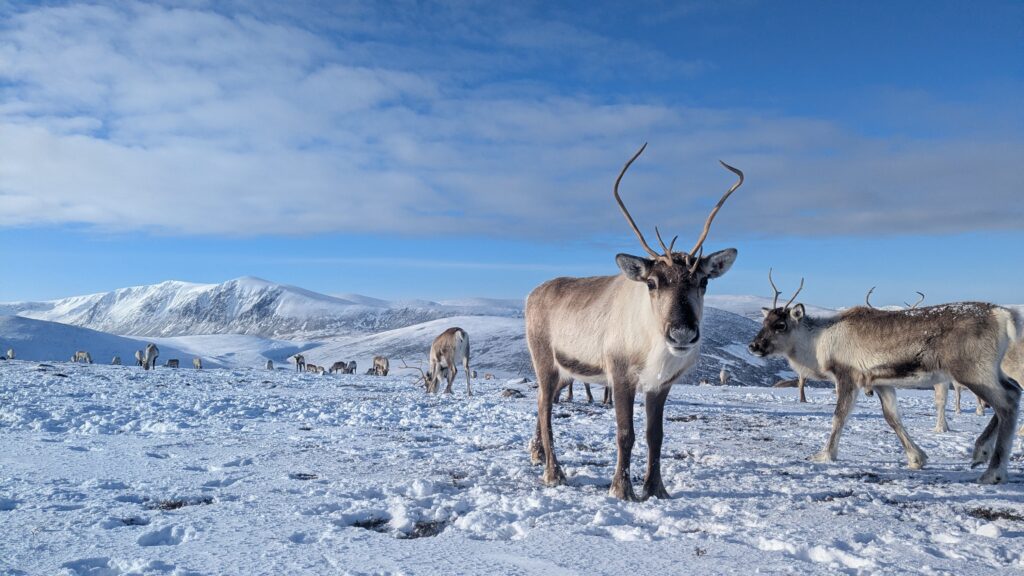
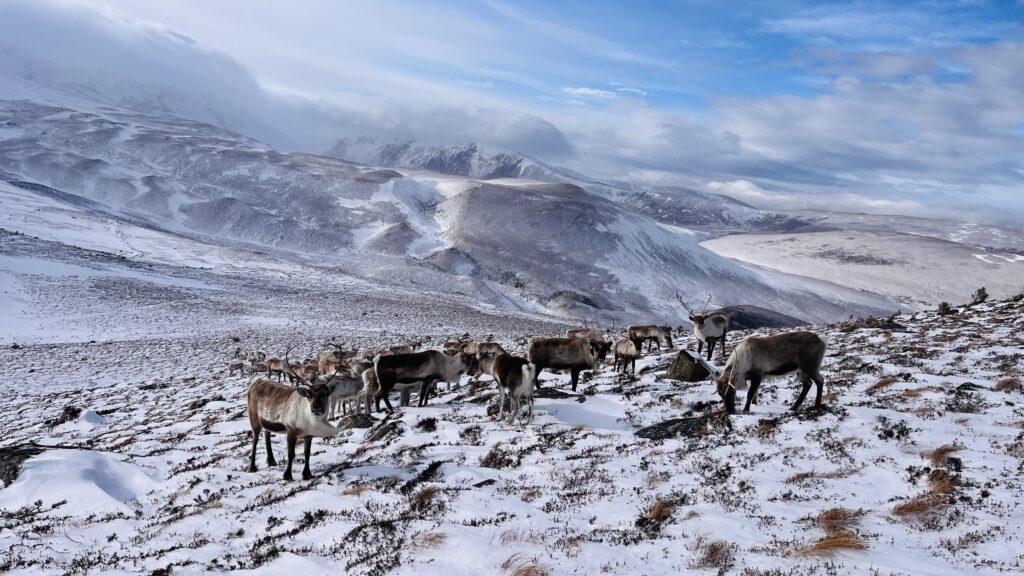
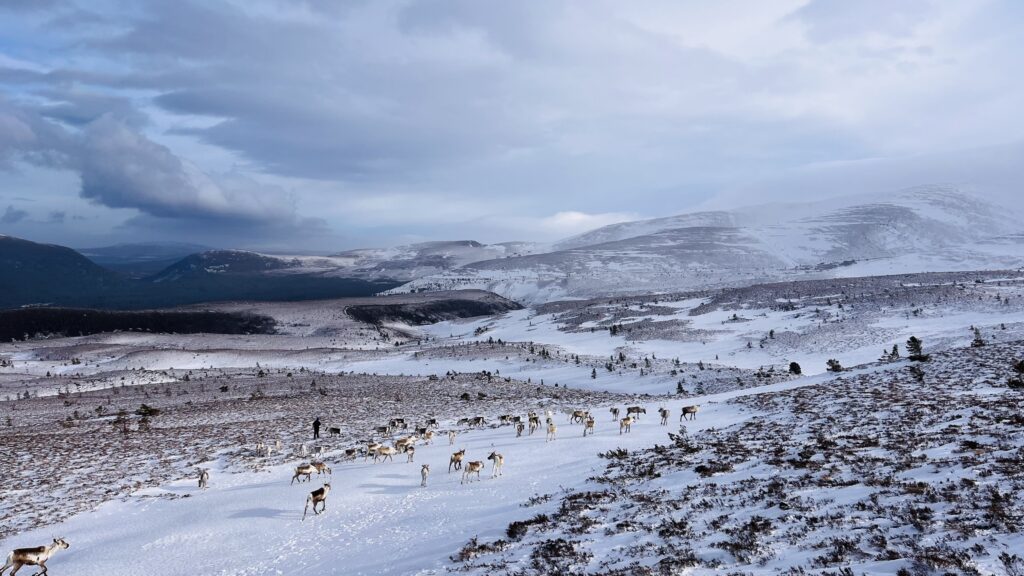
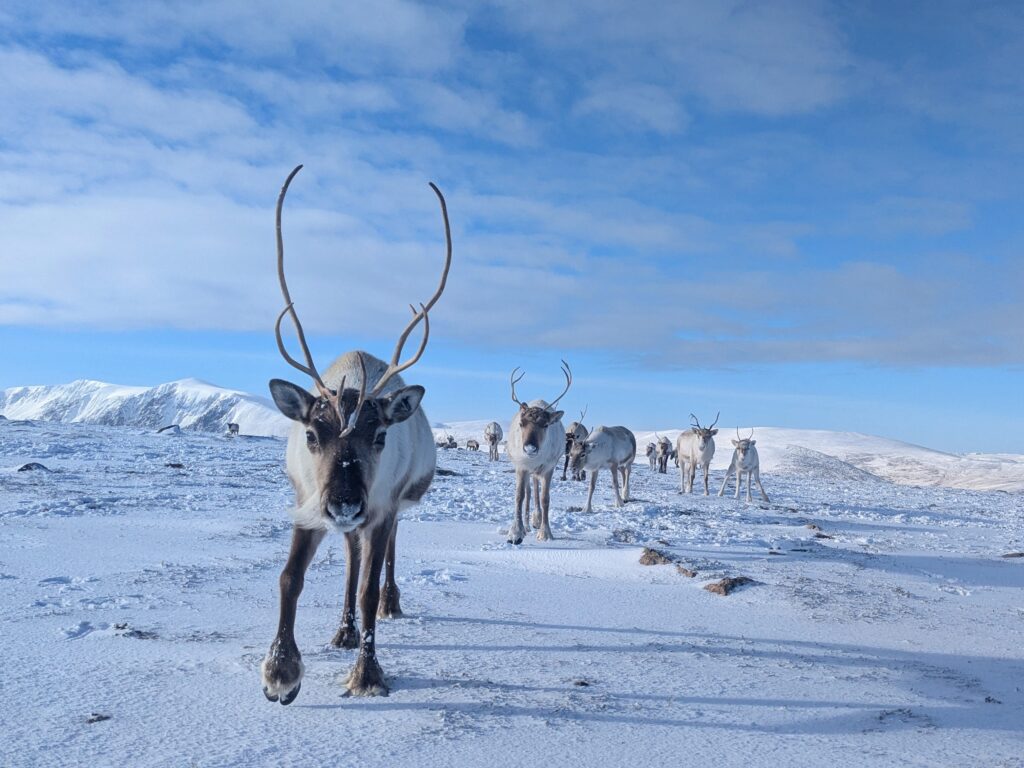
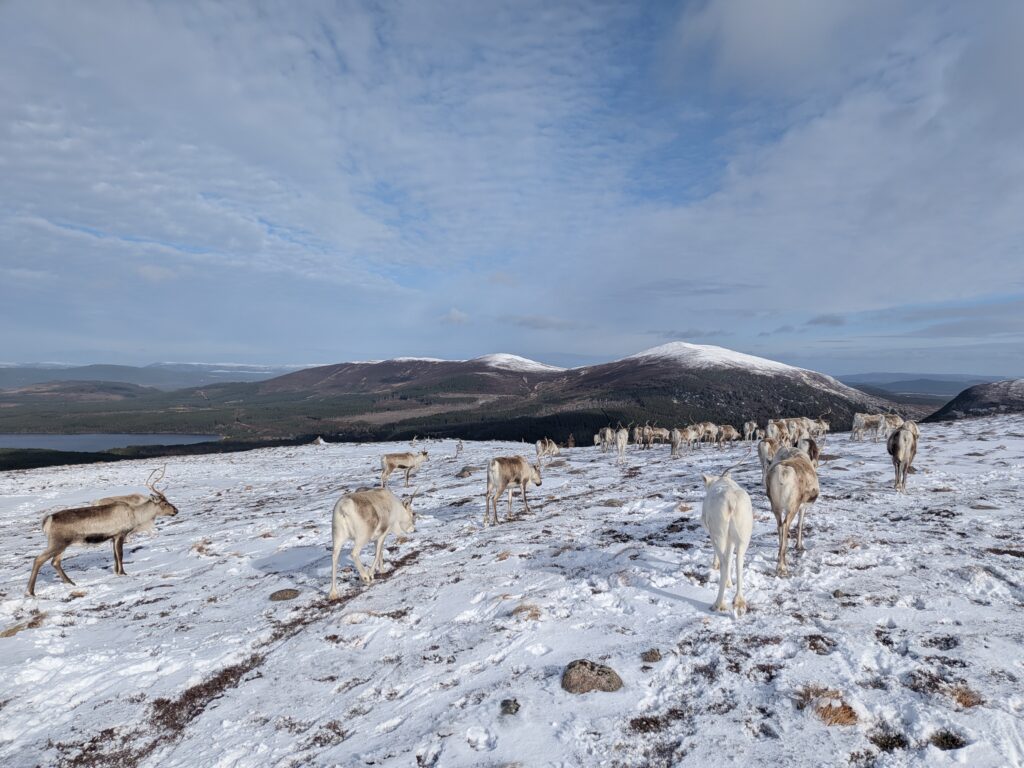
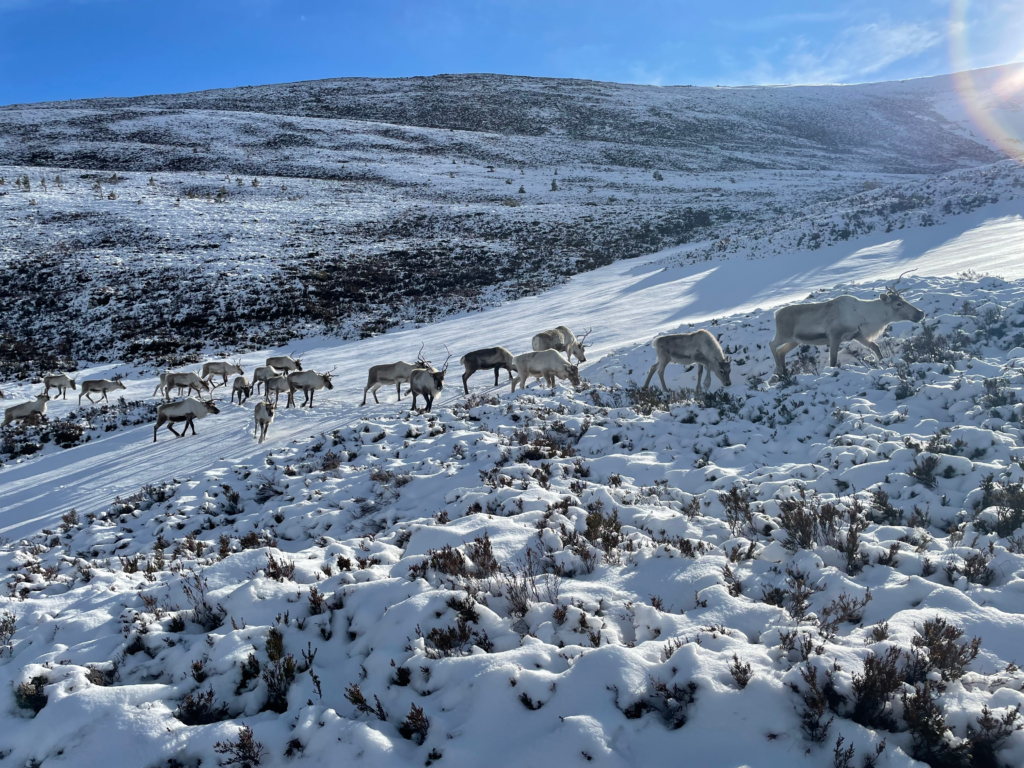
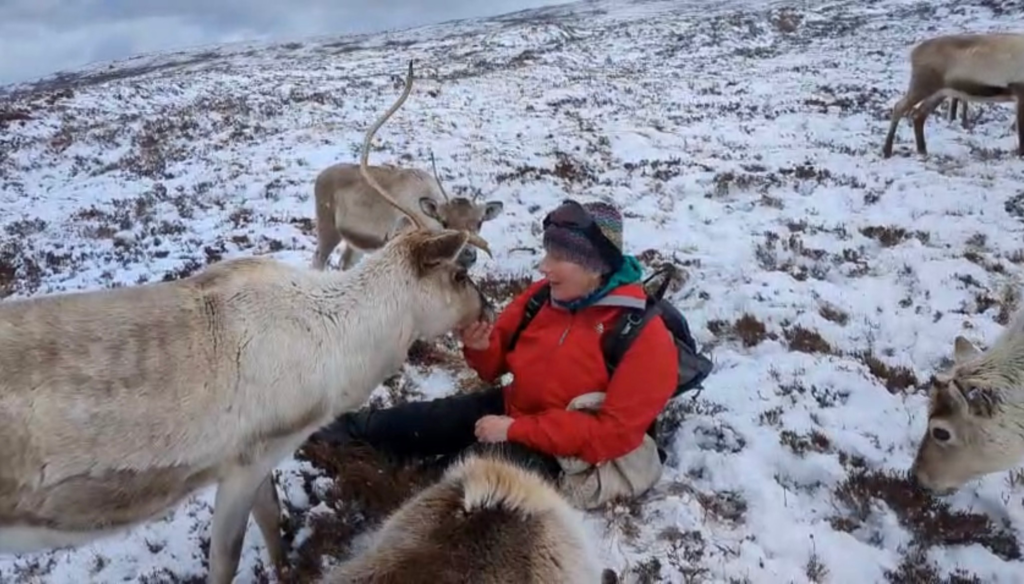
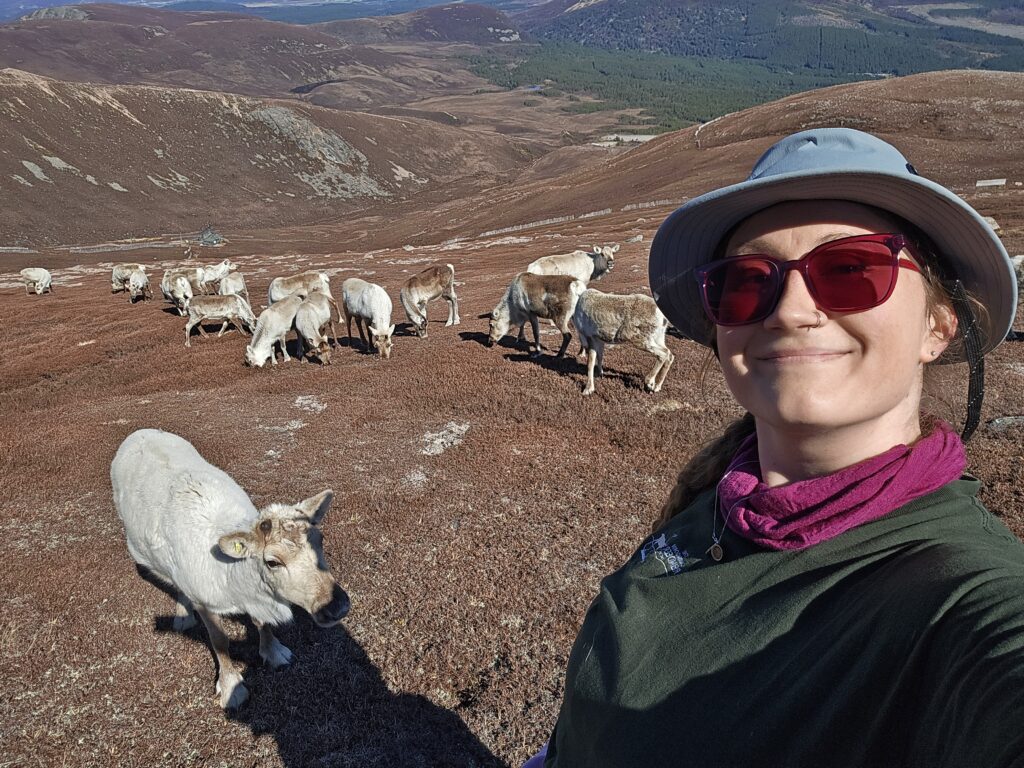
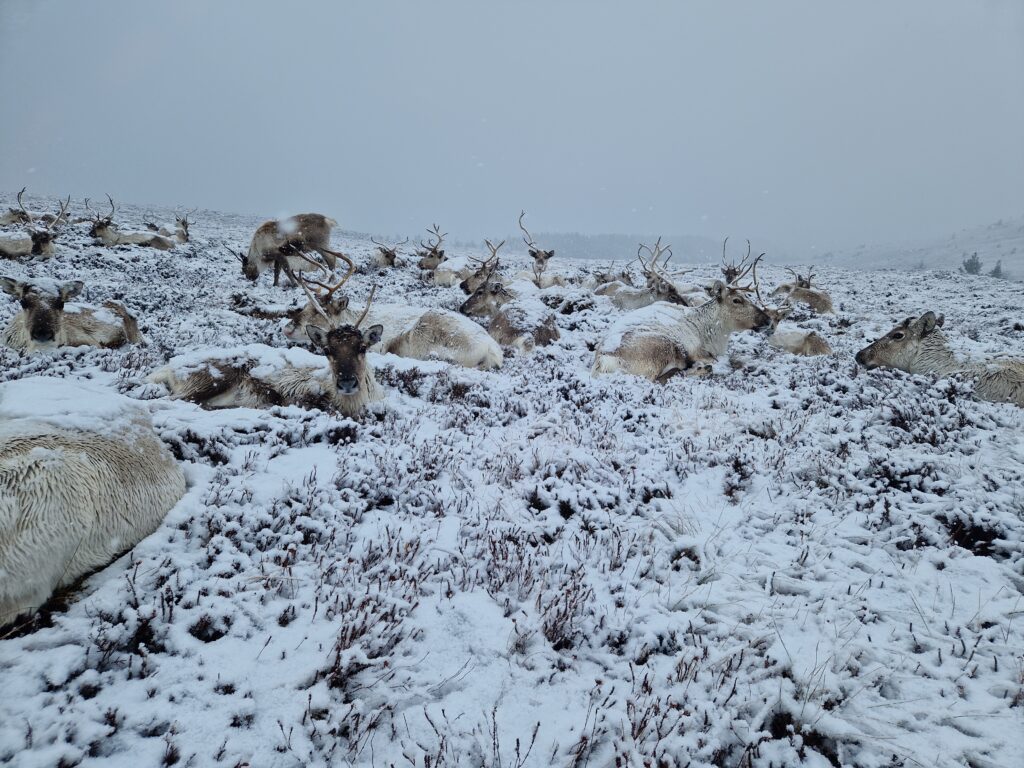
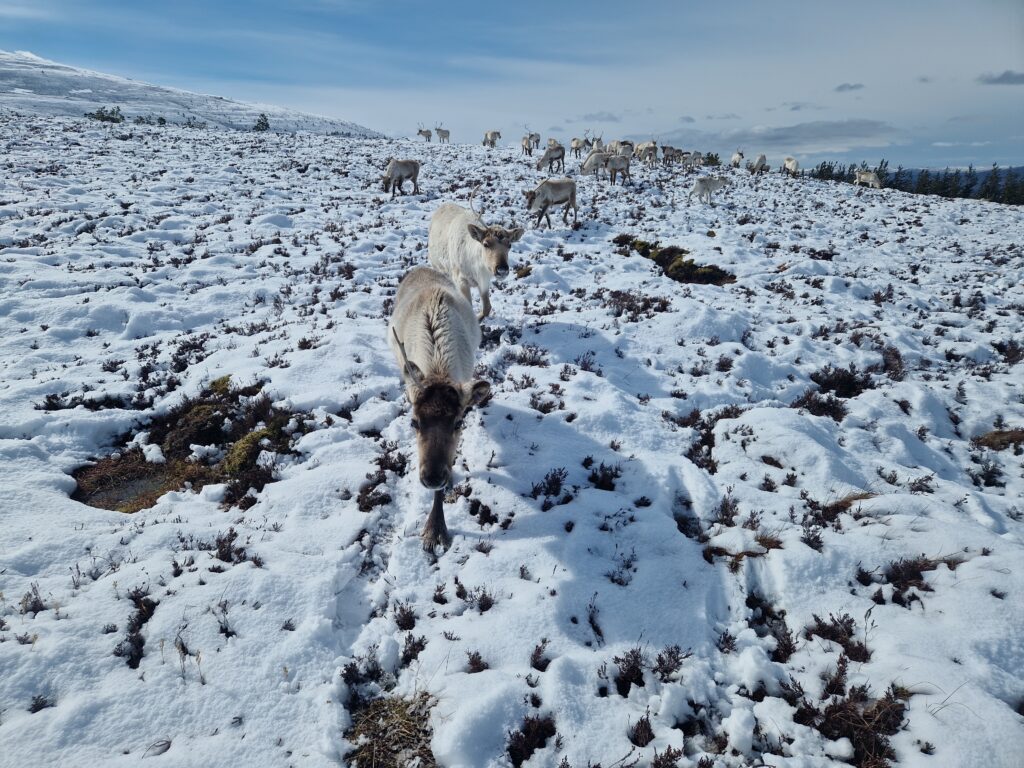
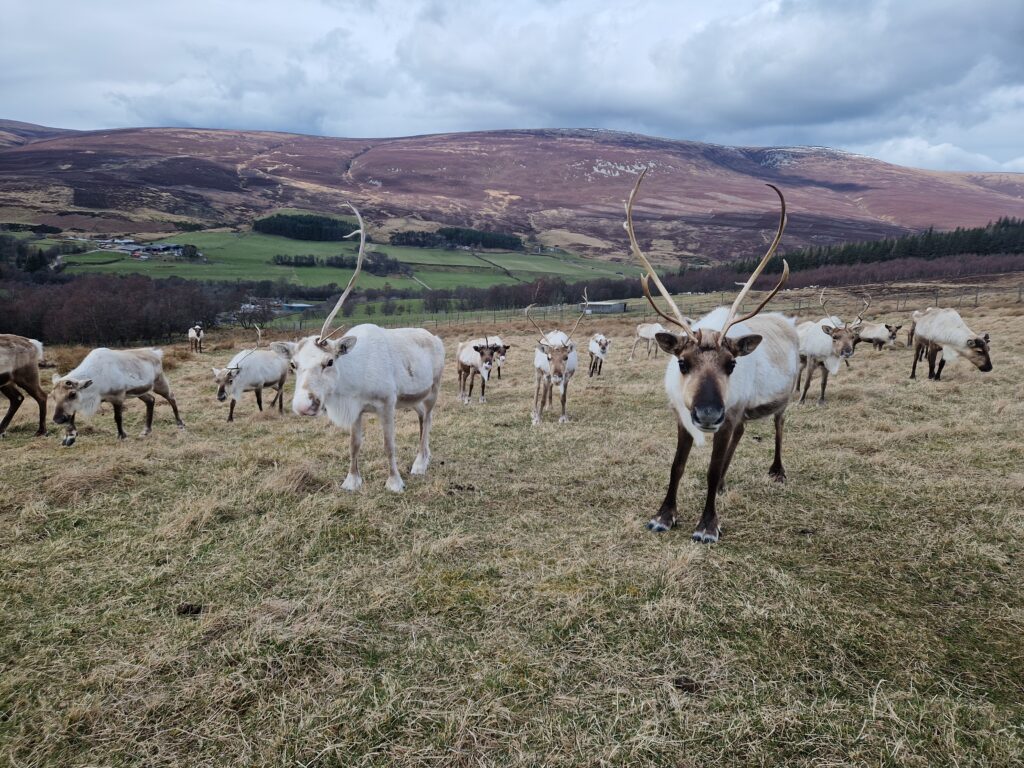
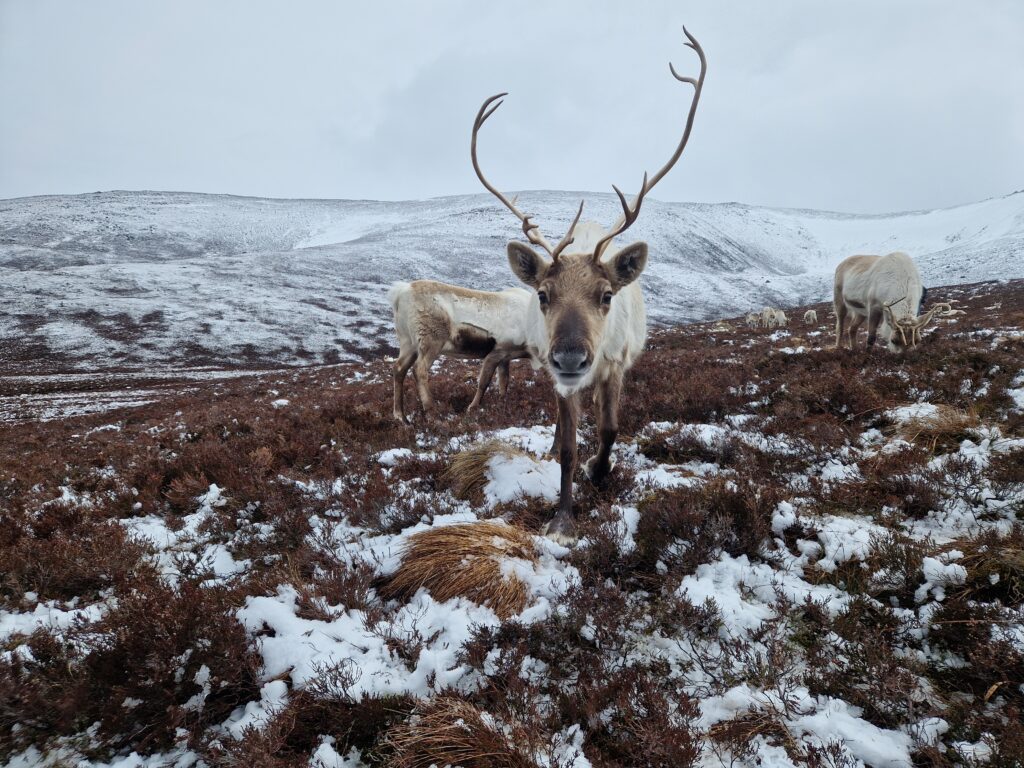
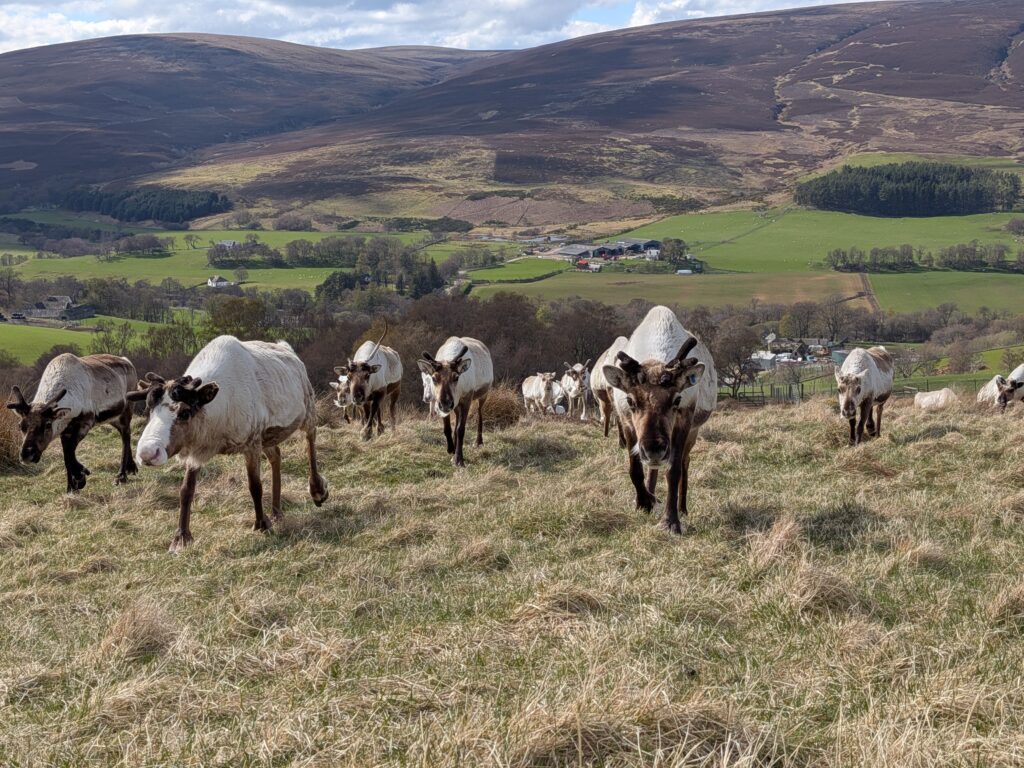
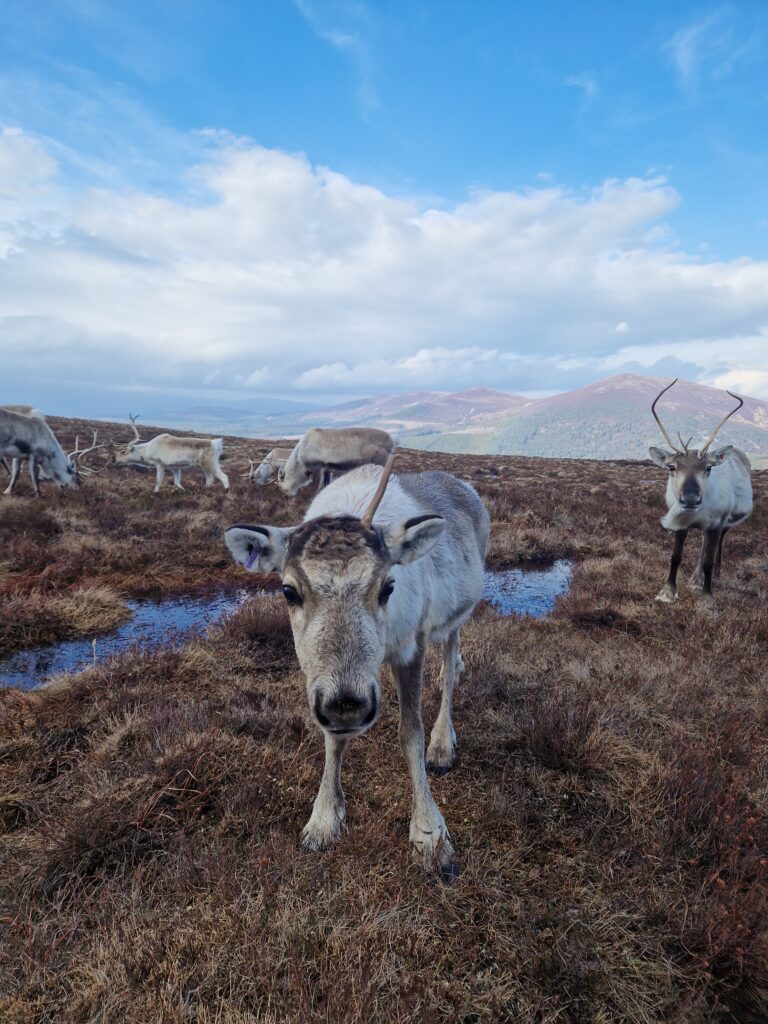
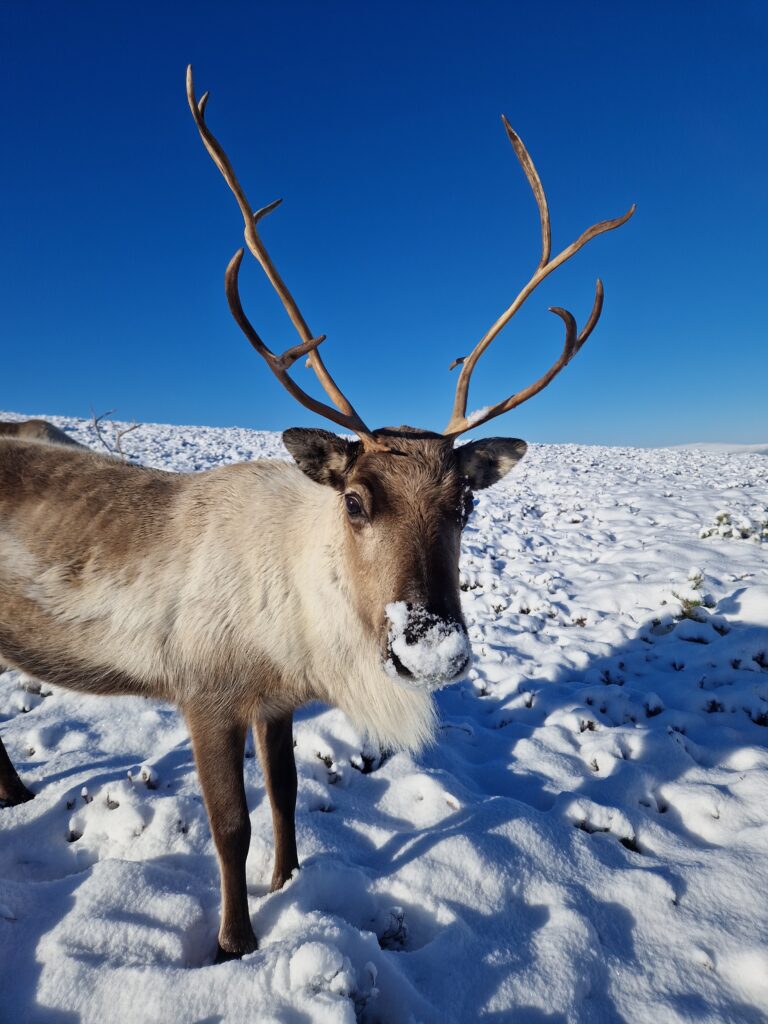
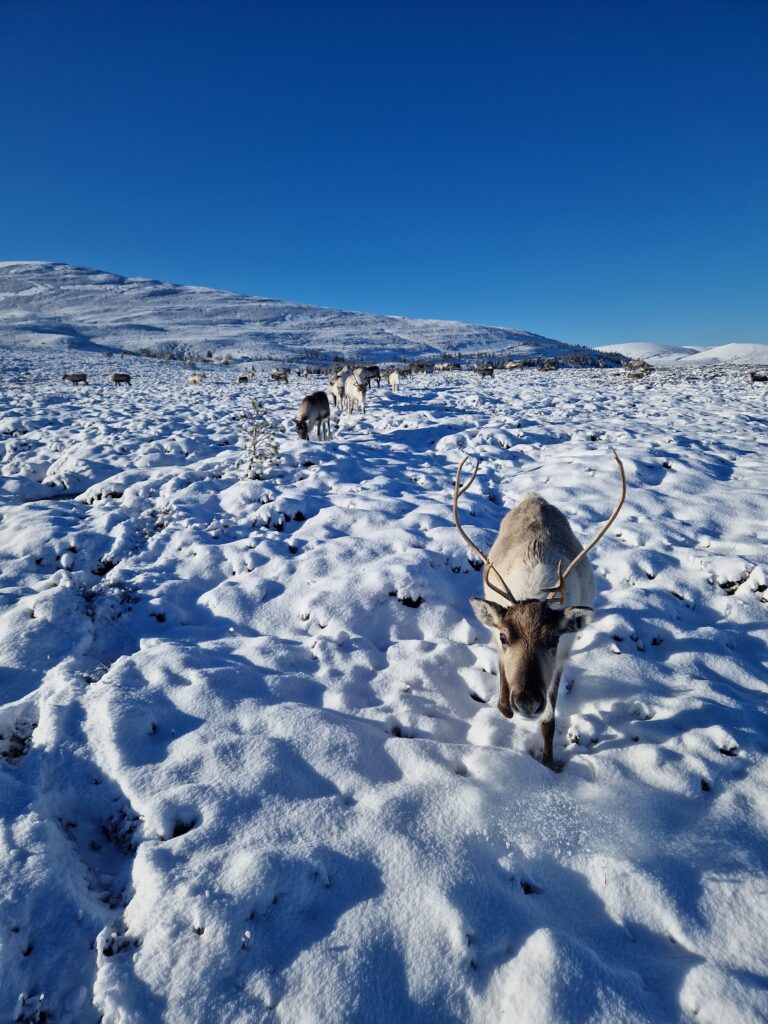
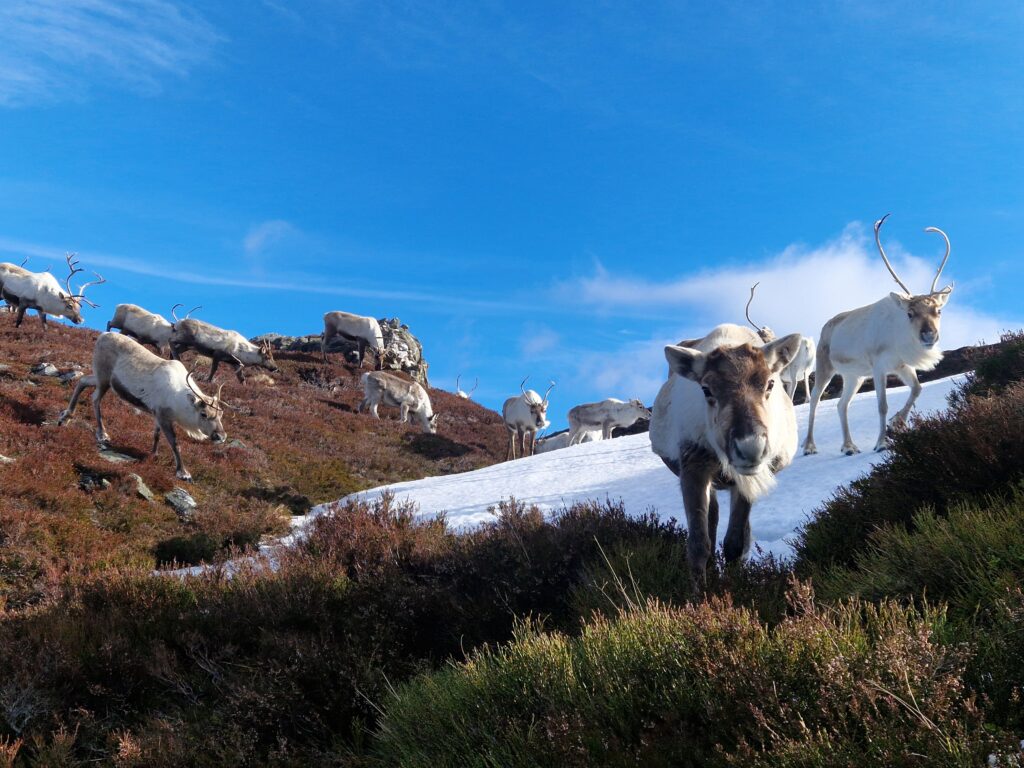
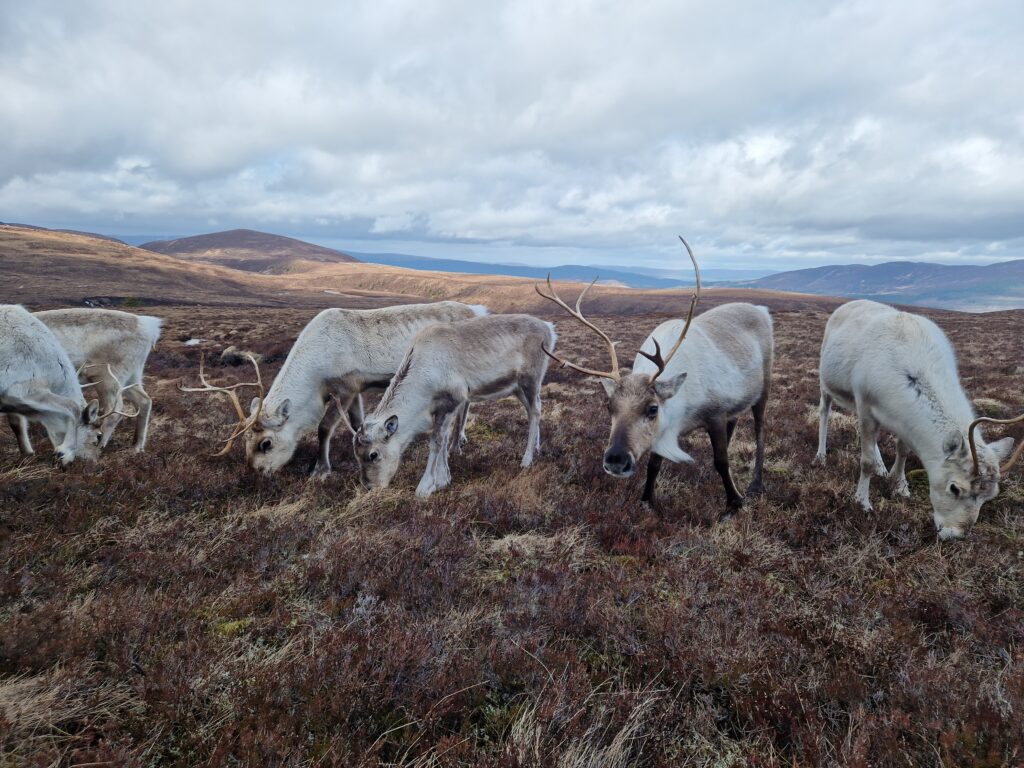
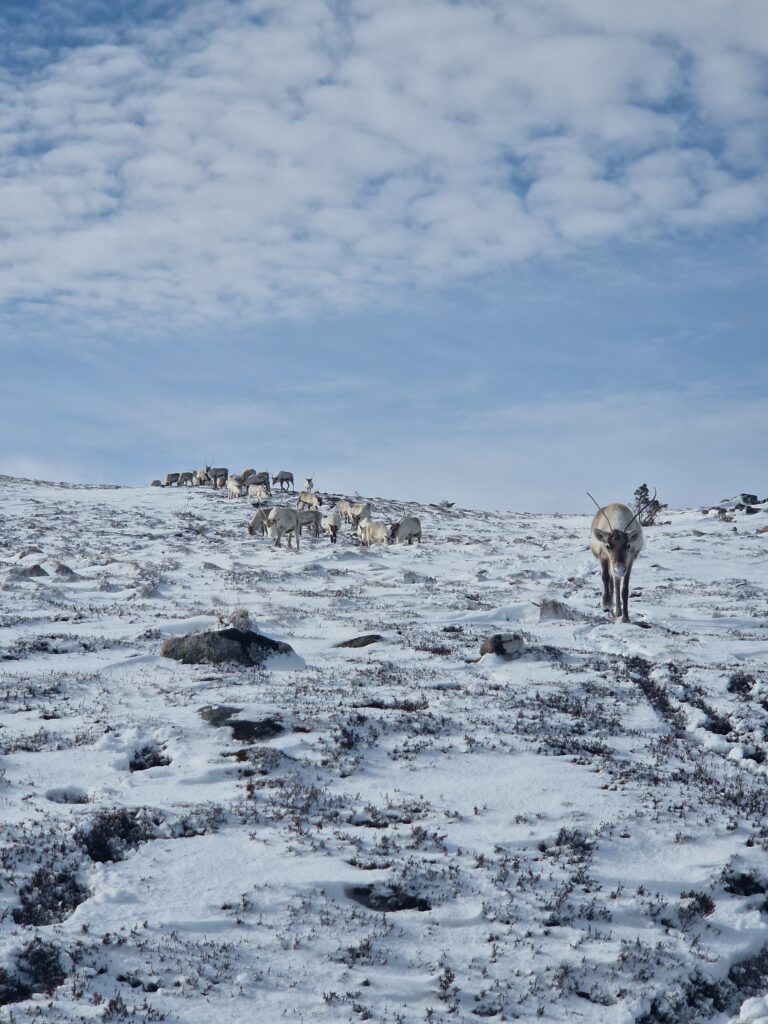
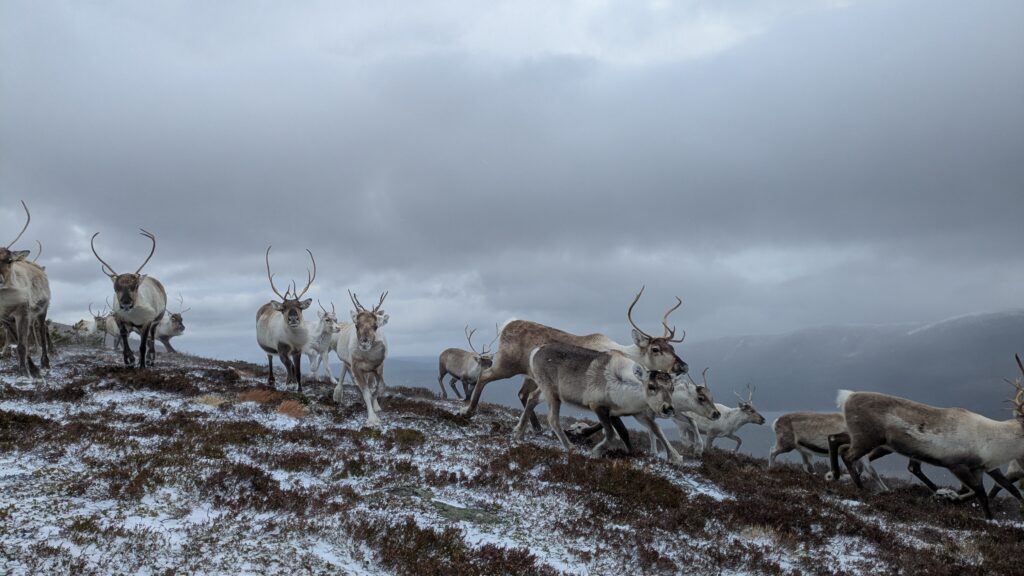
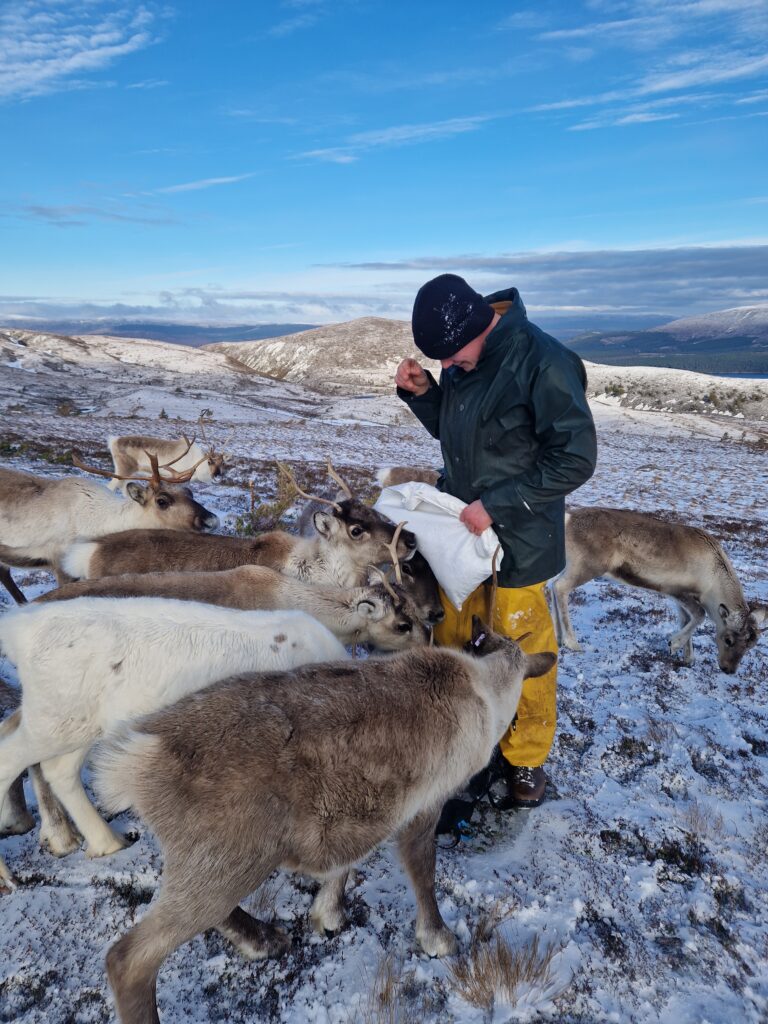
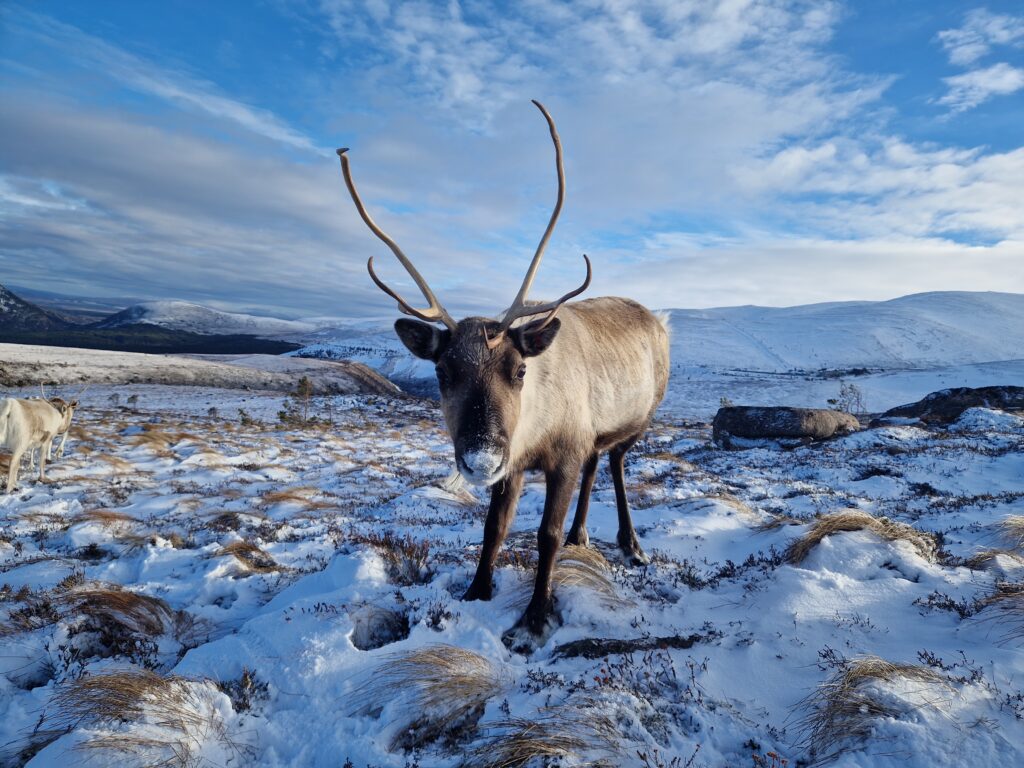
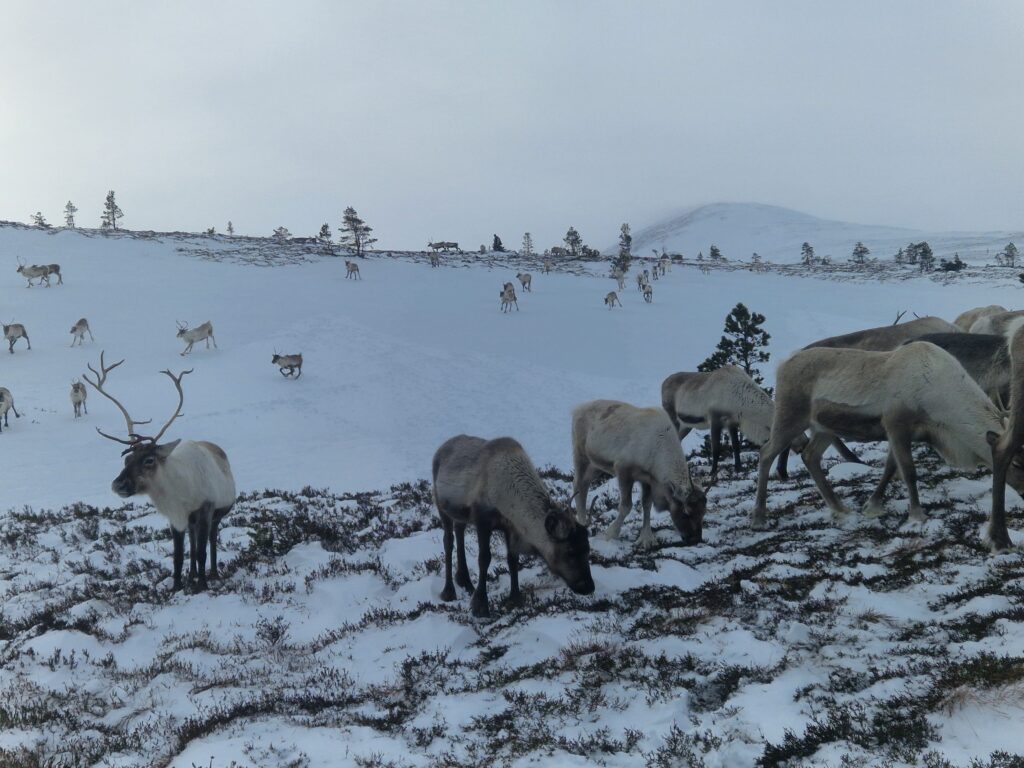
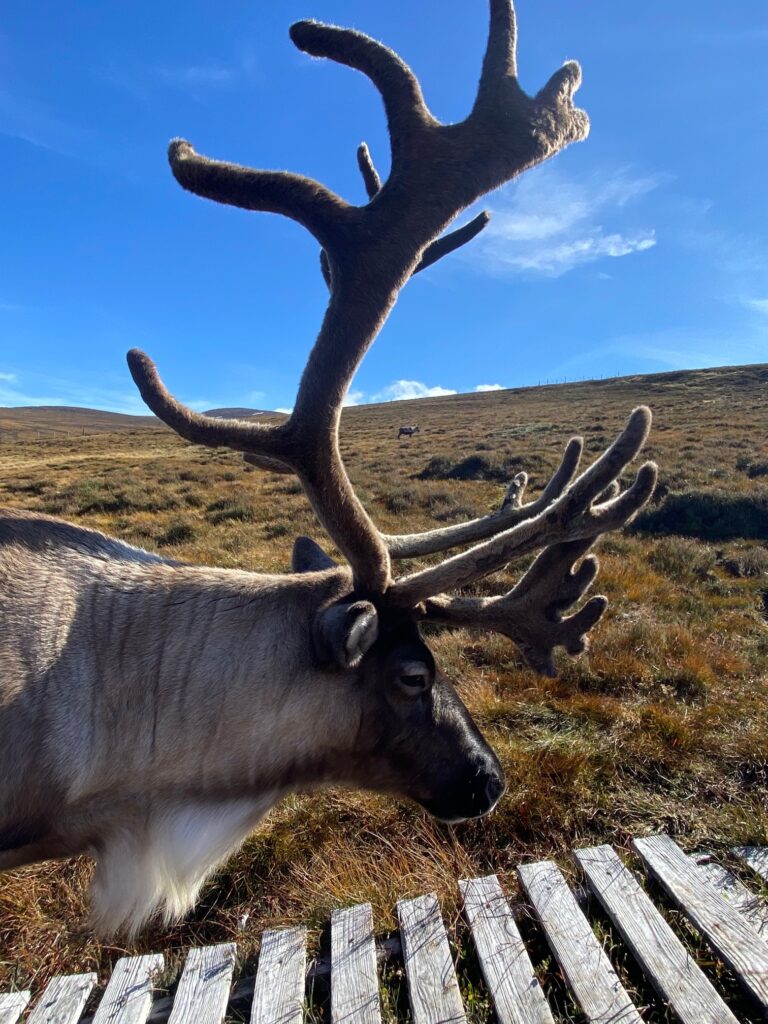
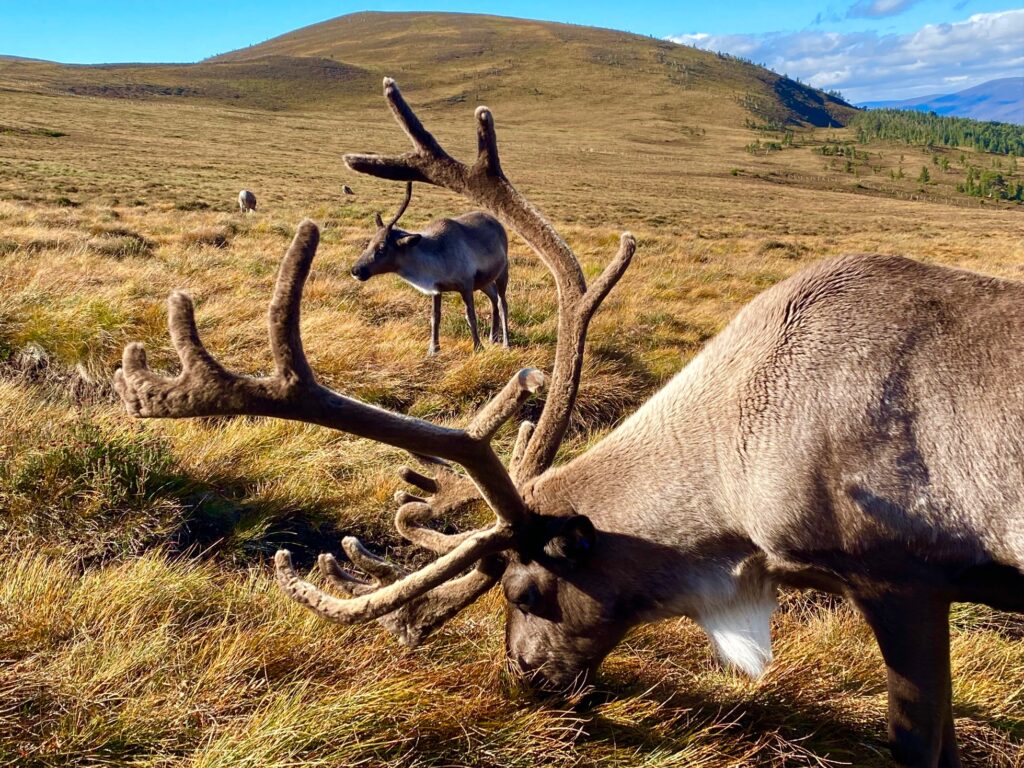
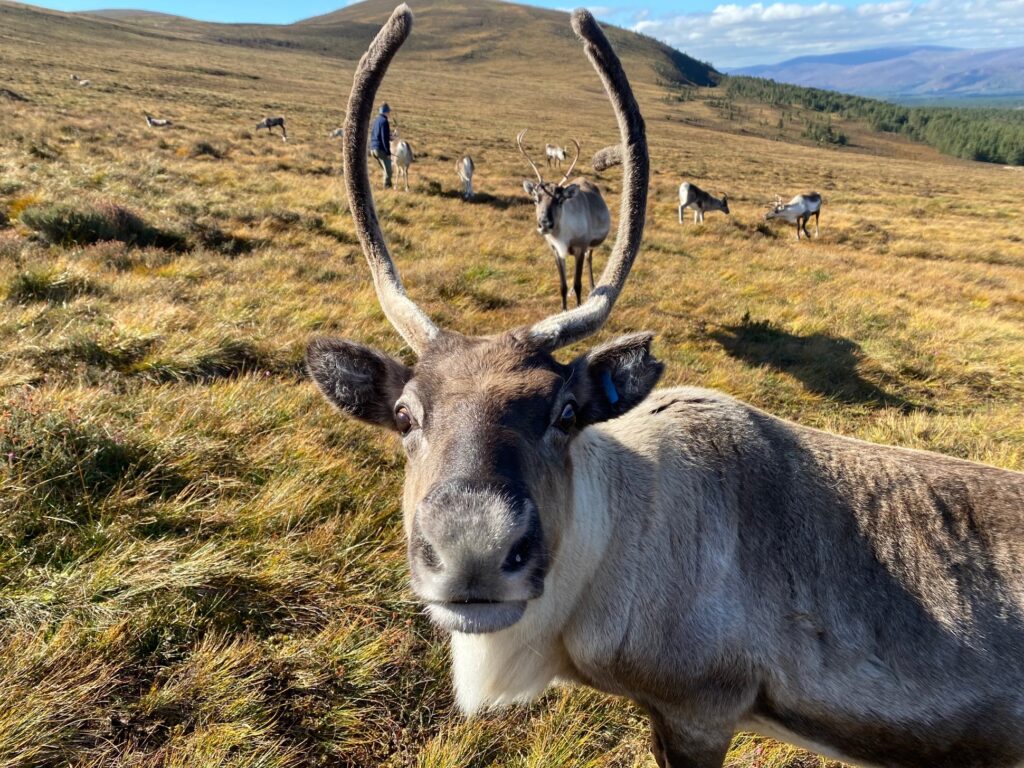
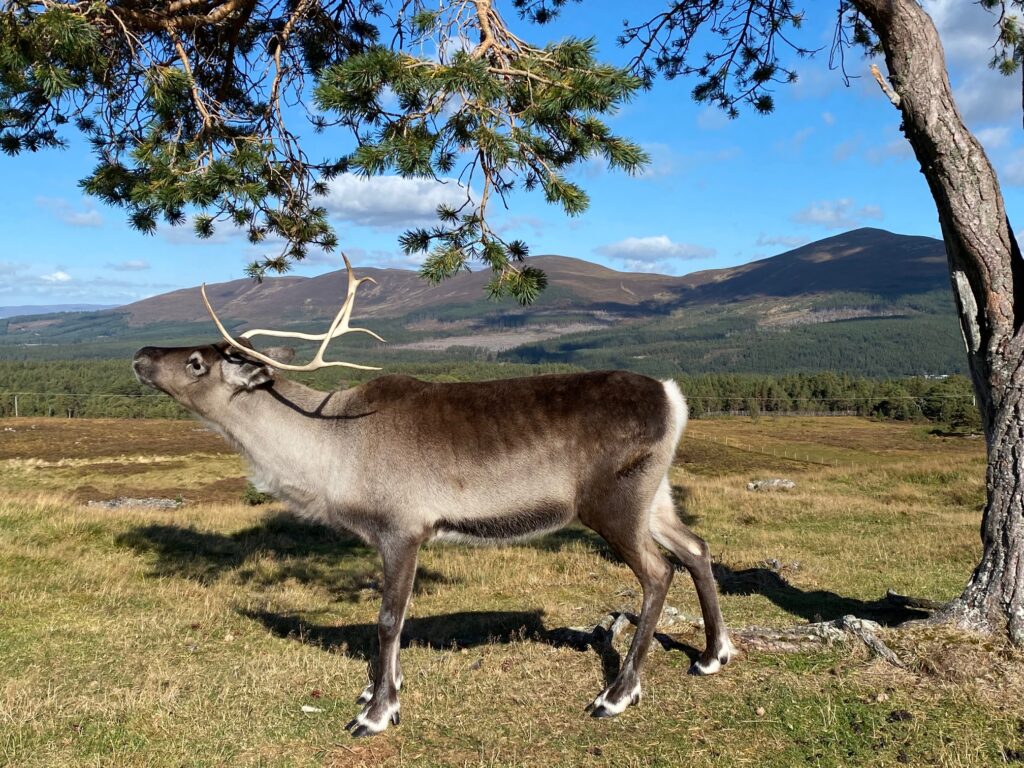
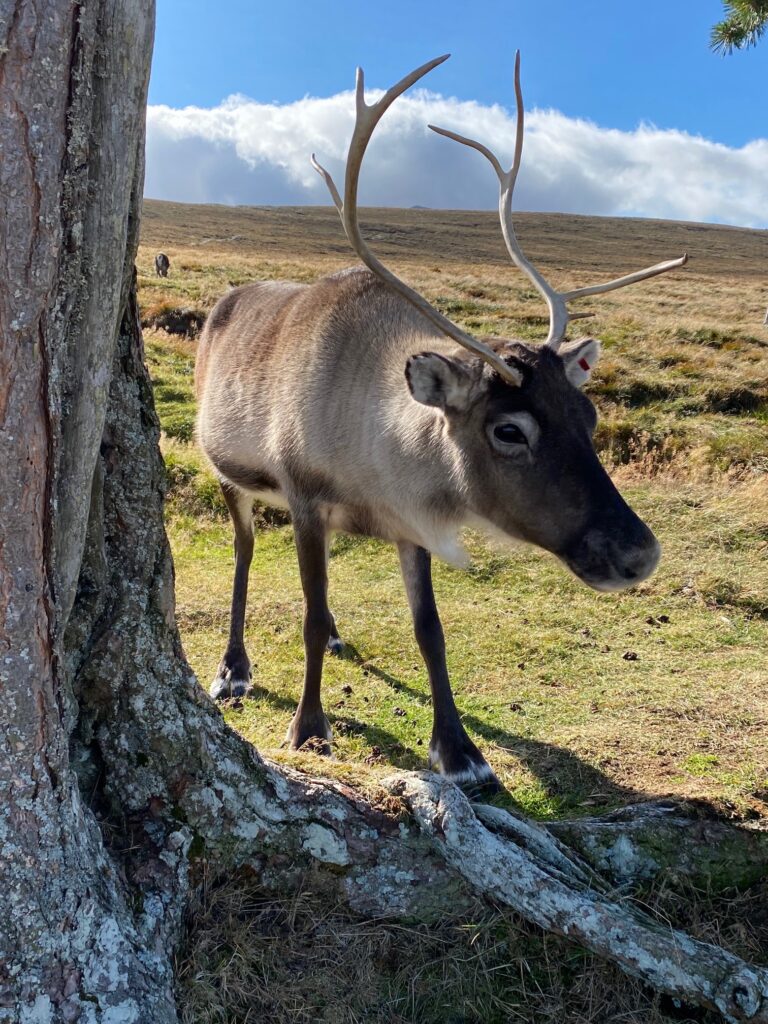
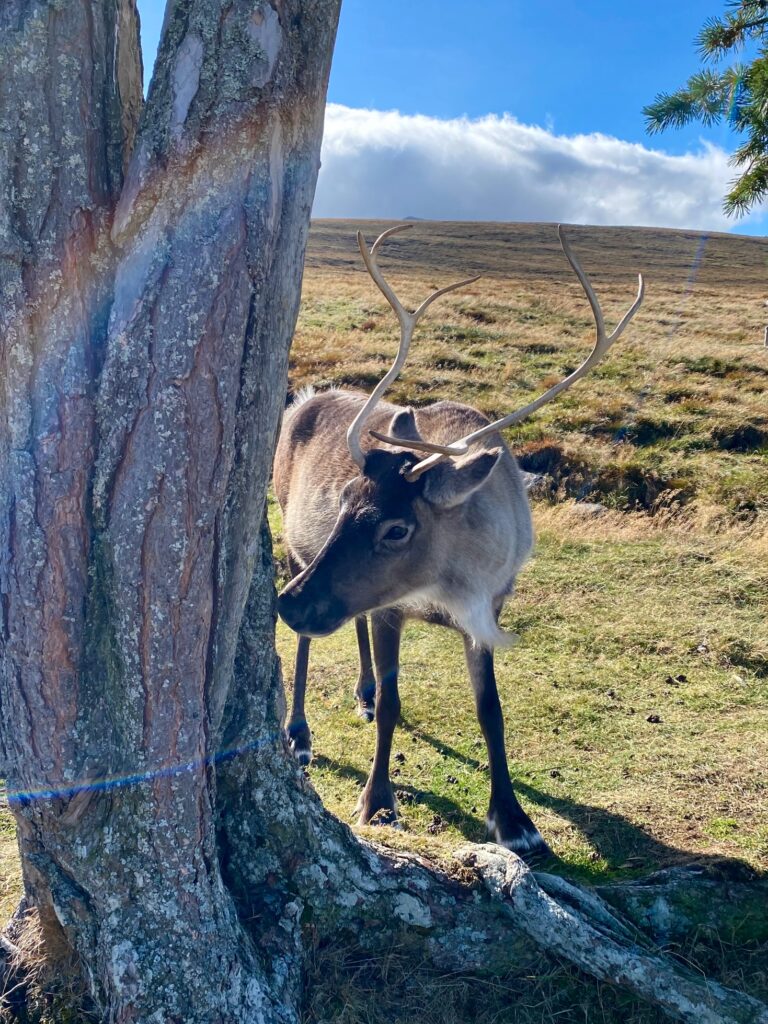
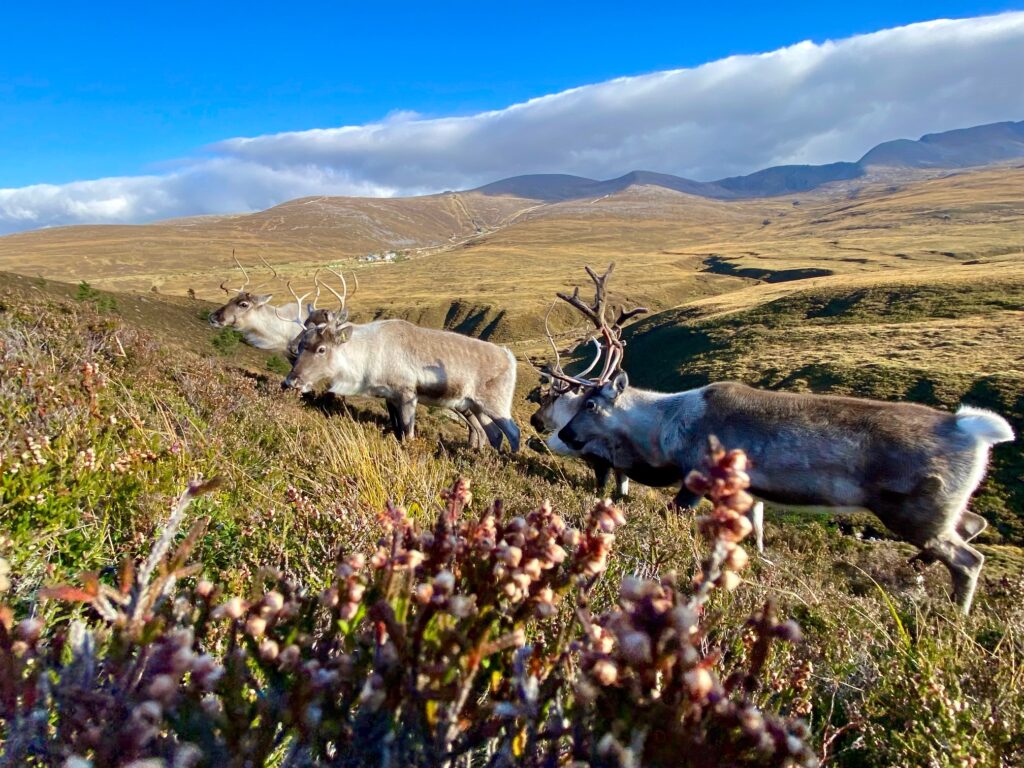
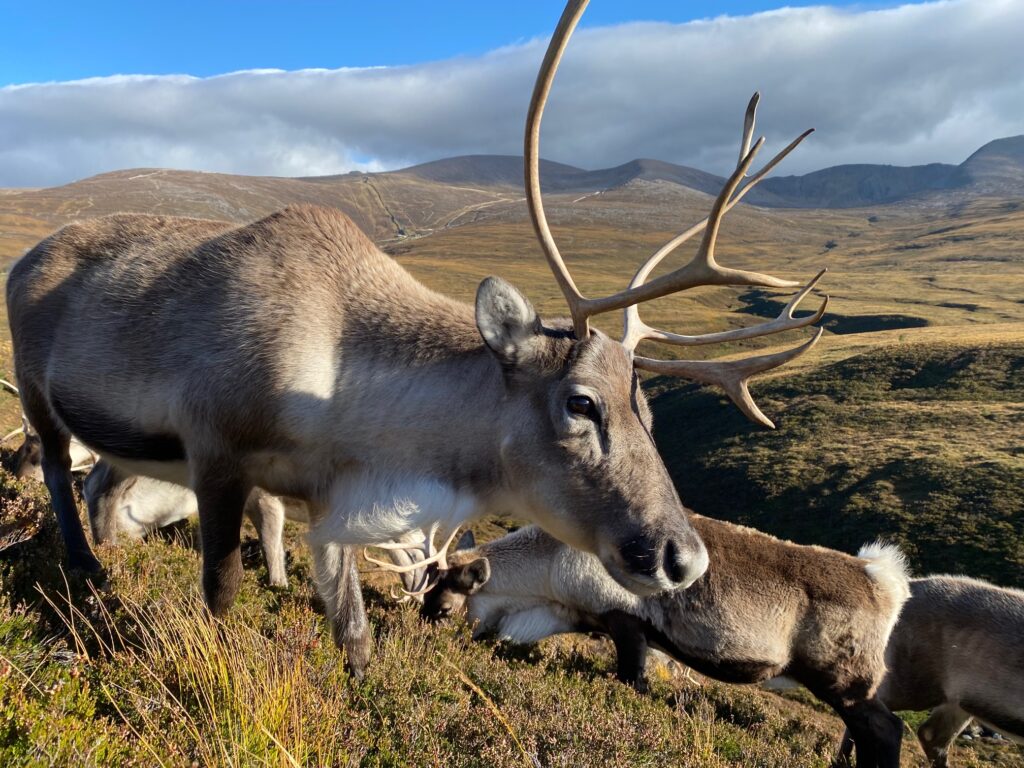
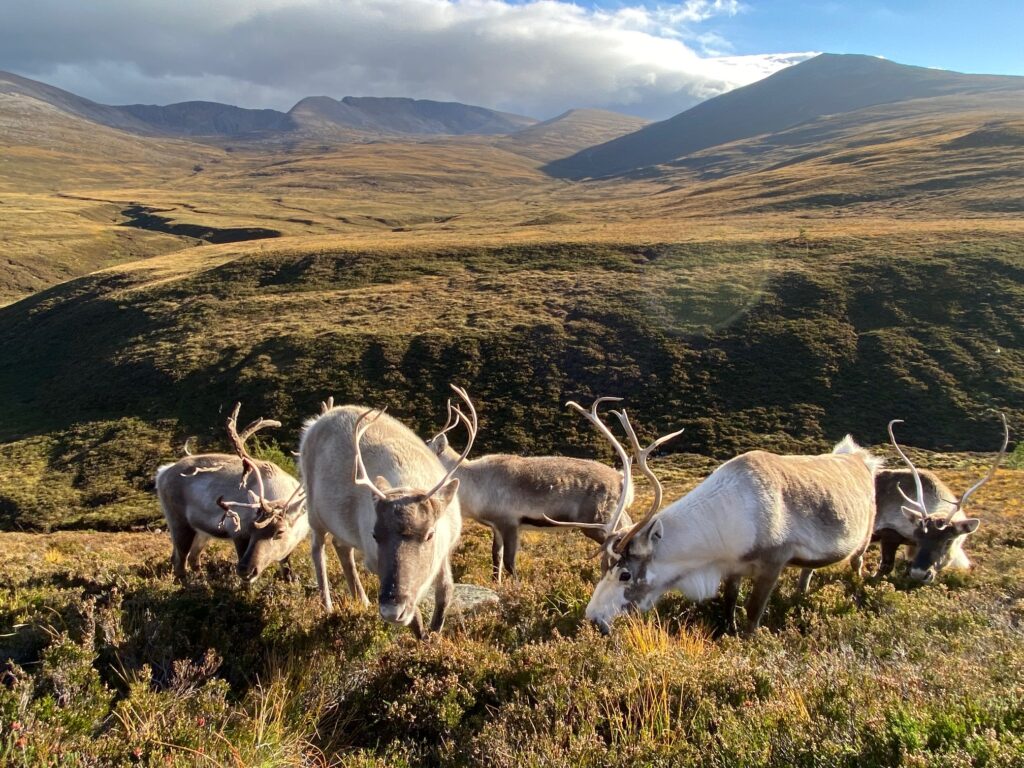
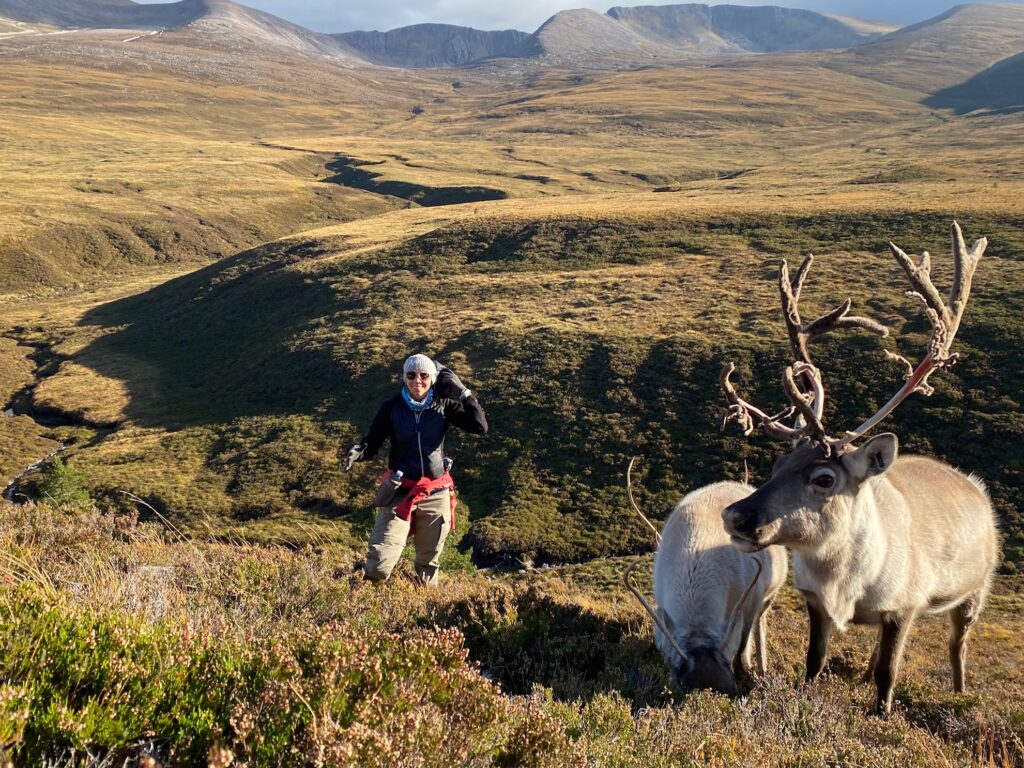
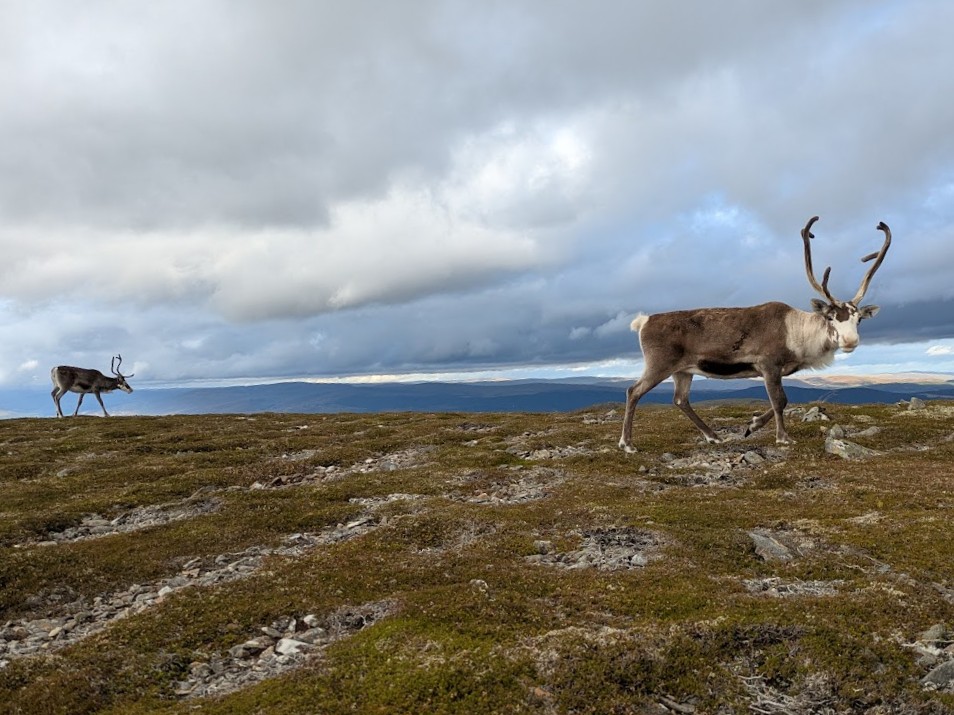
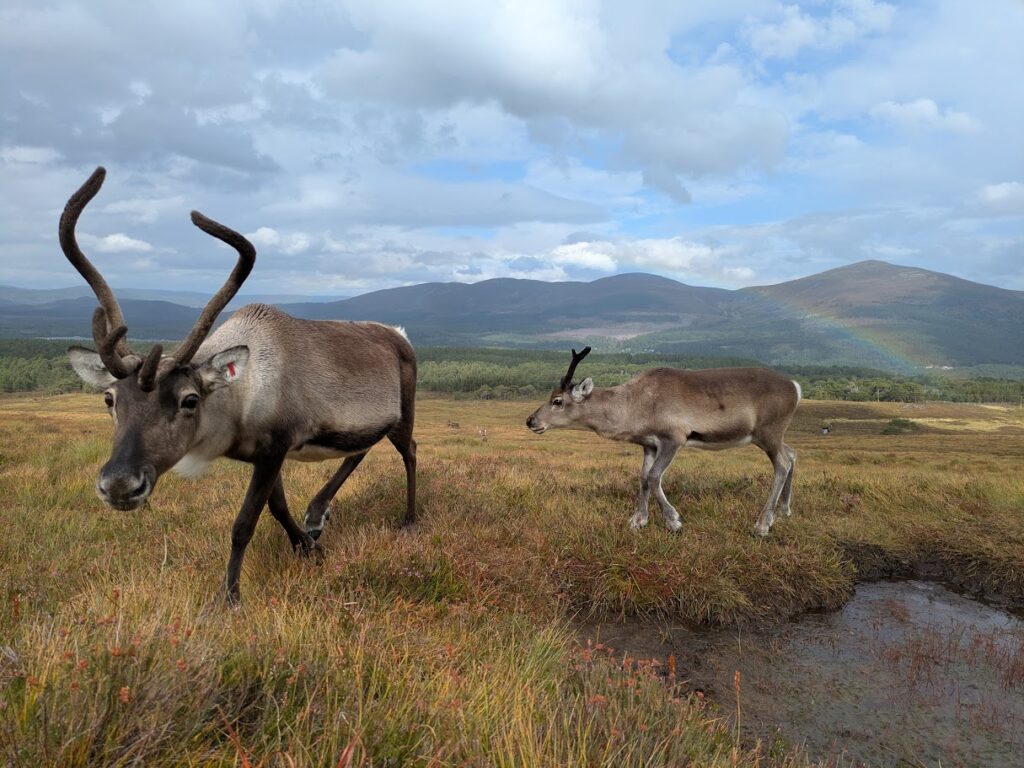
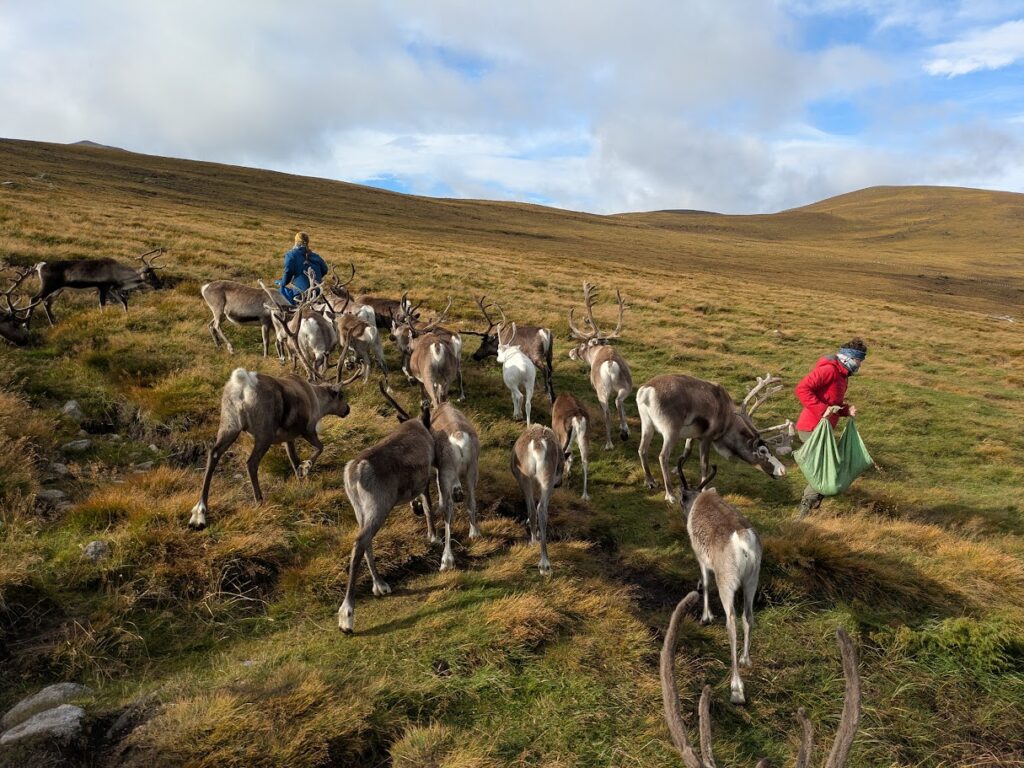
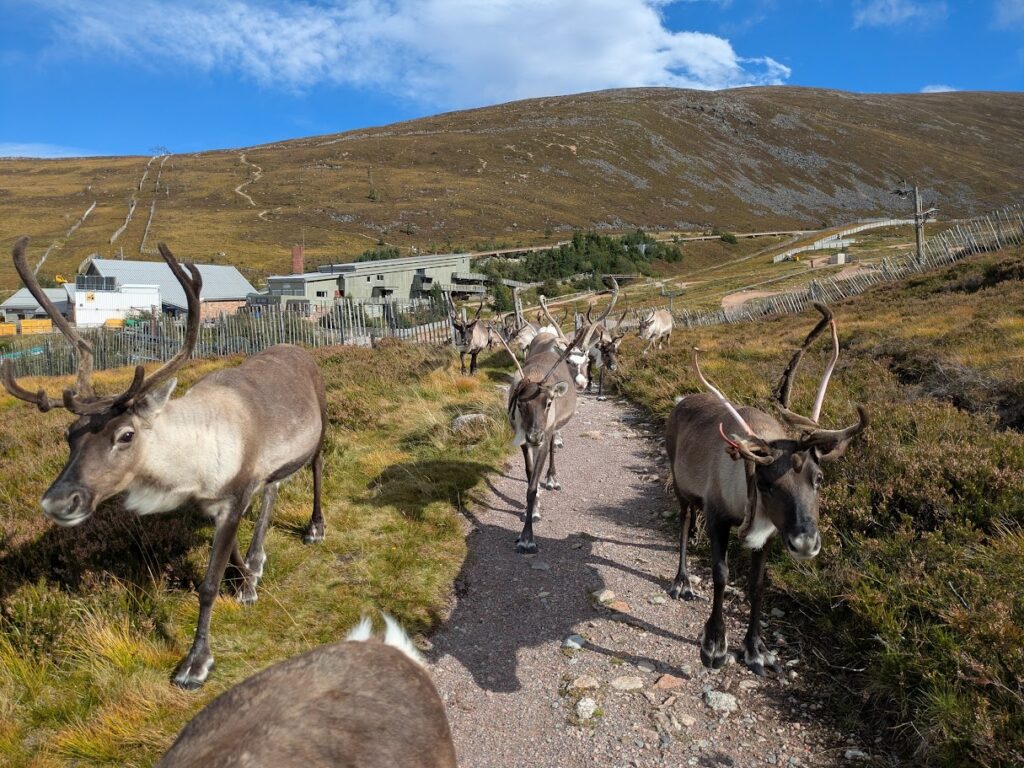
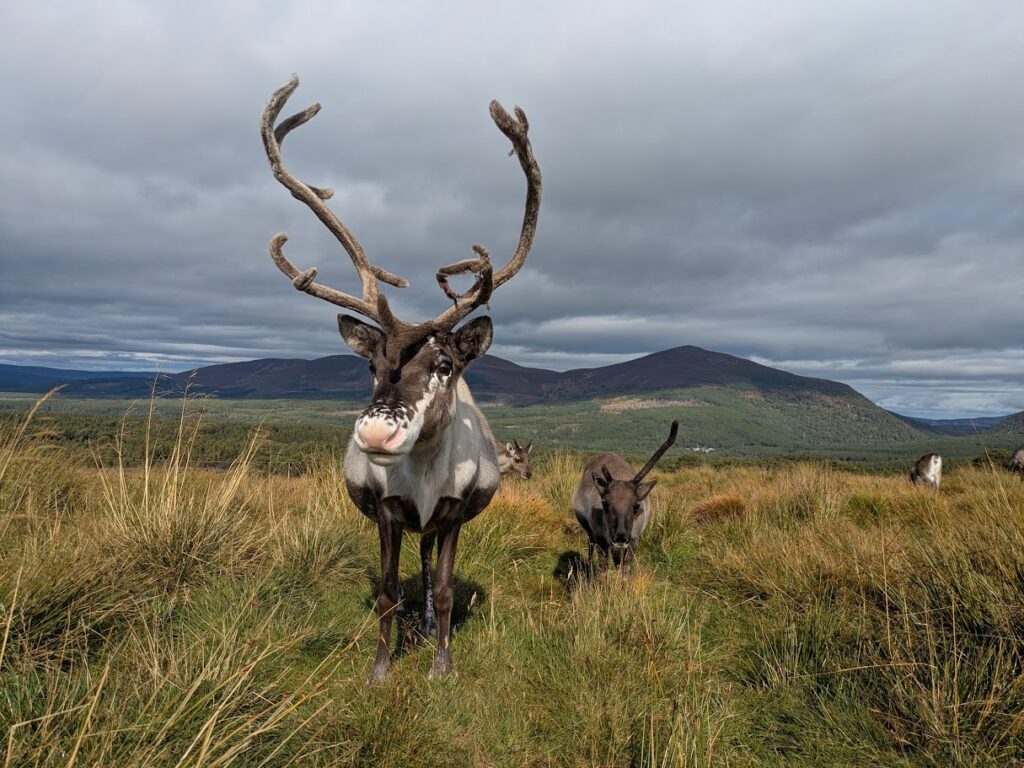
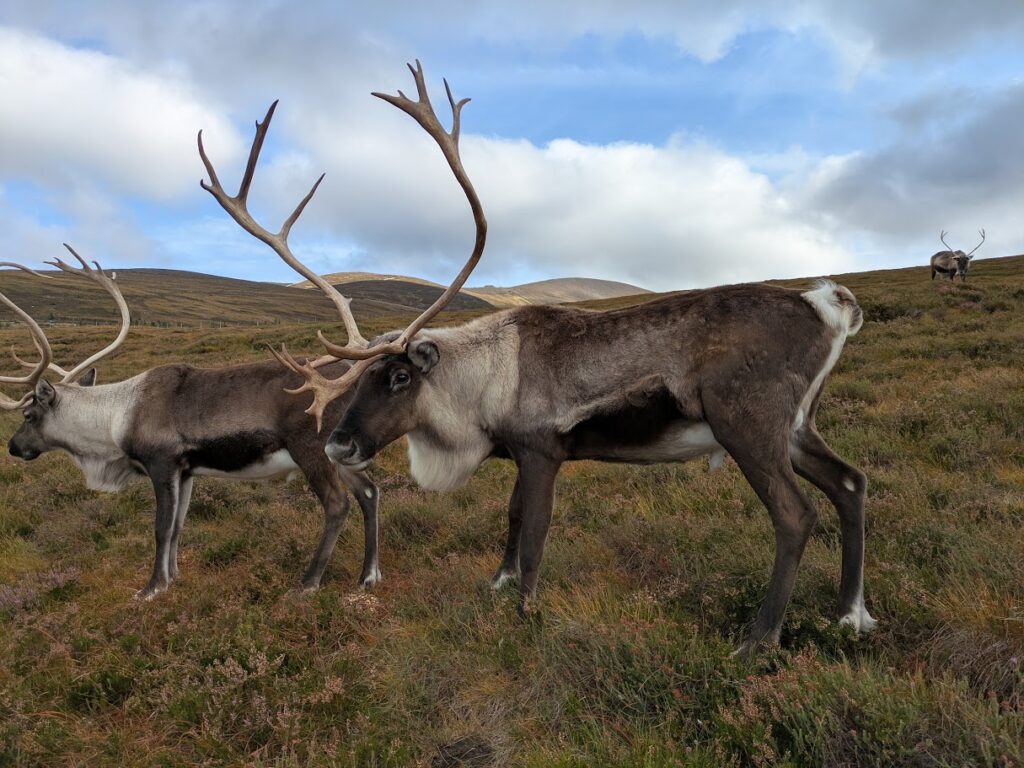
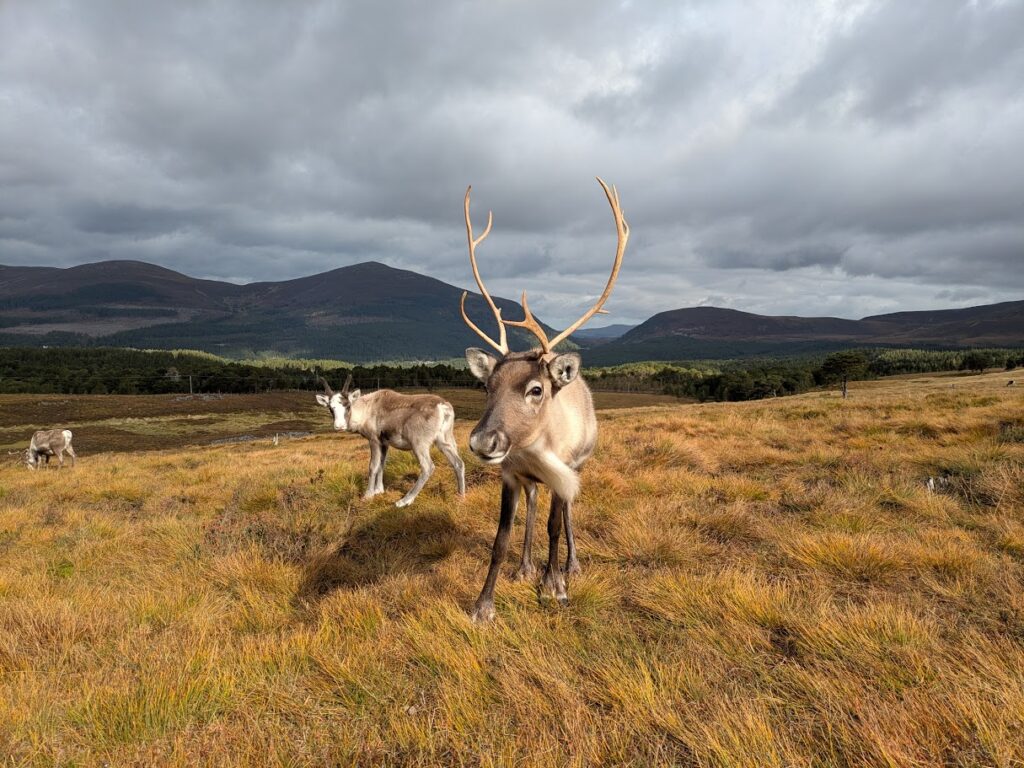
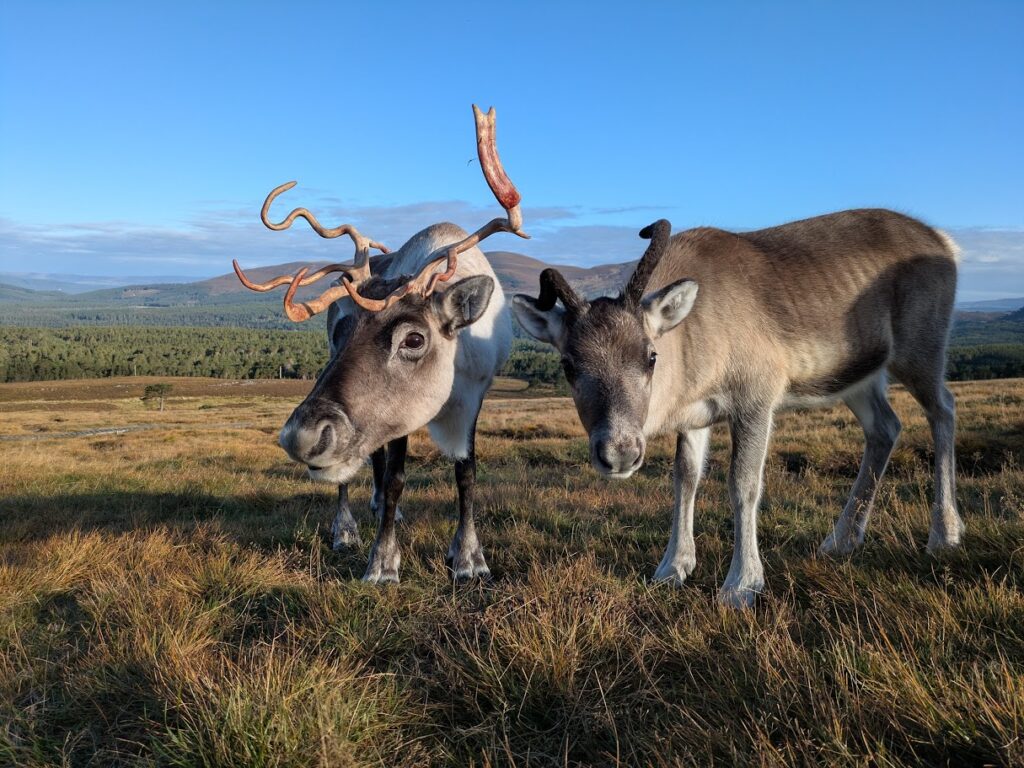
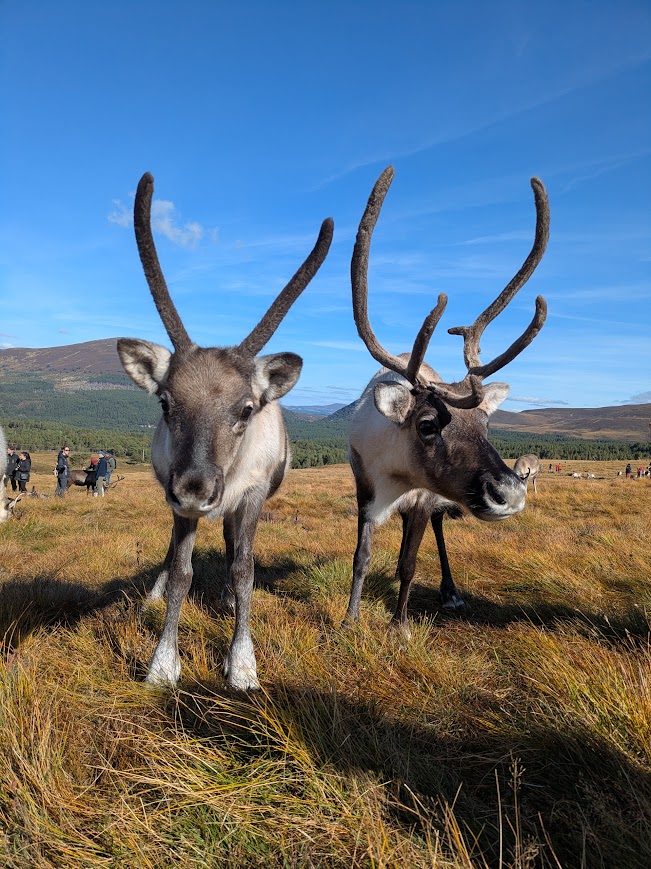
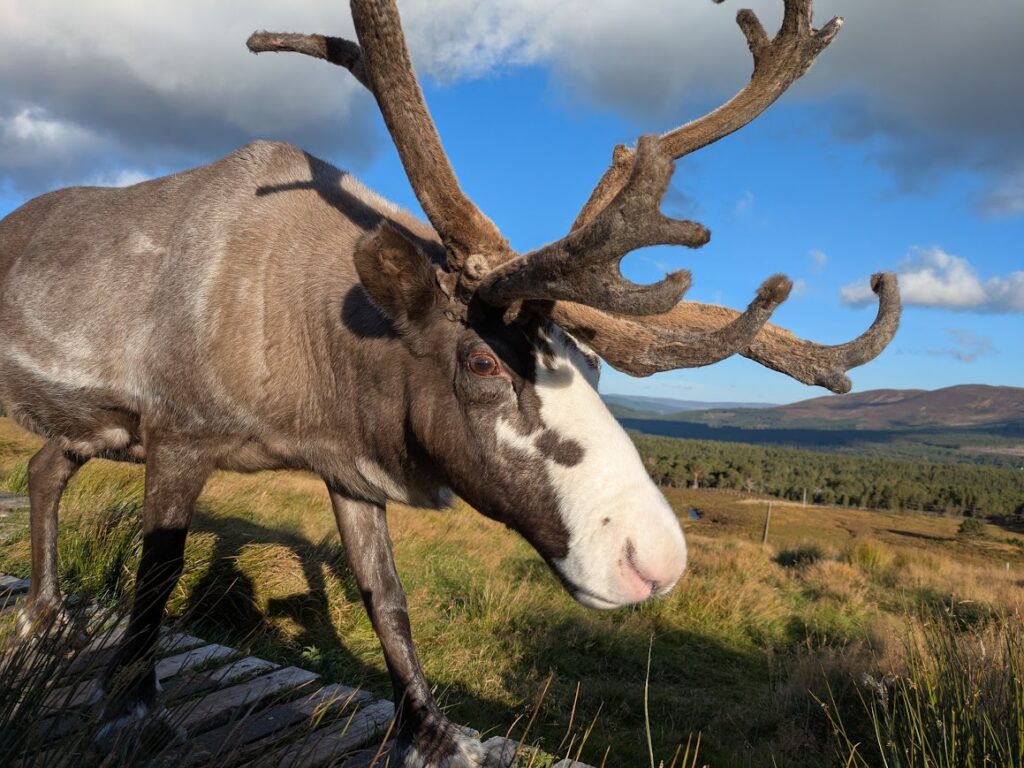
As we all know, reindeer are truly beautiful animals. Herds running through deep snow, keeping pace with one another, crossing burns in such a fast paced grace. The sounds of their clicking heels and the moving snow all you can hear. Seeing them at sundown with their antlered silhouttes standing atop a hill, overlooking a wonderful rolling valley… What a picture to paint.
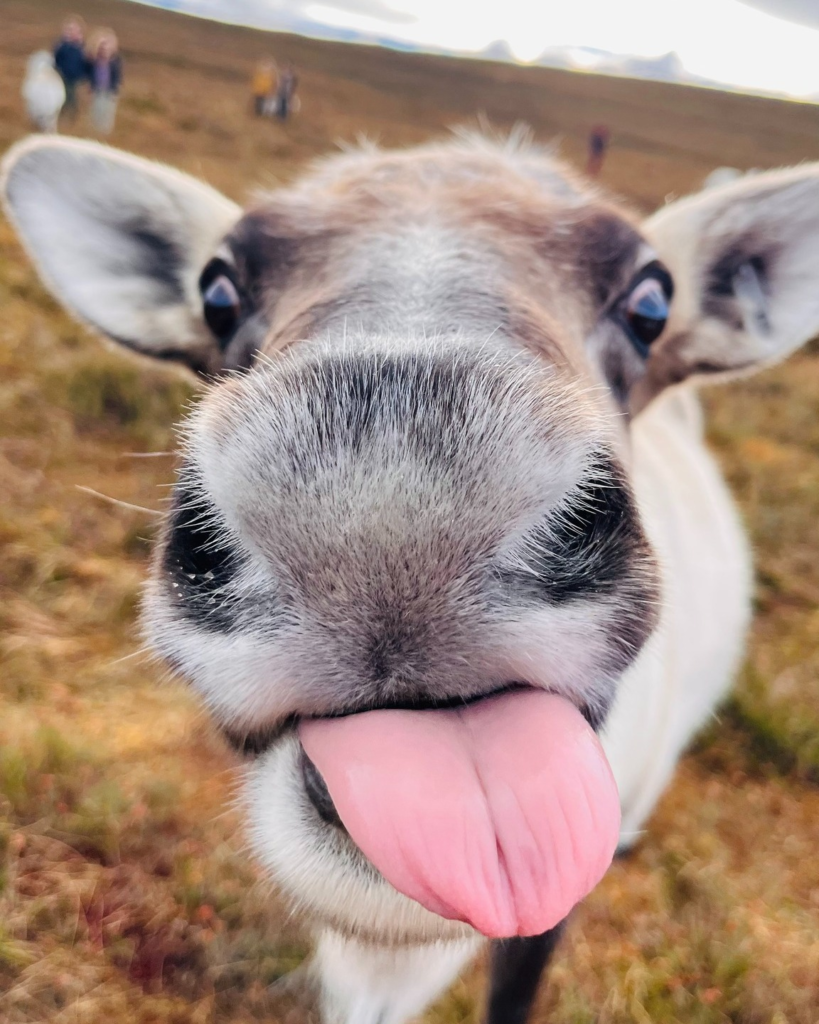
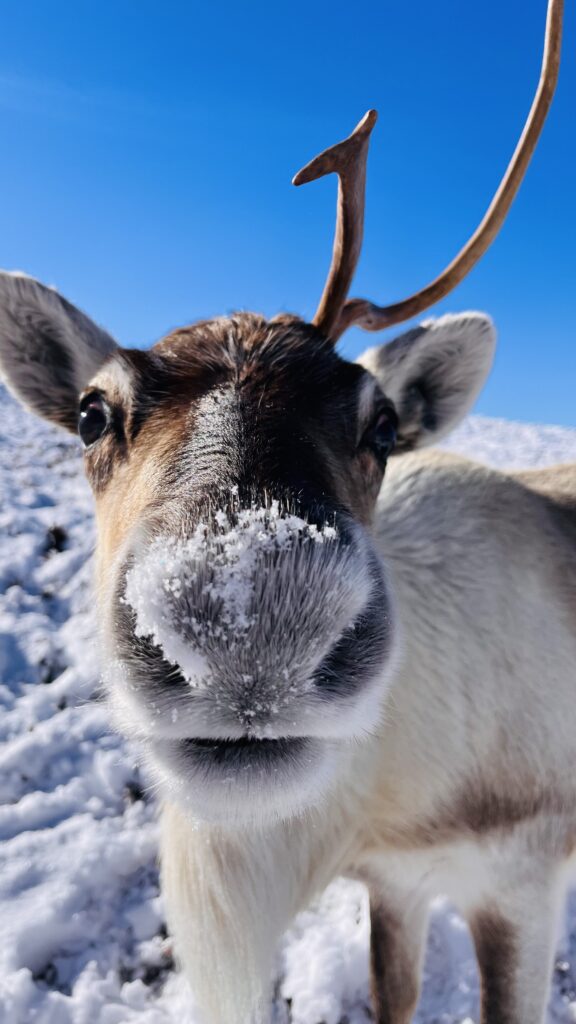
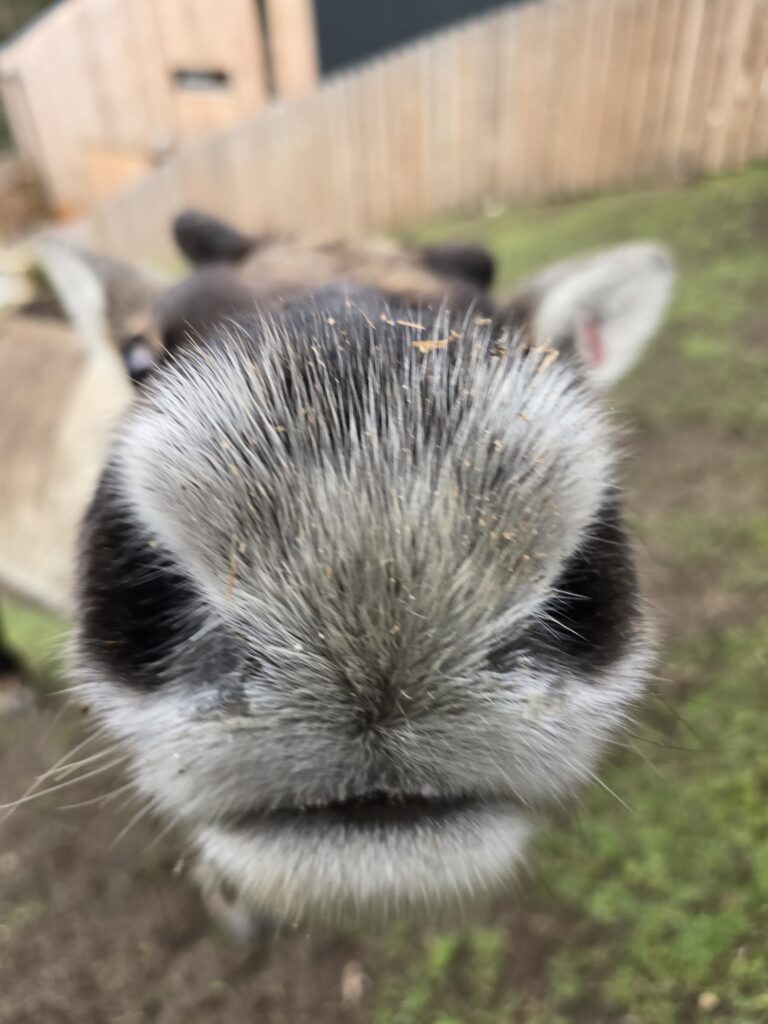
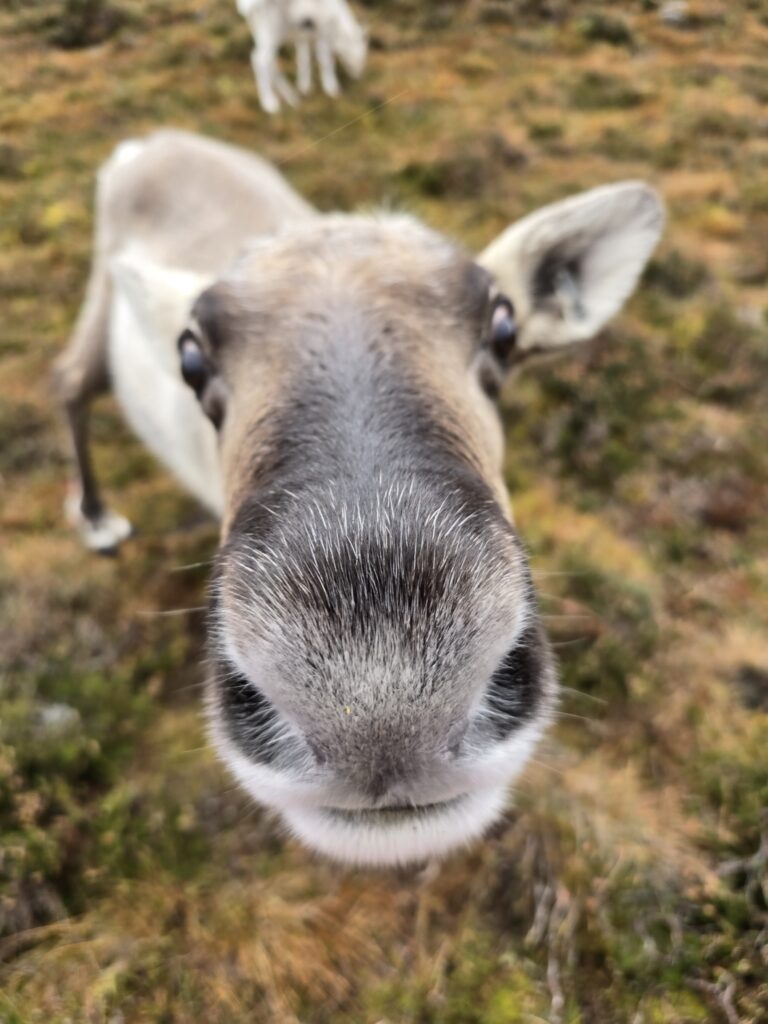
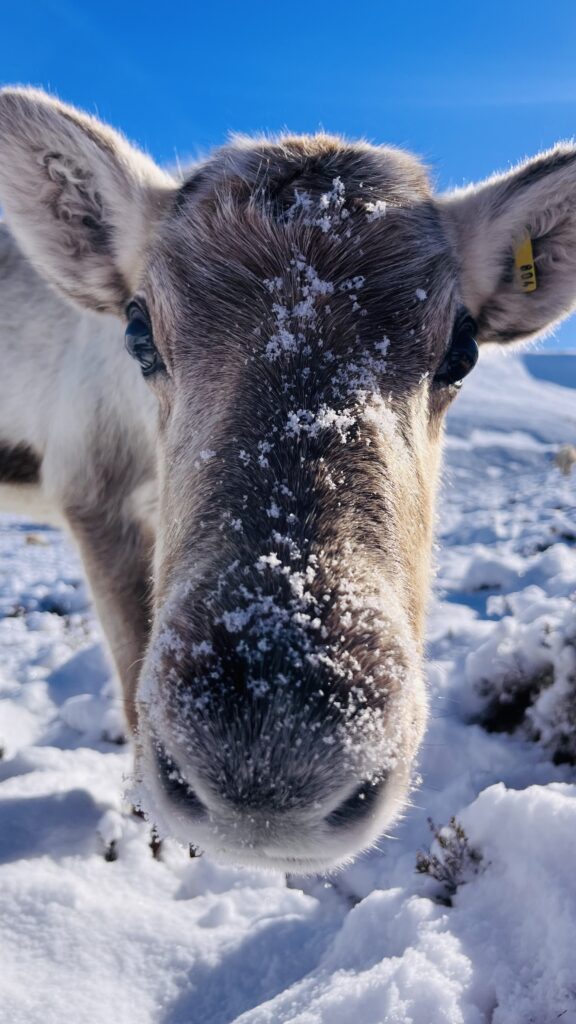
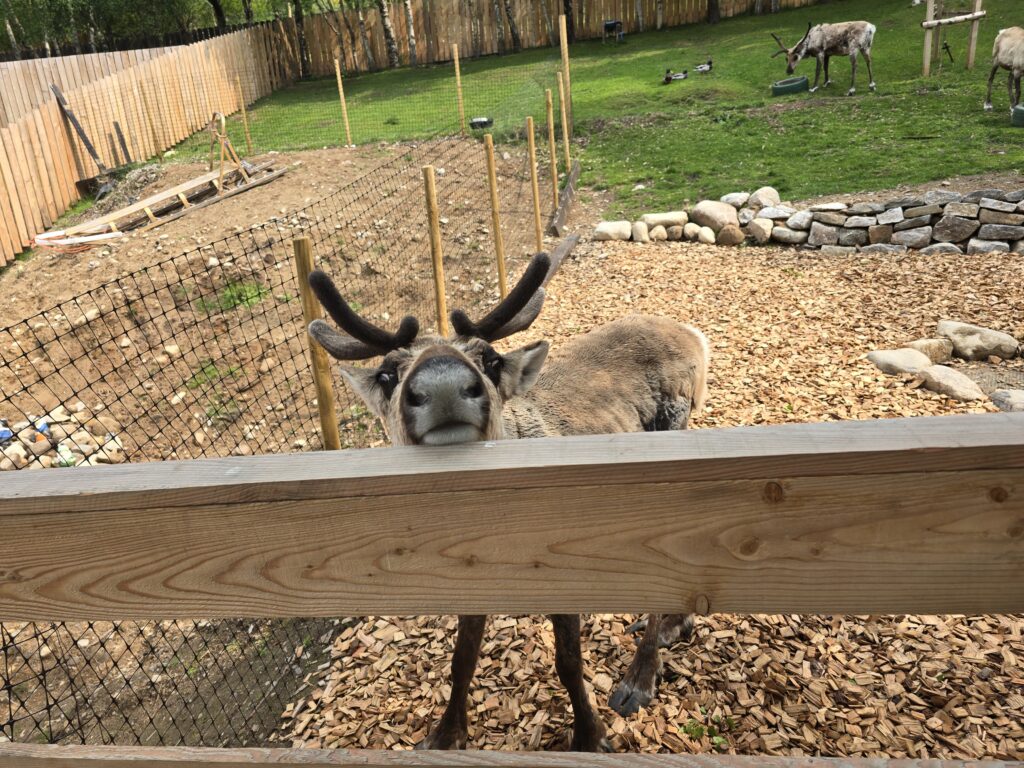
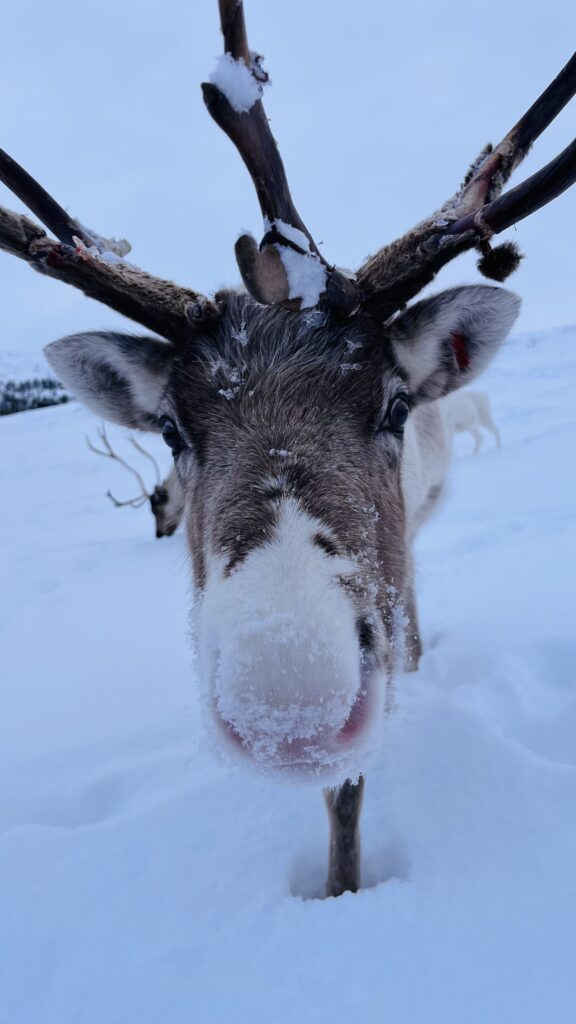
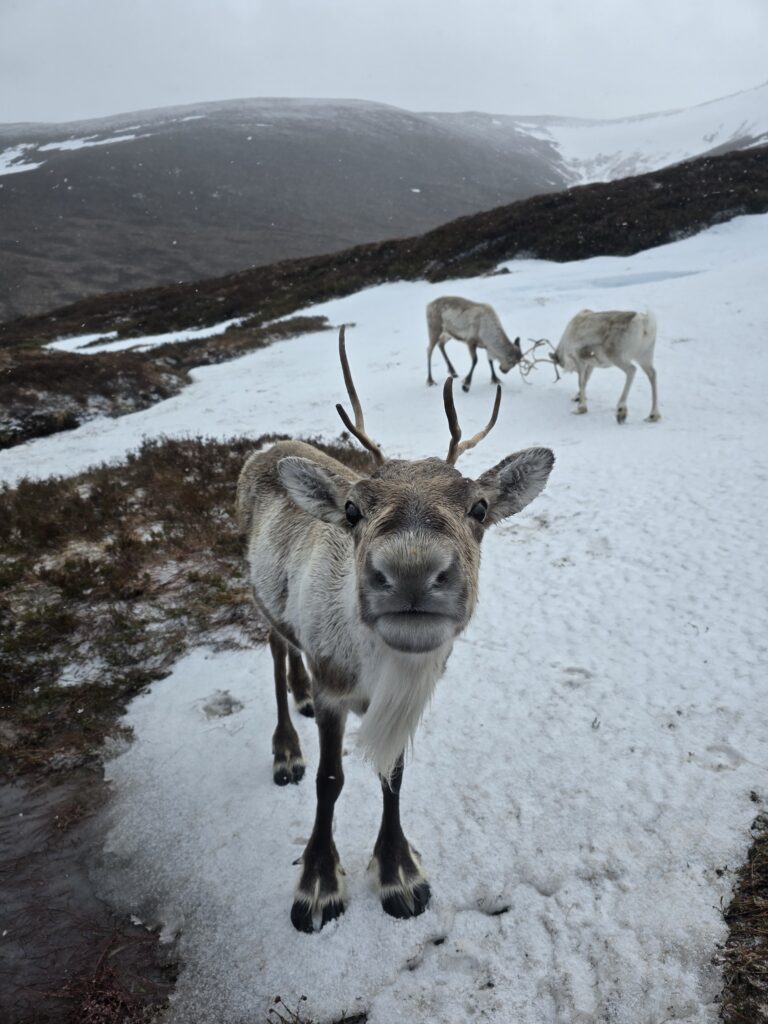
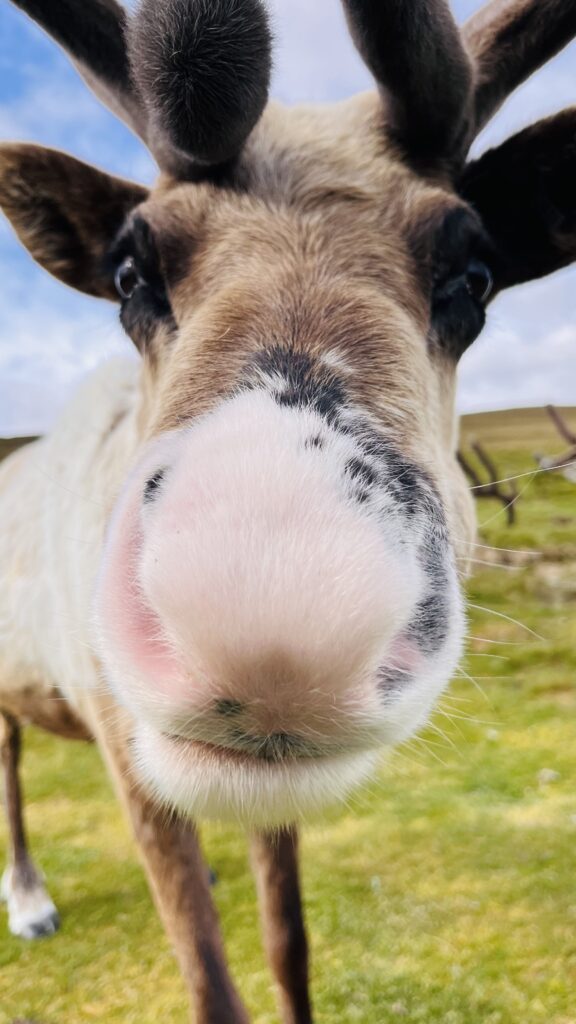
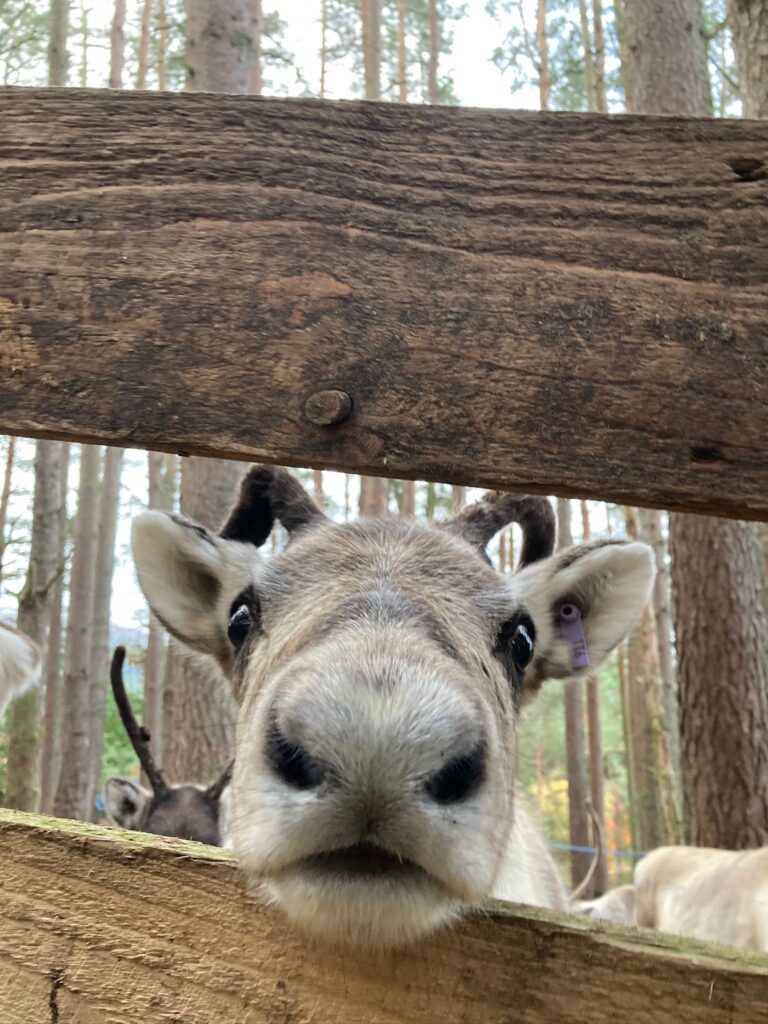
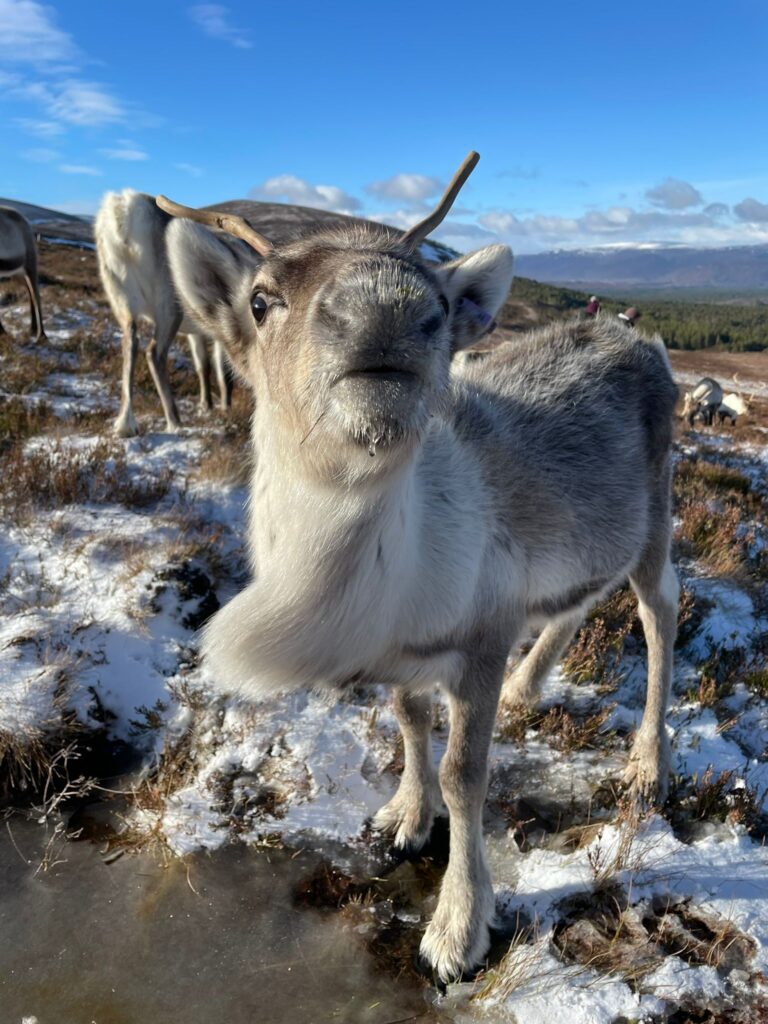
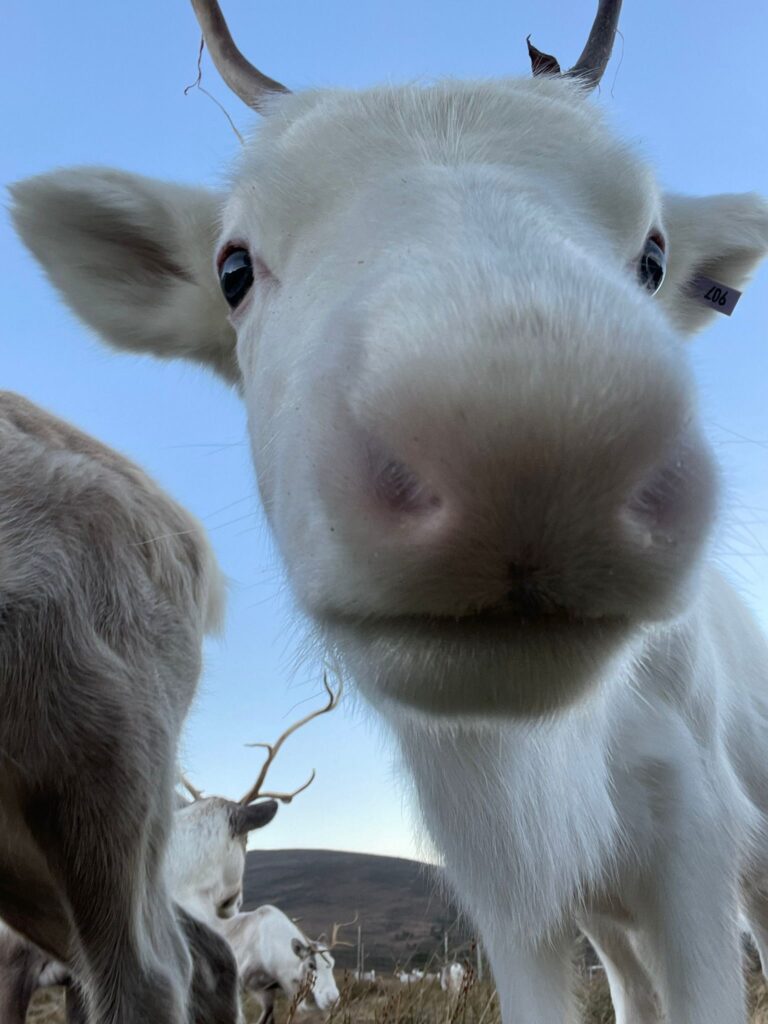
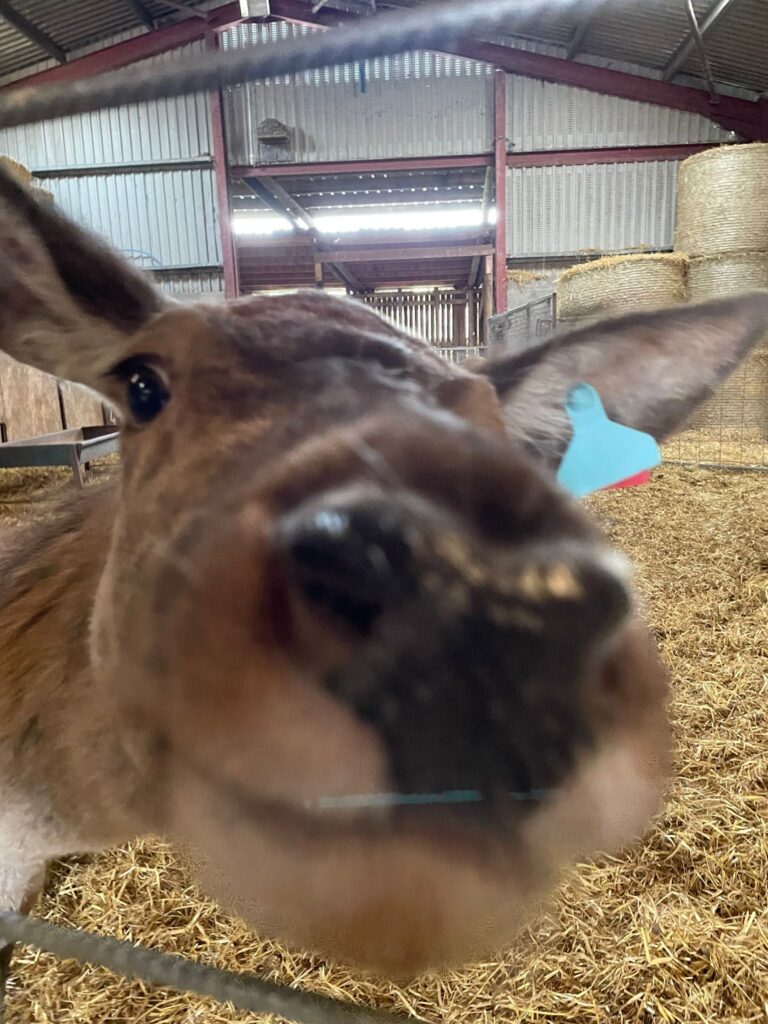
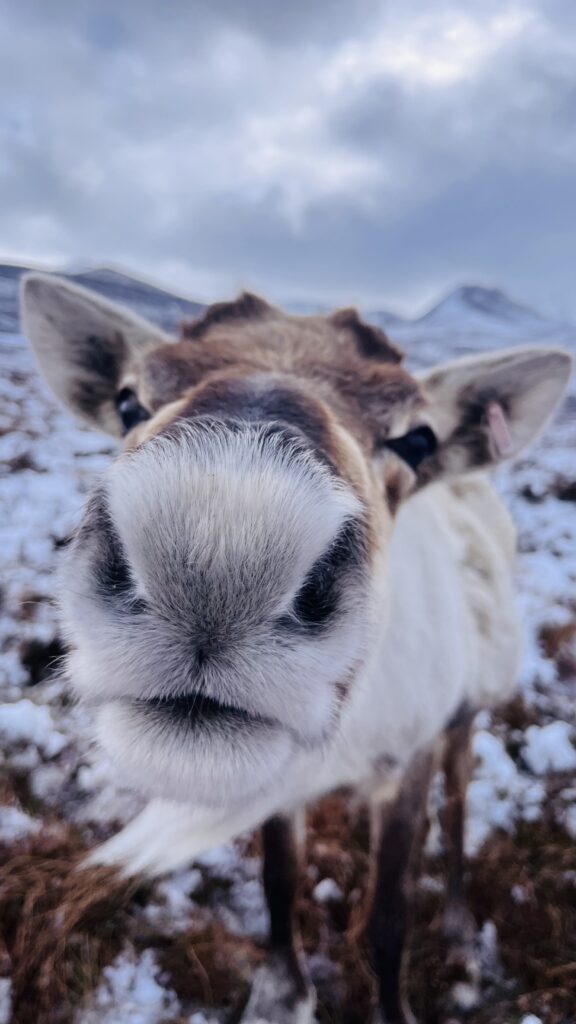
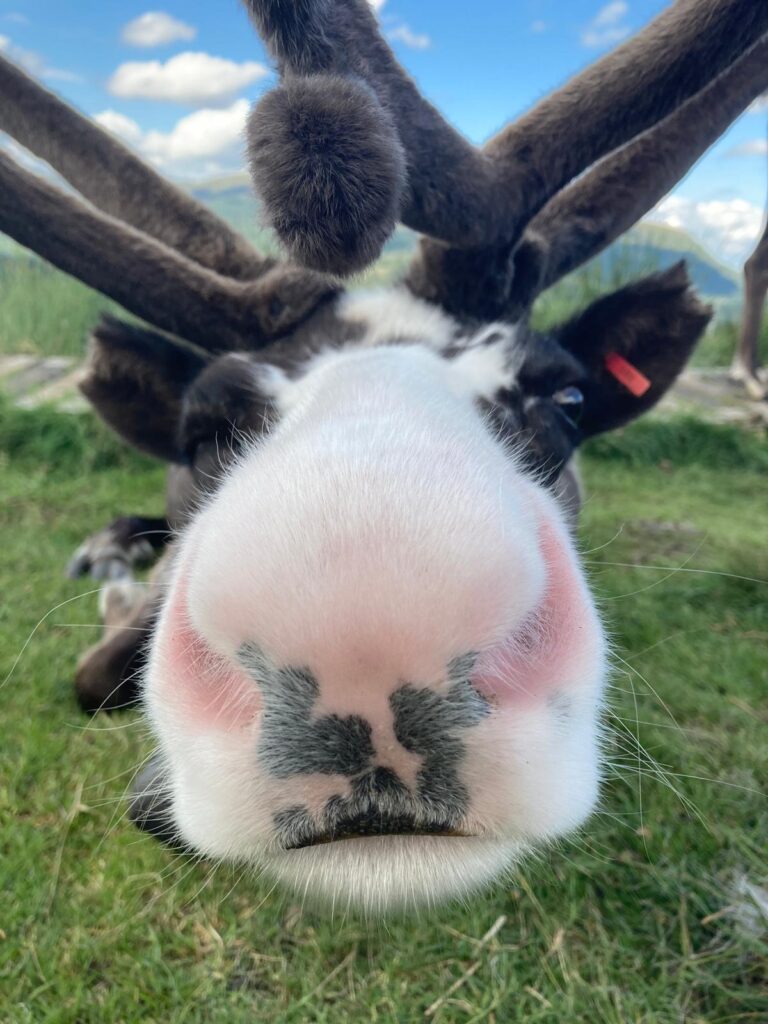
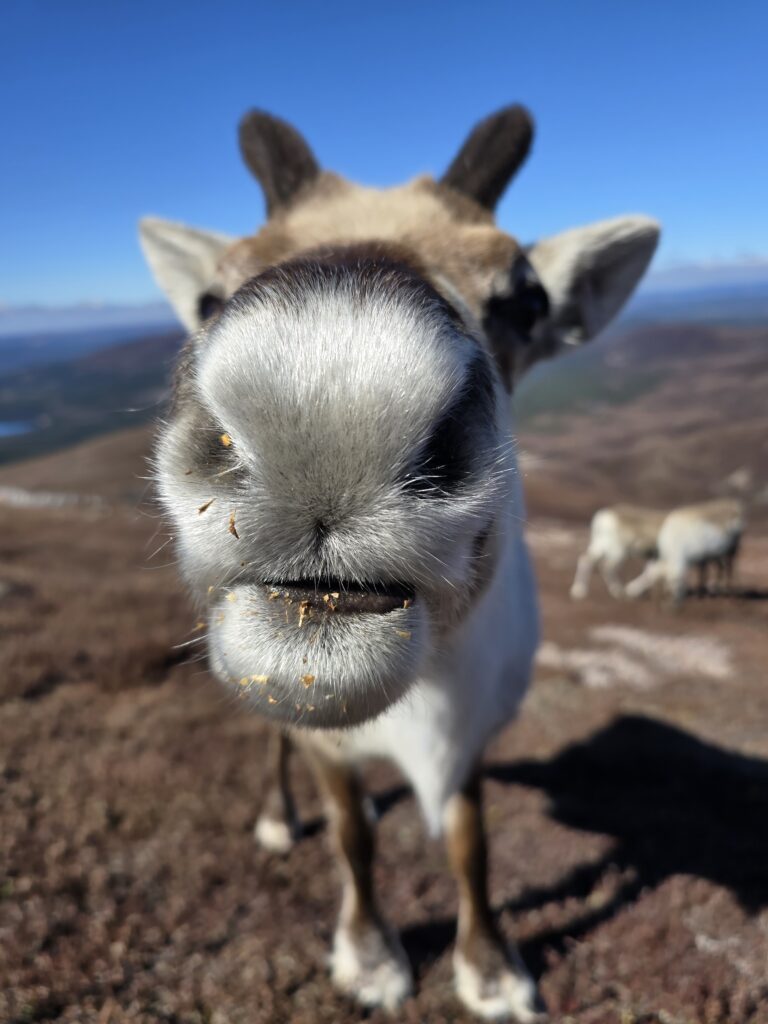
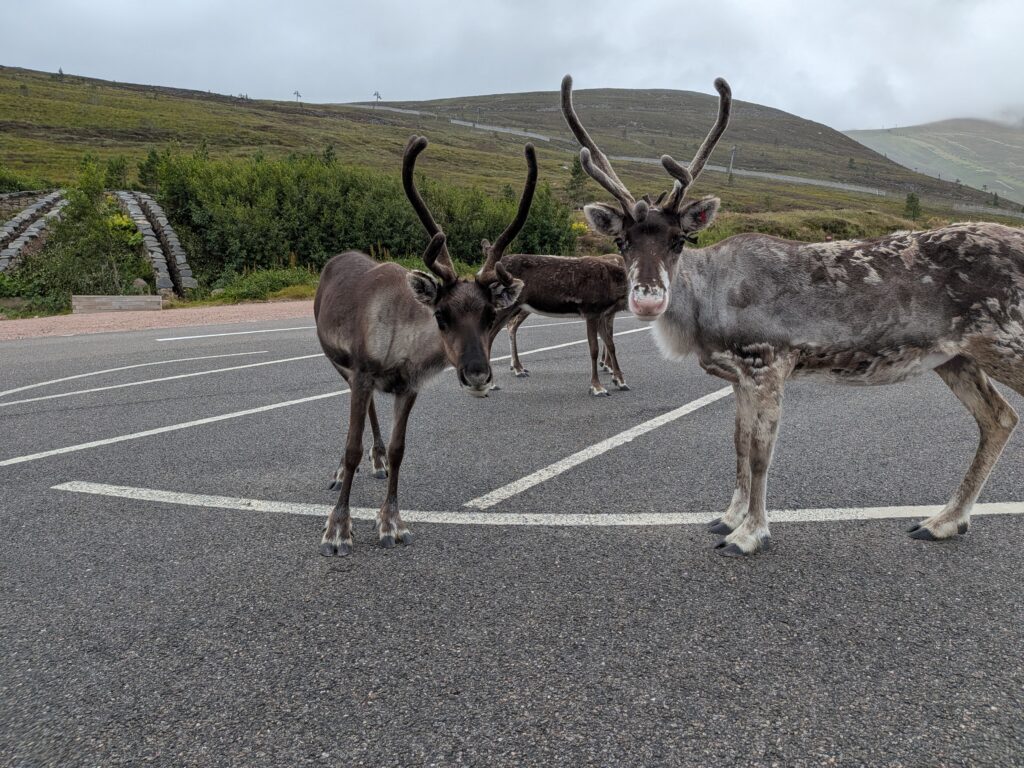
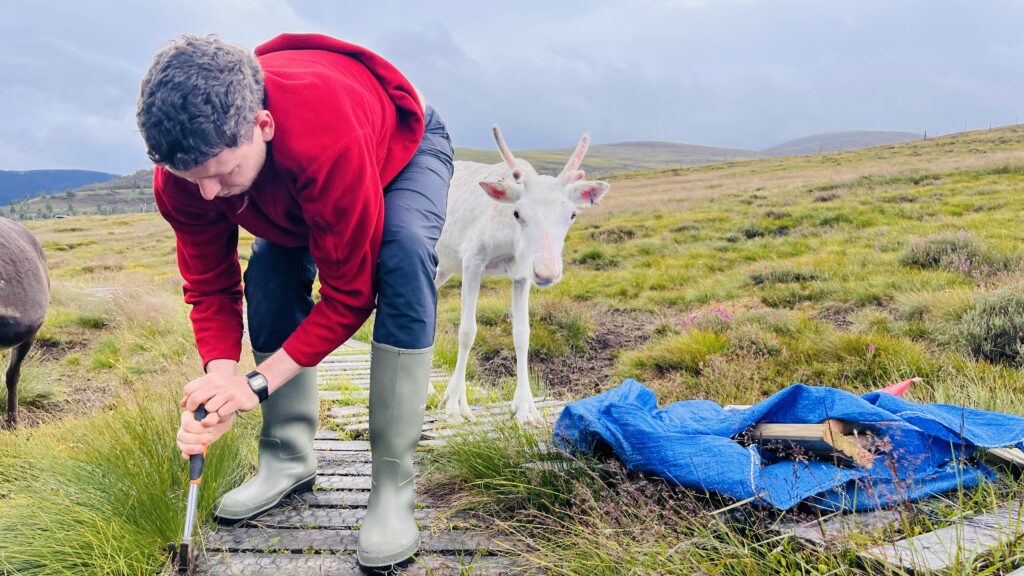
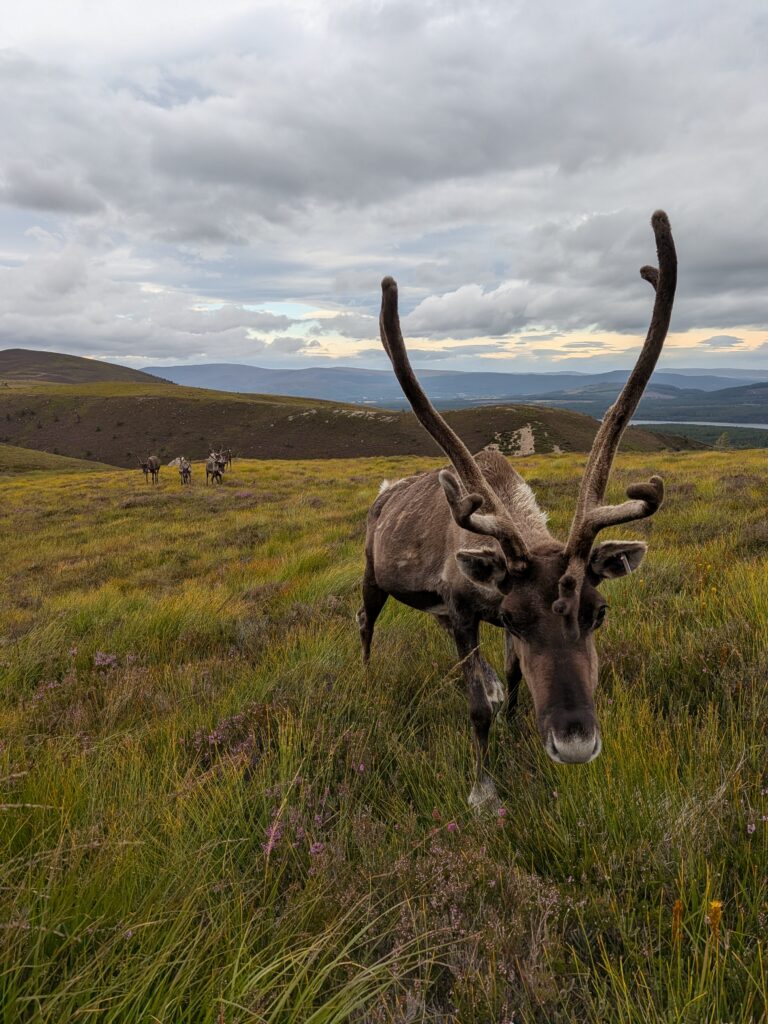
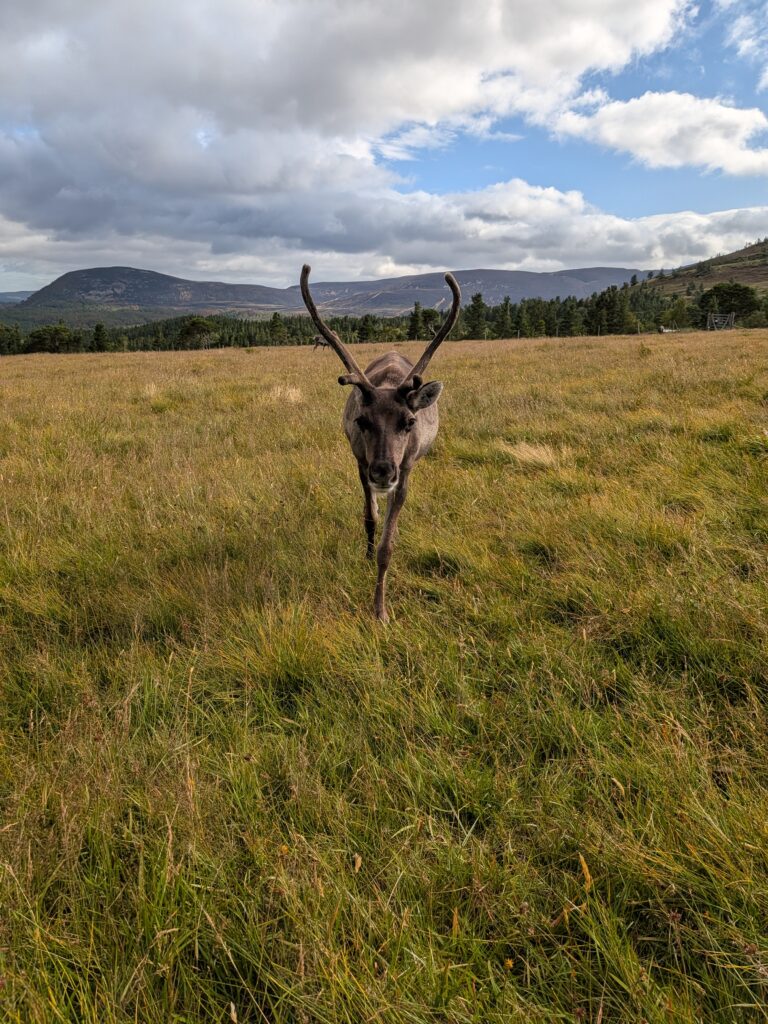
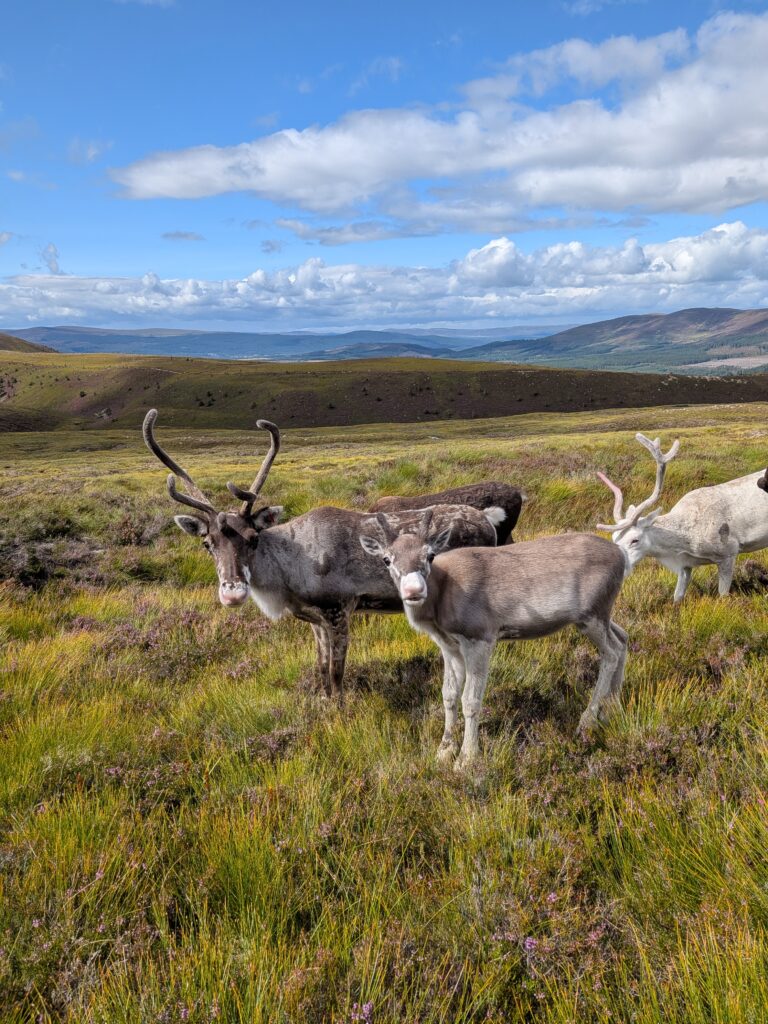
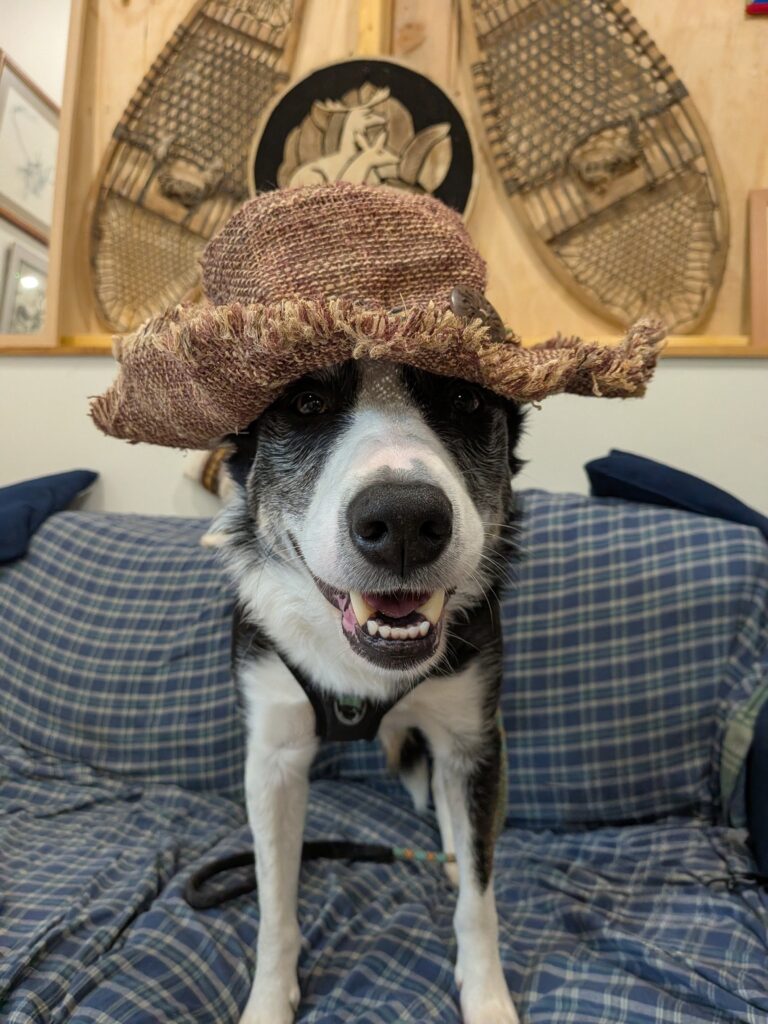
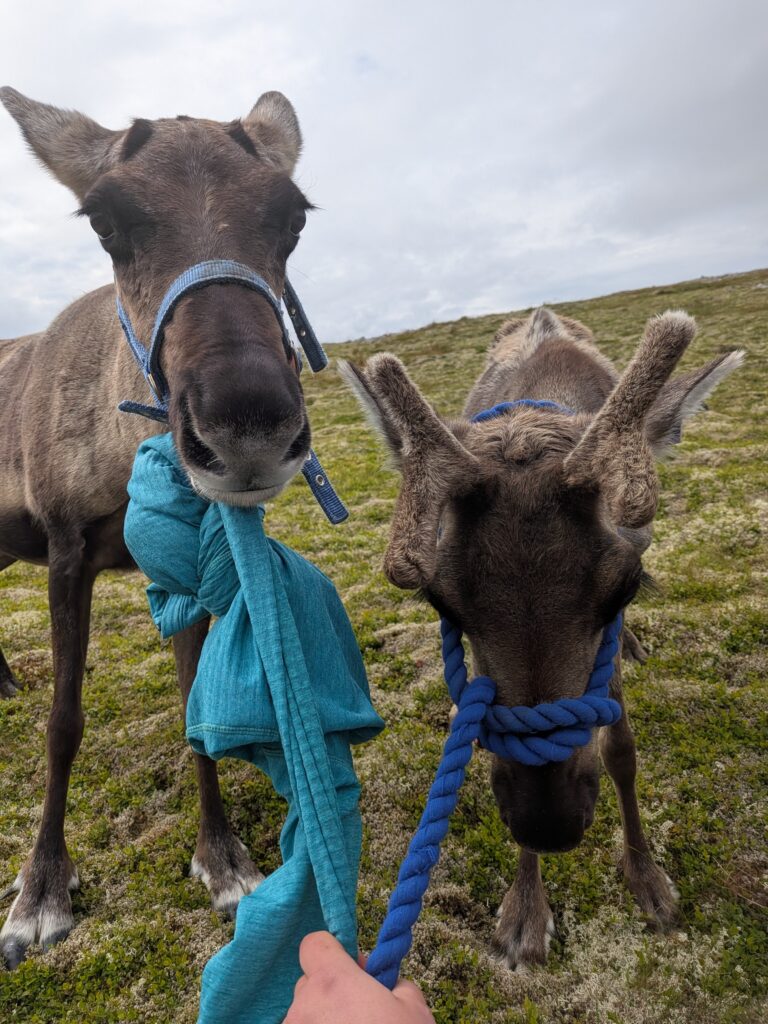
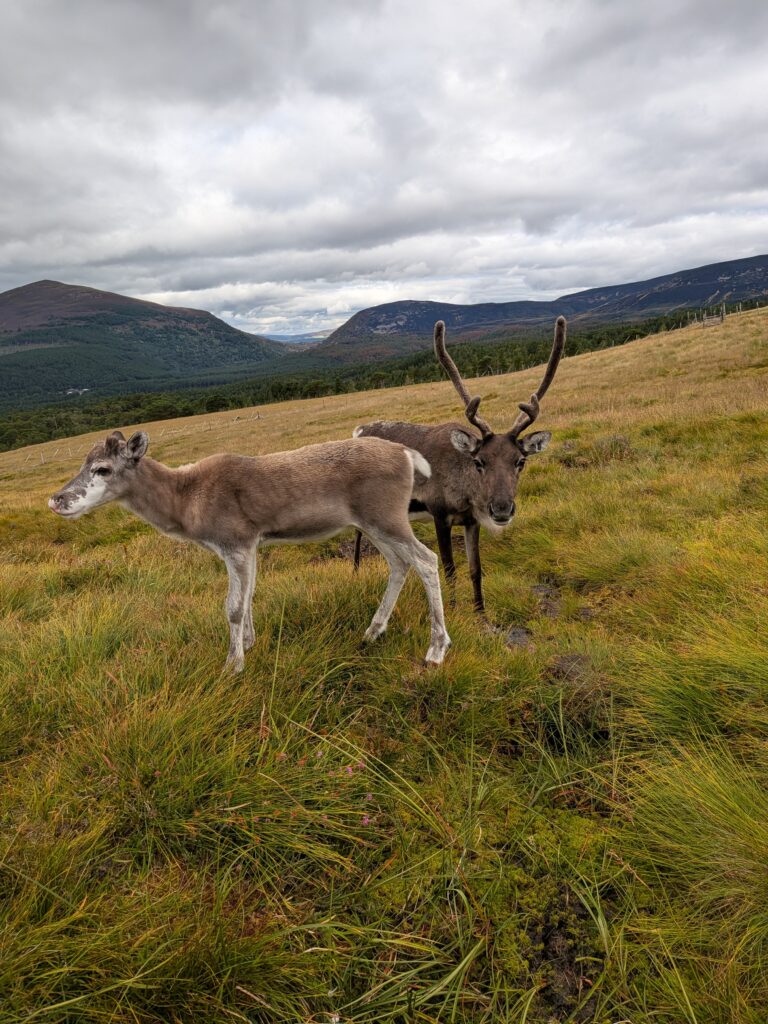
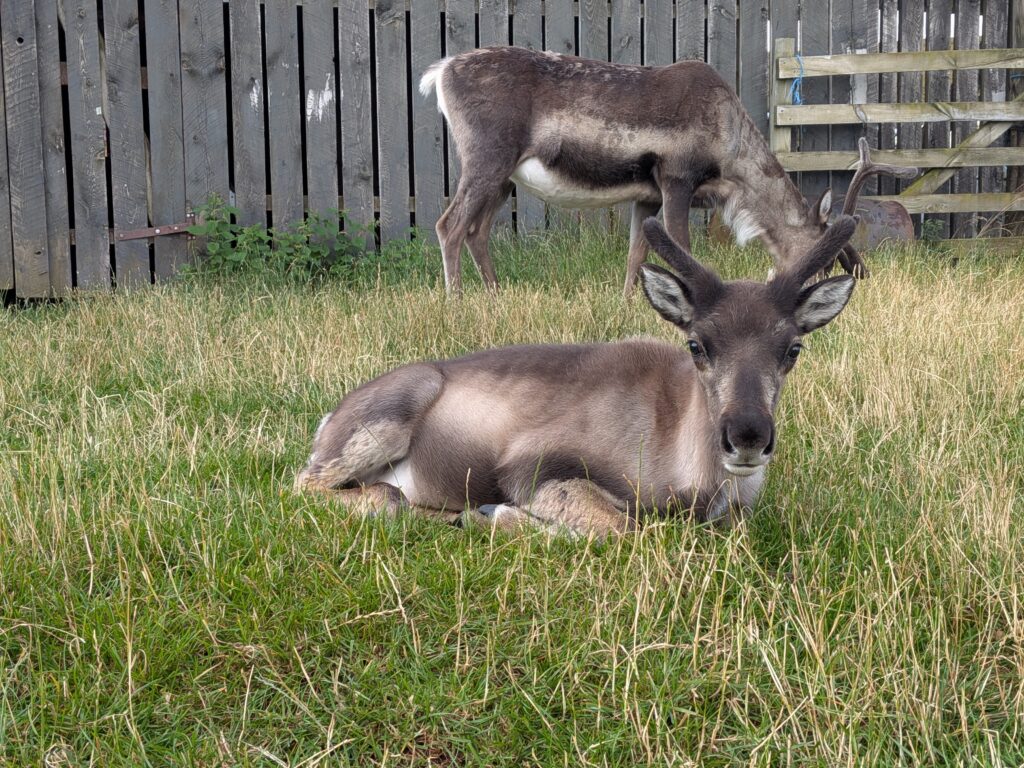
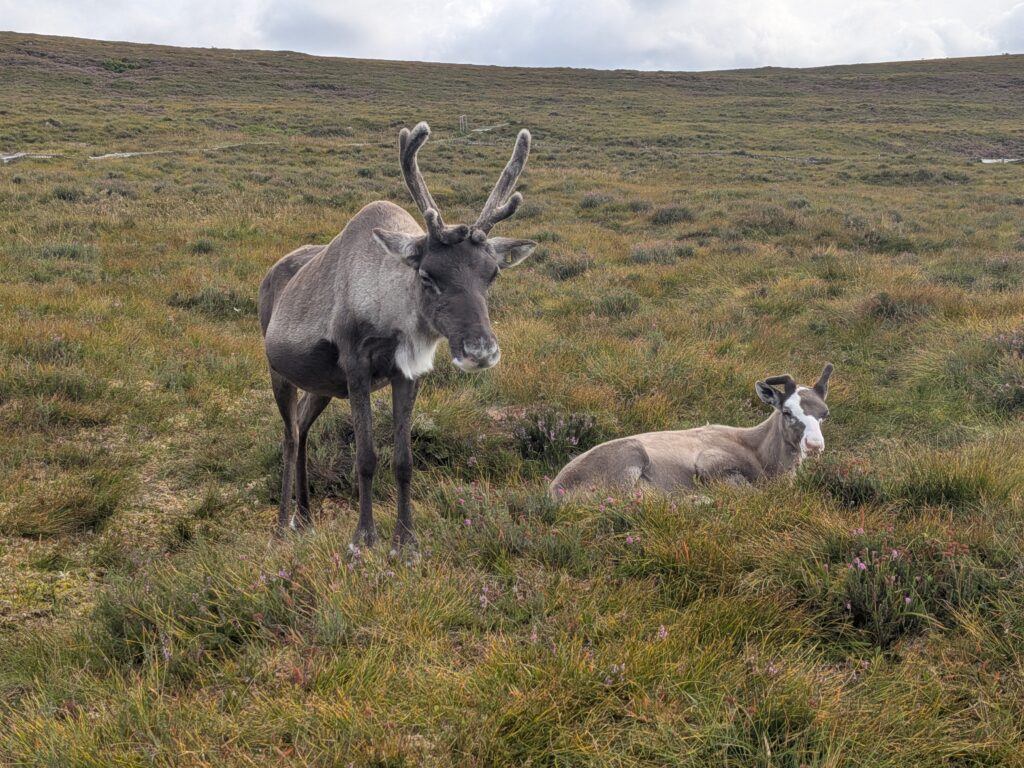
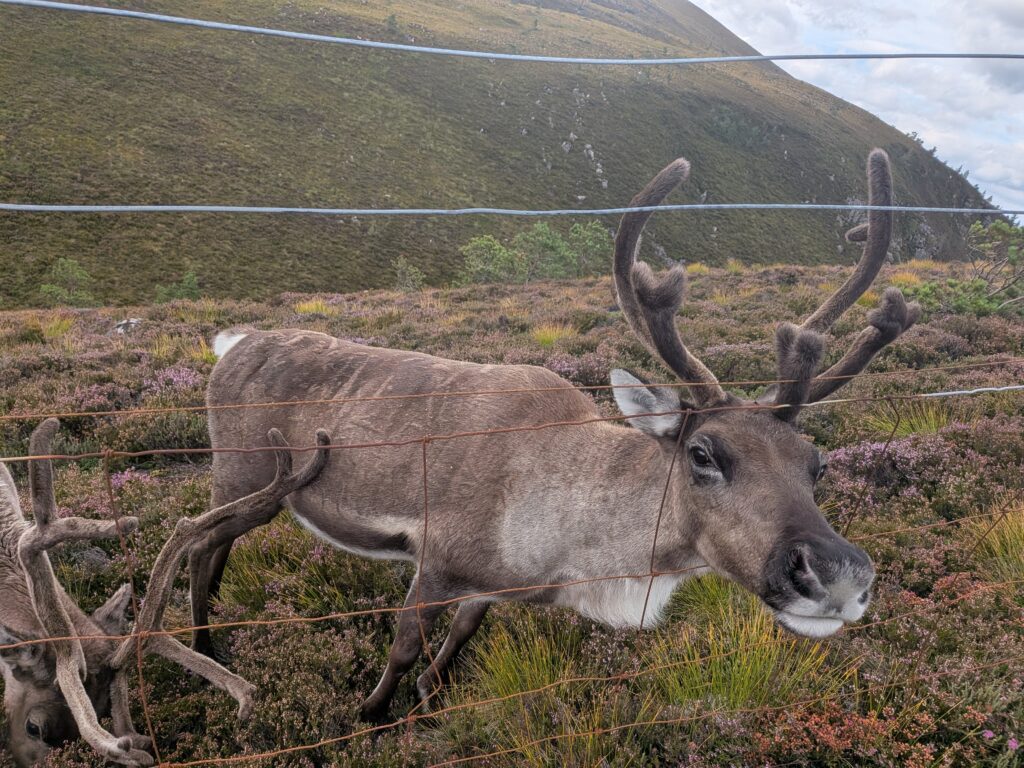
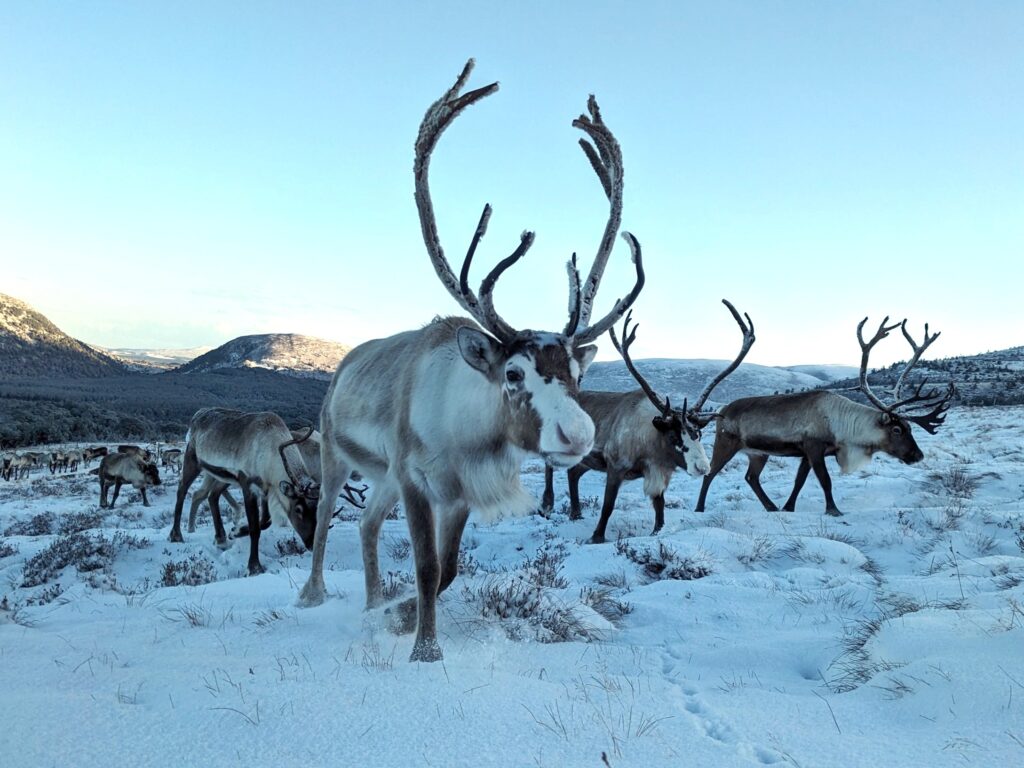
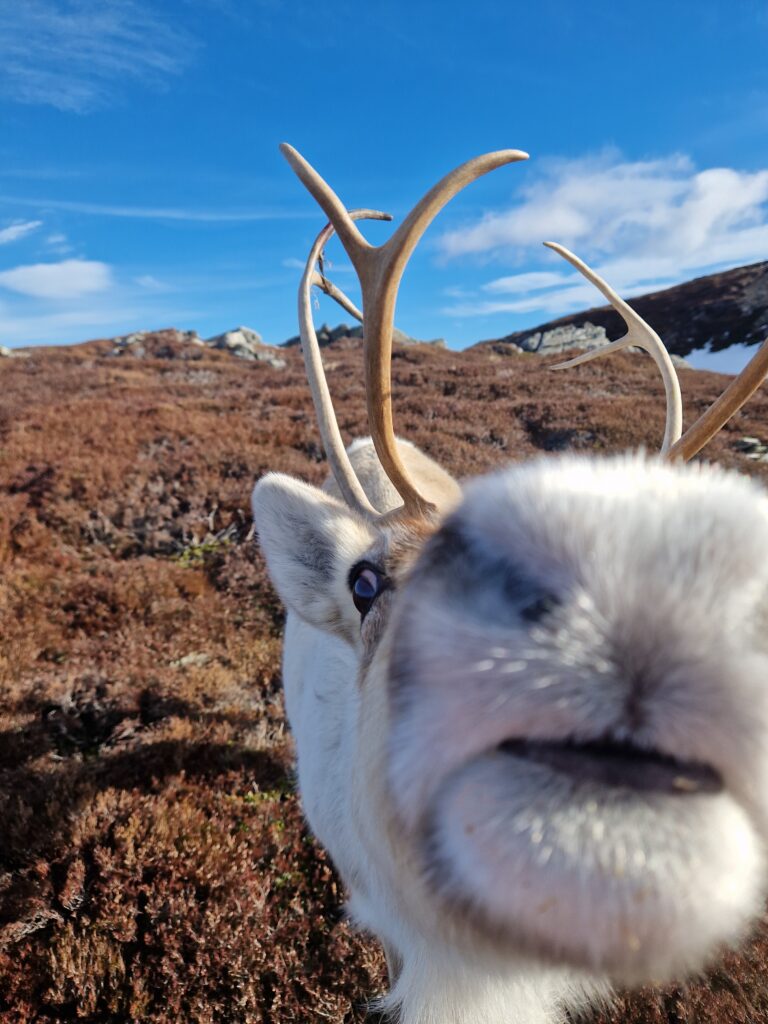
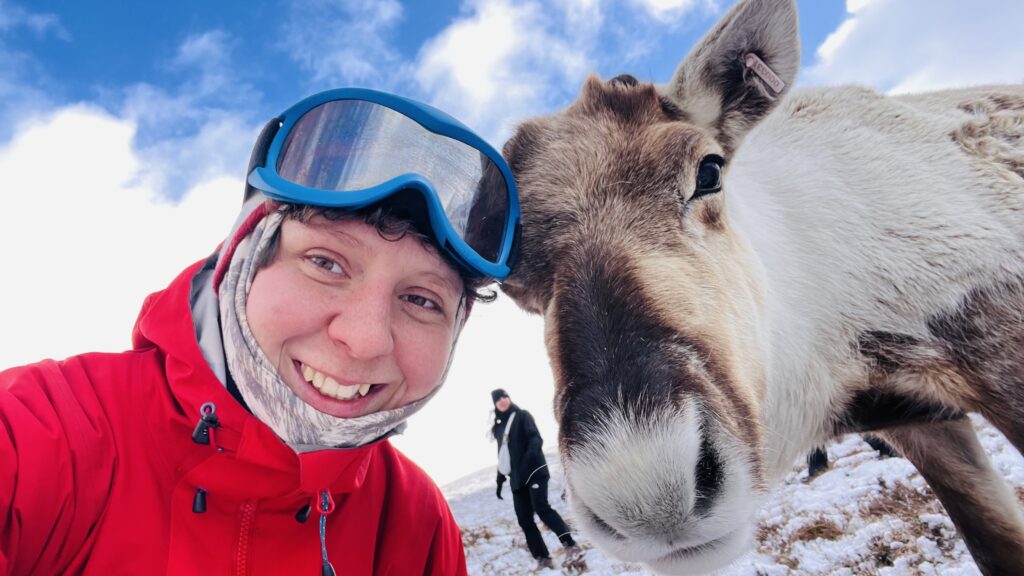
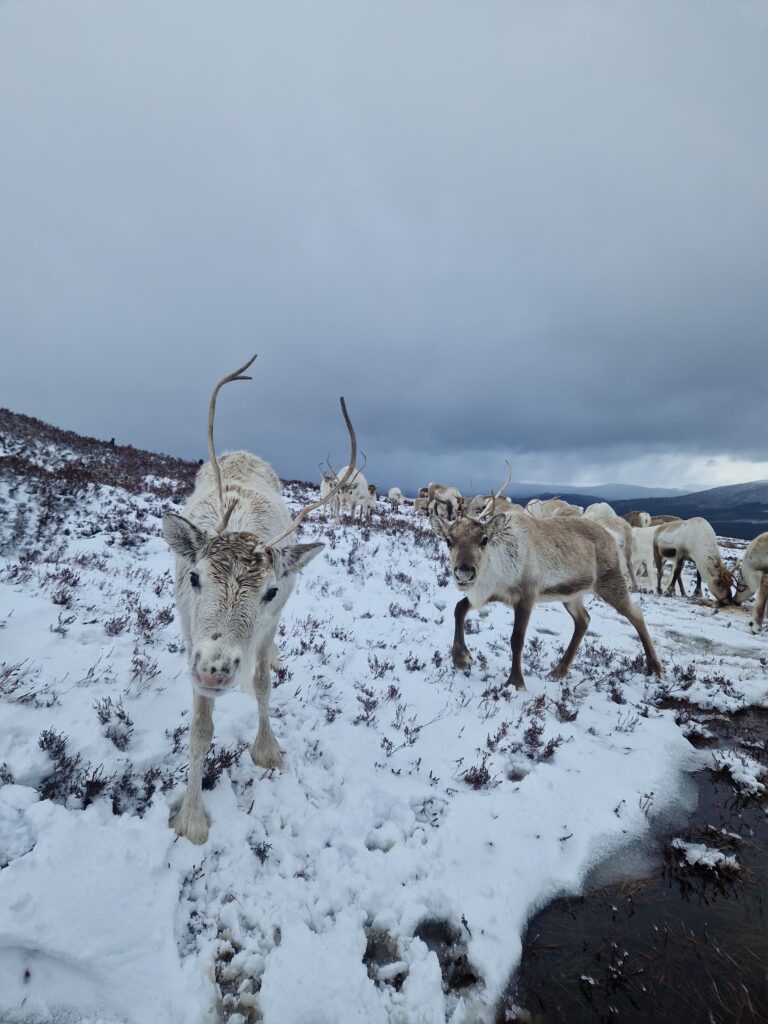
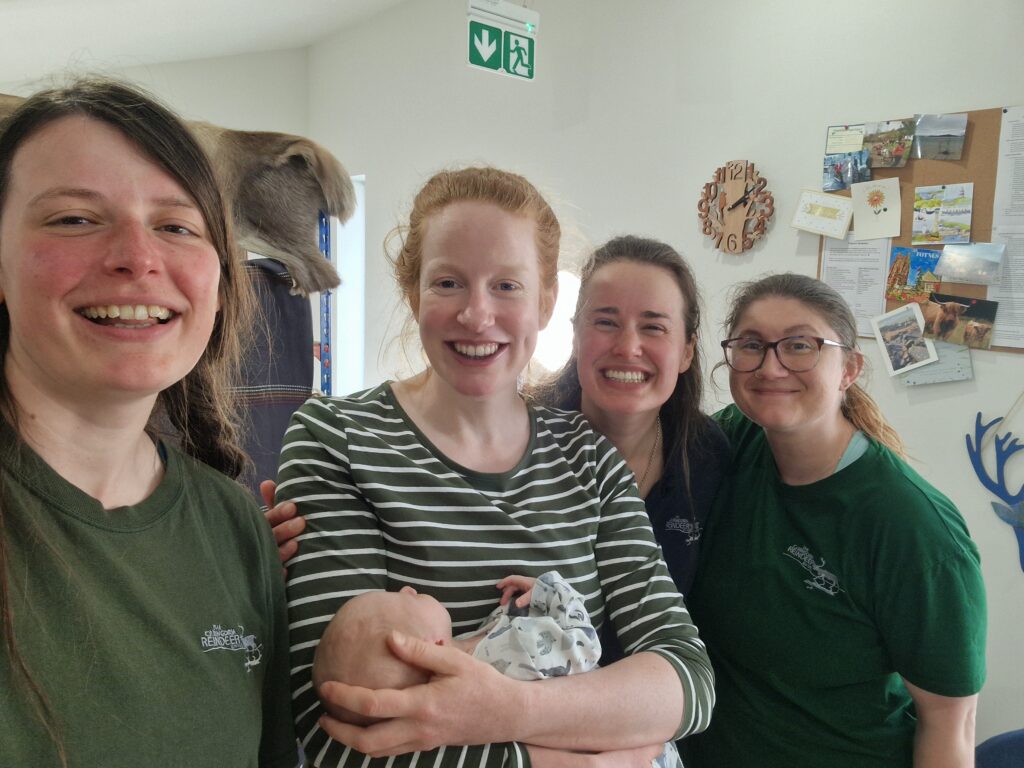
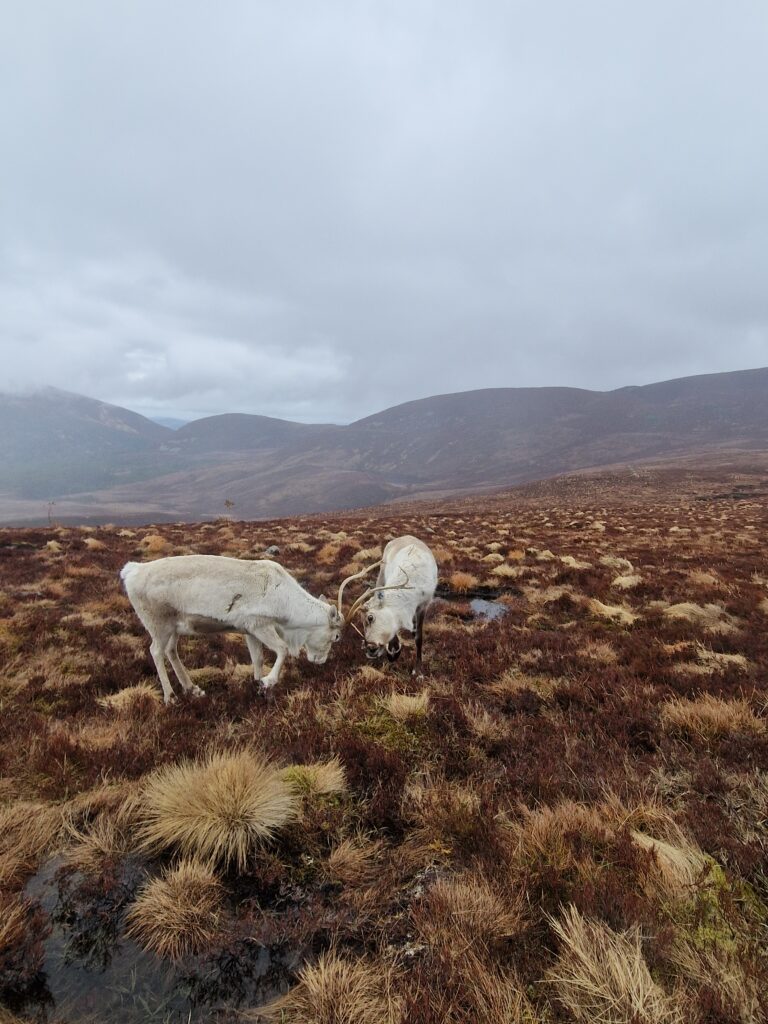
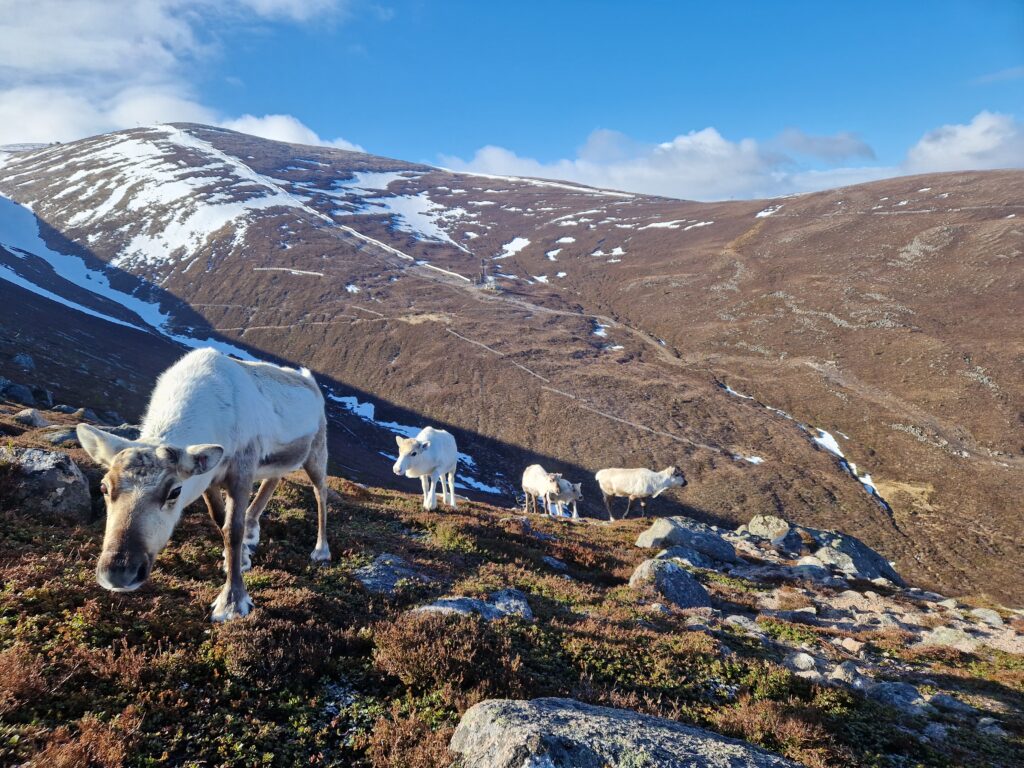
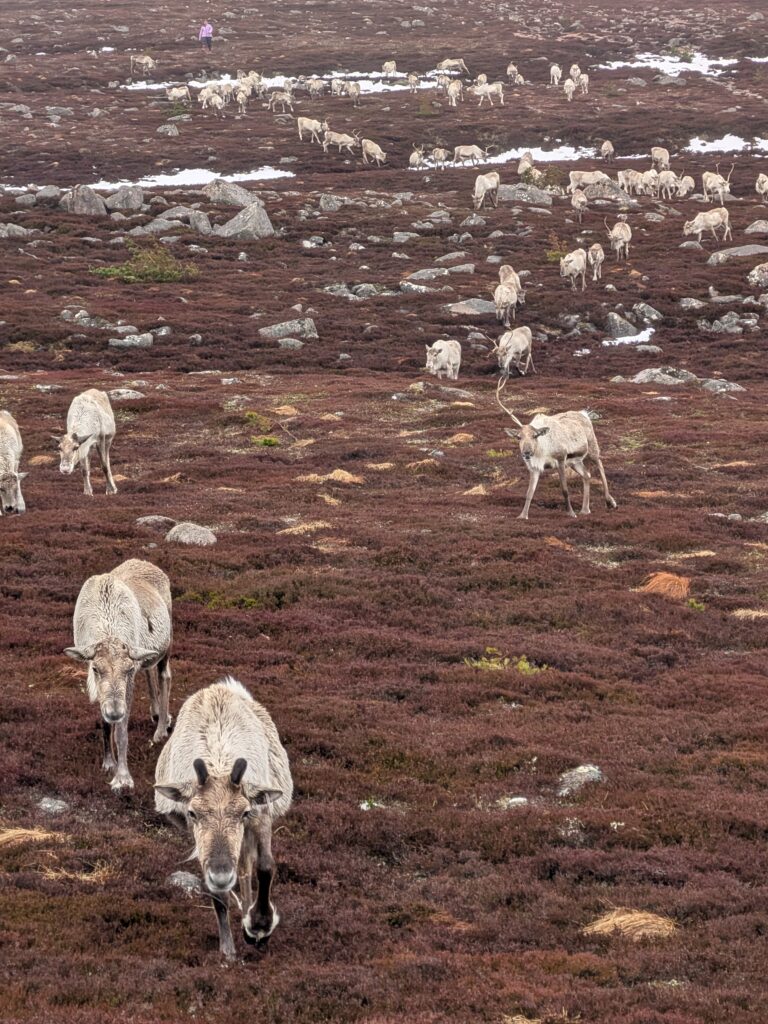
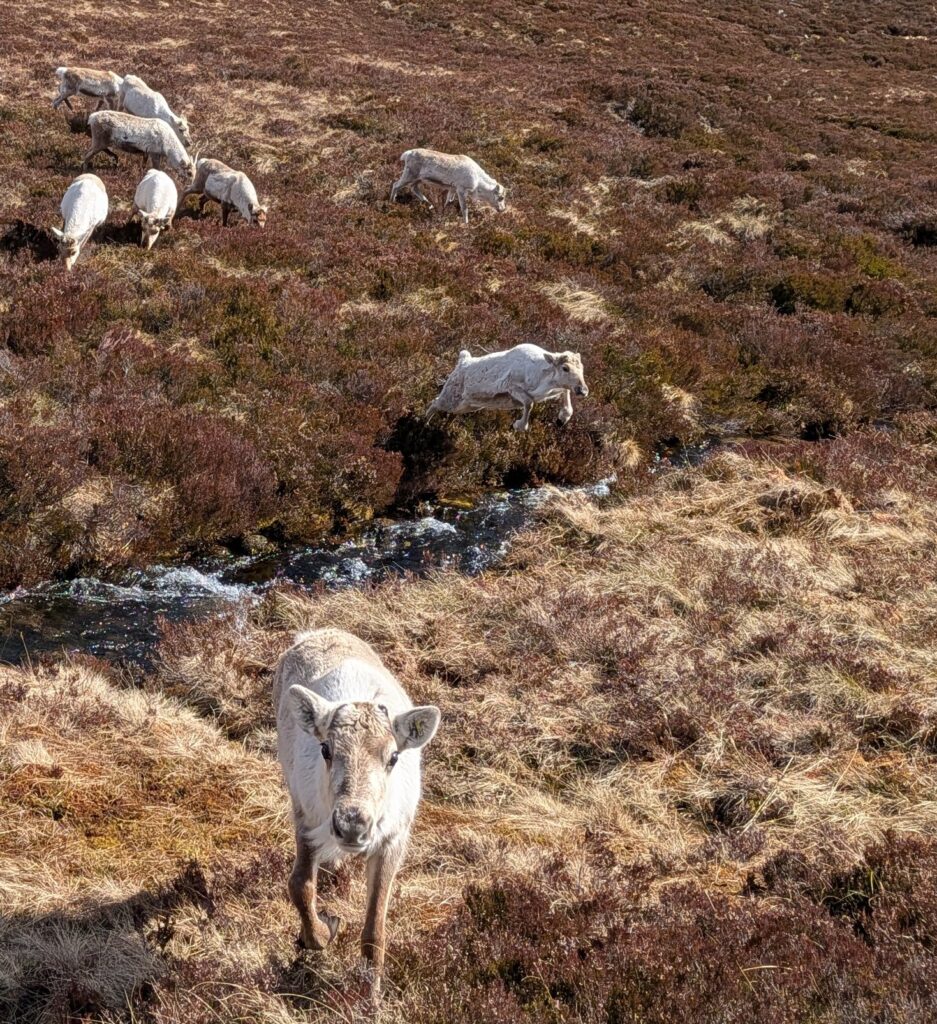
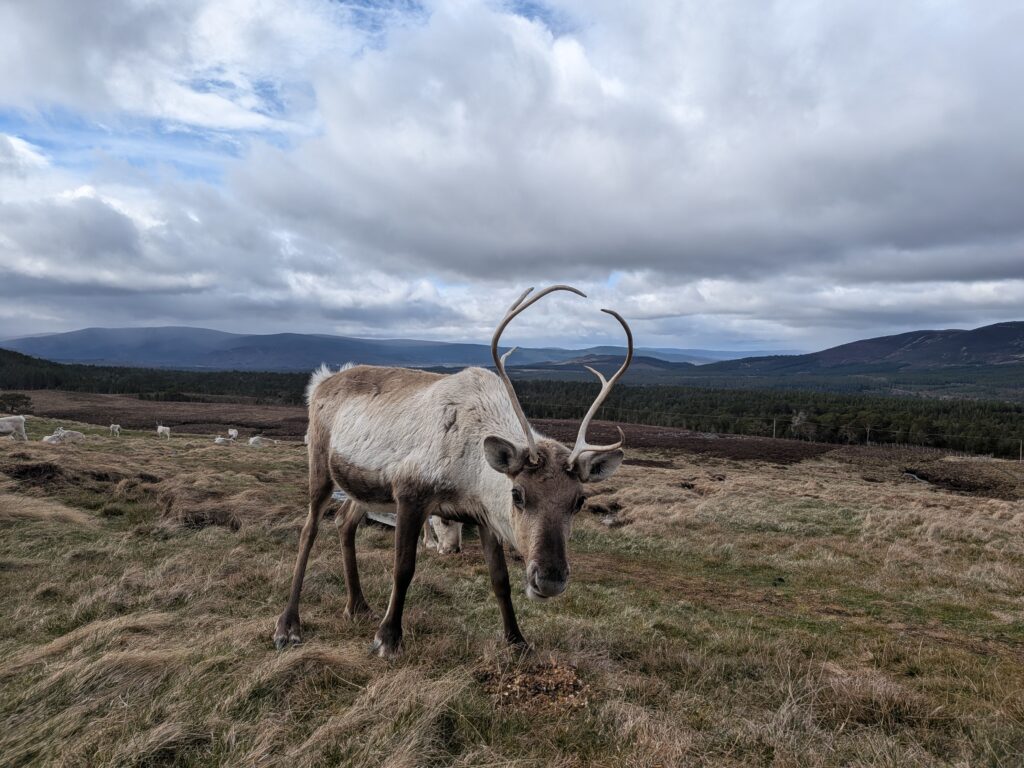
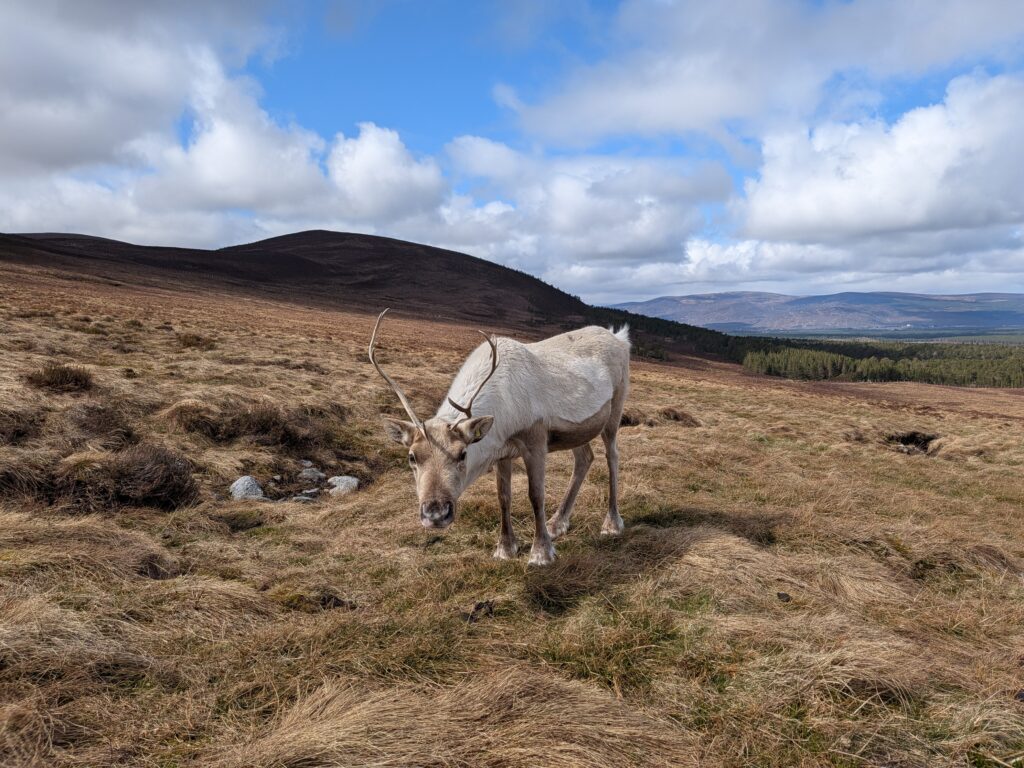
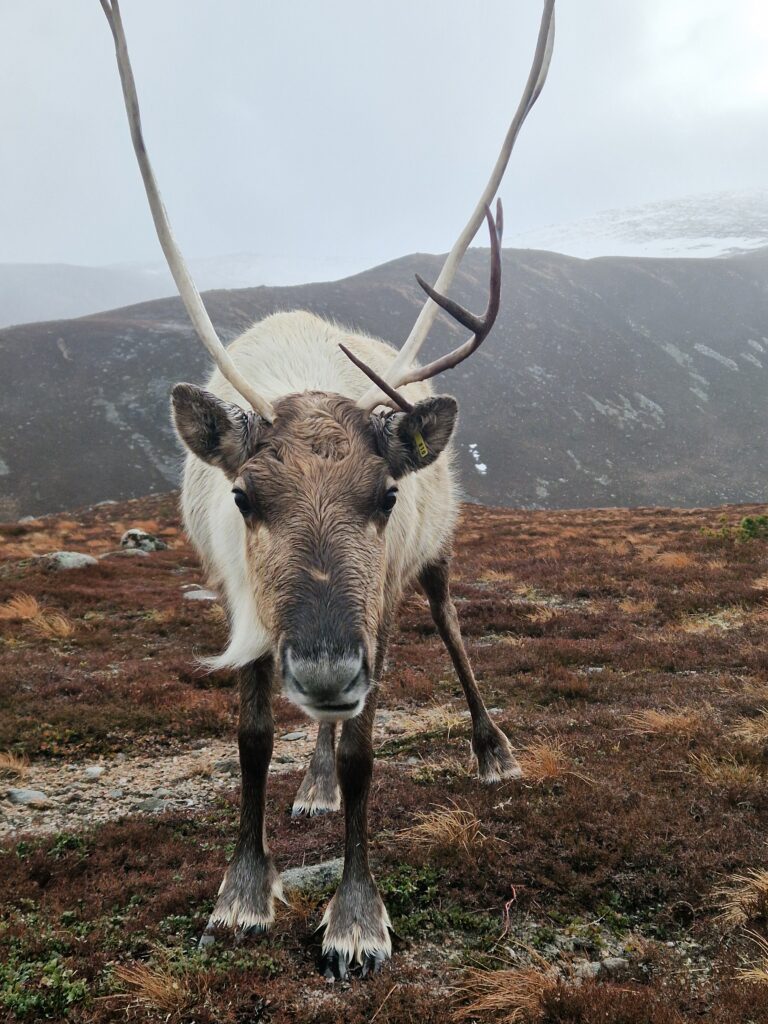
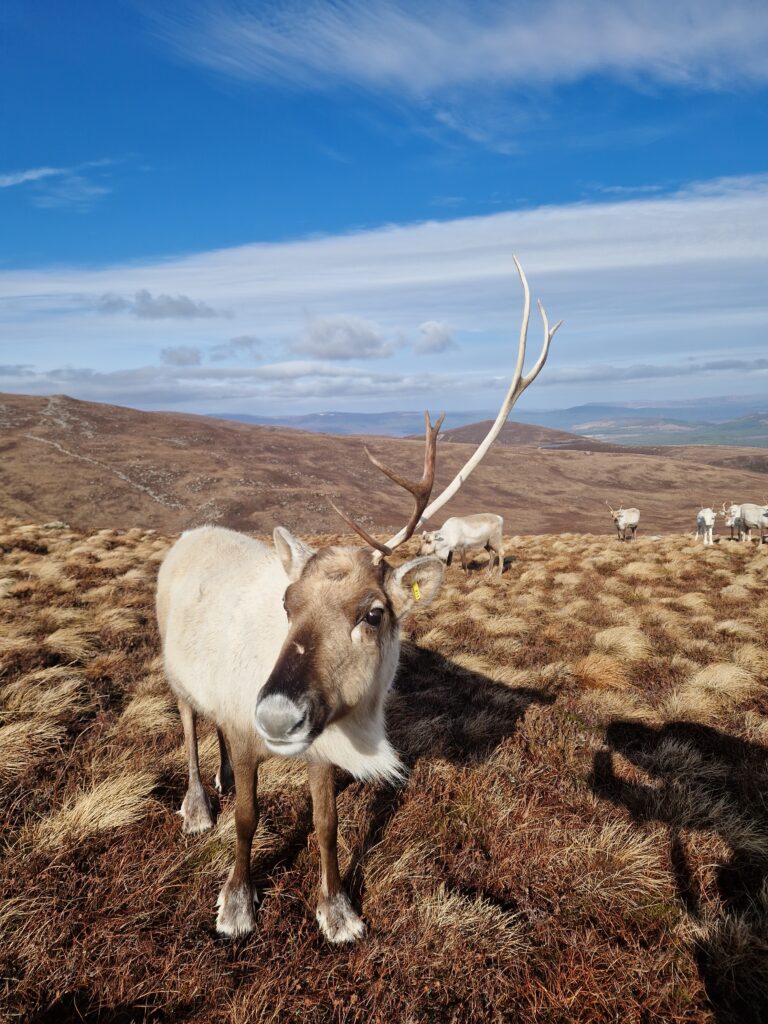
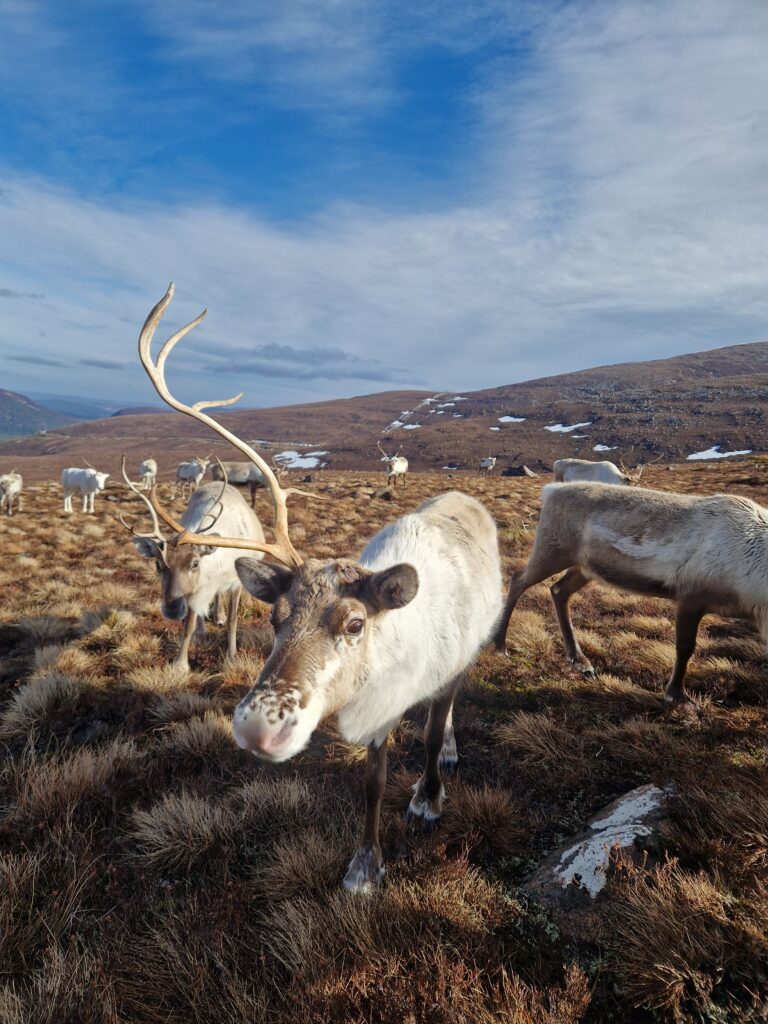
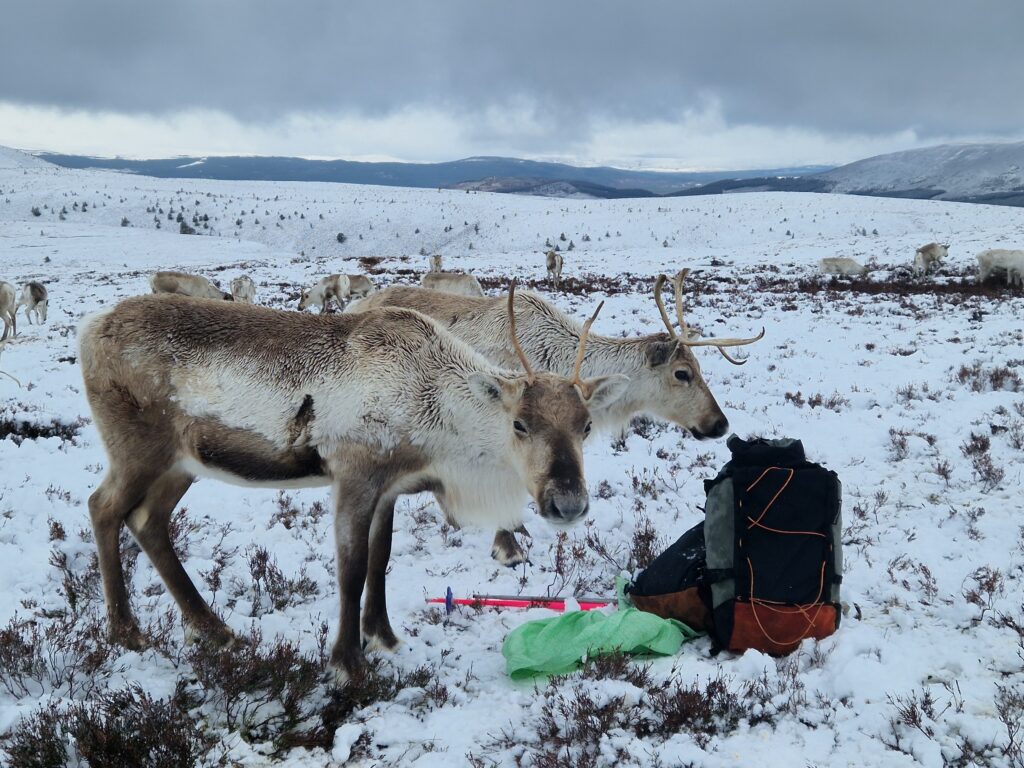
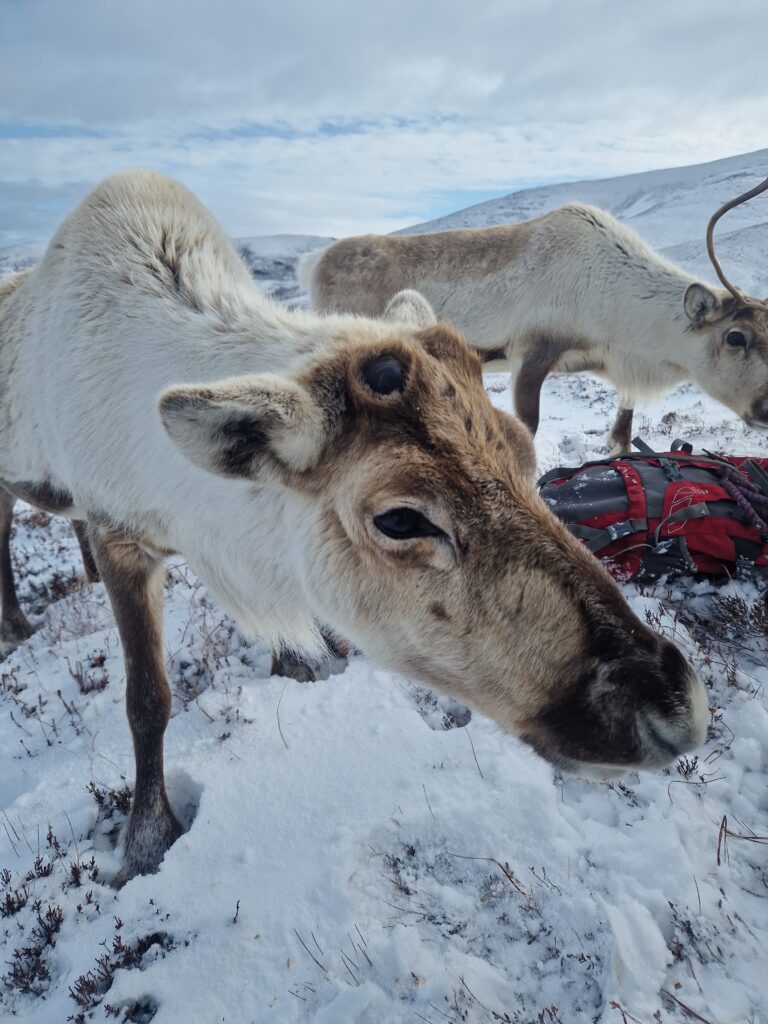
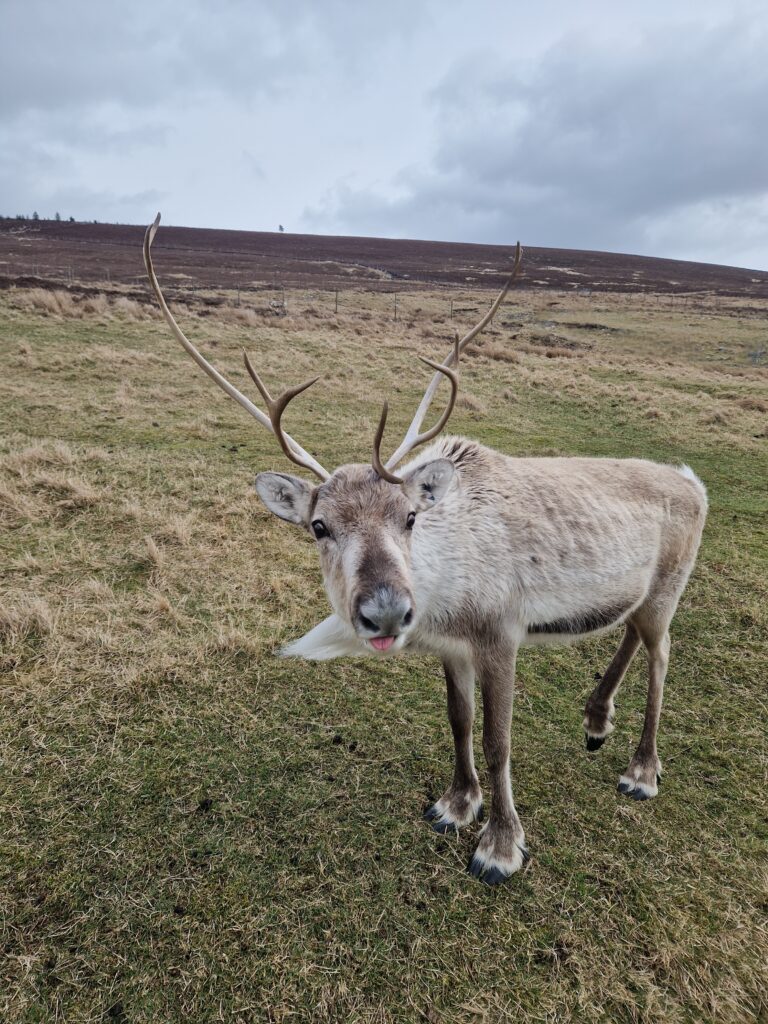
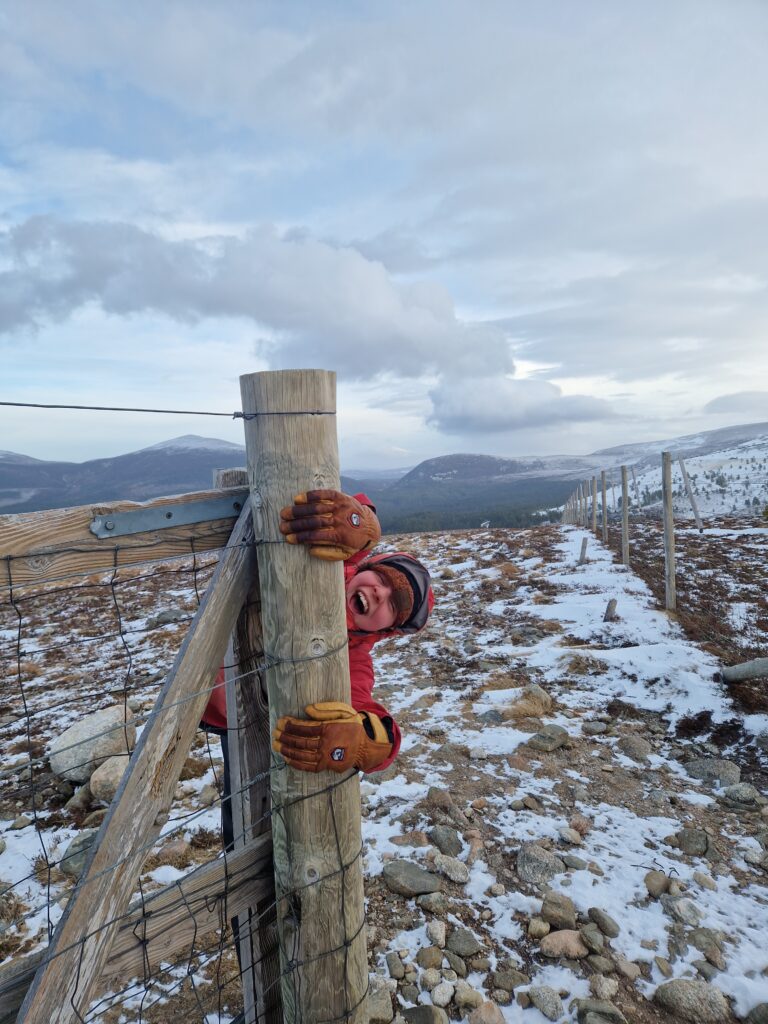
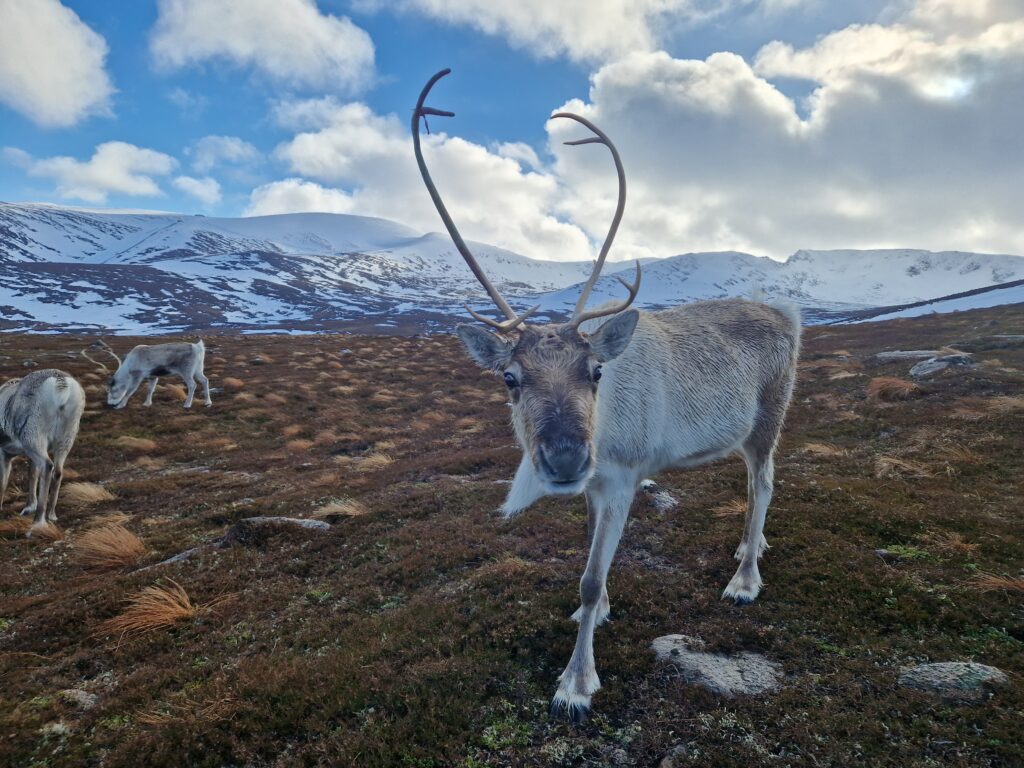
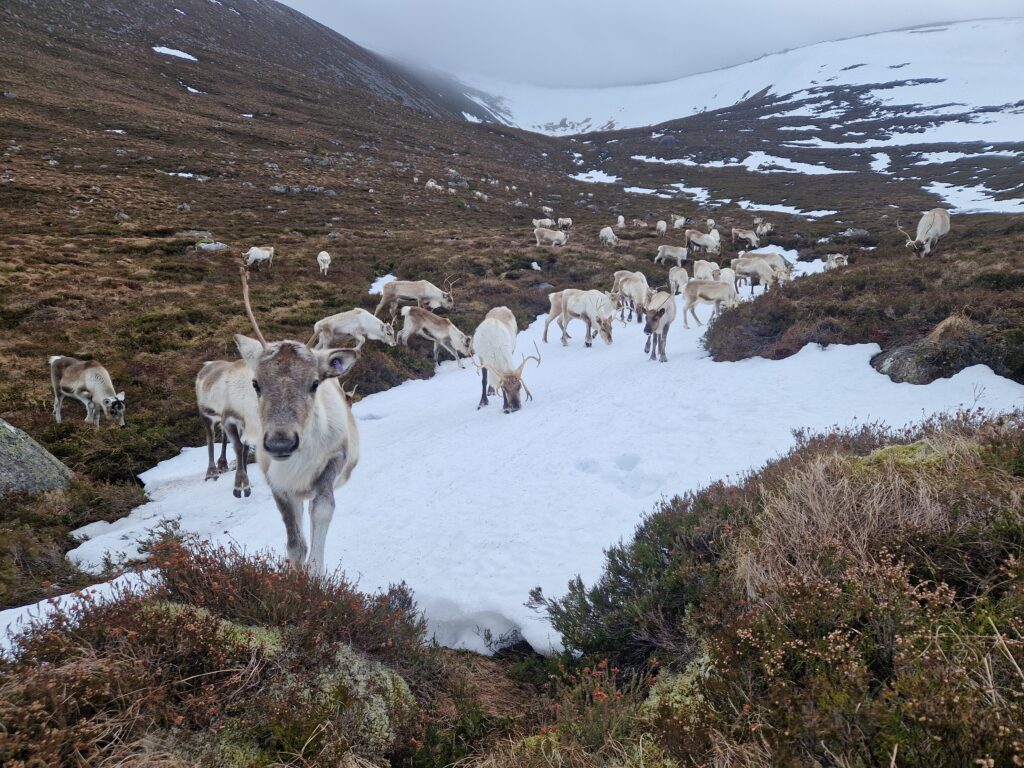
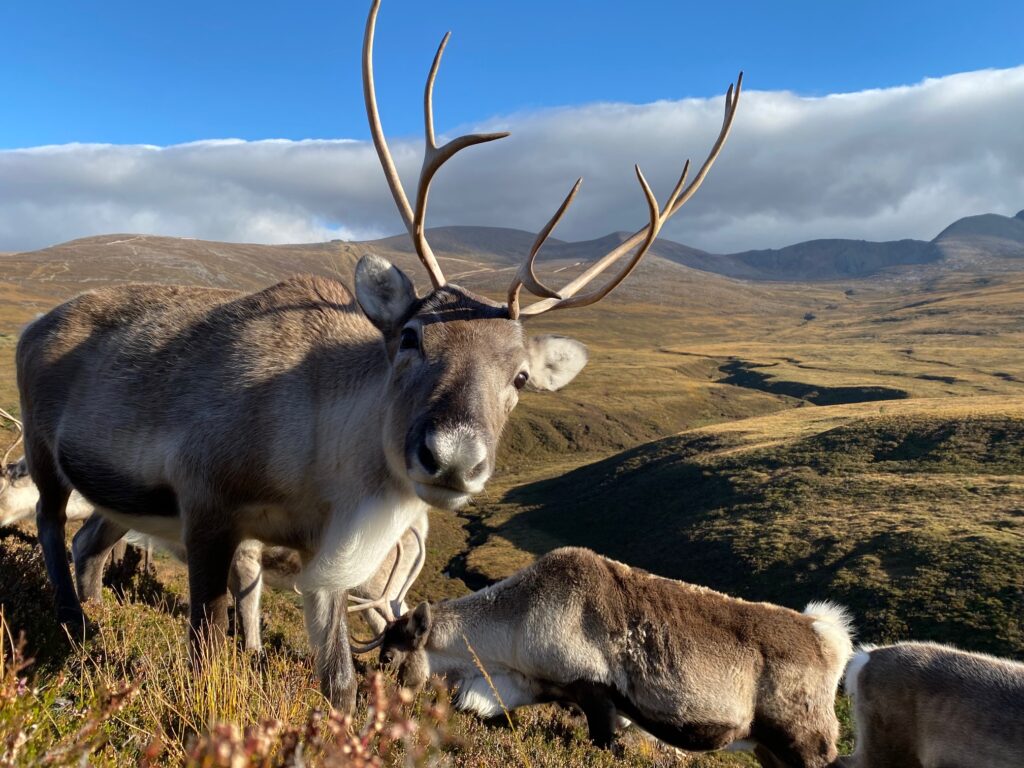
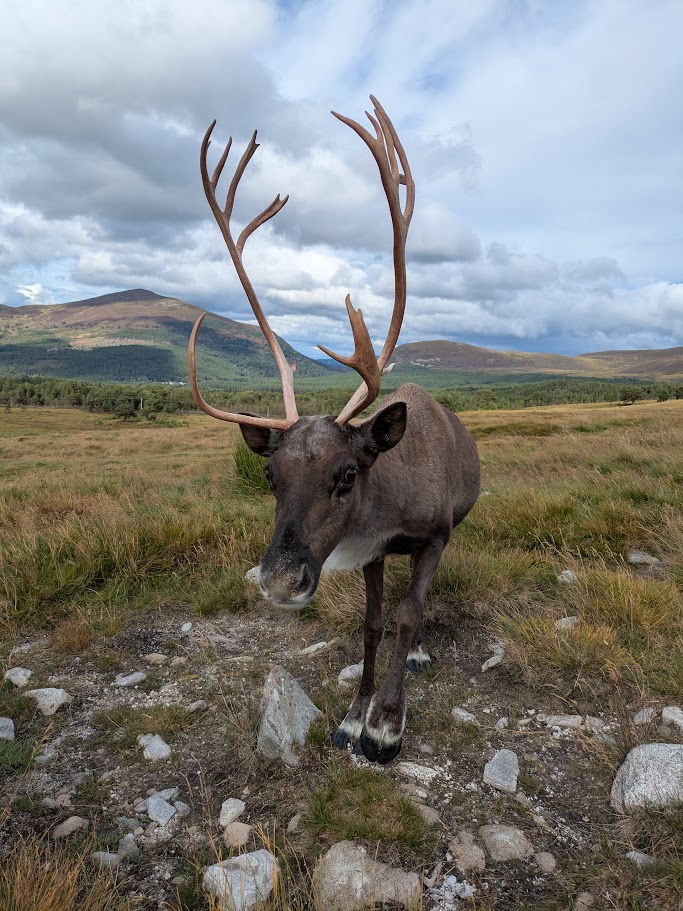
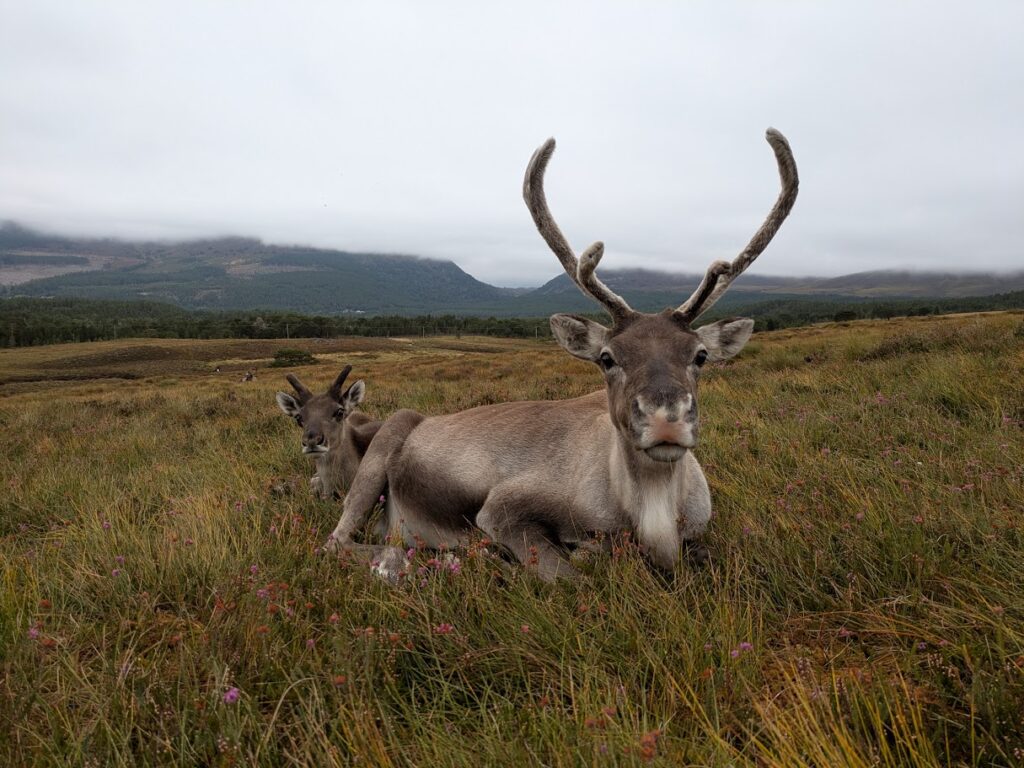
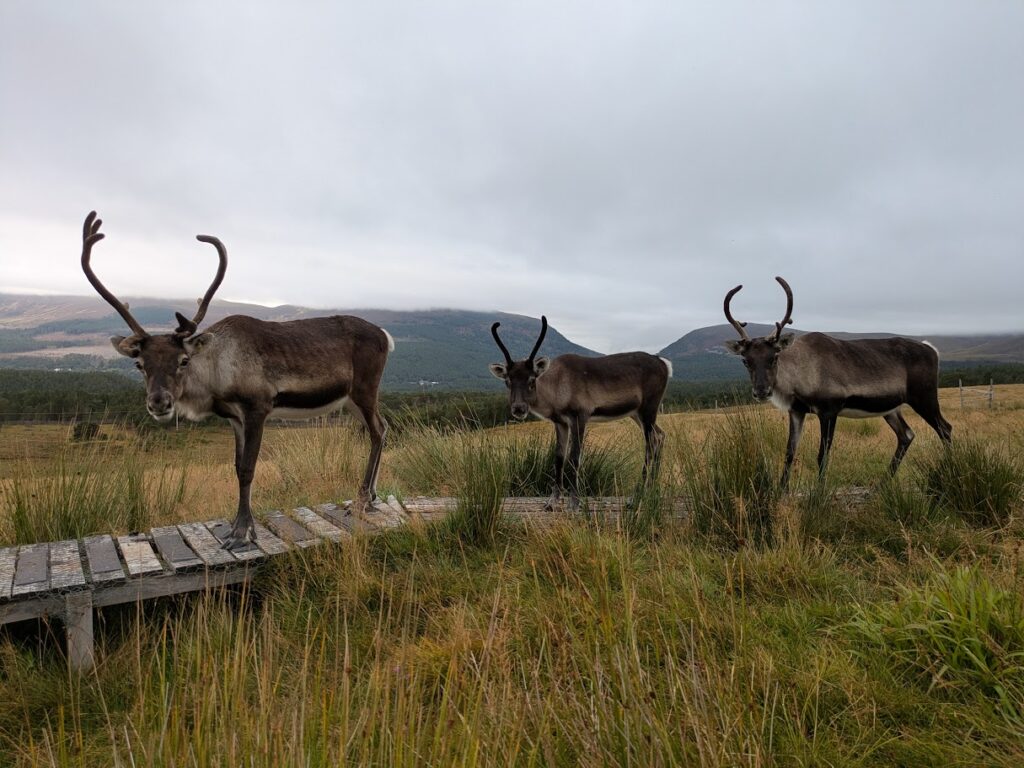
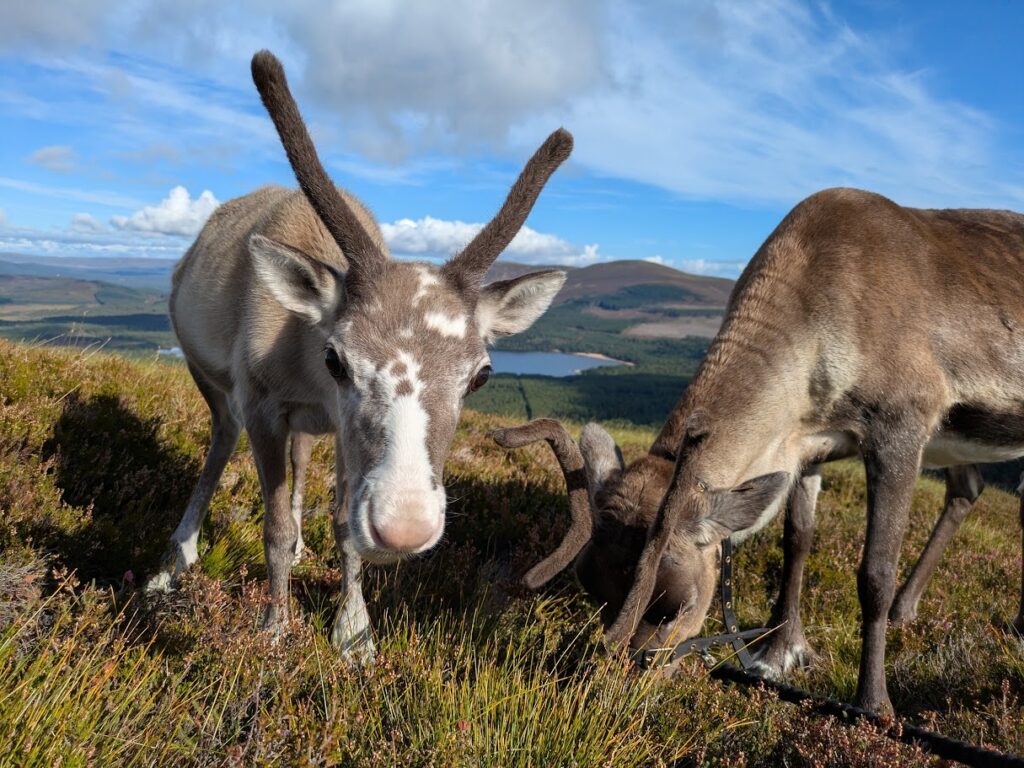
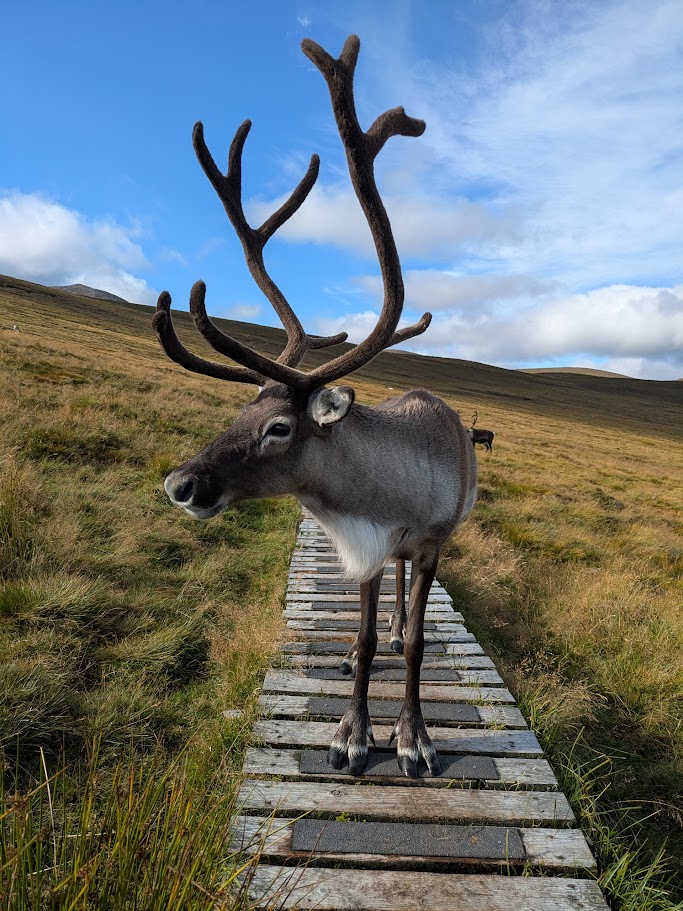
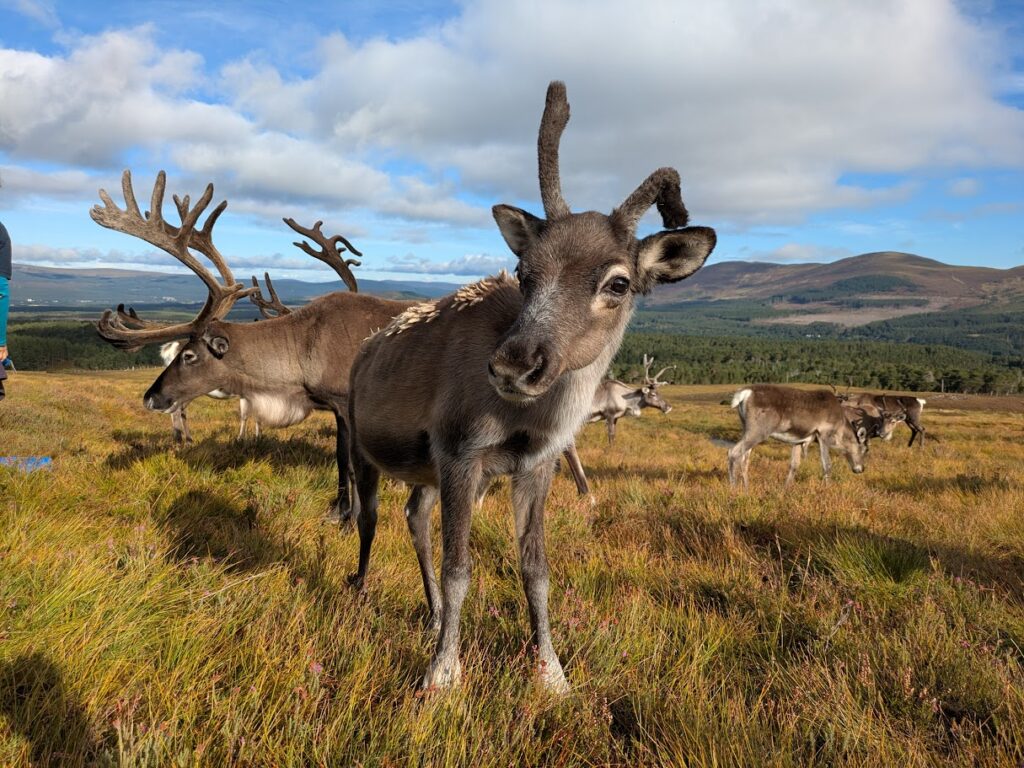
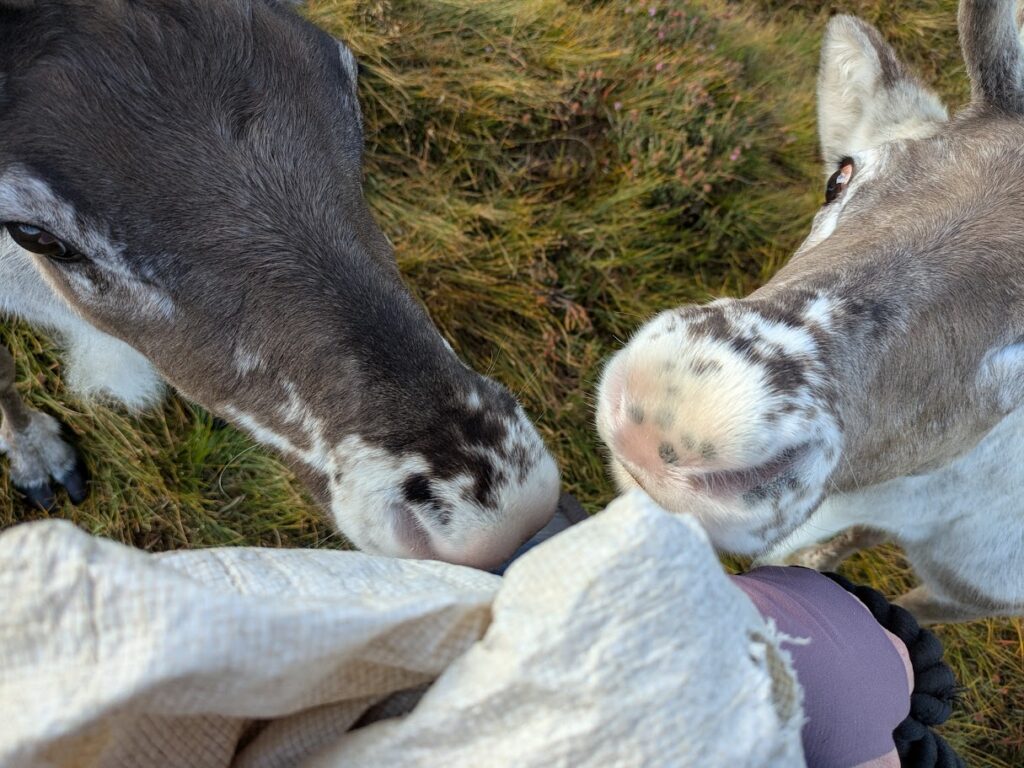
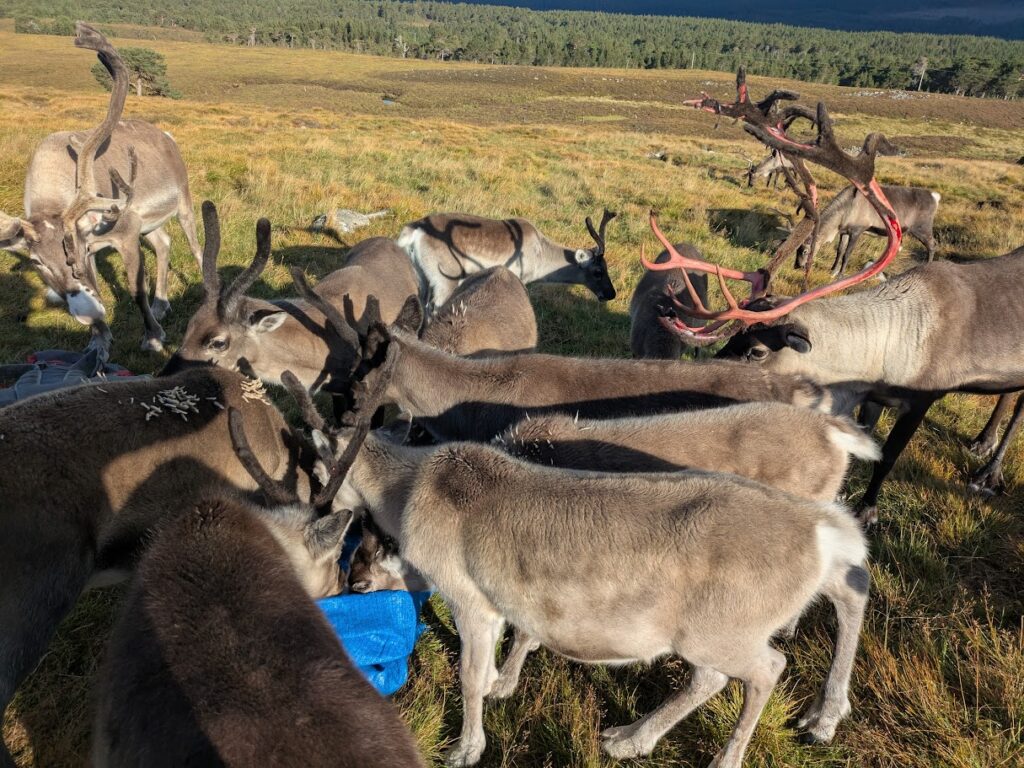
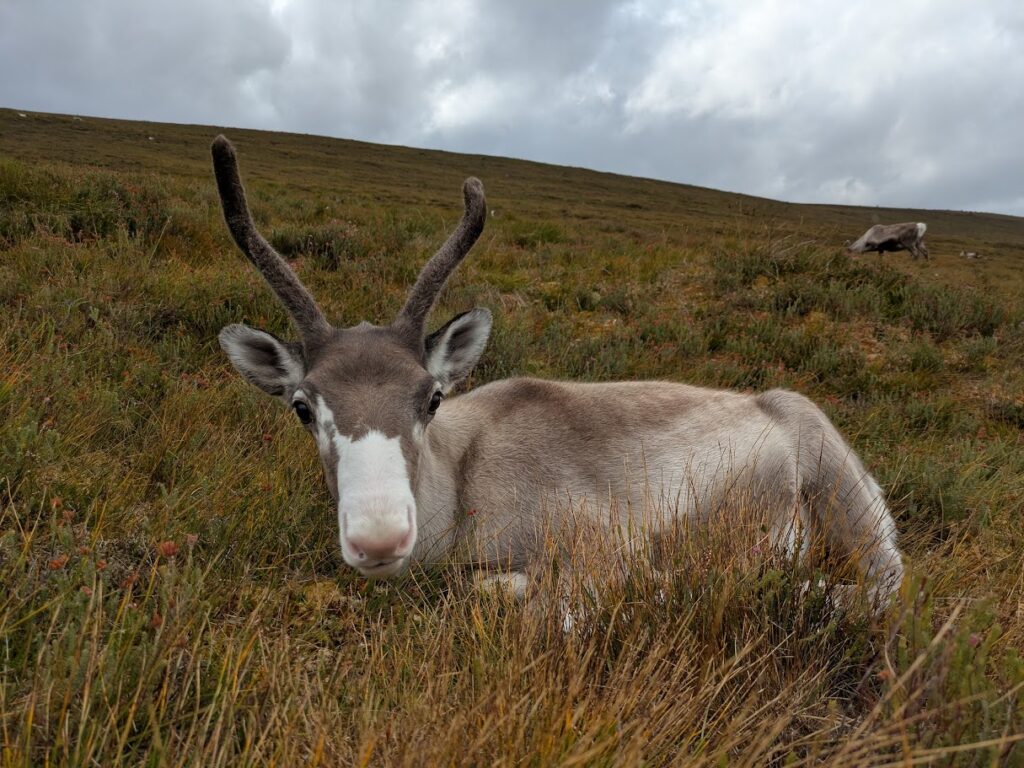
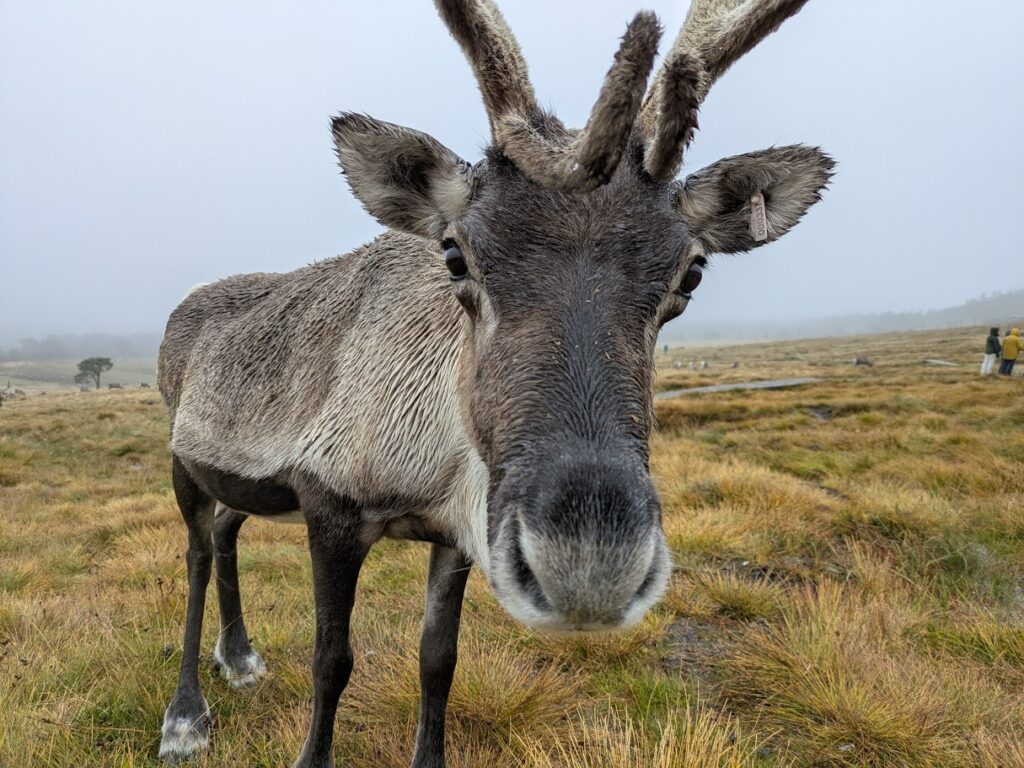
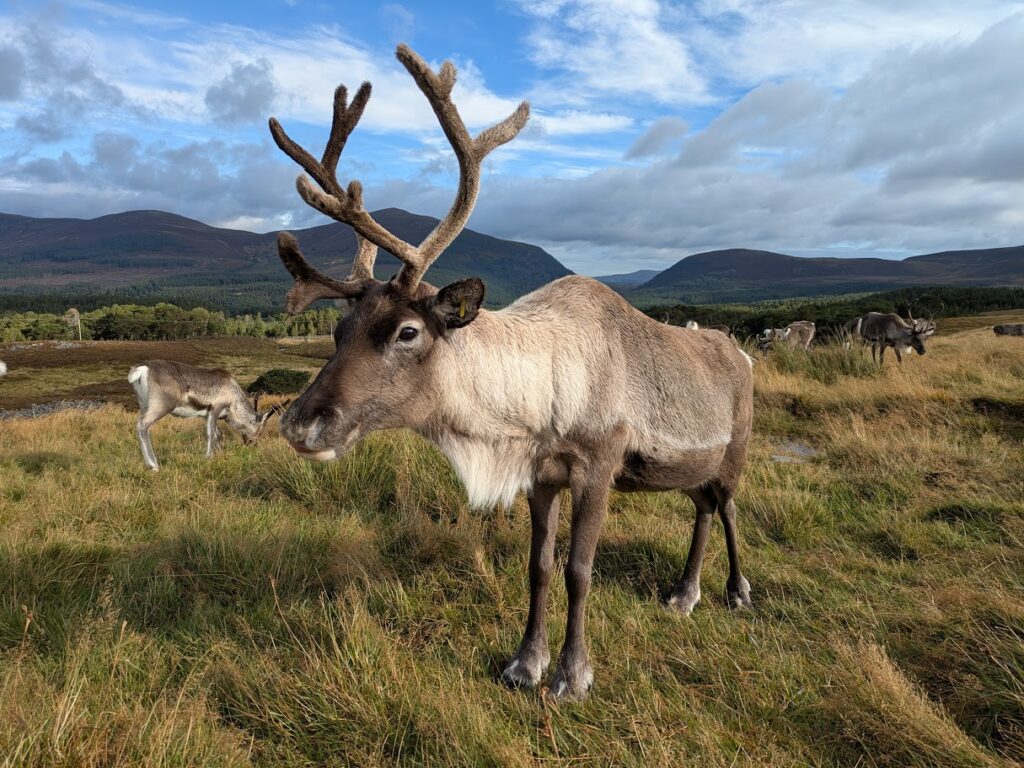
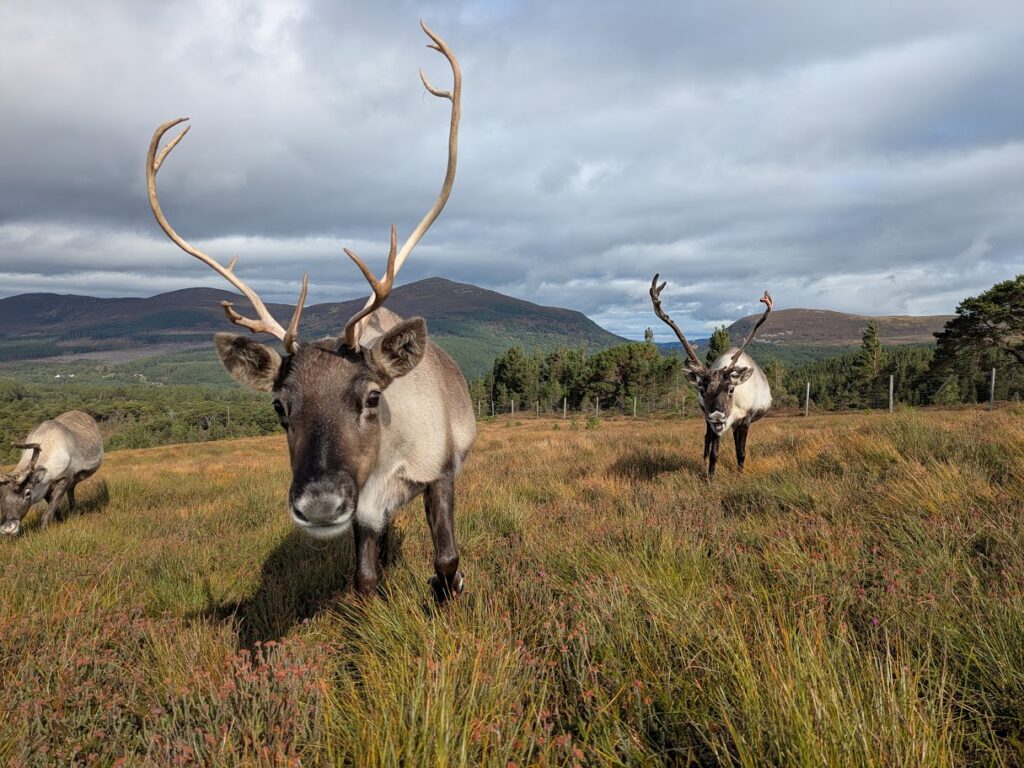
There is however a different side of majesty to the reindeer… The boop! Fury, warm noses that you just want to squish. Unfortunately for us, reindeer do not particularly enjoy having their noses squished so you’ll simply have to poke the screen of whatever device you’re reading this on instead. Each photograph has been named with a herders first reaction to the boopable nose. So sit back and enjoy our boop gallery!
Juniper. “Not so much a boop as a sloop…” Kate 2026. Holy Moley. “Blue sky, furry nose.” Alicia 2026. Cornetto. “The whole snoot and nothing but the snoot!” Alicia 2026. Juniper. “Why do I only have one ear?” Cameron 2026. Tetley. “That is such good quality.” Amy 2026. – Thank you very much from newly crowned photographer Daisy. Yukon. “His nose looks really squishable there.” Daisy 2026. Zoom. “God, I’m good looking”. Fiona 2026. Bordeaux. “No time for battles, boops to be had!” Daisy 2026. Hemp. “Schnozzle!” Amy 2026. Macarena. “Peek-a-boo!” Emm 2026. Flamenco. “Mum… I’ve got a bogey up my nose.” Fiona 2026.Morris. “A sentient marshmallow.” Kate 2026.Red Deer. “Because every deer’s nose deserves to be squished.” Daisy 2026. Ryvita. “That’s so cute!” Caroline, 2026.Dr Suess. “Does this picture make my snoot look big?…” Alicia, 2026. Ryvita. “Nom nom nom nom nom.” Caroline, 2026.
I hope you enjoyed our collection of boop shots of our lovely reindeer. I think we can all agree, they’re all pretty boopable noses!
Normality has resumed and over the last month we have welcomed our lovely visitors to our site in Glenmore and have also caught up with a few of our cows and calves. They’re all looking well and have had a good summer out on the free range!
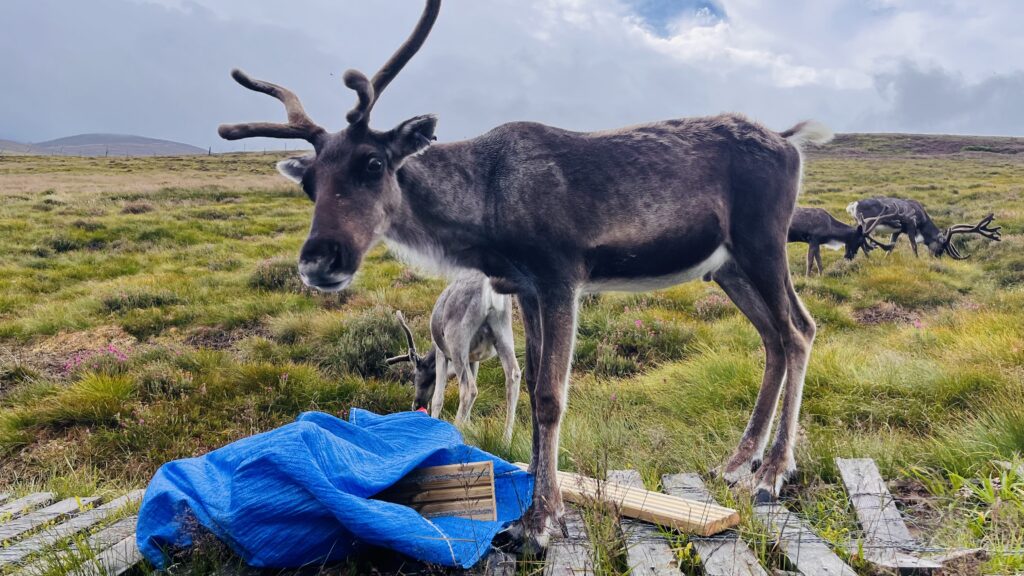
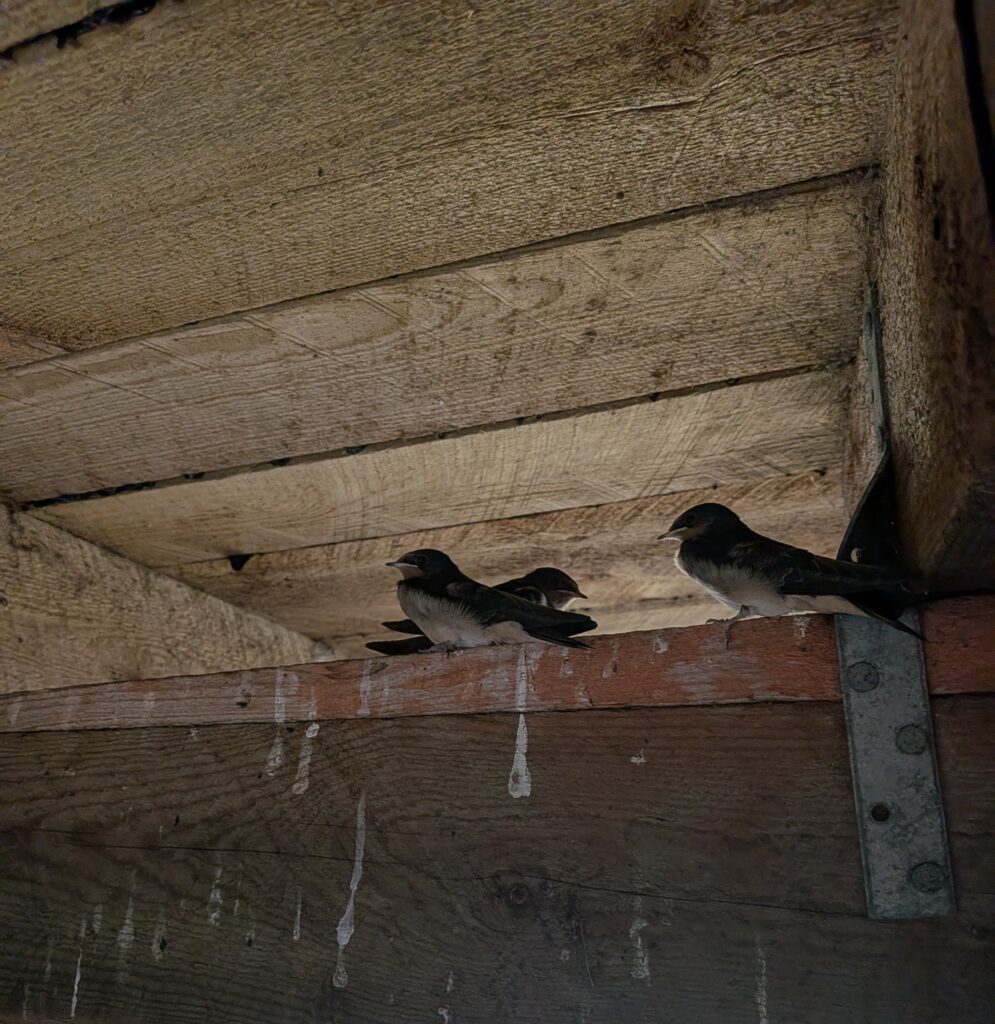
1st of August: With the ski road still closed, the mountains are quiet, meaning that groups of our free rangers are lower down on the mountains. Here we have Sundae on the right and her yearling daughter Salsa (who is still suckling milk from her mother) on the left.1st of August: Looks like Rocket was tired of being a free-range reindeer, he made his way into our hill enclosure on his own accord. It was a rewarding morning with very little effort from myself and Daisy as we picked up Quickstep from the ski centre as he was with Sundae, Salsa and a group of female reindeer which left us at only 2 male reindeer left out on the free range after the wildfire.2nd of August: Morven looking out over the hill side, she was in another group of reindeer we found close to the ski road.4th of August: Rumba does not approve of reindeer feed sacks being used to carry tools.4th of August: Morris supervising board walk improvements.8th of August: Catching up with Ryvita and co. She has a cracking set of antlers for a 17 year old. 9th of August: Lovely Oro after one of our morning Hill Trips. 10th of August: Sundae along with someone else’s calf and Vanilla behind.11th of August: Lunch time sillies. Rowan is prepared for the sun.13th of August: I enjoyed a day out on the free range looking for reindeer and stumbled across Juniper along with her yearling, Cha Cha, who was in poorer condition than what we would like for this time of the year, so they were both brought into our hill enclosure for some TLC. We train all our reindeer to walk on a head collar, so even when we must use makeshift efforts the reindeer are comfortable.14th of August: First cow and calf back in our hill enclosure. We aren’t shocked that it was Winnie and calf! 15th of August: Orinoco grazing behind her calf.16th of August: Lotti hanging out with Texel, Texel’s yearling Waltz and Texel’s most recent calf.19th of August: Kulfi post scratch. Reindeer definitely put us to shame with how flexible they are.20th of August: It is common to see Aztec with a headdress of foliage. 23rd of August: Iskrem is the first to begin stripping his velvet. 25th of August: Brie and Calf relaxing after one of our HIll Trips. 26th of August: Over the summer, we have had two groups of swallows that have fledged from our shed in our hill enclosure. 27th of August: We use a vocal call to gather the reindeer in our hill enclosure for their food and fairly often it is heard by our free rangers. Here is Nuii with Ryvita grazing, they are currently free ranging in the mountains but heard us calling and came over to see if they could have some food too!
The bodies of reindeer go through many changes allowing them to cope with huge temperature difference throughout the seasons. In summer reindeer can cope with temperatures above 30 degrees and the lowest recorded temperature that reindeer have been know to survive is -72 degrees Celsius. Reindeer have two different coats, a thick white winter coat as well as a fine, dark summer coat. Their antlers grow in an annual cycle and the different times of growing and shedding them allows different animals to be dominant at different times of year. One of the most interesting, and important, changes to a reindeer though, you can’t see – their metabolism.
Magnum in his winter coat.Colorado, Iskrem, Yangtze looking smart in their summer coats.
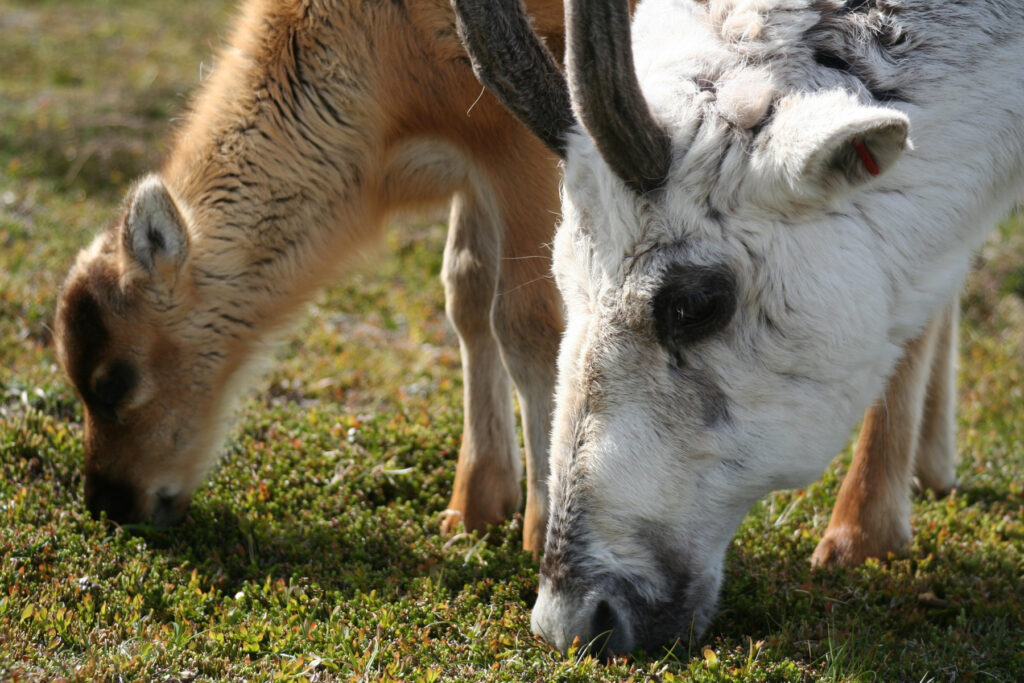
Reindeer have adapted to eat vast amounts of food throughout the spring, summer and autumn to gain enough weight to survive the winter, when food is scarce. To cope with these changes in food availability their metabolism changes too. In the summer reindeer will graze around the clock, eating a huge variety (between 200 and 300 different species) of plants which are high in nutrition. This allows each individual to grow a new set of antlers, they start to grow in the spring and are fully grown by the end of august and the heaviest set we have had in our herd, weighed a whopping 8.9 kgs. The summer is also the time that the young reindeer grow in body size. Finally, every reindeer will need to gain body fat which will act as reserves over the winter. All these things require their digestive system to work in overdrive converting the food they are eating into energy that can be used by their body to create protein, bone, fat, and whatever is needed.
Ryvita grazing and growing her beautiful antlers.Cow and calf grazing on the high plateau plants.
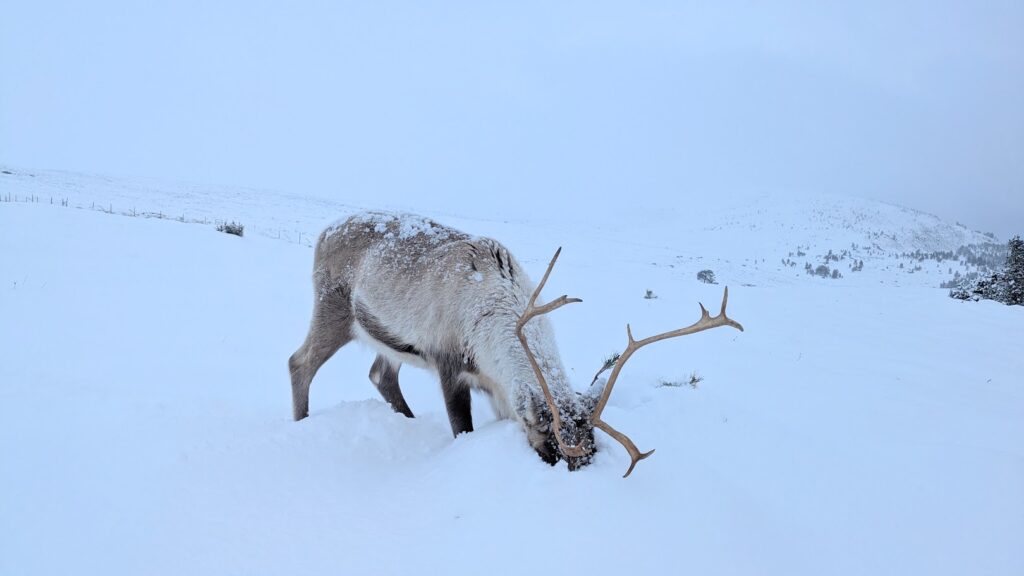
On the contrary, winter is all about survival. During the winter most of the plants will have died under the snow and 70% of a reindeer’s diet is made up of lichen. Lichen is a symbiosis of fungi and algae and is very resistant to extreme changes in temperature. Over the winter lichen won’t grow but it will stay dormant, preserved under the snow. Reindeer will then dig down through the snow to reach the lichen. But lichen is relatively low in nutrients, just enough to sustain the reindeer through the winter and their metabolism shifts in line with this. In fact, even if you gave a reindeer a big pile of food, during the winter, they just aren’t as hungry and wouldn’t eat it all.
Winnie eating lichen under the snow.
During the winter reindeer are no longer growing their antlers, they won’t increase their body size at all, a calf will grow lots in the first 6 months of their life and then stay the same size for the next 5 months, until the following spring. They will survive the winter by using their fat reserves. The one important growth that does happen in winter is that of a growing foetus. This is the reason that the females grow antlers and keep them after the males have shed them, as it gives them a physical advantage during the time that they are pregnant and therefore they get first dibs on the food.
Vienna and Amazon showing off their beautiful antlers right through the winter.A group of our males in the winter having cast their antlers.
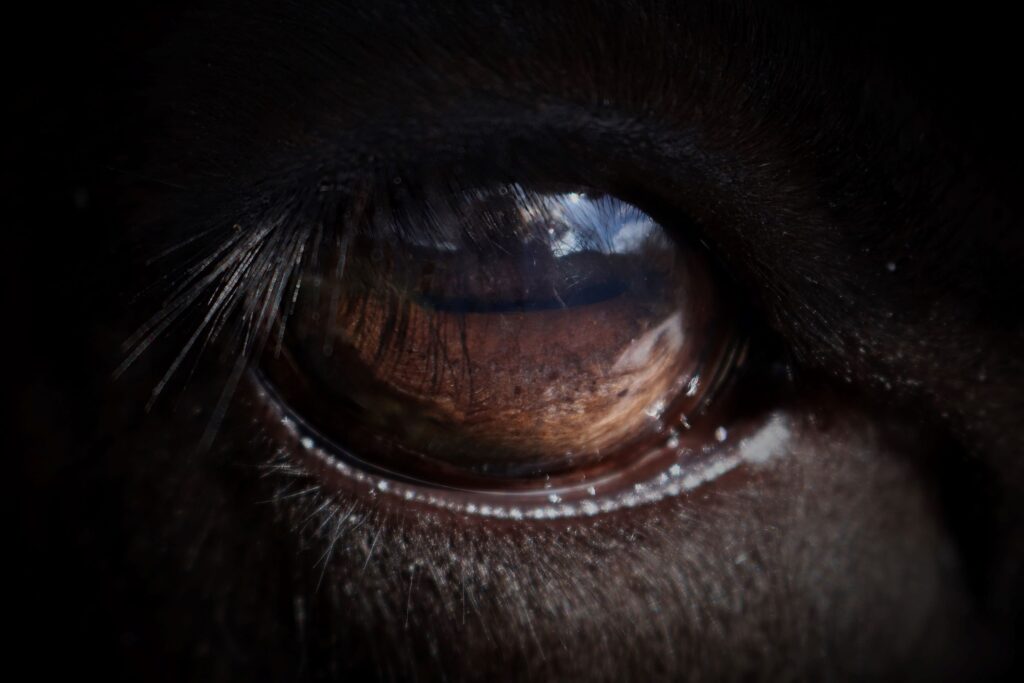
But how does a reindeer know that it’s time for spring? Rather than responding to food availability or temperature which may well change year by year, the changes in their metabolism are triggered by the changes in daylight. The increased daylight associated with spring is detected by specialised receptor cells in their eyes which then convert to a hormonal signal using melatonin. Melatonin is synthesised during the dark period each day and then synthesis stops during daylight. This means that the amount of melatonin varies based on the time of year. The concentration of melatonin has many effects. In terms of metabolism, in the spring as melatonin decreases, this increases the appetite of the reindeer. In the autumn, as melatonin increases, this decreases the appetite of the reindeer and increases the breakdown of fat stores. The changing melatonin levels also controls their antler growth and release of sex-hormones but that may be another blog in the future.
Eye of a reindeer.
For anyone particularly interested in a much more in-depth description of the physiology behind these changes, I would highly recommend reading this article.
If you have made it this far, thanks for reading my very nerdy reindeer biology blog! Hopefully you have learnt something and enjoyed the pictures of the reindeer along the way.
Since the first week of January, our wonderful herd of reindeer have been out free – ranging the mountains. Our females and smaller male calves from last Spring roamed the hills here in the Cairngorms, while our males, bigger male calves and their mums free roamed the hills not too far from our farm. Free – range season is a chance for all our reindeer to enjoy the good grazing and open plains of the sub-arctic tundra we find ourselves in here, and to grab a well earned rest after our busy Christmas season.
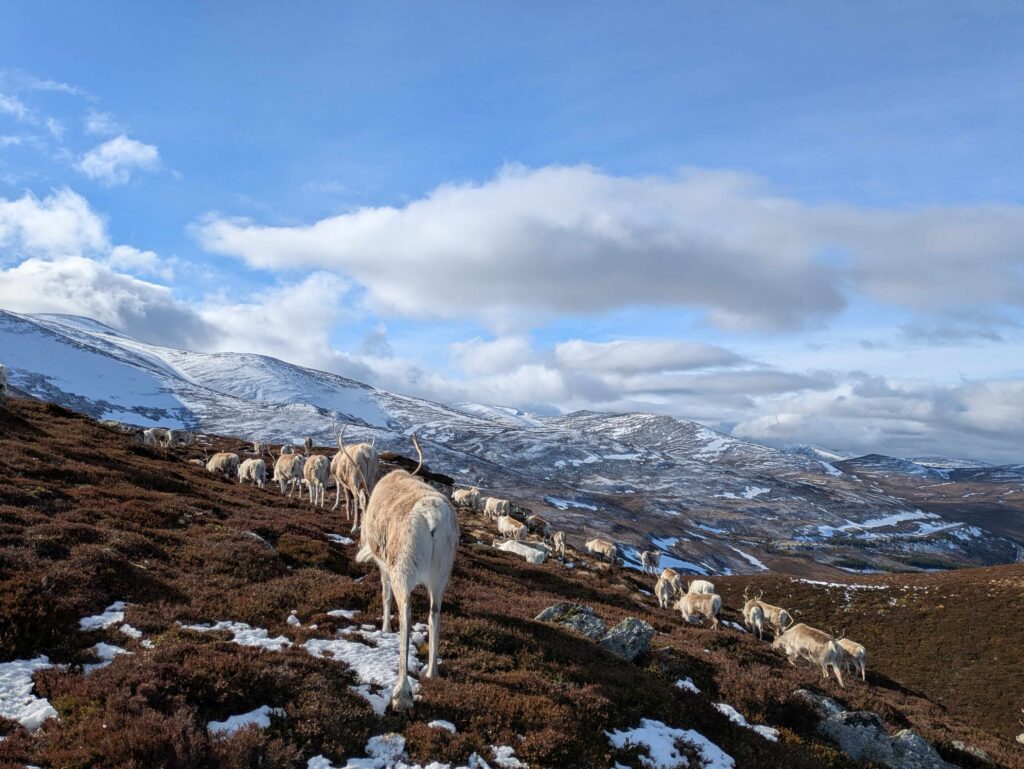
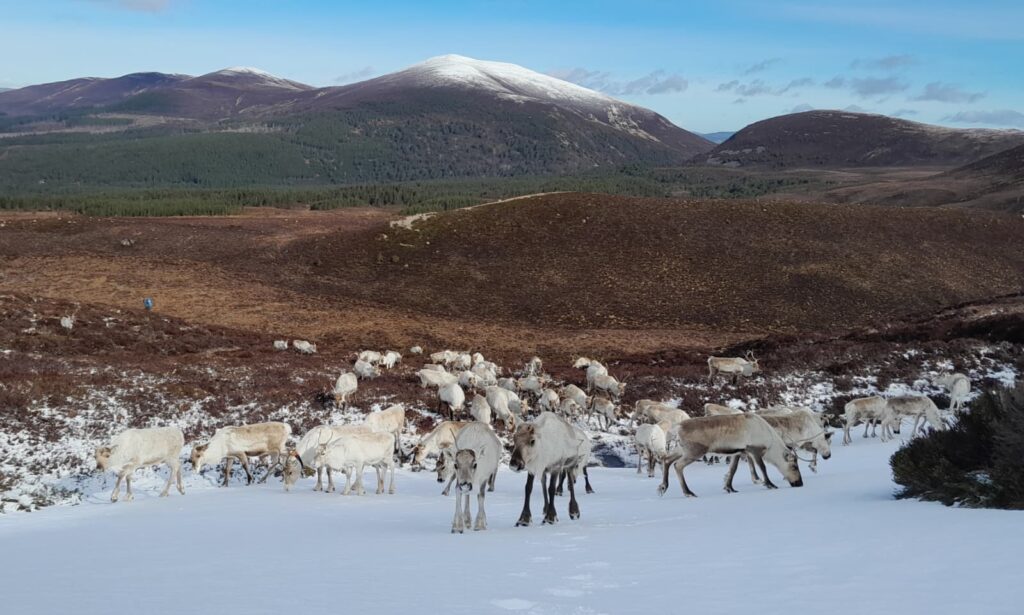
Free – ranging season provides the most stunning views of the reindeer with the backdrop of the beautiful Cairngorm mountains.
It’s also a fantastic time of year for us herders, getting to move the reindeer around the hills every morning, and take guests out to see them in their natural habitat with no fences. So, as free – range season draws to a close for 2026, it’s time to look back on our herders favorite moments.
Can you spot the herder amongst the herd?…
Lotti
Looking back over the last few months, one morning fetching the reindeer immediately sprung to mind as a highlight. To set the scene, the previous day, Andi and I had fetched the reindeer for the morning visit, and both agreed that the reindeer had been slower and more difficult to herd than either of us had EVER seen! Fast forward to the following day, I was feeling tired and whilst the morning walk out to find the reindeer is usually my favourite job, after the day before I was quite happy to do a hill trip instead. But alas, it was not meant to be. As it turned out Daisy was the only herder with enough beans to volunteer to walk out to find the reindeer. At this time of year it takes two of us, one at the front and one at the back, so reluctantly I joined her.
Poor Daisy had to cope with a distinct lack of enthusiasm from me on the walk out which finished with an uphill, off path trudge through the snow. When we reached the top of the hill though, we were greeted with the most wonderful sight, the herd on a snowy hillside with the beautiful mountains of the Cairngorm’s behind them. I have lived and worked here for a wee while, but a view like this still has the ability to take my breath away – I hope that never changes.
Of course, on that day the reindeer were good as gold, and we had the most wonderful time walking them in. I often find that the days when I’m feeling less joie de vivre than usual are the days that the reindeer and the mountains really show off and have the ability to completely change my mood. I couldn’t wipe the grin off my face for the rest of the day!
Orinoco leading the herd across the snowy hillside.
Amy
My favorite day from this winter free range was collecting the reindeer at the start of March. Myself and Hen had walked out to where the reindeer where and it was decided that I would be the person that would walk infront of the reindeer and lure them to the visit spot, whilst Hen would stay at the back of the herd and make sure that we didn’t leave any stragglers behind. At the front I could see that lovely Vienna was very determinedly trudging up the hill behind me, along with the sweetheart that is Ryvita, plus Christie and Cheer had taken a small group of reindeer on a questionable detour into a snowy crevice and Bordeaux was walking off very purposefully in the completely wrong direction. Given Bordeaux’s nature, it is very unusual for her to decide that she isn’t going to follow the herd, so I sat back for a brief second to see how things were going to play out and Bordeaux continued in the direction she was heading- away from myself.
Eventually, I rustled the white bag of hand-feed I was carrying to see if I could catch her attention and then it became evident that Bordeaux was confused about what direction I was going in. You could quite literally see in her face the moment she realised where I was and that I wasn’t in the direction she was expecting. I also loved the urgency she had when she walked off in the wrong direction, there was so much hope that just over the skyline she would be able to snack on some yummy handfood.
Whilst we were waiting for Bordeaux, Vienna is trying to persuade me to give up some hand feed.
Hen
My memory links directly to Amy’s, as I trailed along at the back of the herd keeping them moving in the right direction, like a sheepdog. Unfortunately my short stumpy legs cannot go uphill nearly as fast as a reindeer – or downhill, to be honest – so this role is often somewhat unneccessary when they are moving well as I’m struggling to keep up and can’t do much about stopping them going in the wrong direction anyway. On this particular day the herd had been quite hard work already, really preferring to stay put grazing, but once they were finally moving I clocked Bordeaux heading off in the wrong direction, leading multiple other reindeer with her. We were crossing a really rocky bit of ground and Amy was partway down the hill the other side already, and I remember yelling something rude at Bordeaux… Perhaps she realised at that point she was going the wrong way, or perhaps she’s well-versed in my swearing, but a minute or two later she appeared back in sight, now heading the right way…
I’m not sure this is necessarily my favourite memory, but it’s the one springing to mind right now, and the morning is one I actually have a photo from (although involving the random dog-leg of Bordeaux’s route).
Andi
My highlight of this year’s free-range season was fetching the herd from high on the mountain in a white-out, and having to use a compass bearing to navigate our way down out of the cloud – the first time in my 15 years of herding that I’ve had to rely on a compass whilst leading the herd! You will find out more about that experience in a few months time… keep following the blog!
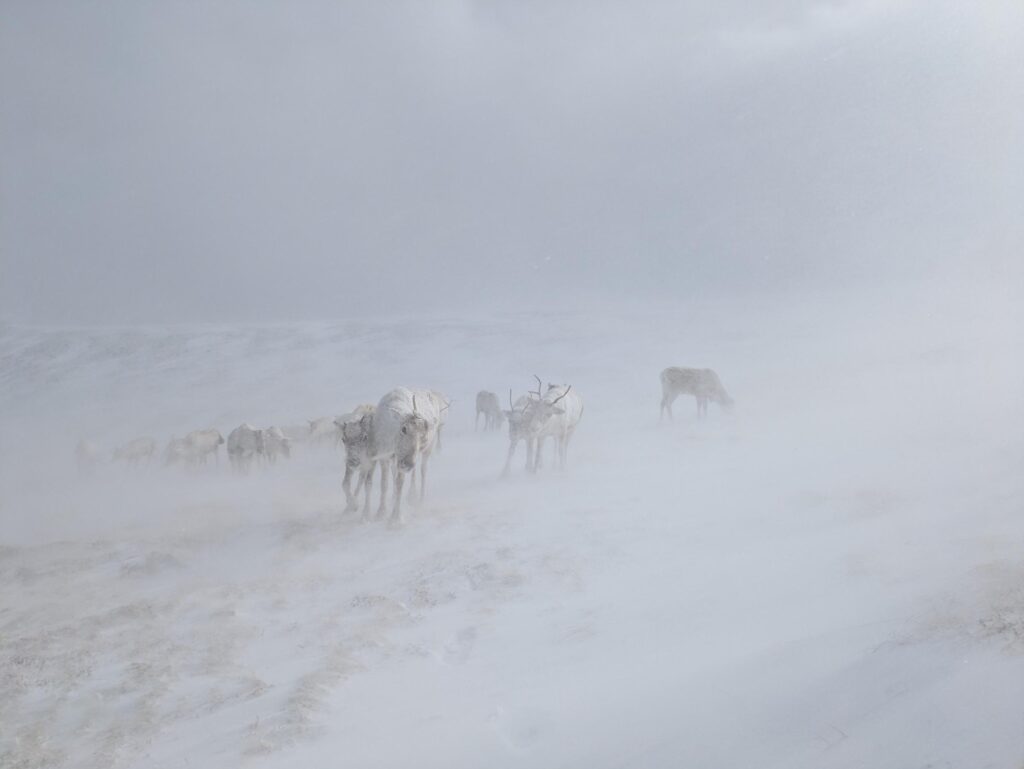
The cows battling the high winds and snow gusts, protecting their calves in the harsh conditions.
Daisy
One of my most memorable moments from my first free-range season has to be the wild weather Saturday of moving reindeer in a blizzard! The day had started with hardly any clouds and blue skies when I first dropped Cam and Sheena off to move the reindeer that morning. But, by the time Andi, Emm and I set off for the Hill Trip, a white out blizzard had struck. I only managed to locate Cam and Sheena thanks to their bright waterproofs! As I waited for Andi, Emm and the Hill Trip guests enough snow had settled against my ski googles that I could hardly see past Juniper stood next to me. The snow was quite short lived though and the guests had the most amazing blue skies and calm breeze with a fresh layer of snow settled on the reindeer for their trip. The hills looked amazing!
After the guests had gone we had the task of moving the reindeer across flats, jump a burn, over the road, and up onto a new set of hills. We set off as the mornings blizzard returned and the winds picked up! It was my second go of leading the reindeer, and seemed quite daunting given the lack of visibility. But the combination of Andi’s hand signals from the back of the herd and Ryvita leading the charge and following my calls, meant we successfully crossed the burn and got them up onto the road. With a cluster of cars parked up in the middle of the road, everyone hanging out their windows to record the reindeer – the entire female herd of 73 steadily came into view as they ran across the road and up onto the bank of the next hill in a quick single file. I never get over how fantastic it is to see the reindeer rush over the road, and how excited all of the passing drivers are, but with the snow falling and having just herded them through a blizzard – it was pure magic. From there it was up onto the flat of the next hill and to give the reindeer some well deserved food, and then back to the centre for a hot cup of tea (and several custard creams)!
Chilling with Ryvita before the blizzard returned.
Maisy
My favourite moment in this winter free range was when Cam and I went out to fetch reindeer for the morning visit at the start of April. It was a stunner of a day with most of the snow gone which was meant to make it easy walking, however Cam decided to take us through deap heather and across a large river from the snow melt. Thank god I had my big wellies on! We headed along then up to where we thought the reindeer were. We arrived for where we last spied the herd, but they were nowhere to be seen. We had lost our 73 reindeer! I thought they had gone back the way we came, but Cam said that they probably carried on round the side of the hill. I suggested for us to split up to cover more area, so off we went in oposite directions with our walkie talkies turned on. All I could hear as I was walking back round the direction we came from was silence from Cams end. I was thinking about heading back and looking else where until I saw them! I was right. Cam was wrong… The reindeer had gone the way we wanted them to. Cam made us walk straight past them! Once Cam evantually caught me up with the reindeer (he took ages), I lead the herd up towards the visit spot (this was actually my first time leading reindeer on the free range!). Some were more enthusiastic than others to follow. We made it to the spot and awaited for Daisy’s arrival in the sun (which took longer than expected as she also got lost… what can you do?).
Can you spot Cam miles in the distance?…
Cameron
Erm… That’s not how I remember it!
Editor’s Note: This is all we could get out of Cam for his offical response.
Fiona
Being an old timer when it comes to reindeer herding I often end up leading the herd in for their morning feed rather than being the sheep dog at the back to keep them moving. This year we had a few newbies herders join our team and this was their first winter fetching reindeer so I took this on board and mostly lead the herd, even though everyone’s favourite job is at the back. At the back you just get to hang out, at a sensible pace and you don’t have to choose the route so when given the choice this is where most herders would want to be. Mid March I went out with Amy (another old timer) and this time I didn’t give her the choice, I opted for following along at the back. It was a glorious day, blue skies, sunshine and snow… Just perfect! I spent most of the time taking videos and photo’s and sending them to everyone I knew working an office job that day boasting about my morning. It’s days like this that make you forget about the wet, windy and claggy days that end up being a total mission and therefore restoring your faith in Scottish winters!
Nice butt(s)!
Kate
Free-range season is a real mix. The weather can be truly awful, and on days the reindeer are feeling stubborn, moving them can be a long and difficult slog. But sometimes, you get a bluebird day when the sun is out and the reindeer are hungry and cooperative, and these are some of my favourite mornings throughout the whole year. Me and ‘The Aisies’ (that’s Daisy and Maisy) headed out on a lovely blue-sky day in March to move the herd. We wouldn’t be returning by the same path, so Cam kindly dropped the morning feed at our destination (thanks, Cam!). We could see him from a distance, making his way to drop the bag. “He looks like a tick!” Daisy said. I then had to explain to her how perspective works and that things look smaller at a distance… Walking out without a heavy bag always nice. We found the herd at the crest of the hill, a few were up and picking through the snow to graze, but most were dozing in the sunshine. They were initially slow to get going, and split into two groups which can make things difficult, but having three herders is a luxury and made it much easier to keep the herd moving in the right direction. I led, the Aisies herded at the back, and we skirted around the slopes easily enough, until we hit some big snow patches and the reindeer started to pick up speed. Eventually, Emmental decided she knew exactly where we were going and passed us. The herd followed, and most of them rushed over the snow to gather ahead, where the feed was waiting. I waited for Daisy and Maisy to catch up and we enjoyed having the last few minutes of the walk to just enjoy the sunshine and chat.
A lot of our most memorable days on the free-range are the big adventures, when it’s difficult, and you feel exhausted but accomplished at the end of it, but I always love the calm mornings, when things are easy, the sun is out, and you have enough time to stop for a moment and appreciate the reindeer and the incredible place we live.
Emmental and her son, Oro, leading the herd, 7th March 2026
Sheena
I think we all love heading out to look for reindeer in the morning when they are free ranging on the high slopes of Cairngorm. My most memorable walk out this year was with Cameron, just at the end of winter start of spring. Our biggest challenge was what to wear. The weather was sunny one minute and then full on winter blizzard… So a full set of winter waterproofs, gloves, hats, hoods and last minute went back for ski goggles! We had a long walk and luckily we spotted them just before the weather changed into a white out snow storm. Goggles on time.
We had several challenging stream crossings, the first one had a big snow drift over it and was very dodgy spring soft snow, so we went for a crossing area up stream, with a good helping hand from Cameron when I jumped over, so no wet boots for me. After locating the reindeer Cameron lead the way as our plan was to move the reindeer to an area easier for our visitors on the hill trip, it took 30 mins in white out condition. Just as we got near our Hill Trip spot, we saw a hill walker on the hill path who unfortunately had a very noisey dog and, two barks later the reindeer turned on their hoofs and headed back up the hill! Luckily the sun came out, blue sky and we caught up with the herd not too much higher and changed our visit location as the weather was now sunny. It was now a safe option for our visitors. Cameron and I had a good work out and I wish I had a step counter that day – it would have been miles.
You may have caught the wonderful video of Sheena and our lovely Holy Moley post blizzard hike! If not you can watch it on our facebook page here.
Alicia
March has been my first taste of the free-range season, and thus has been host to many small ‘firsts’ for me! First time leading free-range Hill Trips, first time seeing the girls out in the mountains (leading them off the road in December doesn’t count!), first time out with radios trying to bring the girls to a nice spot for the Hill Trip in the mornings…
My favourite memory from this season was also my most trying morning. Fiona and I hiked out in the morning, braving blue skies but 30+ mph winds (which is quite a lot when you’re carrying a lot of reindeer feed on your back!). The cows and calves were happily resting in a little gully when we came upon them, and they were very much not in the mood for moving on! I was the ‘sheep-dog’ at the back of the herd trying to encourage some rather stubborn lassies on from the nice patches of lichen they had found, all the while unsuccessfully dodging boggy sections of ground. After finding a safe way to cross the river, I gave a quick celebratory ‘Yes!’, before promptly falling into a bog on my next step…
All smiles pre bog fall…
——————
Hope you enjoyed all our favourite moments from 2026, and here’s to free – range season 2027!
April started with snow showers and continued with frequent snowy showers higher in the hills nearly to the end of the month. Throughout the month we have definitely started to see the signs of spring lower down, with the Blaeberry beginning to flower and the mountain flora becoming greener!
Our female reindeer enjoyed a few more weeks out on the free range before we moved them into our hill enclosure in preparation for the Calving season; there are definitely a few big bellies and udders starting to form. Every year the reindeer herders partake in a calving bet which involves us choosing a reindeer and hoping that they are not the last to calve. If they do, we are required to bake a cake for us to enjoy when we name the calves in September; it isn’t the worst if you lose the calving bet. Some herders chose strategically and others chose their favourite reindeer, so by the end of April all the calving bets are in, and it has become a waiting game!
1st of April: After taking visitors out to see the reindeer in the morning, when there was no snow, this was an absolute treat to find them again in the afternoon! You can see Disco on the left, Sundae behind her, Turtle on the right and Tetley.2nd of April: Disco has lost one of her antlers over night. Here is Disco and Latte leading the herd over the the Hill Trip spot. 3rd of April: A trip to see the reindeer over on our Hill farm. From left to right we have Caterpillar, Mangetout, Merida, Spartan, Hemp, Oatcake, Spy, Pumpkin, Brie, Mushy and Busby 4th of April: Beautiful Amazon looking for extra food after the Hill Trip. Over the last year Amazon has grown in confidence and is very greedy.5th of April: As you can seen the snow hung around lower down for a few days. Here is Chai and Camomile scouting out whether i’ll offer more food.7th of April: A suprise visit from Ruth and Baby M9th of April: Despite Cheer having an epic set of antlers, this didn’t deter Trilby from a bit of antler sparring. At the time, Trilby only had half of one antler left. They will both soon lose these antlers in preperation for a new set to grow.10th of April: Hopscotch and Foxtrot leading the herd over a steep sided ridge, the herd didn’t bat an eyelid, and it often amazes me the places the herd chooses to rest. 15th of April: Ryvita, Sika, Christie and Winnie in the Mid ground. Ryvita has the start of her new antlers growing. I often find at this stage the reindeer often look a little like Giraffe. 16th of April: Tetley with Latte excelling at jumping the burn in the background. Turns out reindeer can be agile!18th of April: Our cows and calves are now in our hill enclosure before we split our pregnant females, who will stay in the hill enclosure for the calving season which will start in May. Here is lovely Shannon enjoying some feed after the Hill Trip.19th of April: Before coming over to our hill enclosure, Brie spent her time free ranging at our secondary site. 21st of April: Here come the boys! Dr Seuss (on the left) and Cowboy (on the right) leading the boys up for their feed.
So far during March we have encountered all manners of weather, thankfully though in comparison to January and February there has been an increase in good weather days. During the start of the month, we had beautiful blue skies and even a fresh dumping of snow. The reindeer have been amicable, meaning that our walks out to collect them in the morning have been a bit easier than the previous months; once they find a good patch to graze on it can be hard to move them again and as you can imagine there is fresh grazing begining to sprout on the mountain side.
It is usual in March for some of our younger reindeer to come down to lower ground at our secondary site and in return a handful of reindeer were returned to us here at Cairngorm. The most important being Winnie of course- she has been missed!
Over the last month our cows have began to lose their antlers and there are now a few of our girls walking around with no antlers on their head. By the end of the month, Ryvita, one of our 16 year old females has began to grow a new set!
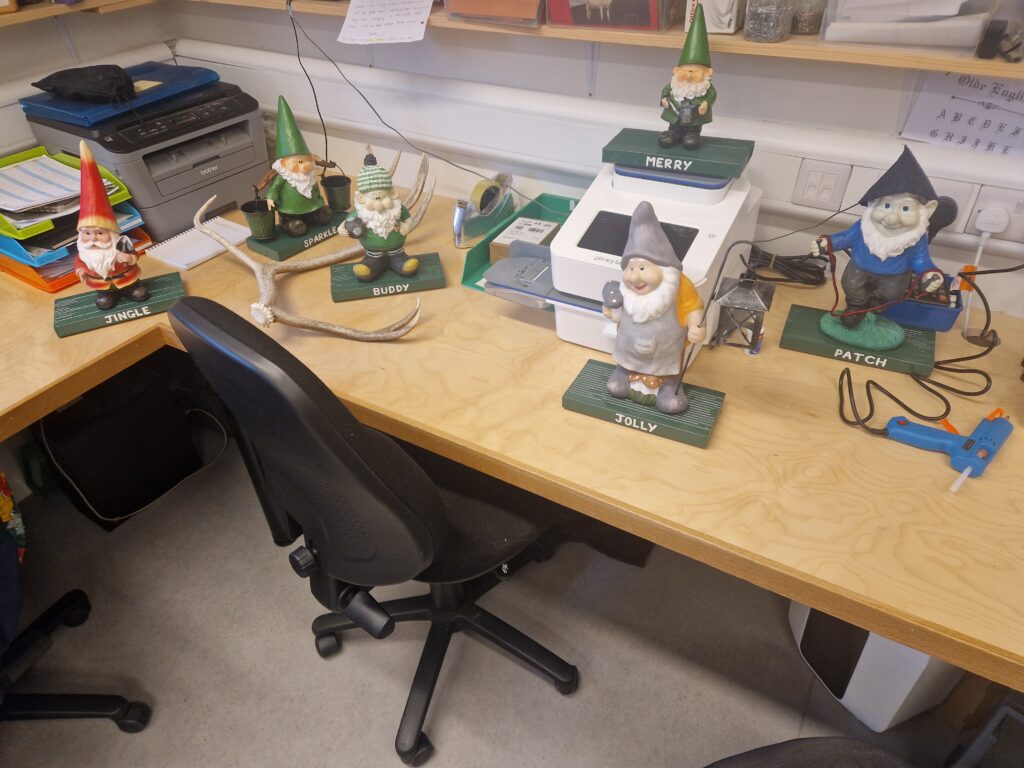
4th of March: Celidh with Mum Glacee on her right. These two are definitely continuing their families fiesty character.6th of March: Fresh snow fall means that most grazing is covered. Thankfully pip’s fluffy nose is protecting her from the effects of the cold.6th of March: Winnie is back!!8th of March: Ryvita and Vienna leading the herd on our way to the visit spot. In previous years, Vienna was often found at the back of the herd, not this year, she is pretty determined to make sure she is at the front of the group.15th of March: After almost a week a way from work it was a wet morning to collect reindeer. Here is a very soggy Lapsang.15th of March: Fox trot and Oro are questioning their choices at the back of the herd during the morning walk to the visit spot.17th of March: Moving left to right- Peanut, Polka, Pip and Lolly all eating off the feed line during todays Hill Trip – it was a blustery one!18th of March: We are hitting the time of the year were our female reindeer are begining to lose their antlers. Here is Lapsang again with only one antler.18th of March: Christie also sporting one antler with Mississippi behind.22nd of March: Our christmas elves are observing the office and making sure we are working hard!25th of March: Bordeaux and Zambezi waiting patiently for extra feed after the Hill Trip.26th of March: Fika (one of our young females, born in 2024) first in line for the morning feed! 26th of March: Ryvita showing off that her new antlers have begun to grow. 26th of March: Finishing up with a picture of Alba, who is currently at our secondary site, as we cannot mention Winnie without including Alba! As the girls have matured they have forged their own paths in the herd and it isn’t very often that we find them both together.
February is the month that we ease ourselves back into Hill Trips again after being closed for a month. From mid-January to mid-February, we are trying to catch up with general maintenance and into February prepare for being open to the public again. The start of the month consisted of feeding reindeer, ensuring we are prepared for opening and we also spared some time to visit one of the Lynx reintroductions drop in’s that have been happening in the area.
The 7th of February was our first day open to the public. It is always a bit of a daunting thought, and you’re left hoping that you remember how to talk about reindeer and that you have hopefully remembered everything that needs done first thing in the morning. But these anxious thoughts were soon squashed by our first Hill Trip of the season, the weather was good and how to be a public facing reindeer herder came flooding back!
The weather at this time of the year can be challenging and trying to take a picture that encompasses how brutal the weather is on a hill trip is hard. Daisy and I did a Hill Trip on the 11th, and the conditions were rather wintery. The met office report for the day told us that the max wind gust at Base Station was to be 26 MPH, our Hill Trip that day was lower than Base Station and the wind was enough to knock you off balance, so I feel it may have been a little stronger than that! I do love the variation that we get in weather as it makes the good weather days feel special.
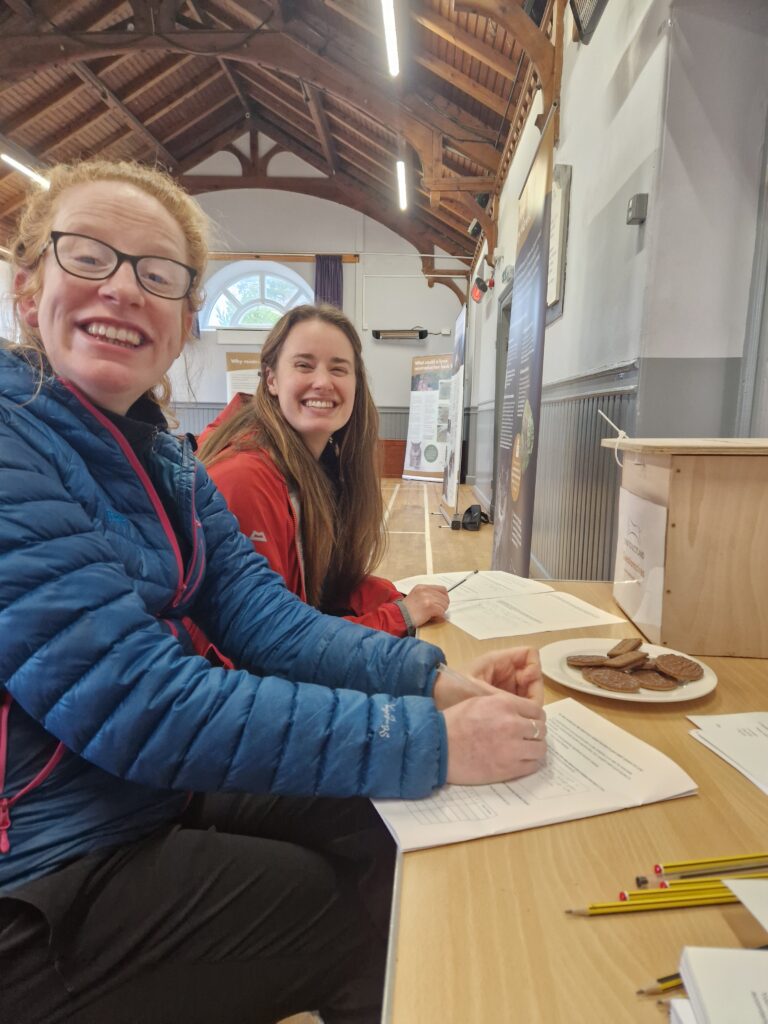
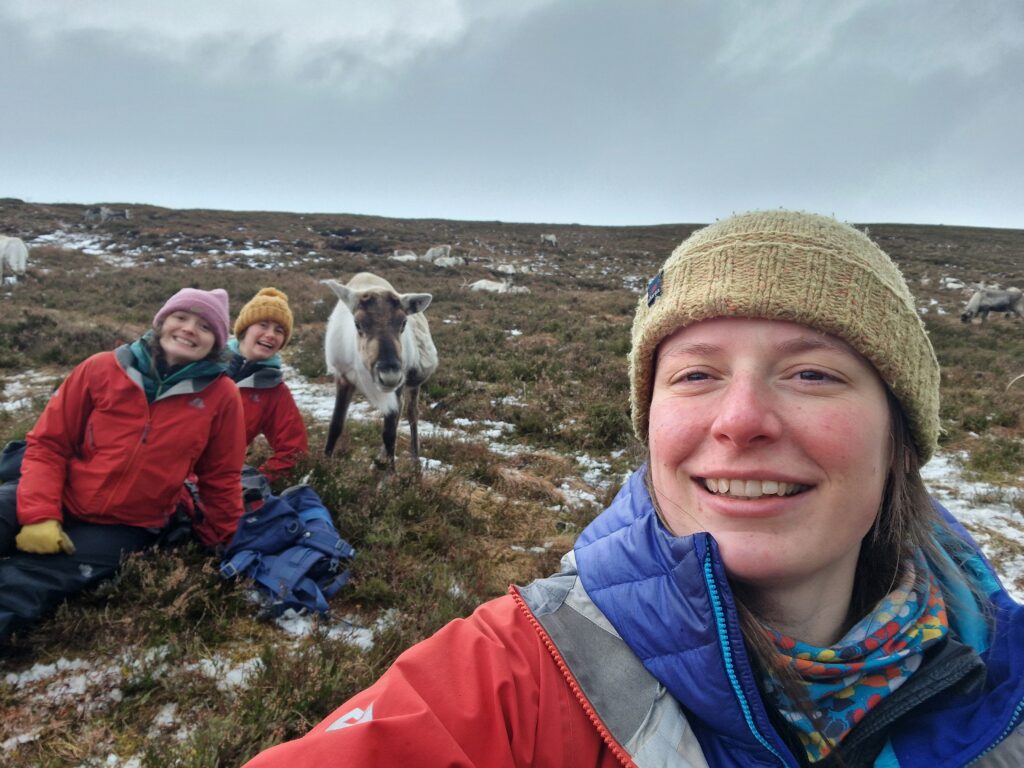
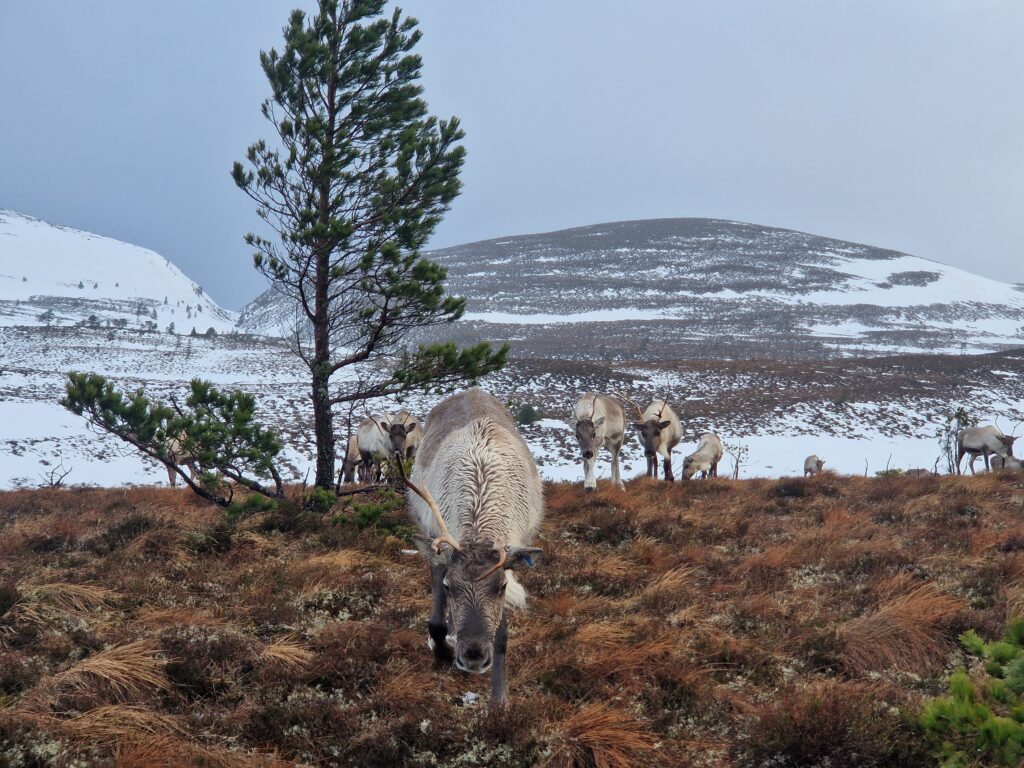
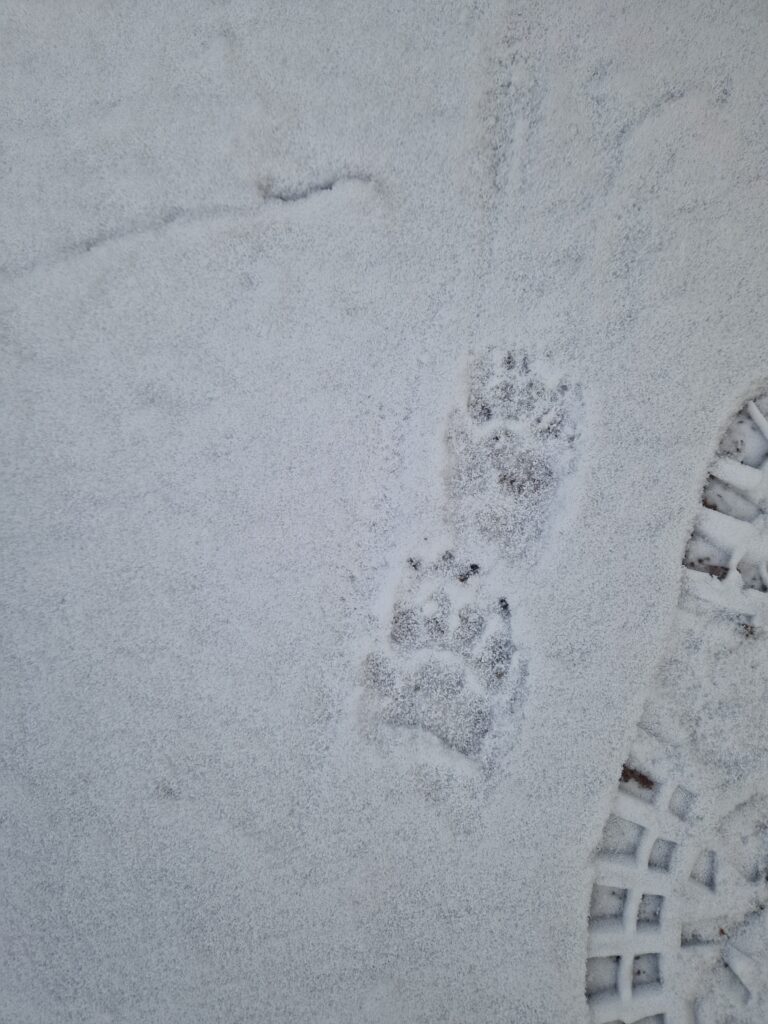
4th of February: Left to Right- Suebi, Orinocco, Bolero, Ceilidh and Glacée on a very blustery trip out to feed the herd before we begin Hill Trips again. 5th of February: Ruth and Lotti enjoying biscuits whilst completing their Lynx questionaires. 7th of February: Myself, Kate and Maisy with Ryvita after the first Hill Trip of the new season.8th of February: Trilby leading the herd in for our morning Hill Trip with Disco on her left, Tango and then Pip.11th of February: On the walk out to the reindeer myself and Cameron noticed some unusual prints in the snow… Possibly Badger prints?11th of February: Cameron teaching his merry band of calves bad habits 11th of February: Above is Beautiful Solero. This was the first day of good weather we had seen in a while, so plenty of pictures were taken!15th of February: Another mission to collect the reindeer before our 11 am Hill Trip. In the fore ground (left-right) we have Dante, Disco and Bolero.18th of February: The first day of the season where we had to cancel the Hill Trip due to the weather. Sanna, Fraoch and myself agree that it was the best call! 19th of February: Daisy clinging on for her life on a very windy walk out to collect the reindeer in the morning.22nd of February: Vienna, often found snooping around us herders looking for extra food. 25th of February: Polka leading the herd in before our Hill Trip.
I volunteered with the Cairngorm Reindeer Centre in September from the 22nd to the 26th after being accepted which I was so happy about as I have been a fan of the Centre since moving from England up to the Highlands five years ago. I fell in love with Aviemore and the Cairngorms quite early on and experienced a Hill Trip after my husband surprised me with a reindeer adoption (Dr Seuss) for my birthday and since that I have been on three further Hill Trips in varying weather but particularly enjoyed it in snow.
I love reindeer, I find them fascinating, beautiful, calm, serene and endlessly photogenic plus I have acquired a passion for wildlife in the Highlands from seals, dolphins, whales, deer and to my favourite animal which is the reindeer. I am a very keen hiker and am getting to know more of the Cairngorm hills and mountains as time has gone by and my experience grows, so the combination of being amongst my favourite Highland scenery in addition to helping out with this physically demanding and rewarding role was an absolute must for me.
I am also a photographer who specialises in landscapes, locations, scenery and mountains but not much experience of wildlife so I really wanted to explore how to capture these majestic and friendly animals.
On my first day at the Centre I was struck by the amazing images that have been taken by herders already and that are produced into postcards, calendars and prints in the beautifully presented and stocked shop which only opened earlier this year. I noticed that landscape was the preferred format for a postcard and was inspired to try and produce my own stunning image when I first went out into the Paddocks and then onto one of my many Hill Trips that week. I was blessed with great weather luckily, some lovely blue skies combined with dramatic cloud over the Cairngorm range and plenty of sun too.
Anna’s inspiration to take the perfect photo.
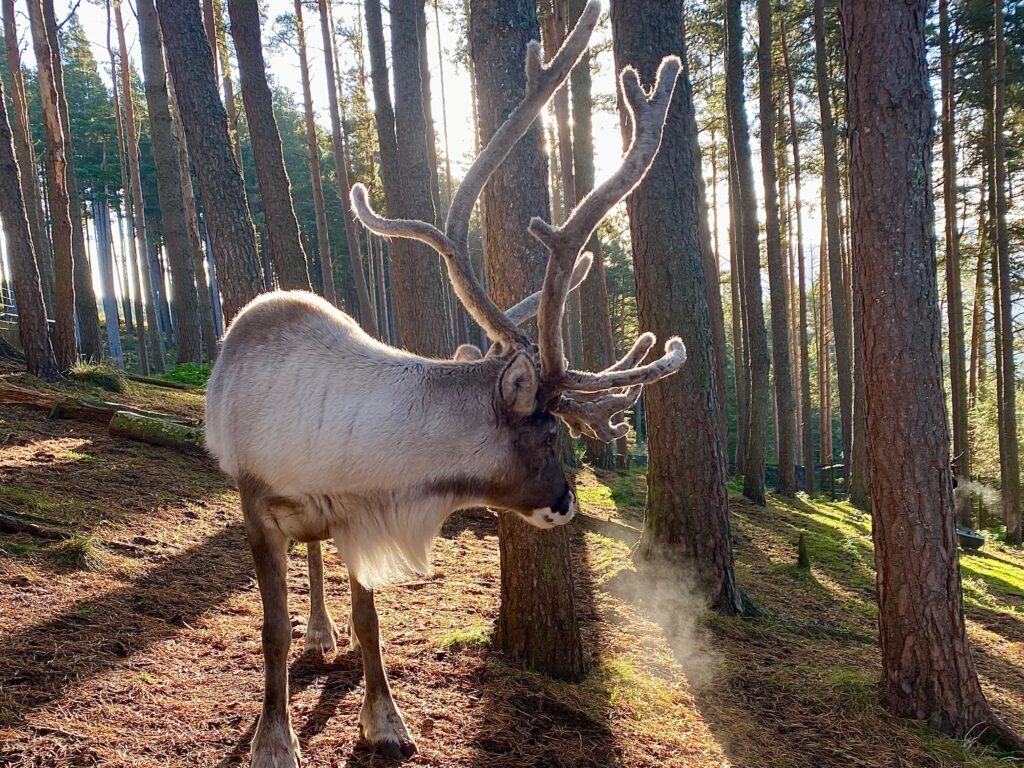
My first attempt was to capture the reindeer in the Paddocks first thing in the morning when the cold breath was visible from their nostrils and the trees surrounding them made the early sunlight more interesting.
Adzuki in the woods.
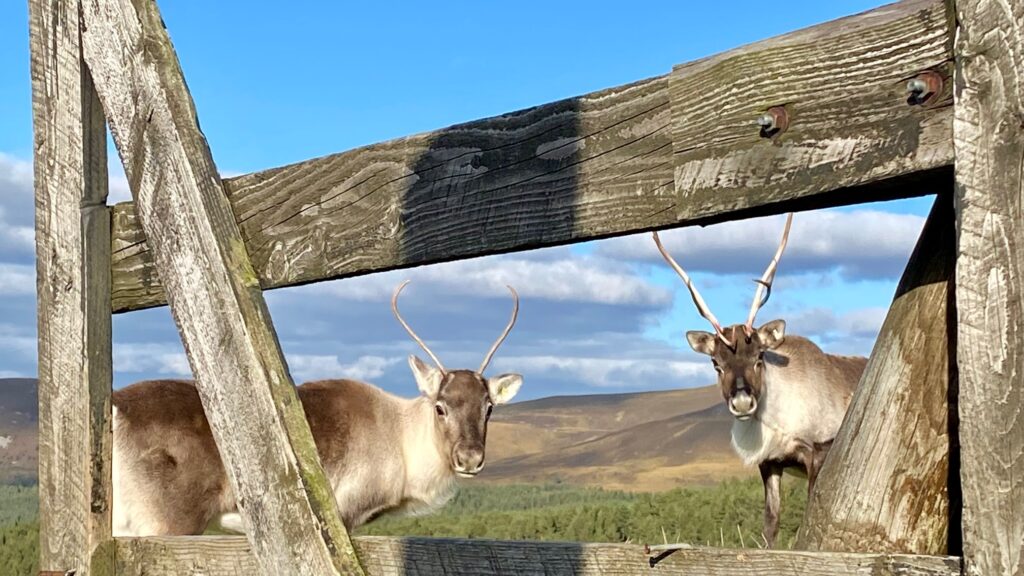
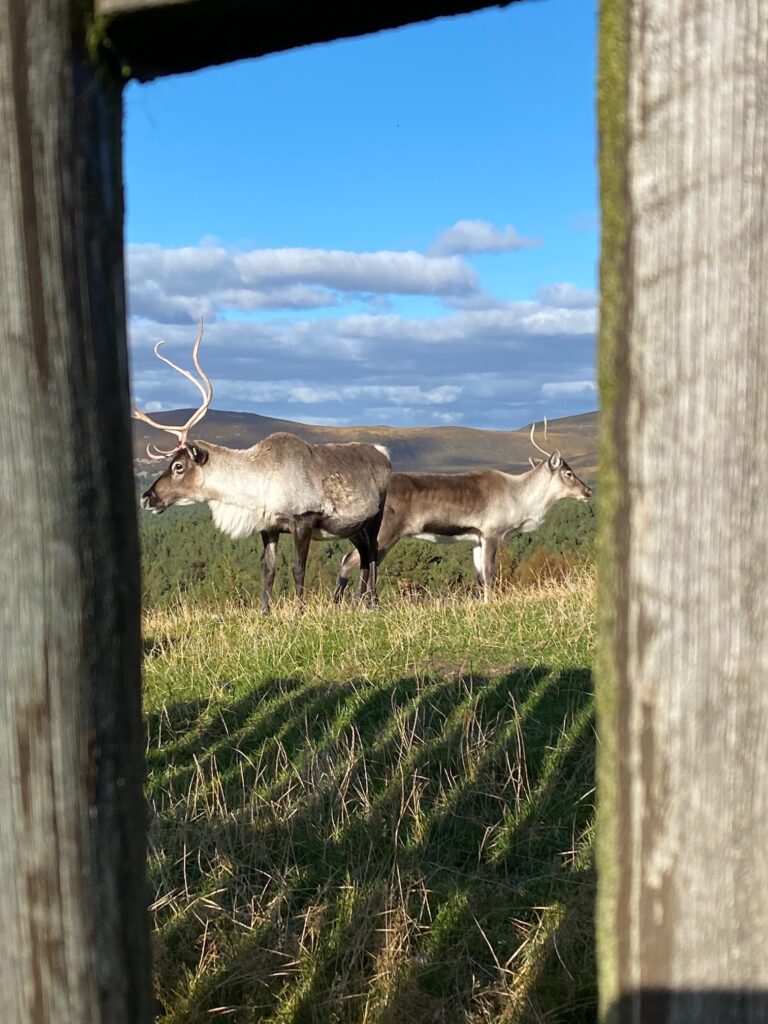
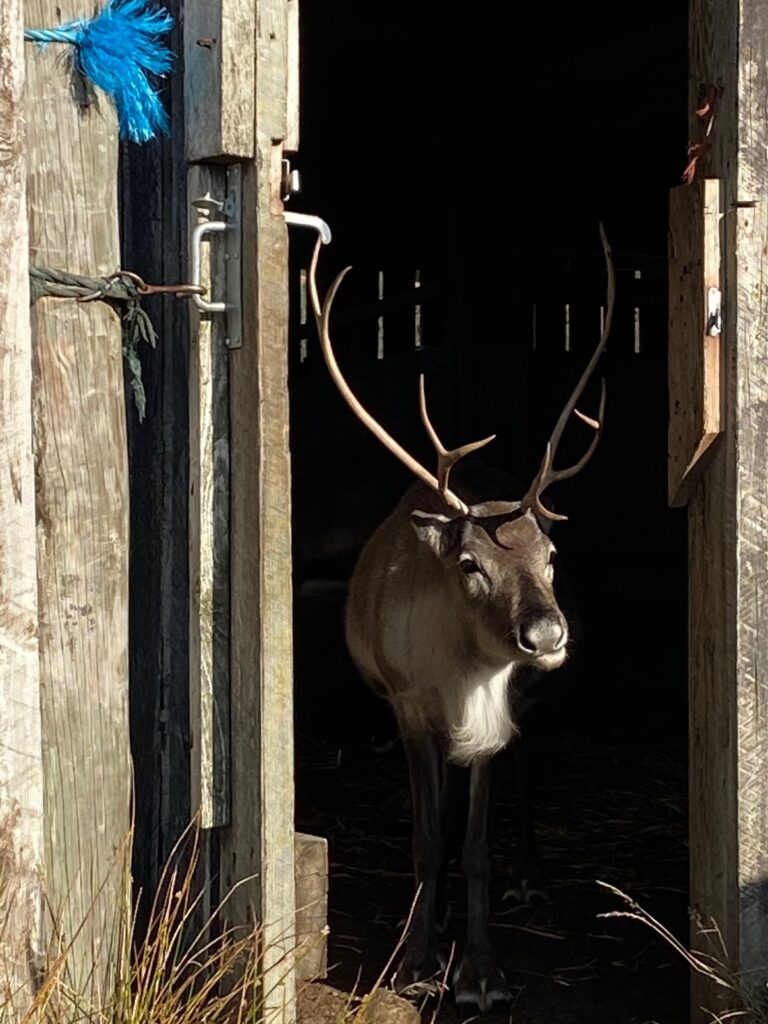
My second attempt was when I was up at the top area of the hill enclosure with the other herders tending to a couple of poorly reindeer and while I had a few moments I managed to snap the other reindeer through the fence and a gate, plus an open door of the shed. There was I thinking I was clever and that I’d nailed it I went and showed Fiona back at the Centre, who has taken her own amazing photos over time that have made it on postcards. She told me very nicely that anything interrupting the view of the reindeer does not appeal to the public as they prefer to see the animals in their natural, free habitat without fences etc, great advice which I straight away took on board, even if a little crest fallen…
Tetley and Ryvita shot through the gate into the hill enclosure.Another angle of Ryvita and Tetley.Alba waiting at the entrance to the shed.
On my other Hill Trips once we had done our jobs feeding the reindeer and engaging with the public, answering their questions or taking photos of them with the reindeer near them, I was able to walk around a bit and try to get my own images from that day, depending on which reindeer was still enough or what would strike me as an interesting shot.
Busby walking up the boardwalk.Jester with Haka between his antlers.
I did manage to get a couple of photos through the antlers with a reindeer herder in the background which was a treatand I was very lucky one lovely day when I spotted the most amazing reindeer under the big photogenic tree with Meall a’ Bhuachaille (the hill) behind it and I took a few different pics while it was reaching up to the branches of the tree as if it was a giraffe on the African plains feeding from the high up leaves and then the same reindeer around the base of the tree with beautiful sunlight on it.
Herder Kate and reindeer Peanut taken through Caterpillar’s antlers.Popsicle under a pine tree with Meall a’ Bhuachaille in the background.Popsicle under the tree.Popsicle again with beautiful sunlight.
On my very last day I was blessed at the end of the second Hill Trip with a quick dash up to the ridge with Maisie to call and feed the roaming reindeer. on the top of that ridge (which I have hiked many times before) you get the most incredible view of the Cairngorm plateau so I was very happy to be in one of my favourite places. Maisie did a brilliant job of calling the small herd who swiftly ran down into the valley below and headed up into the wild heather just below us to have some food. I was amazed by the stunning scenery around me and the very beautiful reindeer with pristine antlers that came and stood right in front of me, so I promptly fell back into the soft heather behind me and started to photograph this unique scene.
Falling back into the heather to take in the moment.A lovely close up of Alba. Beautiful Alba again.
I believe I was very fortunate that afternoon to have the blue sky, mountains with the dramatic cloud and the joy of the prettiest reindeer around. Maisie did also take a photo of me with Cairngorms behind me which I very much appreciated.
Soaking in the views and the reindeer – Latte and Cheer (white face) closest to the camera. Anna and the reindeer, Zambezi is at the front stripping the velvet from her antlers.
Of course I did not want to leave at the end of the week as I was so loving being in this familiar environment with the animals that I had admired for ages and the herders that I had wanted to be like and learn from too, who all turned out to be amazing, helpful and friendly. What I learnt in those five days will stay with me for ever and the gratitude I have for the most amazing experience is as real as the reindeer and I remain hopeful that maybe one day a photo of mine will make it into the shop…
September is a beautiful time of year. We’ve had the first snow on the plateau and lovely autumnal sunny days. The odd soggy day too, of course! The reindeer look fantastic with fully grown antlers and fresh winter coats growing through.
We’ve been doing lots of free range missions to bring in the cows and their calves which is always fun. The bulls and cows have been stripping the velvet and getting a wee bit more feisty and hormonal in preparation for the upcoming rut. We split the first bull, Choc-ice, with a small group of girls on the 22nd – exciting times!
The calves have also been given a name but as always we don’t post any names online until our adopters have their newsletters. Maybe by next month’s photo blog!
1st of September: Cheer and her daughter Chai in the background. 1st of September: The time of year when the bulls start stripping the velvet. Here is two-year-old Limpopo looking very handsome. 3rd of September: Emmental and her calf back in the enclosure after a summer of free ranging. 3rd of September: A family portrait! Irish, his wee sister, and his mum, Helsinki. Since Helsinki has been back in our enclosure, one-year-old Irish has become rather attached to his mum again! Helsinki is very tolerant and shares her pile of food with her teenage son. 4th of September: Bordeaux and her son. These two didn’t come in for their breakfast so I got a lovely walk up Silver Mount to find them and return them to the herd. Both were completely fine and clearly just having a lie-in. 4th of September: Elbe, a twin, is looking phenomenal! He’s two years old and has a really lovely nature! We’re all very fond of him. 4th of September: Peanut’s male calf is looking great and is already quite tame. 4th of September: Two freckly white noses trying to get into the hand feed bag. Sundae on the left and Beanie on the right. 9th of September: The calves in the enclosure have quickly learnt what’s in the bags! They get allowed to feed directly from the bags which encourages them to be tamer and so they can get some extra mouthfuls without a bigger reindeer stealing it from them. Zoom and Choc-ice are circling the bags like piranhas! 10th of September: One of our gorgeous calves. This wee one belongs to Hopscotch. 10th of September: Glacée and her daughter. She’s done so well as a first time mum!11th of September: Lotti and Kate feeding the herd. 11th of September: Moving some of our free rangers from outside the cafe on Cairngorm Mountain! Sunflower, Fika and Solero are the three closest to camera. Fika and Solero are stripping the velvet from their antlers. 15th of September: Old girl Ryvita on a very soggy day. She’s now back out free ranging but came into the enclosure for a few days for a health check and vaccination. She’s looking great for 16!16th of September: Brie posing beautifully on a lovely autumnal morning. 16th of September: The calves are allowed to feed from the bags before we put it out on the ground for everyone else. You can see the older reindeer lurking around the edge and Cameron and Kate on guard duty!17th of September: Amazon is now two years old. Her mum Dante is just behind. 17th of September: Christie has done it again! She looks phenomenal and has produced yet another lovely, chilled-out wee dude!18th of September: Jimmy looking very handsome.22nd of September: Winnie looking gorgeous in the beautiful autumnal light! She was hand reared in 2023 and has come back into the hill enclosure after almost a year out free ranging looking amazing!23rd of September: Morven and her calf. Both have ridiculous antlers!24th of September: Marple and calf. Her calf has turned into a greedy food monster!26th of September: After a week in our Paddocks Dr Seuss is now back in the hill enclosure ready for the 11am Hill Trip and hand feeding!
As the seasons change and we transition from spring into summer our female reindeer will start to move from the lower grounds where they have spent most of the winter, higher onto the hills. This is partly to stay cool as the weather will warm up but also to follow the grazing. In the middle of the winter there will be more snow higher on the hills, meaning further for the reindeer to dig but in the summer the tops of the hills are where the best grazing is.
Waving the cows and calves off to spend the summer free-ranging.
For our reindeer this migration may be only a few miles but across the world, reindeer and caribou (which are genetically the same as reindeer but haven’t been domesticated) migrate long distances. In fact, caribou hold the record for the longest land migration of any animal, migrating a whopping 2,000 miles between their summer and winter-feeding grounds. The equivalent records are held by the humpback whale with the longest migration through water of 5,000 miles and the arctic tern with the longest migration through the air with a mind boggling 18,000 miles.
Long Distance Migration (Varpe and Bauer).Arctic Tern.Humpback.
2,000 miles is still an incredibly long way and takes the caribou first to their spring calving grounds near the coast. The spring calving grounds are highly fertile, providing lots of food for the new mums and free of predators, which is important as the young are born. This sounds like the ideal location to spend the summer and perhaps it would be if it wasn’t for the swarms of mosquitoes that arrive at the start of the summer. These mosquitoes, as well as the warmer weather, drive the caribou to migrate higher onto the hills. They spend the summer grazing on a plethora of different plants and lichens. Summer is a time of abundance in the arctic and sub-arctic regions.
Lace and Ryvita free ranging in the Cairngorms.
With long hours of light, the plants grow quickly, and the reindeer will graze on over 200 different species. This allows the reindeer calves to grow quickly, before the winter. It also allows bulls, cows and calves to all grow a set of antlers. The antlers grow over roughly 5 months and can reach a massive size. The largest set we’ve had in our herd weighed 8.9kg for the pair. It is also important that reindeer gain weight in the summer in order to survive the harsh winter.
Christie’s calf, Espresso, Christie and Borlotti enjoying the best of the summer grazing on the plateau.Glacée and Dante looking fantastic at the end of a summer of free-ranging.
As autumn approaches the reindeer will migrate yet again. As the temperature drops, there will be less to eat high on the hills so the reindeer will move to the lower hills in search of better grazing. It is also the time of year that the mushrooms emerge so many of the reindeer will come into the edge of the woodland to forage mushrooms. They eat many varieties, but the boletus family are their favourite.
In our herd the female reindeer spend the summer months free-ranging and the males spend it in our hill enclosure. This means there is another drive for the females to come to the lower slopes and into the hill enclosure, the boys! The cows know that the rut is held in our hill enclosure each year so when their hormones tell them it’s time to find a mate, they know where to come!
Dante munching on a mushroom.
The migration of the Cairngorm reindeer may be much smaller than reindeer and caribou elsewhere, but it is equally important. It allows the reindeer to move to the best location for each season, following where the best food and climate is.