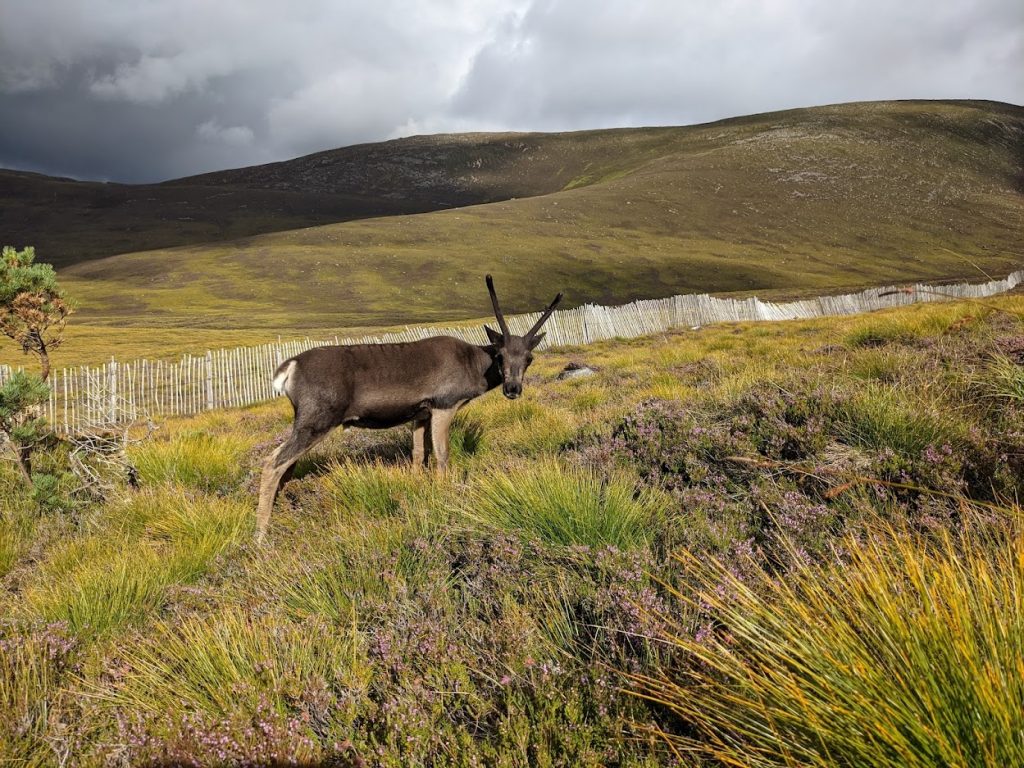
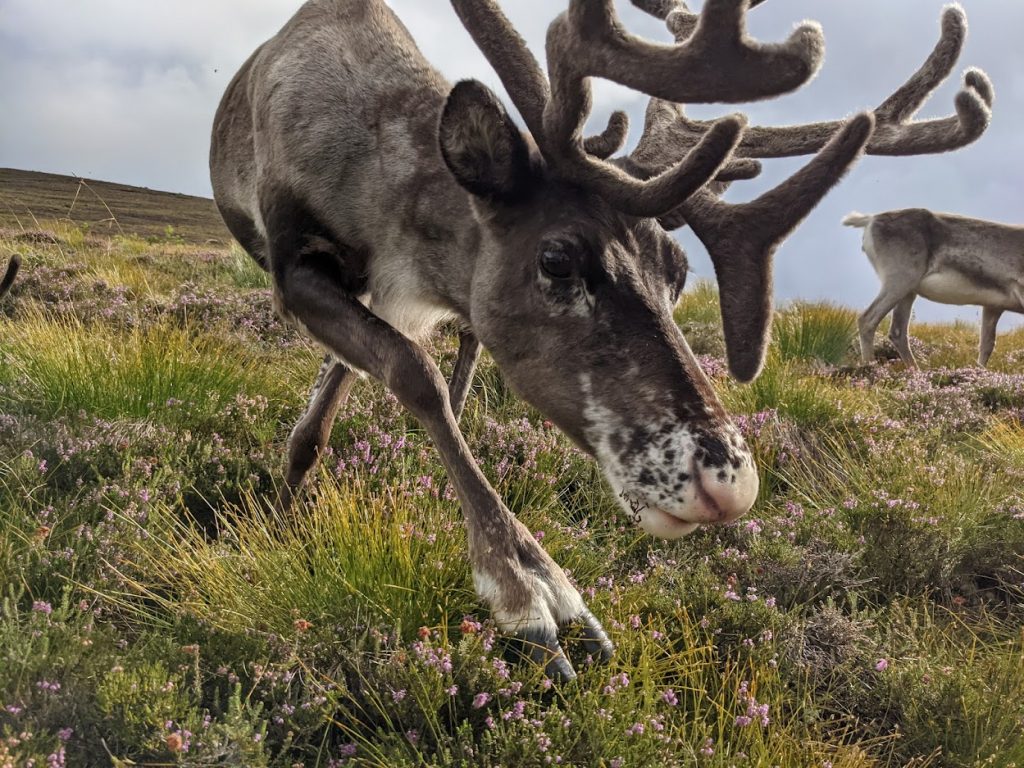
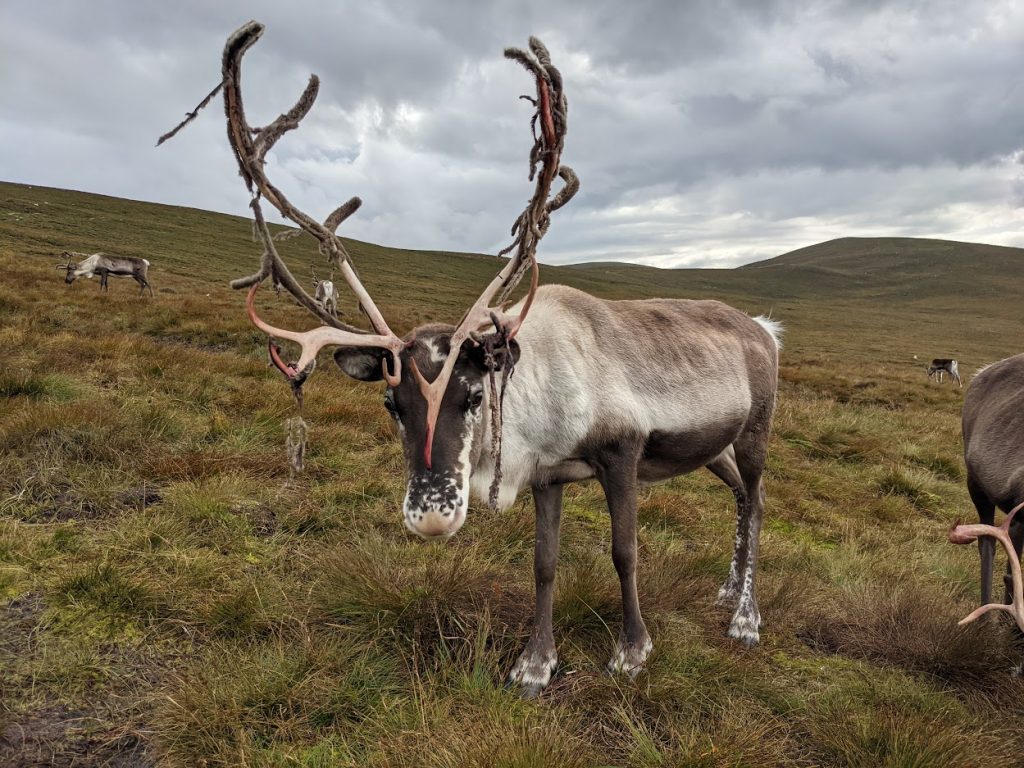
Late summer/autumn is always a very exciting time of the year for a reindeer herder. It’s when we start seeing the cows and calves more regularly after they’ve spent the summer free ranging in the hills.
Each morning we drive up the ski road to Cairngorm Base Station and have a spy for any free ranging reindeer. One morning in mid-September Fiona, Sheena and myself were checking the roads when we spotted a small herd of reindeer. Exciting! Even from a distance we instantly knew there was a calf in the group, and we knew she had to belong to a lovely female called Ochil.
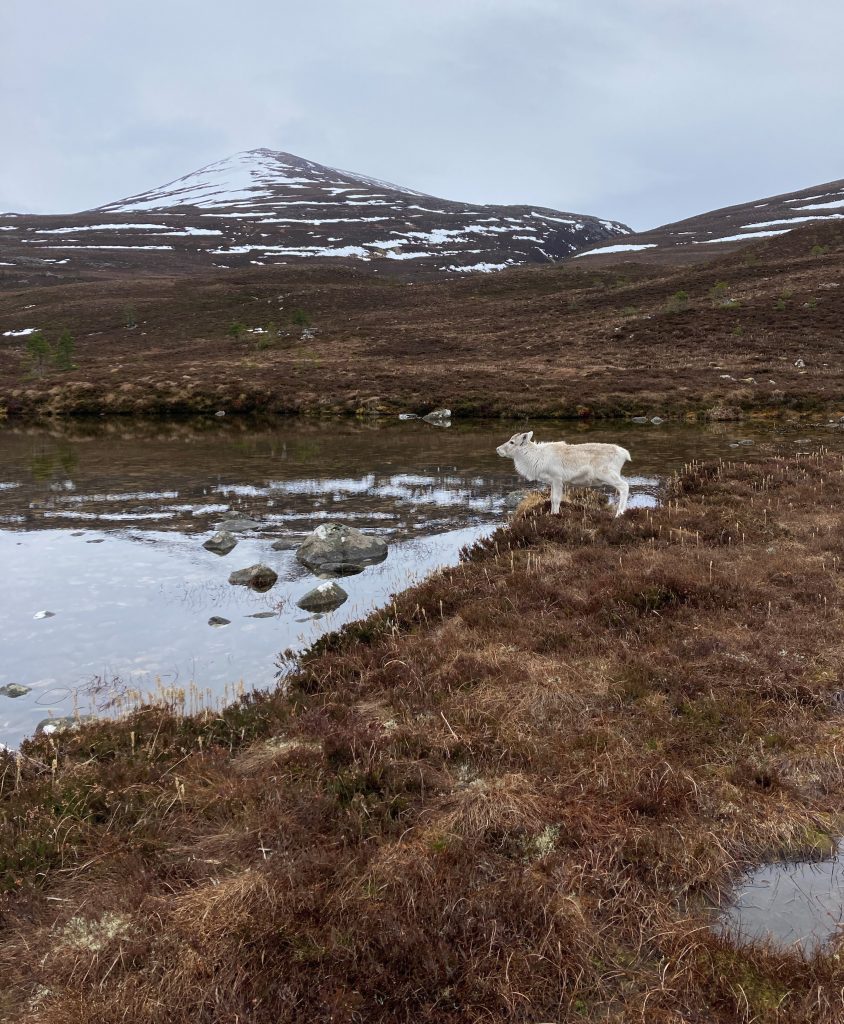
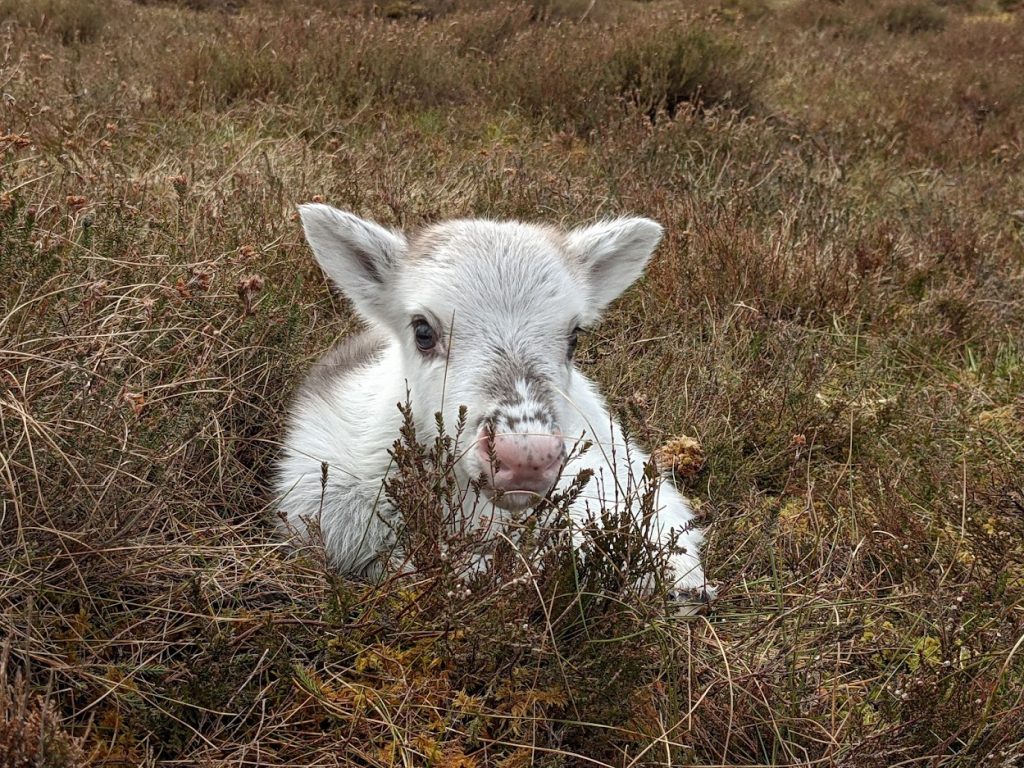
Ochil had a white (leucistic) calf back in May, and even though we had three white calves born this year, the other two were already safely in the enclosure with their mums so it just had to be her – our ID skills of calves from over a hundred metres away are not usually that good!
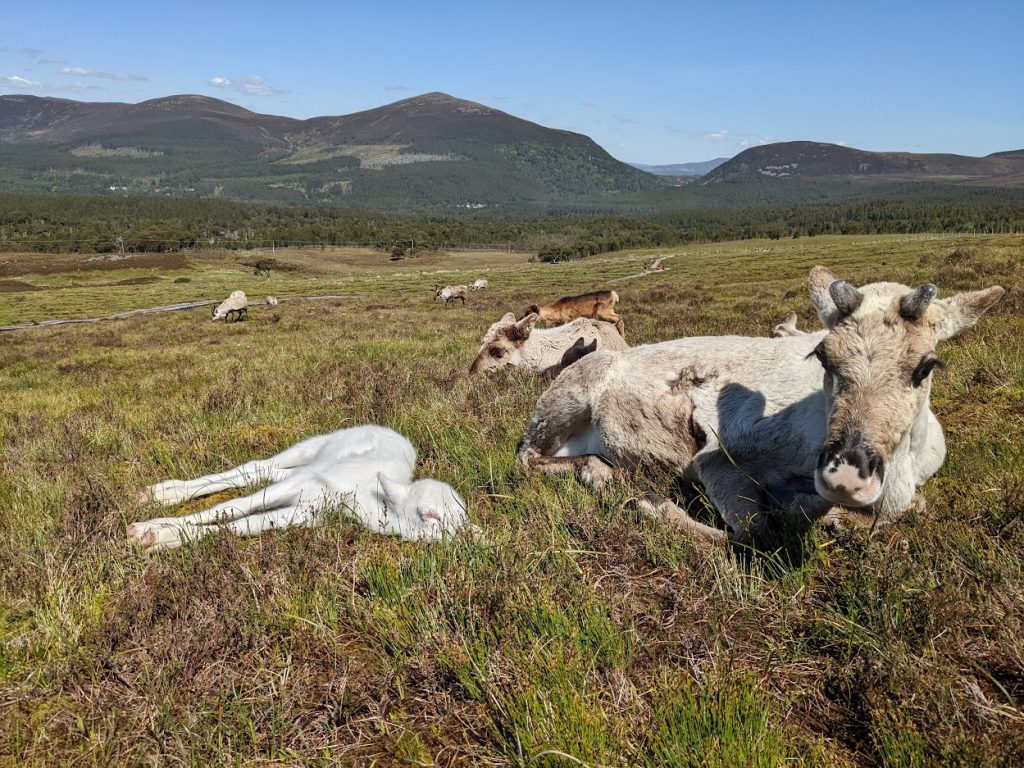
Ochil and calf Vanilla on the 4th of June – the last time I saw them!
Fiona dropped Sheena and I off to try to get the small herd into the enclosure, whilst she headed back down the hill to carry on with feeding the herd in the enclosure. Mission on!
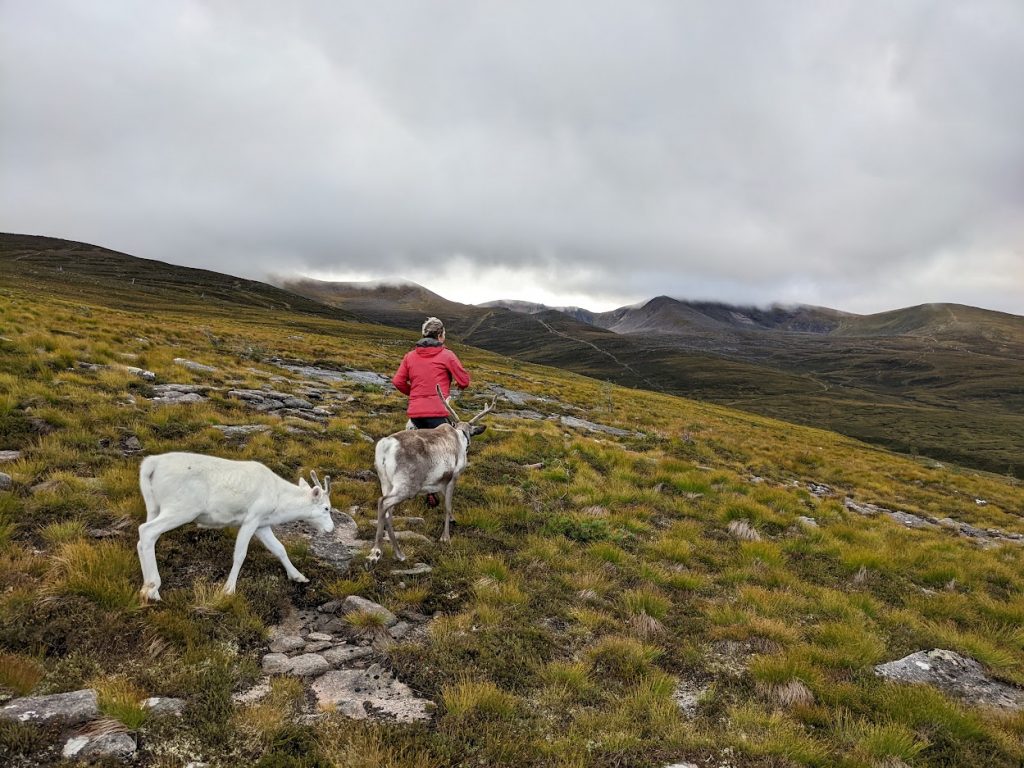
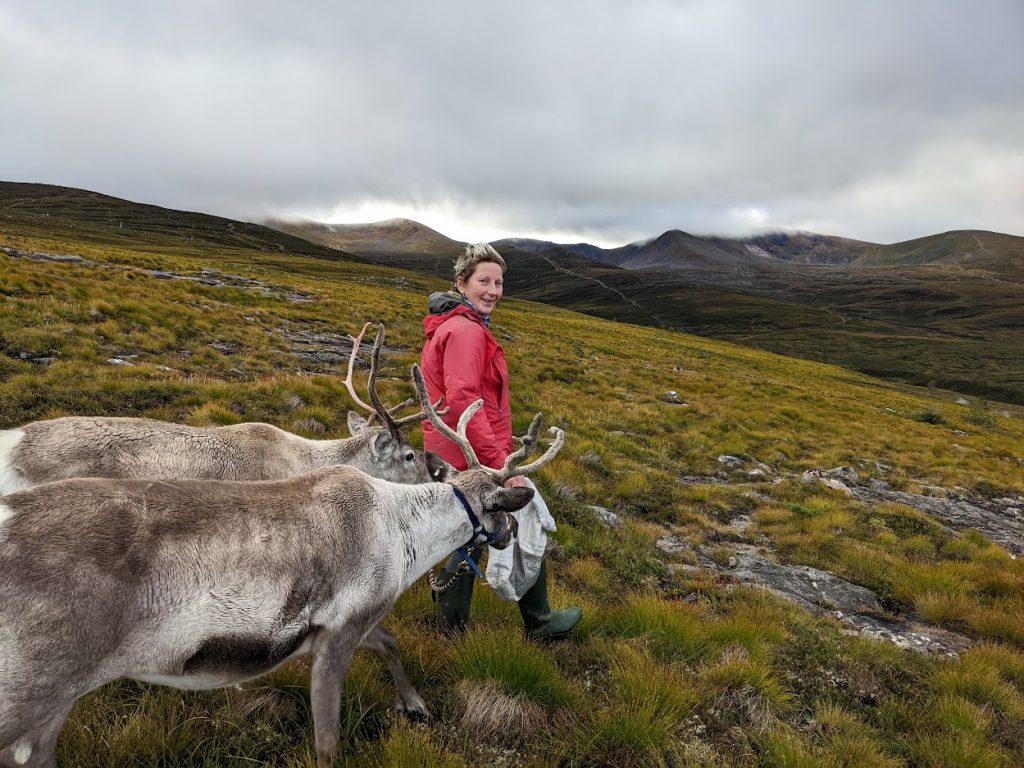
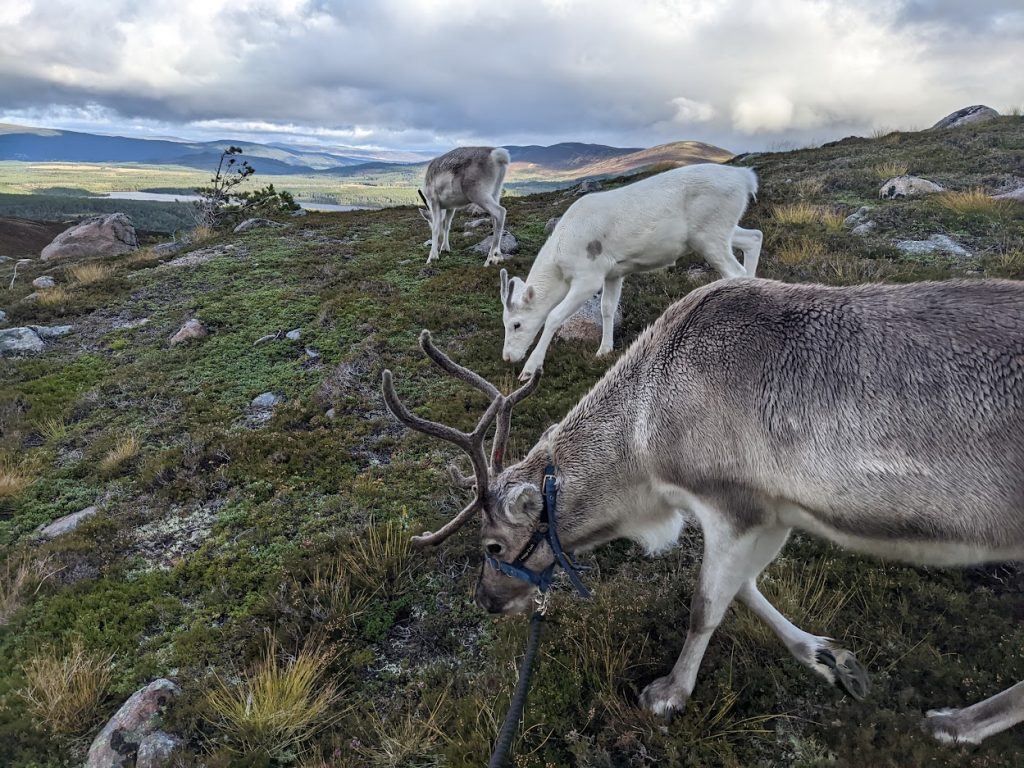
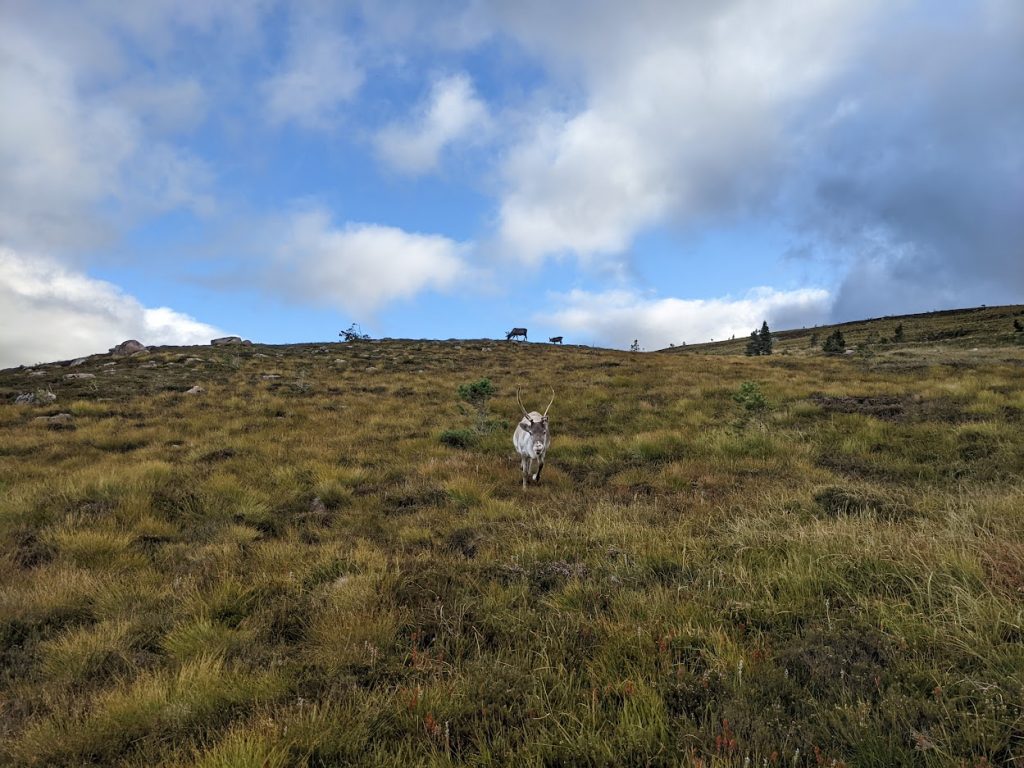
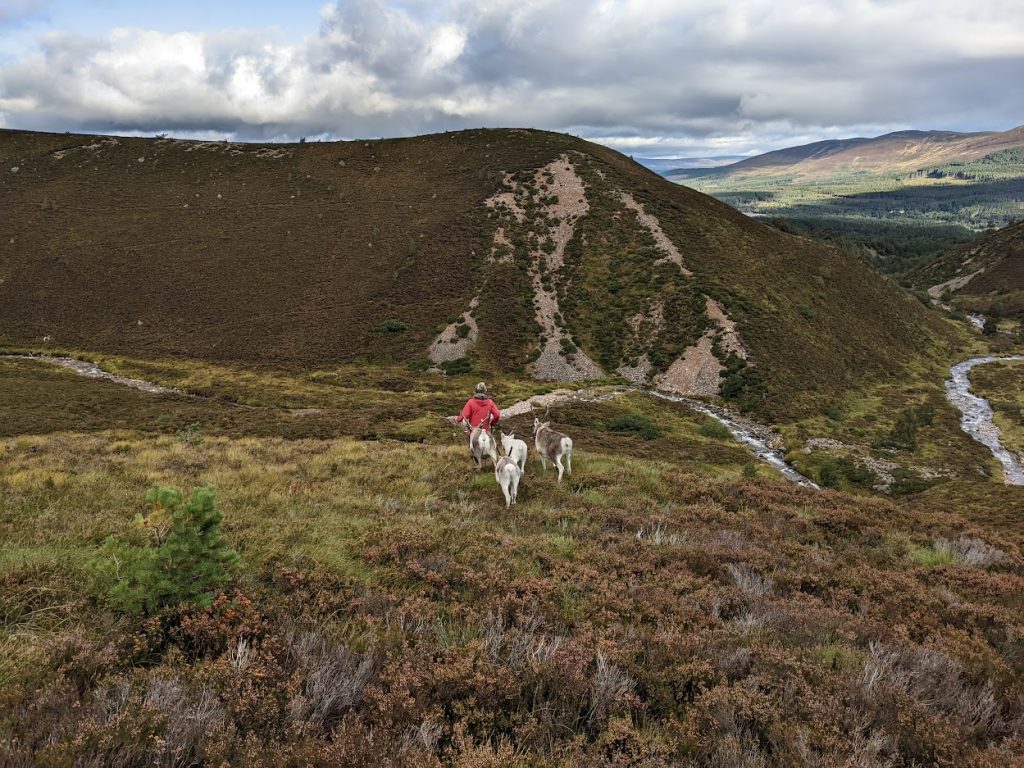
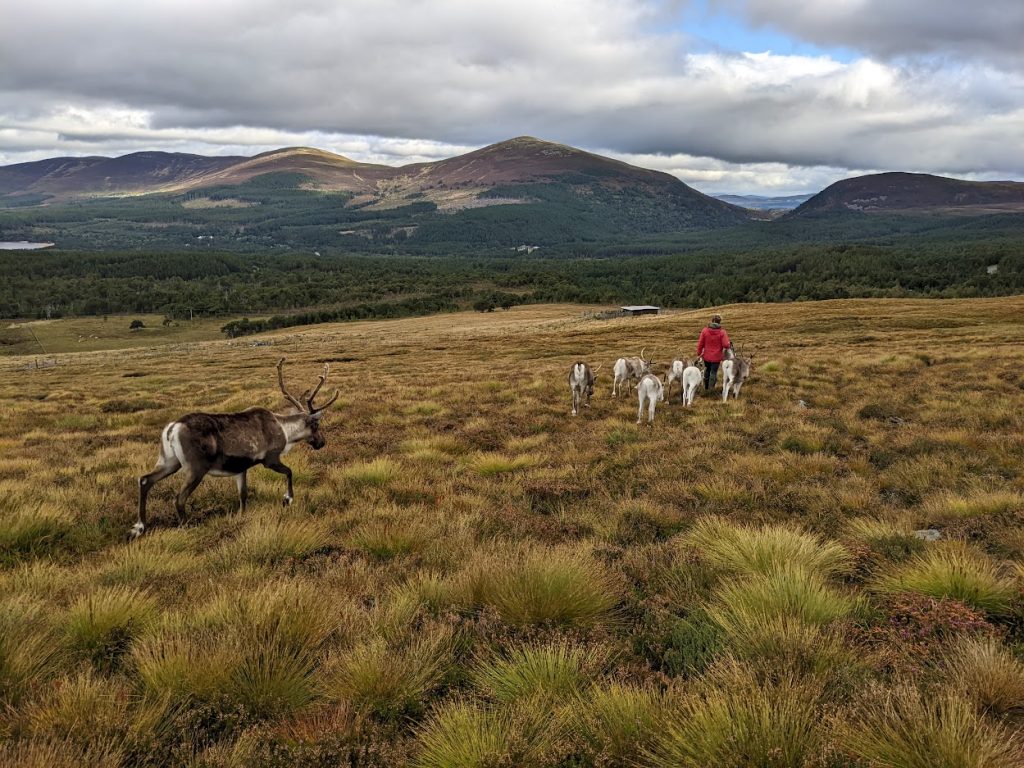
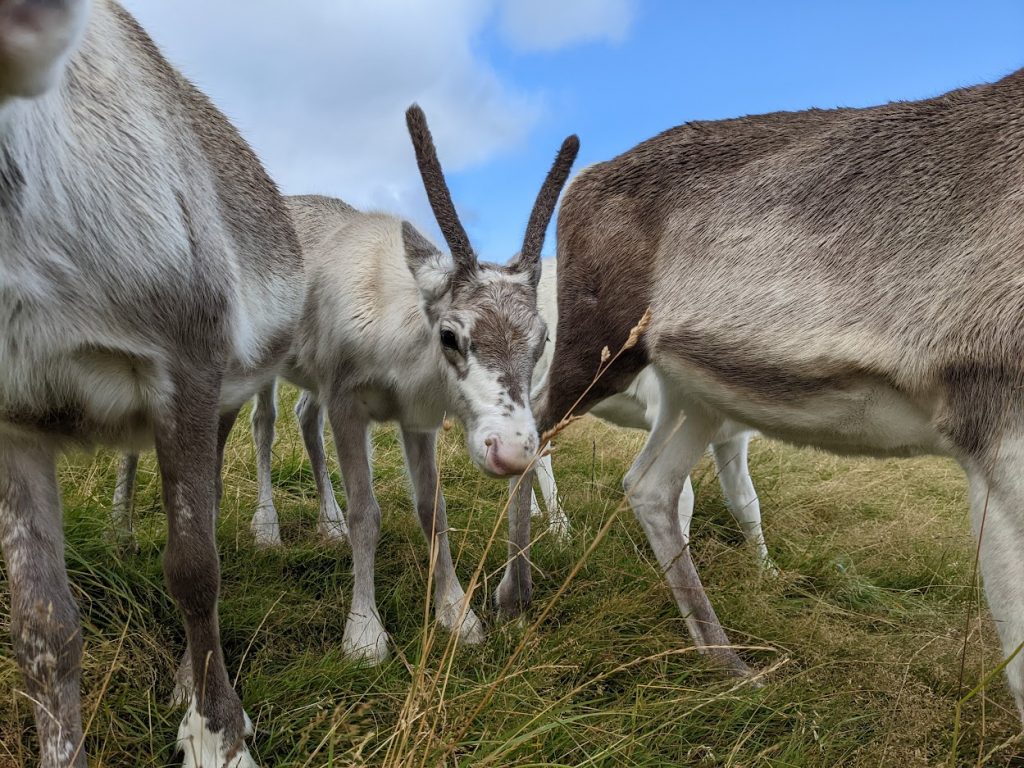
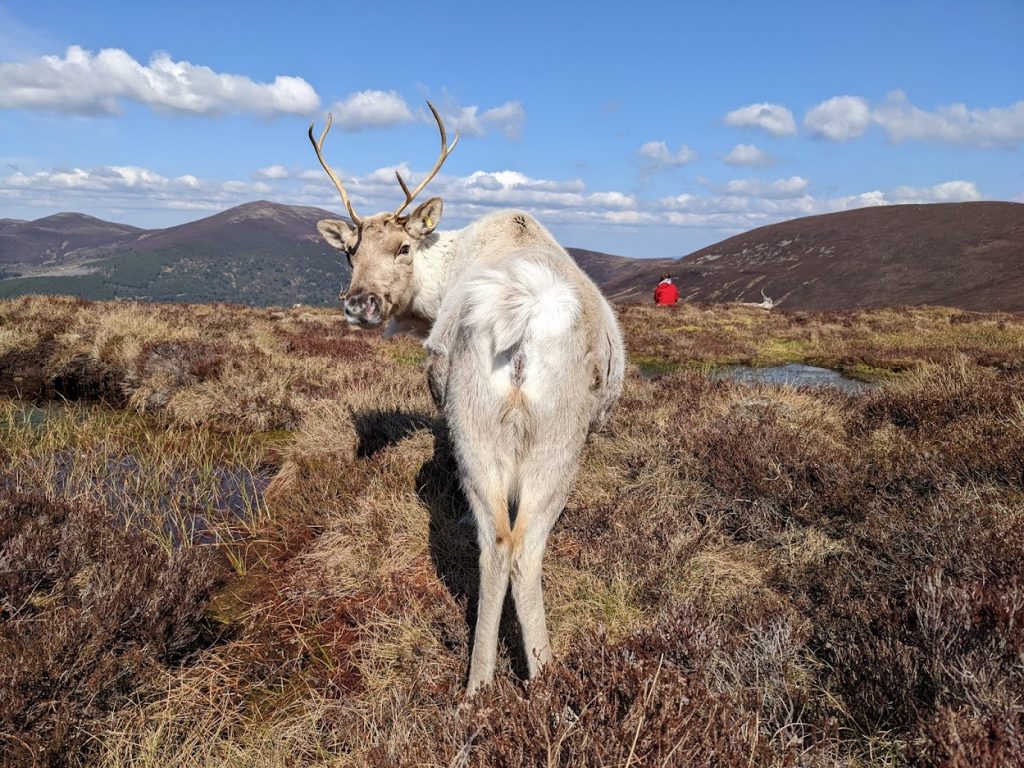
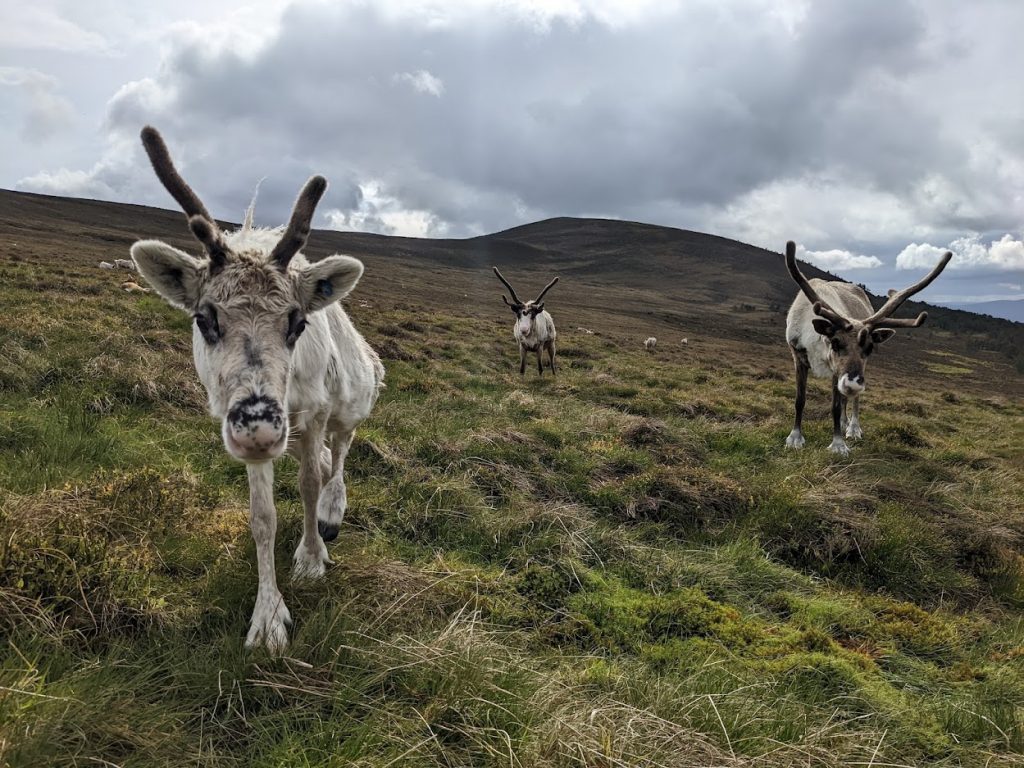
As we got closer to the herd we were able to identify them all. Three cows (Ochil, Vienna and Roule) and their lovely calves, plus a yearling female called Beanie. I’d not seen any of these reindeer since we let them out to free range back in June, so it was lovely to see them again. They all looked great! The enclosure was about 1.5km away from where we were, across a ridge, over a road, across a burn and up a hill affectionately known by the herders as “Killer Hill”. You can see how our mission unfolded in the following photographs….
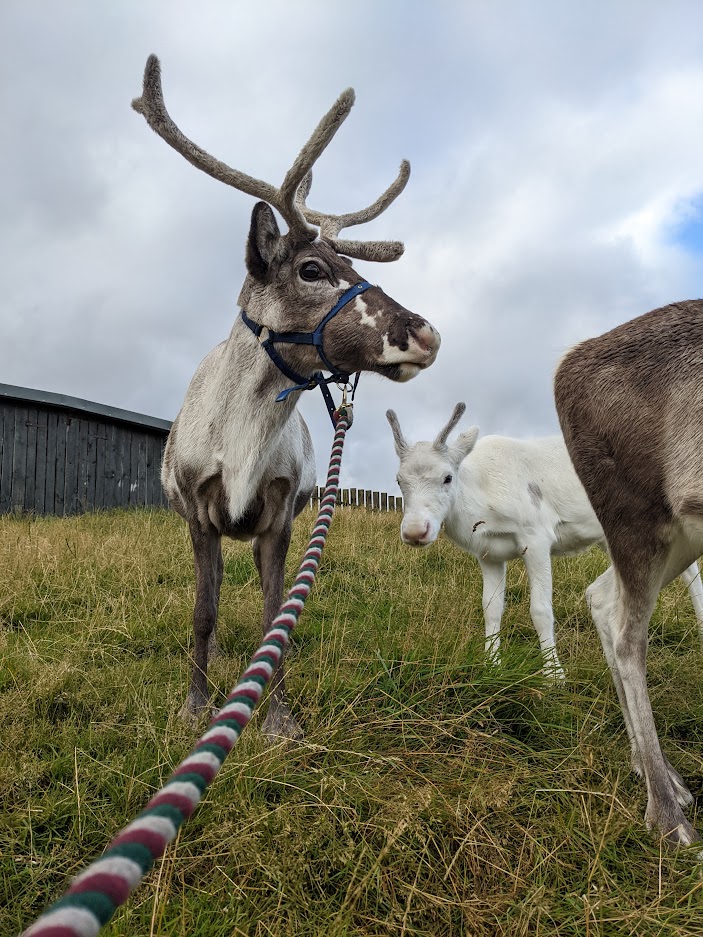
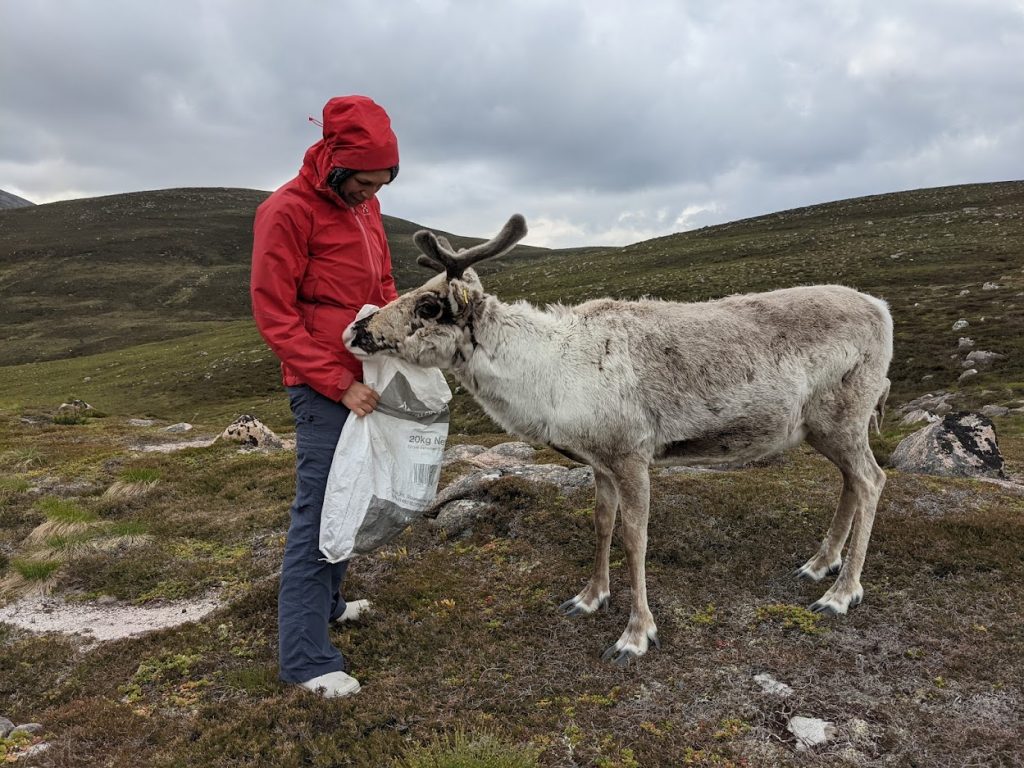
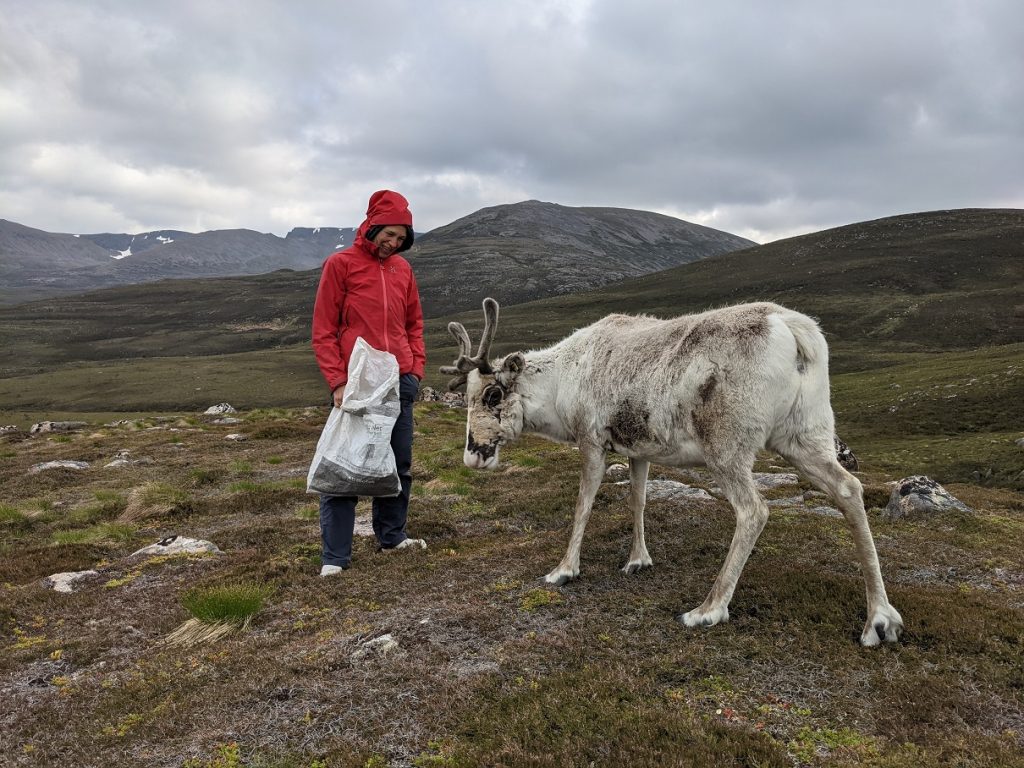
Sheena with Ochil on a halter and her leucistic calf following beautifully behind. At this point I had Vienna on a halter with her calf also following very closely behind his mum and me. Beanie (just behind Ochil) was also following beautifully. As a herd animal they generally follow quite merrily (plus Sheena’s white bag contained something particularly tempting!)This is Vienna on a halter about mid-way through the walk over to the enclosure, with Ochil’s white calf Vanilla and Vienna’s grey calf Kulfi not too far away.Beanie following nicely not too far behind us. And what about Roule and her calf?! Well, you can just spot them on the skyline. Roule is an independent lass and couldn’t be persuaded to come into the white bag to have a halter put on, so we left her to it and crossed our fingers she just followed the rest of the herd! She played it very cool – this is about as close as she decided to get to us.Sheena leading Ochil and Vienna with their calves still following well. Just one burn to cross and “Killer Hill” to climb, and we were almost there!Yes!! We got them in to the enclosure! Now just to get them down to the shed. More free ranging reindeer joined us on route, they were waiting for us at the top of “Killer Hill”. 14-year-old Ibex is closest to the camera, who happily followed us in with her two-year-old daughter Flax.Ochil and calf safely in the enclosure.Vienna’s calf also in the enclosure, looking very well after a summer in the mountains. And yes! Roule and her calf Mivvi also followed us in. We weren’t sure if they would until the final moment. She was very reluctant to follow us up “Killer Hill” but after losing sight of her for around 15 minutes she finally decided to follow the others and come in (with a little help from Ibex). Success! Here they are later that afternoon chilling out after a Hill Trip.Beanie later that afternoon on the Hill Trip – clearly not camera shy after a summer spent free ranging.
Each year, as calving season looms, we reindeer herders have a sweep stake. We place our bets on which reindeer will calve first. Or rather more importantly, try to bet upon which reindeer won’t calve last.
I say ‘bet’…what I really mean is we try to combine luck and science to each predict a reindeer. The herder whose reindeer gives birth last then has to do a punishment. The punishment was historically swim in Loch Morlich. However, this task became obsolete as a punishment a few years ago when it became apparent that most herders regularly braved the cold waters as a leisure activity.
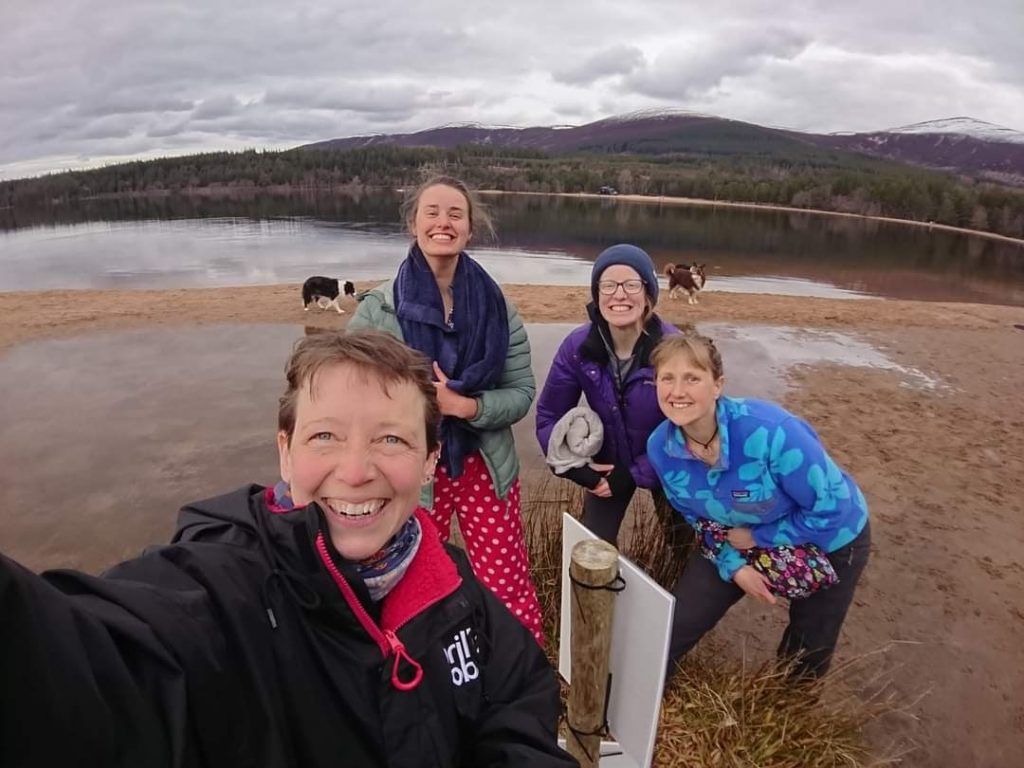
Andi, Lotti, Ruth, Fiona and dogs after a post-work dip in Loch Morlich.
So, the current ‘punishment’ is to bake a cake for the calf naming evening in September. It is on this evening in September that we pick a theme and subsequent names for the recently born reindeer. It’s hungry work, so cake is always greatly appreciated. In fact, in 2009 the cakes were so appreciated that we had a whole naming theme dedicated to ‘cakes, puddings and biscuits’.
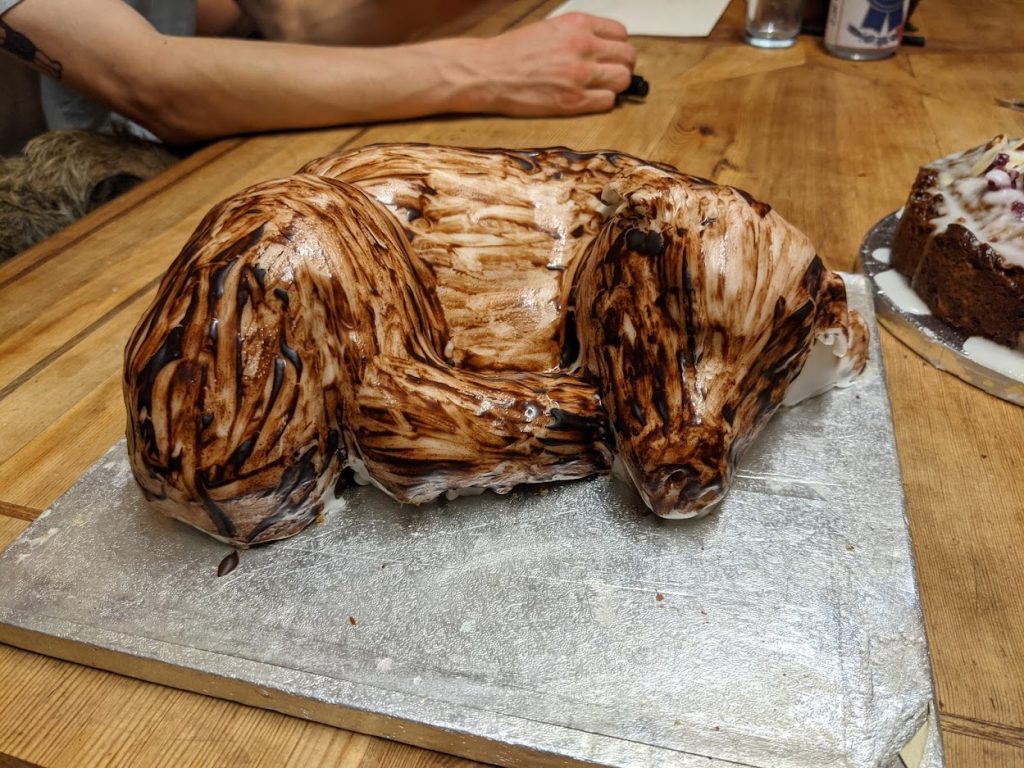
Olly lost the calving bet last year (alongside Andi so he was in excellent company) so produced this cake in the shape of a newborn calf!
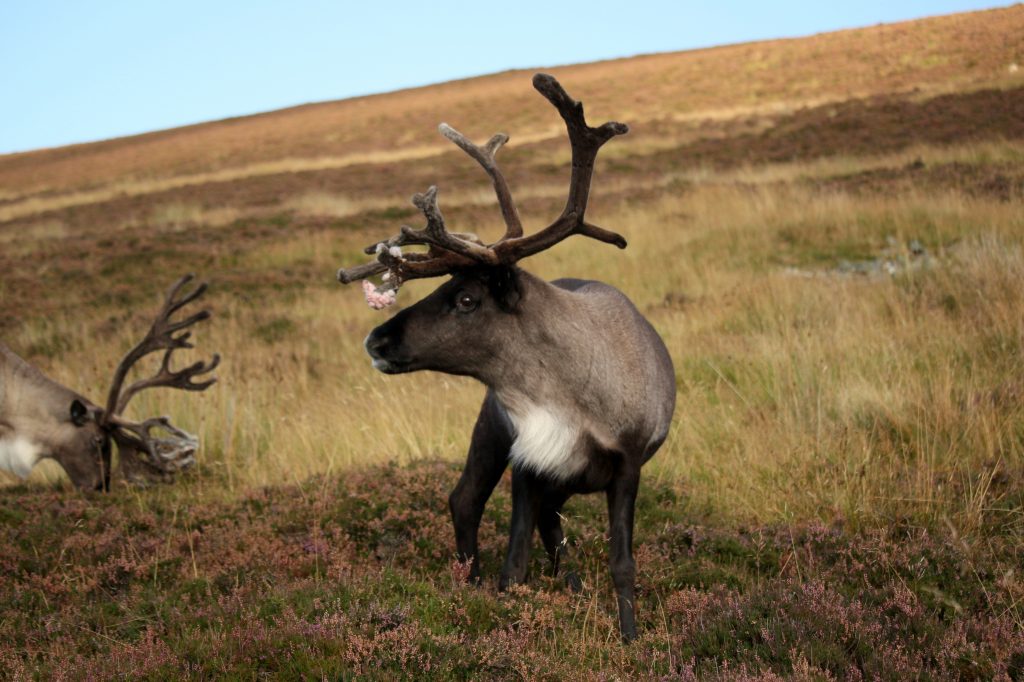
We’re in the last week of April as I write this blog and it’s a stage in the year where some of the pregnant females are MASSIVE. We’ll be expecting the first calf in the coming days and each of us will keep a keen eye on who calves throughout the month. I mentioned science as a prediction method in my first paragraph. Some herders like to research when a reindeer stripped the velvet on their antlers in the previous year, some herders like to look at if the reindeer are already growing their new antlers, and some herders like to inspect how big a reindeer’s udder is, all as a sign of their readiness to calve. If a reindeer strips their velvet early it can be an indicator that they come into season earlier. If a reindeer is already growing their new antlers it can be a sign that they are using more of their nutrients for themselves and not sharing them with a foetus.
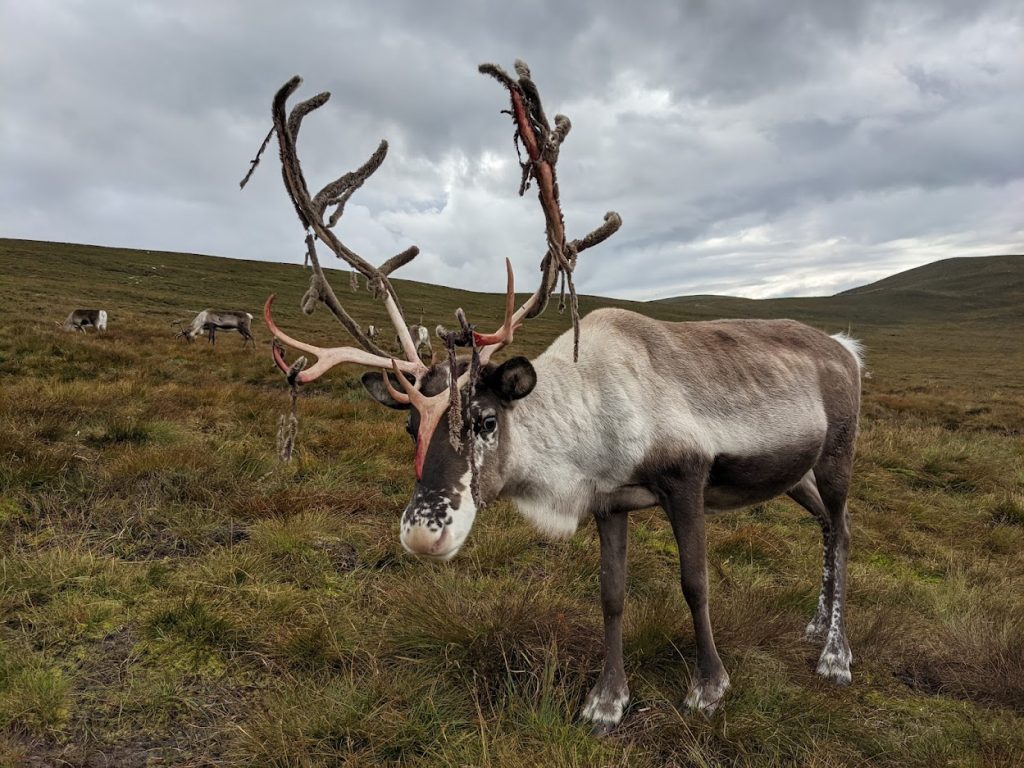
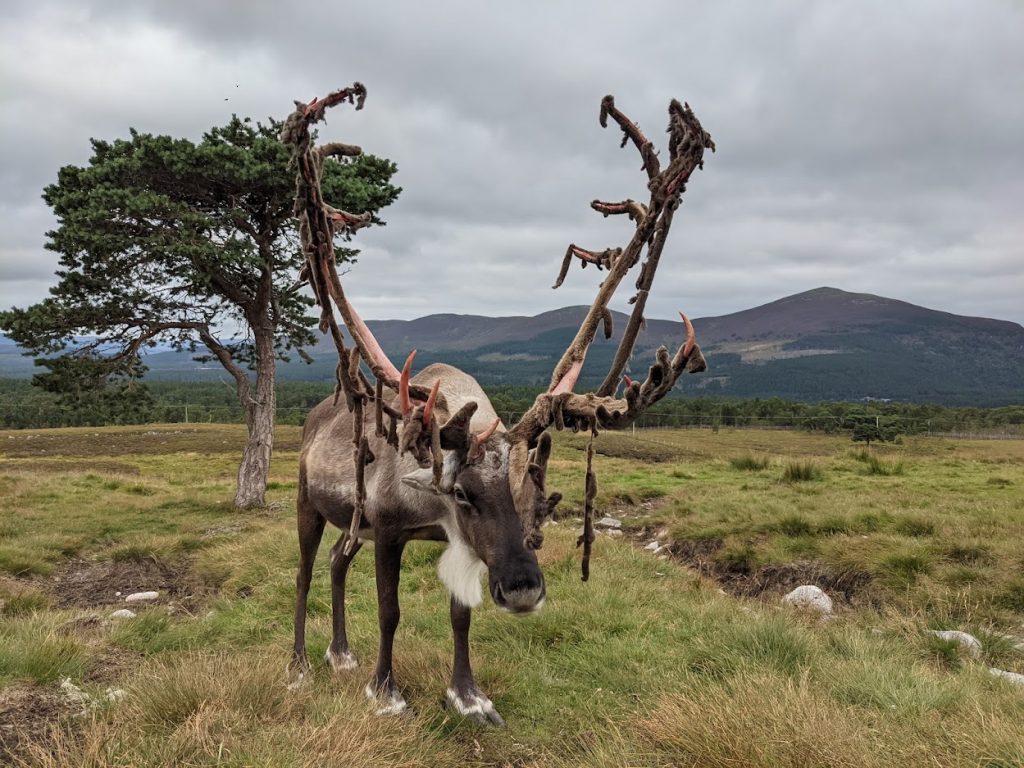
Christie stripping the velvet on the 15th of September 2021 – what does that mean for her calving date?!Don’t think Brie is very impressed by the udder check! Being the “sheepdog” at the back of the reindeer herd in April can be the perfect time to compare how wide bellies are growing!
This makes it all sound very technical actually. I think most of us just tend to pick one of our favourite reindeer. It’s more fun that way in my opinion. Sometimes it’s fun to take a risk as well. Add to the drama. However, herders have been known in the past to make a risky prediction and the reindeer to not be pregnant at all. Just fat!
In May 2021, Andi picked Camembert, but sadly for Andi (great for us – the cake was delicious!) she was just fat, not pregnant! This is Camembert being put out to free-range for the summer on June 21st after no calf appeared, still trying to get more food from Lisette!Lotti picked one of her favourite reindeer Gloriana (R) for the past two years, she didn’t let her down in 2021 when Beanie (L) was born. But what will she do this year?!
Some reindeer are so dependable to calve first that they’re off-bounds. Christie was first last year. And it was Pagan the year before that who always seems to be there or thereabouts. This year Tilly has chosen Ladybird who looks rotund. Ladybird, that is. I’ve chosen first time calver (I hope), Texel. My baking skills aren’t up to much so let’s hope Texel pulls through to reduce the risk of a salmonella outbreak up here.
It is now officially calving season!! As I write this blog it is the last day of April, and we already have two new calves in our ranks. All the calves will be named in September, as is always the case. In fact, every Cairngorm reindeer has a name, and this follows a designated theme each year. Whilst we have not yet decided on the theme for the 2022 calves, we will often be asked about previous themes. In this blog I’ll describe previous themes. Feel free to leave your ideas for themes in our comments section.
2007: A theme centred around all things ‘Green’ (green) – Fern, Fly.
2006: Popstars (silver) – Elvis, Enya, Lulu.
2005: Countries (yellow) – Malawi.
Three white-nosed reindeer: Beanie (2021), Dr Seuss (2017) and Spartan (2016).Fly named in 2007’s “green things” theme – so she’s named after a greenfly!Jester (2021), Ochil (2015), and Feta (2013).Oatcake (2009) and Scully (from the X-Files, 2018).Okapi and Addax – both named after other “horned or antlered animals” (2008).Mum and daughter pair, Hobnob (2009) and Mushy (2020). Sometimes we try to be clever and match the calf’s name with his or her mum’s name. In this cash Mushy (named after mushy peas) was linked to Hobnob (the cakes and biscuits year), because hobnobs go mushy when you dip them in tea!
So, there you have it, that is a list of the naming themes (with the corresponding tag colour and some examples of reindeer names) that are currently in circulation with our reindeer. Now, when you visit again you may have a better idea of how old the reindeer you are feeding may be. Although, as you can see, some colours are repeated which can cause confusion. For example, if you see an orange tag, you may not know if this reindeer was born in 2008 or 2017. Well, each reindeer also has a number on their tag and this number corresponds to the reindeer name on our systems. It is a legal requirement to have a tag on any animal that is transported within the U.K., so we’ve made it work for us with specific colours and numbers that help us identify the reindeer if required.
Juniper (2020) showing off her grey ear-tag.
It is worth noting that we also have just under 10 male reindeer still with us that were born in Sweden between the years of 2009 and 2011 and brought to Scotland to provide new genetics for our herd. These older boys were named individually and not within a theme. Spike, Caesar, Houdini, Bovril, and Hook are some examples of these boys’ names, and they have a range of numbers and colours in their ear tags.
Bovril (photo from 2020) was used as a breeding bull here on Cairngorm for several years after being imported from Sweden in 2011. He was named by Fiona, just because she likes the name!
It is not just ‘the Swedes’ that have names that don’t fit into a theme. Occasionally we will get reindeer where a nickname from early on in their life appears to stick and stay with the reindeer. Holy Moley, our television superstar, had such an eventful initial few days to her life that one herder exclaimed ‘holy moley!’ after being informed of events (she fell down a hole in a boulder field). Svalbard is another example. He was supposed to be called Meccano to fit in with the 2011 naming theme of Games & pastimes, but that name never stuck due to him looking incredibly alike a Svalbard reindeer (small and dumpy). Hamish is a final example of being an exception to the naming rule. Hamish was born in 2010 and unfortunately wasn’t being fed by his mother. This led to him being bottle-fed by the herders for the first part of his life so that he could grow into a big, strong Scottish reindeer and as such was given a big, strong Scottish name…Hamish.
Hamish in 2019 – still a big strong reindeer and character in our herd.
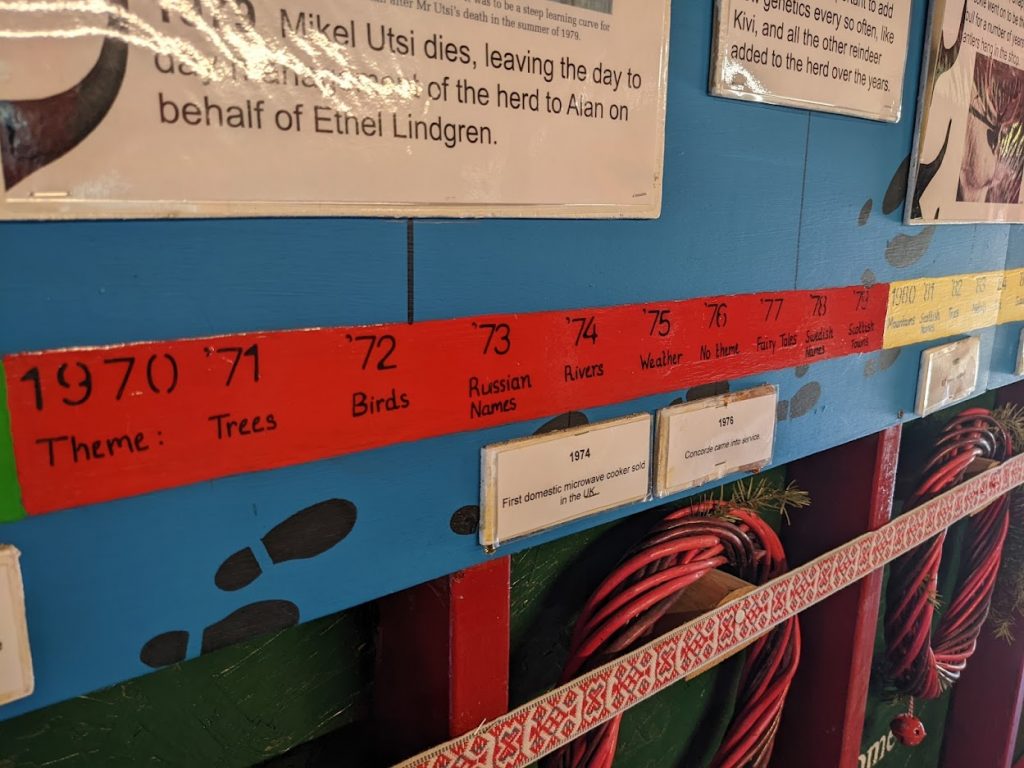
Previous themes, prior to 2005, yielded some great names. We have been naming the reindeer after a theme since 1971. It has gotten to the point where a lot of the more obvious themes have been chosen by now. Some examples of previous themes are: Musical instruments & genres (2000), Colours (1999), Sweets & chocolate bars (1998), Fruits & nuts (1992), Wines & whiskies (1991), Herbs & spices (1988), Scottish islands (1987), Fish (1984), Trees (1982 & 1971), Mountains (1980), Weather (1975 & 1996), and Birds (1972). Before 1971, Mr. Utsi and Dr. Lindgren (the original owners of the Cairngorm Reindeer Herd) named the male reindeer after Scottish places (e.g., Aviemore) and the female reindeer had human names (e.g., Mary).
If you have ever visited the Paddocks and Exhibition you may have noticed the timeline of naming themes, starting in 1971.
In our office we have a folder with naming theme suggestions collected throughout the years. I have just had a look through it and some of the suggested themes are: Vegetables, Ice creams & lollies, Mushrooms & toadstools, Condiments & spreads, Indian foods, Teas & coffees, Cocktails (as you can see, we enjoy our food and drink here), Disney side-kick characters, Mountain ranges, Sea creatures, Gods & goddesses, Rivers of the world, and Dances. Who knows what themes 2022 and beyond will bring? Once we decide, the theme and each reindeer name are revealed to adopters in the autumn newsletter.
Now that calving has come to a close for 2022, we are getting ready to send all the cows and calves out to join the rest of the reindeer already free ranging here on the Cairngorms. Once this happens we will only see them intermittently through the summer months as we leave the mothers be, to teach their young ones where all the best spots in the mountains are!
Meanwhile our boys will be in the hillside enclosure for visitors to come and see, and for us to keep an eye on.
So with all that being said, I wanted to round off our regular free range excursions with a little photo summary of some of my favourite moments out in the hills with the reindeer.
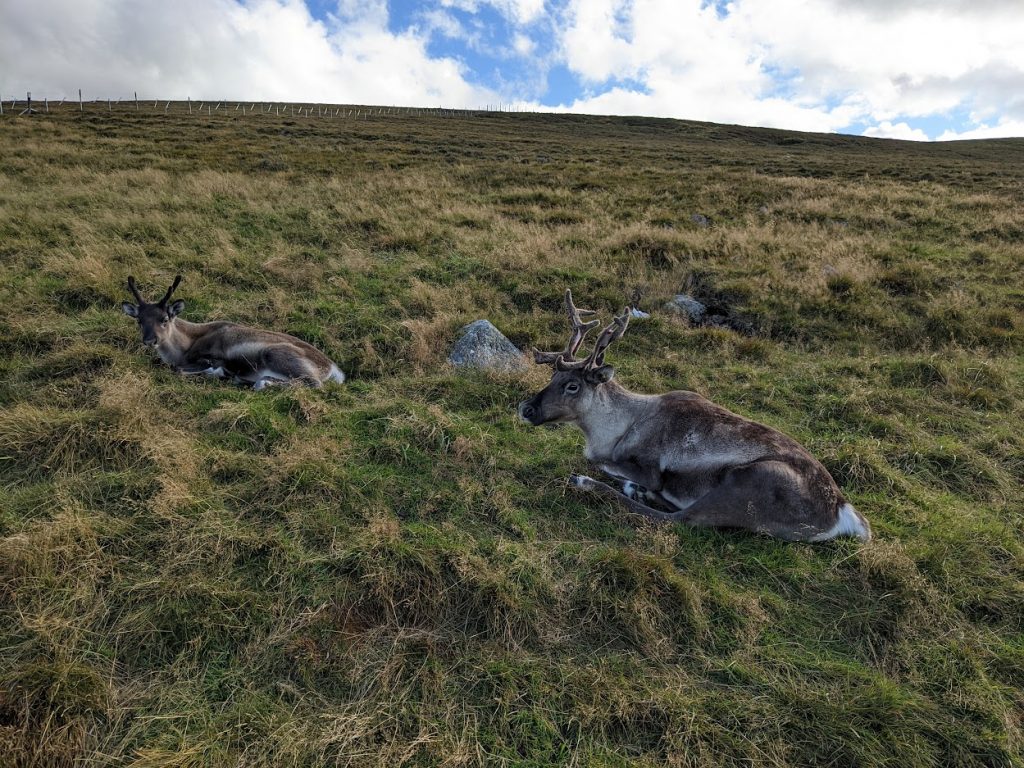
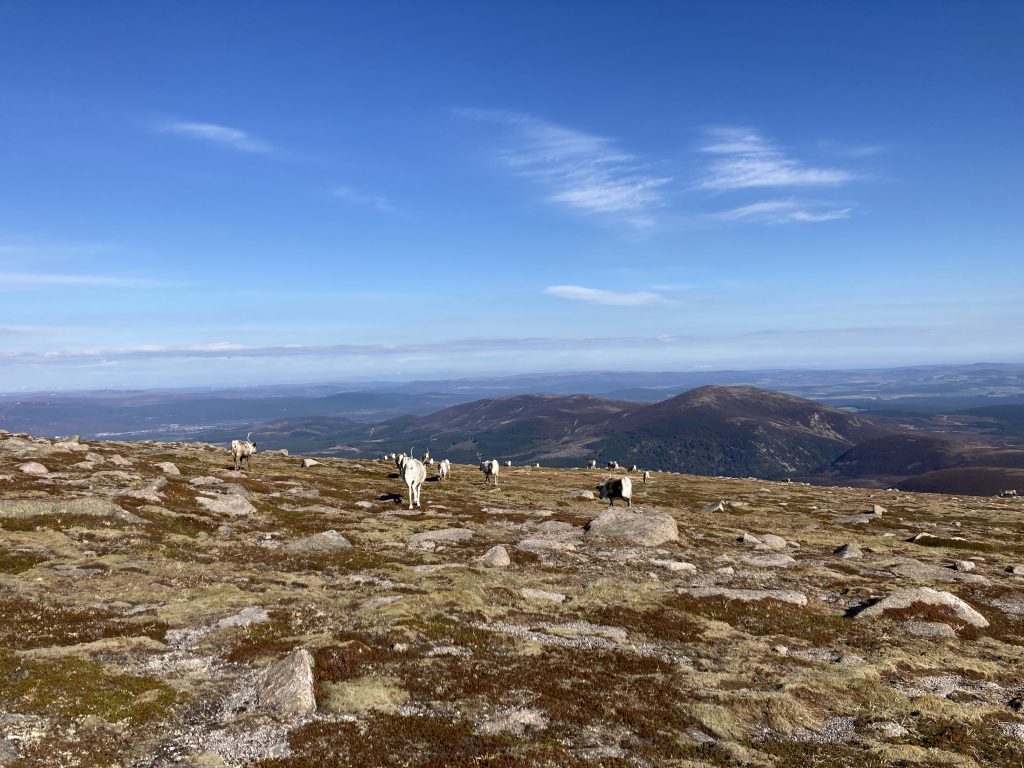
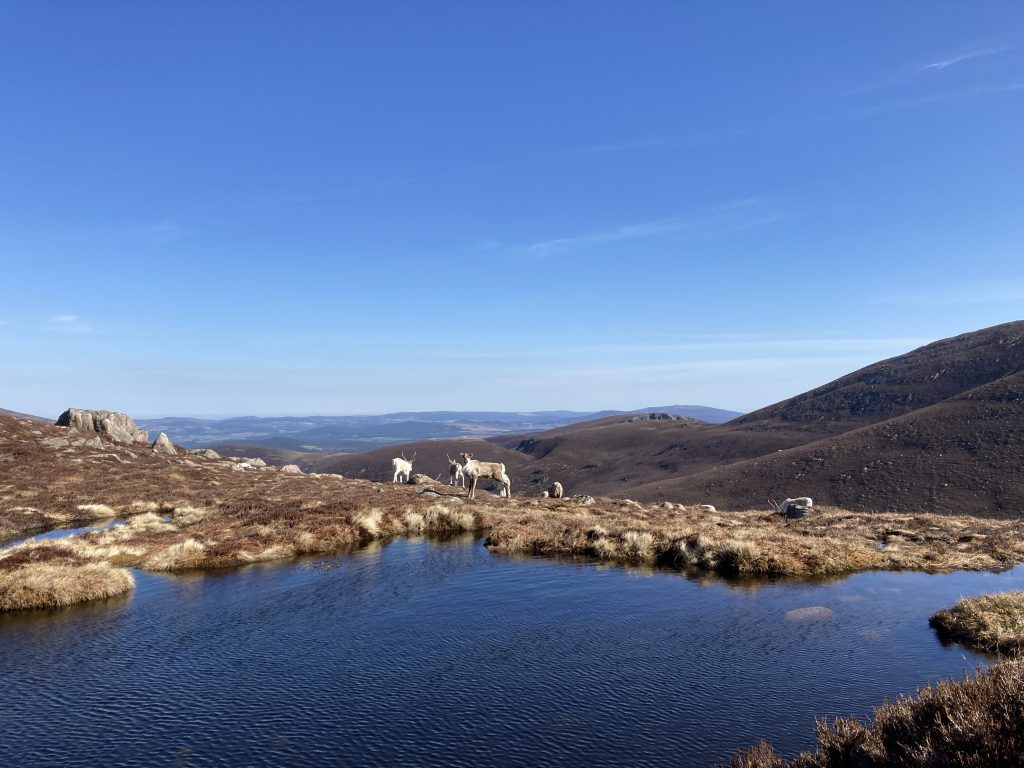
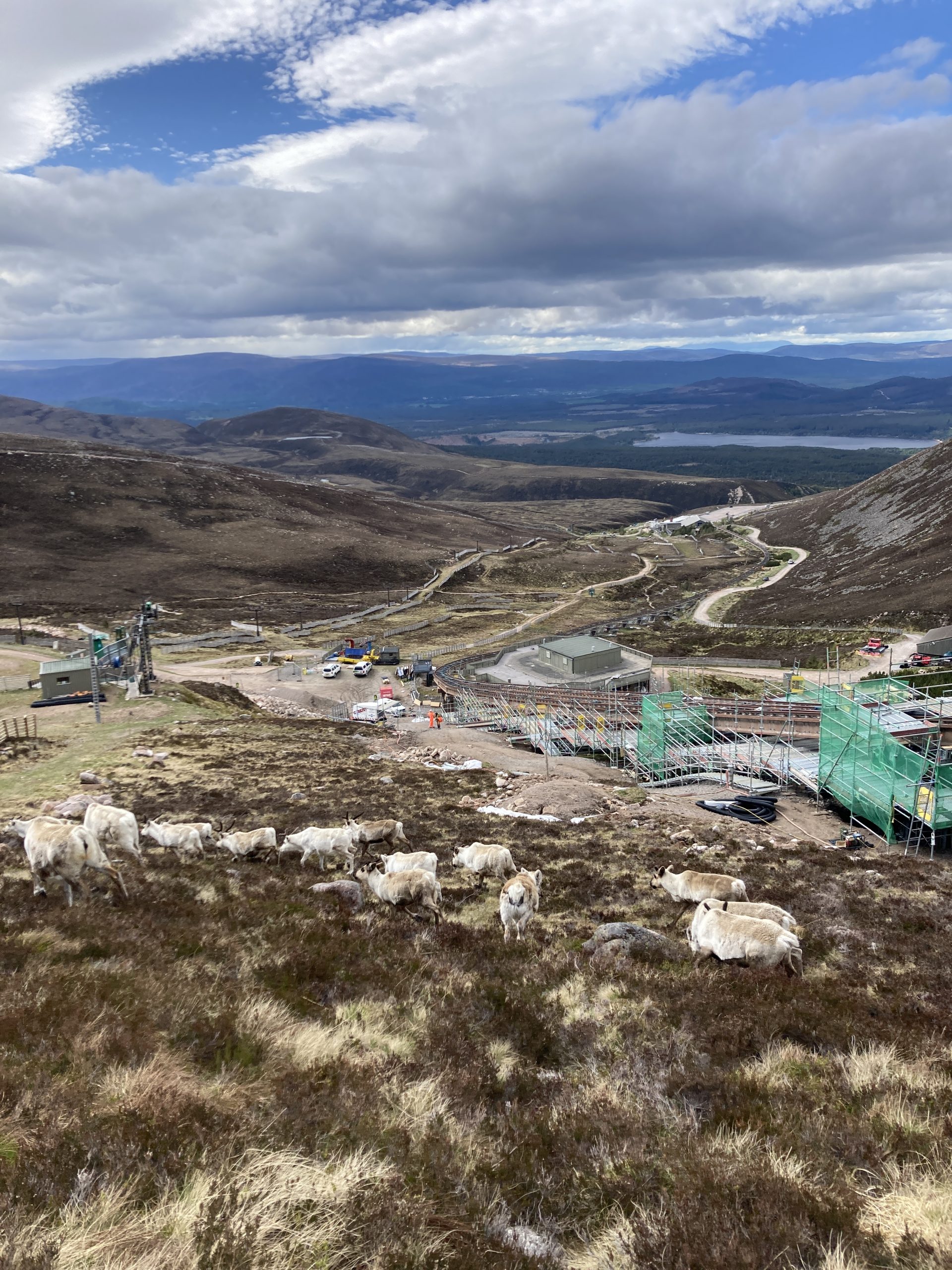
Torch, with a fabulous view in the background.The free rangers make their way down to a morning Hill Trip.A beautiful evening panorama.Very blue looking snow on Cairngorms eastern ridges. Beanie… contemplating how much she loves food, probably! Camembert…. (or BERT as Harry likes to call her).FernMorning reindeer retrieval – in time for them to meet our visitors.Witch pauses to look back across a tiny lochan.Feta posing in front of the Northern Corries.Not everyday that you get to herd reindeer through a building site – the free ranging girls making their way under and past the funicular railway!The cows on Fiacill ridge with the Northern Corries behind. What a life!
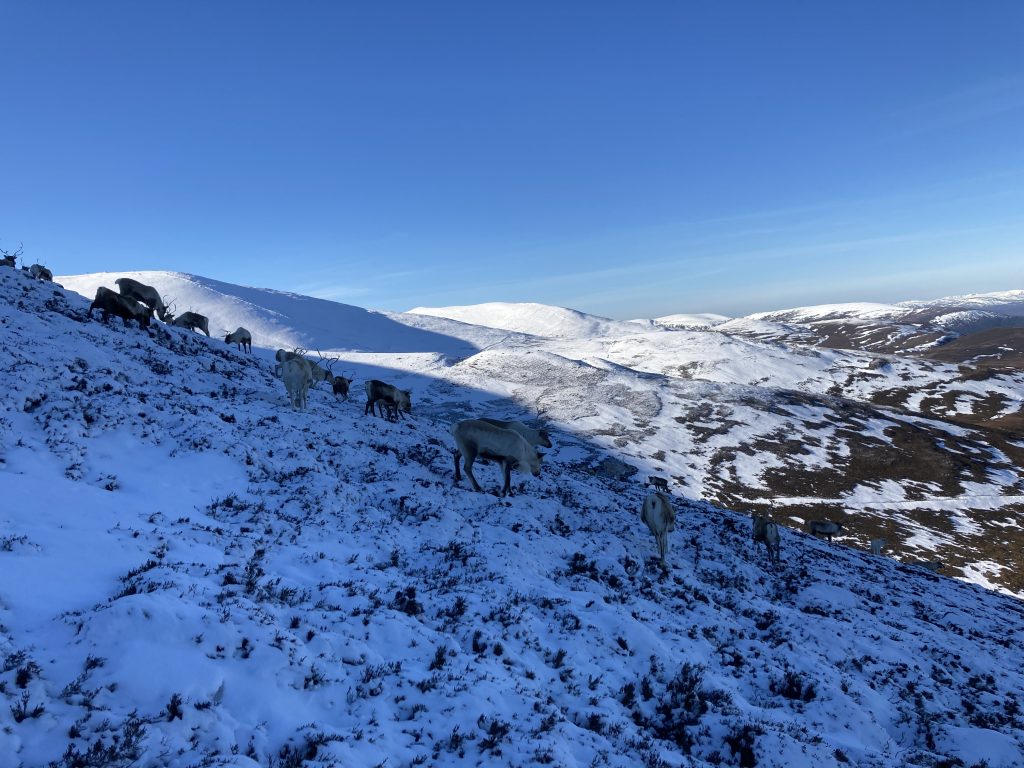
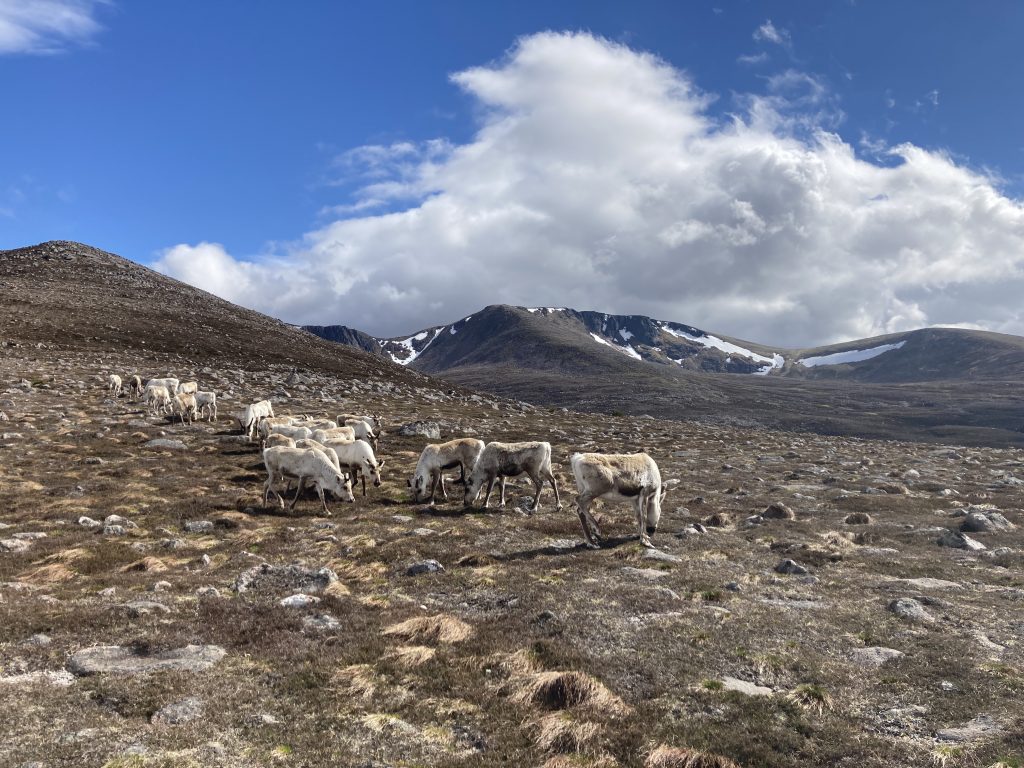
From when we close in January through until around the end of April, most of the reindeer here at Cairngorm will be out free-ranging. This is great for them as they get to roam wherever they please (mostly) and spend time in their natural habitat, where they are at their most comfortable. But it does mean that before every Hill Trip during this time, we must head up into the hills to find the herd.
Generally getting to the reindeer is a pretty simple process but getting them back to whichever site we are running the Hill Trip from can be more complicated – they don’t always want to follow us!
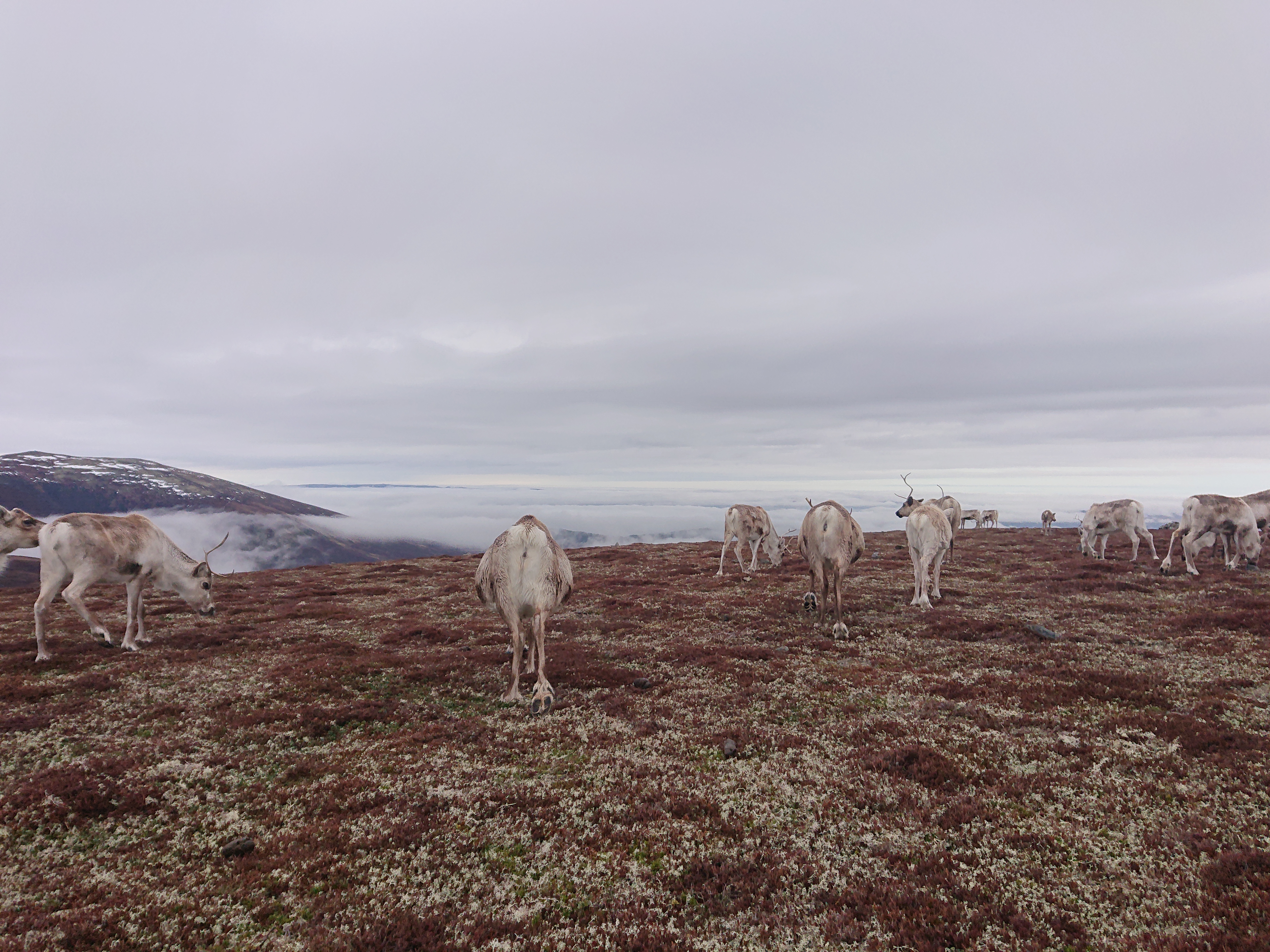
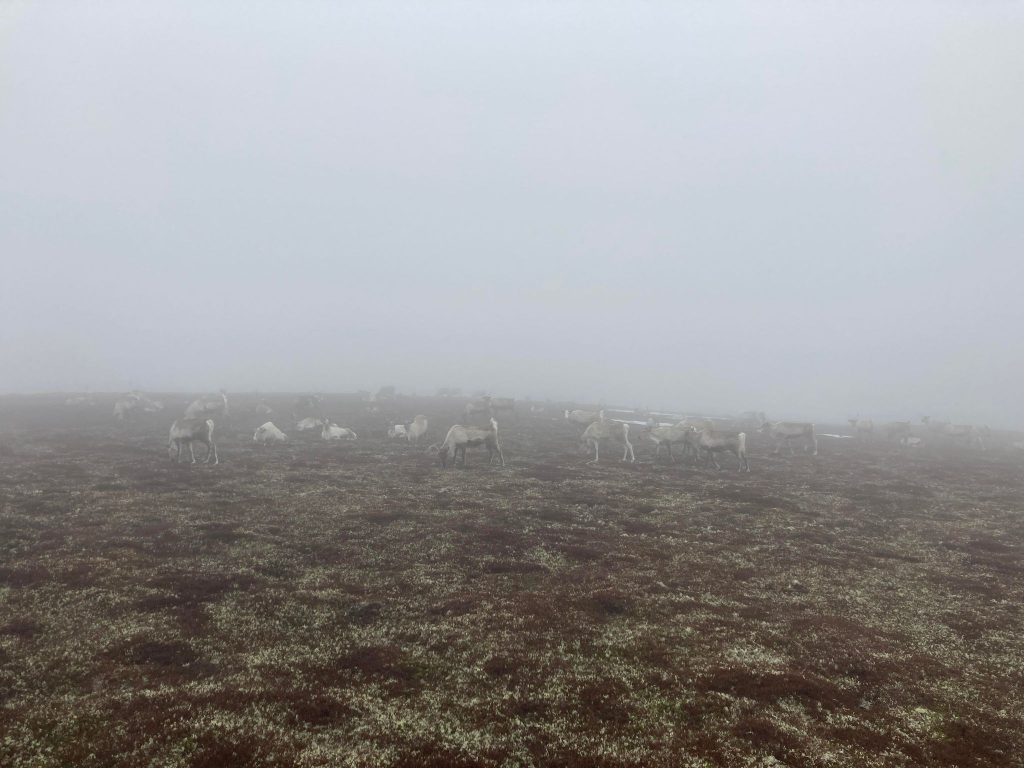
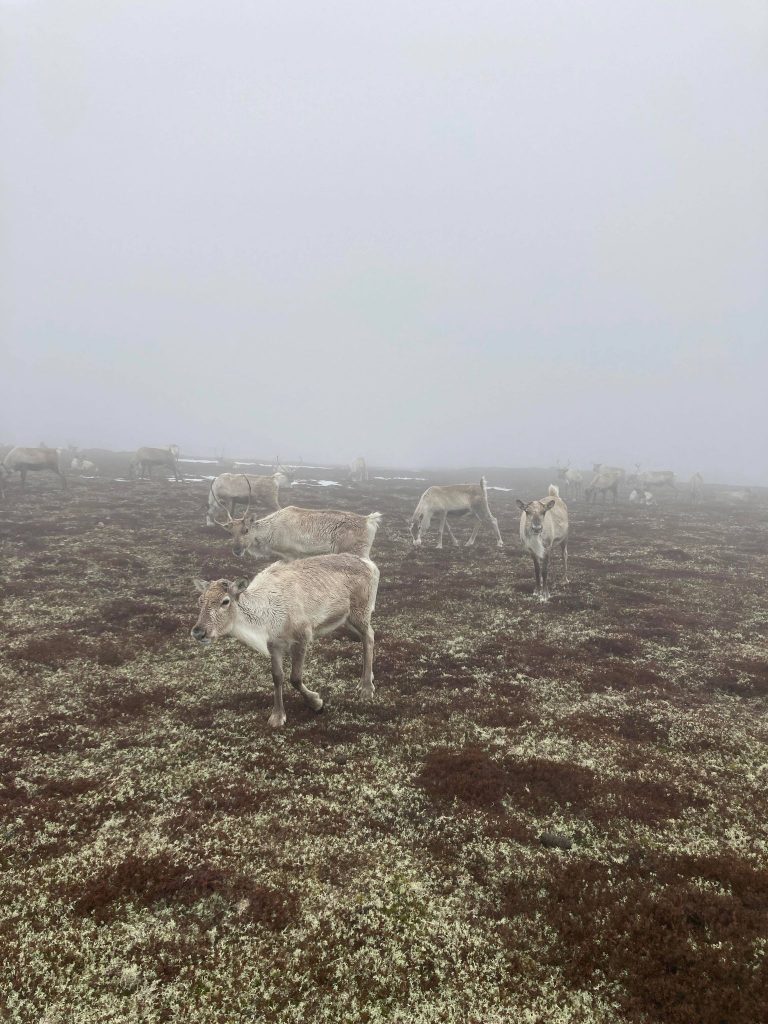
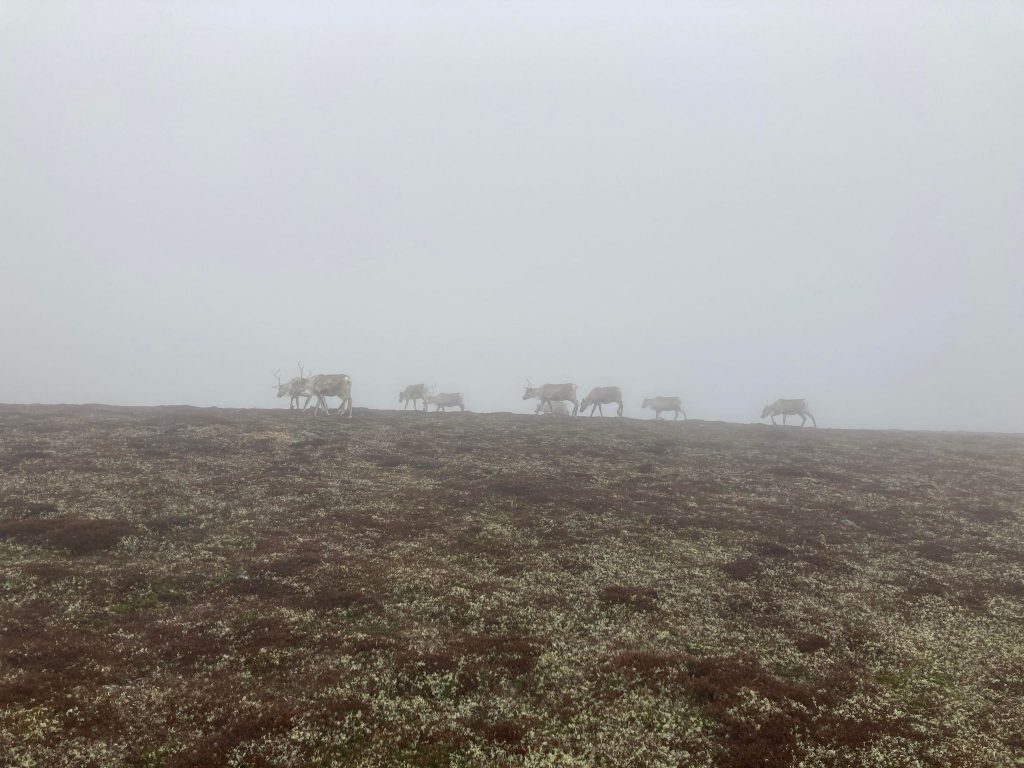
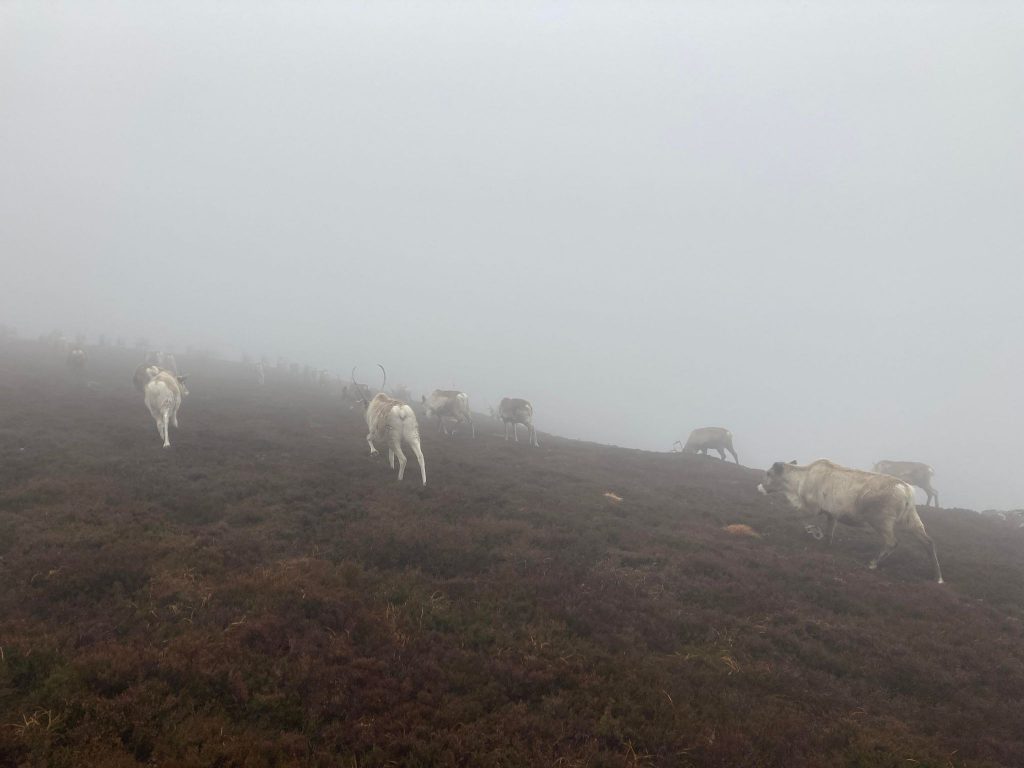
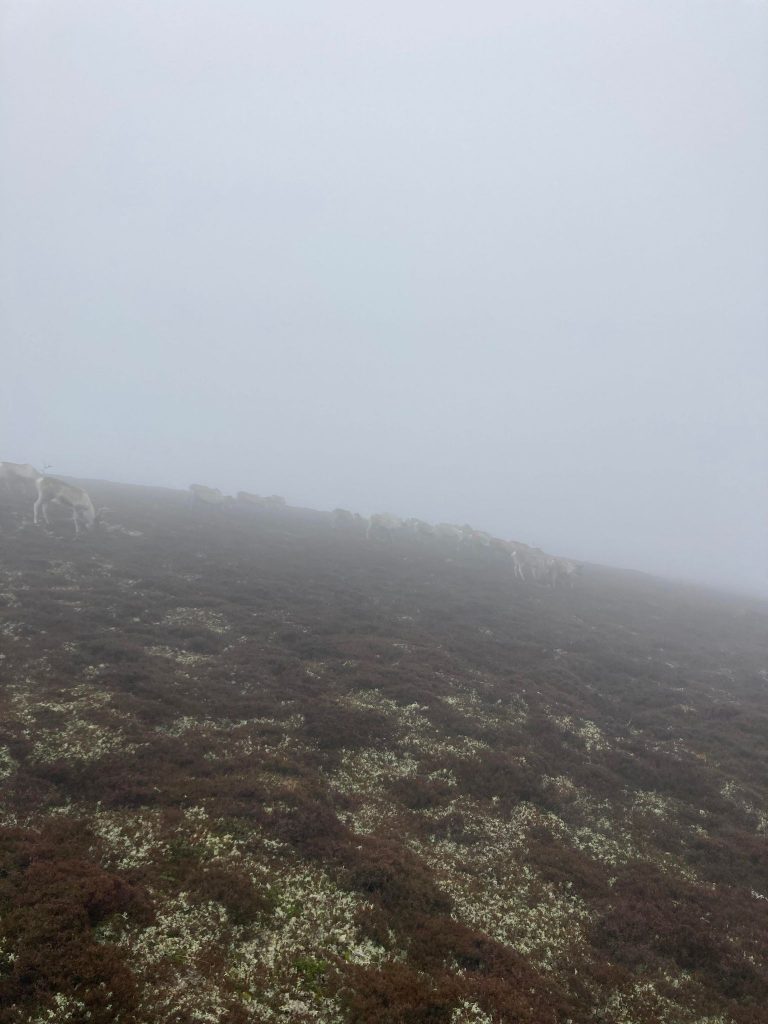
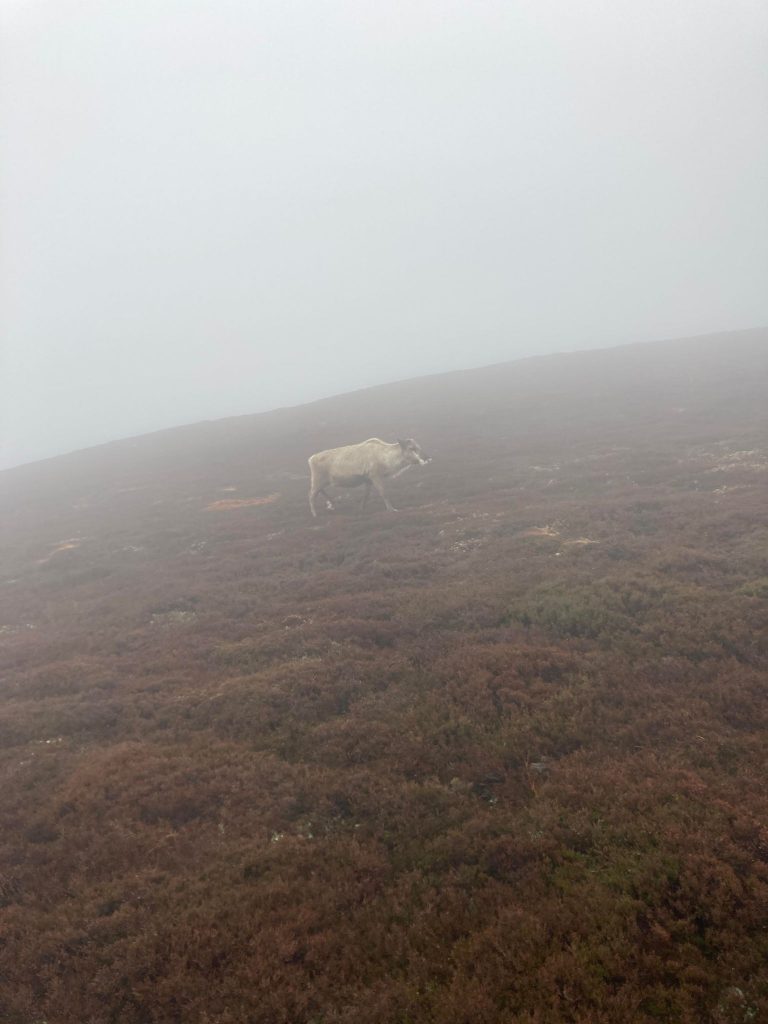
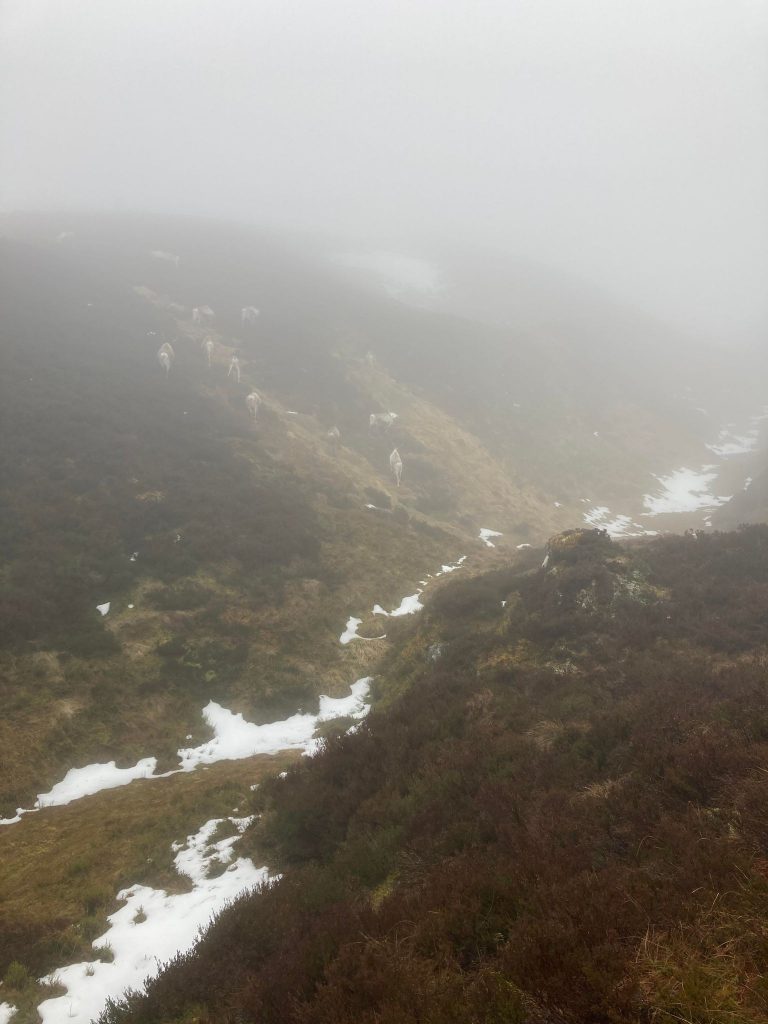
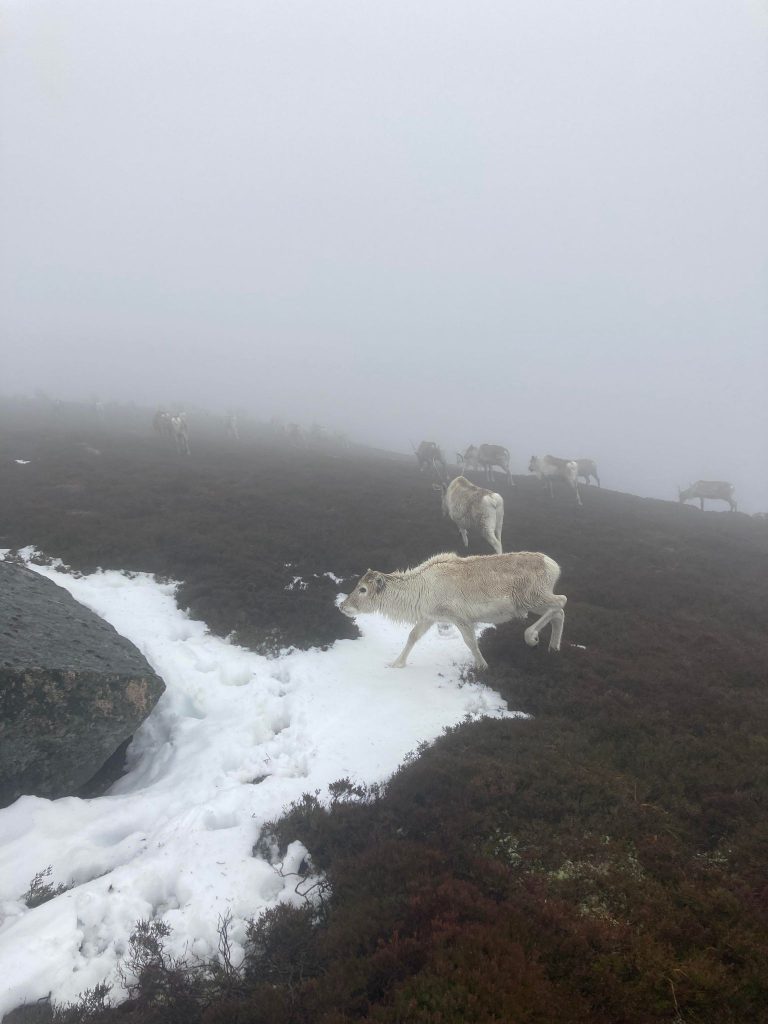
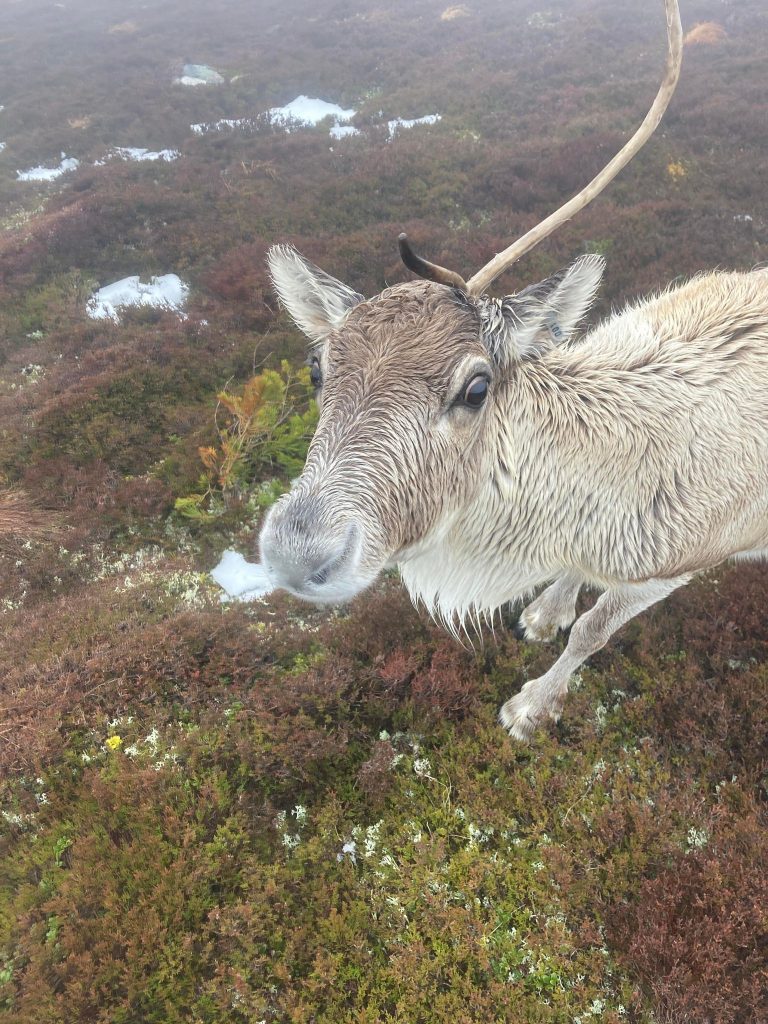
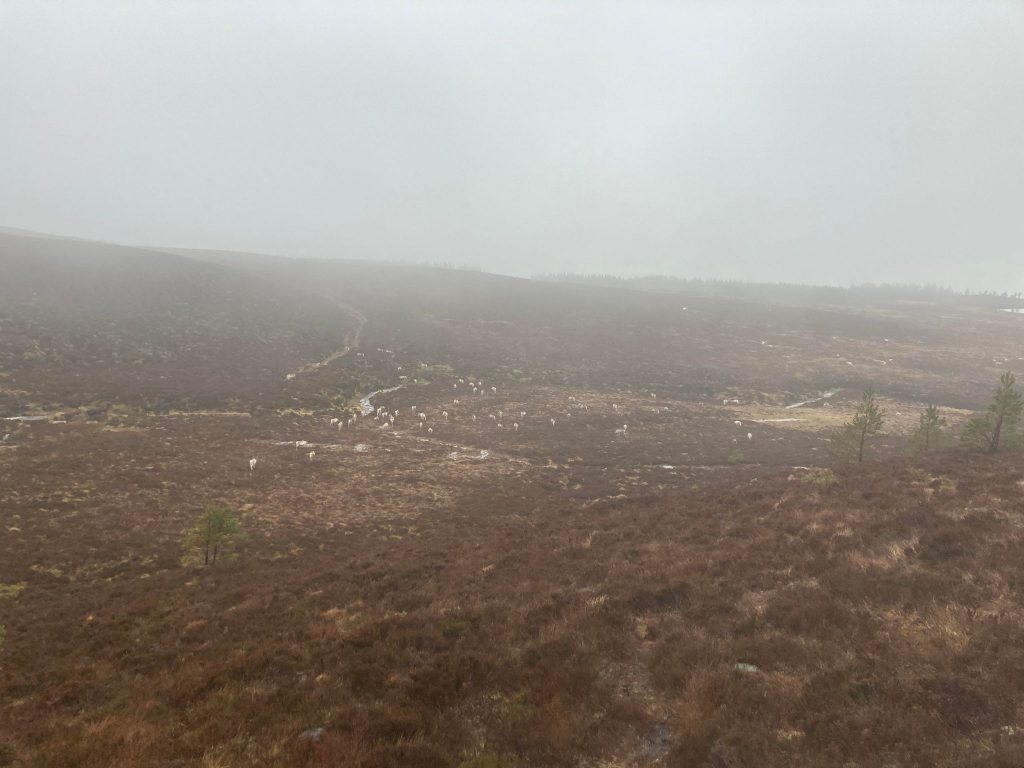
Around the beginning of April, we had a morning collecting reindeer that were a little more difficult than usual. The cloud was extremely low and thick, and they were in an area of the hills with almost no established paths, only a handful of trodden trails at best. It’s also not an area we go too all that much and there are very few proper landmarks to navigate by. All this is a way of saying that it was quite a difficult morning of reindeer herding!
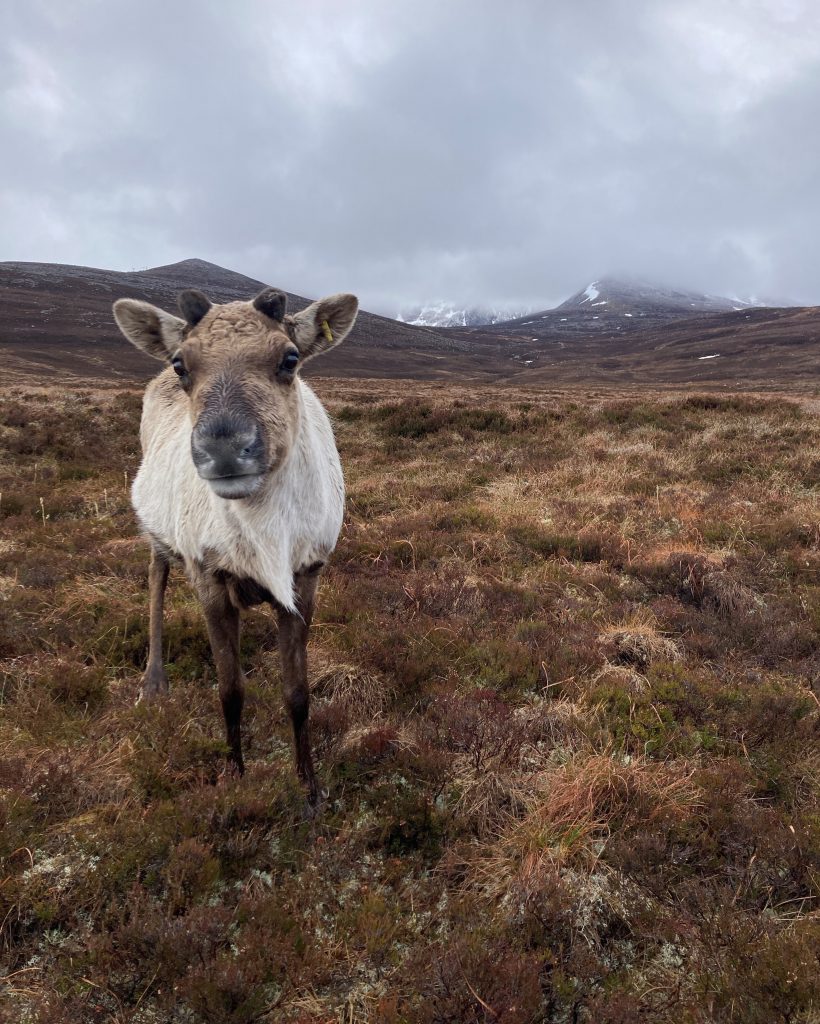
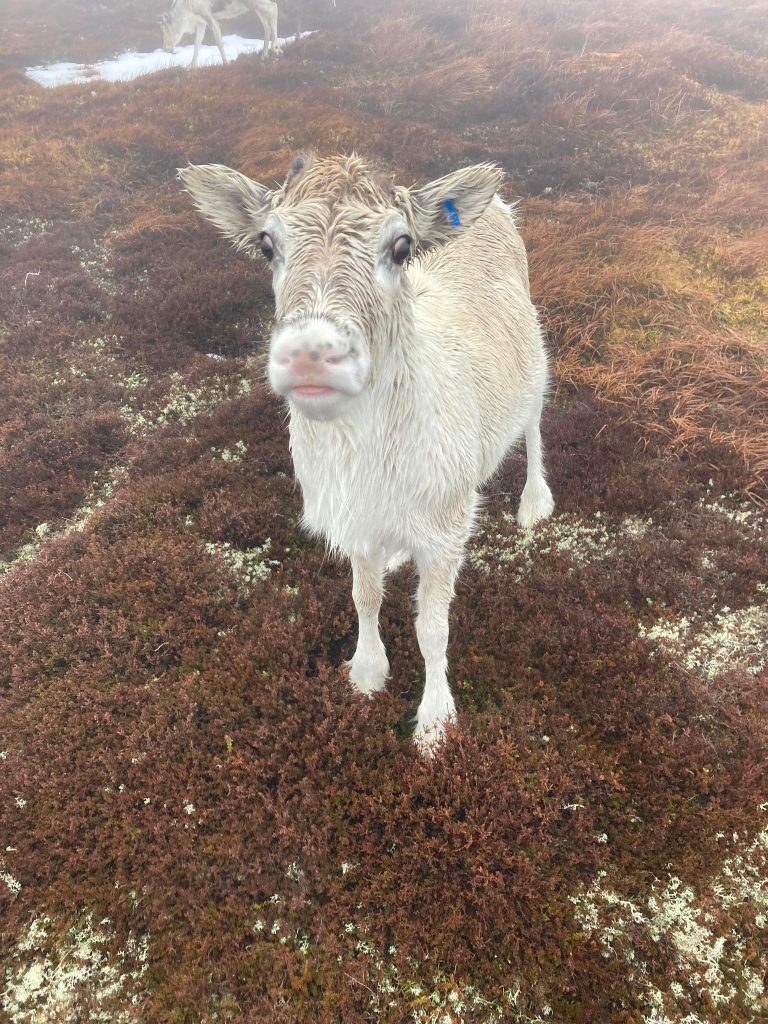
Me and Fiona had to split up to cover more ground once we reached the last GPS point, but luckily….….we stumbled right onto the reindeer!It took them a little while to notice that we’d arrived, but we soon got them up and moving.Very atmospheric, if a little worrying about losing sight of them all.I was on sheepdog duty at the back of the herd.Spot the reindeer!Very curious Beanie suddenly materialised – I think I gave her a fright coming out of the cloud. Look at that face!Beanie’s mum Gloriana hanging back a little more.The herd making their way through a gully on their way towards the Hill Trip location.Always interested, Beanie stops to check out some last remnants of snow.Another familiar face appears through the fog. Holy Moley!The home stretch, the herd crossing the final burn before reaching the site where we give them their breakfast before the morning Hill Trip.
Whilst sorting through the photos on my phone recently, I thought it might be fun to show how the reindeer change in appearance over the summer months so I put together this little blog. This could have turned in to the longest blog ever but I have tried to restrain myself picking just a handful of reindeer; Camembert, Dr Seuss, Kiruna, Sherlock, Beanie and Christie and her calf Akubra.
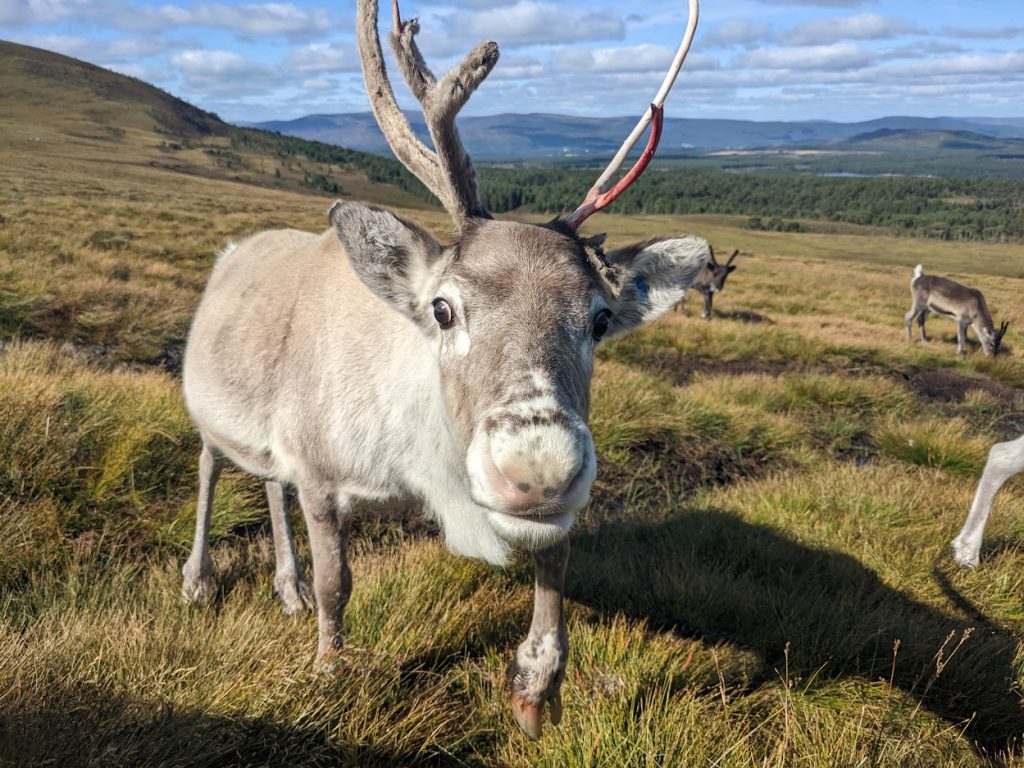
Camembert 1 – on the 21st of June (Summer Solstice) Lisette and I walked Camembert and some other cows out on to the free-range for the summer. Here she is growing her antlers, still to moult last year’s winter coat, and determined Lisette still has some food for her!Camembert2 – This was the next time I saw her, on the 14th of September after my lovely colleagues successfully brought her and a large group of cows back in to the hill enclosure. She’s clearly had a great summer free-ranging, she looks totally fantastic and is still fat as butter.Dr Seuss 1 – it’s no secret that I have a wee soft spot for Dr Seuss so my phone is predominantly full of pictures of him! Here he is on the 20th May, he’s just beginning to moult his winter coat from around his eyes, and his lovely antlers and growing well.Dr Seuss 2 – here’s the big boy again on the 5th of July looking almost ready for summer in his short coat, with a slightly pink nose! Dr Seuss 3 – how smart does he look here?! This was the 8th of September. His winter coat is now beginning to grow through around his neck and he’s had a busy summer growing lovely big antlers, and a big tummy after hoovering up all that tasty hand-food!Kiruna1 – Here’s two year old Kiruna after hearing one of Ben’s jokes. This was on the 8th of July, his antlers are rapidly going and he’s moulted most of last year’s winter coat. Kiruna2 – Here’s Kiruna stripping the velvet on the 28th August. His paler winter coat is growing through quickly on his neck and flank. Kiruna3 – What a handsome lad! Here he is leading the herd in for breakfast on the 7th of September.Sherlock 1 – Three year old bull Sherlock on the 11th of June, rapidly growing his antlers and just beginning to moult his winter coat from around his eyes and on his nose. Sherlock 2 – 1st of August, looking smart in his short, dark summer coat. He’s grown enormous antlers for a three year old! Sherlock 3 – 29th of August, just before his velvet started to strip.Sherlock4 – Just one day later, here he is midway through stripping his velvet on the 30th of August.Sherlock 5 – Handsome boy on the 1st of September, with beautiful clean antlers.Beanie – The palest calf of 2021, Beanie, this picture was taken on the 20th May, just one day old. What a cutie! Beanie 2 – What a fantastic job Gloriana has done! This was taken on the 15th of September. After a summer spent free-ranging Gloriana and her daughter are now back in the hill enclosure. She’s already getting used to being around people on our Hill Trips and quickly learning big green bags = food! Akubra1 – Christie in the background with her thick winter coat, you can still make out her freckly nose. Photo taken on the 27th May when her calf was just over three weeks old (born 4th of May).Akubra 2 – I was delighted to catch up with Christie and her calf on the free-range on the 15th of August. Christie has done a fabulous job and has produced a nice big strong boy, well done Christie!Christie 3 – Looking beautiful on the free-range with her huge calf on the 15th of August.Christie 4 – Photo taken on the 15th of September midway through stripping the velvet from her large antlers. Not only has she produced a large calf this summer, she’s also grown big antlers herself and is in excellent condition. Go Christie! Her winter coat has grown in a lot over the last month.