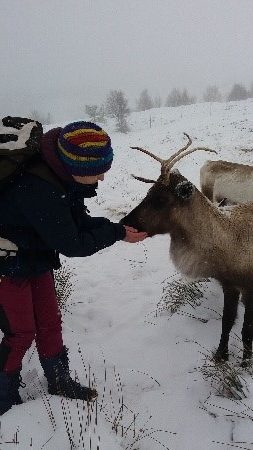
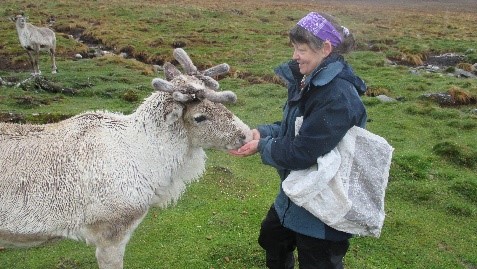
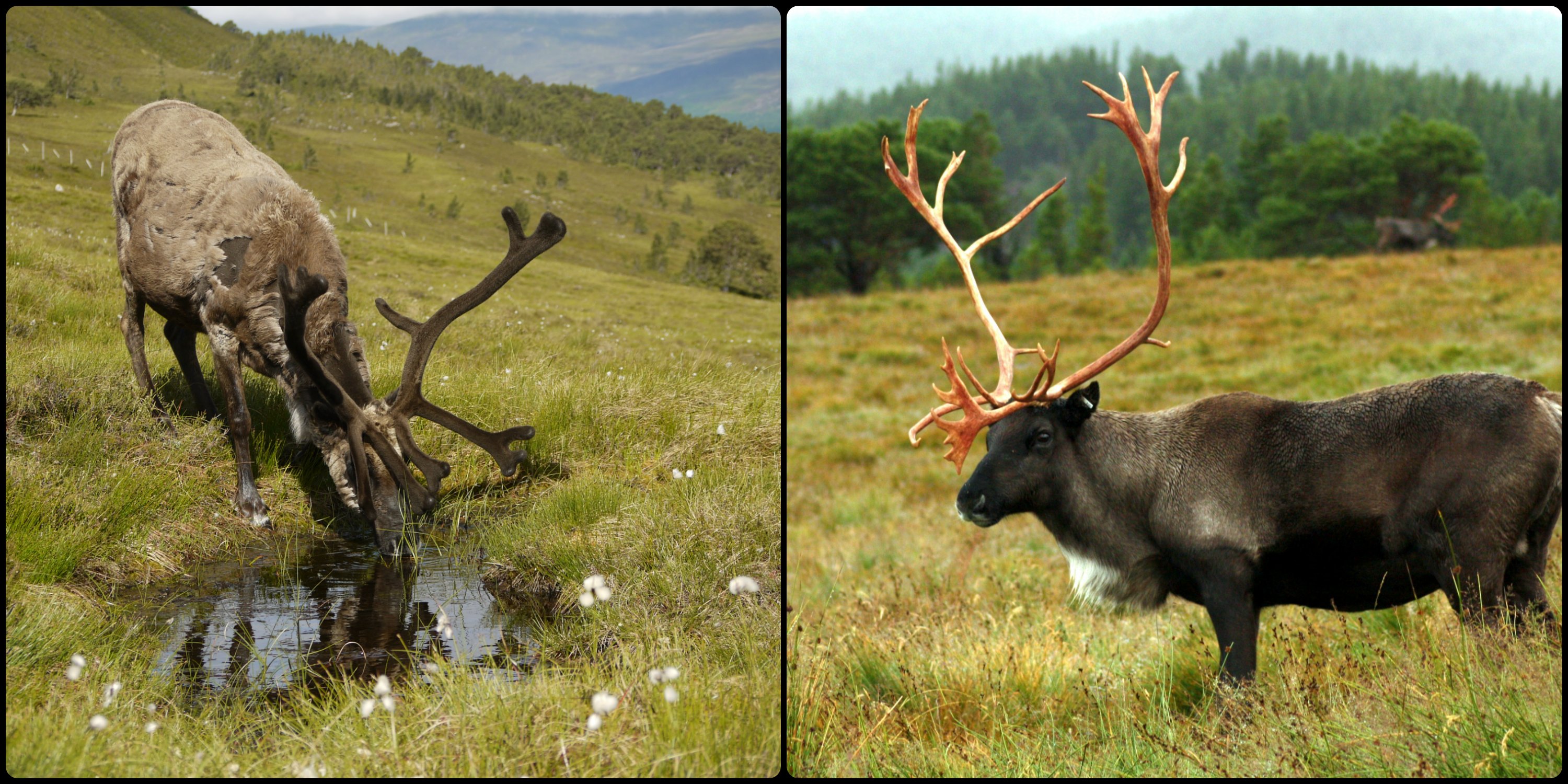
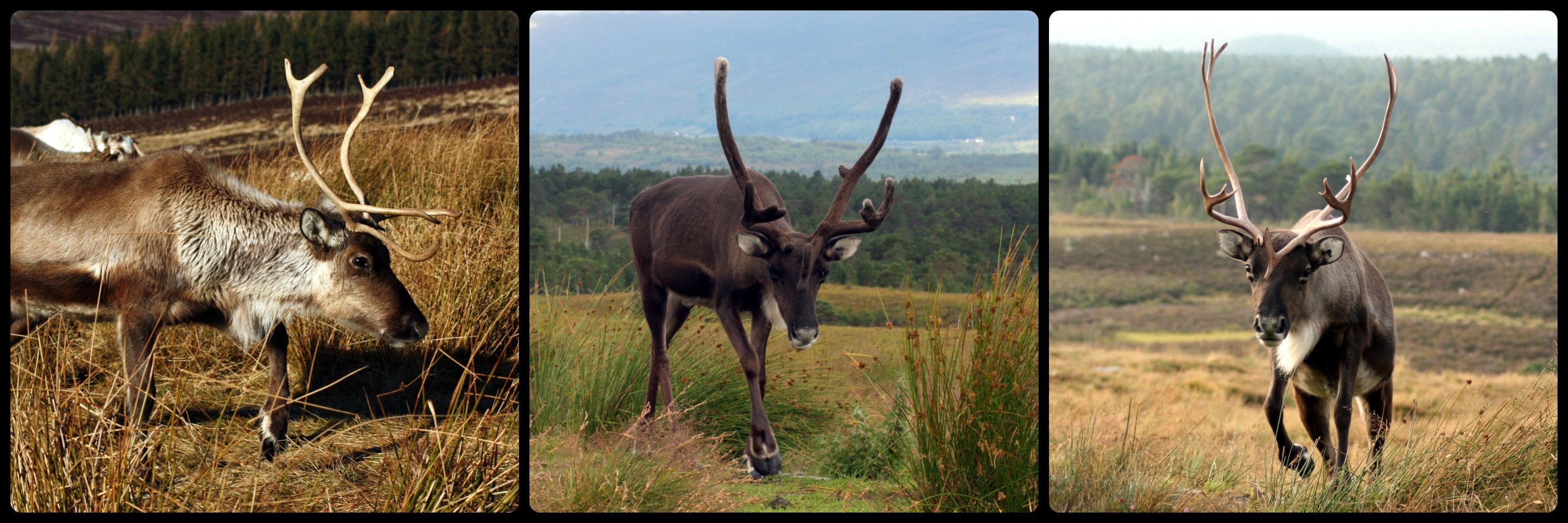
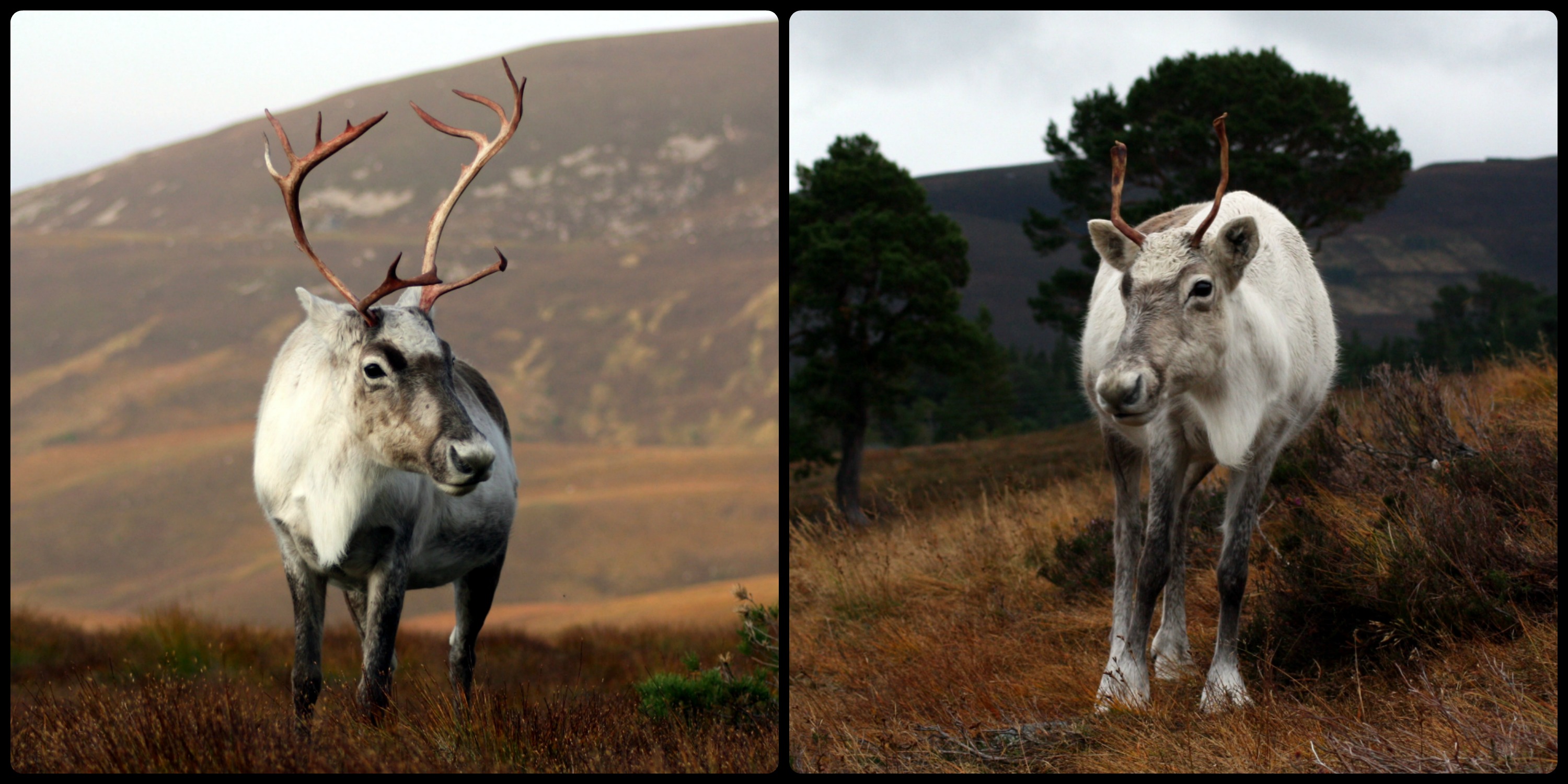
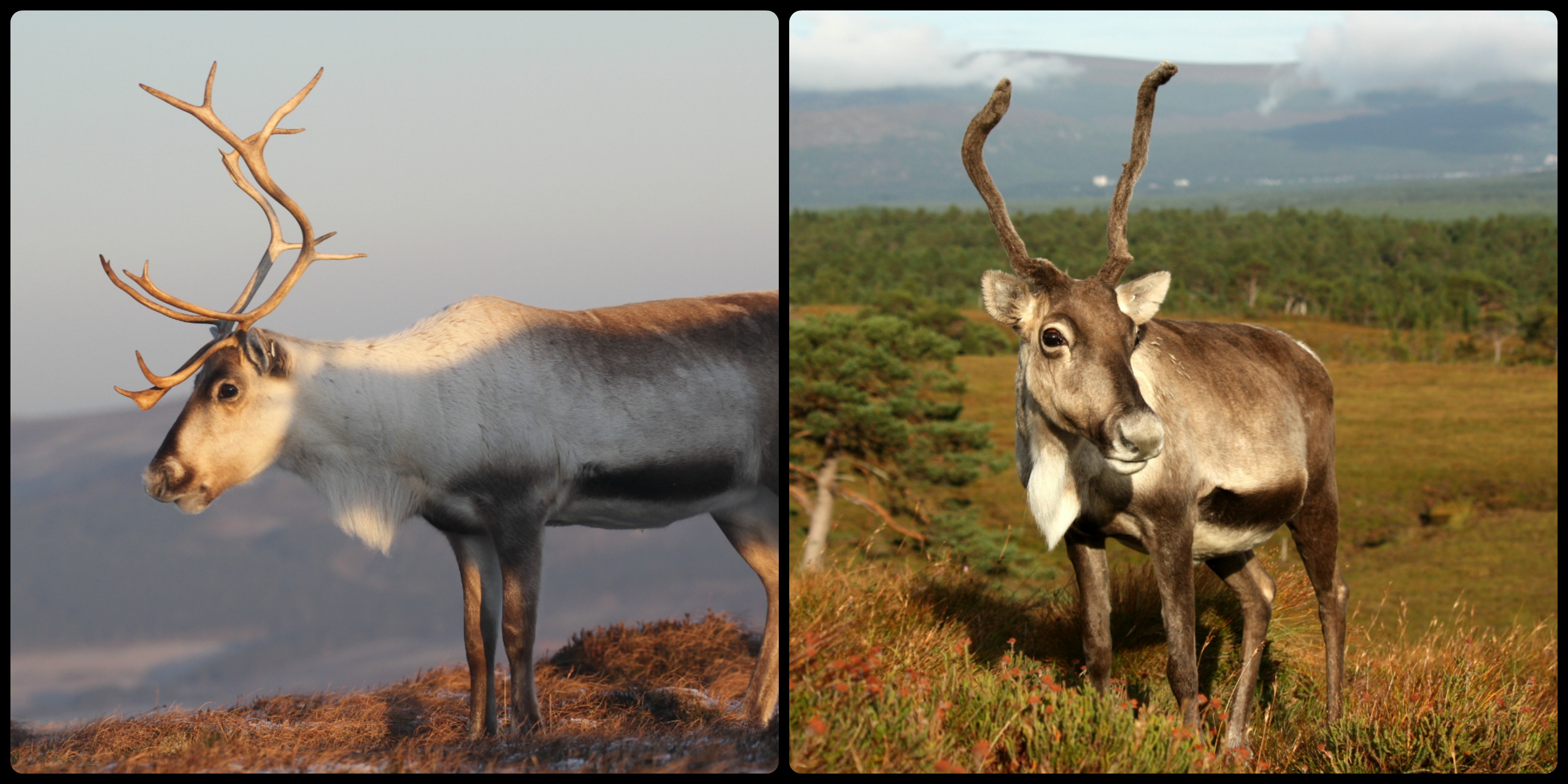
People often ask me ‘why do you adopt a reindeer of all things?’ Little do they know I could spend the next 6 hours explaining why; just how lovely they are, relaxing to be with and such gentle creatures to watch. You get free hill trips where you can walk on to the hill and hand feed them, you get certificates and photographs and surprise goodies in your adoption packs every year. You get newsletters twice per year and the adoption money goes straight to supporting the herd, I could go on……but I don’t.
If the truth be known I’ve never adopted a reindeer – they always adopt me, I just pay for the privilege. My first adoptee was Indigo back in 2003. A calm and lovable character who always had her nose in my pocket even when all feed had disappeared from my hands. I fell in love with her at first sight and continued with the adoption until her sad demise. I was lucky enough to be offered one of Indigo’s antlers which my husband, Colin, made a pair of earrings out of for me – I will treasure those forever. After Indigo died I adopted Cheer in 2014, Indigo’s great granddaughter. A very quiet and shy reindeer, not an enthusiastic hand feeder like Indigo but easy to spot, which for me is a distinct advantage! For the past 3 years I have adopted Bumble, as far as I’m concerned one of the best reindeer there has been in the herd.
The mighty Bumble. Favourite reindeer of Andi, Chris and Sharon of course
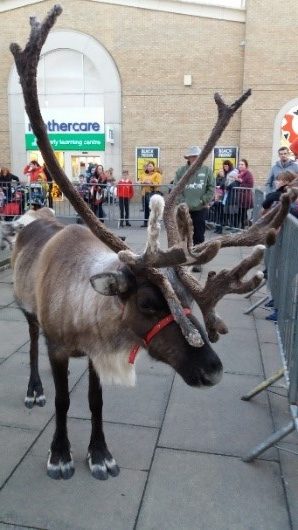
However, Colin disagrees as his adopted reindeer is the majestic Olympic who adopted Colin at a Lincoln Christmas event in 2017. On this occasion Colin and I just have to agree to disagree.
Olympic
This month I have adopted another impressive character Svalbard. I have spent these two weeks volunteering by hand feeding him and getting to know his lovable if not occasionally grumpy ways with people. He’s an enthusiastic hand feeder but when the food has gone he’s on his way, thank you! Although his antlers aren’t yet up to his normal impressive spread they are growing so fast you could almost sit and watch them grow to maturity.
Sharon
Svalbard, another greedy hand feederSvalbard with a full set of antlers
One of our visitors recently decided to adopt a reindeer they’d met at the Centre, but called us up when they received their pack to let us know that we’d sent a photo of the wrong reindeer. The reindeer they’d met had been a pale brown, with a thick shaggy coat and small antlers, whereas the photo on their certificate was of a sleek black coloured reindeer with large bony antlers. Thankfully, we hadn’t got it wrong, but could totally understand their confusion, as the reindeer change in appearance a lot throughout the year.
Bovril in his shaggy old winter coat in June, and looking smart in September
First, there is the coat appearance. From May, the reindeer start moulting out their long winter coat, which, with 2000 hairs per square inch, takes about six weeks. They look incredibly scruffy at this time, but by around mid-July the whole herd look glorious in their short summer coat. This summer coat is a richer colour than the winter coat, so the white reindeer are gleaming white, and the darker reindeer are virtually black. The short coat exposes all of their angles, so they can look a bit gaunt, with angular heads and shoulders.
Olympic’s varied coat throughout the same year (2014) – in February, July and September
Summer in the Highlands is short-lived, however, so by September their long winter coat is growing through, softening their appearance and turning them into cuddly teddy-bear lookalikes. This coat is slightly lighter in colour, so the darkest reindeer are now a rich brown. Over the winter months, the sun gradually bleaches out the colour, so by April the whole herd are a similar washed-out shade, with only the pure white reindeer looking different. It is the worst time of year to become a reindeer herder, as the reindeer look almost identical, and I’ve had sympathy with Ruth, and previously Dave and Imogen, starting in April and trying desperately to work out who is who!
Young Beastie throughout the same year (2011) – in full winter coat in January, darker summer coat in July, and new winter coat in SeptemberYoung Strudel throughout the same year (2010) – in old winter coat in May, dark sleek summer coat in August and with new winter coat growing through in September
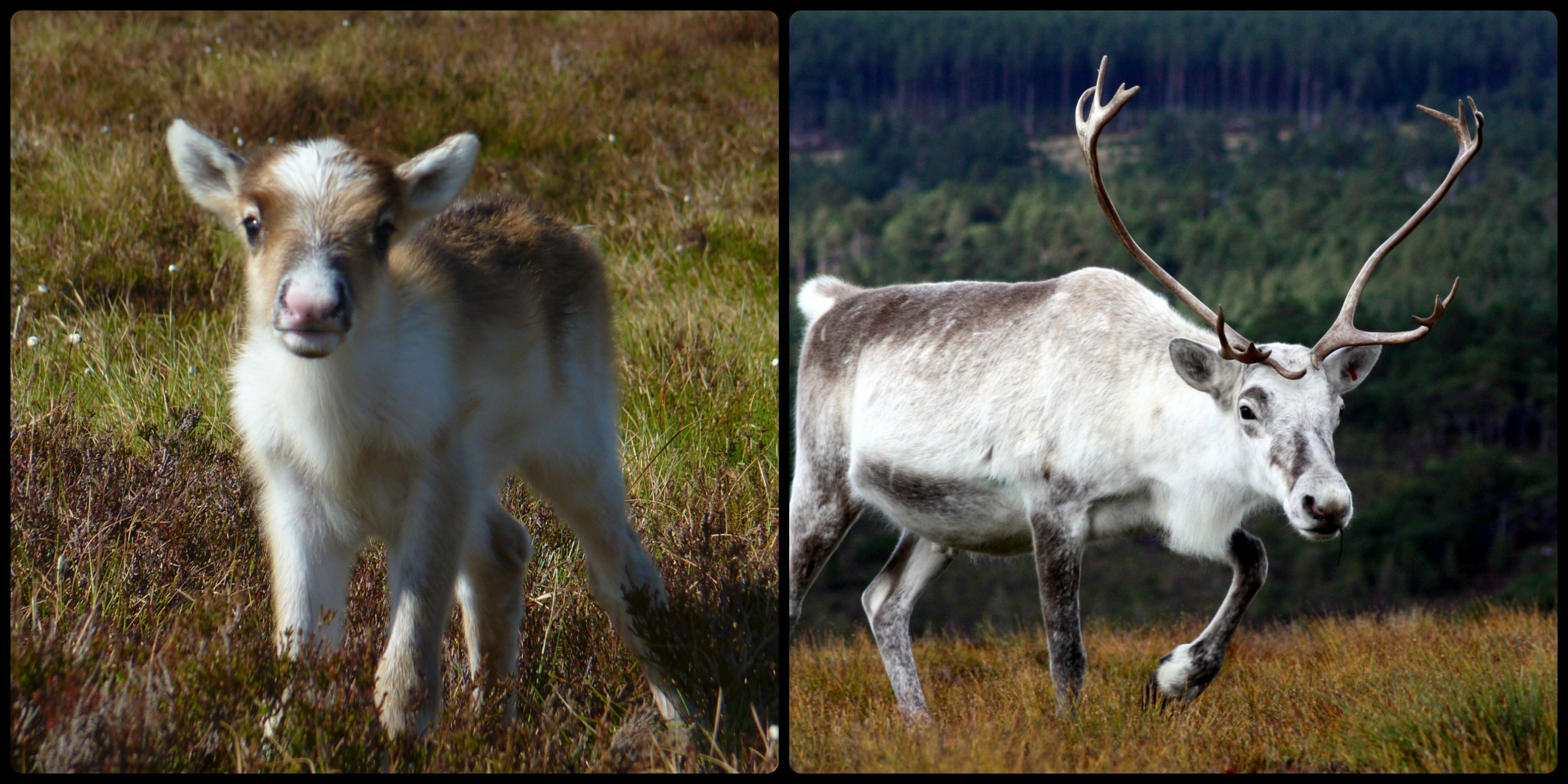
Whilst the colour of a reindeer varies depending on the time of year, a dark coloured reindeer will always be comparatively dark, and a light one will be light. There is one exception, in that some white calves are born a mousy brown or grey colour, with a white forehead. This white forehead suggests their future colour, and once they are a yearling they have changed into their adult silvery coat.
Diamond as a brown calf with a white forehead, turning silvery later that year, and even lighter as a yearlingOrigami as a calf with a white forehead, and as a silvery white adult
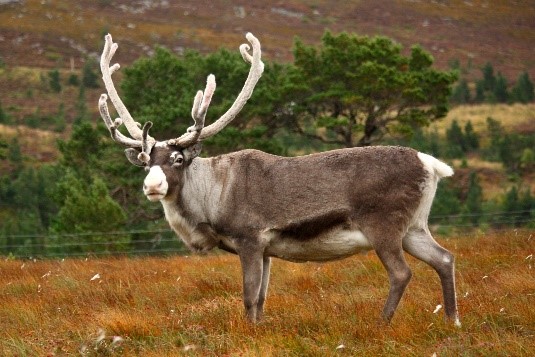
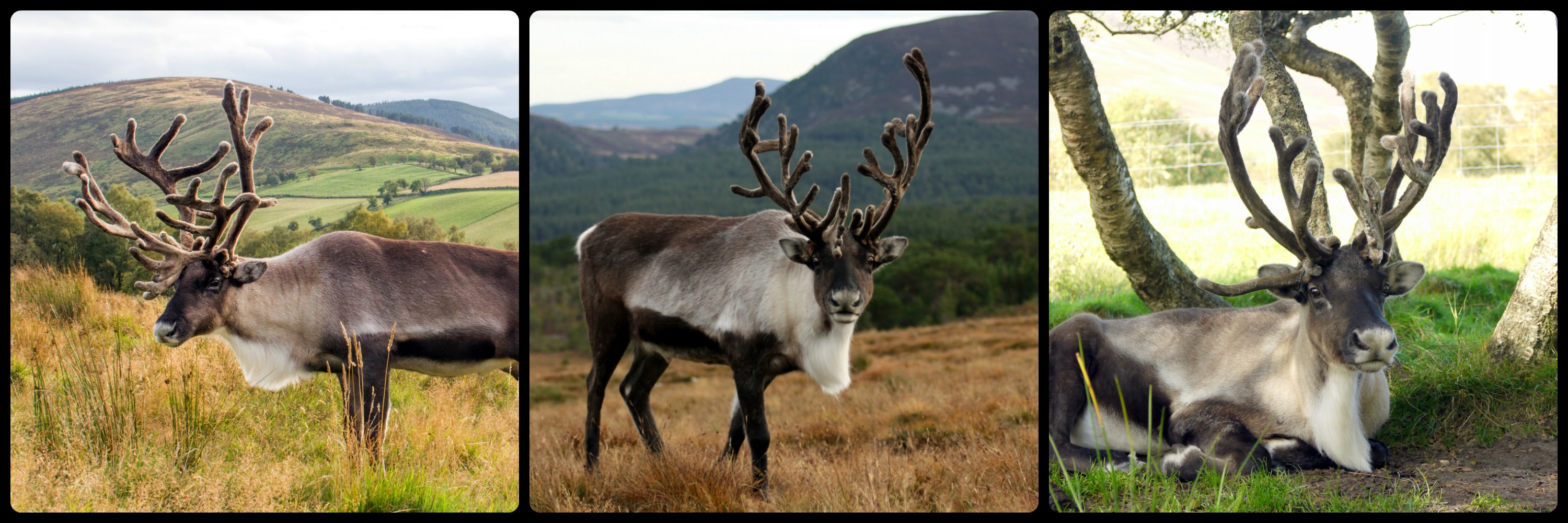
The other major change in appearance is relating to the antlers. Every year, each reindeer grows a full new set of antlers before casting them again at the end of the season ready to grow the next (hopefully better) set. From January to March, the male reindeer are antler-less, with the females usually losing theirs a little later, between March and May. Antlers are very distinctive, with each individual tending to grow a similar shape or pattern each year once they pass the age of about three. This is really useful for us herders, helping us to recognise the reindeer from year to year. Not much help in the period between casting the old set and the new set getting to a sensible size though! New herders are cautioned to try to “look beyond the antlers” and instead learn more permanent characteristics, such as the shape of their face.
Caterpillar with very similar antlers over three consecutive years – 2014, 2015, 2016.Puddock with his familiar crazy branching antlers over three consecutive years.
There is a slight spanner thrown in the works though, as adult reindeer don’t necessarily grow the same size of antler each year. Antler size is determined largely by condition, so if reindeer are short of energy, they will grow smaller, more basic antlers – it’s pointless to waste energy on an amazing set of antlers if you don’t save enough energy for your body to survive! The three main reasons for sub-standard antlers are illness, rearing a calf, and advancing years. If a reindeer becomes ill whilst growing their antlers, the growth will be checked, and sometimes the new bone is weakened to the point that it breaks off, leaving the reindeer with short, oddly shaped antlers. Antler growth also checks when a female is about to calve, and the extra effort of producing milk to feed the calf can mean the antlers are considerably smaller than usual. Finally, once a reindeer is in their old age, their antlers often become distinctly short and basic – they are focusing their efforts on being alive rather than growing antlers for dominance.
Lulu with impressive antlers in 2013, and a rather less impressive set the following year, due to rearing a calf.Beautiful Sequin in her prime with a large set of antlers, and with a simpler set in her old age.
It’s always entertaining for new herders watching the change in reindeer throughout the year, and sometimes peering in disbelief that the handsome reindeer in a photo is the same beastie as the scruffy fellow they know on the hill (as a side note, most of the photos for the adoption certificates are taken in September when they reindeer are at their smartest, with a fresh winter coat and recently stripped full-grown antlers). So if you do receive an adopt certificate with a reindeer looking a little different from when you met them, it is of course possible that we’ve got it wrong (we’re only human!) but if we check for you and confirm that it is them, hopefully this blog will help you to believe us!
We all have favourite reindeer in the herd and over the years I had a very special reindeer, Beauty, who I hand-reared, back in 1993. Beauty’s mother Sorrel died when Beauty was born and I became her mother, a relationship which lasted her whole life even though she had calves of her own. Indeed I felt a bit like a granny as a result!
Beauty
Beauty died an old lady and for many, many years there was never really a reindeer for me who filled the gap. There have been some great characters since Beauty but none of them were really special enough to replace her. Various reindeer were hand-reared, but not solely by me and although each reindeer has a distinct character there was no real favourite. But over the last 4 years a reindeer has grown on me and now I can honestly say, I have a favourite again.
Baby Olympic
Olympic was born in 2012, in the year of the London Olympics, hence his name. His mother Glacier came from a long line of white reindeer and so when Olympic was born dark coloured, that was a bit of a surprise to say the least.
Olympic with mother, Lilibet
So he was the ‘black sheep of the family’. He grew tame and friendly like all the other calves once they are handled, indeed Olympic became quite outrageous when it came to hand-feeding, terrorising many an unsuspecting visitor on the hill visits. Which meant, in time Olympic was banished to the quieter life at our Glenlivet Farm, where visitors to the herd are less frequent and so life with Olympic and hand-feeding became manageable.
Strangely enough although Olympic is a very bold reindeer and eagerly comes up to us, amongst the reindeer he seems to be quite low down in the pecking order, almost to the point that he is a little bullied! Although he is a big strong reindeer he is just a big softy and another reindeer only has to so much look at him and he’s off. So Olympic often seeks out human companionship and whenever I am bringing the reindeer down off the hill for the daily feed Olympic is often right there beside me. So we have developed a close relationship and as time has gone on Olympic has grown on me and become my new special reindeer.
Olympic as a yearling
Last autumn we trained Olympic to harness and he joined the teams at Christmas time. Handling reindeer, gaining their confidence and harnessing them to pull a sleigh is a real joy for me. I love the close contact with the Christmas reindeer, feeling so responsible for them when away from home and proud of them as they delight the crowds who come to see them. Olympic was a delight to train and looks fantastic in full harness. He is as much at ease pulling the sleigh alongside another reindeer as pottering along at the back of the sleigh with the 6 month old calves. And I think Fiona, who organises Christmas now and decides which reindeer goes where made sure I had Olympic in my team! Thanks Fi!