‘There is no such thing as bad weather, merely unsuitable clothing’. It’s a great phrase this and one that is on display in the Reindeer Centre, to warn people to be well prepared for the hill visit to the reindeer (even in summer sometimes!).
In the animal kingdom, a number of the arctic animals change their coats in winter and in the case of reindeer they not only grow thicker coats but also their coats turn lighter in colour, in some cases pure white.
Reindeer snoozing comfortably in the snow – Lilac (right) is currently our oldest reindeer at nearly 17 years old
The change in colour is associated with shortening day length and there are obvious benefits from being white or very light coloured when it comes to camouflage in snow. But it is also the case that white hair is more insulating than dark hair. White hair lacks pigmentation and nothing replaces this, leaving pockets of air, a very good insulator. So I suppose that means that when the reindeer grow their winter coats they have more airy hair! Indeed the reindeer never cease to amaze me, on the coldest of days, they are high up in the snow, on the exposed ridges, lying around, resting, ruminating and I suspect positively enjoying the weather which we shelter from in our warm houses.
White reindeer – this photo was taken back in 2008 of male reindeer Harry, Minto and Bajaan
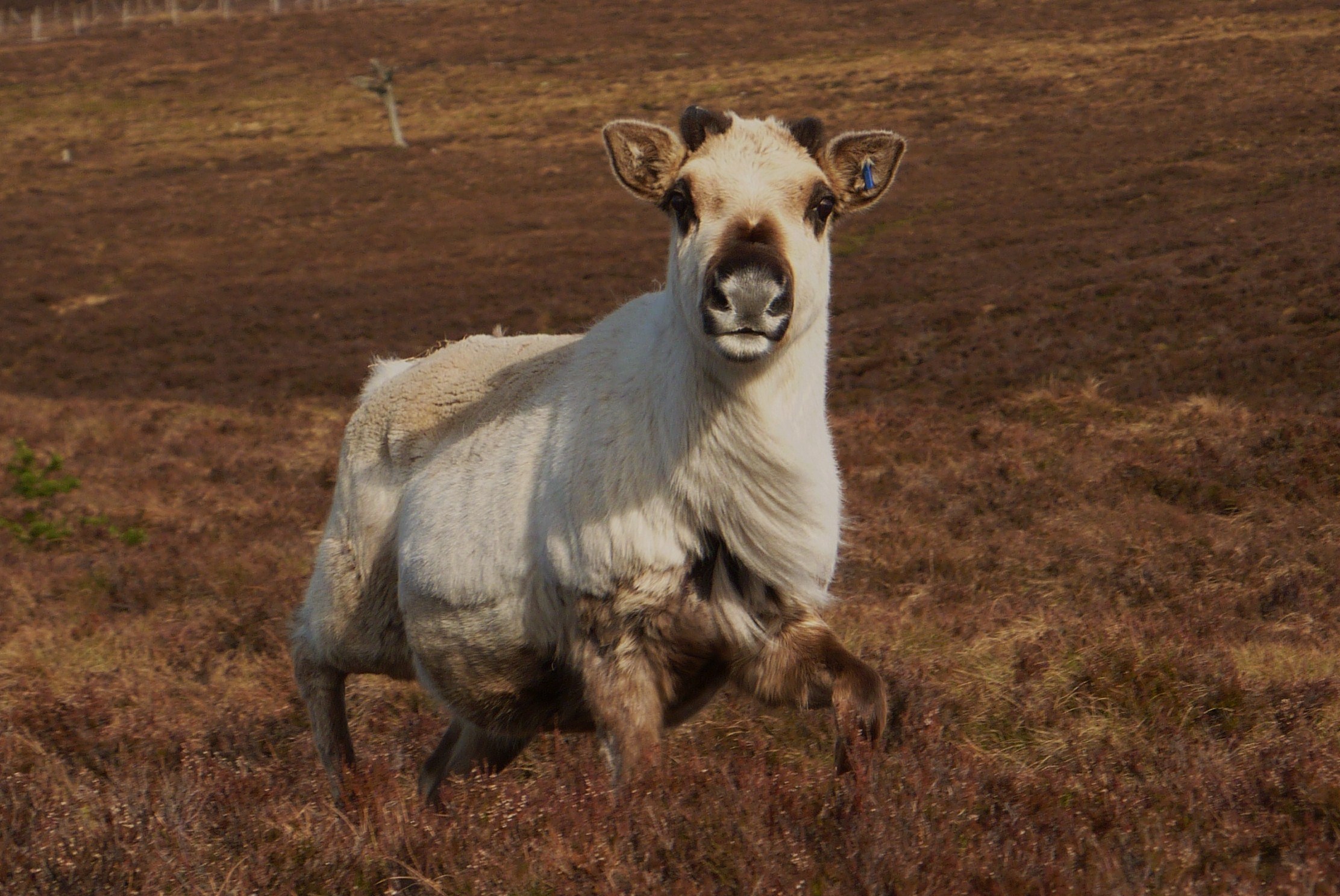
In the herd we do have a few reindeer who are actually pure white: Blondie, Lego and Blue to name just three of them. Knowing that white hair has more insulation does that mean they have the warmest coats? They certainly always look very comfortable in the snow.
A mountain hare in its winter coat, spotted whilst I was completing my 146th munro!
Over the last few weeks I have regularly seen mountain hares, which live in a similar habitat to our reindeer but are also quite widespread across many of the Scottish hills. They too turn white in winter and like the reindeer have relatively large feet which act as snowshoes making running seem effortless as they hurry across snowfields.
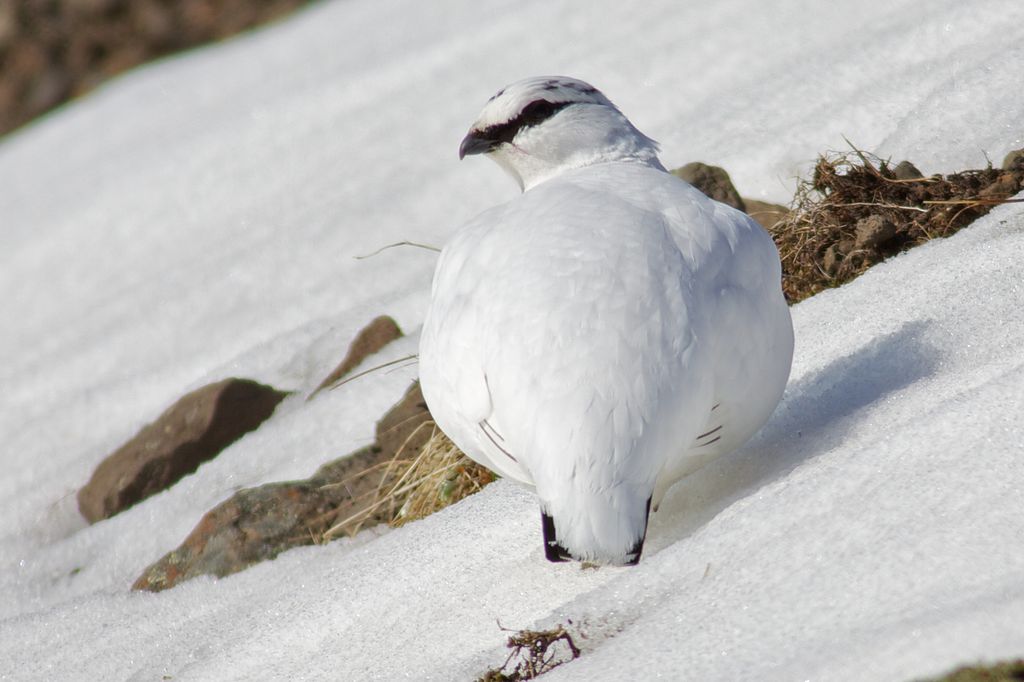
Ptarmigan (Lagopus muta). Photo by Boaworm [CC BY-SA 3.0], via Wikimedia CommonsThere are two other animals found in Scotland that also turn white: the ptarmigan, an arctic grouse that is found in many of the Scottish mountains above 2,000 – 2,500ft, and the stoat, which depending on how far north it lives also turns white, when it is then called stoat in ermine.
Stoat in ermine – white with a black tail tip. Photo by Steven Hint [CC BY-SA 3.0], via Wikimedia CommonsLike the reindeer and mountain hare, the reason the ptarmigan plumage turns white is for camouflage and warmth but I do sometimes wonder about the stoat in ermine. Although I have seen them in snow around the farm, all too often there is not a flake of snow to be found and they ‘stick out like a sore thumb’. But they are a very clever predator, predating mainly on rabbits. They are incredibly quick, will catch and kill prey 10 times bigger than themselves and appear to be completely fearless. They are sometimes thought to ‘hypnotise’ their prey, maybe the white coat and black tip to their tail somehow confuses the rabbit!
At the beginning of March an event occurred in the Cairngorms which only happens once every three years… El Nino or meteor showers you may ask, no, the Reindeer Herders got our First Aid training! On a snowy morning we all headed down to our local village of Kincraig to meet our wonderful trainer Pete from Outwardly Mobile First Aid in Newtonmore (Look them up if you need training local folks!).
Pete, our trainer, prepared for every situation
You’ll be glad to know that our course was aimed specifically at Outdoor Emergency First Aid, rather handy seeing as we spend lots of time out on the mountains. However, although we can theoretically now deal with almost any eventuality whilst on the hill with our lovely visitors, please don’t throw yourself off the path to test it…
As you can imagine we turned up in true reindeer herder style (slightly shambolic… but still classy I think..). Our first, or rather my (Abby) first faux pas was failing to find the ‘Meeting Room’ we were using… apparently it said it on the door… who knew! After setting up in what was basically a spare cupboard, the keeper of the hall turned up and set us right! We also had one special reindeer herder on-site to make sure we were taking things mega seriously…
Tip brushing up on her skillsTip standing in as a casualty
She valiantly guarded us and made sure we practiced our First Aid to our full abilities!
While learning the finer arts of CPR we were all granted our own CPR dummy faces (for hygiene) although they were a tad creepy…
Pete despairing at his class of dummies
After going through all the basics, recovery positions, CPR and Defibrillator training it was time for the fun stuff… the scenarios! This was AWESOME! We got to dress up AND behave like idiots – in my case, my job on one scenario was to be a stressed out bystander to a cardiac arrest… there was even a prop chainsaw involved… EPIC! (We did also learn a lot of useful stuff too – like how to prioritise your patients and keep people calm).
Checking for danger (village halls can be dodgy places)Check for a response, airway and breathingNo response – call for help (note Imogen – “I have an unresponsive casualty, not breathing, who appear to have lost all of its limbs, clothes and hair”)Commence CPRRecovery position and recovering Imogen on a stretcher made from a bivvy bag
After two intense and riotous days we all successfully passed (woohoo!) but Imogen was so super serious she got two certificates to prove her dedication to the First Aid cause!
So whilst we sincerely hope that our skills won’t be called upon, if the worst happens at least we’re all up to speed and well rehearsed on what we need to do.
Lace still proudly wearing her antlers… we’ll see if we can find them when she casts them!
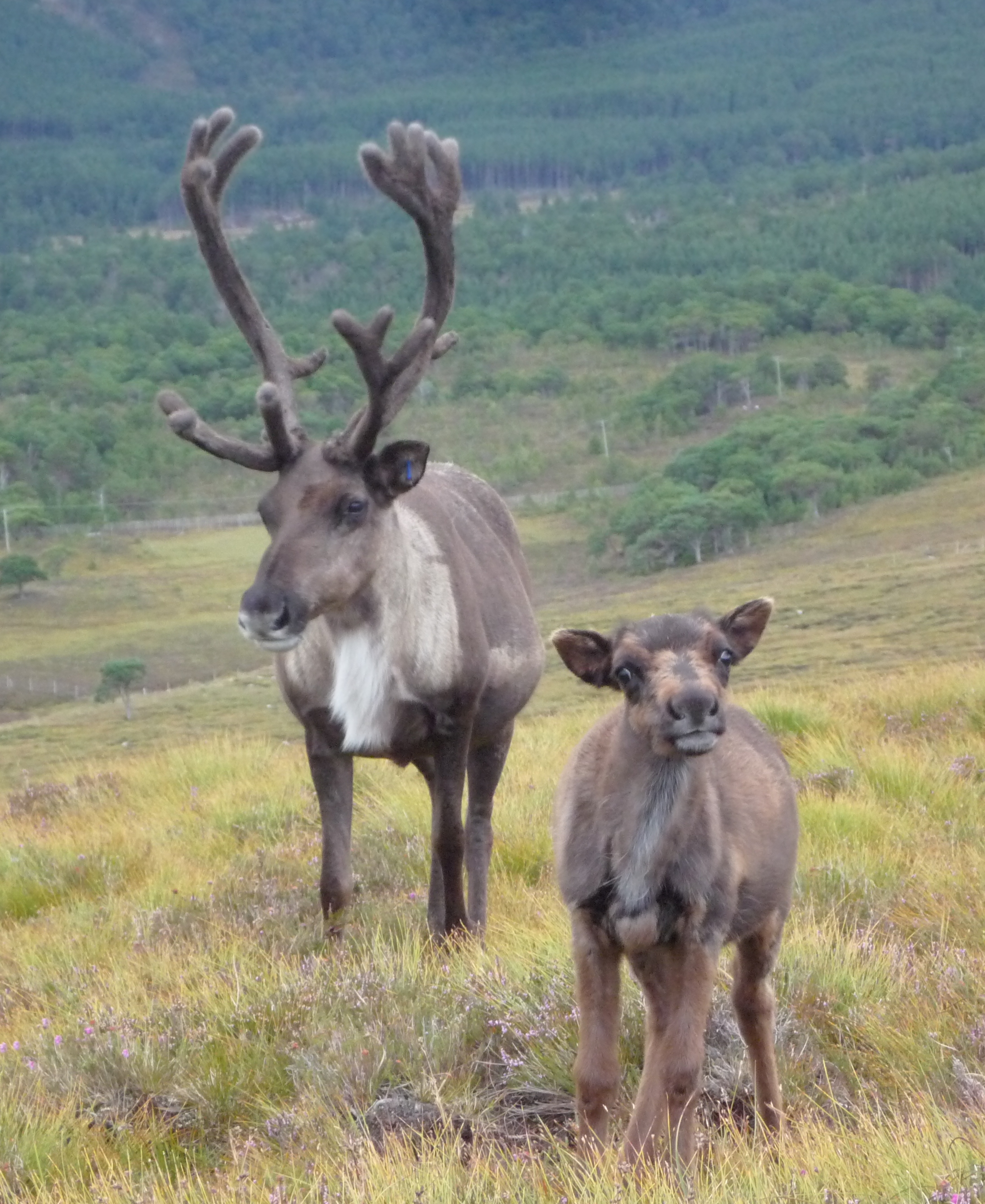
Each year every member of our 150-strong herd (well, with just a handful of exceptions… Malawi, Dixie…) grows a pair of antlers. And every winter, at some point between November and May, those same antlers are naturally cast so the owner can grow a (theoretically) bigger, better set the next year.
Over the winter months, our reindeer are all roaming free on either the Cromdale or Cairngorm mountains, so there are many antlers that ping off into the heather and snow and are either never seen again, or are picked up by a lucky hillwalker. But plenty of the antlers are found by us, collected and brought back to the Centre, then usually handed over to Hen. She has (foolishly?) taken on the task of sorting out what happens to them next.
The first of the antlers for the year…
First job is to identify which reindeer the antler belongs to. Sometimes this is easy – perhaps we saw two reindeer having a tussle and witnessed the moment the antler parted ways from its owner. Some antlers are pretty distinctive and when whoever found it walks into the office with it, usually displayed held on their own head and asking, “Who am I??” there is a chorus of correct answers from the other herders present. But sometimes it is a fairly standard shape and size, and then it comes down to skimming through our photo archive (we aim to keep a recent photo of every member of the herd) until it is spotted in its previous position attached to a head.
Once the past owner of the antler is identified, first port of call is our “Antlers wanted” list – if you adopt a reindeer and fancy owning a set of their antlers just drop us an email and we can pop you on it – bear in mind there are only a maximum of two antlers available each year though, and we frequently don’t find both! Otherwise we write to any adopters of that reindeer to see if they’re interested in buying it, on a “first come, first served” basis – whilst this is the fairest way we can do it, it often leads to several phonecalls on the same day asking to buy it, and we can only sell it to the first respondant! Finally, if none of the adopters want it, or indeed if the reindeer has no adopters, then it goes for sale in our shop here at the Centre, usually in about June.
Various wearers of the same set of antlers: Kota, Imogen and HenA slightly less impressive offering from Israel this year…
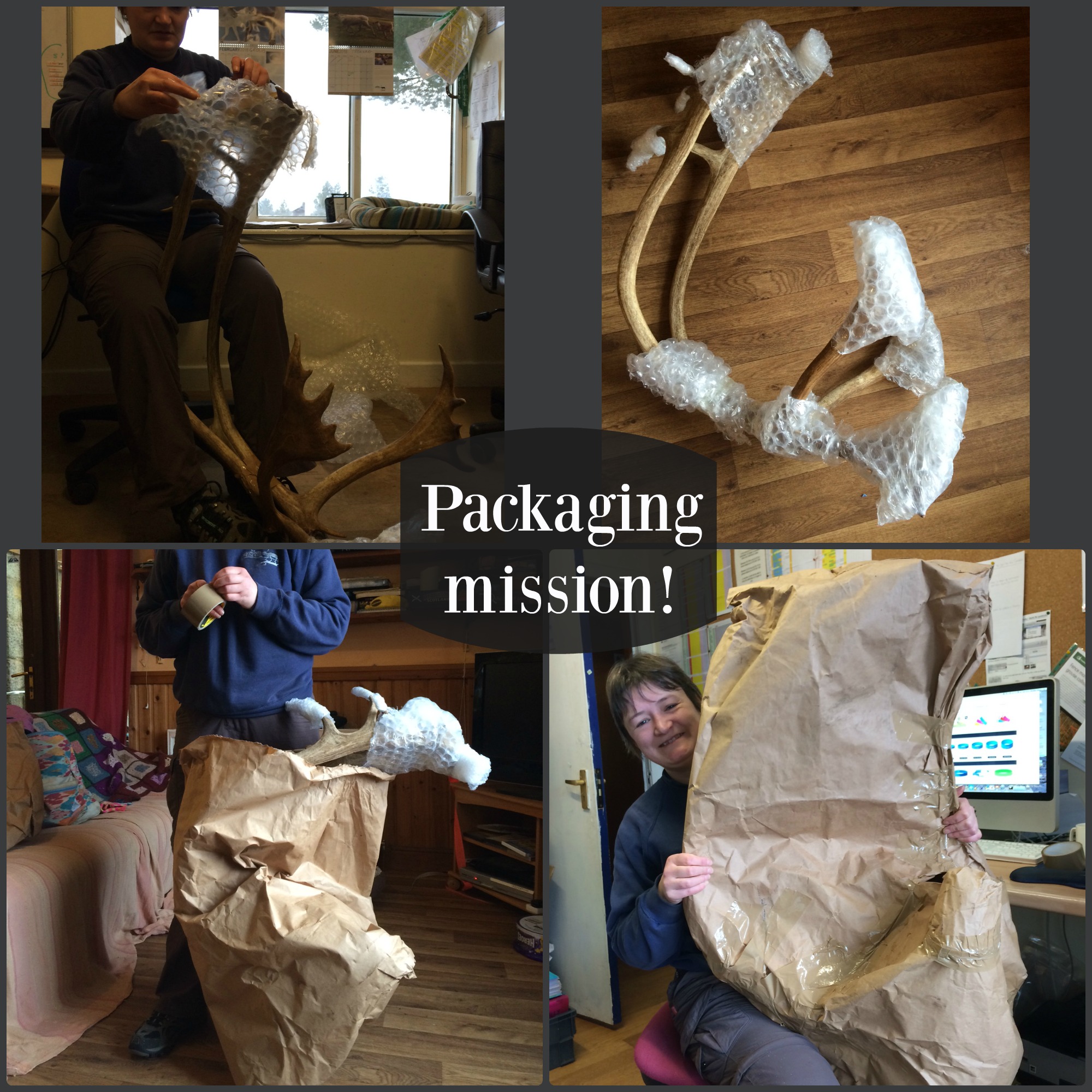
Antlers come in all shapes and sizes, from big handsome bull antlers (we usually only have one or two large sets available each year) to fancy cow antlers, and calf “twigs” to furry broken castrate antlers. We’ve already started working through the pile of antlers that we’ve found this year, and the biggest set without a doubt belonged to our breeding bull Kota. One of his adopters was delighted to purchase the set, but as they don’t live locally, the next challenge was packaging them up to post. As you can imagine, transforming a pair of unwieldly, bony objects into a postable package is easier said than done… We first wrap the points in bubble wrap, not to protect the antler (it’s solid bone) but to stop it bursting out of the package, and then pop the whole thing in an empty barley bag (or two, in the case of Kota’s set). Barley bags are super as they have two strong layers of paper, and we’re helping the environment out by recycling. As an added bonus, recipients often find a few stray flakes of barley! Though on the downside, sometimes the posting out of antlers is delayed because the reindeer haven’t eaten enough for us to use the next bag of barley in our feed mix!
Kota’s antlers being packaged for posting
With a large pile of antlers still to work through, and plenty left on the heads of the reindeer on the mountains, its likely that it’ll be summer before we finish finding new homes for them. All of the funds raised from the sales go straight back into the day-to-day care of the herd, so it both helps us out and hopefully brings a lot of pleasure to anyone who buys them. Every antler is unique and its great to have something sustainable which allows people to own a “bit” of a reindeer!
Andi
Please note – there’s now a newer, more up-to-date blog about how we sell antlers, which you can read here.
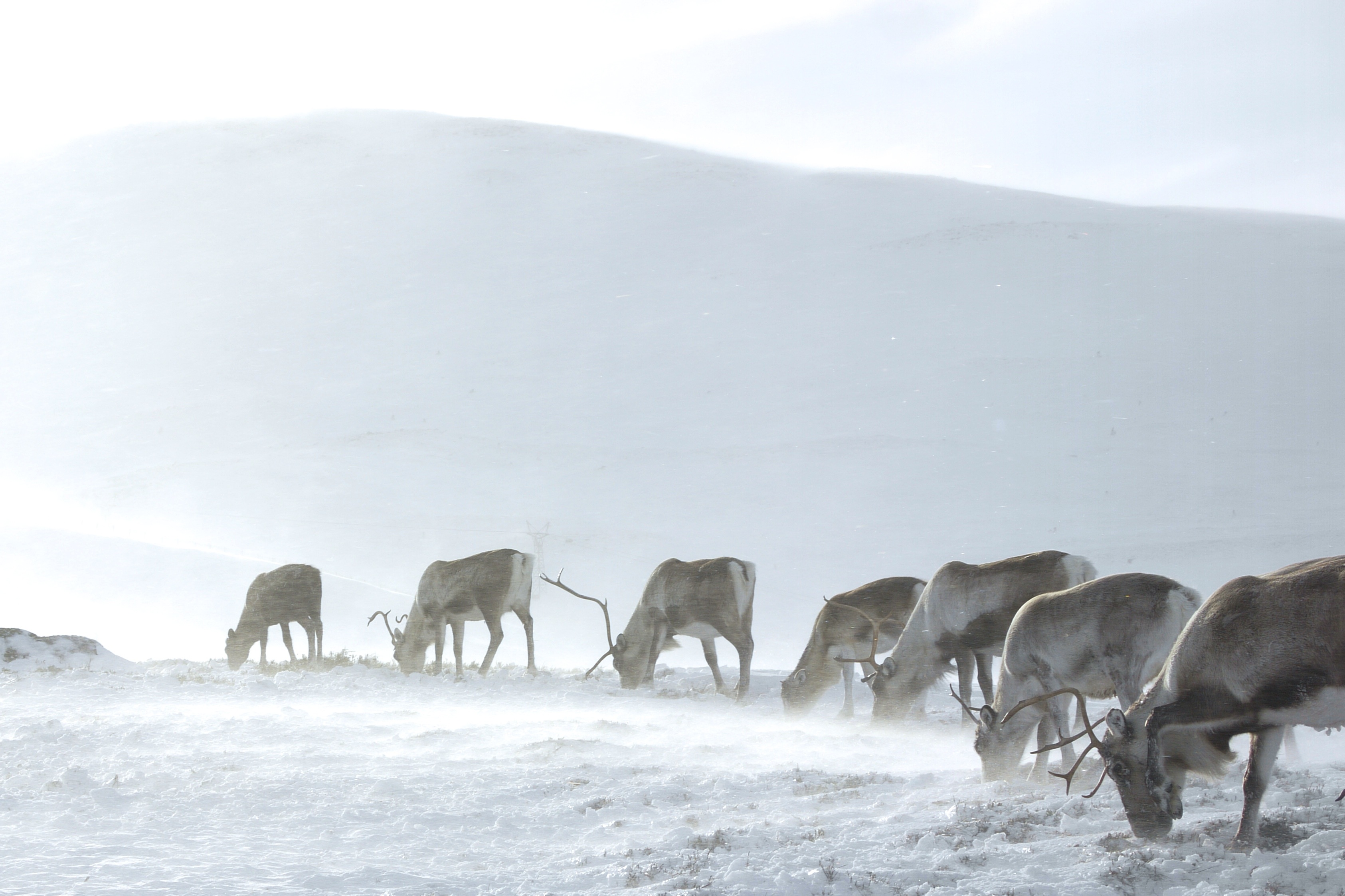
Eve feeding the herd in a blizzard (Photo by Jeff J Mitchell/Getty Images)
“There’s no such thing as bad weather… only unsuitable clothing…”
This is very much the mantra us reindeer herders live by and there are unfortunately even days here in the Cairngorms where our beautiful “office” on the mountains leaks and gets a wee bit blustery. This is never more emphasized than during the winter months here where weather conditions are some of the most beautiful and the most extreme.
We often start our mornings here at 8am vaguely unaware of exactly what the weather is going to bring, Reindeer House is fortuitously sheltered at the foot of the Cairngorms and it’s often not until we venture above the tree line that the true extent of the weather hits us.
If the ski road remains open and the reindeer are there we dutifully head out onto the hills even if this means battling 80 mph gusts and freezing temperatures… winds so strong herder Hen’s car was relieved of its undercover last winter! (we love it really!).
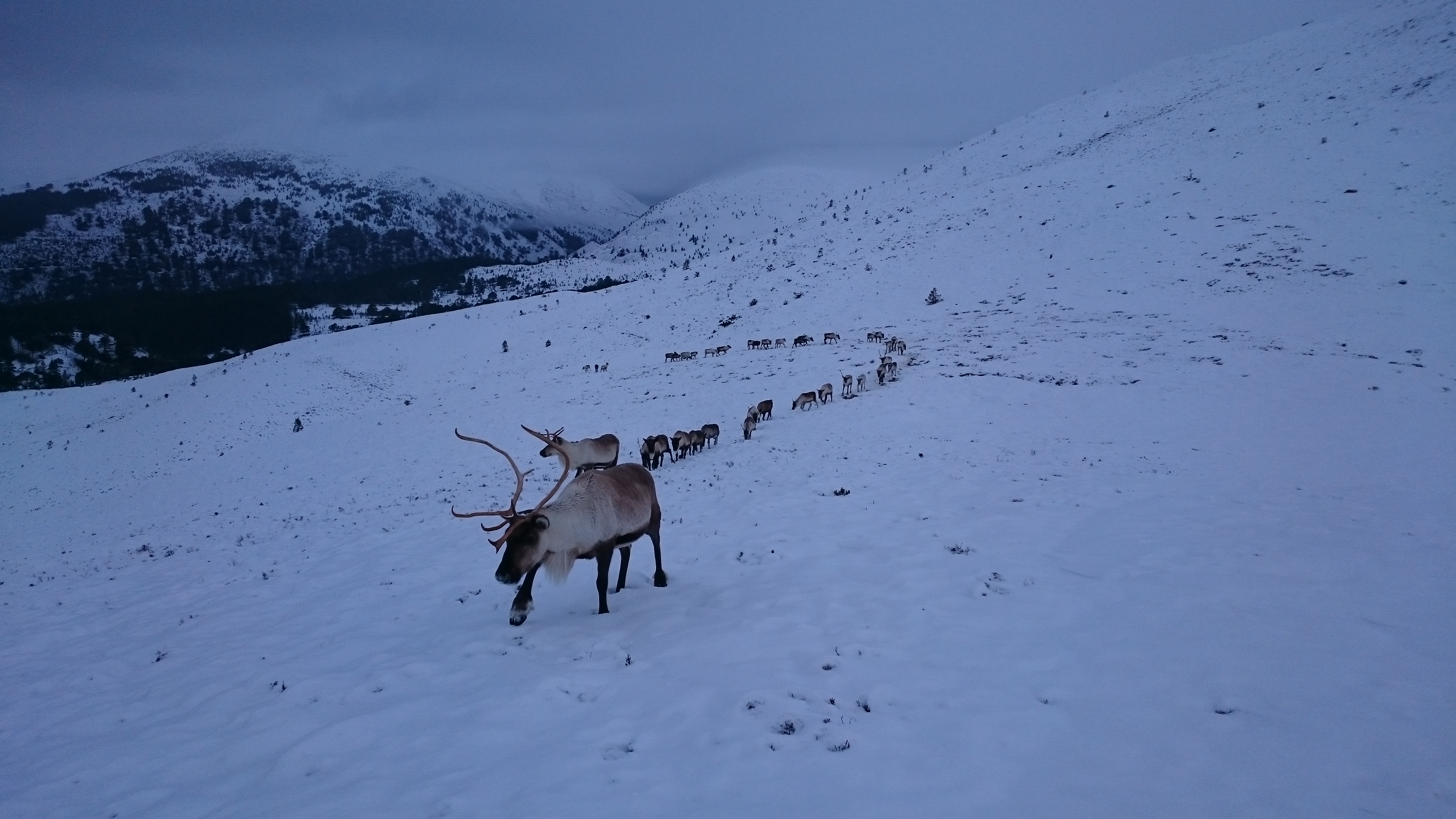
It quite often looks a wee bit of a comedy show, us herders trying to walk in a straight line (people must think us perpetually drunk!). Annoyingly, the reindeer often look completely unfazed be it wind, icy temperatures and deep deep snow, quite often as we lumber through the drifts they use us as the snow plough for making them a path, following cheerfully in our footsteps even though they’re the Arctic animal!
Making a path for the herd through the snow (Photo by Tony Dilger)
This brings us to clothing, again the reindeer come annoyingly pre-prepared for the weather with thick insulating, water repelling coats and built-in snow shoes; us on the other hand live for woollen thermals, multiple jumpers and cosy hats and are most definitely never far from a pair of waterproofs! Woe betide the reindeer herder who doesn’t have a spare set of clothes! On the other hand, I personally often find myself far too prepared in the summer months when even in the sunshine I never quite trust that Scotland won’t throw snow at me!
Working in the Cairngorms year round is definitely a different challenge to some of the more indoor based jobs I’ve held but as long as I have my mittens and spare socks I’m super happy to battle whatever the weather throws at us!
I thought maybe I’d start an occasional blog series remembering particular characters in the herd who are no longer with us, because some readers amongst you may have met them once upon a time, and those of you that didn’t can at least have a brief glimpse of some of the most memorable reindeer from our herd.
Flake with her beautiful antlers
I scrolled through our photo archive of reindeer no longer with us, and my eye alighted on Flake. Well, there is a fine place to start! Plenty of memorable things about Flake, and what a fabulous reindeer she was over the years. I first met her in summer 2009, having been away for several months, and arrived back and headed up to the hill enclosure for the first time. Most of the reindeer there I recognised, or managed to work out pretty quickly, but who was this bull with a blue ear tag? Quite narrow, upright antlers compared to some, but still a very good size, and ‘clean’ in design rather than the chaotic, many tined antlers of the castrate males. I was flummoxed. Turns out it was Flake, in the enclosure for the summer months rather than out free-ranging like the other females, due to her calf Diddly (who we’ll get to in a tick).
Flake was a beautiful reindeer
Flake’s fabulous antlers set her apart from many of the other cows, as they were much more elaborate than the average female set and a very decent size most years. In 2009 however, the year I first saw her, they were a particularly fine set and there is a specific reason for that…
Flake was a notoriously bad breeding female. Her calving record, filed away on our computer here, is basically a list of disaster after disaster, from stillborn calves, to ones that got stuck and needed pulling out by the vet, to premature twins, you name it. In 2011 she produced a calf who had a problem with his joints, probably not helped by the fact that Flake had calved right next to a large boulder which he had promptly got stuck beneath! The entry on her records for her final calf Brave, born in 2012, reads ‘Normal!!!!’.
But before that, in 2009, there was Diddly. Born prematurely, she was tiny, so much so that she couldn’t reach Flake’s udder. Even if she had been able to, Flake didn’t produce any milk that year anyway, so right from the start we had to hand-rear her, bottle feeding through the night to start with.
Heather working hard to look after Diddly, while Flake stands byDiddly was so tiny!
Flake and Diddly started off in the paddocks, then eventually moved up to the hill enclosure for the remainder of the summer and the autumn. And that is the reason for Flake’s great antlers – while we slaved away feeding Diddly for the first 5 months of her life, Flake basically sat back and let us do all the work – a ‘designer mum’. All the energy going into her body from the feed we lug up the hill every day went straight to her antler growth rather than to milk production. The antlers of the other females, out on the high tops foraging for themselves, all showed the detrimental effects of the effort of raising a calf, being smaller and wigglier, but not Flake. She resided in state in the hill enclosure all summer, fat as butter and with fancy headgear, with a queue of reindeer herders tending to her every need and raising her calf for her!
Flake and Diddly when I first met them in August 2009
Flake with the grown up Diddly in February 2011
Flake passed away in 2013, an old girl by that point. Very sadly, Diddly followed later that year, but not before producing her son Crowdie, who is now nearly 3 years old and a great fun wee reindeer. Diddly was an interesting character in her own right as she never produced any antlers at all, remaining bald for her whole life, a little quirk that sometimes happens with female reindeer.
You all know Christmas is our busy time of year, however you also know that reindeer are not just for Christmas, so what happens after all the commercial pursuits we undertake and those many visits onto the hill throughout the year…? Well, this is a reindeer herder’s favourite time of the year as the Centre is closed and for once in the year we feel like we can start to get back on top of things!
First and most important job is to get the reindeer into their correct locations for the winter. They are split between the Cromdale hills over near our Glenlivet hill farm and here on Cairngorm. We don’t use our mountain enclosure from January through to April/May (in time for calving). It’s a time of year reindeer are in their absolute element and what this species is all about – the cold, snow and thick winter coats. The split tends to be boys to the Cromdales and girls on Cairngorm however some females do also go onto the Cromdales as well.
Santana leading the herd up – single file through the snow to save energy.
We still like to see the reindeer everyday so we know where they are and therefore we feed and check them every morning. This means heading up and spying from our various points along the hill road where we get the best views of their hot spots. A reindeer herder’s eye is well trained and can spot the reindeer way before anyone else. A lot of the time we don’t even reach for the binoculars – we just know the lay of the land so well that we know which ‘reindeer shaped rocks’ are indeed rocks and which ones are actually the reindeer! The weather has a big part to play in this so no snow means we find the reindeer quickly, lots of snow means the darker reindeer stick out, however that annoying mottled, patchy snow is the worst to spot reindeer in as they are so camouflaged. High winds keep them off the high tops and closer to the tree line, sunny weather often means they are happy just to have a chilled out day soaking it up… just like us!
Mel hefting just some of the daily rations – it certainly keeps us fit lugging feed out into the mountains!
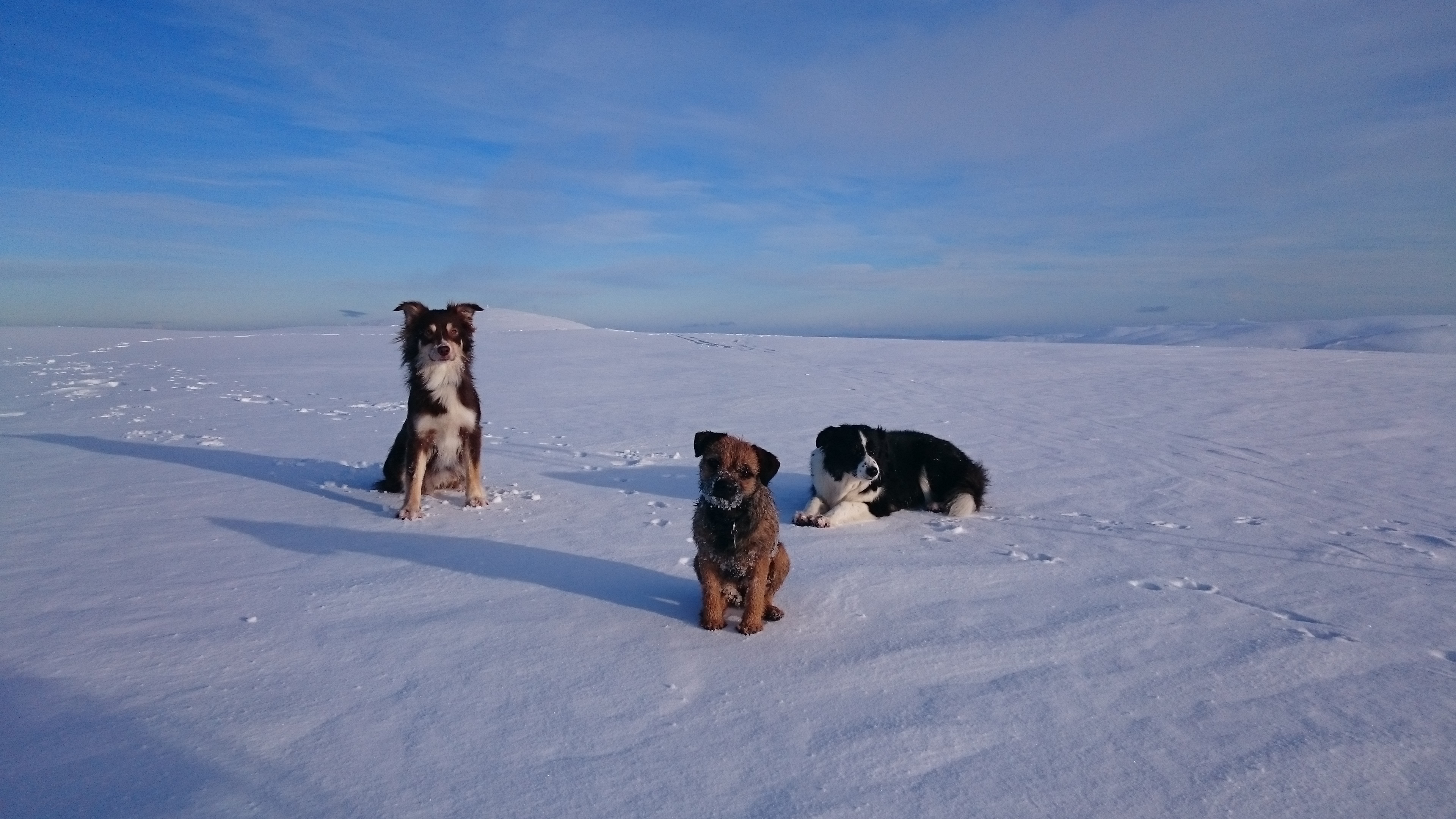
So once found we head out and give them a good feed, count and check them. Even the dogs benefit from this part as they get to come part of the way out. Obviously they can’t mix with the reindeer however Sookie and Tiree are both now trained to wait wherever we ask them. Sometimes we are feeding and checking the reindeer and look back to the dogs and all we see is their wee faces poking above the heather watching our every move and the reindeer don’t even notice them!
Sometimes the dogs look all majestic… (Tiree, Moskki and Sookie)… sometimes not so much! Looking windblown – Murdo, Sookie and Tiree
Once the morning is complete and reindeer fed and checked its back down to the centre to complete our long list of ‘January Jobs’. This may be painting the exhibition floor in the paddocks, fixing fences and gates, oiling the Christmas harness (ready to pack away for another year), going through every single event folder and reading all the reports, making up adoption packs, cleaning, packing away the endless decorations put up at Christmas etc, etc, etc… But being closed means we can also make the most of the good weather. If the sun is shining and snow conditions allow some of us keen skiers head for the hills for a day on the snow! Needless to say the dogs like this part too as they get to come along. This does turn us into fair weather skiers, however we spend plenty of time in the hills being blown off our feet and getting soaked to the bone, to pick and choose when we can go skiing only seems fair!
The honeymoon must come to an end though so on the 6th February we re-open our doors and get back to our daily routine of 11am guided tours. It’s all fine and well it being a nice time of year for us herders but we wouldn’t have this job if it wasn’t for our many visitors to the Centre supporting our lovely herd of reindeer in the Cairngorms!
Today’s the day – Merry Christmas everyone! I hope you’re all having a lovely day and have eaten your weight in chocolate and cheese and are having a good rest. If your wee ones (or your big ones!) have already tired of some of their presents, then I have a very quick little Christmas decoration tutorial for you all.
Everyone meet Gerald, the pom pom Christmas reindeer! This is a quick wee make that hopefully the kids will manage, with some adult supervision, of course.
Materials
Yarn or wool. It doesn’t really matter what kind, or what colour, but I used brown for realism. Please feel free to make rainbow reindeer!
Red felt. I buy whole sheets from local crafty places for about 50p, but you only need a little to make a nose.
Googly eyes. I use ones that you peel that backing off and it sticks to anything.
Sticky tape.
A pair of scissors
Cardboard or a pom pom maker. I used a pom pom maker because I am super into crafts and like to buy useless stuff.
Pipe cleaners
Instructions
Firstly, make a pom pom. I presume everyone knows how to make a pom pom with cardboard, but if not there are lots of tutorials on Youtube. I will put links in to tutorials at the end of the blog.
If you don’t know how to make one, you basically get two pieces of cardboard, cut them into circles of equal size, and make a fairly large hole in the middle. Put the pieces of card together and then wrap the yarn/wool around the circles, going through the hole in the middle and round the outside. Once the circles are completely covered in a fairly thick layer of yarn, you then have to cut the yarn. To do this, I get a pair of scissors and hold the cardboard circles so that I’m looking down on top, i.e. like a bird’s eye view of a tyre on a car, as opposed to looking at a tyre lying flat on the ground. I then put the scissors roughly in the middle and cut down, trying to find the split where the two sides of cardboard meet. Then cut along this split all the way round. You’ll be left with lots of little bits of yarn all poking out. Keep a good hold of that cardboard! You need to wrap a length of yarn around all those little bits, so put the length in between the cardboard bits and then basically tie it as tight as you can. This is where the pom pom can go wrong – if that piece of yarn isn’t tied tight enough, your little yarn bits will all fall out and you won’t have a pom pom!
Tie it really tight a few times and then you want to make a loop with the end, to be able to hang Gerald on your tree. I just tie a knot in the yarn quite low down and it gets hidden in amongst the pom pom.
The next step to a pom pom is to remove the cardboard, but HOLD ON! We’ll do that in a minute, but first we want to make a start on those reindeer antlers! I put a pipe cleaner in the middle of the pom pom, basically through the hole in the middle and then you can remove the cardboard. You should be left with a pom pom with two ends of pipe cleaner coming out of the middle. I then bend the pipe cleaners so they stick up, like antennae.
You can leave the antlers like this if you like, to make something similar to calf antlers, of you can add more pipe cleaners and make cow or bull antlers. I just twist the pipe cleaners round the sticking up pipe cleaners and bend them into shape and I ended up with this.
Starting to look a little like a reindeer now! Next, we need to cut out a nose for our reindeer. I went for red, but you can do whatever colour you like. Just cut a wee circle out of your felt.
I then get my sticky tape and cut a little bit off. I bend it on itself to make it double-sided and stick it on the back of my nose. I then place my nose on my pom pom.
The next step is to put your googly eyes on Gerald. I just chose a nice big pair and stuck them on!
And finally, hang him on your tree!
Admire your handiwork and enjoy the rest of the festive period!
Merry Christmas and Happy New Year from all of us at the Reindeer Centre.
We’re pleased to tell you about an exhibition we’re helping to host up here in Glenmore.
“Reindeer with pack & crib held by Kardin & Nikolaevich Buldotovsky.” Baramakan Camp, Inner Mongolia
Life in the snow forests: 100-year-old photographs displayed for the first time
Indigenous people from the snow forests of Inner Mongolia and Siberia have been reunited with century-old photographs of their family and communities as part of a research project and exhibition at the University of Cambridge.
Previously unseen photographs capturing life in a remote corner of the world a hundred years ago will now be displayed in Glenmore, following the River Stars Reindeer first unveiling at the Museum of Archaeology and Anthropology, Cambridge.
The photographs record the indigenous Evenki and Orochen communities and were made by Russian ethnographer Sergei Shirokogoroff and his wife Elizabeth between 1912-1917, and by Cambridge graduate Ethel Lindgren and her husband, Oscar Mamen, between 1929-1932.
The exhibition, was the culmination of a painstaking curatorial process, which involved choosing 70 images from more than 26,000 photographs. A process further complicated by the research team coming from ten different institutes located in three different countries.
One of the curators of the Cambridge exhibition, Jocelyne Dudding said: “This is a unique opportunity to see the very best of their images together for the very first time. The photographs are not only a wonderful record of the ways of life for Evenki and Orochen, but they also speak of the more personal stories behind every image.
“Each photograph tells many, many different stories about the lives of the people, the clothes they wore, the animals they raised and the places they called home.
The conversations Dudding and her fellow researchers from Aberdeen, St Petersburg and Hohhot had with the indigenous communities directly influenced the selection process for the exhibition. As the project developed and word spread, more and more communities from other areas came forward and asked to be included.
“River Stars Reindeer comes about from a digital sharing project to reunite Evenki and Orochen communities with their photographs, and thereby their histories and their cultural heritage,” added Dudding. “We are now in the process of digitally sharing our photographs with them – having spent the last 18 months digitising 16,000 images so far.
“A shaman, a shamaness, and a Achinsk Lama with their helpers.”
The exhibition title River Stars Reindeer speaks of the cosmologies and realities of the lives of Evenkis and Orochens in an area known as the three rivers region.
Many of the photographs to be displayed at the exhibition were gathered by anthropologist Dr Ethel Lindgren and photographer Oscar Mamen. Lindgren went on to continue her studies and immersion with reindeer husbandry and in later years married her second husband Mikel Utsi, Swedish Sami reindeer herder. In 1952 Lindgren and Utsi successfully re-introduced reindeer to Scotland. The Cairngorm Reindeer Herd still thrive today and exist freely within the Cairngorm mountains.
River Stars Reindeers exhibition runs from 26 November 2015 until 3 January 2016 and will be displayed at Glenmore Visitor Centre. The exhibition is on loan from the Museum of Archaeology and Anthropology, Cambridge where it has recently been shown.
October is a fun time of year as it’s when we train this year’s calves as well as harness training our young Christmas reindeer to pull Santa’s sleigh. Halter training and handling the calves makes them much tamer and easier to handle for the rest of their lives so even if they don’t end up pulling Santa’s sleigh at least we can catch them if we ever need to when they are out in the hills…well, most of the time anyway, some are always wild…it’s in the genetics!
Luckily reindeer are very food orientated, aren’t we all! So stage one is to get their heads in a bucket full of tasty lichen, chocolate for reindeer!
Lotti luring the calf into the bucket of delights!
Once the head is ‘inserted’ a sneaky manoeuvre gets the halter on with them barely noticing what’s happened!
Mel putting on the calf’s halter while Lotti holds the bucket
Once the wee ones are caught we get ourselves a couple of steady old boys to come alongside and ‘teach’ the calves…this day it was Puddock and Parfa’s turn to be the companions. We have found that they are better behaved without their mums, like some children! So mum’s go back up the hill once they have accompanied the calves down to the ‘training centre’ and the big boys take over.
All haltered up, we are ready for a wee walk around Glenmore to see the new sights and sounds…….To try and make the walks a ‘fun’ thing we go off into the woods in search of yummy snacks!Enjoying some freshly picked tree lichen from Lotti.The boys enjoy the smorgasbord walks just as much as the calves! Puddock nibbling lichen from the trees.Fresh birch leaves are another favourite, Grunter snacking on leaves while Lotti feeds the wee calf, Ochil.Moose ready to grab a big mouthful of leaves, it’s interesting to watch the technique. They grab the twig some way toward to base and then pull it throw their teeth and hard pad to strip off all the leaves but leave the twig and tip intact so they don’t actually damage it, clever!The training/buffet walk finishes with a wee graze of the grass.
Lastly with heads snuggly back in buckets of lichen, halters are carefully removed! After 2 or 3 outings like this they will be pretty much halter trained. The key to winning them round is lots of tasty snacks and pockets full of lichen as you will have seen and a couple of old boys who can be a good influence!
Reindeer are the only semi-domesticated animal which naturally belongs to the north. Reindeer herding is conducted in 9 countries; Norway, Finland, Sweden, Russia, Greenland, Alaska, Mongolia, China and Canada. Most importantly of course our small herd here in the Cairngorms!
Herder Eve feeds the Cairngorm herd in a winter storm (Photo by Jeff J Mitchell/Getty Images)
There are roughly 30 different reindeer herding cultures (i.e. the Sami in Scandinavia) with up to four million reindeer! (A few more than our 150!). There is often an intimate relationship between herders and their reindeer as well as husbandry, which, wherever practiced is often almost identical.
Reindeer represent one of the only domesticated species with which humans still live to their terms and needs instead of making the reindeer adapt to ours. For example, popping a reindeer in a grassy field prevents them grazing and migrating normally, which is key to a healthy and happy (reindeer) life. Reindeer herding is socially and culturally extremely important as each ‘group’ of herding peoples have unique identities and cultures centring on their way of life with their reindeer. Economically reindeer are also very important as meat and other products make up these cultures’ livelihoods.
In the modern reindeer vernacular you’ll find two terms, ‘reindeer herding’ and ‘reindeer husbandry’ – herding is the much older concept which mainly refers to working with the reindeer whereas the ‘husbandry’ encompasses not only the reindeer but the entire herding industry: socio-economic issues, scientific research and management. As with many traditional occupations around the world the reindeer herding lifestyle is under threat from loss of pasture land, predators and of course climate change, which has an immediate effect on grazing.
As you may know, the Cairngorm herd are a family owned business and this is often true of reindeer herders across the globe where individual owners often work in co-operation with their families, neighbours or villages to care for their reindeer. There are around 100,000 reindeer herders in the circumpolar north today which is a lot more than our 7 full-time members of staff! Reindeer herding varies between different cultures and countries but the one thing which remains constant is the need for herds to migrate between summer and winter pastures. If you’ve visited us here in the summer you’ll know that at this time of year our female reindeer are up and away on the Cairngorm plateau where they find yummy alpine plants and relief from insects; they then return to lower more stable winter pastures where they find their favourite food: lichen.
Reindeer herding is not a 9-5 job but a way of life: here in the Cairngorms, our daily routine is dependent on where the reindeer are, the weather conditions, pasture land and the seasons. In fact, for the Sámi, their yearly calendar is entirely based upon what reindeer are doing during specific seasons. For example, early spring is known as Gijrra – The Season of Returning – winter is ending, snow is melting and the reindeer return to familiar calving grounds for May or Miessemannu – the calf month.
Herder Vicky hanging out with old boy Comet
The lovely thing about reindeer herding is by working with these wonderful (sometimes ridiculous) creatures your work is not only focused by your own goals but it is truly dependent on the reindeer themselves and most importantly the natural world around you.