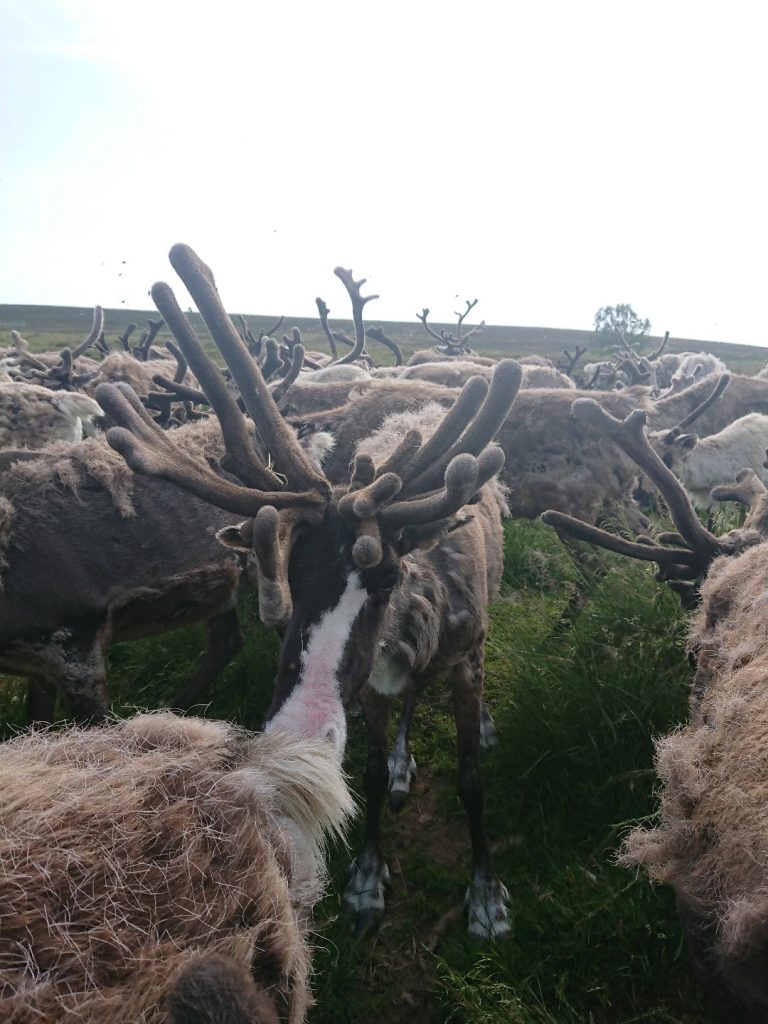
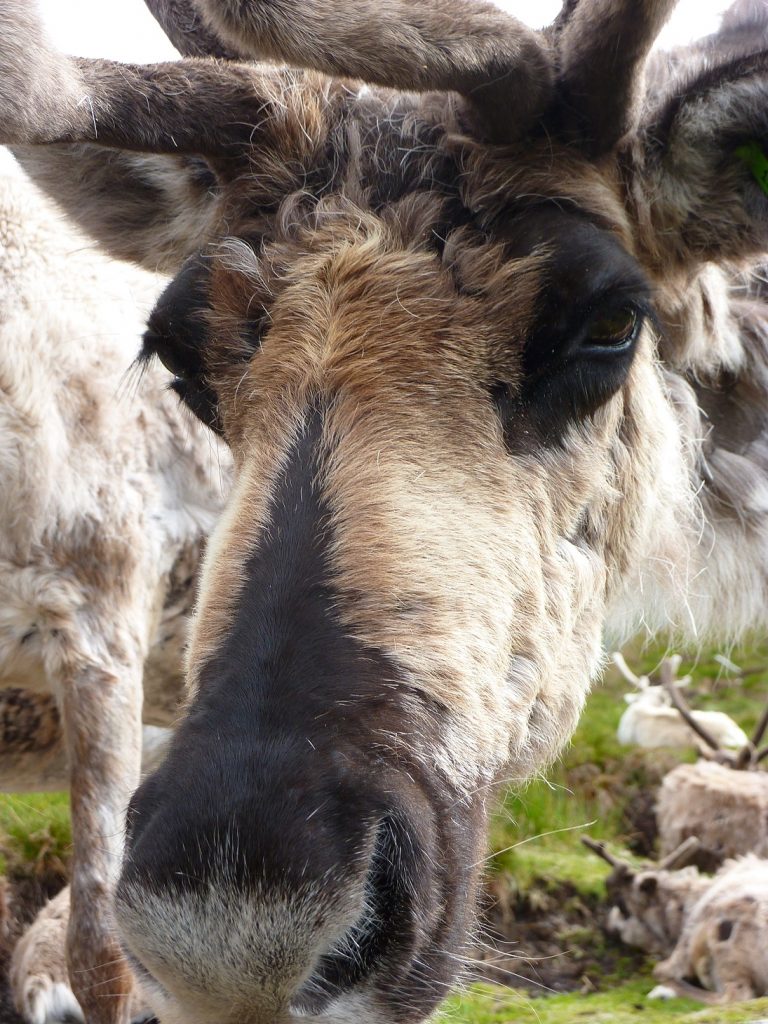
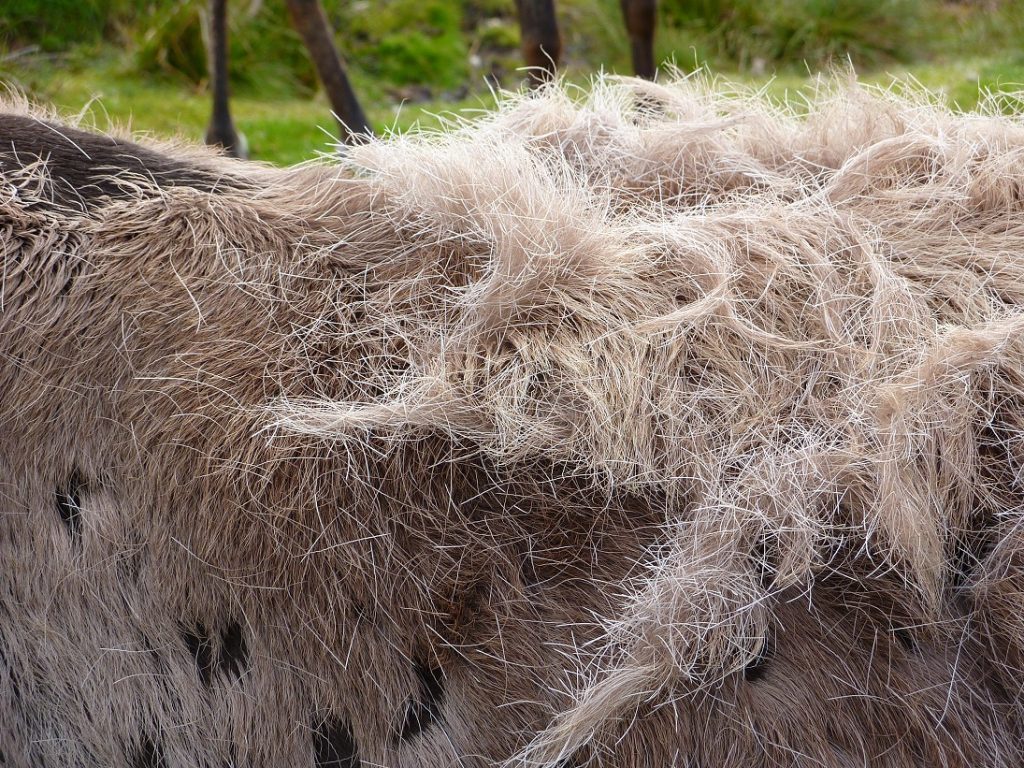
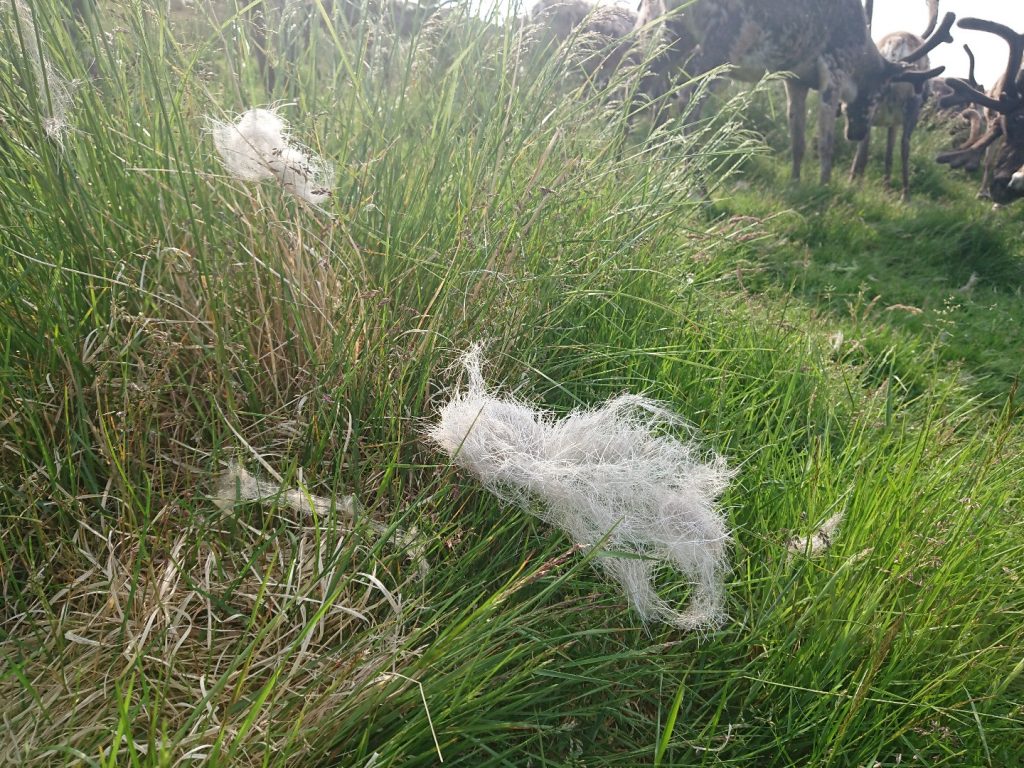
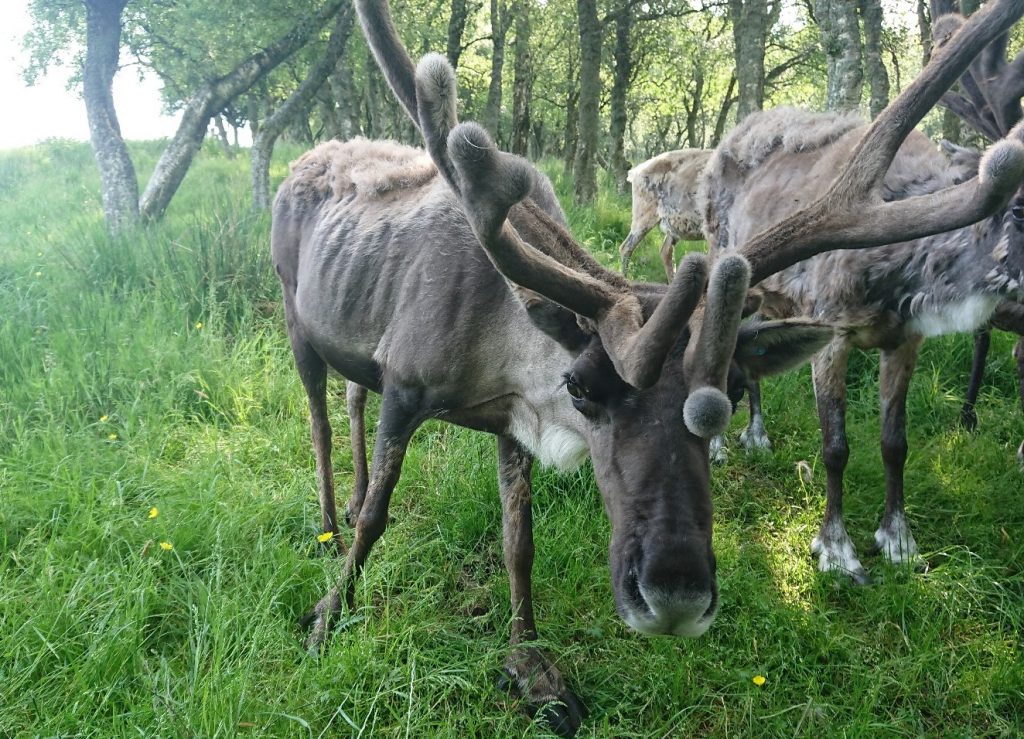
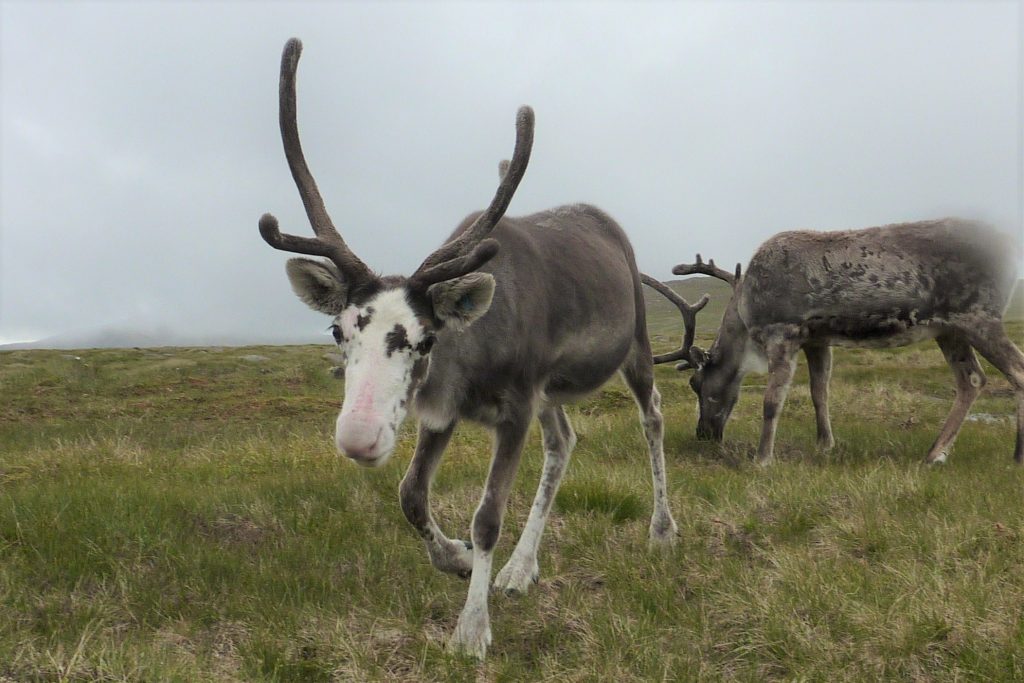
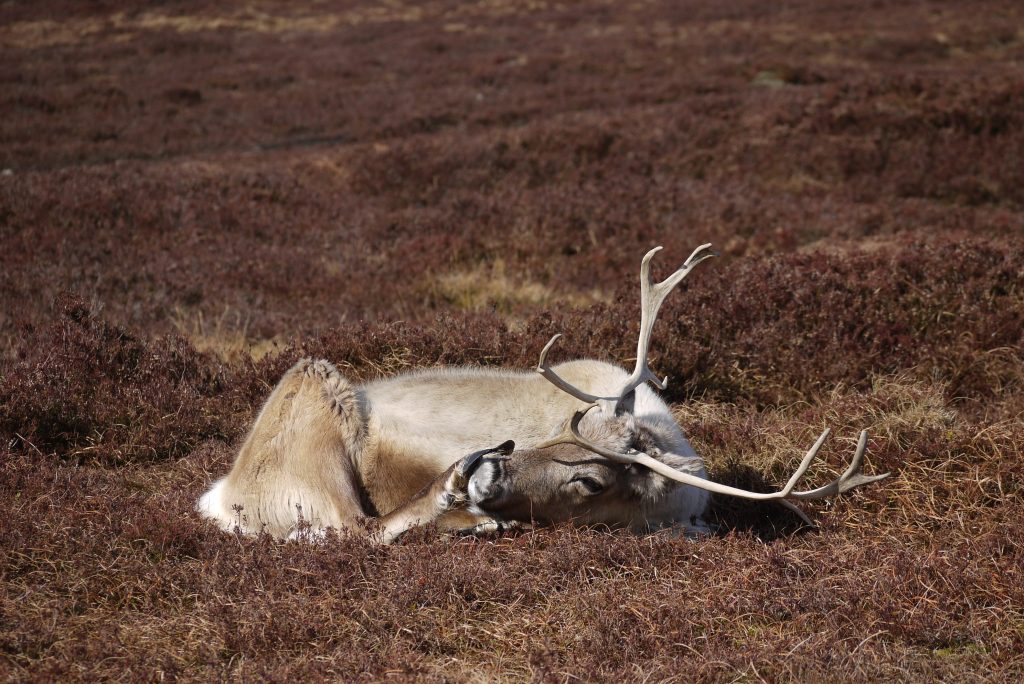
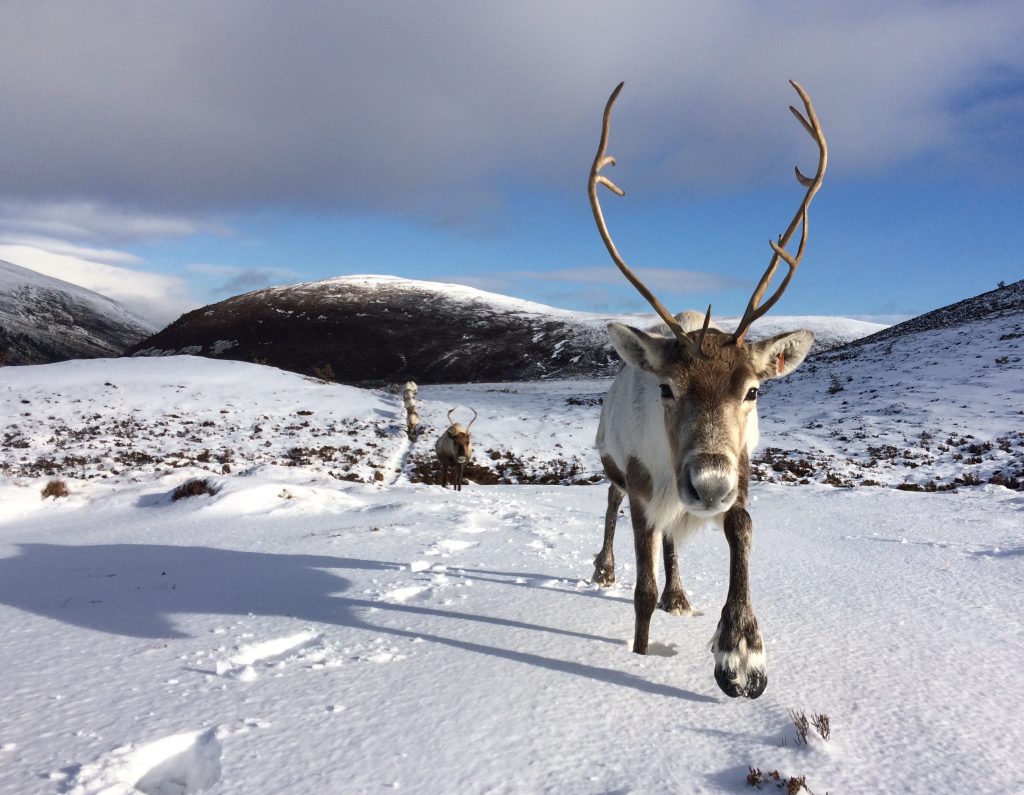
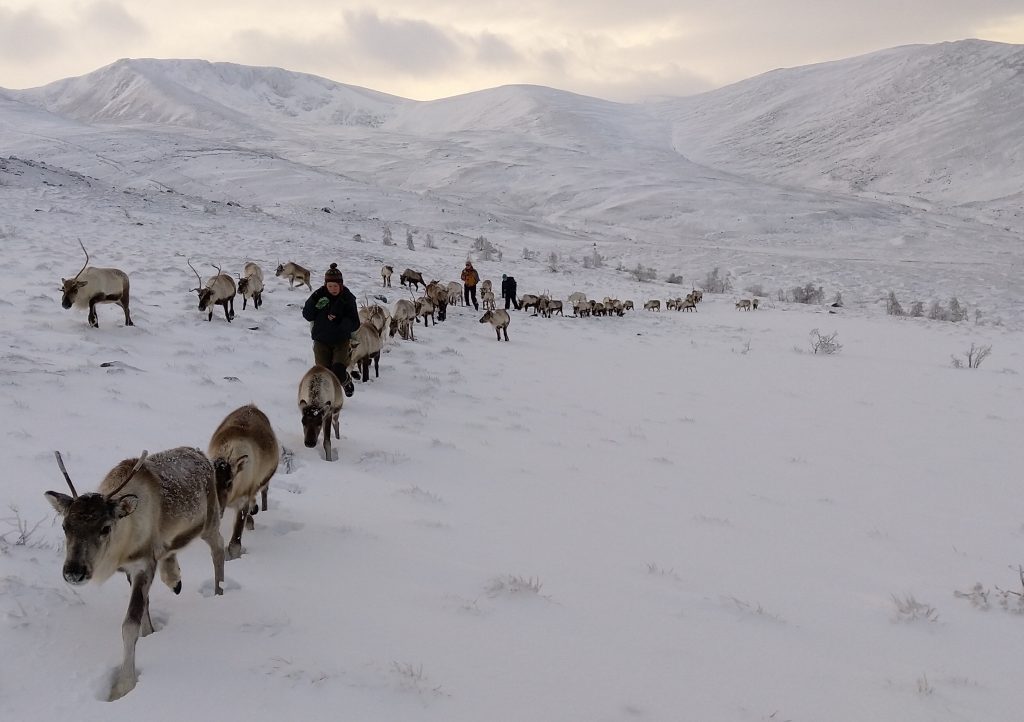
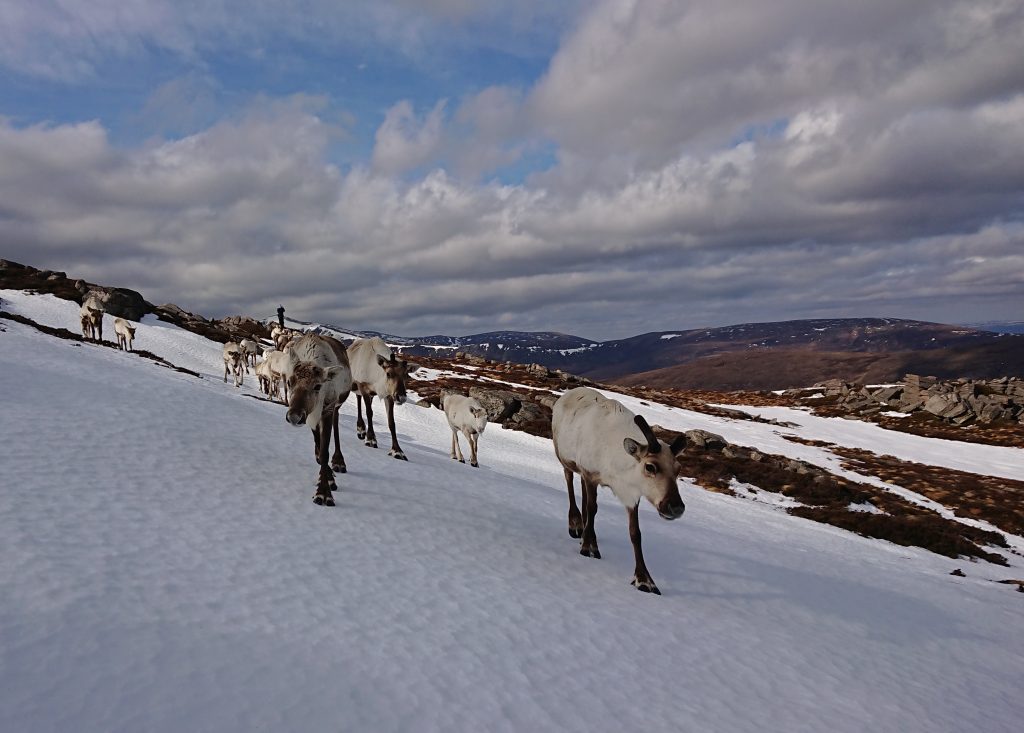
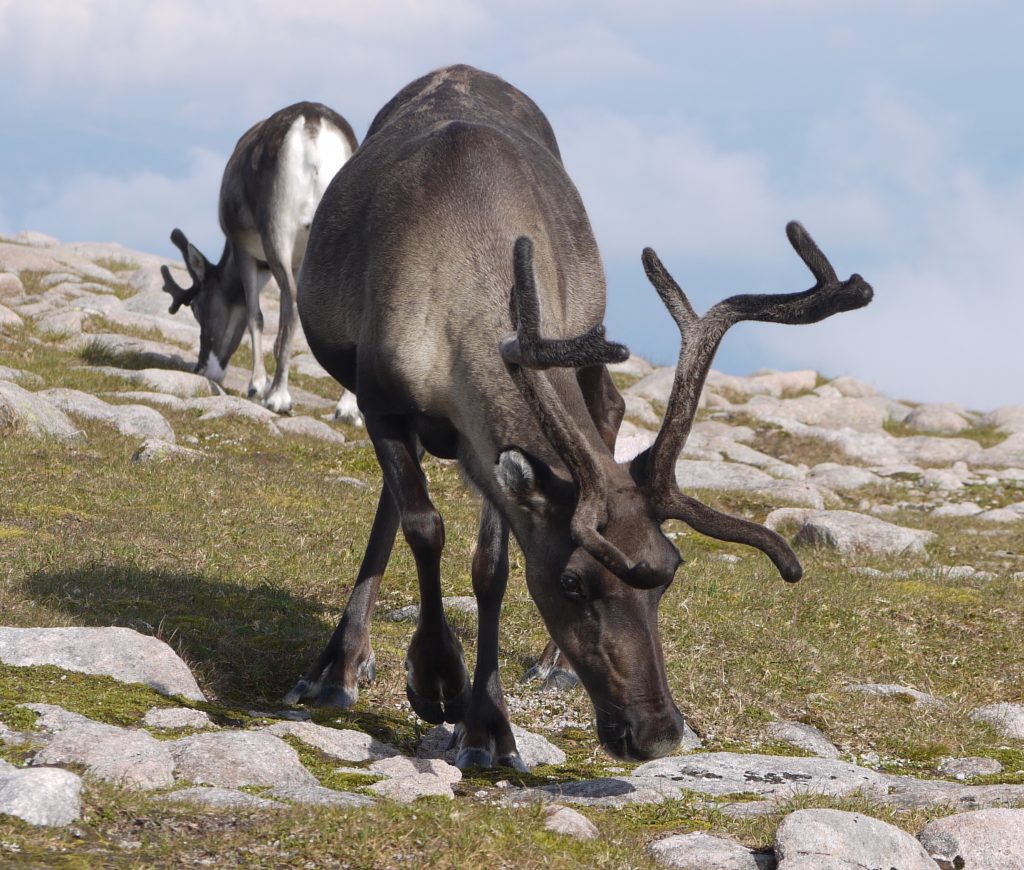
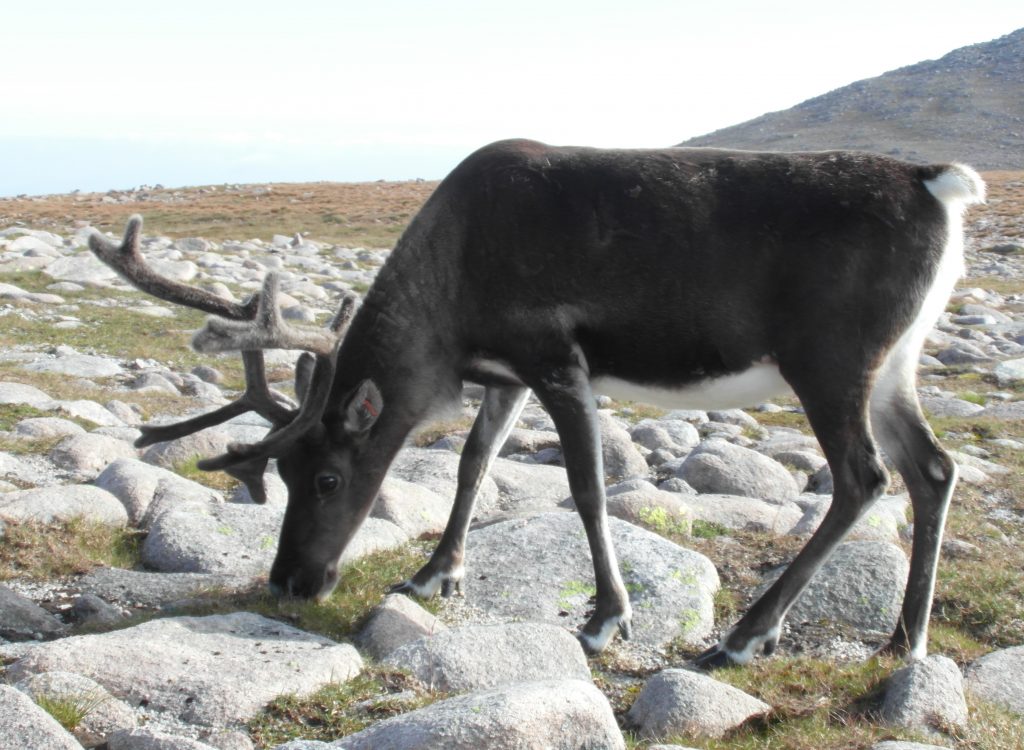
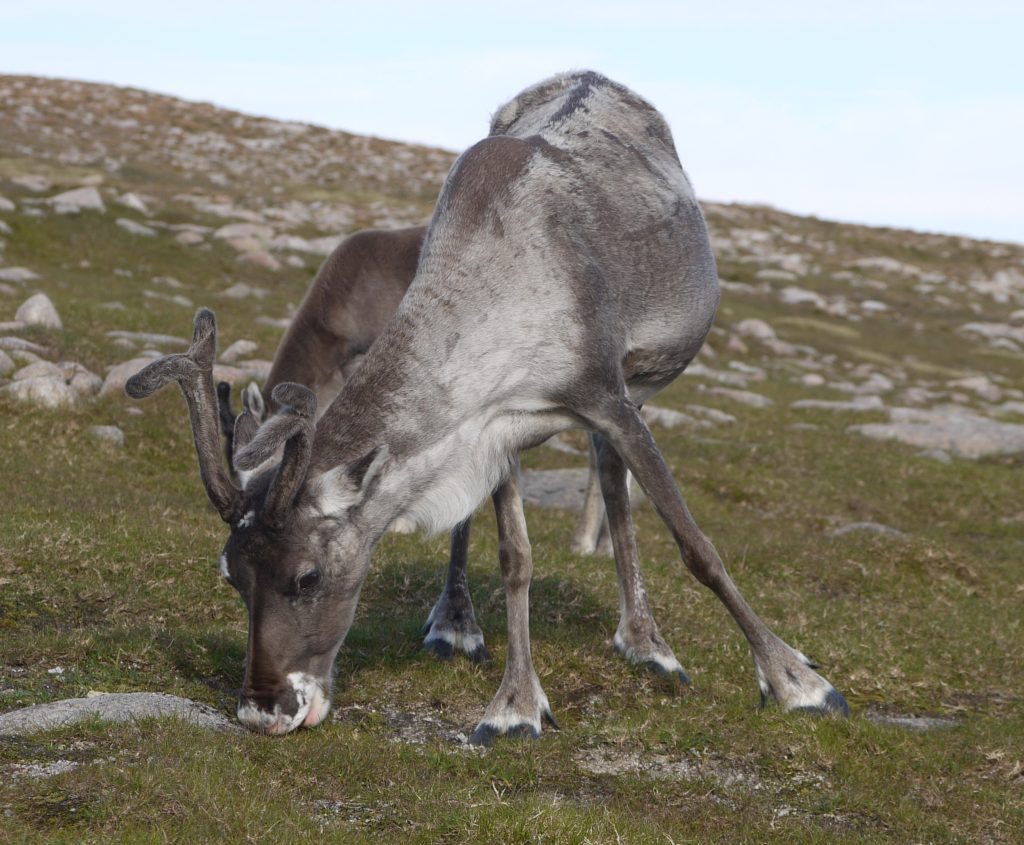
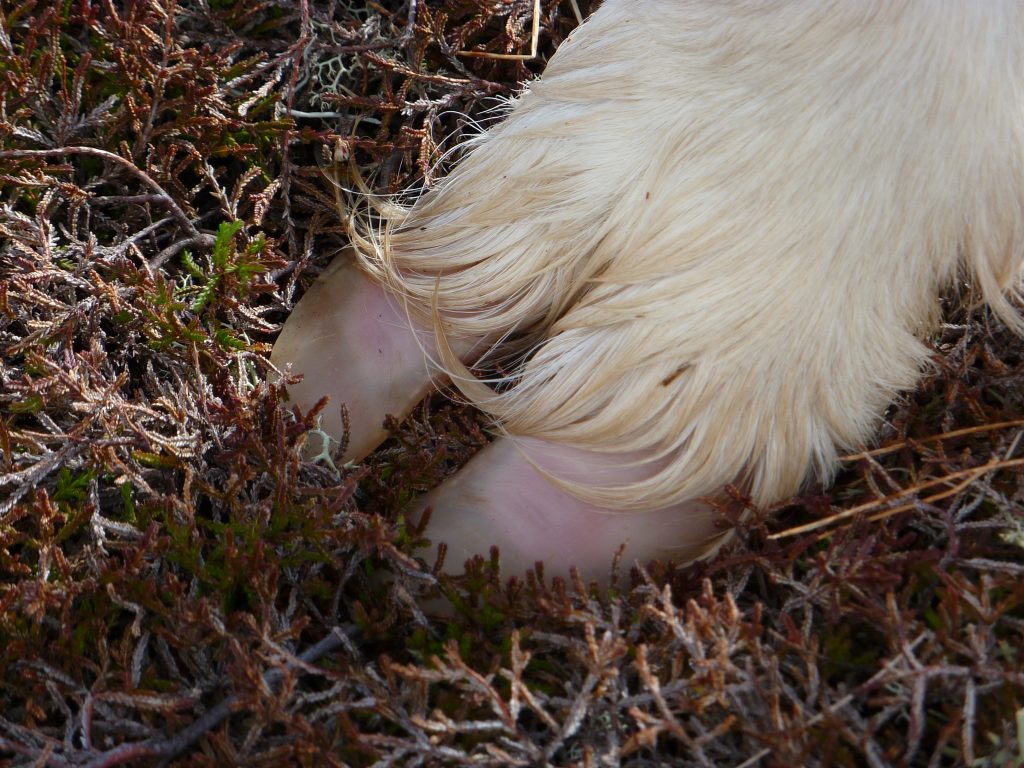
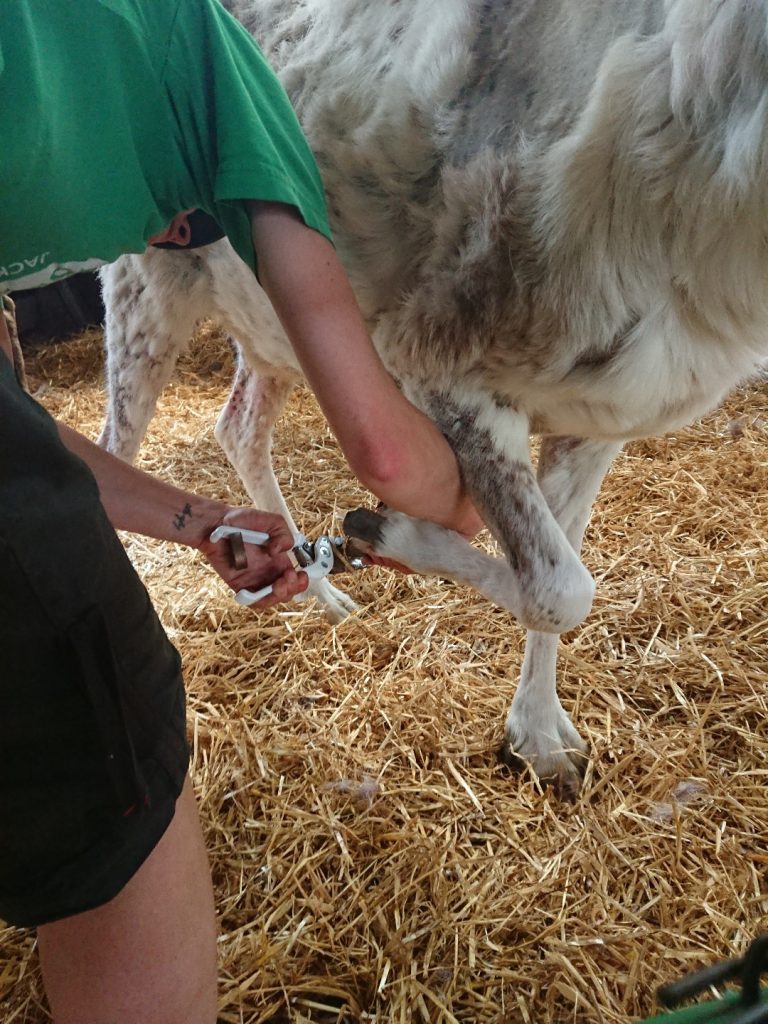
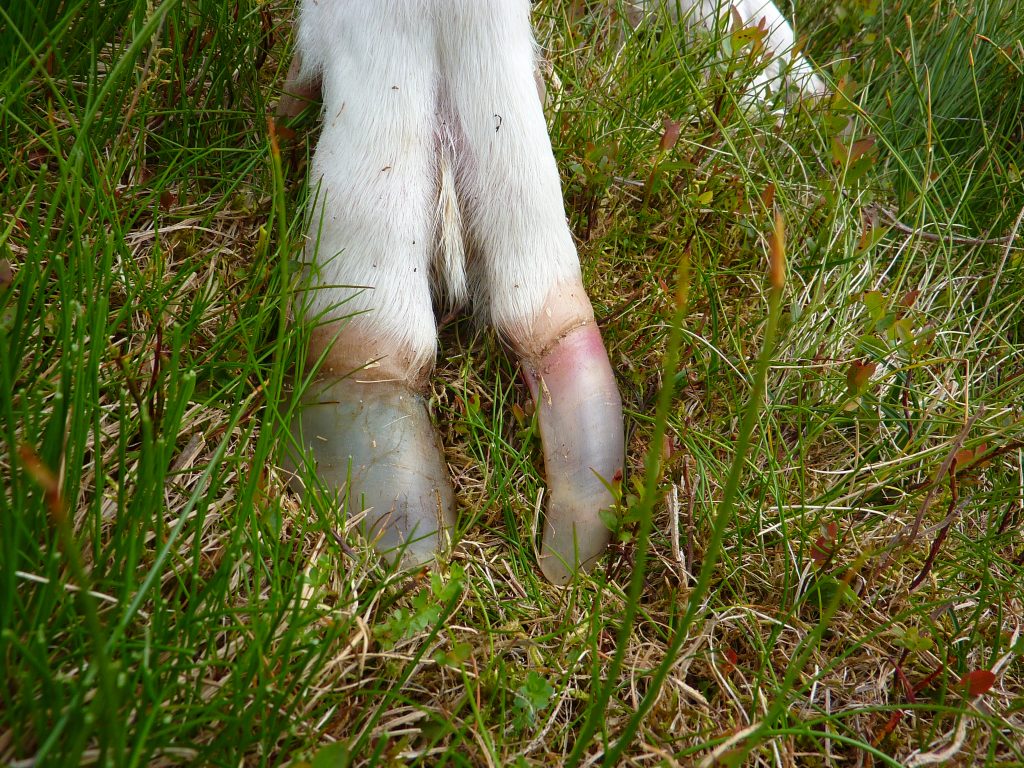
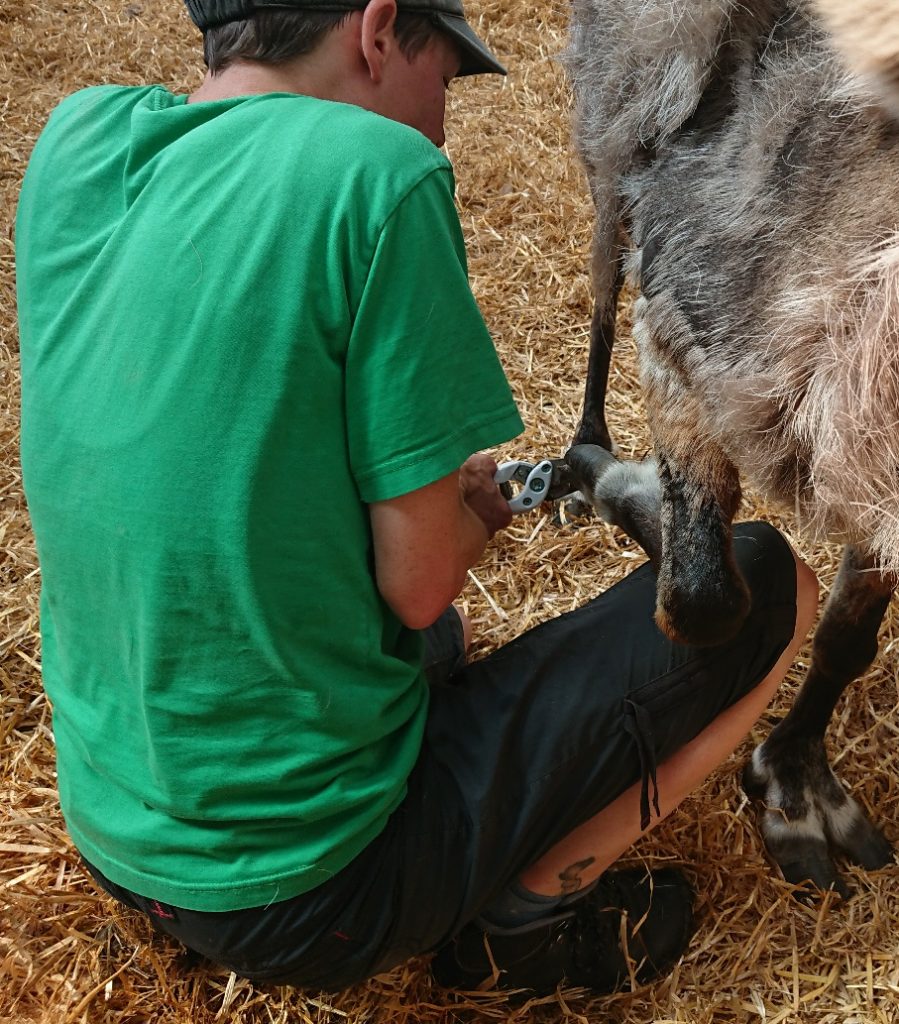
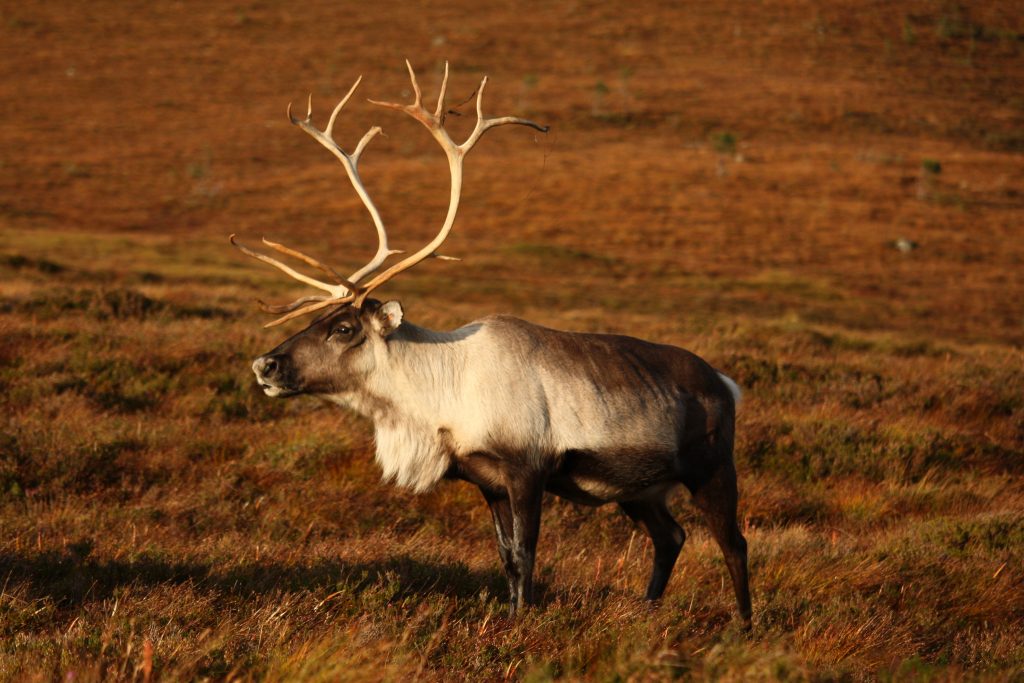
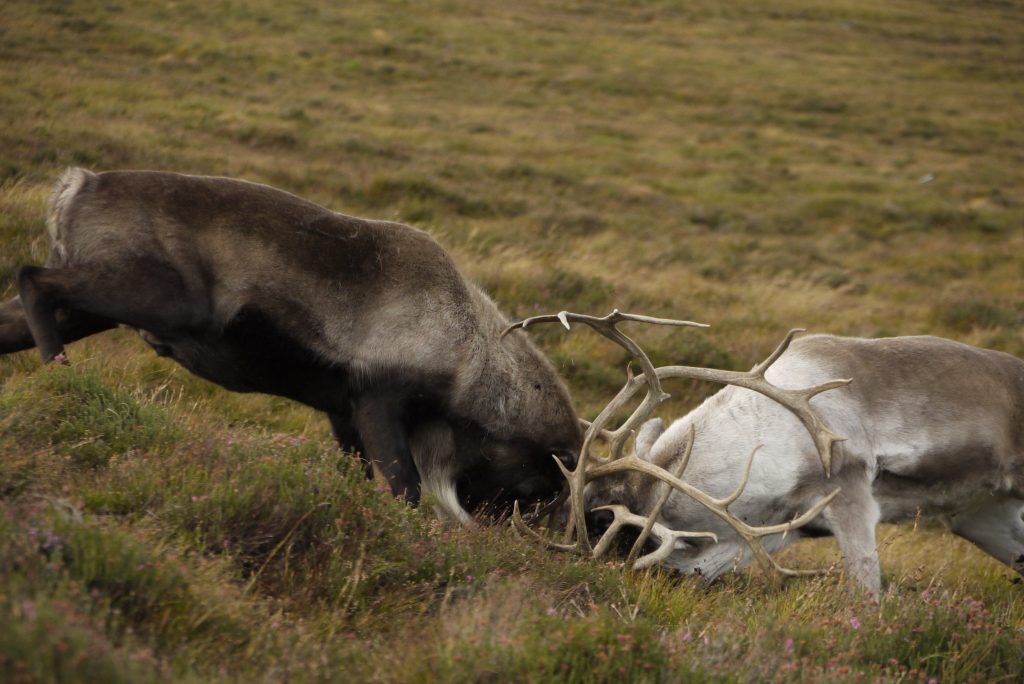
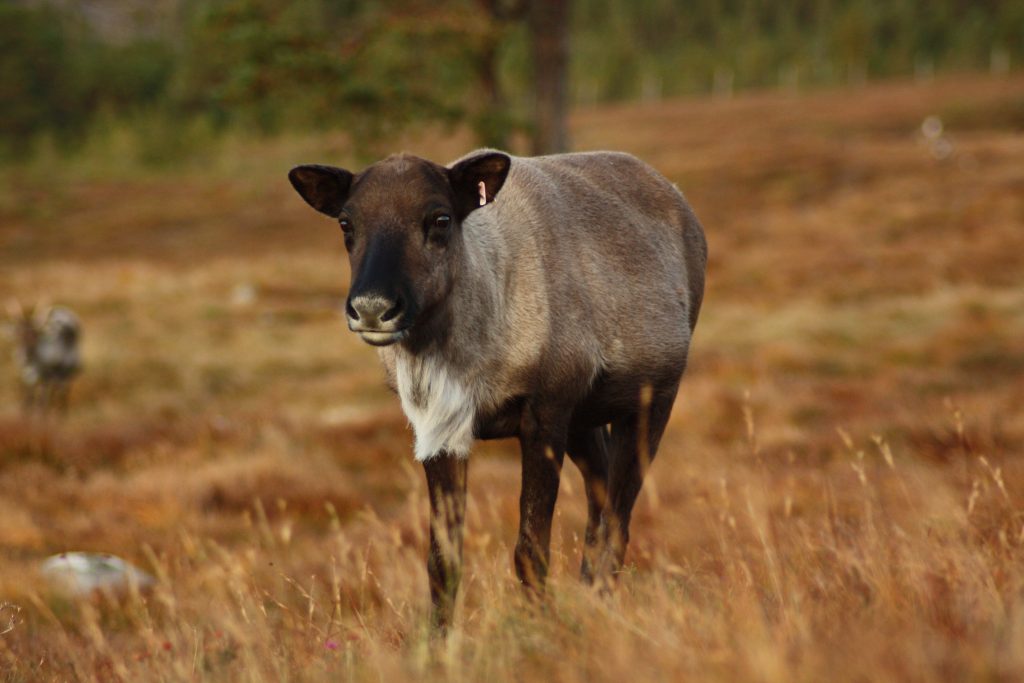
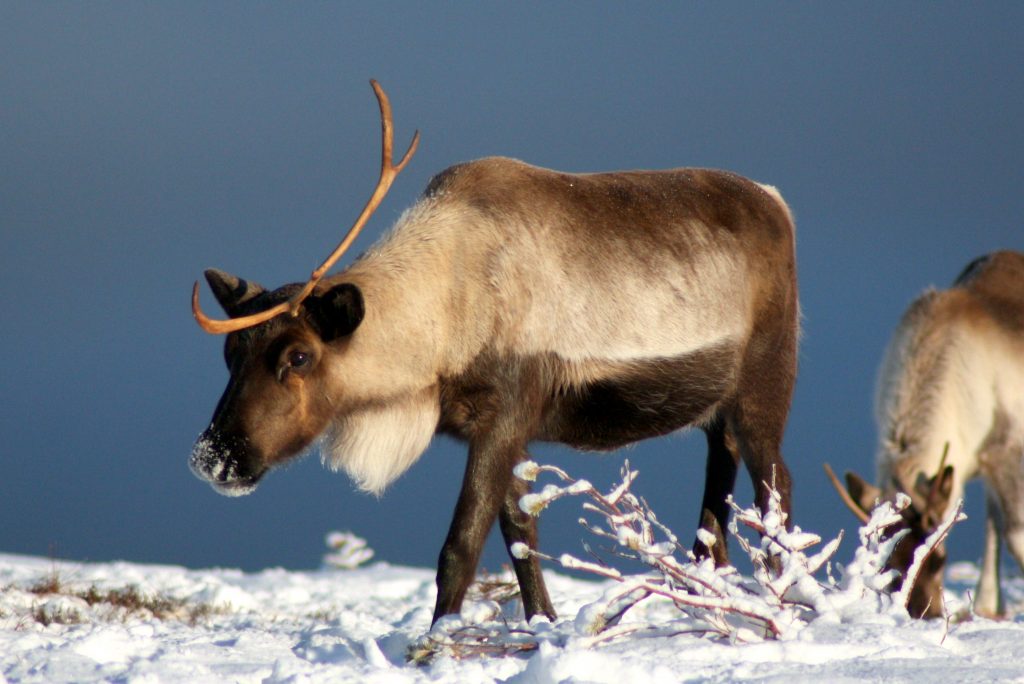
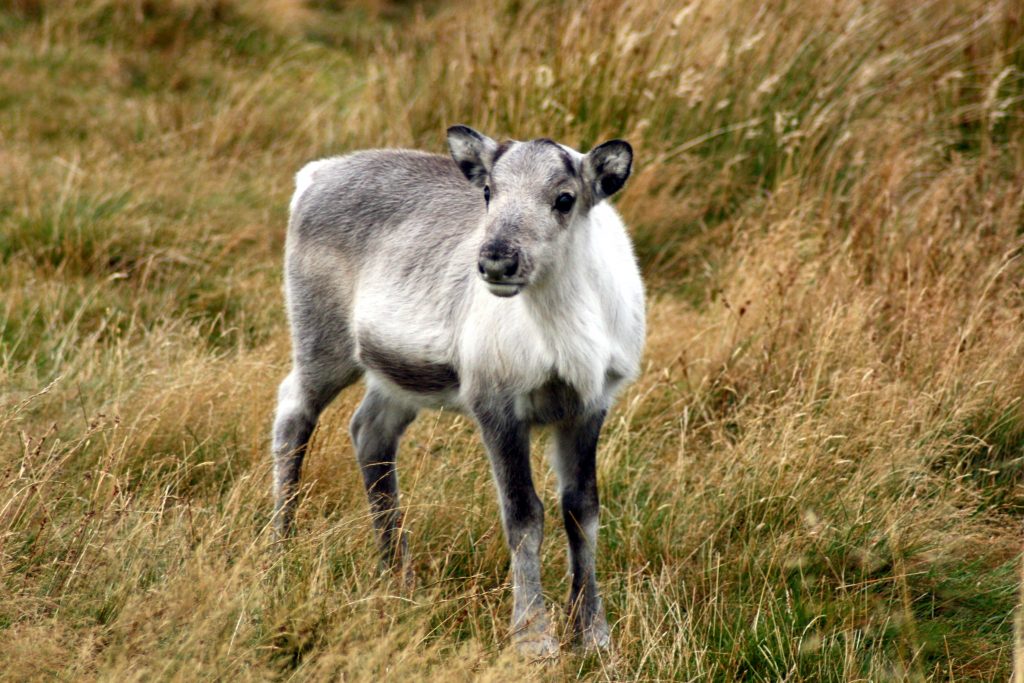
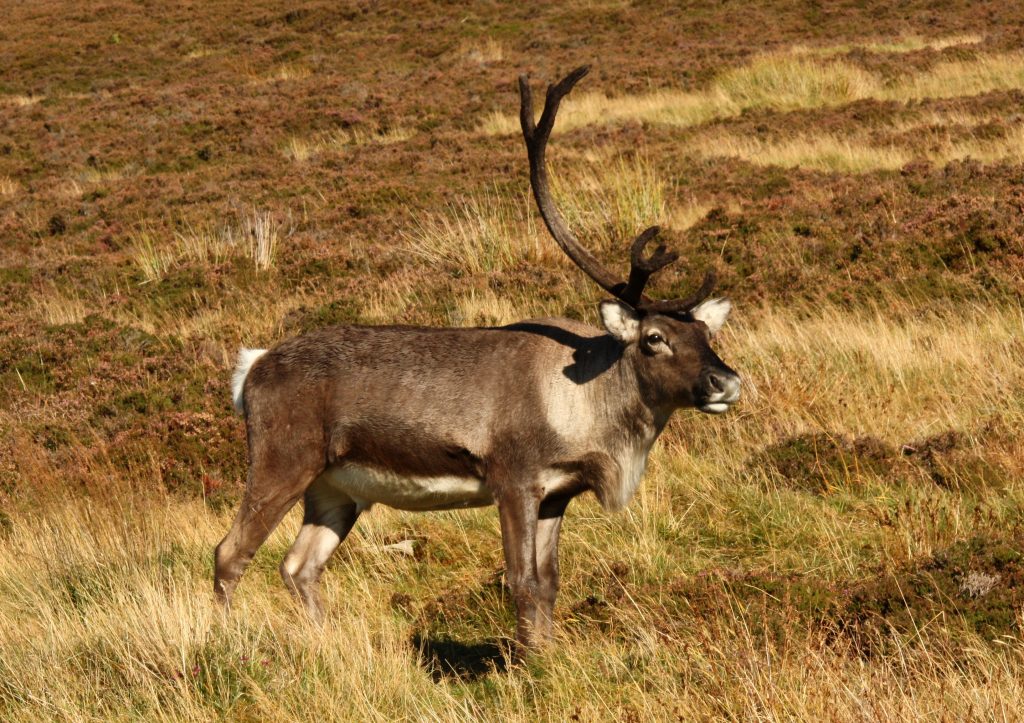
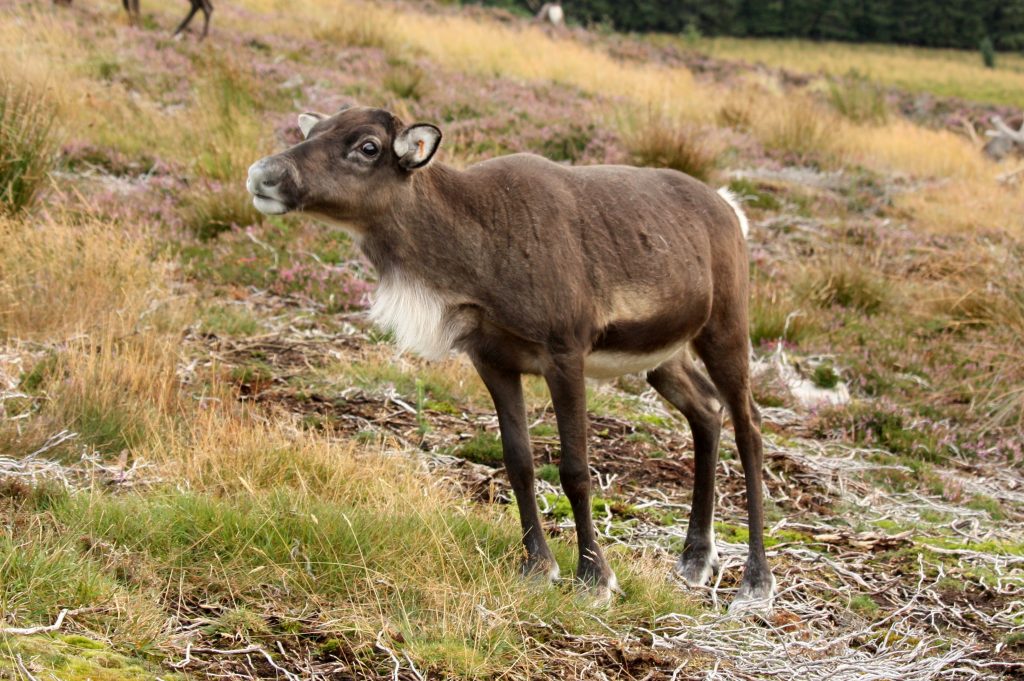
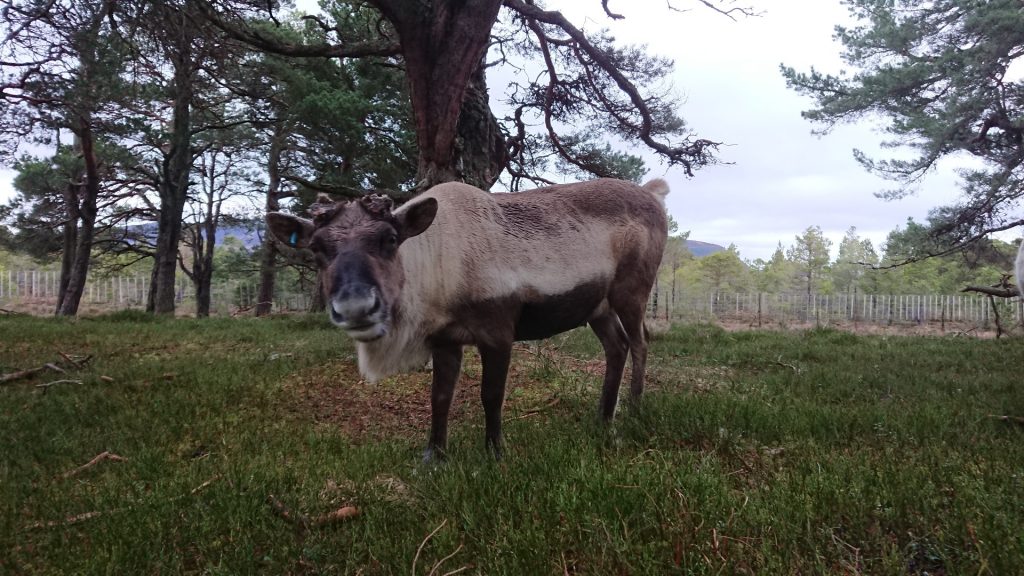
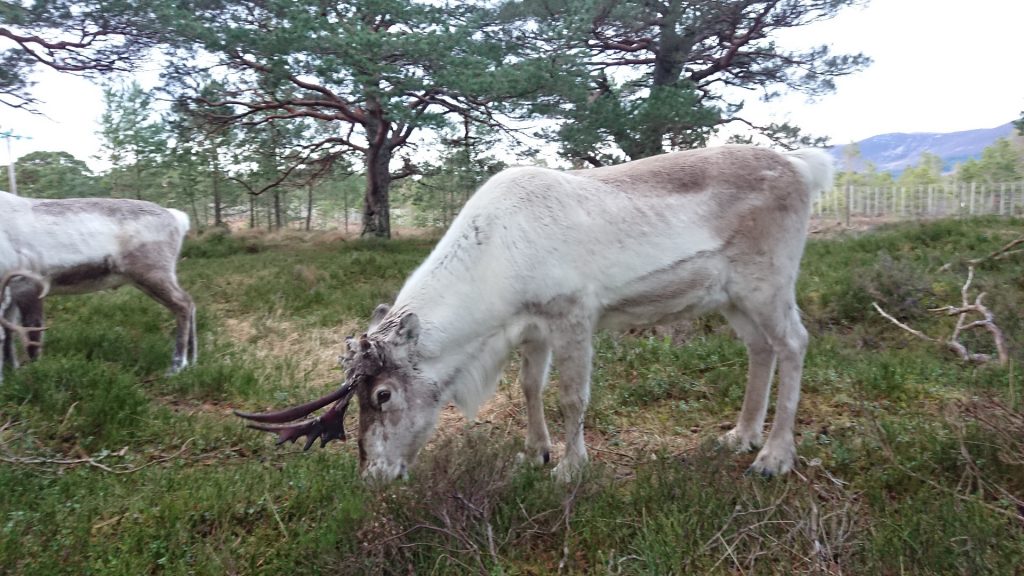
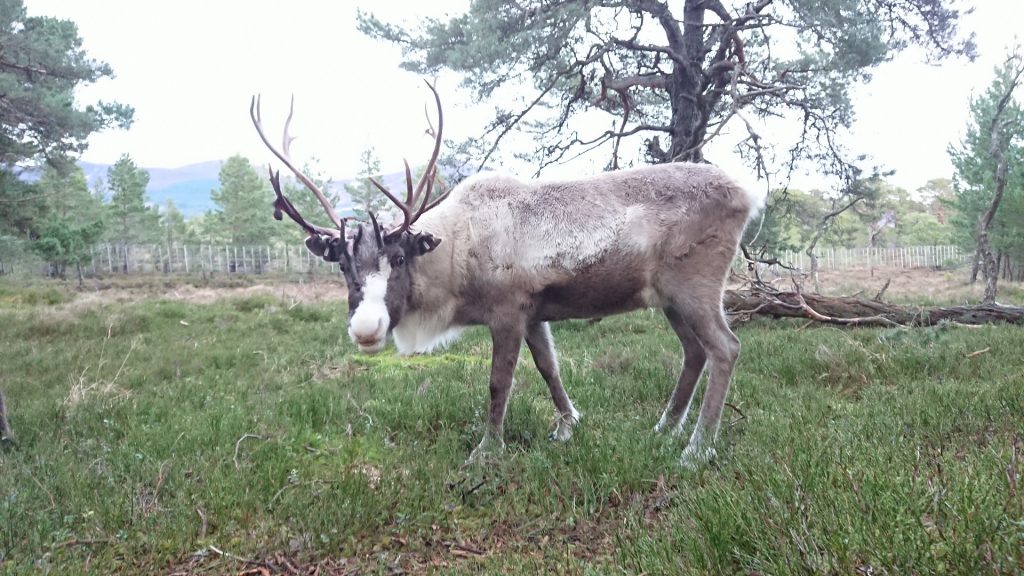
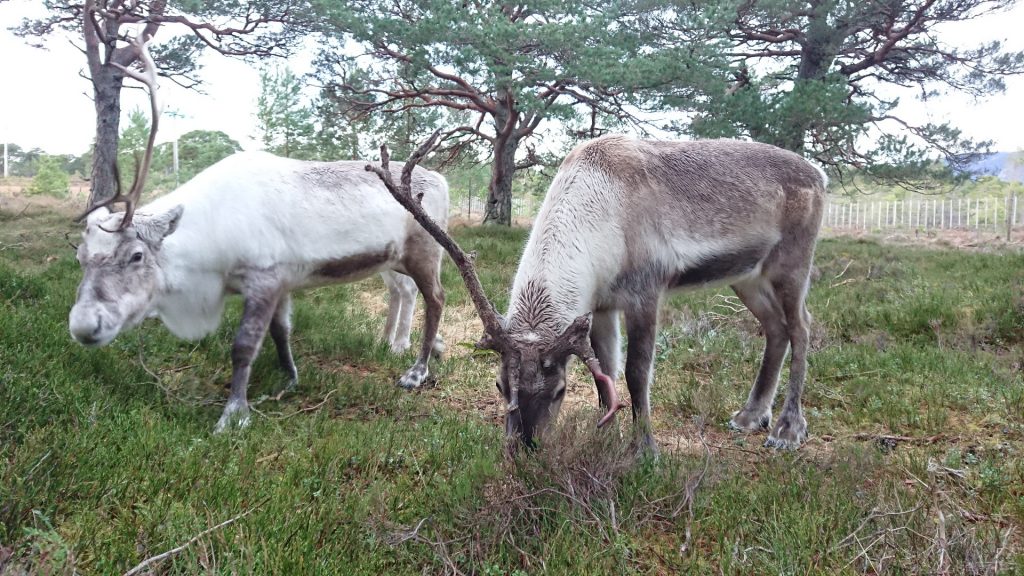
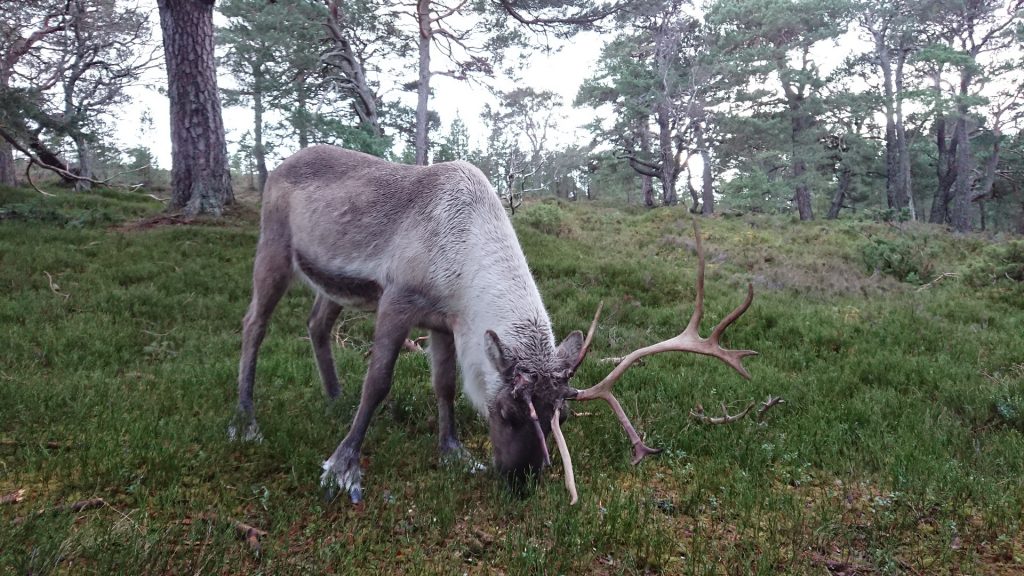
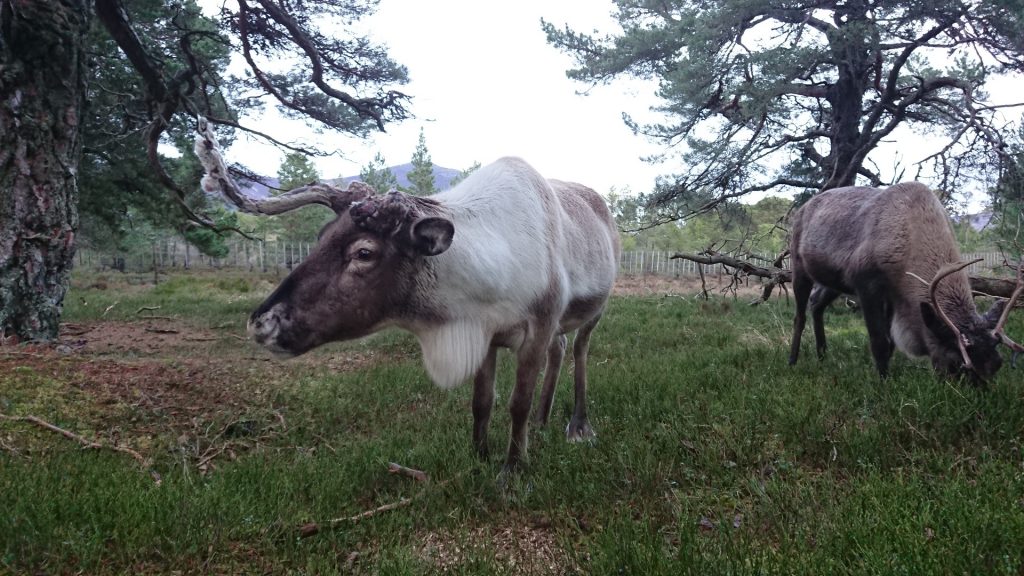
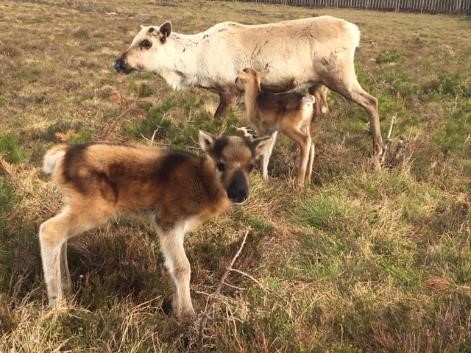
…our reindeer turn into cows… Not quite, but it is the time of the year when they are casting their antlers, and beginning to look perhaps a little like people imagine a reindeer to.
Oh dear Spider! Spider always casts his antlers early – usually by the end of November.Jonas cast his upright parts of the antlers about six weeks ago but is holding on to his blade and front points.
Casting antlers is a completely natural process, and is one of the huge differences between antlers and horns (no deer in the world have horns!). Reindeer grow their antlers from scratch every year, from an area on the top of their skull called the pedicle. The growth period is from about March to the end of Summer, at which point it calcifies into solid bone, with no feeling remaining. After use in the autumn rut, the males cast their antlers, meaning they don’t have to carry a heavy weight through the winter snows, and leaving the coast clear to start their new set in Spring.
Jonne is one of the few castrated reindeer still with a full set of antlers on his head in late December.
This means that from November antlers drop off on a regular basis, sometimes at the most inopportune moments (in the middle of a Hill Trip for example, causing panic among visitors and frantic reassurances of “It’s normal, it’s ok!” from the herder!). As we get nearer to Christmas, our choice of which reindeer join a Christmas event team becomes more and more influenced by who still has antlers on their head – event organisers can be a little grumpy if a team turns up with just one antler between six reindeer!
LX has been lopsided for about a fortnight now, whereas Scolty cast the upright of his left antler just a few days ago.Bingo cast his whole right antler a few days ago.
Most of our males are castrated at 3 years old, helping to prevent inbreeding and giving them a much calmer life in general. A side effect of castration is that the antlers are not as dense as the bulls’, and tend to be cast in sections rather than in one piece. Hence we end up with reindeer with “One and a half” antlers, or often just the front points remaining after the more top-heavy upright points are cast. It’s interesting that members of the public often don’t realise that a reindeer with their front points has actually got any antler missing, whereas a reindeer who has cast all of one antler but none of the other looks more lopsided and draws many more questions of “Did they lose it fighting?”
With his front point remaining, Duke gets less concerned comments than reindeer who still have one entire antler on their head. In the background, Stuc still has his full (small) antlers.
Sometimes antlers are lost in squabbles, but only when they’re ready to fall off anyway, and I think as many go from being bumped against a tree (or a herder’s backside!). And whilst there is sometimes a little residual blood on the pedicle when the antler is cast, it isn’t a painful process, the only insult being to their pride, as they often drop down the pecking order. But this is often when a bully gets their comeuppance, as the other reindeer they’ve pushed around see the tables turned and get their own back. So don’t feel too sorry for them!
During the autumn months reindeer are starting to prepare for winter. By October, their summer coat has begun to disappear below a fresh new winter coat. Reindeer winter coat is one of the warmest coats in the animal kingdom, with over 2000 hairs per square inch on their body. About 600 hairs per square inch are hollow allowing air to be trapped between them forming an insulating layer, which can keep help them survive down to 72°C.
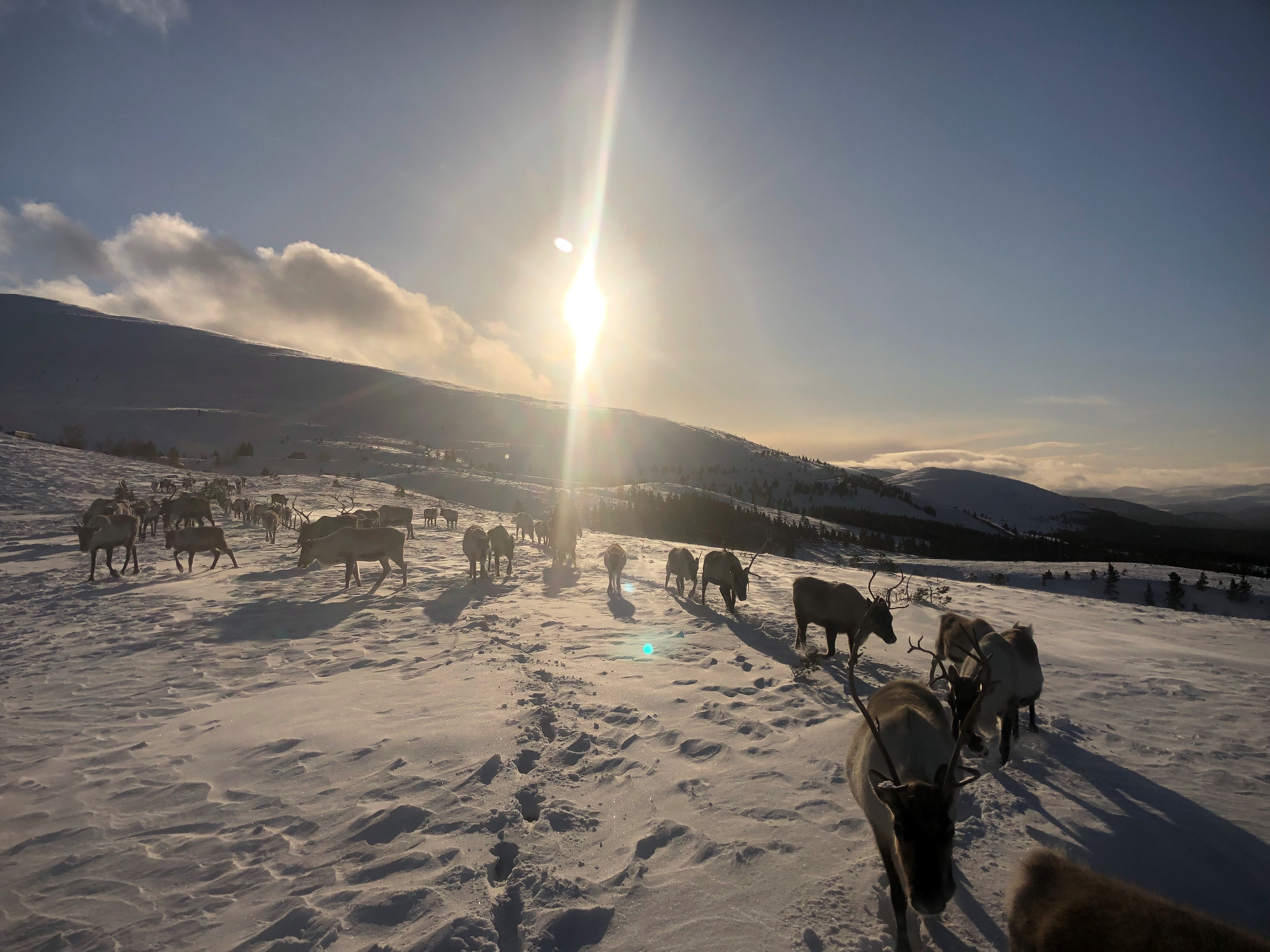
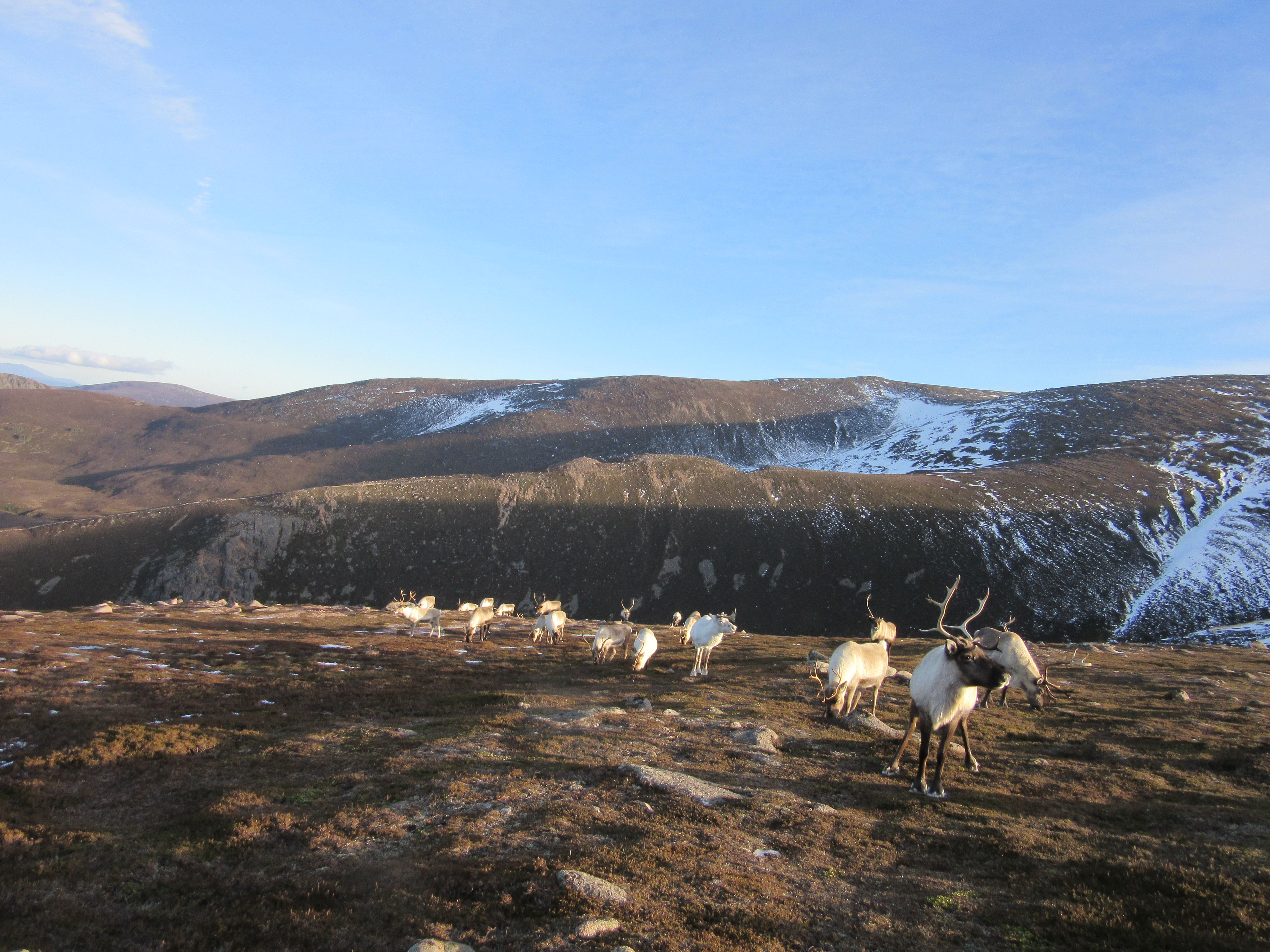
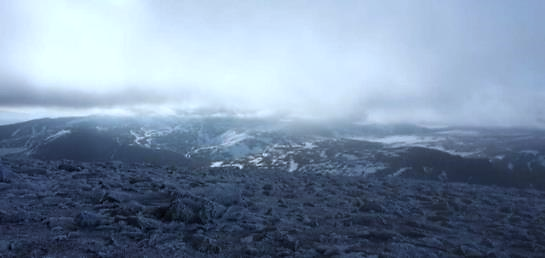
Cairn Gorm views
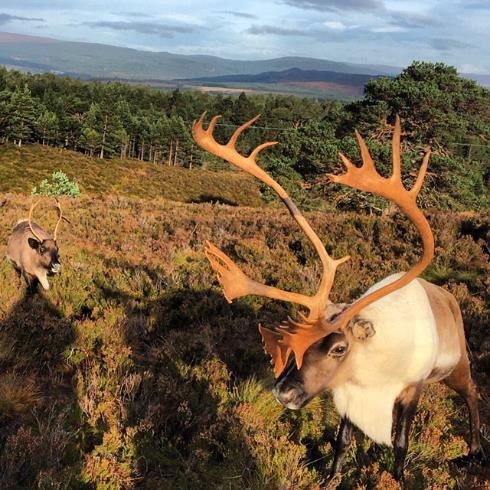
The rutting season is an important time of year for Reindeer bulls. First their velvet strips off their antlers leaving them with solid bone, stained red from the blood supply that was there to help the antlers to grow. Eventually the antlers lose the red stain and their impressive sets are revealed!
Kota during this year’s rutting season
Castrated males don’t lose the velvet from their antlers quite so quickly. This is because the reduction of testosterone doesn’t trigger the response to shed it. This also means that the castrated males get to keep their antlers slightly longer than the bulls. Because of this, castrated males make for the best Christmas reindeer.
Females that are put with the bulls during the rutting season spend the majority of the time with the breeding bull. Calves and yearlings will stay with their mothers during this period too.
Female with her calf and a friend
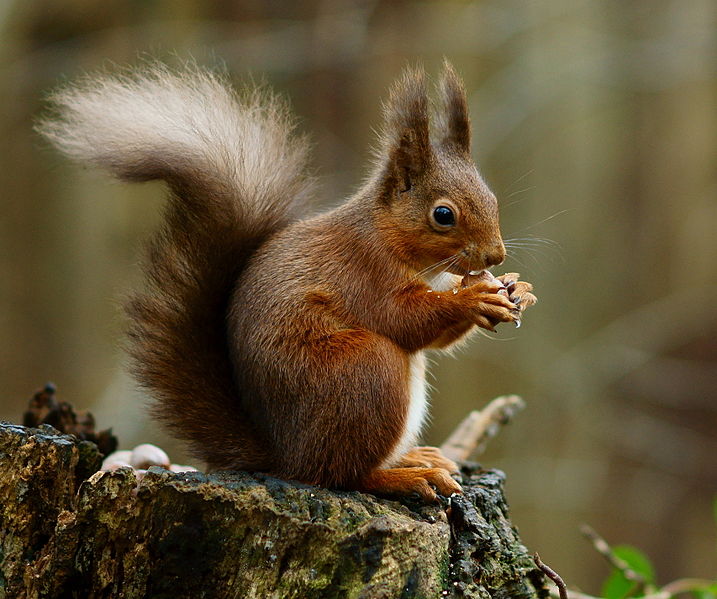
Red squirrels
The red squirrels are also preparing for winter during the autumn too. They collect stores of nuts and burry them so once winter begins they have a source of food, even when no suitable food is available. The only issue they have is remembering where they buried their store.
Also during the autumn Red Squirrels begin to grow their winter coat. Their winter coat, like reindeer, is thicker than their summer coat, and denser. This allows them to keep warm during the winter. Their ear tufts also become thicker and more prominent.
Pine Martins
A group of pine martins is called “richness”, even though they are skillful climbers they normally hunt on the ground. Pine martens are believed to have come to Britain around 10,500 BC, at the end of the last ice age. They live in woodland habitats and were Britain’s second most common carnivore around 6,500 years ago in Britain and Ireland.
Similar to red squirrels, pine martins do not hibernate. They have thick fur all over there body to keep them warm during the cold winters. Pine Martins are hardy mammals and will eat anything including mushrooms, insects, small mammals such as voles and bird eggs. Being omnivorous allows them to always have a source of food even when certain plants and berries have died off due to the winter frost. They mainly forage or hunt for food at night or late in the evening.
The local bar to the Reindeer Centre is named after this elusive creature, the reason being that several Pine Martins have been spotted outside the bar late in the evening eating the various feed which is left out for the Red Squirrels. (Reindeer herders are also often found at the Pine Marten Bar late in the evening…)
Birds
Osprey
During the autumn Ospreys will start their incredible journey back to Africa, where they travel up to 5000 miles. The female is the first to leave. She leaves the nest and her fledglings in the care of the male who will continue to fish for them until they are able to fend for themselves, once they can the male will set of on the migration. Then finally the young will start their journey.
The mating pair may not see each other over the winter period, but will meet up again the following breeding season back in Scotland or Northern England. Ospreys were driven to extinction in the UK in the 1900’s due to egg collectors, they were also considered a pest due to them eating the salmon and trout.
Ospreys returned for the first time to breed in 1954 to Loch Garten near Aviemore. This was a natural recolonization, but the birds still needed a huge amount of help and protection to breed successfully in the Scottish highlands.
Eventually several pairs of osprey began to breed successfully in more remote parts of Scotland. However, many birds were helped with artificial nest platforms and nest protection watches, and a huge public enthusiasm for the birds helped ensure their survival.
Golden eagle
The golden eagle is the top predator in Scotland. It’s a massive bird of prey that mainly hunts rabbits and mountain hares but will also catch foxes, young deer and large birds like grouse. It can be seen soaring high in the sky in upland areas and remote glens. Golden eagles have large home territories, nesting on rocky cliff faces and in trees where it builds a giant nest or ‘eyrie’. These nests are often used by successive generations to rear their own young. Furthermore, similar to Osprey, Golden eagles pair for life
There are around 400 breeding pairs of Golden Eagles within Scotland and Northern England too. The birds are perfectly adapted to survive the harsh Scottish environment. Their talons can grow up to three inches, along with an amazingly sharp beak makes them perfect hunters. Also their varied diet means that there will always be some sort of prey to hunt.
Ptarmigans
They are exclusively found in the Scottish Highlands. Mature birds eat a diet of seeds, berries, nuts and leaves, while juveniles will also eat invertebrates. During the breeding season, males usually mate with one hen, producing one brood a year of around seven eggs.
You can often find them all year round on top of the highest mountains in the UK, especially on the Cairngorm Plato. Ptarmigans prefer the rocky tops of mountains to the forest environment.
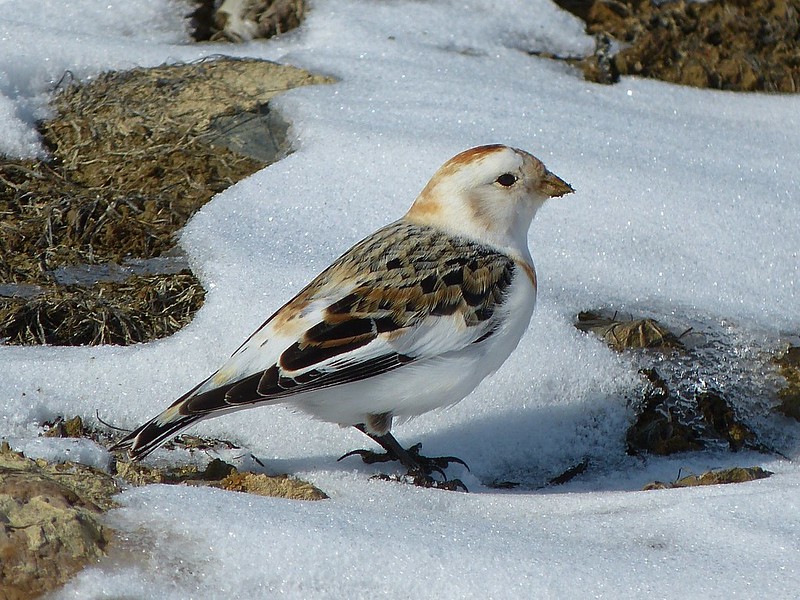
During the autumn months they start to grow in their winter feathers. Eventually they change from brown to a pristine white colour. This helps protect them from predation. Blending into the snowy winter background makes it more difficult for Golden Eagles to hunt the small bird.
A frequently asked question on the hill is what noises the reindeer make. Whilst they are mostly fairly quiet animals but there are a few fascinating reindeer noises.
Clicking Feet
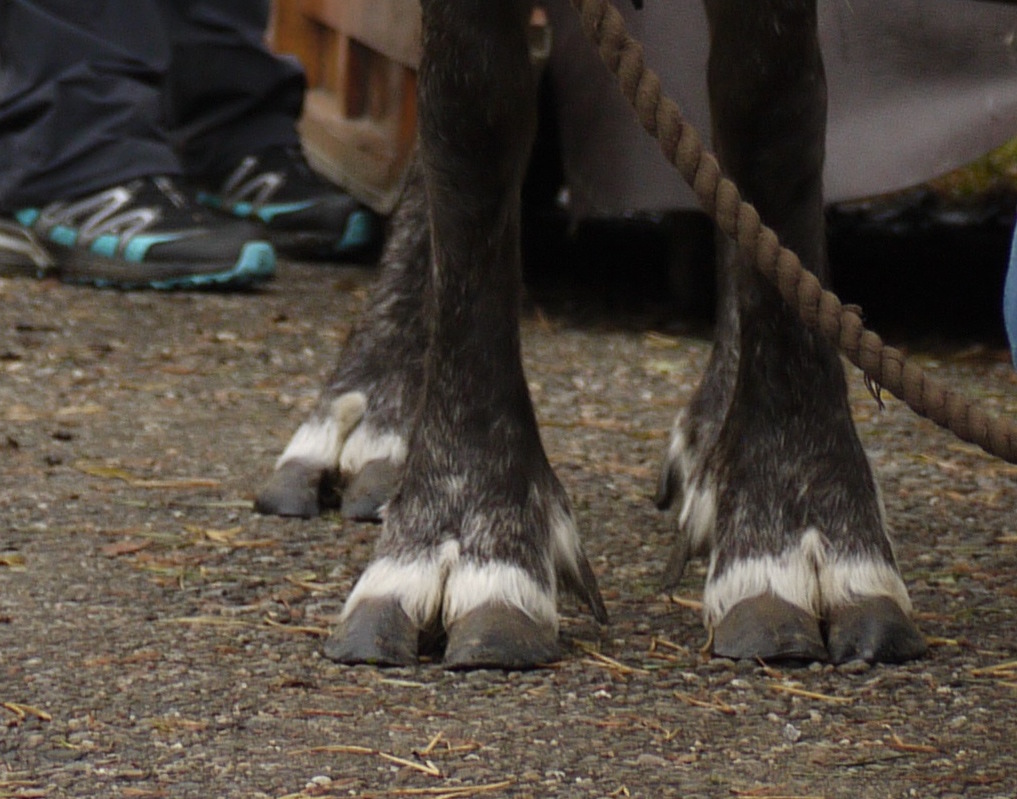
For any of you who have been on the hill trip you will have heard the clicking noise coming from the back feet of the reindeer. Unlike the forest dwelling Roe deer, the reindeer do not have long enough legs to outrun their predators, instead they survive using safety in numbers. They are of course a herd animal. Whilst our reindeer no longer have any predators in the UK they have maintained the mechanism for staying together as a herd. The click is produced by the friction from a tendon slipping over a bone in their back feet. It happens with every single step that the reindeer take and cannot be switched off and on. The calves will have a very quiet click whereas the big bulls will have a quite a loud click, the noise of the whole herd moving is quite amazing. This means that even in the harshest of weather conditions, where they certainly wouldn’t want to open their eyes and wouldn’t be able to see through the blizzard if they did they can still hear where the rest of the herd are. If they were to grunt then opening their mouths would lose heat, the clicking doesn’t use energy or heat so is the perfect communication devise.
Grunting
Another important reindeer noise is grunting. There are two times of year where the reindeer grunt, the first is the calving season in the spring where the cows will grunt to their calves if they are not close by. The second time of year where the reindeer grunt is during the breeding season, the rutting bulls will grunt to the cows. The reindeer grunt is a bit less majestic than the famous Red deer roaring in the glens or the Roe deer barking in the woods. If you want to read a bit more about the noises of all the native deer species, Tilly wrote a wonderful blog about it last year. https://cairngormreindeer.wordpress.com/2018/01/12/calling-all-deer/
Crackle grunting during the rut. Photo by Laurie Campbell.
Yawning
I have saved the best reindeer noise till last, the reindeer yawn. When reindeer yawn they make a lovely creaking noise which is followed by a chin wiggle. Since I first started working with the reindeer I have been trying to record a reindeer yawning as I think it would be the best possible either alarm or text message tone. If anyone has managed to record this fantastic noise, please do get in touch! There seems to be much discussion over the purpose of a yawn. Popular opinion is that animals yawn to remind the rest of the group that they are tired and thus less alert for danger and this is why it is more common amongst social mammals. Recent research shows that the yawn may in fact be to cool down the brain, the long inhalation of air cools down the blood in the vessels close to the surface in the nose and mouth and the stretching of the jaw increases the blood flow to the brain. The blood then cools down the brain making it function better and the animal feel more alert. This would perhaps explain why the reindeer seem to yawn more than normal on a particularly hot day.
Spider mid-way through losing his winter coat, having a yawn. Photo by Julia Kenneth.
One day last summer I was leading Okapi and Ryvita from the Cas flats to the reindeer enclosure. I was just about to cross the burn that is crossed by Utsi bridge further down the hill when with one misplaced step I found myself thigh deep in bog. What followed consisted of much giggling (from both me and the reindeer), a serious struggle to get my leg out and a very wet arm having had to reach down into the bog to retrieve my welly. As a squelched my way to the reindeer enclosure I started thinking about the different plants that grow in a bog, especially the indicator plants that could have helped me avoid my rather soggy fate.
Stuck in a bog
Sphagnum moss
Sphagnum moss is probably the most important plant to look out for. Also known as peat mosses, this group of plants can retain an incredible amount of water (up to 26 times their dry weight). It is so absorbent that it was even used by native North American babies in nappies. This means that standing on this bright green moss (notice it behind me in my bog selfie) will almost always leave you in a similar predicament as I was in. Sphagnum mosses have two types of cells that make up the plant; small living cells and large dead cells. It is the dead cells which have a large water holding capacity. (Disclaimer: if you have no interest in biochemistry then please skip the next sentence or two) Sphagnum mosses are very good at out competing the surrounding plants by carrying out a process called cation exchange, in which nutrients such as potassium and magnesium are taken up and hydrogen ions are released. The increase in concentration of hydrogen ions in the surrounding environment is responsible for making it more acidic and stopping other species from growing there. The acidic conditions along with the layering of the sphagnum produces the peat that we see on the mountains.
Sphagnum
Bog cotton
Bog cotton is a good indicator of a boggy area as its seed head stick up above the ground and warn you of the wet area beneath. Its white cotton-like seed heads can often be seen bobbing in the wind. Unlike regular cotton, bog cotton cannot be weaved into fabric, however in northern Europe it has been used to produce paper, pillows, candle wicks and wound dressings.
Bog Cotton
Bog asphodel
For those of you who have been on the hill trip, you may have seen the yellow spiky flowers of the bog asphodel plant. The Latin name for bog asphodel means ‘bone-breaker’ due to the belief that when sheep eat it then develop brittle bones. However it is more likely that it is correlation rather than causation as sheep eating a low calcium diet are prone to bone weakness and bog asphodel grows in calcium deficient soil. Our reindeer however have no problem getting calcium, as displayed by the wonderful antlers that they grow each year.
Bog Asphodel
Sundew and butterwort
The most vicious of all the plants I have described are these two carnivorous plants. They both survive the harsh environment that they live in by catching insects to eat. Sundew catches insects by sensing their movement and elongating the cells on one edge of the leaf and retracting the cells on the other surface of the leaf causing the leaf to curl around the unsuspecting fly. Butterwort uses a different hunting method, the insects stick to its sticky glandular leaves and are then digested by the plant. If you ask me, the plants up on the hill are not working nearly hard enough to catch the midges this summer.
Midges…complete and utter nuisances. That’s what most people tend to say.
Well…I’ve heard quite a few individuals use more colourful language than that, but that’s the gist of most people’s views on this small flying insect that occupies the Highlands. This view is commonly expressed whilst people flap their hands around as if they’re aiming to actually launch off and flee the plague of midges.
In the bible there is reference to a plague of locust but this past week it is the midge numbers that have been of biblical proportions, causing people to look like they have moustaches and tattoos. In the five years that I’ve been reindeer herding last week was by far the worst that I’ve ever seen the midges.
During this past week I also found that the term midge can get lost in translation! We recently had a visitor who complained about being attacked by midgets. It’s amazing the difference one letter in a sentence can make!
It was during the latest inundation of midge attacks that I found myself asking: Where do these midges even live? Why are they biting us? How long do they live? Well, look no further folks…let’s rattle out some midge facts.
• Midges have a life span of around one month. Although adults are only capable of flight for a short portion of that time.
• Midges lay their eggs in wet soil, bogs, mires and the soggy surrounding landscape.
• In the U.K. there is 2-3 batches of midge eggs per year. The first batch is in May or June depending on warmth and moisture levels. A second occurs in late July or early August. And if the season is a warm one, a third batch can occur in September.
• In the U.K. alone there are more than 500 species of non-biting midges, and more than 150 species of biting midges. Most of these are found in Scotland, however they can also be found in Northern England and Northern Wales.
• Only the female midges bite. The male and female midges survive upon sugary food such as plant nectar. However, the females need a protein rich meal of fresh blood in order to mature their eggs. They get this from both birds and mammals, with the majority of blood coming from cattle, sheep and deer.
• Female midges tend to bite in close proximity to their breeding site and rarely go further than 1km away (cough, cough, Utsi bridge).
• Once they’ve found a blood source, midges emit pheromones and summon all their buddies to come on over, hence the swarming.
• They have short and sharp mandibles to pierce the skin of mammals and then they increase the blood flow via histamines in their saliva. This is what causes the wound to swell afterwards.
• Low light spurs their feeding habits so they’re most active at dawn and dusk.
• It takes a midge five minutes of feeding to become engorged.
• Mild and wet winters usually means a bigger midge season. Moreover, a very cold winter can also mean a bigger midge season. In 2010 the prolonged freezing conditions in Scotland reduced the number of natural predators such as bats and birds, meaning more midges.
• It is estimated that midges cost the Scottish tourism industry around £268 million per year in lost visits.
• On the Isle of Rum, folk lore says that as punishment for improperly burying a body, a gravedigger was stripped, tied to a post and left outside for the midges to feast on. They did kill him, eventually.
• Rumour has it that pomegranate skin, marmite, lavender and charcoal are all deterrents.
• They’re attracted to the CO2 that us animals produce. Some people are more attractive than others due to a combination of specific body odour and temperature. They are also more attracted to dark coloured clothing than light coloured clothing.
• There is a midge forecast, detailing how torrential the midge downpour is across Scotland, which can be located at https://www.smidgeup.com/midge-forecast/.
Close up of the horrible things Source: https://www.mosi-guard.com/articles/midge-bites-how-to-recognise-midges-treat-bites-and-avoid-both-altogether
So, there you have it. They say knowledge is power, but I’m not sure this knowledge will stop you being attacked by these small critters, but at least it may give you some happiness to know that you’re playing a part in a midge’s life cycle. Bah, who am I kidding? Probably not! But you may get some happiness in knowing that at least you’re not a midge.
Reindeer are good swimmers and today we’ll find out why and how.
Reindeer have spent millennia migrating across continents to access seasonal pastures. Their habitat grows relatively coarse fodder meaning they must travel vast distances for grazing. These migrations tackle many obstacles and one particularly challenging is water. This water body was often a river but also small sections of ocean between the mainland and an island perhaps. Either way the reindeer needed to swim. And Swim they did. And this is how they do it…
Reindeer have miraculous hooves. Their hooves can be used as snowshoes or spades in the winter for dealing with all that snow and flippers for swimming! Their action is a doggy paddle stroke and I feel we should rename this stroke and call it ‘reindeer paddle’.
We know their fur is hollow trapping air to insulate them from winters’ frosts but did we know this air fill coat also acts as a buoyancy aid! How fantastic is that?!
Manouk’s interpretation of a swimming reindeer
I know what you’re thinking. You’re thinking yea ok reindeer can cross a river, so can I. I swam across the Spey River once. No, they can really swim. The herds in North America are known for especially large migration routes. These herds swim across huge rivers. The Yukon river flows for over 3000km the Spey just 170km. The Yukon has a volume of 6428 cubic metres per second almost exactly 100 times larger than the Spey. These rivers are big and anything that could swim across would need to be a strong swimmer.
Caribou swimming across the Porcupine river, Yukon. Photo credit: Niclolas Dory, www.nicolasdory.com
On our kids quiz in the Paddocks is the question ‘Name a sub-species of reindeer’, and I notice it’s often the one that people get stuck at (despite the fact that the answers are there on the display boards). I’ve realised over the years however, that this is often down to a basis lack of understanding of a percentage of the population of the concept of species and sub-species, rather than anything else. So therefore, allow me to explain.
As a zoology student (all too many years ago, so bear with me if my science is rusty), the classification of all organic species using a system of ‘taxonomic rank’ was drilled into us. The system still in use today was founded by Swedish botanist Carl Linnaeus in the 16th Century and brought order and clarity to the then chaotic and disorganised way of naming and categorizing all types of life. No wonder I loved learning about taxonomy – lists and organisation? My kinda thing.
Carl Linnaeus (1707 – 1778)
The Linnaean system breaks down all living things into 7 major kingdoms, animals being one and plants another, and then each kingdom is broken down further, into different phyla. Then phyla are broken down once more to the next level, which is class, and the system carries on through order; family, genus and finally species. So reindeer can be categorized as such:
Kingdom: Animalia (Common name: Animals)
Phylum: Chordata (Chordates – meaning ‘possessing a nerve cord’)
Class: Mammalia (Mammals)
Order: Arteriodactyla (Even-toed hooved mammals)
Family: Cervidae (the Deer family)
Genus: Rangifer
Species: tarandus
Biological classification chart
The two part ‘binomial’ name Rangifer tarandus is perhaps more commonly known as a ‘Latin name’, and every species in the world has one. You will be familiar with ours as Homo sapiens, and like humans, reindeer are the only species within their genus, Rangifer. A regular question from visitors is ‘So….how are reindeer different from deer?’ Bizarrely, it can be quite hard explaining to people that reindeer are deer. My usual analogy is to get people to think about lions and tigers. Both obviously cats, so therefore members of the cat family (‘Felidae’), but at the same time both clearly different species from each other. So while reindeer are a member of the deer family, they are a different species from other types of deer. For example, moose, red deer and muntjac – all clearly distinguishable in looks from one another, but crucially also genetically different.
But then, as with most things, it all gets a little more complicated. Not content with 7 major divisions, scientists introduced sub-divisions in order to break down everything further. So now there are, among others, sub-classes, sub-families, sub-genera etc. Arghh! While Rangifer has no sub-genus, there are some subspecies to contend with, and this is the relevant info that we hope people will track down in our Paddocks. All seven subspecies of reindeer and caribou are all still Rangifer tarandus, so effectively all genetically the same animal, but a subspecies is shown by adding a third name after the binomial. Just to clarify too, reindeer and caribou are the same animal, but reindeer are the domesticated version of caribou. The differences are also geographical, in that reindeer are found in Europe and Asia, while caribou are found in North America and Greenland.
So back to our seven subspecies. We have:
Eurasian Tundra reindeer (Rangifer tarandus tarandus): Open-ground dwelling subspecies, which the majority of all domesticated reindeer belong to, including ours.
Our big bull Crann, a ‘tundra reindeer’
Eurasian Forest reindeer (Rangifer tarandus fennicus): Boreal forest dwelling subspecies, typically taller than tundra reindeer.
Forest reindeer
Svalbard reindeer (Rangifer tarandus platyrhynchus): Smallest subspecies, endemic to the arctic archipelago of the Svalbard islands. Short legged!
Svalbard reindeer
Barren-ground caribou (Rangifer tarandus groenlandicus): Migratory subspecies of open ground. The most similar of the caribous to our tundra reindeer.
Barren-ground caribou
North American woodland caribou (Rangifer tarandus caribou): Largest caribou subspecies, often darker in colour. As the name suggests, they live in forests, and generally don’t migrate.
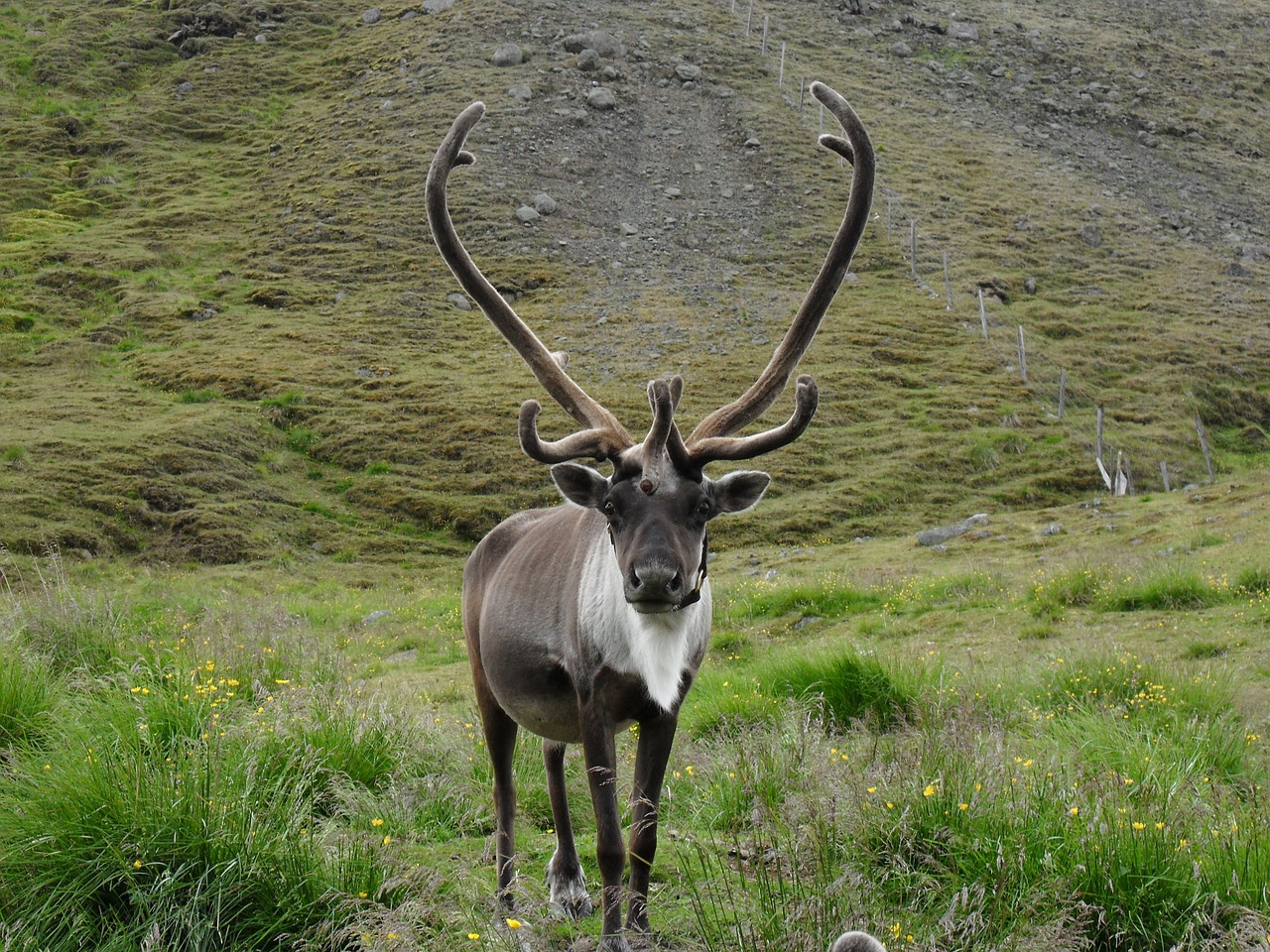
Woodland caribou Copyright Paul Sutherland
Peary caribou (Rangifer tarandus pearyi): Smallest of the caribou subspecies.
Peary Caribou Copyright Trent University
Alaskan or Porcupine caribou (Rangifer tarandus granti): Migratory subspecies most closely resembling the barren-ground caribou, and named after the Porcupine river, which runs through much of their range. The longest migrating land mammal on Earth.
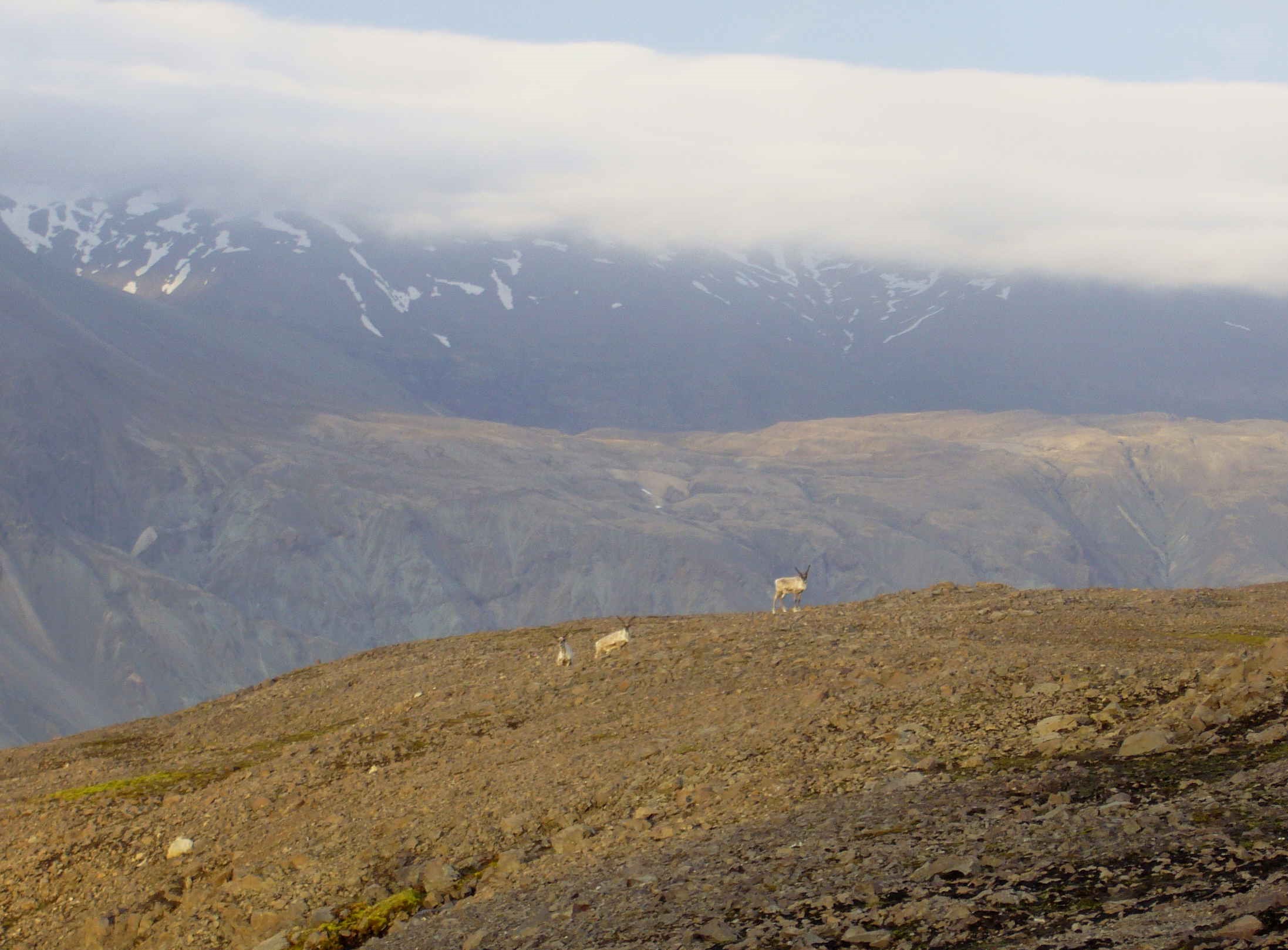
Porcupine caribou
There have been two other subspecies in the past but these have now died out – the East Greenland Caribou and the Queen Charlotte Island Caribou.
So there you go, a brief taxonomy lesson, and congratulations to anyone who has stuck with me, as well as apologies for some slight over-simplifications for any scientists amongst you. Hopefully you’ll have all learnt something though – I’m a big believer of sneaking in educational blogs among the pretty pictures and funny stories we often post! And if it’s all too much and you’d just prefer something a bit more light-hearted, head off and google pictures of Svalbard reindeer. You’ll not be disappointed.
Around mid March Fly, one of our mature female reindeer started to grow her antlers. March is pretty early but I suspect due to a warmer winter than we usually have and possibly the growth of vegetation starting earlier this has brought on an early antler growth in some reindeer. Fly has certainly grown some of the biggest antlers we have seen in female reindeer over the years, as well as producing some of our biggest calves so she’s certainly an asset to our herd and is now the grand age of 12… yet still looking amazing!
Here is a sequence of photos over 9 weeks showing how incredibly fast Fly’s antlers were growing.
Her antlers grew a good 2 inches between week one and two.About three inches between weeks two and three.Between weeks three and four the antler started to show its first split into another point on her right antler.Then between weeks four and five her left antler didn’t the same with about another 2-3 inches growth as well to both antlers.I think between weeks five and six shows the biggest difference with about 3-4 inches of growth on main branch of antler as well as the first points branching off.Weeks six to seven her right antler seems to have gained some good height to it growing very tall. At this point her antlers were bigger than one of our main breeding bull, Kota.Week 8Week 9
So there you have it, a nine week antler growth process. It really is amazing how fast antler can grow and this is proof in the pudding. Thank you Fly for being such a great candidate.
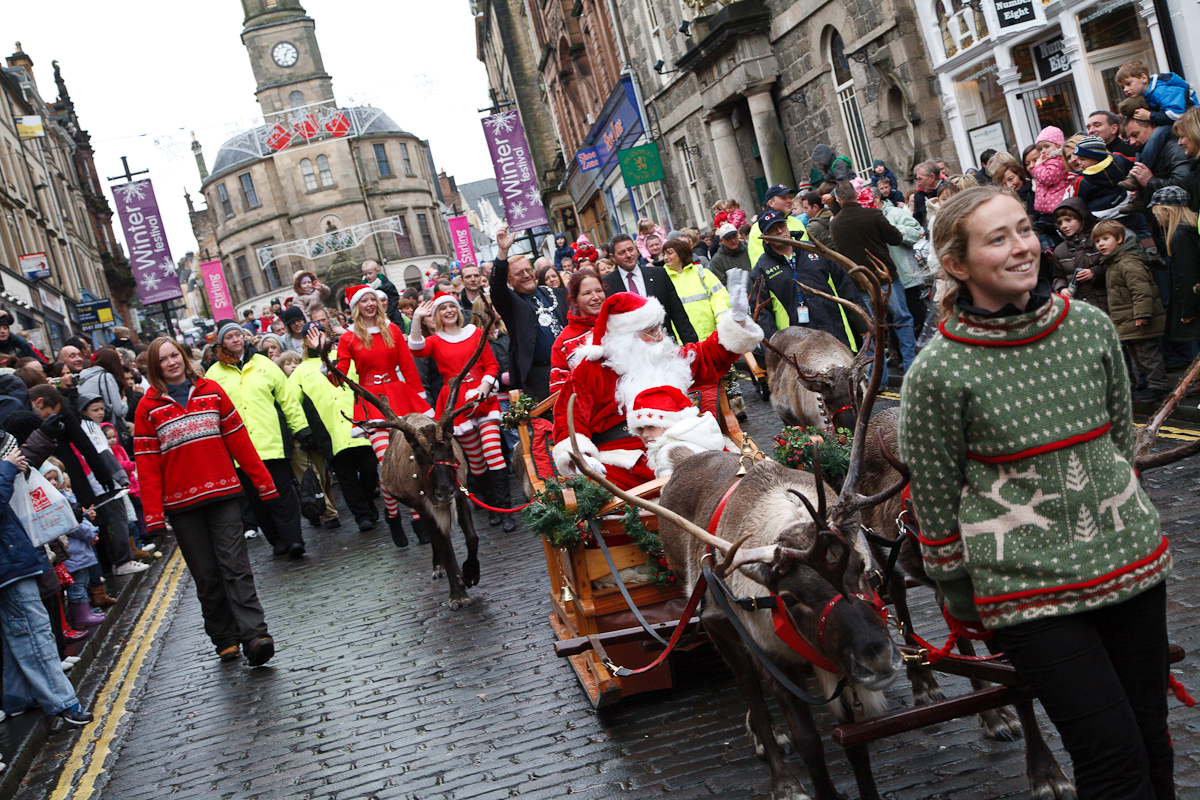
A couple of months ago there was a woman on our Hill Trip who wondered if we ever did sleigh rides with our reindeer. Apart from our parades around Christmas time, at which we use a sleigh for Santa to sit on, we don’t do any sleigh rides. It is simply not along the lines of what we want to use our reindeer for year round.
Reindeer getting some snacks in NorwayReady for a sleigh ride?
When I was in Norway before, there were companies that offered sleigh rides with reindeer. The owners of these reindeer seemed to be quite happy taking people along on sleigh rides and the reindeer, being rewarded with lichen, happily obliged. I couldn’t resist, so I gave it a go. It was quite fun, yet a lot slower than I had imagined, even though I had been involved with Christmas last year as well. The reindeer just take it slow and put up a pace you could easily keep up with on foot. Nonetheless, it’s quite calming and relaxing to be in your sleigh, being pulled by your reindeer. Reindeer seem to have a calming effect on people. This is something many people say on our hill trips, and something I’ve found as well from the first time I met them. So in Scotland it won’t be possible to go on a sleigh ride any time soon (unless you’re Santa and it’s Christmas time) but if you do it in Norway, Sweden or Finland, you’re up for a calming, relaxing ride, right through winter wonderland.
All farmers and animal keepers know the saying. It’s a phrase often learnt the hard way but once learnt, it’s never forgotten. It’s only too easily remembered though when everything, it seems, is going tits up…
‘When you have livestock, you have dead stock’.
The subject of death might seem an odd choice for a blog but it’s part and parcel of working with animals and therefore not something to be hidden, or never mentioned. I feel that in this sort of job, it could be all too easy to brush over losses, but sometimes people do like a little frankness and want to know more (aren’t I brave?!).
Reindeer probably don’t live as long as many people expect, the average age being around 11-13, so naturally there is a turnover of quite a few animals per year. As to be expected, we have years with good survival rates and some with bad, so therefore we purposely vary our calving numbers from year to year in an effort to hold the herd at around 150 animals. This way we control our overall number without ever having to cull.
Reindeer in the corral at one of our winter grazing sites, having been brought down off the hills for annual vaccinations. Youngest reindeer herder Hamish is in attendance!
But animals being animals, they can find all sorts of ways to turn up their toes before their time, and sometimes we do find ourselves fighting a losing battle with a particular reindeer. Though I must say, in recent times there thankfully hasn’t been quite such a dramatic loss as one I unearthed in ancient diaries of Mr Utsi’s, detailing a bull in the 50s who was found drowned, having become accidentally tangled in wire and then blown into a loch – such is the wildness of the winter weather here at times. What a terrible way to go, and an incredibly hard loss for Mr Utsi, especially in the days when the herd was in its infancy. A striking example of the fact that sometimes, accidents do just happen, however much you try to ensure that they don’t.
In latter years, ticks have been the cause of many a loss in the herd. Twenty years or so ago, we lost reindeer after reindeer until we got to grips with a particular illness that reindeer can suffer which is transmitted by ticks, and though we are on top of it nowadays, having learnt which vaccinations do and don’t work and how often they should be used (no veterinary drugs come with detailed instructions specifically for reindeer!), it does still rear its ugly head every now and then. Most of the time we treat the affected reindeer successfully, but we still do lose reindeer to it on occasion, and one such loss hit us particularly hard last autumn. That was Fergus, our big, handsome three year old bull. If you’ve followed us via our blog and social media pages over the last few years, you’ll have heard all about Fergus, hand-reared in 2015 after his mum died. From the underdog in the herd as a calf he had turned into the biggest, most impressive reindeer of his year, so his death really, really hurt.
Fergus as a young bull, having grown into a very impressive lad!
Spring is often the most difficult time for reindeer, coinciding with the highest concentration of ticks. In spring, before the good grazing appears, the reindeer have just made it through the winter using up their fat reserves as they go, so their bodies are at a low ebb. This makes them more vulnerable to illness, with lowered immune systems, and it’s probably the most problematic time of year for them as a result. Into the summer and they put on weight, rolling in fat by around August, standing them in good stead for the winter months to come. That said, autumn can be hard too with another spike in the tick numbers coupled with a change in diet for many of the reindeer, females in particular, as they drop from the high tops of the mountains to the lower slopes.
You may remember that in 2018 we had live twins born for the first time in the history of the herd, but that in the early autumn we lost the smaller one, Hutch. We think his immune system just wasn’t strong enough to cope with illness after a difficult start in life, and very sadly his twin Starsky also died, about 6 weeks later. The curse of the autumn months, but in hindsight I think we can be pretty proud to have got them right through the summer when they were so much smaller than their compatriots – reindeer aren’t designed to have twins for a reason. We had great fun with them throughout the summer and will look back on their time with happy memories as, I think, will everyone who met them.
Lulu and her twins at a few hours old.
I can fully appreciate how upsetting it can be when people have enjoyed meeting a particular reindeer, and later find out that they’ve died. For us, working as closely as we do and investing a huge amount of love, time and effort into each individual, it can be utterly soul destroying when we lose them. In order to work with animals we have to learn to at least deal with death, but coping doesn’t mean we’re hardened to it – the atmosphere in the house when a reindeer has died is subdued and keeping a cheerful attitude with visitors is difficult. Ironically, it’s often on these days that a visitor will announce that we have the “best job in the world” …
One aspect that can make the loss of a reindeer even harder is then having to write to that reindeer’s adopters to let them know the sad news. In particular, my heart will sink when I realise that I have to let so-and-so know when it’s not too long after they have lost a previous adoptee, but this is the way that luck works, and sometimes it does happen. Conversely, when our ancient female Lilac passed away last year, there were a couple of adopters who had adopted her for almost her entire life of 19 years!
Lilac, our longest lived reindeer record holder.
We always do our best to address envelopes to the parents of an adopting child in case they want to break the news themselves, and over the years I’ve had a few visiting adopters here at the Centre, small child in tow, gesturing frantically to me over the child’s head, while saying how sad it is that their adopted reindeer has had to move back to Lapland to live with Santa! However, it is easy to make a small mistake on a computer, so if you find yourself one day receiving a letter addressed to your parents but you’re in your 40s, for the love of God let us know because we’ve ticked the wrong box on the database!