Truckin’

For just six weeks a year, the normal job description of a reindeer herder changes a little, and many of us start driving massive trucks around the country. Well, 7.5 tonne trucks anyway, which are pretty big in comparison to our wee 3 tonne truck (affectionately named Brenda) who we use for day-to-day transport for the rest of the year.

Kuh
My truck for both this season and last, nicknamed the “Coo” as her number plate ends in KUH

On a busy Christmas weekend we can have up to 8 teams of reindeer and herders out and about across the country, so we hire 5 flatbed trucks and put our own specially designed and built boxes on the back, each with ample space for sleigh, kit, feed and of course most importantly, the reindeer themselves. There’s even internal lights! Each of the 5 boxes is a slightly different design, and over the years everyone has gotten attached to a particular box. Alex’s box is the most unique in design, with the space for the feed and equipment running down the side of the reindeer compartment. Great for Alex, who is tall, but not ideal for someone short like Hen, who can’t reach far enough over the barrier to grab the bags at the bottom! Fiona’s box has a rather heavy ramp, again difficult if you’re shorter, though Fi has the strength to heave it up herself. The “Post Box” did indeed start out its life as a Royal Mail box, and still has a few bits of red paint! It has a roller door into the sleigh compartment which takes a fair bit of practice and agility to get open and shut! The Metal box is a little smaller than some of the others so tends to be used for more local events – fitting enough feed in it for 2 weeks away can leave you short of room to move.

And then there is the newest box, nicknamed the Royal box as it seemed so posh and shiny when first made, and the name stuck. This is my favourite box, and having taken it out on tour for the last few years I’m now very familiar with its quirks. Our ramp has been tensioned beautifully (i.e. quite a lot) so it’s easy for us shorties to put up, but also meaning that you can unintentionally “ramp-surf” as you’re opening up the back gates, finding yourself hovering several feet in the air and having to gingerly edge your weight down the ramp until it touches down.

Xmas Compartments
The compartments of the Royal box

Like most of the boxes, the Royal box has a “corridor” with access to storage for all of the reindeer feed, lichen, straw, buckets, odds and ends, shovel, broom, etc; the sleigh compartment for the sleigh itself, all the decorations and harness; and then of course the biggest area is for the reindeer. Our reindeer travel loose, and whenever we check on them (if we stop for fuel, for example) they’re usually lying down catching some shut-eye! It’s reassuring for us that they seem to like the box, and virtually load themselves, always happy to walk up the ramp.

Reindeer Box
Sleepy reindeer as seen from above!
Origami Morven
Origami and Morven having a restful journey, I sometimes wish I could join them back there!

The boxes are bedded thickly with straw, poo-picked after each journey (let’s just say we’ve discovered another use for the “diesel gloves” you can pick up at garages…) and completely mucked out & pressure washed each time we return home. Keeps us and the reindeer smelling fresher and helps prevent that embarrassing moment when you emerge from the box with “something” stuck to your shoe!

Poo picking
The less glamorous side of the job – poo picking!

Getting kit in and out of the corridor can be fairly entertaining, and over the years the pastime of “lorry yoga” has evolved, providing gentle muscle stretches for the herder on tour as you manoeuvre and contort into weird positions to get (sometimes heavy or awkward) things in and out. The straw bales are the worst, as they frequently try to take you with them as you eject them from the shelf! Getting them back in is even harder, especially when they weigh half as much as you do…

Lorry Yoga2
Just a bit of morning lorry yoga to warm up the muscles…
Lorry Yoga1
… and reach!

Driving the trucks is something I half dread and half look forward to each year. As I’m not old enough to drive them on “grandfather rights”, I did a training course a few years ago and passed the dreaded test to get my license. The problem is we go for over 10 months of the year without driving anything so big, so there’s always a bit of apprehension when the trucks are picked up for the season and you first get behind the wheel… It’s funny though, as everything is bigger, the mirrors are bigger, and they just feel totally different to a car, and your brain automatically seems to click into “slow careful truck-driving” mode. Everything has to be done slower as the trucks are so big, and it’s essential to give the reindeer a smooth ride, so it instantly stops you hurrying and gives you a new sense of patience. Our top speed, even on a motorway, is restricted to 56mph, but it’s quite delightful to pop on cruise control and just potter along to your destination.

DrivingTruck2
Onward!

There are a several things I didn’t know about before starting to drive the trucks. Firstly, the ruts on motorways, created by the endless trucks using the slow lane – whilst I never tend to notice them in a car as the wheels are closer together, when you’re in a truck you can get “sucked in” which is rather disconcerting. Secondly, the frustration of being limited to 56mph when trying to overtake on a motorway. All trucks theoretically have the same limit, but speedos can have a bit of variation, meaning that you’ll sometimes get stuck trying to overtake a bigger truck that’s going just fractionally slower than you. When going uphill, their extra weight slows them down and we gain on them, but once we reach the top of the hill and start heading down again, their weight speeds them up and off they shoot again! This may explain why you sometimes see trucks “duelling” for miles along a motorway… The other time your limiter is frustrating is when you come up behind a car doing 50mph on the motorway, you pull out to overtake, at which point they instantly speed up, just enough to pull ahead, so you tuck in behind them again, at which point they slow back down again!

TyCap Max
That’s what the gap’s for! Max the cat using our truck as a surveillance point

Most of the time though it’s great fun driving a truck, and I still love arriving at an event, the organiser pointing out a tricky bit of manoeuvring that you’ll need to pull off (archways being a major culprit, sometimes with mirrors folded in and a couple of inches to spare each side) and looking hugely impressed when a girl manages to pull it off!

Andi


Getting Ready for Christmas (Tour)

Whilst our reindeer spend the vast majority of the year leading a very relaxed life out on the Cairngorm mountains, for the six weeks running up to Christmas, some of our full-grown adult males and six-month-old calves take it in turns to join in Christmas events across the country. These events serve several purposes: spreading the word and educating people about the reindeer, raising vital funds to sustain the herd through the coming year, and of course spreading some festive cheer, especially to those who are unable to make it up to see the herd at home.

Xmas signs
Sleighs and sign boards waiting to be varnished, whilst some of the “farm boys” observe from their part of the barn
Xmas kit
Boxes of sleigh decorations, useful kit for the trucks, spare everything…

Of course taking up to eight teams of six reindeer away on tour requires just a bit of preparation. Or rather, a lot of preparation. Poor Fiona deals with all of the paperwork and logistics, starting in January (it’s always Christmas for her!), whilst Tilly is the queen of organising the rest of us into helping her sort out the physical kit required. In October, most of the team end up spending a day or two at the farm, helping to scrub, sort, varnish, count and clean the various bowls, head collars, harness, ropes, boxes and sleighs, and to mix numerous bags of feed.

Xmas Headcollars
Digging out the smart event head collars and ropes from storage
Xmas varnish
Giving the sleighs a fresh coat of varnish
Xmas bowls
Imogen got the short straw of pressure-washing all of the feed and water bowls

Our specially designed “boxes” which the reindeer travel in, similar to a large horse box but with additional room for a sleigh, also have to be taken out of storage and painted, cleaned and bedded down ready for the first trip of the year.

ReindeerLorryFleet1
Some of the trucks and freshly painted boxes ready to go ©Alex Smith
Xmas feed
Mountains of feed waiting to be mixed – we use a cement mixer for speed!
Xmas ropes
Nearly 100 lead ropes and head collars are needed to kit out all of the teams (each reindeer has a “smart” set and an every day set)

All in all, it’s a lot of work, but meeting so many excited and delighted people out on tour with our beautiful reindeer makes it all worthwhile!

Andi

Disappearing Under Paperwork

Newsletters. The very word strikes alarm into the heart of a reindeer herder. Twice a year, our very outdoorsy, active job becomes a little more office bound for a few days, as we frantically scrabble to prepare, write, and compile about 3000 words into a comprehensible piece of A3, and then mail it out to our supporters of the herd, each of whom ‘adopts’ one of our reindeer. Or more than one, and in the case of one particular adopter (you know who you are…) – six!

We send out the newsletter twice a year, in late June and late October. The June one isn’t usually as fraught as the October one, which coincides with a hectic time of year for us: calf halter training, reindeer sleigh training, the run up to the Christmas tour and the October half term. Over time they have evolved from a single, black and white sheet to a glossy, double-sided and full colour affair. We always include info about each adopter’s particular reindeer in June, but over the years as the support scheme grew, this became too much for us to cope with in October and now we send a photo of the herd instead, with a little info on the back.

Newsletters
Some of our more recent newsletters

There’s no fancy computerised system for us though, we instead trawl through the filed adoption slips for each year of adopters, bit by bit double-checking the info on the form and the printed label is correct, and combining a newsletter with the correct photo or info slip – and then lots of envelope stuffing ensues! When I started working here, years ago, newsletter time seemed to go on for weeks, but now it is a matter of days, usually driven by panic by the amount of other work building up that is on hold. Newsletters come first for a few days! There always seems to be one envelope that floats around the office for a few extra days, with a scribbled post-it on it saying something like ‘can’t find form in folders!’, or ‘why isn’t this on the database!!!!’.

Newsletters
A clear kitchen table and massive amounts of water are needed as preparation
Newsletters
Even Tiree is roped in to help spot the right address labels
Newsletters
All of these folders are full of adoption forms… and all of them must be manually checked

While we do our best to save paper and only send one newsletter to each person who adopts more than one reindeer, there’s no way for adoptions to be easily linked together, so it relies purely on the memory of person working their way through the filed forms, one by one. Many of us recognise most adopters’ names straight away, and the office talk will involve lots of ‘hang on, I think these guys adopt someone else too. Where’s their other form?!’. Often punctuated with ‘bugger, I forgot they adopted so-and-so too. It’s been posted already…’. So if you receive two separate newsletters in the post, bear with us, one day we’ll get it right! (and on that note – if you spot anything wrong with your address, do drop us an email so we can correct it!)

And then, finally, comes the mission of franking all 1000 plus envelopes. A mind numbing job, but quite soothing as the machine beeps away – known to us as ‘the franking song’. The beeping ditty is stuck in the head of the unfortunate herder tasked with this job for the rest of the day.

Newsletters
The hardest week of the year for the franking machine
Newsletters
At last – envelopes stuffed, labelled, checked, franked, boxed and ready to wing their way across the country!

So hopefully by now (or within the next few days at least), you adopters out there should have your shiny new Oct 2015 newsletter in your hands. And if don’t adopt a reindeer, and want to get your paws on one of these hallowed pieces of literature (ha!), then there’s only one way to do so. Now, where’s that adoption form got to???

Hen

Boris: a reindeer of dubious distinction

If you’ve visited us in the last couple of years and met Boris up in the hill enclosure, there’s every possibility that he was the reindeer that left the strongest impression on you. However, he’s not, shall we say, our finest specimen in the herd. He’s not particularly big, nor does he grow the most impressive antlers, but he is, without even a shadow of doubt, the ugliest reindeer in the entire Cairngorm herd (if you’ve not met him, have a good long look at the photos before you say ‘awww, poor thing’…).

Boris and his nose through the years

Boris was born in 2012, but way out on the mountain free-range rather than in our hill enclosure. We therefore only saw him once in his first summer, and at that stage nobody noticed something rather strange about his face. It was only when he and his mum Foil came into our hill enclosure in the autumn that we realised something was amiss. At first glance it looks like his eyes are wonky, but in reality both are the same distance below his antlers, and it is only below eye level that his nose takes a dive to the right with alarming squint-ness! As Boris has got older and his skull has continued to grow, the nose has become more and more wonky, but it never appears to cause him any problems, and is instead garnering him quite a fan club. Tilly once saw him having a wee sip from a puddle in a neighbouring field that no other reindeer could reach underneath the fence, so perhaps it has its advantages! Somebody who volunteered here a couple of years back once told me they had seen a similar condition in a red deer before, caused by the nasal passages developing in the womb at different rates. I have no idea if this is indeed the case, but anyone reading this has any knowledge on the subject, we’d be delighted to hear from you. We have seen it before, in a lovely male reindeer named Addjá who joined our herd from Sweden in 2004, but his face is barely squint at all in comparison to Boris; he could almost be called handsome! Although I’ve just looked through his photo archive to choose a picture of him – and on second thoughts, perhaps not.

Addja
Our lovely Swedish boy Addjá, with his slightly squint nose

When we take our harness trained reindeer on tour at Christmas time they are trained to pull a sleigh side by side, and as Addjá’s nose bends in the opposite direction to Boris’s, this has led to a bit of a debate here. Should Boris go on the left and Addjá on the right so their noses point into the centre (more stream-lined?) or should it be the other way around? As Addjá is an old boy now and Boris isn’t yet trained to harness, this may be a question we never get to figure out the answer to.

Hen

Busy summer – trekking and extra staff!

Summer is well underway with Scottish schools off and English schools just breaking up and here at the Reindeer Centre we have certainly noticed the rise in visitor numbers. We now offer three guided tours onto the hill daily over the next two months with our additional 3.30pm tour on Monday – Fridays. Trekking has been running for a month now and already we have taken over 23 groups made up of 68 people of which two of them were hardy 5 and 6 year olds! It has all gone very smoothly and the reindeer have been absolute stars. On the whole we have been very lucky with the weather with only a couple of wet trekking days but if you come to Scotland to go trekking in the Cairngorm mountains you have to come with the frame of mind that you may experience all four seasons in one day!

Trekking
Rubiks and Boxer admiring the view with their trekkers at the summit of Silver Mount

The reindeer that have been trekking already this year are – Marley, Puddock, Caribou, Gnu, Topi, Paintpot, Oryx, Grunter, Strudel, Macaroon, Hornet, Beastie, Tanner, Spider, Hamish, Horse, Rummy, Domino, Origami, Monopoly, Bingo, Svalbard, Rubiks, Stenoa, Olympic, Second, Nutkins, Monty, Balmoral, Duke, Minute, Boris, Mo, Orkney, Ost, Drambuie, Jonne, Kota, Gandi, Bovril, Hook, Boxer, Gin, Max and Nutti. Grunter is used for our younger trekkers. He is what I’d describe as a bombproof reindeer. He is quite happy either at the front of the group or at the back. A wee Dutch lad who led him a couple of weeks ago headed off on his own route jumping all the puddles – I think him and Grunter covered almost twice as much ground than us!

They have all got their different characters, some love the attention and a good fuss while others are quite happy to plod along at the back at their own pace. Some reindeer are super cheeky and others know how to ‘take the mick’ out of trekkers who maybe aren’t so confident in their leading so what I always like to do to match up characters of reindeer to the characters of my trekkers and 90% of the time I get it right. I’ll let my previous trekkers work out how I see their characters compared to the reindeer they led 😉 The 10% I get wrong is my fall back excuse!

As well as our additional summer activities we are still doing our day to day work both out on the hill checking the free-ranging herd of cows and calves as well as here in our office putting adoption packs together, so naturally we need a few extra hands at this time of year and therefore employ more staff. Our latest member of the team has taken to the reindeer herding life very well indeed. She is super fit which is great when out in the hills and although still a bit shy with our visitors she is only young so confidence will come and by the end of summer I’m sure she will be on full form. Recently we have been showing her how to set up adoption packs as we have a great support network of adopters all over the world and each pack has its very own hand written letter because we really feel they deserve that personal touch. She does a great job and who knows we may even keep her on after the summer months if she continues to show hard work and commitment to the job in hand. Everybody, meet Tiree! She is my 10 month old Aussie Shepherd pup and is by far the best looking member of our team here…

Summer staff
Tiree settles in to office life

Fiona

The Calving Bet

Every year we reindeer herders have a little flutter into betting around calving time of year – the idea is to pick a reindeer you think is going to calve first and if your reindeer calves last you have to take an icy dip into Loch Morlich. As you can imagine this makes it all the more serious and some proper consideration should always go into picking your ‘bet’ reindeer. This year turned into a two handed contest between Abby and Hen, and it was never going to end well for one of them…

Hopscotch versus Lulu
The contenders: Hopscotch versus Lulu

Abby: Last year (my first calving) I took all the advice on board, I learned about families who calve early, I checked out tummy size and I looked at udder size; and ended up with a female who calved pretty near the beginning.

You would think that after a year of reindeer herding I’d enter this year’s bet with a bit more wisdom and expertise: after all, I’ve got to know the reindeer pretty well now. However, I committed the cardinal sin, and chose a reindeer who I just really liked before weighing up the facts properly. A lovely four year old called Hopscotch, and indeed she was pretty rotund looking when I picked her but there was no sign of an udder, but I’d made my choice and had to stick by it.

Hen: Bets have to be in by the end of April, and this year I went with Lulu. I had dutifully peered between hind legs at udders, assessed general belly size, and considered previous calving patterns, and Lulu seemed like a pretty safe bet. Everyone else made sensible bets too, with the exception of Abby. We ripped her to shreds continuously as she was very obviously going to end up in the loch, and deserved to as well – Hopscotch (daft choice, ha!) was looking pretty slim compared to everyone else’s bets, who were waddling around huffing and puffing.

Pregnant cows
Checking the pregnant cows early in the morning

Abby: By the 30th of April it all kicked off and the calving storm began – one by one the females started popping and one by one my colleagues became safe from the dreaded swim. By mid-May most of the females had calved and all that was left from the bet was me with Hopscotch and Hen with Lulu. Lulu was the size of a barge with an udder to match, and was like the vision of doom every time I saw her up the hill. I began to think myself very foolish indeed and resigned myself to the fact that a very cold swim was coming my way as there was no way Hopscotch would calve before an old pro like Lulu!

However, much to my surprise on Monday the 18th of May Hopscotch was missing, I was all a-flutter and stoked thinking that I was free of the swim and off we headed to track down her and her new calfie. We were, however, a wee bit disappointed, finding her on the top of Silver Mount (which is a very popular calving spot) chillin’ like a villain. There would be no calf today it seemed. It’s very common for reindeer to go off and faff about for up to a week before they actually give birth and I resigned myself to fact once again that I’d probably end up in the water. However the next day the same thing happened, no Hopscotch, hopes were high until once again she was found and pootled back to the herd quite happily but by our afternoon visit she was once again gone… this was it I thought. If a female goes missing in the afternoon a herder will head up the hill at the ungodly hour of 5am to track her down and this is just what I did! Once again she was on Silver mount (a bit of a shock for my legs that early in the morning – this is why reindeer herders get through so many biscuits!), but she didn’t look quite right and upon taking her temperature I realised she had an acute case of ‘Man Flu’! She got a wee dose of antibiotics before I popped her in with the cows and calves. 10 yards later she went down and in my head my thoughts ran along the lines of ‘Oh my god, I’ve killed a reindeer!’ until she started huffing and puffing away… she seemed to be going into labour! I left her to it and waited with glee to meet a new calfie in the afternoon.

Hen: I had foolishly chosen this week to have a few days off, and was away from home too. A smug text message on the Monday told me that Hopscotch was away to calve, but frantic texts from me after that, trying to gauge what was happening, mostly seemed to go unanswered or got a cryptic reply that didn’t really tell me what was going on. I started to sweat. Surely I wasn’t going to be beaten by Abby?! Having been here for a year, she is still ‘new’ compared to me – I’ve been a reindeer herder for over seven years and have experienced a lot more calving seasons than Abby, I should have been able to sail through the bet with no problems! Towards the end of the week I started to doubt myself.

Abby: By Wednesday afternoon Hopscotch was acting completely normally and stuffing her face with glee and was most definitely not giving birth. At this point I felt it was all a bit cruel and gave up on the idea of no swim and as Thursday rolled around with still no sign of a calf I decided it was definite.

Hen: I arrived home from my days off to discover Hopscotch had had a temperature but nothing else, and all was back to normal up the hill. Huge relief, false alarm and all that, and I went back to teasing Abby relentlessly about when she was going swimming! I was stupidly overconfident once again that I was completely safe, Lulu must surely calve any minute, but reindeer have a nasty way of bringing you back down to earth and the ringing phone the following morning signalled the end for me… Andi’s voice sounded like she was stifling the giggles, informing me that she’d just found Hopscotch with her new-born male calf. Abby collapsed in relief and I cursed Lulu, Hopscotch, everyone else and to be honest, reindeer in general.

Hopscotch and calf
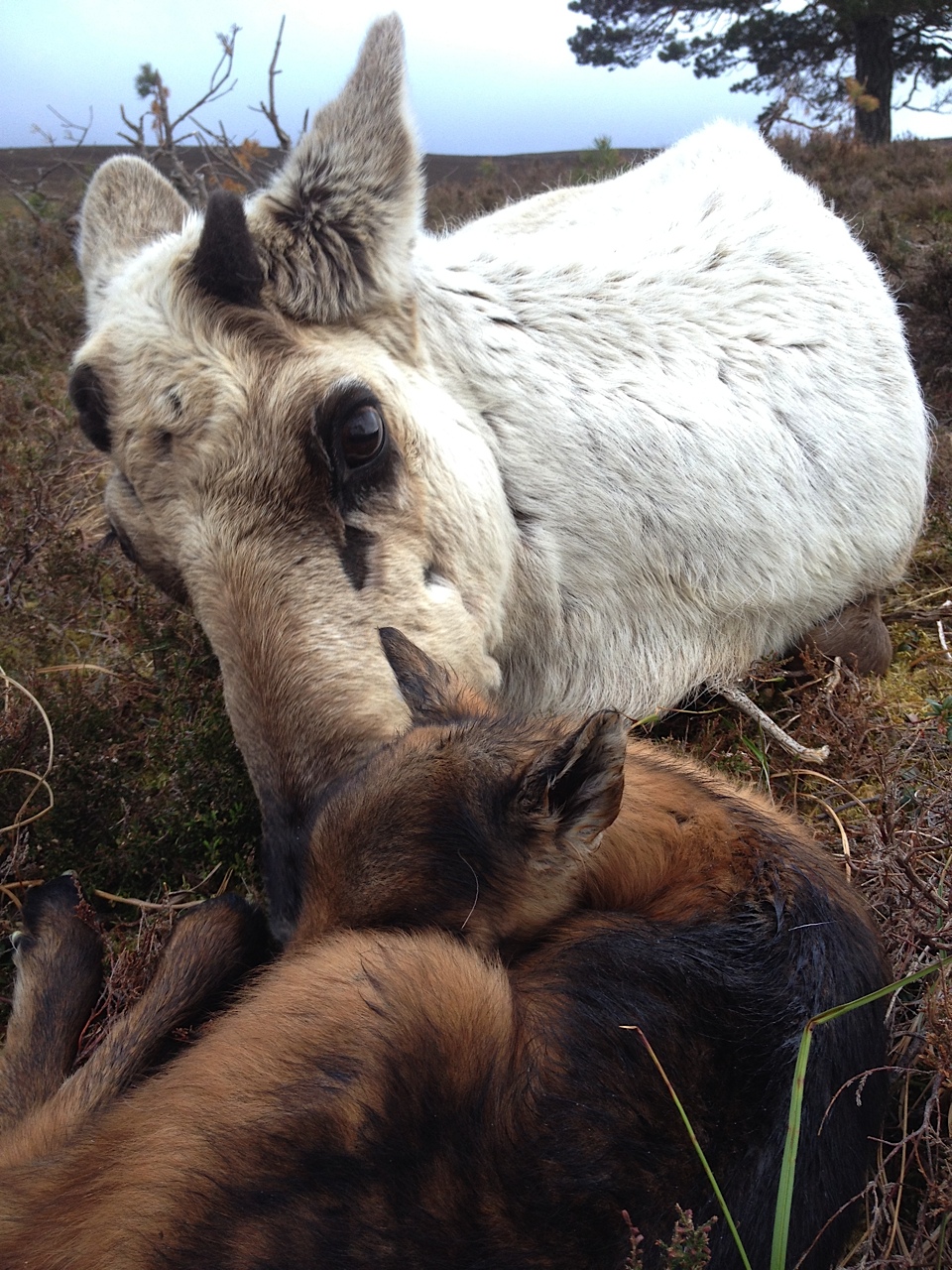
Hopscotch and her new-born calf Kips

Being as it was about 8°C at this point, I was given until the end of June to swim. Loch Morlich is only a few hundred metres from Reindeer House, but at this time of year consists mainly of snow melt, and I am not someone to throw myself into cold water with abandon unless there’s a damn good reason.

Swim
Walking to my doom… Note the laughter on everyone else’s faces!

Summer didn’t arrive right until the end of June in the Cairngorms this year, so I bided my time and kept an eye on the forecast. I left my swim right till the bitter end, on 30th June, and at least the dogs had the decency to come in with me, although everyone else stuck to paddling! I don’t appear to have hypothermia either. Or at least not yet. Maybe it’ll be slow onset hypothermia.

Swim3
Sookie at least joined me in the loch!

Lulu did eventually calve, far too late for Hen of course, completely unaware of everything that had been riding on her!

Abby and Hen

The Return of the Natives

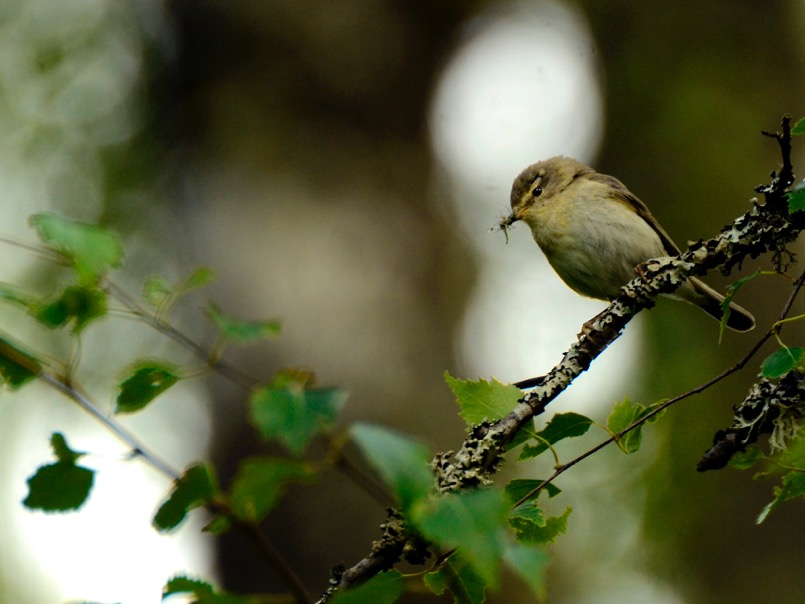
Willow Warbler
Willow Warbler – photo courtesy of Jack Ward of Alba Wildlife (much better photographer than me!)

While the other reindeer herders are spending the first part of the year watching the female reindeer gradually expand outwards and wondering who is going to calve first, I am often preoccupied with the return of the birds – the first fluting song of a Willow Warbler is one of my annual highlights, heralding the onset of summer. An ‘outdoor job’ in such a beautiful location as the Cairngorms means I’m in the right place at the right time to see, bit by bit, the changing of the seasons – and nothing makes me happier than to see winter finally receding! And added to that, I’m lucky enough to work in an area with outstanding birdlife, some of which is very rare elsewhere in the country.

Christmas Day 2010
Christmas Day 2010 (left to right Veikka, Fiona, Kermit, Bee, Eco, Tilly and Go)

The first sign I look out for is the birds starting to sing once again and I can remember, on Christmas Day in 2010 in Coylumbridge, taking photos (above) in the snow of Fiona, Tilly and our team of reindeer just before our first parade of the day (we do four parades at local hotels on the big day itself) and hearing a Coal Tit sing – the first of the new breeding season. A new season starting before the other had even finished. Ironically that is my most vivid memory of the whole day! That might just have been a particularly enthusiastic, or at least optimistic, bird however, as this year I think it was into February before I heard anything singing.

After that excitement there’s a long lull as winter drags on, seemingly never-endingly, but the days tick by as we retrieve the reindeer for the daily 11am visits each morning, one by one their antlers falling off as we get later into the winter. The Red Grouse get more and more noisy in March, often erupting out of the heather calling as we walk past and startling me, although the reindeer don’t appear to even notice them. Into April and spring is definitely starting to make an appearance, the weather milder (sometimes!), the plants starting to show fresh growth, while curlews, meadow pipits, pied wagtails and black-headed gulls move back into the area from their coastal wintering areas. Meanwhile the reindeer get wider and wider…

Ring ouzel
Ring ouzel on the hill enclosure fence – taken with my compact camera so not the best photo, sorry!

Then the migrants start to return, back from Africa. I usually see my first Wheatear up at one of the ski car parks on Cairngorm, the white flash of their rump unmistakable. Then there are the Ring Ouzels, basically looking like a blackbird with a white chest, but again they’ve come all the way from Africa; and the Cuckoos in the forest below the reindeer enclosure, their iconic call carrying miles across the hillside. The Swallows are back too, and as usual are in and out the reindeer shed up on the hill when they nest annually. In the summer, as we harness up reindeer in the shed to go trekking, I wonder how many visitors have noticed there is a swallow on her nest just feet from them, peering down at the daily proceedings. High up on the mountain plateau the Dotterels return in May, one of only two species in Britain where the male incubates the eggs so the female is the one with the brighter plumage.

Dotterel
Dotterel on the Cairngorm plateau – photo courtesy of Andi Probert

But it is the little, greenish Willow Warblers that are my absolute favourite, and I keep an ear on the grapevine in April, as news of them making their way north after their arrival at the south coast trickles in, and in mid-April they arrive on mass, the birch trees lining the Sugar Bowl path up to the enclosure suddenly dripping with them. And not long after their arrival, then the calving season kicks in and spring is well on its way, winter is behind us, and all is right with my world!

Hen

Book Now