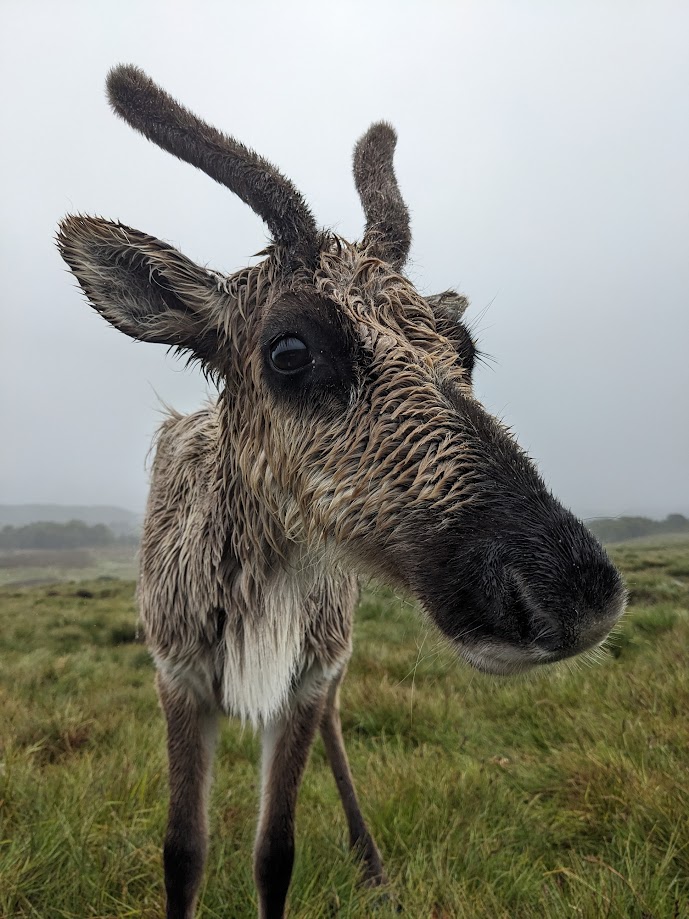
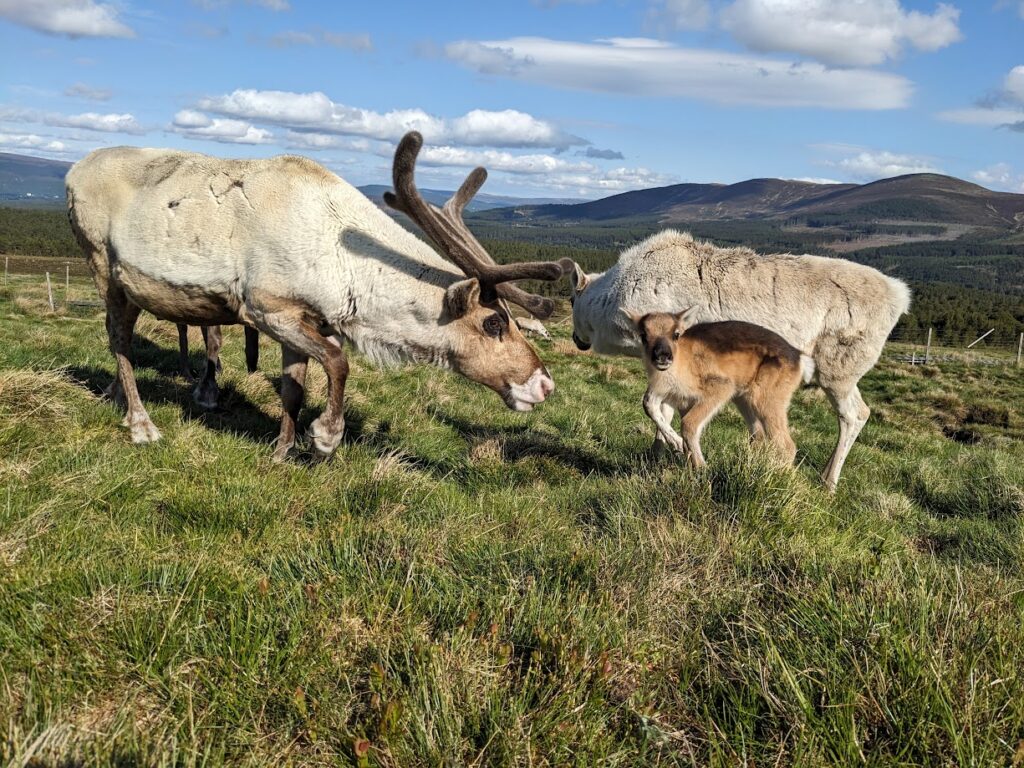
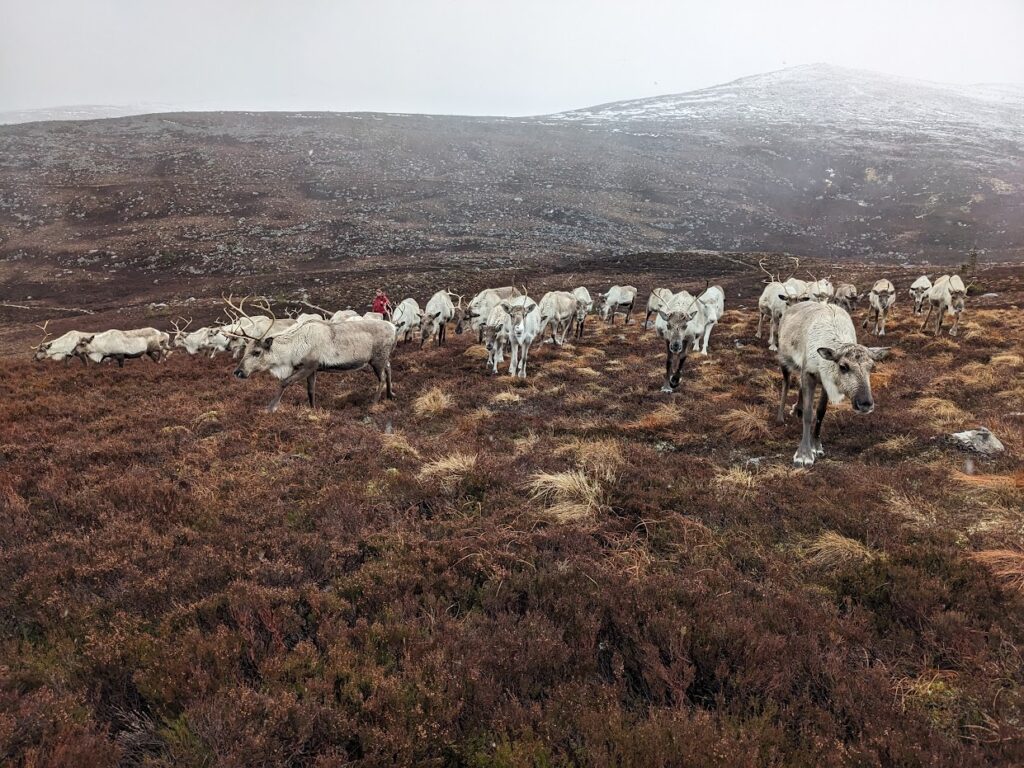
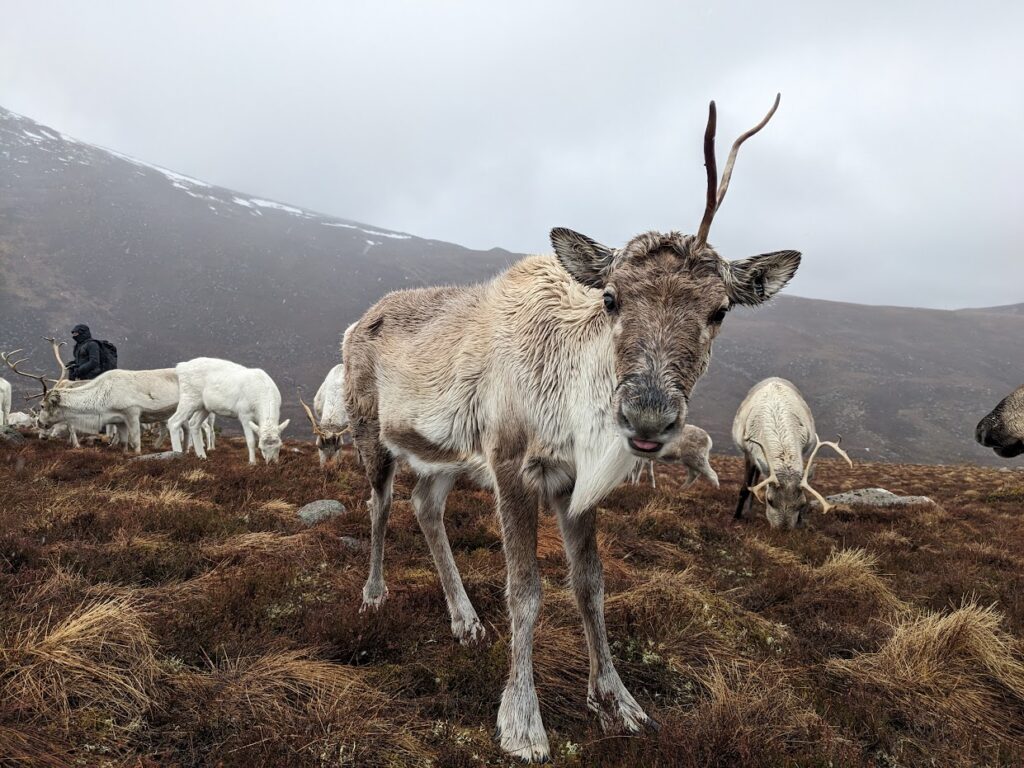
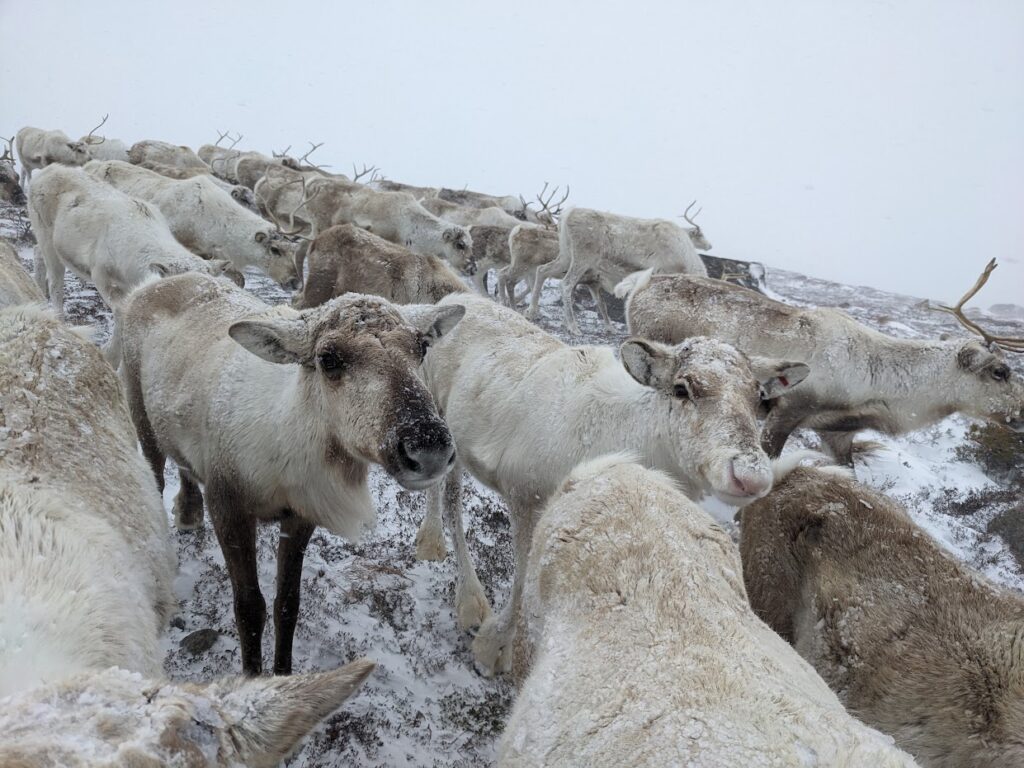
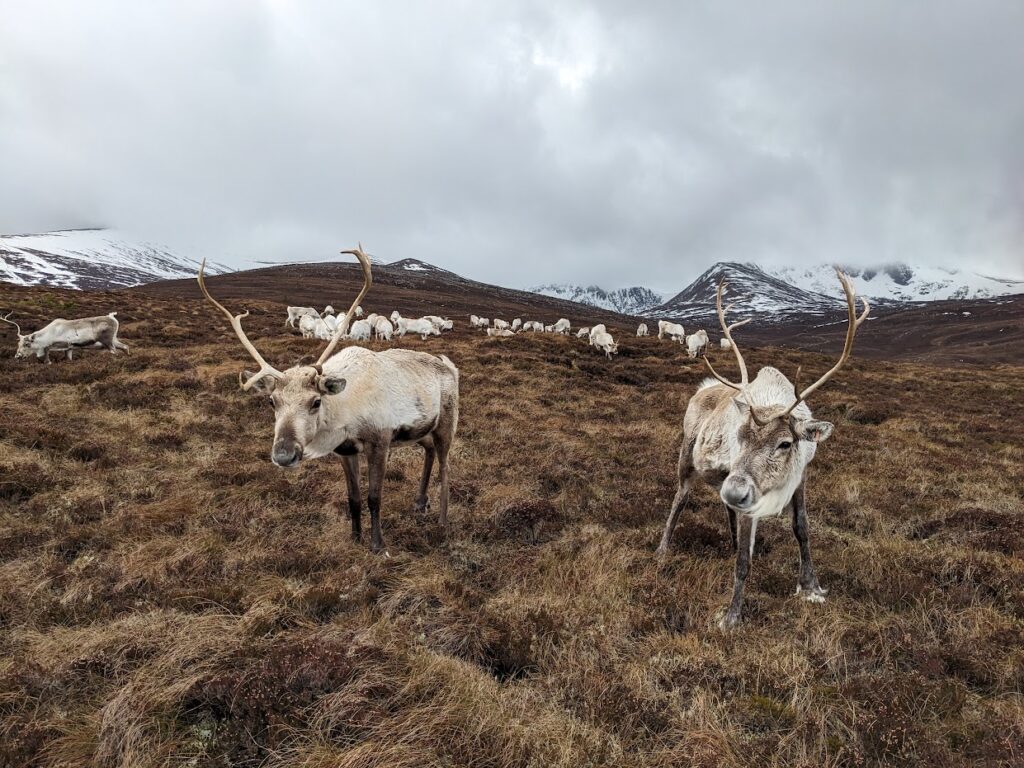
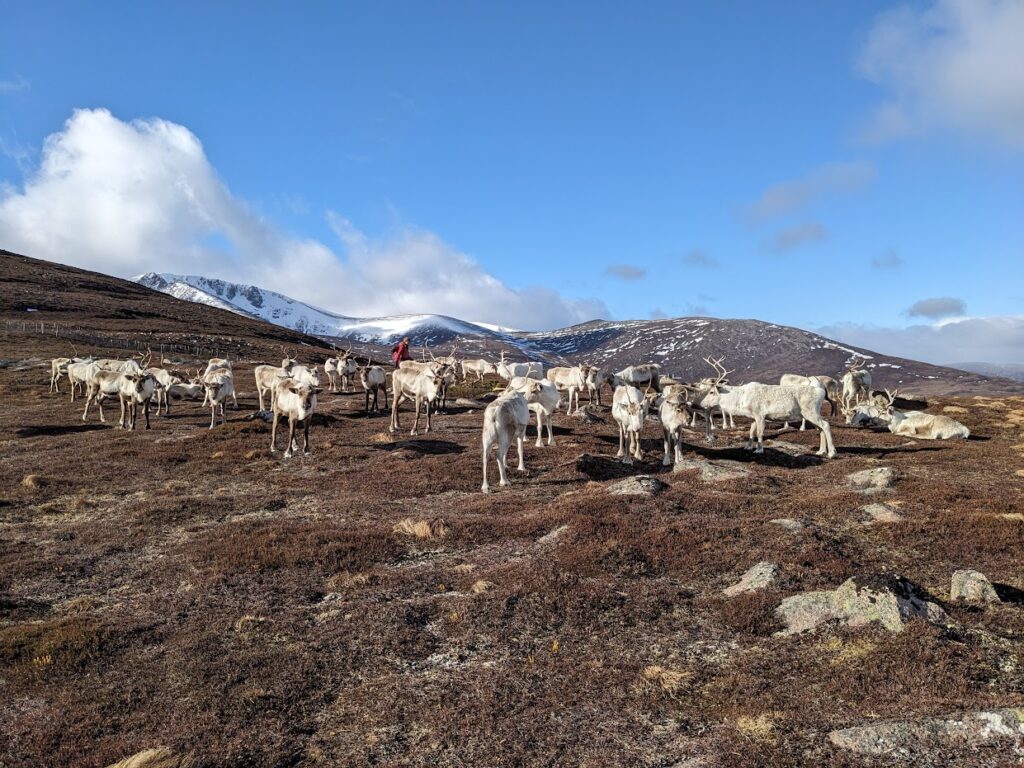
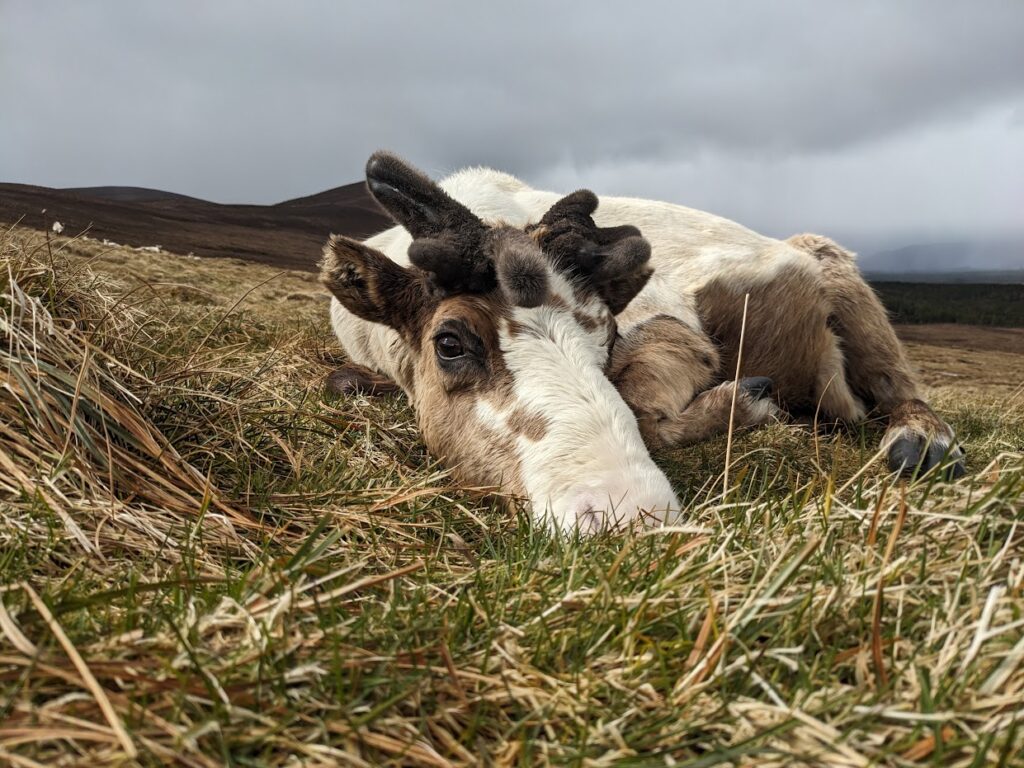
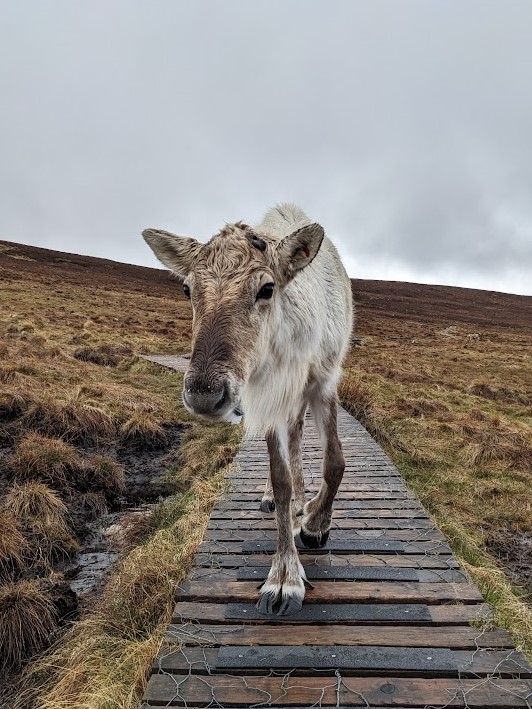
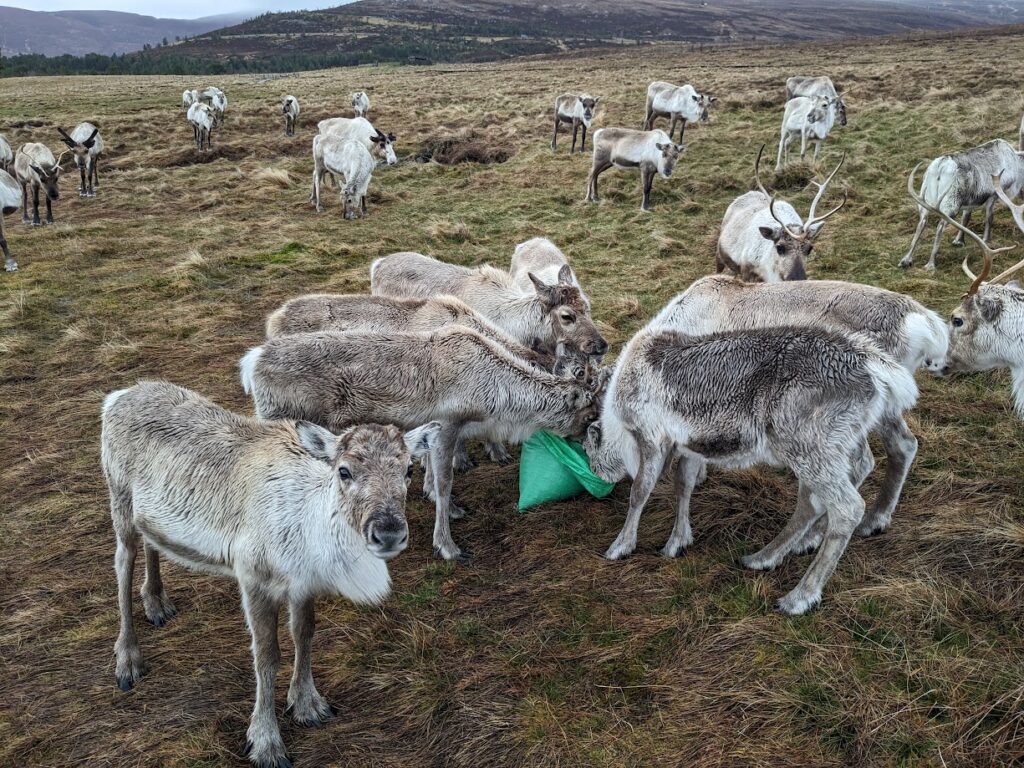
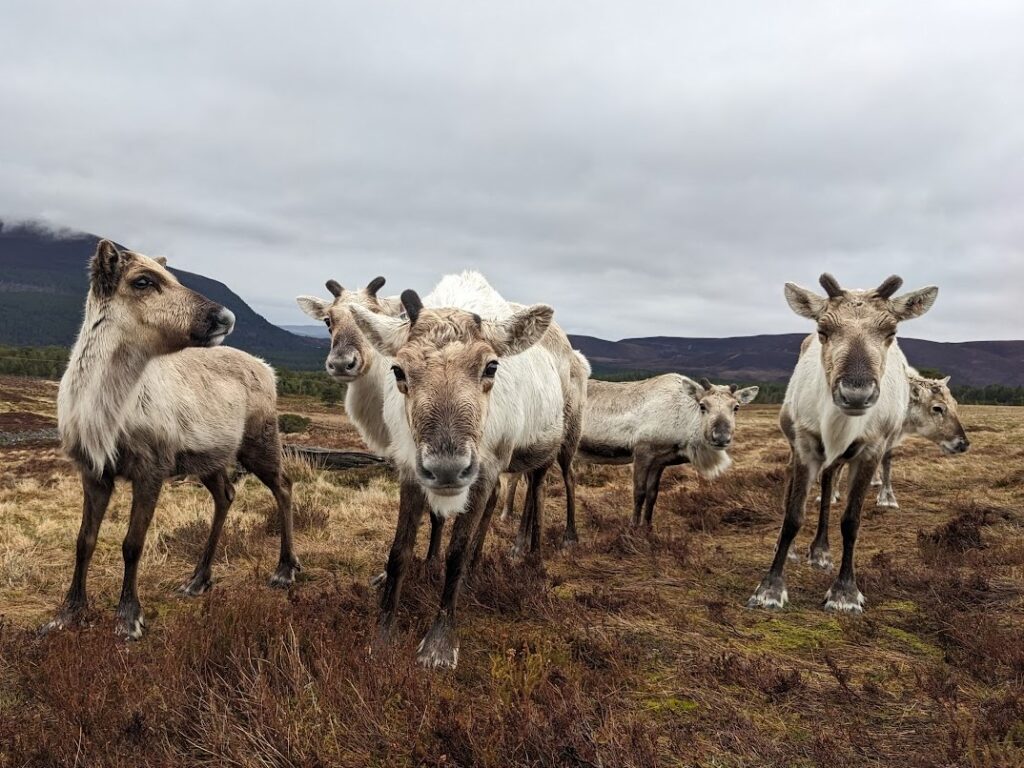
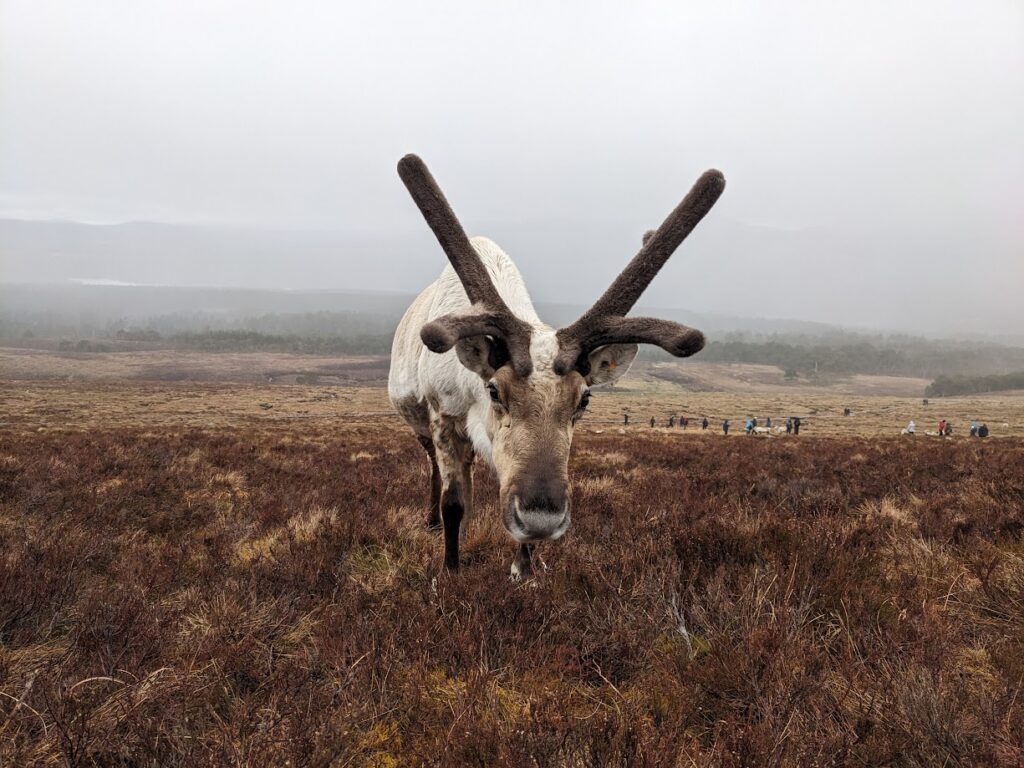
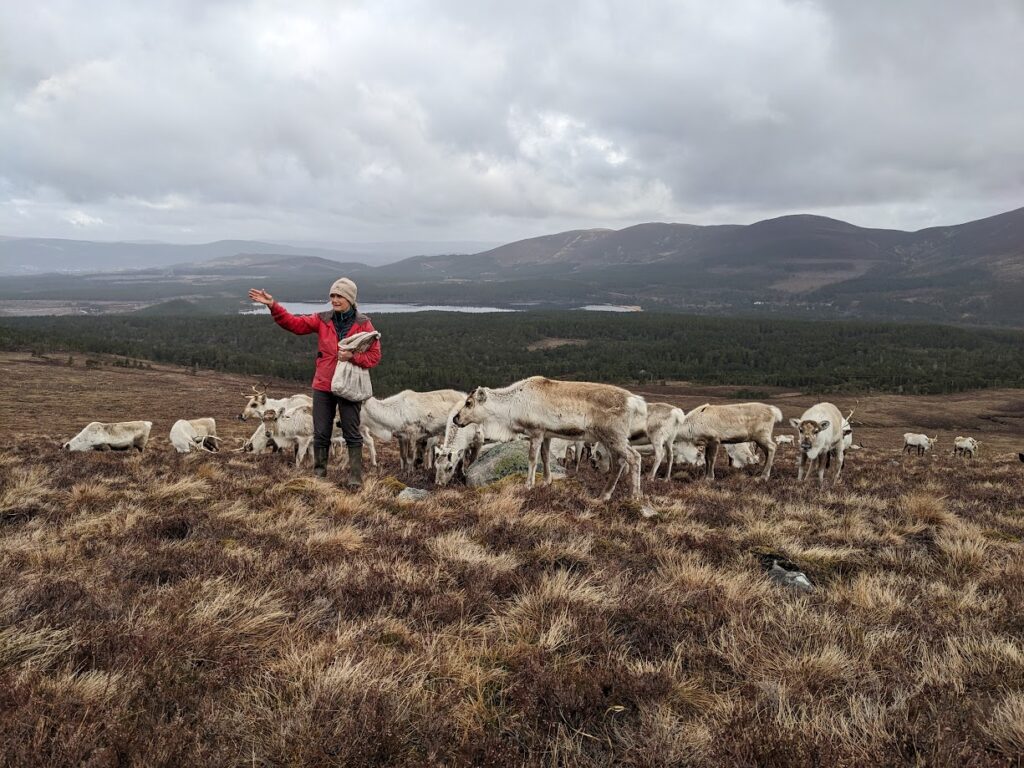
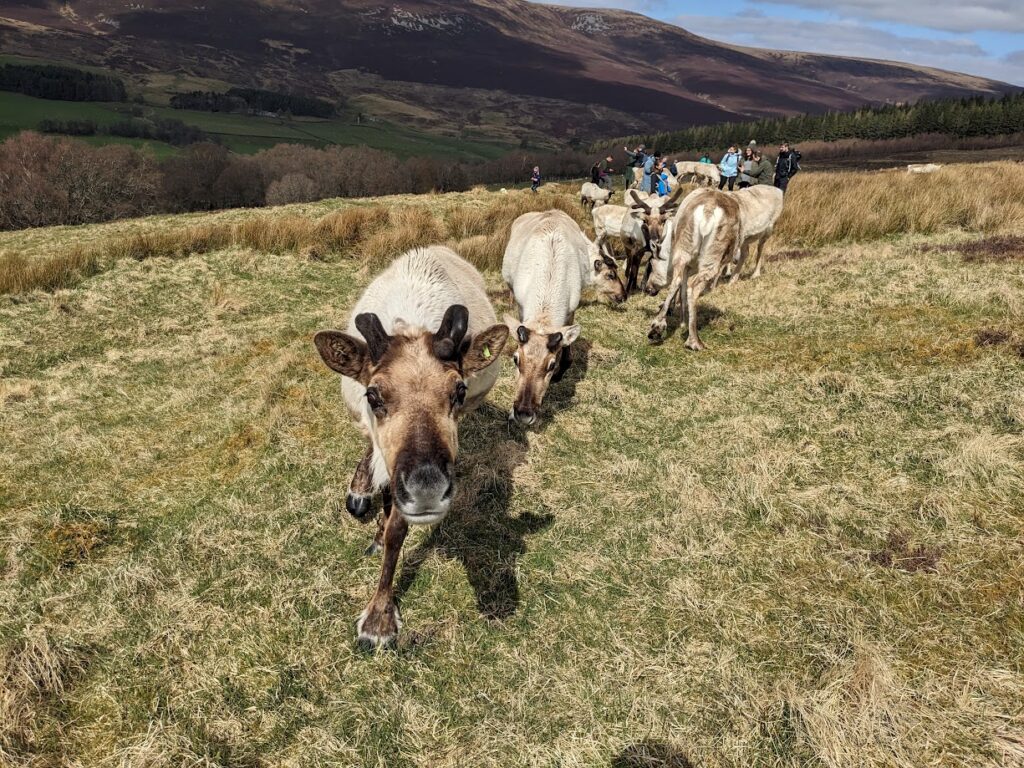
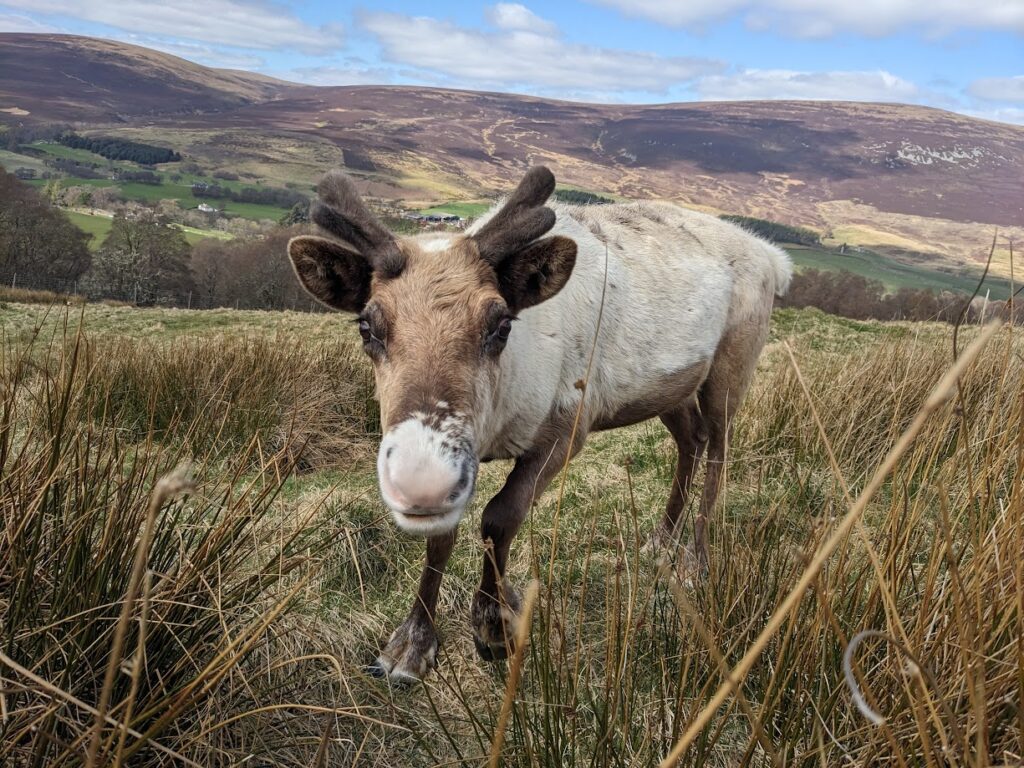
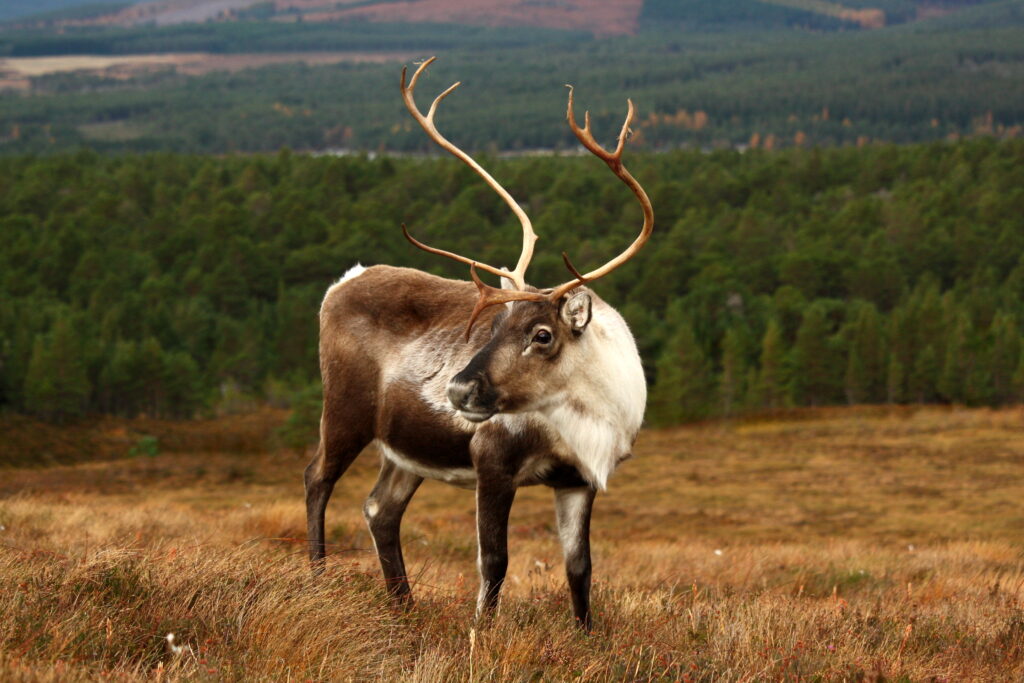
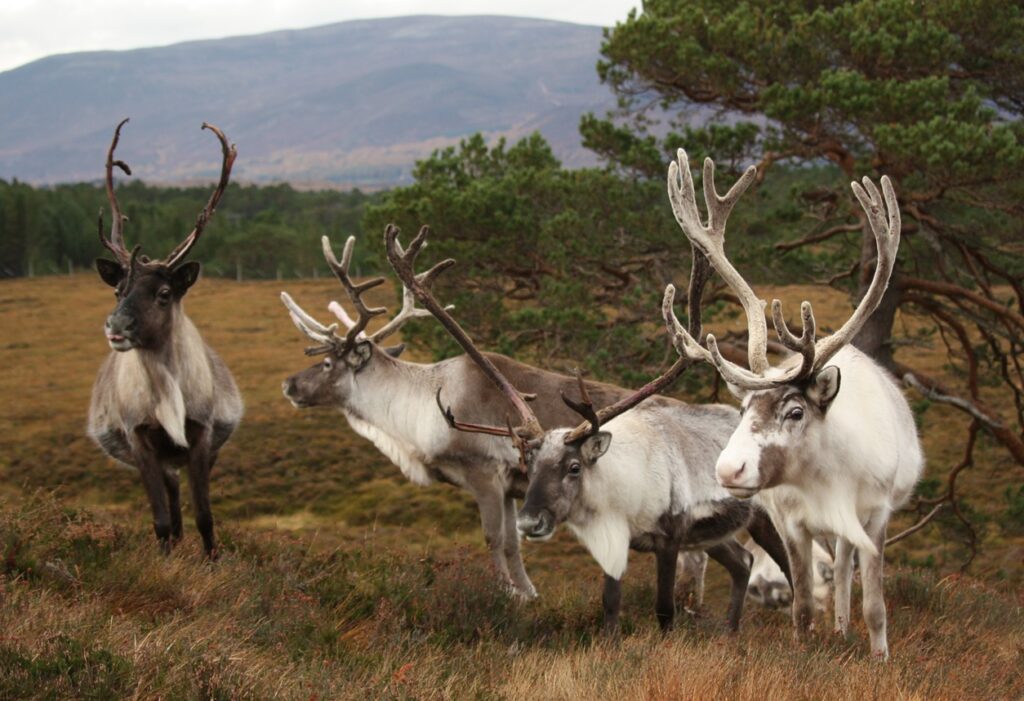
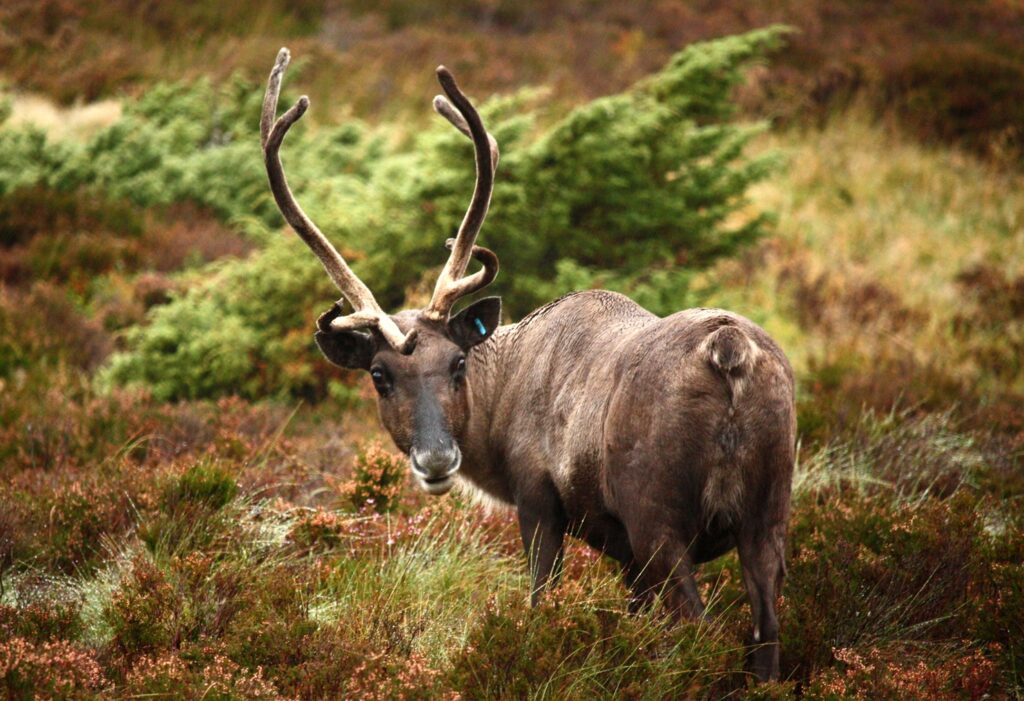
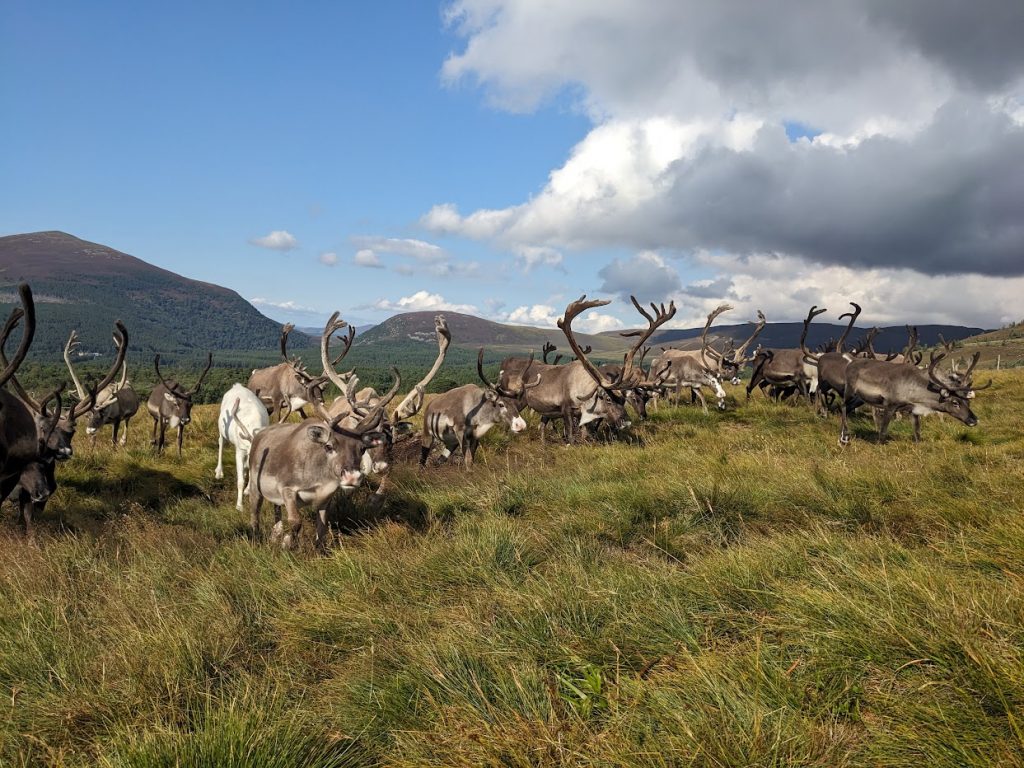
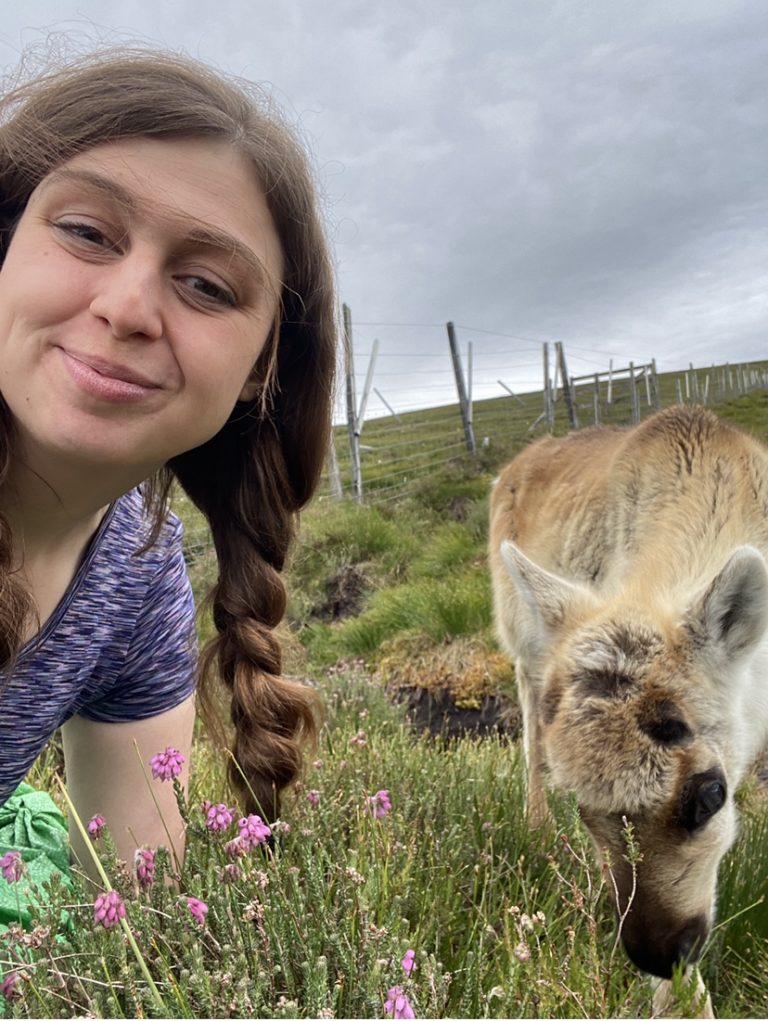
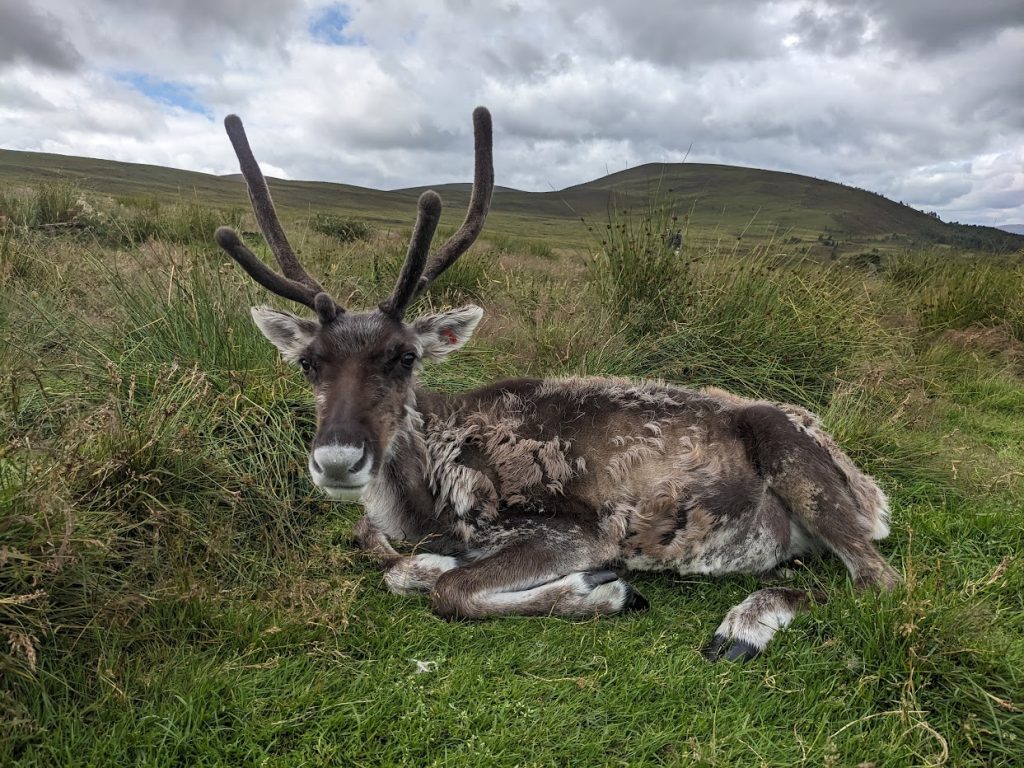
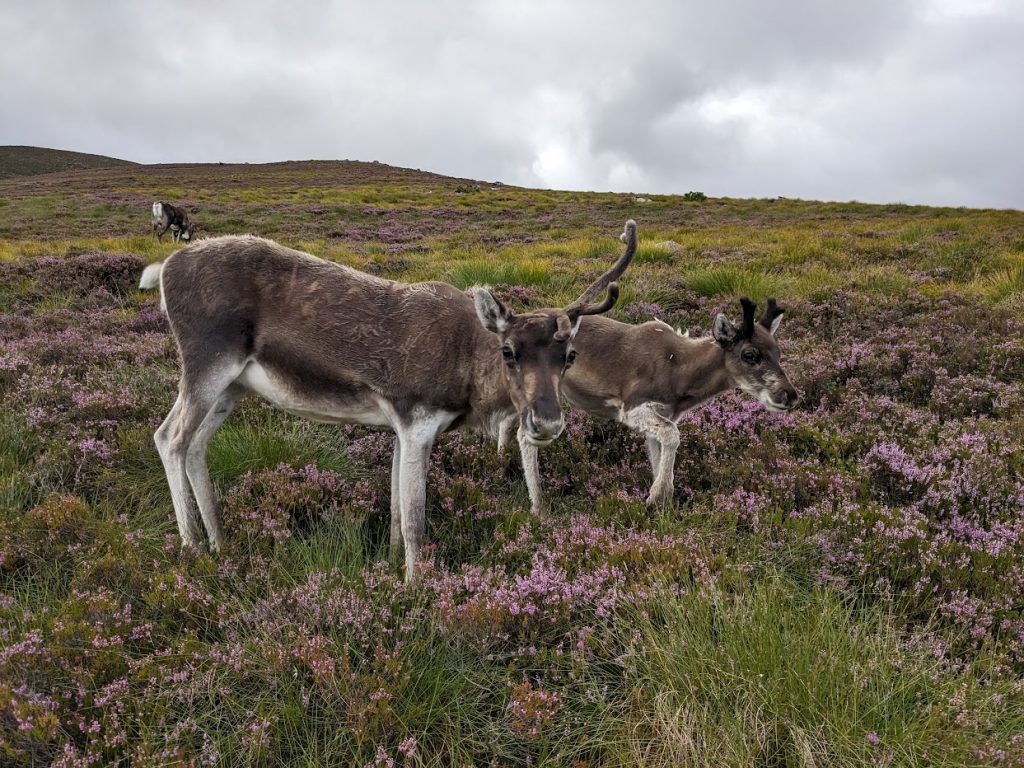
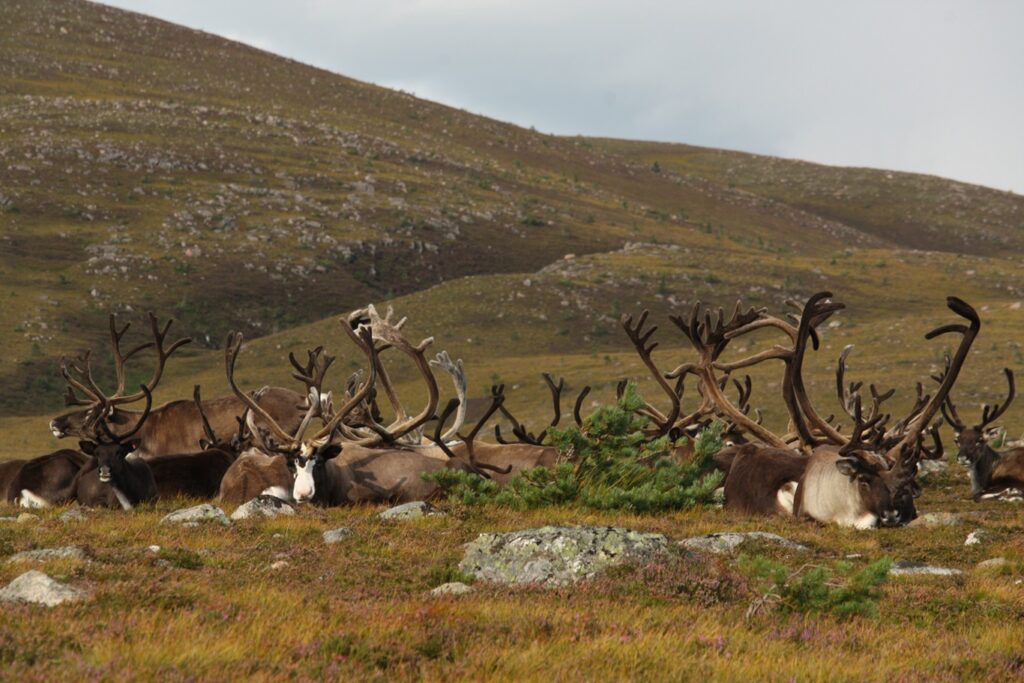
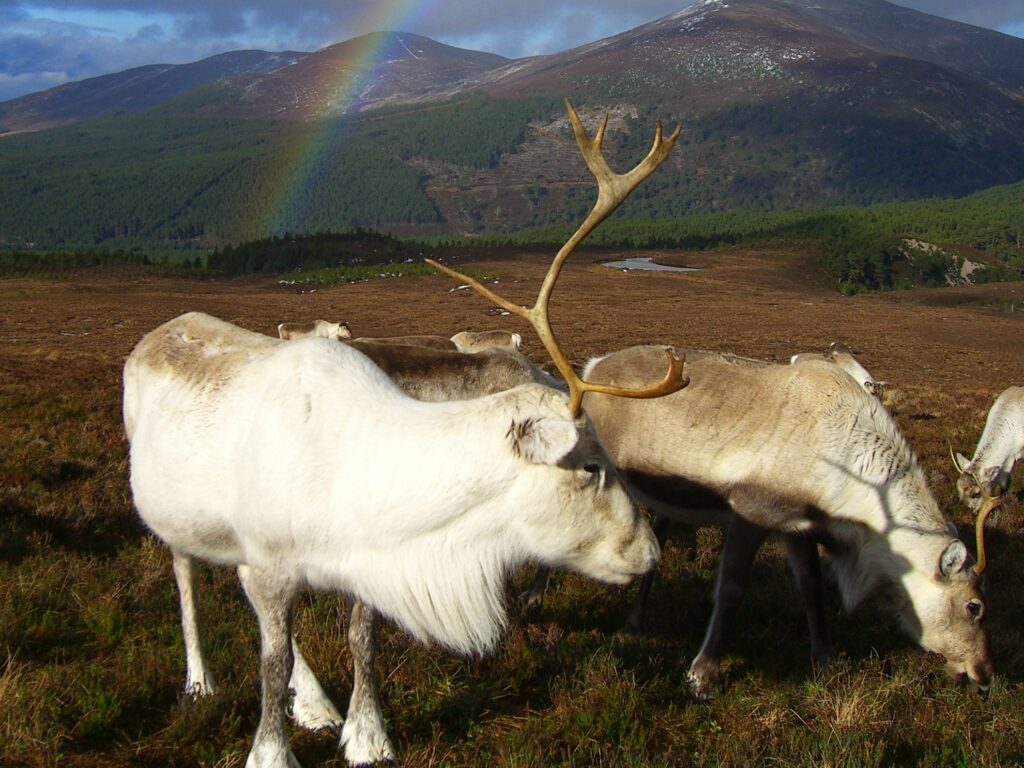
Scruffy reindeer month! Not their most photogenic season but a wonderful time of year nonetheless. The cows and calves left the enclosure to free range in the mountains and the males in our enclosure are looking super with lovely velvet antlers.
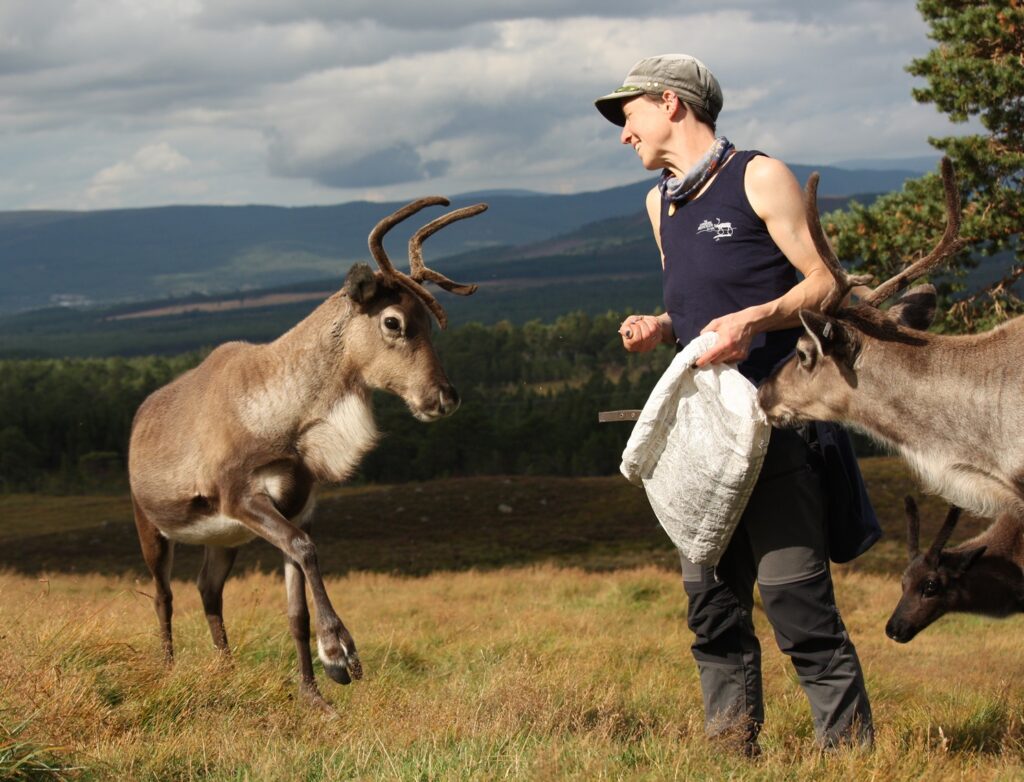
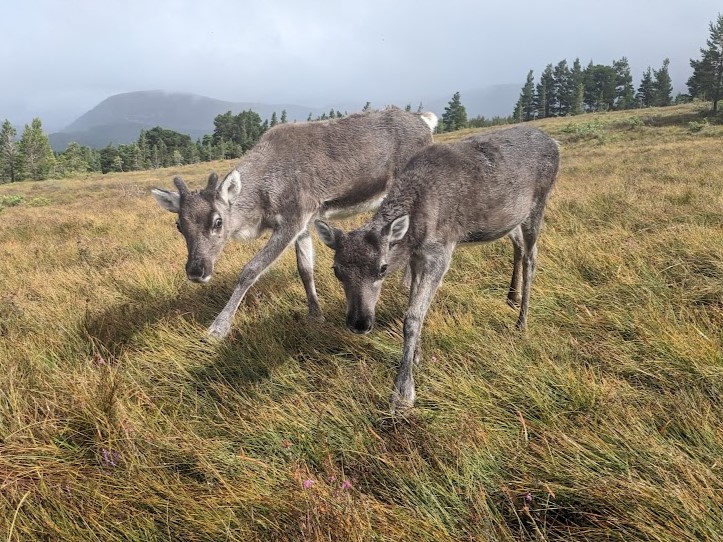
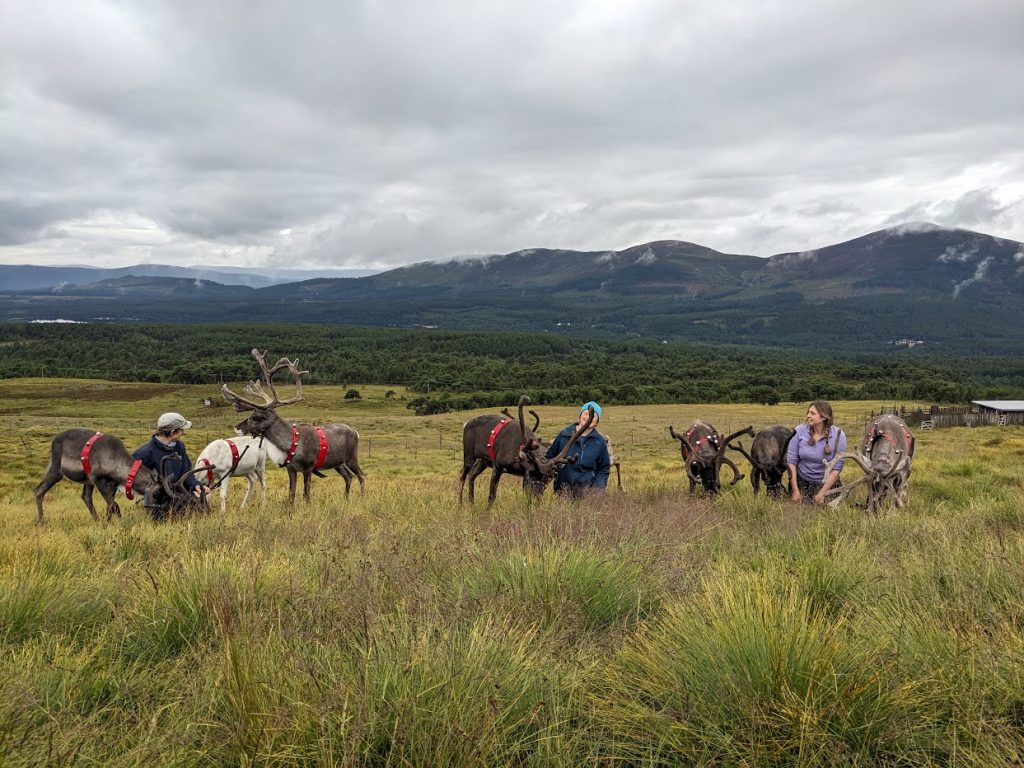
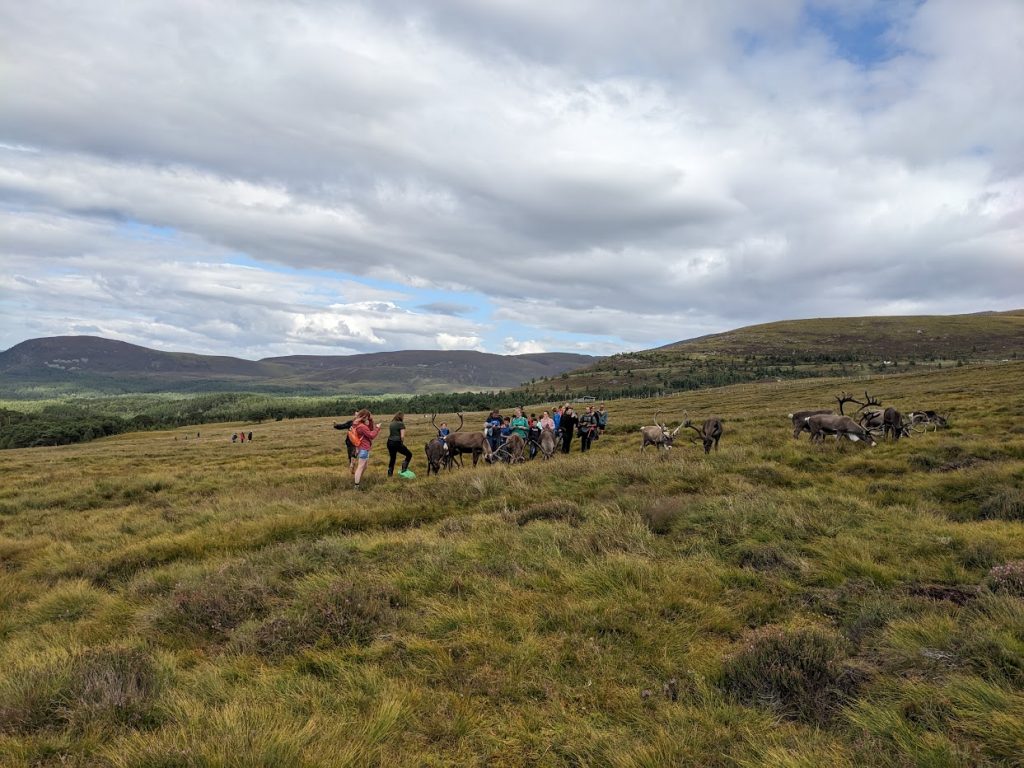
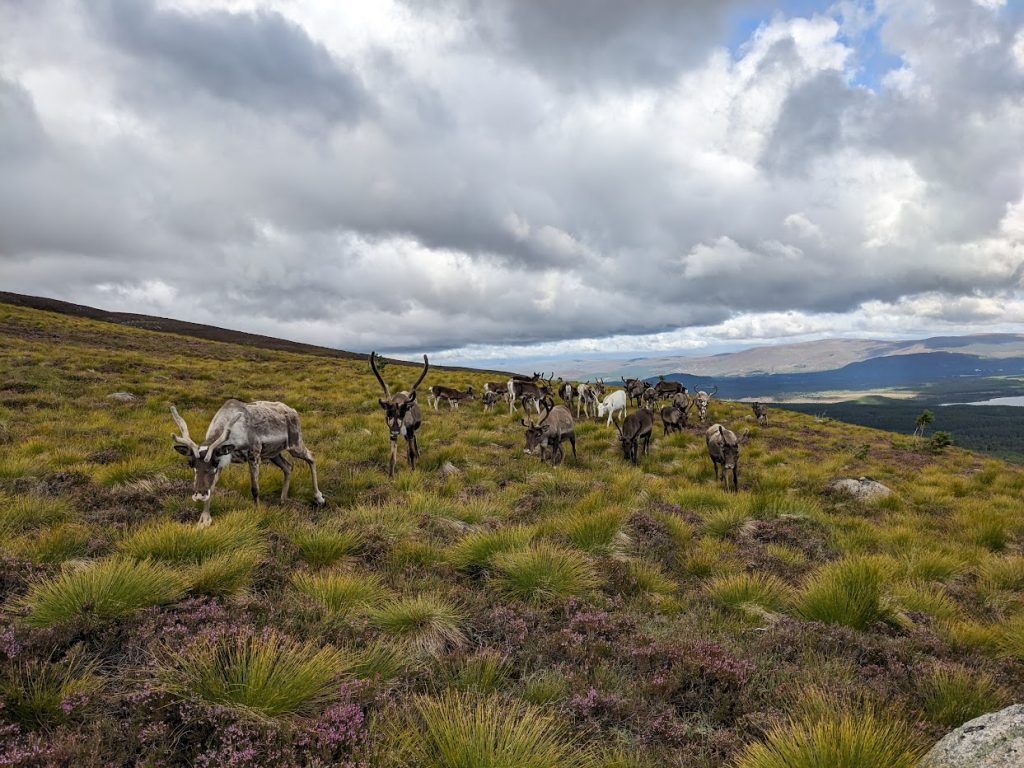
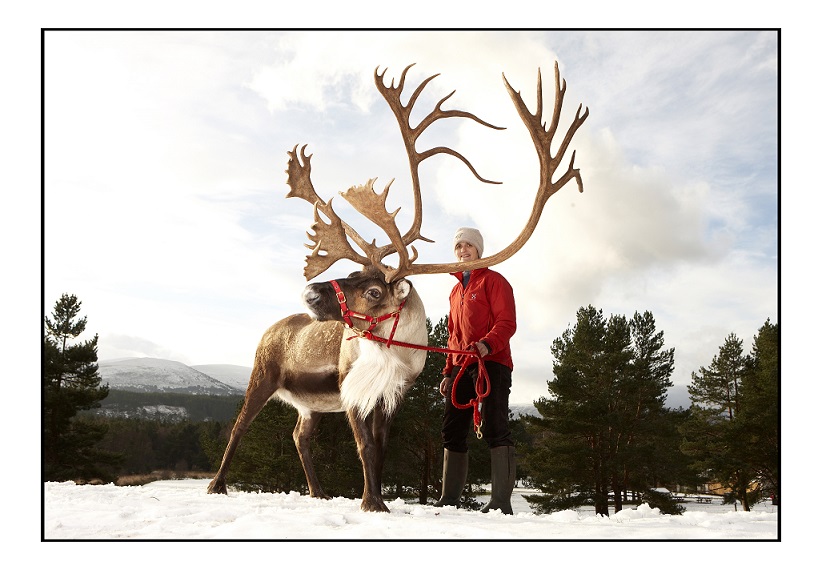
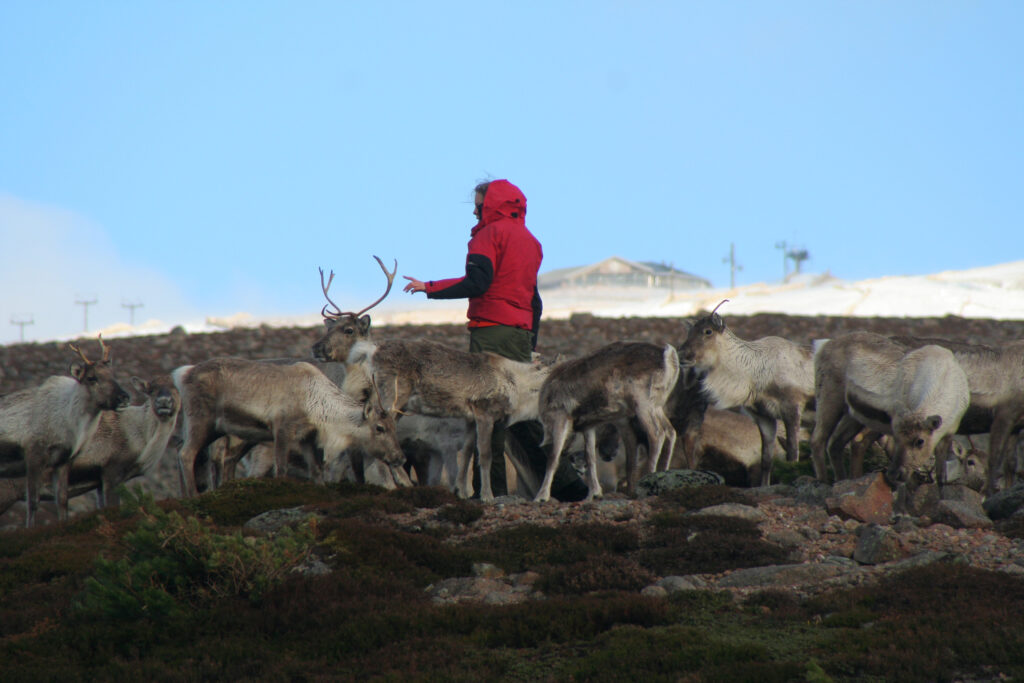
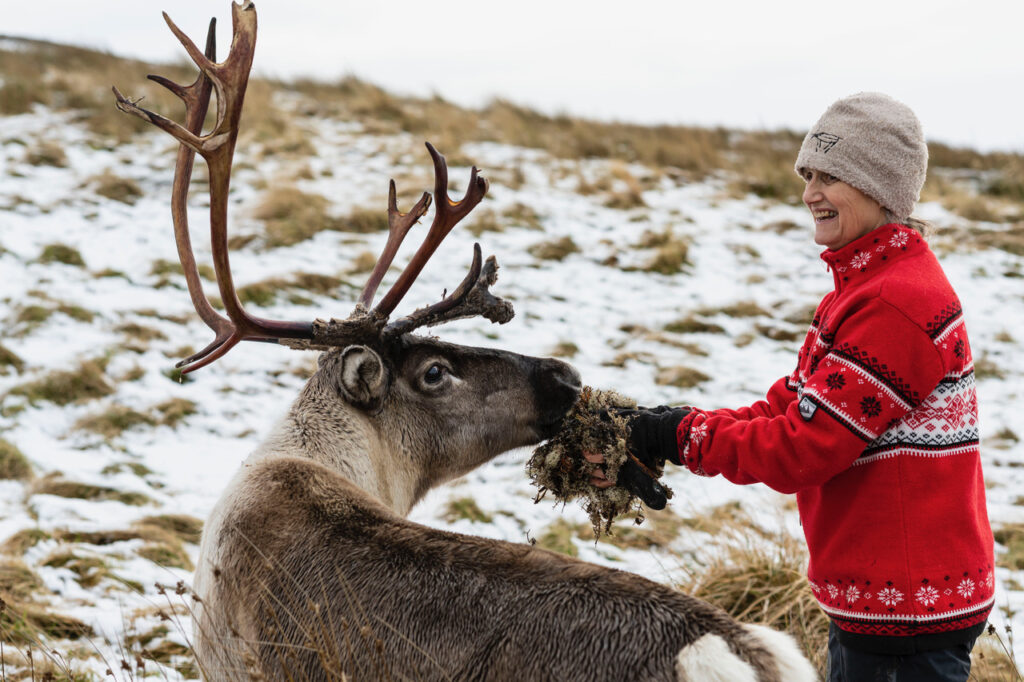
3rd of June: Putting out the first batch of cows and calves of 2024.4th of June: The remaining cows and calves in the enclosure are now old enough to mingle with visitors on our Hill Trips.6th of June: The two palest calves of 2024.7th of June: This lad, Espresso, is already very friendly and bold!10th of June: Yangtze saying hello! 13th of June: Isla is back for the summer, hoorah! Here she is spoiling Sherlock! Just for reference Isla is 6ft so Sherlock’s antlers really are that tall!13th of June: The lovely Zoom.16th of June: Gorgeous Winnie on a very soggy day.17th of June: The first harness training session of 2024.17th of June: Druid LOVES feeding out of a white bag but the exact same food offered in a hand , no thank you!18th of June: Ärta looking handsome!19th of June: A trip out to see the free rangers. Found a wonderful bunch all looking very happy and healthy!21st of June: Busby posing beautifully on a rock!23rd of June: Lotti and Amy feeding the herd their breakfast.26th of June: Cameron and the waiting herd.27th of June: Lupin!
In January 2021 we embarked upon a project of a lifetime here at The Cairngorm Reindeer Centre. For many, many years we have operated out of Reindeer House, with a modest shop/reception area and to say the least a cramped office.
Visitors arriving would sometimes come in and say ‘where’s The Cairngorm Reindeer Centre’, slightly incredulous that our place, with such a grand name was so small and homespun. But equally many of our visitors and supporters have loved the way it is and I suspect are slightly worried that any change may be for the worse.
We hope the new Centre will bring as much joy as this to everyone who visits the new Exhibition and Paddocks! Photo by Joanne Weston, taken in October 2023. Thanks for sharing it with us!
But please be rest assured that the reindeer, the herders and the passion for our unique herd of reindeer will be no less than it already is and our new facility will tick lots of boxes for everyone, whether able or unable to make it out onto the hill to see the free-ranging herd. It will also be a game changer for our dedicated reindeer herders who will be able to work out of a purpose built work place where they can ‘come in from the cold’, dry their clothes and work in a comfortable spacious office with a dedicated area to have a break.
Taking down the old Exhibition in January 2024 – the end of an era!A tractor was recruited from the farm to help with the clearing of the old Exhibition.The clearing continues.
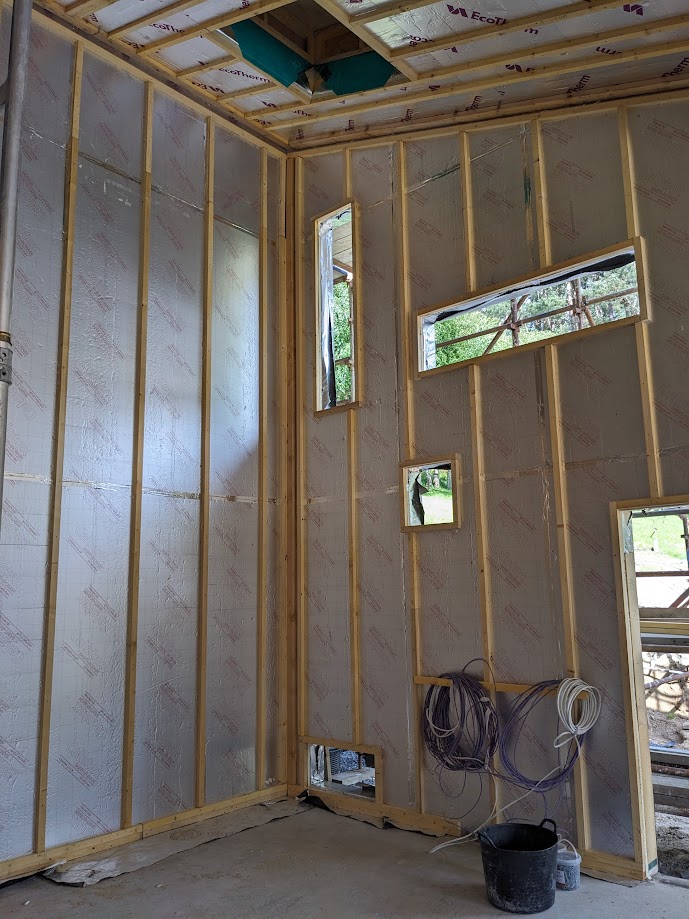
The site for the new building is in our reindeer Paddocks, which is quite a steep bank, so there was an initial dig out to provide a flat surface at the same level as Reindeer House on which to place the foundations. That started in mid February and without a doubt the snowless winter worked in our favour. Since than the foundations have been laid, the concrete floor poured in and then in a flash a very large crane arrived, the site was buzzing with tradesmen and a lorry came with prefabricated panels. The crane lifted the panels on to the site and the internal walls and roof of the building went up in double quick time.
A great big hole!The gabion baskets go in behind where the new building will be – March 2024.The freshly poured concrete floor.
Right from the start, after we received an extremely generous donation from a long term supporter the process of finding an architect, doing a feasibility study, drawing up plans and finally going for planning permission has been seamless. Much credit needs to go to our architect Catriona Hill, from Oberlanders, who has been our guiding light/guardian angel throughout the process. And here we are now more than half way through the construction and a completion date pencilled in for the end of October.
By the middle of May we could really see what space we will have for our shop, exhibition, reception area, toilet, office, plant room and staff room. We are limited for space because we still need as much room as possible for the reindeer Paddocks, but we are extending their range into the wood to provide them with shelter from the hot sun and rain (they of course won’t need shelter from the snow!).
And just like that, within a few days the building went up and the roof went on.The new Exhibition space.Huge window in the Exhibition!
So, when we are all finished and everything is open as normal visitors will arrive and come into the new Centre before making their way through the new exhibition and on to the reindeer out in the Paddocks. With the incredibly successful crowd funding we will be kitting out the inside of the Centre and the Paddocks with all our fascinating facts about reindeer, the history of the herd and the amazing world of reindeer herding. We also intend to have some immersive film of our reindeer in the different seasons. In particular to be able to show visitors, who are unable to walk out onto the mountainside just how friendly and well adapted our reindeer are to their mountain environment.
Who takes a holiday at the beginning of May? Yep, three full-time reindeer herders! Myself, Fiona, and Lotti got back on the 8th of May to 13 calves already romping around on the hill. What a treat to see them all and catch up properly on all the news from home.
We got straight in to the thick of it and the calves kept on coming. Hill Trips were fully booked during the bank holidays and Whitsun Week. We had some shorts and t-shirt weather and some FULL waterproofs and warm hat kinda weather. We’ve also been busy in the office running our Crowdfunder campaign which is going incredibly well (please check it out here if you haven’t seen it yet: https://www.crowdfunder.co.uk/p/a-reindeer-experience-for-all). Adoptions are still flying out the office and the June newsletter is being written. Oh, and the brand-new Reindeer Centre went up before our eyes in around 3 days in the middle of the month! An action-packed month!
Just a reminder – we won’t reveal the names of the new mothers until after we’ve let our adopters know in the June newsletter so I’ve tried to be deliberately vague. Enjoy… !
8th of May: On my first day back to work I have the pleasure of being the first person to lay eyes on this tiny lass. Ignore her blue toes – we always spray their navel with an antiseptic spray and I accidently got her foot!10th of May: As I fed the cows and calves this little dude comes to say hello.11th of May: The father to around half of this year’s calves!! Sherlock looking very proud of himself.15th of May: Little and Large. Big bull Spartan walks past a mum and her new calf!16th of May: Zambezi is no longer a calf! She’s now classed as a yearling, but is still just a beautiful! 17th of May: Calf peek-a-boo! This wee one is still not brave enough to come say hello.17th of May: Calves come in a variety of colours from pale to dark.17th of May: Merida and her seven year old son Dr Seuss sharing a moment together!20th of May: Another cutie with distinctive dark eyebrows.22nd of May: Aztec on a very ‘atmospheric’ Hill Trip! His favourite time of the day is the hand feeding session, this is him recovering.26th of May: Four-day-old calf, he’s small but doing very well!27th of May: This is where we found Ochil this morning! She’d managed to break-in to the lichen store and was having the time of her life.29th of May: A gaggle of chilled out calves on our Hill Trip.30th of May: Dr Seuss again, this time with his younger bro Ärta.
I first visited the Cairngorm reindeer herd in August 2000 and since then have visited on many occasions with my husband and our three daughters.
Over the years we have made badges and paper antlers, hunted for elves, taken countless photos of our daughters sitting on the sleigh outside the shop, handfed the reindeer, and have never tired of the beautiful walk up to the hill enclosure.
Our last family trip was on Valentine’s Day in 2022 when we headed out in the pouring rain on the 11am Hill Trip to visit the free ranging herd high up on the mountain. It was following that trip that I heard about the chance to apply to become a volunteer and spend a week helping out at Reindeer House and decided to apply.
Jayne’s husband and daughter smiling despite the rain thanks to Gloriana. Hard to believe this soggy experience made Jayne wish to volunteer with us!
In October 2023 I packed my tent and drove up from Lancashire to spend the week at Glenmore. I was rather apprehensive turning up at 8am on Monday morning with a rucksack full of waterproofs and sandwiches but I needn’t have worried. I was immediately greeted by a room full of very friendly reindeer herders, several dogs and a handful of puppies!
My volunteer week was action packed. In the morning I helped with handling the reindeer down at the Visitor Centre, feeding them, cleaning up and getting everything ready for visitors to come in at 10am.
During October there is just one Hill Trip a day. I would go up onto the hill, carrying a bag of food and talking to visitors about what I was doing. Each day I would heat up some milk and carry it up the hill in a flask to feed two calves named Winnie and Alba who had been successfully hand reared and were now on the hill with the rest of the herd. Whilst I keep insisting that I don’t have a favourite reindeer I do have a soft spot for Alba!
Winnie and Alba, hard not to develop soft spots for these two girls!
October is the rutting season which was quite eventful! The hill enclosure was being used to manage the annual breeding as well as for daily Hill Trips so there was plenty to do. Two male reindeer had been selected for breeding. Sherlock was out on Silver Mount with some of the females whilst Jelly Bean was in another part of the enclosure with some of the other females. Daily checks were made of all the reindeer and extra food provided. It was quite an experience to see these normally very docile males displaying anything but docile behaviour and to see their interactions with the females as they came into season. I was certainly happy to stay behind the fence!
Sherlock out on Silver Mount with Bordeaux, one of his selected cows.
Volunteering in October also meant that I got the opportunity to be involved in the first week of the Christmas sleigh training. I’ll never forget being pulled up the hill from Glenmore Visitor Centre in a Sleigh!
Jayne at the front of the sleigh in hi-vis, on crowd control duty.
I learnt so much that week and thoroughly enjoyed it so it was no surprise to my family when I asked if they would mind if I abandoned them once again this year to spend another week volunteering.
My return to Glenmore was sooner than I imagined and I was back again at the start of May 2024 – approximately 220 days since my last visit – which quite coincidentally happened to be about the same period of time as the average gestation period for a reindeer!
How lucky was I – having experienced the madness of the rutting season I was now in the thick of the calving season.
One of our gorgeous calves.
Three calves had already been born when I arrived on a wet bank holiday weekend and over the course of the week that I was there another 12 were born on the hill.
During my second stint as a volunteer there was no Paddocks and Exhibition to attend to as it has been knocked down over the winter and is in the process of being rebuilt. There was plenty to do though with two Hill Trips a day, plus an early morning walk to find reindeer, check on them, locate newly born reindeer and help with a whole host of other daily jobs to be done.
New mum Vienna and calf Mocha.
Watching how quickly the calves developed and became so sure footed in such a short space of time was amazing and as the new mums relaxed into motherhood it was a joy to just sit and watch them interact. It’s hard to imagine that in just a few weeks the mums and calves will be out free ranging across the Cairngorm mountains.
During the time I have spent with everyone who works with the Cairngorm Reindeer I have learned so much about these beautiful animals. I have thoroughly enjoyed helping to take visitors up onto the hill, telling them about the reindeer and talking to them about all sorts of things!
Sherlock looking a bit different from Jayne’s last visit.Zambezi and Shannon now yearlings in May 2024, in the previous October these were some of the calves that were being trained to walk behind the sleigh.
I feel so privileged to have had this opportunity and am rather hoping that I will be allowed back again next year ….
April has flown by. The first half of the month busy with the Easter holidays. We’ve had some wonderful Hill Trips both out on the free range and also in our hill enclosure here on Cairngorm. Although not much spring weather it has to be said.
The second half of the month was busy with moving reindeer around getting them in the right places for the fast-approaching calving season. Most pregnant females have been brought into our hill enclosure now and the “single ladies” (the old girls, young girls, or ones having a year off motherhood) were put back out to free range. We’ve also brought the first males back into the enclosure after their winter free ranging at our second site. Lovely to see some of the boys back.
The office has also been busy as always – my jobs have included newsletter preparation, working on adoption packs, preparing the 2025 reindeer calendar (wahoo – it’s just gone to print), trying to up our social media game, sorting emails, drinking tea…
It’s been a fun month watching antlers casting and growing, and bellies widen on our pregnant females. Bring on the first calf of 2024!
2nd of April: Moving the herd with Lisette at the back doing a wonderful job as ‘sheep dog’!3rd of April: Danube with her tongue out!5th of April: Juniper and Sundae in a blizzard!6th of April: Fern and Okapi soon to be 17 and 16 years old respectively are the first over at the feed bag!8th of April: Sunshine!! A rare sight this month. Moving the herd into position for our Hill Trip.15th of April: Dr Seuss is back in the enclosure after a winter free ranging in the hills. He’s clearly feeling snoozy after the Hill Trip. He takes his role as chief hand-feeder incredibly seriously!17th of April: Sunny (our hand-reared calf from 2022) was back in the hill enclosure for a short while and followed me back to the gate just like he used to as a young calf!16th of April: These 11-month-old calves get to feed out of the bag for another month before they turn into “yearlings”. Orinoco is the cutie closest to camera. 18th of April: Mushy, Spy, Dante, Ladybird, Sambar and Sunny.22nd of April: Sherlock looking handsome with those big velvet antlers.23rd of April: A lovely morning with Tilly on the hill. 24th of April: I headed over to the farm to help Tilly with a farm tour. Lovely to see some of the boys I haven’t seen much of this winter, like Druid here!24th of April: The lovely Hemp!
I thought I’d write a bit about some of our biggest reindeer pet peeves this week – and undeniably, there are quite a few… Pet peeves 1-4 are tongue-in-cheek, so don’t take offence if you’ve made one of these slips in the past – no doubt some of us did too before becoming reindeer herders! But peeves 5 and 6 are serious, and a cause us a constant headache – please don’t be *that* visitor…
Number 1: ‘Reindeers’
The biggest pet peeve of all is most definitely… ‘reindeers’. The plural of reindeer is reindeer, with no ‘s’, and whilst I’ve never heard anyone say ‘sheeps’, ‘reindeers’ is a very common mistake. It’s only a little thing and it’s hardly going to change the world if you say it right or say it wrong, but it’s just something that grates so much. You will see a tiny shudder of horror pass over any one of us if you see us talking to someone who uses the word ‘reindeers’. Not to mention my roar of disgust earlier this year to open our local paper – who really should know better – to find that they had used ‘reindeers’ (in very large font) in the title of their article about us. Face plant.
One REINDEER……multiple REINDEER.
Number 2: ‘Horns’
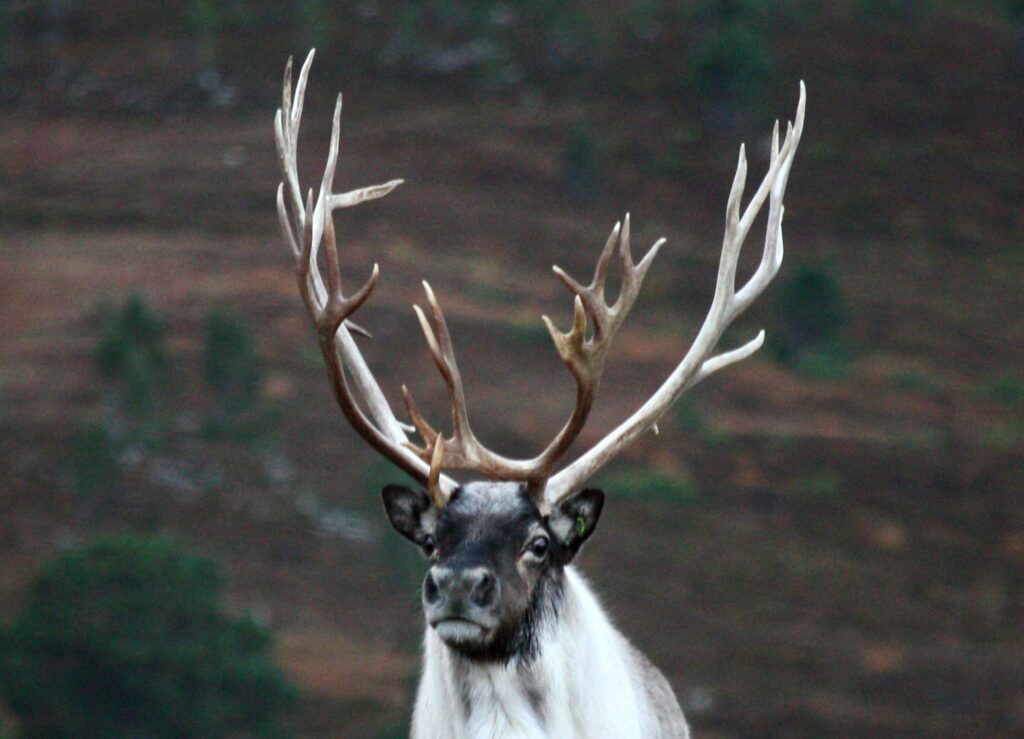
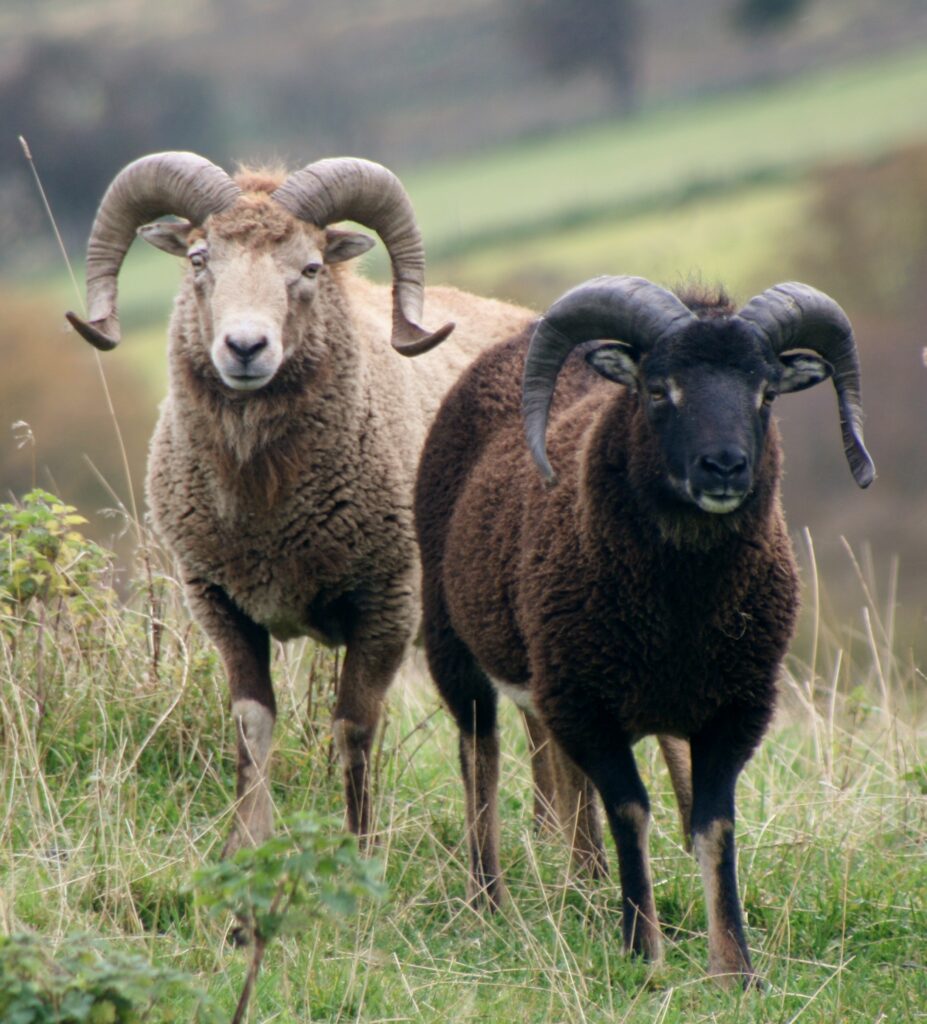
I guess there’s really no reason for people to know or understand the difference between antlers or horns, unless they have background knowledge in biology. But still, when reindeer’s antlers are referred to as horns, it’s something that makes my eye twitch – the word just sounds so wrong. To educate anyone that doesn’t know (every day’s a school day), animals that grow horns, such as cows, sheep and antelope, only grow one set in their lifetime and the horn is made of keratin, the protein that your hair and fingernails are made from. In contrast, antlers are made of bone and are grown by members of the deer family only, and they are grown annually, falling off each year. Technically therefore, they are classed as ‘deciduous’ – not a word normally used other than in relation to trees.
Reindeer have antlers. Whilst sheep have horns. Photo: Alex Smith
Number 3: Reindeer imagery at Christmas
Oh god… where to start? I think 99% of ‘reindeer’ imagery used on Christmas cards, decorations etc, are not actually reindeer at all.
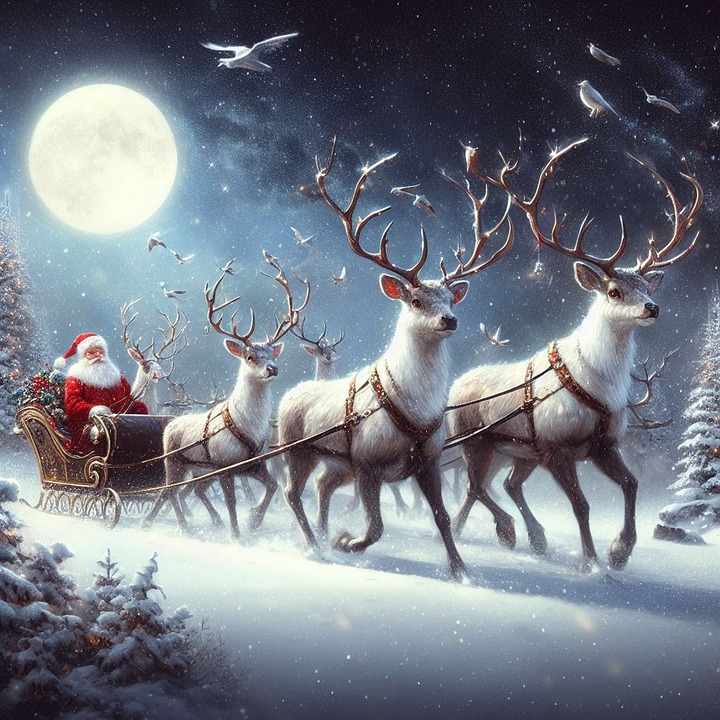
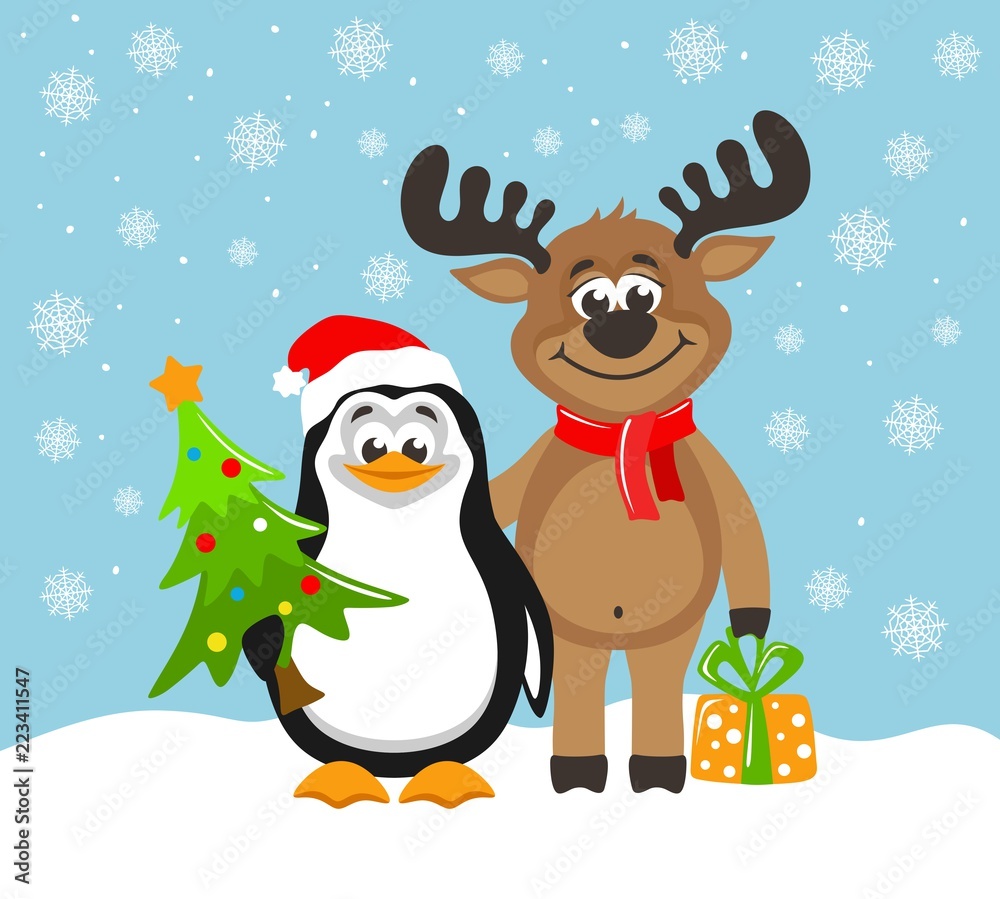
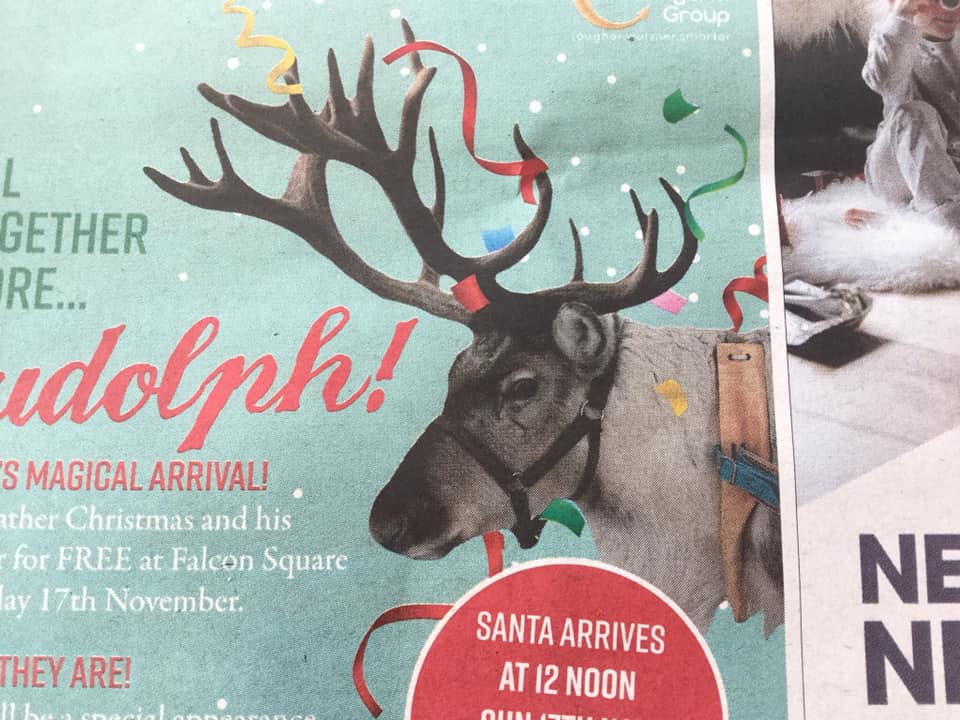
Where to start?! Santa’s sleigh pulled by… fluffy white Wapiti? They certainly ain’t no reindeer….Don’t get me started on the fact that reindeer and penguins are found in different hemispheres. They live at opposite ends of the planet, and always have (other than the introduced population of reindeer on South Georgia who lived there for around 100 years before being eradicated about 10 years back, but I doubt that this Christmas card designer was aiming to represent the fauna of a South Atlantic island). In fact, don’t get me started on the (lack of) connection between penguins and Christmas at all…Granted, it is a reindeer. But with a set of… red deer antlers on it’s head. Backwards on it’s head. I don’t even know where to go with this. The worst thing is it is an advert for a reindeer parade where the providers of the reindeer were – us. We send the organisers of all events we take part in a link to a load of beautiful press photos for them to use for promotion purposes, which, funnily enough, does not include the abomination above.
Number 4: Carrots
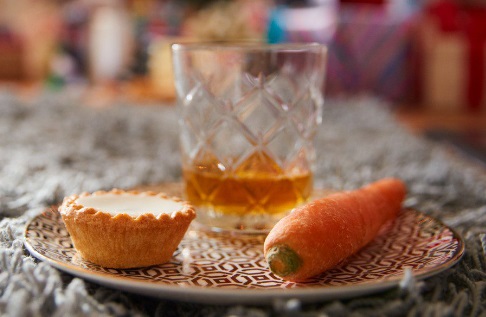
If you happen to have a child who still believes in Father Christmas and are reading this aloud to them… stop now. I don’t want to be responsible for breaking hearts. If you’re an adult however, and think that reindeer love to chow down on a carrot or two – prepare yourself for a shock. Reindeer DO NOT eat carrots. It is a myth. I’m sorry, but there it is.
Santa will eat the mince pie and he’ll no doubt enjoy the dram, but if the carrot vanishes overnight, it’s not Rudolph. Perhaps Santa’s just making sure he can see in the dark? Photo: Scotsman website
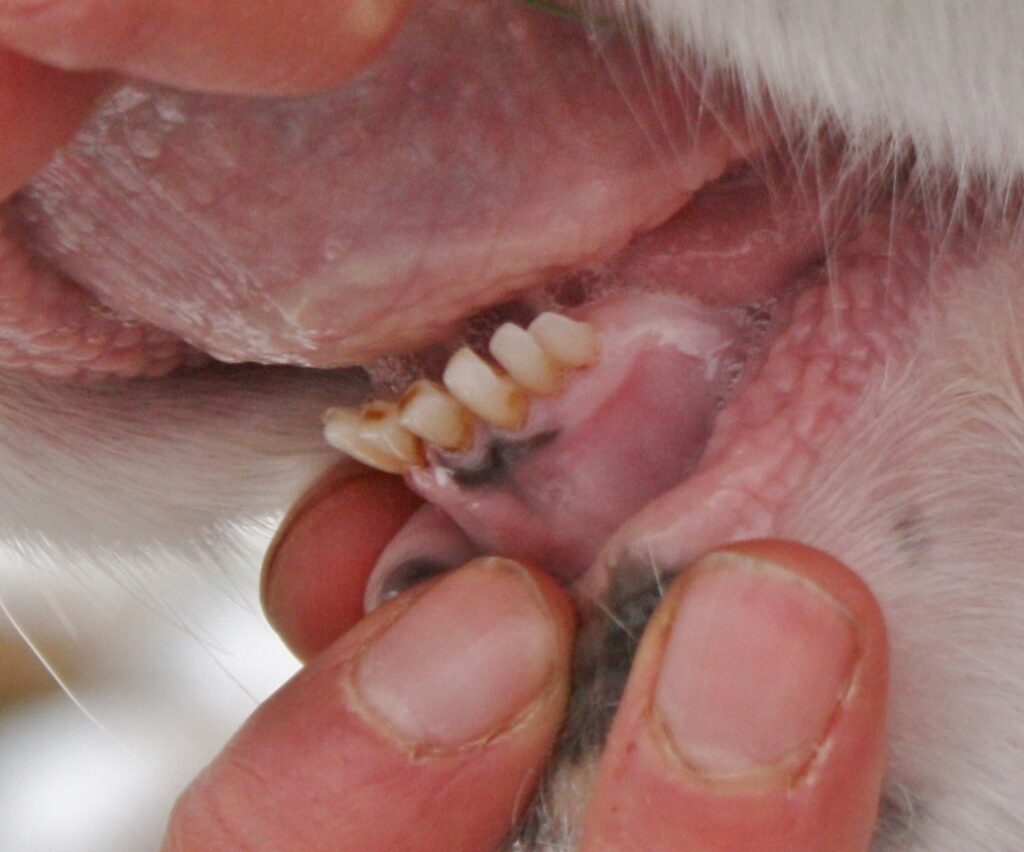
Once again, let’s shoe-horn in some education. Reindeer are ruminants, meaning they have four stomachs, like cows and sheep. They have similar dentition too, having tiny teeth at the front of the bottom jaw, and a flat, bony palate at the front of the top jaw (plus molars top and bottom at the back). This means they nip away at the vegetation with the small front teeth, swallow it into the first stomach – the ‘rumen’ – and then bring it back up to chew again with the molars before it progresses through all four stomachs. Tiny front teeth can’t easily much up a carrot, and nor do carrots grow naturally anywhere that reindeer live, so they do not form part of their diet. I am actually aware of reindeer in permanent captivity in some places being fed carrots – but any reindeer that actually eats, or tries to eat, carrots is doing so out of desperation because they are not being fed a sufficient diet.
A reindeer’s teeth. Not designed for eating carrots!
Working here taught me to quickly work out when to lie to people – if an adult brings us carrots for the reindeer then I will tell them the truth. If a small child gives me a carrot at a Christmas event, to give to the reindeer? Then perhaps they do eat carrots after all, but only on Christmas Eve. Not right now. Makes ‘em fly, you see.
Number 5: Visitors who don’t read any information when booking their tickets
I hesitated to include these last two pet peeves… but my fingers have just kept typing, and realistically, they are the ones that actually cause us herders problems, rather than just annoy us. Visiting the reindeer here at the Centre is wonderful, and we do our utmost to make sure everyone has a lovely time. But you need to know what you are getting yourself in for, and you need to know what clothing and footwear you need to bring, in order to visit the reindeer safely and with maximum enjoyment. The people who book tickets, tick all the required boxes to say they will have the right footwear etc; they understand they need to use their own car; they realise they have to walk to the reindeer, etc etc etc – and then turn up having not actually read ANY of this info, make us want to cry. Hill Trips change throughout the year, starting from different car-parks and using different routes, so having visited before doesn’t mean you know what to expect.
We have all been shouted at by angry people over the years when it’s entirely their fault and not ours that they’ve (delete as appropriate) missed the Trip/have the wrong footwear/are completely unsuitably prepared. Please. Just. Read. It. All. First. Please.
Number 6: ‘That’s not actually waterproof…‘
Peeve number 6 is linked to number 5. We ask visitors to bring a waterproof jacket with them for the Hill Trip at all times, and in the winter season (Oct – Apr) we ask them to bring waterproof over-trousers too. Obviously we can’t predict the weather and whilst waterproofs might not be needed on the day, at times they really are essential, and it is for people’s own safety that we have to insist they are wearing full waterproof clothing. Hypothermia becomes a risk quickly in winter conditions, and much more so if someone is wet to their skin.
Please understand we don’t want to turn people away, nor force them to purchase waterproofs they may not wear again, but as a company we also REALLY don’t want to be responsible for cases of hypothermia either. Safety in the mountain environment has to be foremost so you MUST come prepared for the worst weather, and just be grateful if you are lucky to get nice weather on the day. It’s also a matter of your own enjoyment – we want you to have the best time possible and you have more chance of doing so if you are not soaked through and frozen.
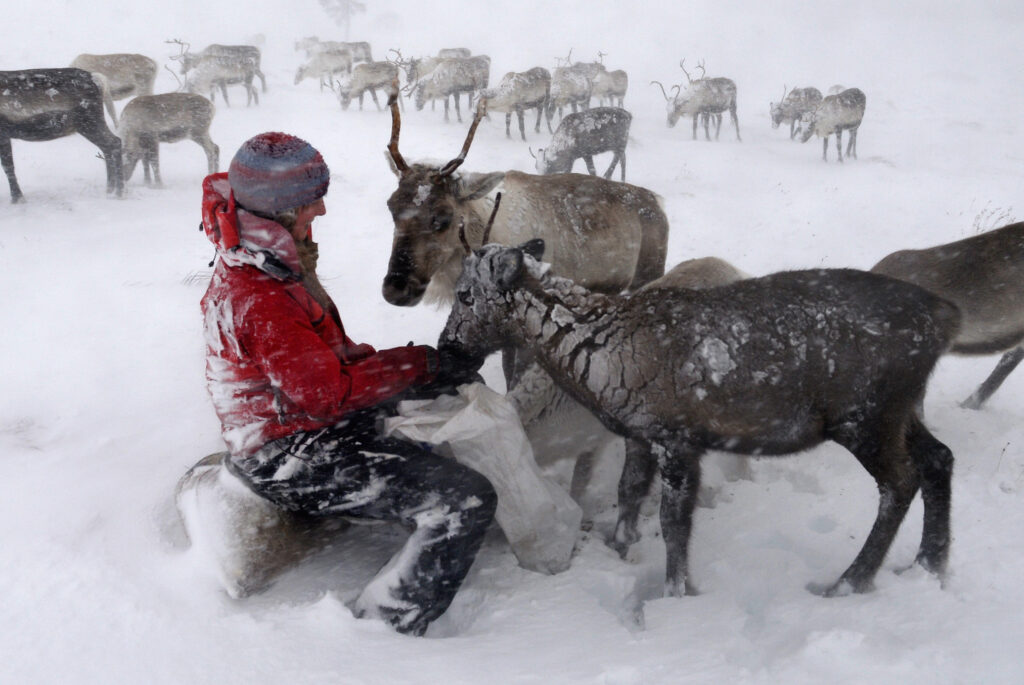
A wild day on the hill. Note the snow plastered down Eve, from her head to her feet, and on the reindeer too. This weather can occur anytime in the winter season of Oct – Apr. Photo: Getty Images
However, it seems the problem is deep-rooted in that a surprisingly large percentage of people seem to have no understanding as to what the word ‘waterproof’ actually means. It’s really not hard – it means… ‘waterproof’. Water can’t get through. Wet one side, dry the other. Not ‘water-resistant’, not ‘shower-proof’ – ‘WATERPROOF’. No, your ‘hiking trousers’ aren’t waterproof. Nope, nor your puffer jacket. Nor your ‘yoga pants’ (I kid you not – I have had this conversation with someone in our shop).
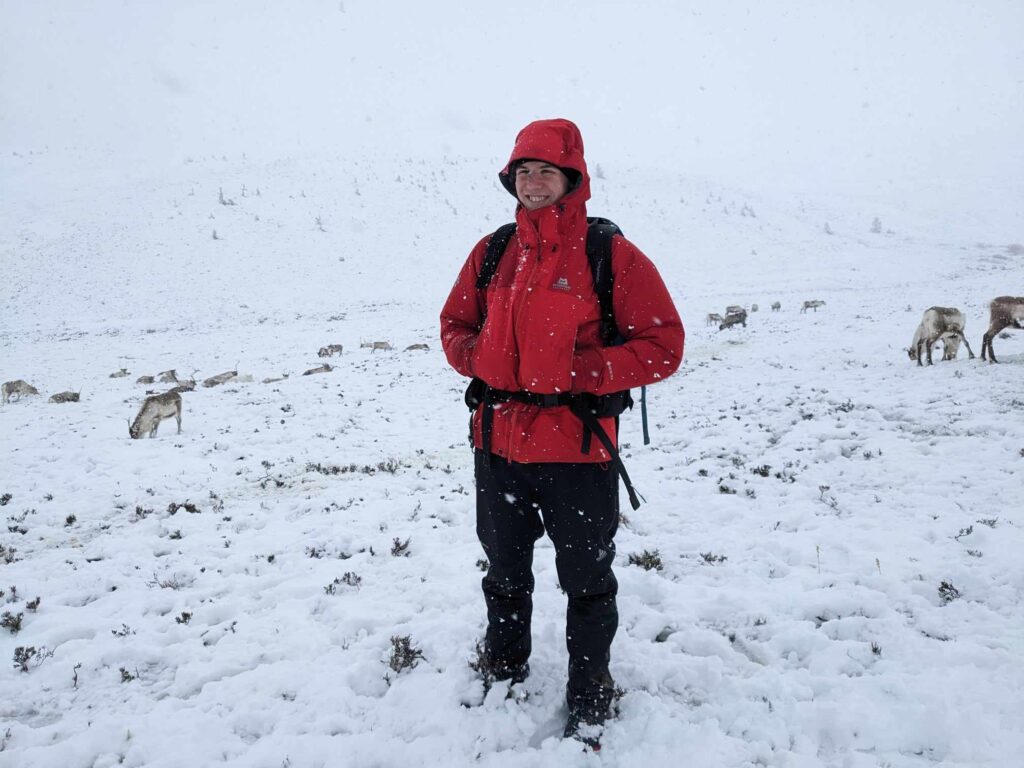
Cameron suitably dressed for the mountains in winter – hiking boots, waterproof jacket and waterproof over-trousers. Lots of layers underneath too. And look how warm and happy he is!
We’re rather at a loss as to how to get it across to people? We’ve tried everything. I’ve resorted lately to literally asking people if they would remain dry if I chucked a bucket of water at them. No? Then your clothes ARE NOT WATERPROOF.
As I write this today (in late March) 6 of the 26 people booked on the Hill Trip had to buy waterproof trousers in our shop (we have some ’emergency’ pairs for sale) before we would let them take part – despite knowing perfectly well upon booking that they needed to bring them, ticking a box to declare that they had them, and being reminded in three separate emails. March is not necessarily spring here – today it was full on blizzard conditions on the hill.
I can go into all sorts of other pet peeves, but I’m starting to feel a bit frazzled just thinking about it all, and I notice my use of capitals is increasing throughout this blog as I feel more and more shouty, so it’s probably time to stop here.
Reindeer have a hugely thick coat as they are designed to survive Arctic and sub-Arctic winters, and they are one of the only mammals to have hair covering every part of their body, even including their noses. So they look incredibly cuddly and visitors are usually desperate to stroke them. If you’ve been on one of our Hill Trips pre March 2020, you might remember being allowed to stroke them too, but now we have stopped this direct contact between visitor and reindeer. But why?
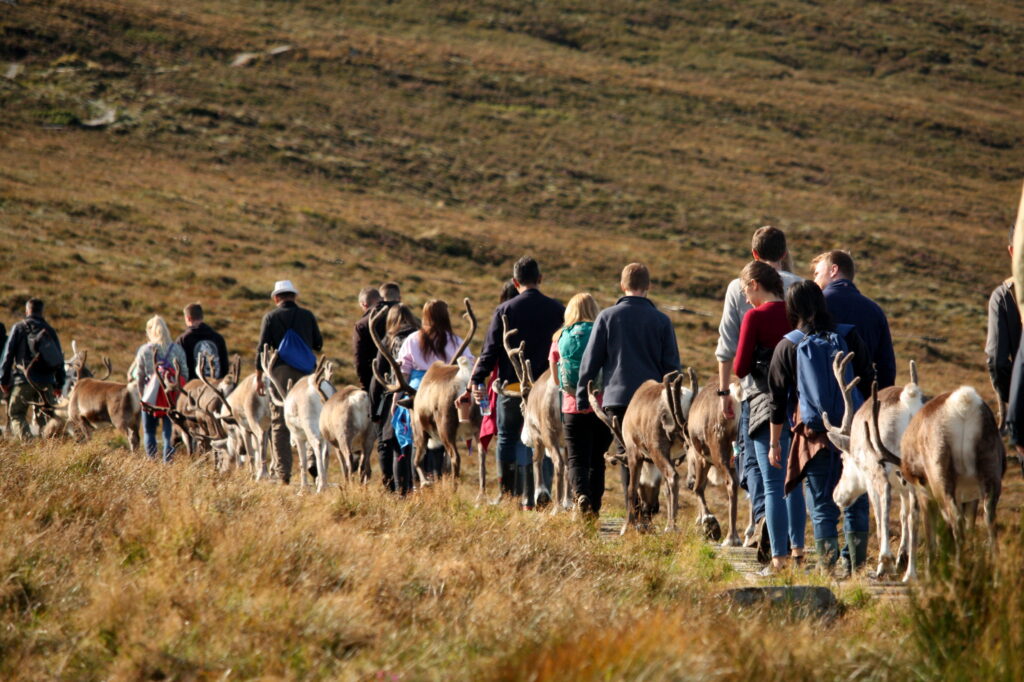
Reindeer and visitors mingling
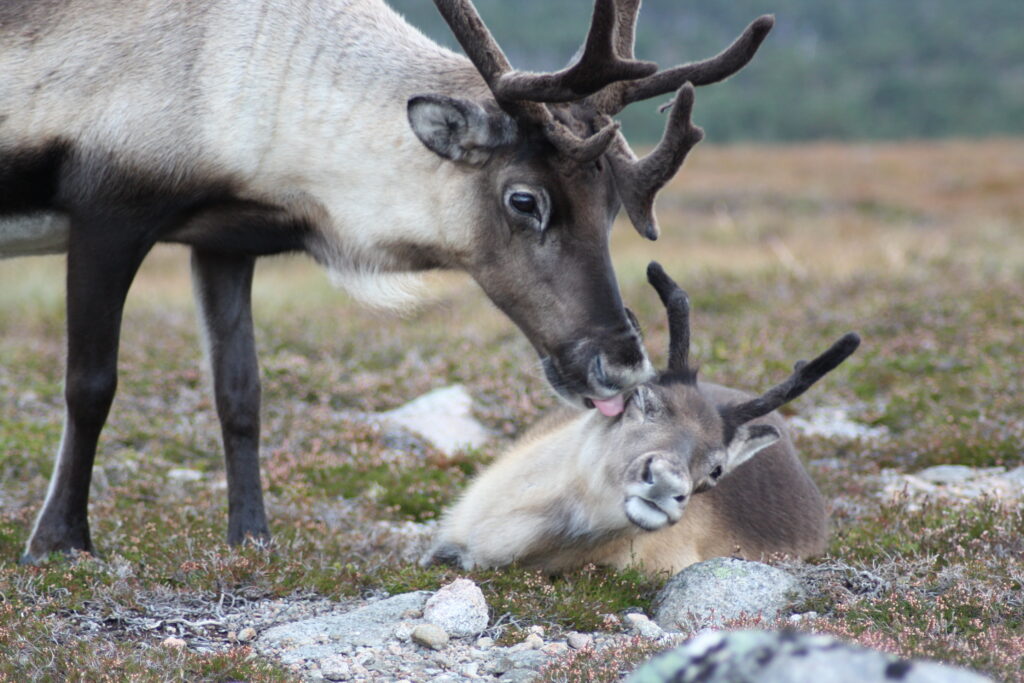
First, some background information about reindeer’s behaviour to each other without influence of human presence. Reindeer are not a ‘tactile’ animal, despite their strong herding instinct. Because of their thick coat they have no need to huddle together for warmth at any point, so the only time you see direct contact between them – such as resting their heads on each other – is affection between mother and calf. Calves stay with their mums for a year only (usually), but after this that close bond is broken and direct contact stops.
Contact like this is only between mother and offspring in general. Although I’m not sure Sitini wanted her face cleaned by mum Hippo in this picture!
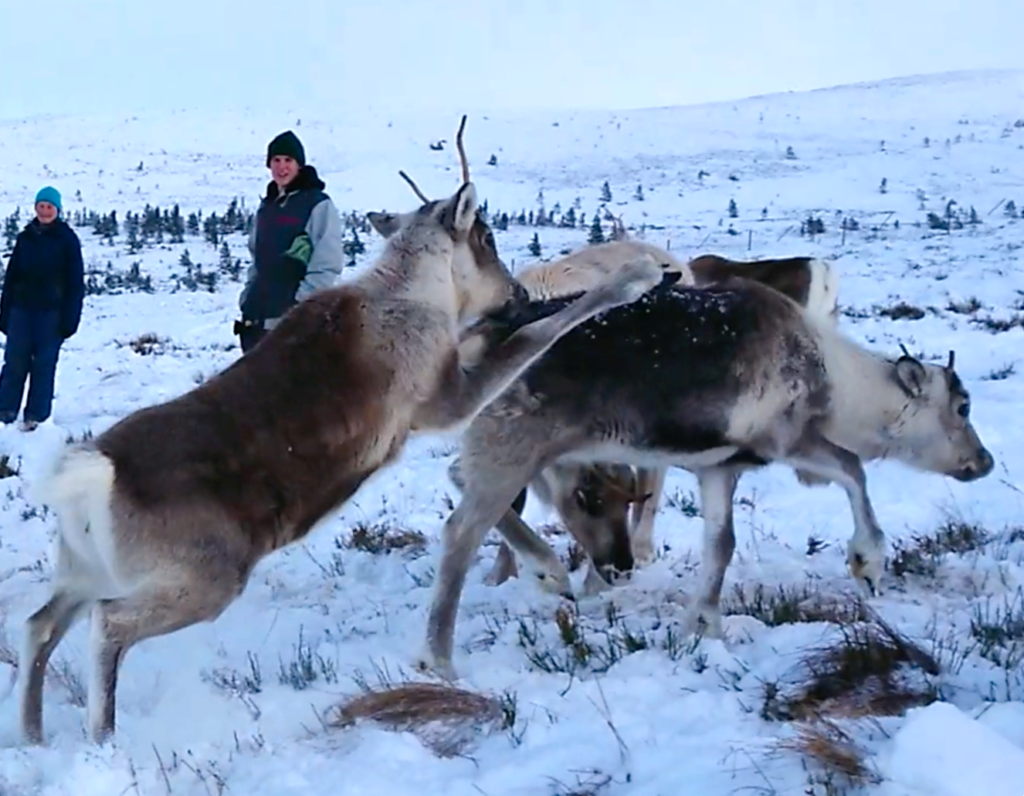
Living in an incredibly harsh environment also means it’s critical to establish a hierarchy, as reindeer need to be able to compete for food when winter is at it’s hardest – hence the presence of antlers on both males and females. Males are bigger in body size so they lose their antlers first, leaving the smaller females at the top of the pecking order through the winter months when food is at it’s scarcest, and when they are likely to be pregnant too. This means that the herds constantly establish dominance between each other, pushing each other around and chasing less dominant reindeer away from good grazing spots.
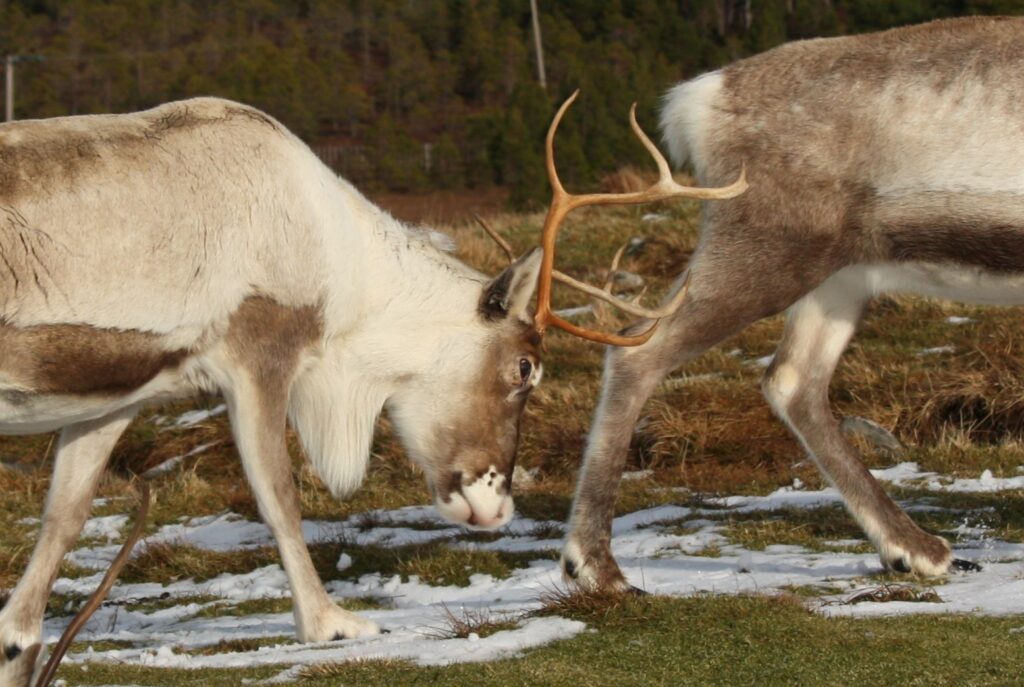
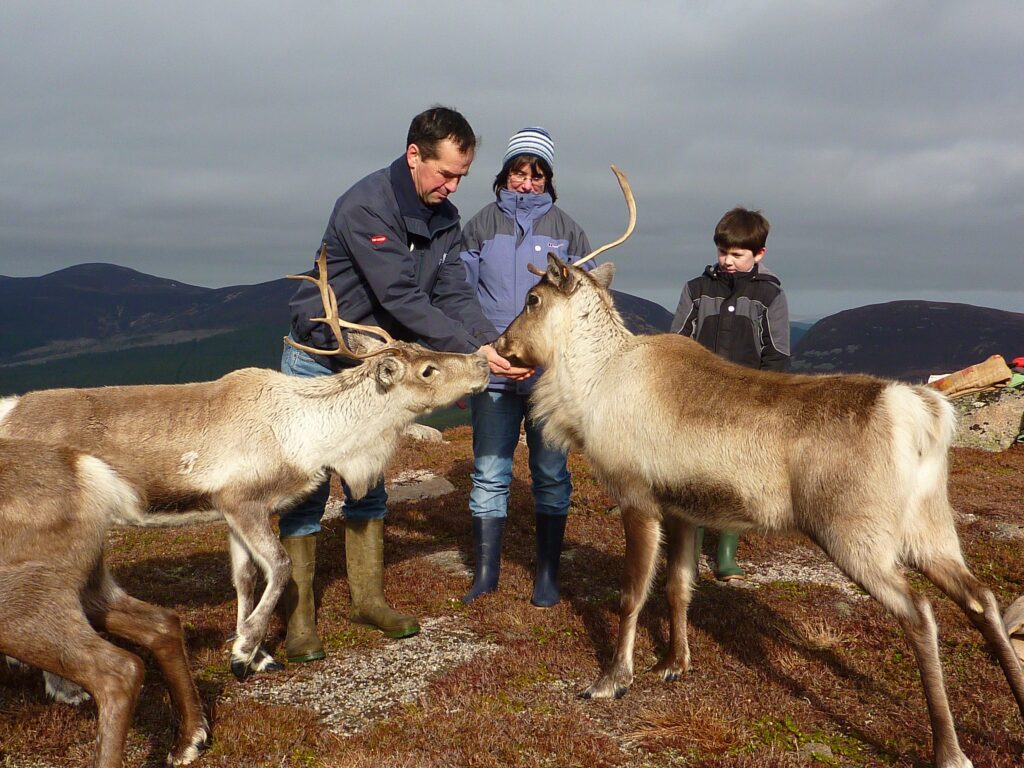
Come on a Hill Trip and look around you, and you’re unlikely to see any reindeer nuzzling each other, but it’s almost guaranteed you’ll see reindeer pushing each other around. So a reindeer touching another is generally an agressive action, with antlers – or front feet – used as weapons. The way I like to phrase it to visitors is that we are entering the reindeer’s natural territory, so we therefore play by their rules – touch is a negative thing so we aren’t going to do so.
The main way a reindeer ‘touches’ another – antlers first! Oatcake demonstrating a reindeer’s way of getting another to move on.Another example of contact between two of the young reindeer, Darling and Elbe – it’s not friendly!
However, pre-covid, we didn’t have a hard-and-fast rule about not touching the reindeer. It was never something we encouraged, but not something we outright banned. As our reindeer are incredibly tame, many did actually tolerate a gentle stroke or pat, and the ones that didn’t had space to move away from visitors. However, some reindeer were well known for standing there looking beautiful and luring visitors in close, only to try and clobber them. This led to us having to have eyes in the back of our heads as guides, and I found myself frequently – often mid-sentence – having to suddenly holler across the hillside: ‘just stand back from that one!’ / ‘don’t try and touch him!’ / ‘oops, sorry about that… are you ok?’. I found this happening more and more too, as our visitor number increased considerably over recent years. Coupled with that, was people’s inability to read reindeer body language – which is perfectly understandable for those not used to being around animals. Generally a grumpy reindeer will warn visitors to keep their distance before going a step further and insisting that they do, but this is often lost in translation from reindeer to humans. Clear as day to those of us who are well-versed in reindeer, but not to all.
Lace. Looks like a supermodel with her glam dark coat and elegant tall antlers – but acts like a thug. To both other reindeer, and visitors, at times.
But covid brought about a change that, in hindsight, needed to happen anyway. For months no-one was allowed to touch anything – reindeer included – and we realised just how much more relaxed the herd were with the new ‘hands-off’ rule. The ‘background’ reindeer of the herd – shyer members who would normally keep themselves a good distance away – started wandering in amongst everyone, sometimes within arms reach, but safe in the knowledge that they wouldn’t be patted unexpectedly. Everyone was more relaxed and this included us as guides – since our rules changed I can probably count on one hand the number of times I’ve had to rescue an unsuspecting visitor from a reindeer who got out of bed on the wrong side that morning. I’m not going to lie – it does still happen sometimes as animals are always unpredictable, but with far less frequency.
Turtle’s reputation precedes her amongst herders – she’s not earned the nickname ‘Snapping Turtle’ for nothing!
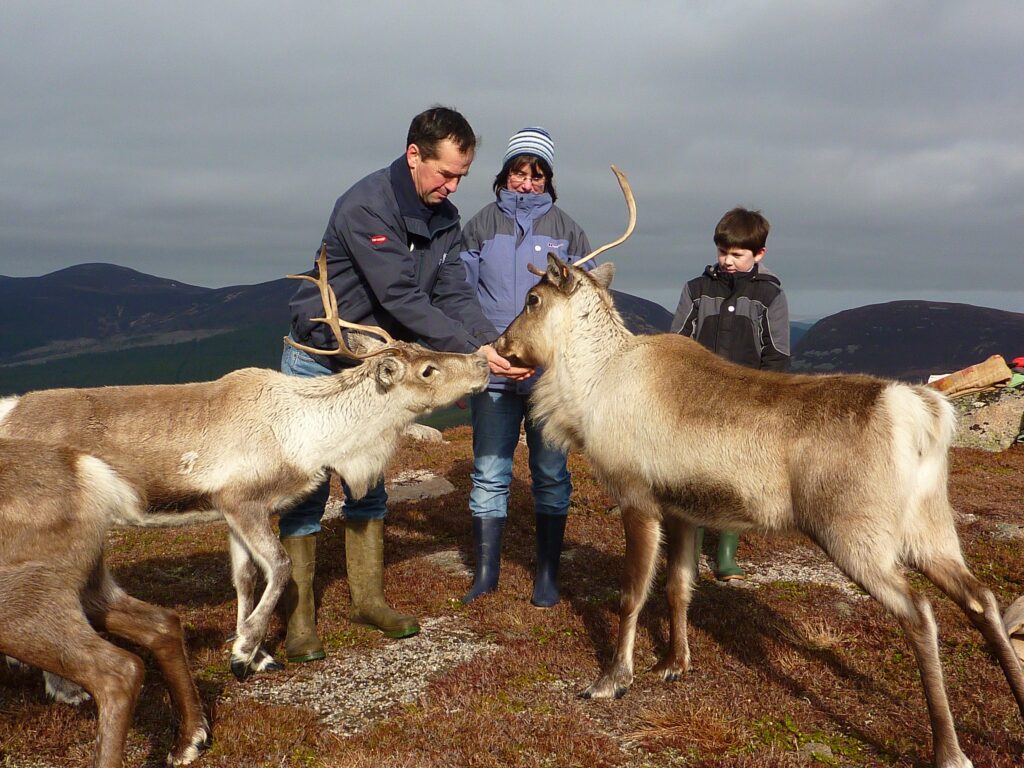
So ‘hands-off’ was here to stay. Once covid guidelines relaxed enough we started allowing visitors to hand-feed the reindeer once again, albeit in a more controlled fashion and allowing one turn per person only. This generally keeps manners better amongst the greediest members of the herd, meaning they only barge around for a short time period before settling down, but it does allow one small bit of contact that visitors crave.
Okapi and Hippo – always enthusiastic hand-feeders!
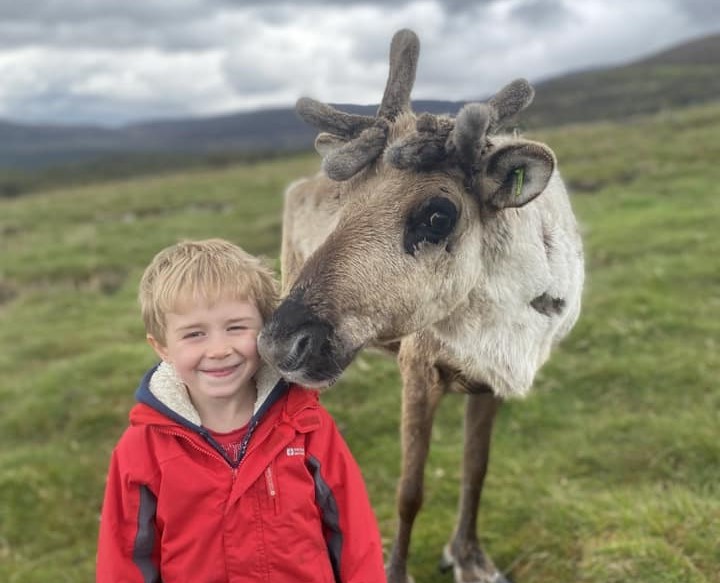
As far as we know, folks who have visited both before and after seem happy with the changes, and almost everyone I’ve spoken to agrees that the reindeer are more relaxed and that their welfare is utmost. And of course, reindeer don’t read the rulebooks so they sometimes choose to touch visitors themselves, which is fine – it’s on their terms. A visitor finding a furry nose suddenly sniffing them, whiskers tickling their skin, is a happy visitor indeed.
Wee visitor Oakley getting special attention from Aztec! Photo: Candice Bell
It’s perhaps important to add that whilst we don’t – and have never – patted or stroked reindeer unnecessarily, we do have to handle them ourselves, but we do so without ‘fussing’ them. We we need to be able to handle them for veterinary care, worming and vaccinations etc., and this needs to be as unstressful for the animals as possible so we do put work into each individual to make sure they are comfortable being handled in this way. We also need to be able to move reindeer from place to place, so every single animal in the herd is trained to walk on a halter at around 5-6 months old, and a lot of effort goes into getting them easy to catch and halter. If we can’t catch a reindeer we run the risk of not being able to catch them at a critical point, i.e. if ill. Nowadays pretty much all of our reindeer aged 7 or less are catchable with ease as we have put more work into this aspect of training in latter years; but there are admittedly still some wily old reindeer who have to be brought into a shed to get hold of them! Looking at you, Sika…
Still one of the wildest reindeer in the herd, even at 16! Click the link above to read another of Hen’s blog’s, this time about Sika herself.
More work goes into our male reindeer overall, as they help to keep our business afloat by taking part in Christmas parades and events, earning income that helps to pay for their grazing leases etc. But again this is all done in a sensitive way and we work as a partnership with them, and touch is – as ever – kept to the minimum; the reindeer know their job and we know ours, and any reindeer that isn’t comfortable with the situation just stays at home.
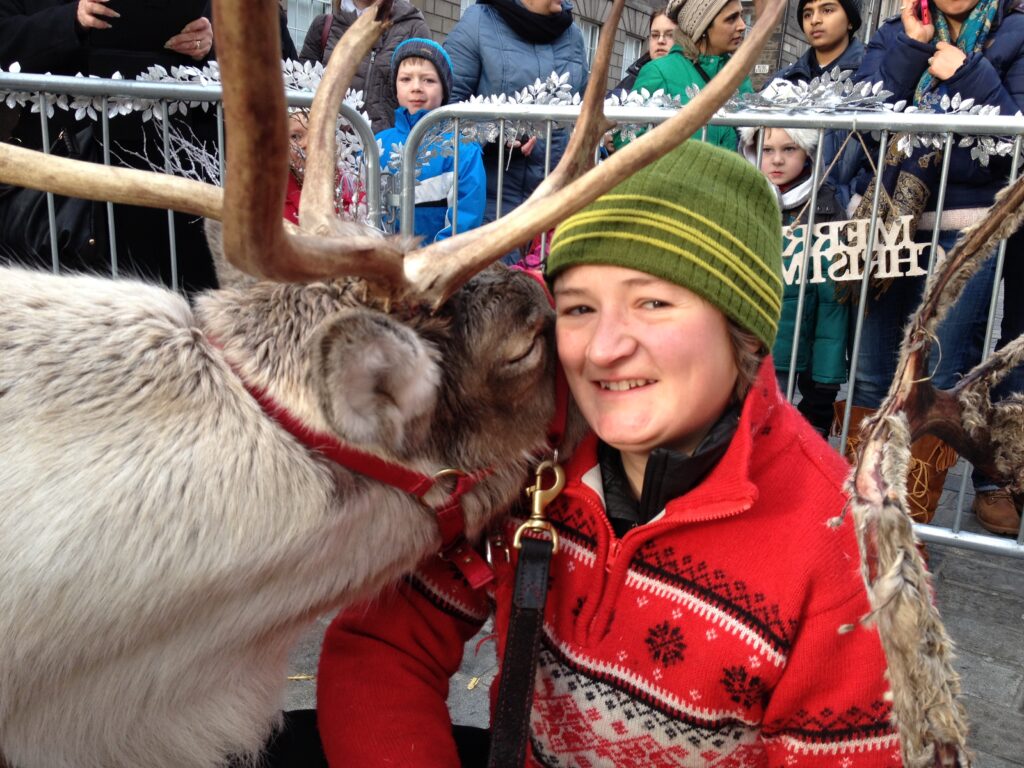
Topi demonstrating how totally relaxed he is, even when harnessed up to the sleigh in the centre of Edinburgh – taking his opportunity for a quick nap on my shoulder before a parade many years ago. Note he’s the one choosing to rest his head on my shoulder, I’m just holding on to the lead-ropes!
So hopefully that gives an overview of why we have stuck to the change we made to Hill Trips in 2020. Initially I was worried we’d have a huge negative backlash from visitors, but there never has been really, and whilst we do know how tempting it is to stroke them, we hugely appreciate everyone’s efforts in not doing so. As we say, if struggling to resist the urge, stick your hands in your pockets!
Editor’s note: The lovely Hannah wrote this blog when she was here back in August 2023 but I have only just found it lurking in a folder on the computer. Sorry Hannah! Read Hannah’s first blog here about her time volunteering with us here: Hannah’s Volunteer Blog – The Cairngorm Reindeer Herd. And then try to imagine you’re reading this current one in the warm summer month of August!
The herd within the hill enclosure – August 2023.
It’s hard to believe that it’s only been a year since I was up on the hill – it always feels far too long! As usual I signed up for my now annual volunteering stint and was met with an even better offer to come and help for three weeks rather than one! Obviously, this was too good an opportunity to pass up and I quickly abandoned my long-suffering partner (and our impending house move) to come and stay at Reindeer House for the month!
A lot can change in a year – last July I was hand rearing Sunny, now one of our yearlings and a fully-fledged reindeer – antlers and all! My hand rearing days were not over, though – as we had two new calves to meet – Winnie and Alba! Being resident in Reindeer House means extra quality time with these two lovely girls, including late night feeds and mornings taking them up the hill. It’s been amazing watching them progress even over the past few weeks, gaining weight as they should and spotting some antlers beginning to appear.
Hannah and Sunny in July 2022.Sunny all grown up in July 2023.Winnie and Alba, our hand-reared calves in August 2023.
I’ve been lucky enough to come at a different point of the year which has included adventures with the free ranging females and tracking the discovery of new calves flourishing out on the hills. Having not had much time with our girls, being mostly a summer presence, it was great to finally put faces to the names of the lovely females I have heard so much about and meet some of their new arrivals.
Hannah on the right helping out with harness training with Andi and Hen – August 2023.Hannah taking her very own Hill Trip and doing a totally superb job!Meeting some of the free ranging cows.Catching up with the calves who were born in May – here’s Holy Moley and calf who we later named Mississippi.
I count myself very lucky to have quadrupled my usual stint here and be a part of the team. Hopefully the next bit of time goes speedily, and I’ll be back out on the hill before I know it!
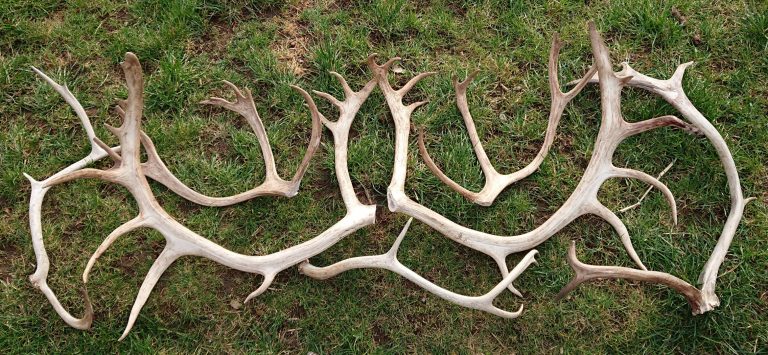
Over the years I’ve established myself as ‘chief of antler sales’ here at the Cairngorm Reindeer Centre. As with most reindeer related things, it’s not really a job that is straight-forward but one that has evolved with time, and I’ve tweaked and tweaked each year until it is as workable as possible. But – in usual fashion – the devil is in the details, much of which are in my head and memory and it’s therefore not a job that I delegate to anyone else.
The dream set of antlers everyone wants… (thanks Spartan).
We’ve always sold antlers from the reindeer herd. But is it as easy as 150 reindeer equals 300 antlers per year to sell? Of course it isn’t…
Firstly, we only find around 30-40% (at a rough estimate) of the antlers each year. This is because the reindeer roam on a huge area of rough, upland land, and the time of year when most antlers are shed – January to April – is exactly the time that almost the entire herd are roaming completely freely and are not enclosed at all. The proverbial needle in the haystack. (In fact sometimes finding the herd itself can be a needle/haystack situation, let alone their cast antlers!).
So many antlers, so few of them found.
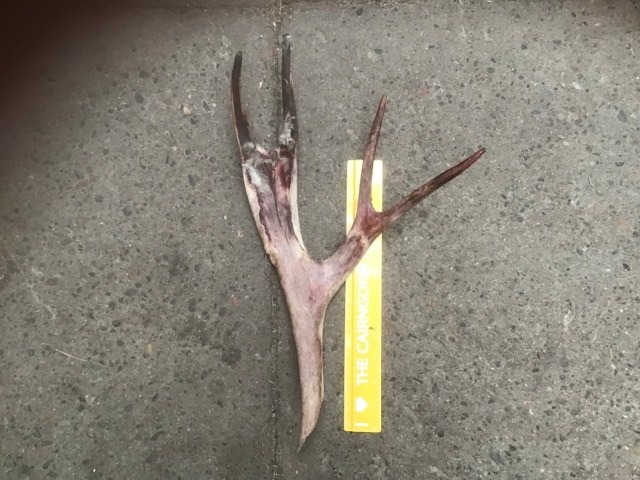
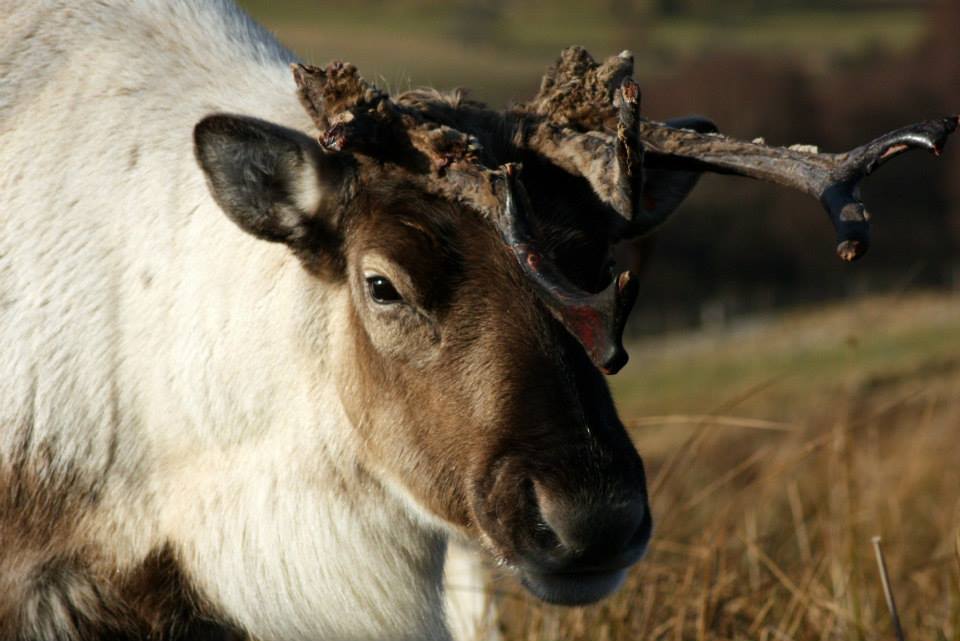
Secondly, whilst around half of our herd are males, we tend to castrate them at around three years old. This means the bone of their antlers doesn’t calcify to the same extent, and they will usually break their antlers off in pieces as a result. So instead of a nice, clean antler, we get broken sections of – to be quite honest – often rather manky antler, still partly covered with the velvet skin that covered it whilst it grew. Smaller pieces disappear into deep vegetation – never to be seen again – far more easily than a whole antler.
A classic bit of antler from a castrated male. This one’s from Frost – the top third of his right hand antler, still with remaining skin and a little velvet hair. But it’s still a bit of Frost none-the-less, regardless of it’s appearance.Classic antlers from a castrate male around February time- the upright sections have broken off and only the points at the base remain, still with the remnants of the velvet skin and hair. Not particularly glamorous, eh Caribou?!
Once castrated, males also tend to grow relatively smaller antlers than they did as a bull. So we really only get two or three big, mature bull sets of antlers each year. But some of these we keep – for example we have almost all of Sherlock’s antlers, and most of Crann’s. Crann holds the record for the biggest antlers ever in the herd, and as such we’ll never sell them as they are of great nostalgic value to us, even though Crann himself is long gone.
Crann with his 2009 antlers (his second biggest set). They are the ones currently in our shop window that we hang stuff for sale on! COPYRIGHT PHOTOGRAPHY: LES WILSON
Antler selling starts in January each year. The mature bulls have dropped their antlers in November/December, and some of our immature bulls then have their antlers cut off in December before they are let out to their winter grazing up on the mountains. This is done for the safety of hill-walkers – a testosterone-charged ‘teenage’ bull could really inflict damage. It’s done long after the feeling in the antler has gone, so causes zero pain.
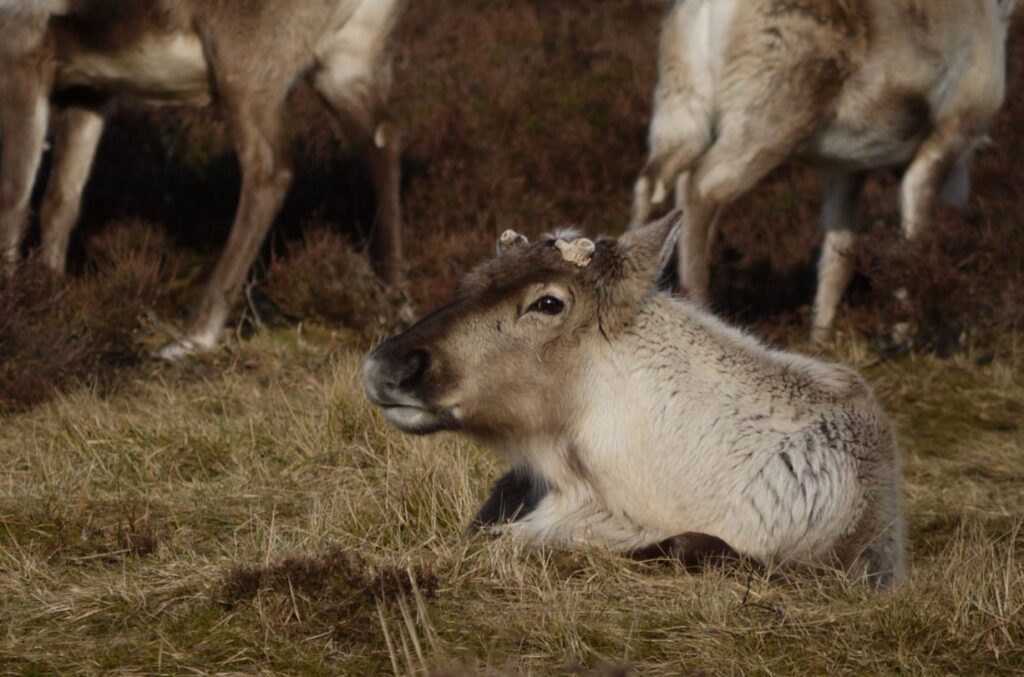
Two year old bull Domino, looking mighty miffed with his antler stumps.
From (usually) around February or March onwards the cows start dropping their antlers, but for me life gets very busy in the spring with the calving season, followed by writing/editing the June newsletter, so it’s often well into the summer before I pick up the antler list once again.
So… here’s some info for those of you now imagining a nice set of antlers adorning your wall.
Firstly, I give members of our reindeer adoption scheme priority for purchasing antlers over ‘unconnected’ members of the public. I feel it’s a privilege someone who supports our business should get. My method for this is to have a waiting list for adopters to add their name for dibs on ‘their’ reindeer’s antlers, which I work my way through gradually as and when I have something suitable. Should you want to add yourself to this list, drop me an email through the contact form on the website FAO Hen (please don’t just comment on the blog/social media – email means I can keep everything together, and gives better chance of a reply one day from me actually reaching you, rather than disappearing into spam).
If you’ve asked to be on the waiting list in the past, no need to get in touch again – you’ll still be there. Well you will as long as your adoption is still current. I’m afraid that I always double-check someone is still an adopter before emailing them, and you’re scratched off the list if your adoption has lapsed. My list, my rules.
If I have no-one on the waiting list for a particular reindeer’s antler(s), then I will send a letter to all of their (UK based) adopters in one go – and it’s first come, first served. Miss out, and you go on the waiting list. This does mean sometime multiple people are all waiting for the same reindeer to shed his/her antlers – which we might never find from year to year anyway. I’m well aware some poor souls have been languishing on the waiting list for years… sorry.
If you aren’t an adopter of a reindeer and are reading this in despair, wondering whether there’s ever a chance of you getting anything, then all is not lost. Email me anyway, and I have a password-protected webpage with any available antlers on that I can give you details of, and on which you can sign up for occasional email alerts when new ones become available (if I get my arse in gear, this is still only two or three times a year, so don’t worry about me flooding your inbox. (Also, I hate Mailchimp – it’s totally user-unfriendly)). I have separate webpages for single antlers and for pairs, and usually have a much better range of single antlers, since finding both sides of a pair is rarer in the first place.
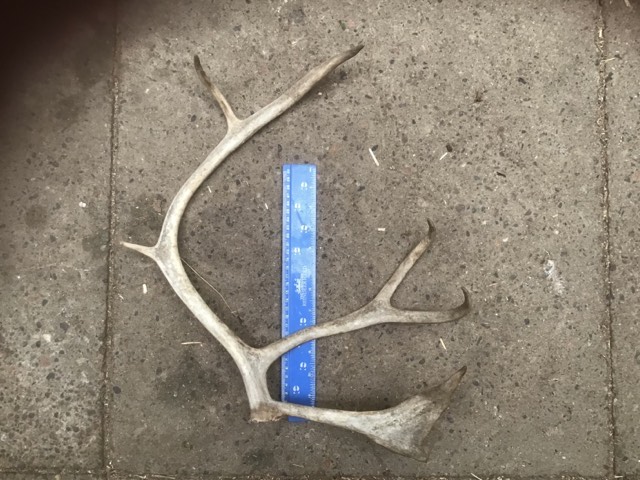
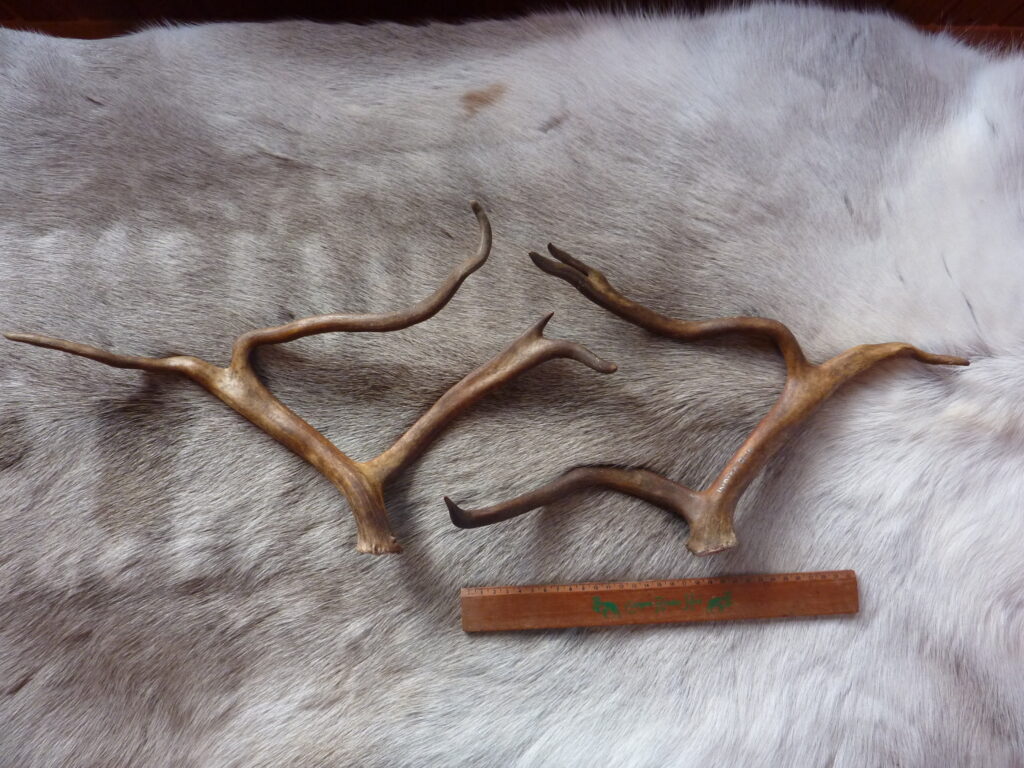
A small, single antler can be very beautiful – size doesn’t always matter 😉
Final info:
Yes, they do cost a lot. The biggest sets we ever get to sell are in the region of (at time of writing in 2024) £300. The single antler in the photo above was about £60. I guess other places with reindeer in the UK maybe also sell their antlers, but I’ve never actually heard of them doing so. I do my best to price antlers fairly though – every single one is utterly unique and in some way it is a snapshot of that reindeer at that particular point of their life. I’m sure I could push up the prices hugely and they would still sell eventually, but that isn’t the point. It’s a balancing act to try and get it right.
For adopters, if you perhaps can’t afford the antler(s) you been contacted about, it’s still worth going on the waiting list. I might have a glorious £200 set of beautiful antlers one year from your reindeer, and a single broken-off – much cheaper – half antler the next year. But hey, it’s still a piece of antler that your reindeer actually grew, and really it means just as much.
Conversely, you miss out on something small that you had your heart set on. But hey presto you might then be first in line for the potentially much more impressive effort from your reindeer next year. It’s all utterly unpredictable and there’s definitely an element of luck involved.
I can’t post abroad, sorry.
If you can collect your antler(s) rather than me having to package and post them, a) it’s cheaper and b) I love you.
Postage nightmare.
If you receive an ‘antler letter’ through the post – read it properly! I always do my best to describe the antler fully before you phone up to buy it – but have never forgotten the lovely couple who arrived to pick up a set of antlers from their adopted reindeer years ago. The bloke was a bit worried about fitting them in the car. The antlers were about 30cm tall.
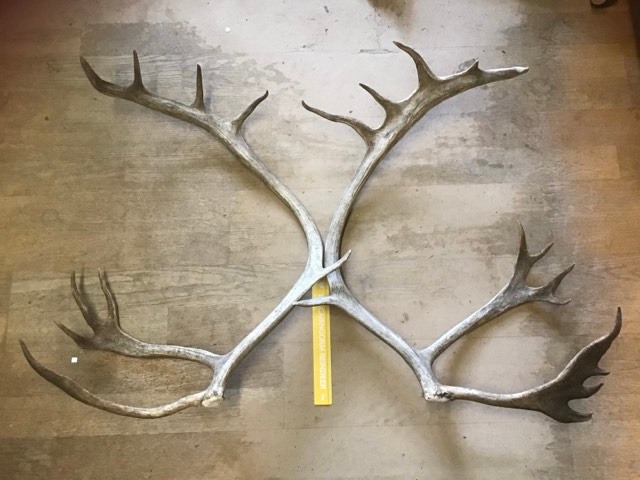
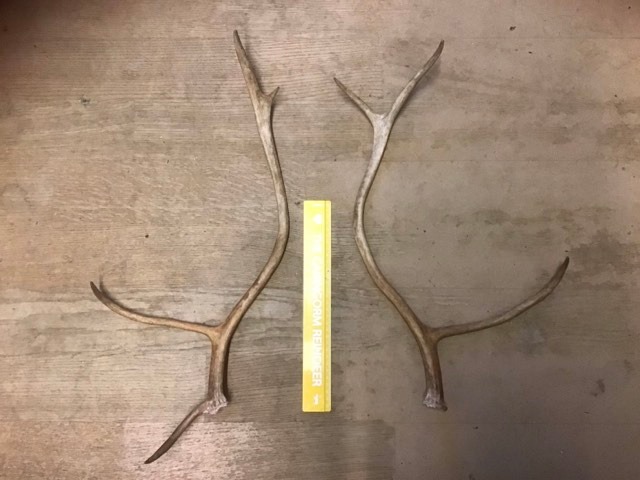
Antlers come in all sizes but all shapes too. Forget that classic set of ‘perfect’ shapely reindeer antlers you’ve got in your mind’s eye – they probably aren’t going to look like that… If I’m emailing you directly I’ll attach a photo, and if I’ve sent you a letter, you can ask to see a photo before you decide.
Tall and thin……or short and wide?
As mentioned before, we keep some of the biggest bull antlers. Herders also usually have first dibs on their favourite reindeer’s antlers (I’ll add that (depending on the size of antler) we do usually still have to pay something them!), so there are certain reindeer in the herd whose antlers will come up for sale very rarely, if ever. Huge apologies, if you also adopt one of those reindeer… let’s mention no names.
I do also try to be fair to people – if I know you already have multiple antlers from a certain reindeer but are keen for more, I will usually try and give their other adopters a look in at some point.
And if you adopt Juniper, well don’t give up hope. Ferrari was also a ‘polled’ reindeer (one who doesn’t grow antlers at all) and suddenly sprouted one when she reached 9 years old, so all is not lost. But I wouldn’t get your hopes up too much.
Ferrari in her latter years. Just one antler! But what a nice antler, after 8 years of baldness.
And finally, I’m only human so bear with me as the old brain doesn’t get everything right every time. Apologies again to the lovely lady who I posted the entirely wrong set of antlers to a couple of years ago, and then had to go through a whole rigmarole of getting her to post them on to the correct new owner (Editor’s note: we did get permission to pass on the address first!), whilst I sorted out the right set for her. And years ago I died a little bit inside when I realised we’d sold the same antler to two separate people, and I was going to have to make a very awkward phone-call (although in my defence, it wasn’t actually me that forgot to mark that antler as ‘sold’ on the list). Oh, the horror.
On 4th August 1989 Alan and I took over the ownership and management of the Cairngorm Reindeer. We had both been working for the family who owned the herd for a number of years and when Mr Utsi and then Dr Lindgren passed away the opportunity arose for us to buy the herd.
Back when Alan and Tilly took over the Reindeer Centre in the late 80s (and Alan had more hair!)
To this day the 4th August is etched on my brain. Our children were 3 and 4 years old and we had never had our own business, Alan had been employed by Dr Lindgren and I was initially a volunteer. But we had lots of ideas and we had a beautiful herd of reindeer.
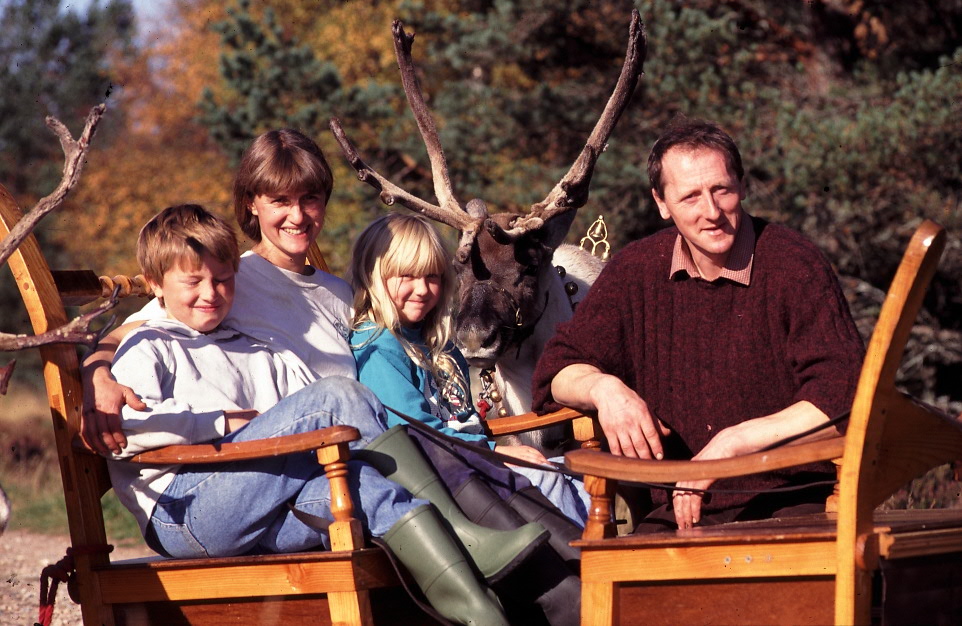
The requisite Smith family photo – Tilly and Alan with Alex and Fiona, and obligatory reindeer.
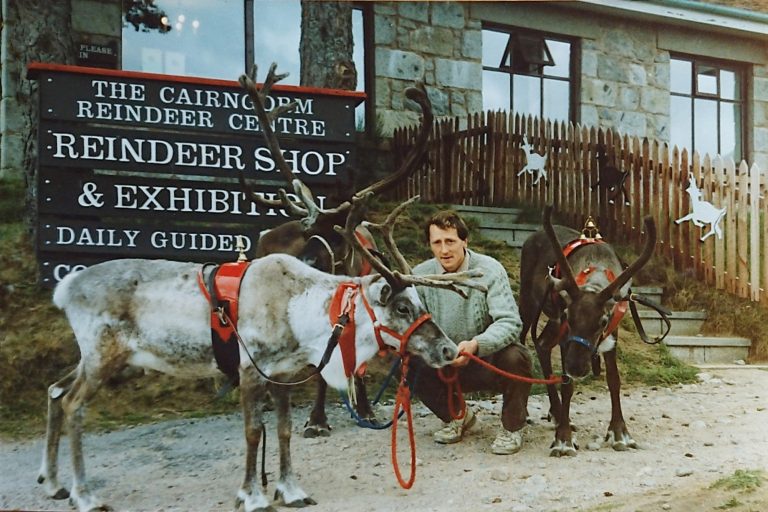
We immediately converted part of Reindeer House into the ‘Cairngorm Reindeer Centre’, with reception, shop and office at one end leaving the rest of the house for living in with our young family and friends, many of whom who were volunteer reindeer herders. The reindeer paddocks beside the house became a display area for visitors to see a small group of reindeer, along with the 11am Hill Trips to the herd on the mountains.
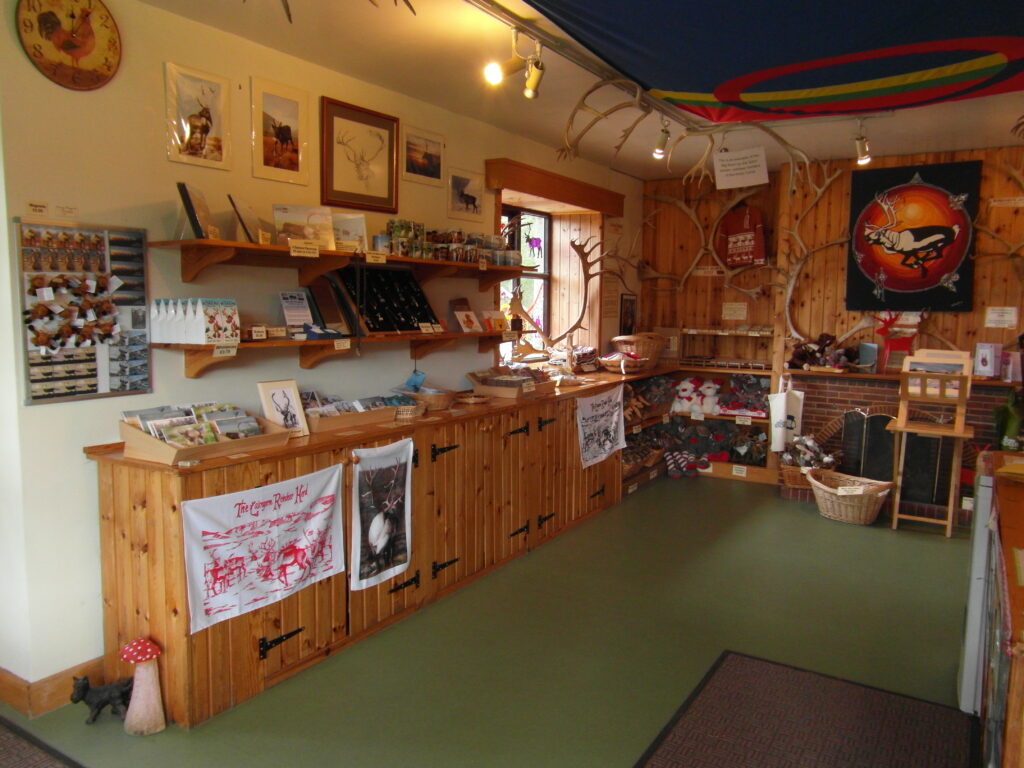
The shop and reception area, in what was once the living room of Reindeer House.
Nearly 35 years later and the status quo continues. The only difference is that we’ve all got older; Alan and I moved out to our new ventures at Glenlivet (although still closely involved with the reindeer) and our daughter Fiona is living at Reindeer House with many of the other herders (they’re paid now though!). We attract more visitors and there are extra daily visits onto the hill to the herd.
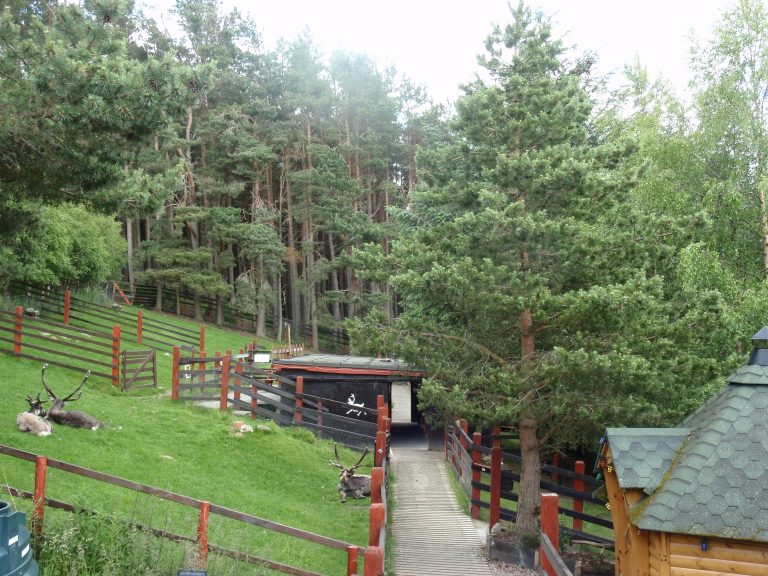
The Paddocks in recent years.
The set-up has worked really well and the homespun infrastructure and hard working herders, along with a unique herd of free ranging reindeer, has been a great story. I have written three books around the life of reindeer and our journey with them and the herd is still looked after by us along with a band of enthusiastic, caring and clever people. Our herders today have brought with them tremendous life skills which have hugely progressed the way the Cairngorm Reindeer Centre is run from day to day. But most importantly the welfare and care of the reindeer is still at the heart of everything we all do on a daily basis.
Looking after the herd. Photo: Alex SmithTilly with Scrabble. Reindeer are the heart of the business, and always will be, regardless of the changes around them. Photo: John Paul
In the summer of 2021 we received an incredibly generous donation from a long term reindeer adopter who asked that the monies they donated be put towards upgrading the current facilities at Reindeer House, which would involve returning the house to a domestic property and constructing a stand alone building for our reindeer shop, exhibition and office.
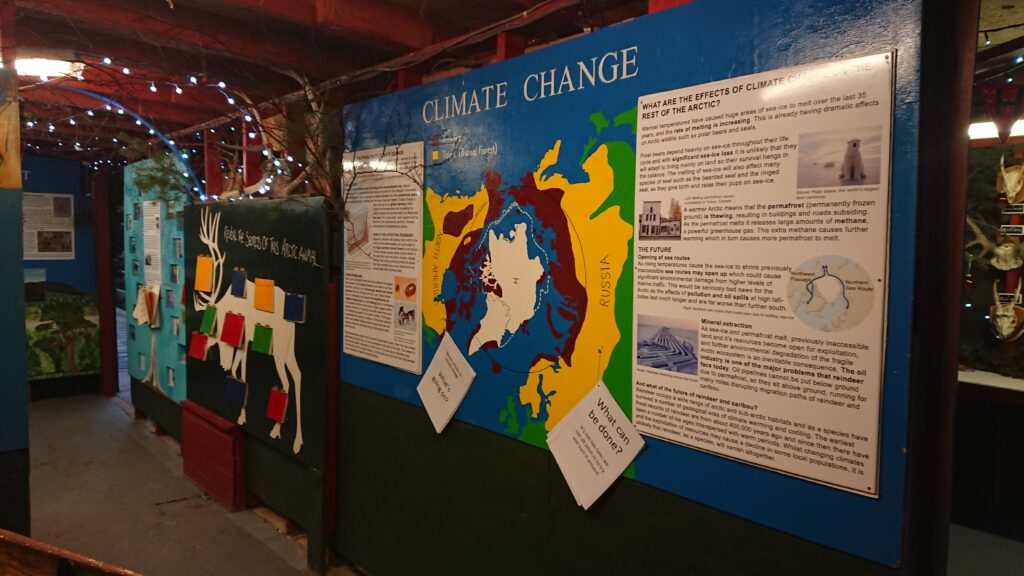
Exhibition displays. They’ve improved a lot over the years, but the building housing them was definitely getting shabbier and shabbier!
The following January we engaged with an architect and since then we have been going through the process of agreeing plans and applying for planning permission and the building warrant. With all the statutory requirements in place we began work last September, building a 16 bay car-park close to the Paddocks. The car-park is now nearly finished (but not available for parking in yet) and work is due to start on the new building in early February, which will be situated in our existing Paddock area.
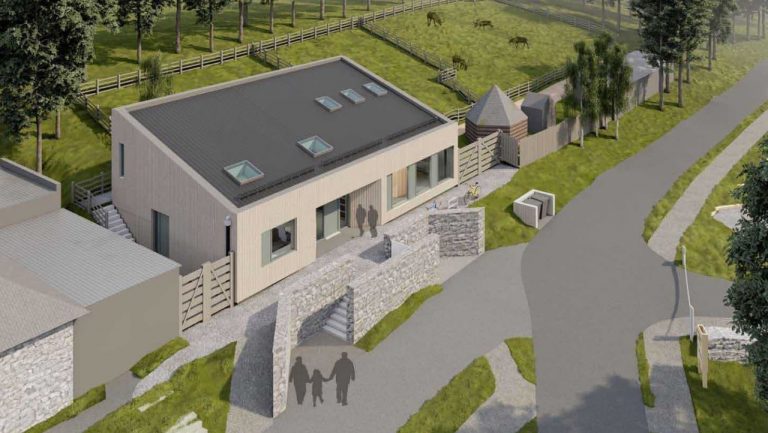
The artist’s impression of the shiny new building!The existing Reindeer House building can be seen at the left hand side here, with the entrance to the new car-park on the right hand side.
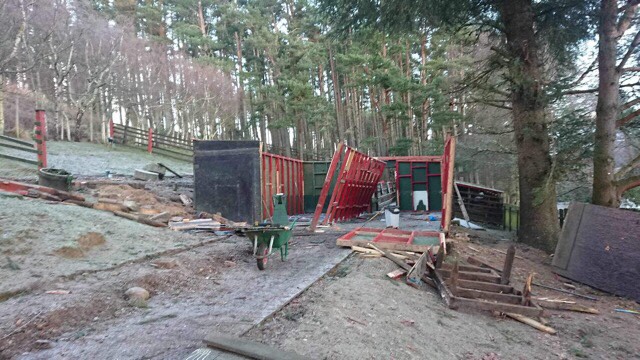
As normal we closed for a few weeks on 8th January 2024 and immediately our son Alex, with help from herders, began to demolish the wooden structures in the Paddocks to make space for the new construction. There is a tinge of sadness seeing the old buildings (that we built ourselves) coming down but I suspect the improvements are long overdue and we are imagining a really special place for visitors to come to learn about our wonderful herd of reindeer alongside new displays, children’s activities and of course reindeer. Most importantly the new Centre will be access to all abilities.
We closed to the public on Monday 8th January. By Friday the 12th the Paddocks looked like this!
So exciting (and expensive!) times ahead. Unfortunately a bit disruptive too as the Paddocks will not be available for viewing reindeer while the building is constructed. However once we re-open to the public on 10th February we will otherwise still operate as normal with reception, shop and office where they have always been and the daily Hill Trips to the herd will continue as usual.
Hill Trips will continue as normal – tickets available on our website (from 30 days in advance)!
To check out what is available and how you can still come and visit do keep an eye on our website for updates and once construction gets underway we will have a better idea of how things are progressing, and more of an idea of the duration of the work.