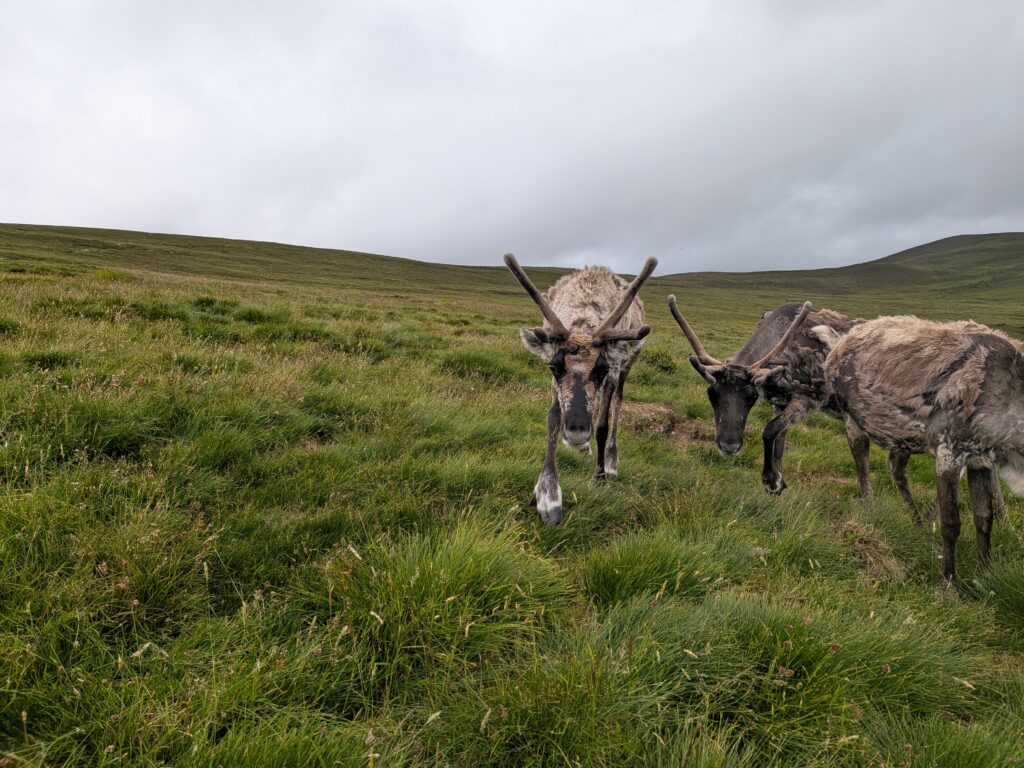
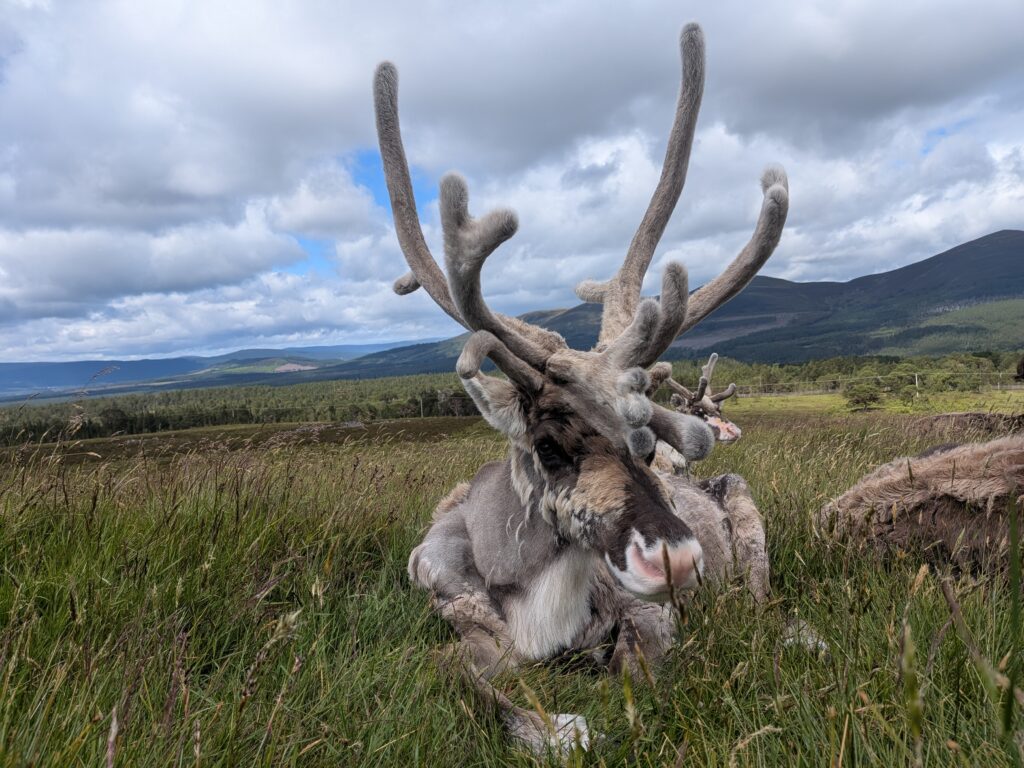
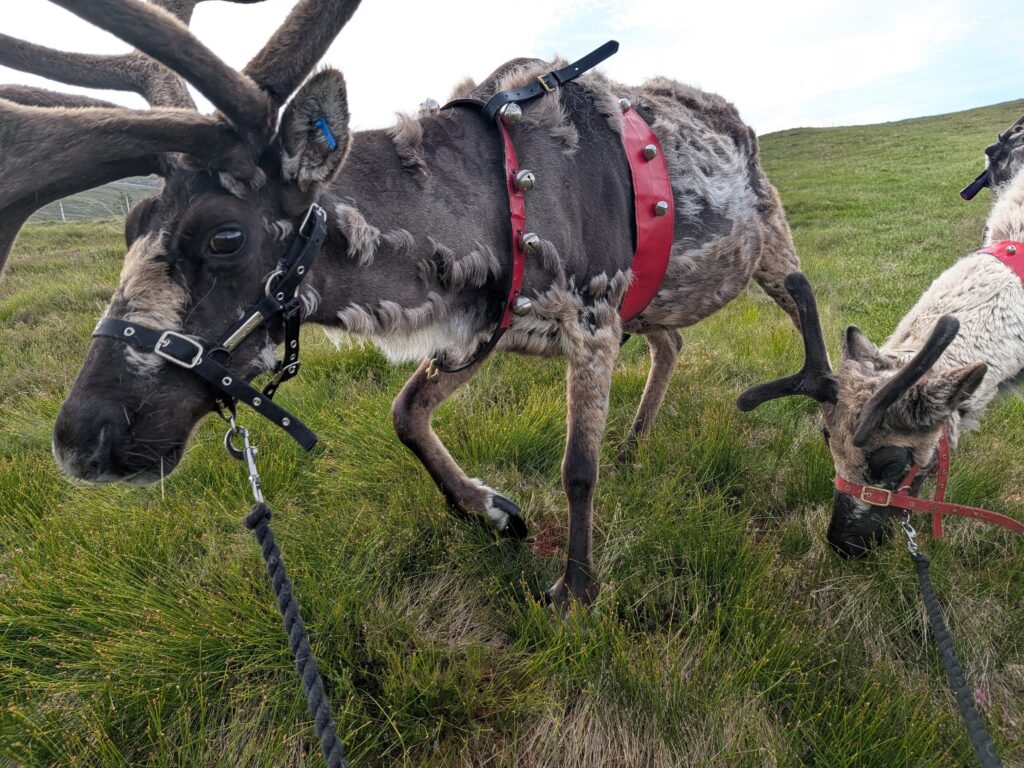
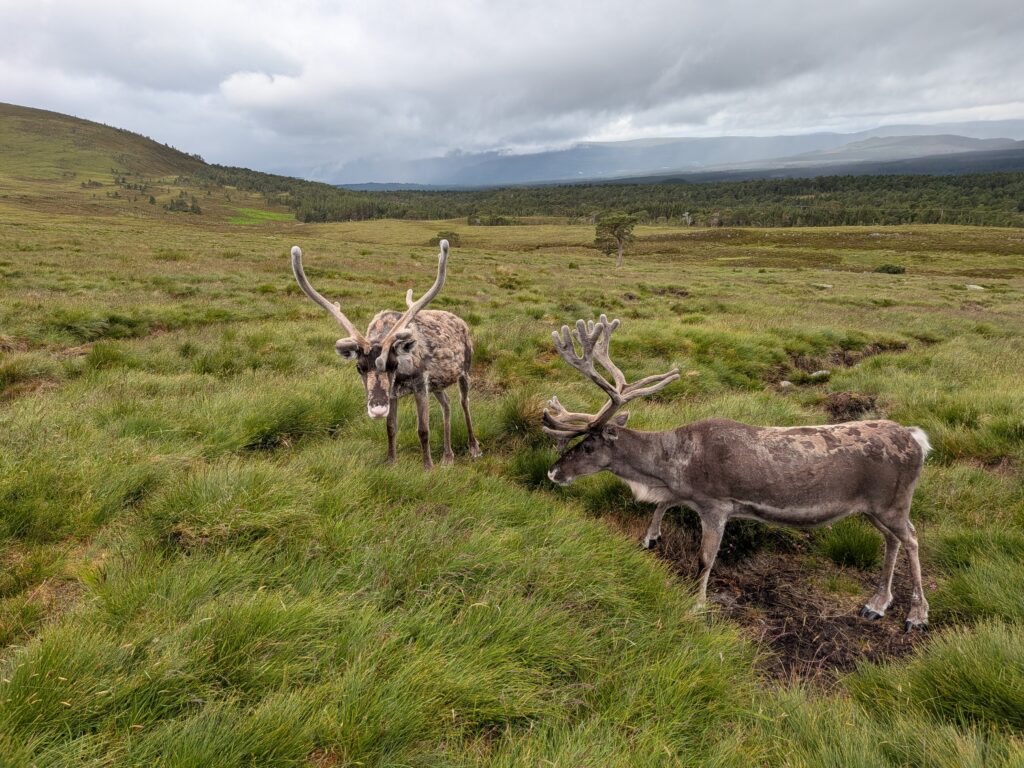
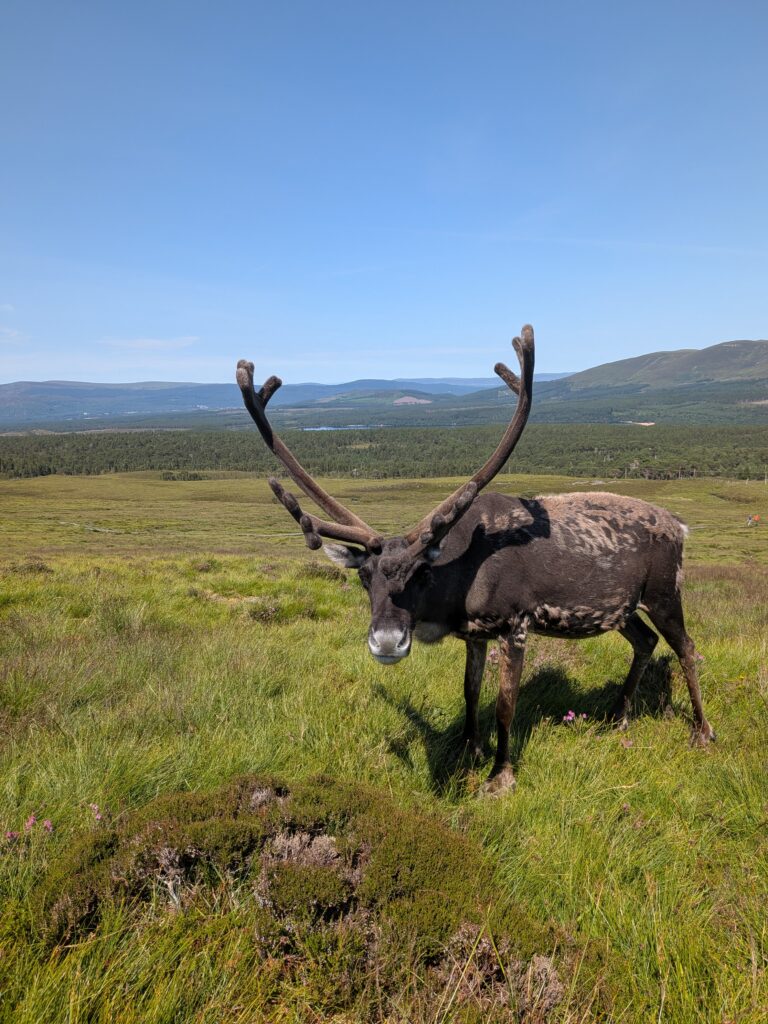
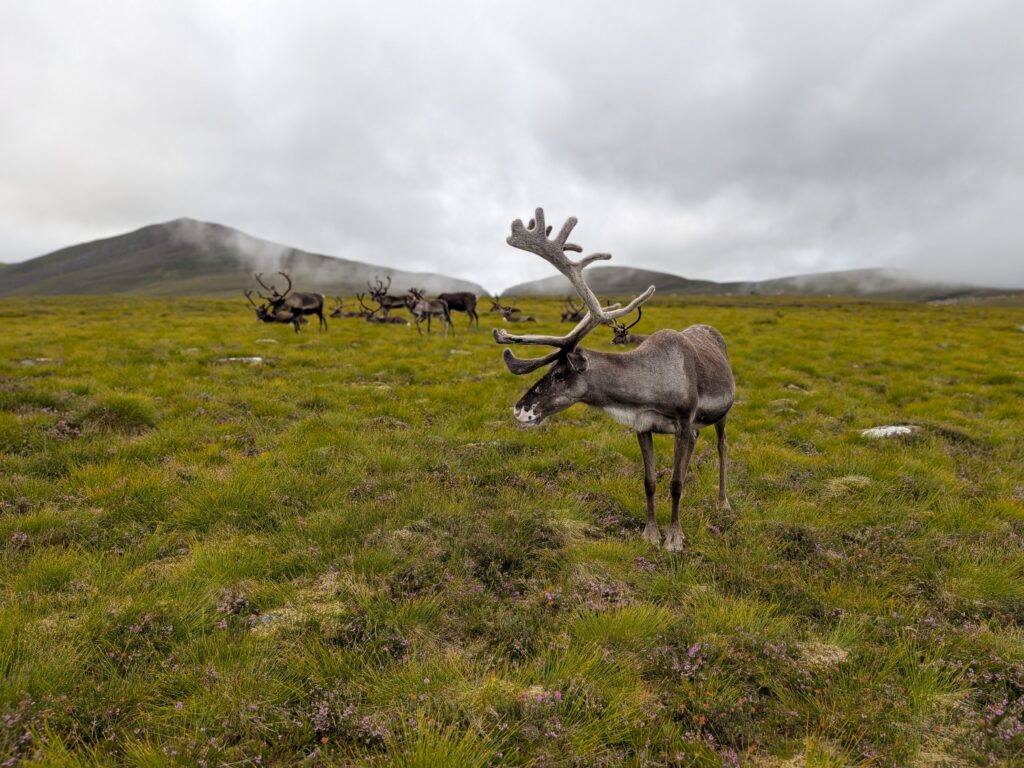
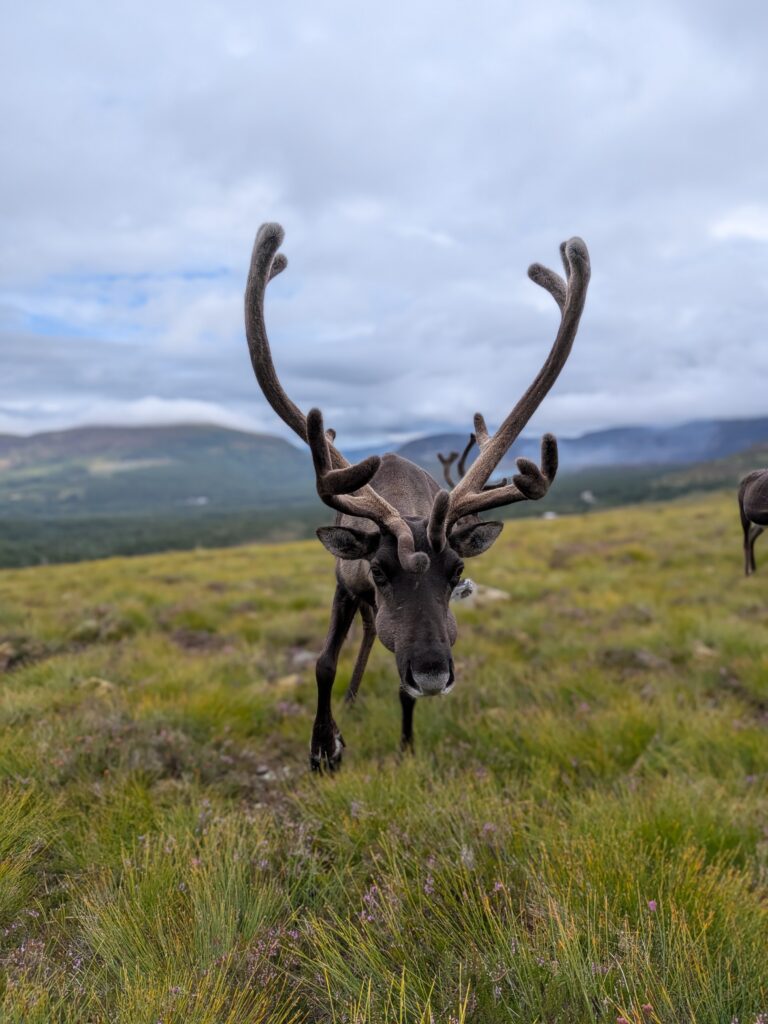
Well, July has been a MONTH! At the start of the month, harness training for our male reindeer was well under way and there was still some really scruffy males around. The antler growth that we have had over the last month has been phenomenal and our male reindeer look completely different to what they did a couple of weeks prior.
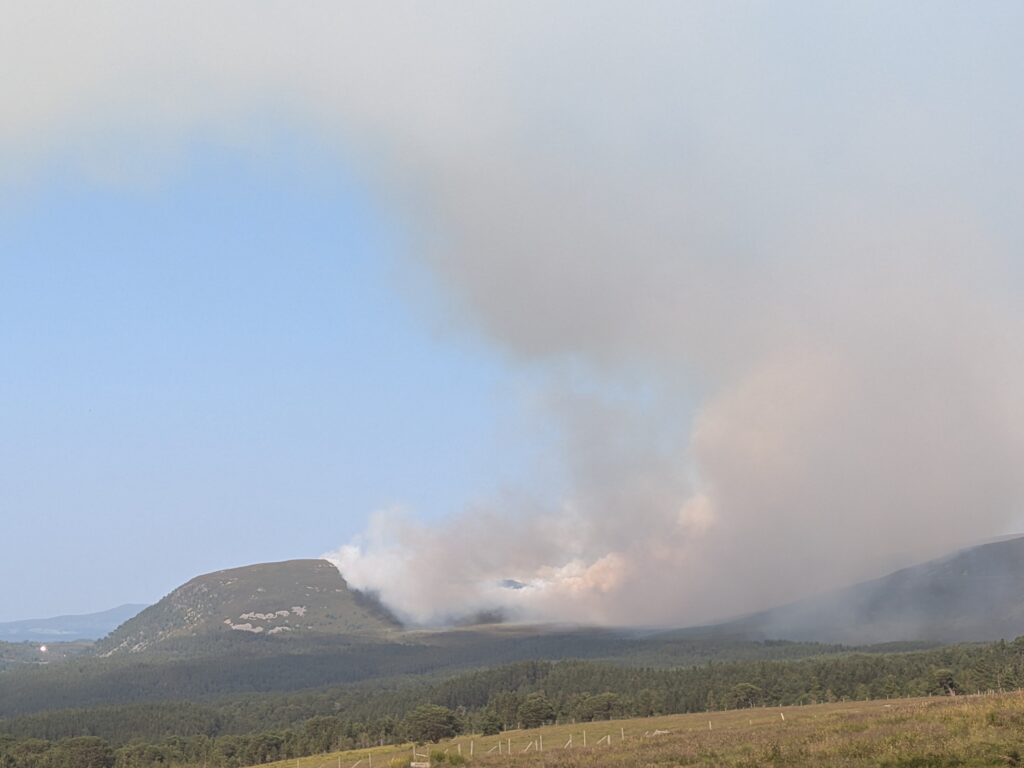
Our usual July routine was interupted about half way through by the threat from a local wild fire which was spreading quickly over the mountain side. You will be glad to know that the reindeer were never in any direct threat from the fire but it gave us all a bit of a fright and on the days that us herders couldn’t get up to see the reindeer we were all walking around a bit lost, unsure on what to do with ourselves! We are so lucky to have a great team of people working with us at the Centre, a lot of which were on hand at the drop of a hat to help move reindeer.
It has been two weeks since we’ve been able to open to the public here in Glenmore but we have been able to take Hill Trips at our secondary site and we have most of the male reindeer back from their little jaunt on to the free range here on Cairngorm with a small group of reindeer still out on the mountainside enjoying the peace and quiet.
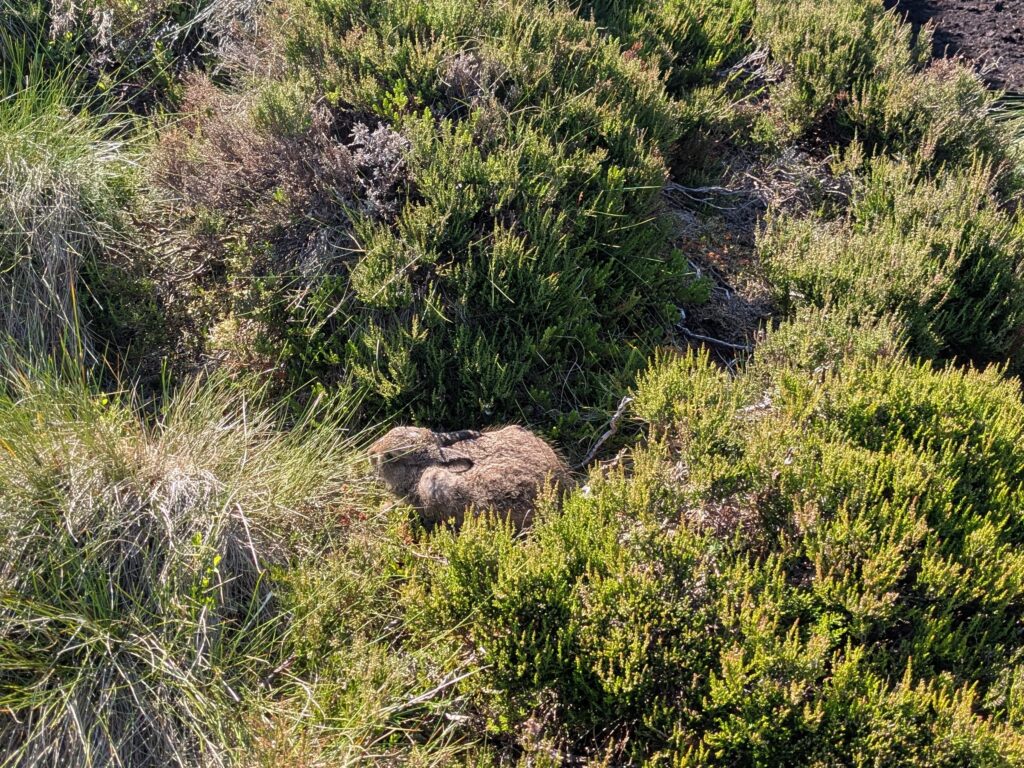
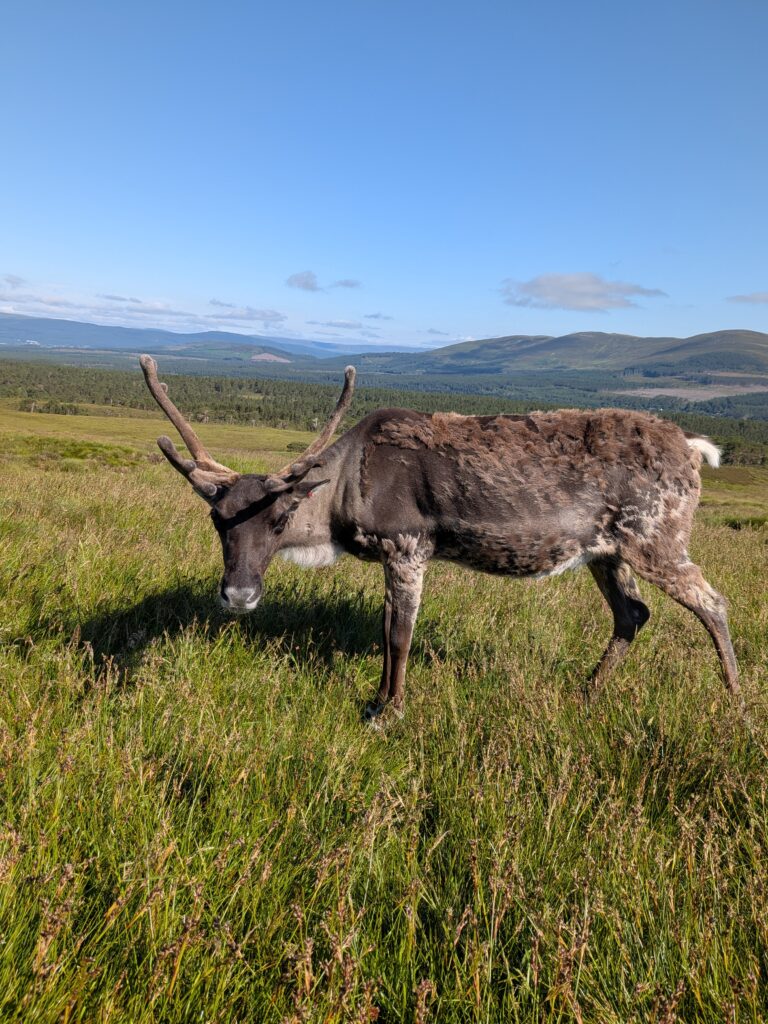
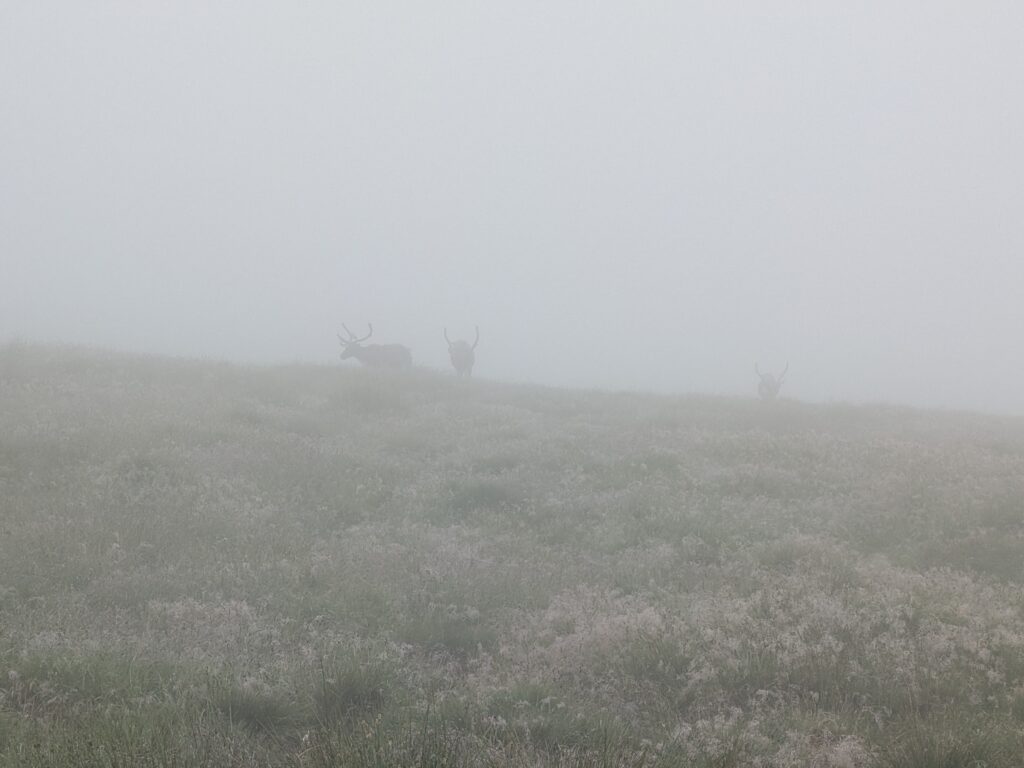
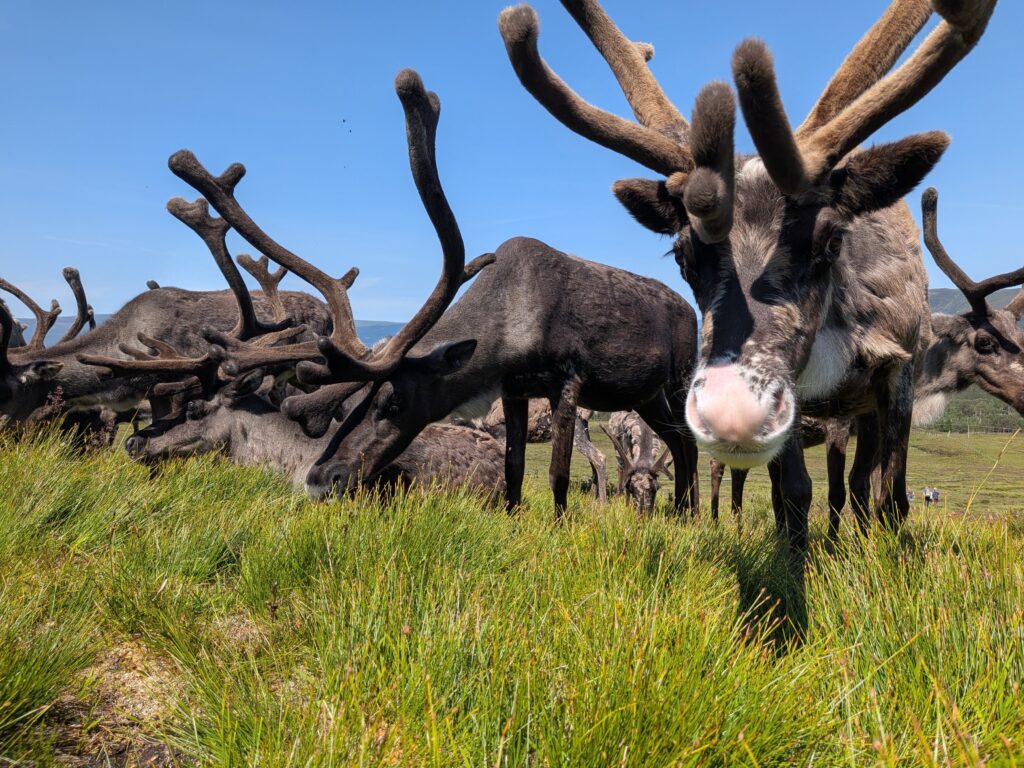
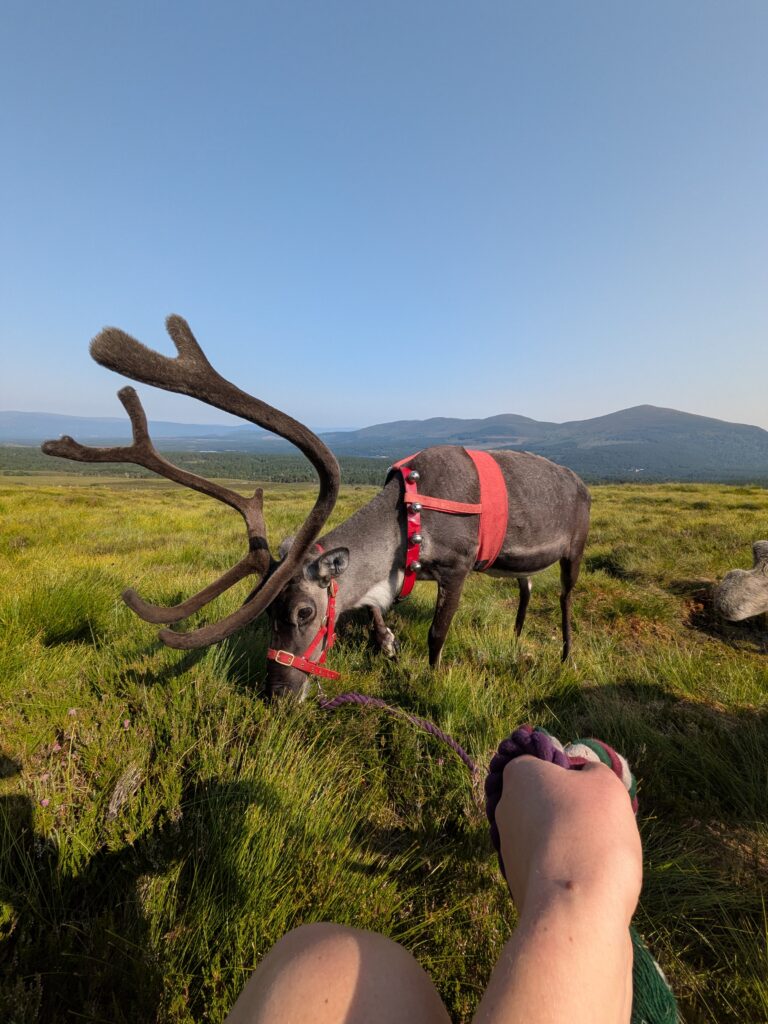
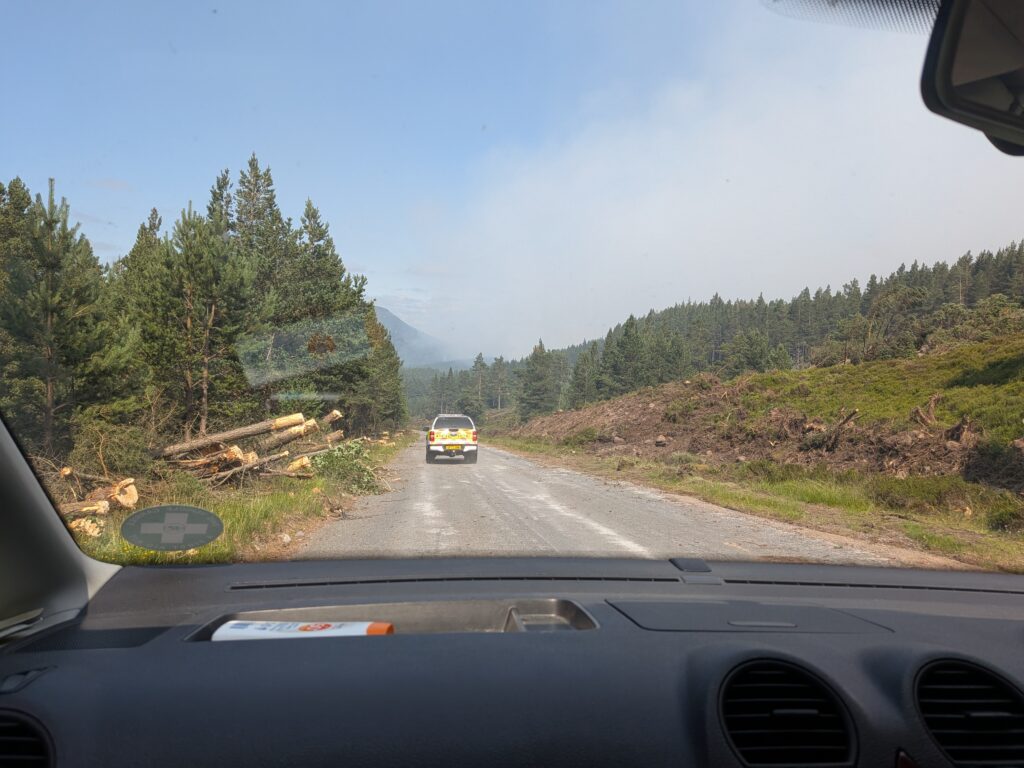
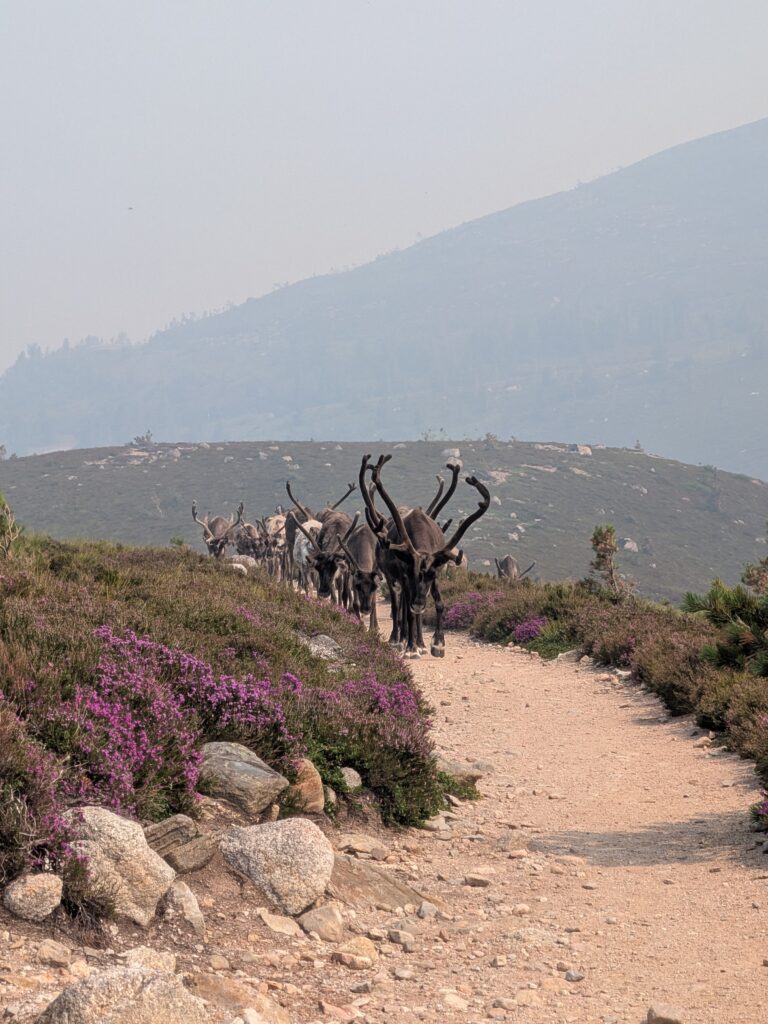
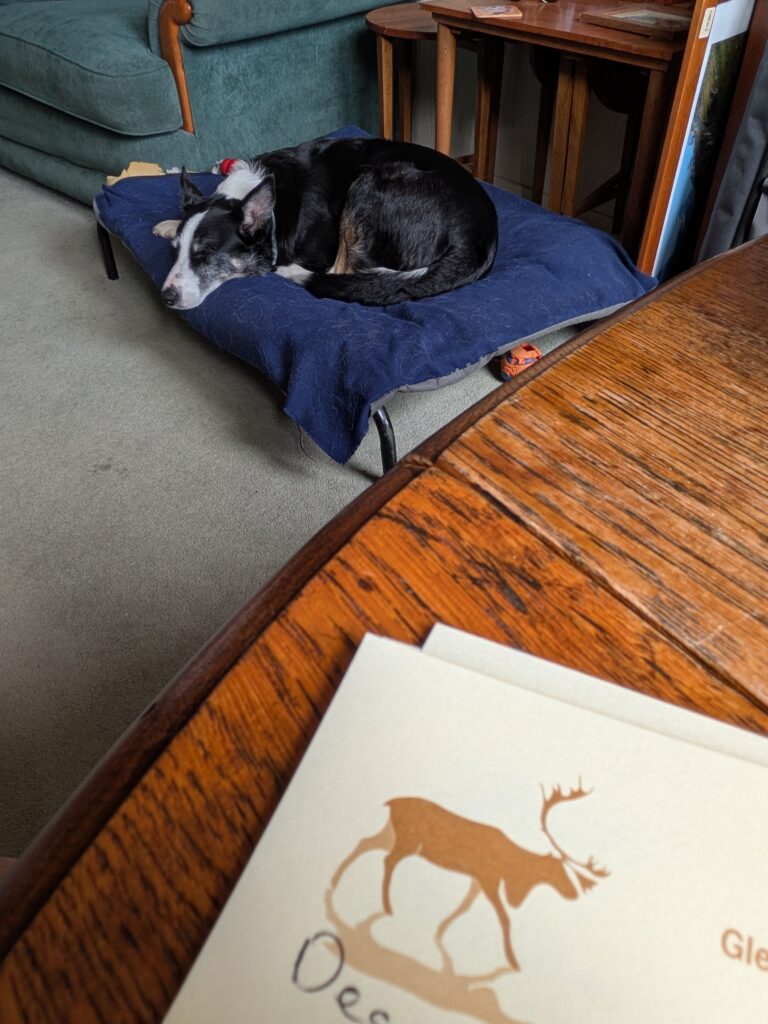
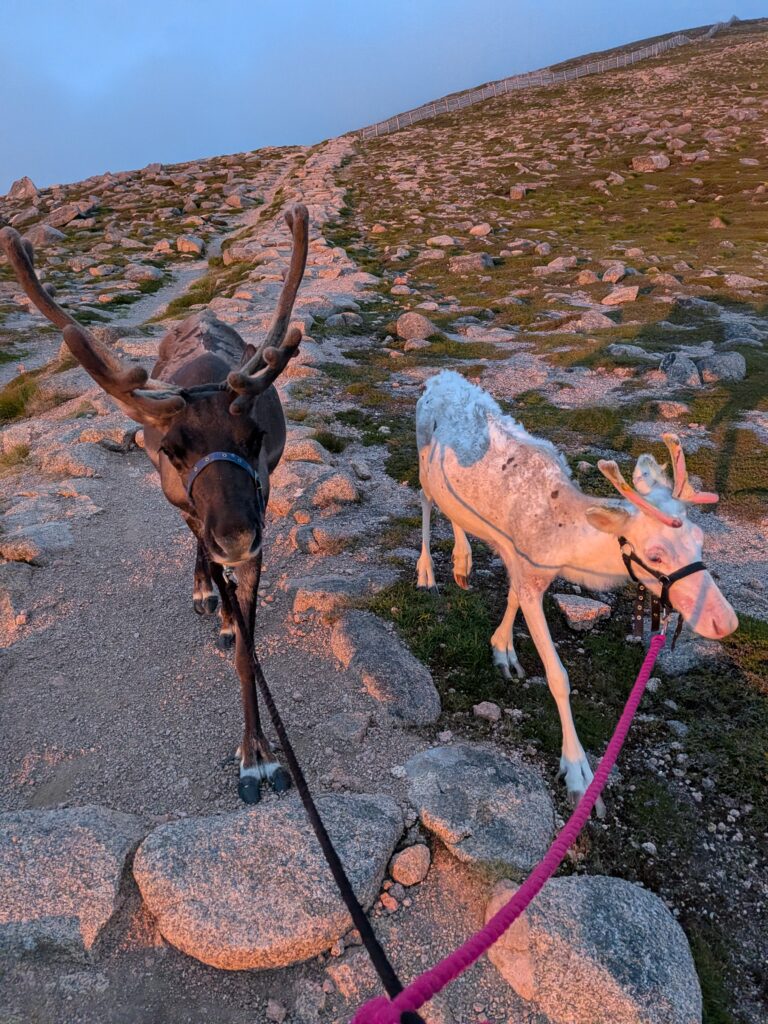
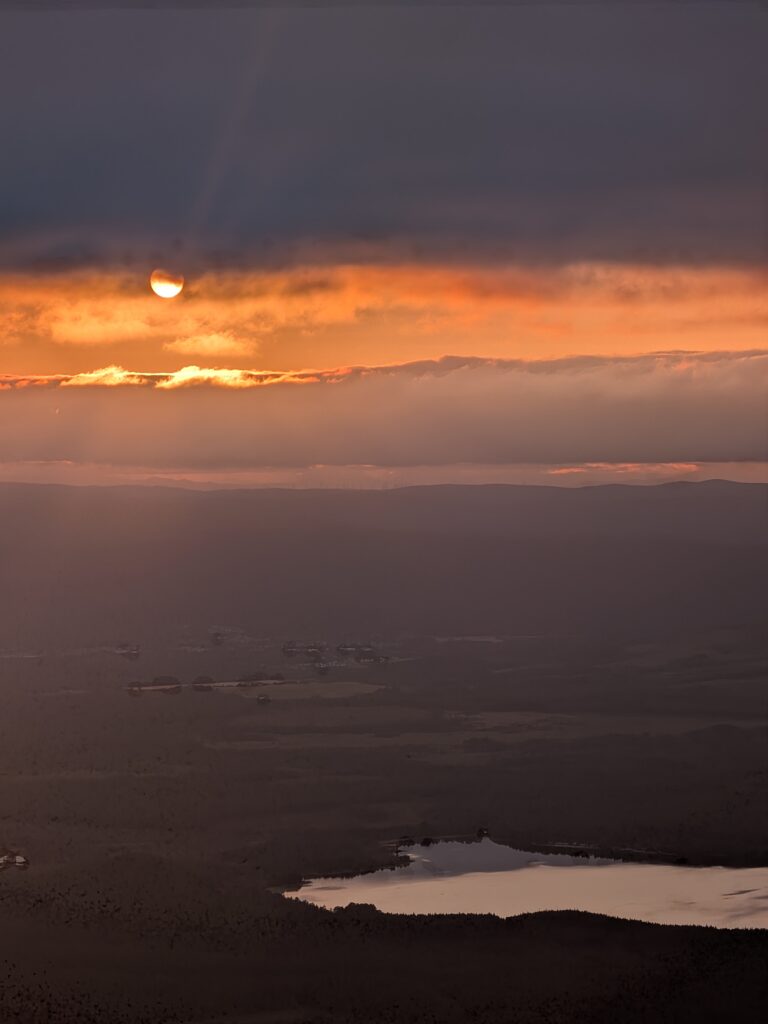
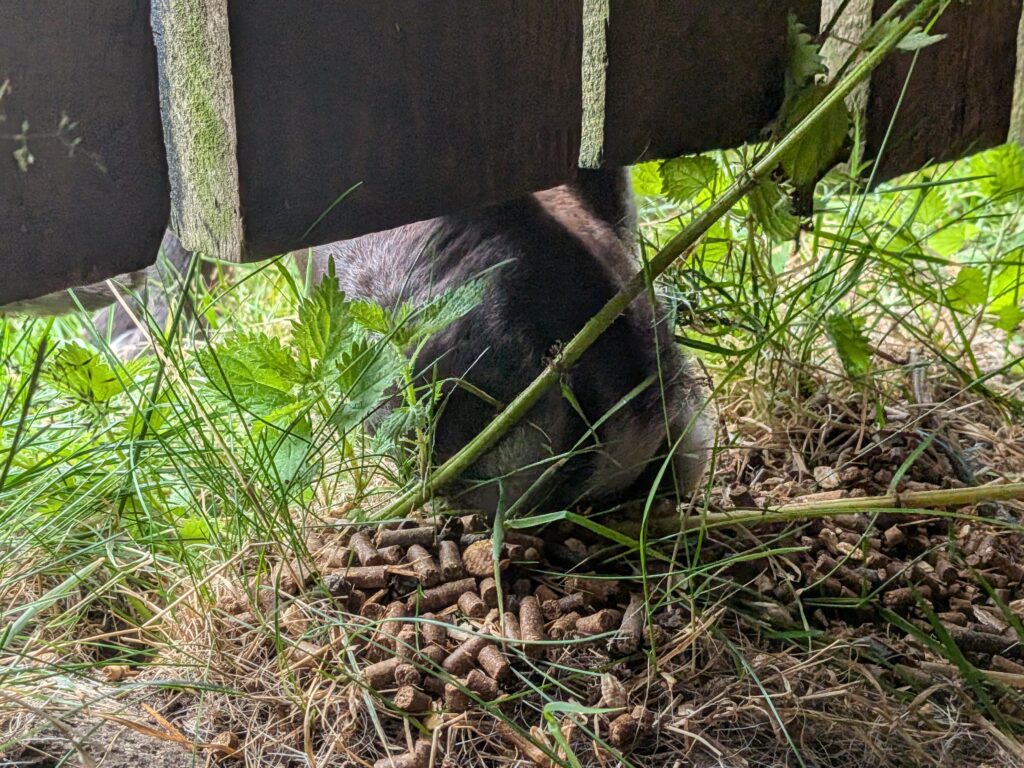
1st of July: Cappuccino and Mivvi on the morning feed line; still looking very scruffy.2nd of July : Adzuki after of our Hill Trips.3rd of July: Busby and Charleston with their Christmas harness5th of July: Brothers, Ob and Iskrem, were last in for their feed this morning- How handsome are they?8th of July: Stumbled across a leveret whilst walking through the enclosure (photo was taken with a high zoom so we didn’t disturb the little one)9th of July: You can probably tell from Mivvi’s face that it was a warm one!11th of July: It was fun to watch the reindeer emerge from the mist this morning.12th of July: Zap looking very handsome, he has a cracking set of antlers this year. 13th of July: A line of very sleek looking boys. Hemp and Yangtze are closest to the camera; it is a yearly occurence for Hemp to retain his winter coat longer than the other boys.15th of July: Part of the harness training experience is grazing with their harnesses on. Here is Elbe enjoying the early morning sun and lush vegetation.15th of July: At this point we realised that the fire had spread over Robber’s hill and was spreading quickly. 17th of July: After being given the OK to head out to the reindeer we had a police escort. It was quite a sombre drive as I had understood there would be a lot of damage done to the area by fire, but hadn’t thought about the necessary damage that would have been done in an effort to stop the fire from spreading. We owe a great debt to all of those who have worked to save Glenmore and the surounding area from fire.17th of July: Rocket leading the herd. It was a great relief to see the herd after pushing them out onto the free range. We moved the group along to an area that was less affected by smoke and checked that everyone was ok. 19th of July: In the days following the start of the fire, us reindeer herders felt a bit lost but you can always rely on there being adopt letters to be written. In the back ground you can see a sleepy Rowan, who is my fiery Collie.20th of July: A late night mission to locate some of the male reindeer that had been pushed out of the enclosure as a precaution – here are Mivvi and Morris.20th of July: This was Mivvi, Morris and I’s view (looking down towards Loch Morlich) whilst walking back down towards the hill enclosure.28th of July: Ob with the herd lying behind him.29th of July: Being ruminants, reindeer will regurgitate food to further chew it. Here is Yukon with cheeks full of partially digested food or as we know it, cud.30th of July: A fence being in the way is no match for Choc-ice when there is food involved.
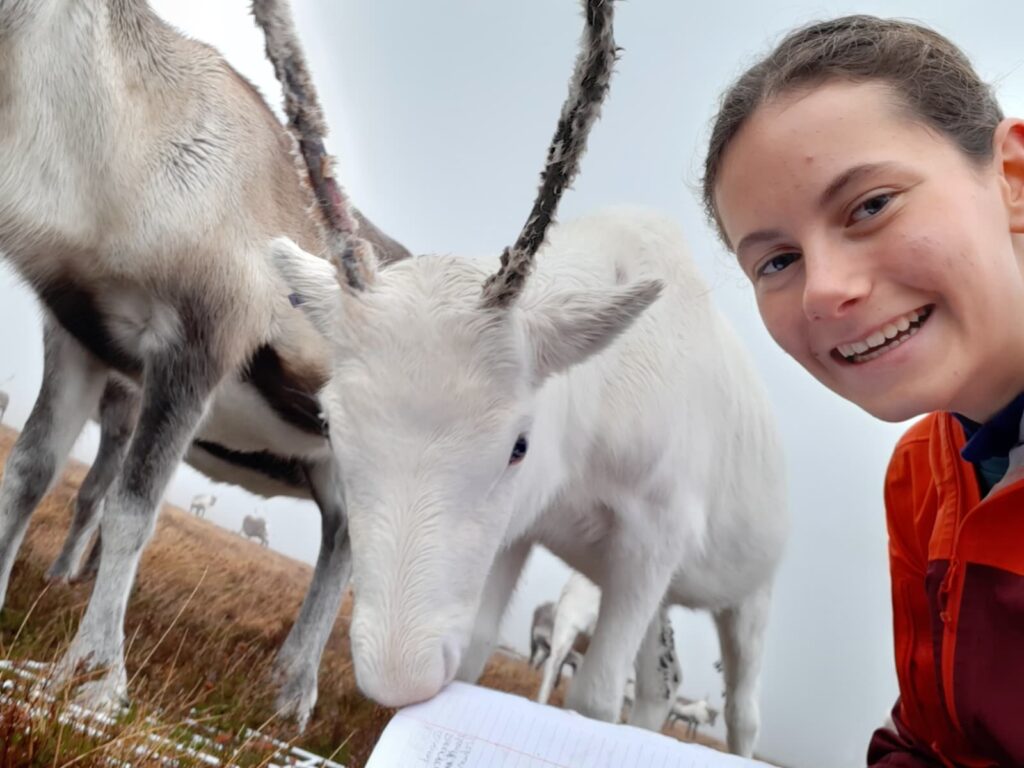
I am the youngest Scottish reindeer herder. Although many people think I’m older than I really am and it happens on a regular basis. I’m either on a hill trip or doing a paddock talk and there is always someone asking me, “how did you end up being a reindeer herder?” When I give people my answer I often hear a gasp. “What, you’re still in school?!.” Yes I am, and only 2 years left then I’ll be free (Im counting down the days practically). Another question always follows this: what are you doing after school? I dunno, I’ll figure it out but I know one thing I ain’t sitting at a desk for ten hours a day. The reindeer herders have learnt that I ain’t sitting still.
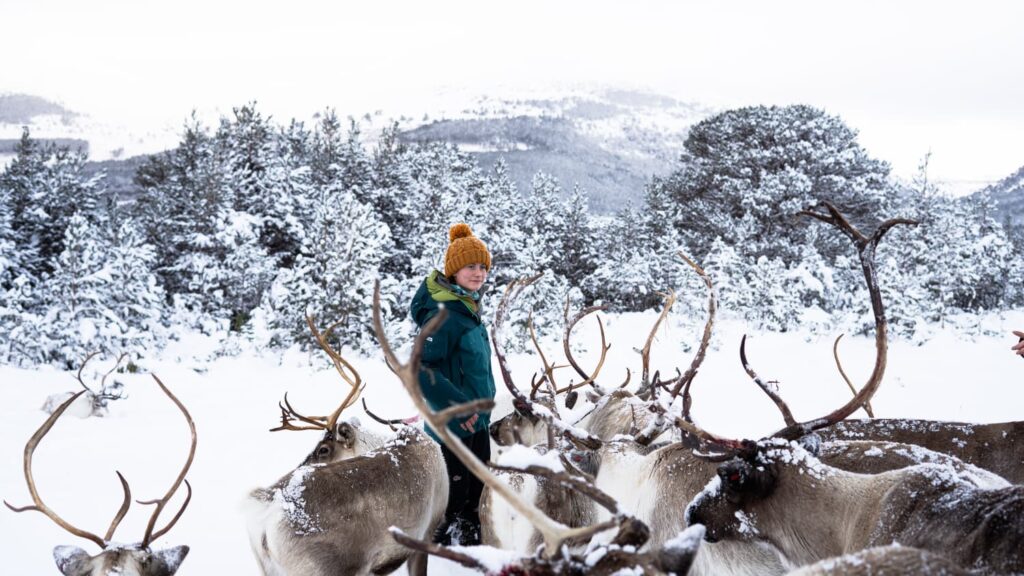
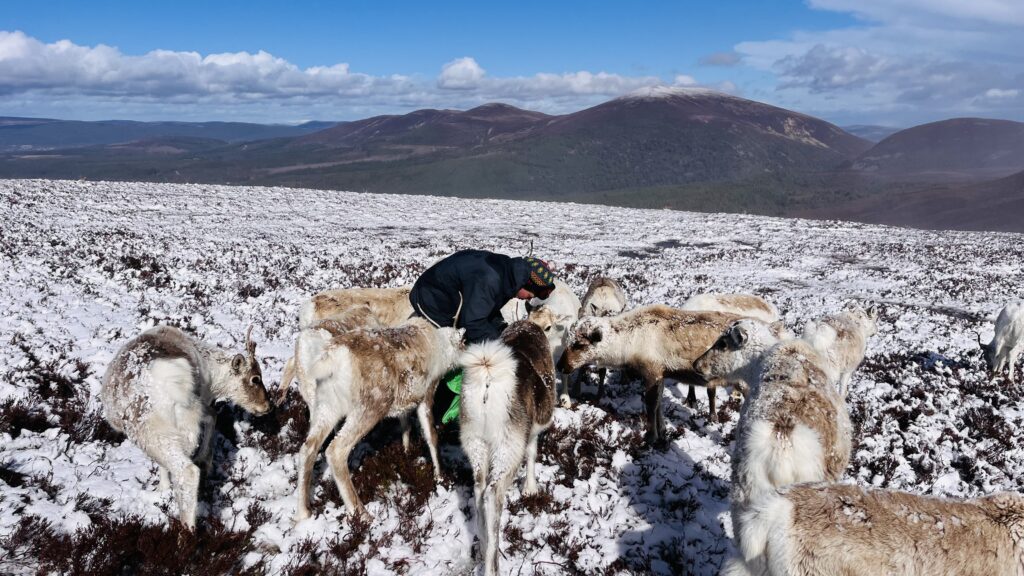
Maisy feeding the herd during a snowy start to 2026.
Although most people are surprised about my age of only being 16, and are really interested in how I have such an interest in reindeer and the hills, the majority of the people I meet are supportive. But you’re always going to have a couple of people who treat you differently when they find out I’m at school still. I get a bit disappointed when people treat me differently after I tell them because all of a sudden there is a switch, “oh you do something so cool, but I still know better than you”. I do sometimes find it can be a struggle being young in a professional environment – but I enjoy this. I get a chance to show poeple my knowledge and it helps me build confidence.
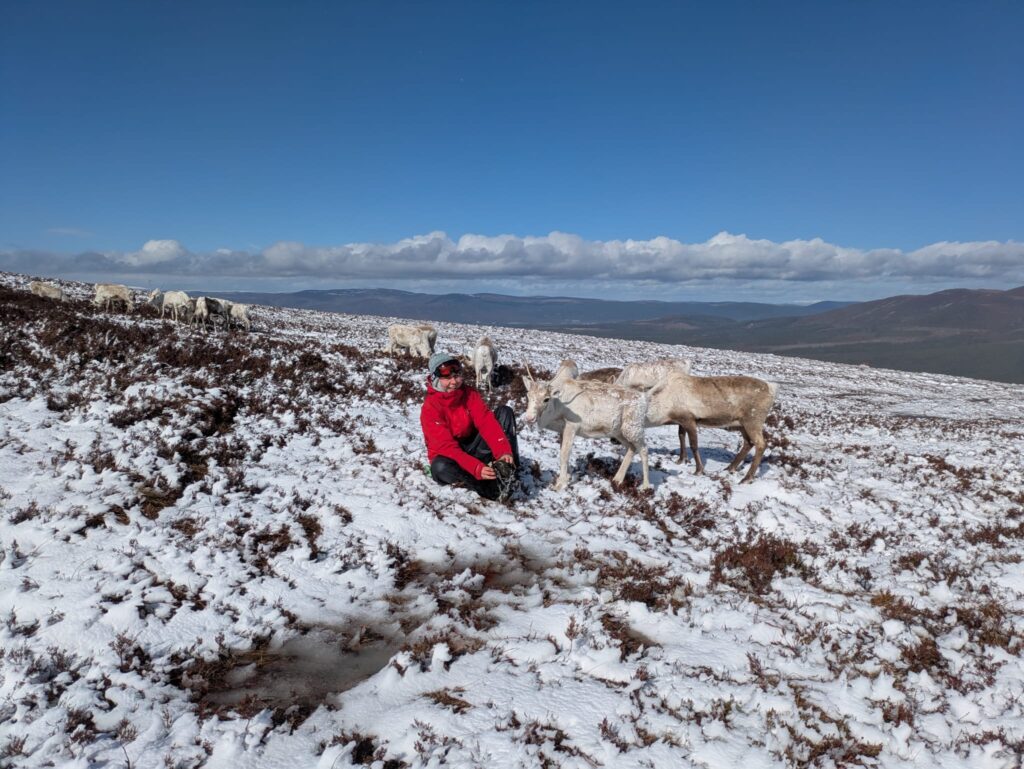
Maisy and Winnie both enjoying the sunshine!
At first hanging out with the reindeer I was just an extra pair of hands carrying feed onto the hill and maybe chatting to a couple of visitors on the hill trips. I was nervous, only 13 and had no experience of talking to big groups of people with no knowledge of reindeer. Now I can easily chat to 50+ people because I now have a love for reindeer. I want to get everyone else to know all their fun facts to know why the herders are here and how important reindeer are to the Cairngorms ecosystem. However, saying this I still will not do a presentation in school! Reindeer I can talk all day about, but in other areas I’m still working on my confidence.
Dante and Disco relaxing out in the hills during this years free range season, during one of Maisy’s many long hikes out to see them.
A strong memory I have of the first time I talked in front of 20 people was in horrible weather with Joe. Joe asked me to talk about handfeeding but I did it only because I wanted to get off the hill and back to the centre as soon as possible! I’m glad for it now – sometimes you just need a little push out your comfort zone to see what you can do.
Reindeer have grown my confidence from now being able to talk to lots of people, work in the shop, give paddock talks, and even answer the phone… The thing I really don’t like is answering the phone! Mainly because you never know what you’re going to be asked on the other side. If it’s anything to do with officey things or on the computers I have no answer. There is always me handing the phone across the room when it’s ringing. If someone is busy in the shop however and only me to answer I have the dreaded task of answering. Slowly getting there but I am still not a fan.
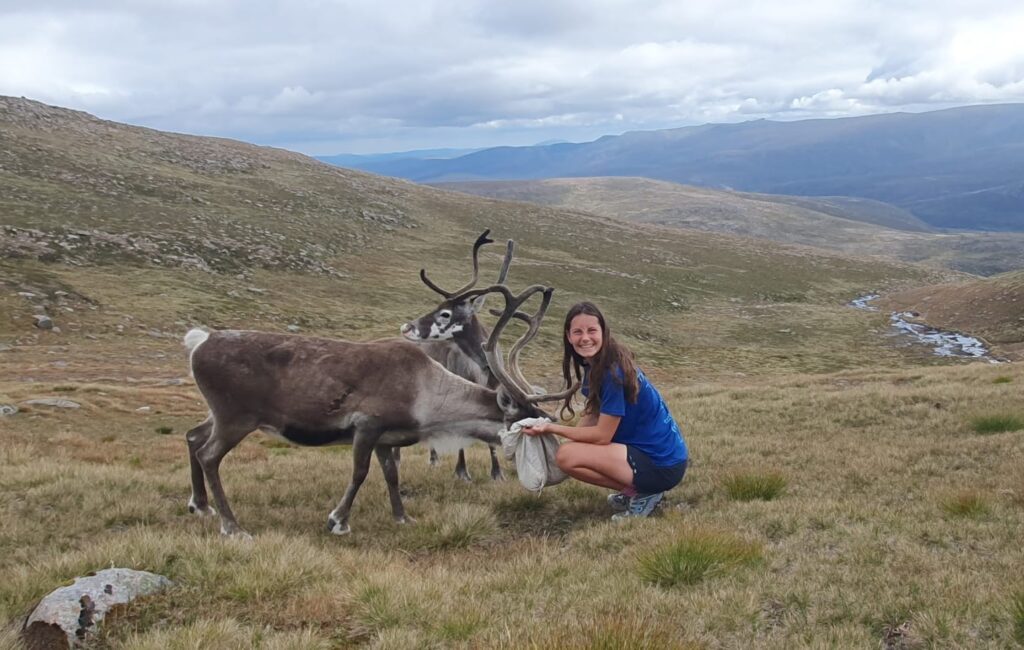
Maisy feeding Cheer and Chai in August 2025 during a hike – Maisy always makes sure her backpack has all the neccassary gear for finding reindeer!
It is obvious that reindeer herding has boosted my confidence massively and I’m slowly gaining more responsibility and trust with the herders. At first I was just an extra person on a hill trip but now I get to help with the talks and help run them.
Amazon looking her absolute best on a morning free range mission in April!
In school they know I hang out with reindeer. This year I had the delight of giving my English teacher a 15 minute talk about The Cairngorm Reindeer Herd. Fun fact, my English teacher even taught Fiona… For my national 5 geography assignment I looked at how reindeer affect the vegetation cover and the different species of vegetation where there is a change in population of riendeer. My results showed that reindeer are creating more diversity of plant species. (If you want the results email us and I can send them over.) By doing this project it also meant I spent a few hours roaming on the hills. However it was revolting weather with no visablity whatsoever but it was still fun!
Morris helping Maisy with her studies of the vegetation growing along the top ridge of the Hill Enclosure.
A favourite memory of mine… In the summer on a Friday afternoon off the school bus, I was tying my shoelaces about to go for a run up Meall a’ Bhuachaille with Froach when Hen answers the phone from Amy saying she’s found some reindeer in Glenfeshie. Hen looked at me, “Maisy, what are you up to this afternoon?” There I was forgetting about Fraoch and my run and off we went up Glenfeshie to go find some calves and Amy. Not a bad Friday afternoon!
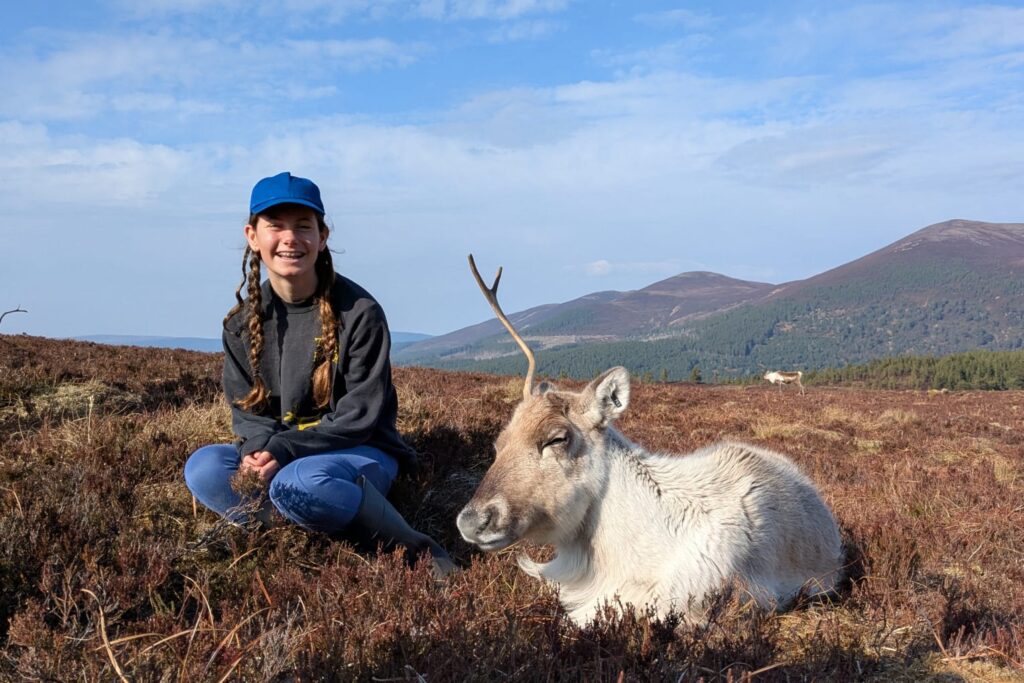
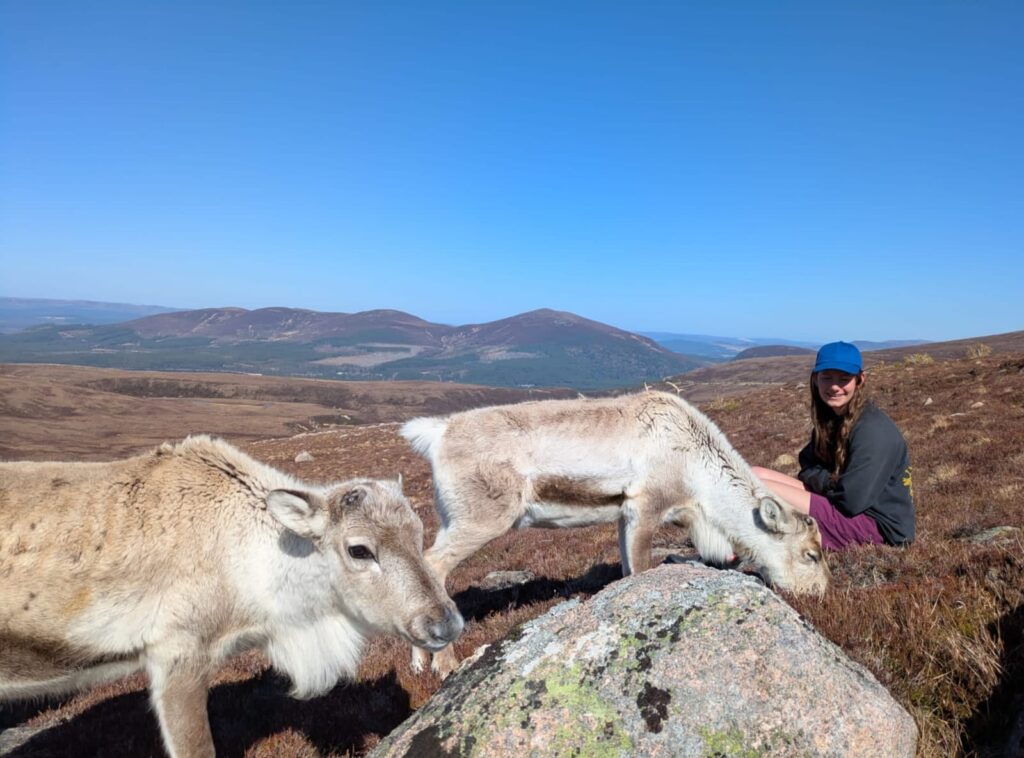
Lochi resting on a sunny day out in the hills. Maisy sitting with Winnie and Alba out in the hills after a free-range trip.
It took me a while to get used to being comfortable around the reindeer just because they are animals and I was still unsure of what their next steps were going to be. However now a few years down the line I’m comfortable with having reindeer brush up against me and try to calm a situation. From working with the reindeer my confidence has boosted and people in my life outside of reindeer can see that. This year was my first proper calving with working a lot more often during the weekend and my study leave. The calves are such sweeeties!
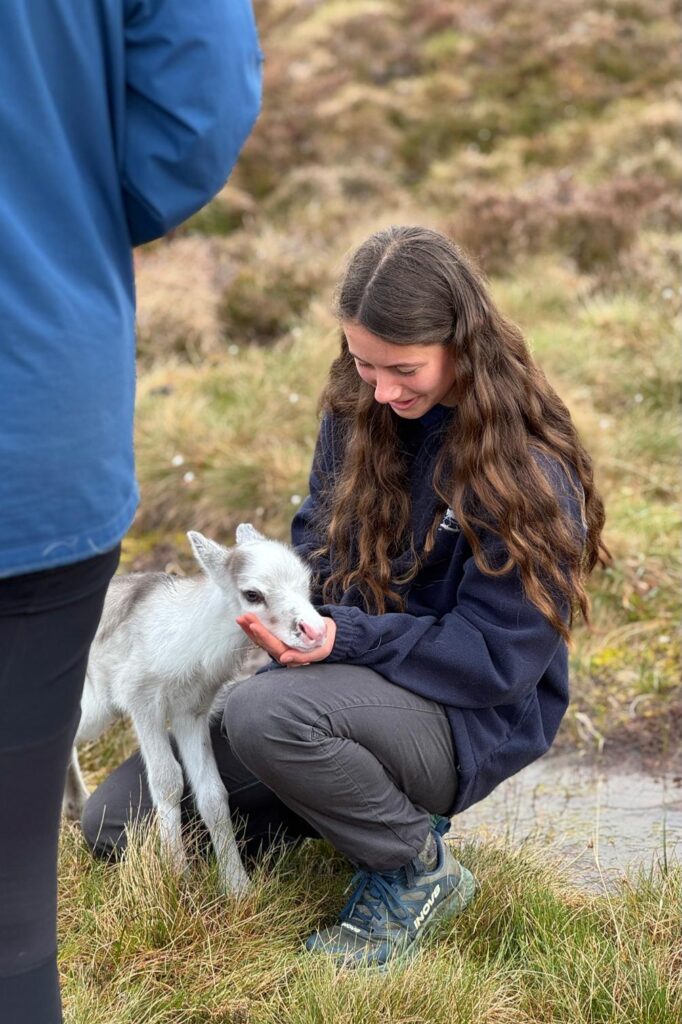
One of the first calves I met this year and my jaw dropped when I saw this guy. This is Texels calf and is just the sweetest little thing.
I think young people should get the chance to work outside with animals and in the outdoors more as so many young people are not getting opportunities to try many varied environments of work. I have found my own self confidence and knowing many young people struggle with this, it would benefit many. Working with reindeer has made me realize that I’m never going to want to get an inside office job mainly because I would probably explode if I were to sit still for 8 hours a day! I know there are lots of young people just like me that are meant for outdoor jobs and volunteering and working with animals gives you a chance to explore that. I’m also grateful for the resposibility and to find a group of people with interests just like mine. Sometimes you just find the right place where you belong!
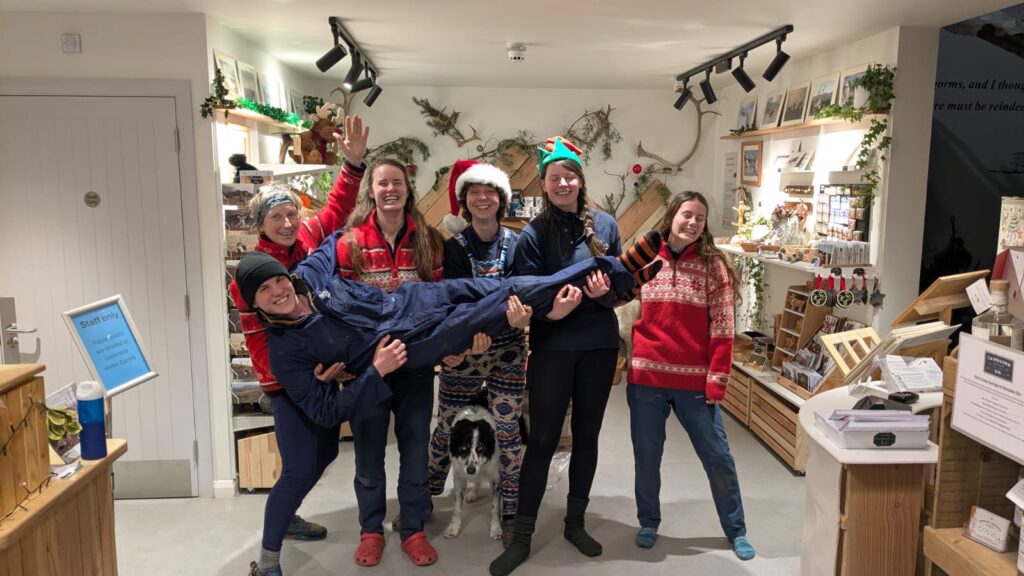
Cameron, Sheena, Lotti, Daisy, Echo, Amy, and Maisy – Christmas Fun Crew, 2025!
Daisy: It was morning briefing in mid April and we were contacted to inform us the reindeer had moved right up onto the mountain plateau not too far from Ptarmigan Station. This was going to be a pretty long walk for us to make it up to the reindeer, find them in some pretty interesting conditions, and then herd them down off the mountains to one of our free range visit spots. Thankfully, Cairngorm Mountain staff came to the rescue!
Andi: A quick phone call to Cairngorm Mountain and they were happy to help us with a ride up on the shiny Funicular Railway – a unique scenic ride which is a destination in itself. For us, this would save us around an hour of uphill walking in blizzard conditions, and made the difference between needing to abandon our Hill Trip plans (with lots of hopeful visitors already booked) and hopefully managing to retrieve our reindeer in time for everyone to enjoy meeting them.
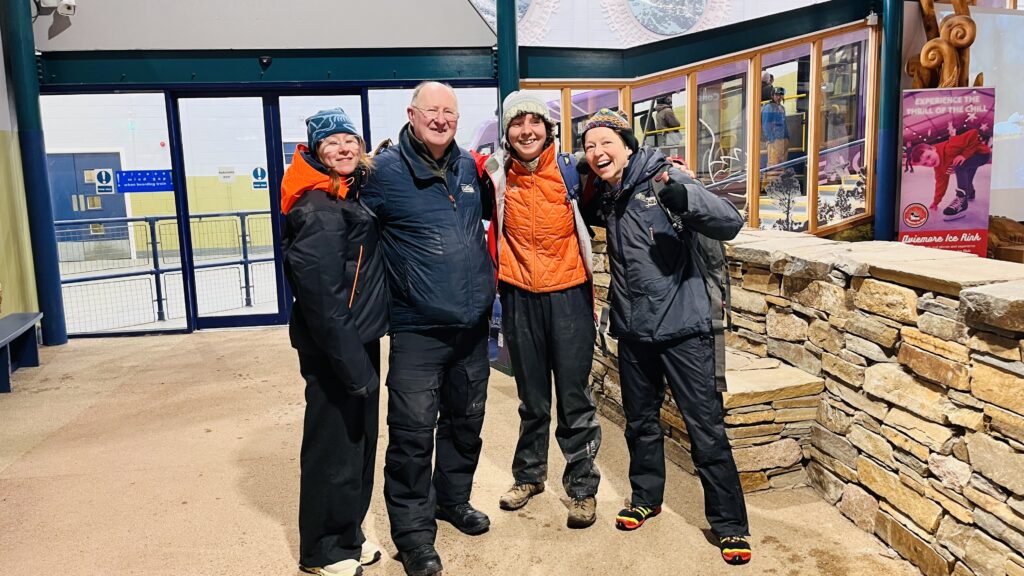
Thank you so much to the Cairngorm Mountain staff who let us hitch a ride on the Funicular to the top of the mountain!
Daisy: It certainly felt like setting off on an expedition that morning with Andi. We had all our gear on, map and compass in our bags alongside lots of reindeer food, and jumped on the mountain railway. A really cool way to start off a herding trip for the day! I actually had never riden the train up the mountain before so we grabbed a front spot and watched the snow get deeper and the visibility worse.
Andi: Travelling from Glenmore, where it felt like spring, to the ski car park, where it was cold and wintry with a little snow, it felt like we were going to a different world as the train took us into the cloud and the weather closed in. Definitely a day where knowing that you have a storm shelter in the bag is reassuring!
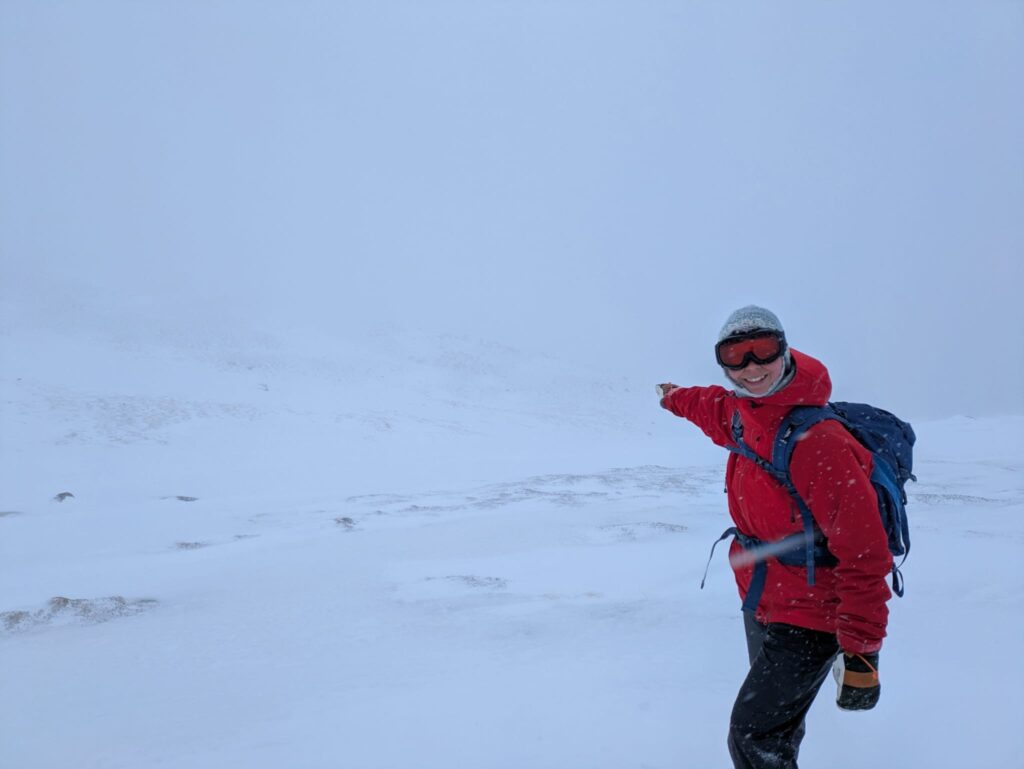
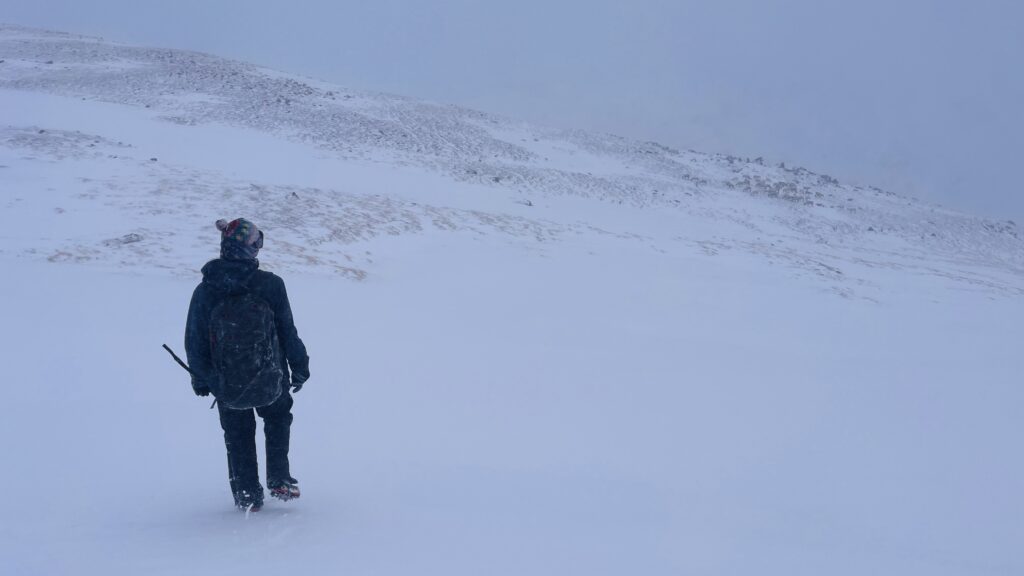
Daisy: As soon as we stepped out of Ptarmigan, we were hit by a pleasant enough breeze carrying some of the snow down the mountain. I pulled my microspikes onto my boots and my ski goggles over my eyes, and followed Andi along a snow fence and up away from the restaurant and Cairngorm summit. A few patches of deeper snow to stumble through, and a lot of frozen ground and sheets of ice that made for nice walking with the spikes on. We crossed past the final lift before the plateau and set off into a frozen, snowy, rocky landscape with little to no visibility. It’s funny to think how many people wander the plateau and hike these beautiful mountains throughout the year, because in that moment it was like we were the first people to explore what felt like a different planet.
Andi: Whilst I’m pretty familiar with our local mountains, having pottered around after reindeer for the past 15 years, it is a whole different ball-game in a blizzard. Visibility was between 10 and 30 metres, and it is so easy to see how people get completely disorientated. It takes a lesson in trust to believe the compass bearing when your brain can play tricks on you, making you think you’re heading in the opposite direction.
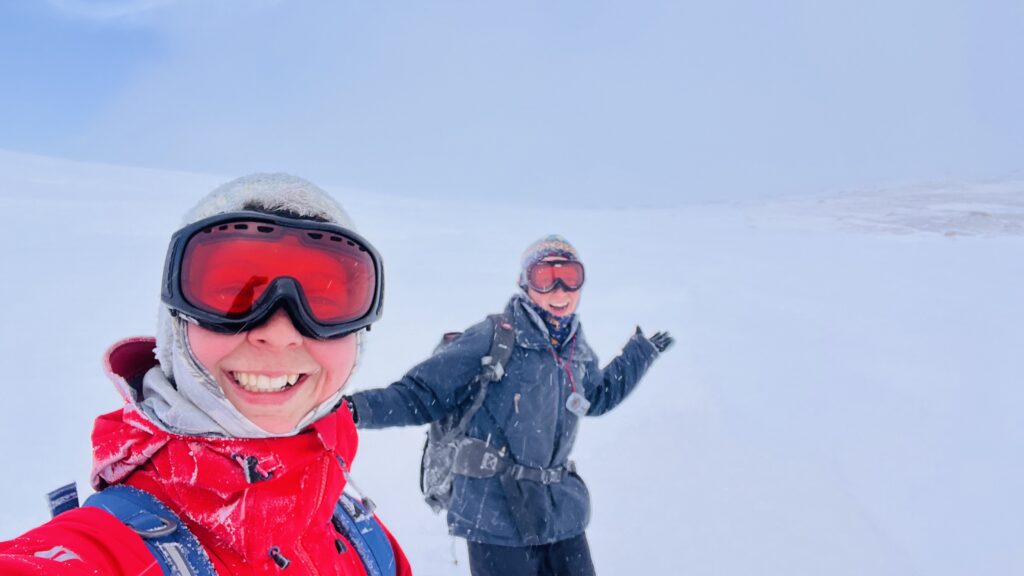
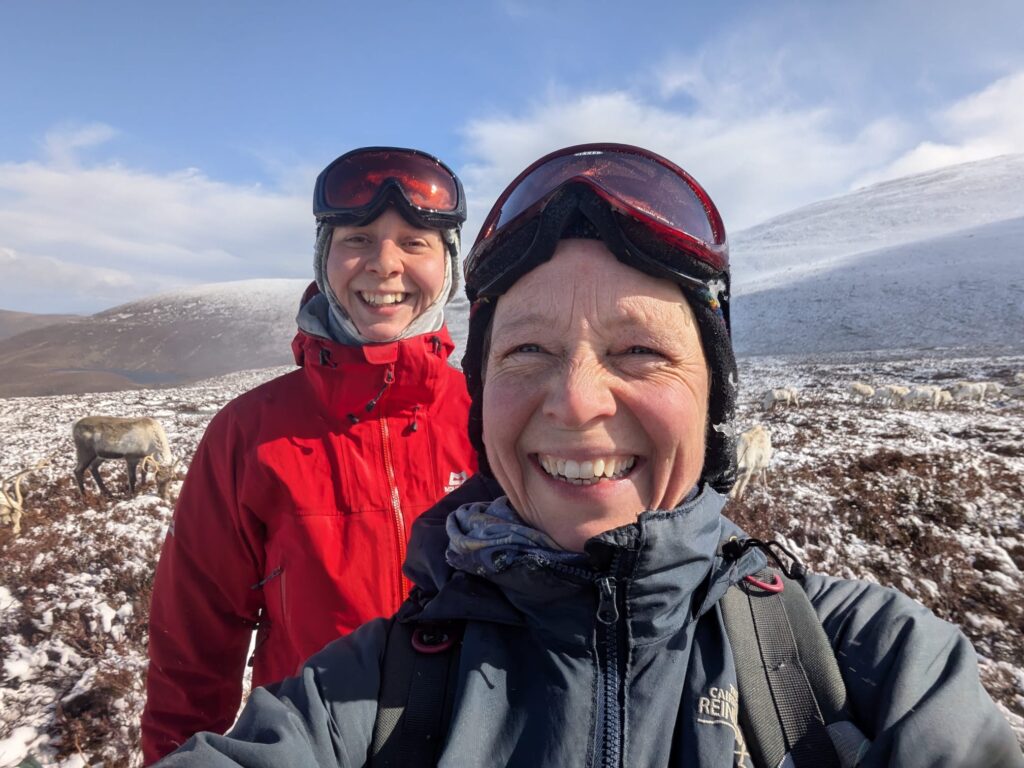
All smiles navigating to the reindeer in white out conditions on the Cairngorm Plateau.
Daisy: We used a combination of a good old trusty compass and Google Maps to navigate through the white out. Despite the freezing temperatures and snow that was blowing up off the ground, we were actually nice and toasty in very excited high spirits the entire time. Looking at the satellite imagery on Google Maps of roughly where we knew they were, I made up names for all the features I couldn’t see in front of me, and was probably really reassuring to Andi when I kept repeating “the reindeer should be at the bottom of the orange segment just in front of us”.
Andi: Between Daisy using the tech to pinpoint where the reindeer should be, and me keeping us on a compass bearing with the old-school methods, it felt like we had a plan! It was reassuring having two brains on it, keeping each other right and cross-referencing to ensure we were on track. Most of our reindeer herding is not done in a white-out, so it was a fun challenge to be testing out our nav skills.
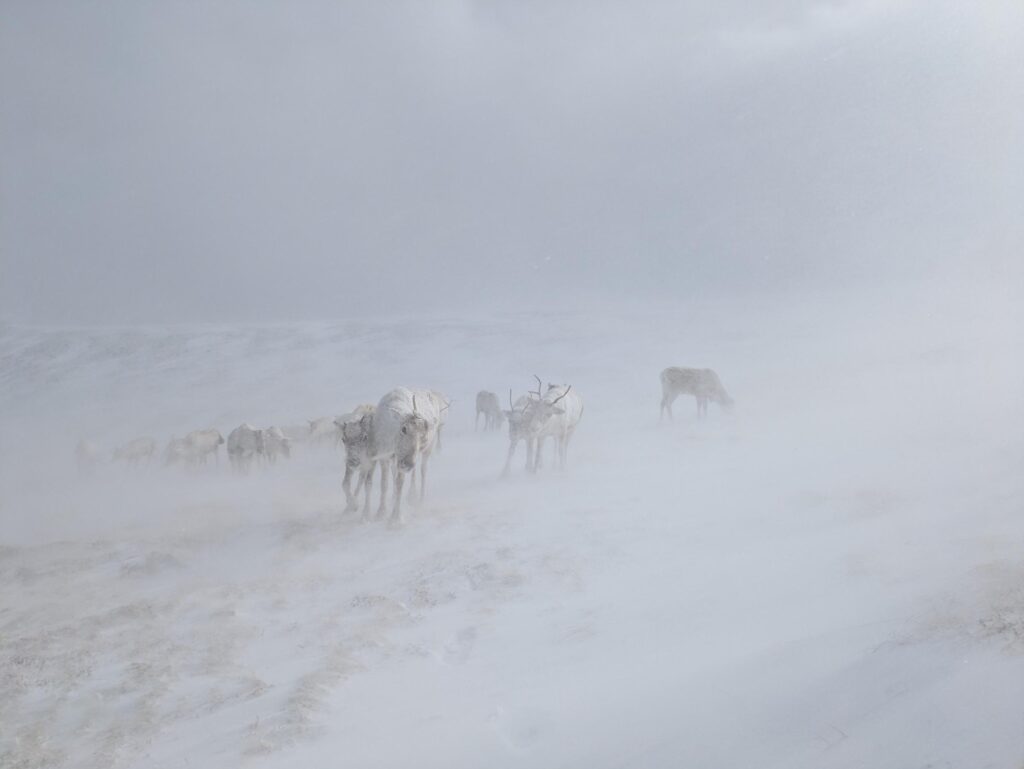
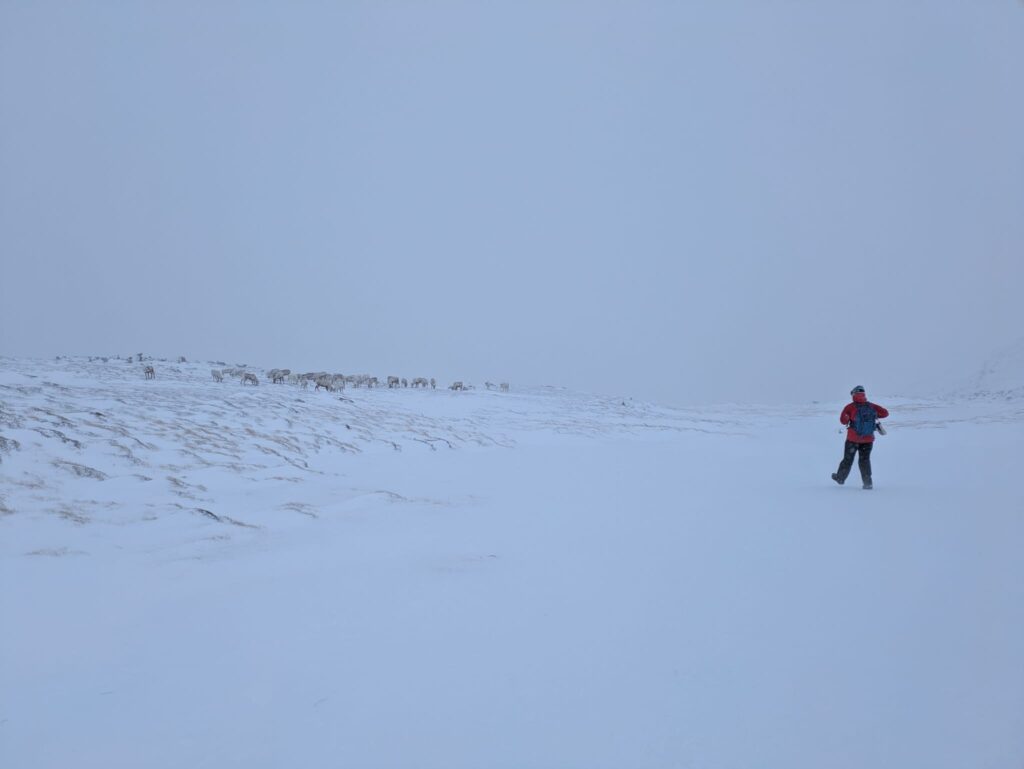
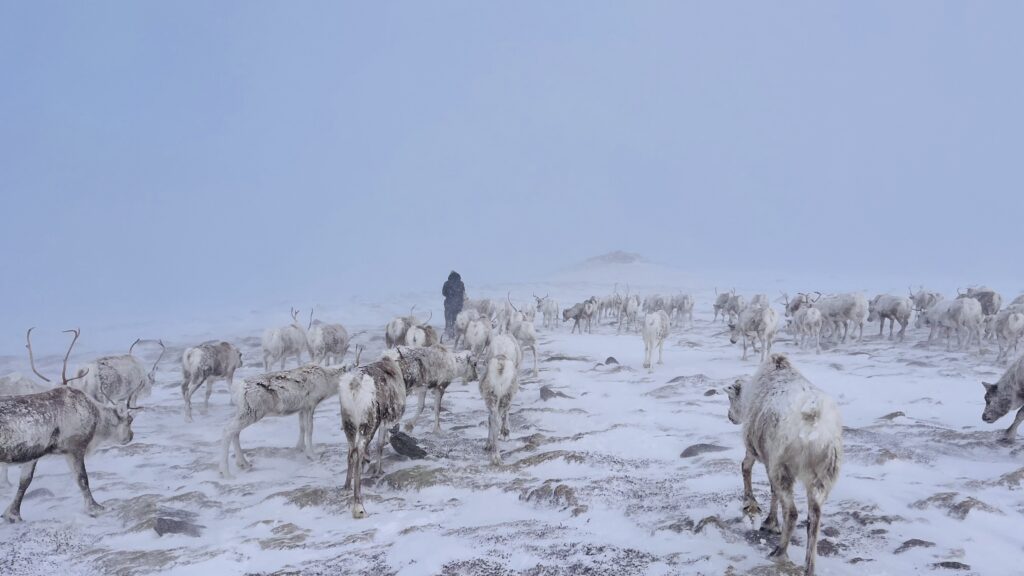
We found the herd! (Trust us, they are in the photo…)
Daisy: We came to a stop and scanned the landscape, the reindeer should have been metres from us at that point. Then like magic, some cloud lifted and Andi pointed off into the distance: “Reindeer!”. There they were, 73 reindeer hunkering down on a hill edge. Several cheers followed as we dug our spikes in to descend a small ice sheet to get to them.
Andi: I was glad to have a fair bit of experience picking out a herd of reindeer on a hillside, as their camo was excellent, but something in the shape/shade of these particular bumps ticked the box of not just being rocks! It felt like such a prize to have managed to follow our bearings directly to them.
Can you spot the reindeer? The hard part’s over right?…
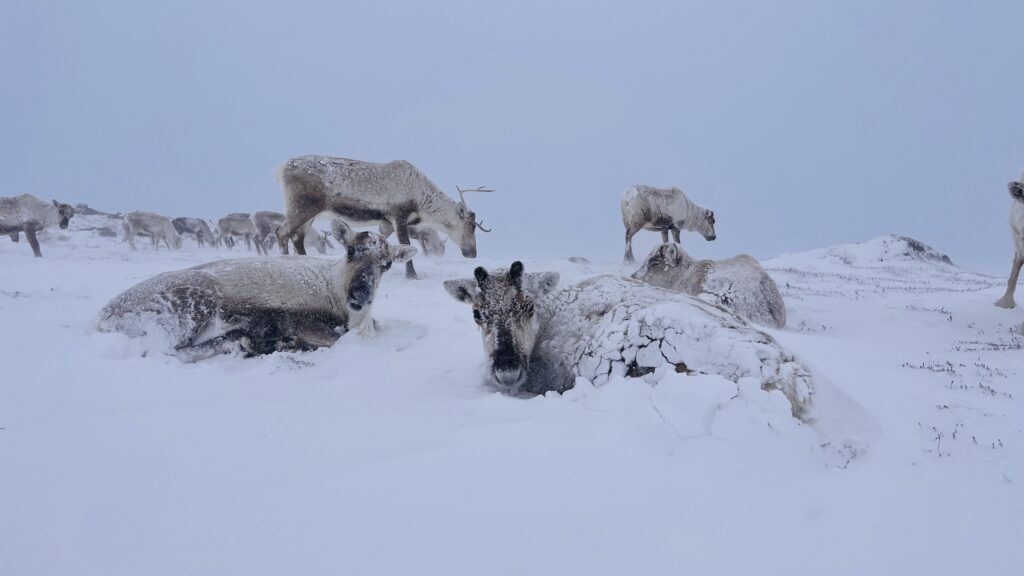
Daisy: It was my first time seeing how effective a reindeer’s coat is against heavy snow and winds and it was amazing to see the snow piling up against them. As I got nearer and walked around the back of the herd to encourage them up, I could see just how cold it must have got overnight with all the frozen snow and ice on them – not bothering them at all!
Andi: It amuses me how reindeer are so blase about weather, actively choosing to wander up to exposed ridges in the worst of conditions. There is actually method in their madness, as wind will blow snow off the ridgeline, meaning they have to dig less for food, and there is also less risk of getting stuck in a snow drift. But still!
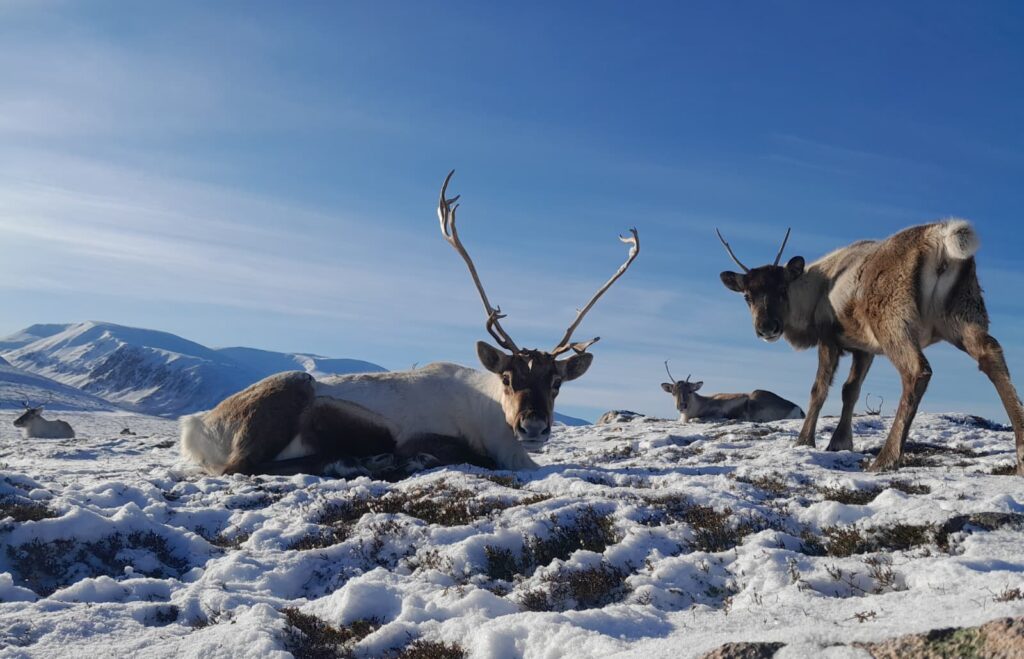
Thanks to the hollow guard hairs that make up the outer layer of a reindeer’s coat, the snow doesn’t melt on them. This keeps them warm on mornings like this, lying in the snow at -4.
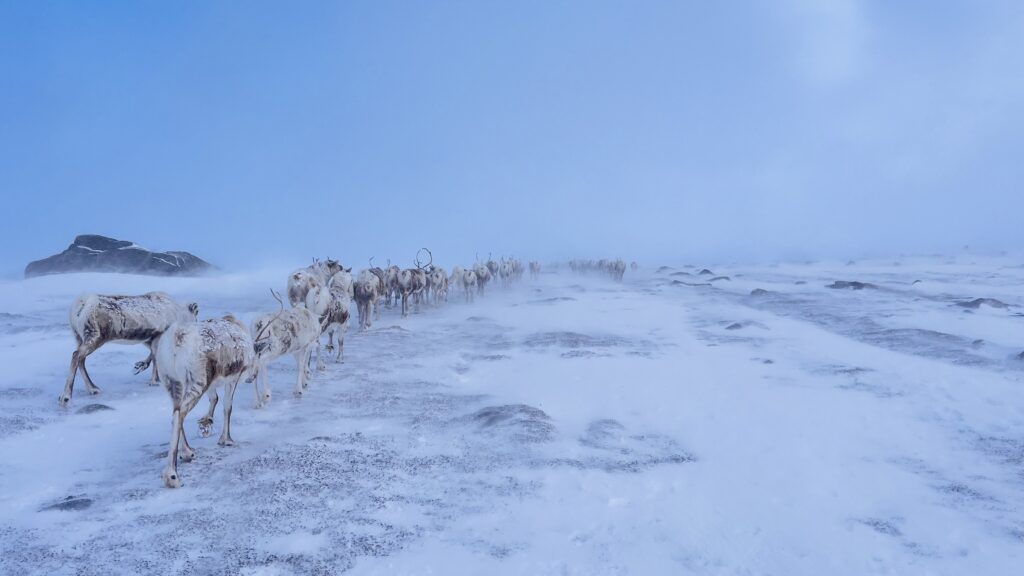
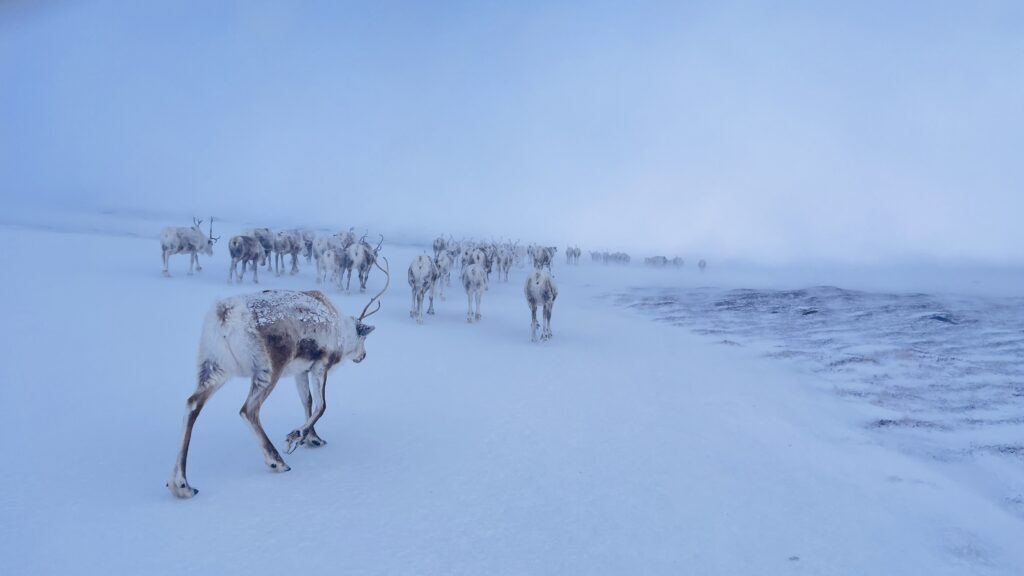
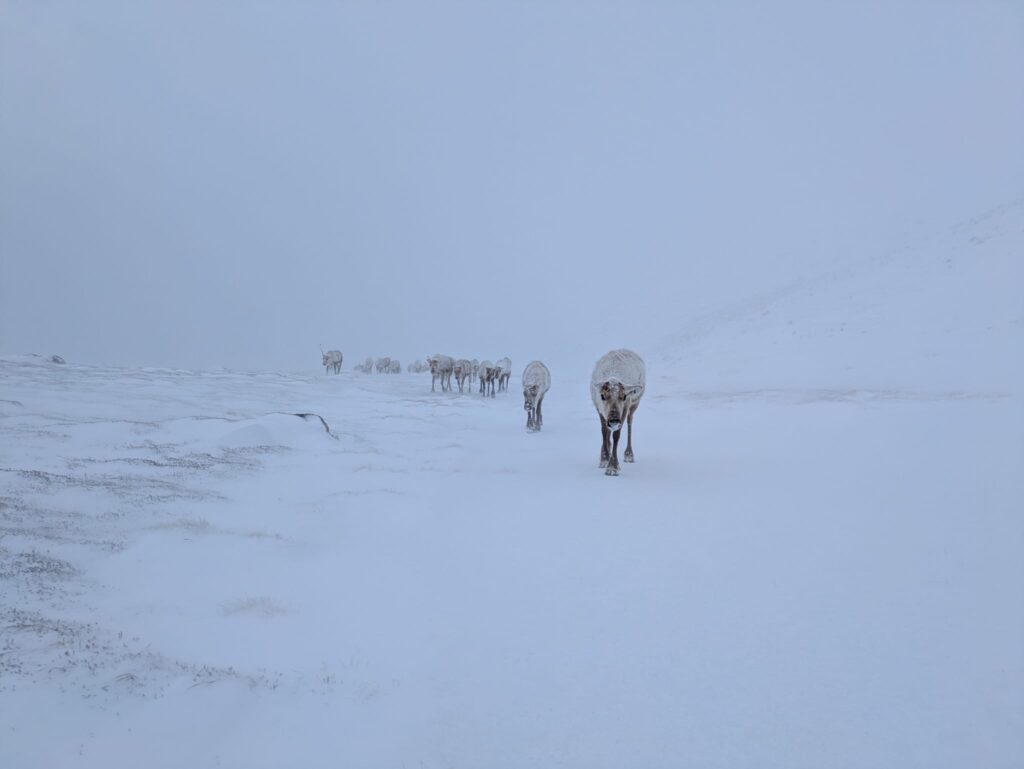
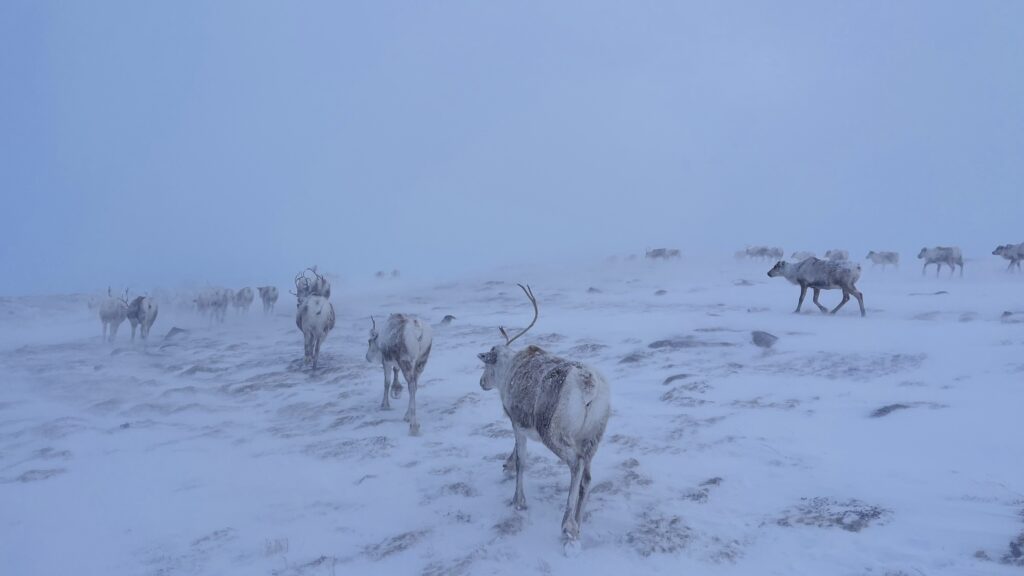
Daisy: With the herd up and already eager to follow Andi, we set off into the white to move the reindeer off the mountains and down to much lower ground. It wasn’t long before the winds started to pick up and throw quite a bit of snow at us. The herd stuck together really well and I got my first experience of how they stay together in low visibility. Usually they spread themselves out a fair bit when on the move, some will stop to graze and take their time – but in the harsh windy conditions and terrible visibility they were staying close as a herd the entire time.
Andi: The herd were in a very co-operative mood and as I set off in the right direction, shaking a bag of food, they all trotted after me. I tried to set a pace where the herd were close enough to me that I could still see Daisy, who was following at the back. It felt sensible to be able to keep an eye on each other!
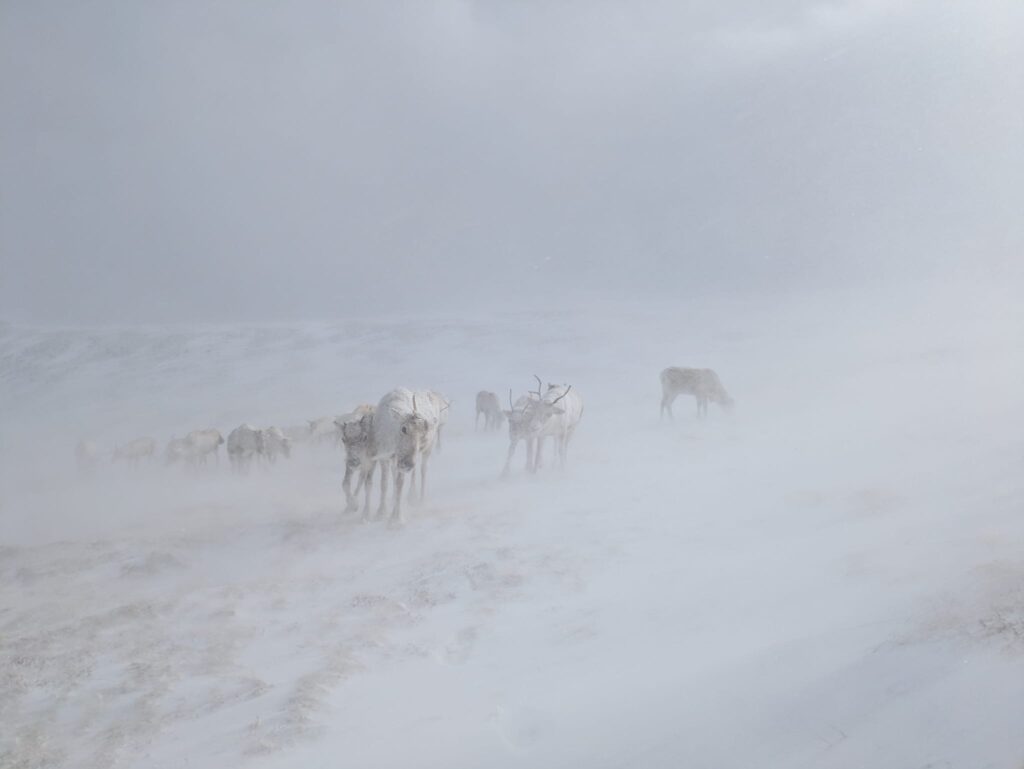
The winds started to pick up as we got lower, here you can see gusts of snow blowing up from the ground and gusting into the herd.
Daisy: I’m glad that it was actually probably the easiest herding I’ve ever done, the reindeer wanting to get off the windy plateau as fast as we did. It gave me plenty of time for photos and to take in how amazing the experience was. Plus I was able to focus on my own struggles in the wind – like making sure I didn’t get blown over every 30 seconds!
Andi: As the wind buffeted us, humans and reindeer alike, I had to stop myself from feeling guilty that the reindeer were in these conditions, reminding myself that they had chosen to come up this high themselves!
Daisy was pushing the reindeer from the back, watching them disappear into the snowy winds ahead. As Daisy watched them disappear, Andi watched them steadily appear following her to lower ground.
Daisy: I was so grateful to be at the back! Apart from making sure I kept up with the herd, (which did involve the occasional sprint whenever they ran on ahead to regroup around Andi – slightly stressful as I’m much slower than a reindeer!) I at least didn’t have to worry about navigating. Andi had to lead 73 reindeer and one herder down off the mountains following just compass bearings!… I did not envy that task at all.
Andi: When fetching the herd, we generally take turns at either leading or pushing. Today Daisy had volunteered me to lead, as I knew the hills better than her so there was some theory that I would pick a good route. In reality, I’ve found it’s a case of heading in roughly the right direction, glancing back at which way the savvy reindeer are going, and repositioning yourself to be in front of them, which makes it look like you knew exactly what you were doing… The reality is that the reindeer spend their whole lives in these mountains and know them far better than any human. Once you have the herd on side, the job of leading becomes much more straightforward, though it is the first time I have brought reindeer in whilst using a compass!
The visibility continued to get worse, but thankfully Winnie (seen in the middle here) kept Daisy company at the back the whole way and made sure she didn’t get left behind!Andi leading the herd solely using compass bearings!!
Daisy: The further we got and the lower we started to descend, the higher the wind speed increased and the snow began to feel like needles being fired at us. I quickly lost any feeling in my face, and loved watching how the reindeer turned themselves into the wind, the cows with their calves sheltered alongside them. While I struggled to stay balanced on my feet and really starting to feel the cold bite – the reindeer were in their element! Sticking together as a herd and following the hoof prints of the reindeer in front of them.
Andi: Whilst the reindeer made it all look easy, the conditions were not so easy for us humans. As we began descending we encountered more deep banks of snow, which resulted in a couple of complete face plants for me! The look of confusion from the reindeer at how useless us two-legged-creatures are was pretty funny!
Andi’s view of the reindeer fighting against the wind gusts as we dropped off the plateau. The wind speed was gusting up to 72mph during our herding mission!
Daisy: We had finally made it low enough that the cloud cover began to lift and I could see all the recognisable land marks to suggest we had nearly made it! We had one last push over a steep bit of rocky ground that proved quite difficult to navigate in the high winds and deep snow – at this point I had stopped bothering with my count of how many times I’d fallen over in suprise patches of knee deep snow. The reindeer were even bracing the final harsh whips of wind for some lichen grazing! The last stretch to the visit spot they picked up pace downhill towards Andi and I watched as they swapped to a very wide gait in the way they were running. It looked pretty comical – their legs so far out to the sides as if they were going to skid on their bellies at any moment, but worked perfectly. Their hooves hardly made a dent in the snow and they kicked through patches of powder at speed. I did attempt my own version to see how effective it would be for a person, and even tried to keep my boots in their hoof prints. You guessed it… I built up a lot of speed before hitting the snow hard and my arms disappearing in front of me. Thankfully only Winnie saw, who gratefully had kept me company the entire walk. I won’t be trying to run like a reindeer again anytime soon!
Andi: By the time we reached our ‘visit spot’, we were low enough to drop down out of the cloud, the skies were clear and there was only a smattering of snow on the ground. We fished out the reindeer feed from our backpacks and the calves tucked in – we give them a brief preferential feed through the winter. The adults know the drill and waited patiently, then we popped out a line of feed for everyone. A quick headcount – everyone was present and correct.
Andi couldn’t get the bag of feed open quick enough for the hungry calves after the long journey. Look at the difference in the weather at a couple of hundred metres lower altitude.Boogie helping Daisy get frozen spikes from her hiking boots.
Daisy: We had done it! Thanks to Andi’s amazing navigation, we had successfully led the herd of 73 reindeer from the mountain plateau down just in time for the days Hill Trip! We fed the hungry reindeer and checked we had everyone and they were all looking happy and healthy and then had a moments breather to chat about how amazing the experience had been. I can confidently say, that herding adventure was the best experience I’ve ever had! Being in such harsh conditions with the wind, the snow, the lack of visibility – it felt like being on a different planet. Experencing the kind of conditions the reindeer are built, not only to endure, but to happily live in felt like such a privilege. Stumbling and running after them at points to keep up, gave me even more respect for how incredible animals’ adaptations are to their home environment, and how much of a privilege it is to experience nature at its best!
Andi: Many visitors assume that being a reindeer herder means you’re incredibly fit and spend all of your time running round the mountains. The reality is that a lot of our job is actually based in the office, shop, and working with visitors. Yes, we do get to roam around on the mountains too, but the weather is not usually quite so gnarly! We had so much fun testing our skills and experiencing the extremes that the reindeer are so at home in, and were buzzing for the rest of the day! It really felt like we’d voyaged to a different planet…
Welcome back to the final installment of Reindeer Around the World! For the last blog in the series we’re travelling west to look at the four subspecies of Caribou that cover Canada, Greenland and a few northern states and Alaska of the USA. So firstly, are caribou and reindeer the same animal? Short answer, yes. Long answer, no, they’re not.
The caribou: similar in nearly everyway to the Eurasian tundra and forest reindeer.
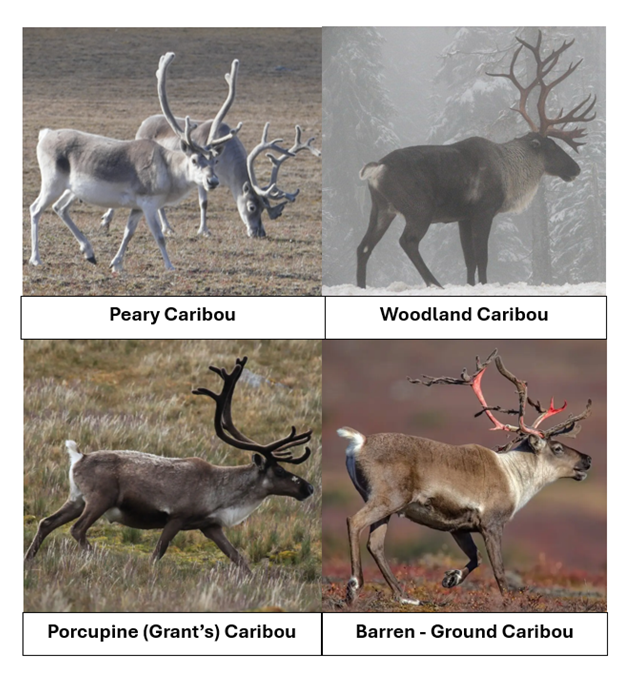
In North America, the reindeer populations are seen as two difference categories of animals: semi domesticated = reindeer, and wild = caribou. But from an ecological stand point, the caribou are broken down into four subspecies:
You’ll notice the similarity in scientific name with the European subspecies of reindeer we’ve previously looked at, confirming they are the same species, but each have slight differences. So, what makes each subspecies of caribou different to each other, and to the reindeer we know and love here in Scotland.
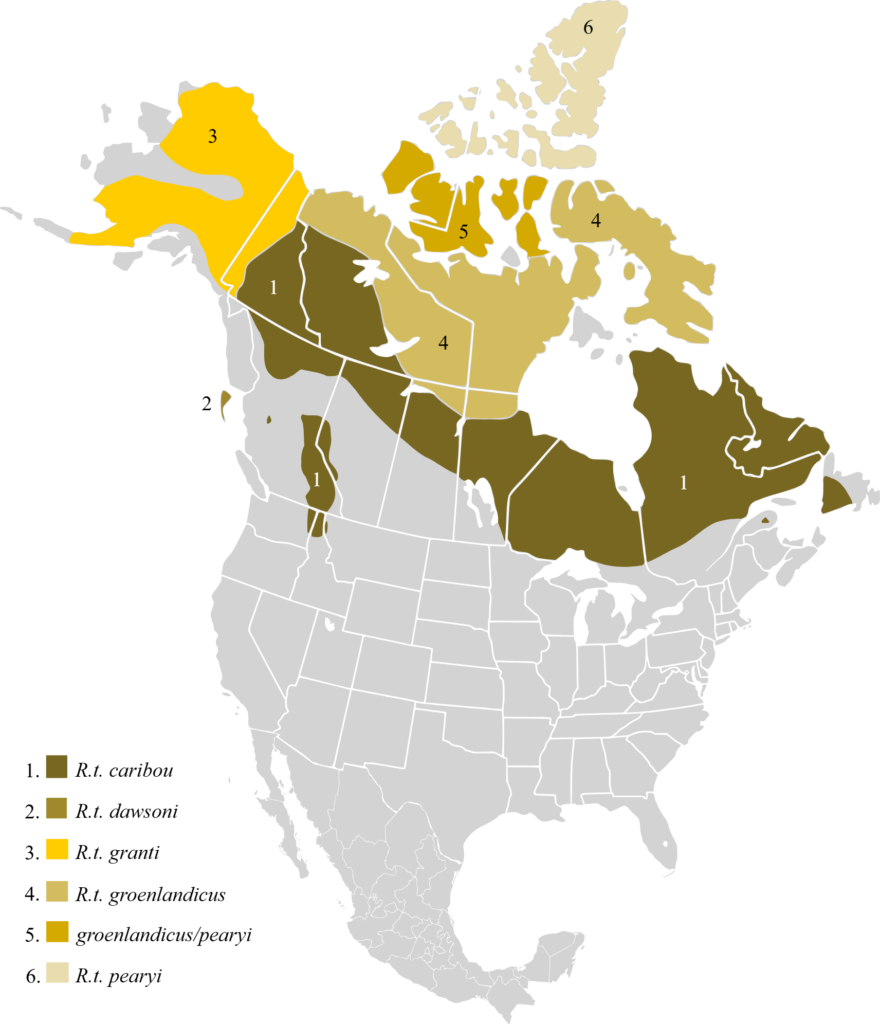
Population map of the four subspecies of caribou and smaller herd populations throughout North America. (Map credit: Cephas)
The Porcupine caribou closely resembles the barren-ground caribou, covering similar landscapes in the northern most territories seen on the above map. They cover a calving ground based on a river system including the Porcupine River – hence the name. They have a darker colouration to them, but their environmental adaptations and ecosystem role are what we’re familiar with throughout the other subspecies of reindeer we’ve been looking into.
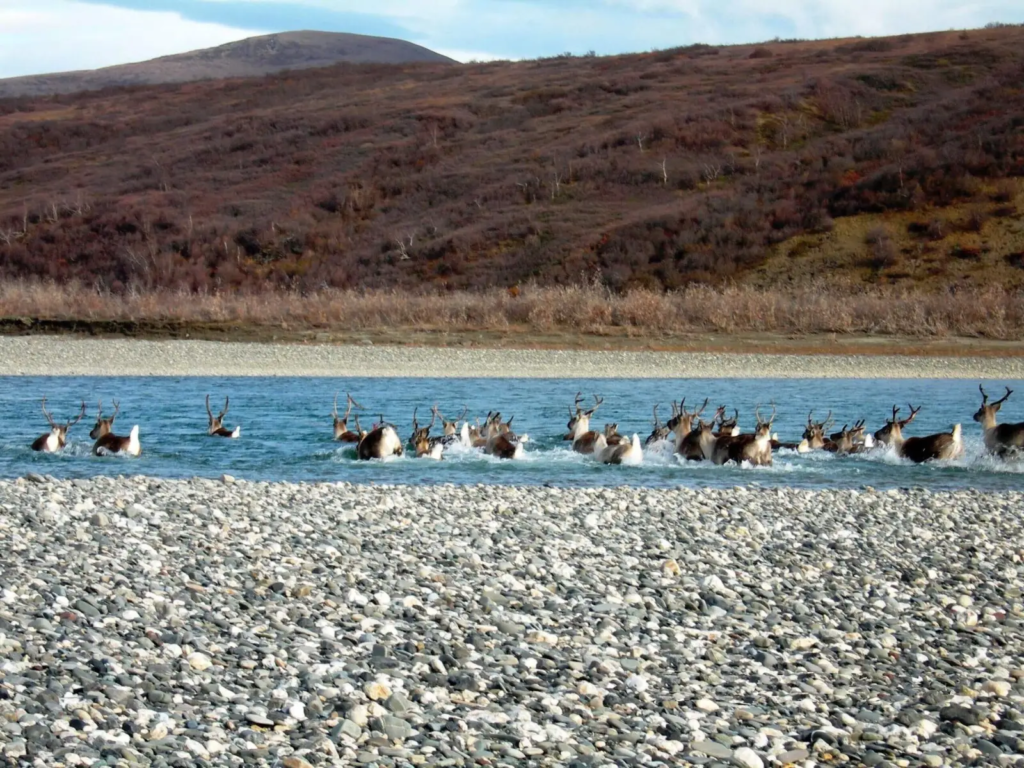
Herd of porcupine caribou crossing a river (photo credit: Animalia.bio).
The woodland caribou is again very similar to what we imagine when we picture our tundra reindeer here at home. Adaptations for sub arctic habitats, dealing with deep snow and harsh temperatures, keeping on the move and fulfilling the same ecosystem role. The differences we know of with the woodland caribou are more to do with diet, it seems, than anything else. Inhabitating a lot of areas of old growth forest and smaller herds found in different rugid mountain ranges further south than any of the other populations, they have different species of fauna available to them to feed off. The woodland caribou feed almost exclusively from aboreal lichens for the colder half of the year, followed by dried grasses and some tree species throughout the warmer months.
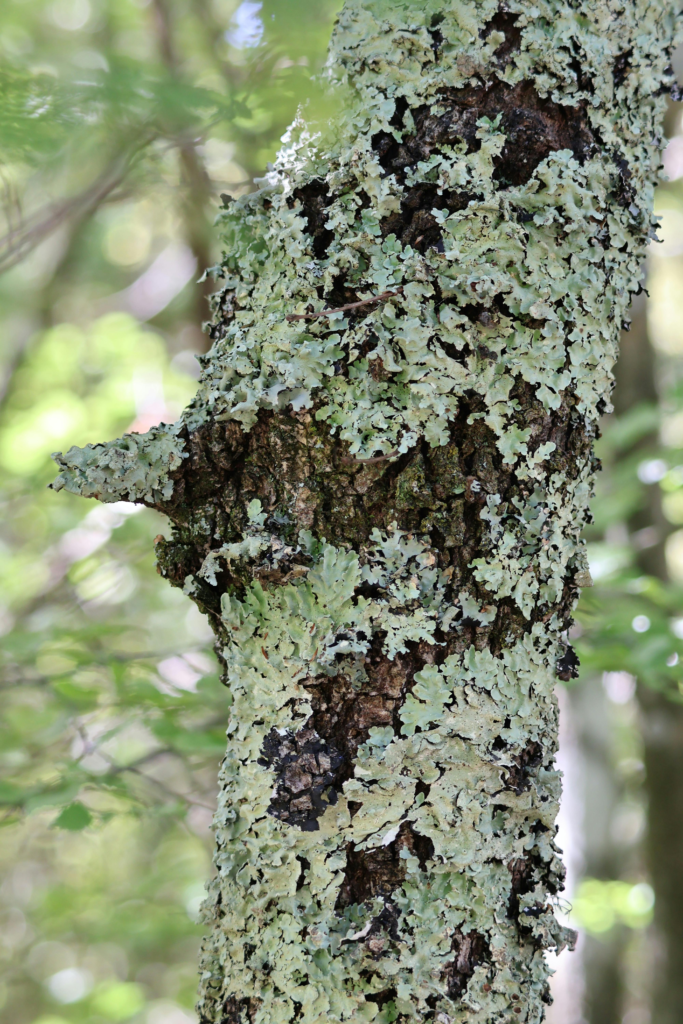
An example of aboreal lichen, growing along the bark of a tree as opposed to carpets of lichen on the ground. These types of lichen are found at a lower altitude than the rocky mountainous ranges we expect to find reindeer, where they typically live above treelines amongst far shorter growing vegetation such as grasses and heathers.
The Peary caribou are the smallest subspecies of caribou and are found in much smaller herds than any other. During winter time you are most likely only going to find up to four of them travelling together and this expands to maybe a dozen during the summer months. They feed on similar plant life to the other subspecies, having limited choice due to their sub arctic and arctic home ranges. But unlike the others, they predominantly feed on purple saxifrage which can stain their noses with a purple tint. Their migratory path is not as large as other subspecies of caribou, moving up to 150km between winter and summer home ranges, sometimes between islands (seen on the map above as number 6). Similarly to the others they are ready for anything winter can throw at them, but do choose to avoid areas of very deep and heavy snow, retreating instead to rocky mountainous outcroppings and beached areas.
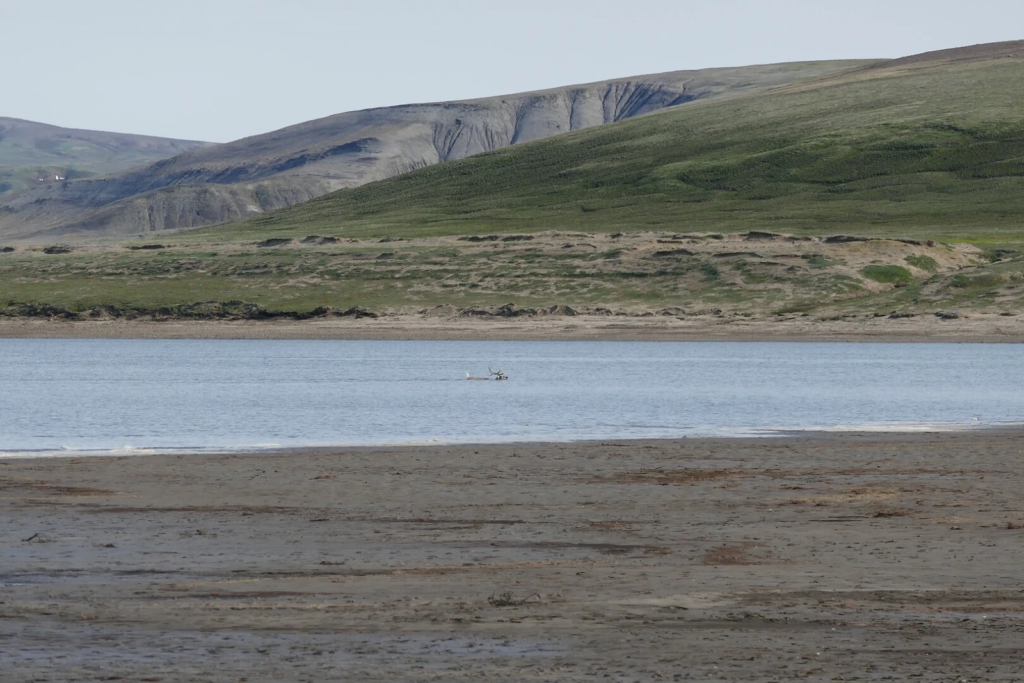
Can you spot the Peary caribou? (Photo credit: Animalia.bio.)
Finally, the last animal on our list to discuss… The barren-ground caribou. Maybe the best to last if that’s fair to say. Let’s meet the animal with the largest ground migratory path in the world! You heard that right, a bigger migration even than the wildebeest in the Serengeti. They migrate twice a year between summer and winter ranges with each journey potentially covering more than 1,000 km depending on the location of their calving grounds. They use higher spots for calving grounds, out of reach of predators such as the wolf, then descend to lower ground and migrate in large herds to areas for summer grazing. Their winter diet consits of some grasses, lichen and leaves from low growth trees. They share their other qualities and adaptations with the other subspecies of caribou, making them efficent at moving and feeding through shallow snow and coping with cold temperatures found in arctic regions.
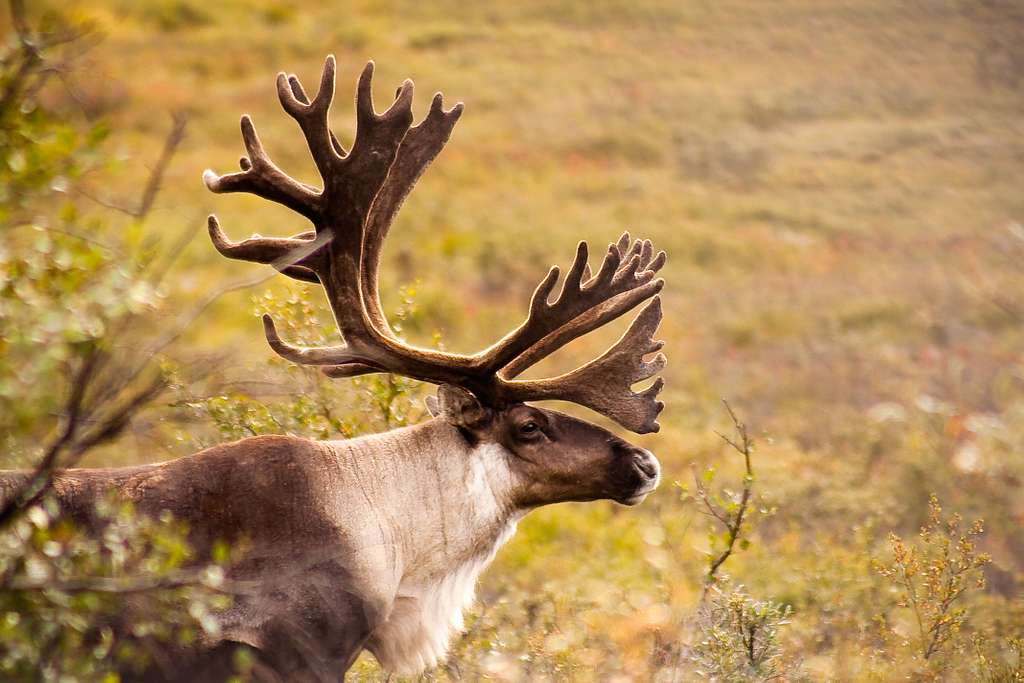
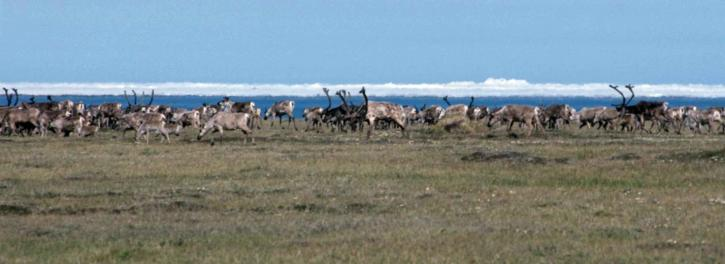
Barren-ground caribou grazing.
And there we have it – we’ve learnt all about the different subspecies of reindeer all across the globe! Thanks for sticking with me, and I hope you’ve all enjoyed reading this blog series as much as I’ve enjoyed researching it. I feel it’s important to say there are other indivdual named herds that I haven’t covered, but to learn about the different adaptations and qualities, I think we’ve got all bases covered. Reindeer truly are a remarkable and wonderful animal, with clearly a lot more to them as a species than we may first realise.
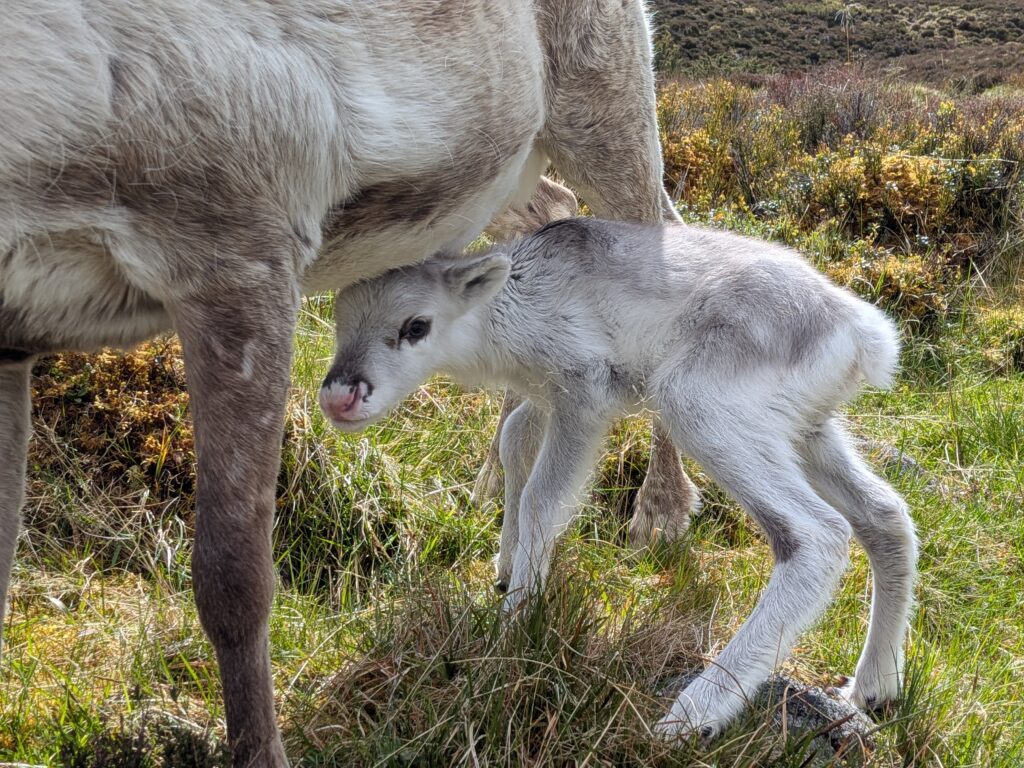
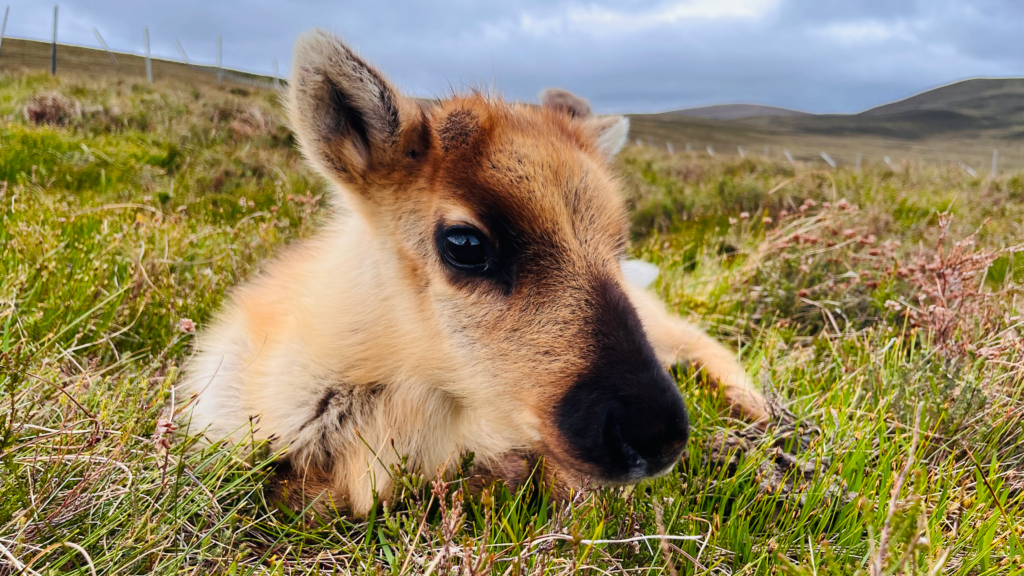
Calving 2026 went really well but it’s now all done for another year with the last calf born on 24th May. It’s an absolute favourite time of year for all the herders welcoming the new additions into the herd and enjoying the few weeks with them before they head onto the free range for the summer. We try to get out when we can to visit them but what happens on the summer free range is completely natural so we don’t always see every calf returning which means it is what it is! I thought I’d write down a few moments that I’ve enjoyed this summer to share our lovely experiences with the reindeer and their calves so here goes:
Calving season of 2026 is all wrapped up and the herd has so many new wondeerful additions!
Filming – Mid May we took part in some filming which you will no doubt see later in the year (watch this space). As a result Andi and I headed onto the hill with a very small film crew of two other people and spent the whole morning hanging out with the herd which was mainly the cows and calves. As there was quite a lot of standing around while they were getting the shots they were after, it’s always during these moments you really get to enjoy being around the calves who are finding their feet within their new environment. Now and again they’d get the zoomies which usually meant mum flying after them trying to keep up and get them back under control… They can also be quite inquisitive and if you stand still long enough then you find a few calves come sniffing round your legs and giving a wee tug on your trousers.
Making the most of all the time we get hanging out with the lovely calves while they’re still tiny before their summer of free ranging.
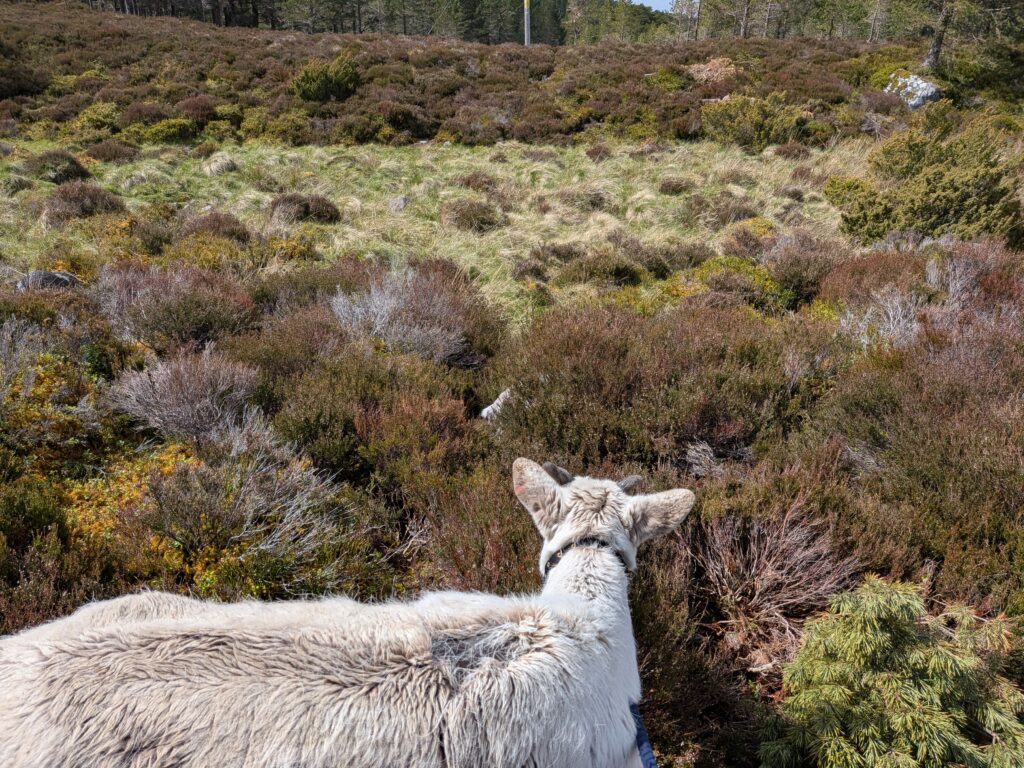
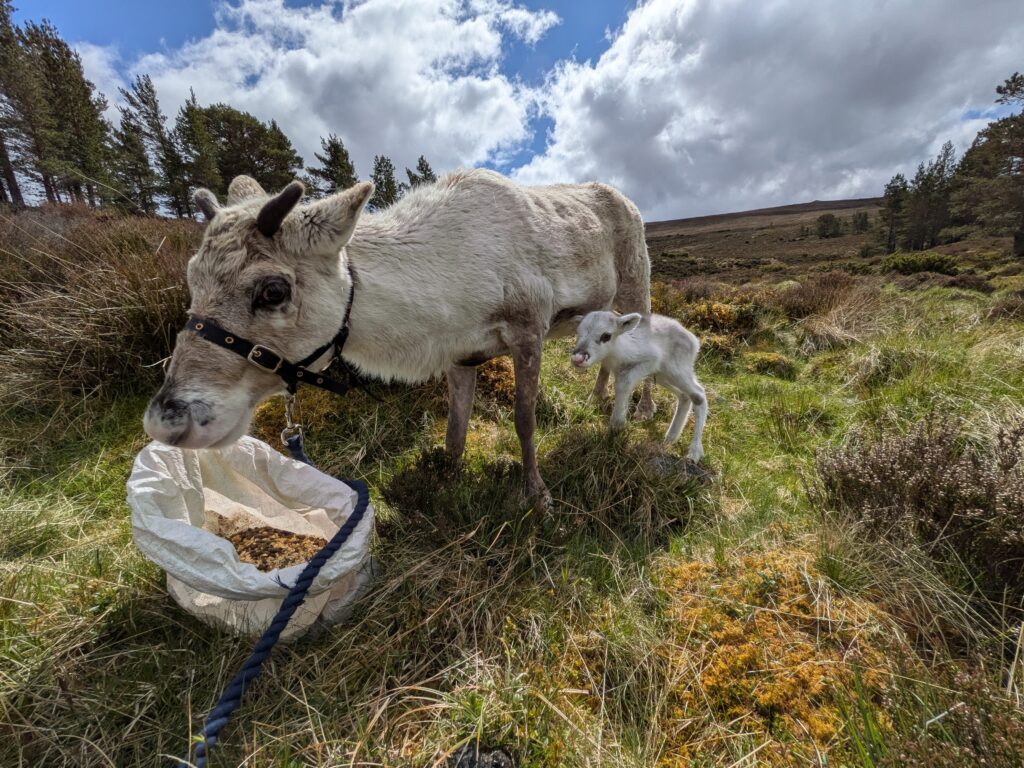
Another nice moment I had was bringing Lolly and her calf in from our main enclosure which is around 500 acres of hill and forested ground into our smaller ‘creche’ where we keep the cows and calves once they’re born. I first had to locate them and of course they were at the furthest back point of the enclosure in the woodland, so, as I started pushing her back towards the herd the calf kept getting stuck in deep heather. Eventually I decided Lolly wasn’t taking her calf on the best route home so I thought I’d try catching her instead and walk them in via a more sensible and less vegetated route. Lolly is one of these reindeer who it’s hit or miss whether you can catch her to put her on a head collar or not so I was going in with caution, however, she was obviously in a good mood today and I caught her no bother. The three of us then set off, at a very slow pace, back towards our final destination. The calf at this point was only a day old so still pretty doddery… We stopped a couple of times, the calf had a lie down then a suckle of milk from mum then we’d carry on. It was a lovely sunny morning so I didn’t feel like I needed to rush. Both Lolly and calf were totally relaxed. From a reindeer who in the past was never up front and had a shy character Lolly has definitely gone up in my estimations.
Can you spot Lolly’s wee one trying to get through all the deep heather?… A much easier route… A snack break before continuing on the long journey across the enclosure (long for wee legs anyway).
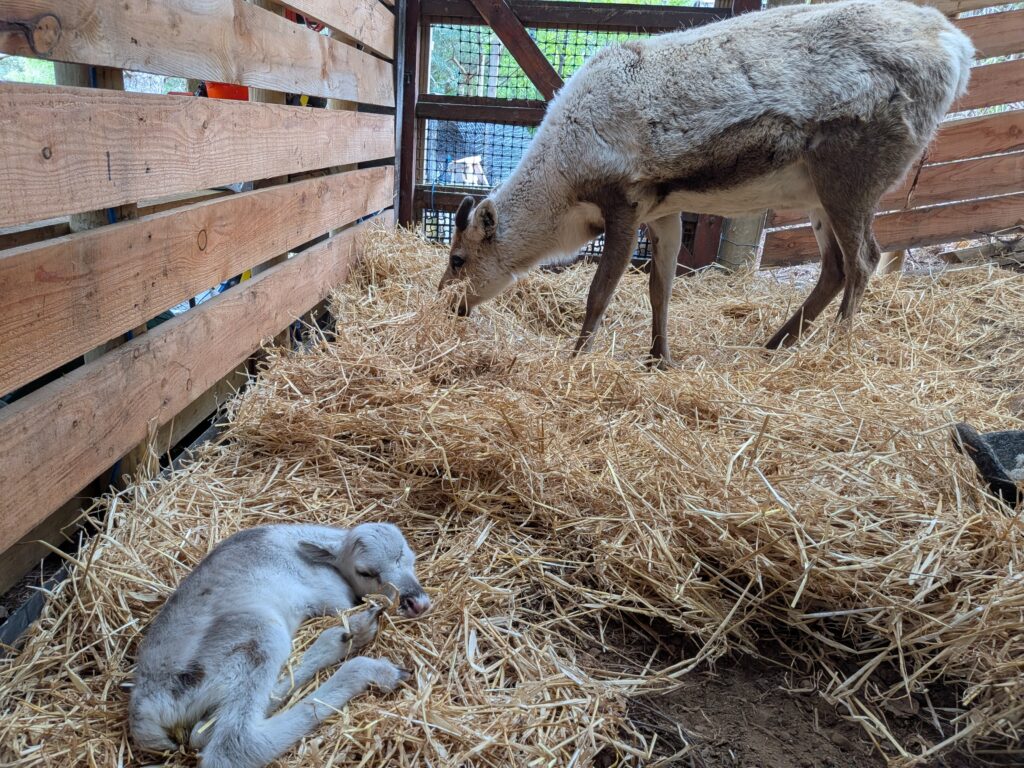
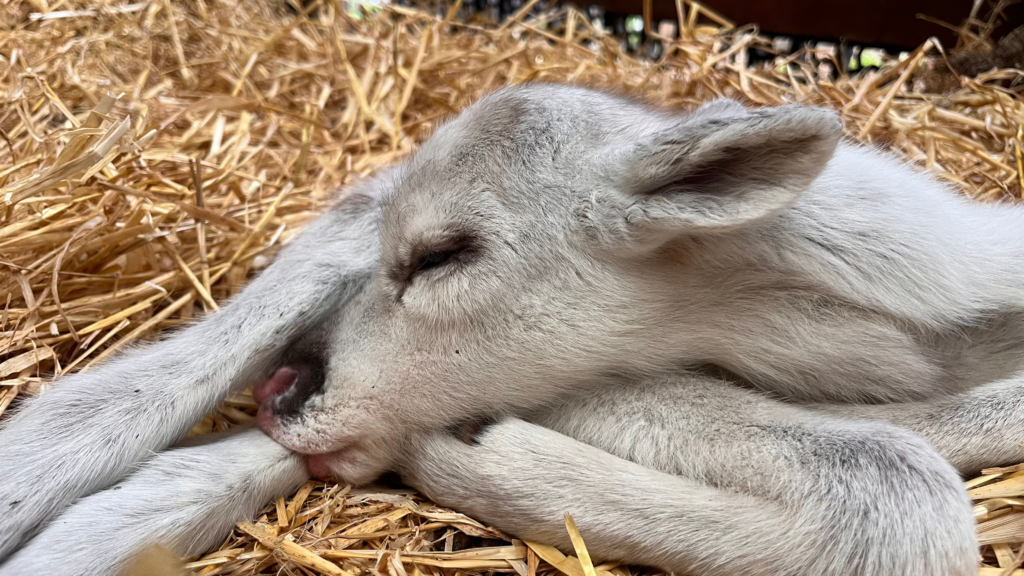
The last wee story I’ve got for you, or maybe this was more of a challenge during calving time, was when Winnie, our hand reared female from three years ago decided to start calving during one of our guided Hill Trips in front of 40+ tourists… There is a time and place Winnie! Herder Amy swiftly popped her on a head collar and brought her into an area a bit quieter and out popped a little pale coloured female calf. At first Winnie was not impressed by what had just happened and was showing no signs whatsoever of wanting or loving this new addition in life! So, Amy dried off the wee bundle and we all worked out where to go from there. We held Winnie so her calf could get it’s first milk as this is really important, however, her milk wasn’t coming through as it should so I suspect this little lass was premature. We brought her off the hill to our paddock area where we could monitor her more closely and after chatting with our vets decided to give her a hormone injection to help bring her milk on but also help with the bonding.
Winnie and her beautiful calf getting some time together in the barn at the centre.
This worked a treat and 2 hours after her injection she loved her wee calf and was licking her. The calf was still a bit too weak to stand and feed herself so we had to assist, however, with Winnie being so tame this only required some extra lichen (reindeer’s favourite food) for her while we held her calf in place. We did this every 3 hours roughly through the day and her last check/feed was around 10pm and first feed around 5am. The two then joined the reindeer on the hill so the wee calf could learn how to be a reindeer, not a human! Then at the beginning of June they headed for the high tops of the Cairngorms to spend the summer free ranging. With all the extra handling the calf got she was super tame and became a quick favourite amongst us herders.
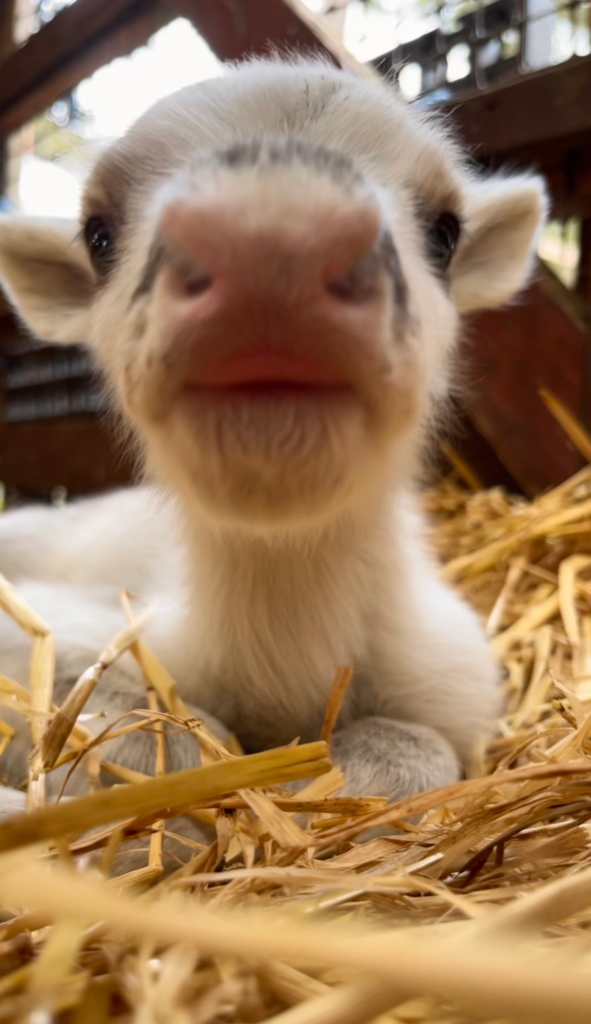
It didn’t take long for Winnie’s calf to feel well rested and safe around all of the herders. Here’s to the excitement and cuteness of calving season 2027!