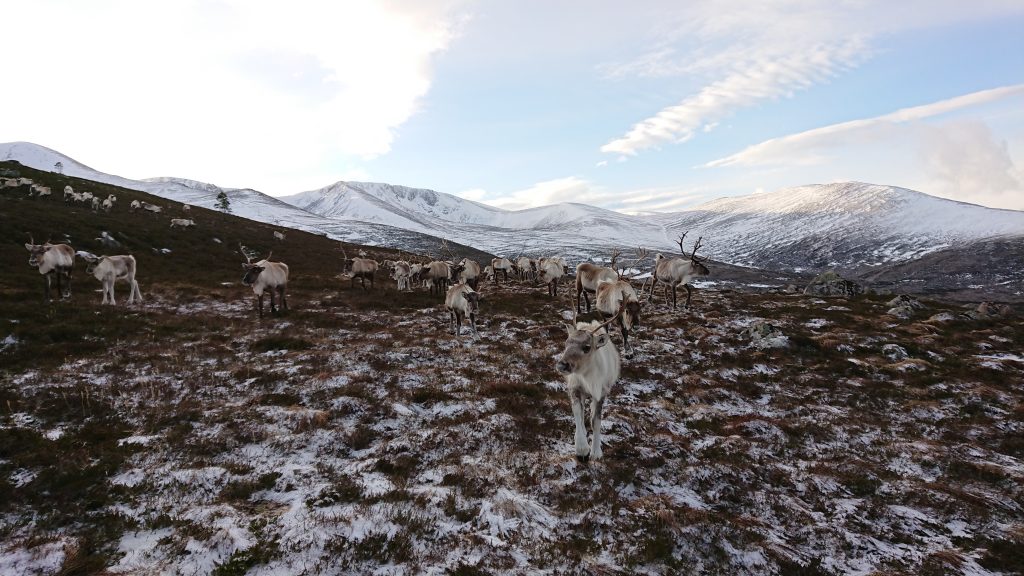
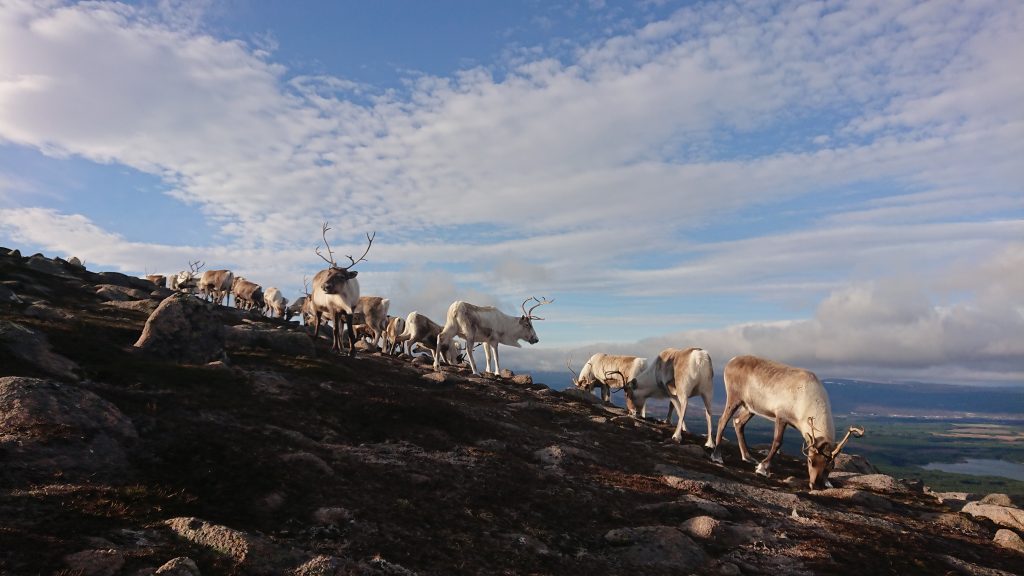
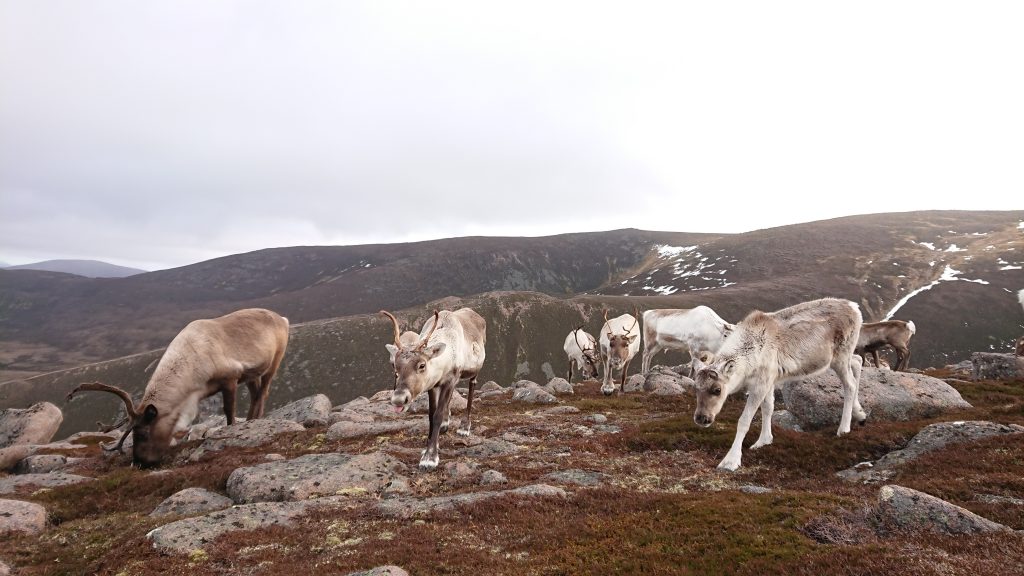
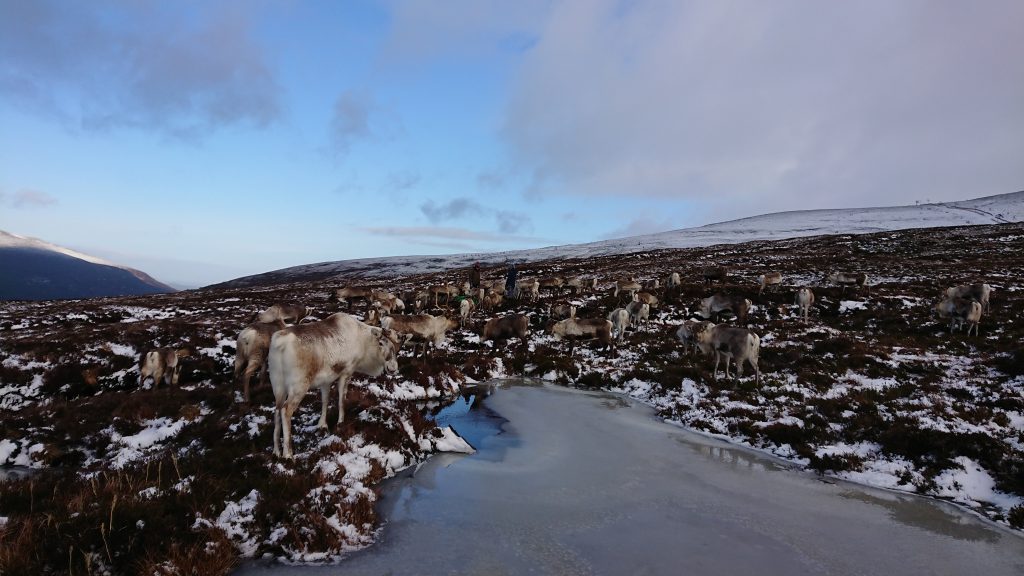
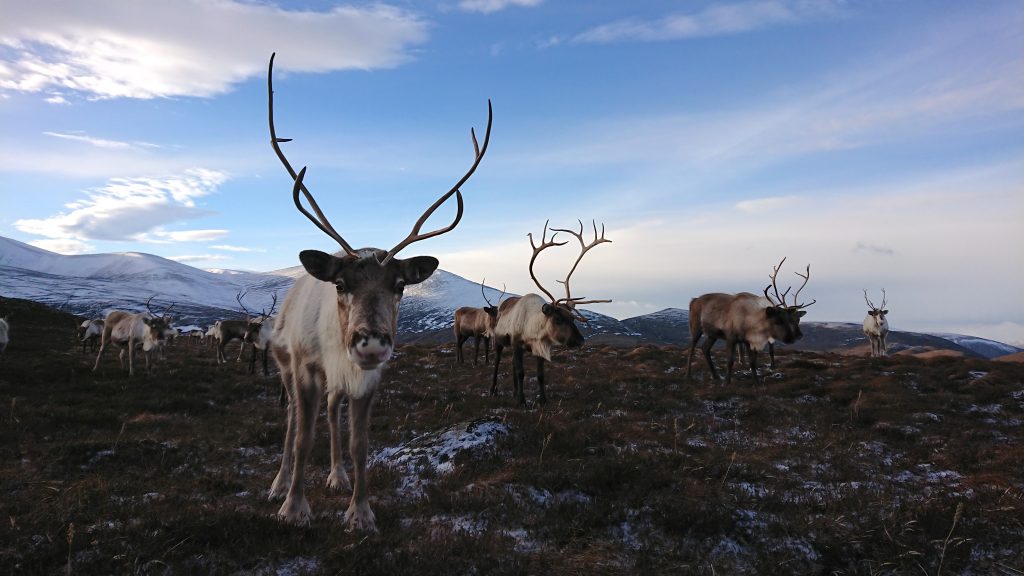
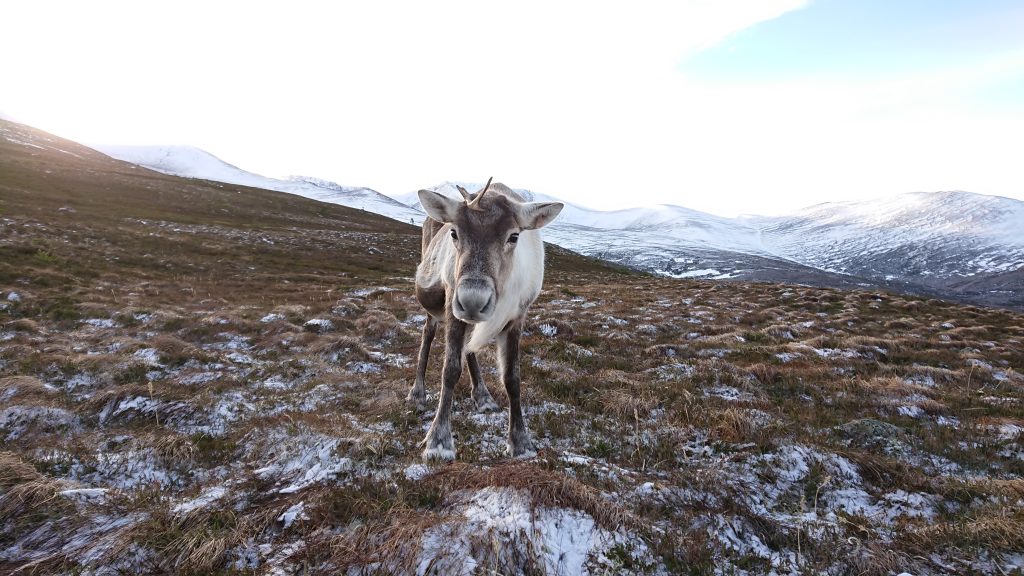
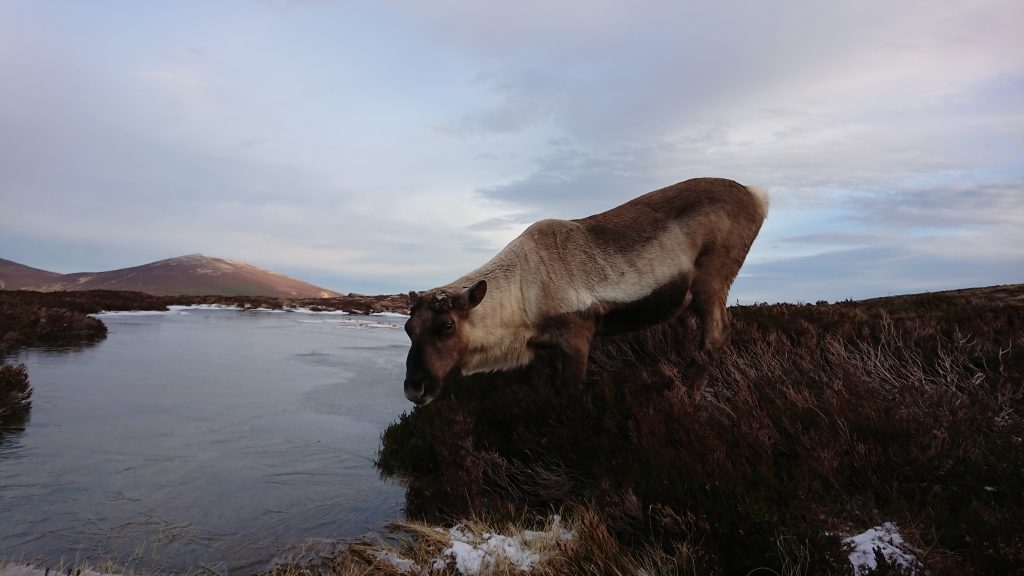
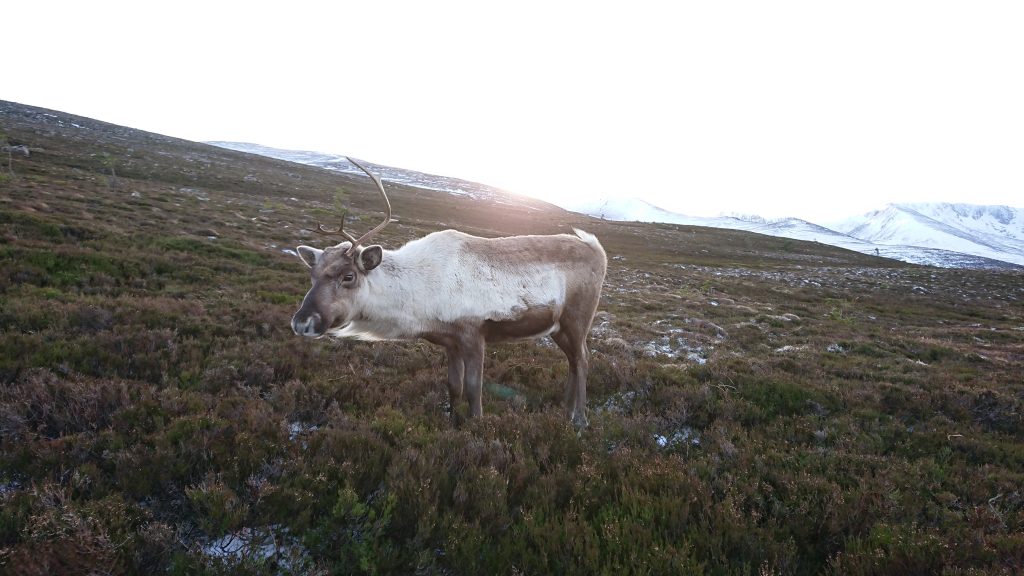
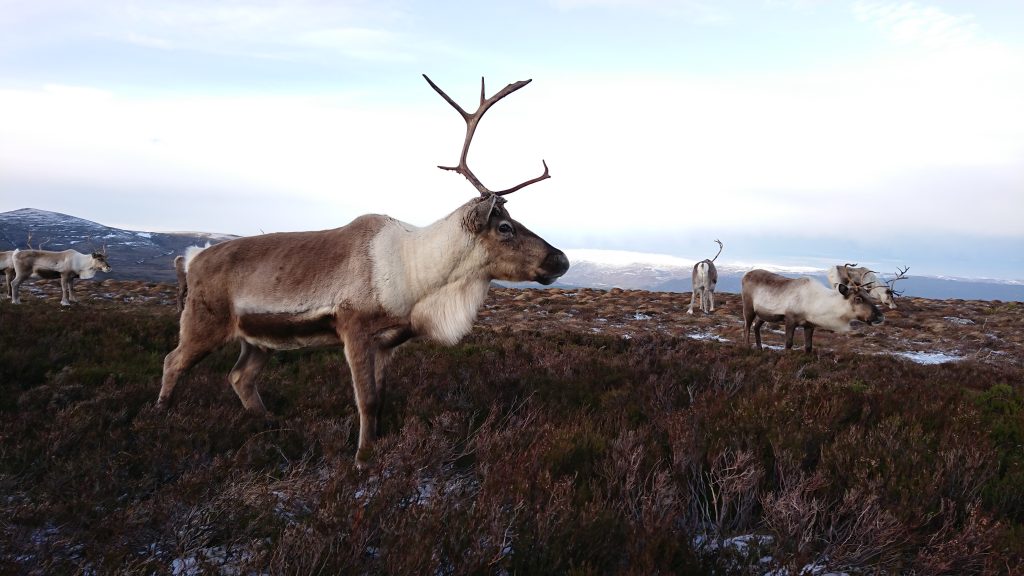
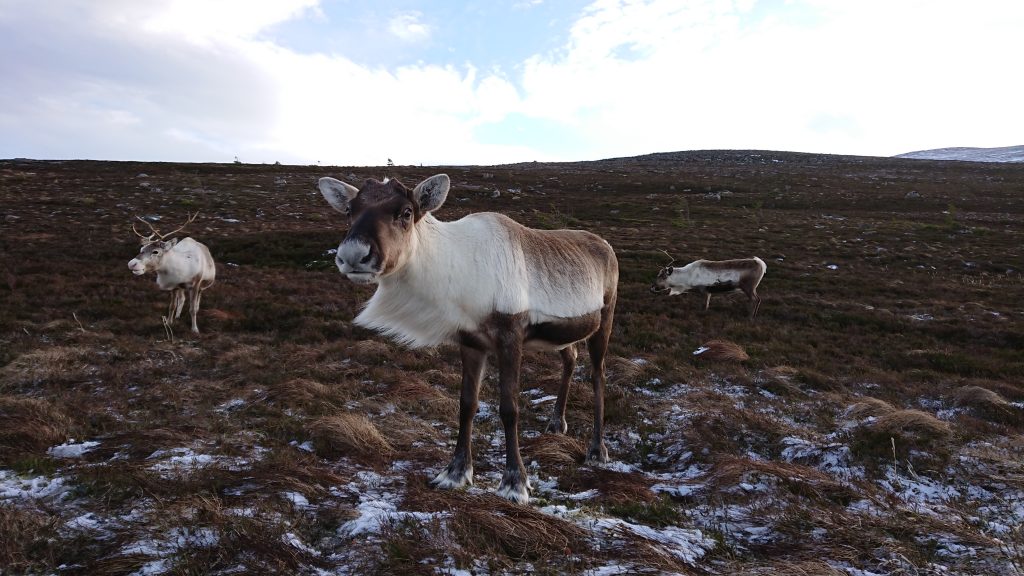
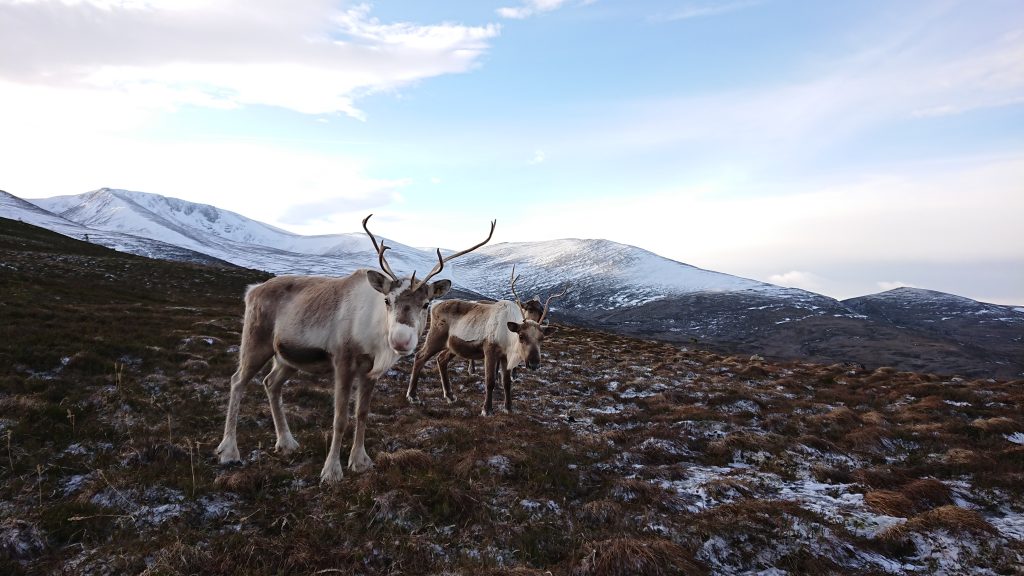
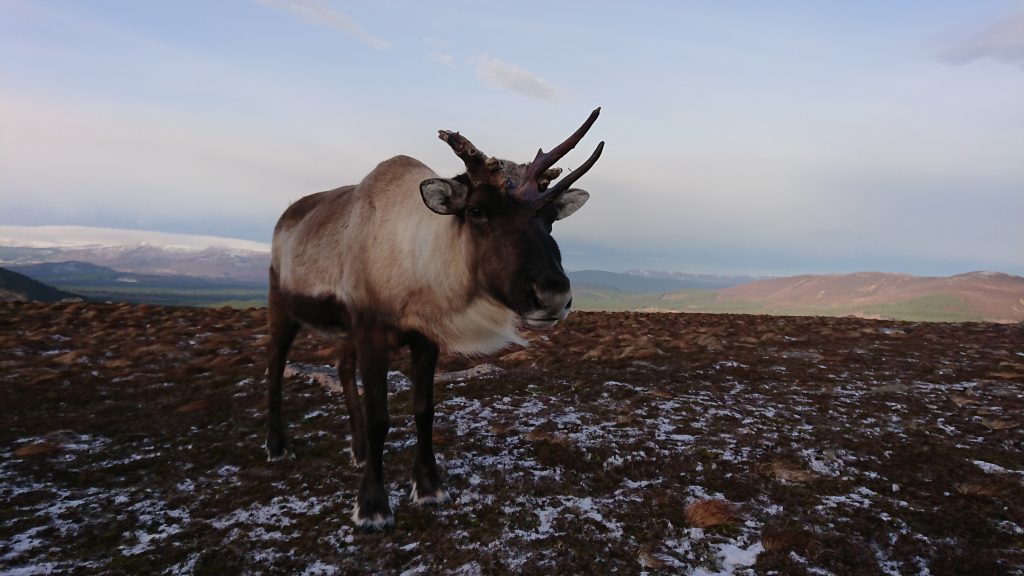
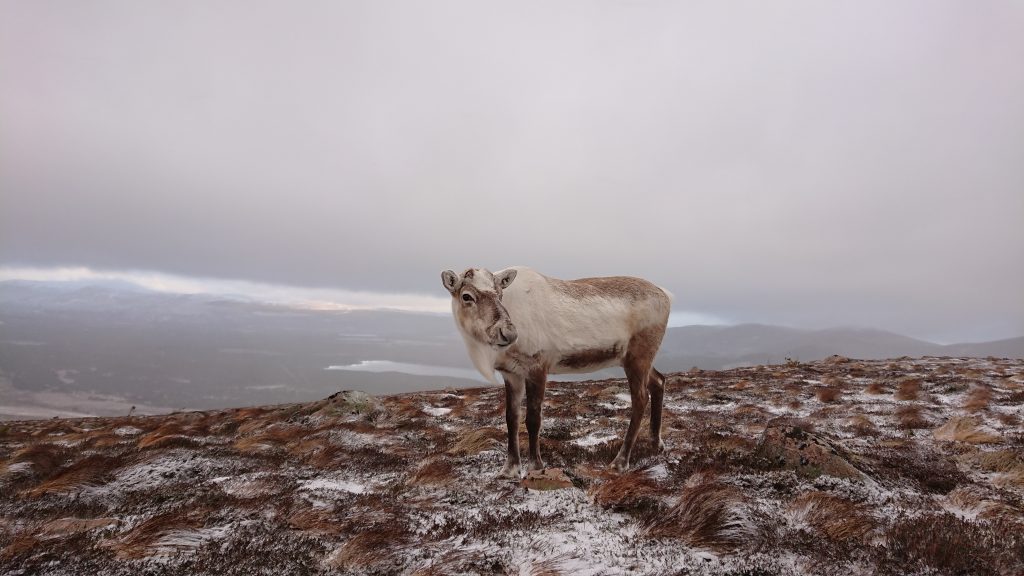
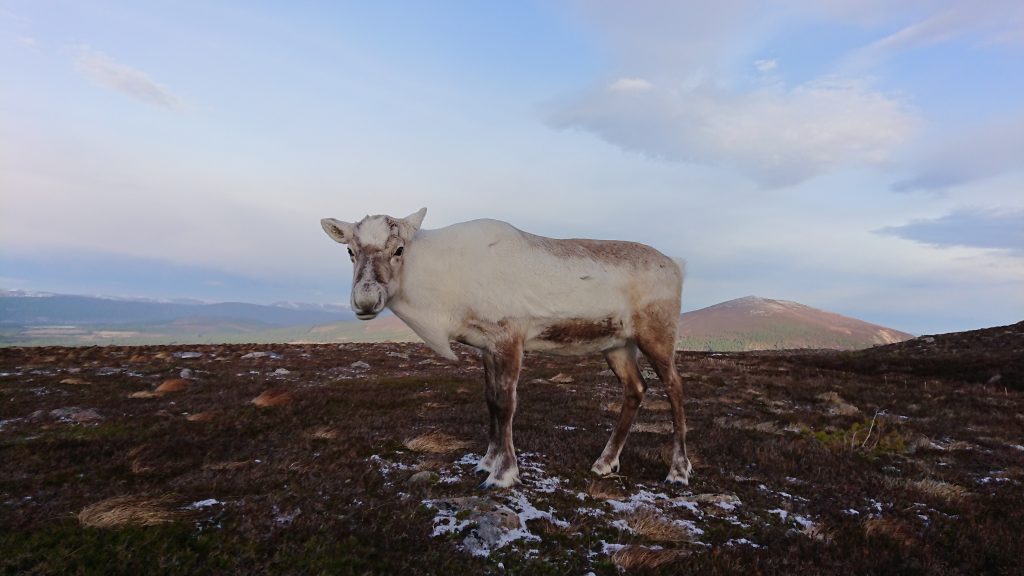
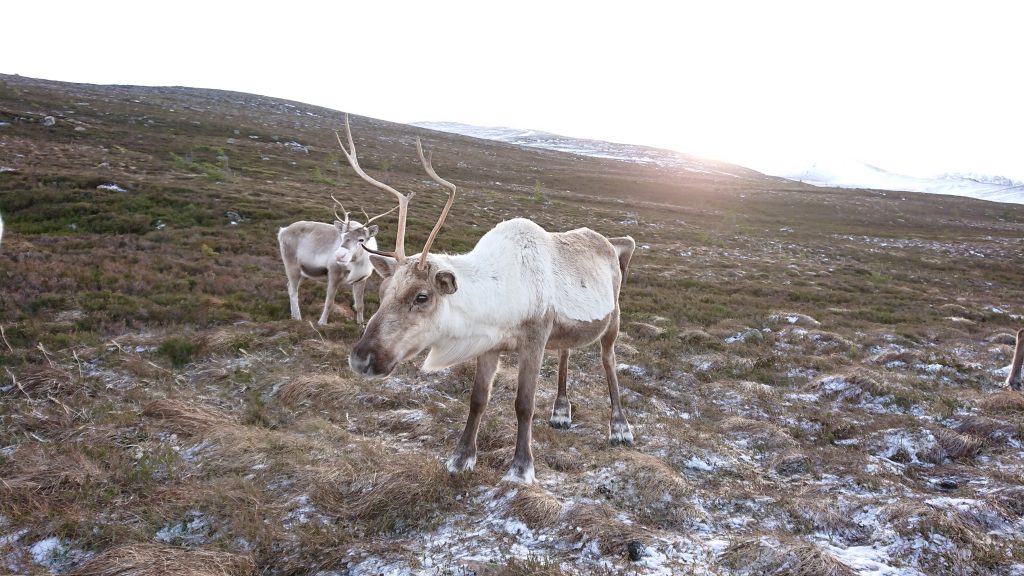
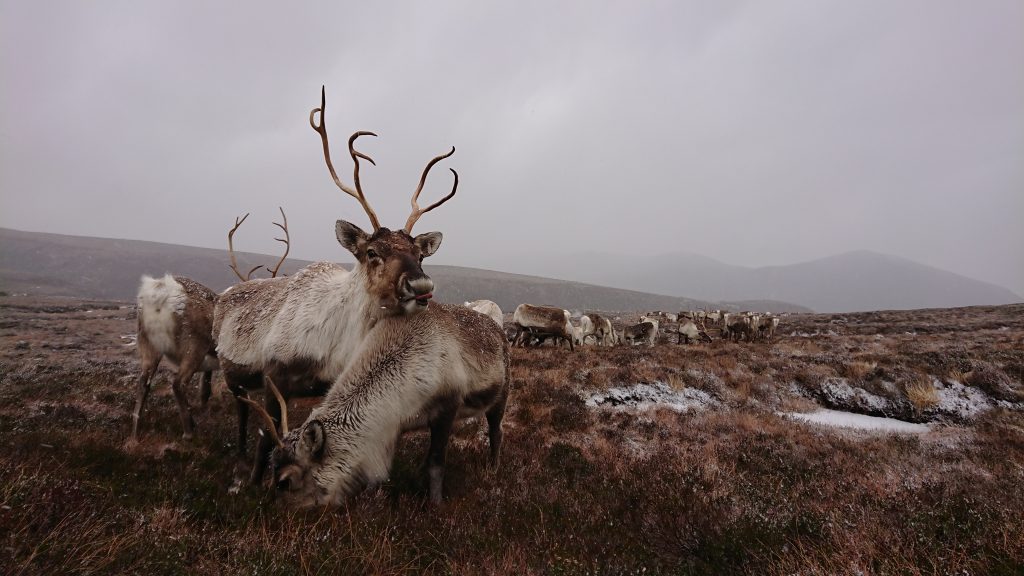
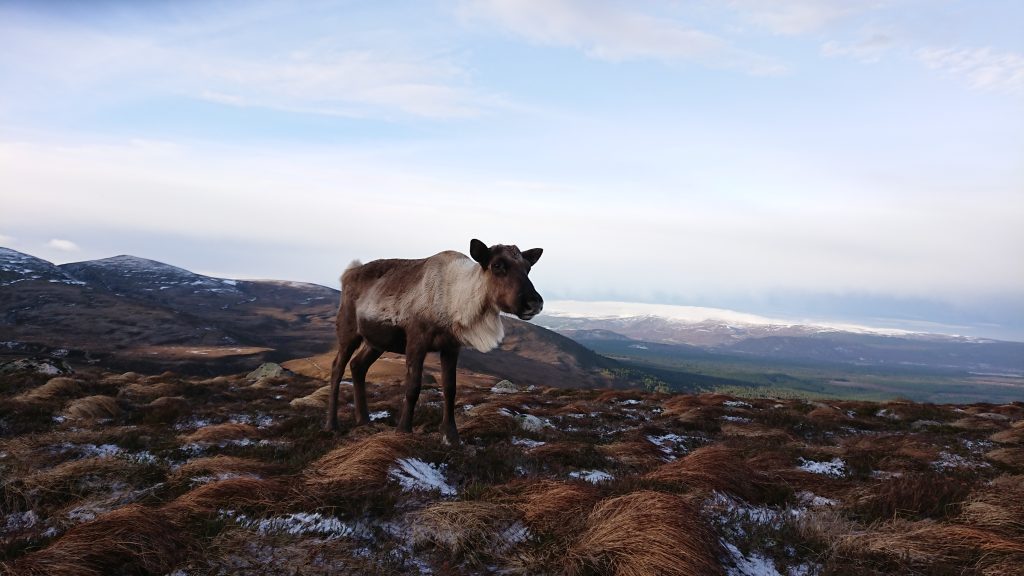
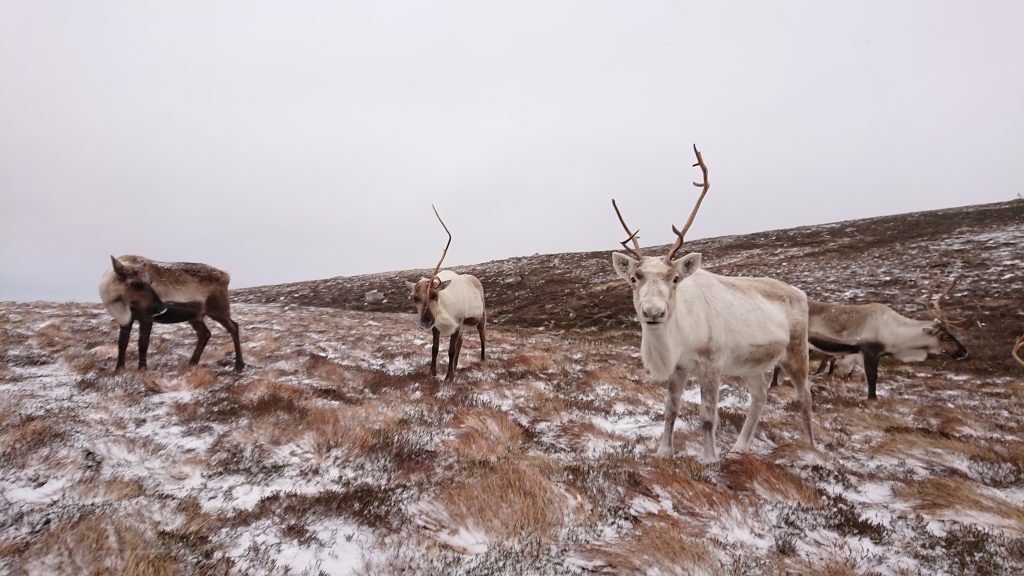
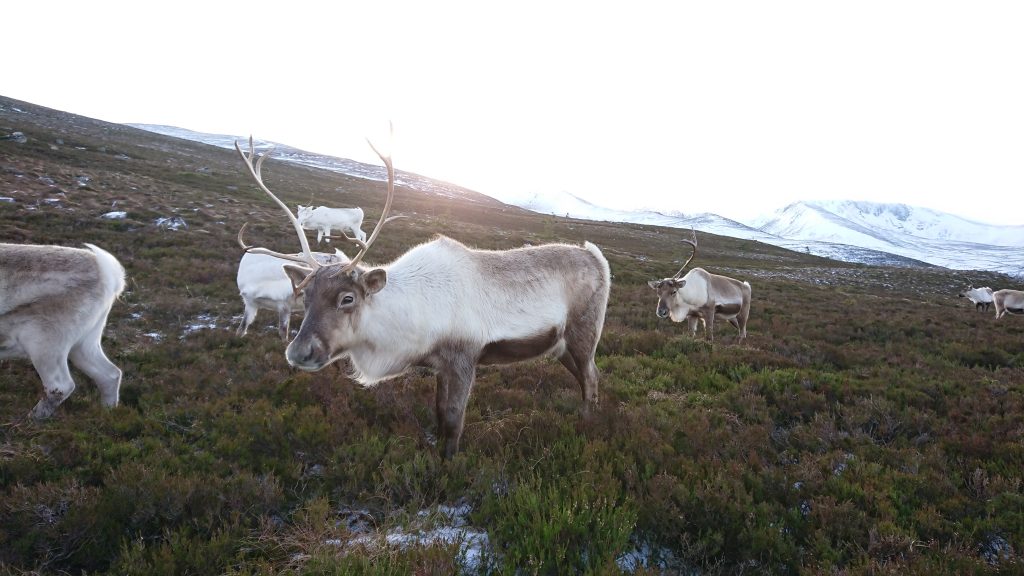
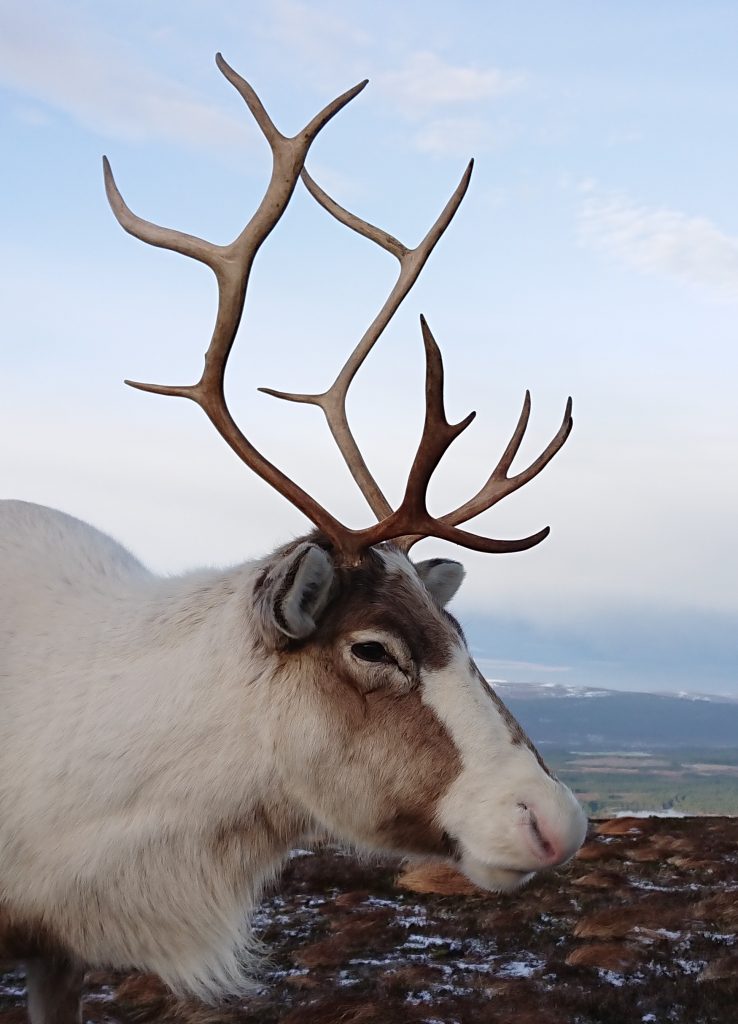
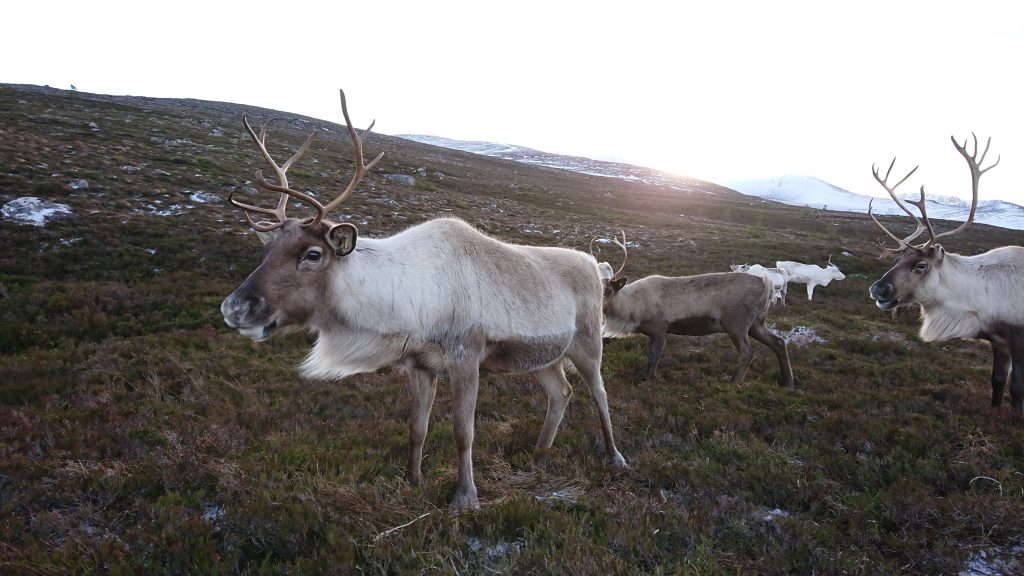
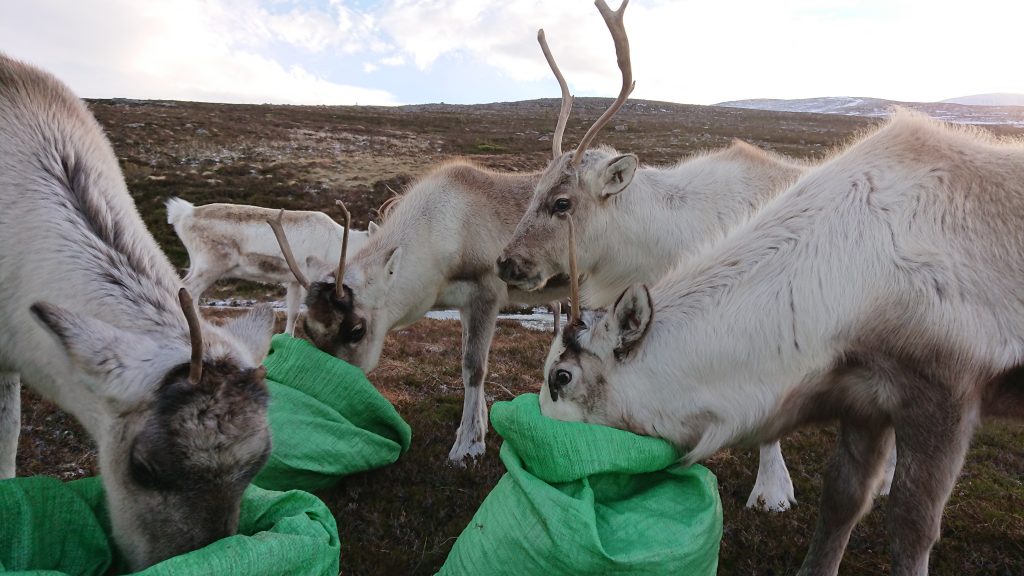
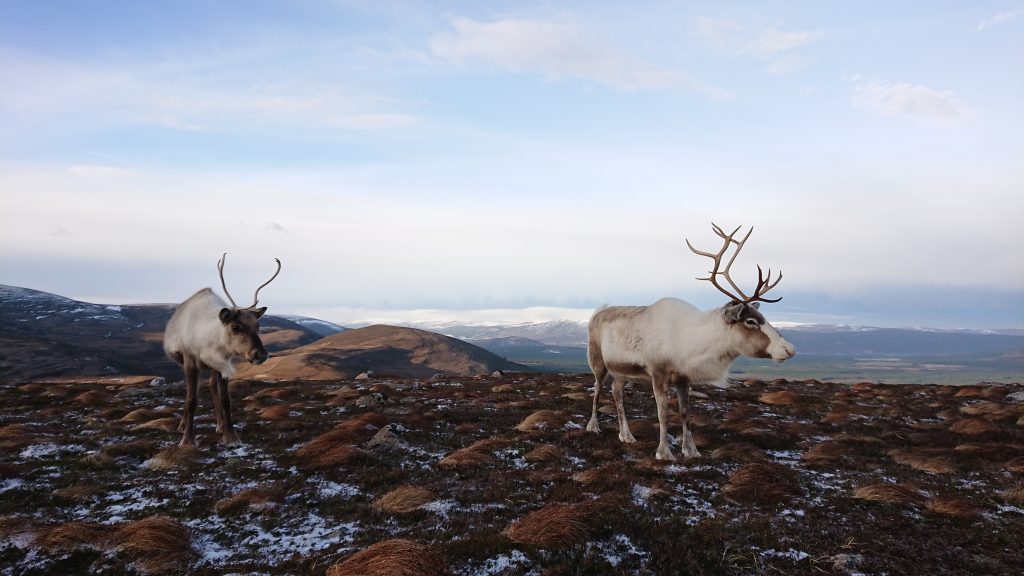
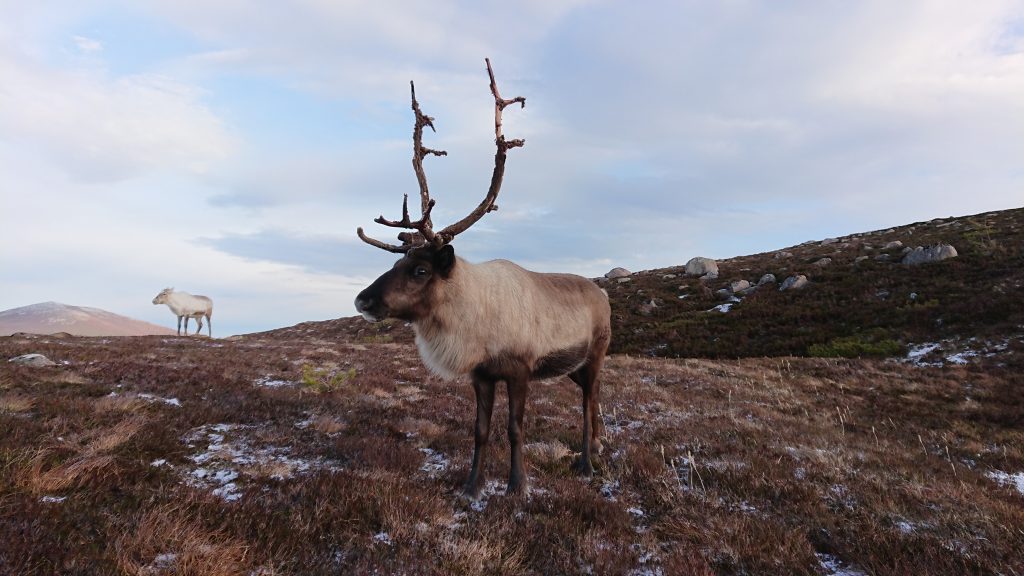
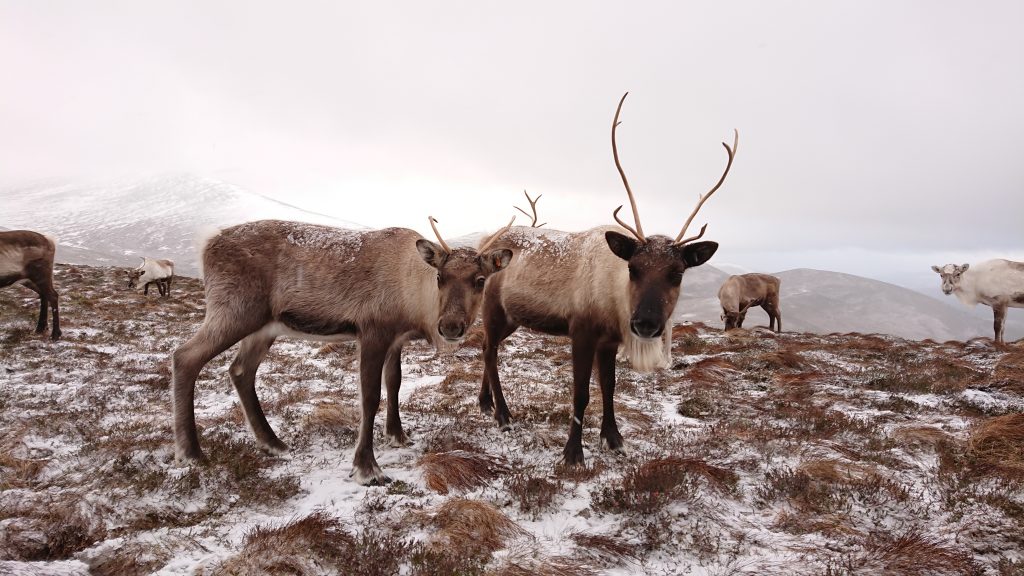
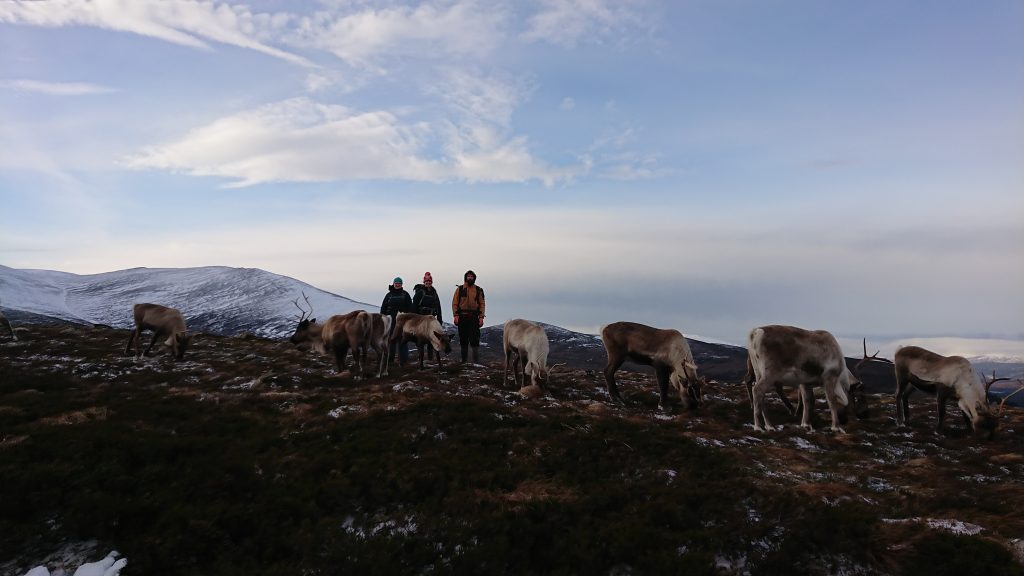
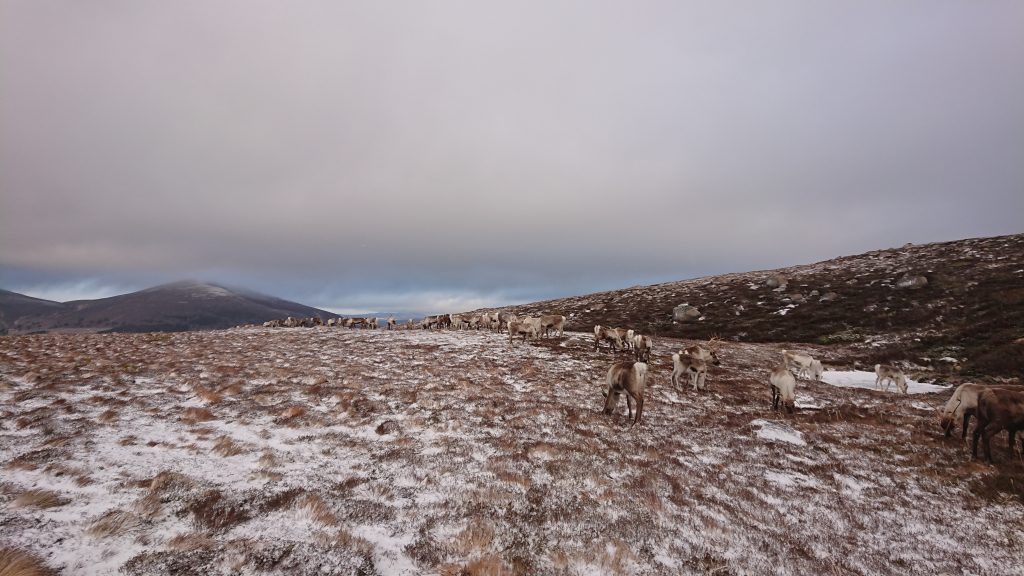
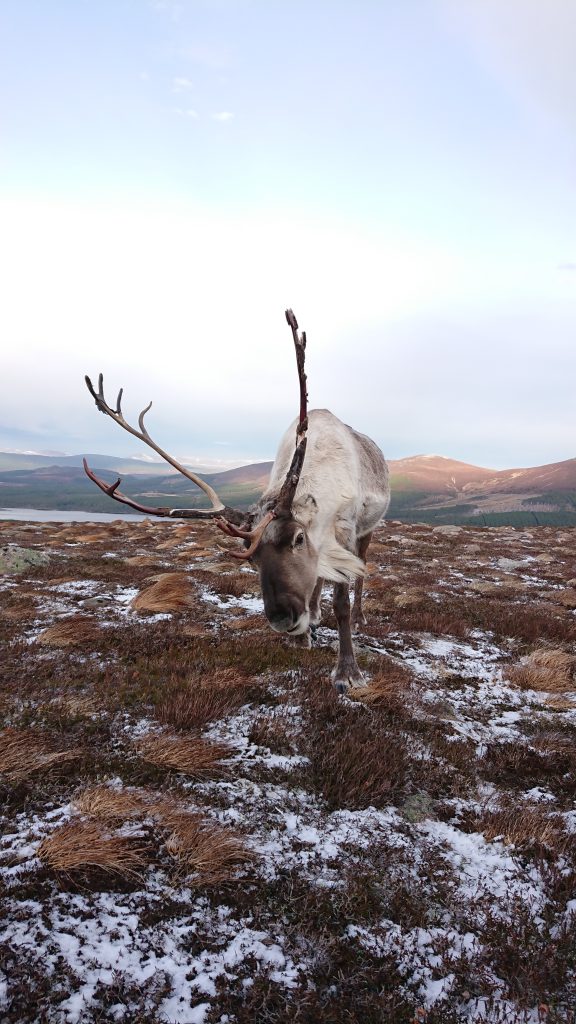
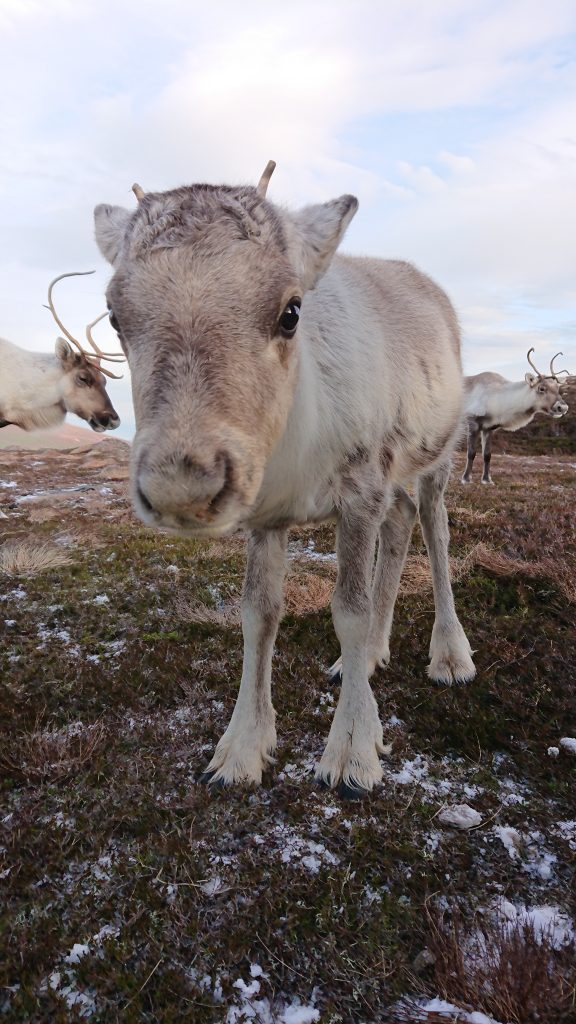
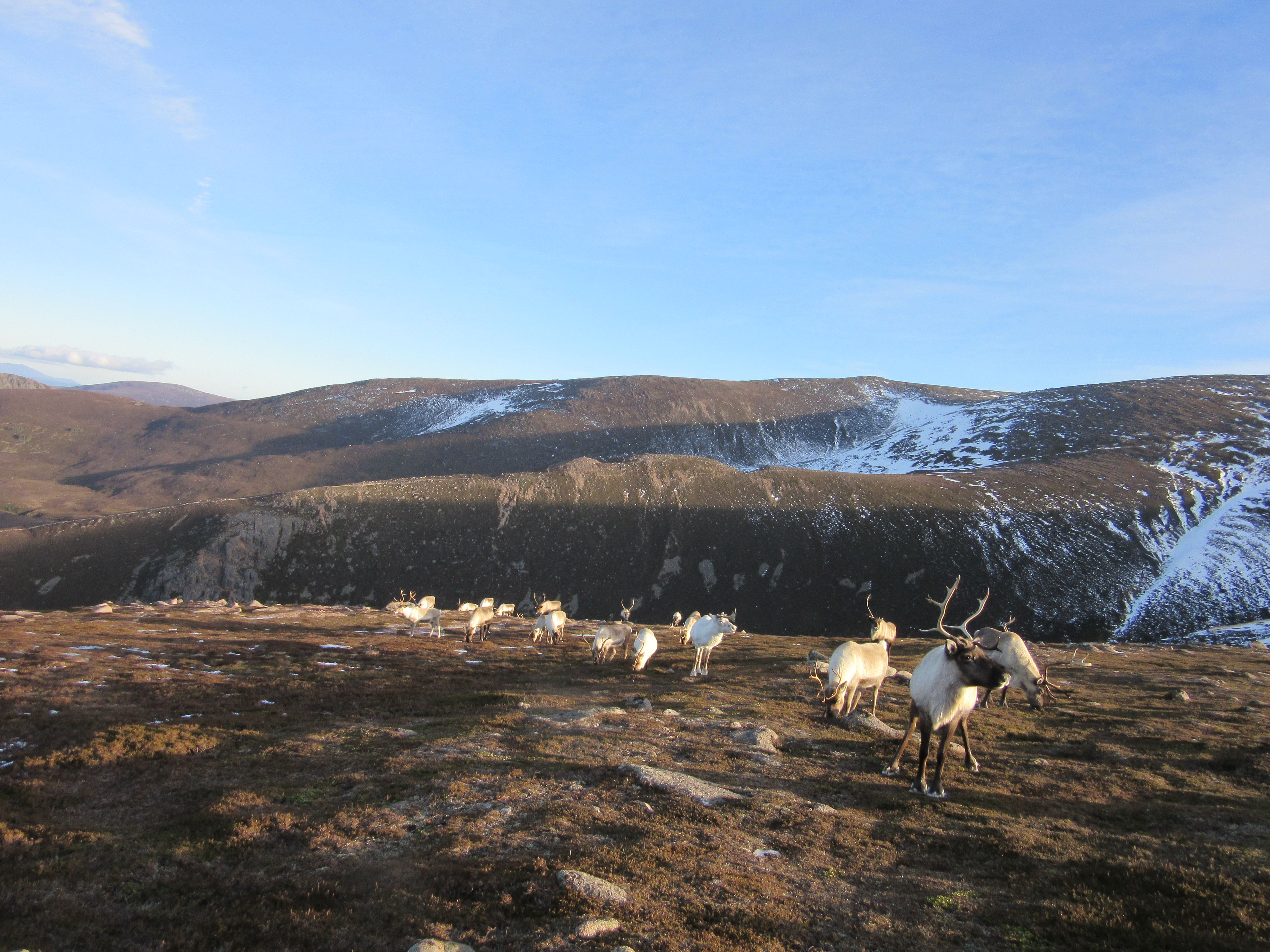
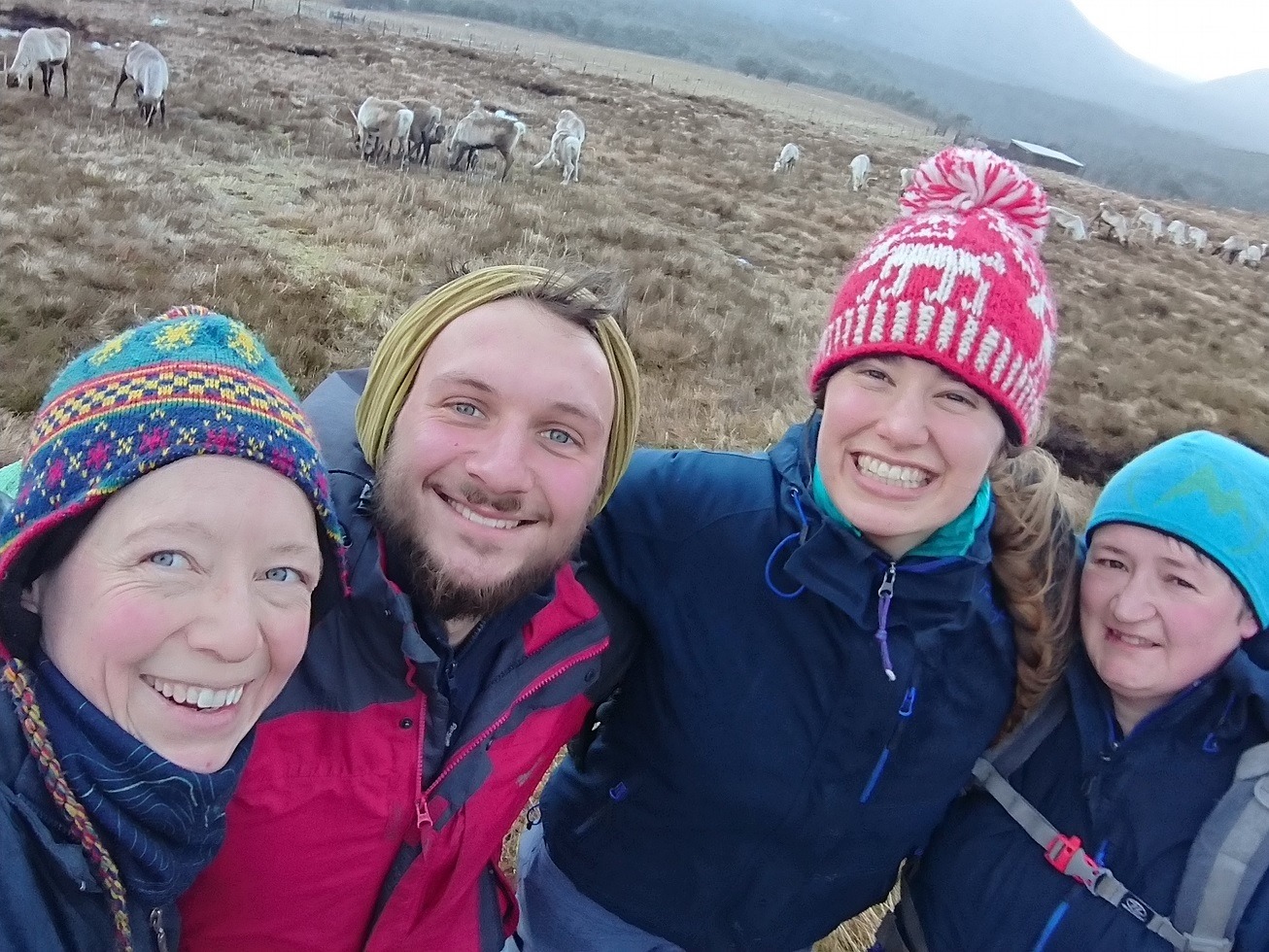
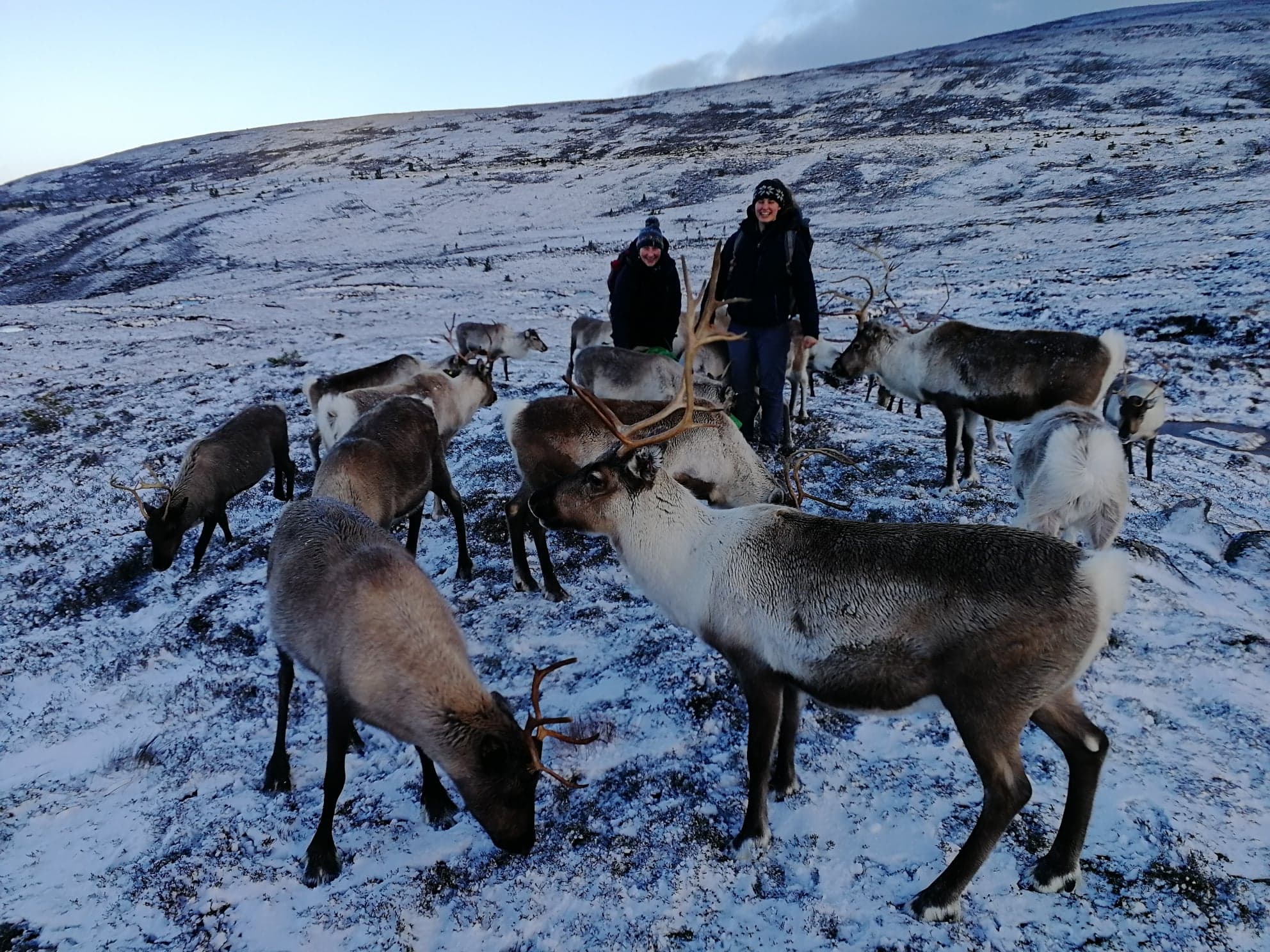
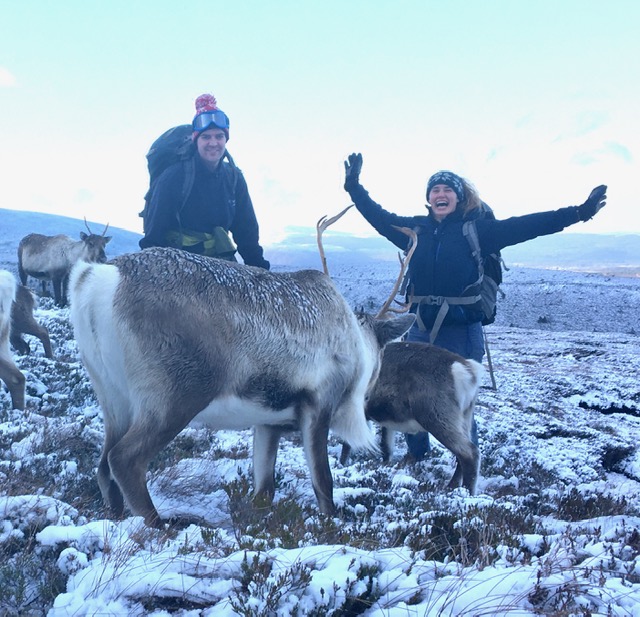
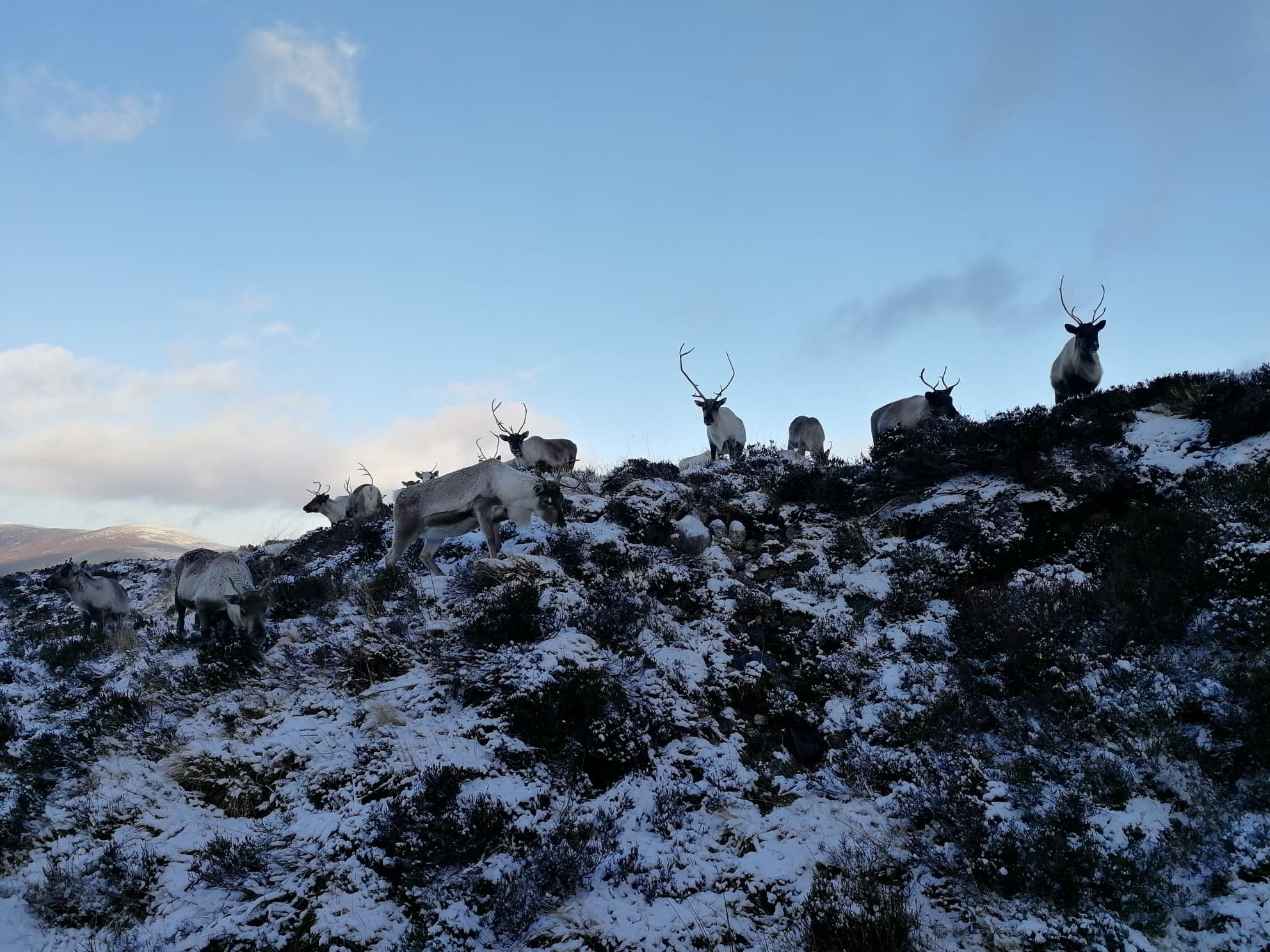
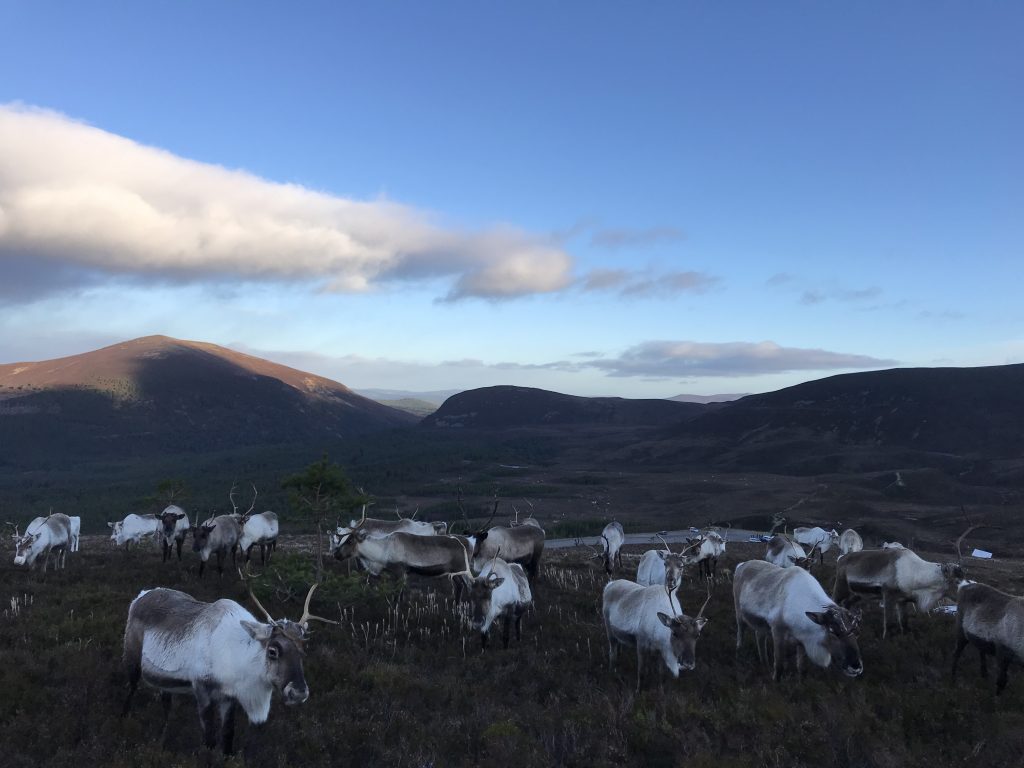
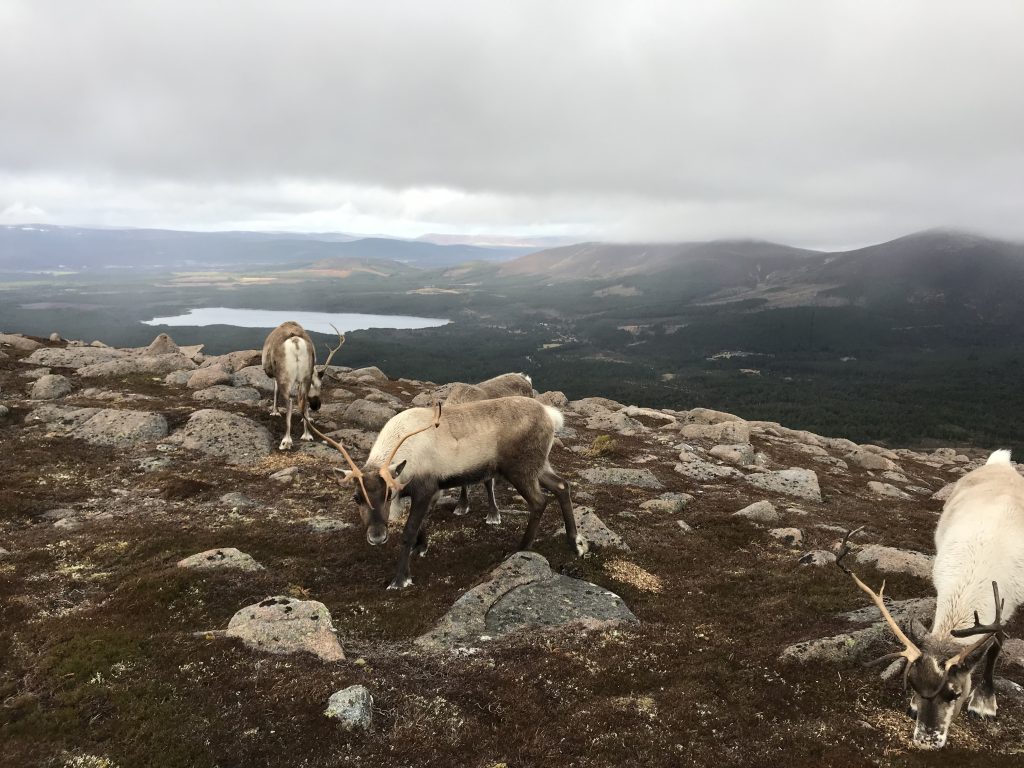
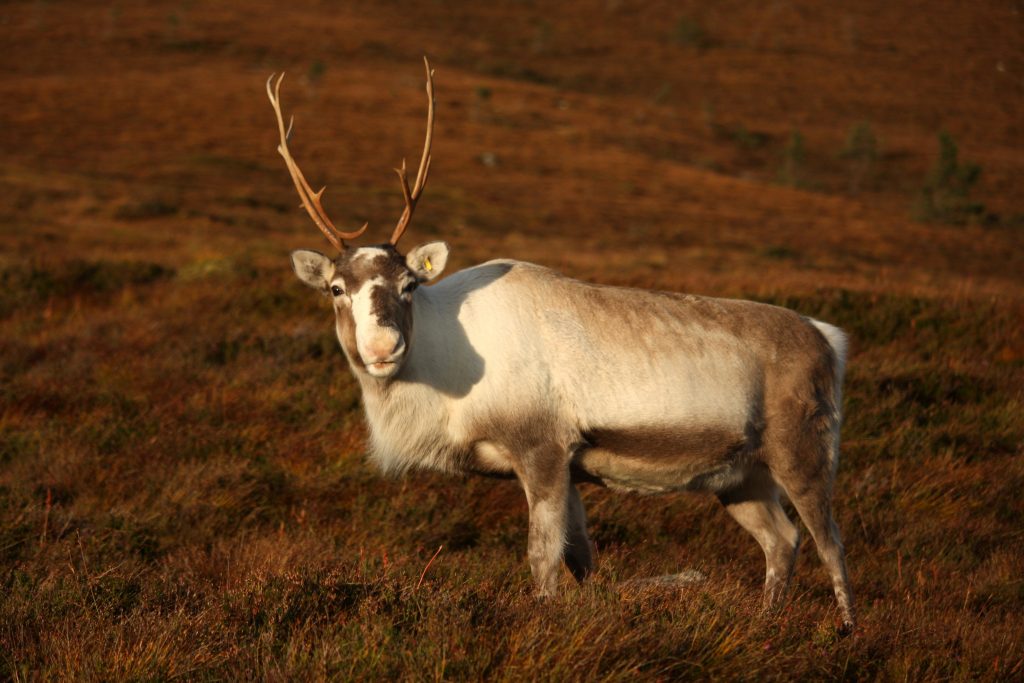
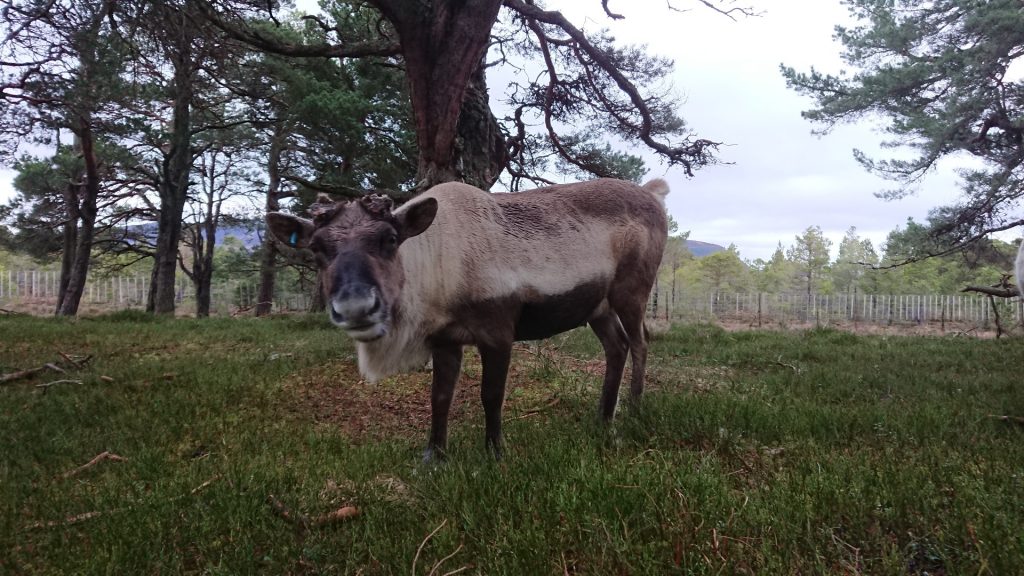
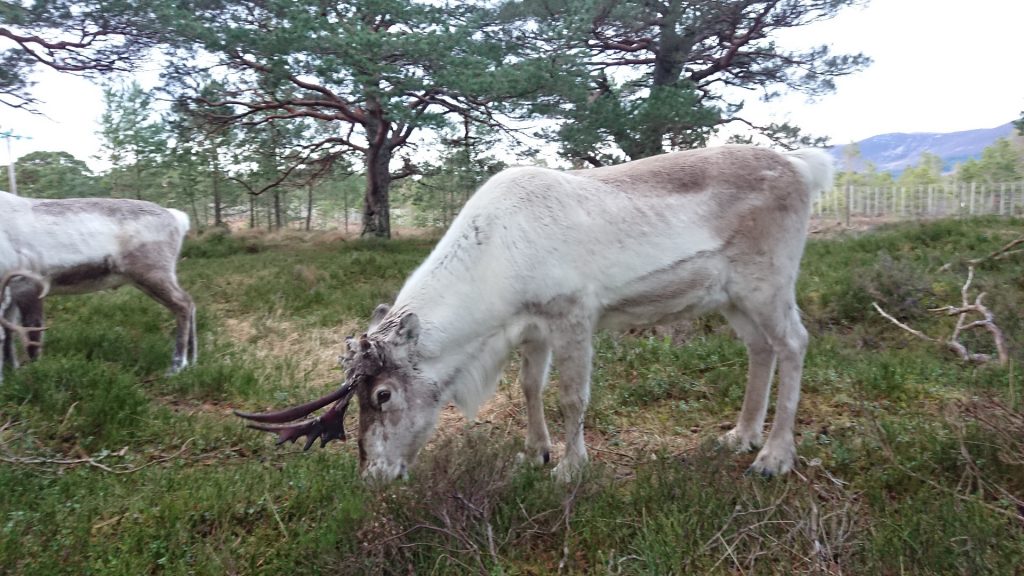
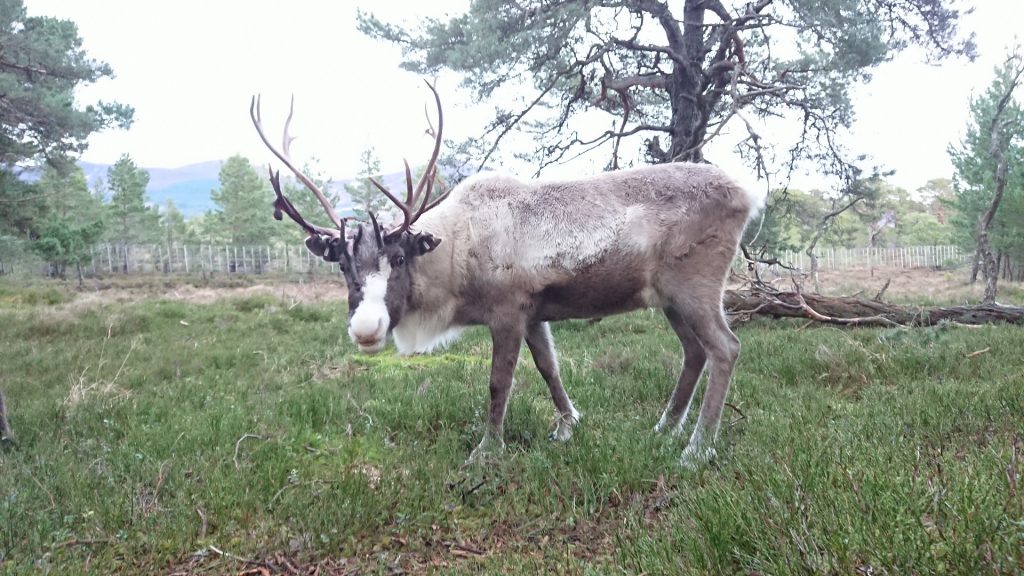
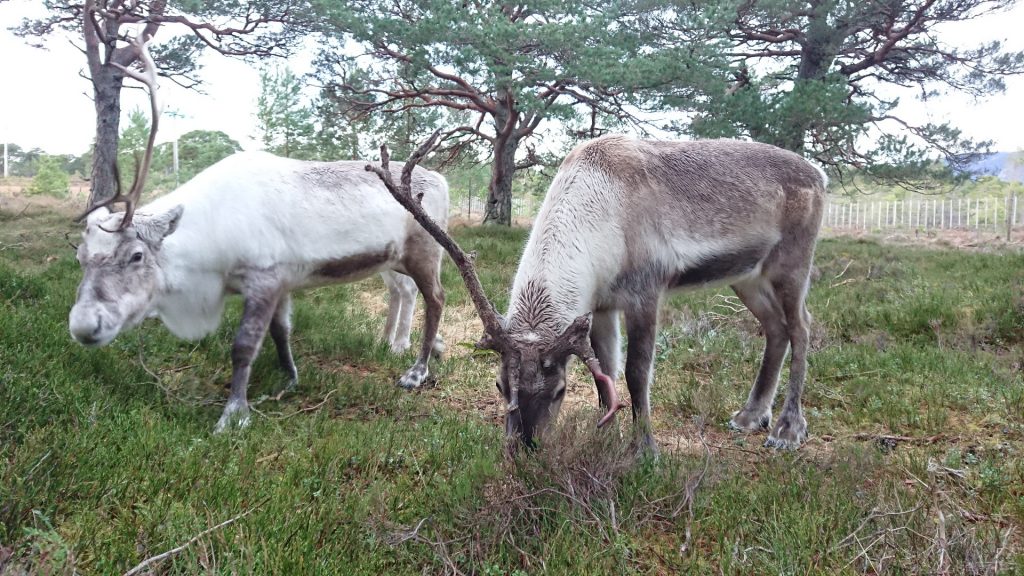
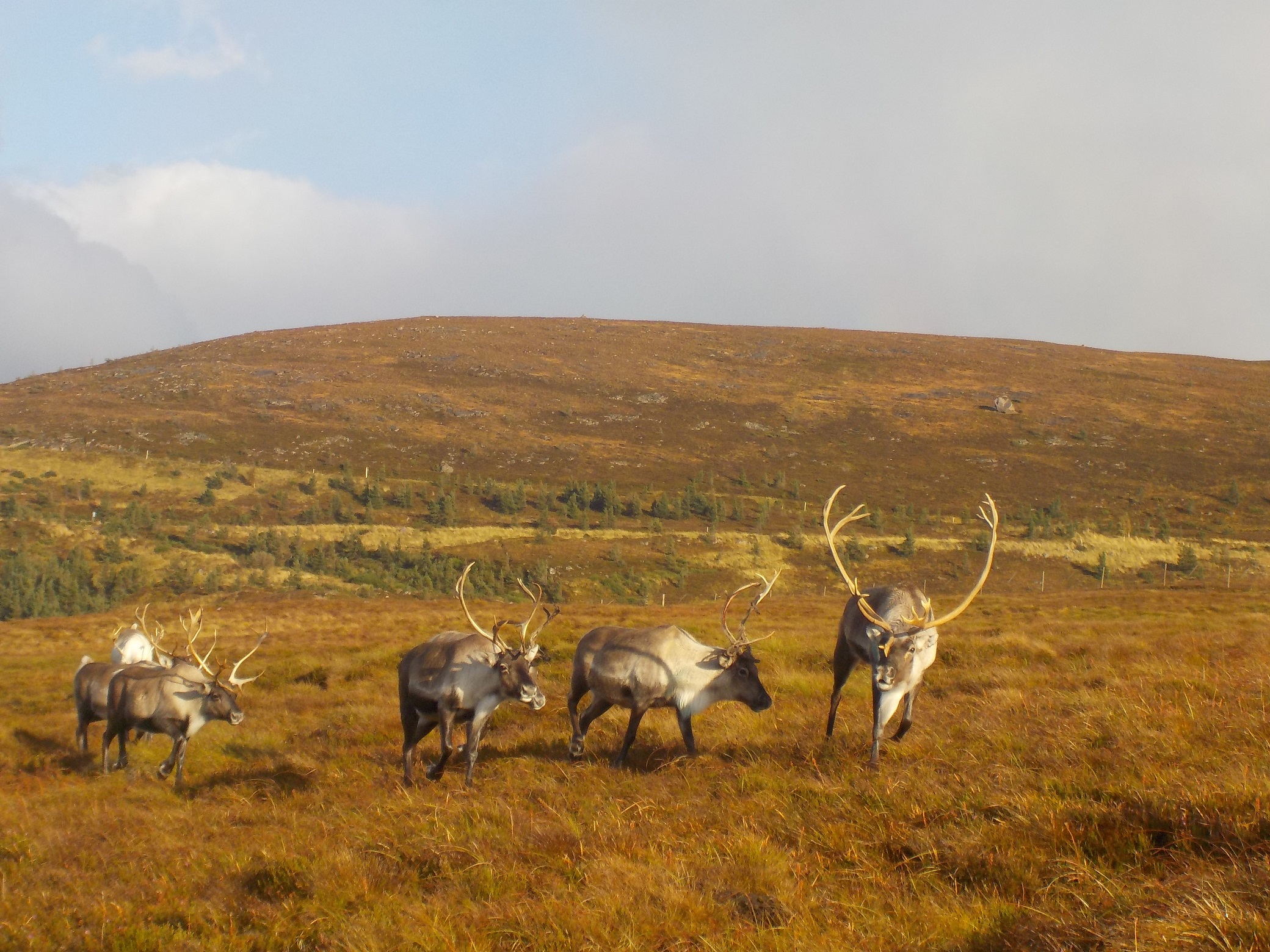
From January to May, our whole herd are out roaming free on the mountains, enjoying the wintry weather that they’re so well-equipped for. Whilst it can be ridiculously wild at times, on other days it is completely still, with glorious sunshine. I thought it would be nice to put up a selection of photos from the last month or two to give you a taste of our winter days…
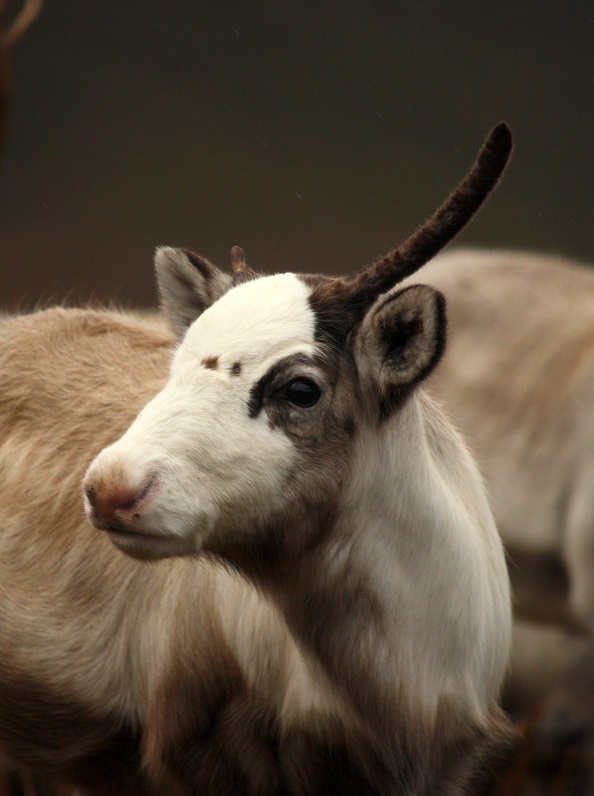
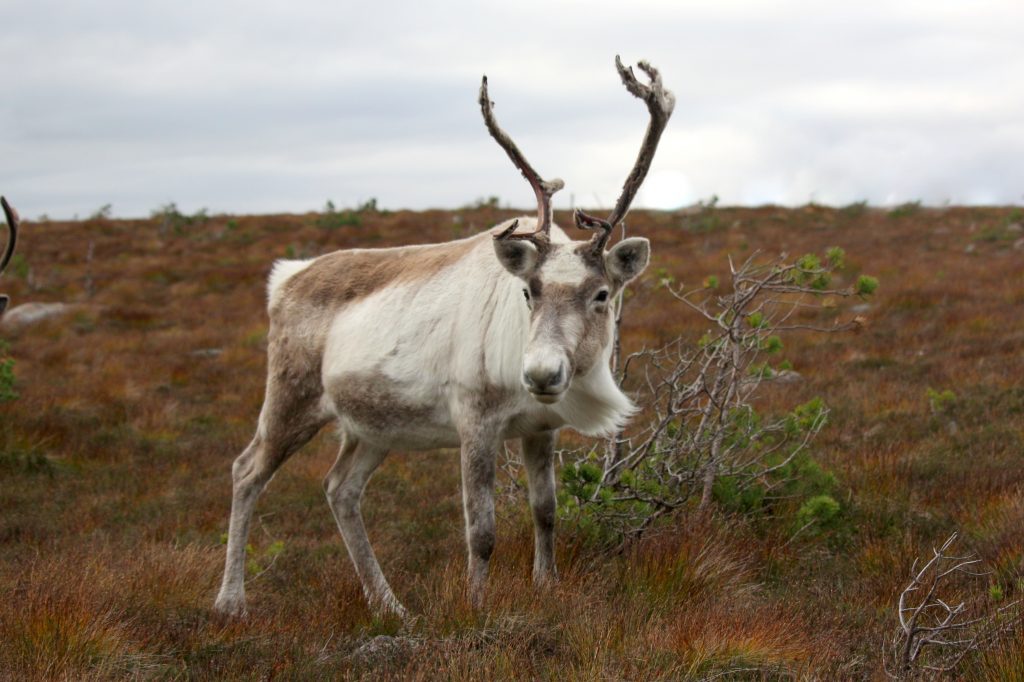
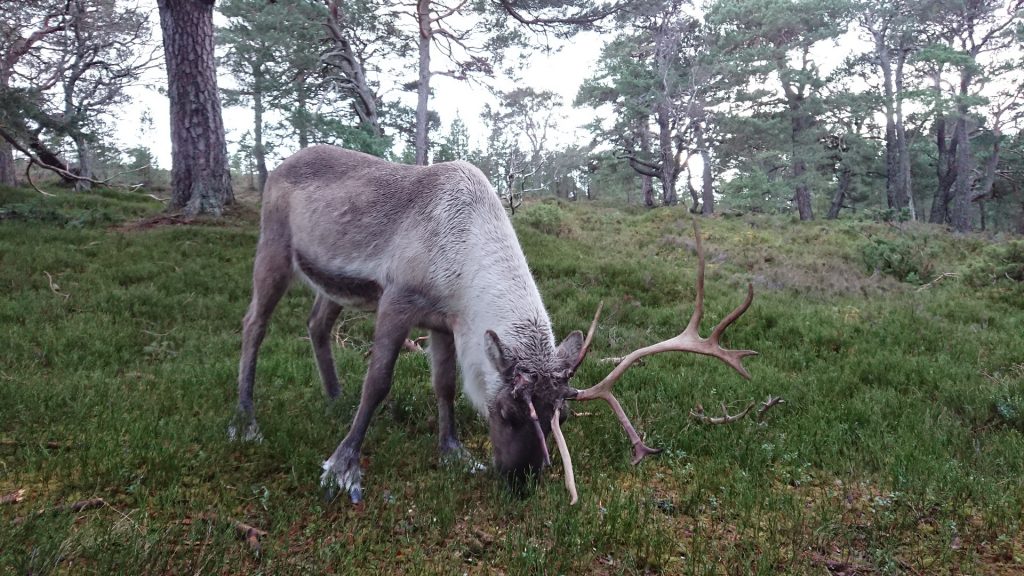
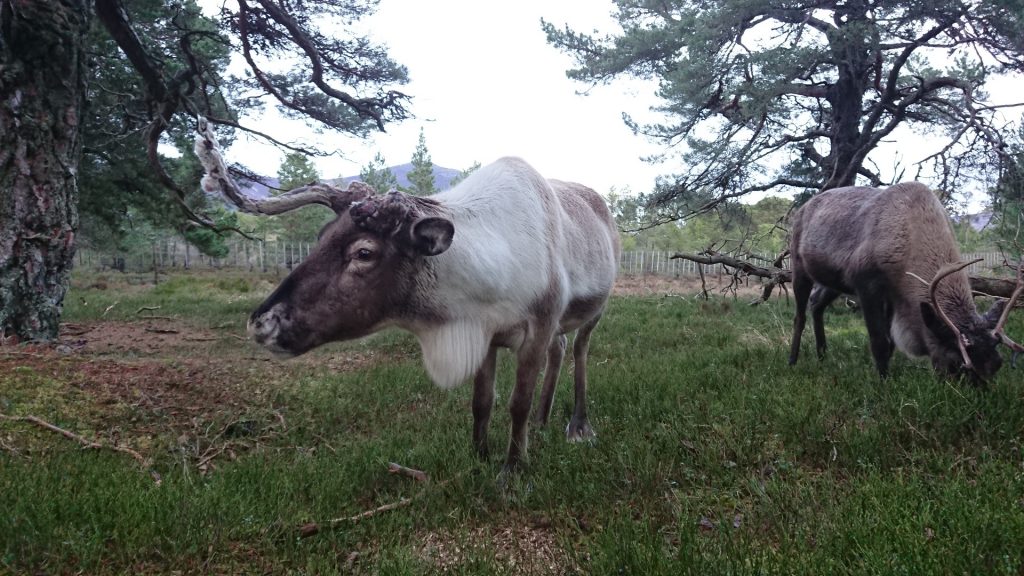
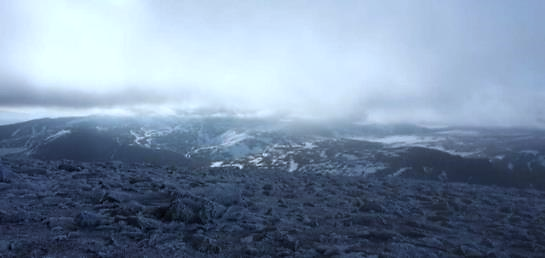
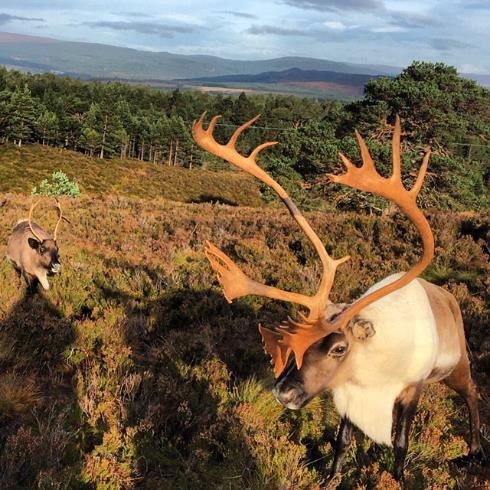
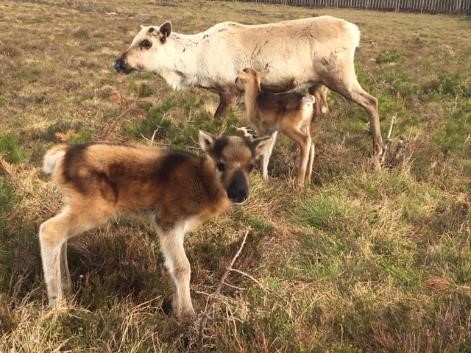
Oslo leading the herd over for breakfast.Glorious views out over Aviemore on a beautiful day.Camus, Sika, Brie and Bordeaux. Sika’s not sure about what she just ate!Origami and the herd on an icy morning.Ochil wondering if the food is ready yetOkapi has cast the main uprights of her antlers, leaving her looking a bit like a unicorn!Spider has found a nice pool for an after dinner drink.Santana sporting one of her antlers.Handsome Rubiks posing!Pavlova is easily recognised with her white tuft of hair on her forehead.Parmesan with her white face marking, and old lass Fonn in the background.Olympic is always one of the first to see us.LX on a grey day…… and again on a blue sky day!Fonn is the oldest reindeer in the herd, at nearly 17 years old.Ryvita and her calf Berlin.Beautiful Dixie.Dixie, Fly and Lulu, stalwarts of the herd.Young Dante.Camembert, what a star!Brie, Inca and Meadow.We always give the calves some preferential feeding out of the bags – it keeps their condition up and keeps them tame – here’s Bordeaux, Florence, Athens and Texel enjoying a snack.Blyton and Camembert.Baffin.Angua and mum Tap. Both are quite shy reindeer but we’ve put lots of effort into feeding them extra feed each day and their confidence has come on in leaps and bounds.Hen, Lotti and Dave – feeding mission completed!Happy reindeer eating their feed.Celt on a windy day.Little Kiruna.
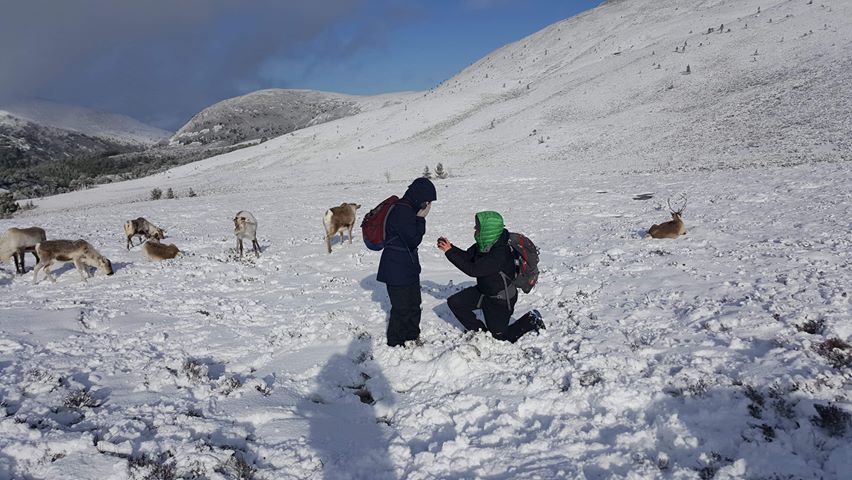
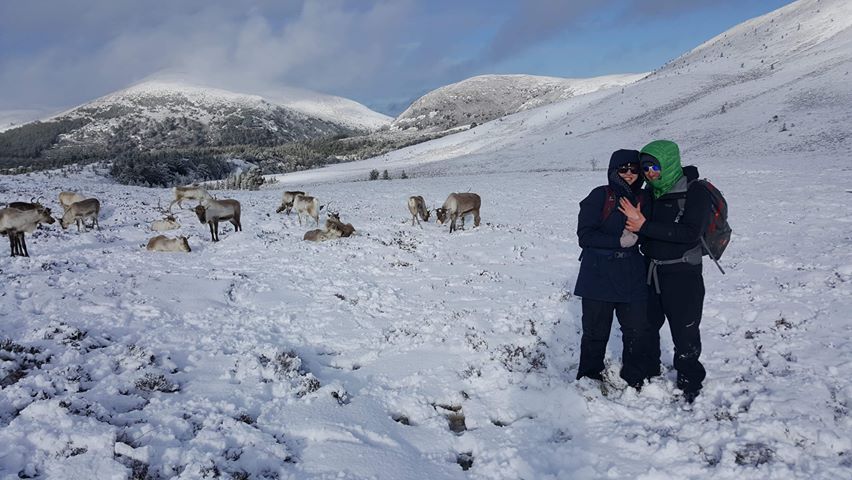
On a wild Hill Trip in February we were fortunate to witness a special moment. Andrew passed his phone to Manouk during a brief break in the weather and asked her to to take some pictures. She was able to capture the moment his partner Jasmine, became his fiancé.
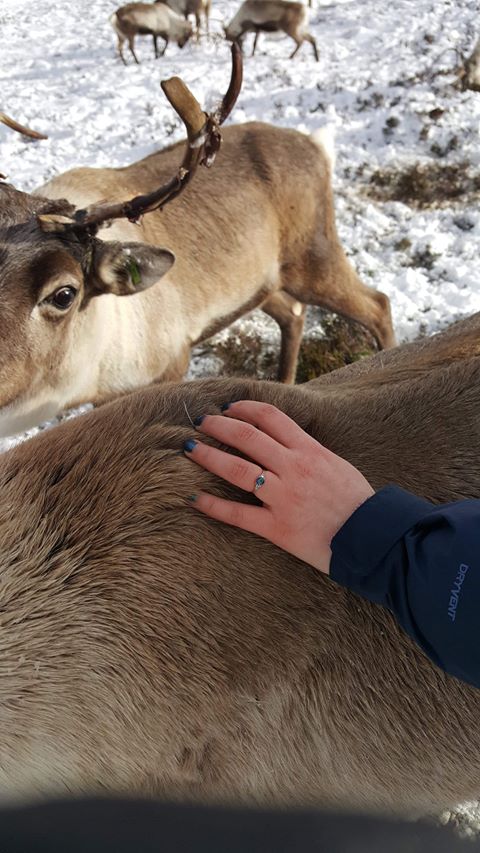
The big question for JasmineShe said yes!Olympic kindly lent his nice thick winter coat as a nice background. Aztec was keen to watch on too in case it meant handfeed!
Thanks to Jasmine and Andrew for sharing their photos with us. Congratulations from everyone at the Cairngorm Reindeer Herd. Let us know if you want Olympic and Aztec at the wedding….
During this year’s Christmas tour we ended up taking the reindeer on boats a couple of different times. The reindeer visited Northern Ireland, Orkney and the Isle of Lewis. I was lucky enough to go with them to Stornoway on Lewis and this got me thinking about the journey taken by the first 8 reindeer in the Cairngorm reindeer herd from Sweden with Mikel Utsi in 1952.
View from the ferry from Ullapool to Stornaway
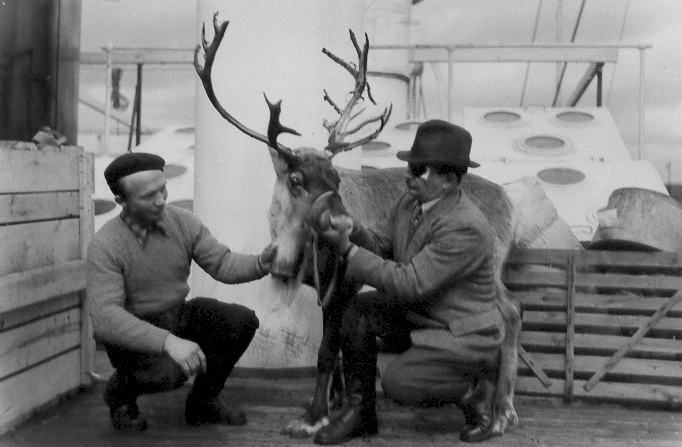
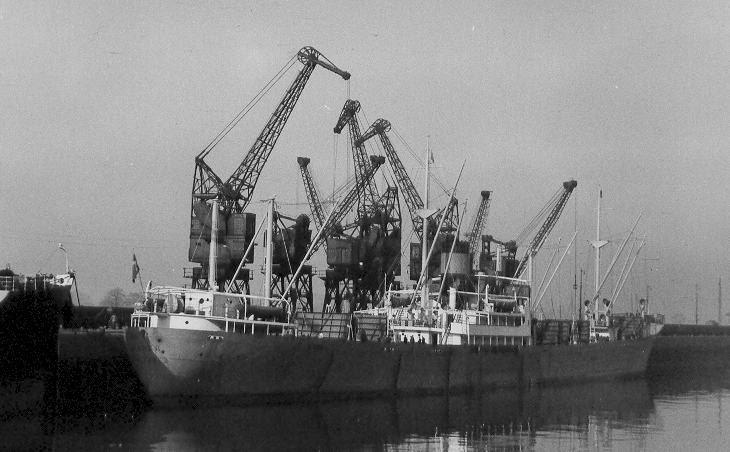
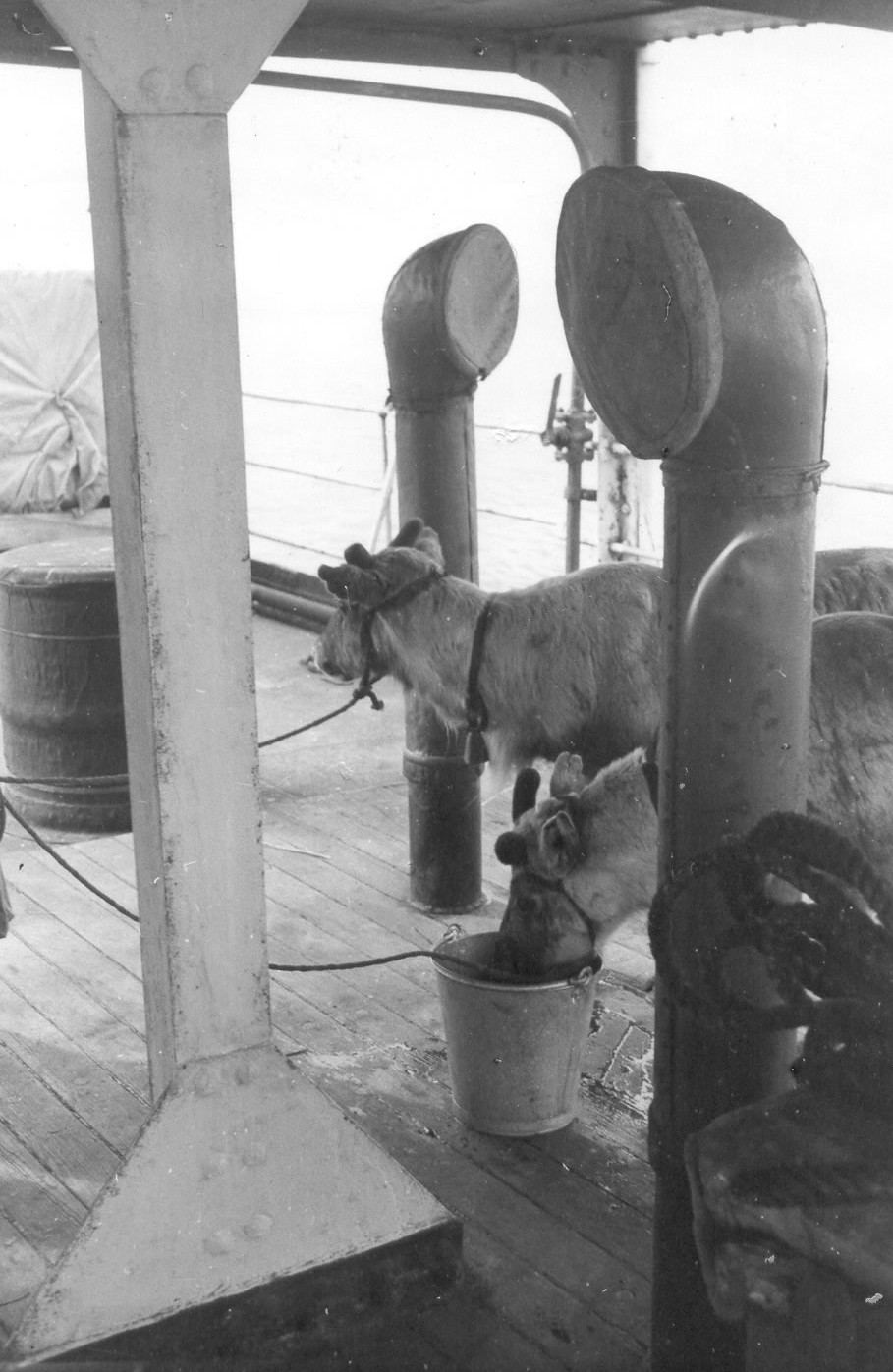
The reindeer were reintroduced to Scotland by a couple called Dr Ethel Lindgren and Mikel Utsi. Dr Lindgren was an American anthropologist whose speciality was reindeer herding people. She travelled much of the arctic studying different indigenous reindeer herders including the Sami. Whilst Dr Lindgren was with the Sami she met, and later married a reindeer herder named Mikel Utsi. For their honeymoon Dr Lindgren and Mikel Utsi came over to the Cairngorms and immediately recognised the artic habitat here as perfect for reindeer. Upon finding out that reindeer had become extinct in Scotland they decided to bring the reindeer back. In 1952 the first group of reindeer came over from Sweden, this is where boats now come into the story. The group consisted of 8 reindeer, 2 bulls, 5 cows and a castrate male named Sarek. Interestingly the boat they travelled to Scotland on was called the S.S. Sarek. The crossing from the north of Sweden to Glasgow was a fairly rough one and the reindeer were at sea for four days travelling 700 miles. Once the reindeer arrived they were quarantined at Edinburgh zoo before finally making it to the Cairngorms.
Mikel Utsi (right) and Sarek.
Once the first group of reindeer had settled in, Utsi and Lindgren brought another consignment of reindeer over later on in 1952. By 1954 they had finally procured a lease of silver mount, the hill at the far end of the reindeer enclosure, from forestry commission. This allowed more reindeer to be brought over from Sweden in 1954 and 1955.
Bulls Fritzen and Ruski in April 1955
The herd has grown in number steadily since the fifties until it reached 150, which is the number we are now maintaining. Throughout that time a few more consignments of reindeer have come over from Sweden to introduce new bloodlines into the herd. 68 years on the reindeer still happily roam the Cairngorms, at the moment every single reindeer is free-roaming for the winter.
I know, it’s a new year, the end of February and I’m already talking about Christmas. But don’t worry! I’m not talking about next Christmas, I’m going to cast my mind back to last years and more specifically, close to the big day itself.
On the 23rd of December our first Christmas event started just over the hill in Braemar. We survived the icy drive over to the Fife arms who were putting the event on for the hotel and local community and there was a real warm feel about the place. The parade was small but it felt a though the whole village had turned out to see the reindeer. The most amusing part of the day was that instead of Santa riding in the sleigh, we had a Queen Victoria who to this day still appears to be an iconic figure for the area. Yep, it turns out she’s still alive and kicking around Deeside! It was also nice to talk to people who knew and understood about the environment that our reindeer live in. I guess living on the other side of the plateau a lot of locals know all too well what the Cairngorm hills are like by living directly under them. All in all it was a delightful event in a very nice part of the world. Also, go and check out the flying taxidermy red deer above the Fife Arms bar…. Very interesting!
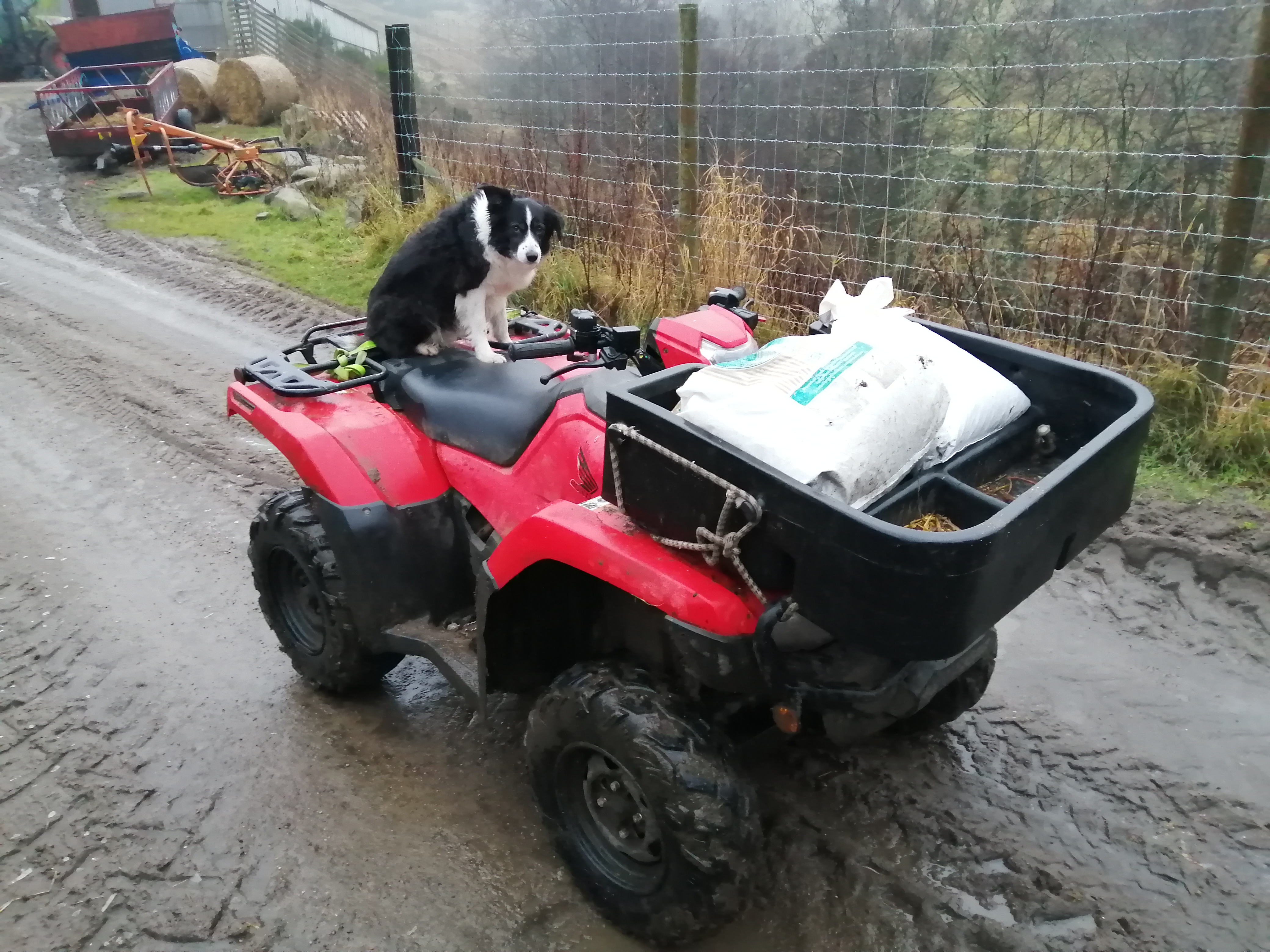
Christmas Eve was a much busier day. We started at the farm by feeding the free-range reindeer on the hill, jumping on a quad bike and heading up to find them. Fi’s dogs Tiree and Sookie came along for the exercise although poor Sookie is knocking on a bit so she hitched a lift on the bike and ran off the hill. At the farm we loaded up our awesome reindeer team for the next 2 days. Baffin, Celt, Rubiks and Matto were our experienced sleigh pullers while Helsinki and Florence were our 2 young calves.
Sookie on the quad bike
Our first event for the day was Baxter’s Highland village factory in Fochabers. Carol Parsons, a local volunteer did a great job at helping us, talking to members of the public so that Fi and I could get the sleigh and reindeer ready. The event was very straight forward and reindeer were great. Everyone was in a happy Christmassy mood thanks to a singer on a microphone who sounded just like Michael Buble (he was either very good at singing or a very good mime). In what felt like no time at all we were packed up and heading in the direction of Aviemore.
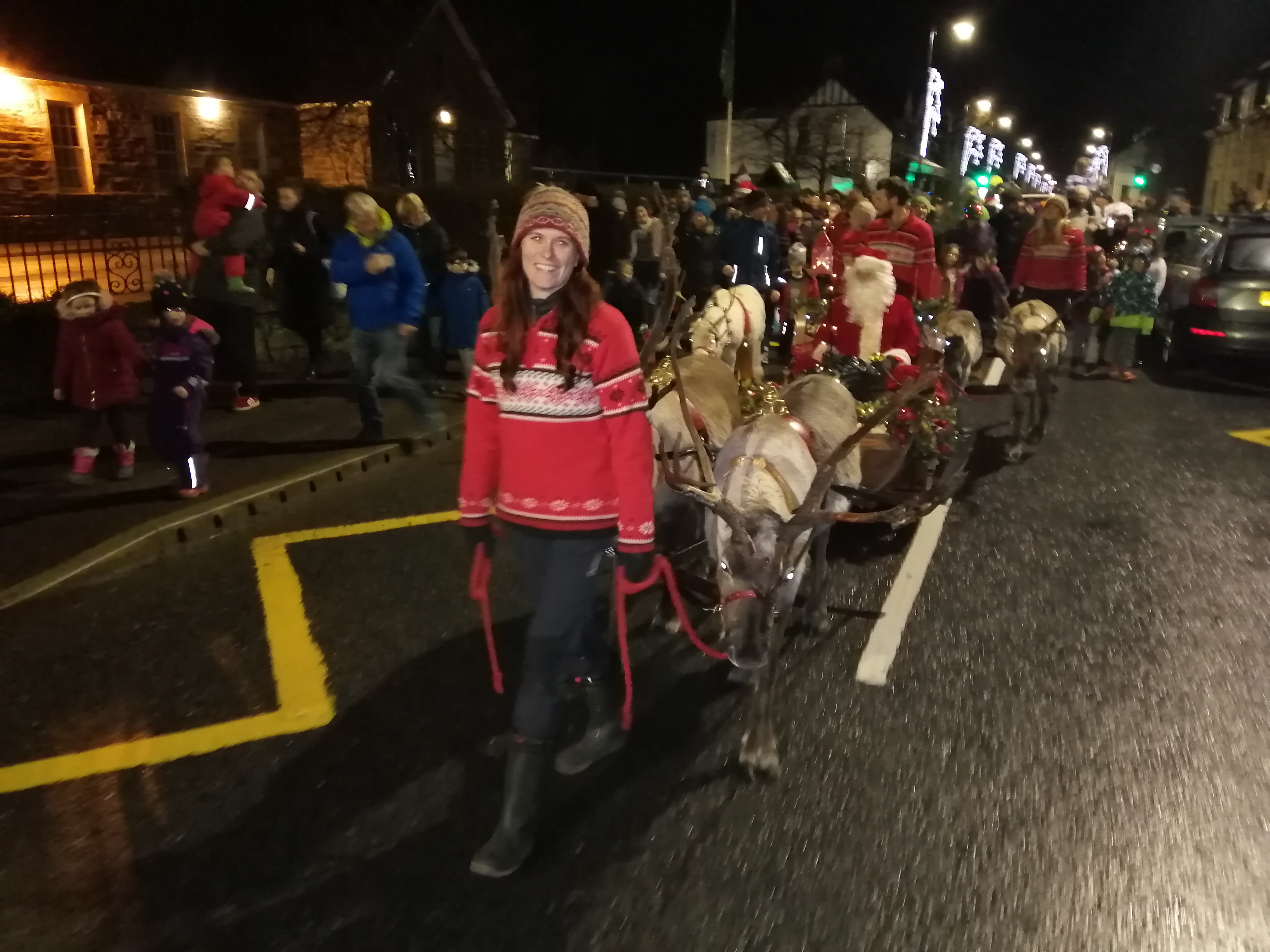
Aviemore is the biggest of the local parades one of the busiest in general. Setting up for the event was helped by reindeer herders Tilly, Olly, Zoe and Sheena. Friends who lived close by in the town also came to say hi and everyone was in good spirits. It didn’t take long for the street lit pavements to be lined full of people who had come out to see Santa and the reindeer. The closer we got to the Cairngorm hotel the busier it got and with a few hundred people also following behind us. The reindeer were all so well behaved, calm and relaxed. It was thoroughly enjoyable to be part of the event, working with the reindeer and Fi. Everyone was in such great spirits and there was a real warm Christmas community feel about the whole event.
After scoffing sausage and chips in the lorry we arrived in Kingussie. With the help from the other herders the parade went smoothly. Up the high street, turn around at the lights and back with a stop along the way. By this point all the reindeer just knew exactly what to do and couldn’t have made it any easier for us. After almost leaving the trace in the dark set up area we set off were in the direction of our final event of the day in Newtonmore.
Driving through the village to the start, we could see everyone who has been waiting patiently, it was 20:00 – 20:30 by this time but I suspect all the young children were allowed to stay up later to see Santa and the reindeer. The pipers and drummers finished their pints outside the pub and we were ready to go. This time Olly went to the back of the sleigh with Rubiks, Matto and the two calves and Fi was at the front Baffin and Celt. Fi had planned to surprise Zoe by giving her the lead half way through the parade, it was her first time doing so but she did a great job! The Highland hotel kindly offered everyone a mince pie and mulled wine at the end and after a little speaking to the hotel guest we finally headed back home to the reindeer centre for a dram of whisky and bed before another day of events.
Zoe leading at the front with Baffin and Celt in Newtonmore
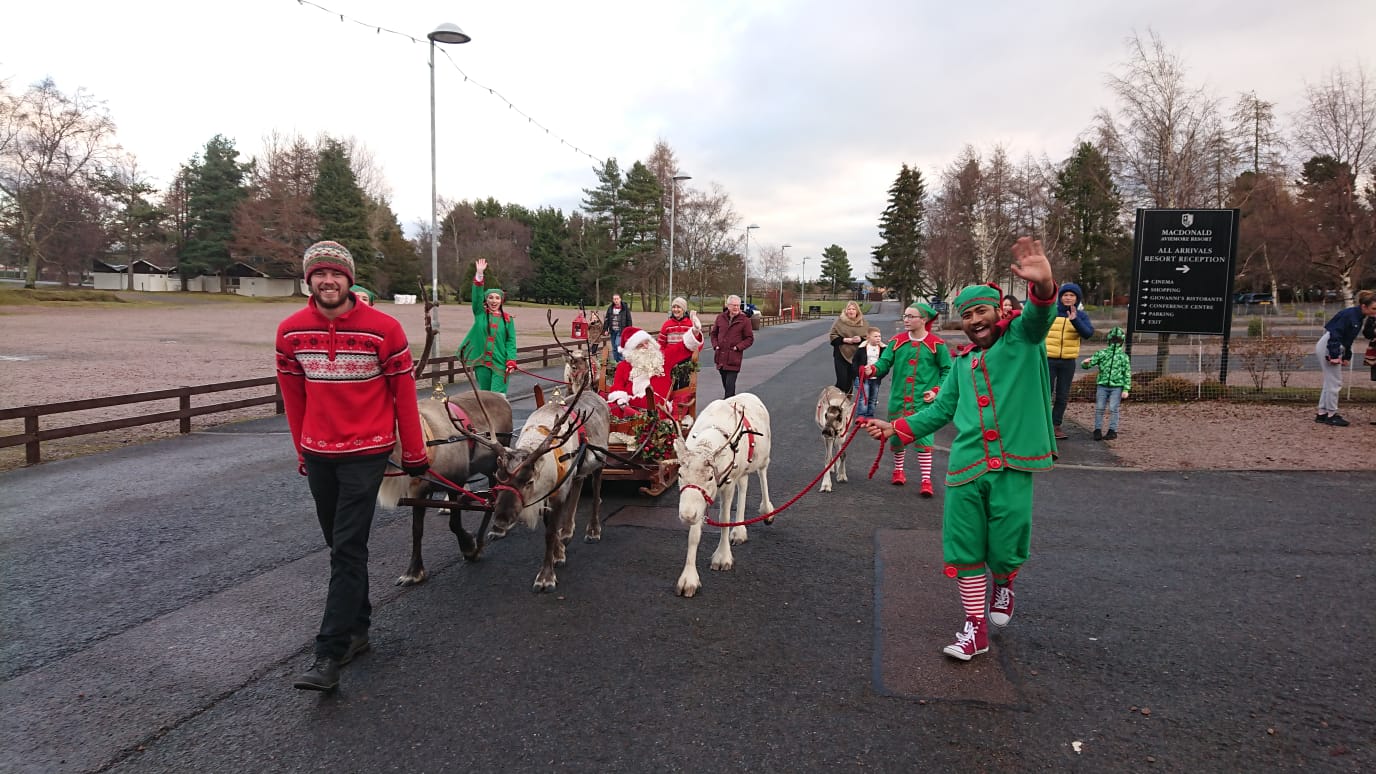
While children across the country started to wake up in excitement and open presents on Christmas morning Fiona, Tilly and I were back out on the road with the reindeer. First stop Columbridge hotel. Fi was surprised with how little people were at the hotel to see Santa and his reindeer, it turned out for some reason that the hotel wasn’t fully booked so after 30 minutes or so we were packing up and ready to move on. Event number two was the Macdonald resort in Aviemore. This was a much busier event and as we started walking down to the main entrance with Santa in the sleigh and reindeer pulling in front. A large crowd was waiting for us. The reindeer were now getting too relaxed for their own good, and while people were saying hello and taking pictures, Rubiks decided he’d lie down for a little snooze. We also had help from several elves during the parade who were so good that each one was able to walk a reindeer back to the lorry, they were of course delighted.
The helpful elves walking reindeer back.
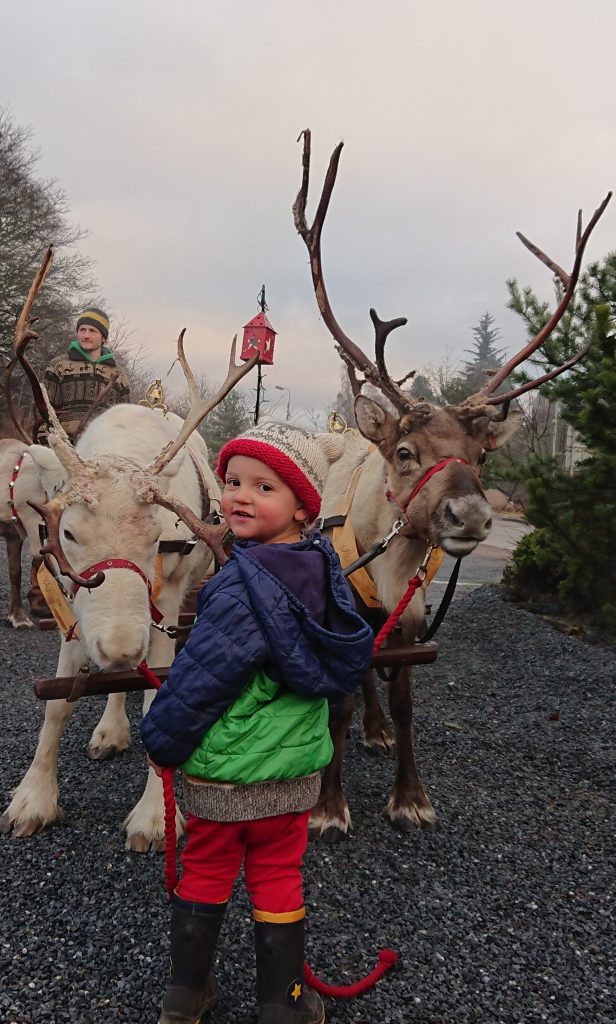
Next up was the Nethybridge hotel. The hotel very kindly fed us lunch beforehand and with our stomachs full we were ready to go. Along with the 3 of us, Tilly’s son Alex and 2 year old grandson Hamish (the youngest reindeer herder) came to help out. Hamish helped Fiona at the front of the sleigh making sure that Fiona didn’t drop the ropes. Once we were outside the hotel he also got to meet Santa! He was a bit unsure at first but once Santa gave him a present he was much happier. Along with the reindeer Hamish was certainly the star of the show and once again helped lead the reindeer away after everyone made their way back into the hotel.
Hamish is a natural
Finally in the middle of the afternoon we arrived at our final event at the Duke of Gordon hotel in Kingussie. With Tilly’s disappearing off to help get Christmas dinner on the go, just Fiona and I worked with the reindeer at the event. Like all 4 events on Christmas day It was nice and straight forward and everyone was happy and in the Christmas spirit. People could sit on the sleigh while we chatted to others and just before it got dark we were packing up for the final Christmas event of 2019!
Finally it was time to start the Christmas celebrations of our own at Reindeer House with everybody else. The reindeer spent the night in the paddocks and not too long after were once again free- ranging on Cairngorm mountain or in the Cromdale hills enjoying the rest of the winter grazing for a very well earned break.
Having worked as a seasonal herder for many years working January is a real novelty for me. Usually on the 24th of December I hop on a train home to Bristol to spend Christmas with my family and then return to uni in the new year. But having graduated last year, and with a gentle bit of persuasion and the promise of reindeer, I convinced my family to spend Christmas up in the Cairngorms. It is now January and I am delighted to still be here. So on Monday the 6th, with no more hill visits for over a month we merrily waved the reindeer off onto the free-range for the winter.
Letting the reindeer out at the end of the Christmas holidays
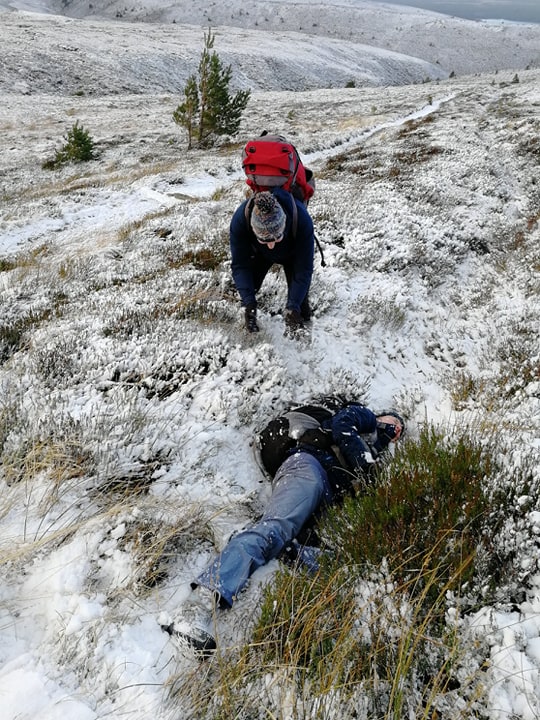
The first full day ended up being incredibly wild and windy (gusting at 100mph) and the reindeer were very far away so we left them to find their own food for the day, something that they are absolutely fine doing as they live in their natural habitat. We spent the days slowly working through the seemingly endless list of ‘January Jobs’ some of which I think were on the list last year and still haven’t been done. On day two however, the sun was shining and then reindeer were slightly closer to home. So me, Sheena and Chris headed up to the Cairngorm ski carpark with rucksacks full of food. Upon arriving we saw lots of cars pulled over with people taking photos, a clear sign of reindeer. About a third 30 of the reindeer were waiting for us, just by the road. We walked these reindeer away from the road, a task easier said than done. Whilst the reindeer were good as gold, walking across incredibly uneven ground in the snow with 20kg of food on your back is quite difficult . Throughout the walk, Sheena lost a wellie in a patch of bog, Chris didn’t fall over once(!), and I fell over completely and couldn’t get back up because of the rucksack full of food. I can’t certainly say that I now know exactly how a woodlouse feels.
Lotti stuck in a hole
As we were leading the group of reindeer away from the road about half a mile away we could see another group of mostly male reindeer coming over from the top of the reindeer enclosure. Eventually we also saw another group of cows and calves coming from the other direction. As the reindeer were getting closer and closer the race was underway, who would come first, the boys or the girls. The boys certainly are greedier but the girls are fitter. Both groups went out of site as they ducked onto a lower area and then eventually the boys showed up, just ahead of the girls. Turns out that the motivation of an easy meal was enough to overcome their lack of distance training. Once the entire group of reindeer currently free-roaming in this area had arrived we fed them all, took plenty of photos of the beautiful reindeer in the snow and then walked back to the van.
First day on the free-range in January
Whilst for most people January seems like a bit of a dreary month, I can certainly now see why reindeer herders love January so much. Having all the reindeer free-ranging the hills and going up to feed them with not a soul in sight really is a fantastic experience.
After the hustle and bustle of the festivities and Christmas events, the Reindeer Centre is closed for most of January and part of February. For the staff it’s peaceful here at Glenmore, and a great time for keeping busy catching up on all types of jobs related to all aspects of the Centre: Christmas kit, shop, office and outdoor, involving cleaning, maintenance, decorating, and even a new bathroom for those that live in!
Meeting up with the free-range herd to feed them.
But one of the perks of the job is that we do also have to find time periodically to hike up and find, check on and feed the reindeer. This year is the first time in a long time we have had not only the usual females and calves out free ranging in the Cairngorms for the winter months, but also some of our boys with them too.
Feeding free ranging reindeer in January. Right front: Christie – Female born 2017.
For myself, after working here almost two years now, I have become confident at learning the names of most of the male reindeer, due to leading frequent hill trips with visitors up to see them all through the Summer months. However, with the females usually free-ranging along with any calves all through the warmer months, this has given me little opportunity for familiarising myself with the girls. The winter hikes this January to check on our free-ranging reindeer have given me a better chance to get to know the females, and with Andi’s tuition and constantly testing me each week, I finally feel like I am making some progress!
Camembert – Female born 2013.
The ones with distinctive markings such as Oatcake, Camembert, Parmesan, Christie and Texel, or that are lighter in colour like Lulu and Mozzarella are the easier ones to learn. I am also guilty of learning them by the size and shape of their antlers, which are like a fingerprint and unique to each reindeer, but also fall off once a year, thus leaving you back at square one! Until they regrow again, but a year is a long time to wait.
Texel – Distinctive female calf born May 2019.
When I first started and was learning the names for the male reindeer on my first hill trips, I actually discovered that learning the colour and number of the ear tags was the easiest method for me. By law we have to give each of our reindeer an ear tag with a number, similar to if you keep cows or sheep. To make it more exciting (and easier to learn their names), each year our ear tags are a different colour, and we also pick a theme. For example in 2009 they are pink tags and named after cakes, biscuits and puddings. We have Clootie (after the Scottish Clootie dumpling), Jaffa, Hobnob, Pavlova to name a few. And in 2016 they are named after Ancient Civilisations, so we have Pagan, Inca, Chola, Suebi, Celt, and many more.
Lulu – Female born in 2006.
The longer you are with the reindeer the more attuned you become to the subtle differences between coat colour, variations in face and body shape, and more obviously their individual personalities and traits. I guess if you have ever worked with horses or dogs before, as I have, or any other animals for that matter, then it’s similar. To the untrained eye a species of animals is just that, but the more you get to know them the more obviously they stand out as individuals, and also the more fond of them you become.
There’s a lot to be learned volunteering at the Reindeer Centre and multi-cultural knowledge is one theme very obvious, just thinking about the reindeer names and the regular herders’ nationalities. However, walking up to hand feed the reindeer throughout December it occurred to me how many visitors travelled many, many miles to experience the thing we have taken for granted over the last 30 years – velvet noses snuggling into your hands for a taste of delicious grains of feed.
(Apologies for the small photo files, they are at their maximum sizing!)
Colin feeding Olympic
During our three weeks in December 2019 we talked to visitors from as far afield as Australia, New Zealand, Austria, China, Thailand, Canada, Holland, Egypt and Germany, not forgetting those from England and Scotland.
December in Australia is the children’s Christmas school holidays and for many families a trip to Scotland and the reindeer is a top priority, as we were quite rightly informed. During our second week, beginning the 9th December we had a good drop of snow, which I enjoyed as much as the reindeer and visitors!
Snow angels!
The reindeer in my opinion are at their best in deep snow. For two children from Australia the combination of sun, snow and reindeer made just the perfect day and it was such a joy to experience their excitement. Having never experienced snow in their lives it was an exhilarating event. With wellie boots borrowed from Reindeer House it didn’t take them long to jump in the deep snow drifts and fill their wellie boots with the cold stuff – and we were not yet at Utsi’s Bridge!
As many of you know, if you have been on a visit, once in the enclosure we follow the board walk, which the reindeer also like to use and they get in between visitors slowing the speed of progress. Well for two young people this meant having to step to one side to let the reindeer pass and subsequently ‘falling off’ the board walk into the deep snow – their feet were rather cold and wet by this time but no adult advice could curtail their excitement, it was infectious! We then had adults stepping off the board walk to experience the deep snow just for the fun of it! We had a lovely visit and the snow was appreciated by everyone, young, older and the reindeer!
…our reindeer turn into cows… Not quite, but it is the time of the year when they are casting their antlers, and beginning to look perhaps a little like people imagine a reindeer to.
Oh dear Spider! Spider always casts his antlers early – usually by the end of November.Jonas cast his upright parts of the antlers about six weeks ago but is holding on to his blade and front points.
Casting antlers is a completely natural process, and is one of the huge differences between antlers and horns (no deer in the world have horns!). Reindeer grow their antlers from scratch every year, from an area on the top of their skull called the pedicle. The growth period is from about March to the end of Summer, at which point it calcifies into solid bone, with no feeling remaining. After use in the autumn rut, the males cast their antlers, meaning they don’t have to carry a heavy weight through the winter snows, and leaving the coast clear to start their new set in Spring.
Jonne is one of the few castrated reindeer still with a full set of antlers on his head in late December.
This means that from November antlers drop off on a regular basis, sometimes at the most inopportune moments (in the middle of a Hill Trip for example, causing panic among visitors and frantic reassurances of “It’s normal, it’s ok!” from the herder!). As we get nearer to Christmas, our choice of which reindeer join a Christmas event team becomes more and more influenced by who still has antlers on their head – event organisers can be a little grumpy if a team turns up with just one antler between six reindeer!
LX has been lopsided for about a fortnight now, whereas Scolty cast the upright of his left antler just a few days ago.Bingo cast his whole right antler a few days ago.
Most of our males are castrated at 3 years old, helping to prevent inbreeding and giving them a much calmer life in general. A side effect of castration is that the antlers are not as dense as the bulls’, and tend to be cast in sections rather than in one piece. Hence we end up with reindeer with “One and a half” antlers, or often just the front points remaining after the more top-heavy upright points are cast. It’s interesting that members of the public often don’t realise that a reindeer with their front points has actually got any antler missing, whereas a reindeer who has cast all of one antler but none of the other looks more lopsided and draws many more questions of “Did they lose it fighting?”
With his front point remaining, Duke gets less concerned comments than reindeer who still have one entire antler on their head. In the background, Stuc still has his full (small) antlers.
Sometimes antlers are lost in squabbles, but only when they’re ready to fall off anyway, and I think as many go from being bumped against a tree (or a herder’s backside!). And whilst there is sometimes a little residual blood on the pedicle when the antler is cast, it isn’t a painful process, the only insult being to their pride, as they often drop down the pecking order. But this is often when a bully gets their comeuppance, as the other reindeer they’ve pushed around see the tables turned and get their own back. So don’t feel too sorry for them!
As the rut has now come to a close and we move into winter, us reindeer herders are feeling particularly strong. For most of the year the female reindeer in our herd spend their days free-ranging the Cairngorms. However during the autumn we have all the reindeer that we want to breed from in our 1,200 acre hill enclosure. This is to ensure that we know which bulls have bred with which females and to ensure there is no inbreeding. This does however mean we have many more reindeer to feed than usual. As this is their natural habitat, when the reindeer free-roam they find all their own food and we don’t feed them at all. Whilst there is plenty of natural grazing in the hill enclosure we also give them supplementary food to make sure that the grazing replenishes each year. At the peak of the rut we were both mixing and carrying a lot of food up to the reindeer. In fact on the days when the most reindeer have been in the enclosure we are carrying 144 kg a day or a tonne a week.
Houdini and his girls
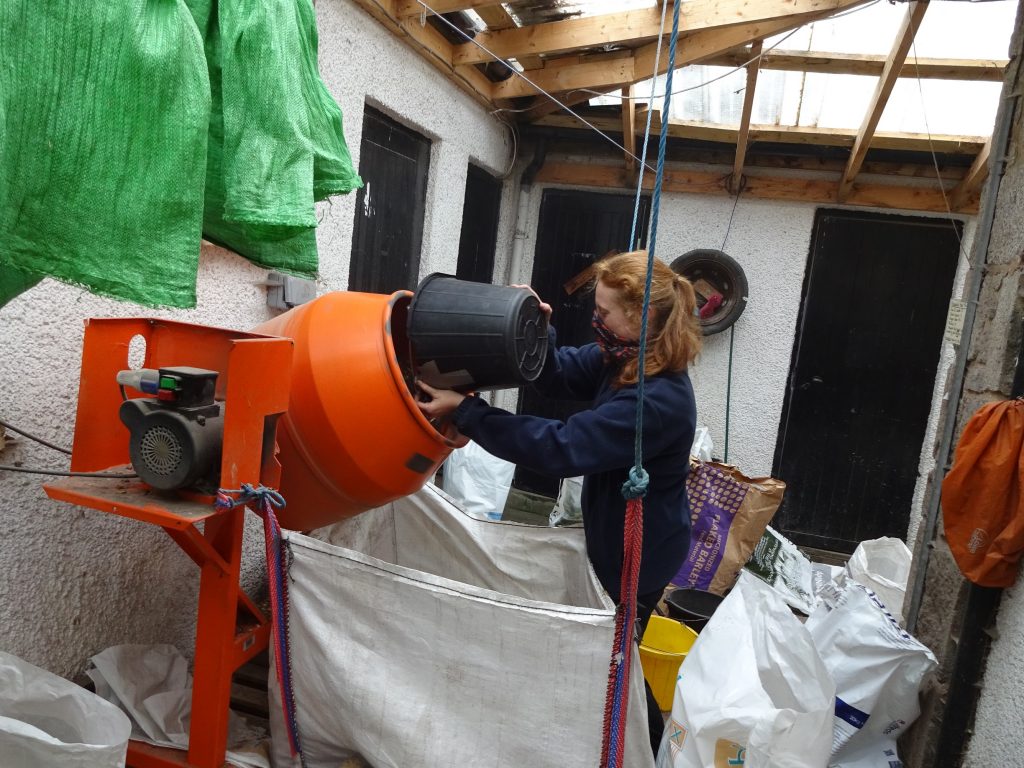
Mixing feed can be a real work out as it involves lugging around 20kg bags of various grains, measuring out the right amounts and throwing them into a cement mixer. The reindeer food is made from a mix of barley, sugar beet, sheep mix, dark grains (a by-product of whisky distilling) and hay soaked in garlic. As you can’t buy reindeer food here in Scotland, we mix up the food from lots of different things to give the reindeer the right nutrition.
Izzy mixing feed
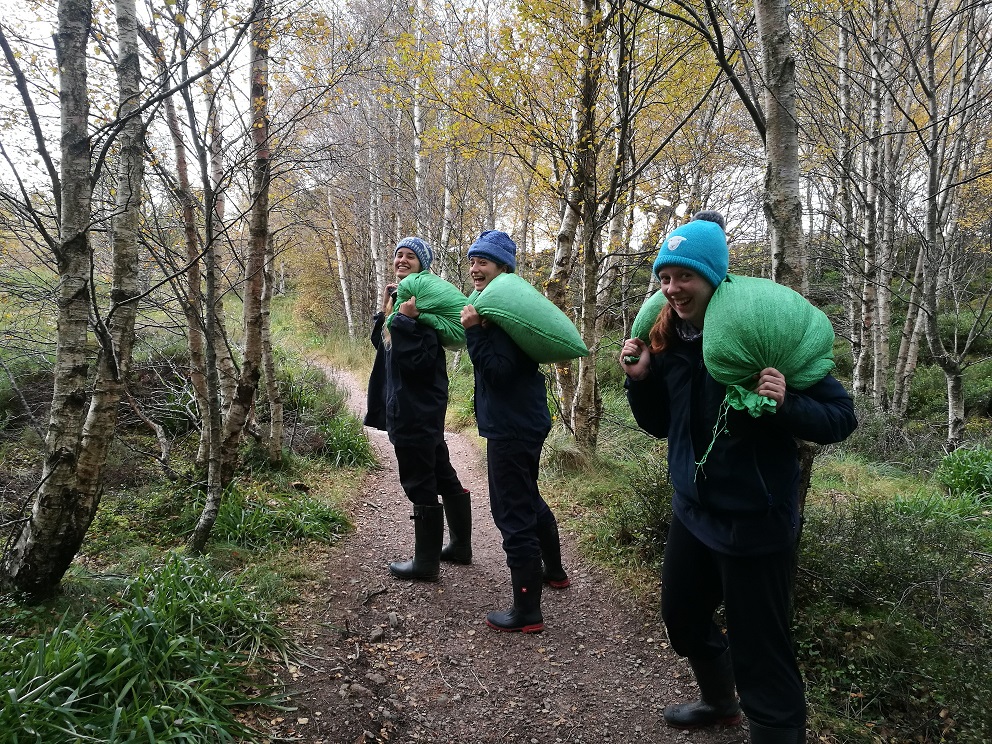
And then once the feed is mixed, actually getting it to the reindeer is no mean feat. Normally the food is packed into roughly 15kg sacs and carried up to the reindeer enclosure on our shoulders. We have however also been asking visitors to help carry smaller bags (no more than 6kg) of reindeer food up the hill. If you have helped us carry food, thanks again from everyone here at the Centre, both two and four legged.
You certainly won’t find a reindeer herder in the gym, especially not during the rut. Mixing and carrying feed (as well as unloading the feed lorry) is a very good work out and justifies the copious amounts of cake we all eat. I also know that all the reindeer herders, especially the women, take great joy in easily flinging a large bag of reindeer food onto our backs as a visit of people look on amazed. This summer I heard a man ask my colleague Nell if she needed a big strong man to help her carry her bag, to which she responded very politely “I’m a little strong woman and I’ll be just fine”. Go Nell!
During the autumn months reindeer are starting to prepare for winter. By October, their summer coat has begun to disappear below a fresh new winter coat. Reindeer winter coat is one of the warmest coats in the animal kingdom, with over 2000 hairs per square inch on their body. About 600 hairs per square inch are hollow allowing air to be trapped between them forming an insulating layer, which can keep help them survive down to 72°C.
Cairn Gorm views
The rutting season is an important time of year for Reindeer bulls. First their velvet strips off their antlers leaving them with solid bone, stained red from the blood supply that was there to help the antlers to grow. Eventually the antlers lose the red stain and their impressive sets are revealed!
Kota during this year’s rutting season
Castrated males don’t lose the velvet from their antlers quite so quickly. This is because the reduction of testosterone doesn’t trigger the response to shed it. This also means that the castrated males get to keep their antlers slightly longer than the bulls. Because of this, castrated males make for the best Christmas reindeer.
Females that are put with the bulls during the rutting season spend the majority of the time with the breeding bull. Calves and yearlings will stay with their mothers during this period too.
Female with her calf and a friend
Red squirrels
The red squirrels are also preparing for winter during the autumn too. They collect stores of nuts and burry them so once winter begins they have a source of food, even when no suitable food is available. The only issue they have is remembering where they buried their store.
Also during the autumn Red Squirrels begin to grow their winter coat. Their winter coat, like reindeer, is thicker than their summer coat, and denser. This allows them to keep warm during the winter. Their ear tufts also become thicker and more prominent.
Pine Martins
A group of pine martins is called “richness”, even though they are skillful climbers they normally hunt on the ground. Pine martens are believed to have come to Britain around 10,500 BC, at the end of the last ice age. They live in woodland habitats and were Britain’s second most common carnivore around 6,500 years ago in Britain and Ireland.
Similar to red squirrels, pine martins do not hibernate. They have thick fur all over there body to keep them warm during the cold winters. Pine Martins are hardy mammals and will eat anything including mushrooms, insects, small mammals such as voles and bird eggs. Being omnivorous allows them to always have a source of food even when certain plants and berries have died off due to the winter frost. They mainly forage or hunt for food at night or late in the evening.
The local bar to the Reindeer Centre is named after this elusive creature, the reason being that several Pine Martins have been spotted outside the bar late in the evening eating the various feed which is left out for the Red Squirrels. (Reindeer herders are also often found at the Pine Marten Bar late in the evening…)
Birds
Osprey
During the autumn Ospreys will start their incredible journey back to Africa, where they travel up to 5000 miles. The female is the first to leave. She leaves the nest and her fledglings in the care of the male who will continue to fish for them until they are able to fend for themselves, once they can the male will set of on the migration. Then finally the young will start their journey.
The mating pair may not see each other over the winter period, but will meet up again the following breeding season back in Scotland or Northern England. Ospreys were driven to extinction in the UK in the 1900’s due to egg collectors, they were also considered a pest due to them eating the salmon and trout.
Ospreys returned for the first time to breed in 1954 to Loch Garten near Aviemore. This was a natural recolonization, but the birds still needed a huge amount of help and protection to breed successfully in the Scottish highlands.
Eventually several pairs of osprey began to breed successfully in more remote parts of Scotland. However, many birds were helped with artificial nest platforms and nest protection watches, and a huge public enthusiasm for the birds helped ensure their survival.
Golden eagle
The golden eagle is the top predator in Scotland. It’s a massive bird of prey that mainly hunts rabbits and mountain hares but will also catch foxes, young deer and large birds like grouse. It can be seen soaring high in the sky in upland areas and remote glens. Golden eagles have large home territories, nesting on rocky cliff faces and in trees where it builds a giant nest or ‘eyrie’. These nests are often used by successive generations to rear their own young. Furthermore, similar to Osprey, Golden eagles pair for life
There are around 400 breeding pairs of Golden Eagles within Scotland and Northern England too. The birds are perfectly adapted to survive the harsh Scottish environment. Their talons can grow up to three inches, along with an amazingly sharp beak makes them perfect hunters. Also their varied diet means that there will always be some sort of prey to hunt.
Ptarmigans
They are exclusively found in the Scottish Highlands. Mature birds eat a diet of seeds, berries, nuts and leaves, while juveniles will also eat invertebrates. During the breeding season, males usually mate with one hen, producing one brood a year of around seven eggs.
You can often find them all year round on top of the highest mountains in the UK, especially on the Cairngorm Plato. Ptarmigans prefer the rocky tops of mountains to the forest environment.
During the autumn months they start to grow in their winter feathers. Eventually they change from brown to a pristine white colour. This helps protect them from predation. Blending into the snowy winter background makes it more difficult for Golden Eagles to hunt the small bird.