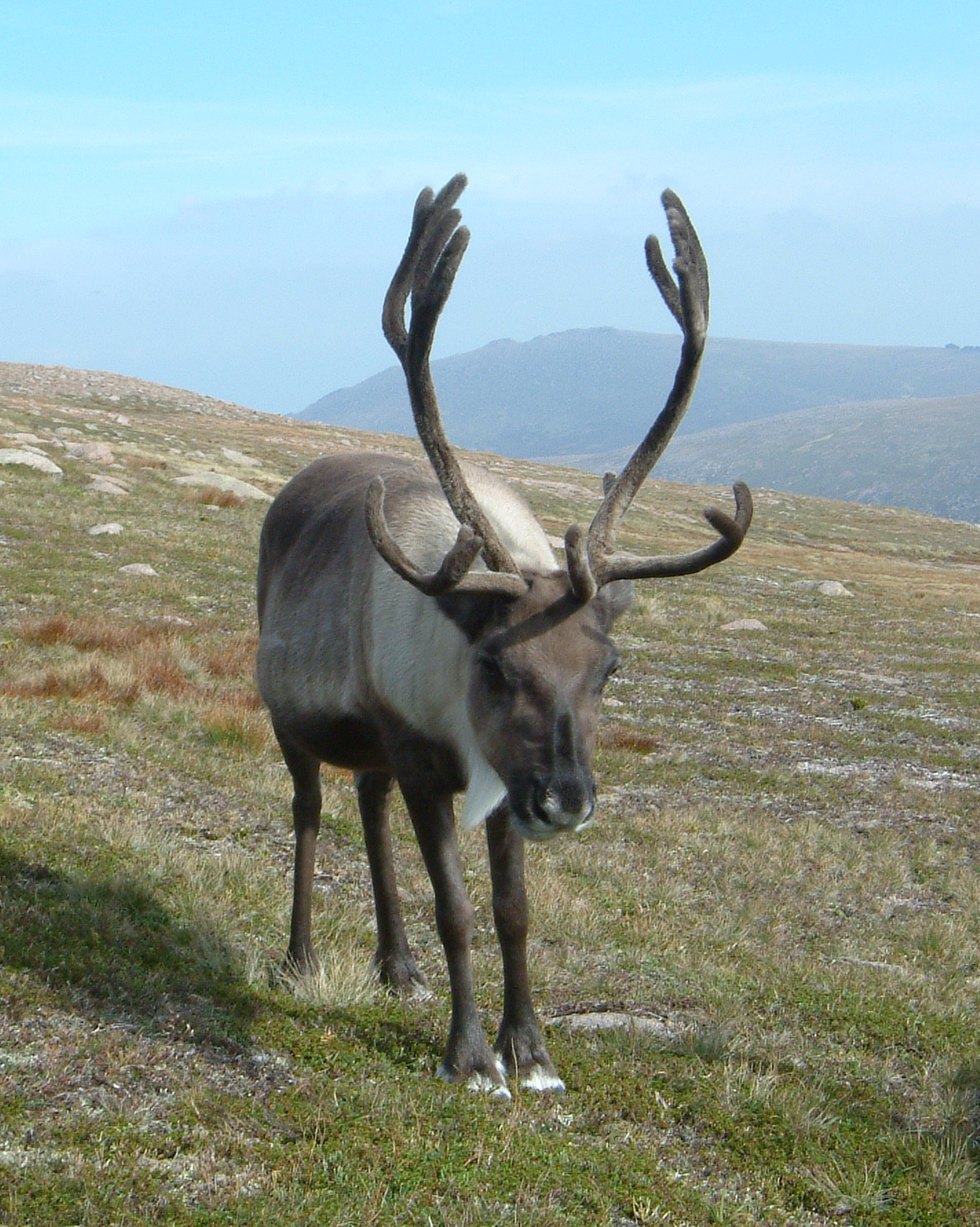
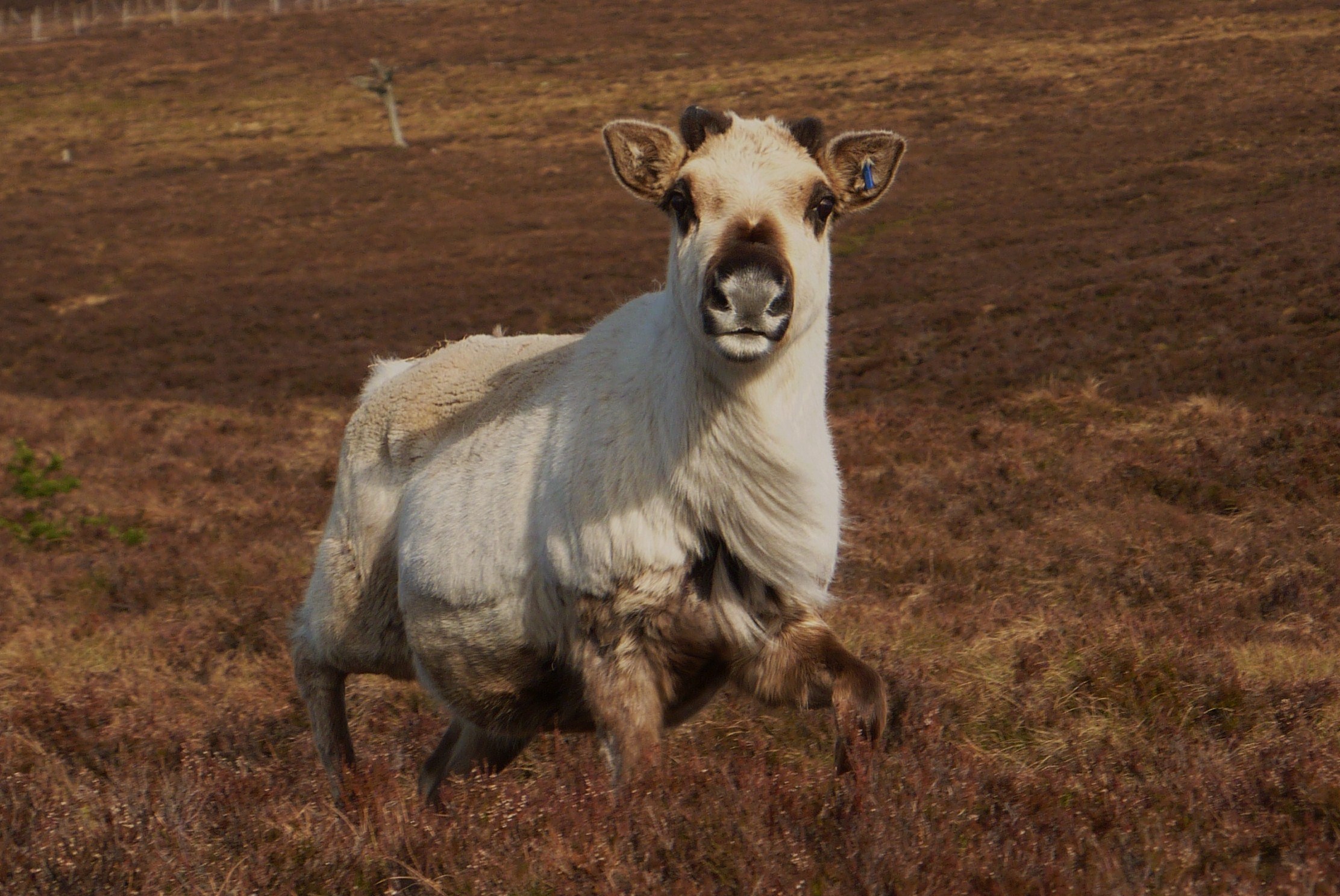
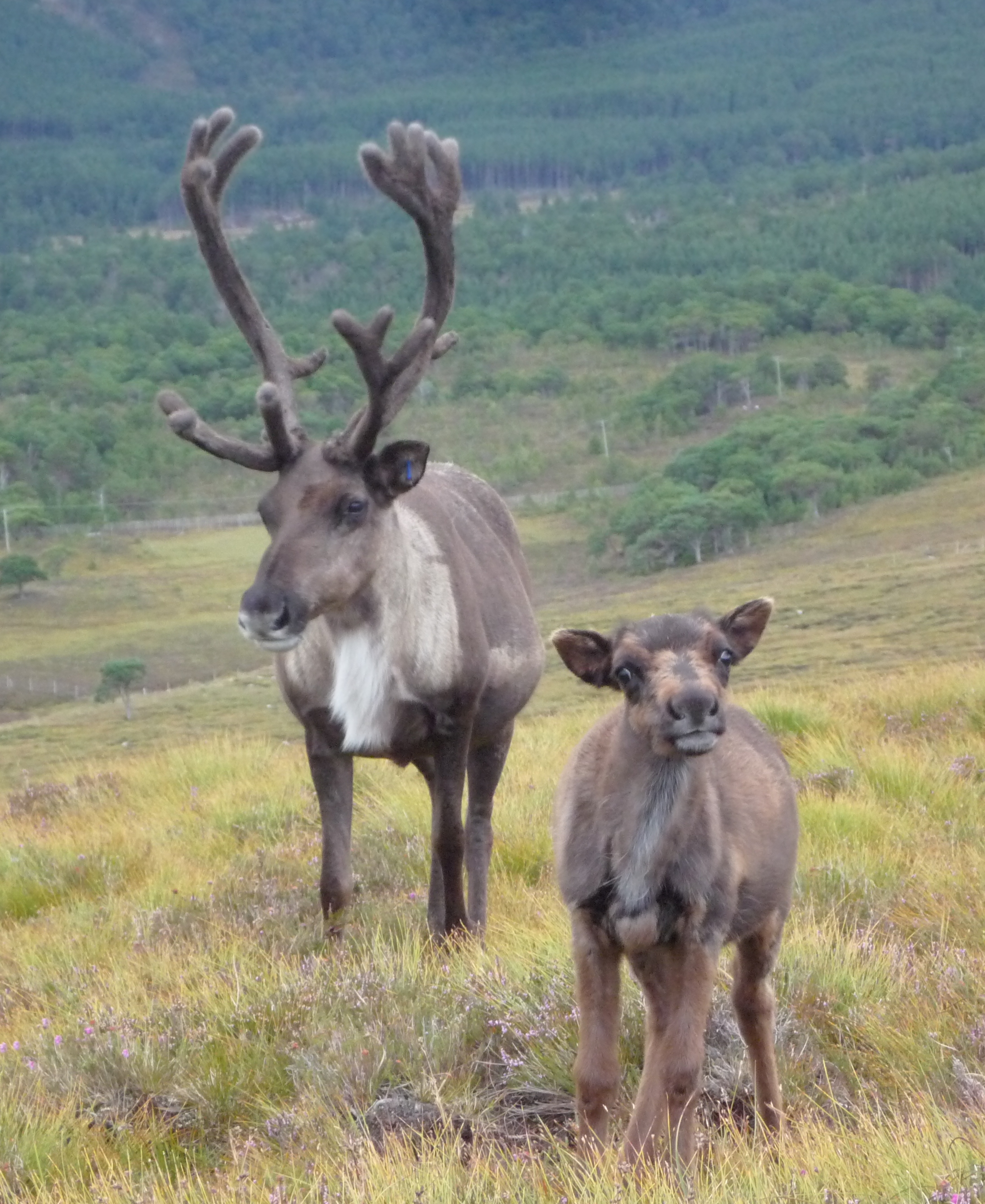
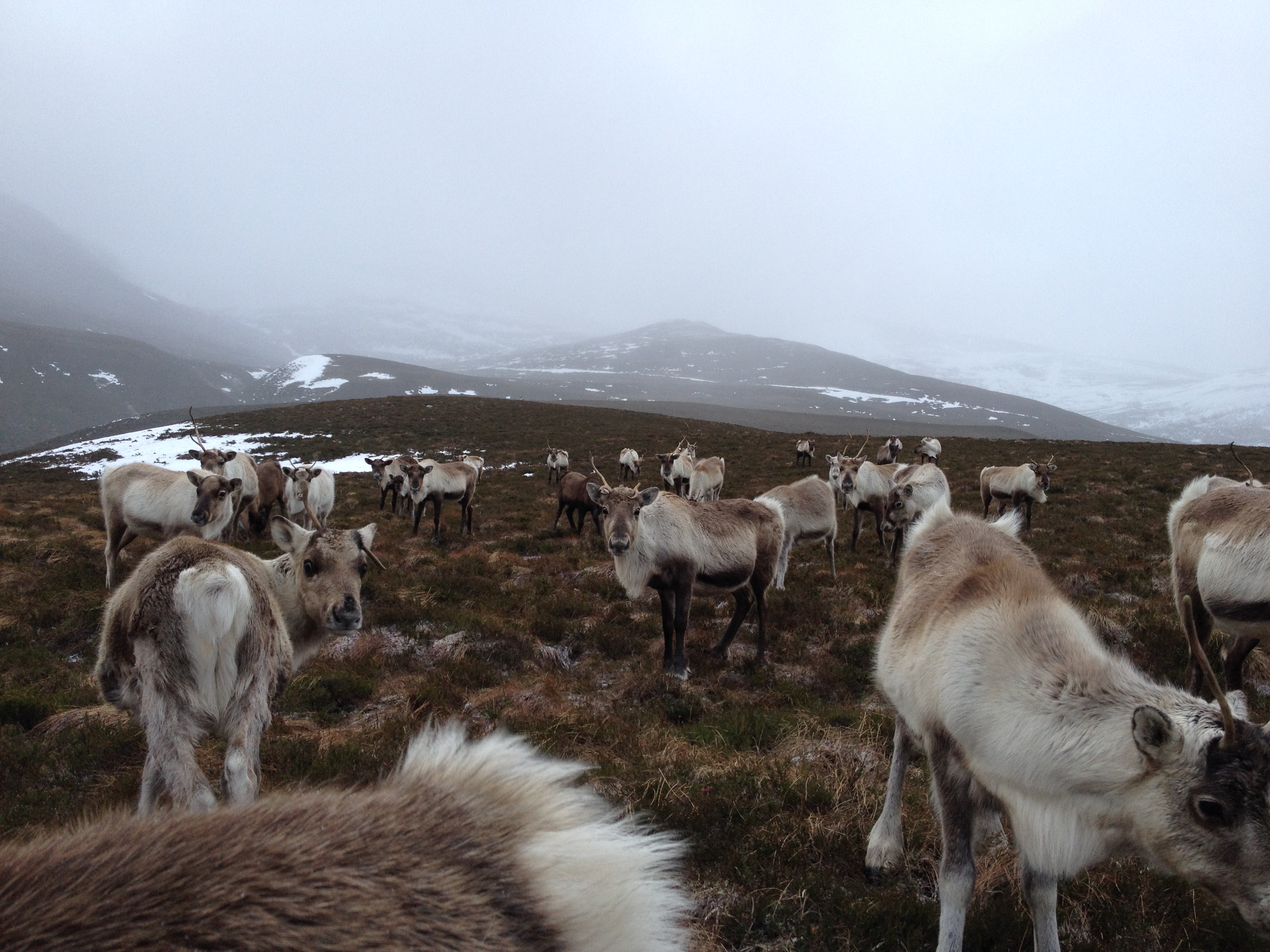
Some of you may already know this female reindeer, Ryvita. If you don’t then she is a 7 year old mature female who has a lovely nature and, like most the other reindeer in the herd, is super greedy! Over the past three years she has had her daughter Cheese by her side as she hasn’t calved since she had her in 2013, so the two of them are inseparable. Not sure what will happen if Ryvita has a calf this year… Poor Cheese! However this blog is not about the relationship between Ryvita and Cheese, it is about antler growth. Over the past month I have been taking photos of Ryvita to show you all how fast reindeer antler grows. Antler is in fact the fastest growing animal tissue in the world.
Ryvita in 2011
I started taking my photos on the 17th April 2016 and took the last one on the 22nd of May 2016 and in that time I reckon her antlers have grown a good 8-10 inches and also a 4-5 inch front point, so it really is phenomenal. We think Ryvita is still due to calve so she’s also growing her calf inside her, and is doing a fantastic job of both. The photos speak for themselves so I hope you enjoy them. Note that we had snow, then a lovely sunny spell, then another good dump of snow again… Got to love an unpredictable Scottish spring!
Ryvita on the 17th of April, just beginning her antler growthOne week later, the 24th of April, in beautiful sunshineA few days later, the 28th of April, and we have snow!Bit of a damp day, May 2nd.Ryvita on the 8th of May, I think she’s bored of being our model!Sleepy Ryvita, May 17thAnd finally, Ryvita on the 22nd of May
Ryvita’s antlers will continue to grow until the onset of autumn, so hopefully she gets lots to eat and she will hopefully grow a rather lovely set of antlers.
Here’s a quick side by side comparison of 17th April to 17th May, just one month of growth:
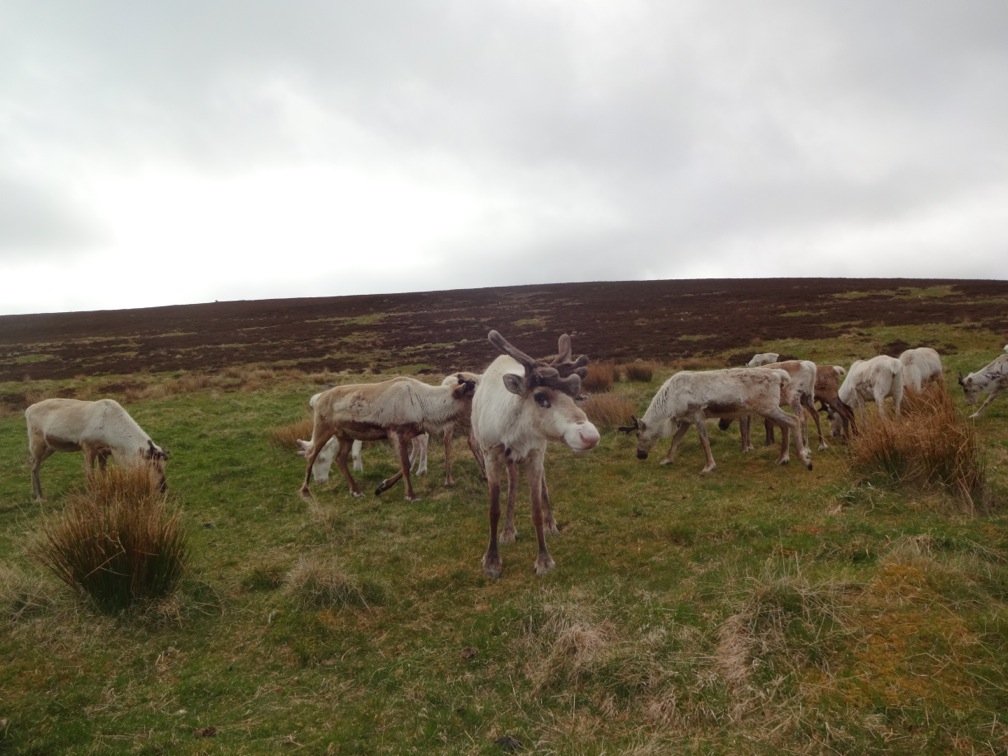
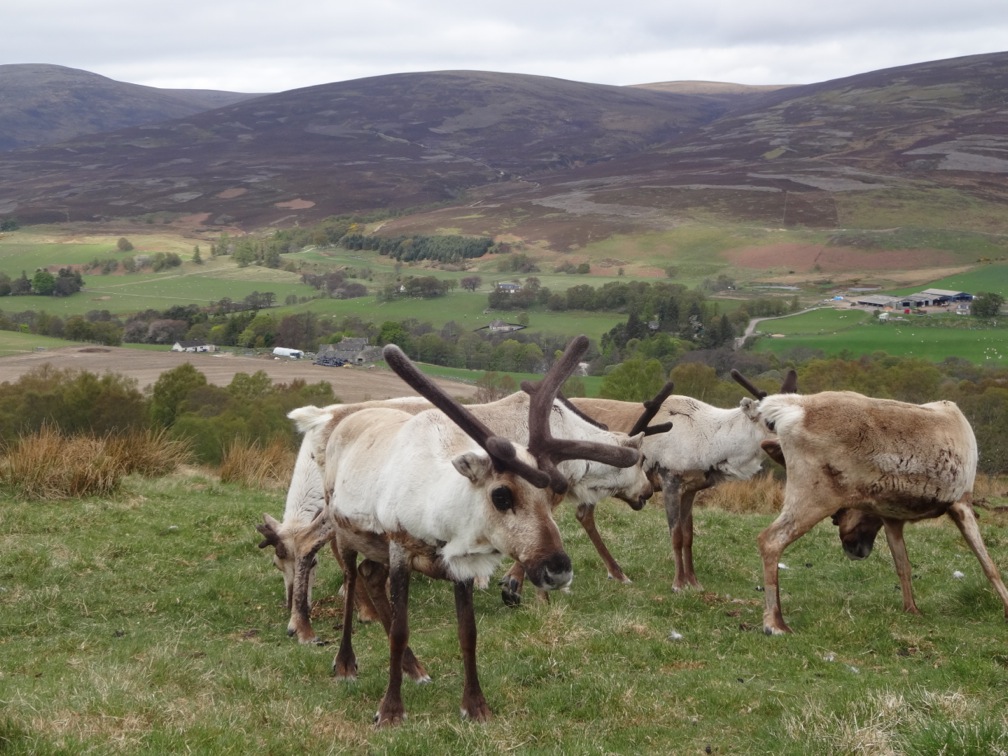
As most of you know part of the Cairngorm reindeer herd lives over near Tomintoul on the Glenlivet Estate. We first took part of the herd over to our hill farm back in the early 1990’s and to this day the herd is split between Glenlivet and Cairngorm.
Over the winter months the reindeer at Glenlivet are up on the Cromdale range but by the end of April it is time to bring them down for the summer closer to the farm. Reindeer love routine and by the time we get to the last few days of April the reindeer are expecting to be on the move.
From now onwards it is all about eating. With spring just about here many of the reindeer are beginning to grow their new antlers and need to put on weight, lost over the winter. They need extra sustenance to achieve this and the winter diet of lichens and last years vegetation is not enough. The new spring growth and the extra feed we give them is what’s needed. Appetite increases many fold and to be absolutely honest everything we give them, they eat.
Every farmer up in the Highlands of Scotland will tell you that this year spring is really late. Whether it is the fields of grass that need to grow for hay and silage later in the year or the newly sown spring barley, the weather has just been too cold. And despite and recent few days of incredibly high temperatures it is not enough to kickstart the growing season yet. New vegetation on the higher ground is also absent so even more reason for us to be feeding the reindeer more than normal for the time of year.
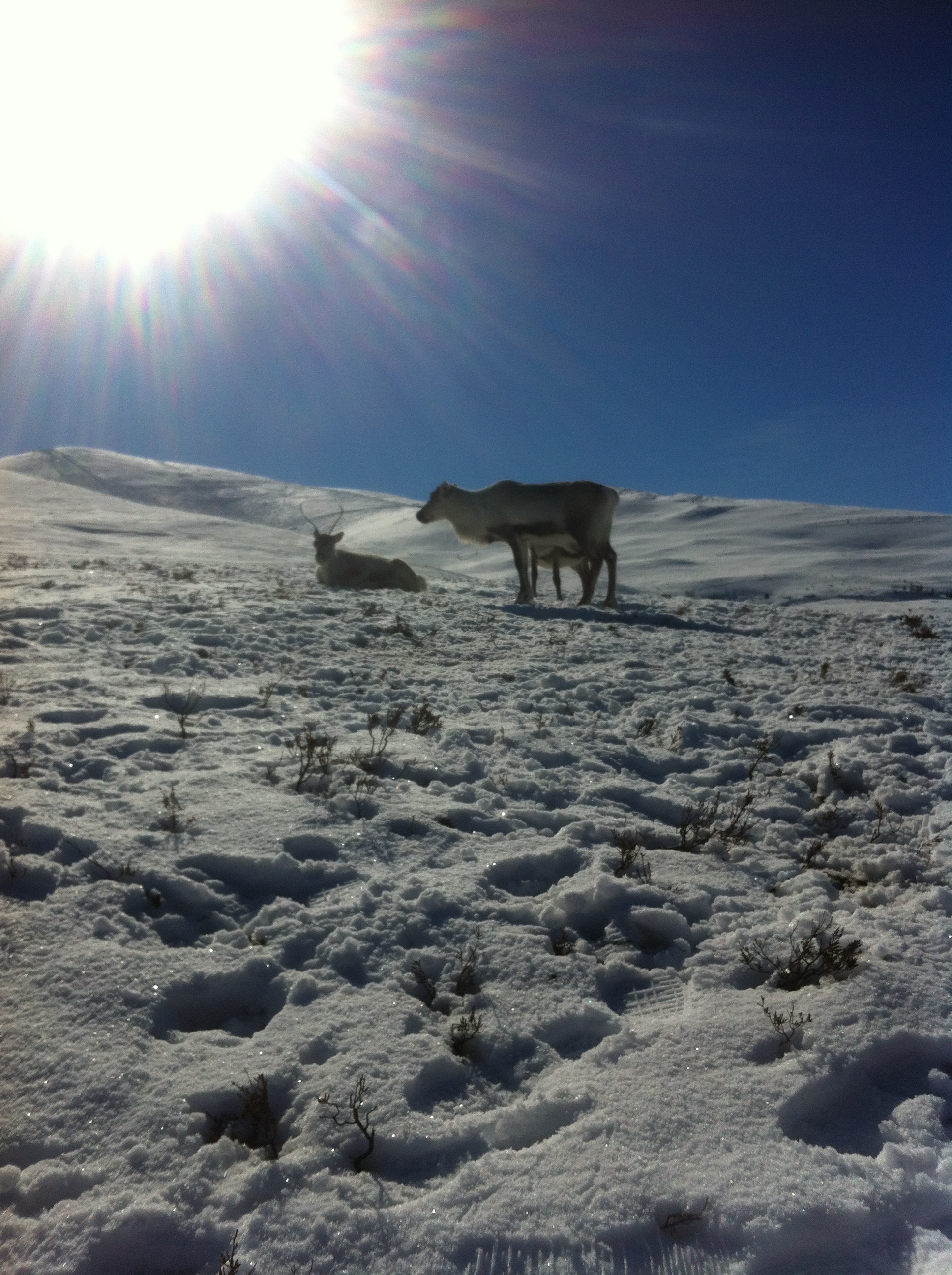
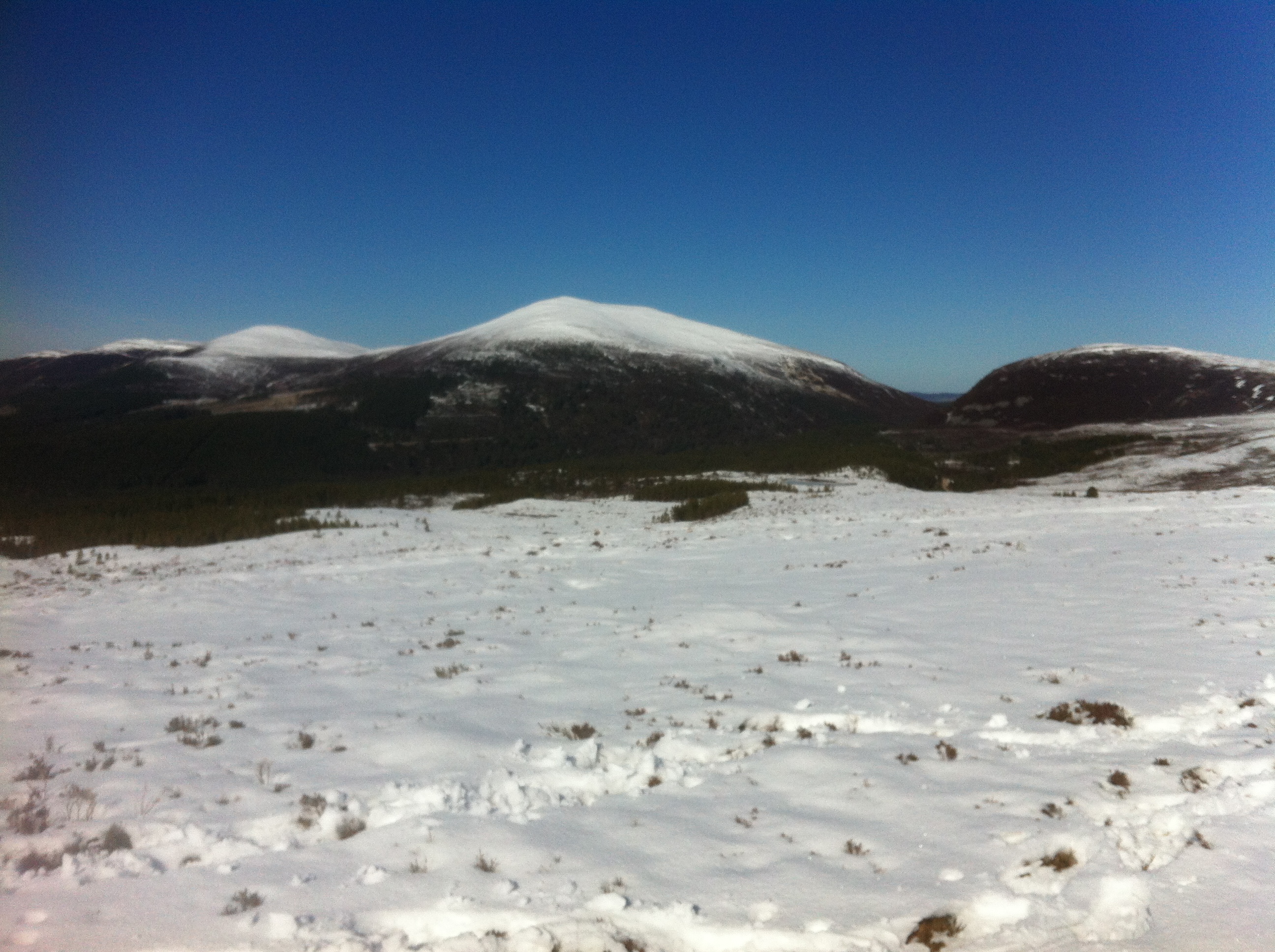
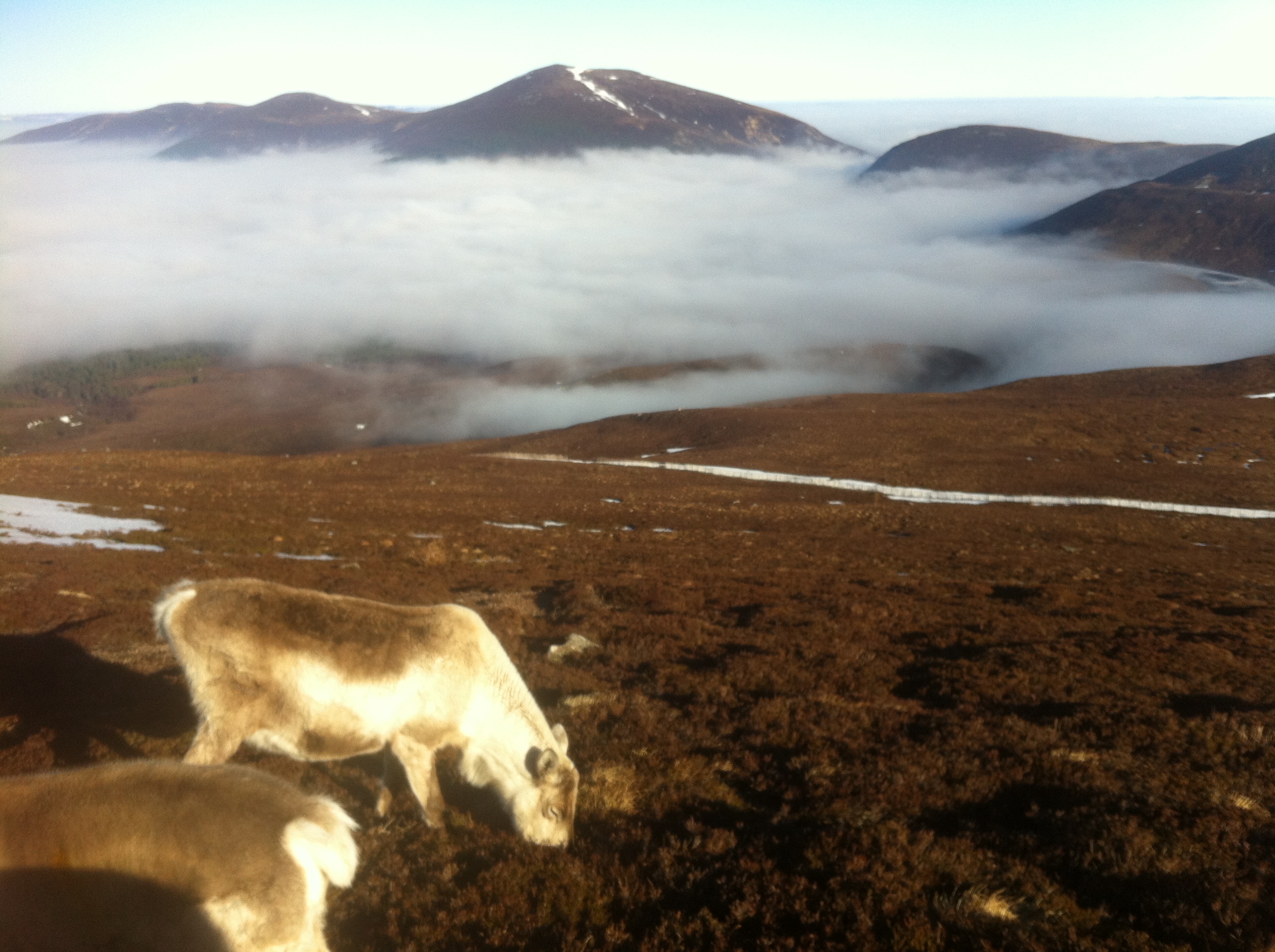
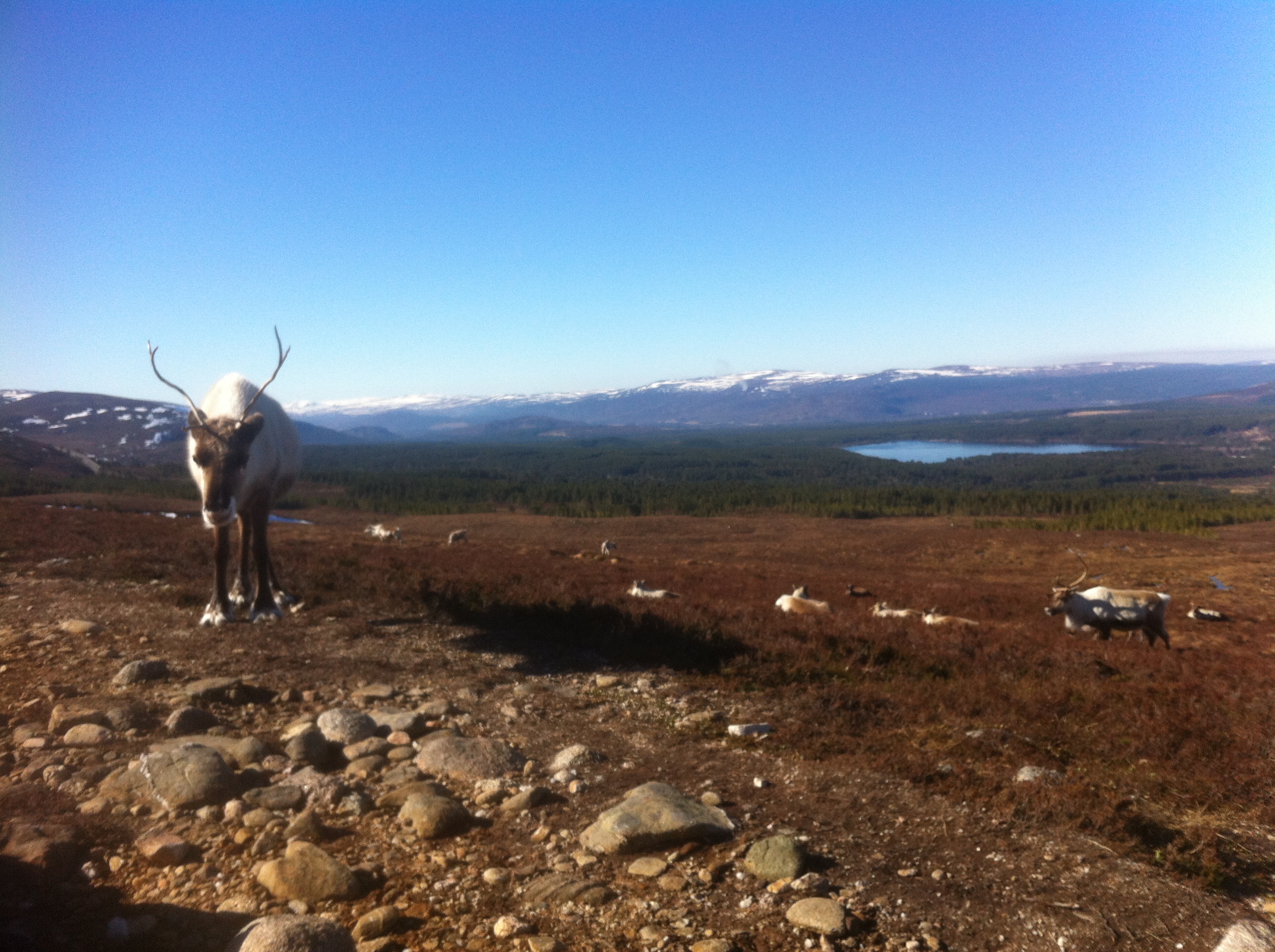
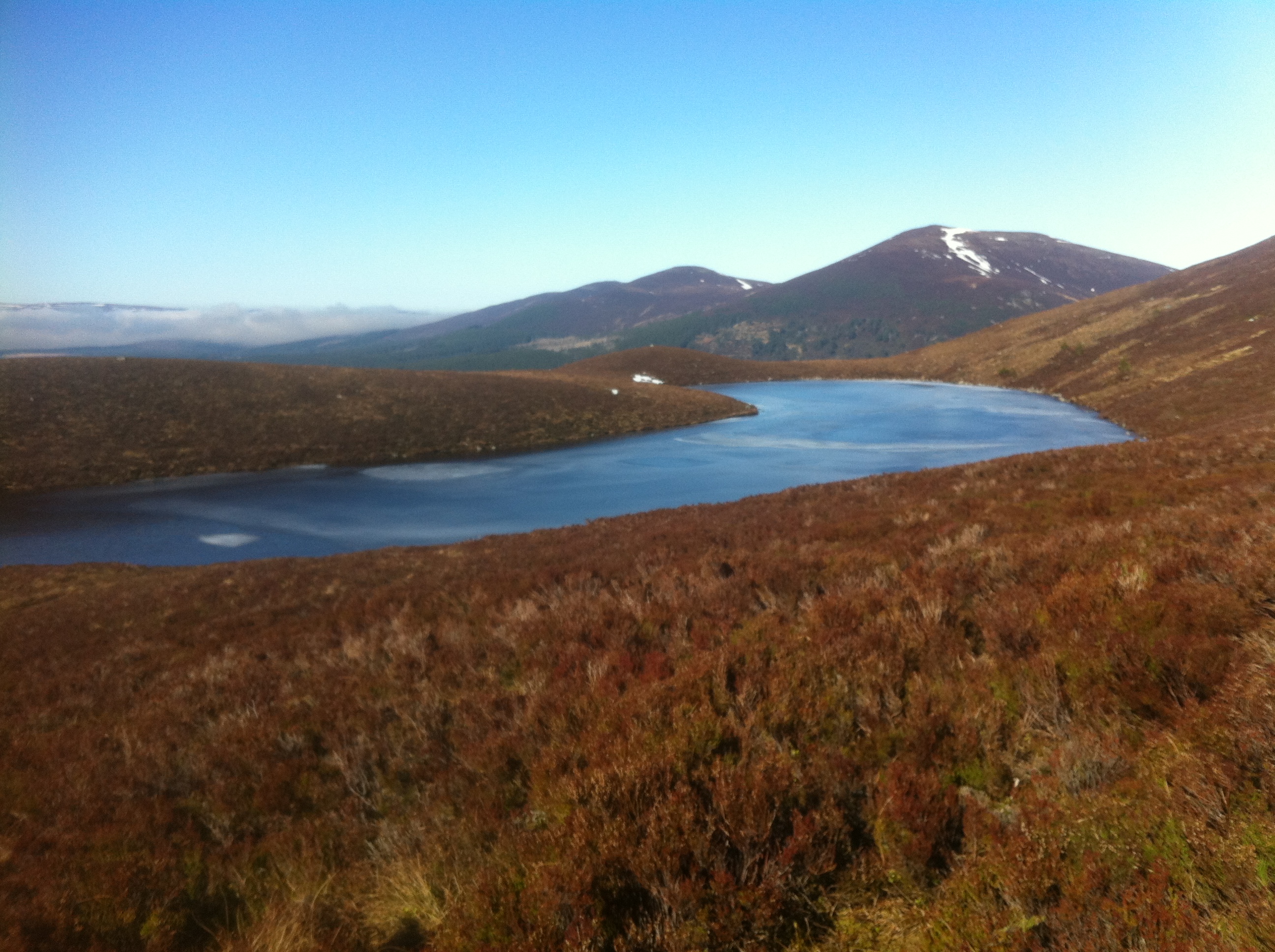
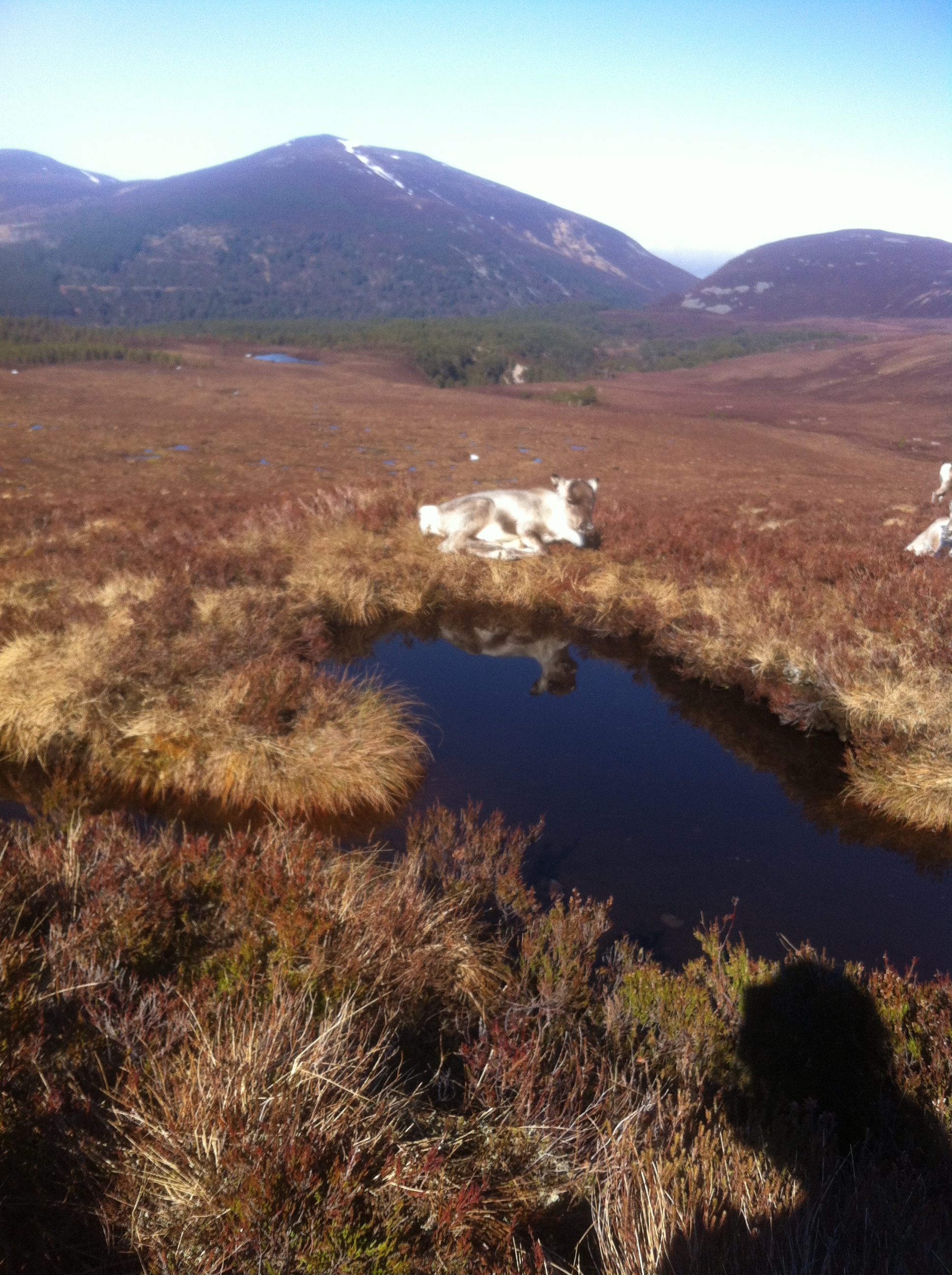
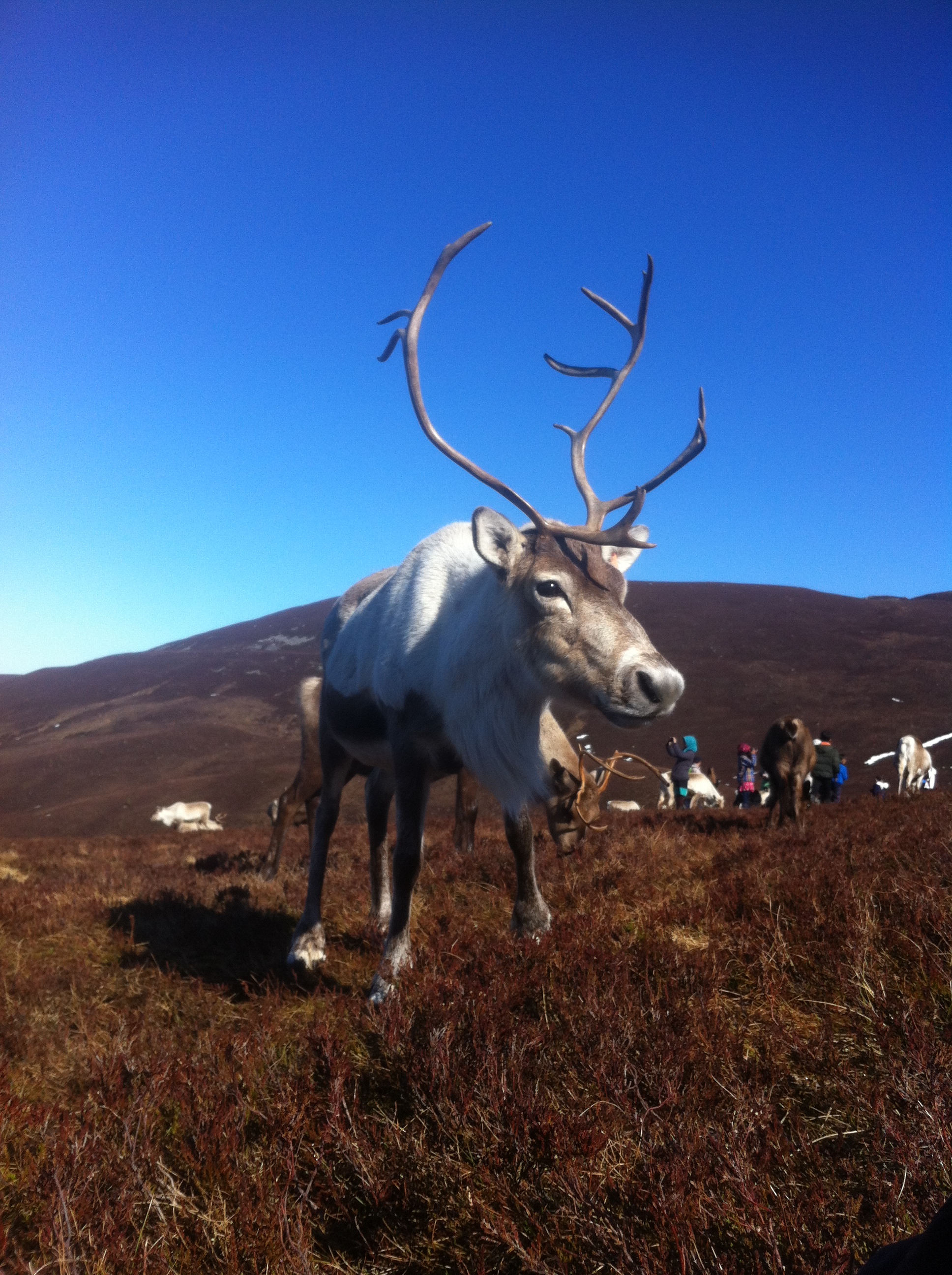
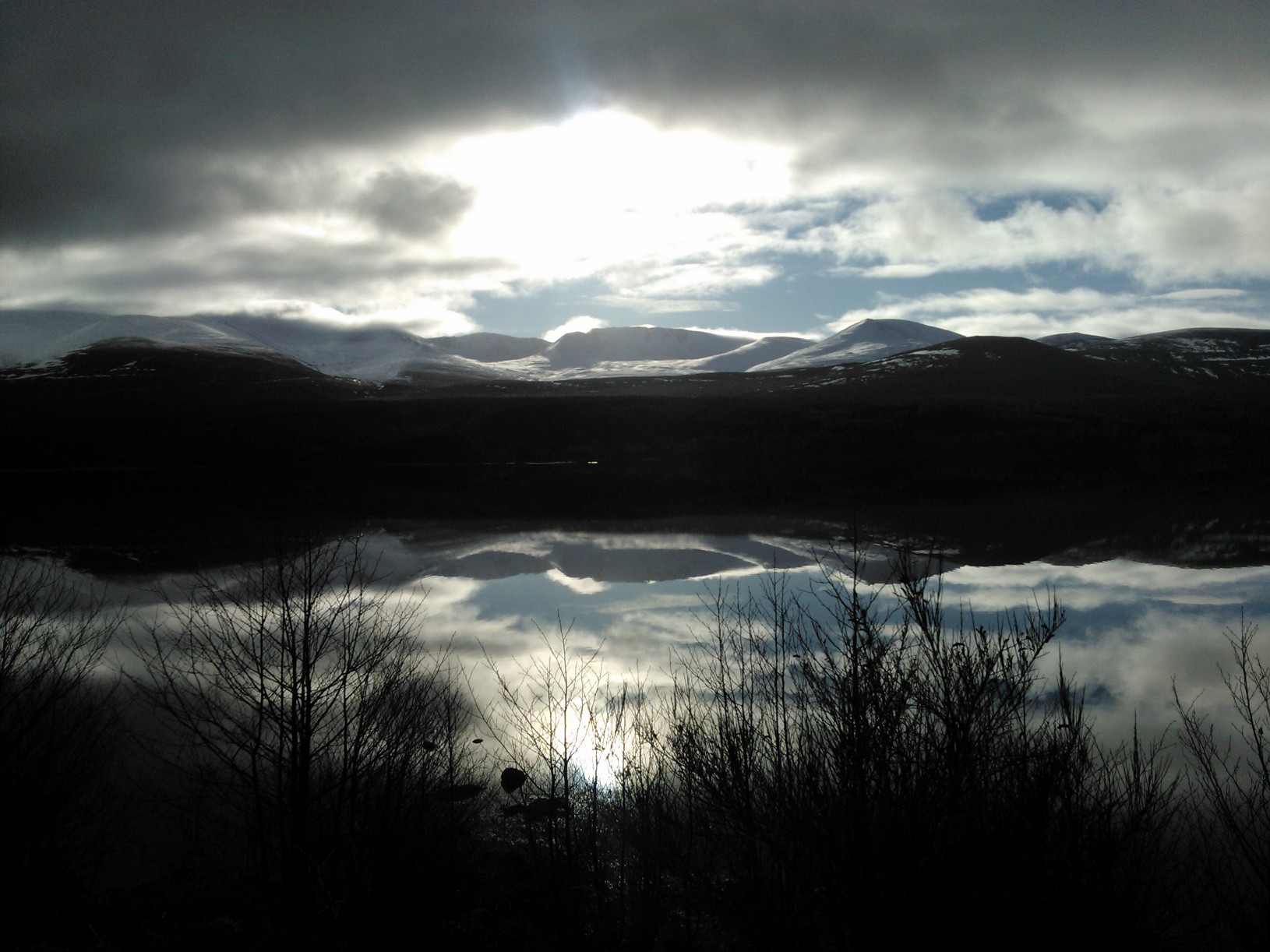
So as it’s almost summer and I’m having a bit of a phone clear out of all the photos and thought who would most enjoy all my winter reindeer ones… everyone online! It was only 6 months ago I managed to upgrade my trusty old button phone to a smart one so I’ve been making the most of having a camera to hand most of the time.
The girls walking behind each other to save energy
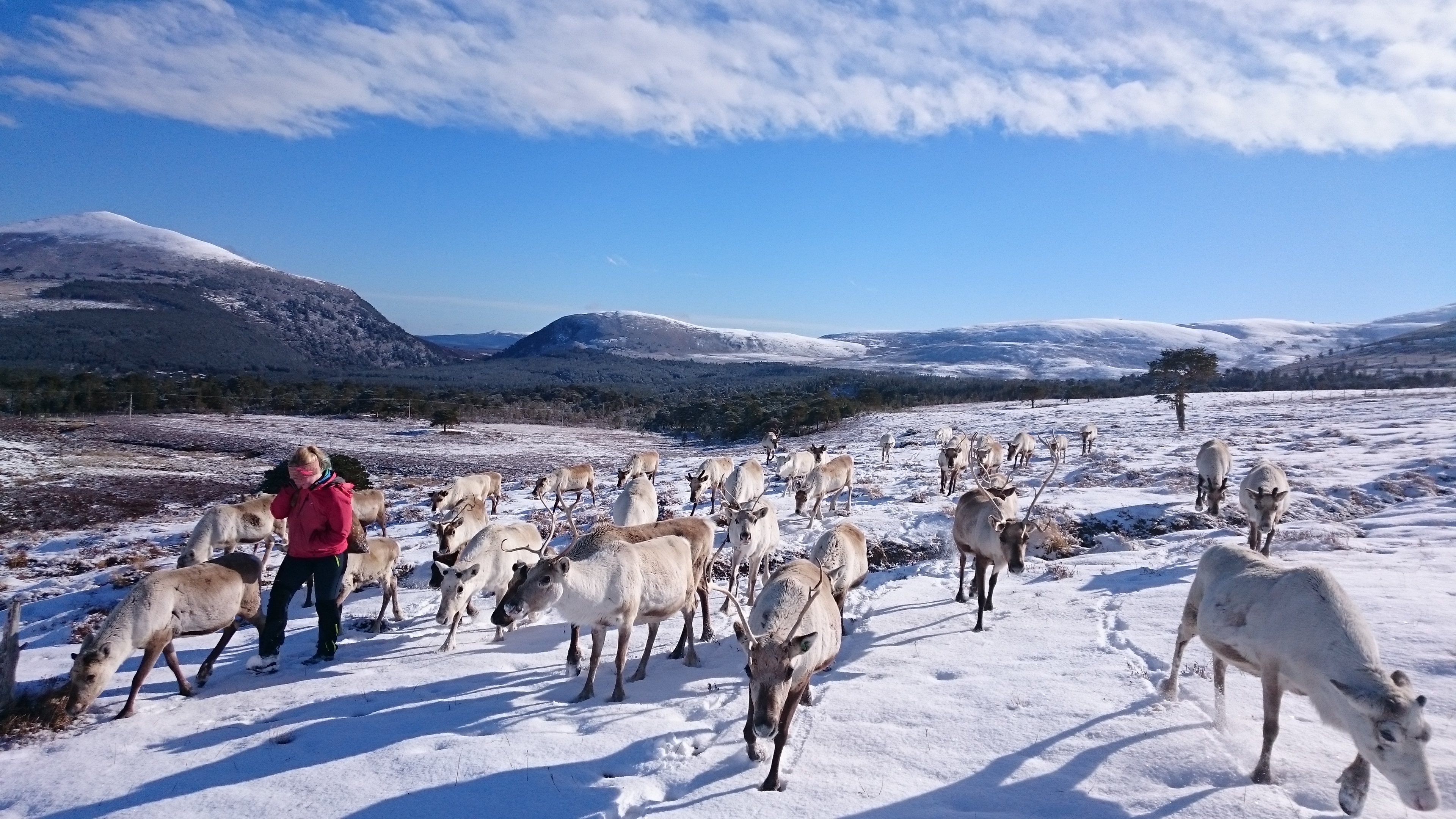
We have had a right mix of weather over the past few months but regardless what it is doing out there we have to go out and locate the herd every morning. This is one good reason I never look at a weather forecast cos I either get excited that there is going to be good weather and it disappoints or I see it’s due to be bad weather so then I don’t look forward to getting a drenching so best just to look out the window on the day and dress appropriately! At least this way there is no expectations.
Mel leading the herd in for breakfast
The girls (reindeer) have been pretty well behaved and we have found them most of the time. I say most because lets face it there is going to be the odd day the hill is storm bound or just too foggy to even begin to find them. We have experienced every terrain under foot from deep snow, mud and ice but to be honest the snow is the easiest one to walk through as we create a lovely packed path that both us and the reindeer use… unless you are the first one to break that path after a fresh dumping in which case a deep thigh high walk out it is!
Abby and the reindeer on a gloriously sunny winter’s morning
They always go through the same pattern every year and they come to a call from far away through January and February but then through March they seem to get quite lazy and expect us to go to them so the walks become further and a little more frustrating, however, when you do get them back to the right place there is a much bigger sense of achievement. Plus it keeps us fit and if the weather is good then there is no better office!
Lace having a stretch, overlooking Loch Morlich
Anyway there is no need for me to say anything else so enjoy my photos of the reindeer this winter.
Since it’s Friday the 13th, I thought I would try to write up a blog about superstitions from reindeer herders around the world. I thought it would be a fairly easy subject to research, but it turns out it is rather difficult and trying to determine what was actually believed way back when, and what has been made up for the tourist industry is exceedingly difficult. I have tried my best to be as accurate as possible and only report on reliable information, but do feel free to correct me if any of what is said below is wrong. Sámi shamanism, traditions, superstitions etc. are very difficult to come by because up until the mid-20th century, the Sámi underwent ‘Norwegeniasation’. The Sámi were not allowed to speak their own languages, were converted to Christianity by missionaries and it was shameful to have Sámi roots. Attitudes have now changed and it is cool to be a Sámi now. There is even a festival in Norway called Riddu Riđđu where people can explore and enjoy their Sámi roots. Anyway, here are some little snippets of traditions and beliefs of reindeer herders around the world.
A band at Riddu Riđđ, holding a Sámi flag on stage. (Photo from norwayfestivals.com)
The Chukchi, a group of reindeer herders from Siberia, thought it akin (bad) to sell a live reindeer, but would happily sell a dead reindeer. There is a book called ‘In a Far Country’, by John Taliaferro, which is a true story describing how, after whaling ships were trapped on Alaska’s north coast by ice, a missionary named Top Lopp decided to herd reindeer out to the 200+ whalers who would otherwise starve to death, with the help of 7 Eskimo herders, in the late 1800’s. The book describes the troubles that the men faced in trying to purchase live reindeer to herd across the Bering strait to the men stranded in Alaska. It talks about the Chukchi being offered a fortune in tobacco and cloth, but they would always refuse. The Chukchi would sell dead reindeer at 75 cents apiece, up to 500 at a time, but never a live reindeer.
Chukchi reindeer herder, Sergei Elevye, with one of his bull reindeer. (Photo from mediastorehouse.com)
The Sámi had and have a very close bond with nature, and natural phenomenon which nowadays can be easily explained by science, were of course much more exciting/terrifying occurrences. The aurora borealis, or Northern lights are of course one of the most fascinating and obvious phenomena in the north. Some northern Finnish reindeer herders used to believe that they were caused by a fox running extremely fast across the sky, whipping up the colours with her tail. The Sámi of Sweden feared the lights and would even hide away from it, or at least try to cover themselves if they could not hide. It is also extremely bad luck to mock, or even make notice of the lights, to some. It was believed that if you whistled at the lights, they would swoop down and kill you. However, if they did try to kill you, you could clap your hands and they would leave you alone.
This close connection with the natural world often meant that they would pray and give sacrifices to many different Gods. They also believed that everything had a spirit including certain trees and rocks. There were often stones that people would have to greet, otherwise the stone could get angry and come down on them. Unusual landforms, especially rocks, were often called seidi‘s and were worshipped to bring the worshipper protection. They were also seen as gateways to the underworld.
A seidi in Balsfjord (Image from wikipedia.com)
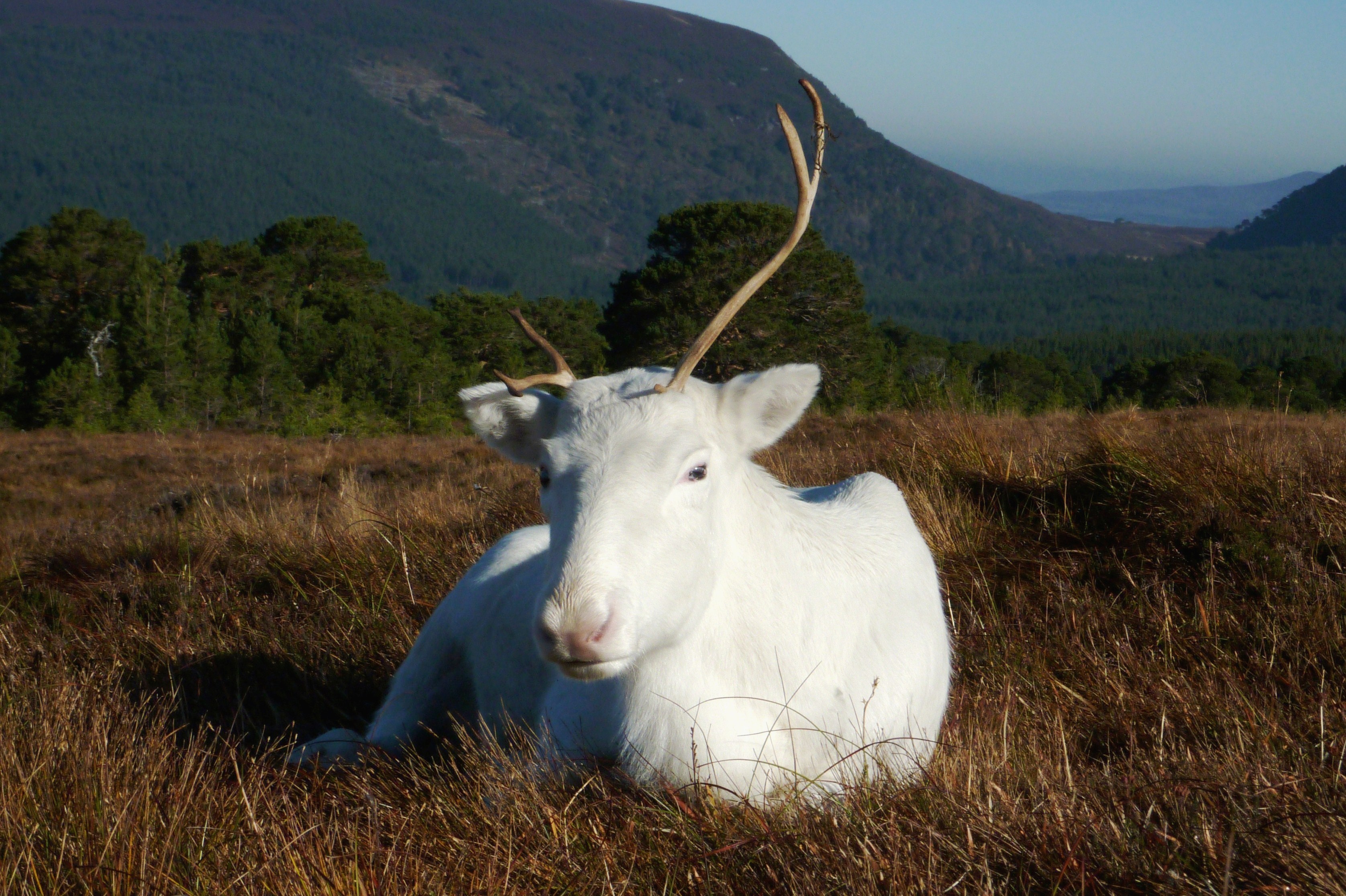
It is also believed that white reindeer bring good luck and all herders should have a white reindeer in their herd. Luckily, we have quite a few in our own herd, including Blondie, and her son Lego. Fiona has also heard that if you see a white reindeer, the sun and the moon all at the same time, it brings good luck. So have a look out next time you come on one of our visits!
Blondie, relaxing on a sunny day.
The Sámi also joik, a form of acapella singing; its themes usually include animals, people and special occasions in life. The Sámi also joik about Stállo, who is a mythical being, very rich and very smart, and who is able to change shape and can even change the landscape so people become lost. He is an evil entity, and often the joiks describe how to trick Stállo.
We haven’t had many reindeer born on Friday 13th, since it really is only May that the reindeer calve. We did have one handsome male reindeer born, called Peru. He lived up until around 8 years old, and was a ‘Christmas reindeer’. There are actually only 4 reindeer still alive who were born in 2005 with Peru, so I think he did ok to get to 8 years old. Obviously, I don’t know if one has been born today or not, but it doesn’t seem to be too bad an omen for the reindeer.
So this blog is a wee bit different, of course there’ll be a wee bit of reindeer chat – what’s a reindeer blog without the reindeer! However, this week we thought we’d plug some of the fab things going on in the Cairngorms next weekend for the Cairngorms Nature Festival – if you’re around get involved as there’s a plethora (a good word I know!) of ace things on offer to see and do for all ages!
Every May, the National Park has a weekend to celebrate all the amazing nature things in the area, and this year it will be running on Saturday 14th and Sunday 15th May. It’s a super way of seeing and learning a wee bit more about the environment here and what makes it special, be it if you’re local or on holiday, get out there and learn something cool!
I guess we should get on to the reindeer bit… we’ll be business as usual with hill trips going twice a day at 11am and 2.30pm as well as the paddocks & exhibition being open and all tickets prices will have a 20% discount applied. Come and feed the reindeer up on the hill, but be prepared for all weathers!
Hopefully the sun will be shining when you come to visit us!
There’ll also be tonnes of other things happening all over Badenoch and Strathspey, around Blair Atholl, Upper Deeside and Tomintoul. Some events that adults might enjoy include Green Woodworking Demos with Wooden Tom (he’s a really cool chap) at Feshiebridge Sculpture Trail on Saturday 14th. This is a ‘drop in anytime’ session running from 10am until 4pm (Here’s a handy link to his website). There is also the ‘Night Time on Nethy’ event on Saturday at 9pm. You’ll be on the river Nethy at night with the ranger, and booking is essential for that event. If you’d like to go on an all-day adventure, why not book into the ‘High Living in the Cairngorms’ event. This is a walk, starting at the Glenmore visitor centre and will involve some uphill. Booking is advisable and you will need to be dressed to be outside all day, in all weathers, and make sure you have a packed lunch too.
Wooden Tom, who will be demonstrating Green Woodworking Skills
For families, there are lots of interesting things to do. You can help the Loch Garten forest elves and fairies, by helping to create a garden for their enchanted tree. This event takes place on Saturday 14th, from 10.30am until 3.30pm (drop in any time) and you will also make some little forest-folk to take home at the end as well! This is located just 5 minutes from the Osprey Centre, and you can ask for directions from the kiosk there. On Sunday the 15th, there’s a self-guided trail letting us know all about how trees grow. It starts from the Glenmore Visitor Centre and you can do it any time between 10am and 4pm. At Blair Atholl there’s a ‘Woolly Woods and Woolly Nature Trail’ on both Saturday and Sunday. You can drop in at any time and search for the knitted nature and other wildlife from the Blair Atholl Information Centre.
There are lots of other events going on all over the place, and you can get more information and book spaces by going to the Cairngorms Nature Festival page, where you can download a .pdf of all the events running throughout the weekend.
Hope you all enjoy some of the events being put on!
‘There is no such thing as bad weather, merely unsuitable clothing’. It’s a great phrase this and one that is on display in the Reindeer Centre, to warn people to be well prepared for the hill visit to the reindeer (even in summer sometimes!).
In the animal kingdom, a number of the arctic animals change their coats in winter and in the case of reindeer they not only grow thicker coats but also their coats turn lighter in colour, in some cases pure white.
Reindeer snoozing comfortably in the snow – Lilac (right) is currently our oldest reindeer at nearly 17 years old
The change in colour is associated with shortening day length and there are obvious benefits from being white or very light coloured when it comes to camouflage in snow. But it is also the case that white hair is more insulating than dark hair. White hair lacks pigmentation and nothing replaces this, leaving pockets of air, a very good insulator. So I suppose that means that when the reindeer grow their winter coats they have more airy hair! Indeed the reindeer never cease to amaze me, on the coldest of days, they are high up in the snow, on the exposed ridges, lying around, resting, ruminating and I suspect positively enjoying the weather which we shelter from in our warm houses.
White reindeer – this photo was taken back in 2008 of male reindeer Harry, Minto and Bajaan
In the herd we do have a few reindeer who are actually pure white: Blondie, Lego and Blue to name just three of them. Knowing that white hair has more insulation does that mean they have the warmest coats? They certainly always look very comfortable in the snow.
A mountain hare in its winter coat, spotted whilst I was completing my 146th munro!
Over the last few weeks I have regularly seen mountain hares, which live in a similar habitat to our reindeer but are also quite widespread across many of the Scottish hills. They too turn white in winter and like the reindeer have relatively large feet which act as snowshoes making running seem effortless as they hurry across snowfields.
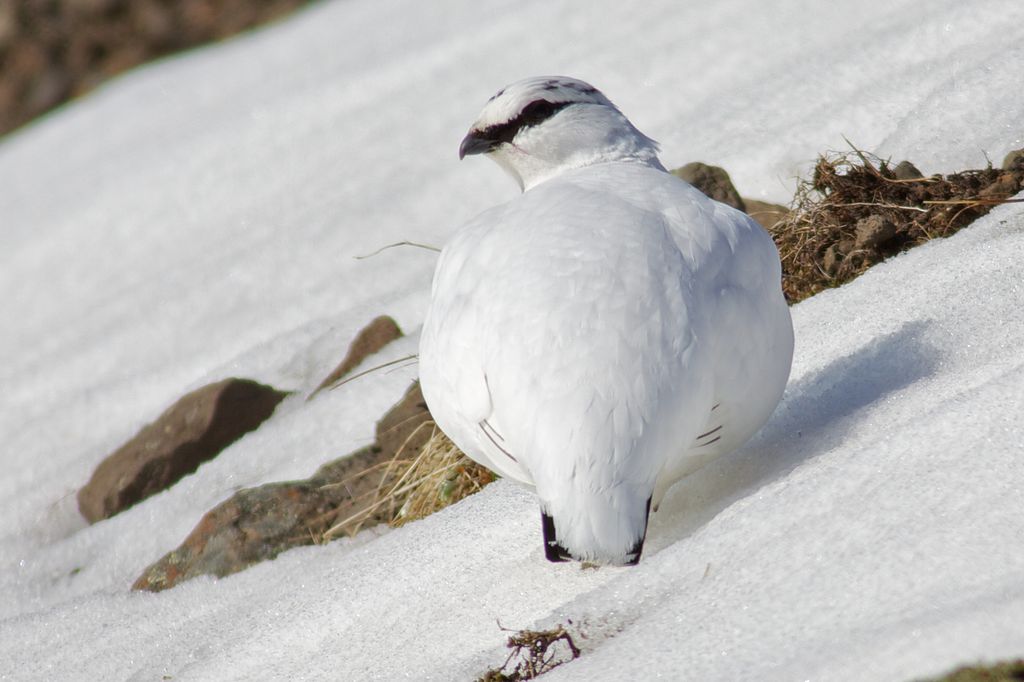
Ptarmigan (Lagopus muta). Photo by Boaworm [CC BY-SA 3.0], via Wikimedia CommonsThere are two other animals found in Scotland that also turn white: the ptarmigan, an arctic grouse that is found in many of the Scottish mountains above 2,000 – 2,500ft, and the stoat, which depending on how far north it lives also turns white, when it is then called stoat in ermine.
Stoat in ermine – white with a black tail tip. Photo by Steven Hint [CC BY-SA 3.0], via Wikimedia CommonsLike the reindeer and mountain hare, the reason the ptarmigan plumage turns white is for camouflage and warmth but I do sometimes wonder about the stoat in ermine. Although I have seen them in snow around the farm, all too often there is not a flake of snow to be found and they ‘stick out like a sore thumb’. But they are a very clever predator, predating mainly on rabbits. They are incredibly quick, will catch and kill prey 10 times bigger than themselves and appear to be completely fearless. They are sometimes thought to ‘hypnotise’ their prey, maybe the white coat and black tip to their tail somehow confuses the rabbit!
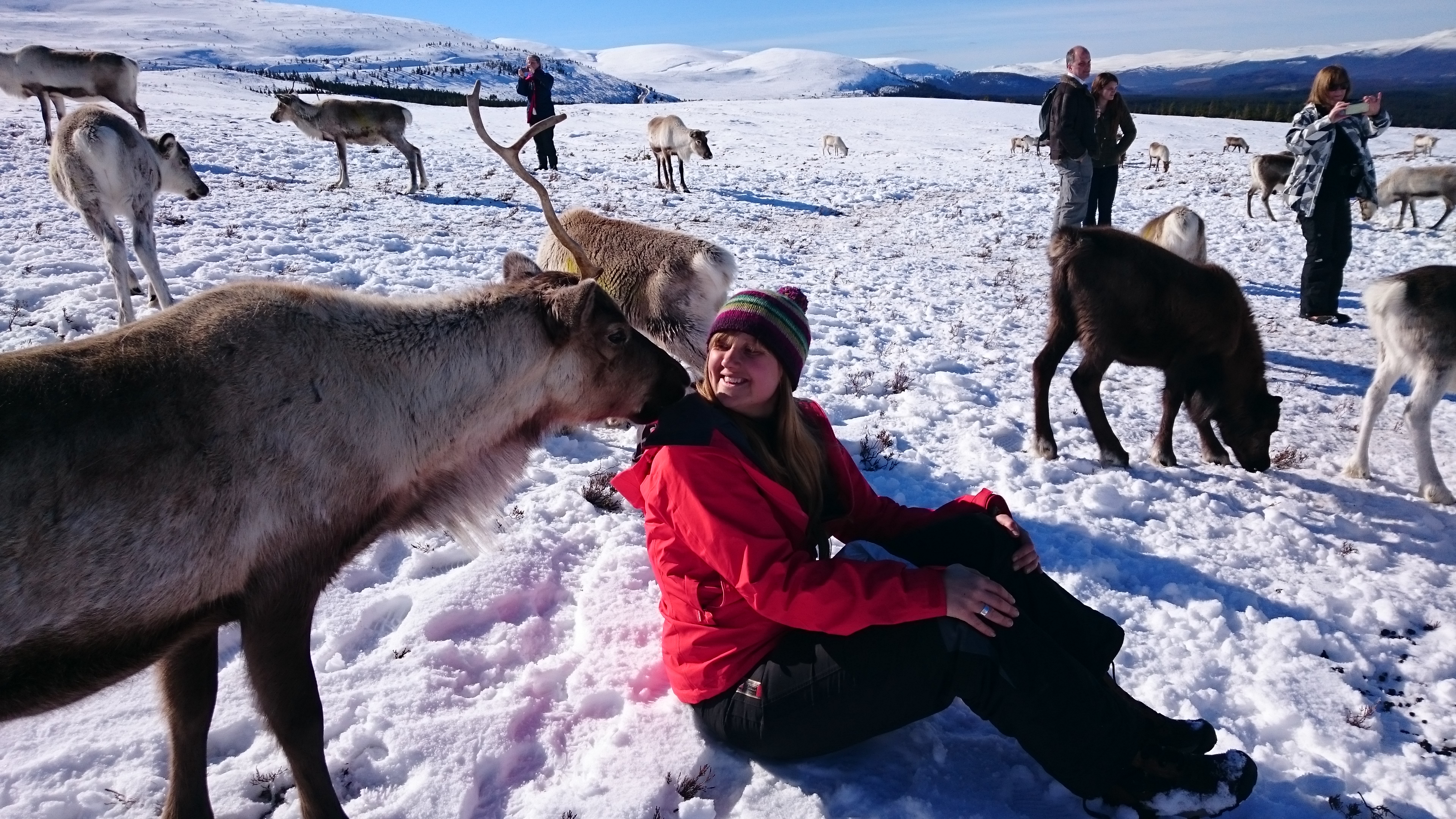
You’ll all have noticed on our Facebook page the lovely snowy photos we’ve been taking with the reindeer. When news channels report that it’s going to be warm and sunny, that the daffodils are out and spring is in the air, we are usually still huddled under our blankets, heating on full with no sign of those bright yellow trumpets. However, we’ve had a few gloriously sunny days here in Glenmore, so thought we’d do a quick round up of pictures (as evidence!) before the warm weather disappears and we get snow again.
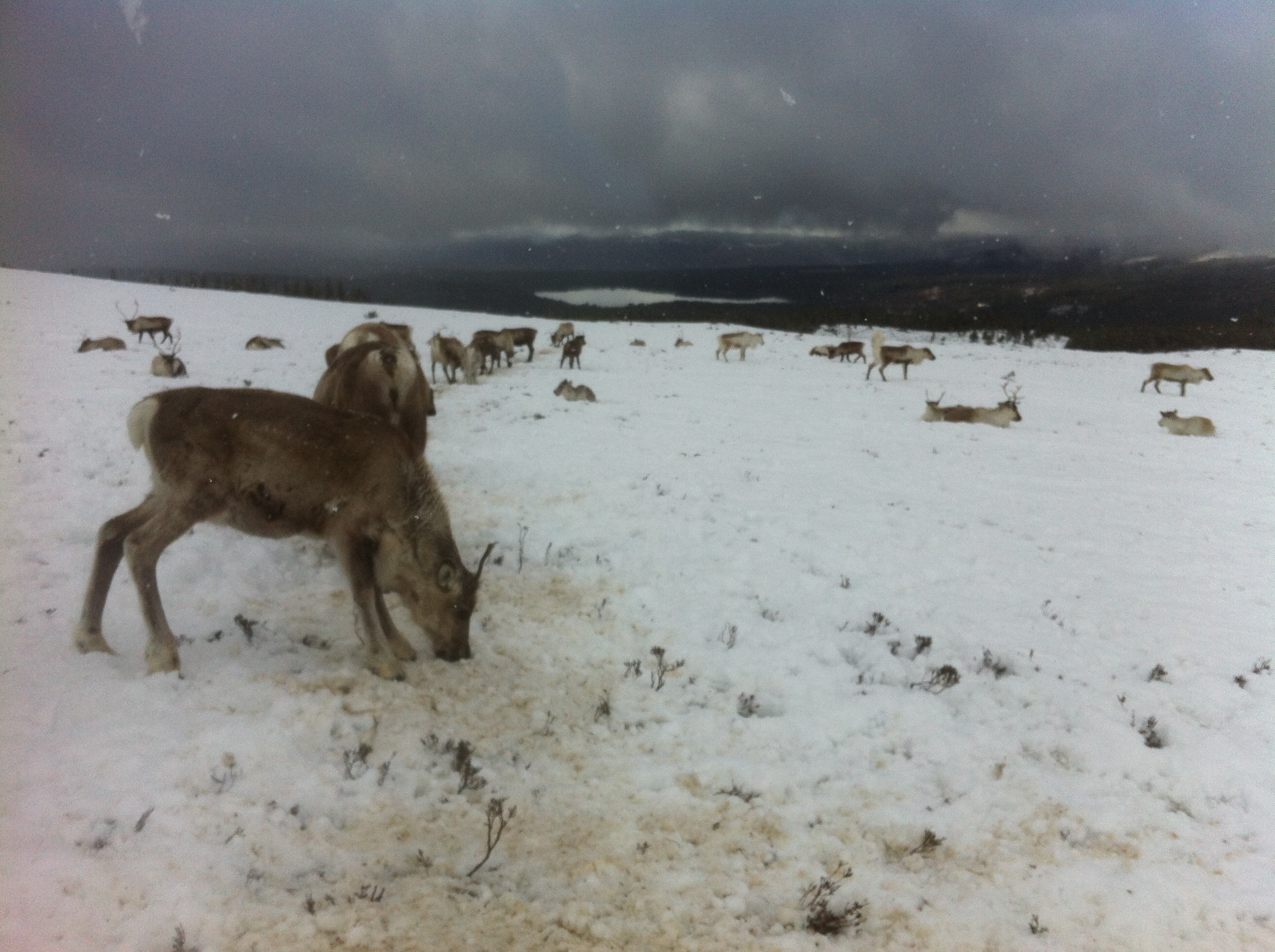
Snowy day with grey cloudy skies and reindeer eating off the lineSnow and a little reindeer off to the side
This was the picture last week – snowy, but pretty. The reindeer do love the snow and when you get snow and sunshine, it’s just bliss.
Reindeer, snow and sunshine – bliss!Snowy hills, blue skies
One week later, and it’s full on sunshine and cloud inversions. I drove to work in mist and fog, thinking it would be a cold, grey day on the hill. To my surprise, and delight, the sun was shining as we drove higher up and on my morning mission to find reindeer, I was down to just a tshirt. The fog cleared and we had a gloriously sunny and hot visit. The poor reindeer were feeling the heat a little, but are great at dumping heat when temperatures occasionally soar.
Clarinet, and unidentified reindeer bum, with hills and cloud
Cloud inversion and hill topsGloriana and co enjoying the sunOur officeLittle Arrochar having a lie down
Since the weather has been so good, we’ve been getting on with our outside jobs, some painting and tidying up that is just too hard to face when the weather is miserable. We even found a little newt in the garden as we were raking! I thought maybe I’d raked over him a little too hard (by accident, of course!) but he was a resilient wee thing and we rehomed him to a wee burn.
Newt!
There is a thick harr over Glenmore today, and unfortunately I think the weather is going to change next week. It was good while it lasted though!
Just over a week ago, I waved goodbye to my work colleagues in London, where I’d lived for eleven years, jumped in a van, and travelled the 500 miles (so cliche!) to Glenmore to begin my new life at Reindeer House.
Last day in London
Three years volunteering with the herd during holidays seeded the thought of moving at the back of my mind. Late in 2015 I thought, “What am I waiting for?” and decided to up sticks, leave my lovely job and lovely colleagues, and life in the city.
A view of the corries
Waking up to snow-covered hills and a single stream of cars heading for the ski slopes is slightly different to the hordes of people packed onto commuter trains and tubes heading for their glass and steel open-plan offices.
Up on the plateau with SookieSnowy selfies!
Mountains, forests, and fresh air give so much, which cities simply cannot give you – despite the parks and open spaces and being outdoors. The landscape here gives and teaches different things, as equally important, and gives a different outlook on life.
How I now spend my evenings – learning about plants with Sookie asleep nearby!
I thought maybe I’d start an occasional blog series remembering particular characters in the herd who are no longer with us, because some readers amongst you may have met them once upon a time, and those of you that didn’t can at least have a brief glimpse of some of the most memorable reindeer from our herd.
Flake with her beautiful antlers
I scrolled through our photo archive of reindeer no longer with us, and my eye alighted on Flake. Well, there is a fine place to start! Plenty of memorable things about Flake, and what a fabulous reindeer she was over the years. I first met her in summer 2009, having been away for several months, and arrived back and headed up to the hill enclosure for the first time. Most of the reindeer there I recognised, or managed to work out pretty quickly, but who was this bull with a blue ear tag? Quite narrow, upright antlers compared to some, but still a very good size, and ‘clean’ in design rather than the chaotic, many tined antlers of the castrate males. I was flummoxed. Turns out it was Flake, in the enclosure for the summer months rather than out free-ranging like the other females, due to her calf Diddly (who we’ll get to in a tick).
Flake was a beautiful reindeer
Flake’s fabulous antlers set her apart from many of the other cows, as they were much more elaborate than the average female set and a very decent size most years. In 2009 however, the year I first saw her, they were a particularly fine set and there is a specific reason for that…
Flake was a notoriously bad breeding female. Her calving record, filed away on our computer here, is basically a list of disaster after disaster, from stillborn calves, to ones that got stuck and needed pulling out by the vet, to premature twins, you name it. In 2011 she produced a calf who had a problem with his joints, probably not helped by the fact that Flake had calved right next to a large boulder which he had promptly got stuck beneath! The entry on her records for her final calf Brave, born in 2012, reads ‘Normal!!!!’.
But before that, in 2009, there was Diddly. Born prematurely, she was tiny, so much so that she couldn’t reach Flake’s udder. Even if she had been able to, Flake didn’t produce any milk that year anyway, so right from the start we had to hand-rear her, bottle feeding through the night to start with.
Heather working hard to look after Diddly, while Flake stands byDiddly was so tiny!
Flake and Diddly started off in the paddocks, then eventually moved up to the hill enclosure for the remainder of the summer and the autumn. And that is the reason for Flake’s great antlers – while we slaved away feeding Diddly for the first 5 months of her life, Flake basically sat back and let us do all the work – a ‘designer mum’. All the energy going into her body from the feed we lug up the hill every day went straight to her antler growth rather than to milk production. The antlers of the other females, out on the high tops foraging for themselves, all showed the detrimental effects of the effort of raising a calf, being smaller and wigglier, but not Flake. She resided in state in the hill enclosure all summer, fat as butter and with fancy headgear, with a queue of reindeer herders tending to her every need and raising her calf for her!
Flake and Diddly when I first met them in August 2009
Flake with the grown up Diddly in February 2011
Flake passed away in 2013, an old girl by that point. Very sadly, Diddly followed later that year, but not before producing her son Crowdie, who is now nearly 3 years old and a great fun wee reindeer. Diddly was an interesting character in her own right as she never produced any antlers at all, remaining bald for her whole life, a little quirk that sometimes happens with female reindeer.
We’re back! As you regular readers will know, the Reindeer Centre has been closed to the public for about 5 weeks while we spruce the place up for all you lovely people, and get all the maintenance jobs done after yet another busy year.
We opened back up last Saturday and awaited the masses with baited breath. It was a pretty minging day i.e. it was howling a gale up the hill and there was a bit of rain/sleet, but still the people came to see our beautiful beasts.
The reindeer await their visitors
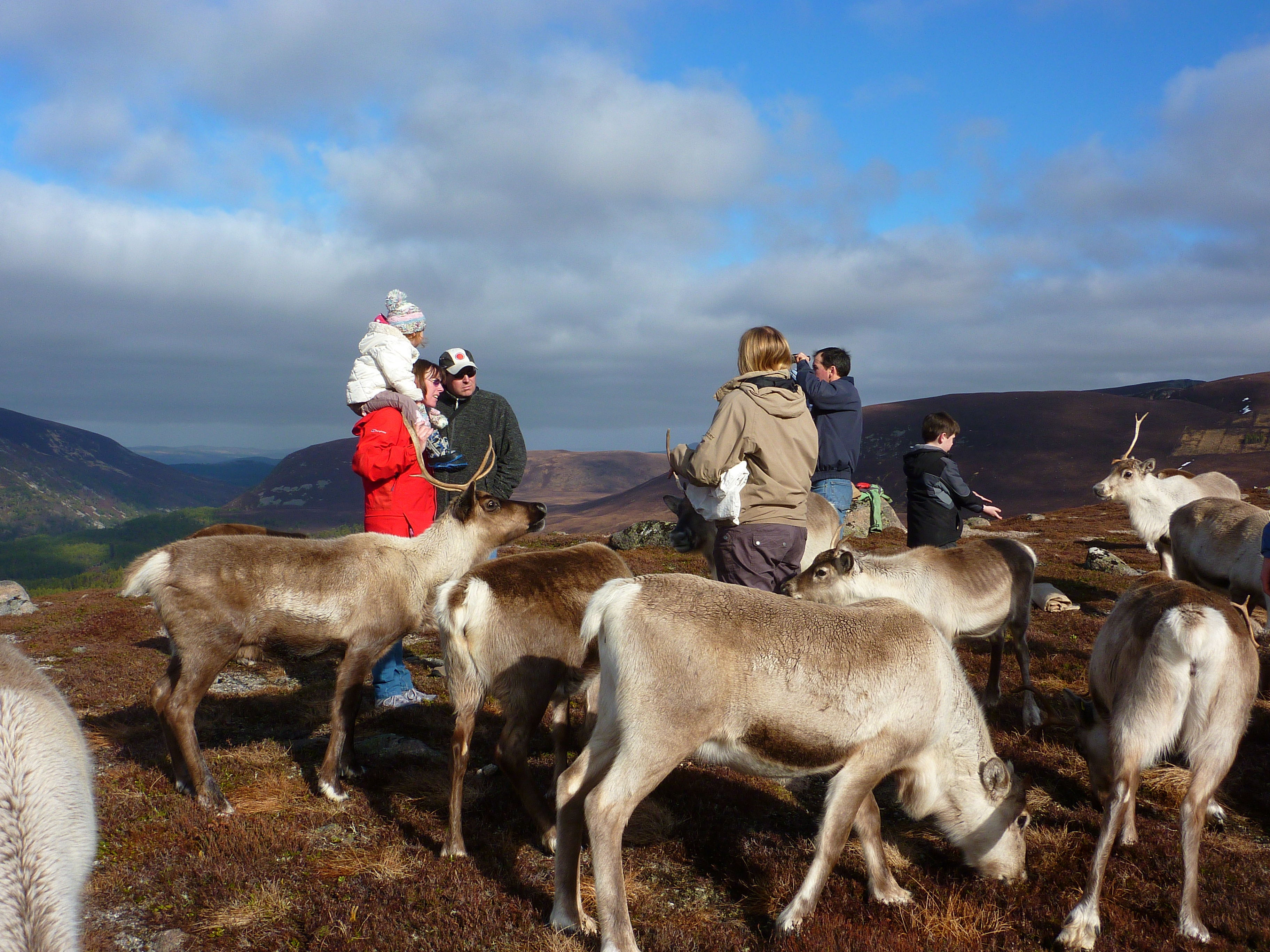
We had around 10 cars on the visit, a respectable but, thankfully, manageable number for our return to visits. Hen and I drove up to the Ciste, and braced ourselves as we opened the doors to the biting wind. We gathered in our visitors and explained what we were going to do, and to be careful on the slippy stairs, and then headed off into the wilds.
At this time of the year, the reindeer are all out free-ranging on the mountains, so our visits could be to a different place every day. The path out to the reindeer that day included lots of boggy bits, and wasn’t particularly a path, but we made it out to the reindeer in one piece, stopping to let people catch up when needed. Thankfully, we were walking with the wind on the way out, so it wasn’t too bad.
Hen called the reindeer and I spoke, very loudly, about their adaptations while the girls made their way over to us. We put the food out, the girls tucked into their lunch, and we started the handfeeding.
A slightly nicer second-visit-of-the-year – the expectant reindeer following the excited visitors and a herder with a bag of food!
Despite the pretty rubbish weather, everyone seemed to enjoy meeting the reindeer. We were sometimes blown over by the wind, and I often had my eyes closed as I talked to the visitors because I had to face into the wind, but it was great getting back into the routine of a visit.
The next time the Centre is scheduled to close is Christmas Day, so this is one of many visits we’ll be taking throughout the year. Hopefully we won’t have to cancel too many over the winter months, and before we know it, it will be summer and we’ll be starting trekking!