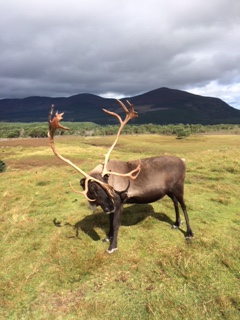
Volunteer Blog: Emm’s Visit – October 2025 (Part 1)

In this latest blog I would like to share some memories from my visit in October 2025. It was very exciting as the new reindeer exhibition was open to visitors with lots of interactive things, videos, information and photo displays. It is so brilliant. The visitors will learn lots of things about reindeer and the history of the herd.
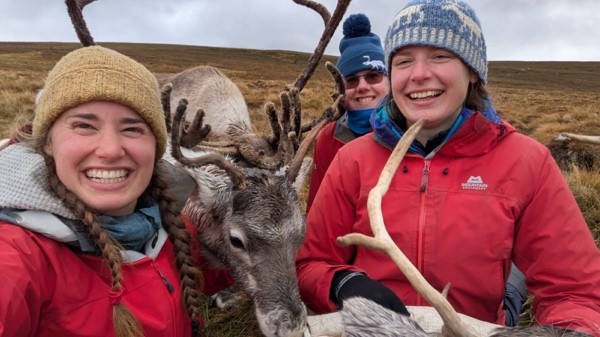
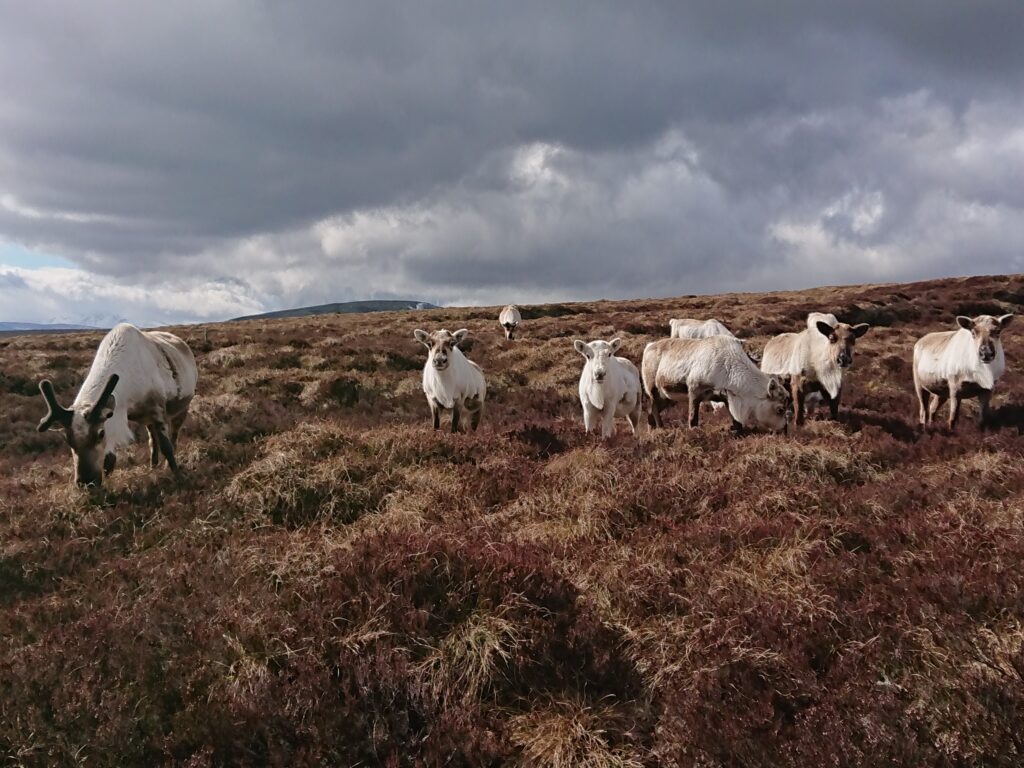
Emm is back, and we’re so thrilled! Emm, Lotti, Amy, and Jig all posing for a team photo!

On my first morning, I walked the calves around Glenmore with EK and Cameron. The calves this year (born in spring 2025) are named after types of dances so I had a lot of fun learning all their names. We walked Ballet and Polka with 2 adult reindeer.
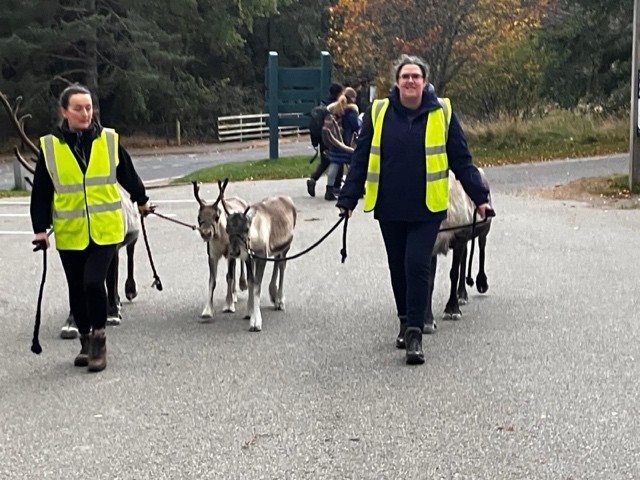
Emm and EK walking Ballet and Polka during calf training.

We were getting them used to everyday things like people, traffic, being led and being handled. Afterwards, Cameron showed me his shed he had built for the reindeer poo bags so they don’t get wet and it is named the poo shed, and it is really good.

There were some new things in the Paddocks. The Santa’s bothy was being built by Alex and Cameron, and they were hoping it would be ready for Christmas. There was also an extended area for the reindeer in their daytime paddock area in the trees.
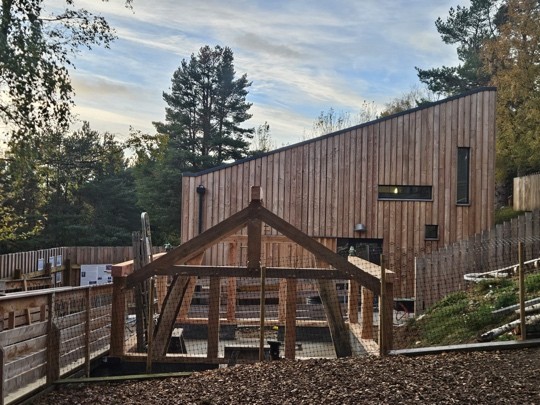
Santa’s Bothy under construction!

Jimmy the bull, who had been over on Silvermount in the hill enclosure with his group of girls, had finished his job with them so one morning Lotti, Ben and Cameron led him off the hill as he was going to go back to Tilly’s farm.  We were also taking Gazelle off the hill to go back to the farm that morning too.
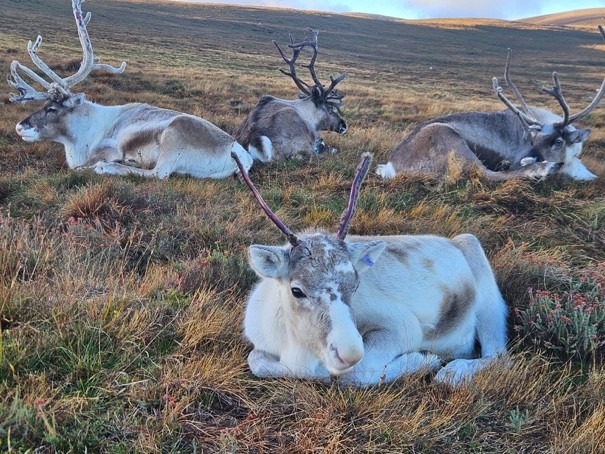
Boogie relaxing with some of our older boys.

I led Gazelle off the hill to Brenda (the truck we transport reindeer in). Ruth and I went to find Vienna one of Iskrem’s girls as they had been moved into a different part of the hill enclosure and she had become separated from them. Iskrem is a very calm bull. We found Vienna and we had to herd her up the hill, as she didn’t want to be caught, to join Iskrem and his girls. Then we moved them as a group to a different part of the hill enclosure. We were very lucky that day as we saw 6 Black Grouse lekking.
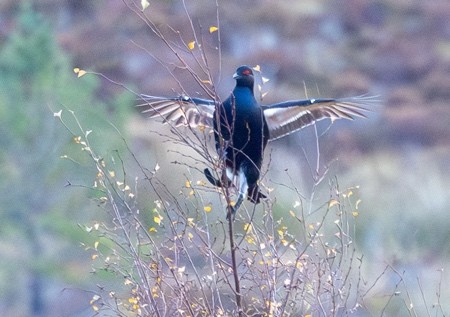
Our hill enclsoure isn’t just home to reindeer.

The day after, I went with Kate, Ruth and Daisy back to Silvermount in the hill enclosure so we could move Jimmy’s girls to where they were meant to be next. Nuii and Fab were missing so Kate went to look for them. We let a few of them out to be with the main herd in the east enclosure in the hill enclosure and I helped Daisy and Ruth take 5 reindeer across the hill enclosure from Silvermount to a different part of the hill enclosure, as they were going to go out onto the free-range soon. I led Orinoco and Suebi. Meanwhile Kate had found Nuii and Fab and brought them back to join the group.
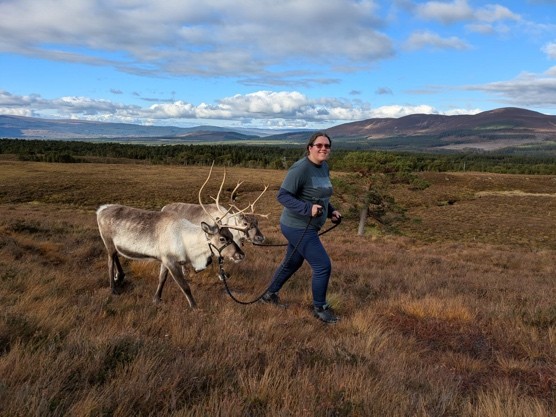
Emm leading Orinoco and Suebi across the hill enclosure.

One day, the free-ranging reindeer were put in a part of the hill enclosure for a few hours so Amy could take Alba off the free-range, who needed to come into the enclosure for a short while.

Meanwhile Kate had gone to find 4 missing reindeer in the hill enclosure as they hadn’t turned up for breakfast or for the 2 Hill Trips and had been missing for the day. They were Pinto and her calf Quickstep and Borlotti and her calf Morris. Morris is such lovely natured and laid-back calf and is pure white meaning he is leucistic. Like some leucistic animals, Morris is deaf.
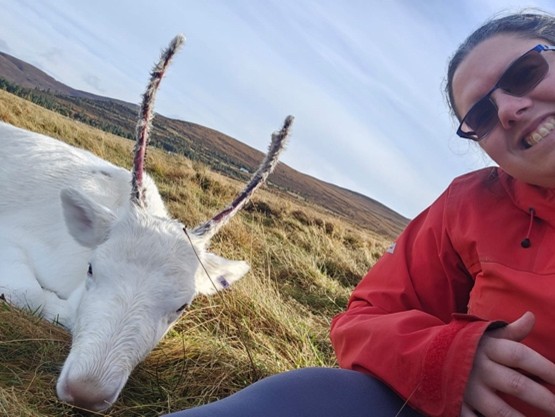
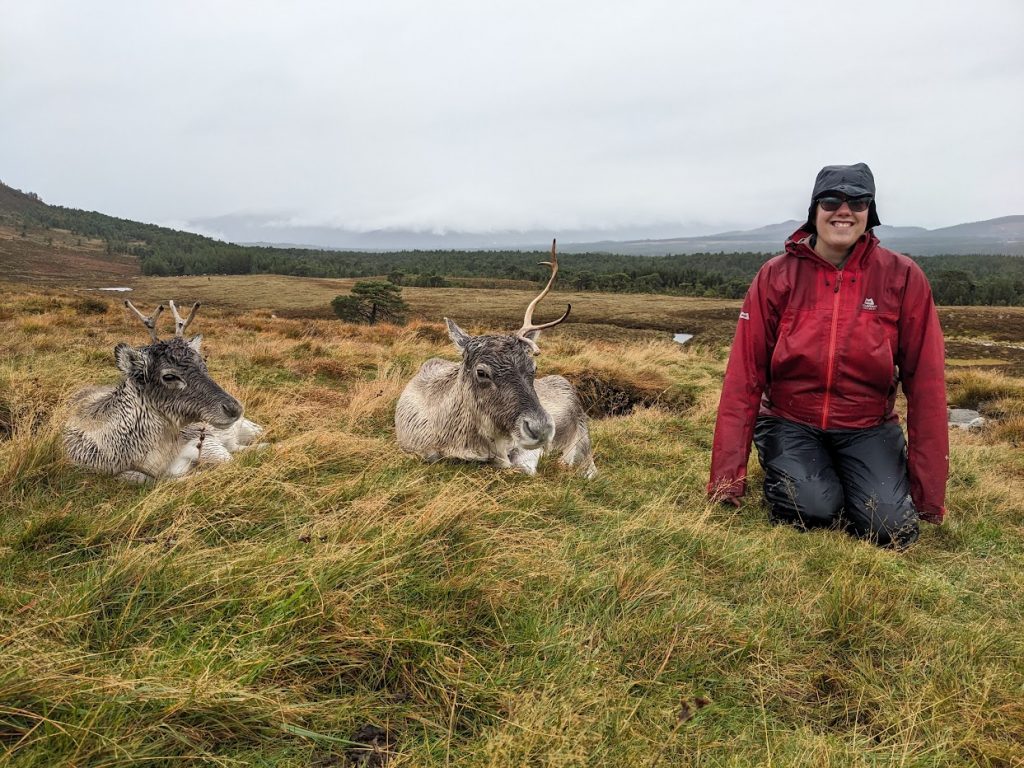
Emm and Morris relaxing on the hill.

I helped Amy put the free-range reindeer back out. We took them to the top ridge on the free range, Amy led and I was at the back. Then we went to help Kate who had found the 4 reindeer on Silvermount in the hill enclosure. Pinto had found a bag of handfeed and was eating out of the bag when Kate found them. We led Pinto and Borlotti on halters and their calves followed and I helped Amy herd at the back. We led them across the hill enclosure and took them to the shed to check them out and take their temperatures as reindeer being away from the herd might mean they are ill. Whilst out leading them we were lucky enough to see a mountain hare.
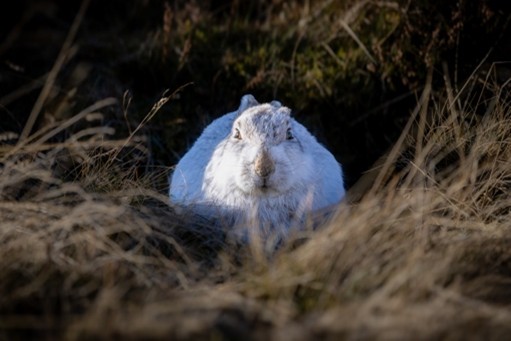
A mountain hare in winter colours.

One morning, the reindeer were slow coming down for breakfast in the hill enclosure. Some of the herd were with us and the rest were on Silvermount. As I helped Ruth call them down, Andi went up and herded them down from the top. We were then able to get them in position for the later Hill Trip.
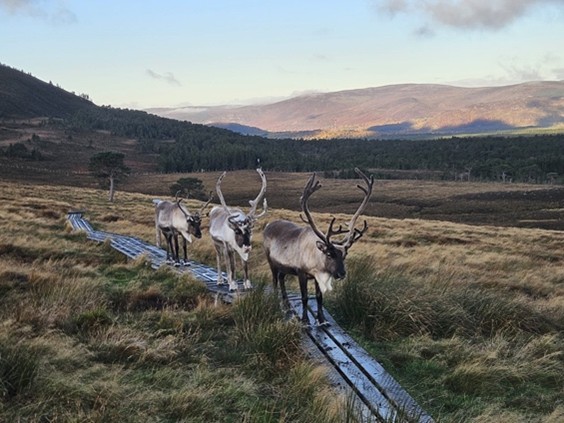
Busby leading the way along the board walk ready for the days Hill Trip.

Unfortunately on our way back down at the end of the day Brenda broke down near the Sugar Bowl car park. The next day, she was towed away to be fixed, a sad sight!

Stay tuned for part two of Emm’s visit in October!

Emm
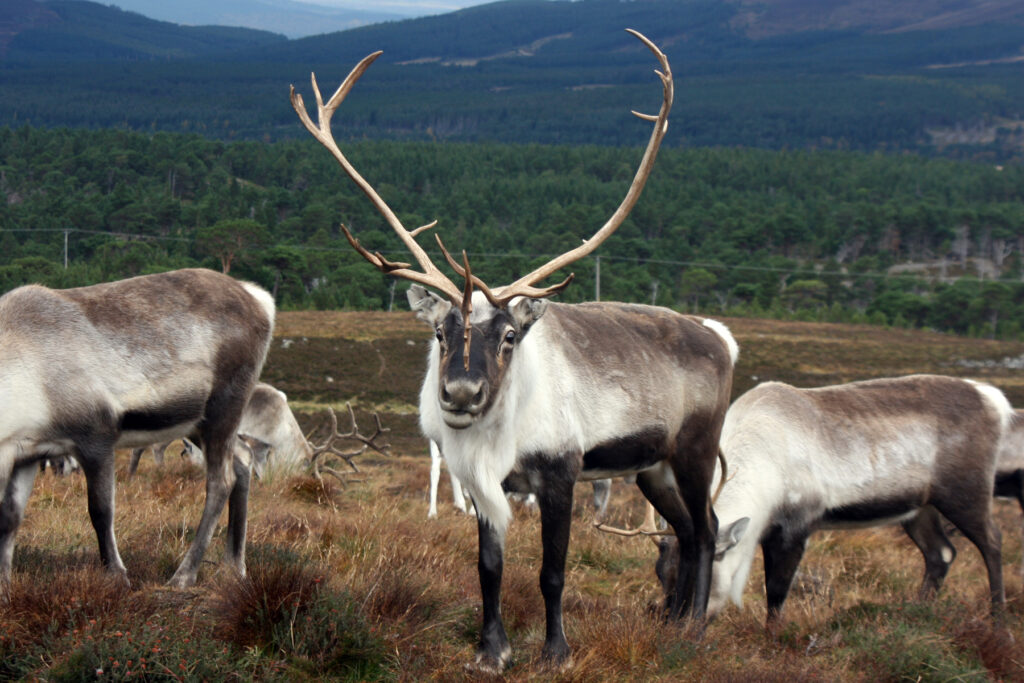
Memorable reindeer: Porjus

Time for another installment of our – rather sporadic – memorable reindeer series. This time it is Porjus’ turn for stardom!

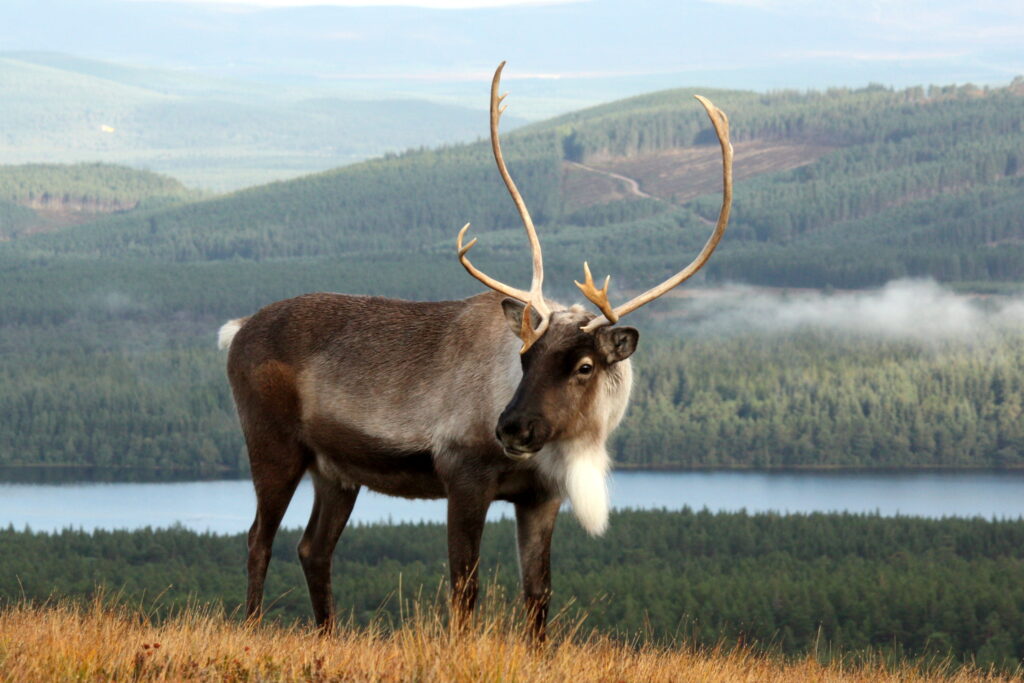
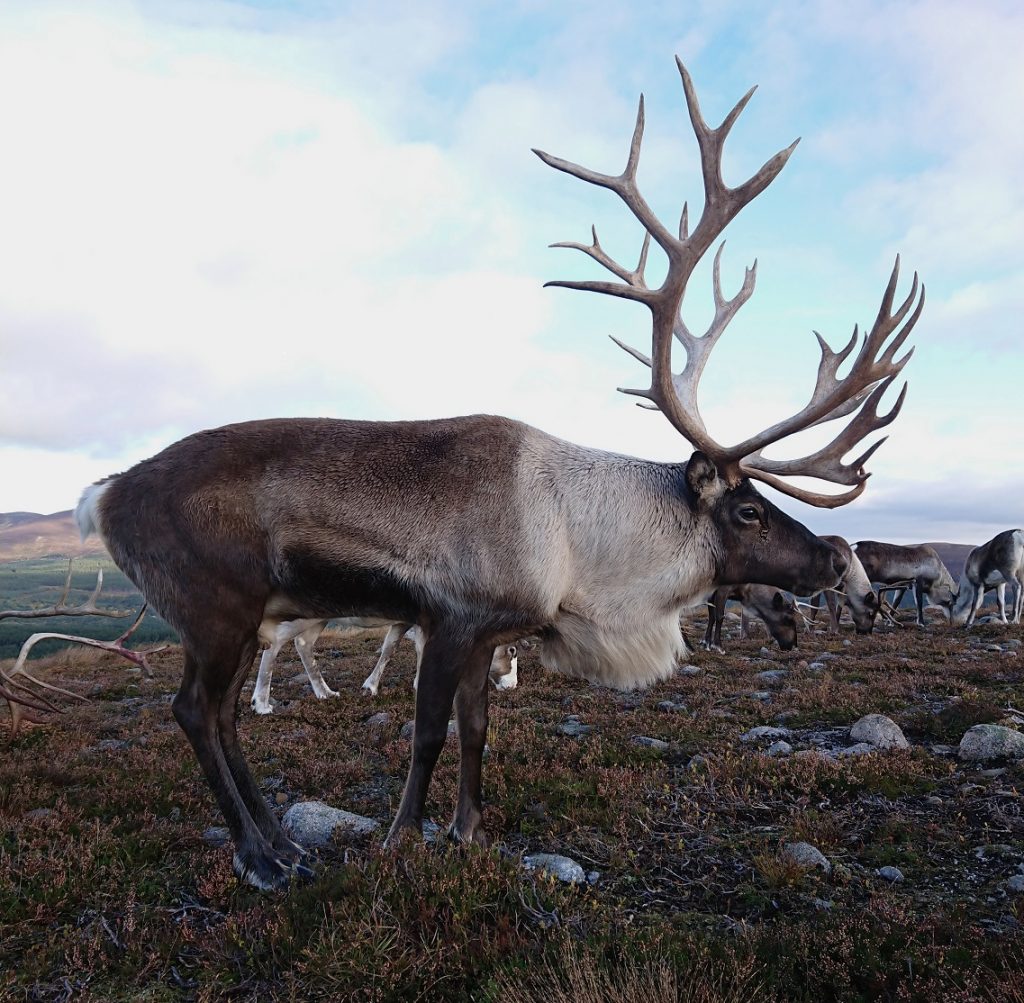
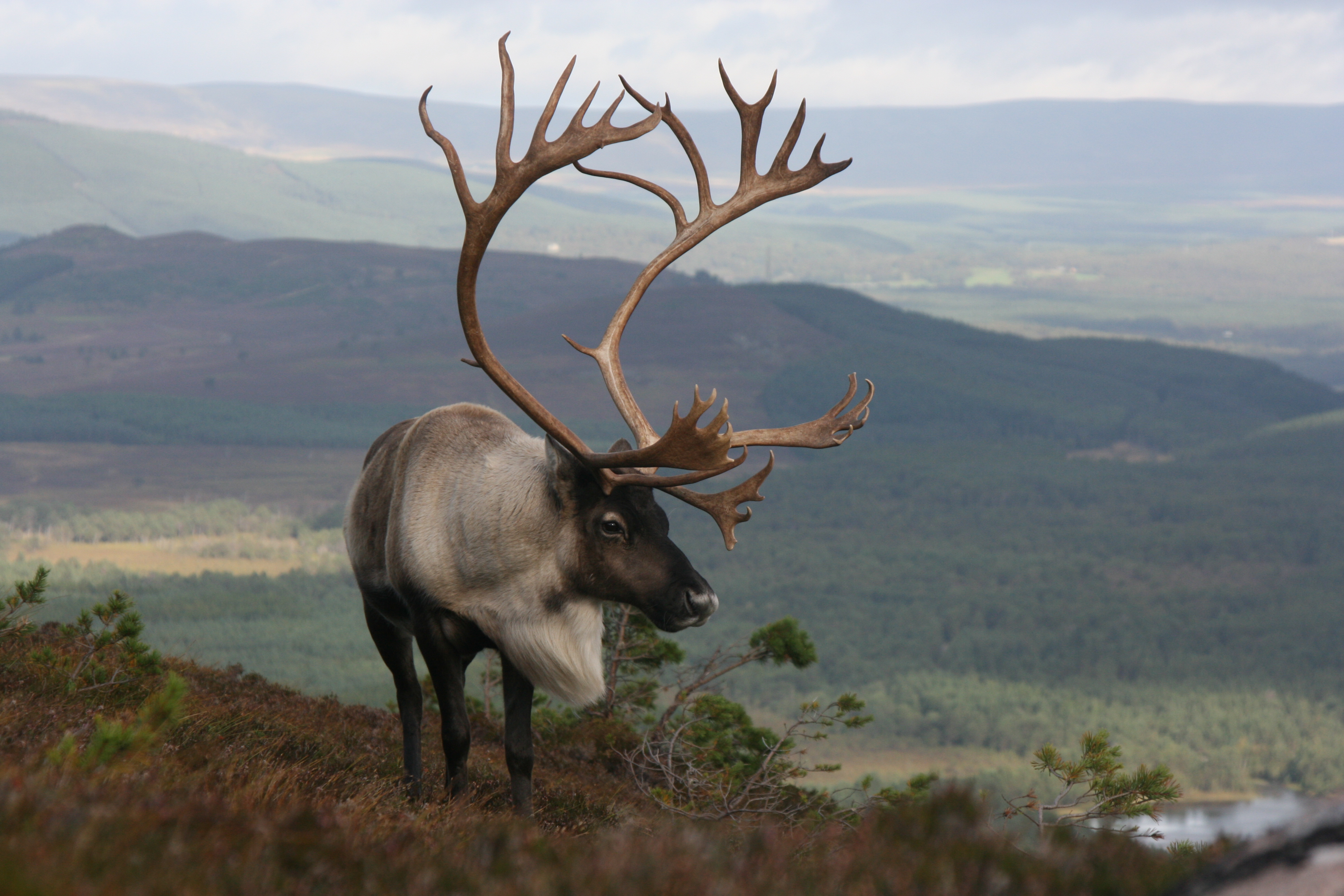
What a handsome chap!

Back in 2004, we imported a batch of male reindeer, mostly calves and yearlings, from Sweden in order to bring in new bloodlines, and one of these yearlings was Porjus. He was named after a settlement up inside the Arctic circle in northern Sweden just north of the town of Jokkmokk, where our founder Mikel Utsi was from. His name was pronounced ‘porr-e-us’, though we frequently referred to him as ‘Gorgeous Porjus’, sounding the ‘j’ so the words rhymed!
Porjus, at the farm not long after he arrived from Sweden. He’s around 1 and 3/4 years old here.

By the time I started here in late 2007, Porjus was an adult and had just been used as a breeding bull in his second rut, going on to breed during the next three ruts too, his last crop of calves born in 2011. His genetics remain in the herd today, most prominently through the descendants of his daughter Chelsea (who include the lovely Winnie, Zap, Diamond – and somewhat less lovely Pumpkin (a reindeer with a serious attitude issue!)) and daughter Jenga, whose son is Jelly. Whilst Porjus fathered lots of offspring over the years, not every calf survives long term, but some of his better known male offspring were Gnu, Topi, Horse, Origami and Svalbard, though these lads didn’t follow in dad’s hoofprints and breed themselves.

Strutting his stuff in the 2010 rut, with Joni and Fiddle behind.

Porjus was a big, bulky reindeer, the ‘normal’ (average) colour for a reindeer, but with a distinctive paler forehead. Throughout each summer he always got incredibly fat – there was never any issue with his appetite – so much so we once tried to put him on a diet briefly (with hopeless results), but it never really mattered as bulls lose a lot of weight during the rutting season. A fat bull at the start of the rut is one that will go into winter in at least ok condition, as opposed to being underweight by the time the rut is over and winter arrives.

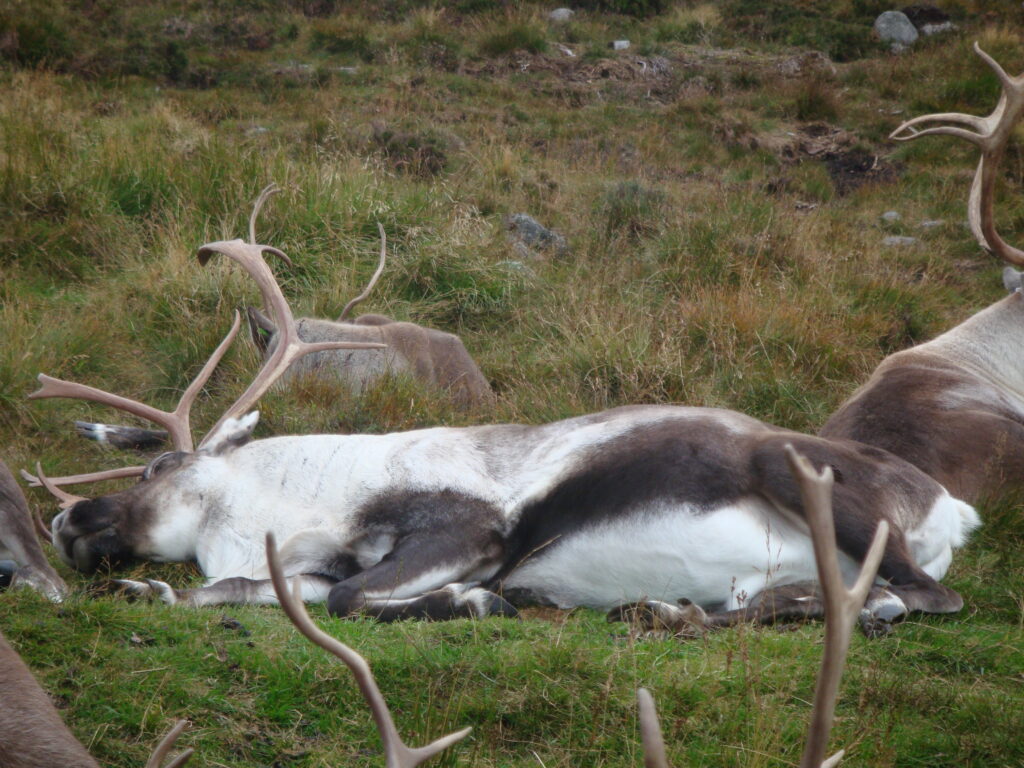
Fast asleep – saving his energy for the upcoming rut. Look at that belly!

Looking at our database, Porjus’ entry includes notes saying ‘A friendly boy’ and ‘well behaved during the rut’, and I certainly never remember being particularly wary around him during the autumn, though obviously we always give any bull a lot of respect at this time. Grandson, Jelly, would have done well to have considered Grandpa Porjus’ gentlemanly tendencies though – we planned to breed from him (Jelly) in 2023 and by less than halfway through the rut had changed our minds and castrated him instead!

Porjus’ grandson Jelly, looking like butter wouldn’t melt…

It is pretty unusual for a mature breeding bull to die in early autumn as they are in robust health ahead of the rut. However, Porjus did just that, dying extremely suddenly in September 2011 from an unknown cause (most probably tick-related), much to our dismay. However, whilst he left his mark in the form of his genetics in the last 20 years’ worth of reindeer born into our herd, he’s left another legacy too.

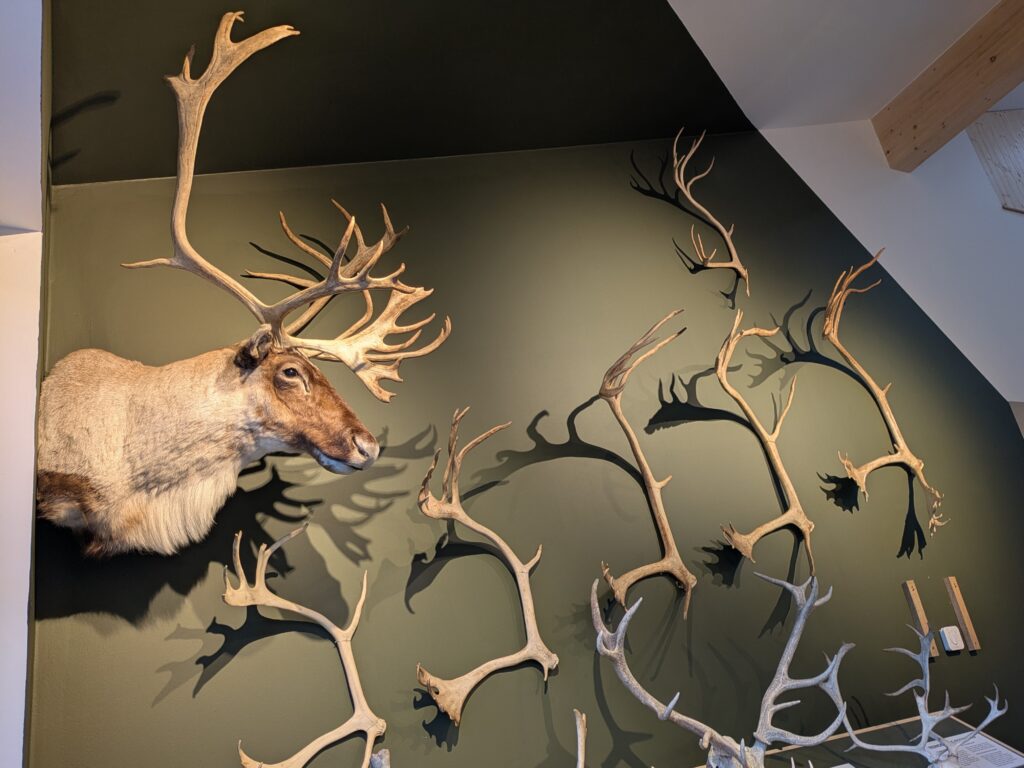
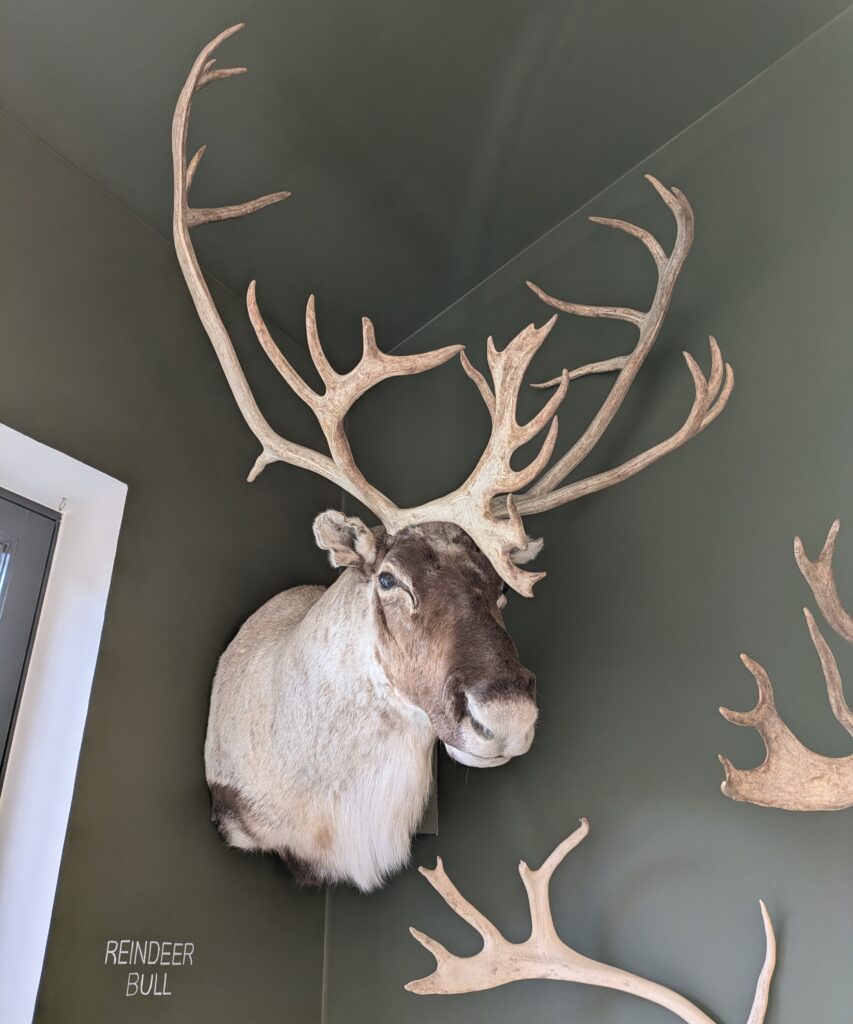
His is the incredible huge head in our Exhibition, gazing serenely over the thousands of people that come through our doors every year. Early autumn is the time of year reindeer look at their absolute best, with fresh thick winter coats and full grown antlers stripped of their velvet skin, so we therefore took the opportunity to have his head taxidermied. The only other taxidermied bull head we have hangs in Tilly’s house, having been brought from Sweden by Mr Utsi back in the 50s. For the last 14 years he and Porjus have gazed at each other across the room, but Porjus is so beautiful it would have been a waste for him to remain at the farm with hardly anyone seeing him.

So Porjus has found his rightful place back here at the Reindeer Centre – he was always a handsome lad during his lifetime, and now he is an awe-inspiring sight with his majestic look and his enormous antlers. I’m glad I knew him, and I’m glad to be able to admire him every time I come to work still.

Hen

Sherlock’s Antlers

Sherlock in September 2022.

Despite spending the last 40+ years devoting my life to the Cairngorm Reindeer I am still fascinated by the annual cycle of reindeer growing their new velvet antlers, then stripping the velvet to reveal hard bony antlers and finally casting their antlers and growing a new set next year.

It is an amazing process, hugely demanding on their resources, but very beneficial to the individual whether they are males competing for females in the rut or females and young males competing for food in the winter.

The older mature males grow the most impressive antlers and for them the process of growing their new velvet antlers begins before the end of the winter and continues until they strip the velvet from the antlers around the middle of August, in preparation for the rutting season. The bigger the antlers the more likely they are to ‘win’ a fight and so claim a harem of females, so big antlers are important.

Sherlock – 8th of April 2023.
Sherlock – 9th of May 2023.
Sherlock – 6th of June 2023.

One of our main breeding bulls Sherlock showed all the signs of growing a pretty big set of antlers last year and by the autumn he didn’t disappoint us. Luckily for us he is a real gentleman among reindeer and although he sported these great weapons on his head, he was never aggressive towards us and we could still safely go in beside him and his breeding females on a daily basis to feed and check them all.

Sherlock – 29th of August 2023 – stripping the velvet.
Sherlock in the rut with Bordeaux in front of him on the 2nd of October 2023.

But their glory doesn’t last long and having spent 5 ½ months growing their antlers the breeding males are the first to cast their antlers at the end of the rut and before the winter sets in. So only about 10-12 weeks of glory with big hard antlers to fight with!

Spartan, who is a couple of years older than Sherlock was first to cast his antlers in the middle of November so I knew it wouldn’t be long before Sherlock was antlerless too. Two weeks later and off came one of Sherlock’s antlers making him very lopsided! Then a couple more days and the other one had fallen.

So now we are in 2024 and Sherlock, who was so dominant in the autumn, has been at the bottom of the pecking order over the winter.

Sherlock with no antlers in January 2024.
Sherlock just beginning to grow his antlers on the 28th February 2024.
Sherlock on the left on the with his lovely velvet antlers growing well, still free roaming in the hills – 30th of March 2024.
It’s in the genes! Sherlock’s mum, Caddis, grew very large antlers for a female.

Tilly

Well hello boys!

In the autumn, we move all of our entire males (apart from the 2 or 3 lucky chosen breeding bulls) over to our hill farm, away from the females and out of trouble for the duration of the breeding season. With no hint of love on the air, this keeps them calmer and easier to manage, though they still enjoy play-fighting. By December the rut is over and our breeding bulls have also joined them, so there is a slight vibe of an all-boys hangout. As Tilly is caring for these fellas every day, and she is less up on her social media, I thought I’d take the opportunity to grab some photos for you all this week when I was over at the hill farm.

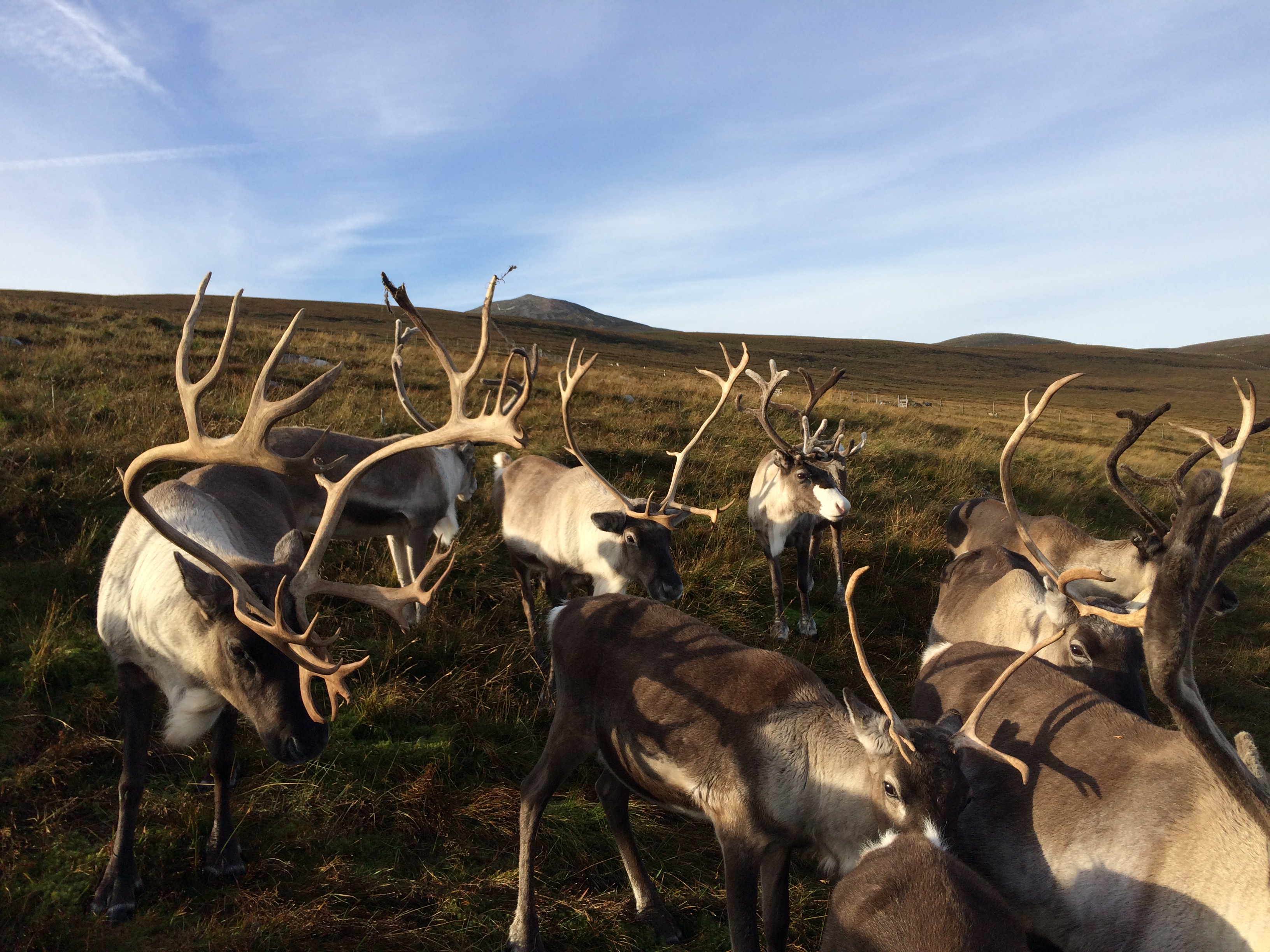
Boys hanging out chilling in the sunshine on the hill
Tub heading over to see what’s up
Spartan is a picture of relaxation! Pure white yearling 99, and Cornetto are closest to camera.
Jester and Scoop resting up for winter
Yearling males 99, Kulfi, Cornetto and Zoom
The bulls spend a lot of time practicing their tussling skills – here’s a friendly bout between 99 and Zoom
2-year-old Akubra looks a bit sleepy for tussling just now!
2 year old Cowboy (centre) is certainly in charge of yearlings Calippo (left) and Iskrem (right)
Too close Calippo!
Pure white 99
The more mature bulls have already cast their antlers. Spartan and Sherlock are now getting a rest from carrying all that weight on their heads!
Look at that big fuzzy nose! Mr Morse.
Mr Whippy is the biggest of the yearlings
Like some of the other young bulls, Zap has broken parts of his antlers. He’ll grow back a full set next year after casting this set, a completely natural process.
Sunny, who we hand-reared last year. He’s grown into a very handsome fella.
Big Morse and young Kulfi enjoying the winter sun.

Andi

Photo Blog: October 2023

Here’s a selection of pics taken throughout the month, hopefully giving a snap shot of what we’ve been getting up to. It’s been full on with the rut taking place in the enclosure, our breeding bulls do now seem a bit less enthusiastic after a busy six weeks for them! We’ve also been bringing two calves at a time down to the Paddocks to halter train them. They usually spend around four days here in which we take them out on morning walks to get them used to seeing traffic, bikes, their own reflections in shiny windows and whatever else Glenmore can throw at us at 8am! Christmas sleigh training for our three year old Christmas Reindeer begins too. So far Adzuki, Haricot and Hemp have been trained and they’ve all been total pros. During the October holidays when our 11am Hill Trip sells out we’ve been putting on an afternoon Hill Trip too. Funnily enough, during the rain and wind of Storm Babet we did not require this attentional visit. But after the storm we’ve been treated to some gorgeous autumnal weather and the first decent snow on the hills of the season.

Amongst all of this we’ve also managed to get the October newsletter written, printed and sent out to our lovely adopters! Until it’s safely in the hands of our adopters I’ve left all calf names out of the blog.

2nd of October – Sherlock watching over Bordeaux whilst she eats her breakfast.
4th of October – Haricot puling the sleigh like a pro -his second time ever!
5th of October- Olympic looking very handsome pulling the sleigh with very special cargo on board – Tilly and her grand children!
7th of October – Fly looking very soggy on an incredibly wet day! She’s 16 and is now of of the oldest reindeer in our herd.
7th of October – Emm, our wonderful volunteer, is here brightening up even the wettest of days, alongside Holy Moley and calf.
10th of October – Druid, excellent at striking a pose!
12th of October – Cicero and Lupin vying for their moment in the blog.
13th of October – A morning at the farm to help Tilly feed the bulls. Here’s Busby, cheeky as ever!
18th of October – Checking in with some of the cows in Sherlock’s breeding group. Here we have Pumpkin, Torch and Pip.
19th of October – An incredibly wet Hill Trip. Gloriana and Borlotti closest to the camera with the herd behind, waiting for their lunch.
23rd of October – Blue skies!! Jenga, Sunflower and Feta posing beautifully.
24th of October – Borlotti and her cute calf with a big pile of breakfast.
26th of October – Ryvita, Sambar and Sika leading a lovely free range group of girls.

Ruth

Stinky Boys

Roman with his cows

By the time you read this, the rut will be underway here at Cairngorm, with our chosen breeding bulls split with selected unrelated females, to make sure we know who the parents of each calf are. While the bulls tend to be fairly relaxed and laid back for most of the year, as September comes to an end and the cows come into season, they start to “rut”, strutting around, posturing and rounding up their females, and challenging any other bull they see. Reindeer bulls don’t “roar” like some deer species (including the iconic Scottish red deer stag), instead they grunt. But one of the most noticeable changes for me is their smell.

Kota in 2020, grunting to his cows

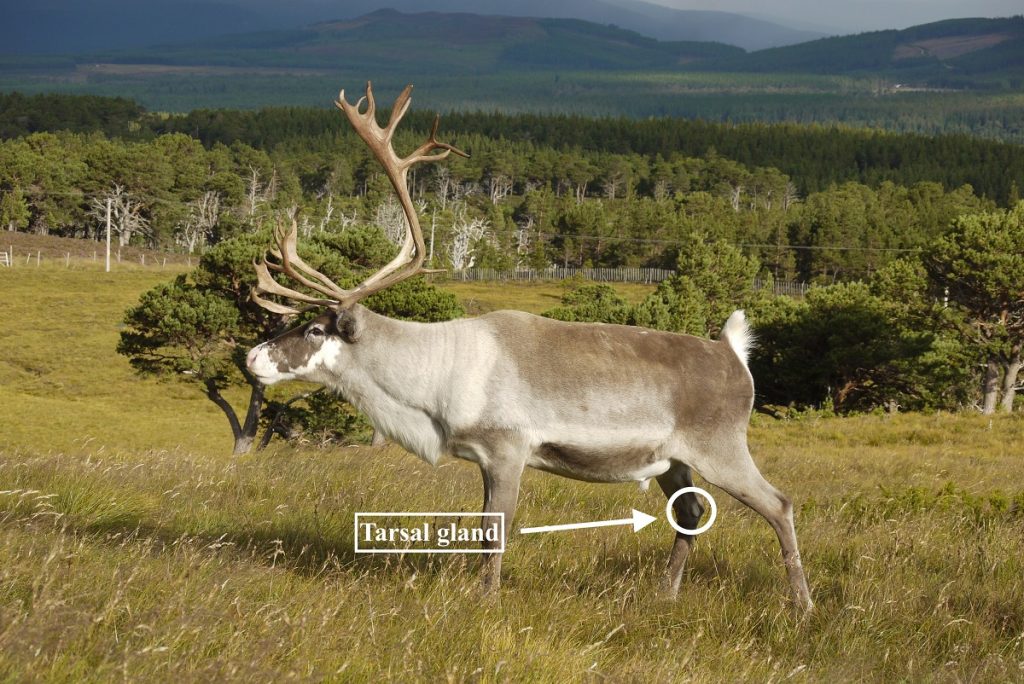
Now, I don’t claim to have a particularly good sense of smell, but in general reindeer are fairly unsmelly creatures. However, a rutting bull is a different matter, and already, as I write in mid-September, our boys are getting stinky. It’s not an entirely unpleasant smell – very musky and, well, masculine I suppose. One of the main reasons they smell so strong is that they begin deliberately peeing on their hindlegs. This always seemed a bit odd until I did my research and realised that reindeer, like all deer, have scent glands on the inside of their hocks, the tarsal glands. This gland produces an oily secretion, and when the natural bacteria on this area combines with pheromones in the urine, that distinctive scent is produced. Apparently every reindeer has a unique, individual scent, due to their own winning combination of bacteria, though I definitely don’t have a sensitive enough nose to be able to tell!

Nutti, illustrating the position of the tarsal gland
Roman peeing on his legs to increase his allure

Why do they feel the urge to be so stinky?? Well, part of it must be as a statement of dominance – when I, as a mere human, can smell a bull from 100 metres away, the other reindeer must be able to smell them from… 800 metres?… a mile?? This must act as a deterrent to a weaker bull, and quite possibly as an attractant to a female in season – they definitely come looking for bulls when they’re ready.

Feeding the big bulls last year, just before the rut – they were already stinky!

We have a vague theory among us herders that the female herders notice the scent of the rutting bulls more than the male herders do. Quite what that means, I have no idea – perhaps the smell is designed more as an attractant to cows than a deterrent to bulls after all (not that any of us lassies have said that we actually like the smell!). Either that or the men amongst us are less sensitive when it comes to body odour!

Andi

Boot Camp

As the rut has now come to a close and we move into winter, us reindeer herders are feeling particularly strong. For most of the year the female reindeer in our herd spend their days free-ranging the Cairngorms. However during the autumn we have all the reindeer that we want to breed from in our 1,200 acre hill enclosure. This is to ensure that we know which bulls have bred with which females and to ensure there is no inbreeding. This does however mean we have many more reindeer to feed than usual. As this is their natural habitat, when the reindeer free-roam they find all their own food and we don’t feed them at all. Whilst there is plenty of natural grazing in the hill enclosure we also give them supplementary food to make sure that the grazing replenishes each year. At the peak of the rut we were both mixing and carrying a lot of food up to the reindeer. In fact on the days when the most reindeer have been in the enclosure we are carrying 144 kg a day or a tonne a week.

Houdini and his girls

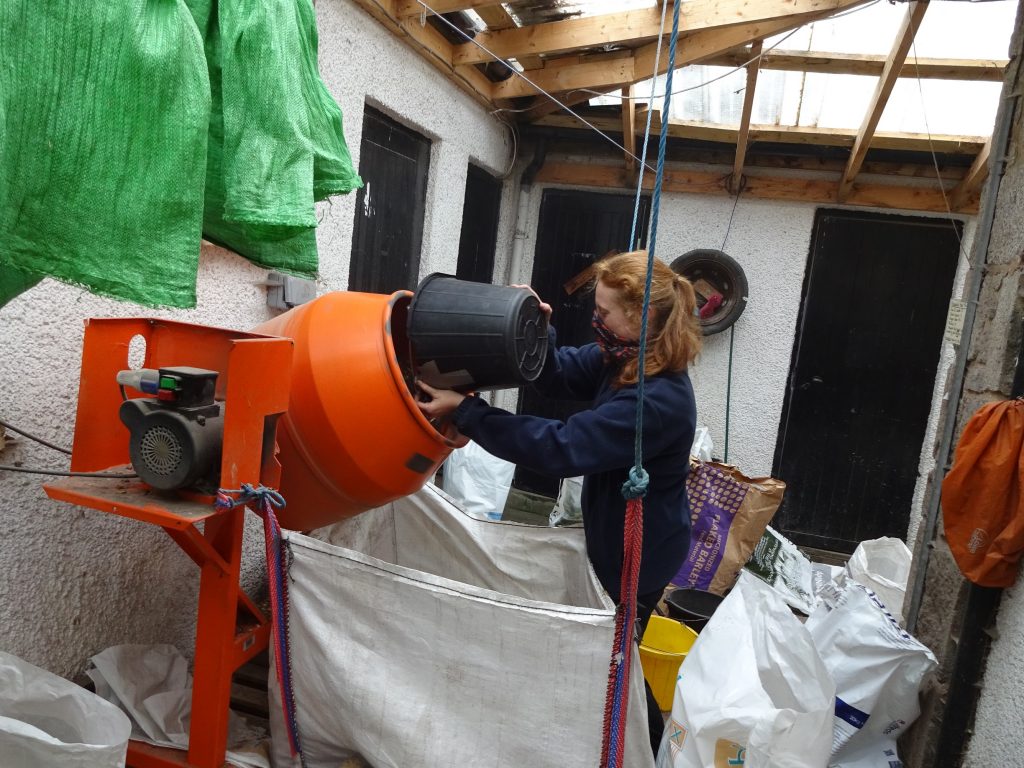
Mixing feed can be a real work out as it involves lugging around 20kg bags of various grains, measuring out the right amounts and throwing them into a cement mixer. The reindeer food is made from a mix of barley, sugar beet, sheep mix, dark grains (a by-product of whisky distilling) and hay soaked in garlic. As you can’t buy reindeer food here in Scotland, we mix up the food from lots of different things to give the reindeer the right nutrition.

Izzy mixing feed

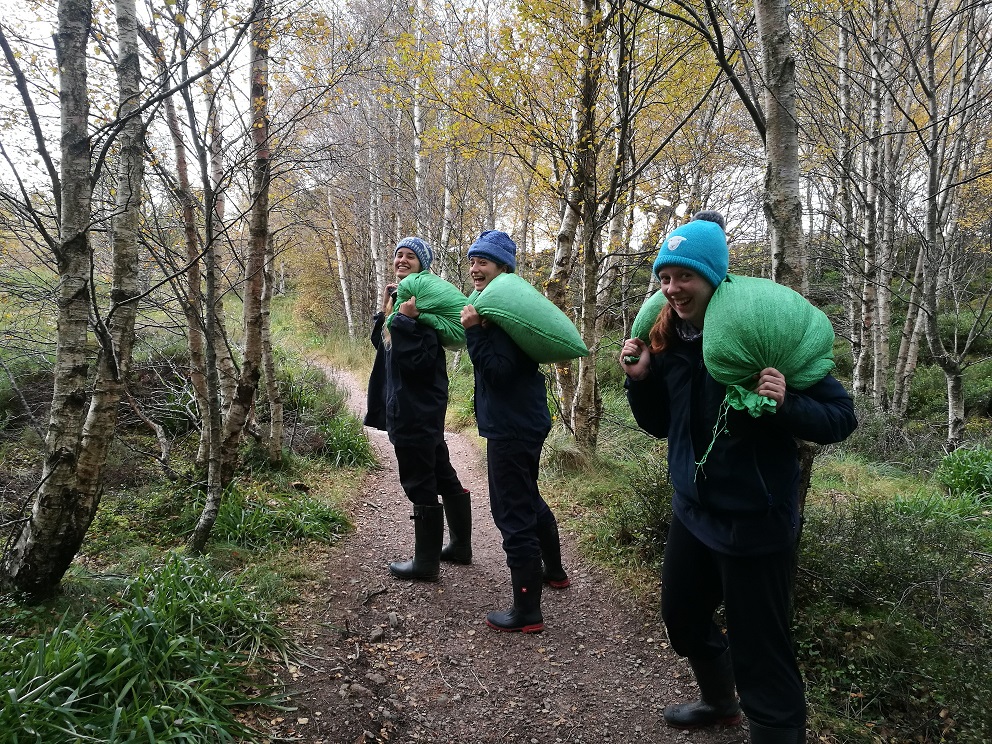
And then once the feed is mixed, actually getting it to the reindeer is no mean feat. Normally the food is packed into roughly 15kg sacs and carried up to the reindeer enclosure on our shoulders. We have however also been asking visitors to help carry smaller bags (no more than 6kg) of reindeer food up the hill. If you have helped us carry food, thanks again from everyone here at the Centre, both two and four legged.

You certainly won’t find a reindeer herder in the gym, especially not during the rut. Mixing and carrying feed (as well as unloading the feed lorry) is a very good work out and justifies the copious amounts of cake we all eat. I also know that all the reindeer herders, especially the women, take great joy in easily flinging a large bag of reindeer food onto our backs as a visit of people look on amazed. This summer I heard a man ask my colleague Nell if she needed a big strong man to help her carry her bag, to which she responded very politely “I’m a little strong woman and I’ll be just fine”. Go Nell!

Lotti

Bulls Over The Years

The Cairngorm Reindeer Herd was established in 1952 so over the past 65 years there have been many main breeding bulls so here is a little sum up. I can only tell you about the ones I remember but there were many bulls before my time as well. I’ll try to inspire Tilly (or Alan) to write a blog on the ones before my time.

The first bull I remember when I was very young was Gustav and he was born in 1985, the same year as my brother. You could not get a more gentle reindeer, if he was a human he would be the perfect gentleman! I suspect nowadays we have lots of reindeer in the herd like Gustav but back in the day he was certainly one of a kind! You may find this morbid but a few years after Gustav died we found his skull so we hung it up in our shed on the hill so we feel like he watches over us when we bring the herd in for handling. He was the main breeding bull in 1989, 1990 and 1991.

The next one to memory was Crackle who came to us from Whipsnade zoo in 1991 along with two others, Snap and Pop (Who remembers Snap, Crackle and Pop from Kellogg’s Rice Krispies?). Being new blood we obviously wanted to breed from him. He was also a very good looking reindeer, grew lovely antlers and had a great temperament so all good things to go back into our herd. He featured on the front cover of Tilly’s first book ‘Velvet Antlers Velvet Noses’ and lived to a grand age of 16. He was also photographed by wildlife photographer Laurie Campbell and recently we have acquired some posters from Laurie which were printed many years ago when Crackle was in his prime which we are selling in our shop.

After Crackle was Utsi who was born in 1998. He was hand reared by Alan, my dad. Utsi’s mum Pepper died when he was very young so we bottle fed him milk and he was Alan’s shadow around the hill and farm. I had a love/hate relationship with Utsi… and not because we fought over Alan’s attention, he well and truly had that 😉 When I was in my mid-teens on the hill one day with mum, we fed the herd and I was walking back counting them. At that point Utis was rutting and decided I was a few steps too close to his females and he completely flattened me. There were no injuries, infact I managed to get myself in-between his antlers while on the ground and held him into me as mum came over flapping an empty food sack to shoo him away. He headed off leaving me in a wee pile on the ground, but un-injured! The trouble when reindeer are hand-reared is they see us as part of their herd and being totally comfortable in our company he wasn’t scared to give me a telling off for getting too close so it’s a fair one really. I’ve learnt from my mistakes and how to act around rutting bulls so there have been no incidents since. The same year Utsi was a breeding bull we also had Cluster who was the same age. He was very different, kept himself to himself but grew lovely big antlers. We also had Red who was another gentleman, good looking with a super nature!

Utsi.jpg
Utsi behaving himself on the Cromdale hills

Cluster.jpg
Cluster with his beautiful antlers in velvet

We then had a spell where we used bulls we brought in from Sweden in 2004. This was new blood in the herd which is very important but it meant there wasn’t necessarily one main breeding bull. Some of these bulls were Sarek, Sirkas, Jokkmokk, Ritsem, Västra, Ola, Moskki and Porjus.

Then there was Crann!!! If you haven’t heard of Crann I’d be very surprised. He has been the pin up boy of the Cairngorm Reindeer Herd for quite some time now and although a very old man at 14 years he is still with us… though not looking as quite as good as he once was. None of the past or future bulls have matched the size of Crann’s antlers, he still holds the record and I suspect will for a long time to come. He was truly magnificent in his prime and his photograph has been in many national newspapers as well as our own advertising and images on various items of shop stock. He is certainly enjoying full retirement now at our hill farm over at Glenlivet, and quite rightly too!

Crann.JPG
One of the many photos of Crann, a truly majestic bull

So in the more recent years we have had more reindeer joining us from Sweden. In 2008 we brought over Pelle, Jaska, Bajaan and Magnus who were the main breeding bulls around 2009, 2010 and 2011. Then there was Gandi, Bovril, Jara, Lalle, Boxer, Kota, Houdini, Pera, Bandy and Nutti who joined us in 2011. The most recent Scottish bulls are Balmoral and Ost. Both from very strong family lines and they have lovely natures and grow beautiful antlers… everything you want in a reindeer!

Fiona

The Rut

3-bulls
Balmoral (left), Ost (centre) and Bandy (hiding on the right)

It’s an exciting time of year here at the Reindeer Centre as we are now well into the rut. Our main breeding bulls are looking fantastic with their bony antlers, thick necks and chubby bellies. The girls are also looking brilliant after a summer out on the free-range getting lots of tasty morsels and running around on the hills.

ost
Youngest bull Ost looking gorgeous

We’ve now got a few bulls in our enclosure with their selected cows and are hoping that they do their one and only job well and we will have lots of babies next year. As most of you know, our herd numbers around 150 and we like to keep it that way. We use the enclosure during the rut to manage our bulls and cows to make sure we get enough calves, but not too many. The single cows we are not breeding from, such as Lilac, Tuppence, Fonn and co., are put out onto the free-range and politely told to go and fend for themselves. Females with calves are kept separate from the bulls, but still in the enclosure. As well as the rut, we are currently halter training the calves so we need them on the hill, but we give most of the mums a year off between calves.

img_1741
Bandy strutting his stuff with his girls

There are roughly 4 large parts in total to the enclosure. The cows and calves have one, and the other three each contain one main bull, his cows and sometimes a couple of castrates and young bulls. The three main bulls in the enclosure this year are Balmoral, Bandy and Ost. We have a couple of castrates and young bulls in with the main bull to keep him fit and on his toes. Whilst the castrates and young bulls will never challenge the main bull for dominance, he will chase them away from his ladies if he feels they are getting a little too close for comfort. It keeps our younger boys in check and means our bulls work off that belly they have been building over the summer.

bovril
Handsome Bovril, with his antlers!

We also have a bull, Bovril, out on the Cromdales with some younger girls. He’s a very lovely boy and his antlers have been cut off (like getting a hair cut when the antlers have hardened!) so he is not too much of a worry if you come across him. Recently Tilly had a very long walk when Bovril’s 8 cows turned up on the road between Bridge of Brown and Tomintoul! I think Bovril was too fat to follow the girls so hopefully they have been reunited up on the hills and he is keeping them in check now.

balmoral-peeing
Balmoral peeing on his legs to make himself extra-attractive to the cows… men out there, please note that this doesn’t work for women!

Hopefully the boys will perform and next year we will have lots of cute little babies again!

Imogen

It’s a strip-tease!

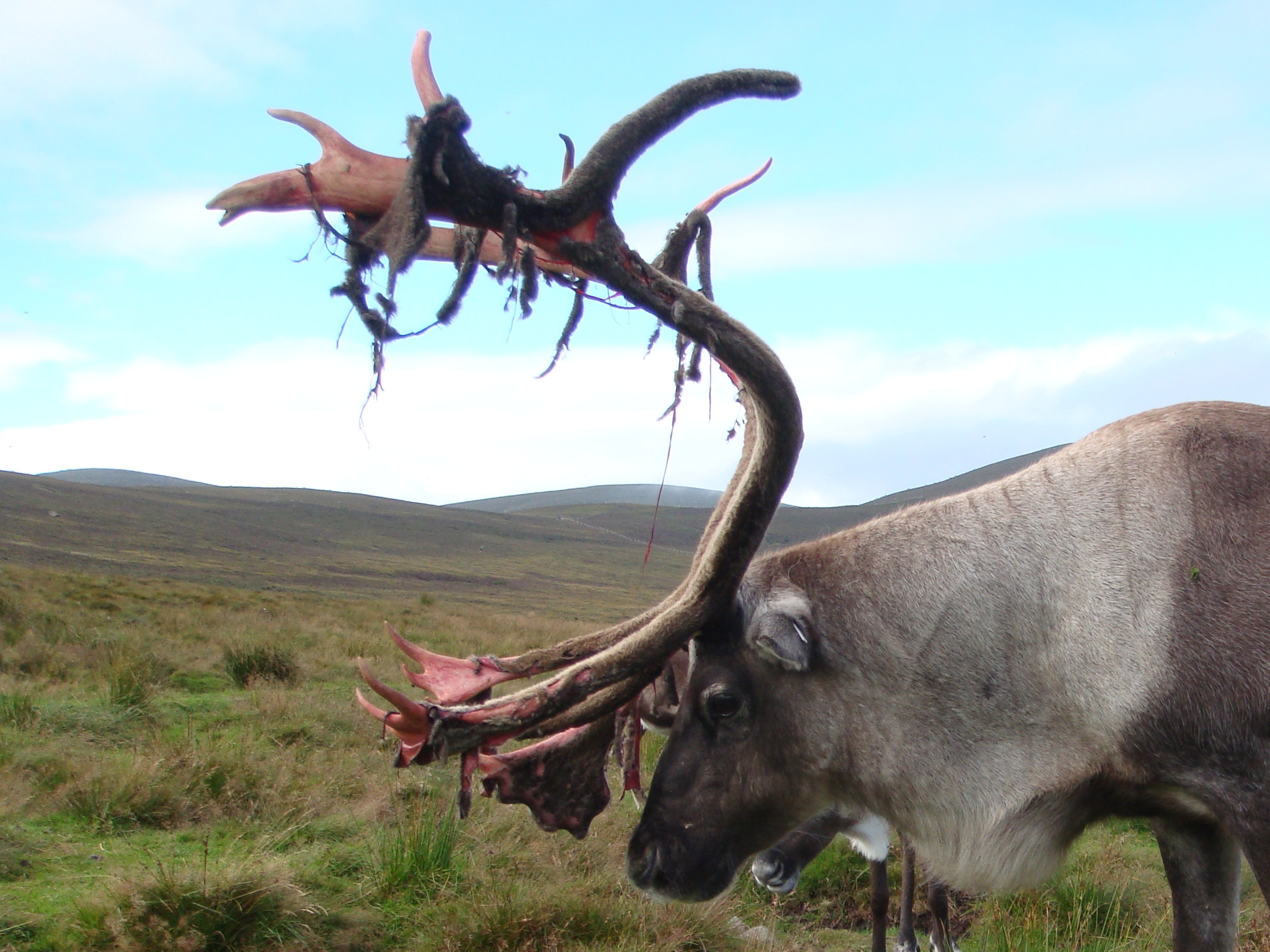
Autumn is definitely here now, even if we have tried to ignore the fact the leaves are turning and days getting shorter… however it’s not all bad cos it’s the time of year that reindeer are looking at their absolute best. The past 5 months have been full on for the bulls growing these enormous antlers. Bovril, Balmoral, Bandy (not all bulls begin with ‘B’), Ost, Houdini, Pera and Kota (there we go) are a few of our main breeding bulls this year and they have all got a fantastic pair of antlers to complement their voluptuous curves (fatties!).

DSC00836
Moskki shedding his velvet

So we get to the end of August and wait with baited breath to who will be first to strip their velvet. Ost was number one. He is a 3 year old bull, just a youngster, so this will be his first year of being the main man. The others took a few days but then we were well underway with velvet hanging off left, right and centre. Balmoral stripped his velvet in the paddocks so with visitors going around we had to pre warn them of his gory state as it can look quite bloody, even though there is no feeling in the antlers at this point. He is now back on the hill with the others. It was fairly amusing walking this huge, quite terrifying looking bull out of our livestock truck, across the Sugarbowl trail to our mountain enclosure and he walked like a true gent. Makes us so proud of them!

The first to strip velvet are the main breeding bulls, then young bulls and females are next in line. The gelded males don’t always strip their velvet clean and end up with velvety antlers over the Christmas period which is fine and means they don’t look so terrifying with big bony antlers, even though we all know they are far from terrifying.

IMG_3127
Bovril in full velvet

bovril
Bovril stripping his velvet

IMG_3173
Bovril looking amazing with his antlers fully stripped

Antler is an amazing thing and there hasn’t been much study on it. For so much bone to grow over such a short period of time, it is incredible! Another cool antler fact is if a reindeer damages or breaks an antler one year, the antler that grows the next year (keeping in mind it’s a whole new antler) will remember the break/damage and it will have a scar in that same spot. At that point it will always be slightly weaker… Hmm, that’s pretty weird you have to admit.

Fiona

Book Now