Since working here, my camera roll has slowly become about 90% reindeer! So here are a few of my fav of our reindeer, getting up close and personal with them to get those super cute nose shots!


Isla

Roaming freely since 1952
Since working here, my camera roll has slowly become about 90% reindeer! So here are a few of my fav of our reindeer, getting up close and personal with them to get those super cute nose shots!
Isla
When sorting through antlers recently and selling various sets, I realised that female reindeer Marple has been kind enough to give us hers for the last three years in a row, which is very unusual. By ‘give’, I mean that she cast them in the hill enclosure, giving us a higher chance of coming across them as compared to losing them outside the fenced area – where they are rarely found. How kind of her!

Although I don’t have any of the sets here anymore, I do retain photos of each set sold for my records, so this seems like a good opportunity to talk about similarities from year to year for antler growth for a particular reindeer.
Marple grows what I would classify as a very ‘typical’ set of antlers for a reindeer – average size for cow antlers, with a ‘blade’ at the base on one side (the tine which comes down towards the nose), front points – originating a little higher – pointing forwards somewhat like a stag beetle’s pincers, and then upright shafts which have multiple tines coming off them.
One of my most regular questions on the Hill Trip is whether or not reindeer grow the same shape of antlers each year. The answer is emphatically a yes, though by no means identical. The photos below show Marple’s antlers from age 3, 4 and 5, and you can see they have the same basic layout from year to year.


But antlers vary hugely, so here’s a composite photo of a ‘pair’ of antlers from two very different bull reindeer, by way of illustrating the differences between individuals whilst still showing the basic layout of the blade, front points and upright sections.

So what affects how antlers vary from reindeer to reindeer? The answer is primarily genetics. Antler growth is genetically inherited, so a reindeer with parents with rather simple antler growth is unlikely to grow anything too fancy, and vice versa. One of the reasons that our big lad Sherlock grows such enormous antlers is that genes for excellent, huge antler growth run in his family line; both his mum Caddis and dad Atlantic grew huge antlers themselves – Caddis exceptionally so for a female. Marple grows very similar antlers to her mum Ochil, as seen below:

Environmental factors affect antler growth too. Having enough energy to grow good headgear is dependent on being in good enough condition, so the grazing abundance and quality is important, which is obviously heavily influenced by the weather. Really hot weather can mean reindeer spend more time lying on snow patches to keep cool, or jogging about to try and evade flies that are buzzing around them, leading to less available grazing time. As I write it’s early July and 9 degrees and raining outside. I’m still having to wear a thermal top under my normal layers and I’m generally pretty grumpy about that fact, but the reindeer are loving life – grazing constantly with no flies around them at all. Every cloud…
Finally, a big part of antler growth is to do with body condition. This can be linked to environmental factors as we’ve just talked about, but other things also affect it, for example illness. A reindeer fighting an illness concentrates their energy on preserving body condition, and antler growth pauses as a result. It will start again if and when the reindeer recovers, but the damage is done and the antlers end up smaller, or slightly malformed, compared to a ‘normal’ year.

Female reindeer raising a calf need lots of energy to produce milk, so their antlers often suffer over the summer months, being smaller and often rather wonky. Some reindeer are prime candidates for this – looking at you, Merida! – whilst Marple actually doesn’t struggle too much. At 6 years old she’s in the prime of her life and has energy to spare, so both a big calf and decent antlers in the same season are achievable. However, the difference is still noticeable to some extent: here are those three photos again – the first pair grown when Marple was three, with no calf at foot, and the second two grown in the subsequent years but both times with a calf at foot. The first pair are slightly taller and perhaps a little more elegant, whilst the others are a touch shorter and a bit ‘squatter’ (although a little chunkier as Marple matured).

If you want to read more about antlers you’ll find all sorts of other blogs about them if you dig around in the archives here, including the difference between antlers and horns; the antler growth process; how they grow so fast; how the antlers strip away the velvet skin; bull Pera’s extraordinary antlers and why some reindeer never grow antlers at all. The most recent covers how we go about selling them too.
Hen
For any of you that have visited us on our Hill Trips at the end of last year, you may have noticed a young female hanging around us herders, ever hopeful that she can mooch some extra feed. She is a 5-year-old female called Bordeaux, who is very non-descript colour wise and was born in 2019 – which was the year we decided to name our reindeer after European places. She was born on the free range after her mother, Sika decided to go AWOL the day before we were due to bring the pregnant cows into our hill enclosure for the calving season. Doing this allows us to check that both cow and calf are healthy before sending them out to free range for the summer. But Sika must have known that a short stint in the hill enclosure was pending and decided it wasn’t how she wanted to spend the next couple of weeks!

Bordeaux’s mother is a sweet reindeer that is relatively independent. At the ripe old age of 16 she is now enjoying a retired life free ranging in the cairngorms. Both Bordeaux and her mother look very much alike, which helps me confidently ID at least one of the retired females out on the free range. To learn more about Sika have a read of Hen’s blog here.

In 2022 it was time for Bordeaux to continue her family line and she gave birth to a male calf in our hill enclosure. However, once out on the free-range Bordeaux sadly lost her calf – it is not unusual for first time mothers to lose their calves out on the free range, as reindeer build up resistance to some illnesses that they may encounter as they age. We found Bordeaux hanging around the ski road in rather poor condition, so we decided to bring her into our hill enclosure so we could fatten her up before the winter set in again.

Being a super quiet reindeer, Bordeaux always hung about on the sidelines, when food was being set out for the herd – suggesting she may have been quite low in the pecking order. This meant that us herders began to feel sorry for her and decided that we would give her extra feed on the Hill Trips too! It has been well over a year since we started feeding Bordeaux and it is very clear that she now expects extra food whenever she sees a herder. But in comparison to other reindeer, she is very polite about it (Editor’s note: Usually. She did kick Hen earlier this year when demanding food…). She has opted for the puppy dog eyes and patient wait tactic, which of course we can’t ignore because she is being so sweet about it!


Another tactic I’ve noticed her doing is to stare at you from afar – there have been a few times now that I have noticed her keeping surveillance on the white bag and as soon as you go to feed another reindeer, she is straight in there too. I’ve also been told that she can be quite pushy and rude with Hen, which I find quite hard to believe – Sorry Hen! (Editor’s note: Hen insists this is absolutely true!). So even now that she is in better condition, we still slip her the odd mouthful of feed as she is a super sweet lass, and it is great to have her around.


So, there it is, a little history on a fairly popular little reindeer that has brought lots of you wonderful visitors a large amount of joy with the added pleasure of some lovely pictures!
Amy

With the Paris Olympics fast approaching I have been persuaded to put pen to paper ( or finger tips to keyboard ) to write about our very own reindeer, Olympic.
Olympic was born in 2012, the year of the London Olympics, hence his name and from the very start he stood out as a little bit different to the rest.
He was quite literally the black sheep/reindeer of his family! His mother Lilibet was a white/grey coloured reindeer who always produced light coloured calves, until Olympic came along and he was born dark brown and has remained a dark coloured reindeer all his life.


Olympic is a very quiet unassuming reindeer who often lingers away from the herd, often behind one of us. I used to think he just enjoyed our company, perhaps he does, but I also think he is a reindeer that is quite easily bullied by others and so the company of a kindly reindeer herder is often preferable.
Even at feed time, although he likes being hand fed he is not pushy about it, standing patiently beside us until a handful of feed or better still, a bag of feed, is offered to him.
Over the years he has been a stalwart of the Christmas teams, in the early years as one of the newbies coming up and now one of the trainers for the newbies. A quiet canny reindeer he is always a favourite among the Christmas reindeer. But now 13 years old the main Christmas work is undertaken by the younger reindeer and Olympic is cherry picked for a local school or community event. Not too far to travel and very easy once you get there!! Sounds like the best events for me to do!
Olympic is a favourite amongst all of us here, the only difference between us all is that I am Olympics favourite herder. I ‘hear’ a sharp intake of breath among my fellow herders, but it is of course true.


Editor’s note: this is actually Tilly’s second blog on Olympic! Check out her first here: https://www.cairngormreindeer.co.uk/2016/12/23/olympic/
Tilly
By the end of July the reindeer finally start looking themselves after what seems like a very long moult. They’re now mostly in their short, sleek and darker summer coats and their lovely velvet antlers are looking amazing. It’s been a generally cold summer so far which the reindeer have enjoyed as it means less pesky flies to bother them.
We’ve been busy doing morning harness training sessions with the boys and carrying LOTS of feed up the hill as their appetite has ramped up – their putting all their energy into those growing lovely antlers and big bellies. Some of the free roaming females have been seen by other herders (sadly not me this month yet!) so no pics of them in this blog, but the ones who have been seen have all looked very well, I always love hearing who has been spotted! The office is busy with sorting out Crowdfunding rewards and the usual adoptions. Plus it’s now peak summer holidays so lots of fully-booked Hill Trips and a busy shop.


Ruth
Back in late May, our thoughts start to turn to getting the cows and calves out of the hill enclosure, so they can spend the summer months free-ranging on the mountains, getting peace and quiet and the best of the grazing, and the cows can teach their calves the lie of the land too. In recent years, we tend to take them out in two batches, allowing each batch to spend a couple of weeks in the main section of the hill enclosure first. This has two-fold benefits – it helps to strengthen the calves as they move around more than they do in the smaller ‘nursery’ area, but most importantly it exposes the calves to visitors. This makes our job in the autumn easier when the female reindeer return to the hill enclosure, as the calves are much more relaxed in amongst people than they otherwise would be – even though they’ve barely laid eyes on a human in the interim.

Prior to leaving the enclosure, the cows and calves are all checked over, and given Spot-on to help ward off ticks. We then halter up all the adult females, as it’s a far less stressful process to just lead the reindeer out of the enclosure rather than to try and herd them. We do this in an evening rather than during the day too, as it lessens the risk of us bumping into hill-walkers, who may have dogs in tow. Any young females of a year old who are tagging along with their mums and new siblings aren’t haltered, as they will just follow anyway.


We take the group about a mile or so from the top gate of the enclosure, although the spot we leave them in is only actually a couple of hundred metres from the fence and the far end of the enclosure.


Some years in the past the cows have taken off at speed into the distance as soon as they’ve got the chance, but this batch were more than happy just to graze and chill out once we’d taken halters off and released them. This little chap (above) was born a bit prematurely, so had to be bottle-fed for a while whilst mum’s milk got going, so he’s very tame!


Through the summer months we see very little of the female reindeer and their calves, leaving them to graze in peace after spending around 6 weeks in the hill enclosure. We will head out to look for them occasionally though, when time and weather allow, but the next time we have proper contact with them again is from August onwards, as they start to return to the hill enclosure in dribs and drabs. It’s like catching up with old friends again!
Hen

We have written much in the past about one of our wonderful female reindeer, Fly. She has been one of the more iconic females in our herd over the years and as she was so dominant (and greedy) this meant she was a good leader during the winter months when we were fetching the herd. Over the years she has had some enormous calves who, like her, have lovely natures. Friendly, greedy but come with an independent steak and aren’t too pushy. Definitely a quality from their mother.
I myself had a soft spot for Fly and over the years grew rather fond of her. Her mum Fiddle was always quite a timid reindeer. You’d tend to see her tail disappearing over the next ridge rather than her following you nicely. Often taking the rest of the herd with her… Thanks Fiddle! Us herders wouldn’t necessarily describe Fly as super tame. She wasn’t pushy for hand feed, would often remain on the outskirts of the herd keeping herself to herself but there was something about her independent nature which I really liked. When you won her over it was so rewarding. She didn’t do things because we wanted her to, she did them cos she wanted to. Inevitably she was a very sweet reindeer in her older years and I don’t think any reindeer knew the hills better than her.
She has outlived most of her family, but still has her son Anster and nieces and nephews, Butter, Beanie and Rocket.


This next paragraph will explain losing Fly so don’t read it if you think you’ll find it upsetting. Just before Christmas while out on the free range Fly was spotted lying away from the herd, not bothered about staying with them when we took them up the hill for a feed. When we approached her afterwards she just seemed a bit down in the mouth. We lead her to a quiet spot where we knew she wouldn’t be bothered by people or dogs and gave her a good pile of food. She wasn’t running a temperature and she wasn’t injured either, just didn’t seem herself. A day or two later it became apparent that Fly was indeed on her way out as we found her passed away peacefully not far from where we left her. I know a lot of people may find this upsetting to read and don’t think we aren’t upset dealing with her like this, however, she was 16.5 years old and that is a great age for a reindeer. She had a fantastic life and I will speak about her with a smile on my face.

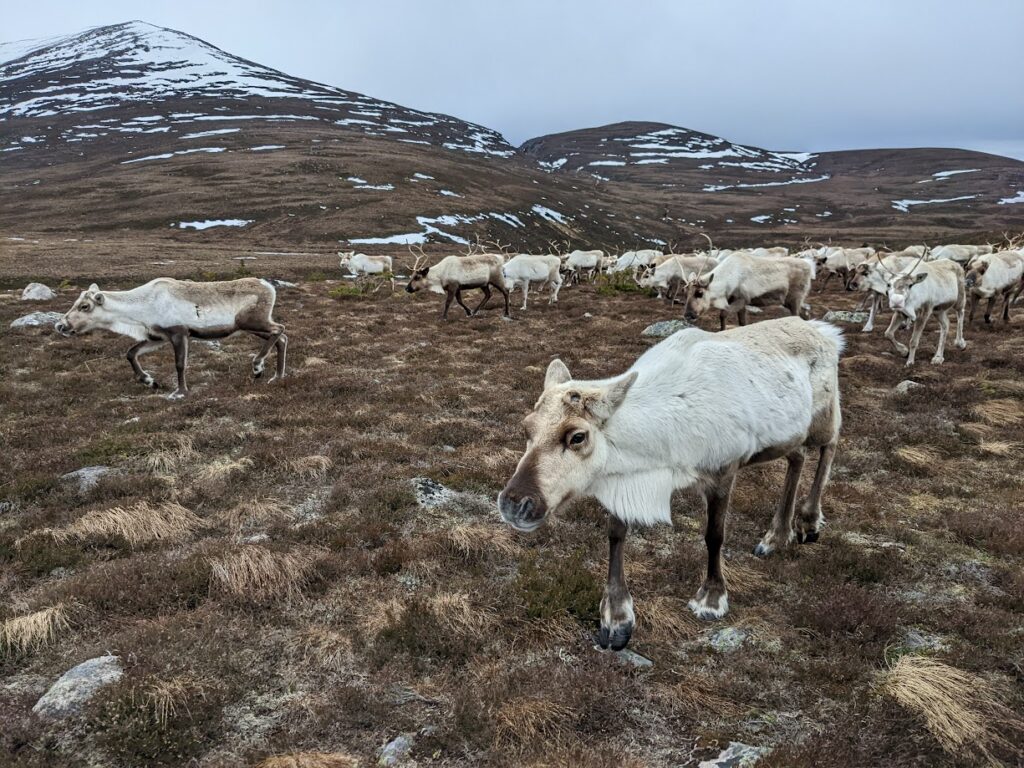

What I will miss is heading to the hills in the winter to go and collect the herd and seeing her face as the first face approaching you. We can spot her a mile off, even when she had no antlers and I would always give her sneaky handfuls of feed while her and I were at the front leading the group in.
Cheers Fly, you’ve been great! Find previous blogs about her here and here.

Fiona
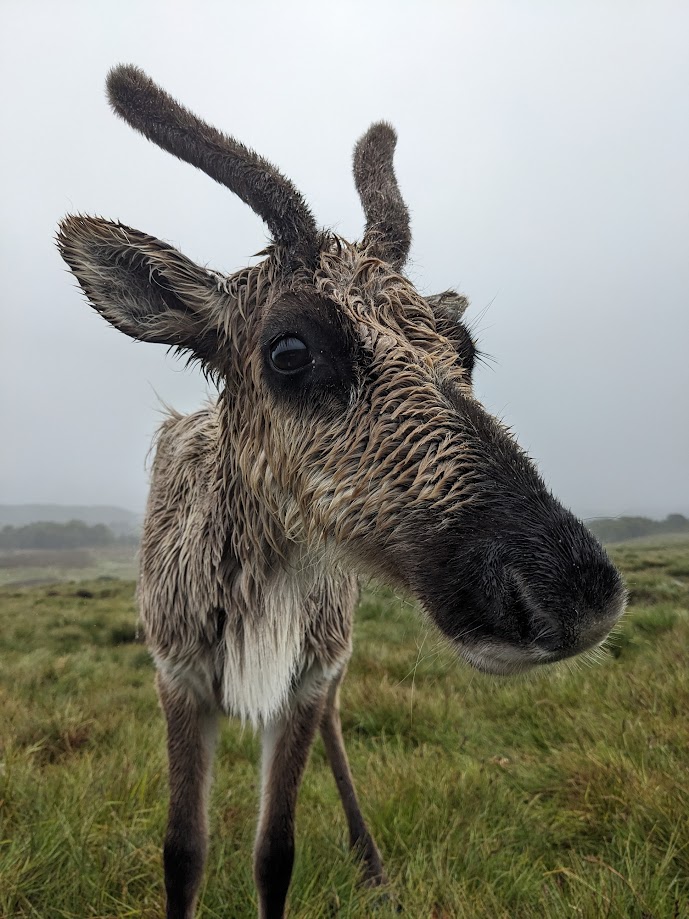
Scruffy reindeer month! Not their most photogenic season but a wonderful time of year nonetheless. The cows and calves left the enclosure to free range in the mountains and the males in our enclosure are looking super with lovely velvet antlers.




Ruth

My involvement with the reindeer goes back 30 years when Tilly and Alan were my neighbours and Alex and Fiona where still very wee.
I came up to the Highlands to work at Badaguish Outdoor Centre for people with additional needs before I was due to start a nursing degree . I never left – I fell in love with the mountains, and then a reindeer herder!! And now the reindeer.


My wonderful friendly golden retriever Rosie used to end up at Reindeer House after following any walker passing by my house down at Badaguish. Tilly would phone me and I would often end up there socialising, helping out, then for dinner and end up walking home with Rosie after a wee whisky or two!
I eventually went to university but not to study nursing. I did a Honors Fine Art degree in 2004.

Over the years I have kept in touch with Tilly and the reindeer, volunteering, an extras pair of hands or legs walking out onto the mountains to help herd in the girls for calving or just going up to spy the herd in the summer months on the mountain.
Several years ago, I got a call to work with the team and use my artistic talents for ‘Christmas Fun’ (weekends in December when Santa visits the Paddocks). By this time Fiona was all grown up and coordinating all things Christmas and the herd on Cairngorm along with her mum and the team. Now I am just a regular part-timer in the team.


So, when I am not a reindeer herder you might find me working in my studio at home as an artist, working on some colorful wild abstract paintings. These days I also work on some reindeer crafts, inspired from my trip to Jokkmokk, Sweden in 2020 with fellow reindeer herders Fiona, Joe, and Olly where we stayed with friend Sofia, Mikel Utsi’s great niece. Inspiration for art was everywhere. The snow, visiting herds of reindeer, northern lights, traditional cloths, and traditional food.
That part of Sweden is the capital of Sami culture in Sweden holding the Sami winter festival, which involve reindeer racing, reindeer parades, and all things Sami culture. And I had a wonderful time in the Sami Museum viewing the traditional arts on show. This was very much my inspiration for small reindeer art and crafts for the shop.


Sheena

Manouk popped into Reindeer House a wee while ago and had picked up this book from a charity shop in Aviemore. It is the Forestry Commission guidebook for ‘Glen More Forest Park’ and has no date on it but was published sometime in the 70s. It has a section about the Cairngorm Reindeer. I had a flick through it and thought others might enjoy the prints and information about the reindeer which was written by Dr Ethel Lindgren (who along with Mikel Utsi, reintroduced the reindeer herd in 1952).


Things have changed a lot in the last 50 years or so. You may read that back in the day some of the reindeer born in the Cairngorms were sold elsewhere and some of them even used for meat. You’ll all be pleased to hear that for a long time now, all of the reindeer born in our herd have been able to live out their natural lifespan (roughly 12-14 years) here in the Cairngorms. Nowadays, we keep our numbers at roughly 150 by controlling how many females we run with a bull during the rut and therefore how many calves we hope will be born each spring time. Below is the article, some photos of the reindeer, as well as some beautiful prints of the Cairngorms. Enjoy!


Lotti