As Ben and Fiona have explained in previous blogs (click here, and here to read), we had a busy December with events and parades up and down the country, as well as a busy Centre here in Glenmore with fully-booked Hill Trips and Christmas Fun paddock slots! Plus hundreds of adoption packs to make up and post out, alongside all the usual office antics.
For this week’s blog, I’ve collated a series of photographs found on my phone during this particularly busy month to give a brief snapshot of what went on in the life of a reindeer herder. Turns out I don’t take many photographs whilst I’m sat in front of a computer answering emails so the photos are quite biased to all the fun times I’ve had out and about. Thankfully this makes for a much more enjoyable blog… lots of pictures of reindeer!
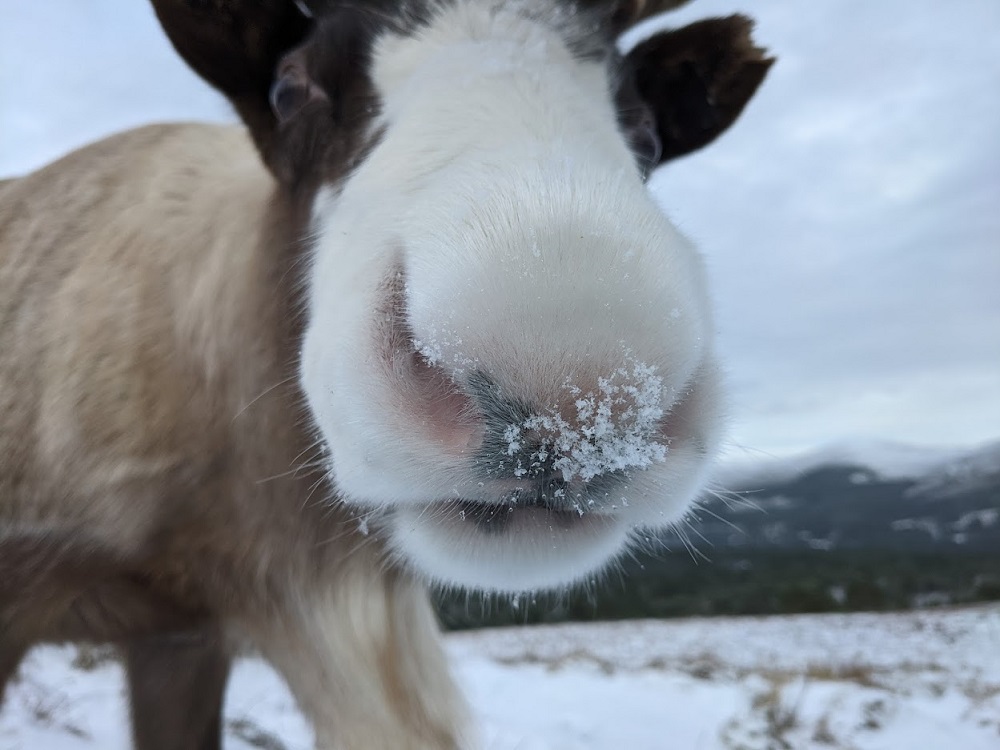
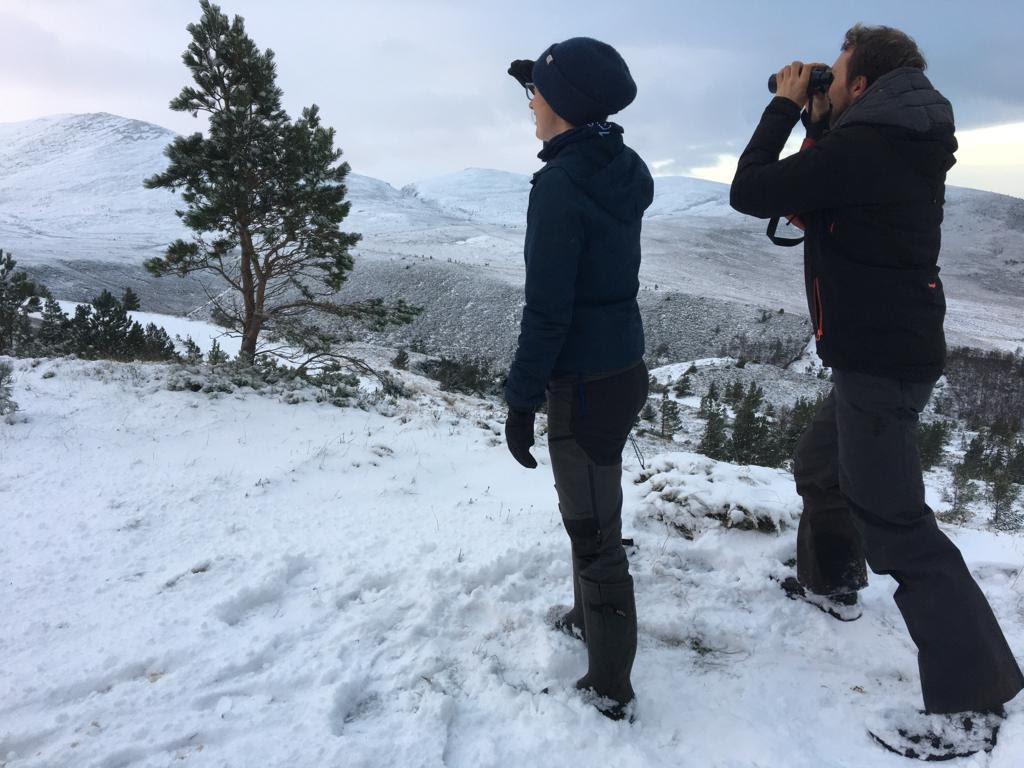
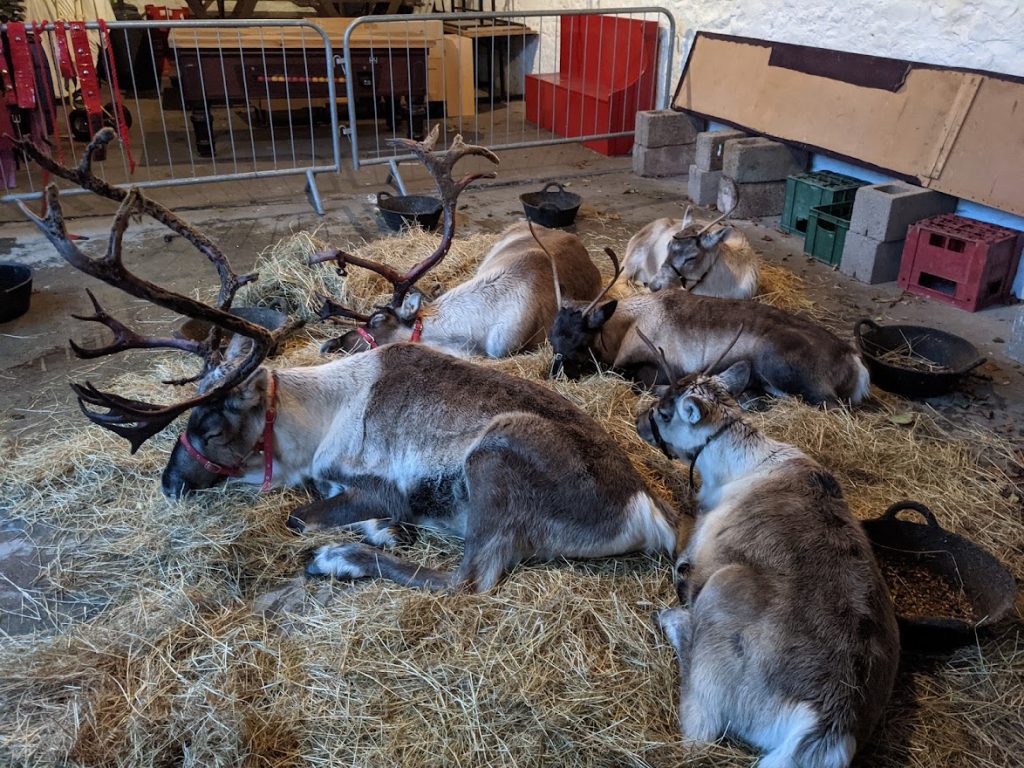
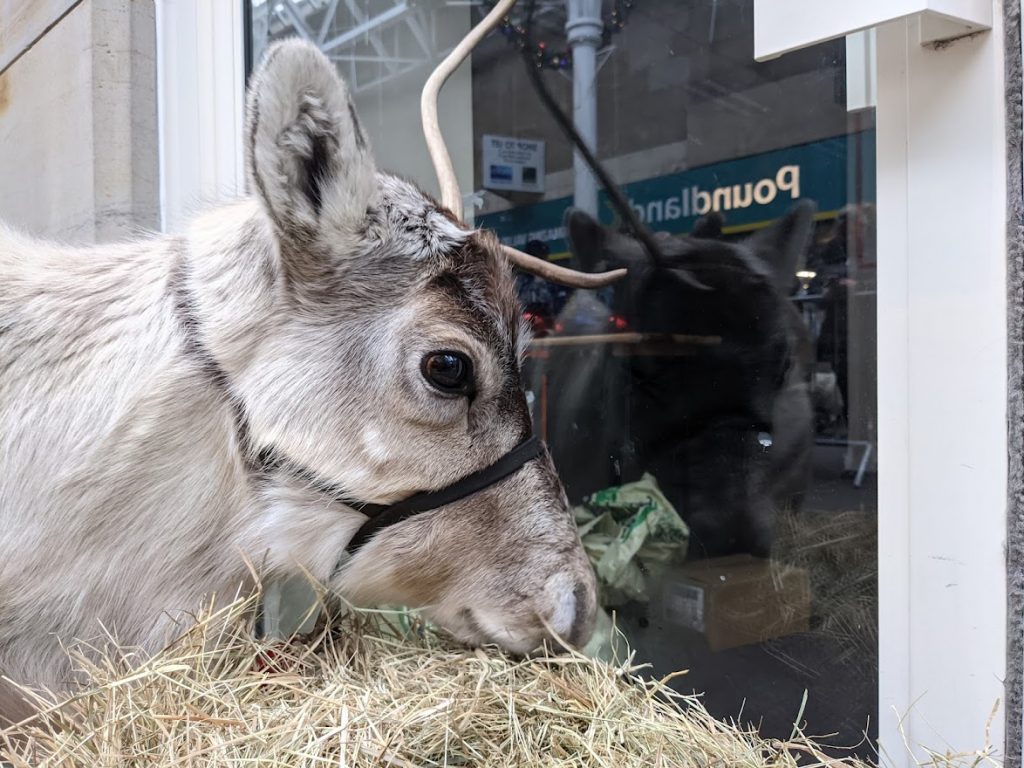
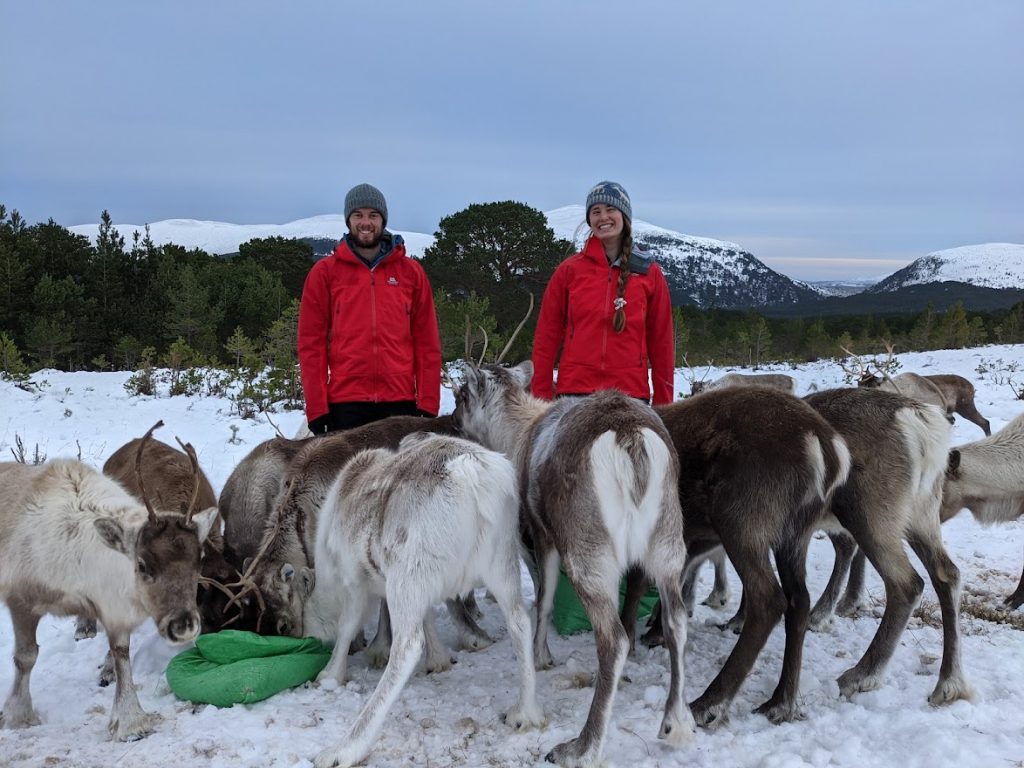
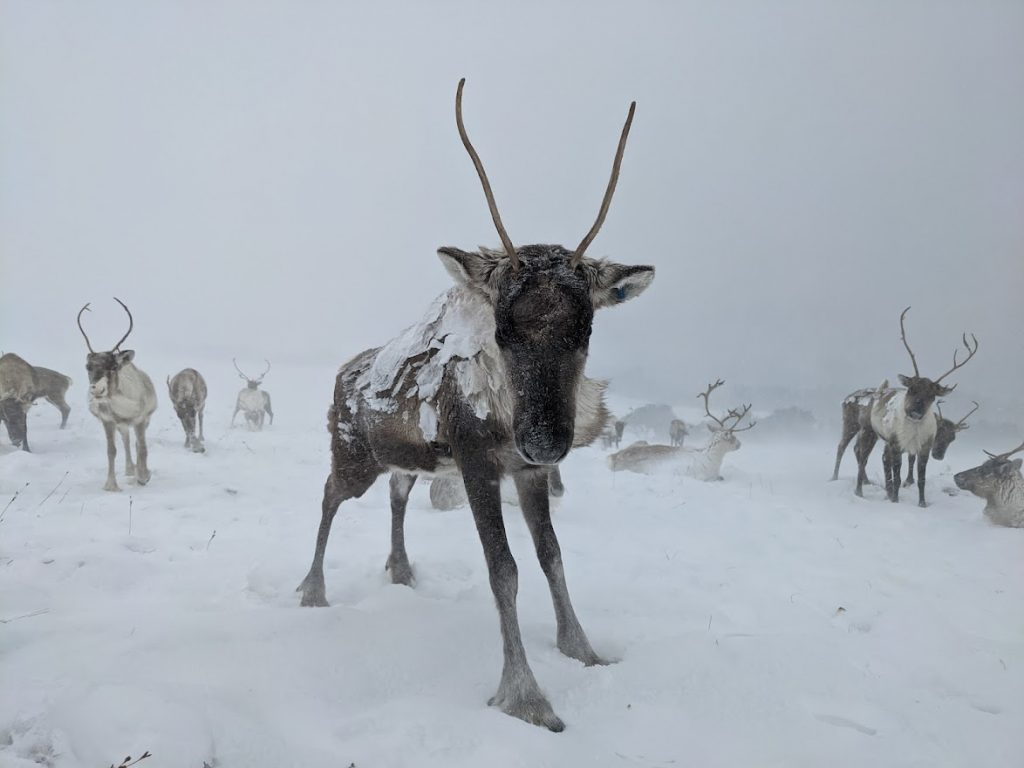
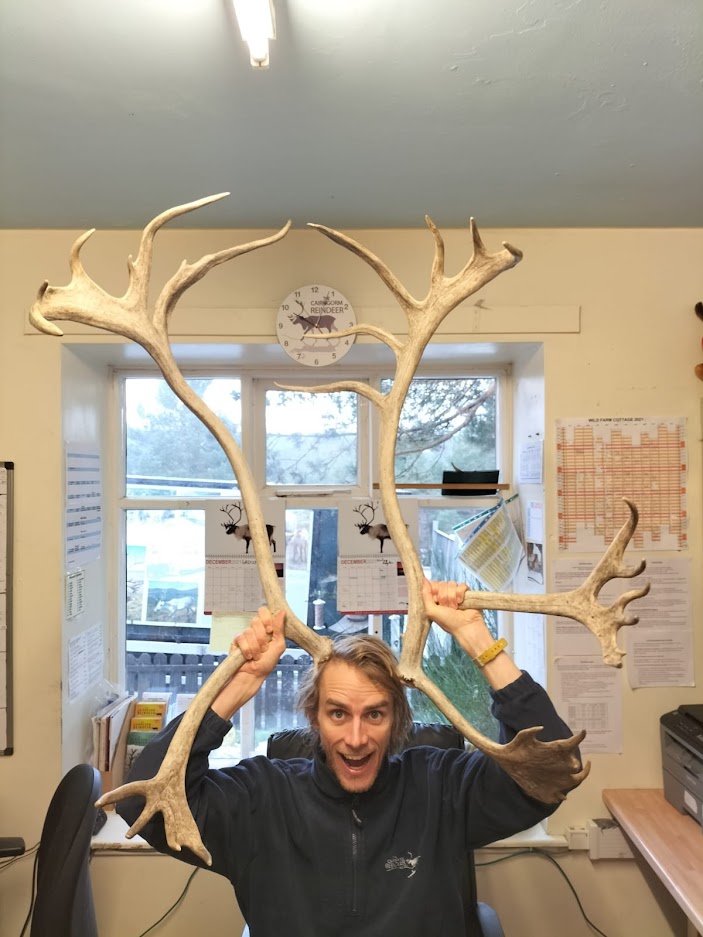
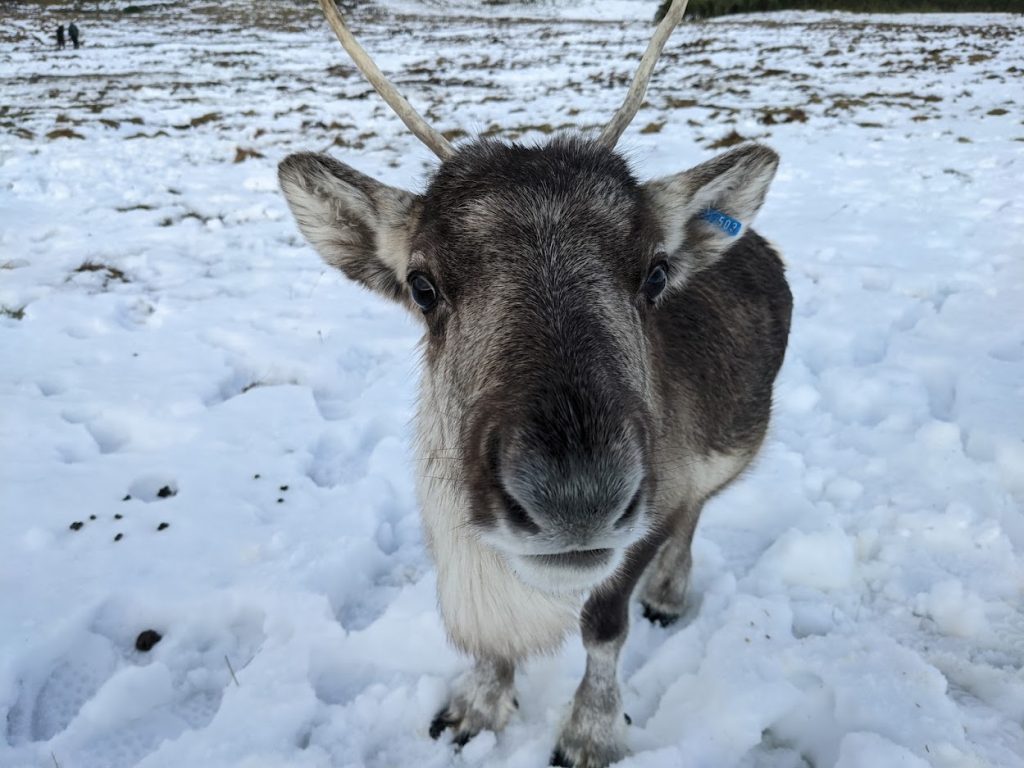
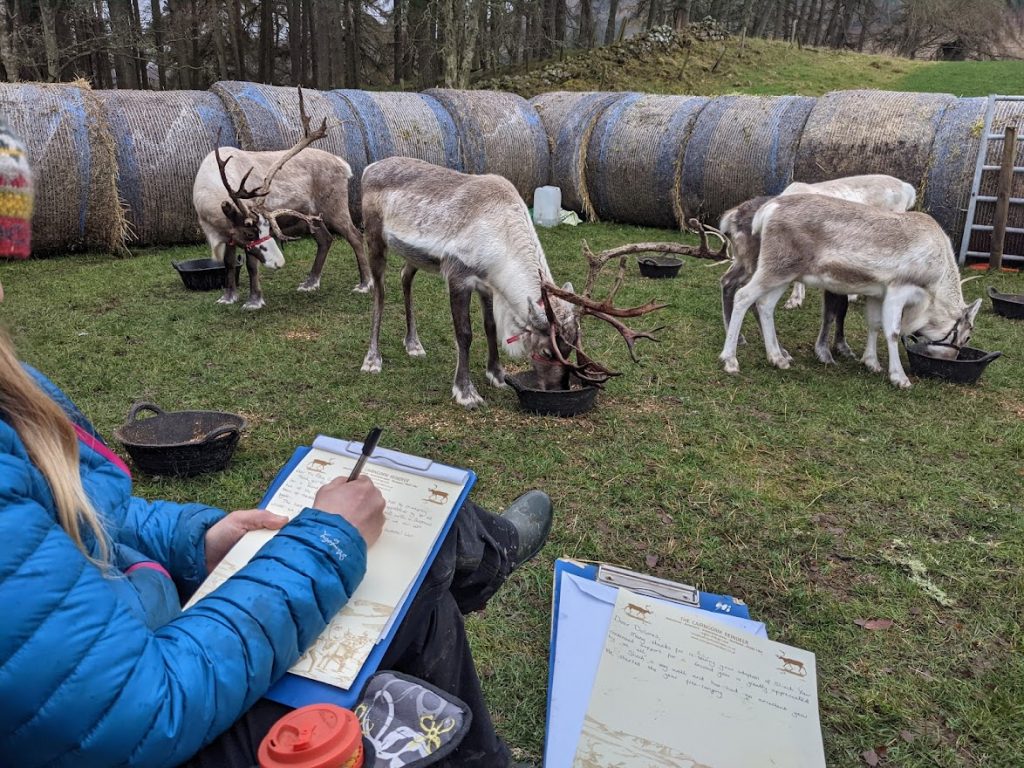
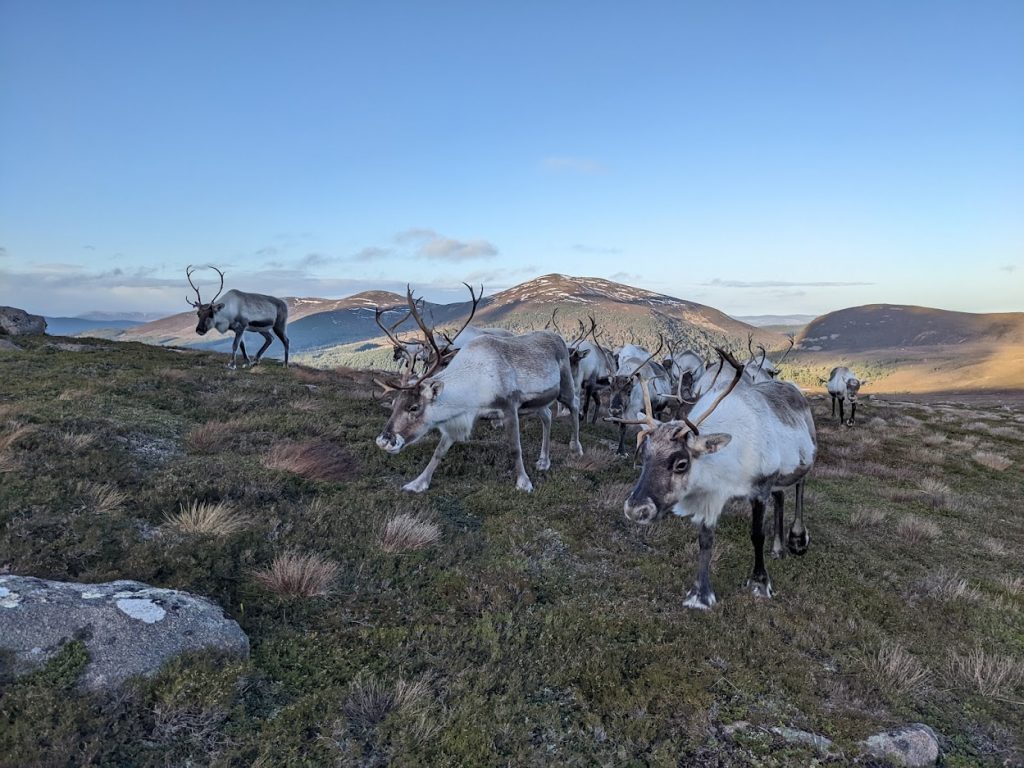
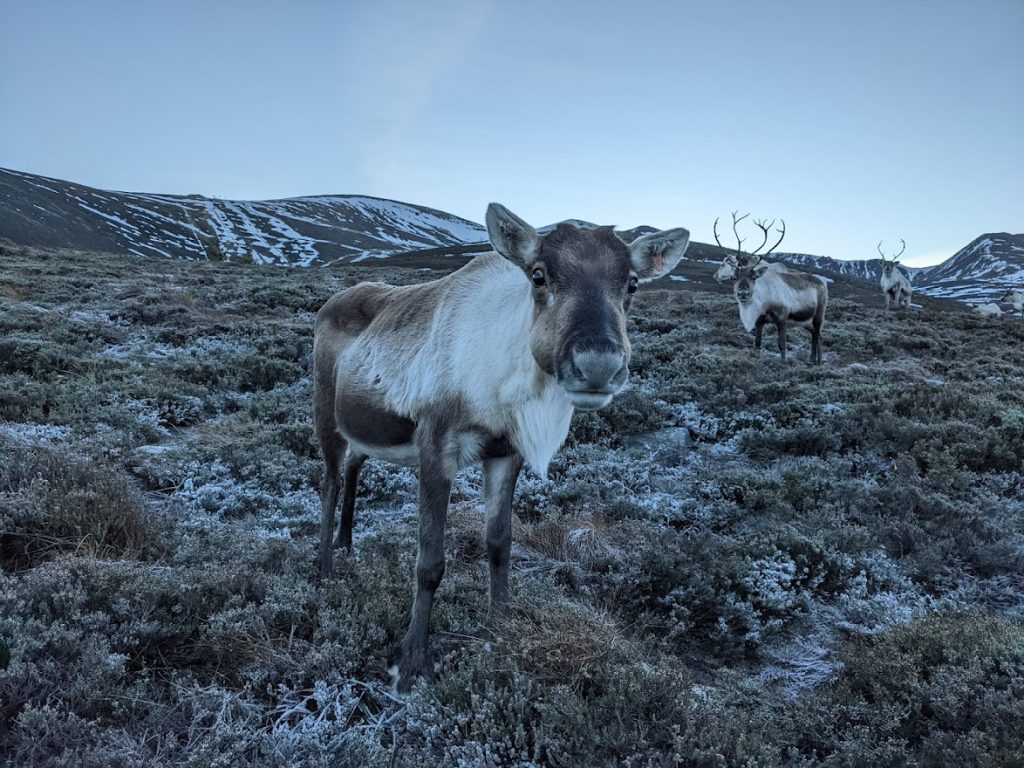
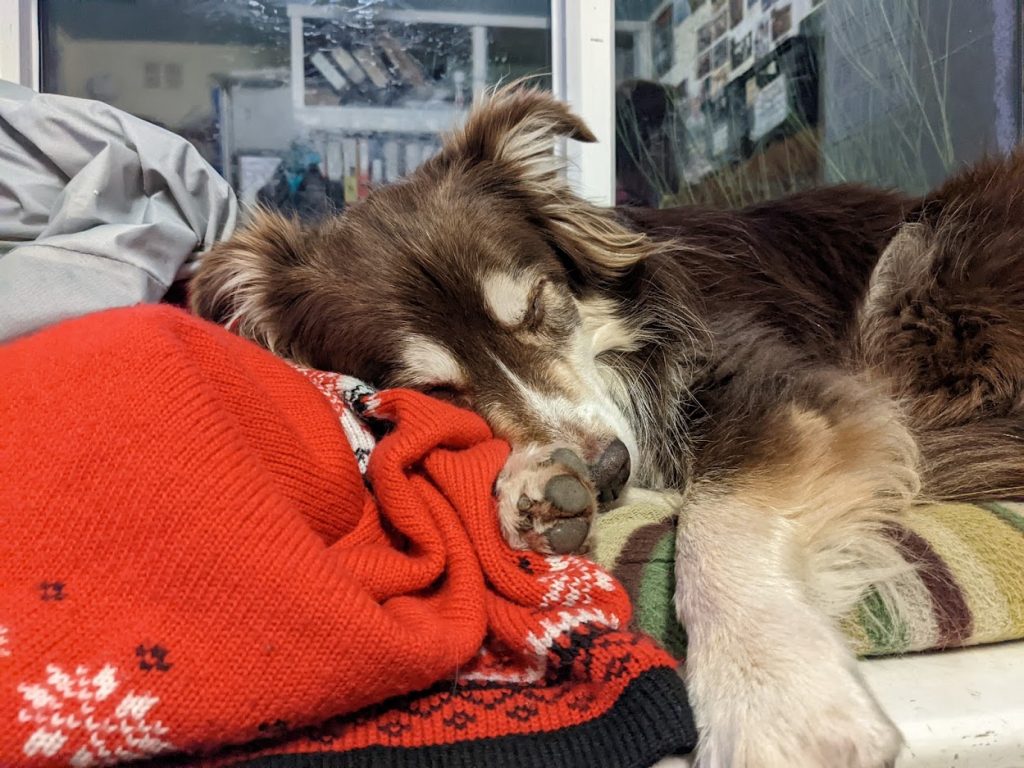
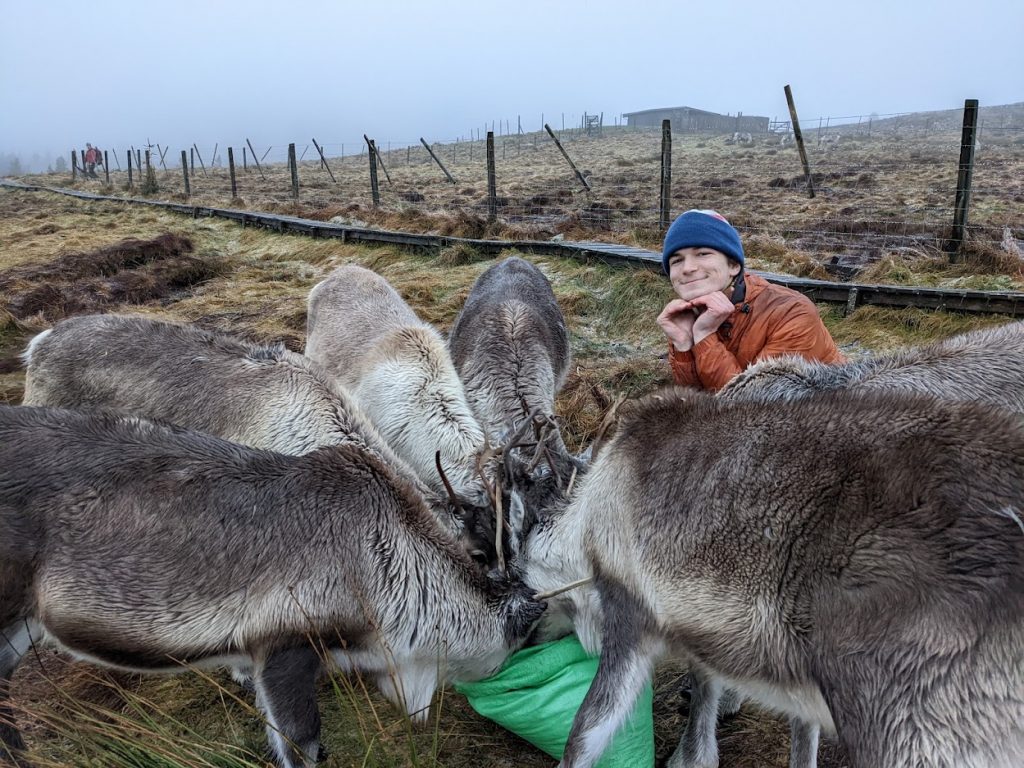
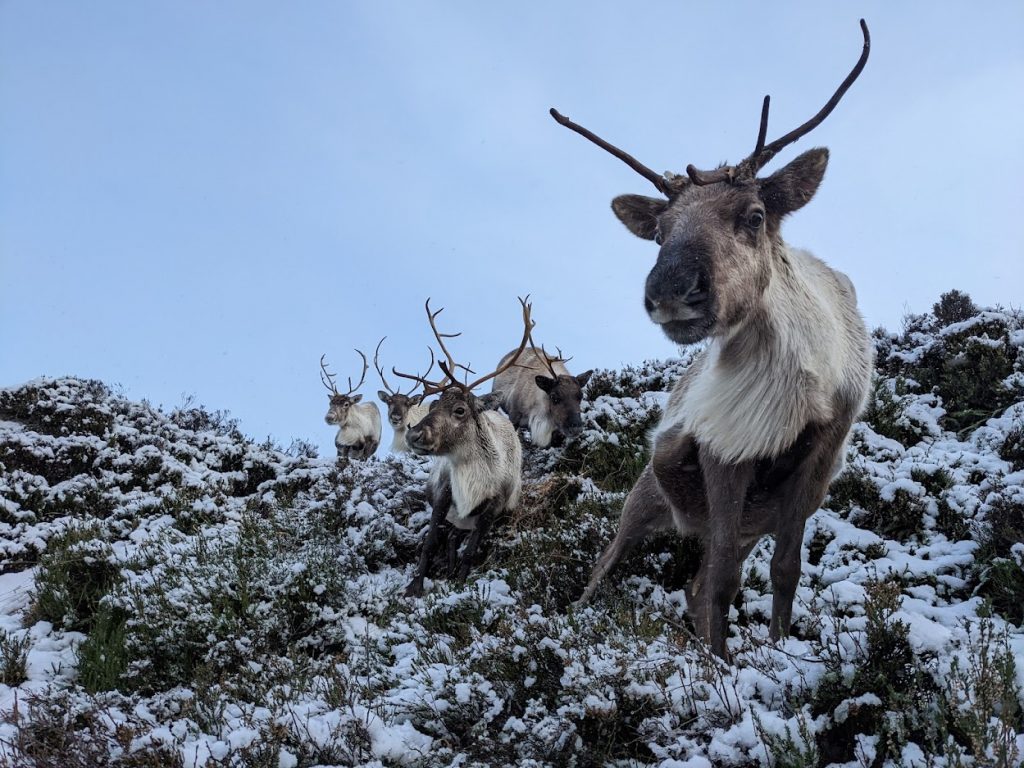
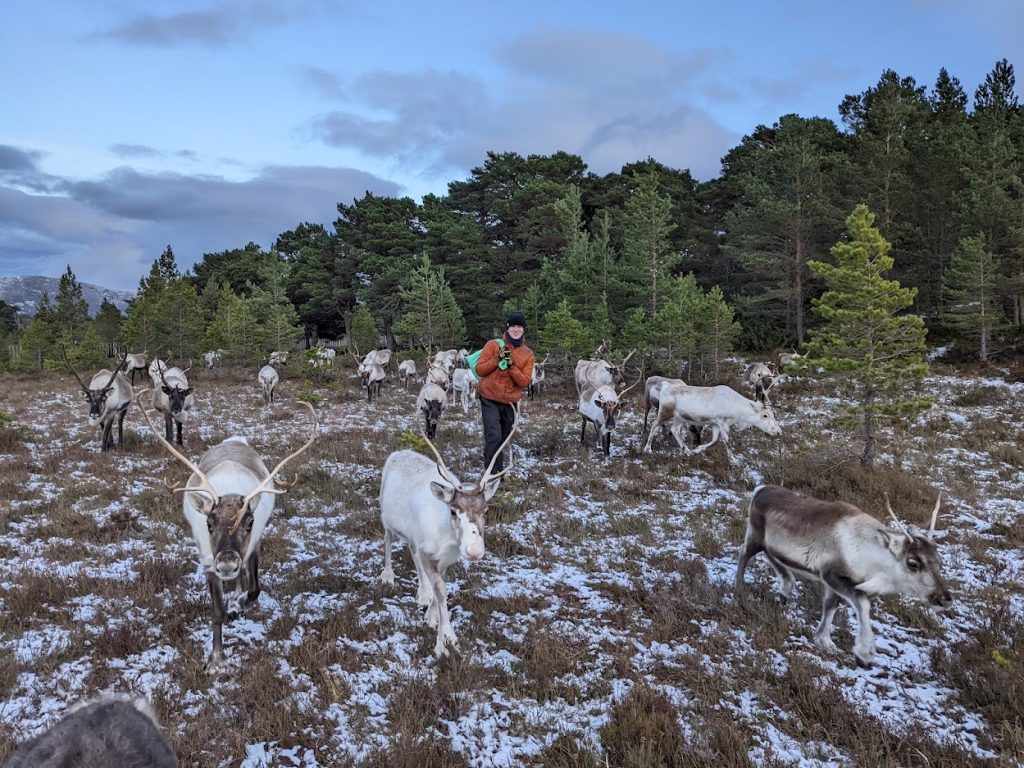
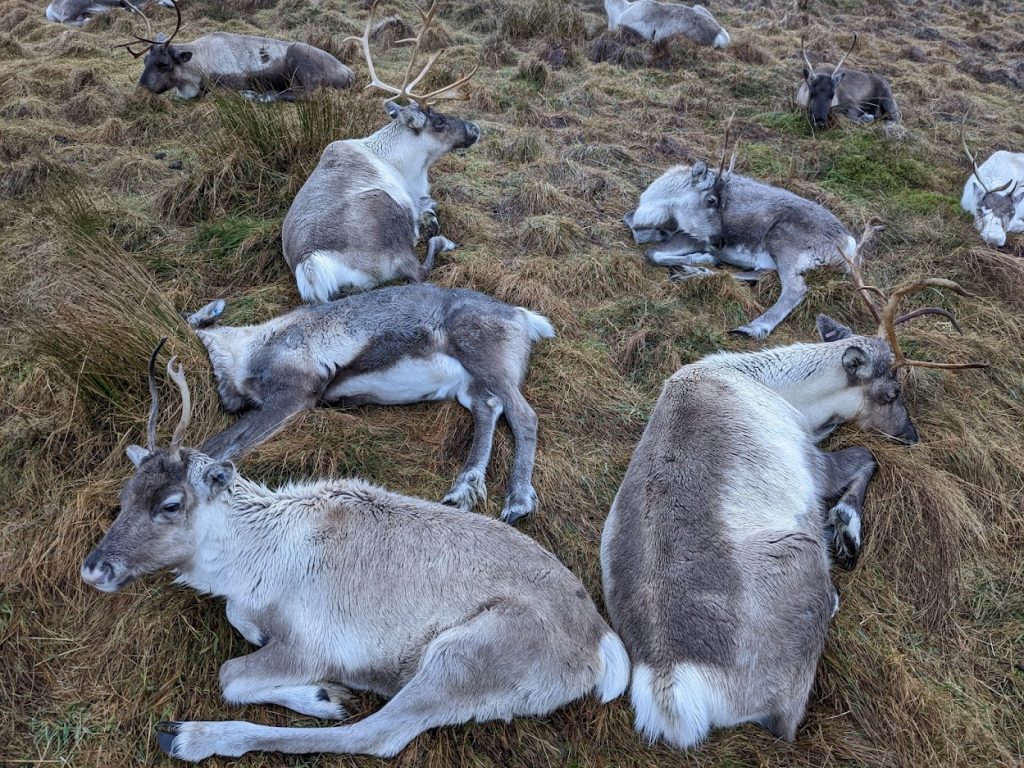
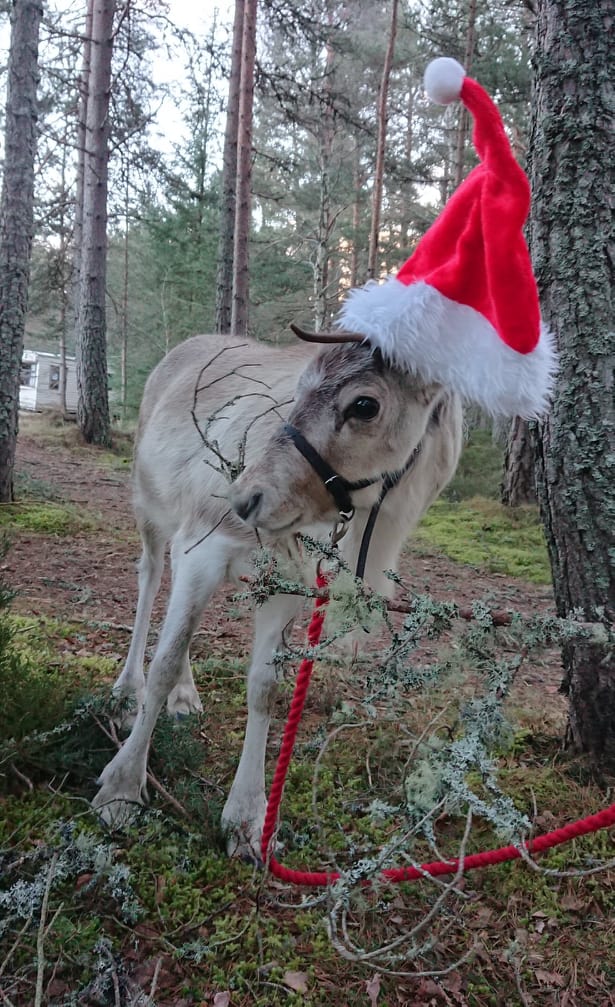
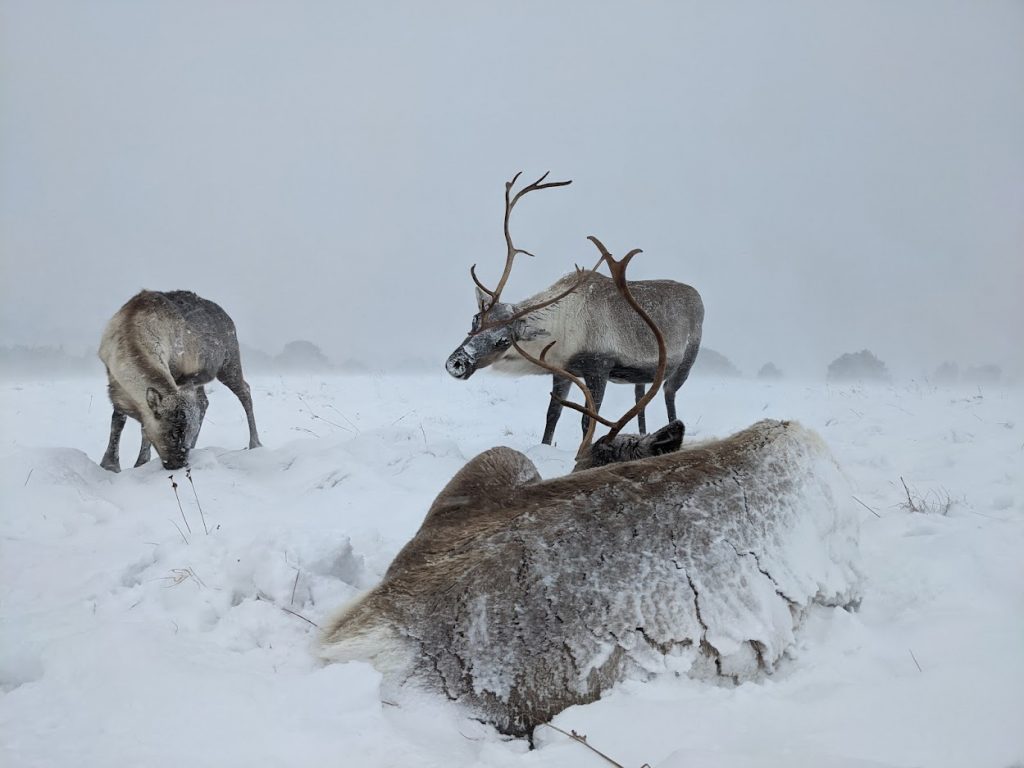
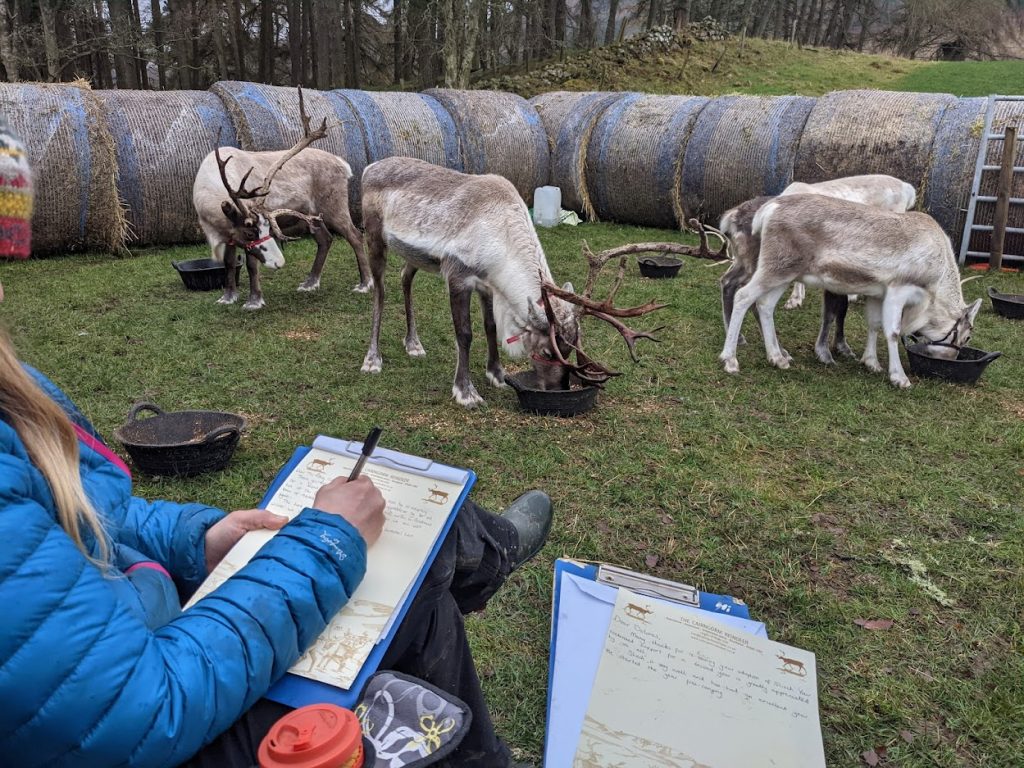
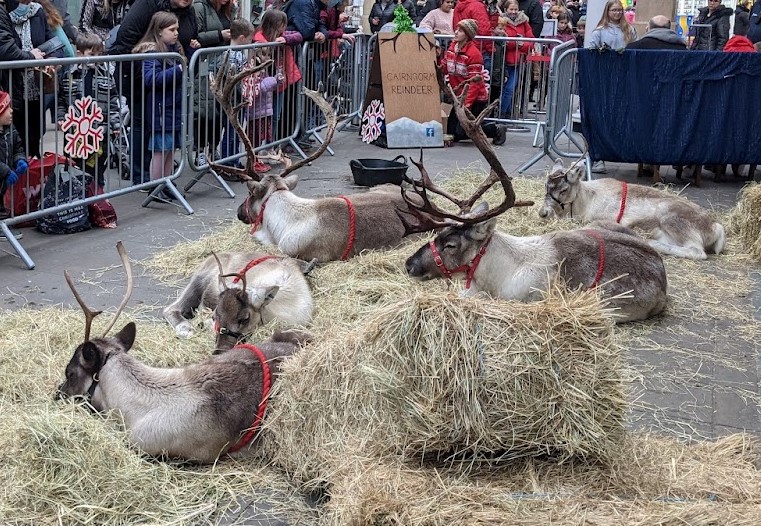
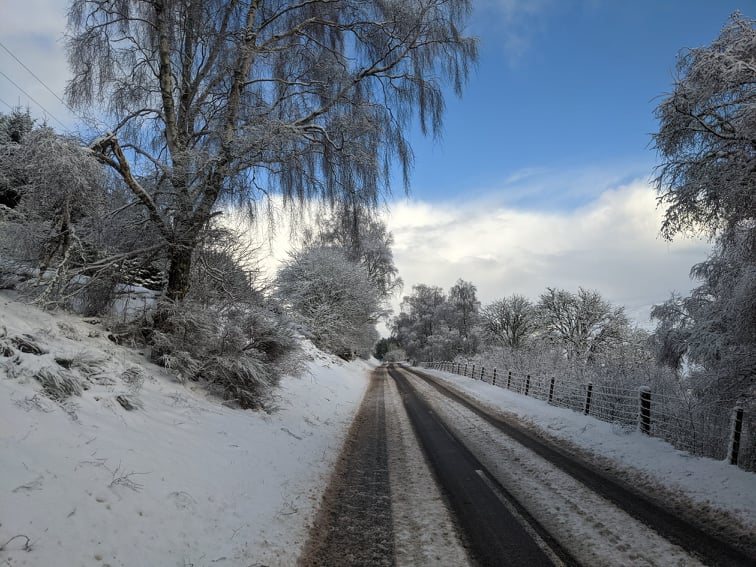
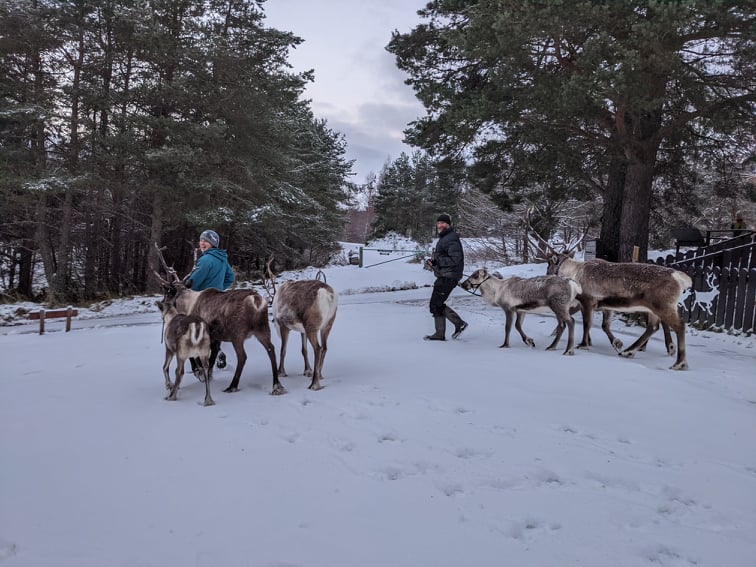
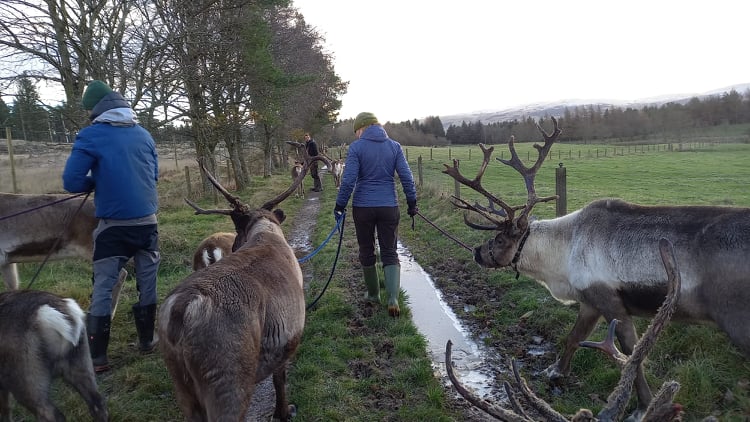
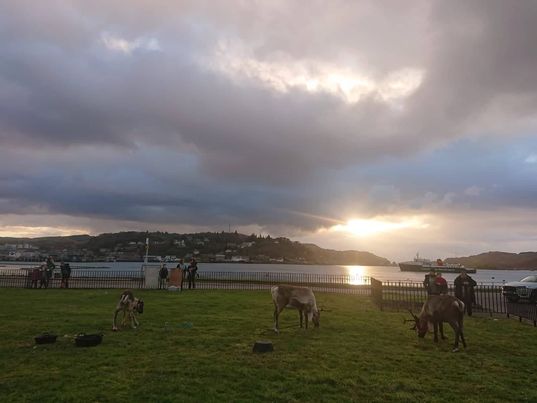
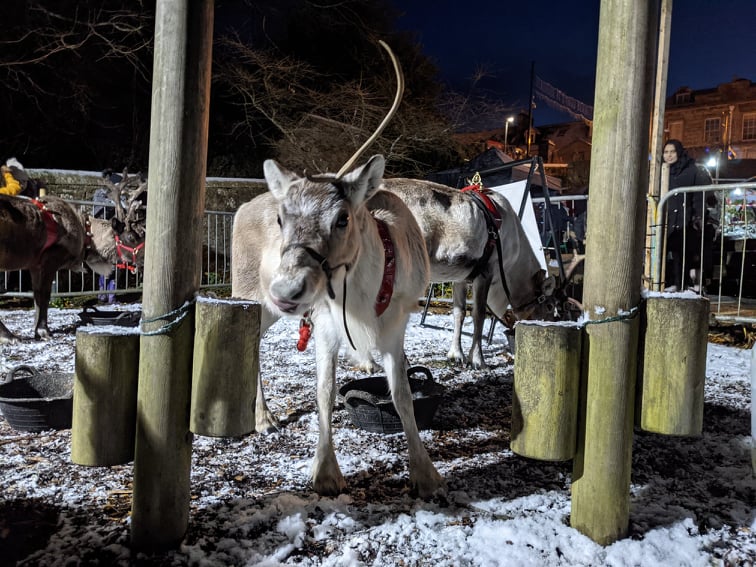
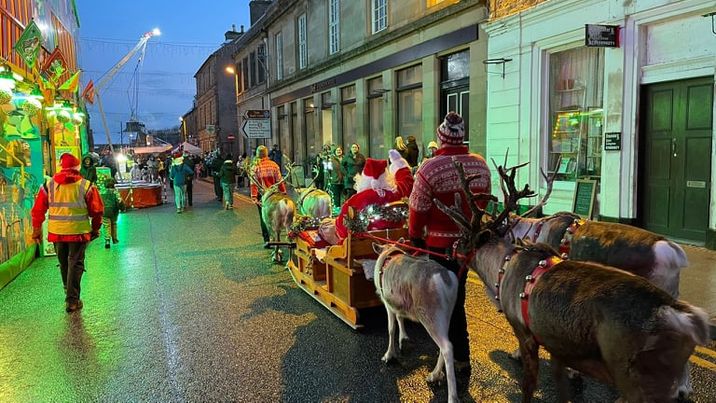
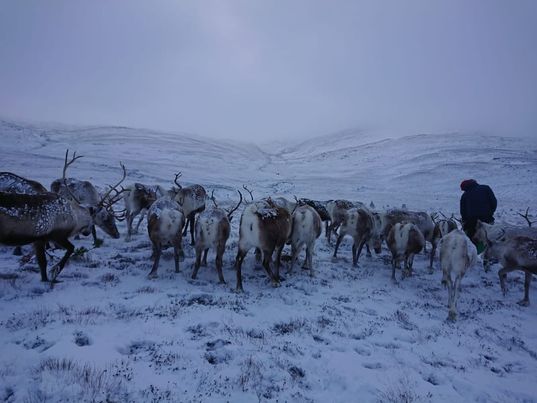
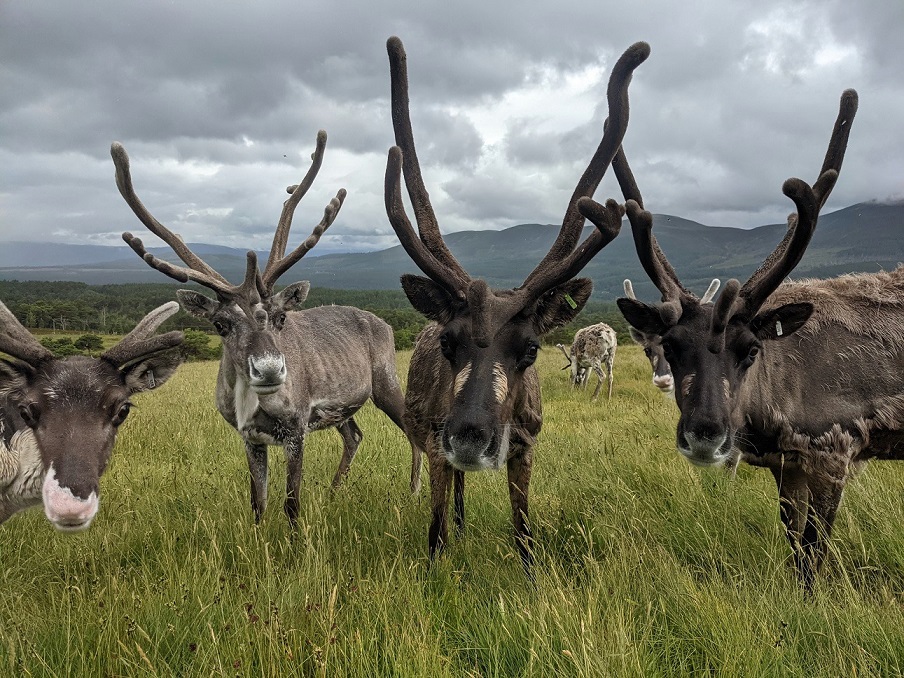
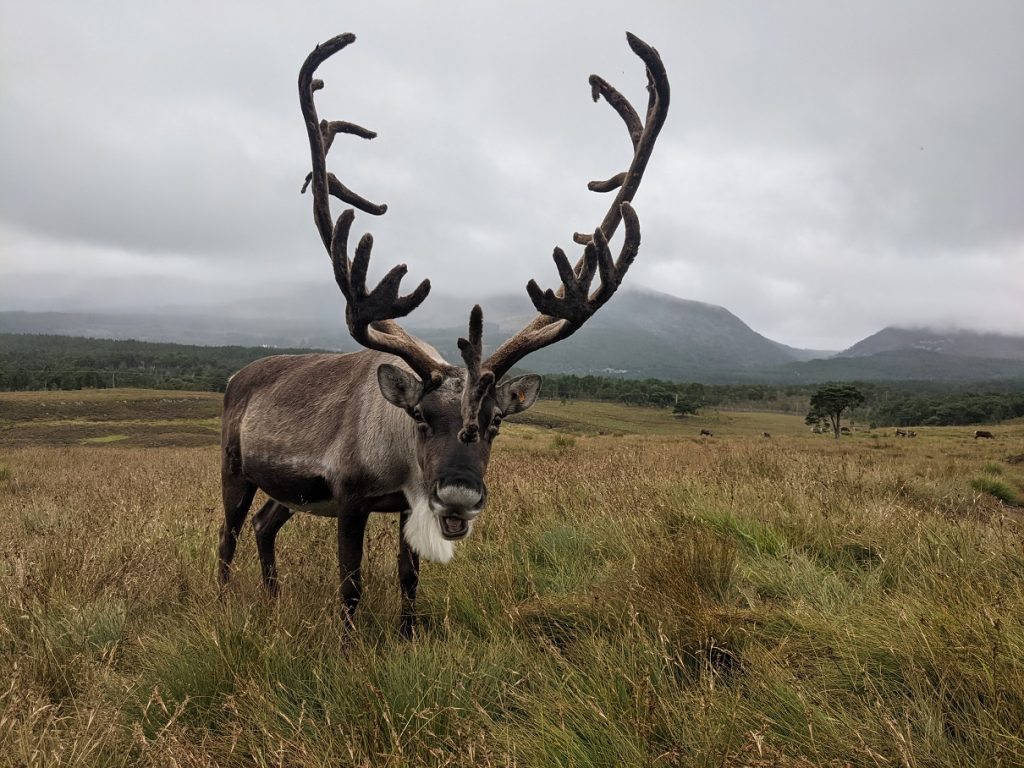
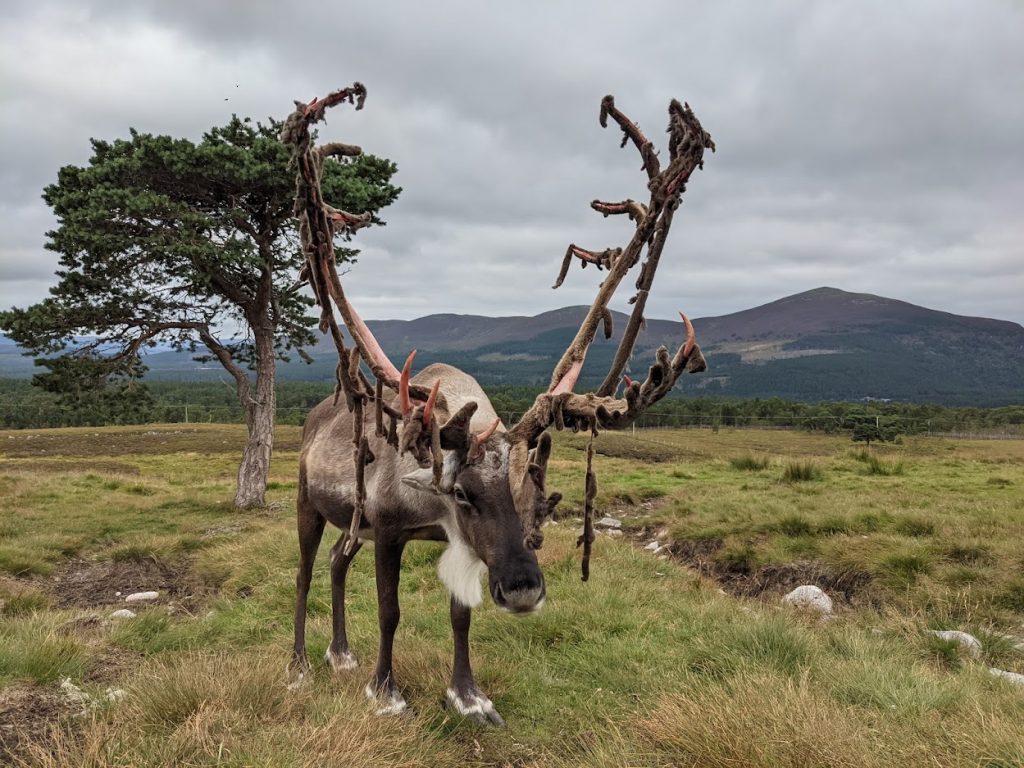
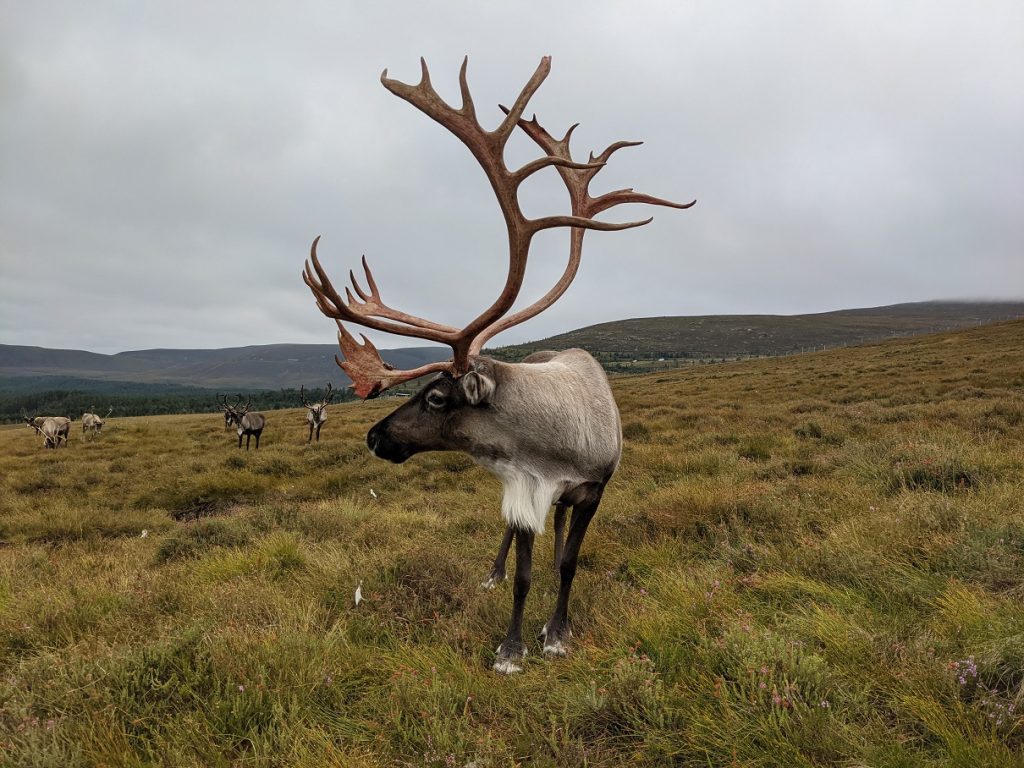
2nd of December – The unmistakable snozzle of Dr Seuss enjoying the fresh snow. The first half of the month was snowy and cold, great for the reindeer but unfortunately this meant we had to cancel some of our Hill Trips. Thankfully the majority were able to go ahead without complications. 3rd of December – Olly and I spying for the free-rangers in a winter wonderland. We watched the herd coming to our call from a couple of kilometers away! Note: stances might not be entirely natural. Photo by herder Sheena. 4th of December – Lotti and I went away for the weekend with this wonderful team of reindeer (Clouseau, Bond, Holy Moley, Trilby and Akubra) seen here having a snooze at the Langholm event.5th of December – After a night at our Lockerbie base, we headed to Lancaster. Here’s Holy Moley trying to beat-up her own reflection whilst in the pen, much to the amusement of the crowd. 7th of December – the first day of our shiny new Mountain Equipment jackets here modeled by Joe and Lotti, whilst giving the calves some extra feed. It’s a tough job but somebody has to do it! 7th of December – Witch having a big stretch after a snooze during Storm Barra! The ice cracked on her side as she stood up and moved – very cool!8th of December – After one weekend looking dramatic in our paddocks for “Christmas Fun” Sherlock decided he’d had enough and cast his antlers! Here’s Ben modeling the impressive head gear. Soon after, Sherlock and the other young bulls were out free-ranging on the mountains.9th of December – Cowboy, now 7 months old, already knows that tasty snacks are kept in white bags! What a cutie.12th of December – Fiona and I had an event at a farm near Inverness. Good opportunity to write some adoption letters whilst waiting for people to visit the reindeer!13th of December – Finding some peace and quiet away from the office by feeding the beautiful free-ranging herd! Note the lack of snow, there was a thaw halfway through the month but still chilly with frosts most mornings which means happy reindeer!19th of December – Feeding the free-ranging herd again, lovely Sambar leading the herd in whilst busily chewing the cud.20th of December – Tiree the dog having a snooze in the office, it’s all a bit much for her!23rd of December – Herder Harry re-joined us again for December. Here he is being all cute surrounded by our cute but greedy calves.24th of December – Another trip up the mountain to feed the free-rangers. Here’s Puzzle looking great!26th of December – It was very windy and wild Boxing Day so we dropped down in to the woods to find some shelter on our Hill Trips.31st of December – Some very snoozy reindeer after the last Hill Trip of 2021! What superstars they are.
After a few weeks of being closed at the start of each year, when we re-open in early February we run our Hill Trips daily (weather permitting), but usually until late April these are to our free-range herd rather than to the enclosure that we use from May – December. In the winter season we now have an age restriction on the Trips with our minimum age being 4 years old. We also recommend against younger children (aged 4 – 11) coming at this time of the year, instead recommending a visit from May onwards.
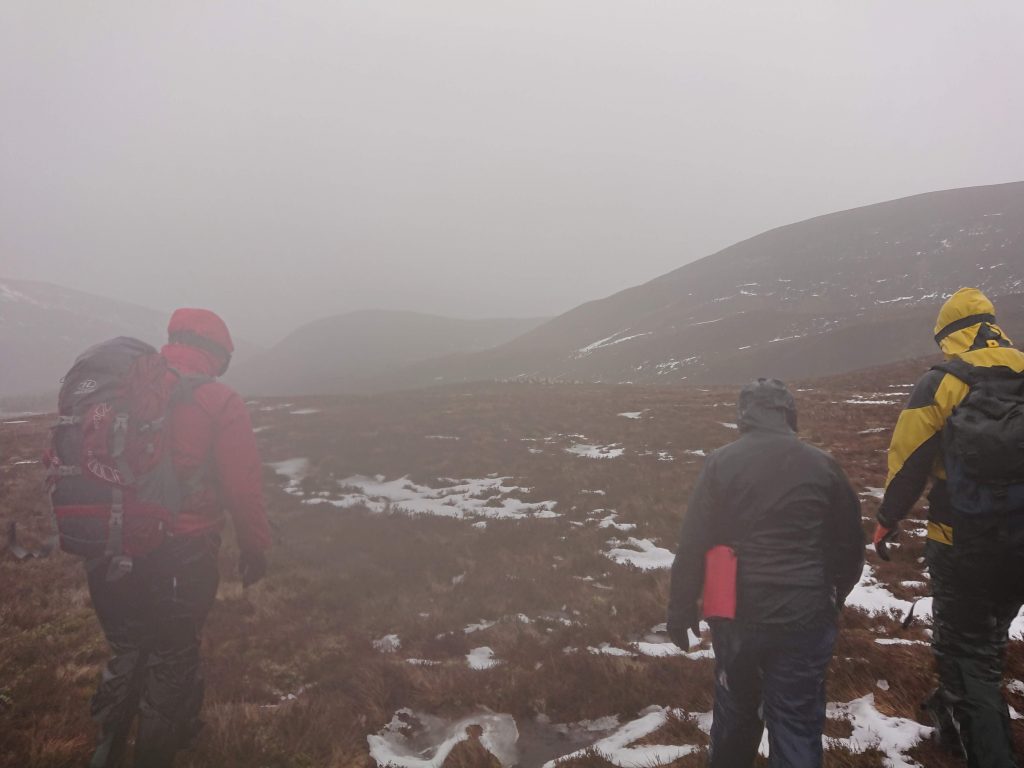
Dreich weather – wind and sleety snow – can make walking out hard work even when we’re well equipped and used to the conditions. Soggy herders!
Why? I know a lot of people will have visited from February to April in the past with a toddler, and had a wonderful time. However, the Cairngorm winter can be extreme, and as we just don’t know until the day if it will be a pleasant bluebird day, or gale force winds with a wind chill of -20, we need to be sensible about when and if it is safe for little children to participate.
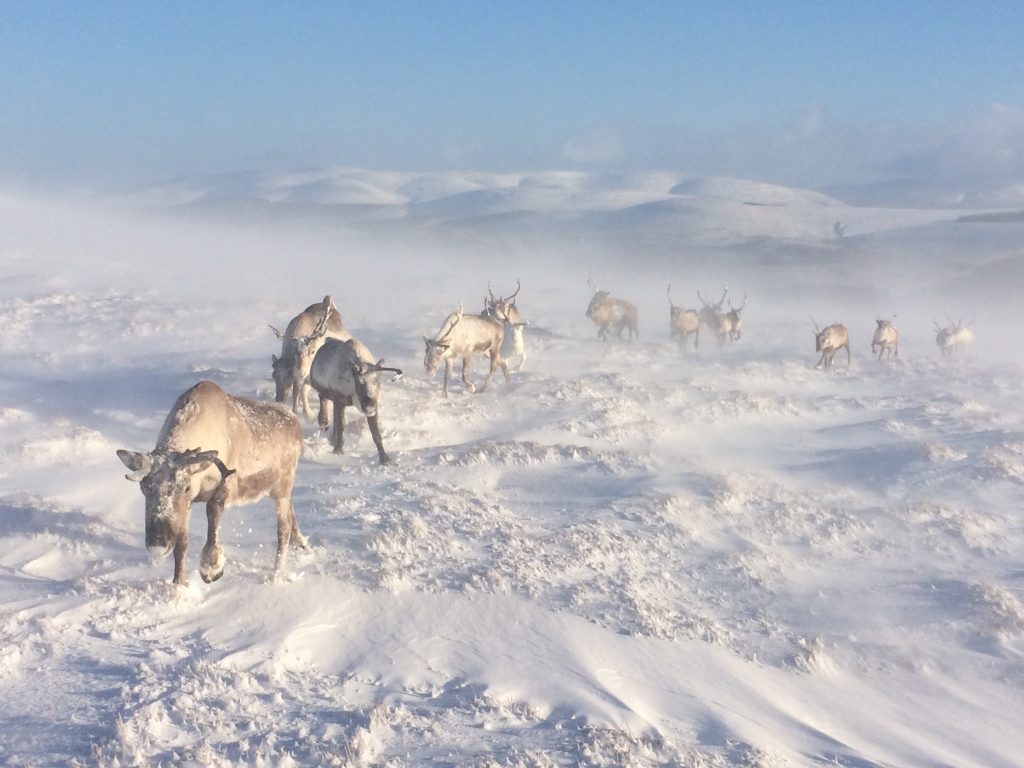
Reindeer and herders battling the elements (c) Joe Mann
Small children tend to struggle with the weather more than adults, just because they’re wee – this isn’t a criticism of their toughness, just an observation from the years we’ve been running Trips. Indeed, for a number of previous Hill Trips in the winter seasons we have had to restrict them to “adults only” due to the weather or distance – safety has to be our first priority. We have to be realistic that when folks are booking ahead, it is unfair to everyone to then have to cancel their Trip on the day.
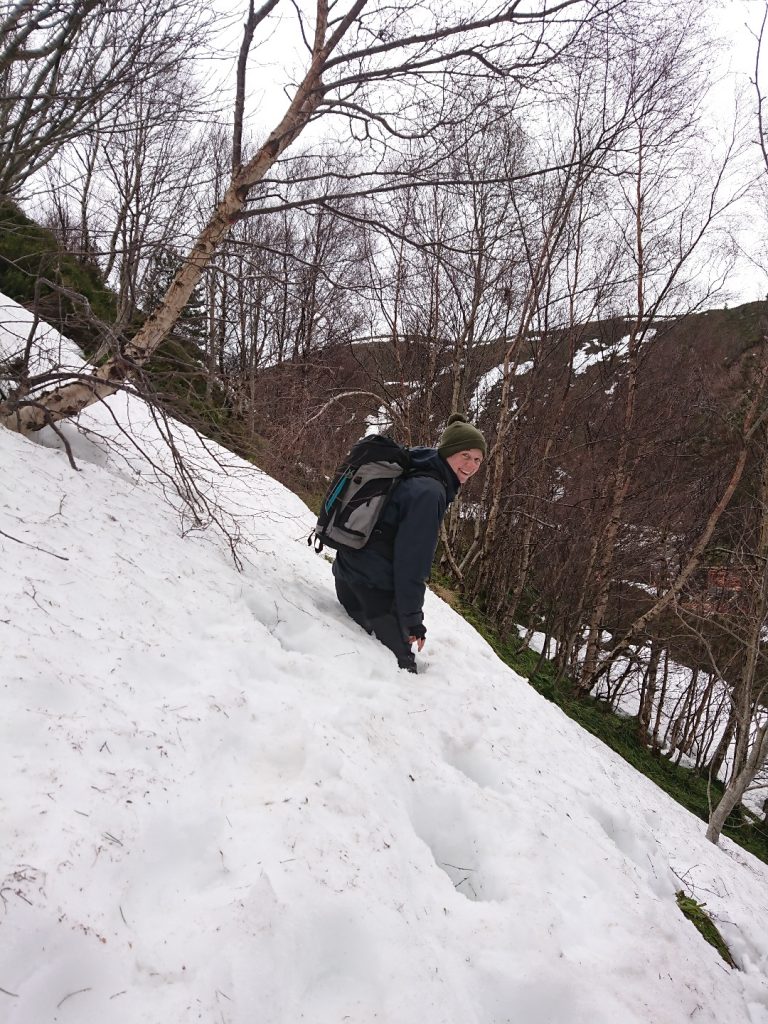
Even when the weather is calm, the walk to the herd frequently involves crossing unavoidable snow patches, which can be waist deep in places
Along with the weather, there is also the difficulty and length of the walk. In the free-range season this can be four or even five times the distance of the walk to the enclosure, meaning that we are out on the hill for much longer. Younger kids often find these longer distances tougher (again no criticism of their ability, just an observation of their smaller legs and reserves) and struggle to keep up with the group, which then leads to the rest of the people getting cold as we stand waiting. Little kids in backpacks can struggle even more, as they are stationary and not generating any muscle warmth. There is also the added risk of the parent slipping with them, resulting in injury.
Conditions like this are far from unusual, and are just not a place for wee kids to be (c) Andi Probert
In addition, the area has been so much busier in the last few years, and as a result we are needing to take our free-range Trips further and further to find a quiet spot where the reindeer are less likely to be disturbed by passing dogs. It is also trickier now that we take advance bookings as it means almost all tickets are sold before the day itself – in the past we used to only sell tickets on the day once we opened at 10am, at which point we already knew what the weather was like up on the mountains. That meant we could literally look people up and down as they entered the shop and judge ourselves whether they were adequately dressed for the current conditions – before selling them tickets. Hill Trips are just so oversubscribed now that advance bookings are our only option these days.
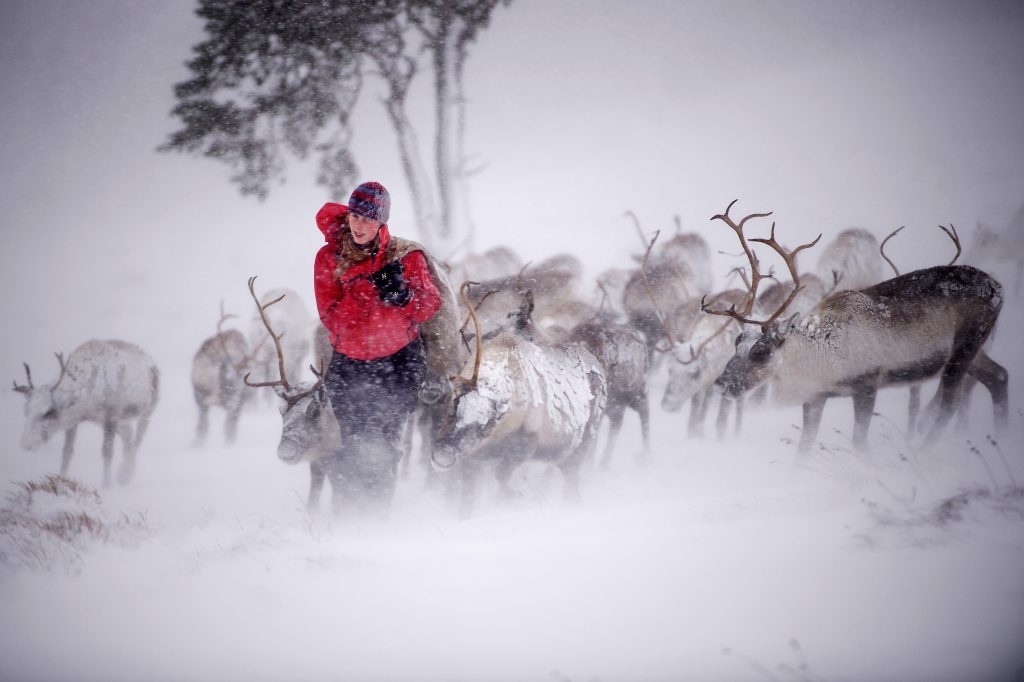
It looks beautiful but… Eve battles to feed the herd in winter – hypothermia and exposure are a real risk, even for well-equipped adults (Photo by Jeff J Mitchell/Getty Images)
We know our decision to not allow tiny children in to take part in the Hill Trips is a disappointment to some, so as an alternative (at some times at least) we run ‘Winter Herder Talks’ here at the Centre in the Paddocks on afternoons. During these you will have the opportunity to meet some of our beautiful reindeer and learn all about them from one of our herders. The Paddocks is usually a self-guided experience (remaining so in the morning), but with a herder available in the afternoons to share their knowledge of the reindeer as a species and as individuals, it gives a much more in-depth experience – providing a good alternative for families with small children. We are still delighted to take all miniature children on the Hill Trips from May to December, when the walk (and generally the weather) is more predictable and manageable.
Well, that is Christmas here at the Cairngorm Reindeer Centre done for another year and I have to say it has been A LOT busier than 2020 when COVID restrictions didn’t allow us to go about our usual business. Although it wasn’t as busy as the years before COVID-19 I think this year has been an eye opener for us and how we go forward in the future. The income we receive over the November/December period through Christmas events is something we once completely relied on to help support the reindeer herd and running costs for the rest of the year but nowadays we are busier than ever and as a result the income through the Centre now provides a bigger ratio than it once did, so I think a quieter Christmas tour in years to come could actually be better in the long run, concentrating more on what we have here at home. I’m not saying we won’t carry on with our Christmas tour completely, but I will look into downsizing, which it has naturally done this year anyway and it’s been very manageable.
We went through all the normal training with the reindeer through the October period. The 5-6 month old calves being trained to wear and walk on a head collar and the new young male Christmas reindeer being trained to wear harness and pull the sleigh. They all did great and I think gold stars in particular go to Christie’s calf Akubra, who I can only describe as a born Christmas reindeer and Frost, our 3 year old who pulled the sleigh like he’d done it his whole life, taking part in some huge events and taking it all in his stride. They make you so proud when out and about on tour its hard not to shout their praises from the roof tops!
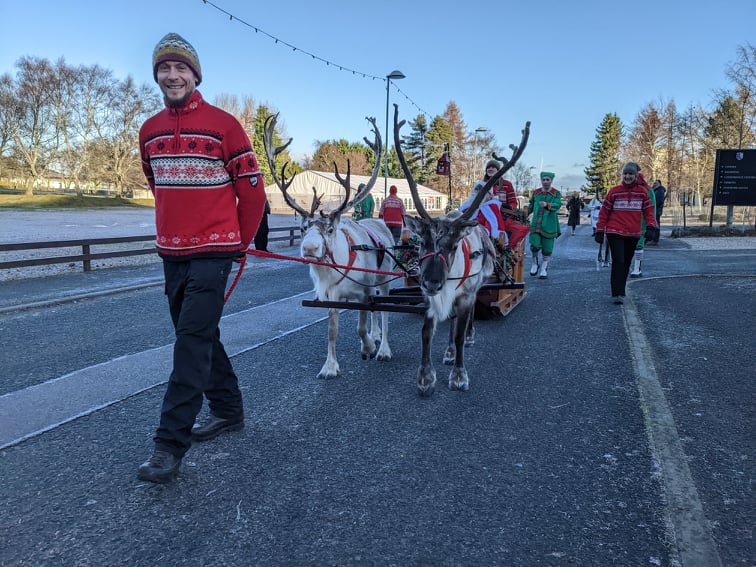
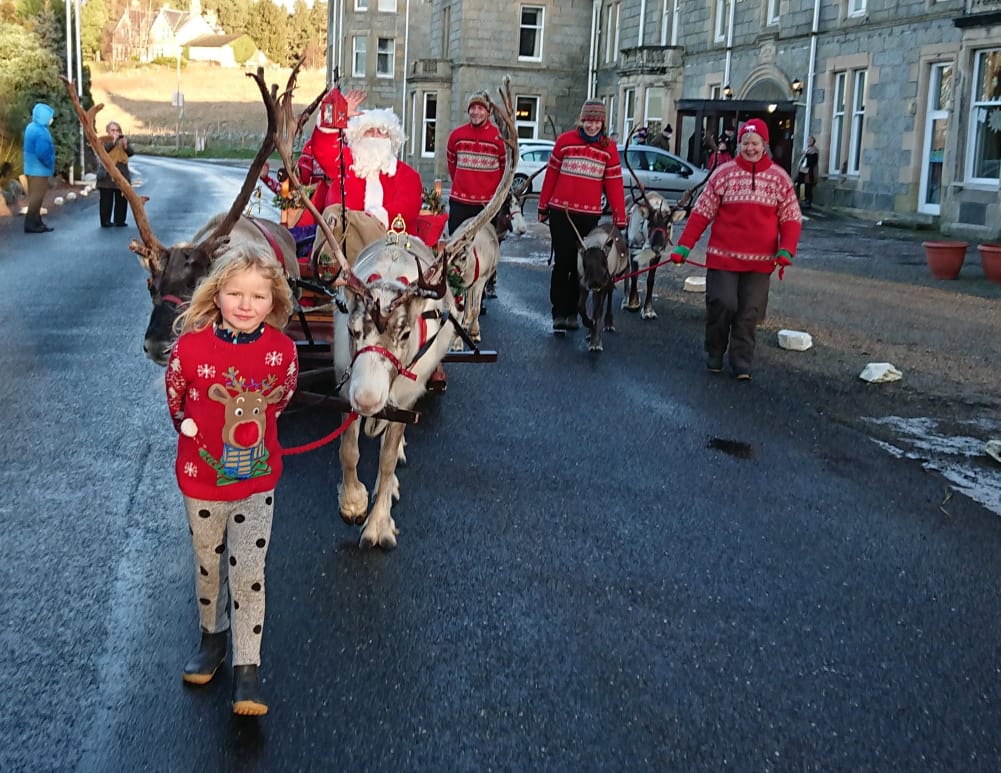
A training session in Glenmore back in the autumn, coincidentally the 4 adult reindeer featured are our Christmas Eve and Christmas Day team! 3 year old Frost and 6 year old Scolty pulling the sleigh in Aviemore on Christmas Day.
I also have to sing the praises of all our wonderful reindeer herders including core employees, seasonal reindeer herders and volunteers. Without this ridiculously capable team of folk we would not be where we are today. It takes input from every single one of us to make it work so thank you to everyone! I have to mention one person in particular who I know won’t want me to make a fuss, but I am going to anyway, because she has been a total super star. Carol thank you so much for just being you. Your kind and caring nature not to mention a special way you have when talking to the public about reindeer is wonderful to watch and you are an asset to our already great team. I know the reindeer also bring a huge amount of joy to Carol as well so I think it works both ways.
Carol and 7 month old Akubra – the most chilled-out of all our calves this year!
We finished off Christmas with 6 events on Christmas Eve and Christmas Day. The team of reindeer were quite a young bunch with the oldest being 6 years, but what a team they were! Scolty, Dr Seuss, Frost, Clouseau, Holy Moley and Akubra. Handlers over the two days consisted of Tilly, Fiona, Joe, Ben Hester, Ruth, Carol and Aurélien. Although icy and cold the weather was kind to us bringing bright blue skies and sunshine on Christmas day. The public were delighted to see the reindeer bringing huge smiles to both adults and kids… and herders of course. Carol was in charge of 7 month old Akubra all day and the two of them got on really well. Introducing him to lots of people delighted to see the reindeer over this festive time. Though Akubra was a little tired by the 4th event so he took a wee nap mid performance! What a dude! Aurélien and Holy Moley were on top form, although Holy Moley can sometimes be a little bossy with small children so Aurélien did a great job of anger management… she’s a wee toerag!
Aurélien and Holy Moley were a great double act.
At our second last event of Christmas day a couple of our youngest reindeer herders joined us and even mucked in helping to handle the reindeer. Oscar and Tilly (little Tilly, not big Tilly) were excellent in taking instruction when it came to leading and handling the reindeer… I see a couple of future reindeer herders in these two for sure! Newbie Christmas reindeer Frost and Clouseau both pulled the sleigh at three of the events each alongside role models Dr Seuss and Scolty. A-star team so bravo boys and girls… you all get an extra handful of lichen… the favourite food of a reindeer.
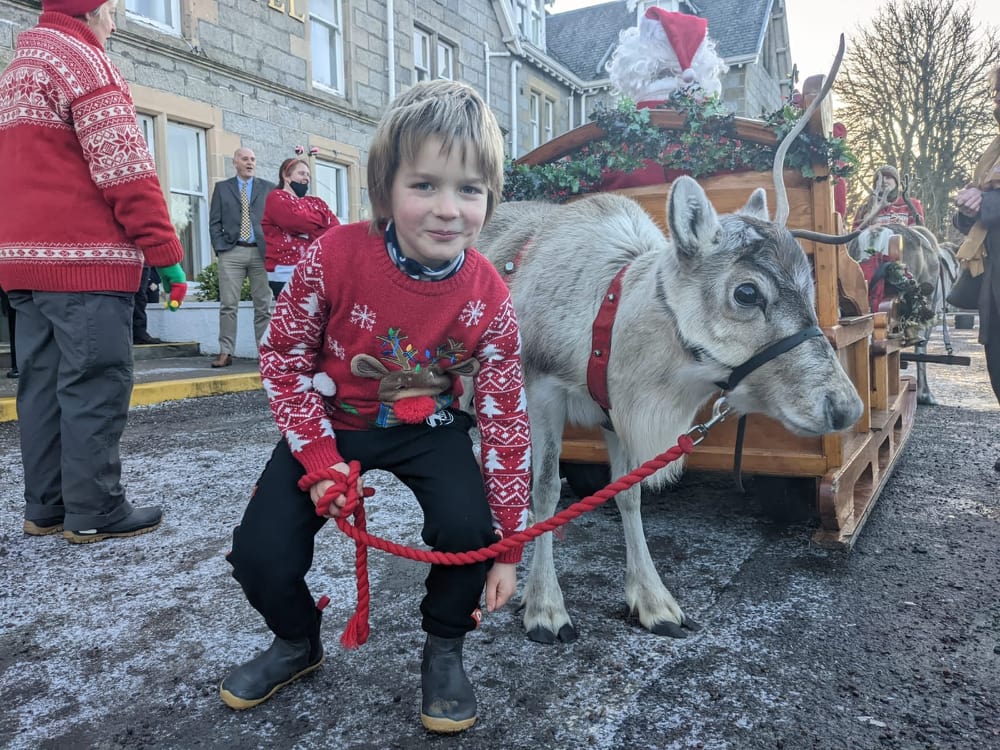
[Little] Tilly leading the reindeer and sleigh in Nethy Bridge.Oscar and Holy Moley at the back of the sleigh doing a superb job.
So that is it for another year and when I thought at the beginning of November that the end was nowhere near in sight. Suddenly Christmas is over. I’d worried that the reindeer would forget what to do on events having had a year off but that was absolutely not the case. If anything it was the humans that needed reminding and reassuring that they knew what to do, the reindeer were fab.
Merry Christmas everyone. As you may well imagine, when you have a herd of reindeer, December is a busy time of the year. And this year has been no different. In this blog, I’ll provide a summary of what happens at the Reindeer Centre throughout December.
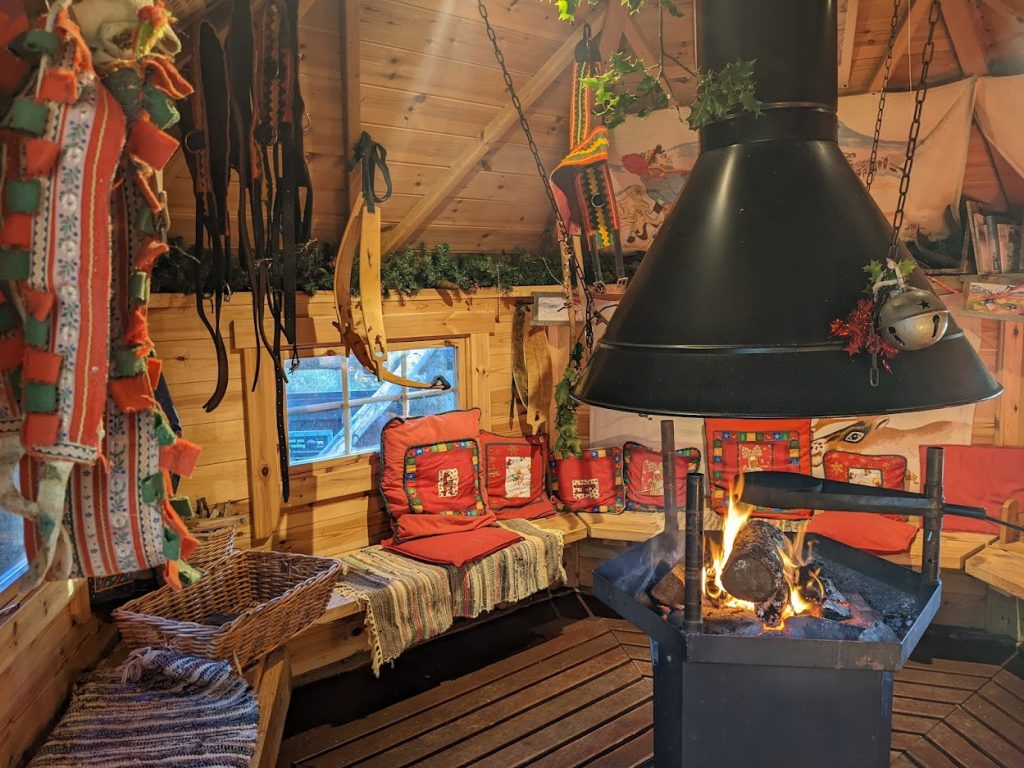
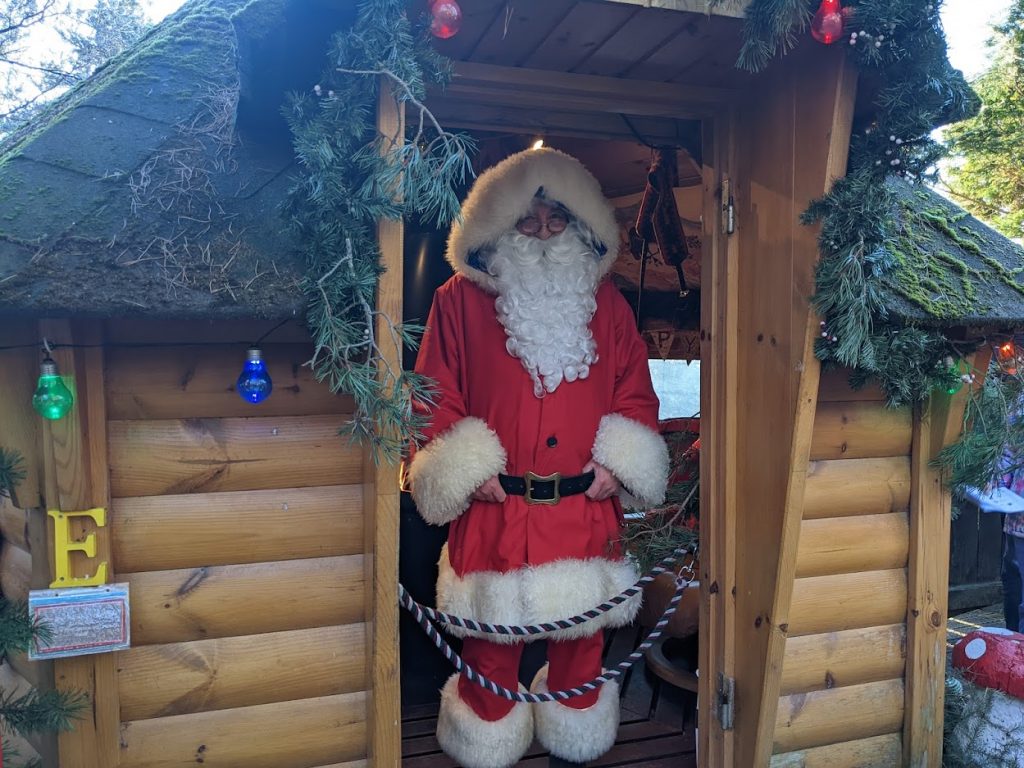
We’ve been having plenty of ‘Christmas Fun’ in the Paddocks and Exhibition area. This has taken place every December weekend as well as every day this past week in the build up to Christmas Day. Here we’ve had Santa Claus in his cosy, fire-lit grotto as well as arts and crafts, a special Christmas activity booklet for the kids to complete and plenty of herder talks out in the paddocks alongside the reindeer. We hope you’ve enjoyed chatting to us herders and seeing Santa!
The BBQ hut warm and cosy, ready for Father Christmas!The main man himself! Delighted to have him join us every weekend in December.
The weather hasn’t always played ball with our plans. In fact, the start of December brought some pretty wild weather. We had over 10cm of snow. The reindeer were delighted and could often be seen dancing with joy, which can be seen in the video below. However, the Ski Road leading up to the car park had to be closed on occasion due to dangerous, icy conditions and a few Hill Trips were subsequently cancelled.
Reindeer dancing with joy in the snow!Blizzard conditions led to several Hill Trips being cancelled earlier in the month.
The snow melted about halfway through the month due to a mild spell of weather and we now have just a bit of frost on the ground in all areas except the very tops of the mountains. The weather didn’t put you hardy folks off visiting though and we had lots of visitors wrapping up warm and braving the elements on our hill trips. In fact, the December weekend hill trips were all booked up before December even started!
December is also the busiest month for our adoption scheme. As such we’ve been wading through seemingly never-ending torrents of incoming adoptions. All the herders have gallantly pulled long shifts of office work and about a week before Christmas Day we managed to paddle through the swell and get through the backlog of adoptions. No adoption was waiting more than a couple of days after being received so we hope that you receive your packages in a timely manner. During the busiest times, herders were writing letters whilst on tour and we recruited help from Linda and Tina who have been fantastic at writing letters for us from their homes.
Fiona and Ruth writing letters on an event, whilst waiting for people to visit the reindeer.
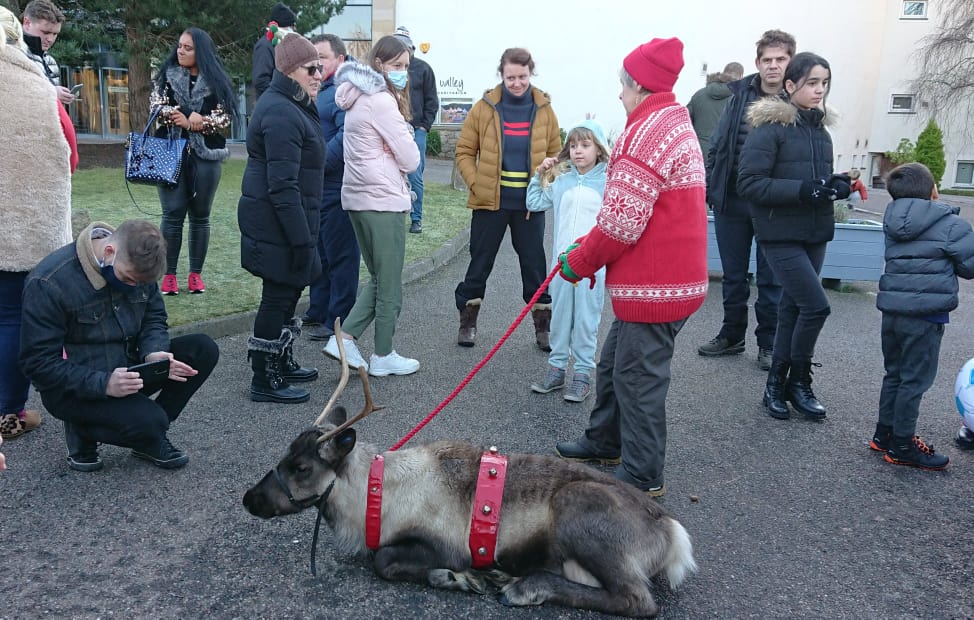
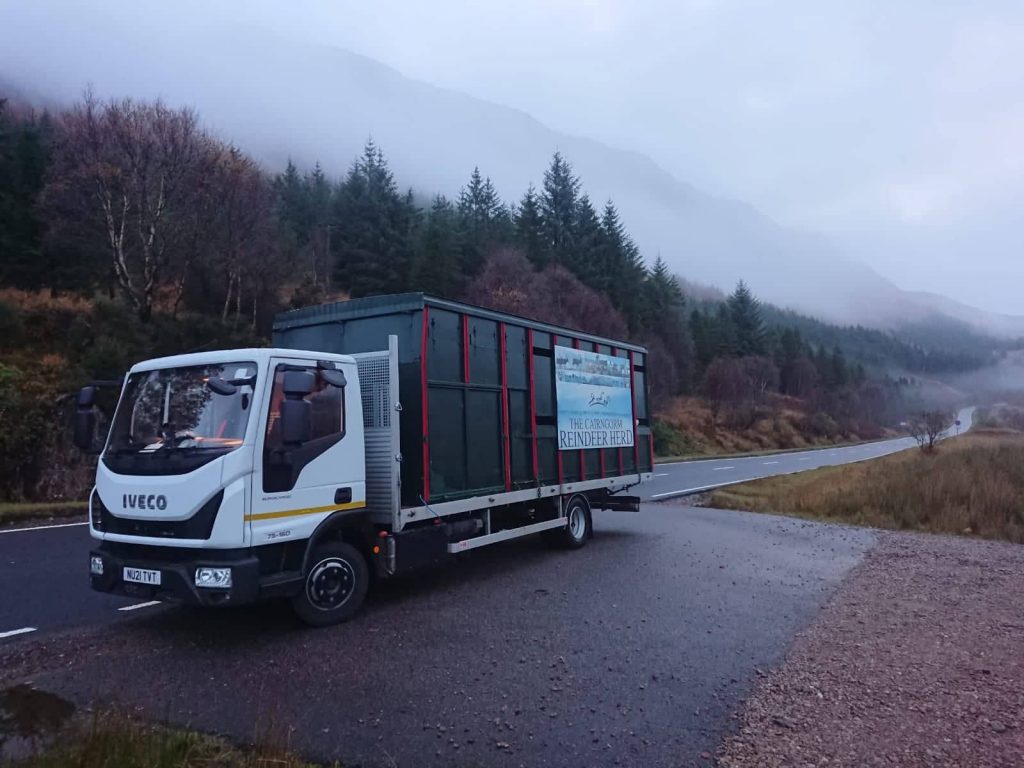
One of the other events that happens over November and December is that a selection of trained reindeer may go out on tour around the nation. Events are often relatively local, however we reached as far south as Windsor this year and went as far away as Llanelli in South Wales. Training for the reindeer occurs throughout summer and really hots up during the autumn. The reindeer may be in a display pen or participating in a sleigh procession. It varies from event to event. The team and their herders will stay at overnight bases throughout the UK, and they will travel in big lorries with lots of space which means that the reindeer will often lie down on the straw when travelling or as some of you may have seen, they may also lie down when they’re in a pen. They like to relax whenever possible. Our calves have even had a bit of exposure to Christmas events and overall, they’ve been absolute champions.
One of our Christmas lorries on the road, containing two herders and six reindeer (usually 4 adult males and 2 calves).Bond, Clouseau, Holy Moley, Trilby and Akubra lying down in a pen in Lancaster earlier this month.
Colin D (we have two Colins!) has clocked up the most miles of all of us herders and that’s good news for the rest of us as he produces the funniest videos. Here is Colin narrating Dr Seuss’ gardening skills. Stay tuned for more of Colin’s videos in a future blog/social media posts…
Colin Delap and Dr Seuss with a special Christmas offer…
We are still open as usual until the 6th of January 2022. The Centre will then close until the 12th of February, re-opening in time for the February half-term. The entire herd will soon be free-ranging either on the Cairngorms or the Cromdales, fingers crossed for another cold and snowy winter. Thank you for all our wonderful visitors, supporters, blog-readers, and adopters throughout 2021. Merry Christmas and a Happy New Year, from all the reindeer herders!
So last week the whole country had a bit of a blustery time with Storm Arwen crossing our paths. When we clocked mid week it was on its way we started putting plans in action for how to run one of our busiest weekends of the season with 6 teams of handlers and reindeer out and about on tour as far south as Oldham and as far north as Portree on Skye. And not to mention the day to day runnings at the Reindeer Centre itself.
Snowy roads for Colin S and Ruth’s team – a bit of sunshine in between the snow showers.
Firstly Banchory, near Aberdeen was due to have an event on the Friday night. But very sensibly made the decision two days before their event to postpone until the following week. Luckily weekdays for us aren’t so busy so we could accommodate with little fuss.
Next I had to think about my own team. Joe and I were heading to Yorkshire on Friday ready for events in the north of England on the Saturday and Sunday. Usually I’d get my reindeer off the hill that morning and hit the road but with the snow and wind forecast to come in mid-late morning I brought my team off the hill the day before, they then spent the night in the paddocks here at the Centre and we got away in good time, getting down country safe and sound.
Another team were spending the night at our farm base in Central Scotland ready for Milngavie the next day. When they’d usually leave late afternoon with only a two hour drive in normal conditions they also got away once their reindeer were off the hill on Friday morning. Our Perth event team were meant to go down Saturday morning but opted to also stay at our Central Scotland farm base as well… and it’s a good job they did because the snow came in thick and fast!!! The final three teams were all leaving from home on Saturday morning to get to Oban, Skye and Tain so just made sure they gave themselves plenty of time.
Lotti and Colin D, setting off to Oban with their team, picking up Lisette on route in Fort William.Ben and Olly’s team + Mel and Leonie’s team on a morning walk after a night at the Gleneagles base.
The Oban team had to divert via Inverness due to closed roads but got there in time to visit a care home prior to their event which was a great hit amongst the residents bringing lots of Christmas cheer to those who couldn’t come and see the reindeer parade. A long day for the Skye team but they have a day off on Sunday to recover. And Tain had a superstar in their team… Holy Moley made an appearance and that went down very well indeed!
Also in Tain, were Hamish and LX who pulled the sleigh with Ruth leading them. During the parade the team got an mention over the microphone, the man announced that Hamish and Alex were pulling the sleigh! Now this to all us herders was rather funny as of course Hamish and Alex are also the names of two of my family members. Alex is my brother and his son is Hamish… So we all had a good chuckle imagining those two pulling the sleigh instead of the reindeer!
Colin D, Lotti and Lisette safely made it to the relatively tropical Oban with their team!Colin S and Ruth made it to Tain, and had a wonderfully snowy parade! Here’s Holy Moley in the display pen lapping up the attention!“Alex” (LX) and Hamish pulling the sleigh in Tain!
So, Saturday for the reindeer teams all went well despite the harsh wintery conditions. Although my parade in Oldham was cancelled we still managed to do a small arrival with Santa and sleigh and the folk of Oldham welcomed us with open arms for the 24th year visiting the Spindles Shopping Centre.
That was the news from all of us out and about on tour so I can’t properly relay the stories from home and the running of the Reindeer Centre. I know the hill trips had to be cancelled due to the hill road being closed as the mountain was storm-bound. Instead the herders trooped together and did paddock talks throughout the day hoping the disappointment wasn’t too much for those missing out on the hill trips… Though to be completely honest if there was a hill trip in those conditions you wouldn’t be able to hear, see or take much in as the wild winds and snow conditions would have been too epic! Some of the herders still had to go up onto the mountain to feed and check the reindeer but actually doing this in these conditions just reminds us how incredible these animals are. They have the most amazing coats to cope with such low temperatures. Facing the wind means they get amazing ice masks covering their foreheads and ice covering their antlers… It looks very cool! Hopefully for those of you who missed the hill trip will get another chance sometime soon, it was very unfortunate but we are at the mercy of the weather gods and when they call it off there is little we can do about it. The main thing is everyone stays safe in these conditions, the reindeer will be here for a long time and certainly ready for your return!
The team back at the centre feeding the reindeer on the hill, note the snow encrusted reindeer!
A while ago I wrote a blog about how Reindeer House managed to cope with its temporary hitch back in the summer, when its resident staff caught Covid. I mentioned then that Andi and I (who live outside of Reindeer House and managed to stay unaffected) were responsible throughout for the 8am morning check of the herd on the hill, so I thought I’d perhaps explain a little more about what we do in the mornings, before visitors arrive, in another blog. So I have put fingers to keyboard and here we are.
Typical scruffy summer reindeer! Butter, LX, Druid and Slioch (left to right)
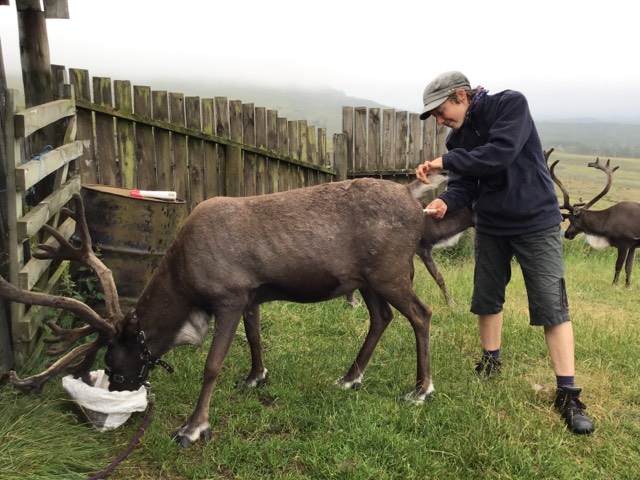
Throughout the whole summer we run the guided Hill Trips up to meet the reindeer in our hill enclosure at 11am and 2.30pm, but the herd are actually fed 3 times a day. By doing the first feed bright and early, it gives us time to check everything is shipshape and ready for the day, allowing us to then concentrate on making sure our visitors have as good a visit as possible, with us safe in the knowledge that all the reindeer are happy and healthy.
Usually 2 or 3 of us will head up early doors, and in the summer there is usually only one group of reindeer in the enclosure to deal with. By comparison right now as I’m writing this (early October), there are reindeer in 5 separate areas of the enclosure, all needing checking and feeding at least twice daily! One group only is much more straightforward and seems like a distant dream right now.
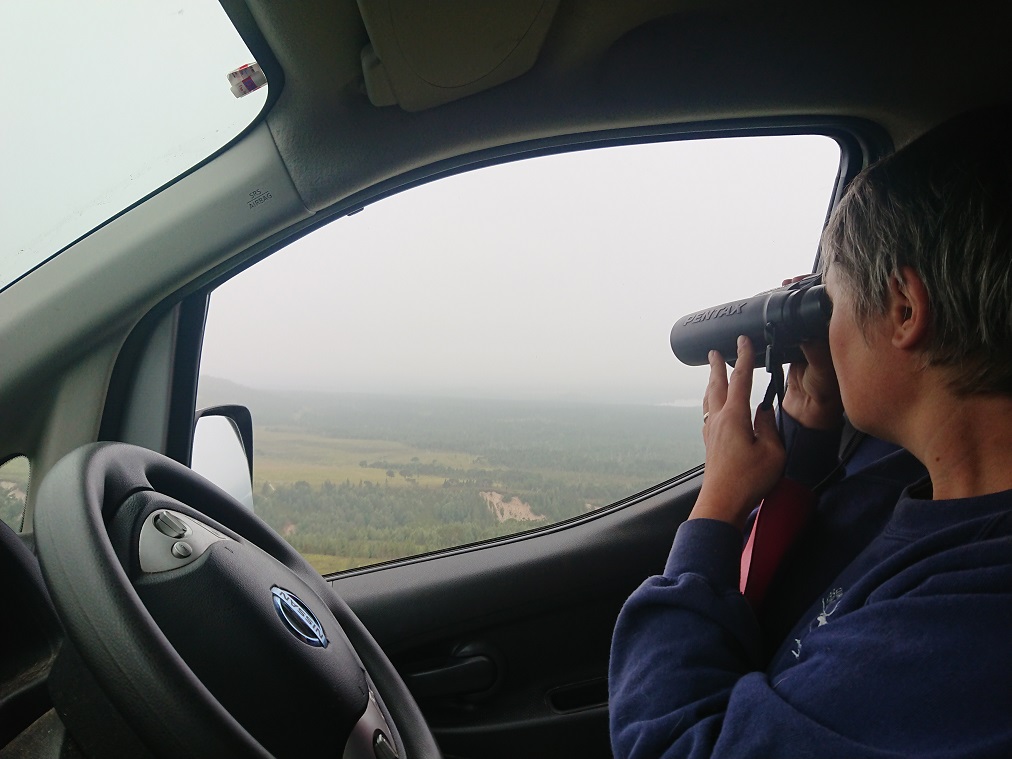
The very first job of the day, before heading to the hill enclosure, is to drive up to the ski centre to check none of the free-ranging reindeer are nearby. Right in the middle of summer this would be unusual, but they do sometimes surprise us, so it’s always worth a check! A convenient layby also gives us a bird’s eye view of much of the enclosure, so we have a quick scan over it too.
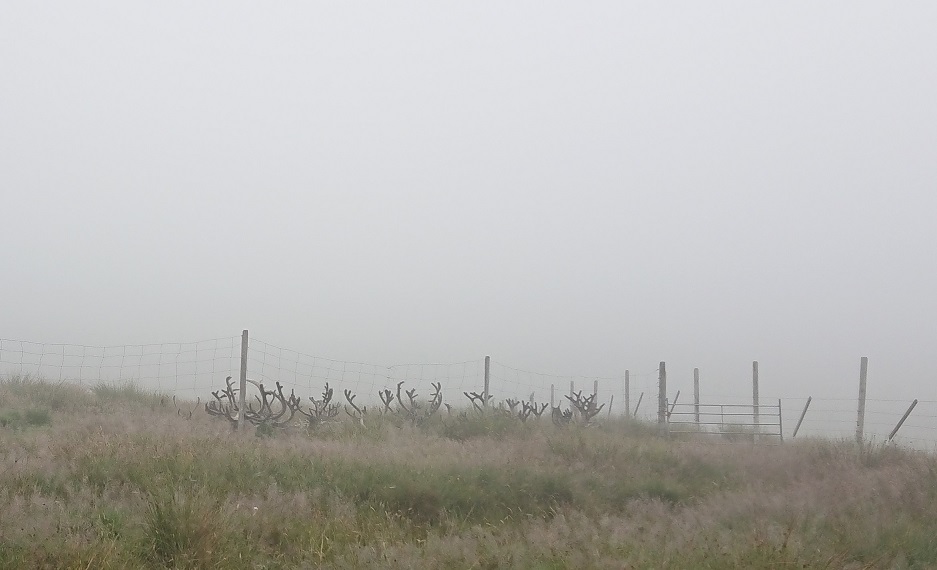
Spying with binoculars on a rather murky day.Even when the herd is waiting for their breakfast in their usual spot, they can be difficult to spot from afar. But antlers give them away sooner or later!
The hill enclosure is around 1200 acres in size; about 2km in length. The nearest end of it consists of several smaller areas, and our first job of the day is to bring the herd through to the nearest area, the ‘bottom corridor’, and to see if everyone walks through cheerfully and willingly. A reindeer who is off colour will lose their appetite and is quite likely to trail through a distance after the others, less enthusiastic about the prospect of breakfast, so that is the first clue of someone feeling under the weather.
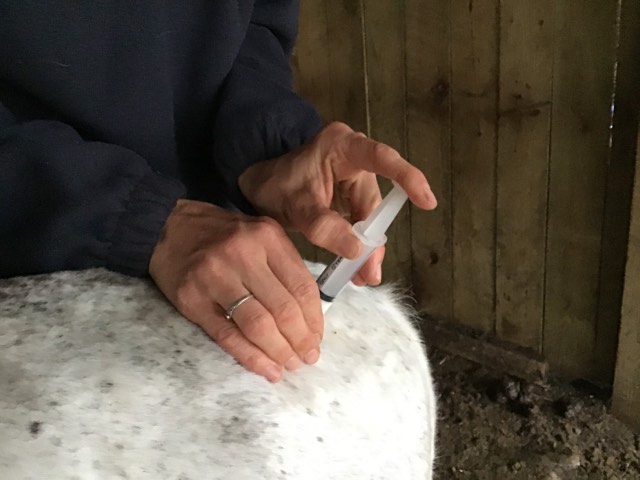
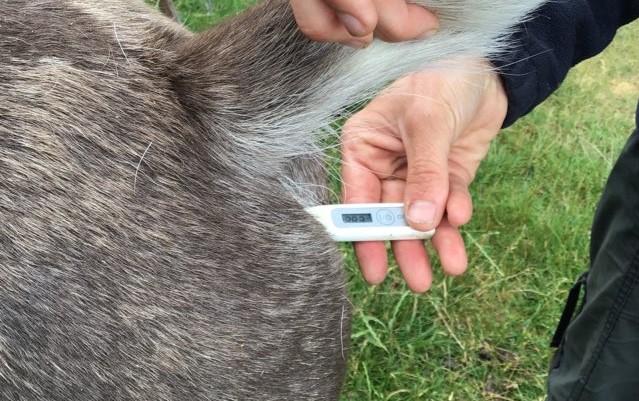
If we are suspicious any reindeer is not quite themselves, the first thing we do then is to check their temperature – so it pays not to be the last reindeer through the gate, otherwise there could be a thermometer up your bum before you know what’s happening! However, a high temperature indicates a tick-borne fever, and a shot of antibiotics is the next step, which should nip any infection in the bud.
Injecting a long-acting general antibiotic – something every herder learns to do early on it their reindeer herding career.
Once every week or so in the summer we’ll get the whole herd up to our shed and work our way through the whole herd, checking temperatures, as some reindeer are very good at not showing any symptoms at all even when they have a roaring fever. This type of fairly intensive routine monitoring isn’t necessary in the winter months as there are no ticks about then, but the warmer weather brings them out and so reindeer do get very used to regular violations of their dignity…
Temperature checking. Dr Seuss couldn’t give a stuff, as long as there’s a bag of bribery in it for him……and all good! A temperature of 38.3, as seen in this photo, is fine, the average being around 38.9 for a reindeer.
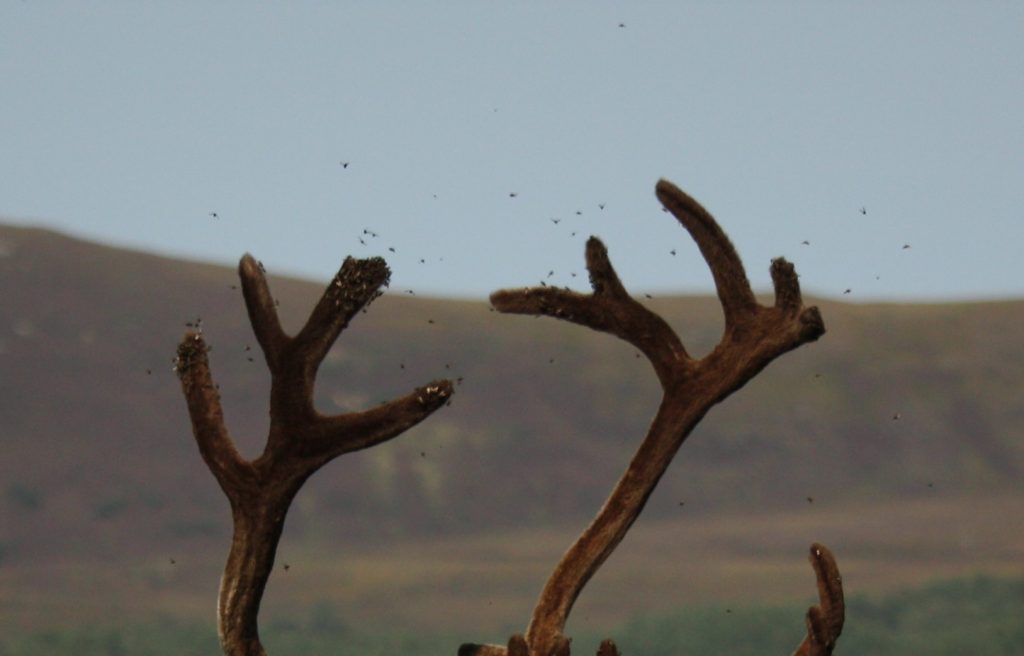
Something else that needs doing regularly of a summer’s morning, even daily at times, is fly-spraying. Like with any animal, flies will buzz around the reindeer on sunny days, and whilst they don’t generally cause any real problem, they drive the reindeer mad at times. No-one likes having flies buzzing round their face! With the reindeer, the flies tend to aim for the antlers, clustering around the soft growing tips where the blood supply is richest. If a tiny nick in the velvet skin is made, the flies will feed on the blood and this brings with it the risk of infection.
Flies around antlers.
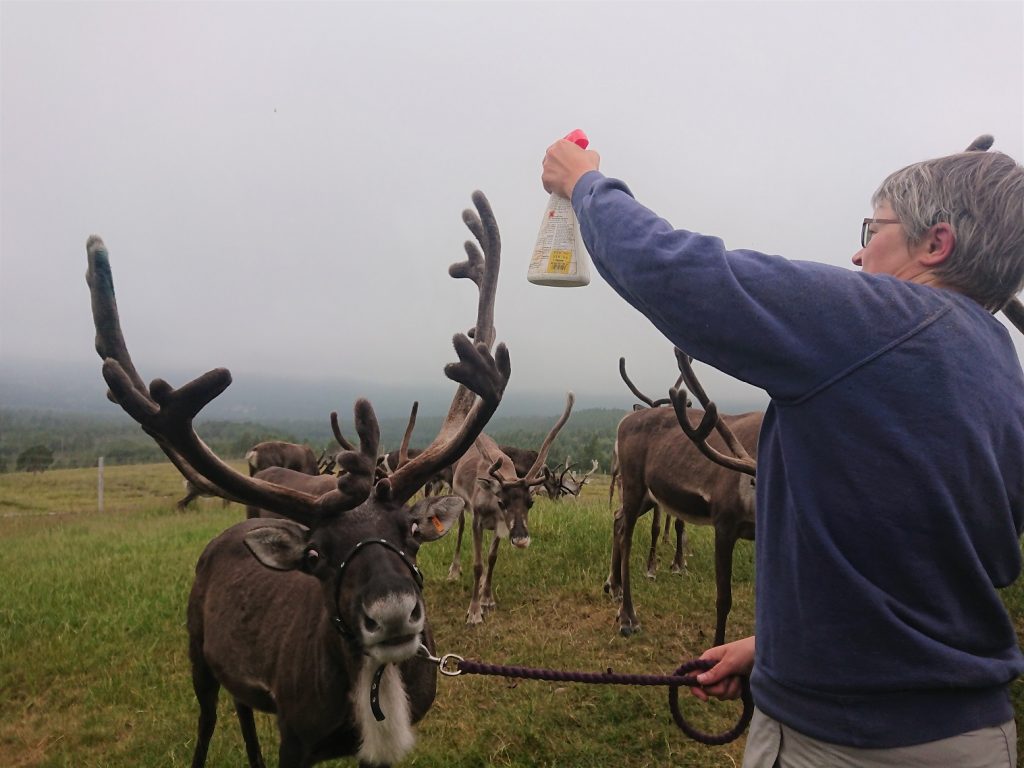
So we spray the antlers to help keep the flies off, using a DEET-based spray that is designed for horses. But unfortunately we can’t wipe the spray on with a cloth as reindeer hate their antlers being touched whilst they are growing (and also it would take forever to do 40-odd reindeer this way!), so we have to just spray it on, accepting that – from a financial point of view at least – an upsettingly large percentage of it is lost or misses it’s target. Reindeer very rarely stand quietly to have their antlers sprayed, either doing their best to pull away from us, or rushing around in circles if contained in the shed. But there’s no way around it – antlers need spraying and it’s better for the herd to be rather flustered for a few minutes each morning than spend the day charging around to get away from the flies.
Myself spraying Bond’s antlers – and getting a beady look in return!
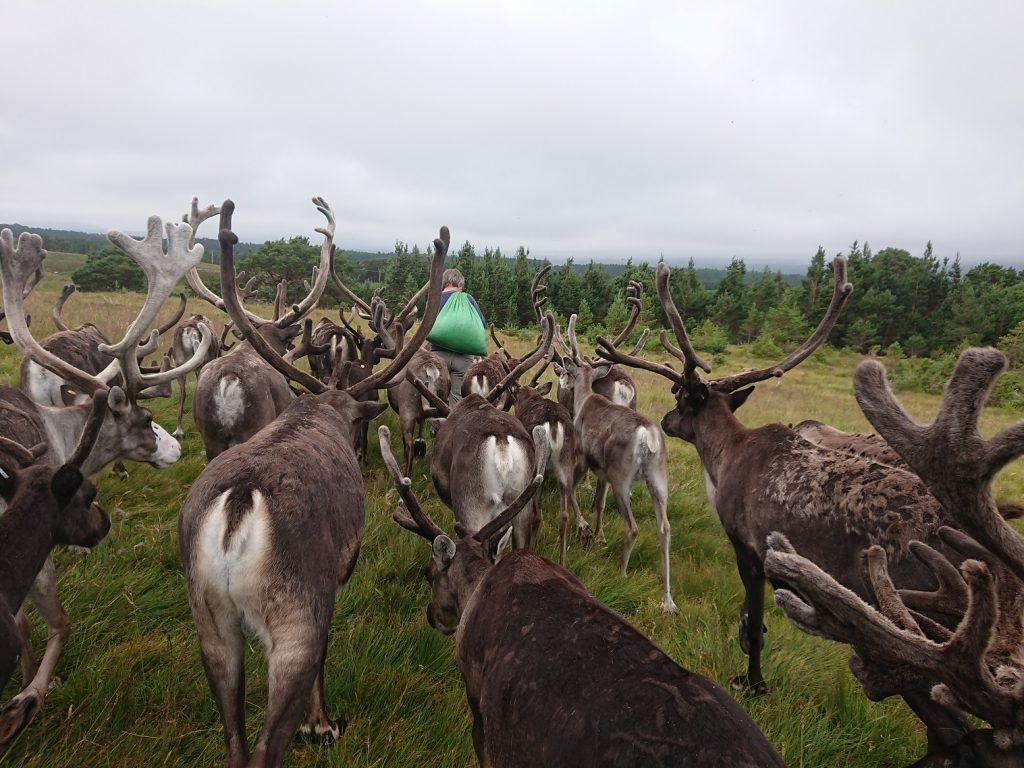
On an average summer’s morning, at this point it’s breakfast time! Just like on the Hill Trips, we tip the bag of feed out into small piles in a big long line, count to check every reindeer is present and correct, and make sure every is eating enthusiastically. And then – just as importantly – head back down to the Reindeer Centre and stick the kettle on…
Me feeding the herd.Andi counting the line to check the numbers match.
This first couple of hours of the morning is also when we do any ‘movement’ of reindeer if needed, such as letting reindeer out to free-range on the mountains outside the enclosure, or swapping over the reindeer in the Paddocks with those up in the hill enclosure. We also regularly poo-pick the nearer areas of the enclosure where the reindeer congregate, or do maintenance jobs on the fencing and boardwalks. I suspect people sometimes wonder why we don’t open any earlier than 10am, but these couple of hours are sacred to us – the time flies by all too quickly and we’re still often left scrabbling around trying to get finished and back to the Centre in time to open on schedule!
By the time you read this, the rut will be underway here at Cairngorm, with our chosen breeding bulls split with selected unrelated females, to make sure we know who the parents of each calf are. While the bulls tend to be fairly relaxed and laid back for most of the year, as September comes to an end and the cows come into season, they start to “rut”, strutting around, posturing and rounding up their females, and challenging any other bull they see. Reindeer bulls don’t “roar” like some deer species (including the iconic Scottish red deer stag), instead they grunt. But one of the most noticeable changes for me is their smell.
Kota in 2020, grunting to his cows
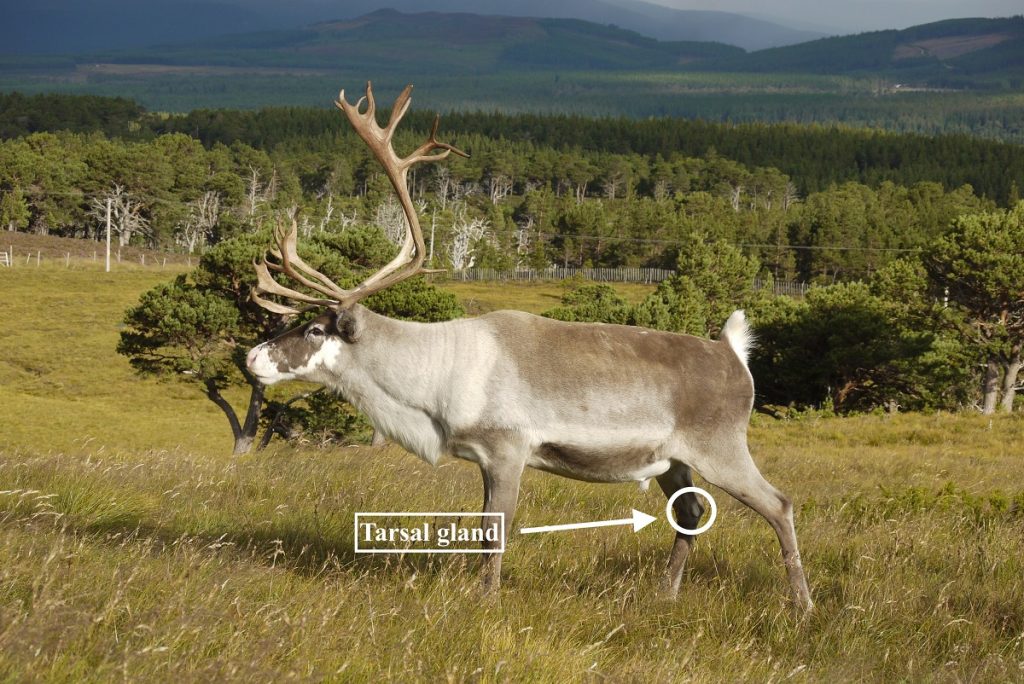
Now, I don’t claim to have a particularly good sense of smell, but in general reindeer are fairly unsmelly creatures. However, a rutting bull is a different matter, and already, as I write in mid-September, our boys are getting stinky. It’s not an entirely unpleasant smell – very musky and, well, masculine I suppose. One of the main reasons they smell so strong is that they begin deliberately peeing on their hindlegs. This always seemed a bit odd until I did my research and realised that reindeer, like all deer, have scent glands on the inside of their hocks, the tarsal glands. This gland produces an oily secretion, and when the natural bacteria on this area combines with pheromones in the urine, that distinctive scent is produced. Apparently every reindeer has a unique, individual scent, due to their own winning combination of bacteria, though I definitely don’t have a sensitive enough nose to be able to tell!
Nutti, illustrating the position of the tarsal glandRoman peeing on his legs to increase his allure
Why do they feel the urge to be so stinky?? Well, part of it must be as a statement of dominance – when I, as a mere human, can smell a bull from 100 metres away, the other reindeer must be able to smell them from… 800 metres?… a mile?? This must act as a deterrent to a weaker bull, and quite possibly as an attractant to a female in season – they definitely come looking for bulls when they’re ready.
Feeding the big bulls last year, just before the rut – they were already stinky!
We have a vague theory among us herders that the female herders notice the scent of the rutting bulls more than the male herders do. Quite what that means, I have no idea – perhaps the smell is designed more as an attractant to cows than a deterrent to bulls after all (not that any of us lassies have said that we actually like the smell!). Either that or the men amongst us are less sensitive when it comes to body odour!
Whilst sorting through the photos on my phone recently, I thought it might be fun to show how the reindeer change in appearance over the summer months so I put together this little blog. This could have turned in to the longest blog ever but I have tried to restrain myself picking just a handful of reindeer; Camembert, Dr Seuss, Kiruna, Sherlock, Beanie and Christie and her calf Akubra.
Camembert 1 – on the 21st of June (Summer Solstice) Lisette and I walked Camembert and some other cows out on to the free-range for the summer. Here she is growing her antlers, still to moult last year’s winter coat, and determined Lisette still has some food for her!Camembert2 – This was the next time I saw her, on the 14th of September after my lovely colleagues successfully brought her and a large group of cows back in to the hill enclosure. She’s clearly had a great summer free-ranging, she looks totally fantastic and is still fat as butter.Dr Seuss 1 – it’s no secret that I have a wee soft spot for Dr Seuss so my phone is predominantly full of pictures of him! Here he is on the 20th May, he’s just beginning to moult his winter coat from around his eyes, and his lovely antlers and growing well.Dr Seuss 2 – here’s the big boy again on the 5th of July looking almost ready for summer in his short coat, with a slightly pink nose! Dr Seuss 3 – how smart does he look here?! This was the 8th of September. His winter coat is now beginning to grow through around his neck and he’s had a busy summer growing lovely big antlers, and a big tummy after hoovering up all that tasty hand-food!Kiruna1 – Here’s two year old Kiruna after hearing one of Ben’s jokes. This was on the 8th of July, his antlers are rapidly going and he’s moulted most of last year’s winter coat. Kiruna2 – Here’s Kiruna stripping the velvet on the 28th August. His paler winter coat is growing through quickly on his neck and flank. Kiruna3 – What a handsome lad! Here he is leading the herd in for breakfast on the 7th of September.Sherlock 1 – Three year old bull Sherlock on the 11th of June, rapidly growing his antlers and just beginning to moult his winter coat from around his eyes and on his nose. Sherlock 2 – 1st of August, looking smart in his short, dark summer coat. He’s grown enormous antlers for a three year old! Sherlock 3 – 29th of August, just before his velvet started to strip.Sherlock4 – Just one day later, here he is midway through stripping his velvet on the 30th of August.Sherlock 5 – Handsome boy on the 1st of September, with beautiful clean antlers.Beanie – The palest calf of 2021, Beanie, this picture was taken on the 20th May, just one day old. What a cutie! Beanie 2 – What a fantastic job Gloriana has done! This was taken on the 15th of September. After a summer spent free-ranging Gloriana and her daughter are now back in the hill enclosure. She’s already getting used to being around people on our Hill Trips and quickly learning big green bags = food! Akubra1 – Christie in the background with her thick winter coat, you can still make out her freckly nose. Photo taken on the 27th May when her calf was just over three weeks old (born 4th of May).Akubra 2 – I was delighted to catch up with Christie and her calf on the free-range on the 15th of August. Christie has done a fabulous job and has produced a nice big strong boy, well done Christie!Christie 3 – Looking beautiful on the free-range with her huge calf on the 15th of August.Christie 4 – Photo taken on the 15th of September midway through stripping the velvet from her large antlers. Not only has she produced a large calf this summer, she’s also grown big antlers herself and is in excellent condition. Go Christie! Her winter coat has grown in a lot over the last month.
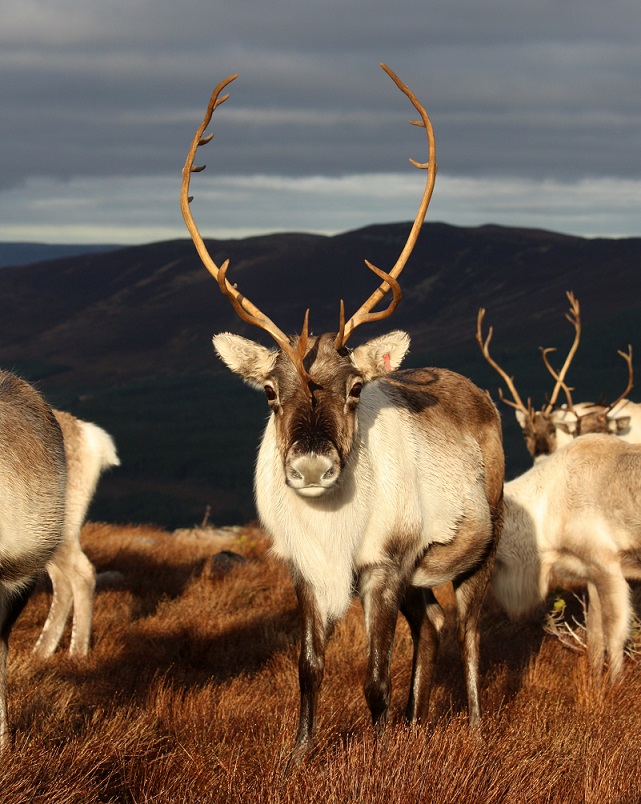
They’re the most distinctive feature of the reindeer, and the most incredible. Branching elegantly like the trees which the tundra so sorely misses, and renewing themselves each year, antlers demonstrate nature’s complexity and mystery in one. At this time of year the reindeer’s quickly growing antlers constantly amaze visitors and captivate my own imagination. It occurred to me recently that the cells in growing antlers and the cells used in the Covid-19 vaccine are both the same type of rare cell: undifferentiated stem cells! It might be interesting to join the dots between this.
A line of hungry boys and growing antlers (August 2021)Nell being inspired to write this blog, surrounded by lots of wonderful antlers (July 2021)
Greater Antlers, Greater Chances…
Large antlers lead to a (sexually selective) advantage in males, and even in females too as those that are better able to defend areas of food in the winter are more likely to produce healthy offspring. A physical advantage in a single characteristic, leading to it’s selection is a process called directional selection. This means that over time, reindeer populations evolve very (VERY) gradually to have larger antlers.
Swedish-born (and the very handsome) Kota, who was used as a breeding bull for several years (August 2017)The lovely Fly, who tends to grow big antlers for a female (September 2019)
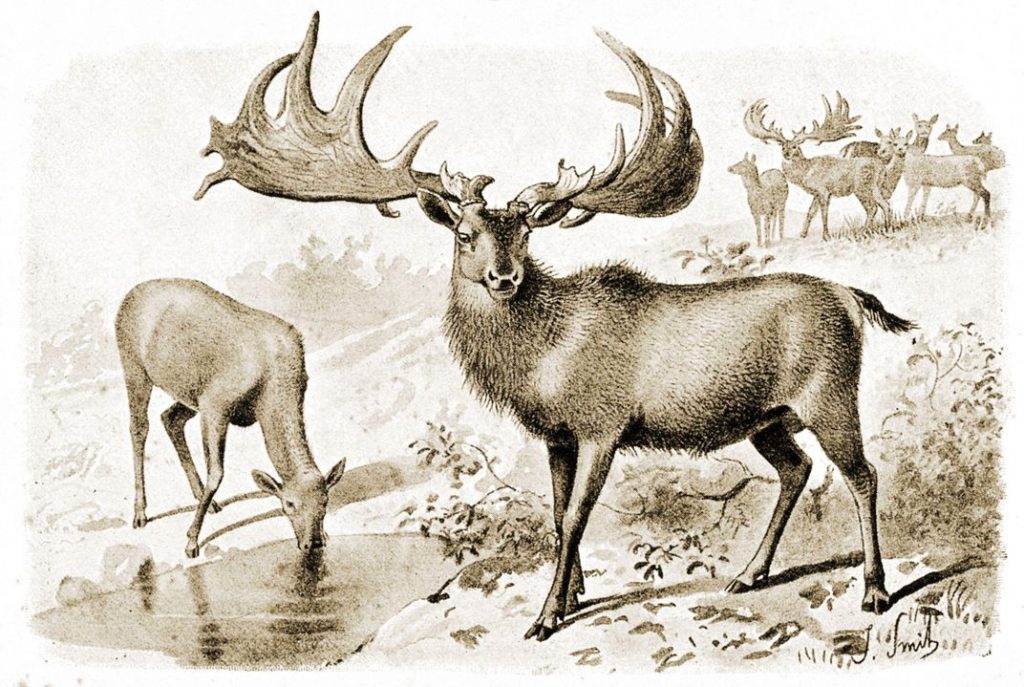
However, large antlers come at a cost, requiring huge amounts of energy to grow in such a short space of time. Reindeer eat lichen, which is fairly low in nutrition and has a long digestive process, as well as other low lying plants, mosses and mushrooms found across sub-arctic areas. As even eating a lot of food won’t make up the energy, the animals shift calcium from parts of the skeleton which don’t carry a lot of weight (such as the ribs) in a process called cyclical reversible osteoporosis, which humans also go through during pregnancy. There are still more adjustments, as the reindeer’s neck and shoulder muscles need to swell in order to carry the bulky weight of the antlers, and movement becomes restrictive. It’s no wonder then that the rutting season becomes so taxing for large bulls that their life is typically shorter than that of a female. Taken to an extreme there is even a theory that the great Irish Elk, or Megalocerous, was partially driven to extinction due to the amount of energy it lost to it’s enormous antlers! I find it unlikely that this will happen to the reindeer but there’s no doubt that these huge organs take a lot for the reindeer to grow.
Although we know what pushes antlers to grow to such a huge size, it’s truly incredible when we begin to ask how. Antlers are the fastest growing organs in the animal kingdom, potentially growing around three inches a week (dependent on nutrition). This is mainly due to the quick regeneration of stem cells from which they are formed; the only type of cell in a body which can differentiate into any kind of tissue, such as bone, fat or skin. We have some of these cells in our bone marrow, as an important part of our bodily regeneration, and the quick formation of embryos is also due to them. Stem cells are also an important resource in therapies for degenerative diseases or to support the body following certain aggressive cancer treatments. Stem cells have even been used in the creation of several vaccines – including for Covid-19! This, combined with their versatility and potential in lab experiments makes stem cells an extremely valuable resource to medical research. It’s awesome to think that the same cells from which reindeer antlers are formed are what we use to treat life threatening diseases.
Finally, the antlers are not just useful to the reindeer, but also to the other animals in the wider ecosystem. Often when we find an antler which has been out on the hill for a while it will be worn thin and marked by the tooth marks of different animals. In the Paddocks we also see that mice and squirrels chew the antlers in the display area! This is because once they are dropped they are an open source of calcium which sometimes the reindeer, or other animals, (like your own pet dogs) will chew in order to reclaim the minerals. There have even been times that reindeer have chewed each other’s antlers while they’re still on their head!
Reindeer chewing on a cast antler in the enclosure, video by herder Olly
Next spring I plan to photograph the same reindeer once a week from the time it’s antlers are small stumps until they’re fully grown as there really is an incredible difference. There’s so much which is unique and wonderful to say about antlers and I’m looking forward to writing still more about them!
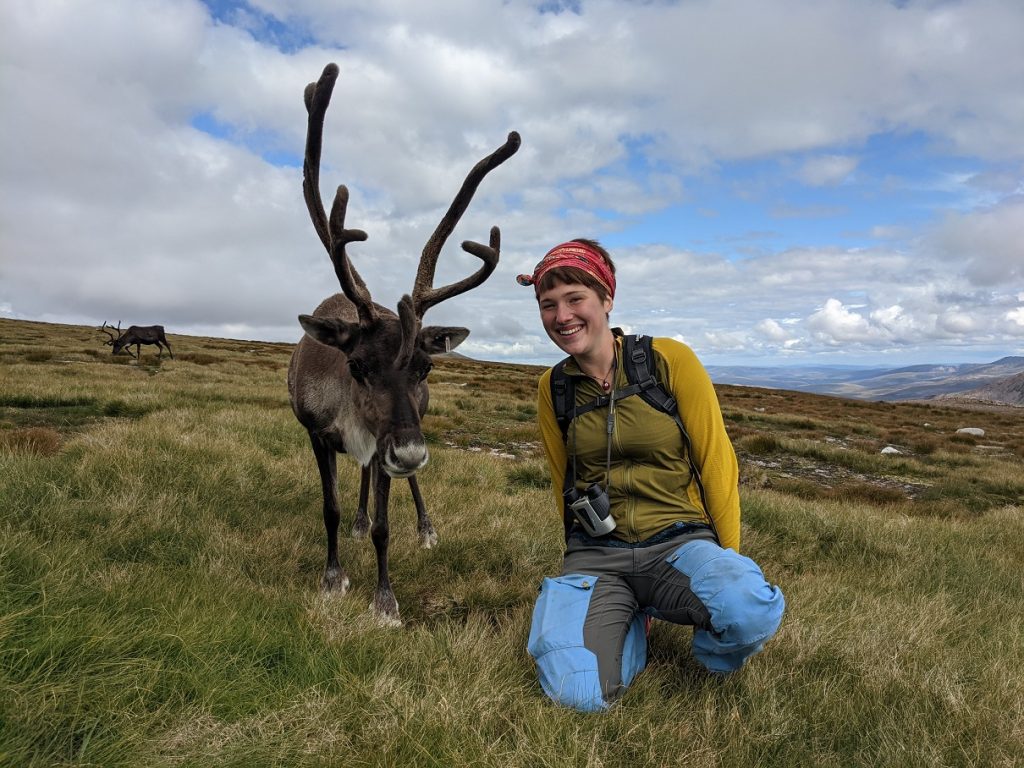
Ryvita (and her lovely antlers) with Nell on the free-range (August 2021)
P.S. What’s the difference between an antler and a horn?…… A horn makes a noise!
A while back, I wrote a blog about how difficult it can be to locate calving reindeer within our hill enclosure (see previous blog). But with one reindeer, finding her is just the start of our problems.
Spy, whose reputation precedes her!
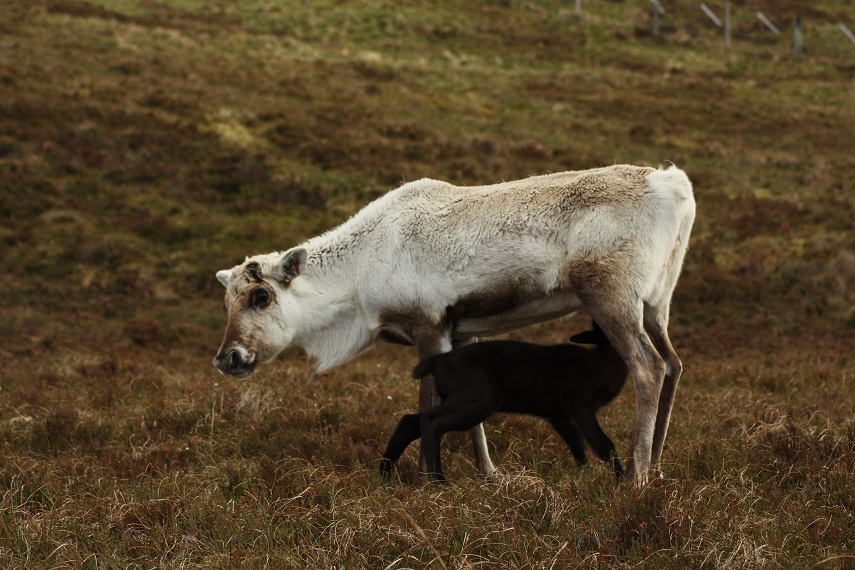
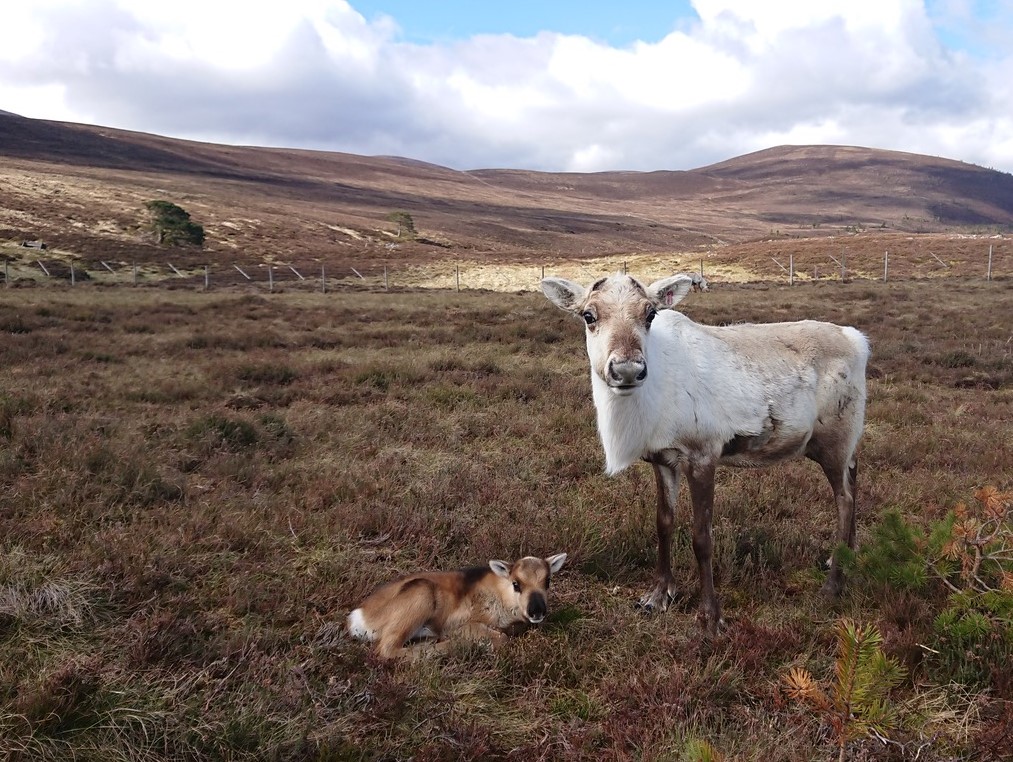
Spy is notoriously protective of her calves, at least for the first few days, and getting her from the main part of the enclosure where she has calved through the gate into the ‘bottom corridor’ (the area of our hill enclosure that we use as a nursery for the newborn calves) can be ‘entertaining’, to say the least. Most reindeer will lead their calf away from us if they can for the first two or three days, but that is the extent of their protective motherly instincts. After that the lure of food wins out, and they decide that actually, they probably can’t be bothered to march away, and that we’re no threat anyway. Some very tame (or greedy) reindeer just totally skip the avoidance phase and are completely blasé about us being around their calf, even if it’s literally just been born.
The way it normally works: Myself gently pushing Cheese and newborn Kiruna in the right direction across the hill enclosure a couple of years back.
Spy? Spy’s instinct to protect goes into overdrive, to the point that we are all VERY wary of her for a couple of days. It would be fine if we could just leave her to get on with everything herself, but in reality we do need to get hold of the calf just once, to spray it’s naval with the antibiotic spray and to put some insect repellent on it’s back, and this has to be done when the calf is less than 24 hours old (otherwise it can run too fast to be caught). The first time that Spy calved in the hill enclosure I was the one who was first on the scene, and discovered that for the first time ever, I wasn’t going to be able to walk straight up to the little furry heap on the ground, despite the fact the calf was obviously not yet strong enough to stand up and run away. Whatever I tried, Spy constantly circled to keep herself directly between the calf and myself, and made it abundantly clear that should I persist, I would be the one coming off worst in the situation.
The only way to get hold of Spy’s calf is to get her through a gateway ahead of us, and then manage to get the gate shut behind her before the calf gets there. Thankfully newborn calves don’t understand fences or gates and will generally just blunder in a straight line towards mum and into the fence, sticking their wee heads and necks between the wires and wondering why their bodies don’t follow. At this point we can swoop in, catch the calf, sort out what we need to do as quickly as possible, and then post it through the gateway back to mum. That first year when Spy had calved, I returned to Reindeer House to announce that yes, she’d calved, yes it seemed fine and strong, but no, I had no idea what sex it was, and no, it was not yet in the nursery area. I think I was then off the following day, and by the time I returned to work Spy and calf were in the right place but Fiona had an epic tale of woe about the trials and tribulations this had involved.
With Nok, the calf who I’d failed entirely to get close to.
This year was the hardest yet, not helped by the fact that in 2020 Spy had grown her nicest set of antlers ever, tall, elegant but very, very pointy, and she still had one of them. A reindeer armed with 2’ tall spiky weapons on her head that she’s not afraid to use is considerably more daunting a prospect than a bald reindeer. We managed to gently push Spy all the way to the gate into the bottom corridor without issue, but getting her through the gateway itself took four of us about 30 minutes, with an awful lot of time spent in a total stand-off. Watching Fiona move gradually towards Spy, arms out trying to push her gently towards the gate whilst the rest of us hung back was like watching a lamb go to the slaughter. I wondered whether Fiona would remain unscathed, and to be honest it was a close run thing! All four of us closed around her in a semi-circle, tighter and tighter, but it was a delicate operation of continuously reading Spy’s body language and reacting to every movement and step. Quietness is needed in this sort of situation, there was no rushing or shouting or flapping of arms, until the sudden speed needed to get the gate shut once she finally went through. Catch the calf quickly, all hearts thumping quicker than usual, and a flood of relief! Calf sexed (male), antibiotic spray on naval, fly-spray on back, post through gate, and high-fives all round.
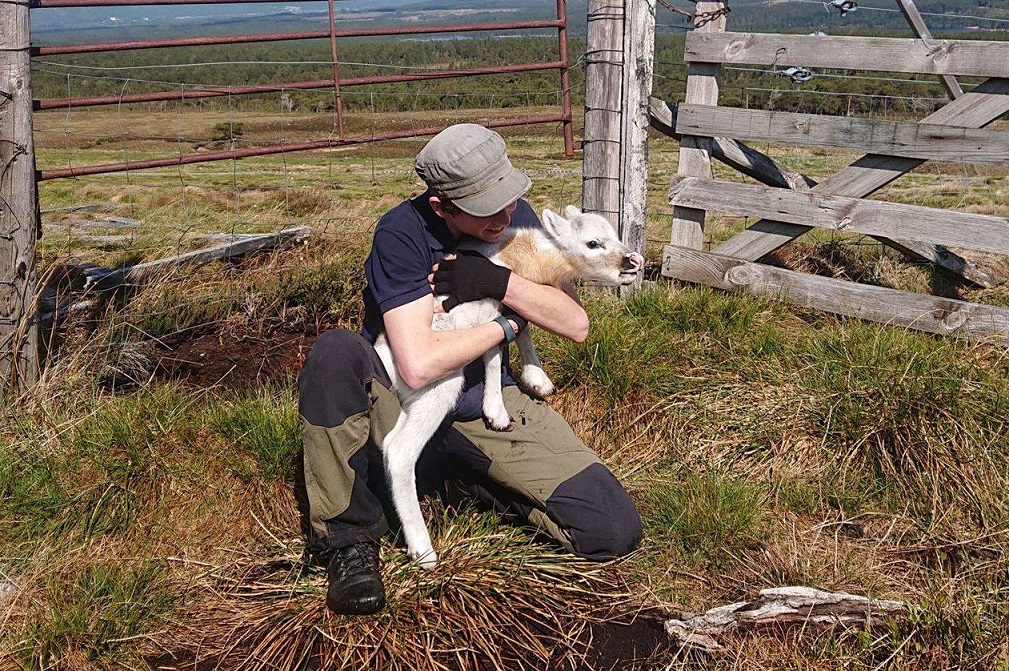
Not one of Spy’s calves (this is Angua’s calf Chickpea), but a quick cuddle is usually needed once all calf duties are done and everyone’s in the right place!
By two days later Spy had completely chilled out once again, knowing perfectly well that once she’s in the bottom corridor none of us are going to try and touch her calf, and was eating off the feed line with the rest of the mums as happy as larry. And then rest of us were also very happy to have survived another calving season involving Spy unscathed! She’s always a reindeer we treat with respect and never handle anyway, unless we have to, for 363 days of the year, but for those two other days she is a very different kettle of fish.
Spy in the nursery part of the enclosure a day after trying to kill us all this year, antler having fallen off in the meantime. Suddenly she doesn’t look quite so intimidating when not waving a large, spiky antler around!