Reindeer Around the World: Eurasian Reindeer

Rangifer tarandus tarandus and Rangifer tarandus fennicus

Continuing on from learning about the lovely Svalbard reindeer (we all remember how cute those guys are!), this time we’ll look at the two other European subspecies of reindeer, the forest and tundra reindeer. Starting with the tundra reindeer…
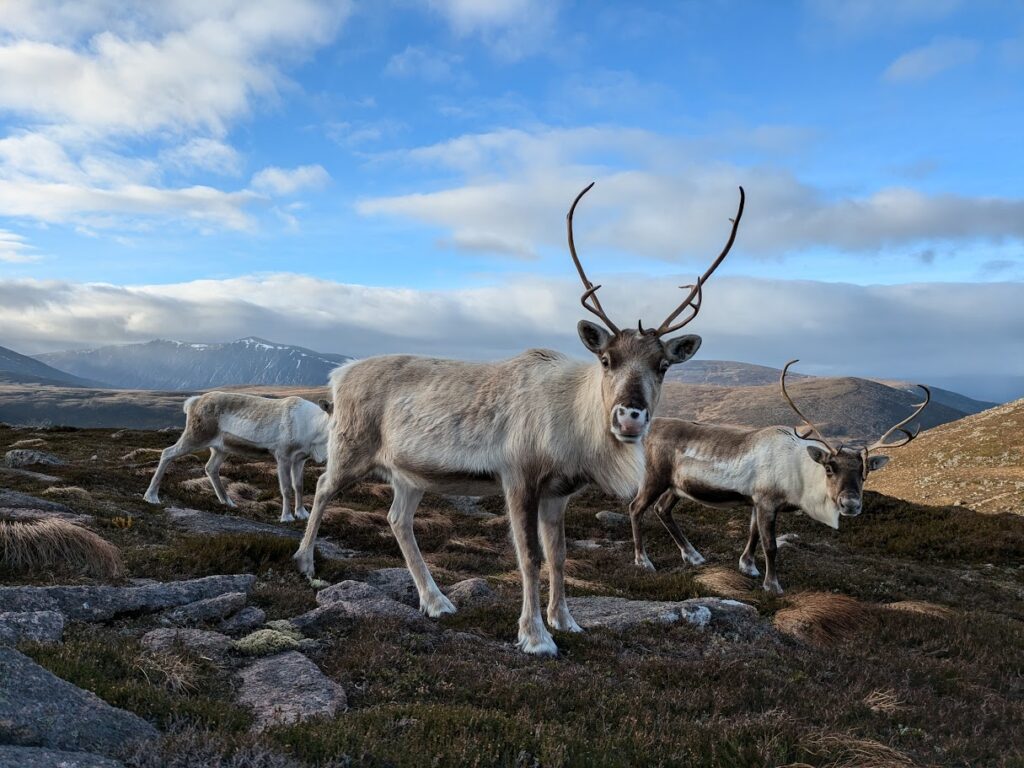
Our very own tundra reindeer, Chickpea and Morven roaming the Cairngorm mountains.

Found across Northern Scandinavia and across Northern Russia with a large population in Siberia. They are also found here in the Highlands of Scotland roaming the Cairngorm mountain plateau. The southern most population on continental Europe is found in the mountain regions of Norway, however it is quite tricky to know where the tundra reindeer population ends and the forest reindeer population begins.
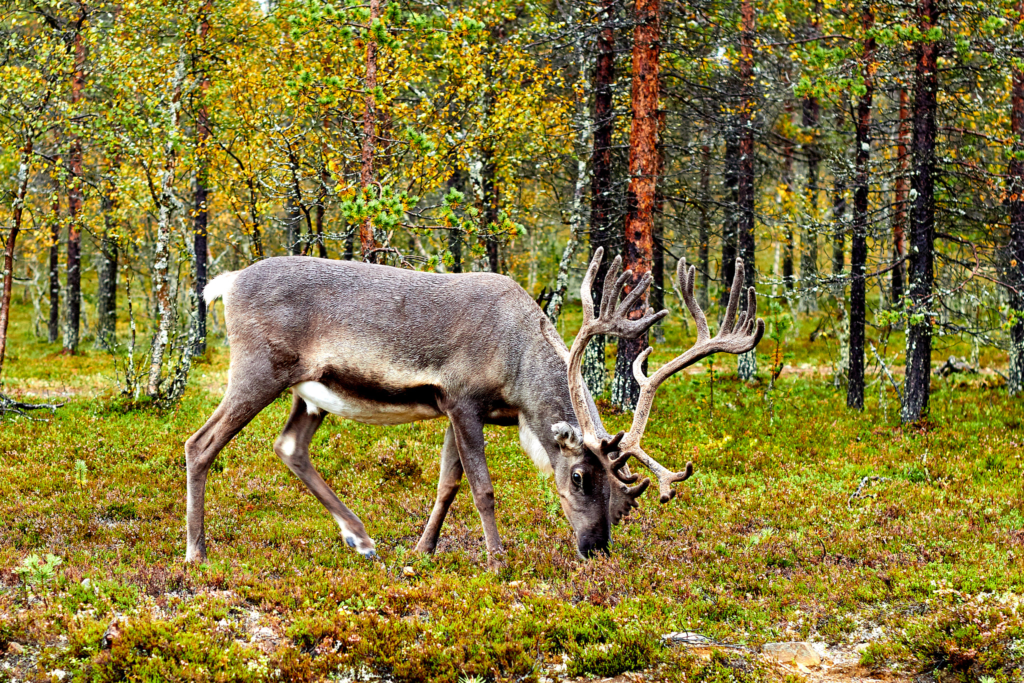
Forest reindeer grazing amongst trees.

The most notable population of forest reindeer is found surrounding the Karelia region, near the border of Finland and Russia. The population is then further wide spread across Russia.
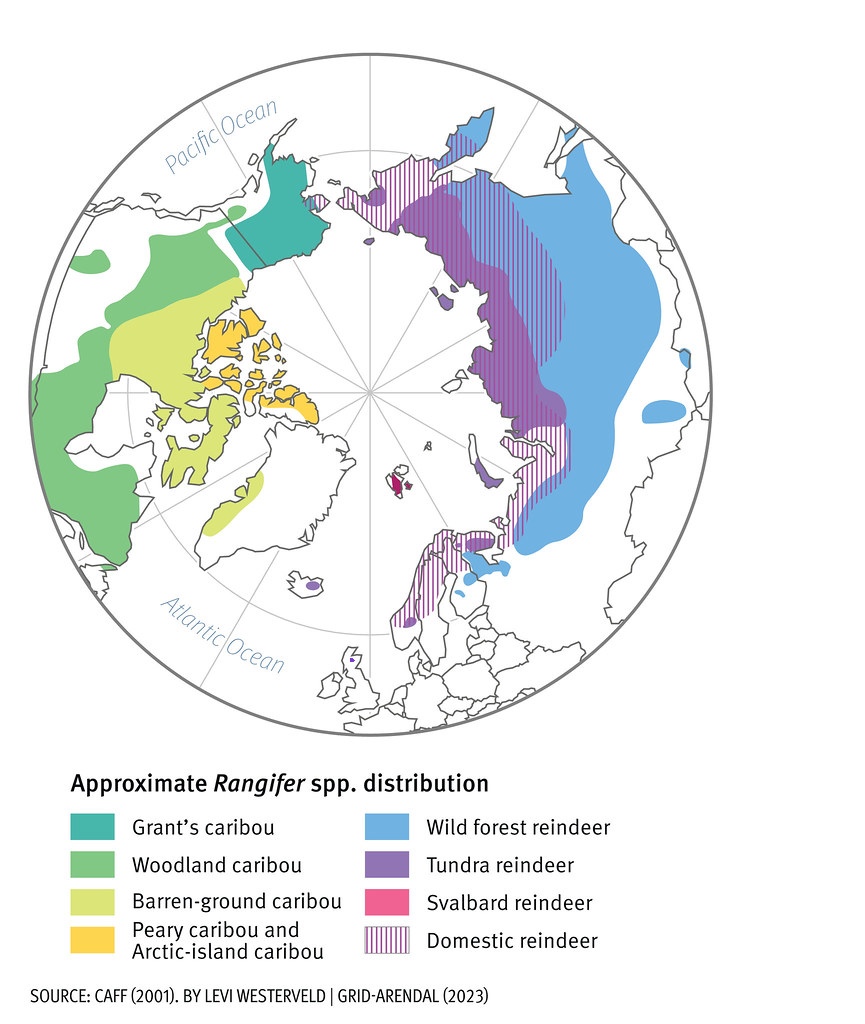
Population map of all subspecies of reindeer, including the N.American caribou populations and the European domestic and wild populations. (Map source: found at the bottom of the image)

Unlike the Svalbard reindeer, these subspecies do follow a larger migratory pattern, and will usually cover anywhere from 12 – 34 miles per day. They move between areas following the availability of vegetation and to avoid the harshest environments during winter months.

The herds will also move alongside humans. Both species are heavily domesticated and have been for over 10,000 years now. Not only are the reindeer used for food, income, and general way of life by indigenous communities (most noteably in Europe – the Inari Sámi), but the reindeer themselves benefit. Knowledge passed down through generations regarding migratory behaviour, and the animals role in the ecosystem means a huge positvie impact on Arctic conservation. This not only benefits the domestic populations of reindeer, but also the wild ones, as well as all other forms of life living in these ecosystems.
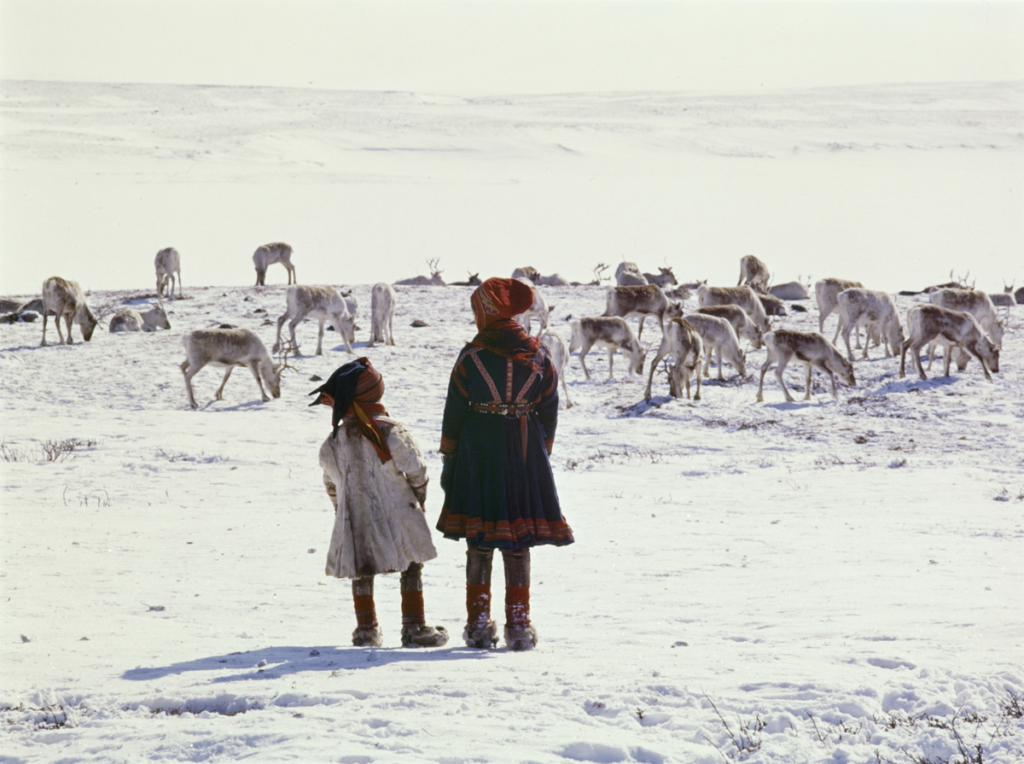
Sámi communities will follow the reindeers migratory habits, travelling vast distances with them every year. (Photo credit: Norsk Teknisk Museum)

The vast numbers of these two subspecies, the distribution of their population, and their movement patterns, give them a much larger impact on the ecosystem than the Svalbard reindeer. With grazing habbits helping to maintain Arctic tundra, it prevents the release of stored carbon in the permafrost. Being farmed in the traditional methods that they are – constantly moving, following the behaviour of the reindeer rather than using other methods of stationary farming – the reindeer are still able to exhibit their natural behaviour. It has also maintained a positive coexsistence between man and the fragile Arctic ecosystem.
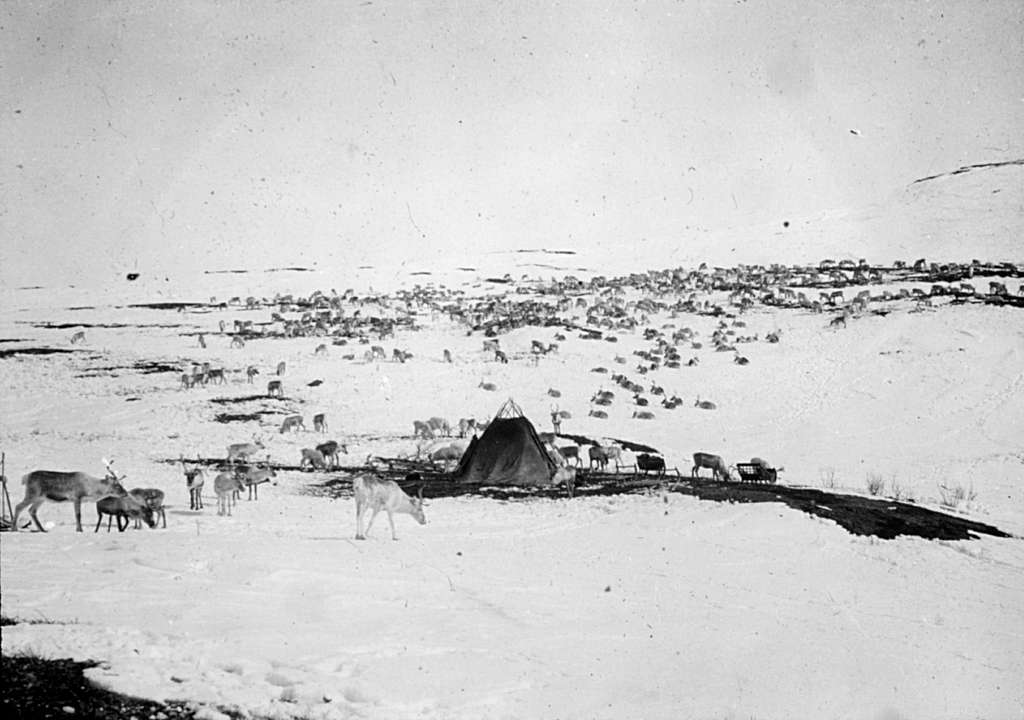
Moving home and following the natural behavioural patterns of the reindeer.

This means that the reindeer have not needed to adapt to a stationary lifestyle. Their bodies are still designed to cover large distances and they remain successfully adapted to their role in the ecosystem – dispersing seeds in the trampled ground they’ve moved over.

Something they have adapted for over the last 10,000 years though, is sledge pulling.
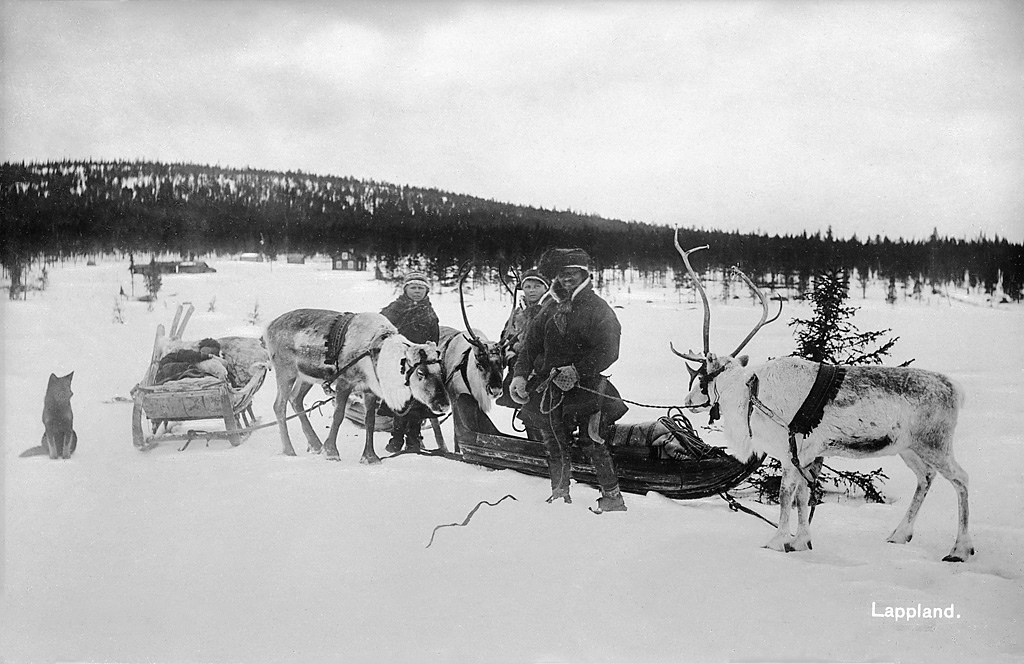
Bigger males, often castrated herd members will be used to pull belongings when following the reindeers migratory habits.

Due to living alongside humans for such a long period of time, the European tundra and forest reindeer are semi domesticated. They don’t perceive humans as a threat and are very accumstomed to interacting with people and being handled. This means their strength and good hoof structure can be utilised for sled pulling.
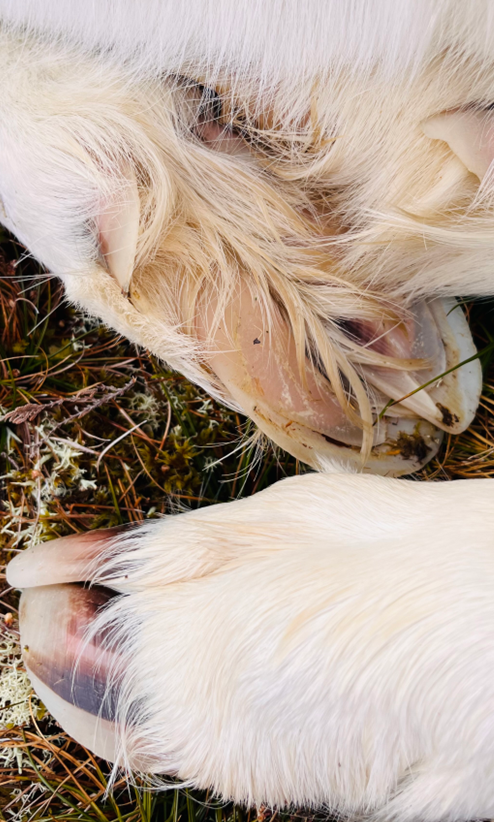
Reindeer toes!

During the winter months, their footpads will shrink and tighten, this exposes the edge of the hoof and allows them to dig it in to the snow. They’ll maintain grip for descending and ascending hills/mountains, and still be able to run at high speeds without the risk of losing their footing. Their strong and muscular build, easy going/ docile nature, and drive for yummy rewards(!) makes them the perfect Arctic sled pulling animal. Second to the sled dog of course, also having worked alongside humans for approximately 8 – 10,000 years (I don’t think anyone could be happier pulling a sled than those guys!).
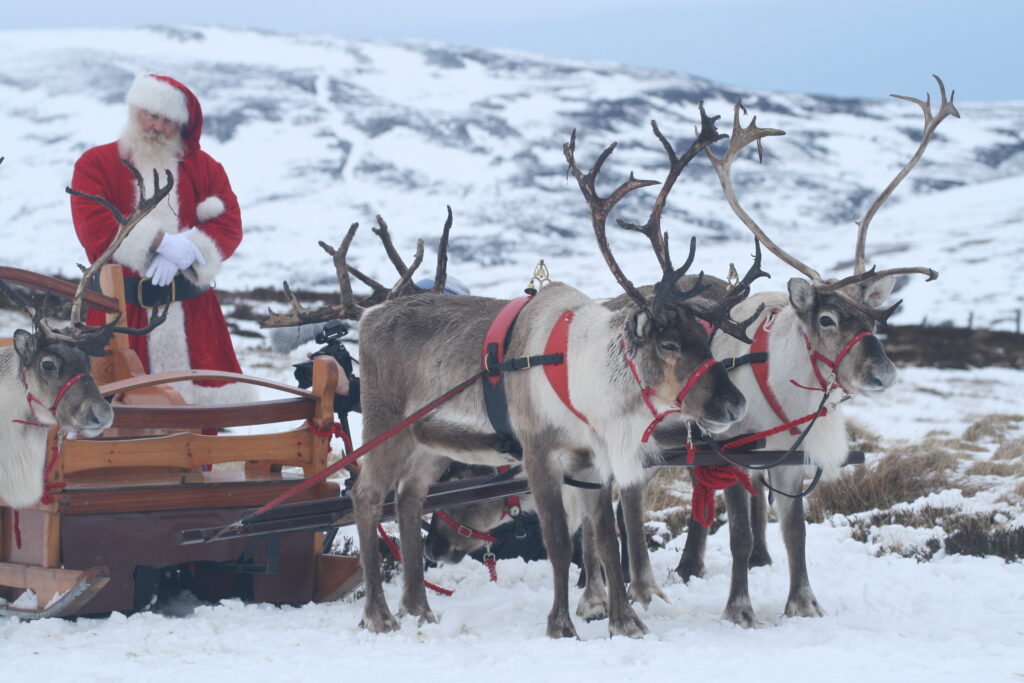
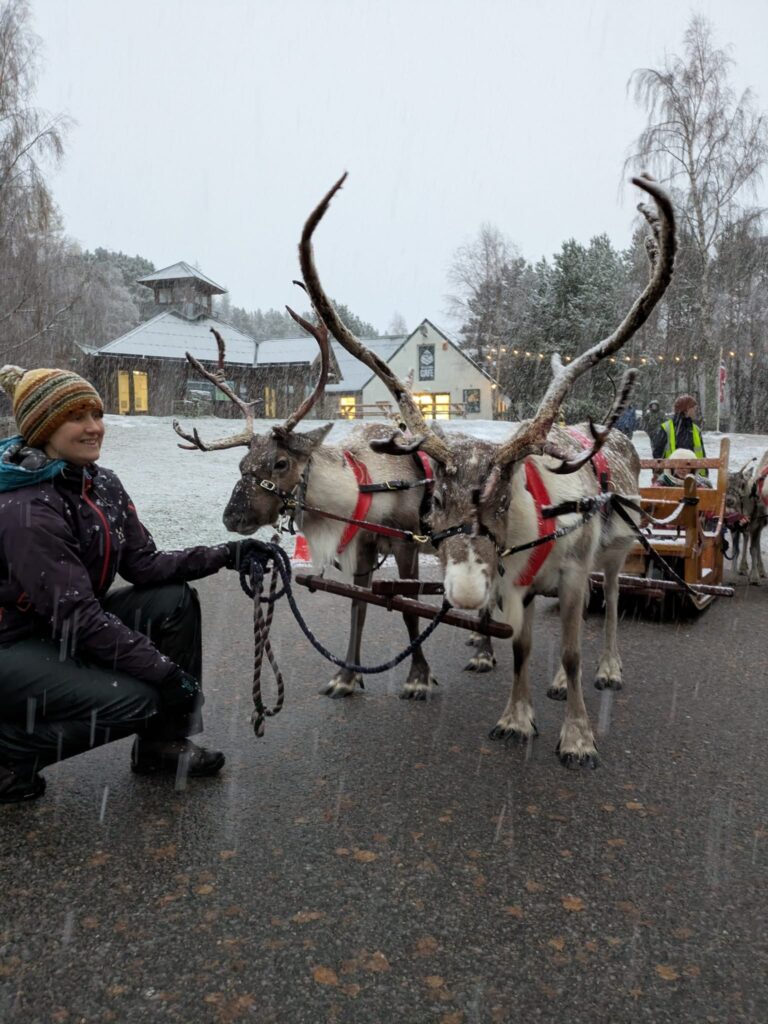
Keeping tradition alive. Our very own reindeer pulling sleds here in the Cairngorms. (Photo credit: Alex Smith)
Our wonderful boys Zoom and Mivvi pulling a wheeled sleigh through Glenmore.

So, in summary, it seems the main adaptations for the European tundra and forest reindeer are behavioural more than physical. They have adapated to be more docile around humans, whilst still maintaining their natural drive to move. Not only for their benefit of chasing good grazing, but also for the benefit of the ecosystem – keeping the Arctic environment healthy.

Next time we’ll jump over 4000 miles from Europe to North America, and find out what the difference is between a reindeer and a caribou (if any).

Daisy

Further reading:

www.//oneearth.org/species-of-the-week-reindeer/

Reindeer and Caribou: Health and Disease, edited by Morten Tryland and Susan J.Kutz (CRC Press, 2019)

A Day in The Life of a Herder on Tour

I thought I’d enlighten readers of a typical day in the life of a reindeer herder on tour.

7.30am: Anyone who knows me will know that I am terrible in the mornings, so my alarm clock is greeted with the usual feeling of utter horror, quickly followed by extreme distress. Fiona (my manager at Reindeer House) will testify that this can last till lunchtime sometimes.

Andi and I (collectively known as team Handi) are on tour with our reindeer once again and are currently right down in Cornwall. This is the furthest afield that we travel and are away from home for 2.5 weeks, the longest time we ever take reindeer on tour for. Home from home just now is a farm near St Austell, when both us and the reindeer have accommodation – but we’ve stayed on two other farms en route down here, and have had several days with no events, so by no means have we travelled all this way in one go.

boys-barn-cornwall
Morning boys!

8am: Our event today doesn’t start till late afternoon, so it’s a fairly relaxed start for us. First priority is to check the reindeer, who are all still lying down dozing when we reach them. On this farm they have a lovely large barn with a deep straw bed, and it’s a particularly nice building for them as it is very well ventilated and they can see out at every angle. They also have some very close neighbours here, in the form of several groups of cattle, all of whom couldn’t quite believe their eyes when we led the reindeer into their shed on arrival yesterday!

Paintpot ignoring his inquisitive neighbours

Before we feed the reindeer their breakfast, we pop their halters on and lead them out in to a neighbouring field to stretch their legs. There’s a brief bit of galloping about and ‘dancing’ (the reindeer equivalent of a horse bucking), but they soon knuckle down to the more important business of grazing. Grass is far too rich for a reindeer’s diet for them to exist purely on it, but a short spell in a field does them no harm and they enjoy it immensely. Andi and I have the usual team of 6 reindeer with us – 4 castrated males (‘Christmas reindeer’) and two 6-month-old calves. Our team this time consists of Paintpot, Tanner, Sooty, Minute, Nazca and Olmec, and having been away from home for 8 days now, we have got the measure of them all, knowing all their little quirks and the exact pecking order between them.

cornwall-field-3
Olmec, Nazca and Sooty following us round the fields

They look so relaxed out in the field that we prepare their breakfasts in the barn, but decide to have our own breakfast before bringing them in. It’s a nice secure field so there’s no worries about them deciding to explore the Cornish countryside on their own.

9am: We bring the reindeer in, but as this team are so relaxed, experiment with a laid-back method i.e. we don’t bother putting leadropes on the calves (we are nowhere near a road). They potter along – just the ticket – if only all teams were quite this easy to lead about! They dive into their breakfast bowls with enthusiasm and we leave them to it.

Leading the whole team back to the barn

Team Handi head inside – at this time of year Reindeer House is in the grip of Christmas chaos, and the staff left at home fight to keep their heads above water amidst (among many other jobs) the adoption packs that require making up in time for Christmas presents. As such, Imogen has emailed us through a list of letters that need writing, and Andi and I just happen to be equipped with headed paper, envelopes and stamps. Fancy that.

2pm: We’ve had a couple of hours off chilling out, but lunch has been had and there’s work to be done. We’re off to a Cornish seaside town today, about an hour’s drive away. We load up the reindeer, and off we go!

3.30pm: We arrive on schedule, and are greeted by the organisers of the event. Our pen is outside a hotel on a grassy area, and there’s a brief delay while they frantically locate some more barriers, the number needed having been lost in translation. This is why we always arrive with plenty of time to spare! I move the lorry around the back of the hotel into its car park, with one of the (male) staff taking it upon himself to ‘help’ me reverse. Have been driving a lorry for years, and have made it all the way here from northern Scotland – can probably just about manage this bit myself, thank you very much…

4pm: The reindeer are on public display before the parade today, so we get them settled into their pen with feed and water, and pop up our info signs. I wangle a couple of cups of tea too, essential for reindeer herders on tour. Well me anyway – Andi’s day was ruined earlier by a coffee machine producing a cup of hot milk without a hint of caffeine to be found. Disaster.

Delighted people looking at the reindeer

With a couple of hours to go before the parade Andi goes off to decorate the sleigh, while I man the fort in the pen, chatting to people and handing out leaflets. The reindeer still have their furry noses in their bowls and ignore the fairly large crowd, particularly, it seems to me, all the people hanging over the barriers calling out ‘Rudolph!’…

6.10pm: 20 minutes to go, so it’s time for us to start harnessing. Minute and Paintpot are the chosen sleigh pullers today, so they wear the bigger harnesses, while the ‘back reindeer’ wear smaller body belts and bells. We get a bucket of lichen to keep Olmec, who is the shyer of the two calves, busy while we put his harness on, but it just results in a mugging from the bolder Nazca – who has earned the reputation of ‘small and annoying’ in the last few days! Olmec stands quietly watching the antics of his buddy…

6.20pm: T-minus-10 minutes, so it’s time to put the reindeer ‘into trace’ (attach them to the sleigh). Andi is leading the reindeer at the front today, so it’s my job to clip the various straps to the right places, and make sure everything is correctly connected. Not helped halfway through by having to retrieve Nazca from the other side of the pen, complete with a wreath and set of bells on his head that he’s collected from the front of the sleigh. ‘Small and very annoying’ today, but it gives the crowd a good laugh! I attach his leadrope to the back of the sleigh, and hope he behaves himself. He doesn’t.

Minute and Paintpot all set for the parade

6.40pm: After a slightly late start (not our fault), we are off! The boys excel themselves to say the least, and are proper pros, ambling along steadily. Nazca even manages to keep his wee antlers to himself for a little while, rather than poking them where they don’t belong: into the decorations, another reindeer, the leadropes, parts of my anatomy. It’s a fairly short parade, so we’re finished by 7pm. Work done for the day, we unharness the boys (while the organisers and hotel staff all take selfies with Nazca!) and repack everything into the lorry.

7.25pm: The reindeer are loaded up, and we set off. A brief stop for fuel, and a short detour in the wrong direction at a roundabout, but we’re back at the farm by 8.30pm. The reindeer are unloaded back into their barn, the cows looking on, and as soon as I pick up the feed bag there’s a chorus of moos, just in case it’s for them. The reindeer are utterly unperturbed.

9pm: Boom! Job done! Dinner is in the oven and pyjamas are on. At this time of year they are the only item of my clothing without a background aroma of reindeer pee. And people think travelling all over Britain on tour with reindeer must be glamorous…

Hen

Getting Ready for Christmas (Tour)

Whilst our reindeer spend the vast majority of the year leading a very relaxed life out on the Cairngorm mountains, for the six weeks running up to Christmas, some of our full-grown adult males and six-month-old calves take it in turns to join in Christmas events across the country. These events serve several purposes: spreading the word and educating people about the reindeer, raising vital funds to sustain the herd through the coming year, and of course spreading some festive cheer, especially to those who are unable to make it up to see the herd at home.

Xmas signs
Sleighs and sign boards waiting to be varnished, whilst some of the “farm boys” observe from their part of the barn

Xmas kit
Boxes of sleigh decorations, useful kit for the trucks, spare everything…

Of course taking up to eight teams of six reindeer away on tour requires just a bit of preparation. Or rather, a lot of preparation. Poor Fiona deals with all of the paperwork and logistics, starting in January (it’s always Christmas for her!), whilst Tilly is the queen of organising the rest of us into helping her sort out the physical kit required. In October, most of the team end up spending a day or two at the farm, helping to scrub, sort, varnish, count and clean the various bowls, head collars, harness, ropes, boxes and sleighs, and to mix numerous bags of feed.

Xmas Headcollars
Digging out the smart event head collars and ropes from storage

Xmas varnish
Giving the sleighs a fresh coat of varnish

Xmas bowls
Imogen got the short straw of pressure-washing all of the feed and water bowls

Our specially designed “boxes” which the reindeer travel in, similar to a large horse box but with additional room for a sleigh, also have to be taken out of storage and painted, cleaned and bedded down ready for the first trip of the year.

ReindeerLorryFleet1
Some of the trucks and freshly painted boxes ready to go ©Alex Smith

Xmas feed
Mountains of feed waiting to be mixed – we use a cement mixer for speed!

Xmas ropes
Nearly 100 lead ropes and head collars are needed to kit out all of the teams (each reindeer has a “smart” set and an every day set)

All in all, it’s a lot of work, but meeting so many excited and delighted people out on tour with our beautiful reindeer makes it all worthwhile!

Andi

Book Now