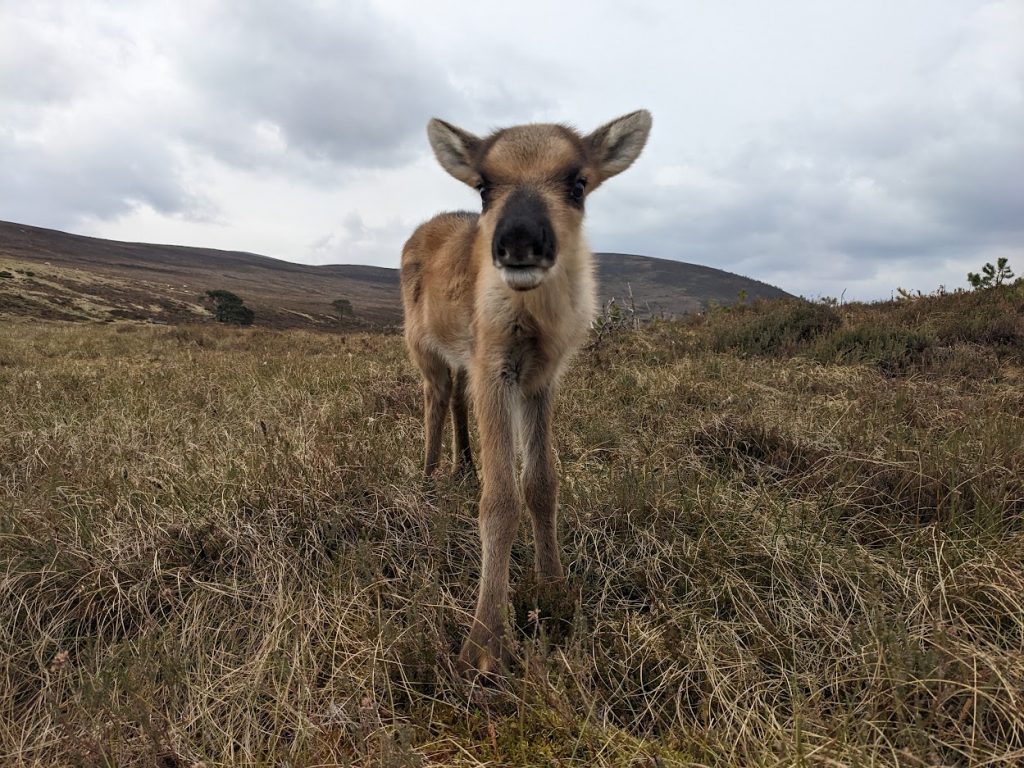
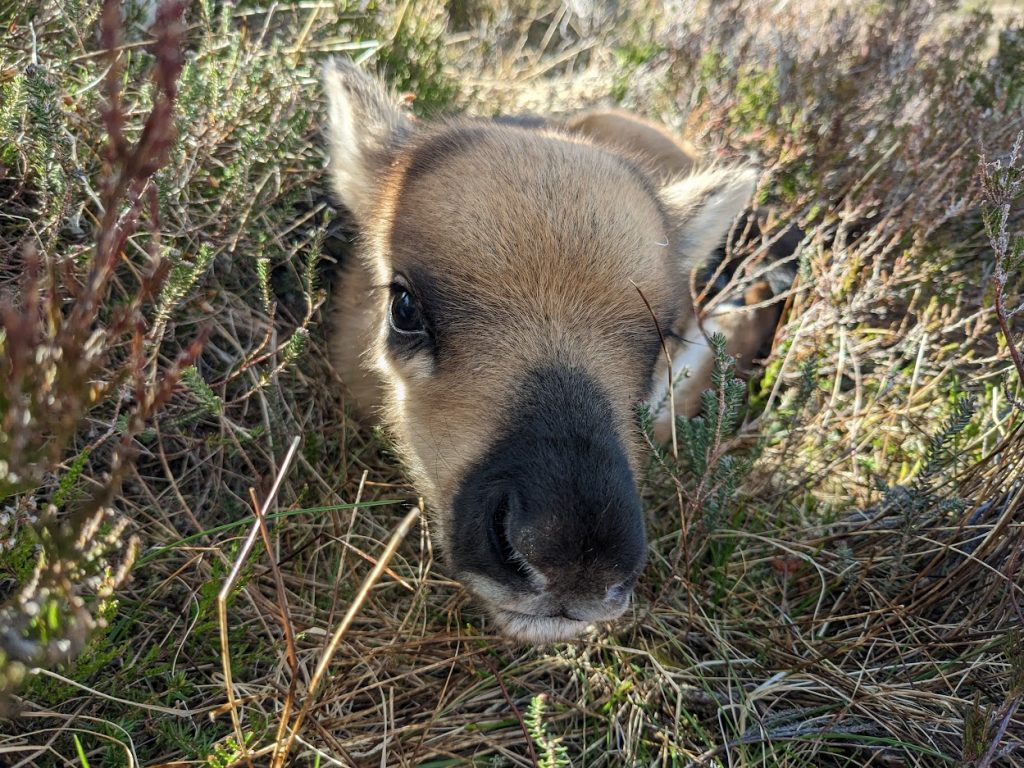
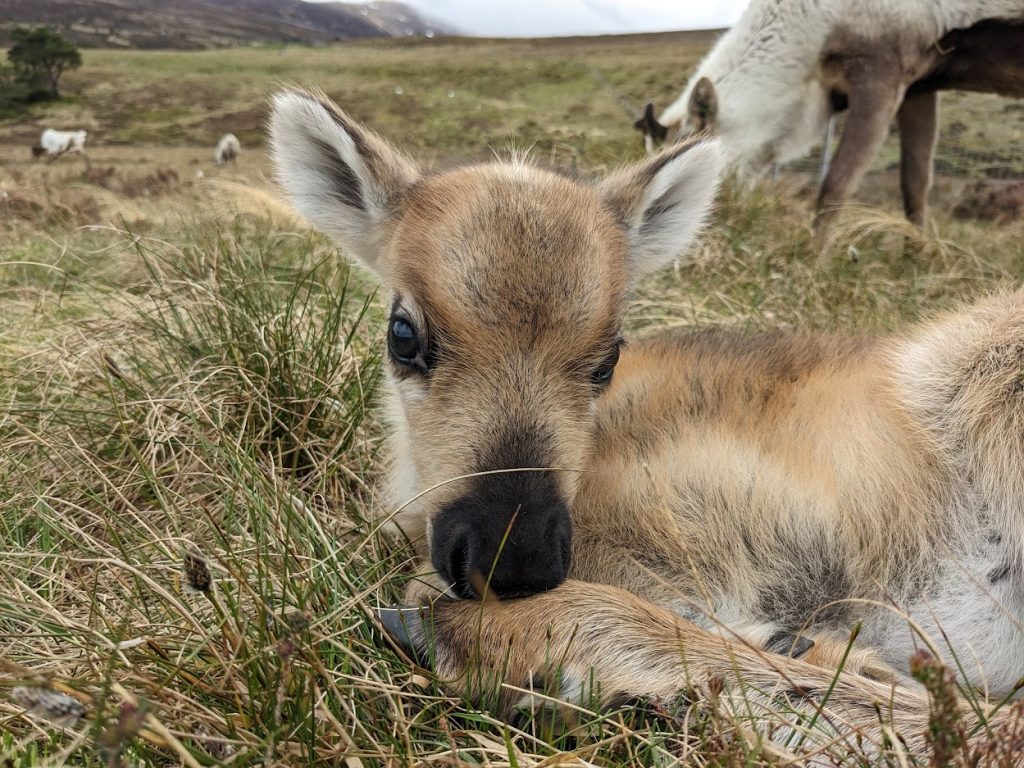
Photo Blog: April 2023

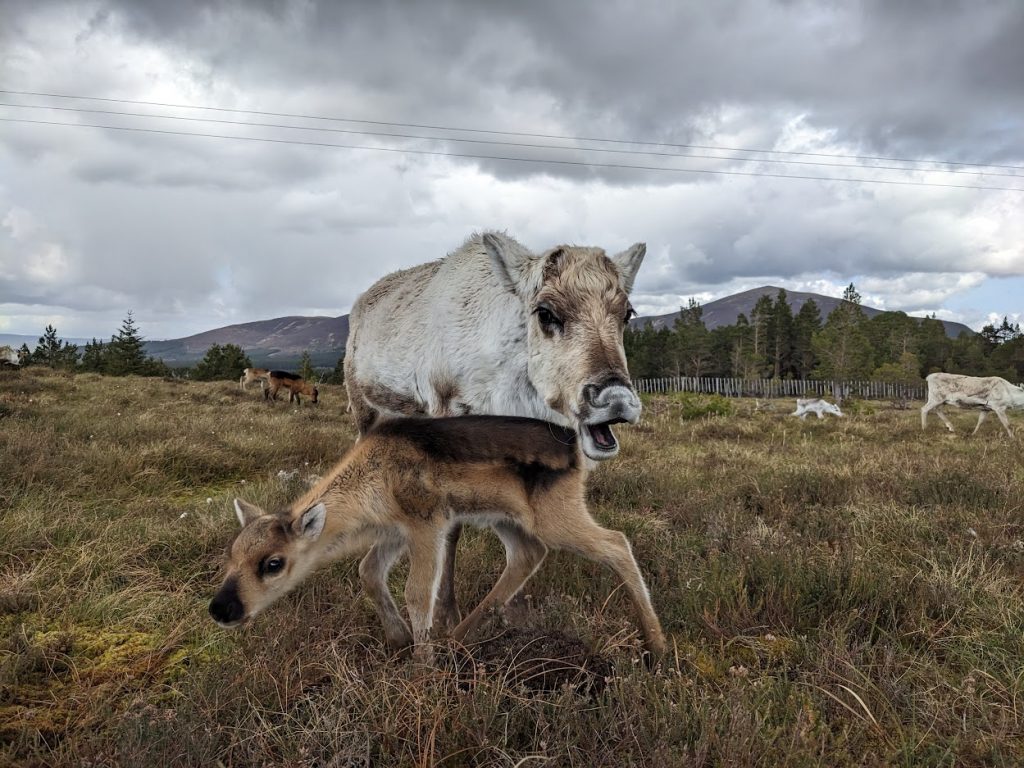
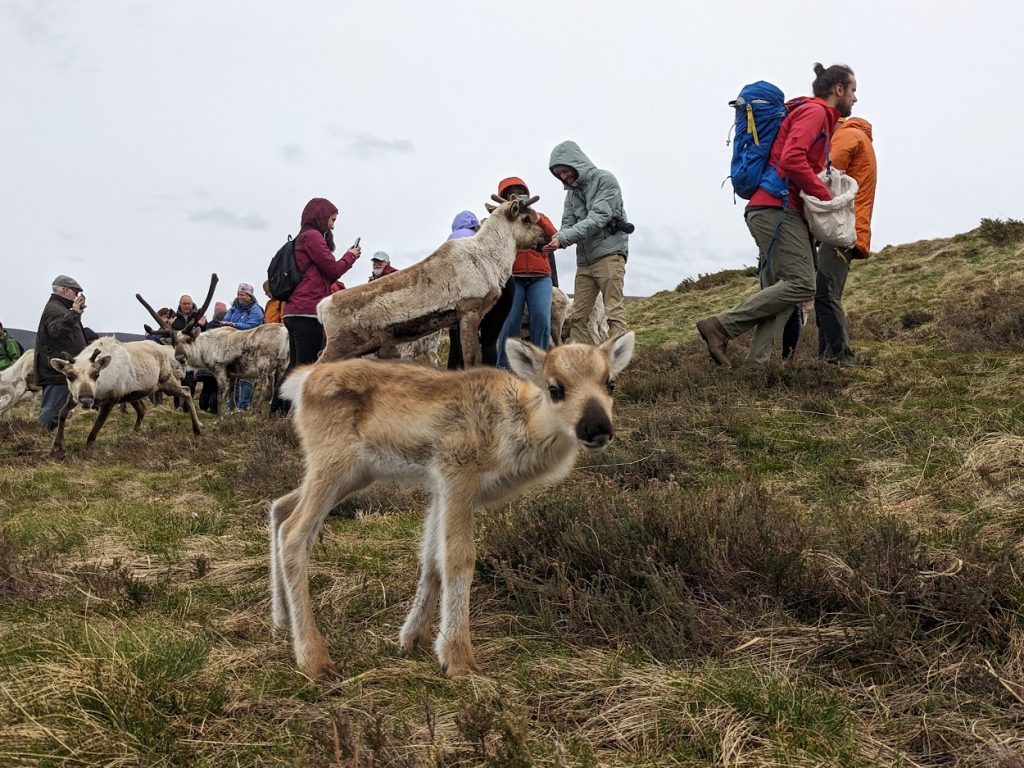
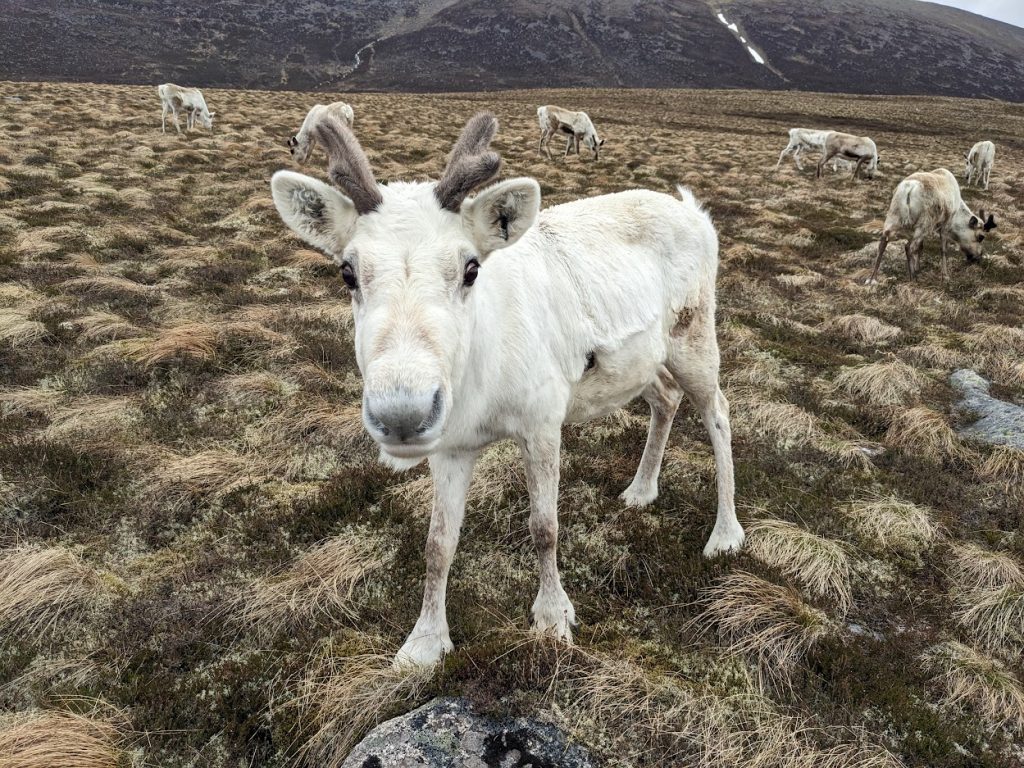
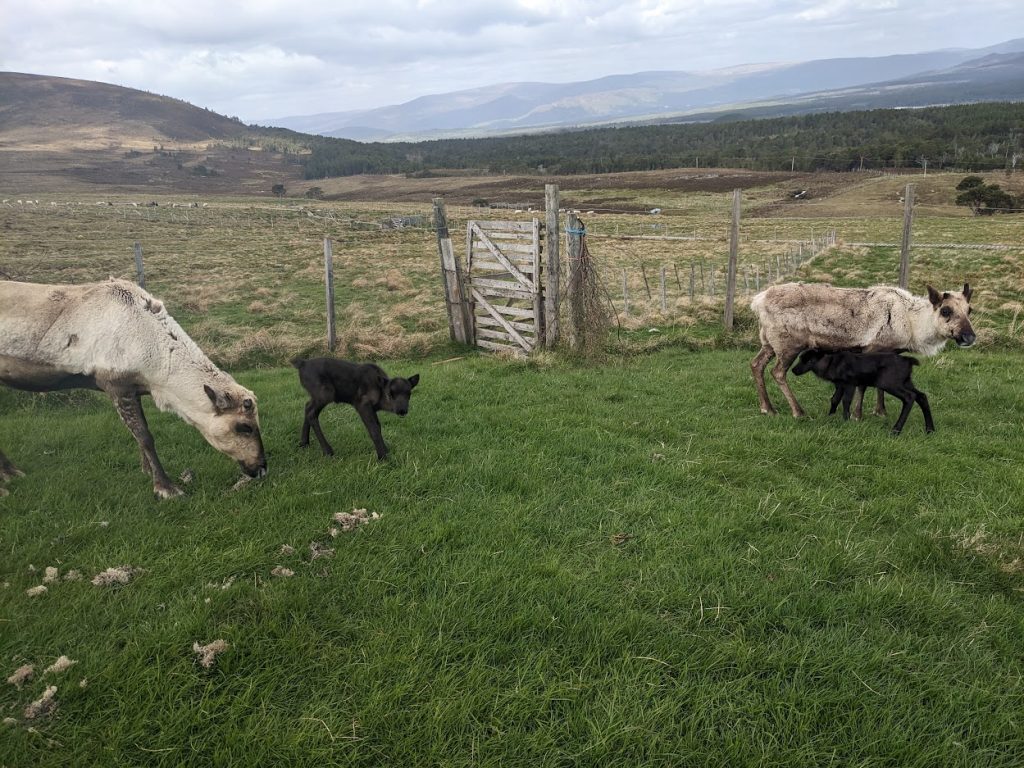
April has been a busy month with some glorious spring weather and some incredibly wild winter weather too. The first half of the month saw the Easter Holidays so we had lots of visitors around – some days we put on an additional Hill Trip in the afternoon when the morning visit sold out, and in the afternoons we ran “Seasonal Herder Talks” in our Paddocks. The second half of the month was busy with moving reindeer around getting them in the right places for the fast-approaching calving season… exciting! Pregnant females were brought into our hill enclosure and the “single ladies” (mostly the old girls retired from breeding or ones having a year off motherhood) were put back out to free range after a quick health check in the enclosure.

It’s been a fun month watching antlers casting and growing, and bellies widen on our pregnant females! Bring on calving season!

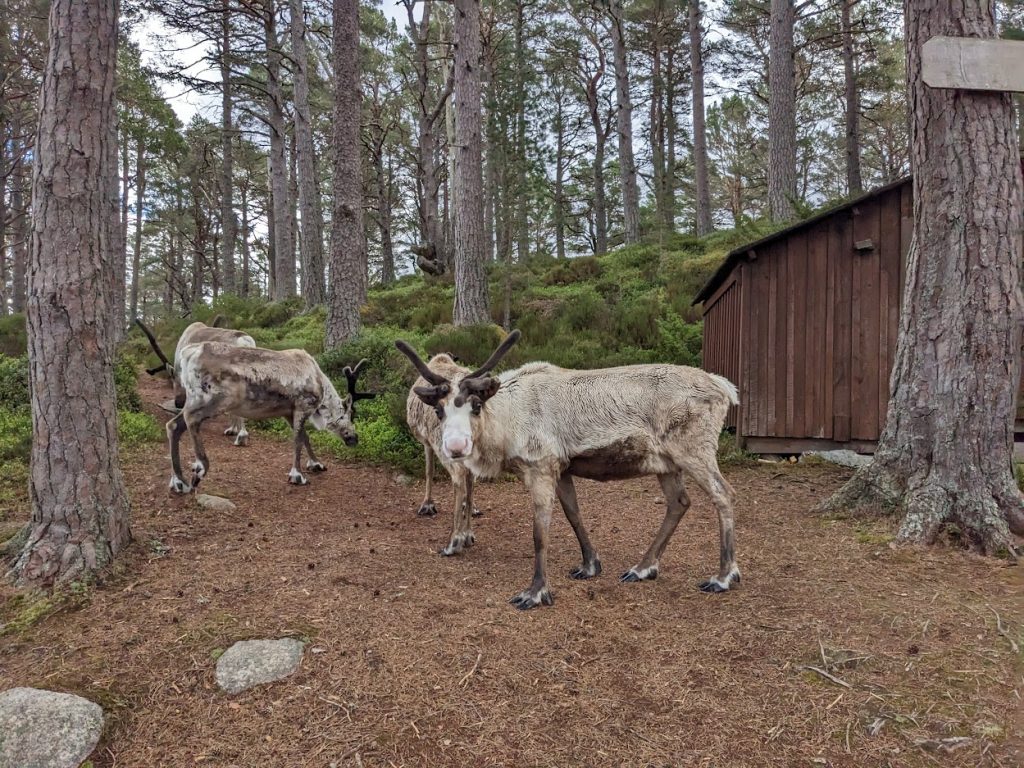
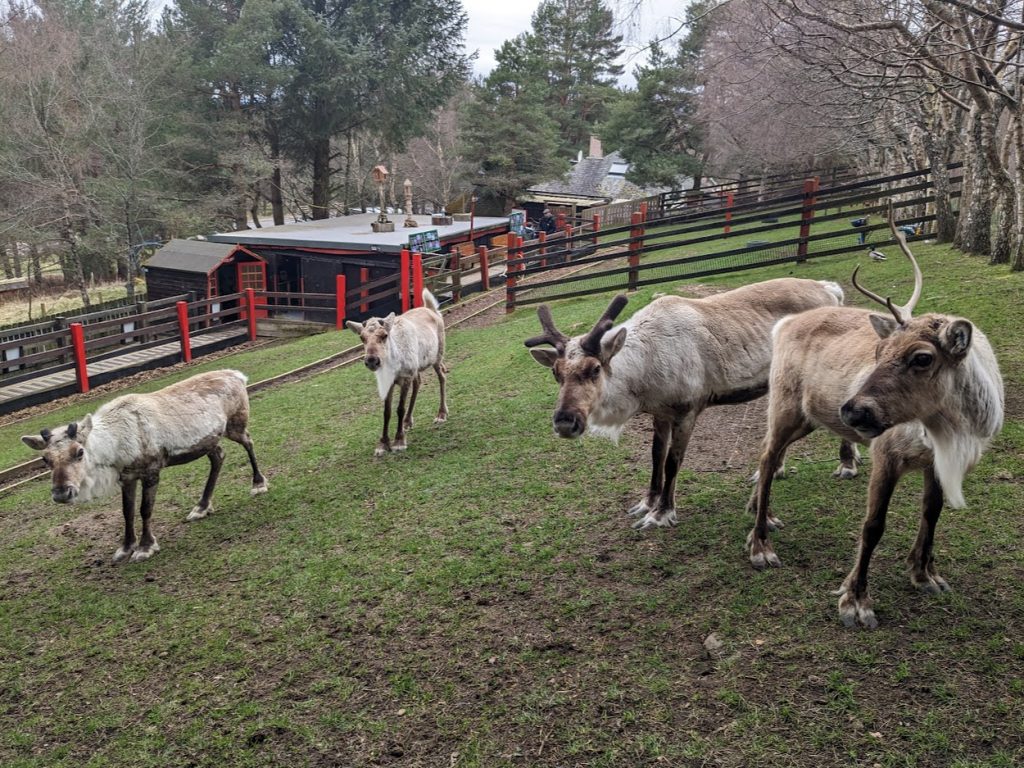
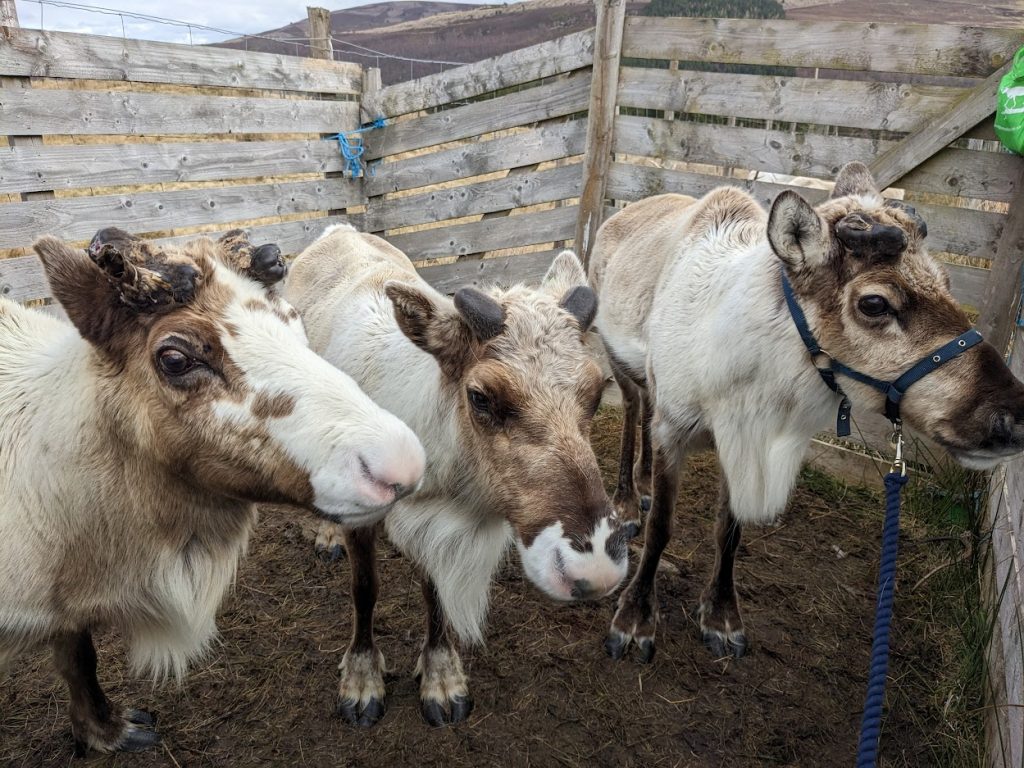
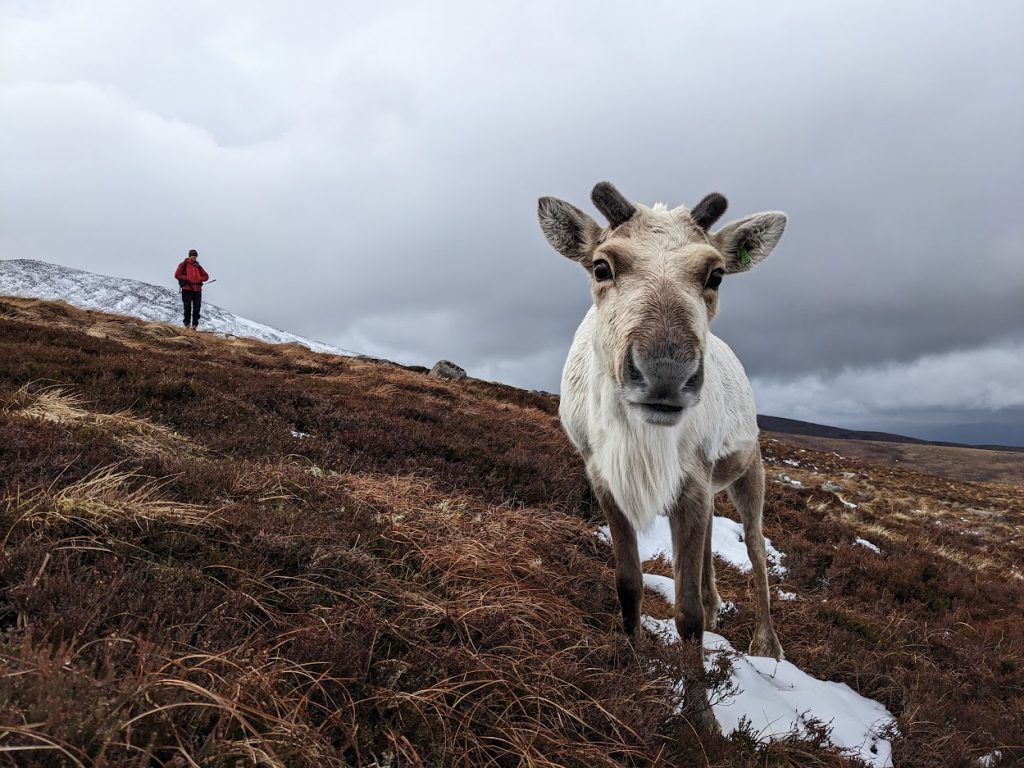
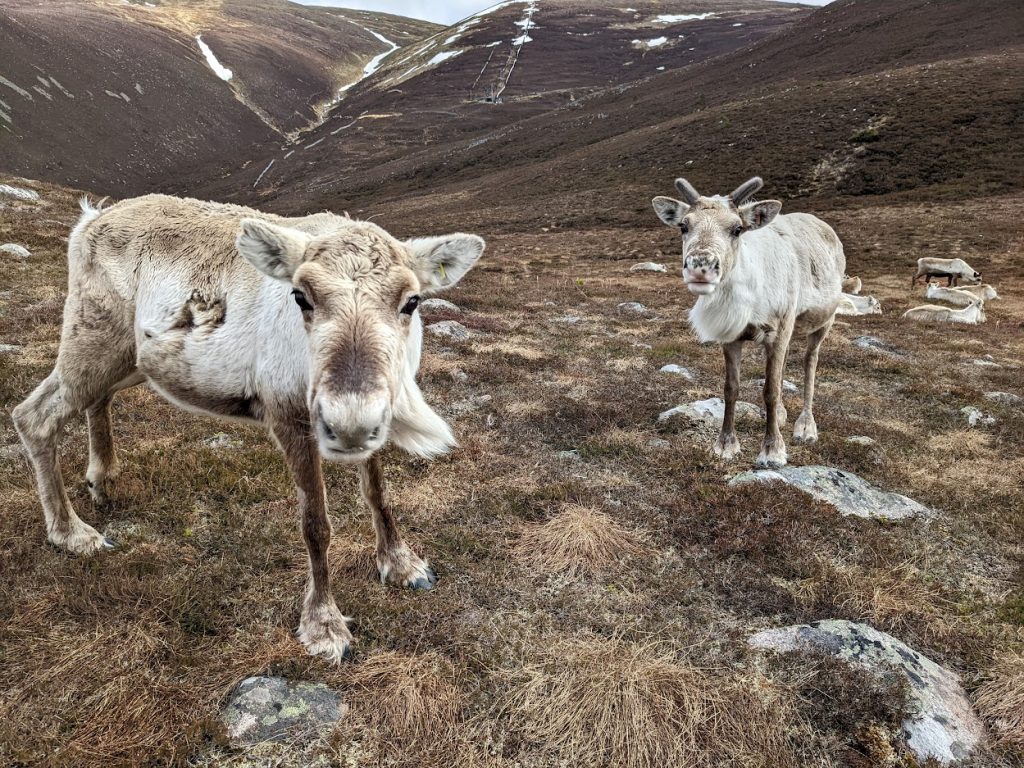
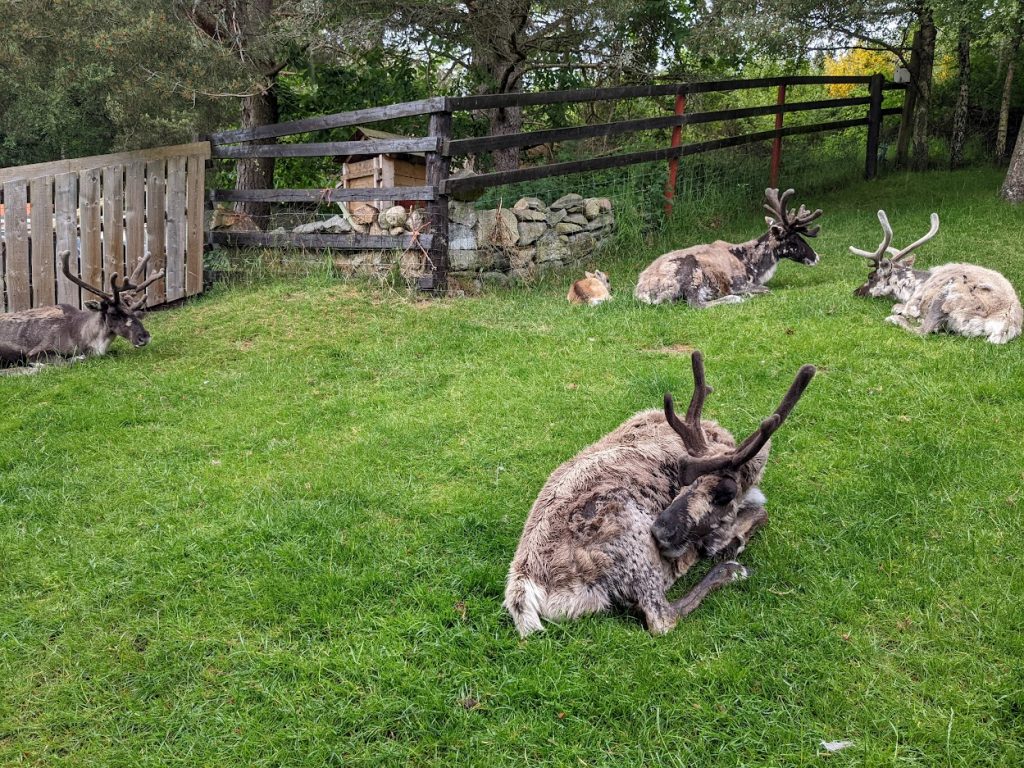
1st of April: We have reindeer back in our Paddocks! From left to right is Kiruna, Jelly, Sherlock and Busby, all here for the first half of the Easter holidays.
2nd of April: Fiona and I spent the day with Tilly where we brought of some male reindeer down from their winter free range. Here we have Dr Seuss, Spartan and Scolty ready to be taken down to the hill farm in Glenlivet.
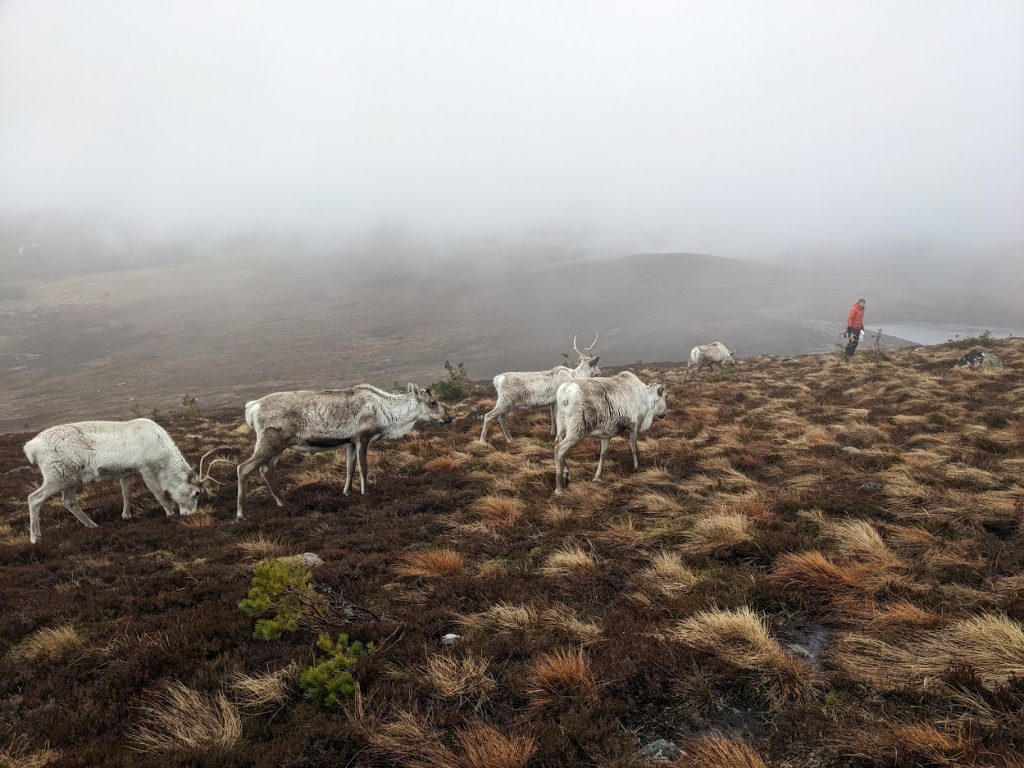
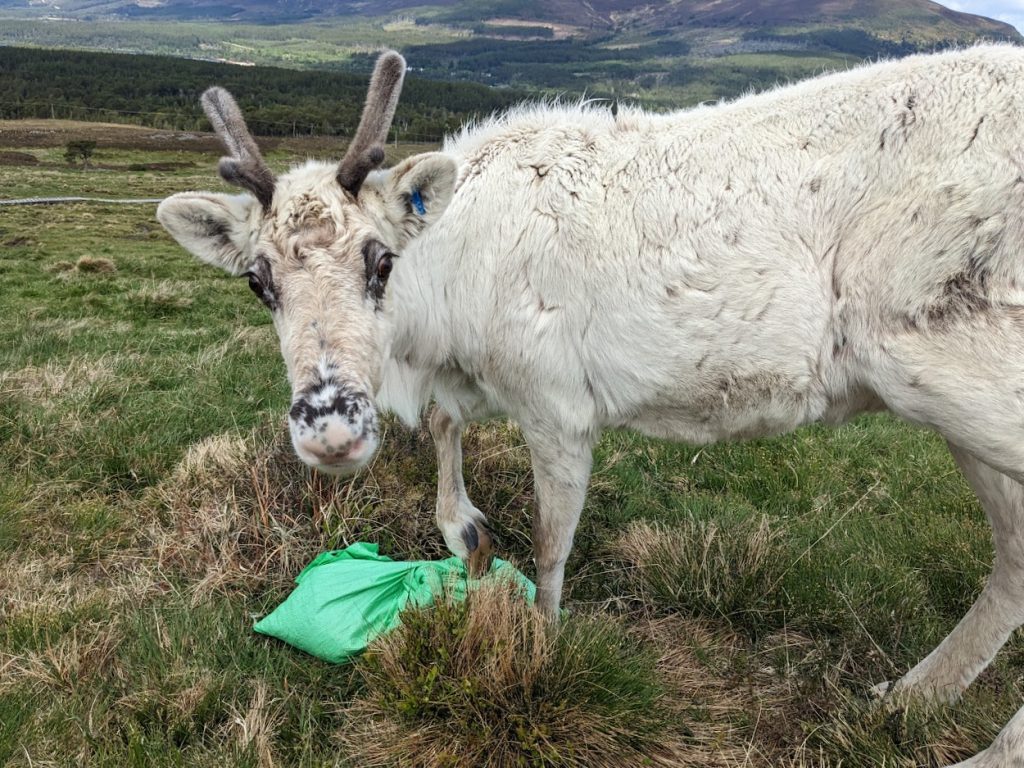
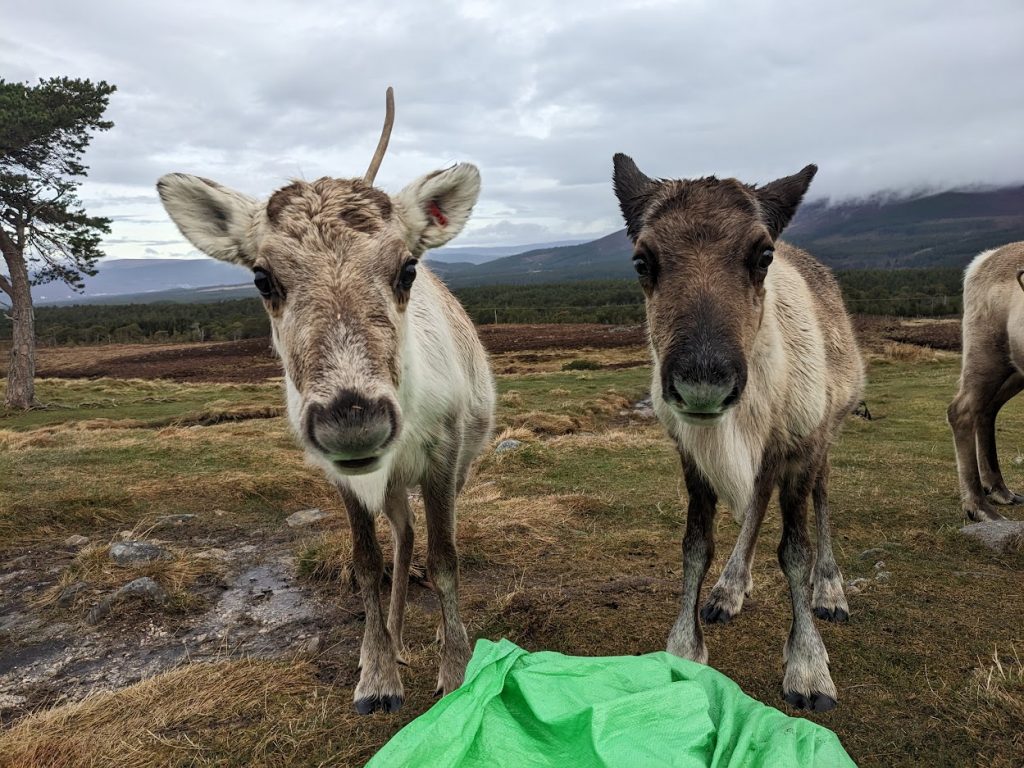
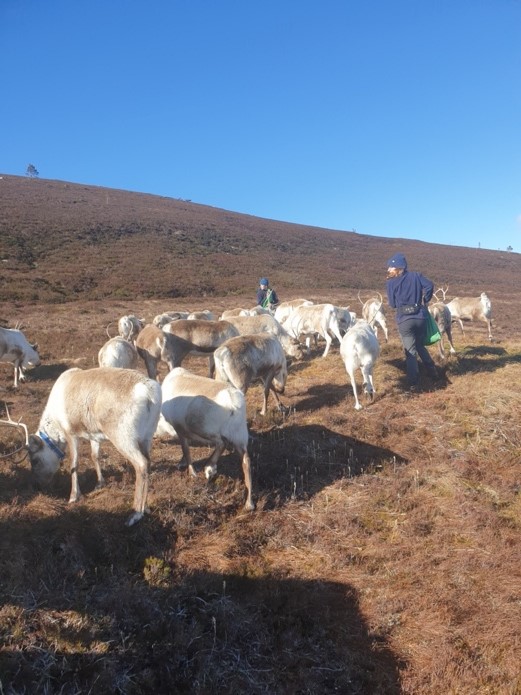
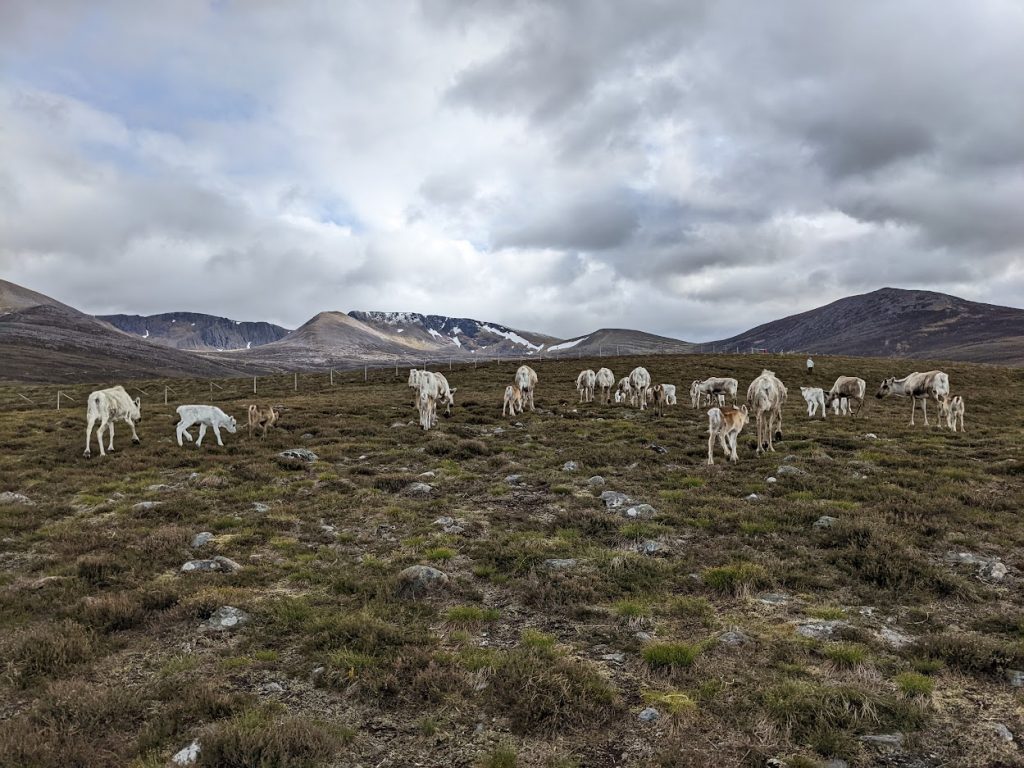
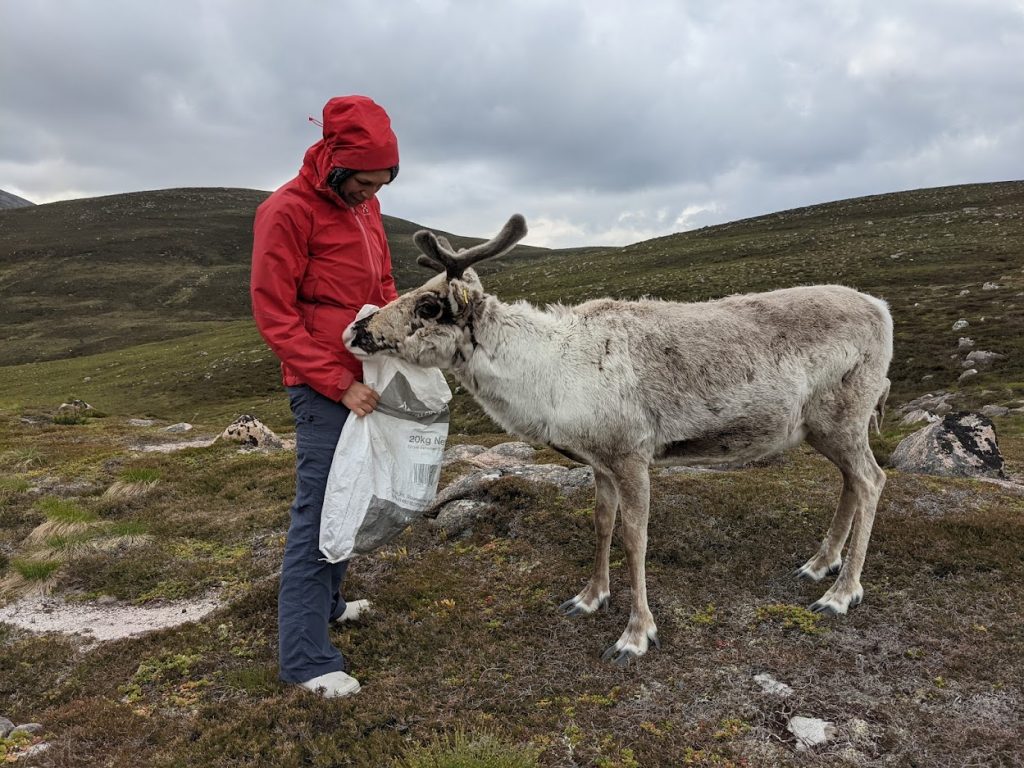
5th of April: Andi and I spent the morning moving the reindeer into position for the morning Hill Trip. You can just see Andi in the distance letting the calves feed out of the bags first.
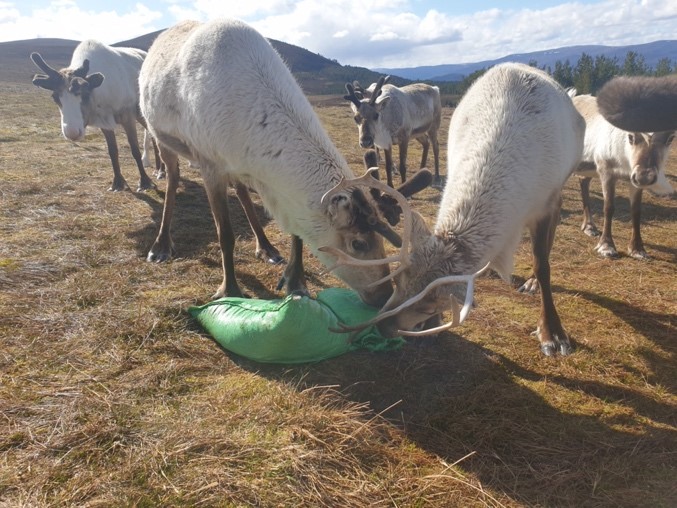
6th of April: Cousins Fab and Tub causing trouble!
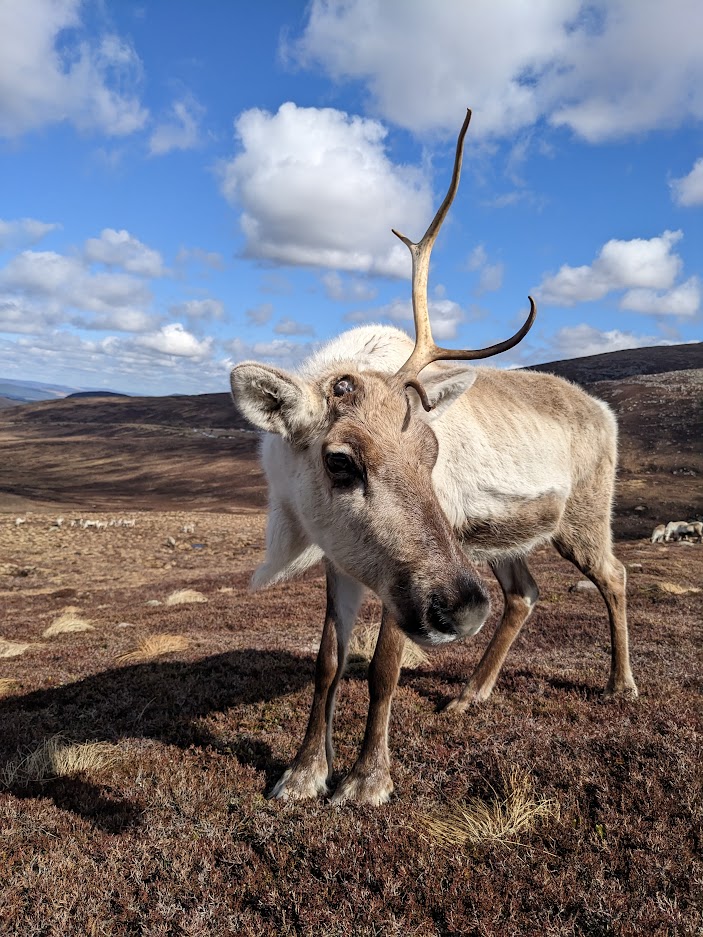
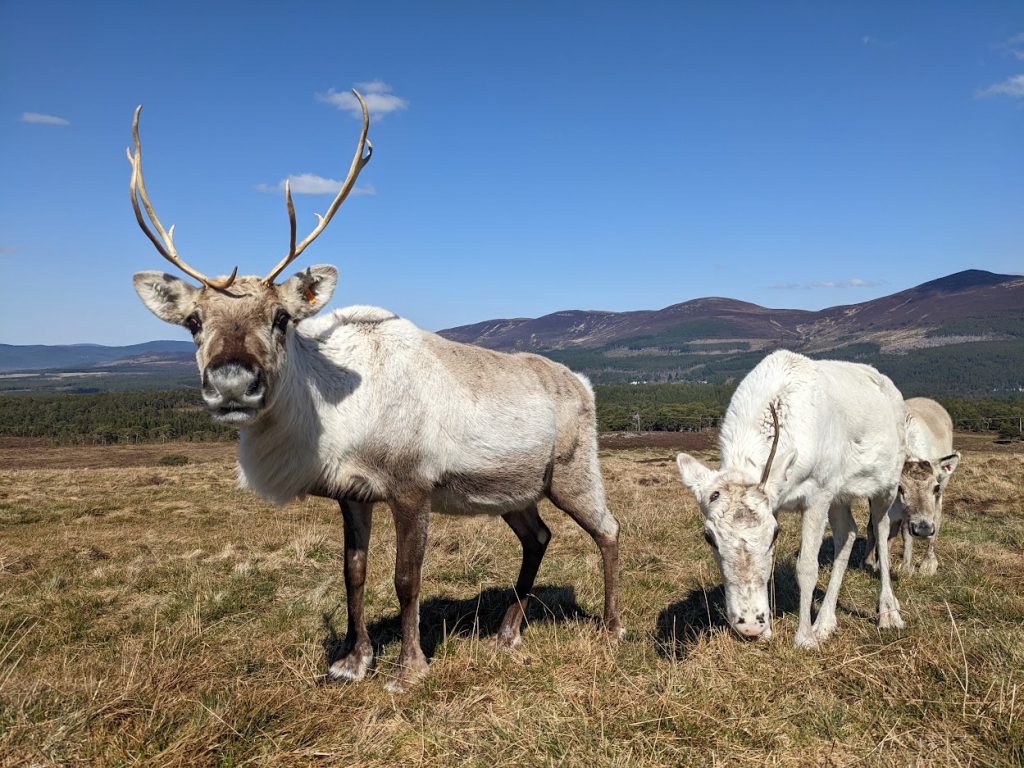
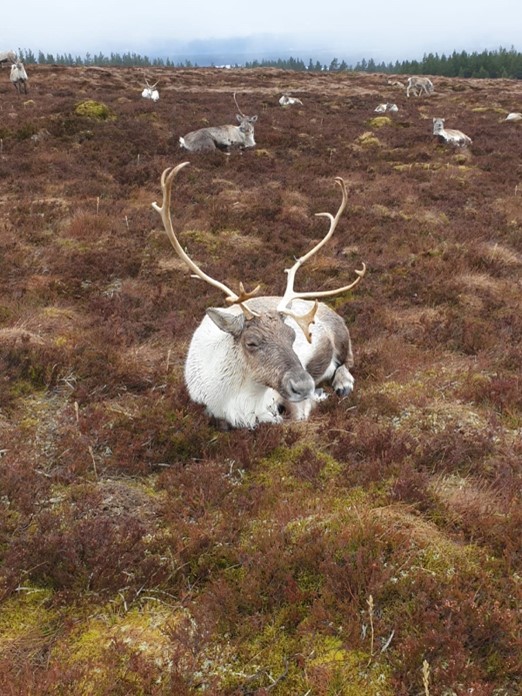
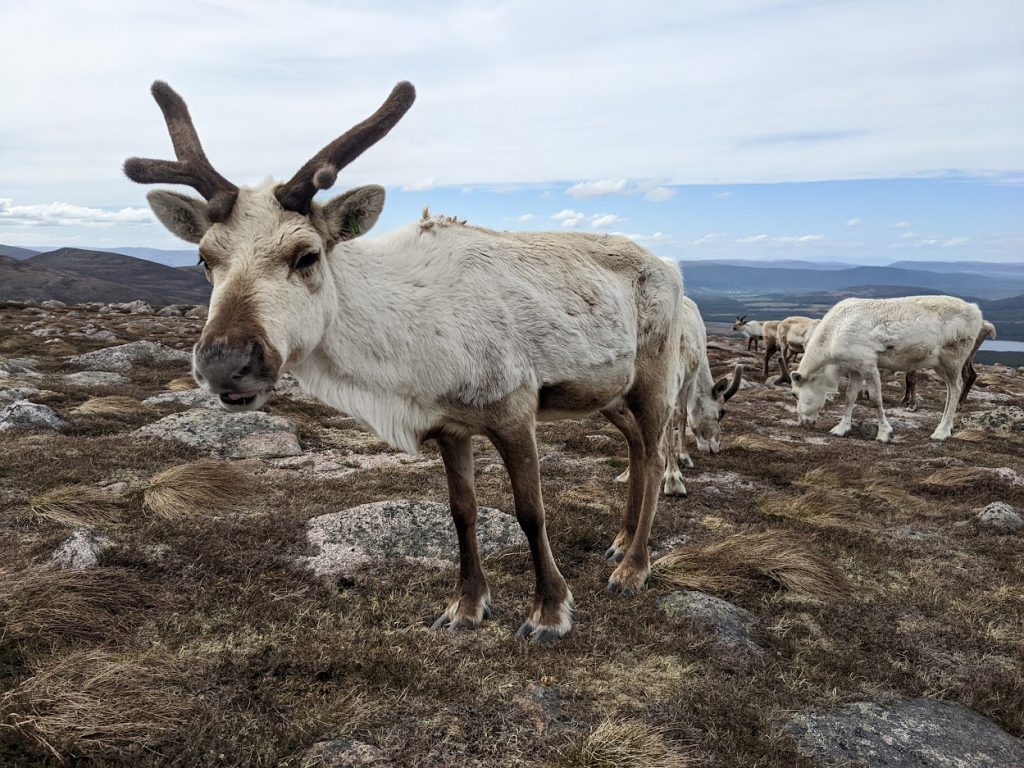
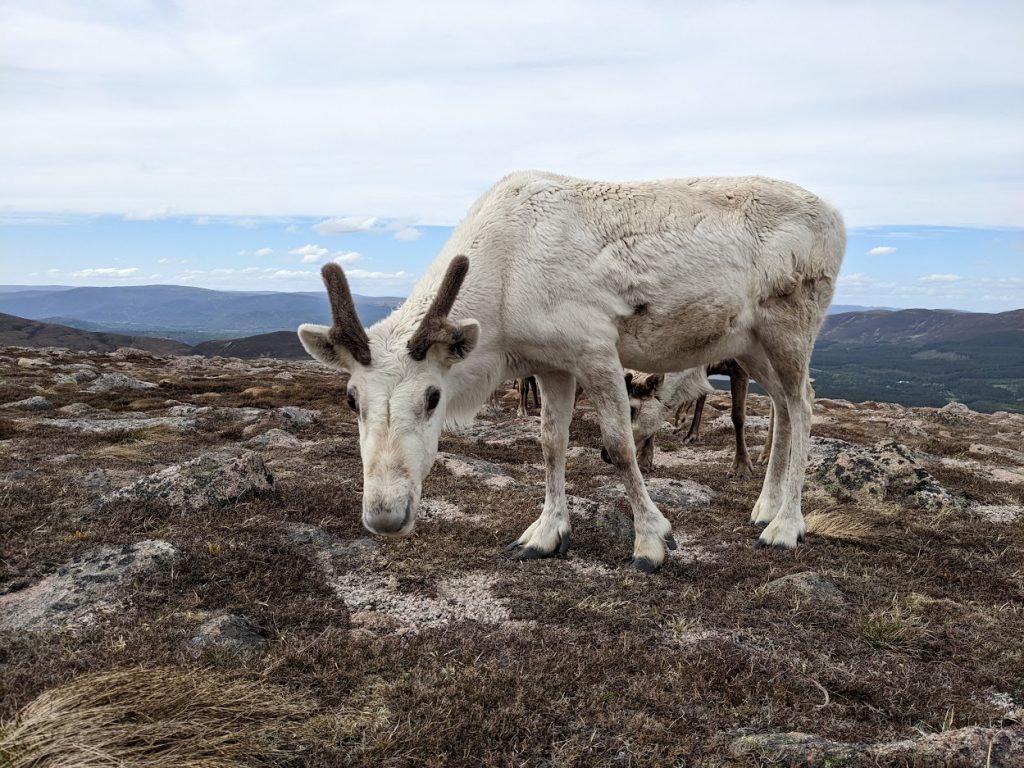
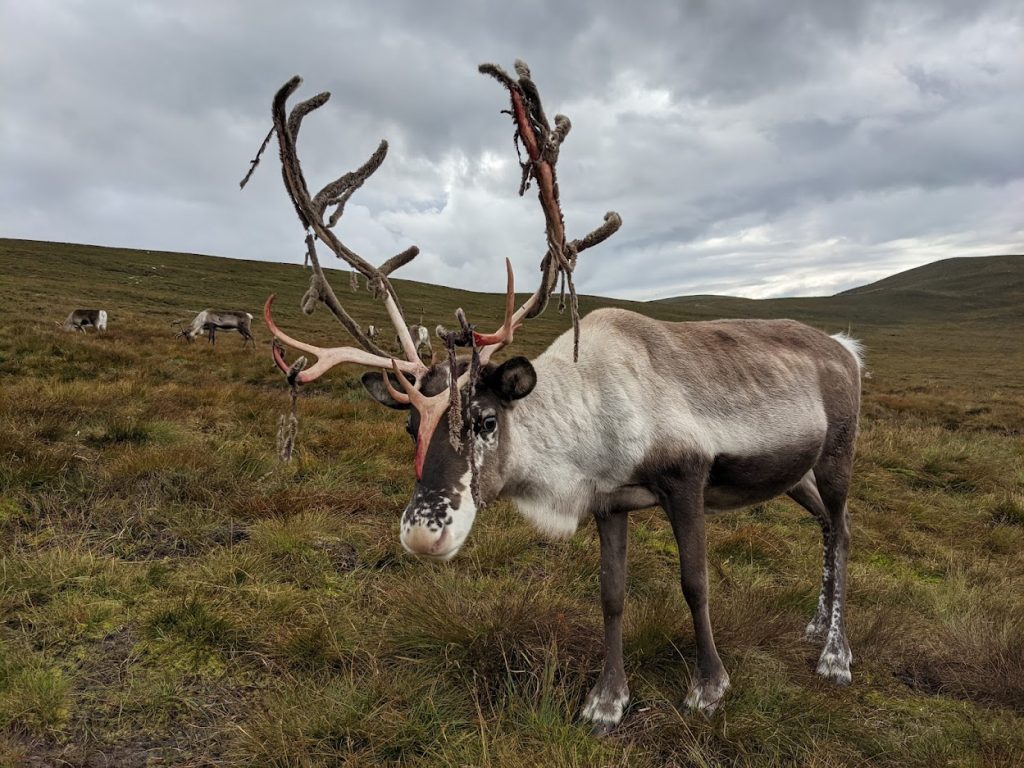
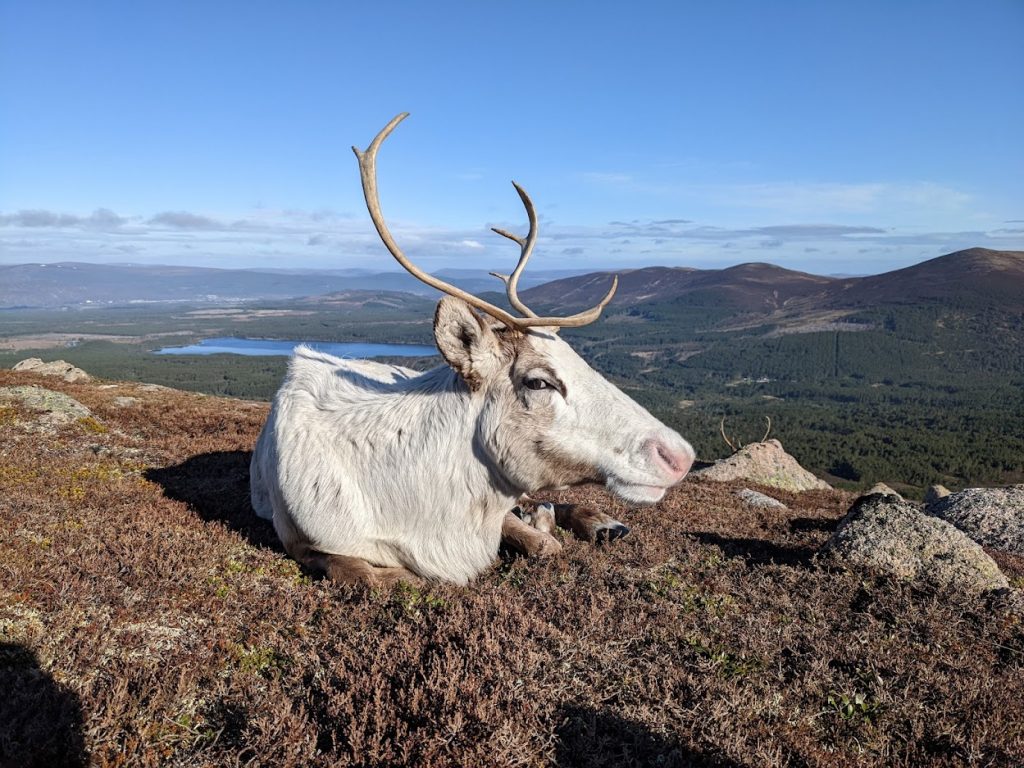
7th of April: Lopsided Florence demonstrating an excellent example of antler growth and development.
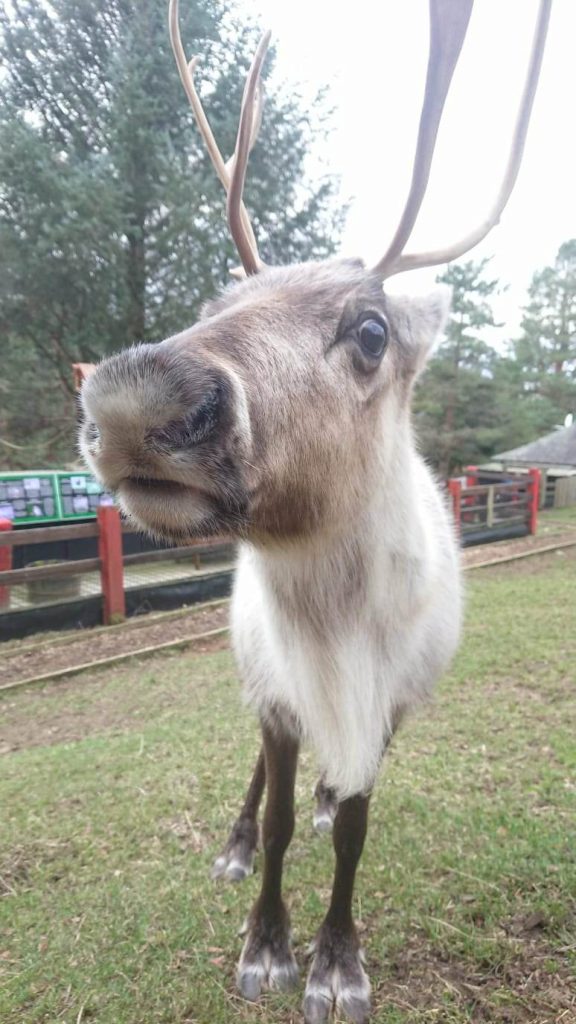
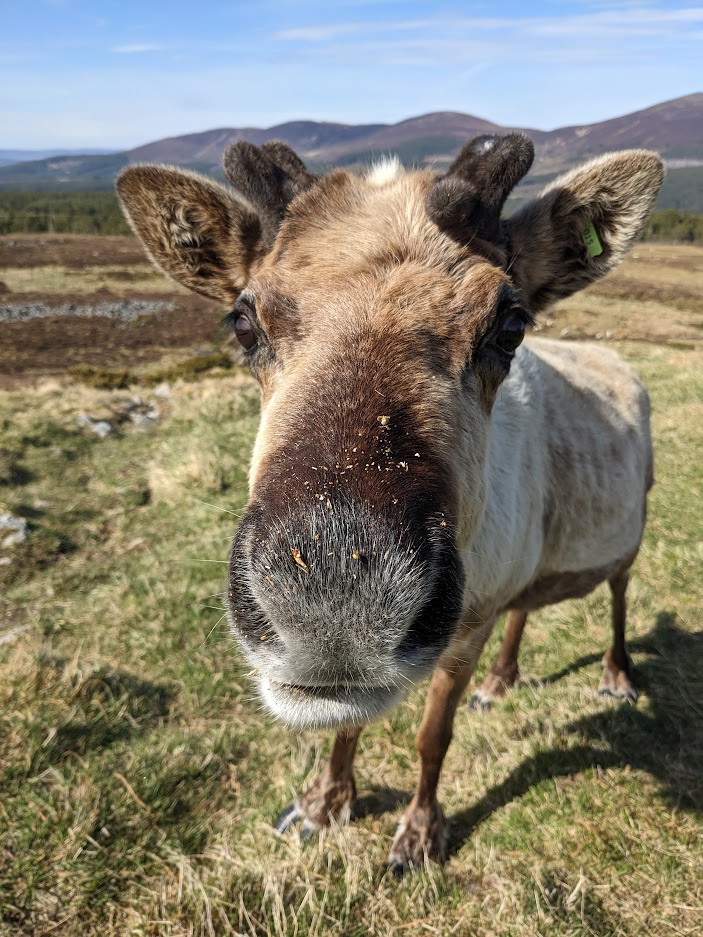
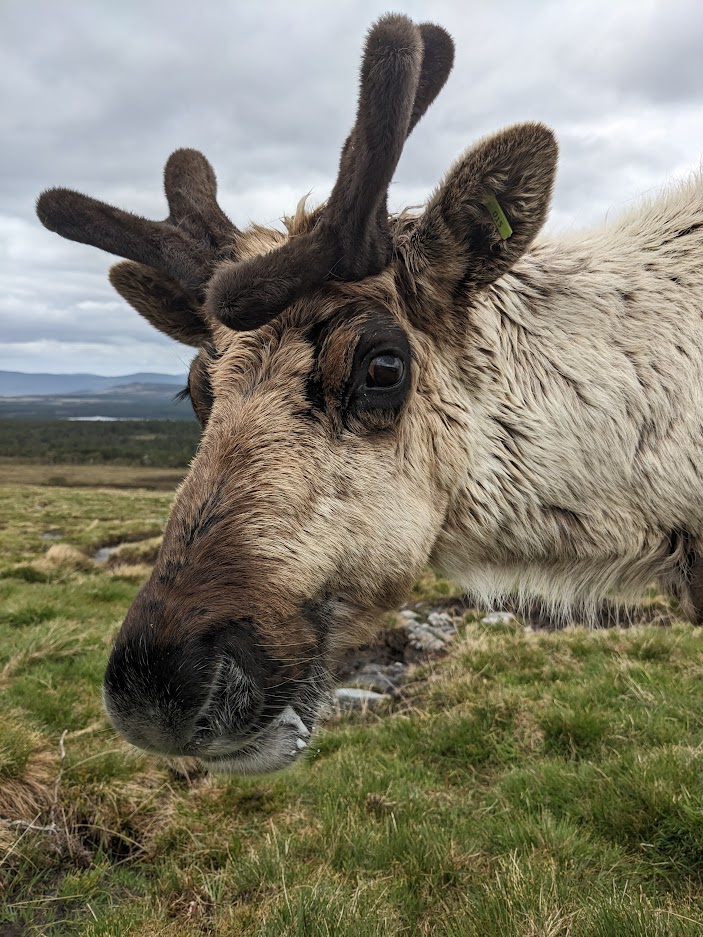
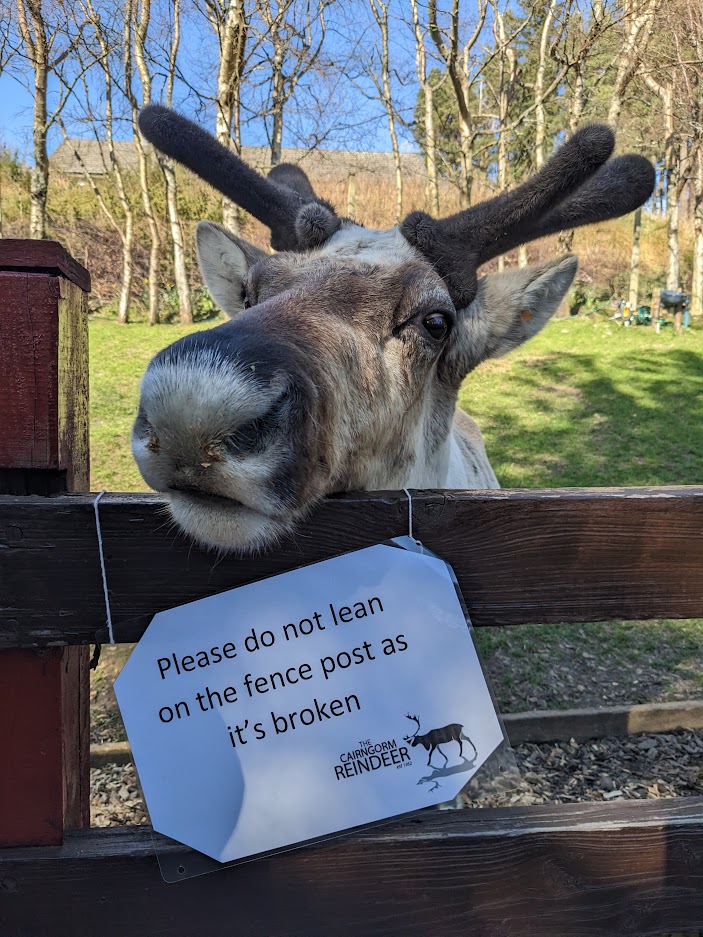
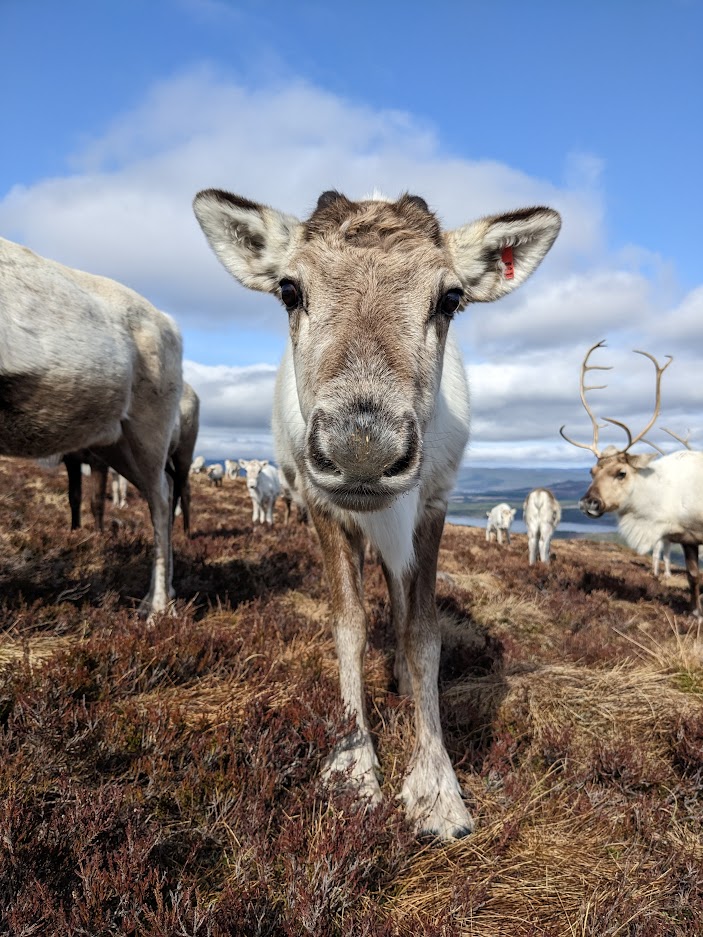
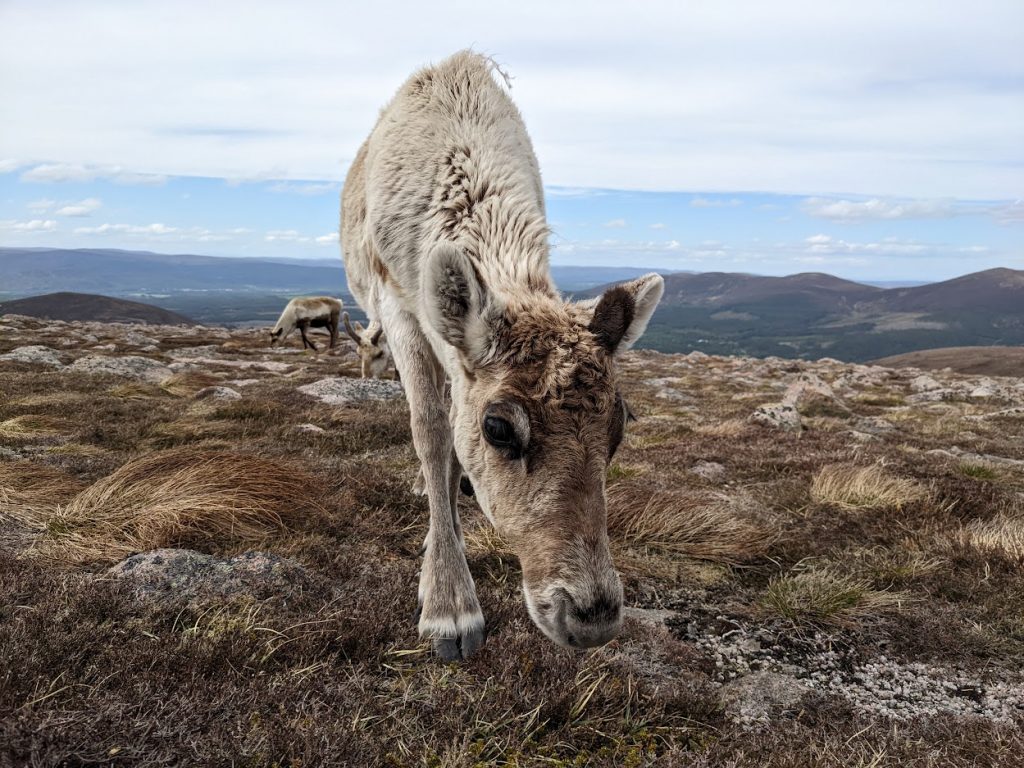
8th of April: Sherlock not remotely bothered about our wobbly fence, but it’s easy to forgive him with a nose like that!
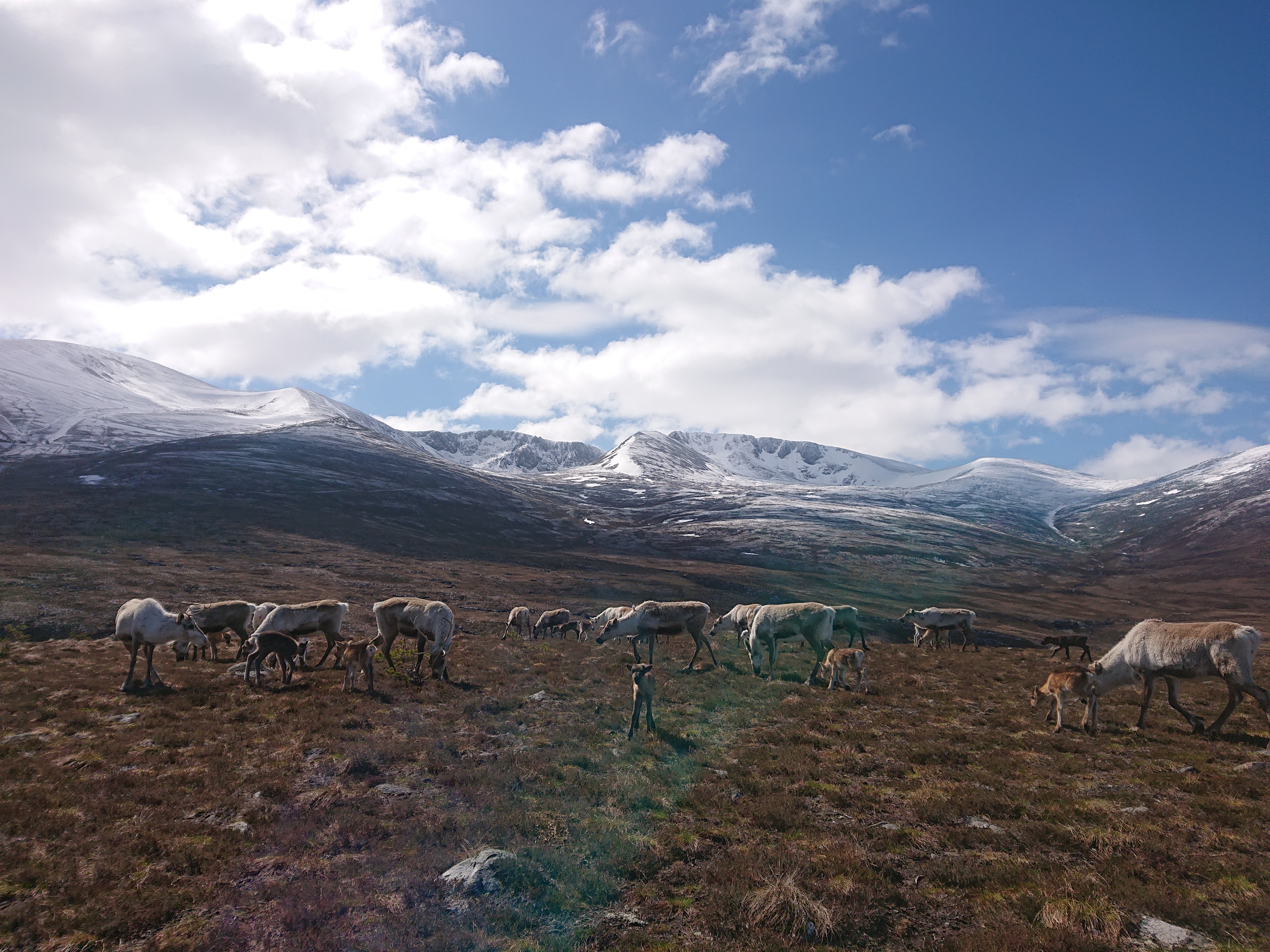
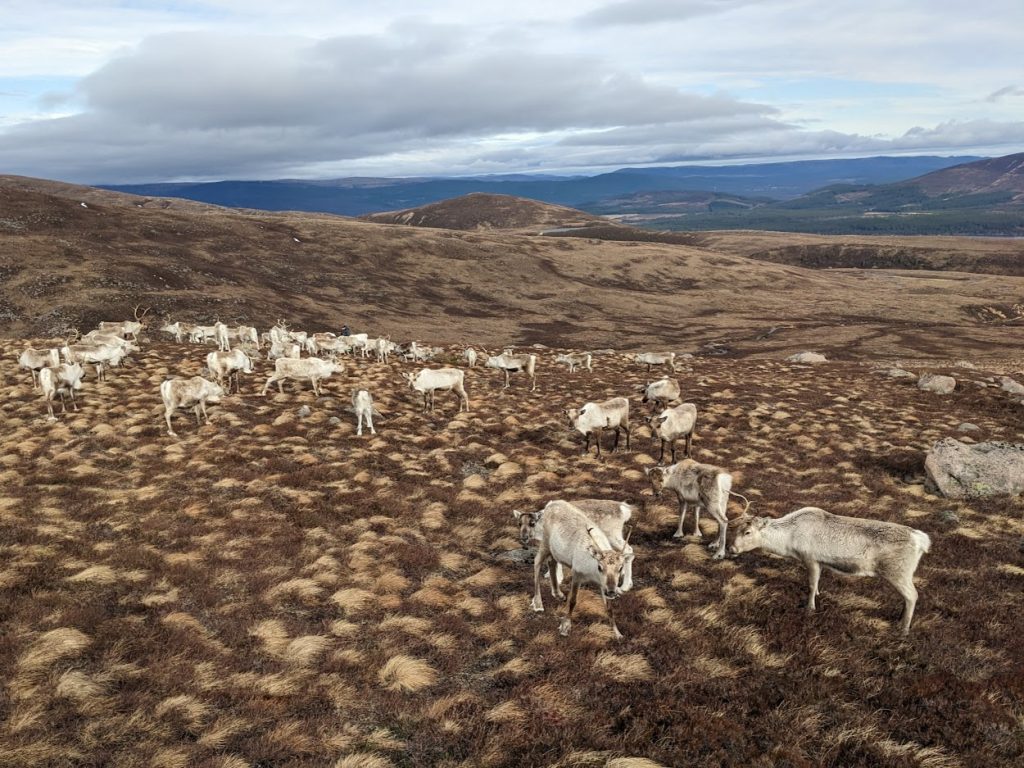
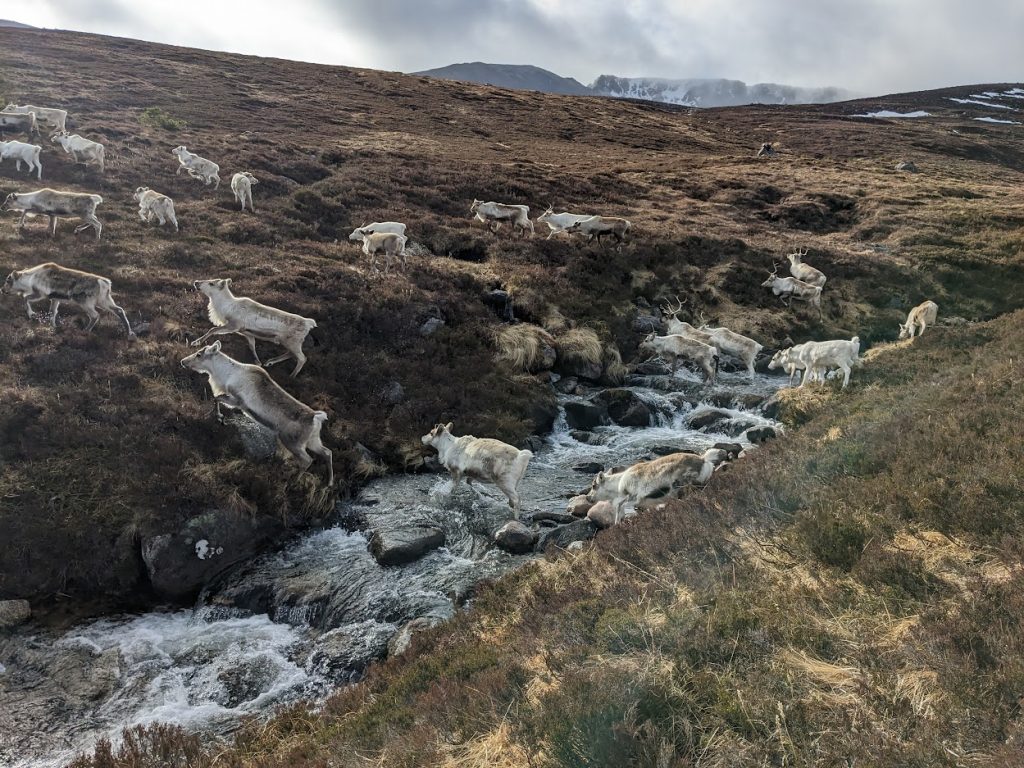
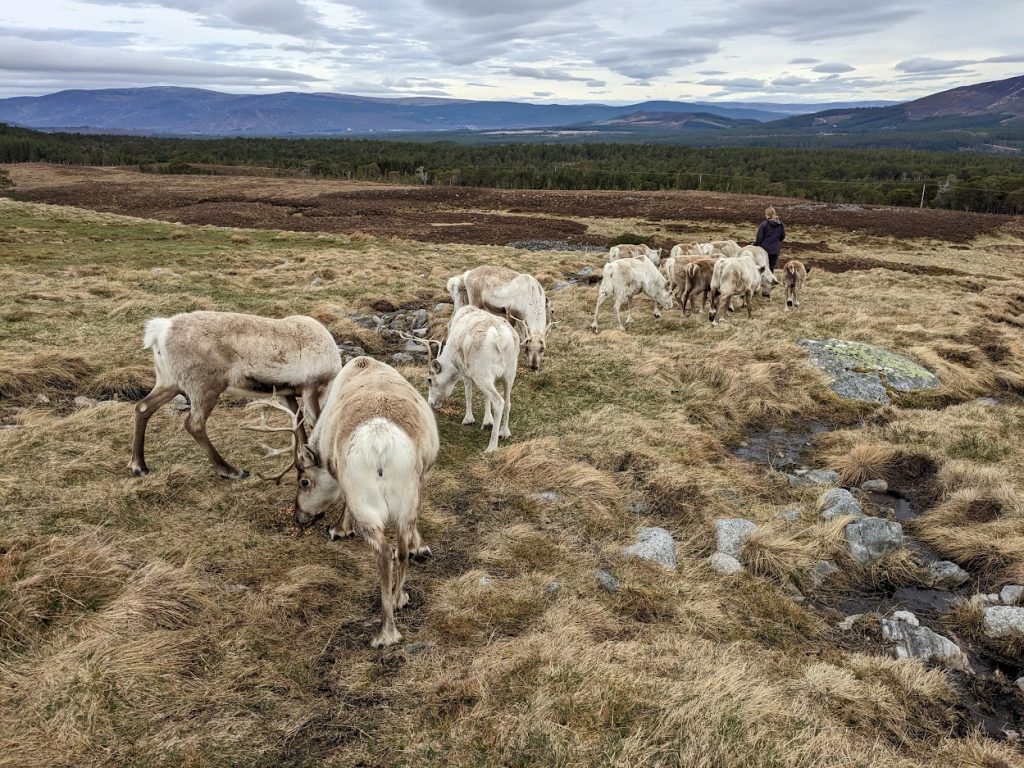
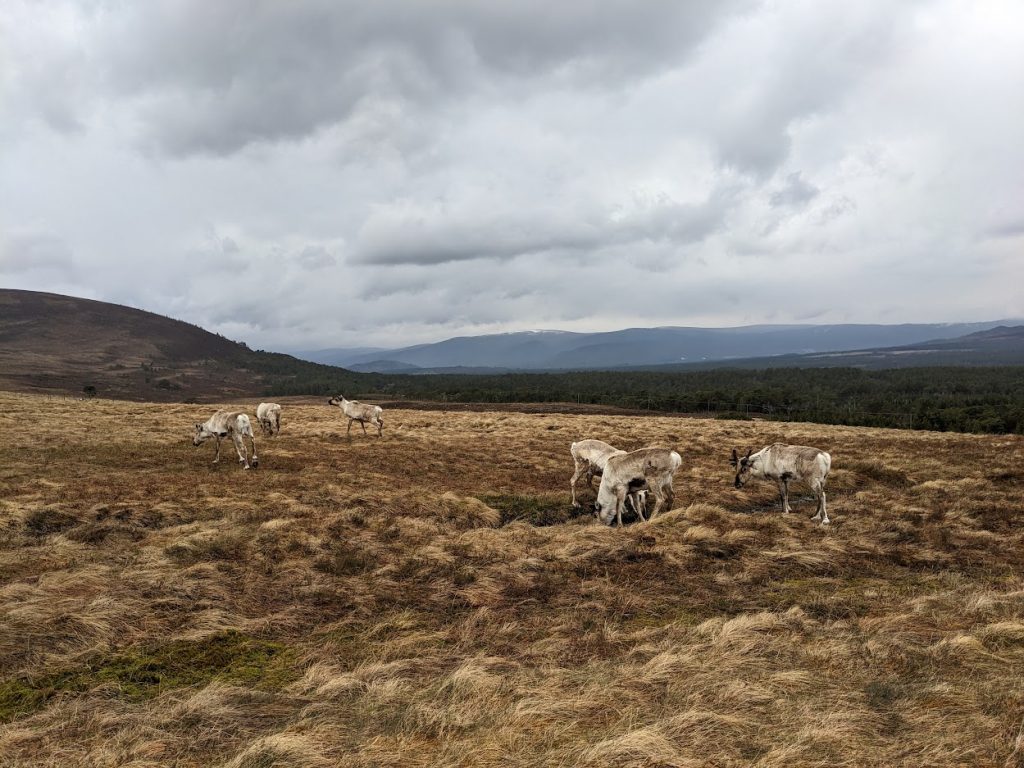
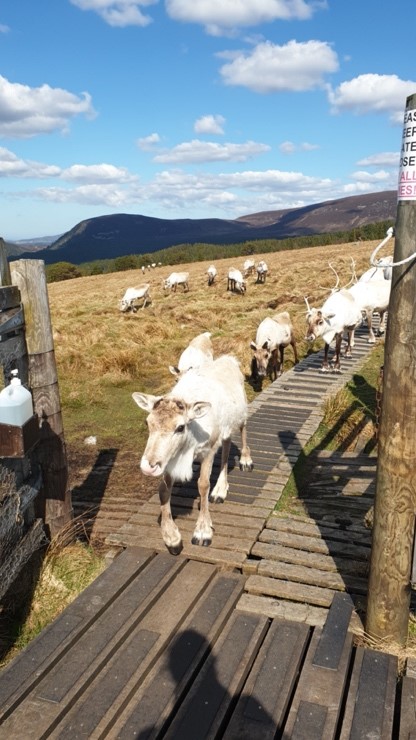
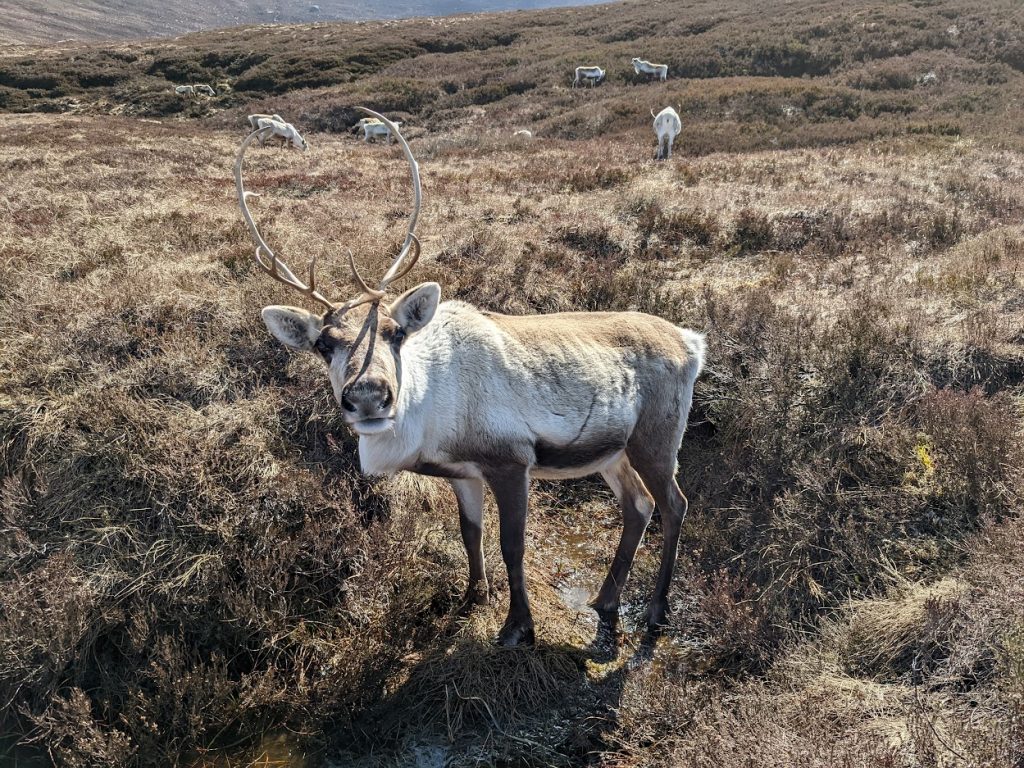
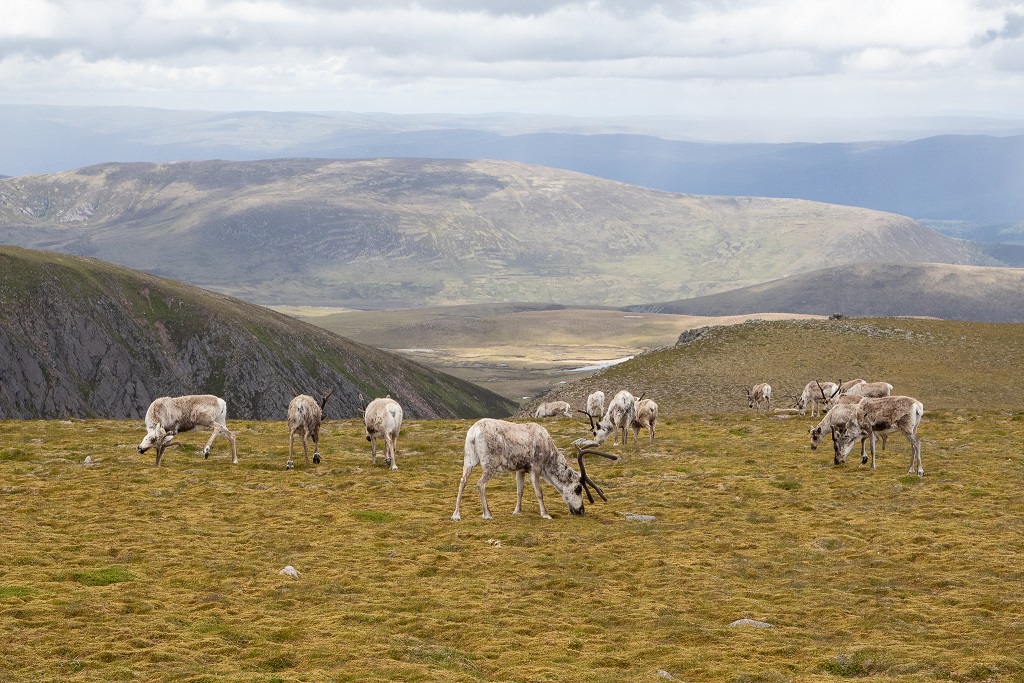
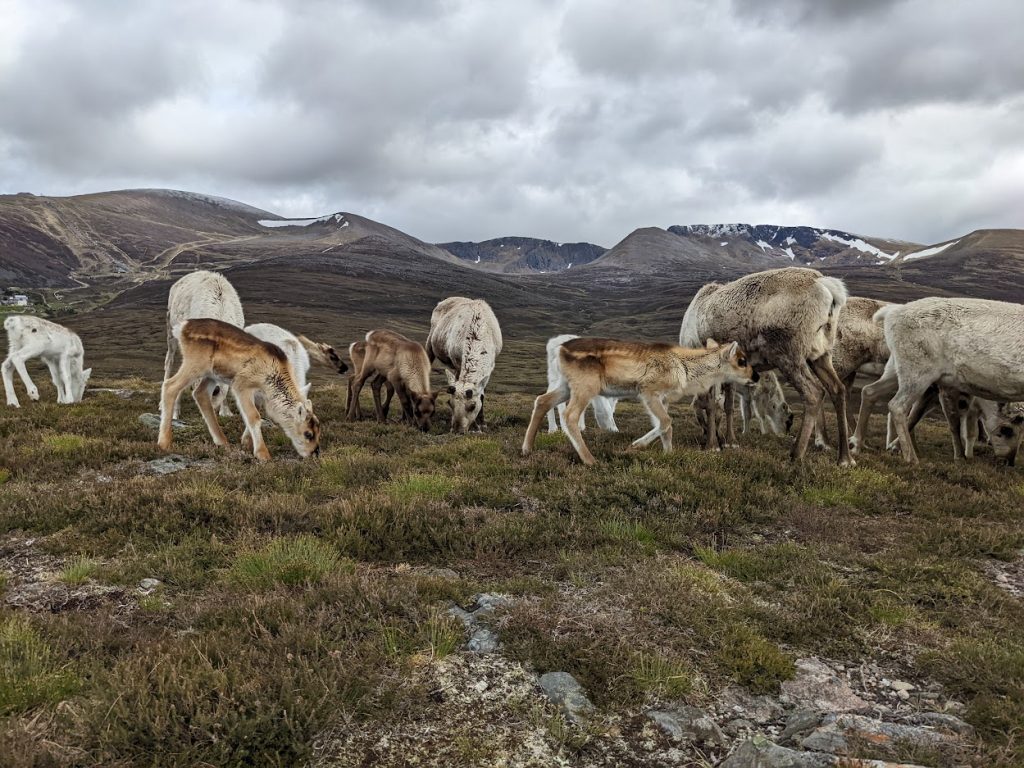
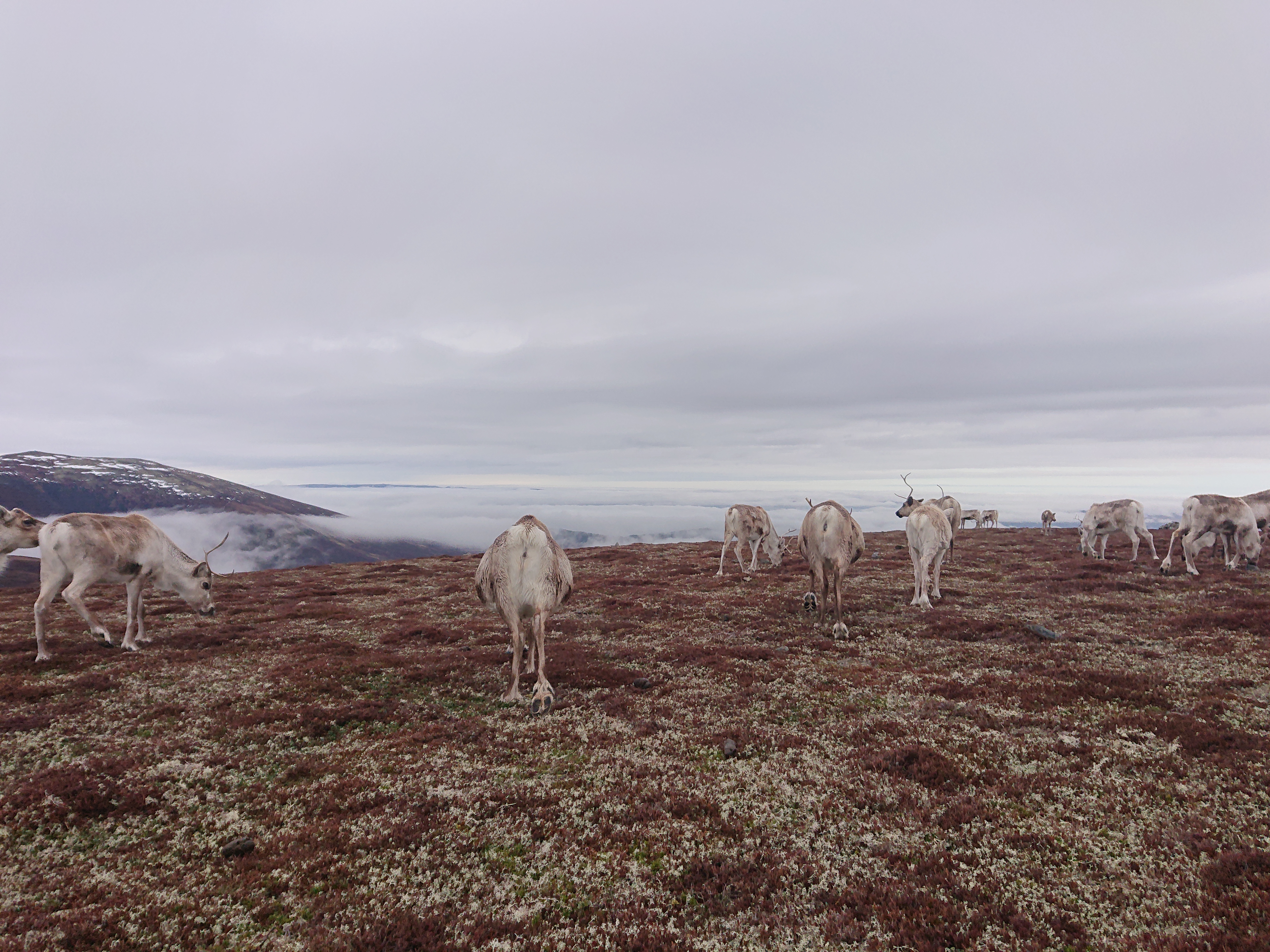
11th of April: Beautiful morning to see the free ranging herd. Here they are crossing a burn with the Northern Corries looking dramatic in the distance.
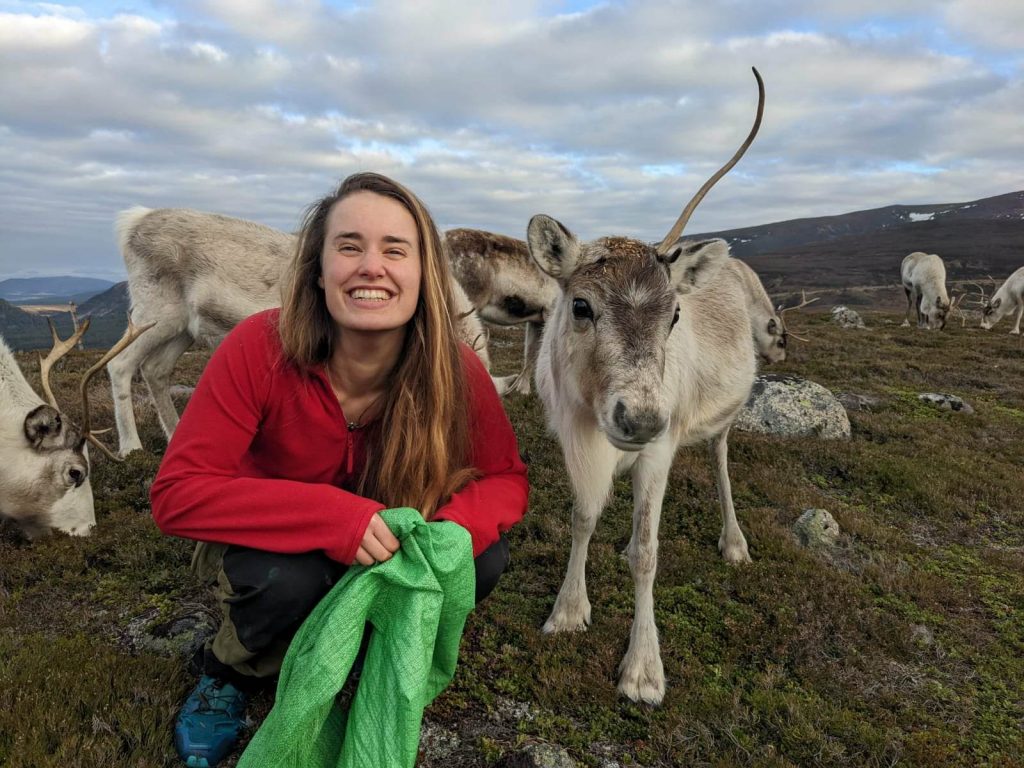
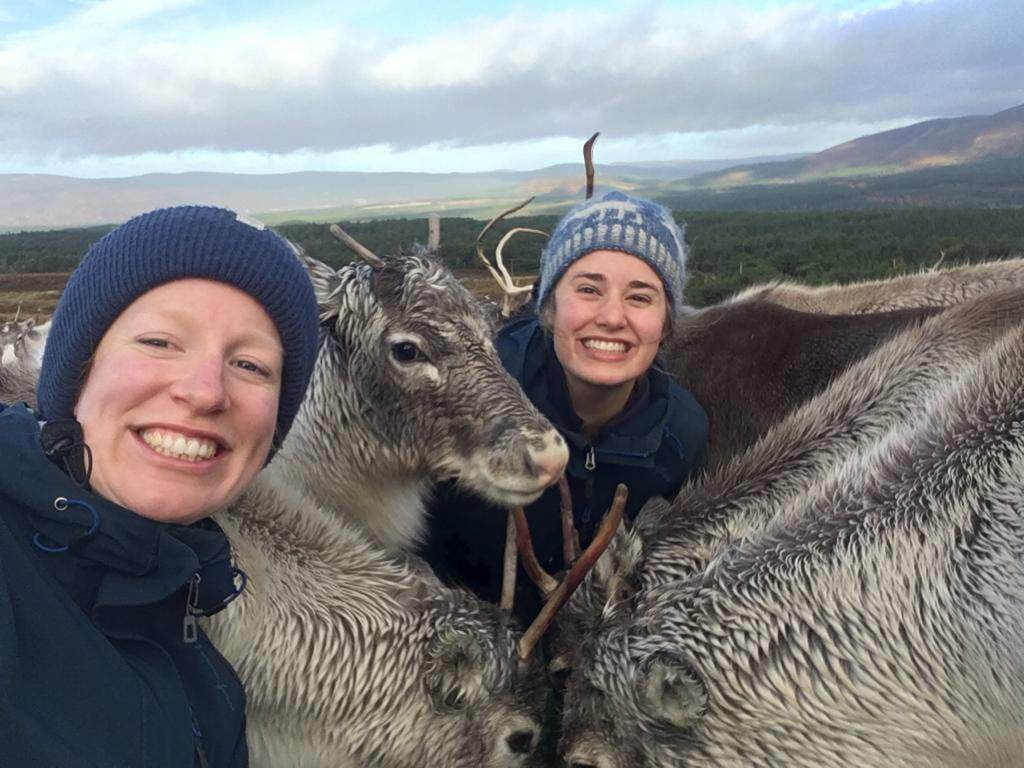
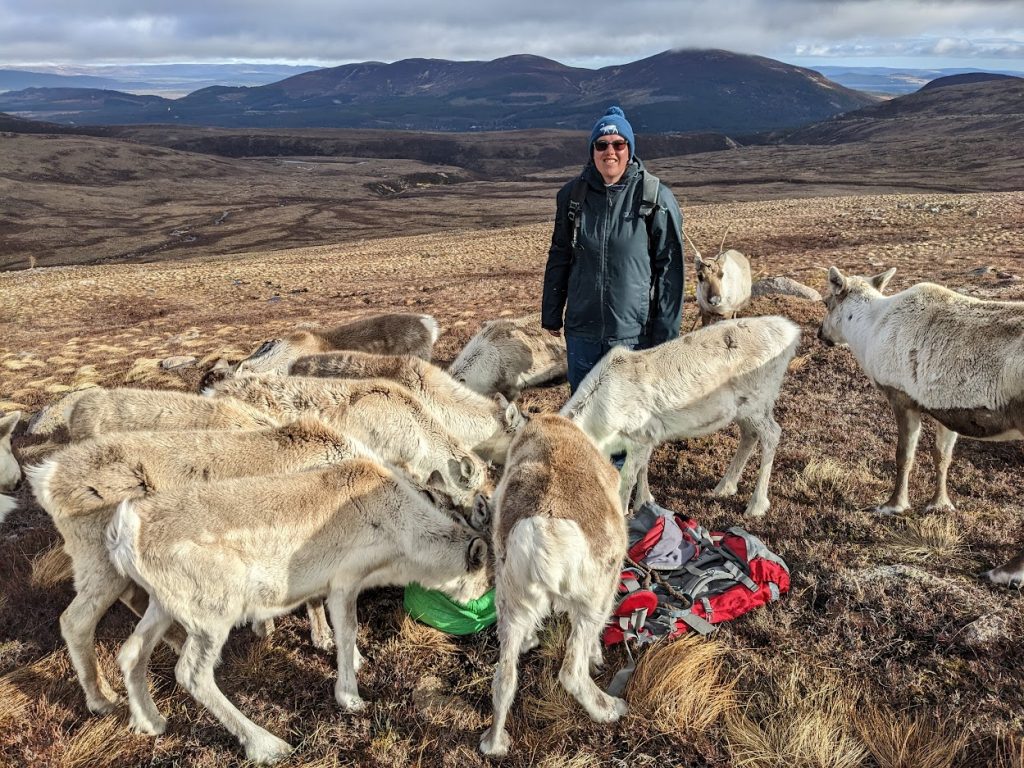
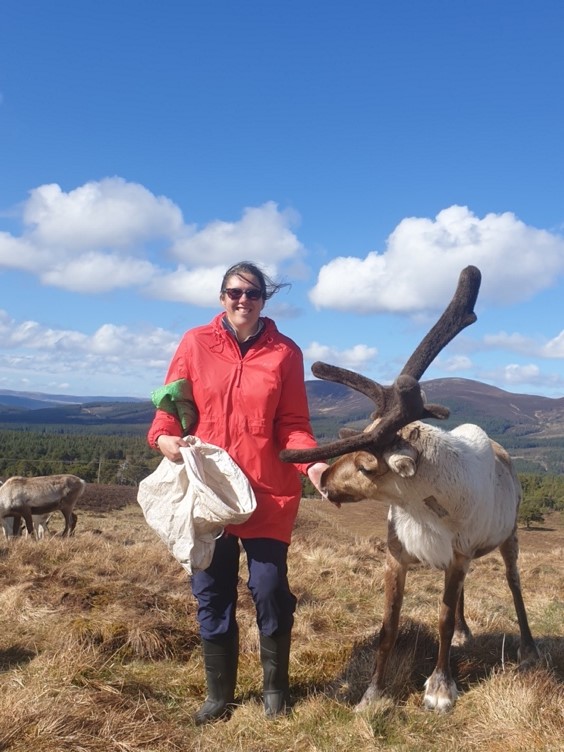
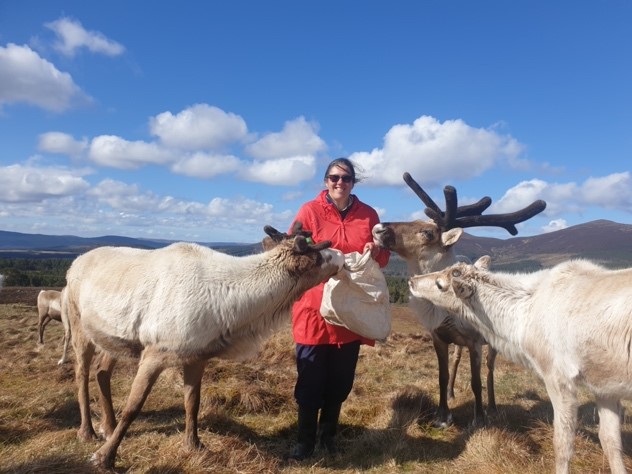
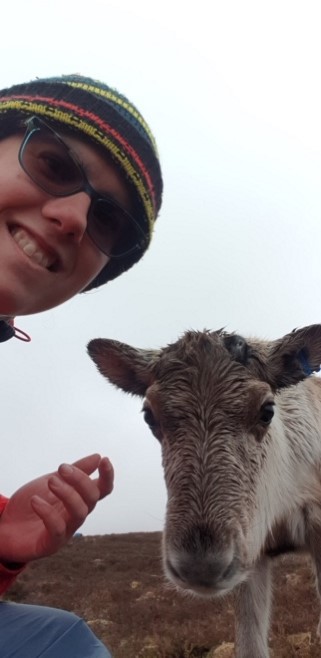
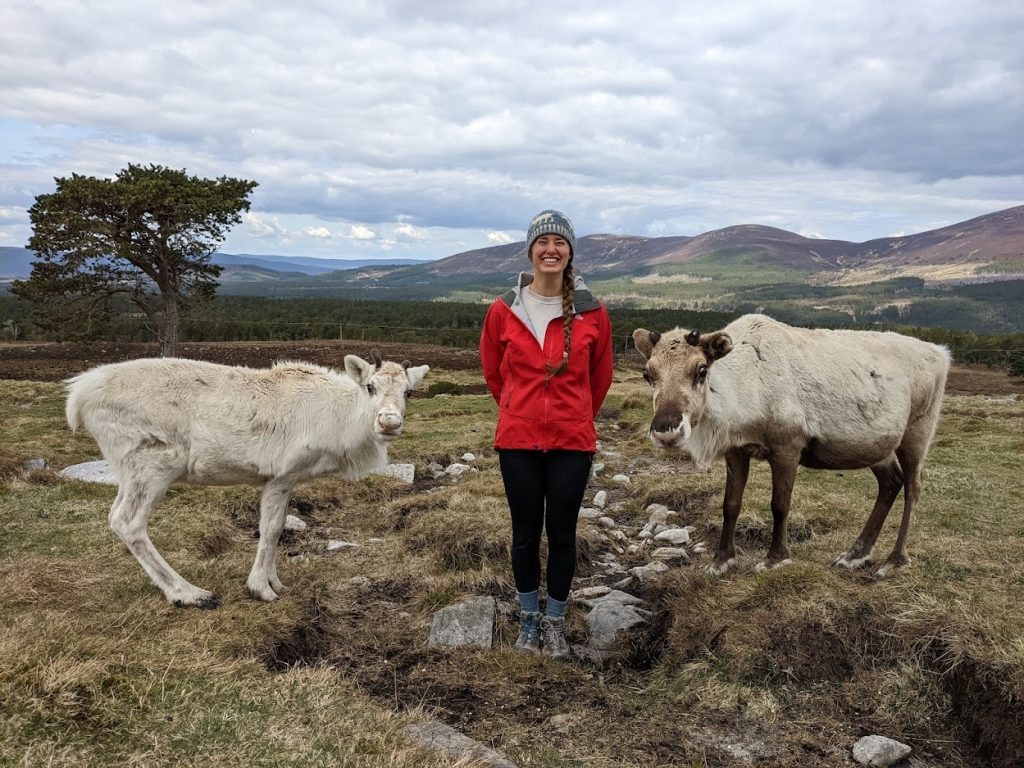
11th of April: Emm is here and grinning away as always! Emm is one of our fabulous volunteers and was up for for a couple of weeks to help us out during April, Here she is defending the bags from the older reindeer.
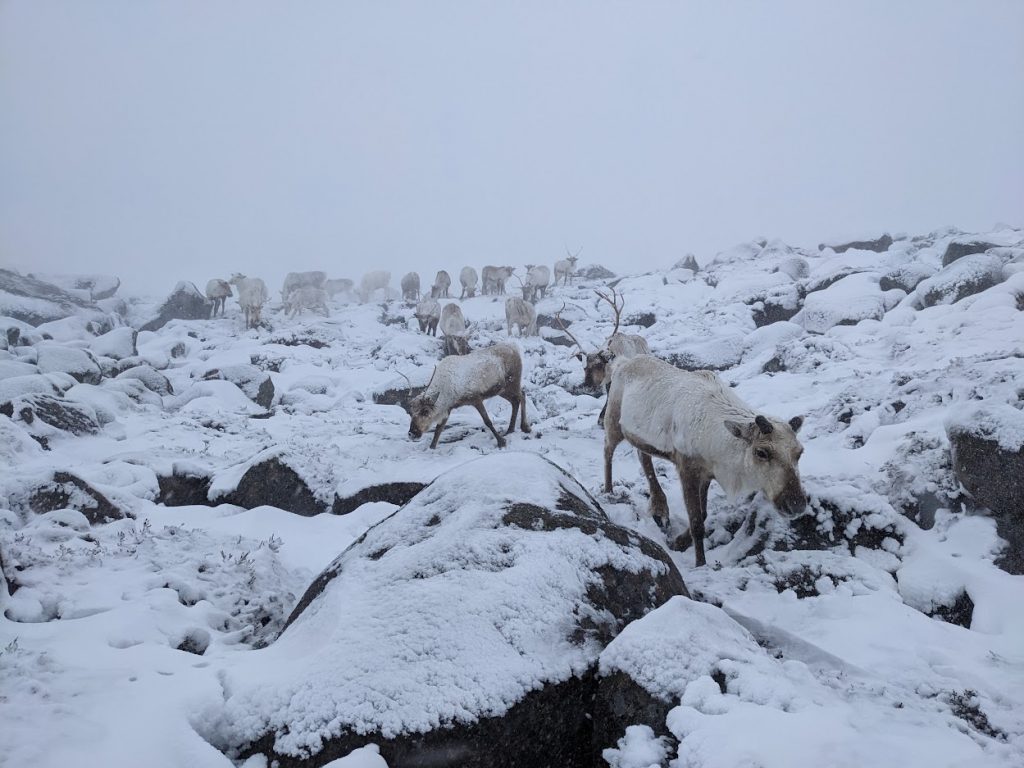
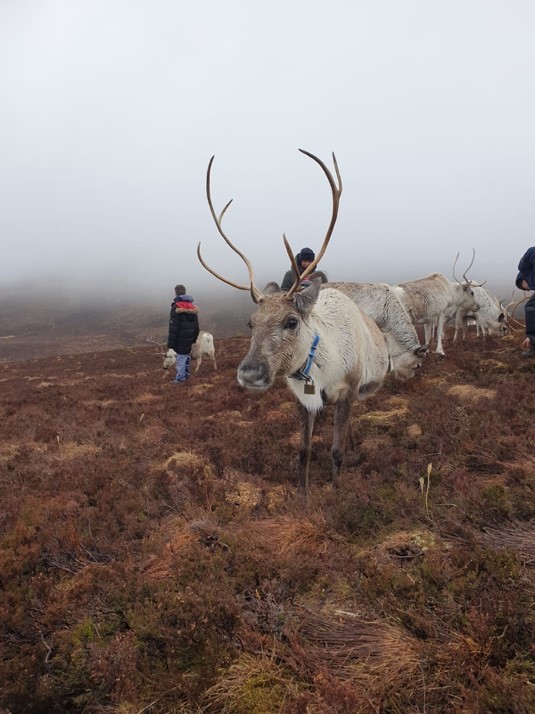
12th of April: The return of winter! A VERY wintery and wild day to be on the hill. Here’s Fly leading the herd, growing her lovely velvety antlers. Pumpkin and Lace not too far behind.
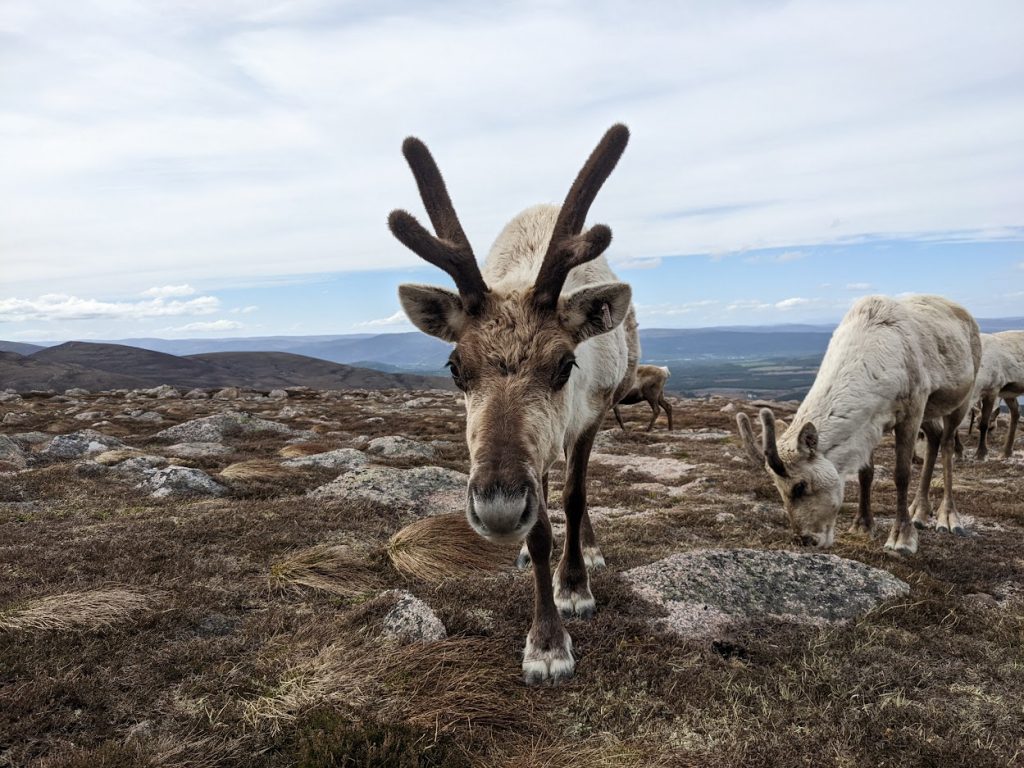
13th of April: Fly posing beautifully, showing off her fast-growing antlers. Cameron in the background waiting for me to stop taking photos!
16th of April: Fiona feeding the herd in the hill enclosure. Check out that wide belly nearest the camera!
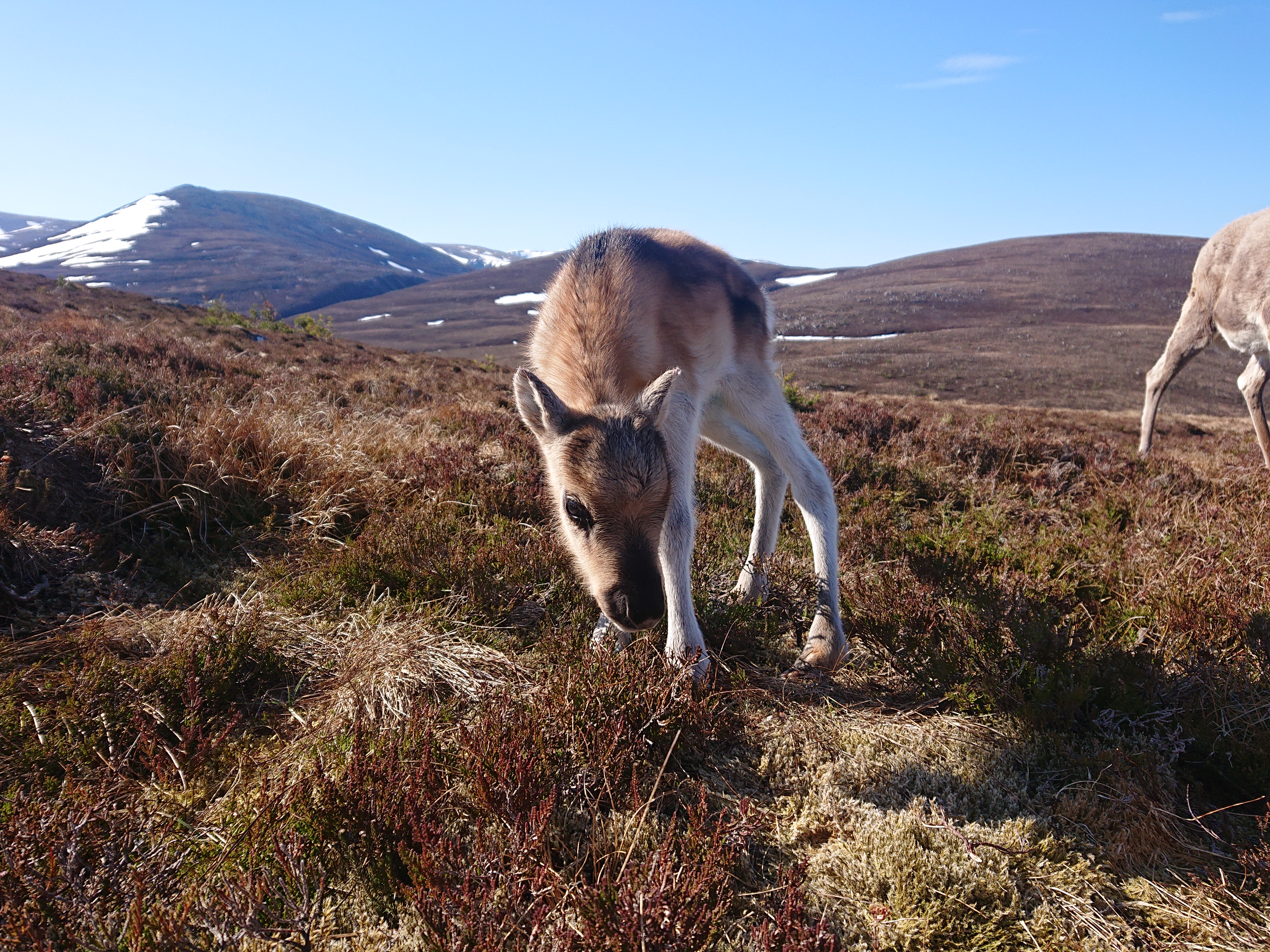
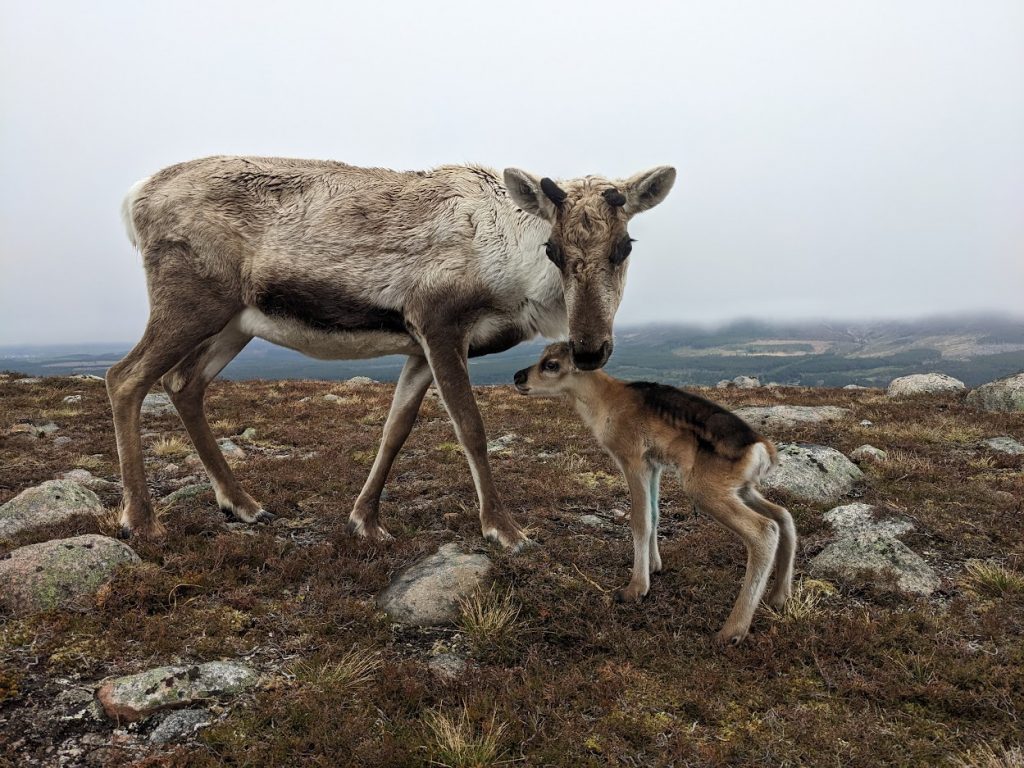
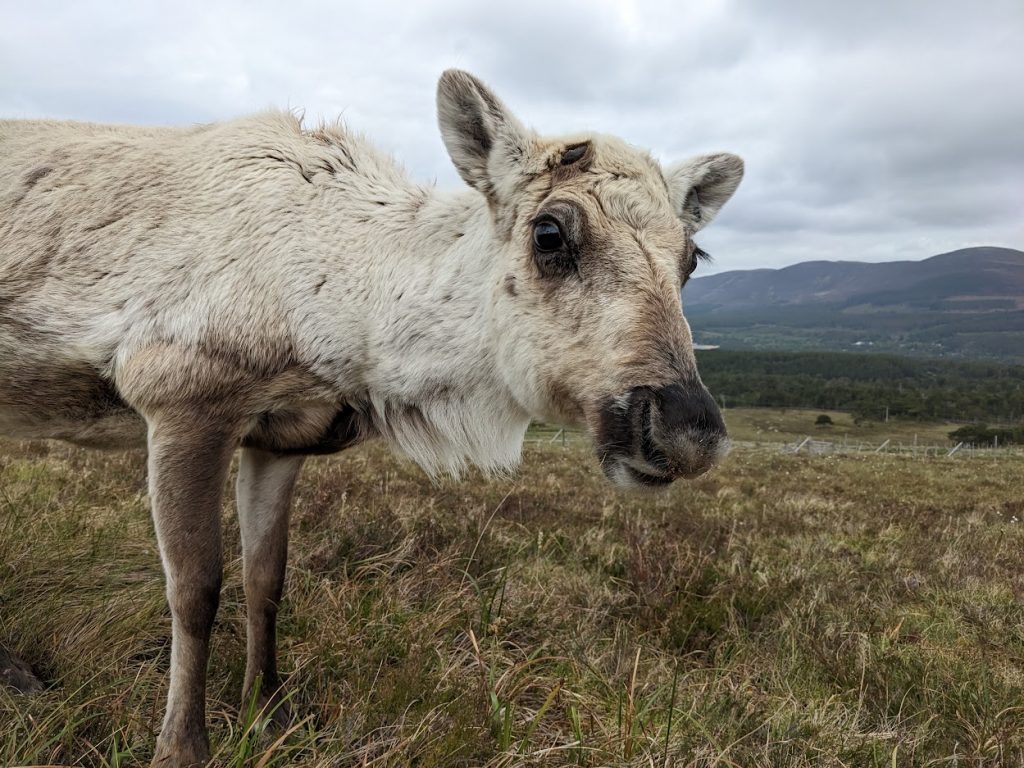
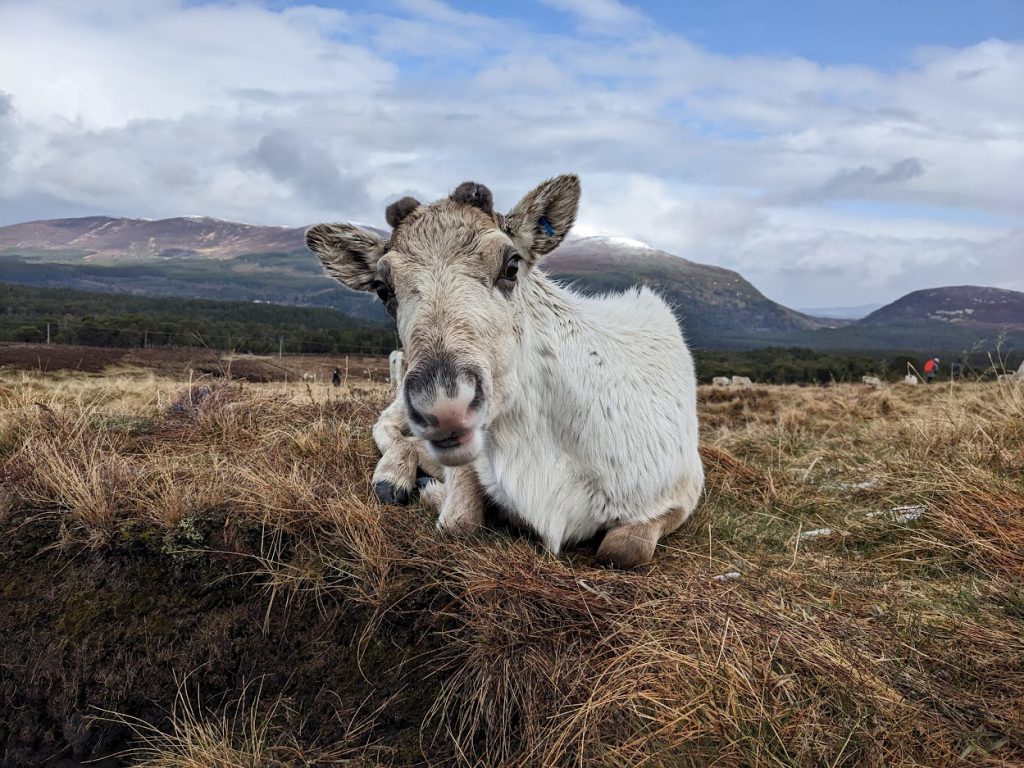
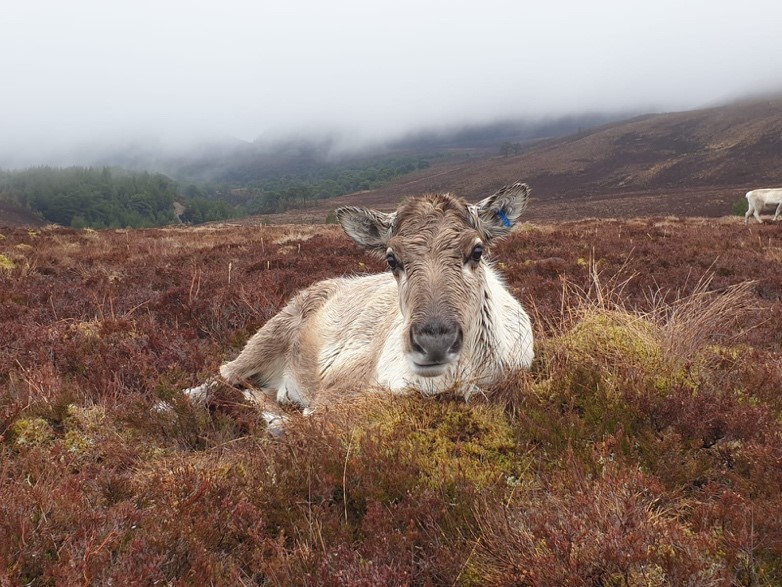
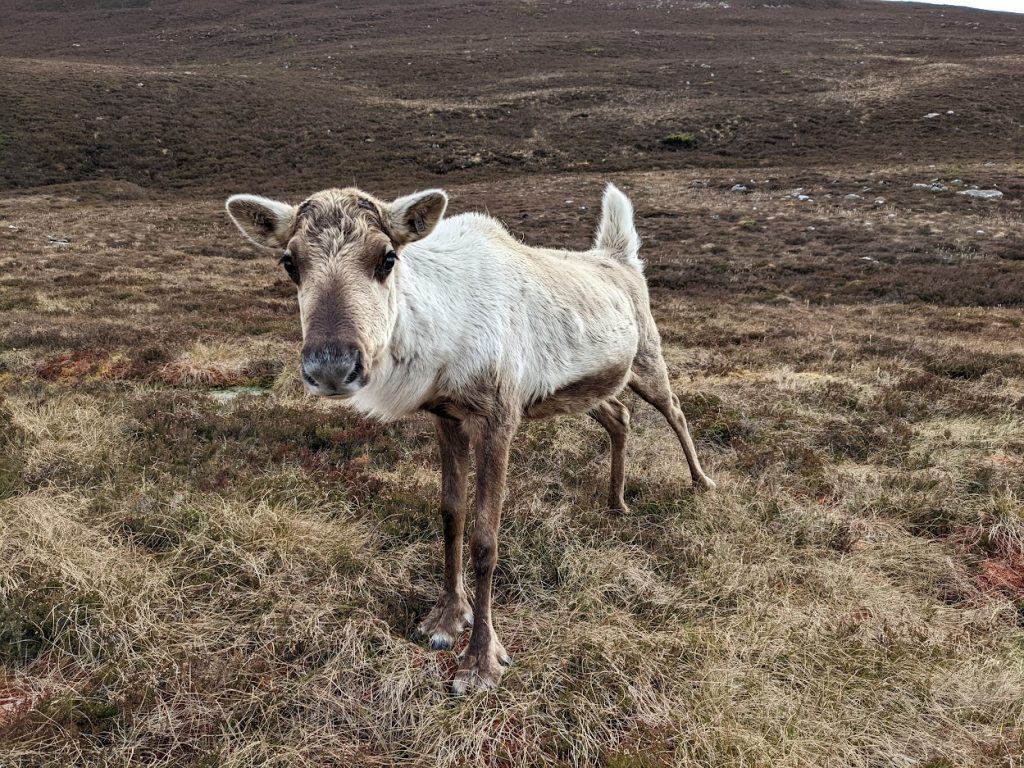
17th of April: Glacée almost a year old and looking gorgeous! Her new antlers just beginning to grow.
19th of April: Marple and her calf from 2022, Viennetta, are now in the enclosure after a winter free ranging.
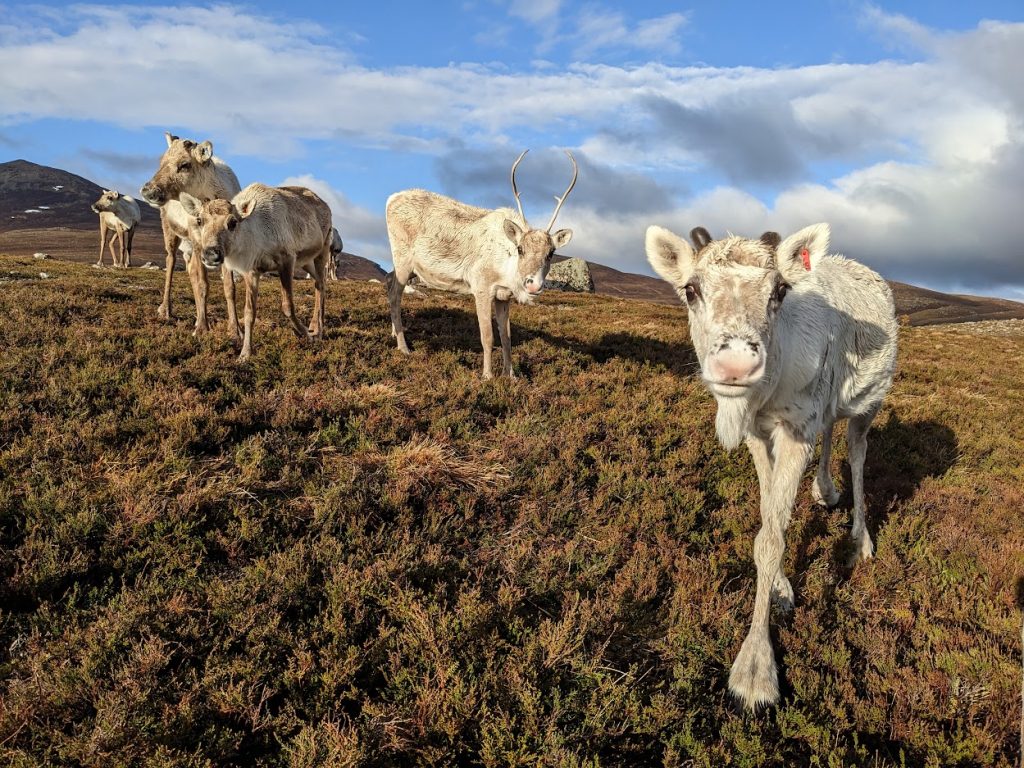
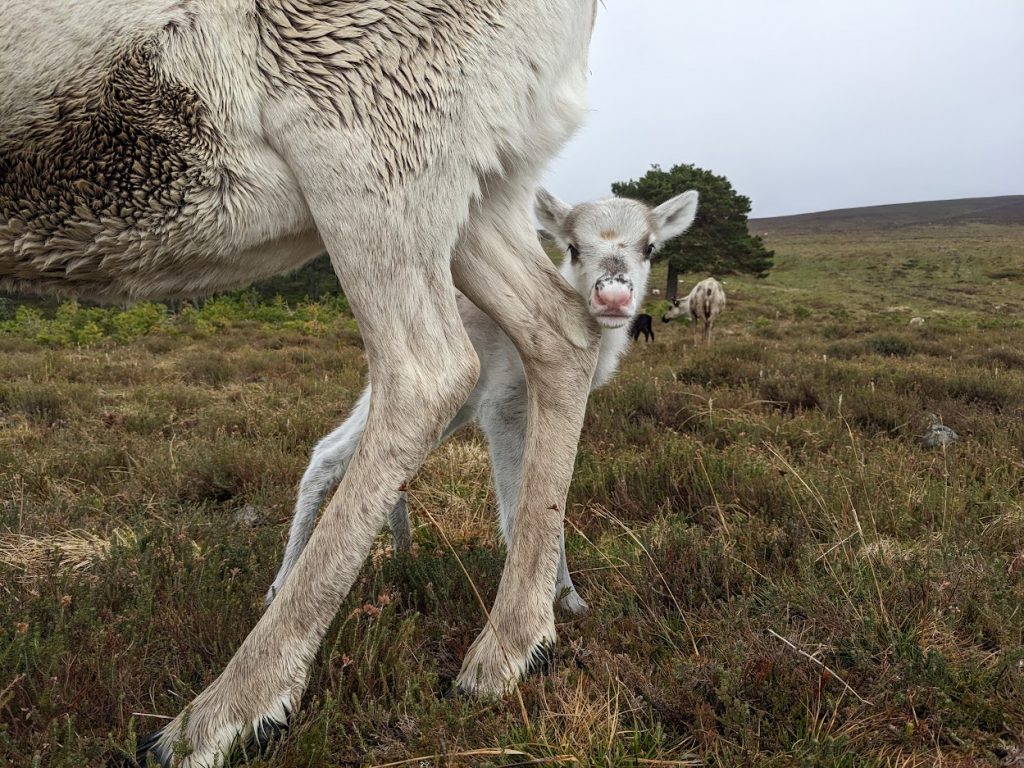
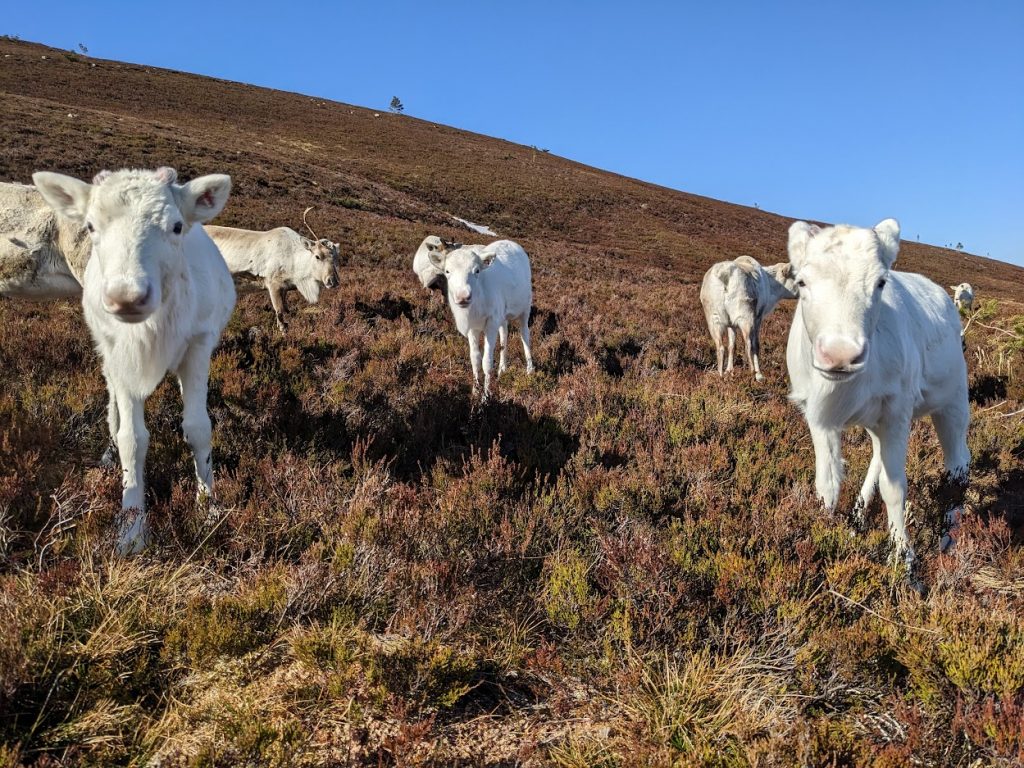
20th of April; All three leucistic calves together – from left to right we’ve got 99, Mr Whippy and Vanilla.
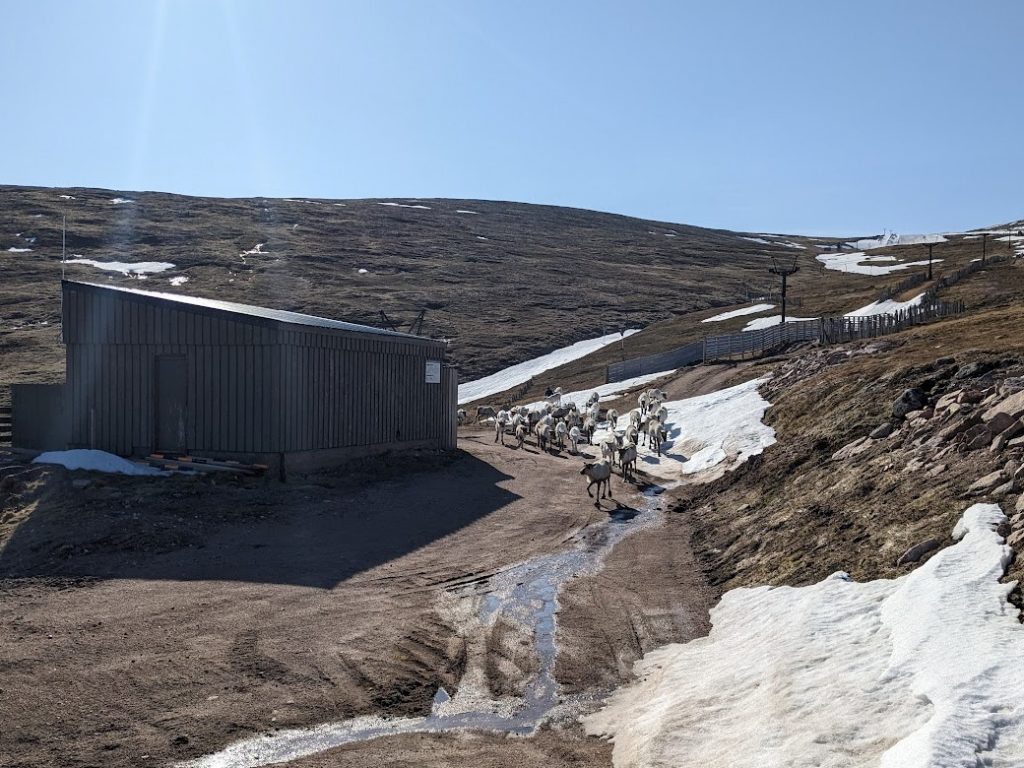
21st of April: Moving the free rangers through the ski area on a gorgeous sunny morning.
24th of April: Beret appreciating her winter coat more today after the recent sunny weather – there’s snow dusting Meall a’ Bhuachaille (the hill behind) and hail showers during the Hill Trip.
27th of April: The boys are back in town! Fiona and I spent the morning at the hill farm and brought back six lovely Christmas Reindeer to the enclosure here on Cairngorm. Super to have them here again!

Ruth

Finding Dante’s calf

Being the most recent person to start working at the Reindeer Centre I am experiencing the day-to-day workings of the Centre throughout the seasons for the first time. I thought I would write about one of my favourite “firsts” to date, which is finding the first calf to be born for the 2022 season. It was a beautiful day at the tail end of April, which happened to be my first day back at work after my usual two days off and Andi’s first day back at work after a holiday. We started our usual morning routine and set off from the house to head up to the enclosure to check on our pregnant cows and feed them, upon feeding the cows we realised that one reindeer was missing, so we grabbed our calving bag which includes: feed for the mother, spot on and antibiotic blue spray for the calf’s naval and made a start on searching the enclosure. For anyone that hasn’t been to our enclosure it is a vast amount of space to search, the perimeter line is 8km in length alone! The missing reindeer was the lovely, four year old, Dante.

We headed along the top ridge of the enclosure to check a well-known calving area up there, but the missing reindeer was nowhere to be seen so we continued climbing to the summit of Silver Mount in search of Dante. Keeping with the theme of many “first” experiences, this was also my first time being on and seeing the summit of Silver Mount, which has glorious views of the Northern Corries, Loch Morlich and down onto Glenmore. Luckily for us, Dante was also at the summit of Silver Mount.

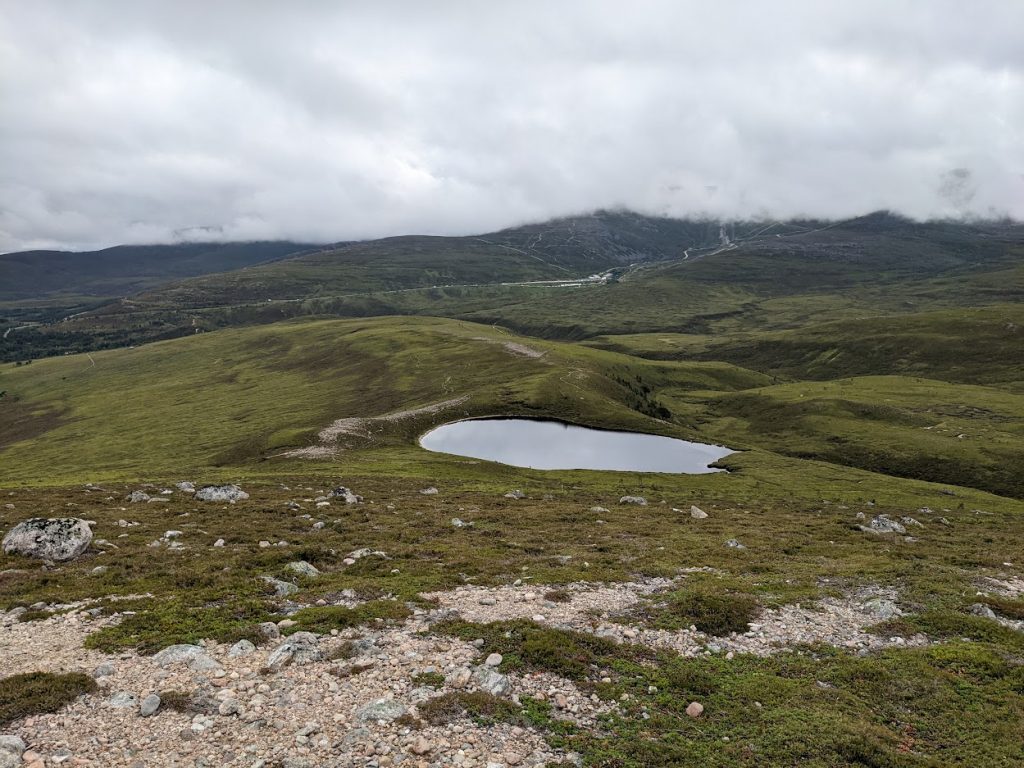
Looking down the top ridge towards Black Loch and Coire Cas in the distance.
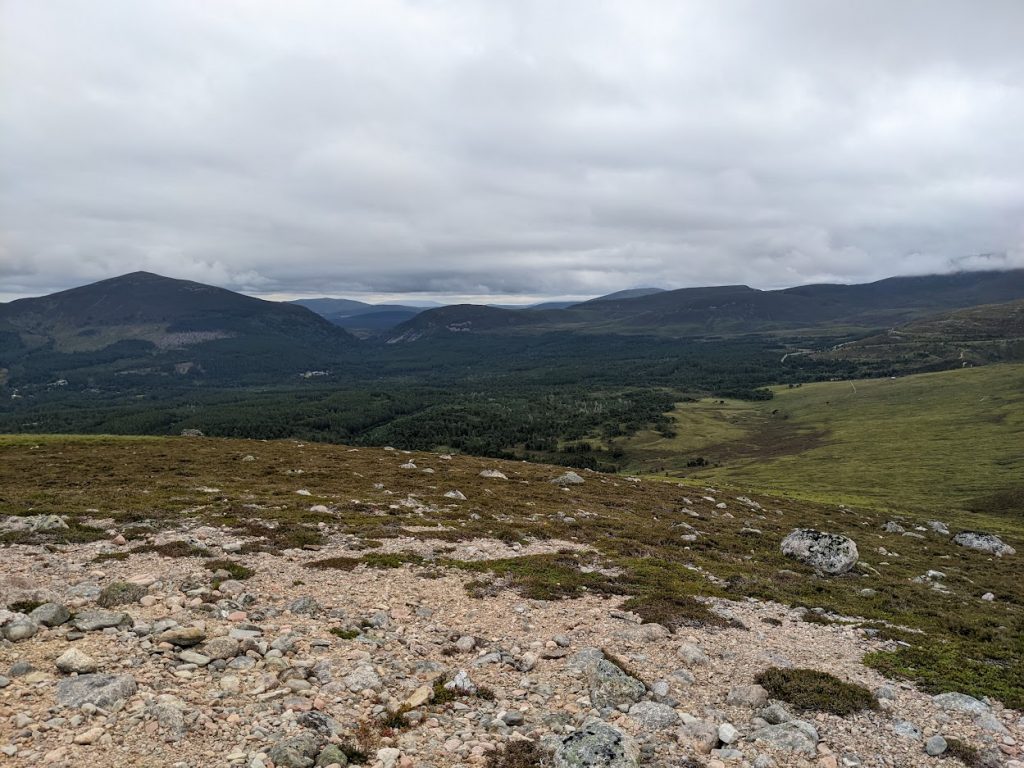
The view from Silver Mount looking across our enclosure towards the Pass of Ryvoan.

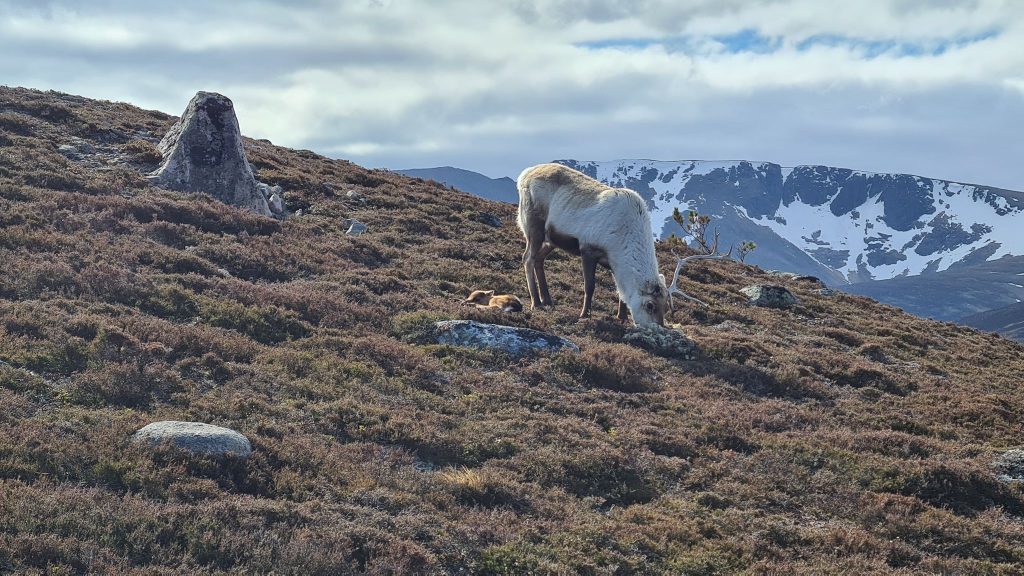
With the easy part over we had to try and see whether Dante had calved or not and for the untrained eye this was a lot harder than it sounds. We could see that the reindeer was focusing on a specific ginger looking spot, but was this a new-born calf or a rock? A question that all herders ask themselves on a regular basis when looking for full grown reindeer, never mind a tiny calf! We were lucky though and the ginger mound began to move which confirmed that we had officially found the first calf of the season (later named Glacée)! Andi headed over to feed the mother, treat the naval of the calf and give spot on to give it protection from those dreaded ticks. Once we had checked that all was ok we headed back down to reindeer house to share the amazing news that our calving season had begun!

Dante and calf looking epic with the snowy Northen Corries behind.
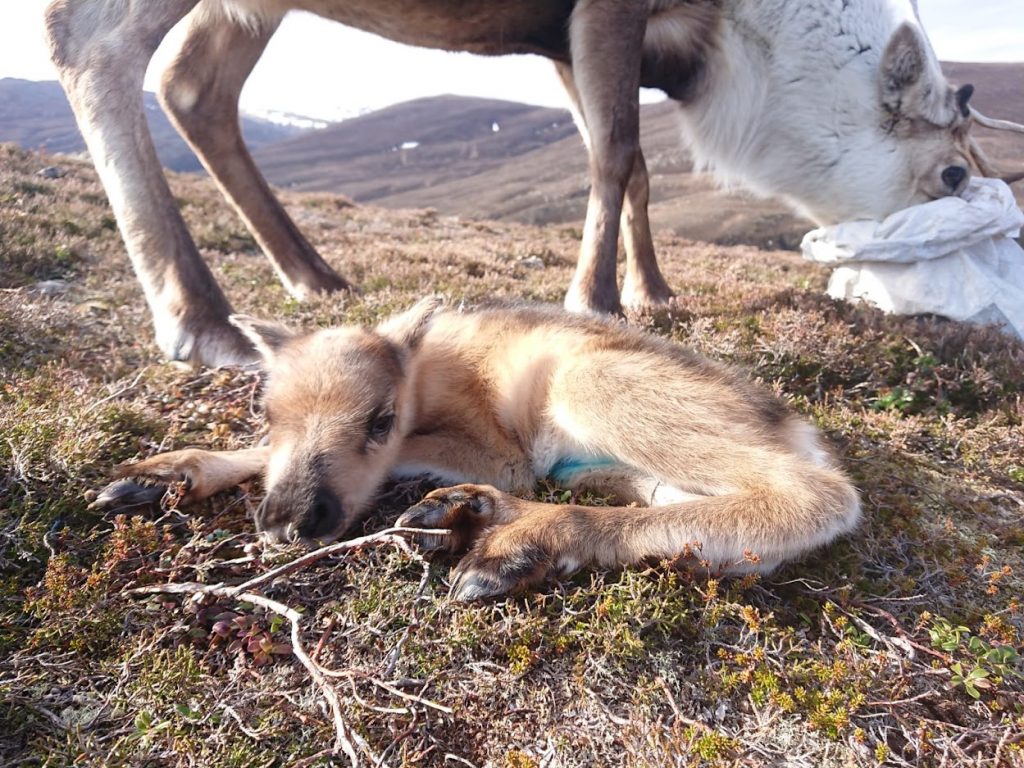
Close up of Dante’s calf – the blue colour on her navel is the antibiotic spray.

At the end of May Dante and her one month old calf headed out to the hills for the summer, along with around half of our other mums and calves. We caught up with them a few times whist they roamed freely in the hills, both mum and daughter seemed to have a great summer as they were always in excellent condition. The pair are now back in our hill enclosure for the autumn where we’ll begin to train Dante’s calf to wear a halter and get to know her personality. Hopefully she’ll grow up to be a big strong girl like her mum, and big sister Mangetout.

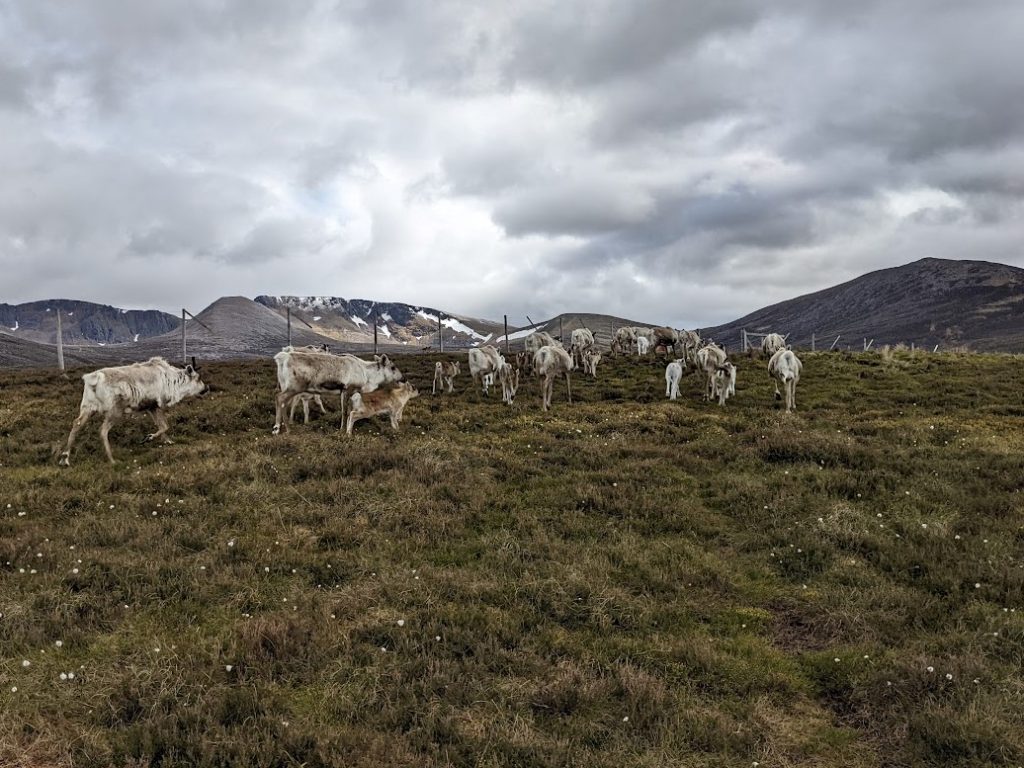
A big moment when the first batch of cows and calves are let out of the enclosure to free range for the summer.
Dante’s calf enjoying the tasty lichen whilst out free ranging at the end of August – 4 months old to the day!

Amy

Emm’s Volunteer Blog Part 2: April 2022

Emm is one of our wonderful regular volunteers, and has written many blogs for us in the past. You can find out more about Emm by reading one of her previous blogs here: how reindeer herding changes me.

This is the second installment of Emm’s blog. Read part one by clicking here.

Dogs

It was my first time meeting Reindeer House’s new Border Collie puppy called Fraoch. It was also my first time meeting Ben H’s dog called Dug and Amy’s dog.

One evening after work, me, Sheena, Amy and Innis took the dogs on a walk. With Elsie and Ginger (Sheena’s dogs), Fraoch and Amy’s dog we walked up the hill on the track and we walked down through a forest near Meall a’Bhuachaille just behind Reindeer House.  It was a lovely special walk.

Elsie, Ginger, Dug and Tiree.

Reindeer

Sherlock was growing his antlers so fast when I was there. It was so amazing how much they had grown since I had arrived. It was one of the fastest antler growth the herd has ever seen and could be on par with Crann who had the biggest ever set of antlers in the herd.

Emm hand feeding Sherlock.

Some of the reindeer were losing antlers at this time of year. Lulu lost an antler when she was in the paddocks. In the hill enclosure, Cannellini was eating from a pile of food. Sambar came over to Cannellini and kicked her hoof at him to say it was her food now. But when she kicked her hoof, it hit Cannellini’s antler and it came off. It was the first time I had ever seen a reindeer’s antler being kicked off. Fava lost an antler in the forest paddock where the paddock reindeer sleep at night down at the centre. Me and Amy went on a mission to find it and managed to find it near the stream when poo picking!

Emm being mobbed by Dr Seuss, Sherlock and Butter.

Reindeer Herding

In the hill enclosure, there are different areas used to separate the reindeer. Sometimes the reindeer are in the bottom corridor in the day and in the east enclosure at night. One morning, me and Hen moved the hill enclosure reindeer from the east enclosure part to the bottom corridor part. It is really lovely as we get to call them and they come running down as they know it is breakfast time. I led them through with my food bag whilst Hen pushed them from the back. Then we fed them and counted them. Most mornings, I got to go up and help move them and give them their breakfast.

One afternoon, me and Lotti moved the hill enclosure reindeer from the bottom corridor to the east enclosure. I led them through with my food bag whilst Lotti pushed them from the back. We fed them and counted them. Most afternoons after the hill visit, we move them and give them their tea which I helped with most of the time. It was so lovely to spend some time quietly with the reindeer. On one afternoon visit, after we spent some time with the reindeer and visitors in the bottom corridor, Ruth and me moved the reindeer whilst the visitors were there and the visitors came along and watched us give the reindeer their tea.

Ruth, Dr Seuss and Emm.

One morning, the free-rangers had split into 2 groups a bigger group and smaller group. The next day, after the hill visit in the afternoon, Andi went in search of the smaller group of free-rangers and found them. She managed to get the smaller group of reindeer to follow her and she managed to join the 2 groups together so the free-rangers were all together once again.

Tilly’s Farm

On my last day, Olly and me went to Tilly’s farm where we met Tilly. The Reindeer Centre has a base there. We went in ‘Brenda’ (the livestock truck). We took Cannellini, Butter, Fava, Dr Seuss, Celt, Kiruna and Spartan to the farm. We filled up bags of dark grains (a by-product from the whisky industry used for animal feed) from a massive funnel in one of the barns as the Reindeer Centre needed some more bags of dark grains and got some more lichen from the shed as the reindeer needed more lichen. We loaded Brenda with the dark grains and lichen. We moved the reindeer to the other reindeer at the farm, they followed me and Tilly on the quad bike which Tilly was driving and Olly herded them from the back. We checked all the reindeer at the farm temperatures and injected them if they had a high temperature.  We put some Spot-On on to protect them from ticks.  I helped with holding the reindeer. Legume had a really high temperature so we separated him and Jelly from the rest of the reindeer in the shed and gave them some lichen so Tilly could keep an eye on them. Jelly was there to keep Legume company.  We picked out 2 reindeer to take back to the Reindeer Centre who were Frost and Olmec. I led Frost and Olly led Olmec to Brenda. The older male reindeer were free-ranging on the hills by the farm so I didn’t see them. Tilly, me and Olly went on the quad bike which Tilly was driving and Tilly took us to see the pigs, wild boars and piglets which was great fun. Tilly and Olly fed them. We also saw the red deer and the Belted Galloway cows. We also saw the Soay sheep with their lambs and Tilly fed them. Eventually we took Frost and Olmec back to the Reindeer Centre in Brenda.

Emm leading Frost.

Opening the Gate onto the Free-range

When we got back from the farm, we did a paddock reindeer swap. Frost and Olmec went into the paddocks and Me and Amy took Lulu and Gazelle up to the hill enclosure and I led them both. That morning, my herder friends went to the hill enclosure and they split all the pregnant females off from the non-pregnant reindeer ready for calving. The non-pregnant reindeer went into the top corridor in the hill enclosure ready to go out on the free-range.  Me and Amy took Gazelle and Lulu into the top corridor with the others and Amy opened the gate on to the free-range. When the reindeer were ready, they would go out on to the free-range. Ben H had realised that Roule had lost an antler that morning in the bottom corridor when splitting the reindeer up, so Amy and me went and had a look for it which Amy found.

Emm with Lulu and Gazelle.

Other Exciting Things I Did

On Easter Sunday, the Easter Bunny had put mini eggs all around Reindeer House which was very exciting. I kept finding mini eggs.

I helped restock the shop. I put price labels on the photo frames for the shop.

I talked to visitors in the paddocks and I identified a reindeer for one of its adopters.

Me, Mum and Dad went out with my herder friends and Sookie for a meal at the Pine Marten Bar which was really lovely and I really enjoyed it.  I once again had such a fantastic 10 days with my lovely friends, all the animals and of course the reindeer.

I am so looking forward to my next trip in October 2022 !!!!

Emm

Emm’s Volunteer Blog Part 1: April 2022

Emm is one of our wonderful regular volunteers, and has written many blogs for us in the past. You can find out more about Emm by reading one of her previous blogs here: how reindeer herding changes me.

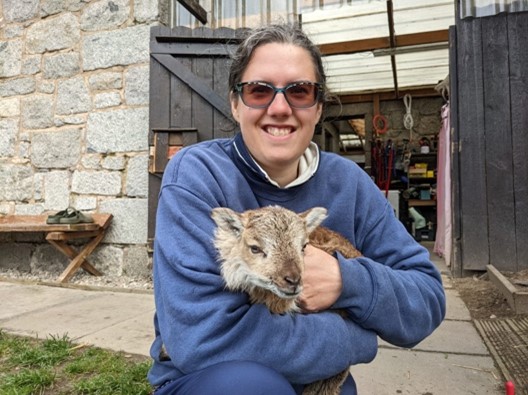
Emm and the hand-reared Soay lamb, Derren.

I visited the reindeer in April for 11 days which was over Easter. It was so brilliant seeing all the reindeer, herders and dogs again. I go and say hi to everyone at Reindeer House the day before I start. I went into the living room/kitchen and the room was empty. I started fussing Sookie the dog who was chilling in the armchair when I heard a sudden bleating noise . I had no idea where it was coming from then I realised it was coming from a big cardboard box. I peered in and saw a little lamb. It turned out it was a 2 day old lamb called Derren Brown (named after the illusionist). He is a Soay Lamb who was found without his mum in the field at Tilly’s farm. The herders were hand-rearing him with bottle-feeds. When I bottle-fed him, Fraoch the puppy licked him and cleaned the milk away from Derren’s face.

Most of the daytime, Derren went into Reindeer House’s garden and had a little pen. He was allowed out of the pen if someone was in the garden with him. The dogs were really good with him and I am sure he thought he was a dog. Derren chased the dogs and also loved to chase people’s feet. When we had lunch in the garden or we were just out in the garden and people saw a lamb running around with the dogs, they were so surprised and amazed. They asked loads of questions and took lots of photos and videos. Some even thought he was a baby reindeer. One day Derren helped me hoover Reindeer House and pack the Christmas cards and when I was doing feed mixing, Derren was trying to climb on the bags.  He followed us around everywhere.

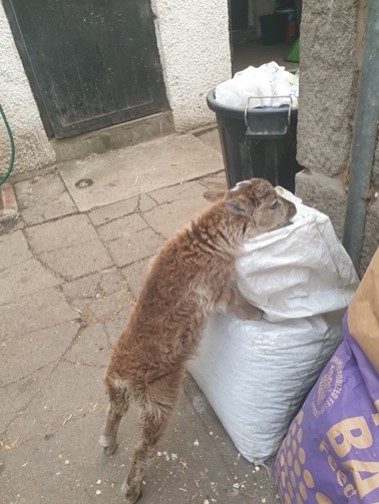
Derren trying to help himself to the reindeer food.

Over the 10 days I was helping out there were a lot of fun and interesting things I shared with all the herders.

Finding the Free-rangers

Most of the 11am hill trips were to the free ranging females who were free in the Cairngorm Mountains. We had different visit sites depending on where the reindeer were found in the morning. There were also a group of reindeer in the hill enclosure and if the 11am trip was full, we ran another trip to the hill enclosure reindeer in the afternoon. I enjoyed doing some of the talking parts on the hill trips and in some afternoons, the herders did talks in the paddocks.

Marple, on a free-range Hill Trip. She has a GPS tracking collar on that is sometimes used for short periods to keep track of the herd.
Witch, happily chilling out on the free-range.
Butter leading the way in the hill enclosure,

Each morning, 2 herders went to find the free-ranging reindeer in the Cairngorm Mountains and brought them down to a suitable visit site for the visitors. It could be a long and steep walk for them as the reindeer like to go high up and also over the hills.  

One morning, I was lucky enough to go and find the reindeer with Ruth and Harry. We had a steep climb and when we got to the top, we located the reindeer.  Ruth tried to get the them to follow her with her food bag and calling them but they wouldn’t follow her so she put Ochil on a head collar and started walking down the steep hill to the suitable visit spot. The reindeer usually follow as they like to stay together as a herd. Meanwhile, me and Harry were pushing the reindeer from the back and made sure they all followed.

When we got to the visit spot, we let the calves (who were nearly 1) eat from the food bags. Ruth and Harry took the calves temperatures to make sure they weren’t brewing something as they are still building up their immune system. We fed them and Trilby had 2 antlers when she was feeding from the bag but after we fed them, and were counting them, I noticed Trilby had lost an antler. We all looked for her antler which we found.

We then realised there was 8 reindeer missing as there should have been 68 but we had 60. We went around the reindeer identifying them to see who was missing. Ruth was ticking off all the names. It was like doing a school register! After the Hill Trip, the reindeer wandered off but were found later on the ski road so Lisette led them away from the road. Later that day Harry was in the hill enclosure and spied the 8 missing reindeer from this morning so Lotti went out to the 8 and led them into the hill enclosure as in a few days time the rest of the free-rangers were going to go into the hill enclosure ready for the calving season.

Harry and Ruth counting the free-range herd and figuring out which cows were missing.

Heavily Pregnant Reindeer

It is an exciting time of year to be up as some of the females are heavily pregnant. They have big tummies and it is amazing to think that a tiny reindeer calf is growing inside them. Hen showed me on a few reindeer where their udders were starting to show. Reindeer have fluffy udders. When they start to grow, the fur is a triangle shape under their bottom.

All the herders have a calving bet each year. Each herder chooses a reindeer who they think will calve first. I chose Scully.

Heavily pregnant Morven having a snooze.

Leading Reindeer

One day, Ruth went to the farm to get some more reindeer for the hill enclosure and paddocks. Lulu and Gazelle went into the paddocks. Me, Ruth and Amy took Morse, Clouseau, Diamond, Aztec, Kiruna and Cannellini up to the hill enclosure. I led Clouseau and Cannellini. A dog off the lead behind them spooked them and Ruth told the dog’s owner to stay as far back as possible as reindeer think dogs are wolves and are very scared of them. When we lead the reindeer to and from the hill enclosure, we have to keep an eye out for dogs as it is a public path. When they spotted the other reindeer in the hill enclosure, it made them jump.

On another day, me, Fiona and Zoe took Celt and Spartan from the paddocks to the hill enclosure. I led Celt. On the way back, we took Aztec and Morse from the hill enclosure to the paddocks and this time I led Morse. When we transport reindeer, we use a big animal lorry called Brenda. I think it can fit 8 reindeer in, depending on how big their antlers are. It has a partition inside it too.

Reindeer in our hill enclosure breaking into a bag of feed.

The Adventurous Hill Trip

I did a hill trip on the free-range with Amy, Harry and Carol.  We met the people in the carpark and we then realised the reindeer were on the path next to the carpark. They had made their way down the hill from the visit spot to the path next to the carpark. It was the first time that it happened to me.

Amy led the visitors up the hill with the food bag calling to the reindeer to follow her. Me and Harry herded the reindeer from the back. I was so focused with herding the reindeer that I fell into a knee-deep bog! My knees to my toes got soaked and I had to empty the bog water out of my wellies after I climbed out of it. Eventually we managed to get the visitors and reindeer to the top of the hill where the visit was happening.

Florence chose to stand in a bog, unlike poor Emm!

The Reindeer Herding Badge

There is a very special badge going around the herders. Whoever has it passes it on to someone who they think deserves it. This could be a herder doing something very special or doing something above and beyond.

I did some Christmas card packing (6 cards in a pack). I did it on and off through the time I was there. When I was a way through packing, I realised some people had been packing 2 designs and some people had been packing 3 designs. And they were all mixed up. So I went all through the packs sorting them into 2 designs and 3 designs. I was so busy and worried about it I missed a hill trip. Ruth who had the special badge thought I deserved it for my work and gave it to me and I was so happy I got it.

I passed it onto Lotti a few days later as on a hill trip Lotti thought Holy Moley’s wee was a different colour so she sat with her for ages until she went for another wee. Me and Amy left her on the free-range sitting by Holy Moley. It was very important to check if it was the right colour or if it had any blood in it. If it has blood in it, it means the reindeer could have Red Water Fever caused by a tick bite. Luckily she was fine.

Emm and Cowboy.

To be continued! Look out next week for the second installment of Emm’s blog.

Emm

All the single ladies

Back at the end of April when we brought our pregnant reindeer into our mountain enclosure for calving there was a herd of around 30 reindeer who either were very old, weren’t in calf or too young to calve so there was no need to keep them in so back out onto the free range they went.

Malawi and Addax on the 26th of April. Both cows are now retired from breeding at the ages of 17 and 14 years old respectively and so will now free-range for the vast majority of their retirement.

Over the past few months we have caught up with them on a number of occasions to check on them. Their antler growth is way ahead of the cows who came in for calving as they didn’t have the same demand on their bodies to look after a youngster so they were looking fantastic. Also as they weren’t pregnant and no calf to look after when we did see them from a distance all we’d have to do is call into the distance our special and unique reindeer call and they would come running! There is plenty of grazing out there but they acted like they were starving.

Ryvita on the 18th of May growing wonderful antlers, now 14 years old and retired from breeding.
Fly on the 18th of May. Now 15 Fly is also in her retirement and is growing beautiful big antlers.

In this group are old girls Malawi (17 years old), Dixie, Lulu and Enya (16 years old) and Fly and Fern (15 years old). But, you’d never know they were as old as the hills because they are looking fantastic. Some of the youngsters in this group are Fez and Trilby (1 year old) and the ever famous Holy Moley as well as others her age Flax, Borlotti, Mangetout, Lima, Turtle, Sunflower, Mushy and Pumpkin (all 2 years old). Some days we’d go out to give them a feed and they’d be hanging out around the building works going on up at the Cairngorm funicular. But with a bit of careful herding around tracks and roads they weaved their way through the building site.

Amy checking in with the “single ladies” on the 8th of May.
All the “single ladies” on Cairngorm Mountain at the end of May. Very keen for a free meal!
Pumpkin on the 26th April . Pumpkin is only 2 years old and not one of our breeding girls just yet so she remained free-ranging all Spring.
Holy Moley on the 18th of May. The TV star is also now 2 years old and her one antler is growing well. It’s hard to believe but next year she could become a mother, but she’s got one more year of freedom ahead of her to enjoy first!

One of the days we went out to feed them we had some ex-herders from over ten years ago visiting. We headed out into the northern corries, gave them a call and the herd came running. It was lovely to see the ex-herders interact with the reindeer they knew so well once upon a time. And even where they didn’t necessarily recognise most of them because they were too young one ex-herder turned to me and asked if Diamond (10 year old female) was related to Lilibet who she knew well in the time she worked here. And the answer was yes, she was related. So it just shows that there is a strong family resemblance even a few generations in.

Diamond, a non-breeding 10 year old cow, on the free range on the 18th May – a relative of Lilibet.
Our herd of non-breeding cows on the 27th of June. Fly closest to the camera.

We’re looking forward to catching up with them again soon. Seeing these old reindeer doing so well in the Cairngorms just really shows how this mountain environment really is home to them.

Fiona

It’s going to be a Sunny summer!

On the whole, calving season back in May went really well with between 25-30 calves born. There were a few, new, young mums in the group but also some of our older girls who have been there, done that when it comes to calving. At the end of May / beginning of June the whole lot went out onto the summer free range where that’ll be them now for the next few months hopefully getting the best of the summer grazing on the Cairngorms.

Some of the cows and calves heading out of the enclosure for the summer months.
The best start in life for our new additions is out on in the hills with their mums.

One calf who didn’t join them is Sunny. He was born on Friday 20th May and his mother was Rain. At 5-6 days old unfortunately we lost Rain. We suspect there was an internal infection, from calving, which she hid from us and as a result she passed away. This rarely happens but in this case we were left holding the baby! He came straight down here to our Centre where we could start the hand rearing process. We knew there was no other option at this stage and we have hand reared lots of reindeer calves in the past so were confident that although we wouldn’t do as good a job as Rain would have we would manage nonetheless.

Sunny’s first day adjusting to life at Reindeer House.

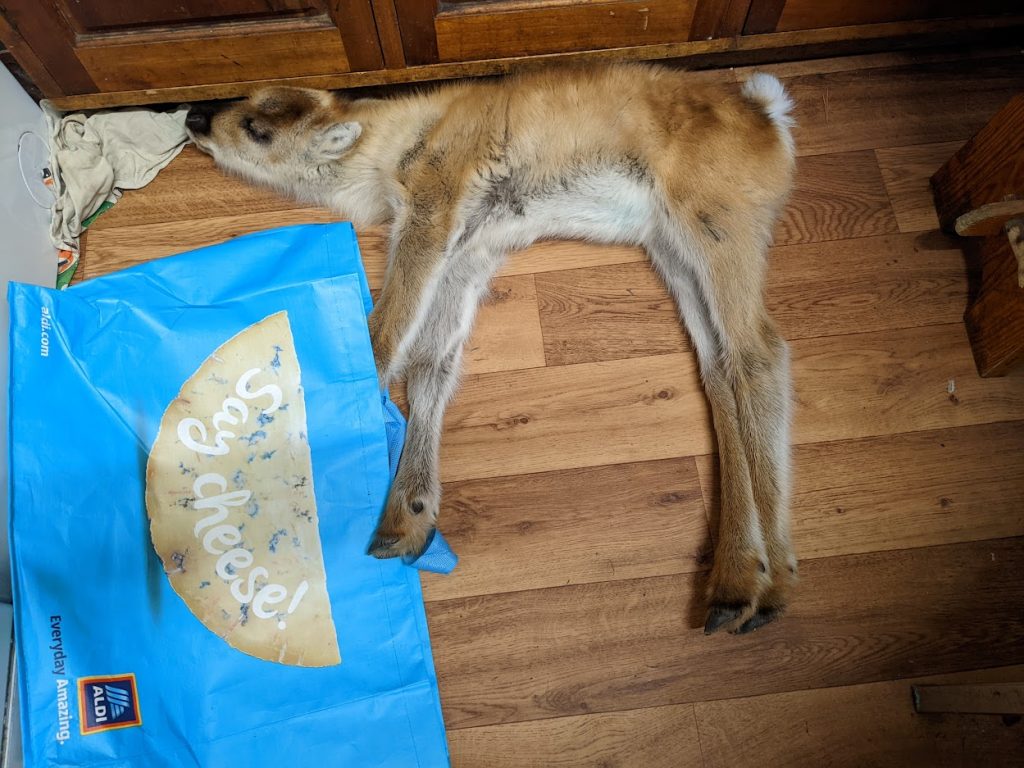
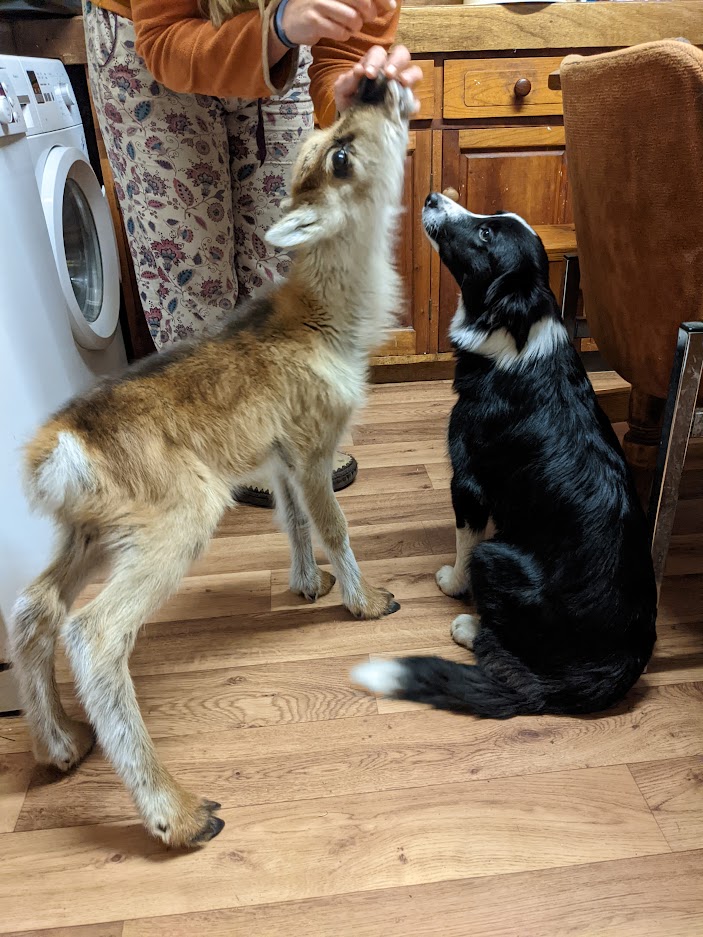
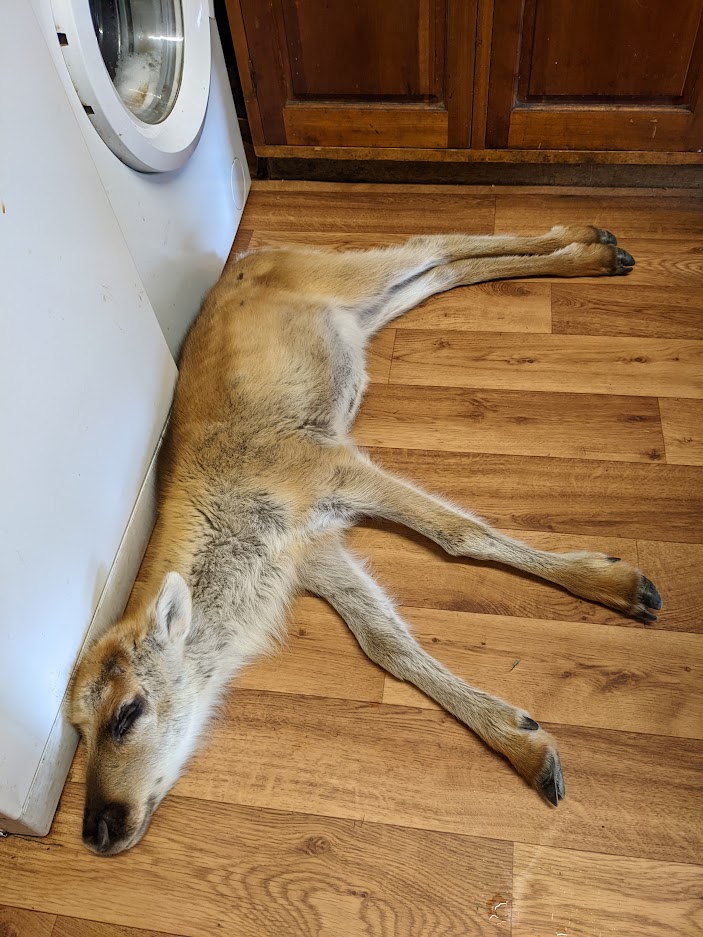
It’s been a good few weeks now and Sunny has become part of the Reindeer house family of humans, dogs and now baby reindeer! He joins us for dog walks, where we know it’ll be quiet and we won’t bump into other walkers with their dogs, he makes himself at home on our kitchen floor on the odd occasion when he comes into the house. His favourite spot is beside the washing machine. In fact he is so comfortable in ours and the dogs presence that he’s the ultimate ‘lazy boy’ and he pees while he is lying down! Needless to say we’re all quite used to mopping up after him now. It’s a good job we have an easy to clean floor and aren’t fazed by a bit of pee and poo!

Fast asleep by the washing machine – his favouite spot within Reindeer House.
He quickly made friends with herders and dogs. Our dogs are very good with him, and basically completely ignore him.
The two youngest members of our household – Sunny and Fraoch.
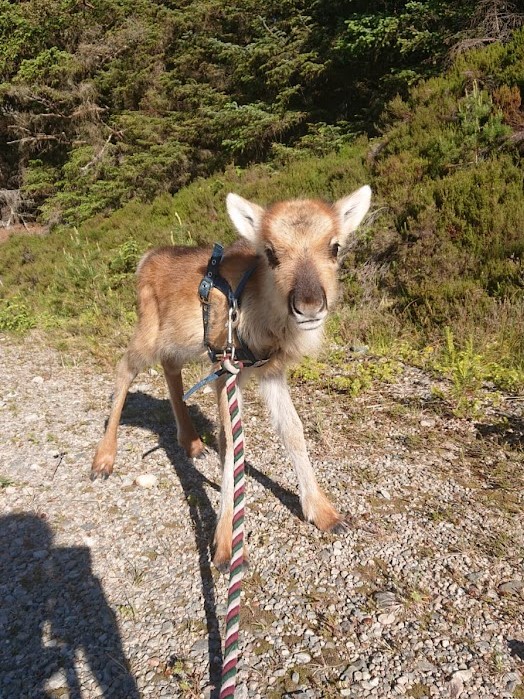
One of Sunny’s first walks with us.
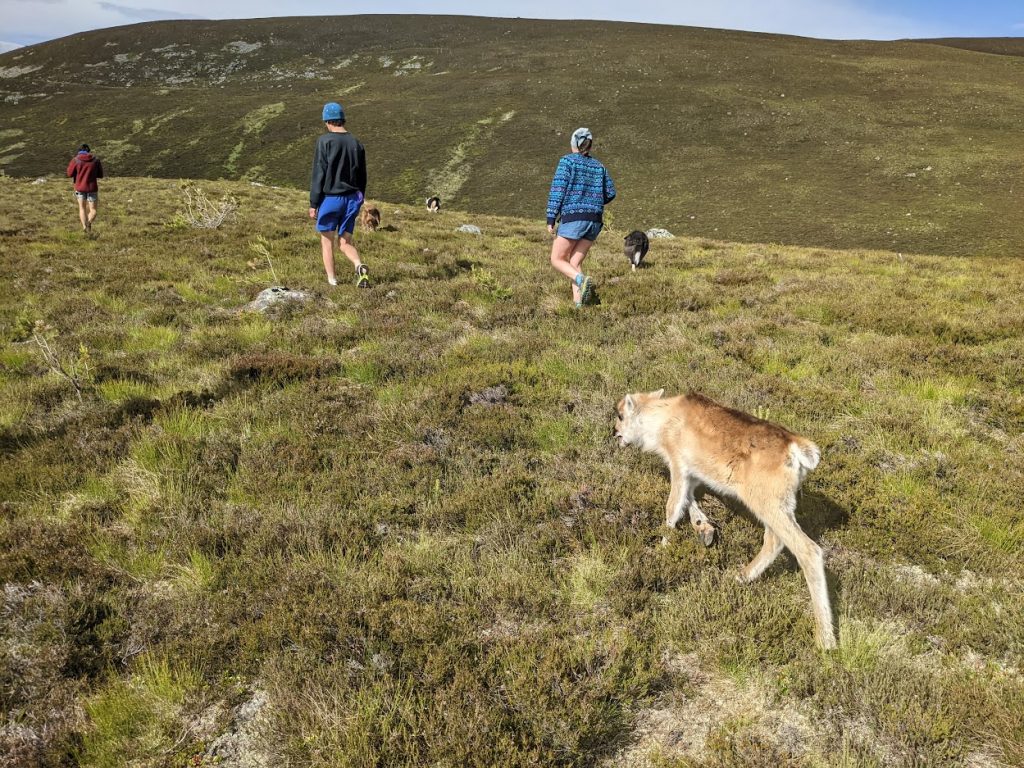
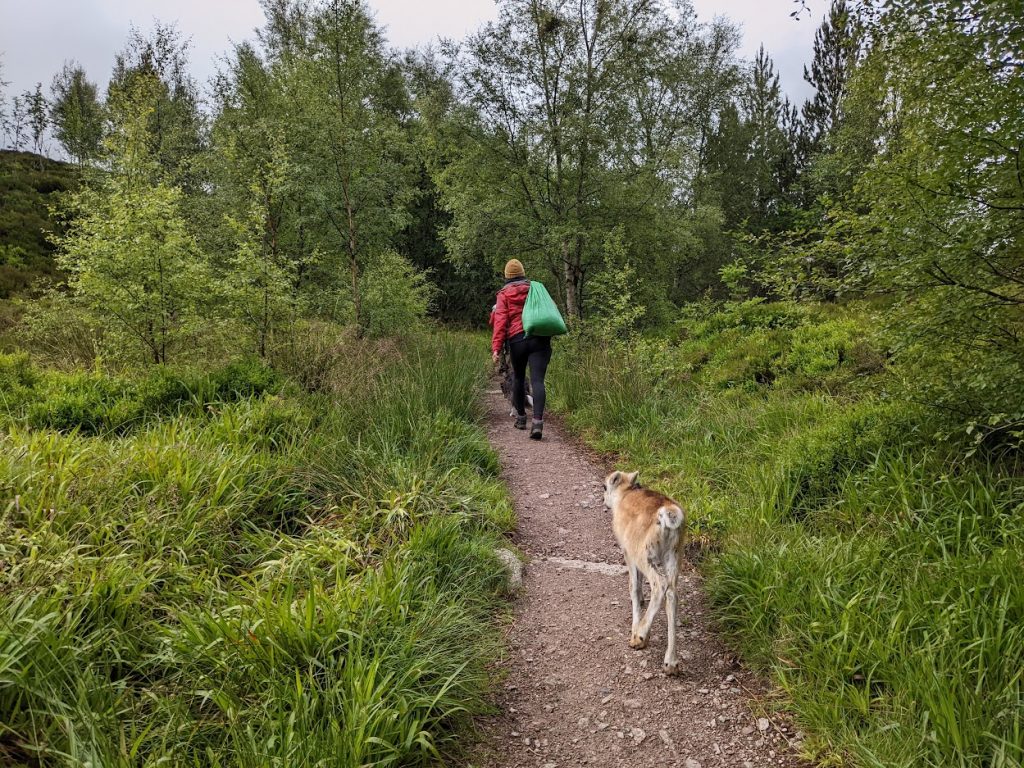
Joining herders on a post-work walk. Good exercise for Sunny, and an opportunity to find nutritious grazing.
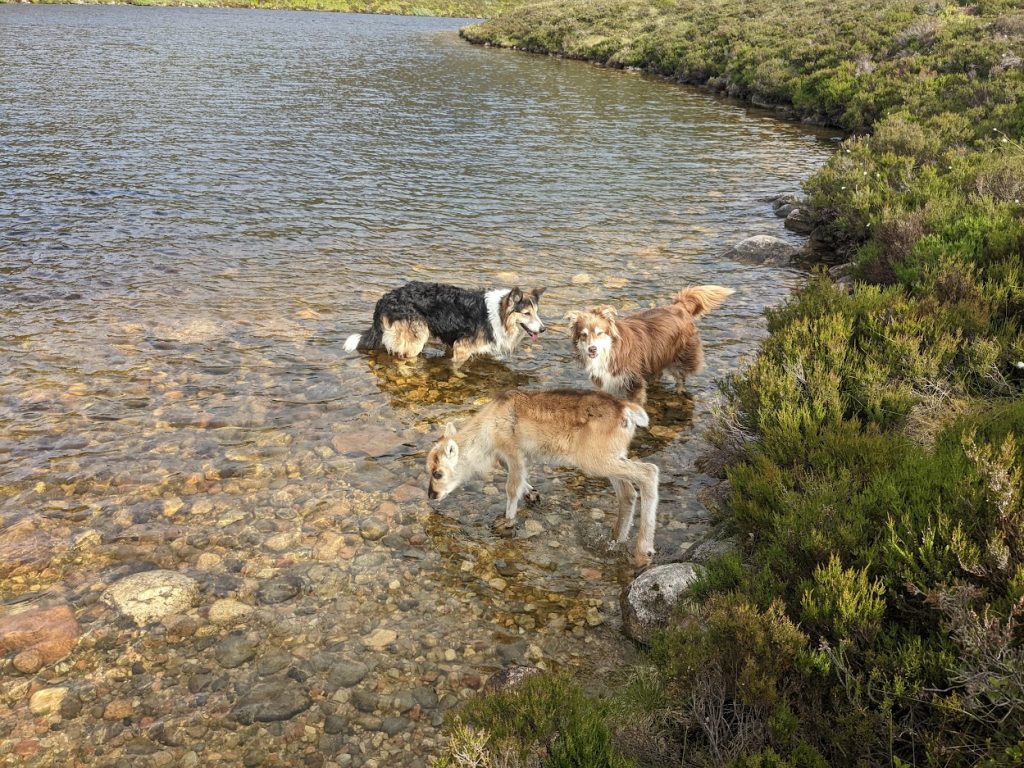
Sunny enjoying a paddle… he even went for a swim, calmly following us herders in as we went for a dip!

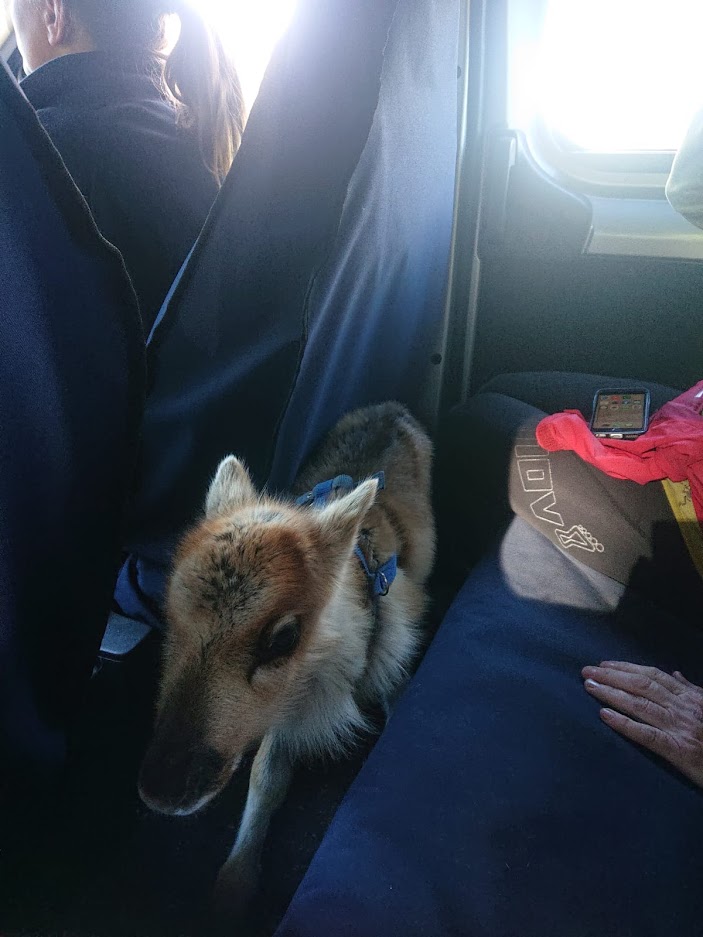
Every morning he gets in our reindeer van and joins the herders and dogs for the walk over to our enclosure. Getting some tasty grazing along the way it’s also very good exercise and socialising for him as he comes in with the main herd. The first time we took him up the reindeer on the hill acted like they had no idea what he was… Is he a dog?!?! They sniffed him and with sudden movements Sunny made they darted off, tail in the air worried he’d do them harm. Little did they know he was just a very young version of them. They are now accustomed to him and he mixes in just fine.

Sunny in the van on his way up to the enclosure for his morning exercise.
Sunny enjoying some tasty grazing on his daily walk to the enclosure.
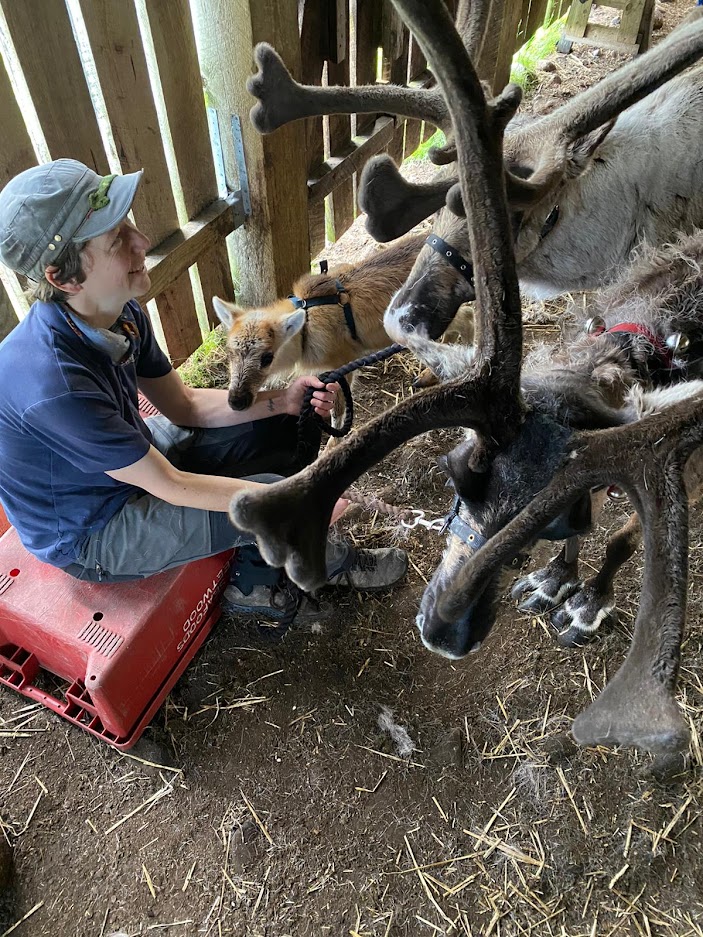
Start ’em young! Sunny assisting Andi with harness training.
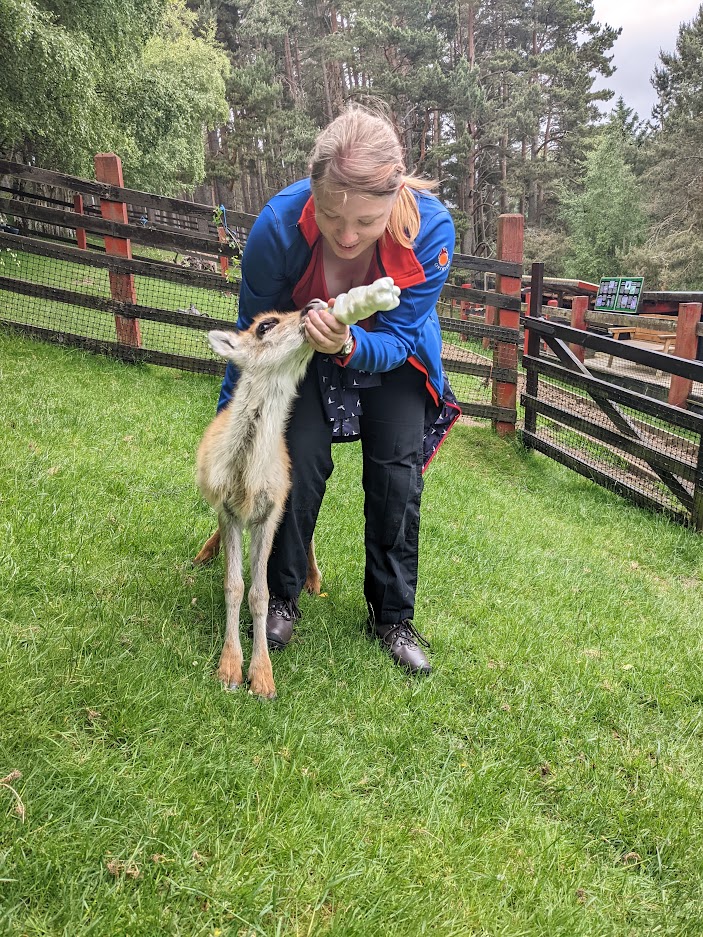
Stephanie, one of our volunteers, giving Sunny a bottle of milk.
Nom, nom, nom.
Sunny now spends his afternoons and evenings in with Paddock reindeer. Here we have Beastie, Druid, Jonne and Haricot keeping him company.
He still comes into the house most evenings, he may have grown a lot in the month we’ve been looking after him, but his favourite location in the house hasn’t changed.

So here you have it, Sunny our hand reared calf of 2022. We named him Sunny as his mother was called Rain and his brother is called Jimmy so for the Scottish folk out there you’ll know the saying ‘Sonny Jim’! We’ve just tweaked the spelling. I cannot predict the weather this summer but I know for sure that we will have a Sunny summer!

Bring on a Sunny summer!

Fiona

Calving Bets

Each year, as calving season looms, we reindeer herders have a sweep stake. We place our bets on which reindeer will calve first. Or rather more importantly, try to bet upon which reindeer won’t calve last.

I say ‘bet’…what I really mean is we try to combine luck and science to each predict a reindeer. The herder whose reindeer gives birth last then has to do a punishment. The punishment was historically swim in Loch Morlich. However, this task became obsolete as a punishment a few years ago when it became apparent that most herders regularly braved the cold waters as a leisure activity.

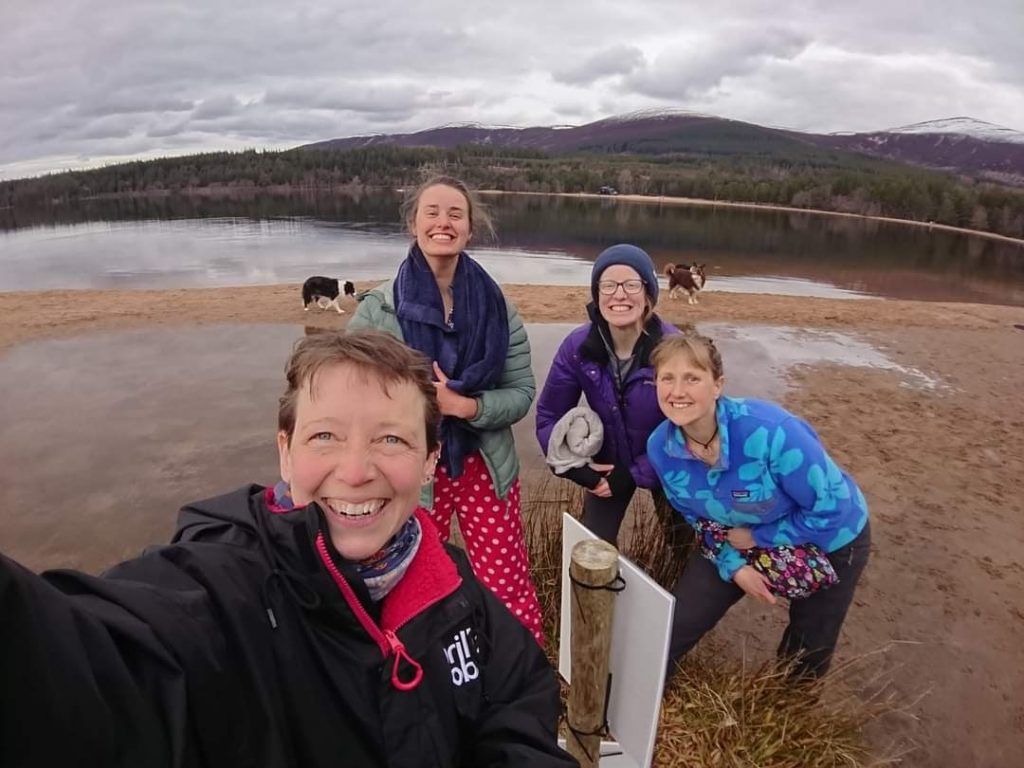
Andi, Lotti, Ruth, Fiona and dogs after a post-work dip in Loch Morlich.

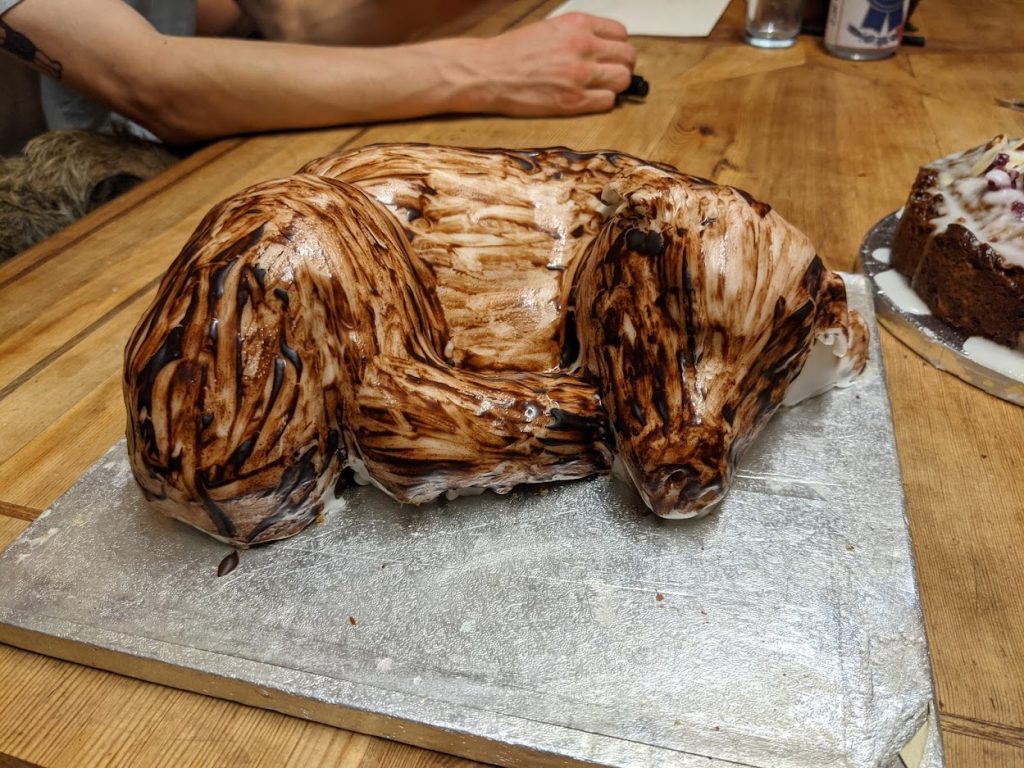
So, the current ‘punishment’ is to bake a cake for the calf naming evening in September. It is on this evening in September that we pick a theme and subsequent names for the recently born reindeer. It’s hungry work, so cake is always greatly appreciated. In fact, in 2009 the cakes were so appreciated that we had a whole naming theme dedicated to ‘cakes, puddings and biscuits’.

Olly lost the calving bet last year (alongside Andi so he was in excellent company) so produced this cake in the shape of a newborn calf!

We’re in the last week of April as I write this blog and it’s a stage in the year where some of the pregnant females are MASSIVE. We’ll be expecting the first calf in the coming days and each of us will keep a keen eye on who calves throughout the month. I mentioned science as a prediction method in my first paragraph. Some herders like to research when a reindeer stripped the velvet on their antlers in the previous year, some herders like to look at if the reindeer are already growing their new antlers, and some herders like to inspect how big a reindeer’s udder is, all as a sign of their readiness to calve. If a reindeer strips their velvet early it can be an indicator that they come into season earlier. If a reindeer is already growing their new antlers it can be a sign that they are using more of their nutrients for themselves and not sharing them with a foetus.

Christie stripping the velvet on the 15th of September 2021 – what does that mean for her calving date?!
Don’t think Brie is very impressed by the udder check!
Being the “sheepdog” at the back of the reindeer herd in April can be the perfect time to compare how wide bellies are growing!

This makes it all sound very technical actually. I think most of us just tend to pick one of our favourite reindeer. It’s more fun that way in my opinion. Sometimes it’s fun to take a risk as well. Add to the drama. However, herders have been known in the past to make a risky prediction and the reindeer to not be pregnant at all. Just fat!

In May 2021, Andi picked Camembert, but sadly for Andi (great for us – the cake was delicious!) she was just fat, not pregnant! This is Camembert being put out to free-range for the summer on June 21st after no calf appeared, still trying to get more food from Lisette!
Lotti picked one of her favourite reindeer Gloriana (R) for the past two years, she didn’t let her down in 2021 when Beanie (L) was born. But what will she do this year?!
Some reindeer are so dependable to calve first that they’re off-bounds. Christie was first last year. And it was Pagan the year before that who always seems to be there or thereabouts. This year Tilly has chosen Ladybird who looks rotund. Ladybird, that is. I’ve chosen first time calver (I hope), Texel. My baking skills aren’t up to much so let’s hope Texel pulls through to reduce the risk of a salmonella outbreak up here.

Texel giving nothing away – 19th of April ’22.

Ben B

Birds in the enclosure (Spring)

Spring is all around! The days are longer and warmer, buds are beginning to burst into leaf and very soon there will be lots of wobbly new-born reindeer calves taking their first steps in our hill enclosure. As well as the reindeer which increase in number on the hill, so will the bird life as migratory birds arrive from warmer places such as Africa, Southern Europe or even coastal Britain to breed and rear young. All the herders enjoy and appreciate the different birds we get in the enclosure during different times of the year and spring announces the return of some of our favourites.

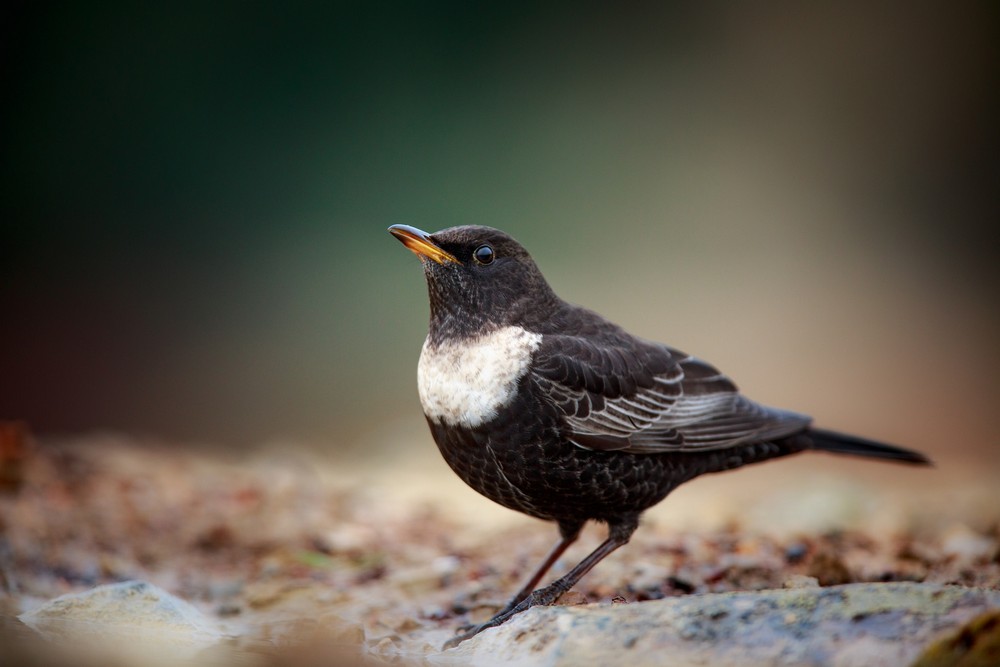
Ring Ouzel – It may be a fair assumption that this species is the favourite of migratory birds amongst herders. Known as the mountain blackbird, they are a little longer and more upright than their more common cousins and get their name because of the male’s obvious white bib under the neck. They typically nest in gullies or steep scree slopes on the hill side and like many migrants, arrive in April and leave by September. Along with a beautiful song and obvious alarm call it is always a joy to see these birds in and around the enclosure looking for invertebrates to feed on.

Ring Ouzel (image from: https://www.british-birdsongs.uk/ring-ouzel/)

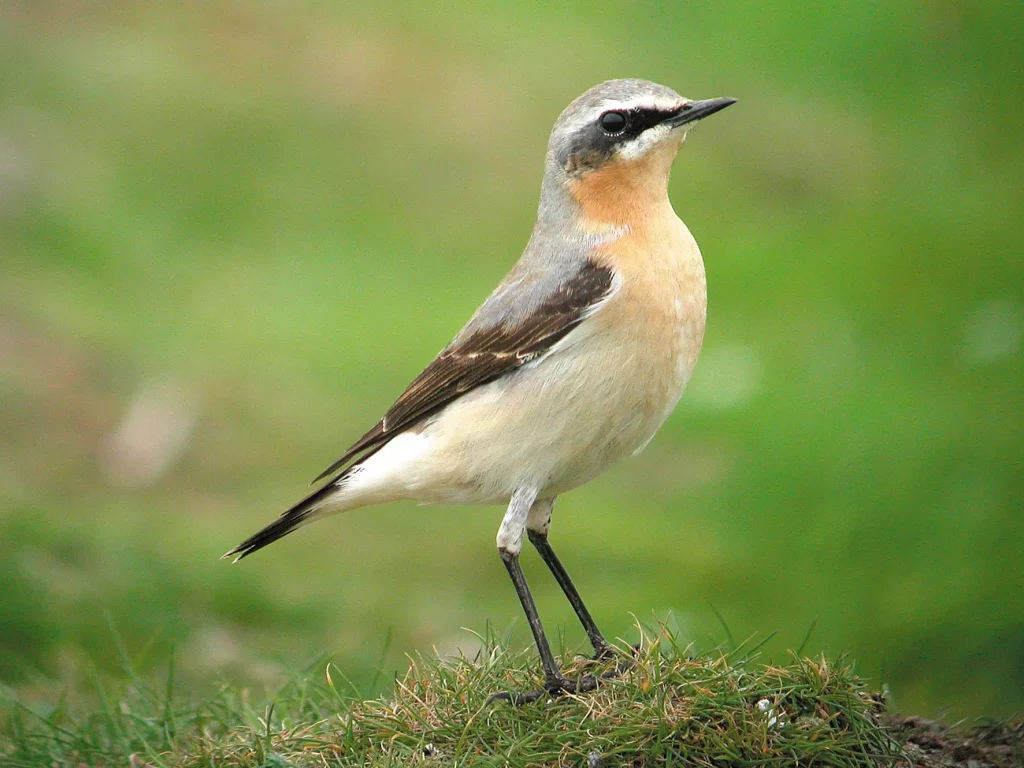
Wheatear – Also summer migrants, these little birds can be common across the more upland environment of the Cairngorms. The males are quite colourful with a blue/grey head and back, black wings and an orange like breast. Wheatears like rocky open land but can be seen on moorlands, and coastal grassland, nesting on the ground in holes, scree slopes or stone walls.  They can be seen hopping about in the enclosure for insects and more so on the footpath towards the Chalamain Gap. Sometimes found in Greenland or Canada and wintering in Africa, Wheatear are among the world’s long distance migratory birds, estimated to fly nonstop for up to 2400km in 30 hours! The first one this season was seen early on the 24th of March.

Wheatear (image from: www.birdwatchireland.ie/birds/wheatear)

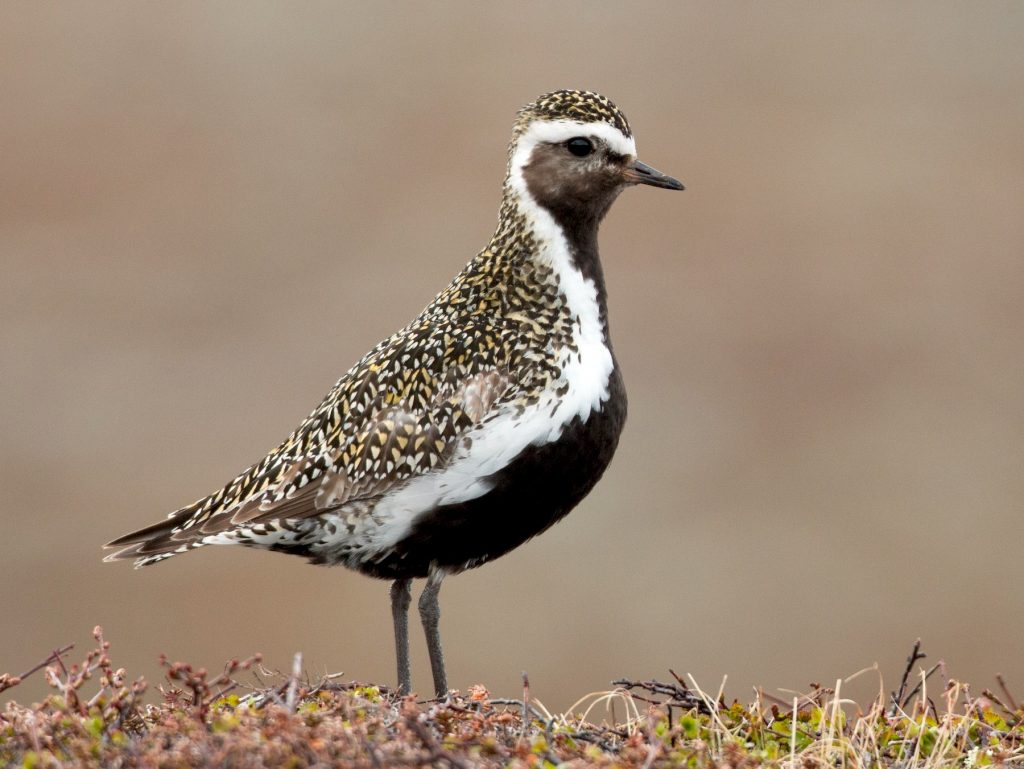
Golden Plover – During the winter Golden Plover can be found in the UK near the coast or lower farmlands and are often seen in flocks with Lapwing. For the spring and summer they move to the higher moorlands and hillsides to breed and nest on the ground, they can be be seen in our enclosure but their spotted black and golden camouflage plumage keeps them well hidden, it’s not until you hear their high pitched and rather sad sounding alarm call that you realise they are around. These shy but charming waders can also be seen up on many of the higher hills of Scotland and are a great addition to any hill day.

Golden Plover (image from: https://mkoireland.ie/new-irish-wildlife-manual-released/)

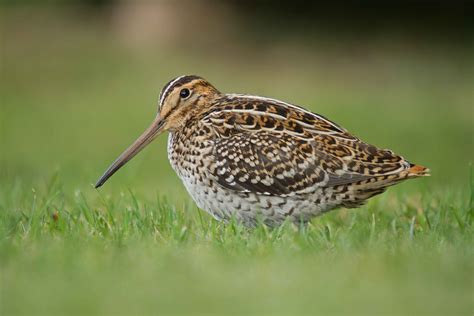
Snipe – Another wader to be found regularly in the enclosure is the Snipe. Like Golden Plover, Snipe are in the UK all year round but many of the wintering birds migrate elsewhere to breed, leaving a much smaller population of residents during the spring and summer. They typically enjoy a damp environment in habitat such as marshes, bogs or wet meadows, all of which is abundant in the reindeer enclosure. Snipe have a long straight bill, short legs and rather dumpy shape. You’re more likely to hear their amazing drumming call during the spring season than ever see them, the only time I ever see Snipe is by accidently getting too close and watch as they fire off the ground and whizz away in a fast zig- zagging motion.

Snipe (image from: https://www.birdguides.com/gallery/birds/gallinago-media/544573/)

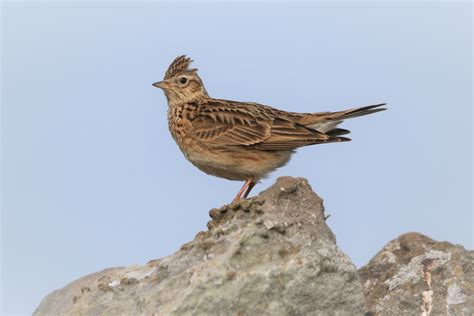
Skylark – Another British resident that also moves up onto the mountain side during the breeding season is the Skylark. With a very good population throughout the whole of the UK, these birds are by no means uncommon but it’s always a delight to hear their long and beautiful song high in the sky during the Spring and Summer months. Skylark’s are a rather bland looking bird with a grey and brown speckled plumage that looks very similar to that of a meadow pipit. Get close enough though and you’ll also notice a crested head that helps differentiate them. It’s the sound of a Skylark that makes them unmistakable though, flying well over 100 meters high in the sky and singing for up to 15 minutes long, they make a great additional to a hill trip in the enclosure with the reindeer.

Skylark (image from: https://www.birdguides.com/gallery/birds/alauda-arvensis/1003602/)

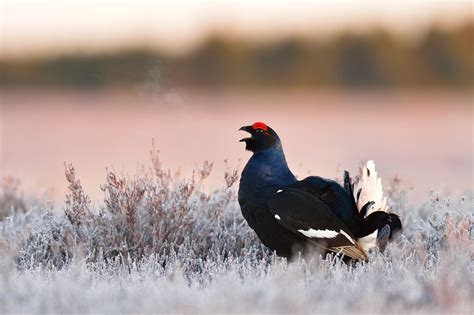
Black Grouse – The final bird to mention is the Black Grouse. Black Grouse are a rather large bird, the females are a grey/ brown colour while the males are predominantly black with red eyebrows and white under tail and wings feathers. They live in Glenmore and the Cairngorms throughout the year in secret until the Spring and breeding season when the male birds start to Lek. The Lek is a site usually in a clearing close to woodland where the males compete for the most central positions within it. Flashing their tail feathers, the males can be highly active with plenty of showboating while making bubbling and shrieking calls and sometimes fighting to gain position, the Grouse most central in the Lek will attract the most females who watch the drama from a short distance. We are lucky to have a Lek within the enclosure where the birds are undisturbed within the safety of our private space.

Black Grouse (image from: https://www.scotlink.org/species/black-grouse/)

Joe

Reach for the sky! How reindeer antlers grow so fast

They’re the most distinctive feature of the reindeer, and the most incredible. Branching elegantly like the trees which the tundra so sorely misses, and renewing themselves each year, antlers demonstrate nature’s complexity and mystery in one. At this time of year the reindeer’s quickly growing antlers constantly amaze visitors and captivate my own imagination. It occurred to me recently that the cells in growing antlers and the cells used in the Covid-19 vaccine are both the same type of rare cell: undifferentiated stem cells! It might be interesting to join the dots between this.

A line of hungry boys and growing antlers (August 2021)
Nell being inspired to write this blog, surrounded by lots of wonderful antlers (July 2021)

Greater Antlers, Greater Chances…

Large antlers lead to a (sexually selective) advantage in males, and even in females too as those that are better able to defend areas of food in the winter are more likely to produce healthy offspring. A physical advantage in a single characteristic, leading to it’s selection is a process called directional selection. This means that over time, reindeer populations evolve very (VERY) gradually to have larger antlers.

Swedish-born (and the very handsome) Kota, who was used as a breeding bull for several years (August 2017)
The lovely Fly, who tends to grow big antlers for a female (September 2019)

However, large antlers come at a cost, requiring huge amounts of energy to grow in such a short space of time. Reindeer eat lichen, which is fairly low in nutrition and has a long digestive process, as well as other low lying plants, mosses and mushrooms found across sub-arctic areas. As even eating a lot of food won’t make up the energy, the animals shift calcium from parts of the skeleton which don’t carry a lot of weight (such as the ribs) in a process called cyclical reversible osteoporosis, which humans also go through during pregnancy. There are still more adjustments, as the reindeer’s neck and shoulder muscles need to swell in order to carry the bulky weight of the antlers, and movement becomes restrictive. It’s no wonder then that the rutting season becomes so taxing for large bulls that their life is typically shorter than that of a female. Taken to an extreme there is even a theory that the great Irish Elk, or Megalocerous, was partially driven to extinction due to the amount of energy it lost to it’s enormous antlers! I find it unlikely that this will happen to the reindeer but there’s no doubt that these huge organs take a lot for the reindeer to grow.

The Irish Elk or Megaloceros with it’s weighty antlers (image: Biggest. Antlers. Ever. Meet the Irish Elk | At the Smithsonian | Smithsonian Magazine)

Shooting for the Skies

Although we know what pushes antlers to grow to such a huge size, it’s truly incredible when we begin to ask how. Antlers are the fastest growing organs in the animal kingdom, potentially growing around three inches a week (dependent on nutrition). This is mainly due to the quick regeneration of stem cells from which they are formed; the only type of cell in a body which can differentiate into any kind of tissue, such as bone, fat or skin. We have some of these cells in our bone marrow, as an important part of our bodily regeneration, and the quick formation of embryos is also due to them. Stem cells are also an important resource in therapies for degenerative diseases or to support the body following certain aggressive cancer treatments. Stem cells have even been used in the creation of several vaccines – including for Covid-19! This, combined with their versatility and potential in lab experiments makes stem cells an extremely valuable resource to medical research. It’s awesome to think that the same cells from which reindeer antlers are formed are what we use to treat life threatening diseases.

Finally, the antlers are not just useful to the reindeer, but also to the other animals in the wider ecosystem. Often when we find an antler which has been out on the hill for a while it will be worn thin and marked by the tooth marks of different animals. In the Paddocks we also see that mice and squirrels chew the antlers in the display area! This is because once they are dropped they are an open source of calcium which sometimes the reindeer, or other animals, (like your own pet dogs) will chew in order to reclaim the minerals. There have even been times that reindeer have chewed each other’s antlers while they’re still on their head!

Reindeer chewing on a cast antler in the enclosure, video by herder Olly

Next spring I plan to photograph the same reindeer once a week from the time it’s antlers are small stumps until they’re fully grown as there really is an incredible difference. There’s so much which is unique and wonderful to say about antlers and I’m looking forward to writing still more about them!

Ryvita (and her lovely antlers) with Nell on the free-range (August 2021)

P.S. What’s the difference between an antler and a horn?…… A horn makes a noise!

Nell

Spy – the reindeer we’re all a bit scared of

A while back, I wrote a blog about how difficult it can be to locate calving reindeer within our hill enclosure (see previous blog). But with one reindeer, finding her is just the start of our problems.

Spy, whose reputation precedes her!

Spy is notoriously protective of her calves, at least for the first few days, and getting her from the main part of the enclosure where she has calved through the gate into the ‘bottom corridor’ (the area of our hill enclosure that we use as a nursery for the newborn calves) can be ‘entertaining’, to say the least. Most reindeer will lead their calf away from us if they can for the first two or three days, but that is the extent of their protective motherly instincts. After that the lure of food wins out, and they decide that actually, they probably can’t be bothered to march away, and that we’re no threat anyway. Some very tame (or greedy) reindeer just totally skip the avoidance phase and are completely blasé about us being around their calf, even if it’s literally just been born.

The way it normally works: Myself gently pushing Cheese and newborn Kiruna in the right direction across the hill enclosure a couple of years back.

Spy? Spy’s instinct to protect goes into overdrive, to the point that we are all VERY wary of her for a couple of days. It would be fine if we could just leave her to get on with everything herself, but in reality we do need to get hold of the calf just once, to spray it’s naval with the antibiotic spray and to put some insect repellent on it’s back, and this has to be done when the calf is less than 24 hours old (otherwise it can run too fast to be caught). The first time that Spy calved in the hill enclosure I was the one who was first on the scene, and discovered that for the first time ever, I wasn’t going to be able to walk straight up to the little furry heap on the ground, despite the fact the calf was obviously not yet strong enough to stand up and run away. Whatever I tried, Spy constantly circled to keep herself directly between the calf and myself, and made it abundantly clear that should I persist, I would be the one coming off worst in the situation.

The only way to get hold of Spy’s calf is to get her through a gateway ahead of us, and then manage to get the gate shut behind her before the calf gets there. Thankfully newborn calves don’t understand fences or gates and will generally just blunder in a straight line towards mum and into the fence, sticking their wee heads and necks between the wires and wondering why their bodies don’t follow. At this point we can swoop in, catch the calf, sort out what we need to do as quickly as possible, and then post it through the gateway back to mum. That first year when Spy had calved, I returned to Reindeer House to announce that yes, she’d calved, yes it seemed fine and strong, but no, I had no idea what sex it was, and no, it was not yet in the nursery area. I think I was then off the following day, and by the time I returned to work Spy and calf were in the right place but Fiona had an epic tale of woe about the trials and tribulations this had involved.

With Nok, the calf who I’d failed entirely to get close to.

This year was the hardest yet, not helped by the fact that in 2020 Spy had grown her nicest set of antlers ever, tall, elegant but very, very pointy, and she still had one of them. A reindeer armed with 2’ tall spiky weapons on her head that she’s not afraid to use is considerably more daunting a prospect than a bald reindeer. We managed to gently push Spy all the way to the gate into the bottom corridor without issue, but getting her through the gateway itself took four of us about 30 minutes, with an awful lot of time spent in a total stand-off. Watching Fiona move gradually towards Spy, arms out trying to push her gently towards the gate whilst the rest of us hung back was like watching a lamb go to the slaughter. I wondered whether Fiona would remain unscathed, and to be honest it was a close run thing! All four of us closed around her in a semi-circle, tighter and tighter, but it was a delicate operation of continuously reading Spy’s body language and reacting to every movement and step. Quietness is needed in this sort of situation, there was no rushing or shouting or flapping of arms, until the sudden speed needed to get the gate shut once she finally went through. Catch the calf quickly, all hearts thumping quicker than usual, and a flood of relief! Calf sexed (male), antibiotic spray on naval, fly-spray on back, post through gate, and high-fives all round.

Not one of Spy’s calves (this is Angua’s calf Chickpea), but a quick cuddle is usually needed once all calf duties are done and everyone’s in the right place!

By two days later Spy had completely chilled out once again, knowing perfectly well that once she’s in the bottom corridor none of us are going to try and touch her calf, and was eating off the feed line with the rest of the mums as happy as larry. And then rest of us were also very happy to have survived another calving season involving Spy unscathed! She’s always a reindeer we treat with respect and never handle anyway, unless we have to, for 363 days of the year, but for those two other days she is a very different kettle of fish.

Spy in the nursery part of the enclosure a day after trying to kill us all this year, antler having fallen off in the meantime. Suddenly she doesn’t look quite so intimidating when not waving a large, spiky antler around!

Hen

Book Now