Differences and Similarities

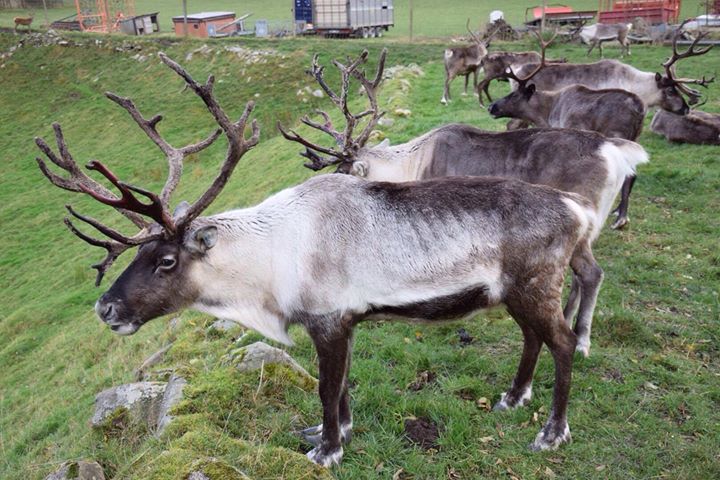
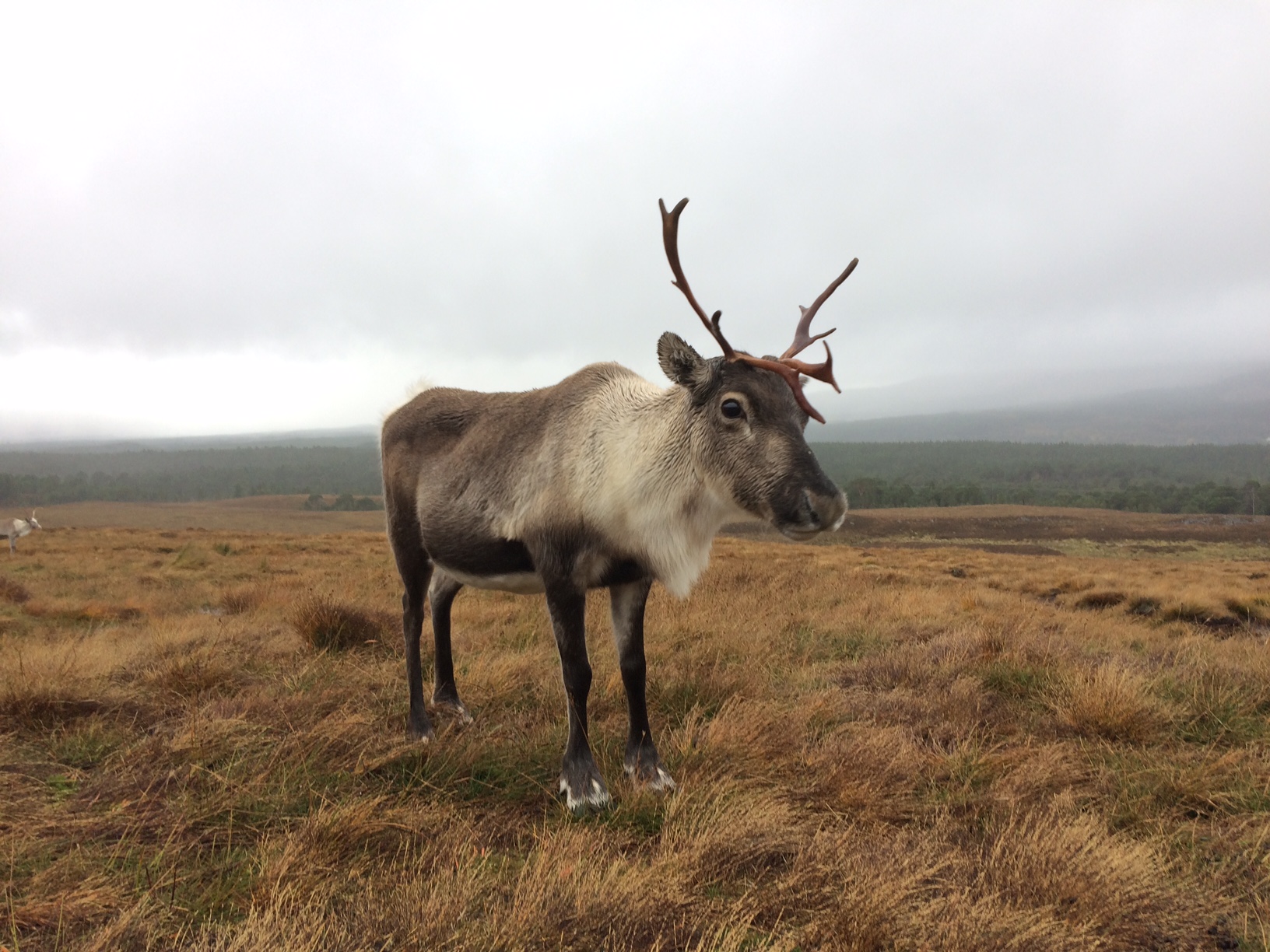
One of our visitors recently decided to adopt a reindeer they’d met at the Centre, but called us up when they received their pack to let us know that we’d sent a photo of the wrong reindeer. The reindeer they’d met had been a pale brown, with a thick shaggy coat and small antlers, whereas the photo on their certificate was of a sleek black coloured reindeer with large bony antlers. Thankfully, we hadn’t got it wrong, but could totally understand their confusion, as the reindeer change in appearance a lot throughout the year.

Bovril
Bovril in his shaggy old winter coat in June, and looking smart in September

First, there is the coat appearance. From May, the reindeer start moulting out their long winter coat, which, with 2000 hairs per square inch, takes about six weeks. They look incredibly scruffy at this time, but by around mid-July the whole herd look glorious in their short summer coat. This summer coat is a richer colour than the winter coat, so the white reindeer are gleaming white, and the darker reindeer are virtually black. The short coat exposes all of their angles, so they can look a bit gaunt, with angular heads and shoulders.
Olympic
Olympic’s varied coat throughout the same year (2014) – in February, July and September

Summer in the Highlands is short-lived, however, so by September their long winter coat is growing through, softening their appearance and turning them into cuddly teddy-bear lookalikes. This coat is slightly lighter in colour, so the darkest reindeer are now a rich brown. Over the winter months, the sun gradually bleaches out the colour, so by April the whole herd are a similar washed-out shade, with only the pure white reindeer looking different. It is the worst time of year to become a reindeer herder, as the reindeer look almost identical, and I’ve had sympathy with Ruth, and previously Dave and Imogen, starting in April and trying desperately to work out who is who!

Beastie
Young Beastie throughout the same year (2011) – in full winter coat in January, darker summer coat in July, and new winter coat in September
Strudel
Young Strudel throughout the same year (2010) – in old winter coat in May, dark sleek summer coat in August and with new winter coat growing through in September

Whilst the colour of a reindeer varies depending on the time of year, a dark coloured reindeer will always be comparatively dark, and a light one will be light. There is one exception, in that some white calves are born a mousy brown or grey colour, with a white forehead. This white forehead suggests their future colour, and once they are a yearling they have changed into their adult silvery coat.

Diamond
Diamond as a brown calf with a white forehead, turning silvery later that year, and even lighter as a yearling
Origami
Origami as a calf with a white forehead, and as a silvery white adult

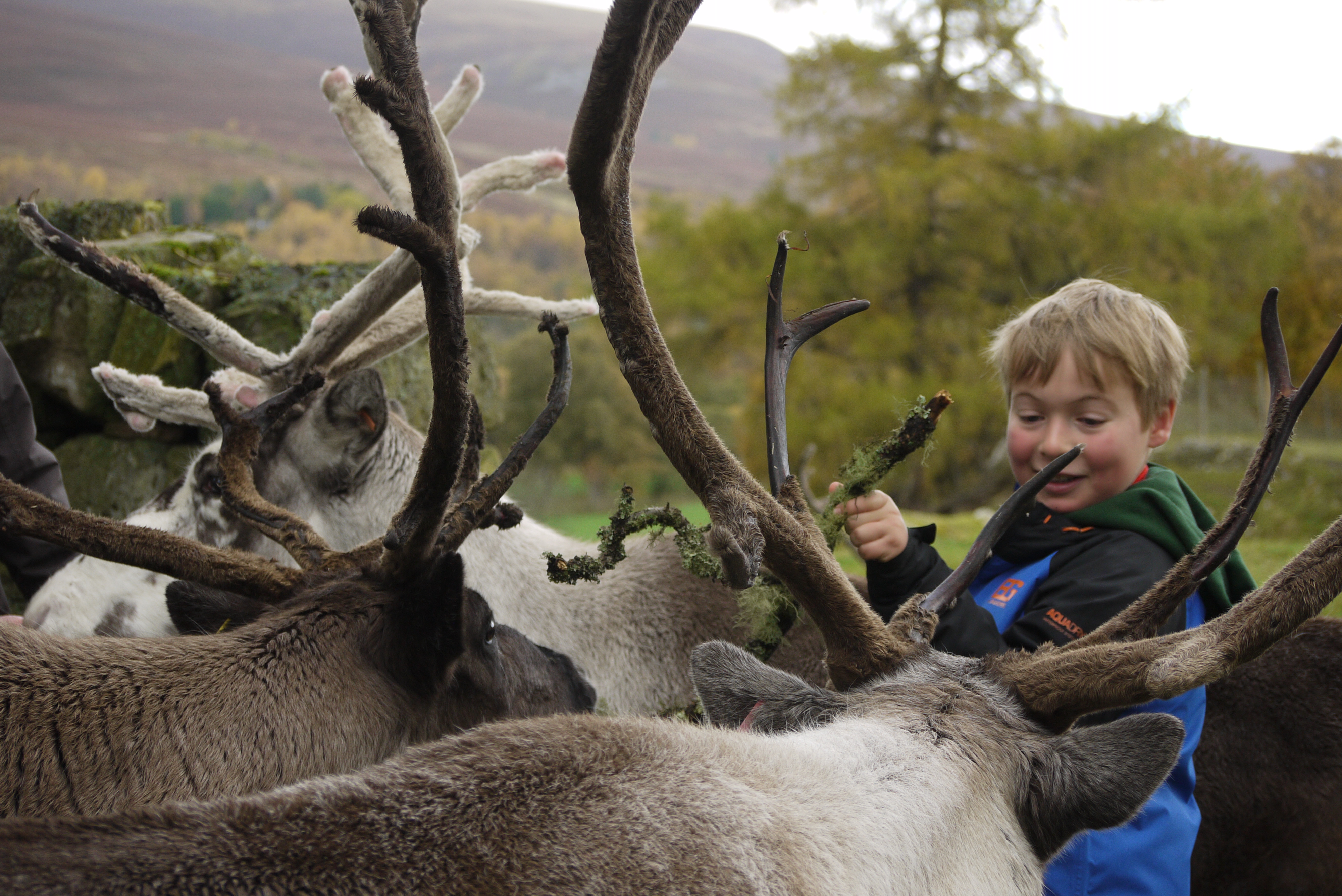
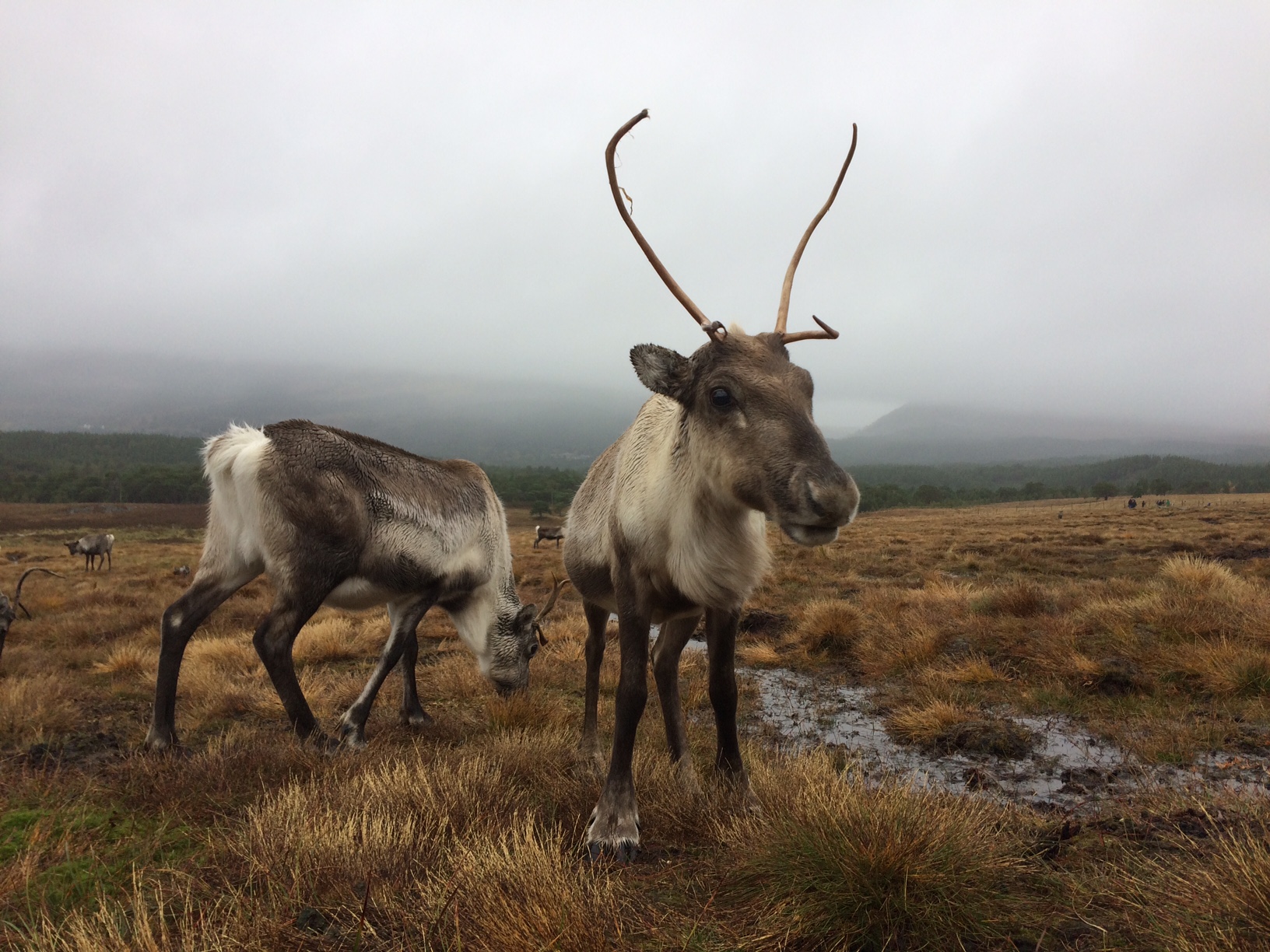
The other major change in appearance is relating to the antlers. Every year, each reindeer grows a full new set of antlers before casting them again at the end of the season ready to grow the next (hopefully better) set. From January to March, the male reindeer are antler-less, with the females usually losing theirs a little later, between March and May. Antlers are very distinctive, with each individual tending to grow a similar shape or pattern each year once they pass the age of about three. This is really useful for us herders, helping us to recognise the reindeer from year to year. Not much help in the period between casting the old set and the new set getting to a sensible size though! New herders are cautioned to try to “look beyond the antlers” and instead learn more permanent characteristics, such as the shape of their face.

Caterpillar
Caterpillar with very similar antlers over three consecutive years – 2014, 2015, 2016.
Puddock
Puddock with his familiar crazy branching antlers over three consecutive years.

There is a slight spanner thrown in the works though, as adult reindeer don’t necessarily grow the same size of antler each year. Antler size is determined largely by condition, so if reindeer are short of energy, they will grow smaller, more basic antlers – it’s pointless to waste energy on an amazing set of antlers if you don’t save enough energy for your body to survive! The three main reasons for sub-standard antlers are illness, rearing a calf, and advancing years. If a reindeer becomes ill whilst growing their antlers, the growth will be checked, and sometimes the new bone is weakened to the point that it breaks off, leaving the reindeer with short, oddly shaped antlers. Antler growth also checks when a female is about to calve, and the extra effort of producing milk to feed the calf can mean the antlers are considerably smaller than usual. Finally, once a reindeer is in their old age, their antlers often become distinctly short and basic – they are focusing their efforts on being alive rather than growing antlers for dominance.

Lulu
Lulu with impressive antlers in 2013, and a rather less impressive set the following year, due to rearing a calf.
Sequin
Beautiful Sequin in her prime with a large set of antlers, and with a simpler set in her old age.

It’s always entertaining for new herders watching the change in reindeer throughout the year, and sometimes peering in disbelief that the handsome reindeer in a photo is the same beastie as the scruffy fellow they know on the hill (as a side note, most of the photos for the adoption certificates are taken in September when they reindeer are at their smartest, with a fresh winter coat and recently stripped full-grown antlers). So if you do receive an adopt certificate with a reindeer looking a little different from when you met them, it is of course possible that we’ve got it wrong (we’re only human!) but if we check for you and confirm that it is them, hopefully this blog will help you to believe us!

Andi

Who’s who at Reindeer House (Part 1)

Times are a-changing and we thought we’d keep all you lovely readers informed with who is working here at Reindeer House. People have left, people have arrived, but the reindeer herding goes on…

So here goes:

Imogen and Abby (aka The Fierce and The Fluff) who both worked here for a few years have left in the last couple of months, moving on to new places and new adventures. We miss them both greatly (and their banter!), and for all of you out there who knew them as herders, we know you’ll miss their characters too..

P1150037
Abby on a beautiful day with Lace.
DSC_0355.JPG
A sunny winter’s day surrounded by reindeer is enough to make anyone, Imogen included, smile!

Ruth is our newest member of staff, who joined us during May. As a redhead she has gone through so much sun-cream since arriving that we’ve decided there should be a redhead grant from the government to cover the cost of this, so you can wish us luck on this venture. Ruth has a fantastic knowledge of the plants and animals of Scotland, and makes tours out to see the reindeer a whole new learning experience for both visitors and others herders!

Ruth.jpg
Ruth with one of our calves from this year.

Olly is back! Olly has worked at the reindeer centre on and off seasonally over the last few years, but is finally here to stay (we just can’t keep him away). Known for his flamboyant shirts and braces and excellent (and probably early-morning-sleep-related) comments, Olly is just great. Full of enthusiasm, knowledge, practical skills and creativity, Olly keeps us amused and is an excellent man to have about.

olly 2.jpg
Olly amongst a hungry herd of reindeer.

After having been here only four months Morna has proved she can handle the most difficult of situations. She wears many hats – equally skilled with hammer or pen, paint brush or calculator. Her calmness is appreciated by the reindeer who are at ease in her presence and us herders appreciate her love for life. Growing up on the Orkney Isles she is at home in wild places (but whatever you do don’t start a snow ball fight with her as she is likely to hurt herself).

morna
Morna enjoying her first calving season.

Dave has been here now for just over a year, so is a well-known bearded face at Reindeer House. Our only resident New-Zealander, Dave has worked on his Scottish reindeer call to make sure the reindeer can understand him, which makes us all chuckle here at the Centre. Dave never seems to get fazed or frazzled, and is one of those genuinely lovely people who calms the rest of us down simply by being around, and visitors seem to come away from the hill trip in a much more relaxed mood than they began in. And although he has been here for over a year, the secret finally slipped out that Dave has never mixed a bag of hand feed…

Dave
Dave finds time for a moment of quiet contemplation on the hill.

Hen and Andi have both been here for a good number of years, and make sure everything runs smoothly here at the Centre. They are in charge of everything from our whole reindeer adoption database, to creating new road signs, to making sure the reindeer get the right amount of food, and to keeping us newbies in line. As Hen has been confined to crutches for the next few months, she is currently being our office-extraordinaire and we are all on orders to take photos of the reindeer down so she can keep up with how they are doing. Andi has taken up the slack of the missing Hen’s ID knowledge on the hill, and is providing a fountain of knowledge and tips for who is who. Andi is the herder to go to for all our stupid questions, and keeps us in line with her patience and loveliness.

Hen.jpg
Hen on Christmas tour, with a sleepy Topi on her shoulder.
Tony and Carol Dilger (6).jpg
Andi leading the herd of calves and other females out onto the hill.

Catriona is the oracle: our accountant, organiser, keeper of records, and all other hosts of jobs that need an experienced hand. She has been keeping the reindeer centre in line for longer than a few of us have been alive, and I’m not sure how the centre would work without her.

Sheena is a friend of the Reindeer Centre and has been around for over 25 years. She works on and off, filling in days here and there. She is the master of badge-making and incredibly full of energy at all times.

Stella and Ann are our long-term regular volunteers. They have helped out in many a sticky situation, have known the Reindeer Centre and all the staff over the years, and never fail to cheer us up with an odd packet of jaffa-cakes or biscuits turning up on the table.

And last, but of course by no means least, come the rest of the Smith family. Tilly and Alan, the owners of the company, are kept busy both here at the Reindeer Centre and over on their farm, working with not only reindeer but a whole host of animals, including Soay sheep, Wild Boar and Belted Galloway Cows. Over on the farm there is also Derek and Colin (brothers of Alan), and Alex (son of Tilly and Alan). Emily is Alex’s wife and, showing the reindeer centre to be a true family business, also works here for the odd day here and there.

Fiona, as many of you will know, is the backbone of the Reindeer Centre. Along with her brother Alex, they make the first native Scottish reindeer herders and her knowledge of the reindeer and how to work with them is long-ingrained. Fiona ensures that the whole of the Cairngorm Reindeer Centre organisation runs smoothly and the reindeer are happy and healthy all year round. Fiona also takes on much of the behind-the-scenes work, along with the hectic job of organising the whole of the Christmas period…

DSC_0361.JPG
An inquisitive girl!

We have too many volunteers and occasional staff to mention by name who turn up and massively help us out on a weekly basis, but who without, many jobs would go undone. So a big shout out to them all, for their fantastic help over the years. And of course, there are a whole host of others, family and friends of the Reindeer Centre, who work on and off or just help out, and are there to cheer us up if the occasion arises!

Yellow’s on the Broom

This is the title of a Scottish song about the Travellers (sometimes called Tinkers) who lived a nomadic life which often settled for a short while during the harder winter months. The lyrics show the Traveller anxious for Spring and a new start to traveling.

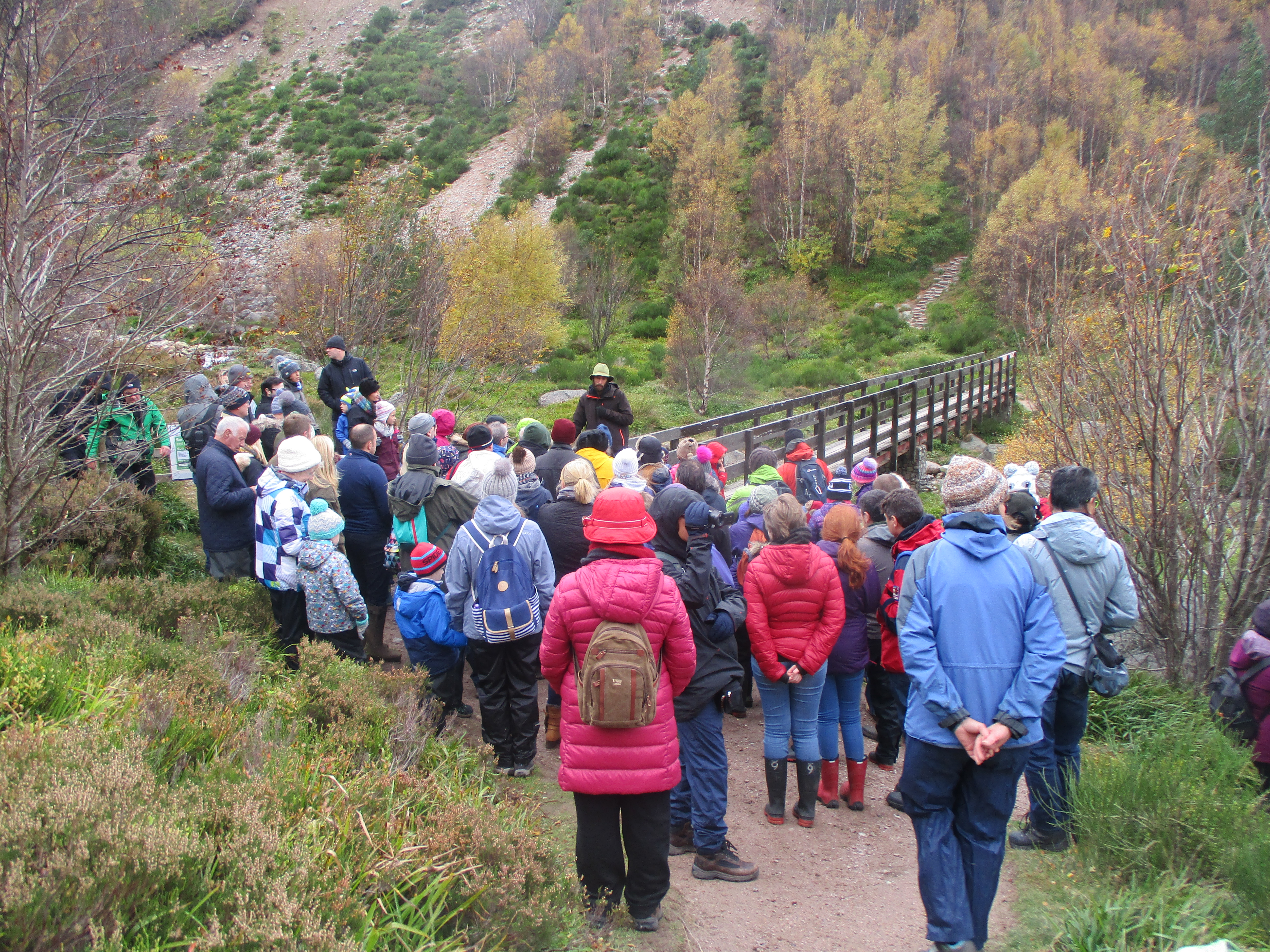
The guided walk out to the reindeer herd at this time of year is particularly colourful because the broom is in full flower with its multitude of bright yellow flowers. After the muted colours of winter, old heather and deciduous trees without leaves the flowering broom brings splashes of colour into the hills. I can understand why the yellow Broom would have lifted the hearts of many a traveller.

t
The Hill Trip group paused for a breather at Utsi’s Bridge, about to cross the Allt Mhor Burn. The yellow Broom flowers light up the valley at this time of year.

In fact the daily hill visit to the reindeer which takes us across the Allt Mhor Burn to the summer grazing of part of the herd is incredibly picturesque just now, perhaps making up for the reindeer themselves who can look quite scruffy at this time of year as they lose their winter coats to reveal their short dark summer coats underneath.

Picture of a really scruffy reindeer

From a distance Broom can look really quite similar to Gorse, another shrub which has lurid yellow flowers.  Both plants tend to grow in the same kinds of places; heathlands, uncultivated land, roadsides etc. In a dense clump where both are found, it can be hard to tell where the Gorse ends and the Broom begins.

However once you get up close you immediately see the difference, Broom is a large, deciduous shrub, like Gorse, but without the spines. You would never push your way through a gorse bush in shorts, that’s for sure.

6
The soft stems of broom give no barrier to the hill wanderer.
gorse.jpg
In contrast, gorse is virtually impossible to pass through without a full coat of proection against those spines. Photo by Nigel Mykura.

For me, my personal preference is definitely Broom, with no sharp, jaggy spines and a slightly lighter coloured yellow flower, but it is a mystery to me why some areas are dominated by Gorse and others by Broom.

Perhaps a more learned person than me can come up with the answer..

Tilly

Memorable reindeer of the past: Comet

Comet was already an old reindeer when I first arrived, but none the less he was still a very visible member of the herd. When our male reindeer get to about 7 or 8, there is a tendency for them to spend more and more time over at our farm where Tilly sees them daily but us lot, based here at the Centre in Glenmore, do so less often. Comet was already 12 when I first met him, but he still spent plenty of time here on a regular basis as he was such a popular character.

Photo 1.jpg
Comet in his heyday.

Comet was a big, white reindeer, born in 1995, the third calf from his mum Ferrari. Ferrari herself was a very memorable reindeer as she didn’t grow any antlers until she reached the age of 9, when she decided to sprout one! That was enough though, and even though she lived until just shy of 17, she never bothered to grow more than one antler a year. She was also a fabulous breeding female, producing 11 calves in her lifetime. This trait runs throughout her family lines, which form a substantial number of reindeer in our herd today.

Photo 2
Ferrari with her one antler. Behind her is her granddaughter Malawi who didn’t (and still doesn’t) grow any antlers at all!

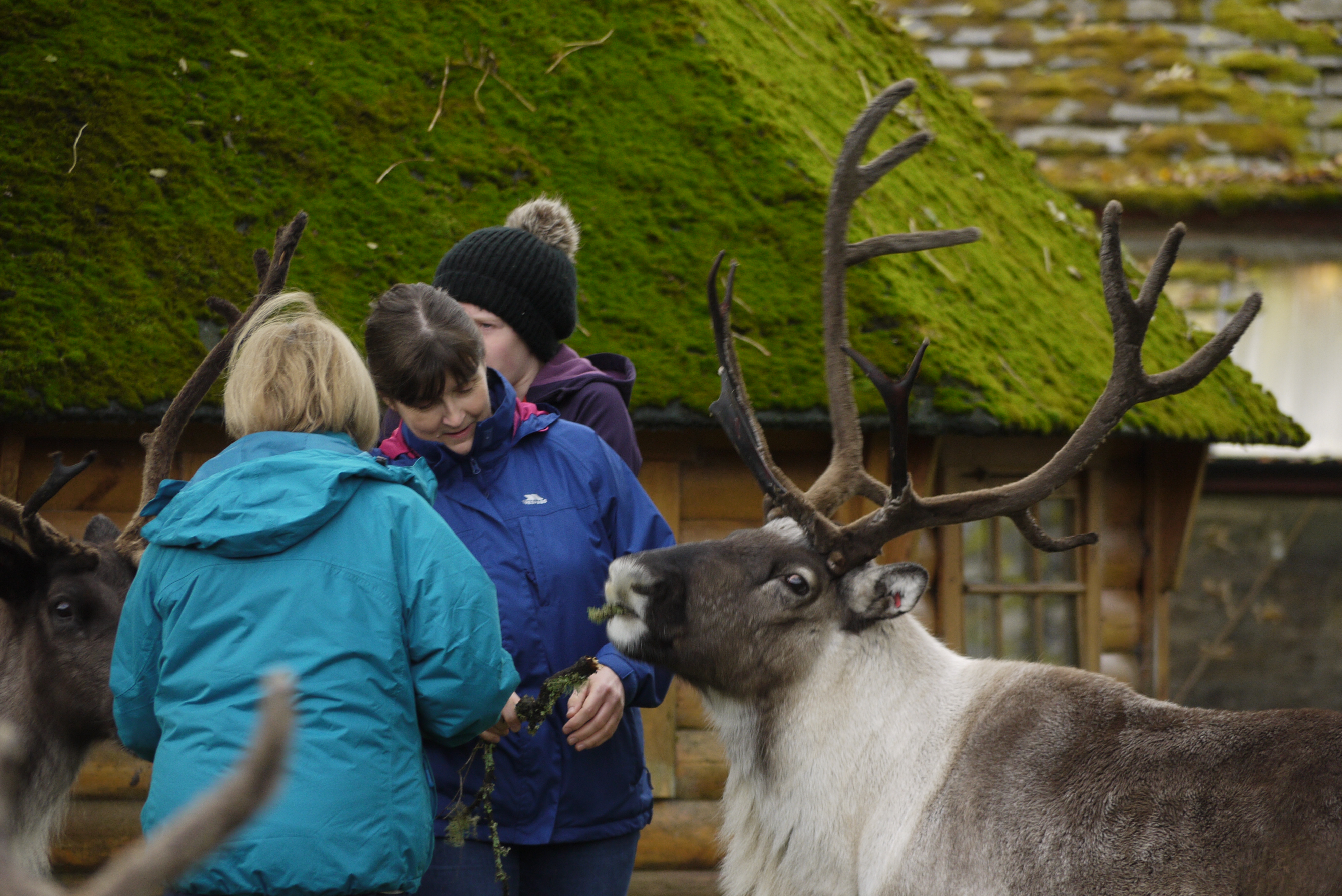
But I digress. Comet was the loveliest reindeer that you can possibly imagine, tame, friendly, polite and somewhat like a teddy bear. Reindeer in general are not a cuddly animal; they happily tolerate being handled but never seek out affection in the way, for example, a dog might, despite having been domesticated for as long. It’s the reason we have a ‘hands-off’ approach with our reindeer, we handle them enough to make sure they are all happy being in such close proximity to humans, but we never put them in a position where they can be petted against their wishes. On the hill it’s the tamest that come to hand-feed while the shyer have the choice to hang back, and out on Christmas tour they are always provided with enough space to keep out of reach of the public. We’re frequently asked if we can bring a reindeer to the side of the pen to be stroked, and the answer is always ‘no’. If they choose to do so themselves that is fine, but it has to be their choice, on their terms.

Photo 3.jpg
With ex-herder Vicky, contemplating life together.

I digress again – keeping to the subject in hand is not always my strong point. Back to it… Comet was unusual in that he seemed to be completely happy to have a cuddle, and indeed we all took advantage of this regularly – there’s nothing quite like putting your arms around the neck of a reindeer and burying your nose in their hair. Most reindeer would respond with a huff and pull away, but not Comet. He is also responsible for bringing us Paul, our twice yearly volunteer who has been coming for a fortnight at a time for years now (and fixing everything we break) – as he put his nose on Paul’s shoulder (Paul was sitting down, I hasten to add, Comet wasn’t that big…) and leant there for the entirety of a Hill Trip, back in 1998! Paul was hooked on reindeer from then on and 19 years later is still coming to help us out, and thank god, as he is a master joiner… I can hear the power drill whining away as I type – Paul is in residence and mending something.

Photo 4.JPG
In his old age.

One of my best memories of Comet is from the first week that I started here, when Tilly and I took two adult reindeer (one being Comet) and two 6 month old calves out for a walk in Glenmore in order to get the previously unhandled calves used to walking on a halter. On this occasion I can remember squeaking frantically to Tilly as we jogged along towards the Forestry Centre next door as Comet danced, spinning around and bouncing; letting off steam. I was hanging on for dear life but not doing a very good job, until Tilly prudently took Comet off me and gave me her (less excited) reindeer instead. Now I can easily handle such a full-of-beans reindeer, but as a wet-behind-the-ears herder, I was utterly out of my depth. It was a very steep learning curve!

Photo 5.JPG
Mel leading Comet out calf-training, on a day when he was a little less excited!

Within a couple of years after that occasion Comet was well into his old age, and such behaviour was behind him. He lived to the grand old age of nearly 17, and although I saw him less regularly in his doddery old man phase, I still had a ‘Comet Cuddle’ each time I met him again.

Hen

Guess the theme: Trees and Antlers

It’s amazing what useless facts you can come across and one such fact was in a booklet I was thumbing through about farm woodlands. In the ‘did you know’ section was the fastest growing tree in the world, the Royal Empress or Foxglove Tree Paulownia tomentosa . Native to central and western China the tree can grow up to 6 metres a year, or 30 cm in three weeks.

Paulownia_tomentosa.jpg
A Paulownia tomentosa in flower. Photo by Meneerke Bloem.

Velvet antler is the fastest growing living tissue in the animal kingdoms with a mature reindeer bull growing his full set of antlers in just 5 months to a length of approx 1 metres. Luckily for the reindeer the antlers then stop growing, the velvet skin peels off and the bony antlers are then used to fight with. Let’s face it a bull reindeer would struggle with 6 metres of antlers waving around on the top of his head!

In China, Paulownia tomentosa is traditionally planted at the birth of a girl. The fast-growing tree matures when she does. When she is eligible for marriage the tree is cut down and carved into wooden articles for her dowry. Carving the wood of Paulownia is an art form in Japan and China. The soft, lightweight seeds were commonly used as a packing material by Chinese porcelain exporters in the 19th century, before the development of polystyrene packaging.

Continuing along the Chinese theme the antler velvet from all species of deer is rich in growth hormone and highly prized in China where it is used in traditional Chinese medicine. The velvet antler however must be harvested from the deer while it is still growing, thus requiring a surgical process to cut the antlers off humanely. It is a practice not permitted in the UK but is an important revenue from deer and deer farming in other countries.

Strangely enough antlers of many deer species generally have a tree like structure to them, with a main beam or trunk, which then branches into smaller tines. Perhaps it is this familiar structure that sometimes leads people to ask the question ‘are the antlers made of wood’! I guess these misled people were never very good at biology at school!

Tilly

Looking Back Part 2: The Norwegian Reindeer

Recently a Norwegian man got in touch with us while writing a book about the reindeer populations in an area of southern Norway called Setesdal, so I dug out the old records to see what info I could help him with. While most of our herd originated from Sweden (see Looking Back: Part 1), in 1961 the 5th consignment of reindeer joined the Cairngorm herd, arriving from the Setesdal area on the MS Blenheim in the middle of September.

Photo 1

The group consisted of seven cows and one bull, ranging in age from yearlings to three year olds. The still relatively newly established Cairngorm herd was struggling a bit as many had died over the past 9 years, finding it difficult to thrive down in the forest as they were more suited to the mountain habitat above. In the mid-50s Mr Utsi had gained permission to move the reindeer higher up the hills where they managed much better, but new blood was also needed to prevent inbreeding – it was definitely time to bring in more reindeer. The Norwegian import brought the herd to around 30 animals.

Photo 2
One of the pages of our press cuttings scrapbooks from 1961.

Their success was varied however. Breive, Lisa, Olga and Valle had all died before the end of 1961, though I can’t find reference in the records as to whether they simply went missing, or died of a particular illness. Reindeer under the age of three are particularly susceptible to illness, having not had as much time to build up immunity to disease, and the Norwegian reindeer also arrived at a time of year when ticks are rife – still the main cause of illness amongst our reindeer today.

Photo 3
Laila on the left (with the collar) with Mr Utsi in March 1962.

Laila was the only reindeer of the consignment to calve the following year, on the 8th June 1962, but disaster struck when she died less than 24 hours after the birth. The calf was strong however, so Mr Utsi went on to hand-rear him, naming him Boko. Boko followed Mr Utsi everywhere and was extremely tame, going on to become a breeding bull in later years. He survived until December 1967, but as with all hand-reared animals, could be a little bit of a liability – there is a reference in the records which says ‘Very tame to lead if you keep your eyes on him’! Hand-reared animals don’t tend to understand the boundaries of acceptable behaviour – as any of you who have been on the receiving end of Fergus will know, our reprobate in the herd today!

Photo 4
Laila with Boko, a few hours after he was born.
Photo 5
Mr Utsi with the ever-present Boko at his heels, in 1963.
Photo 6
Mr Utsi at the Strathspey Farmers’ Club Show with Boko and bull Vikhta (August 1963).

Of the original 8 Norwegian reindeer, by far the most successful of them were the bull Jacob, and two cows Janet and Bykle. Jacob was used as a breeding bull for several years in the 60s, his bloodlines still very prevalent in the herd today, and Bykle produced one calf, Heather, who in turn went on to produce several offspring. This line died out in the 70s however but Janet went one better, producing three calves whose descendants continued in the herd until well into the 80s, finishing with another hand-reared calf, Wally. Wally was hand-reared by Alan, and a photo still hangs in the living room of Reindeer House of Alan bottle-feeding him, back in 1982.

Photo 7
Jacob in Coire Sneachdha, a familiar background to us all even now…
Photo 8
Alan (with considerably more hair than nowadays!) bottle feeding Wally.

So there we go. The success of the bull Jacob, in particular, goes to show the importance of introducing new bloodlines to the herd, and we have continued to import reindeer every now and then to keep our genetics as strong and as varied as possible. Right now there are 25 reindeer in our herd who were born in northern Sweden, one still remaining from our 2004 introduction (Addjá), two from 2008 (Magnus and Laban), and the remainder from 2011, many of whom are still breeding bulls today.

Hen

The growing up of the calves

Spring is flying by – the trees are finally in leaf and the flowers are poking their heads out here on the Cairngorms – but the passing of time is never more obvious than in the growing of the calves.

When the females calve, we move them and their calves into the nursery area up on the hill. Here the mothers get to relax, have uninterrupted access to their food and lichen, and the calves mix with the others. As they find their feet, they also seem to discover the love of jumping, leaping and running, and will often be spotted playing in groups with other calves. They have a lot of energy, and will often stray away from the mothers, but a grunt from their own mother sends them scampering back to safety by her side.

The mothers and calves stay within the nursery area for a couple of weeks, growing nice and strong and getting used to keeping up with their herd. After a couple of weeks, it is time for them to test their newfound skills, by heading out to the free-range for a summer on the hill ground of the Cairngorms National Park.

So a couple of nights ago saw 5 of us herders heading up the hill to the nursery enclosure at about 9pm – everyone wanted to wave them goodbye! We choose to do the moving of the cows and calves late in the day to avoid any unwelcome escapades with hillwalkers’ dogs, and so this means a later finish to the working day than usual..

The mothers seems to know what the plan is, and are keen to get going. One of the main issues is negotiating the enclosure gate – calves don’t understand gates at this young age! Tilly leads the way, and the other 4 of us herders take the back and make sure everyone sticks together.

We lead the herd only a short way from the enclosure as they know the ground themselves well, navigating the nearby burns and steep slopes, sometimes fast but more often slow, and then we say goodbye to the group, and off they go…

DSC00845
The mothers and calves heading off, with the Cairngorms in the distance and some rain-threatening clouds approaching..

We watch for a long while, and then navigate our own way back, enjoying the darkening of the sky and the thought of our beds waiting, and the possibility of a wee dram before bed to send the reindeer off in style.

See you in a few months, little ones!

Morna

Spring has sprung, calving has begun

May is here, and with it comes the first of our reindeer calves of the year! They are long-legged and lovely, stumbling around finding their feet and flopping down in a heap of fur and legs on the heather.

As with many animals, the reindeer seem to prefer calving early morning. So much to our delight, we start at 5am, a couple of us heading up the hill to search out females absent from their dinner the night before. To find them we walk round the 1200acre enclosure, scanning through binoculars for sight of a lone female. On a beautiful morning this is a delight, the Cairngorms behind us tipped red and gold, and the sky turning from white to blue. On a miserable morning this is more of a rain-drenched, hair-dripping, squelchy-shoe, wet-through-to-the-pants kind of job.

After finding her, we check the cow and calf are healthy and if possible, bring them back to our calving enclosure to join the nursery and allow us to keep and eye on them for a few days. So far we have had an equal number of male and female calves, from almost pure black to white, speckled to striped.

DSC00815
A very dark wee male, of almost opposite colour to his mother.
DSC00832
Fending for herself while her mother is off feeding, this lovely grey and white speckled female, Christie, was the first calf born this year.
DSC00823
A bit of a stretch over the calf to get to the lichen!

Reindeer calves are pretty tough little things, having to get up on their feet and keep up with the herd just a few hours after being born. To help with this they are born with seemingly very long legs for such small bodies, and so keeping balance often makes for a steep learning curve..

DSC00837
A reindeer calf seems more leg than anything else!

Unfortunately, rules are rules and we don’t reveal names of reindeer who have calved until our newsletter in June. So until then, you must wait with baited breath to hear who has had what, and in June we will reveal all!

Morna

Looking back: The arrival of the first reindeer

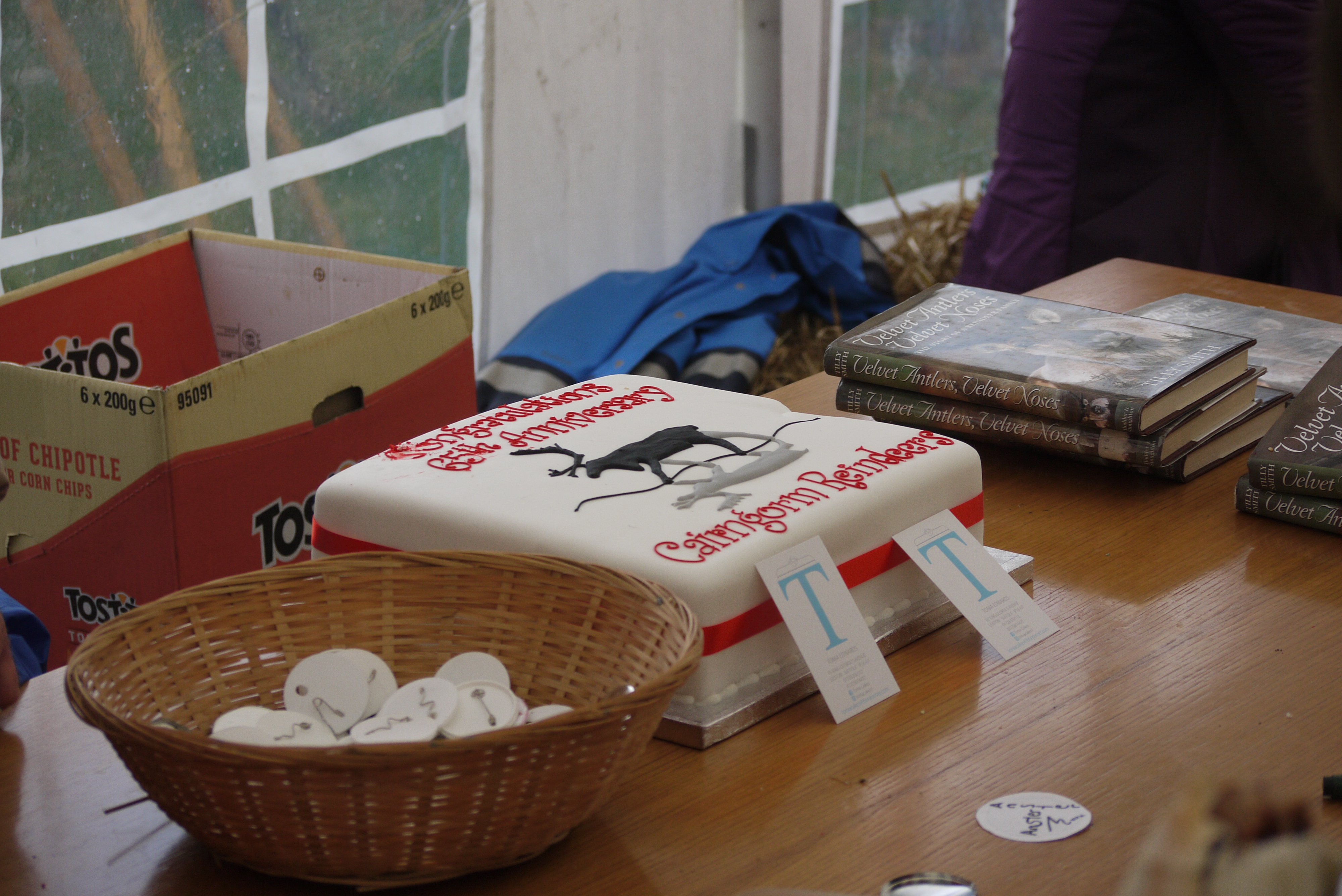
2017 is our 65th anniversary, and just lately I’ve been trawling through the records of the reindeer herd for one reason or another. As such I’m feeling a bit nostalgic, and think it is time I started another occasional blog series, this time about the history of our herd.

If you’ve been on a Hill Trip with us, you may know the basic story. Sami reindeer herder Mikel Utsi visited the Highlands of Scotland in 1947, and was immediately struck by the similarities to his homeland of northern Sweden.

Photo 1
Northern Sweden (top) and the Cairngorms (bottom)

Looking across Rothiemurchus Forest to the Cairngorms from the railway bridge at Aviemore, on a cold morning in April 1947, I was instantly reminded of reindeer pastures. Travel in the Highlands showed that many species of ground, rock and tree lichens which are elsewhere the chief reindeer food were plentiful and of little use to other animals. Red deer and domesticated animals graze on plants and fodder than reindeer seldom eat. The Orkneyinga saga tells us that about 800 years ago red deer and reindeer were hunted together, in Caithness, by the Jarls of Orkney.”

IMG_0821
One of the crates being winched on board the S.S. Sarek in April 1952

Mikel Utsi decided it was time that reindeer once again roamed the mountains of Scotland, and five years later, that dream became a reality. The Ministry of Agriculture gave permission for Mr Utsi and his Swedish-American wife Dr Ethel Lindgren (an anthropologist who had studied in China and Mongolia as well as Swedish Lapland) to bring the first consignment of reindeer over to Scotland, and at first they were granted an area of around 300 acres near Moormore in the Rothiemurchus forest, which was completely fenced to contain them. Moormore is now better known as the Cairngorm Sleddog Centre. Mr Utsi knew this was not ideal for the reindeer however, and had his eye on the higher ground of the Cairngorms themselves – much more suitable reindeer habitat.

photo 3
Mikel Utsi (right) and Sarek on board the S.S. Sarek

Photo 4.jpg

The first consignment of 8 reindeer landed at Clydebank in Glasgow on the 12th April 1952, having travelled on the S.S. Sarek from Sweden, which had been somewhat rough four day crossing. The group consisted of two bull reindeer (Aviemore and Murjek), four cows (Mona, Kristina, Margaret and Rowena), and a castrated male who was named Sarek. After a month in quarantine at Edinburgh Zoo, the reindeer finally made their way north to the Cairngorms to the Moormore enclosure.

IMG_0822.JPG
Reindeer in the forest, looking up to the Cairngorms

Photo 6.jpg

It wasn’t a particularly auspicious start, with the reindeer struggling to cope with the low ground and the insects, but in 1954 Mr Utsi finally got permission from the Forestry Commission to lease Silver Mount, which many of you will know as the hill at the far end of the current reindeer enclosure, the back drop to the majority of our guided tours throughout the year. Later the same year free-grazing up to the summits of the northern corries of the Cairngorms was finally allowed, as well as the continued use of the Silver Mount enclosure. Finally the reindeer could escape the insects and the herd began to thrive. Further groups had been introduced from Sweden too; Inge, Alice, Anne, Pelle, Assa, Ella, Ina, Maja, Siri and Tilla in October 1952; Nuolja, Kirtik, Ranak, Neita, Noki, Rovva and Vilda in early 1954. Bulls Fritzen and Ruski followed in 1955.

Photo 7.jpg
The 3rd consignment of reindeer on the M.S. Nuolja in 1954
Photo 8.jpg
Bulls Fritzen and Ruski in April 1955 – the 4th consignment

To keep a closer eye on his herd, Mr Utsi felt it was important to be on site as much as possible. He made a hut at ‘Road End Camp’ in the 50s, tucked away in the woods at the base of Silver Mount, building it from the wood from the crates that the reindeer had been transported to Scotland in. This made life much easier as there was no bridge across the Allt Mor at that time, or indeed, a road up to where the Ski Centre is now, so for Mr Utsi the herd was now much more accessible. Today, the hut still stands, and some of you may have even been there – in recent years we used to stop for a rest at Utsi’s Hut on some of our half-day treks with visitors. A shelter was also built at the top of Silver Mount, and although this no longer stands, there are still a few old, weathered, pieces of planks lying around up there, which are the last remnant of the shelter.

Photo 9 (2).jpg
Mr Utsi harnessing Sarek at Road End Camp in October 1955. Utsi’s Hut is on the right.
Photo 10.JPG
Trekkers at Utsi’s hut in more recent years! With reindeer Gandi and Svalbard.
photo-11
The shelter on top of Silver Mount in July 1954

By the mid-fifties the herd had grown to around 20 animals, and the herd was doing well. There’s lots more to tell you, but it’s a story for another day! However, if your appetite to learn more of our history has been whetted, we have a lovely book called ‘Hoofprints’ in our online shop on our website which is all about the history of the herd with loads of beautiful photos, so pop over there for a wee look.

Hen

Reindeer calving: Can we predict whether there will be more males or females born?

It has been an exceptionally mild winter here in the Cairngorms; the ski season never really seemed to kick off, the herders are missing the snow and it has just felt a bit wetter and warmer than usual. I’m sure you’ve noticed how early the snowdrops and daffodils seem to have emerged and we have noticed that the hills are looking a bit greener with the heather and deer sedge starting to grow already. Looking at the Met Office summary for winter 2016-2017, temperatures are up about 3.0°C on average (average being data from 1981-2010) in the UK.

OLYMPUS DIGITAL CAMERA
This blog is really just an excuse to look at cute calves. Here’s a reindeer and a red deer calf, both being hand reared.

For the reindeer, this warming winter could have lots of effects, and we have recently heard of the reindeer in the Yamal peninsula, Siberia, starving to death due to increased rainfall in the autumn freezing and leaving a thick layer of ice impenetrable to them for foraging.

Our reindeer seem to be coping just fine and it has not frozen here enough for them not to reach their favourite food, lichen. However, research done by previous reindeer herder Heather Hanshaw has shown that weather conditions do definitely affect the proportion of male to female calves born in the spring. Since calving will soon be upon us, I thought it might interest you to know about this research and what our mild winter may mean for us in the upcoming weeks.

calf
Newborn calf

Heather studied Physical Geography at Edinburgh University and in her final year needed a project to study. Of course, having an interest in climate as well as reindeer, and having worked at the Reindeer Centre, a project about how climate affects them was a natural interest to Heather. She knew that Mr Utsi and Dr Lindgren had been very meticulous about the data kept on calves born in the Cairngorm herd, and climate data was easily enough accessed, so Heather devised a project determining if weather (temperature and rainfall) had any effect on the proportion of male to female reindeer calves born. A similar study was conducted with Red deer on the Isle of Rum, and their study found that milder winters led to more male calves. Would it be the same or opposite of Rum, or would weather have no effect on the Reindeer?

fergus-5
The famous Fergus, asleep on Mel’s rug

It turns out that Reindeer are similar to Red deer and when the winter temperature increases, so does the proportion of male calves. So, will that turn out to be true this year? With only a few weeks until calving begins, it will be interesting to look at whether we have lots of male calves this year.

Last year the winter seemed fairly average, possibly on the warm side a little, and our calving ratio was almost perfectly 1 male to 1 female, so it will be really interesting to see if this mild winter has had an effect on what will be born this May.

Hopscotch and calf
Hopscotch and calf

Please find sources below.

http://www.metoffice.gov.uk/climate/uk/summaries/2017/winter

https://www.newscientist.com/article/2112958-80000-reindeer-have-starved-to-death-as-arctic-sea-ice-retreats/

http://www.nature.com/nature/journal/v399/n6735/abs/399459a0.html

Imogen


Book Now