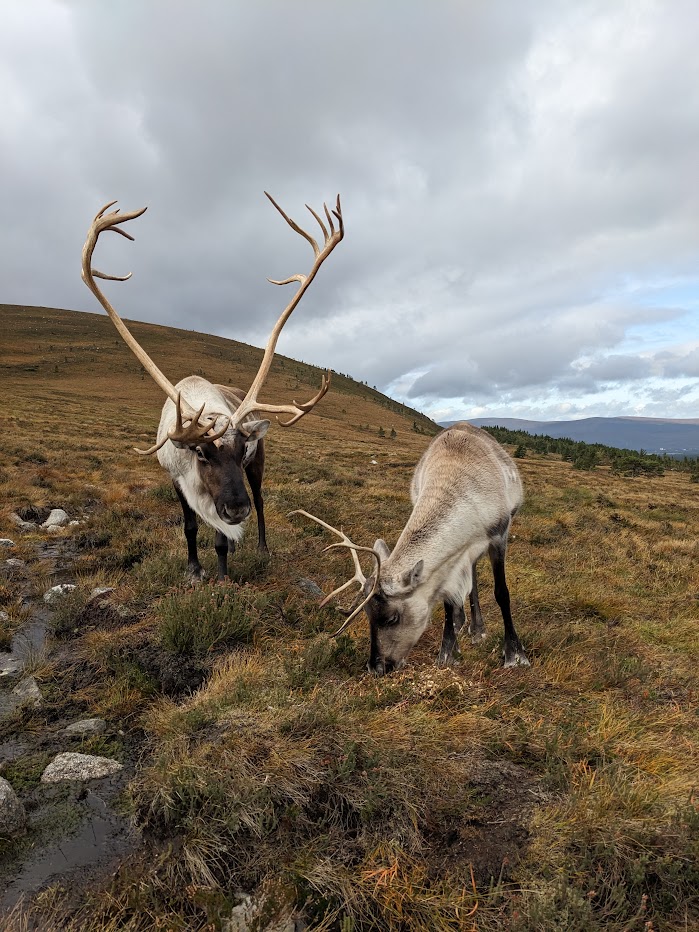
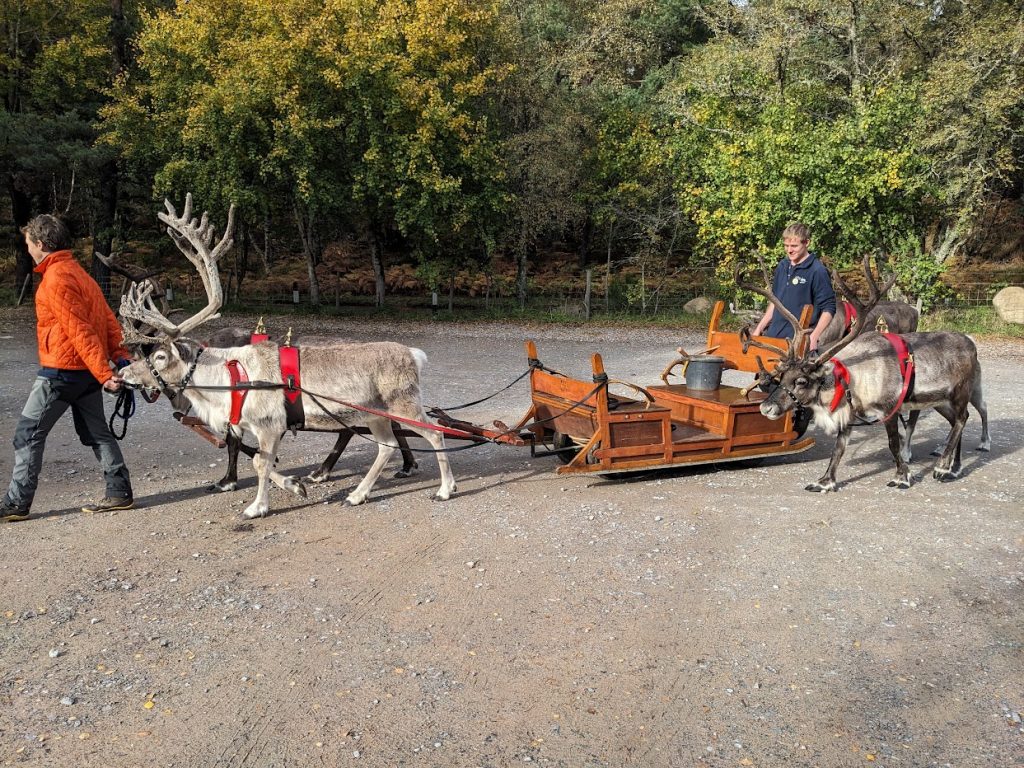
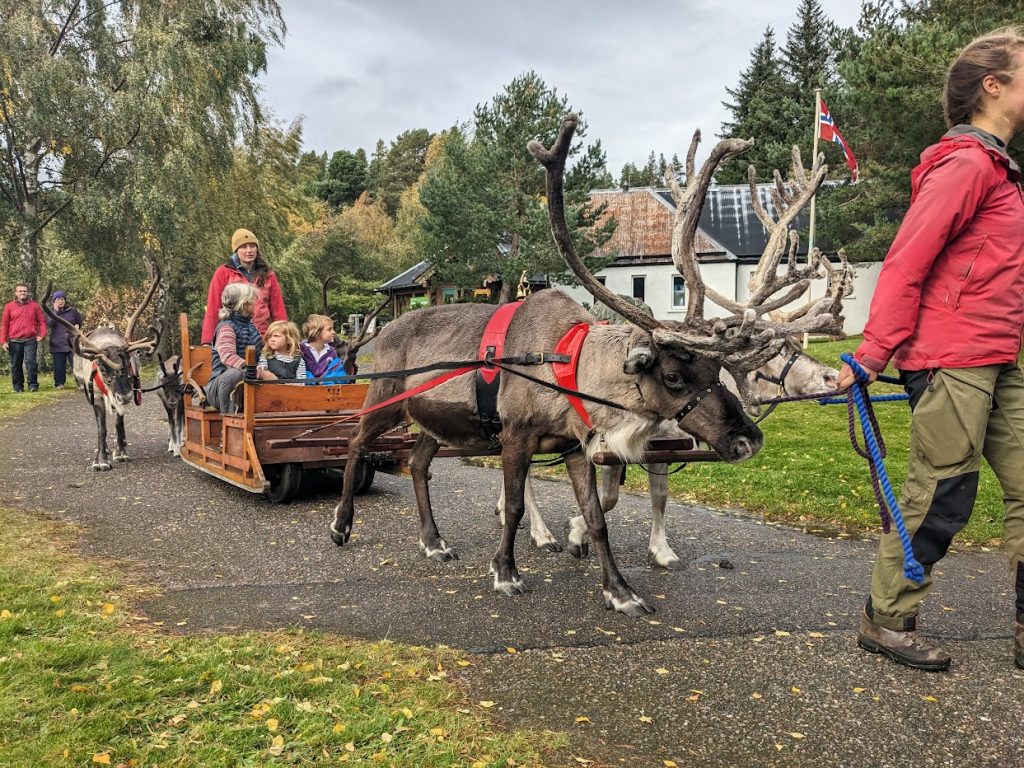
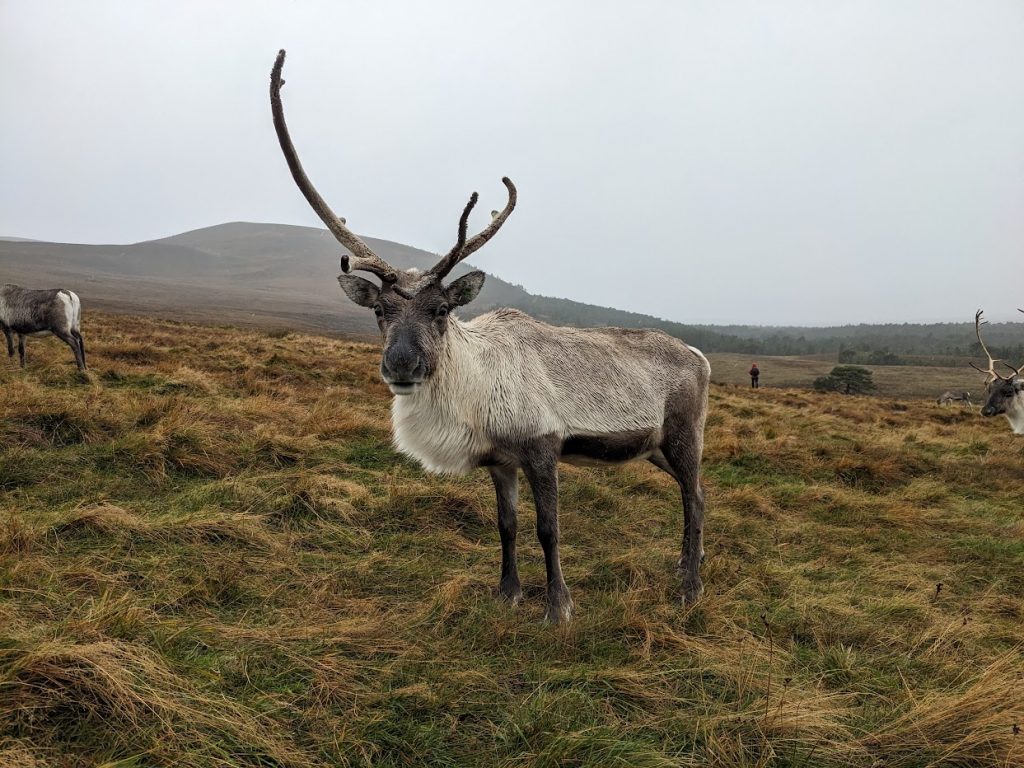
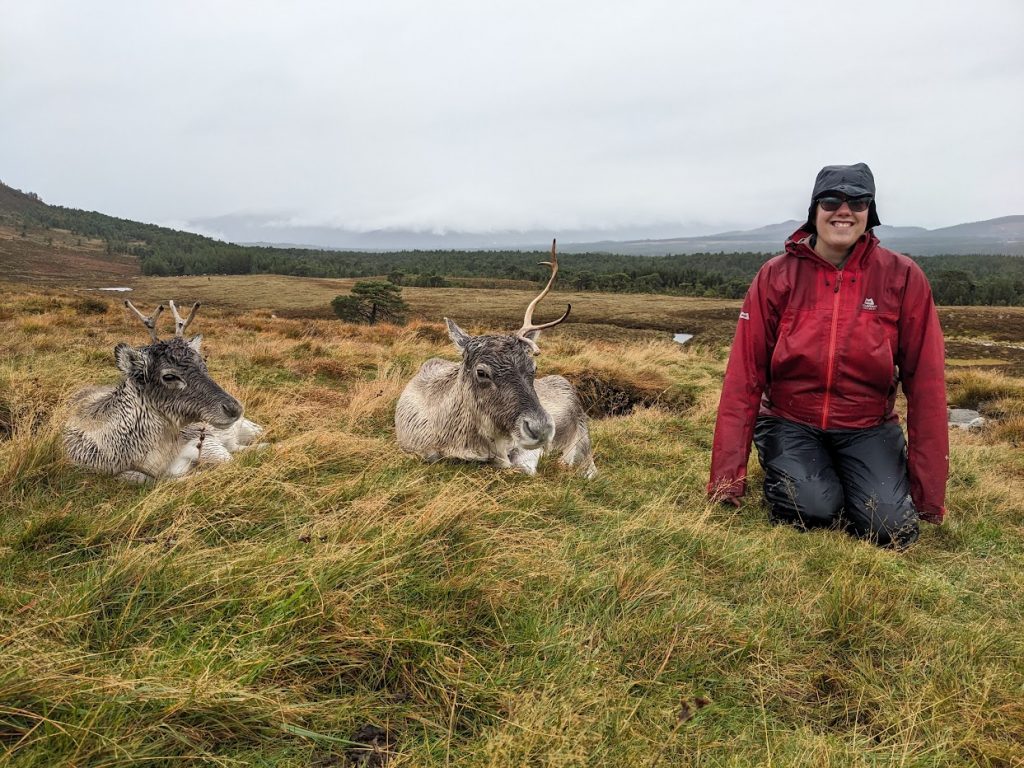
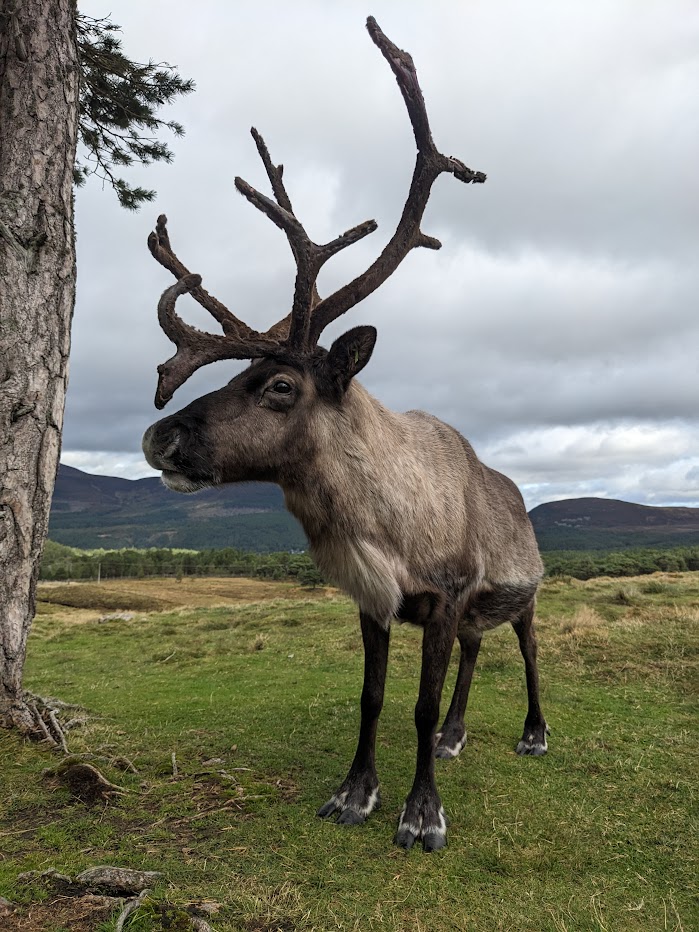
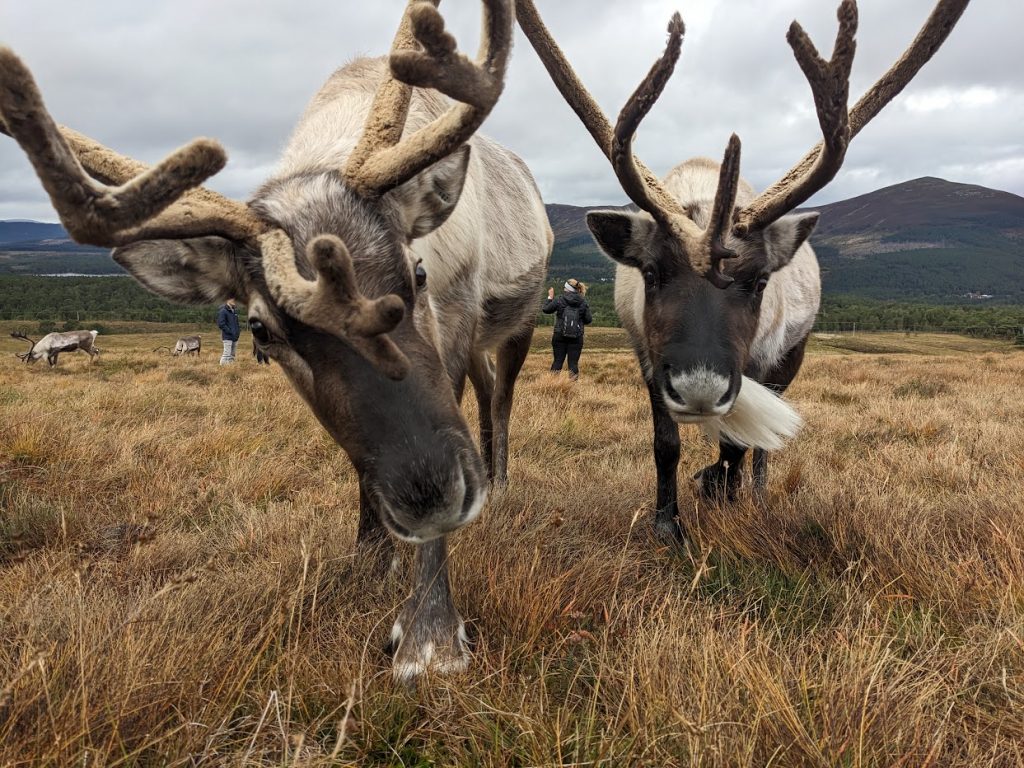
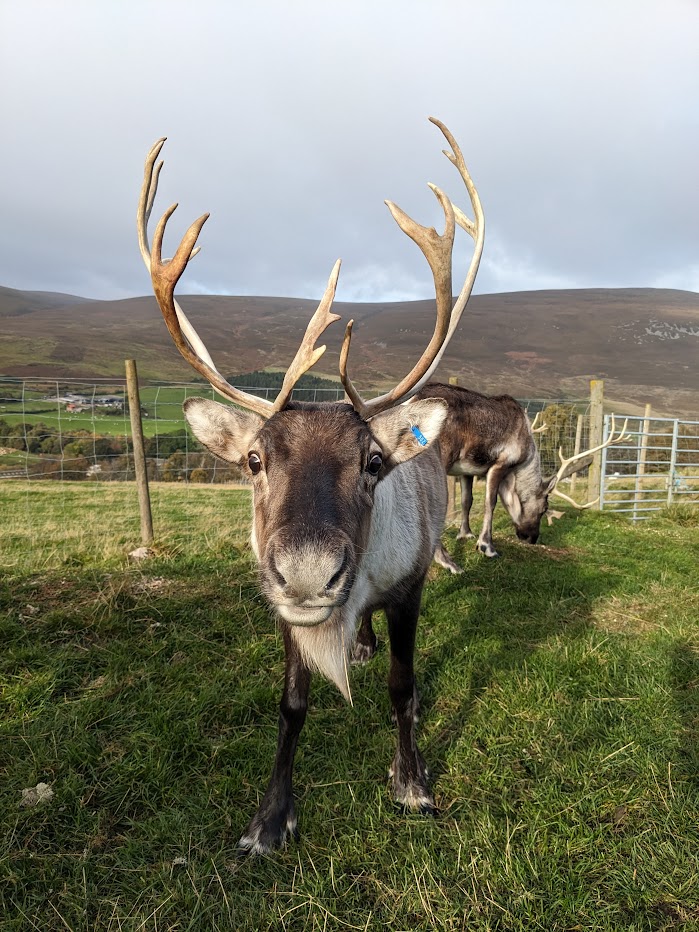
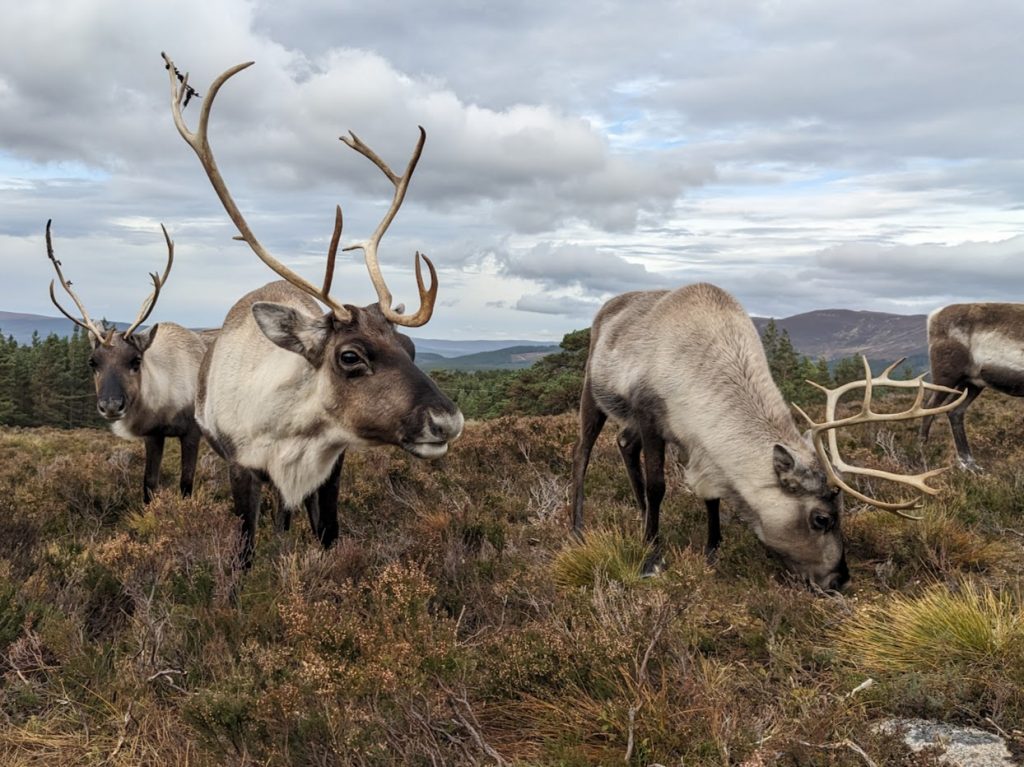
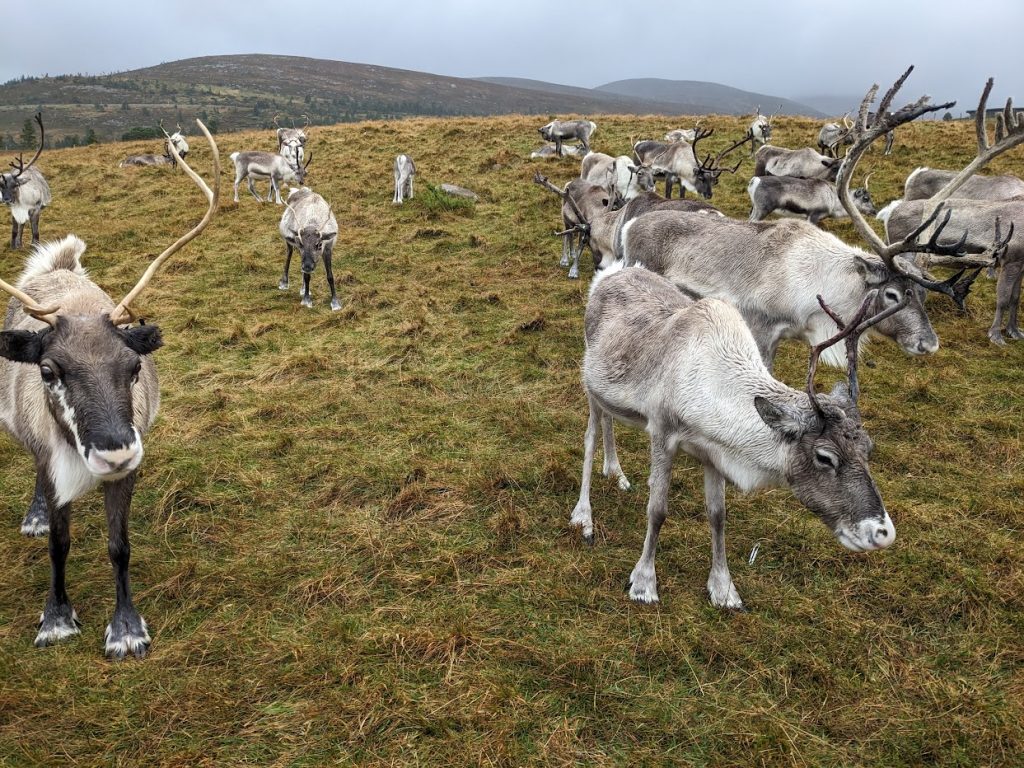
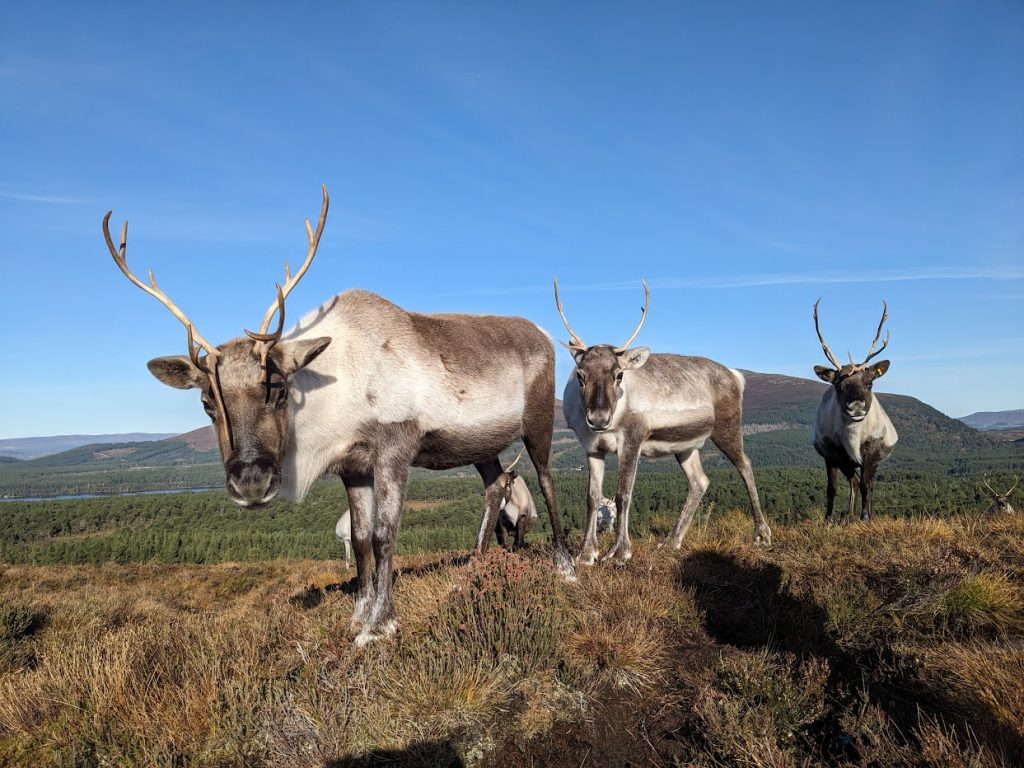
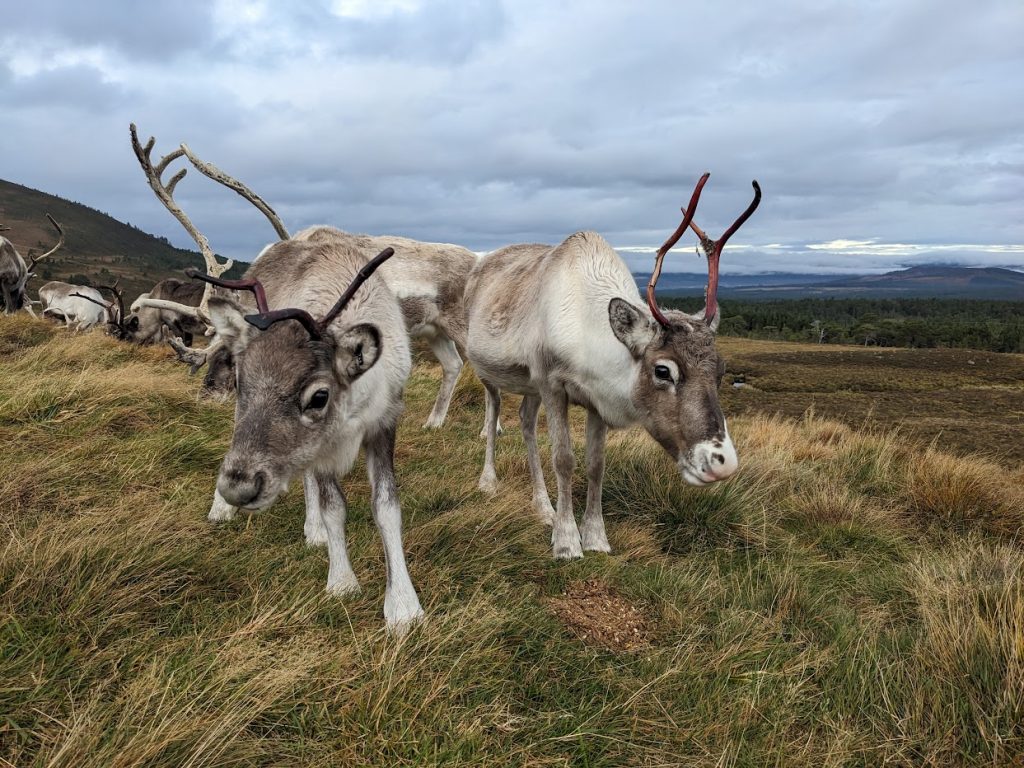
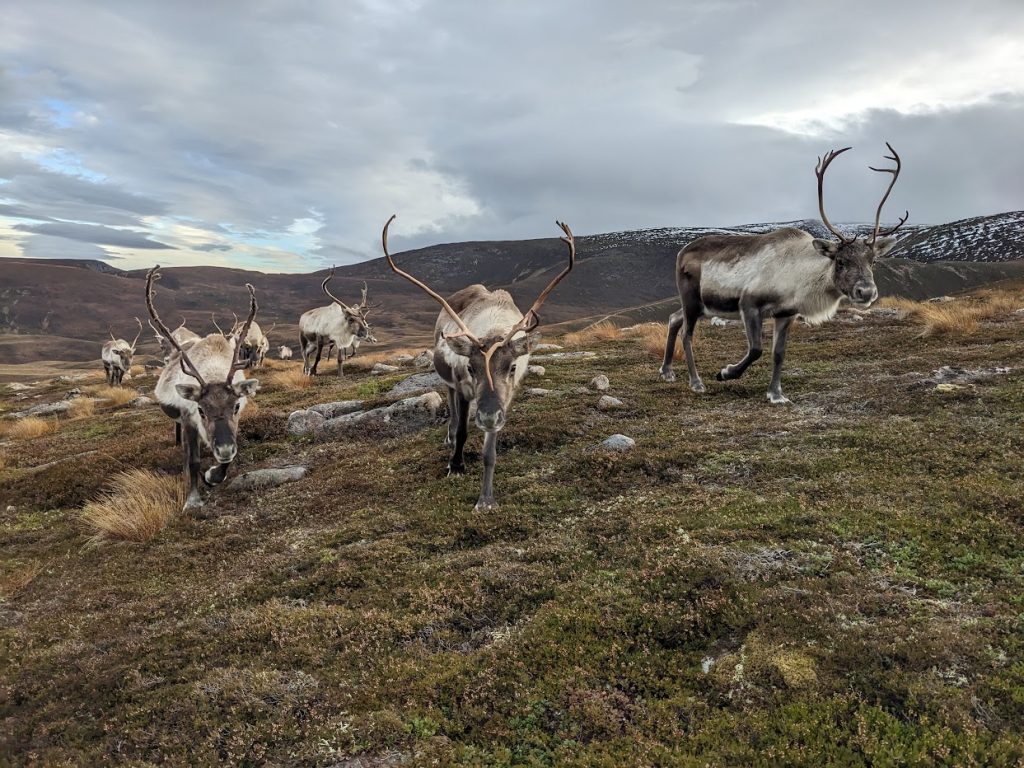
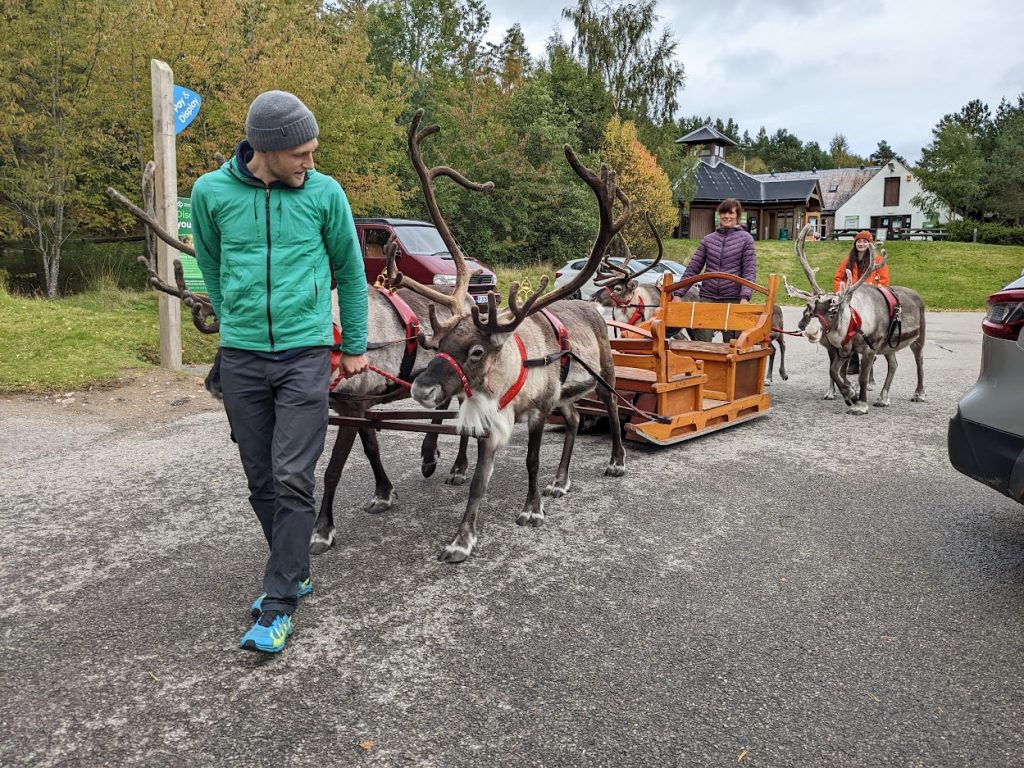
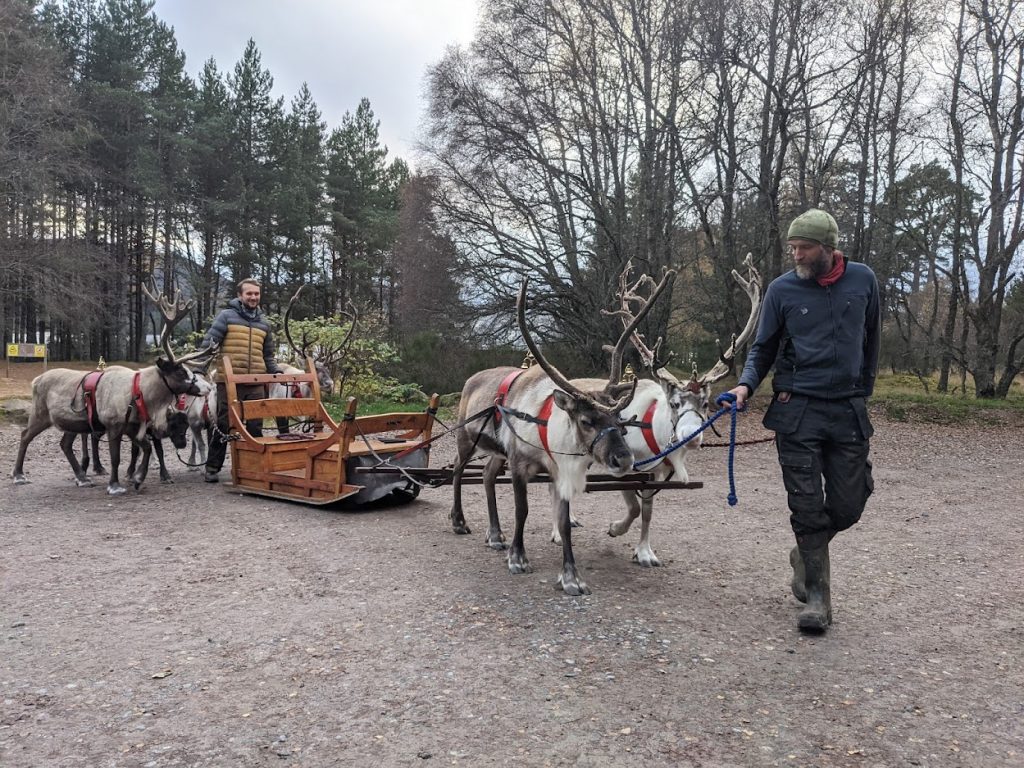
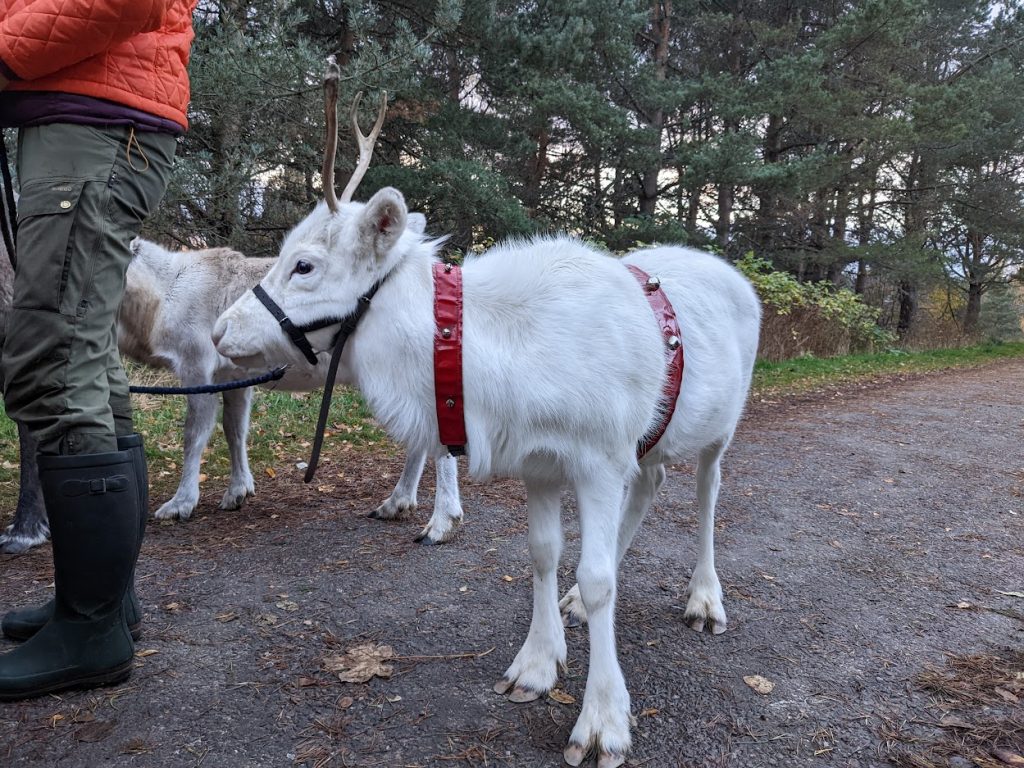
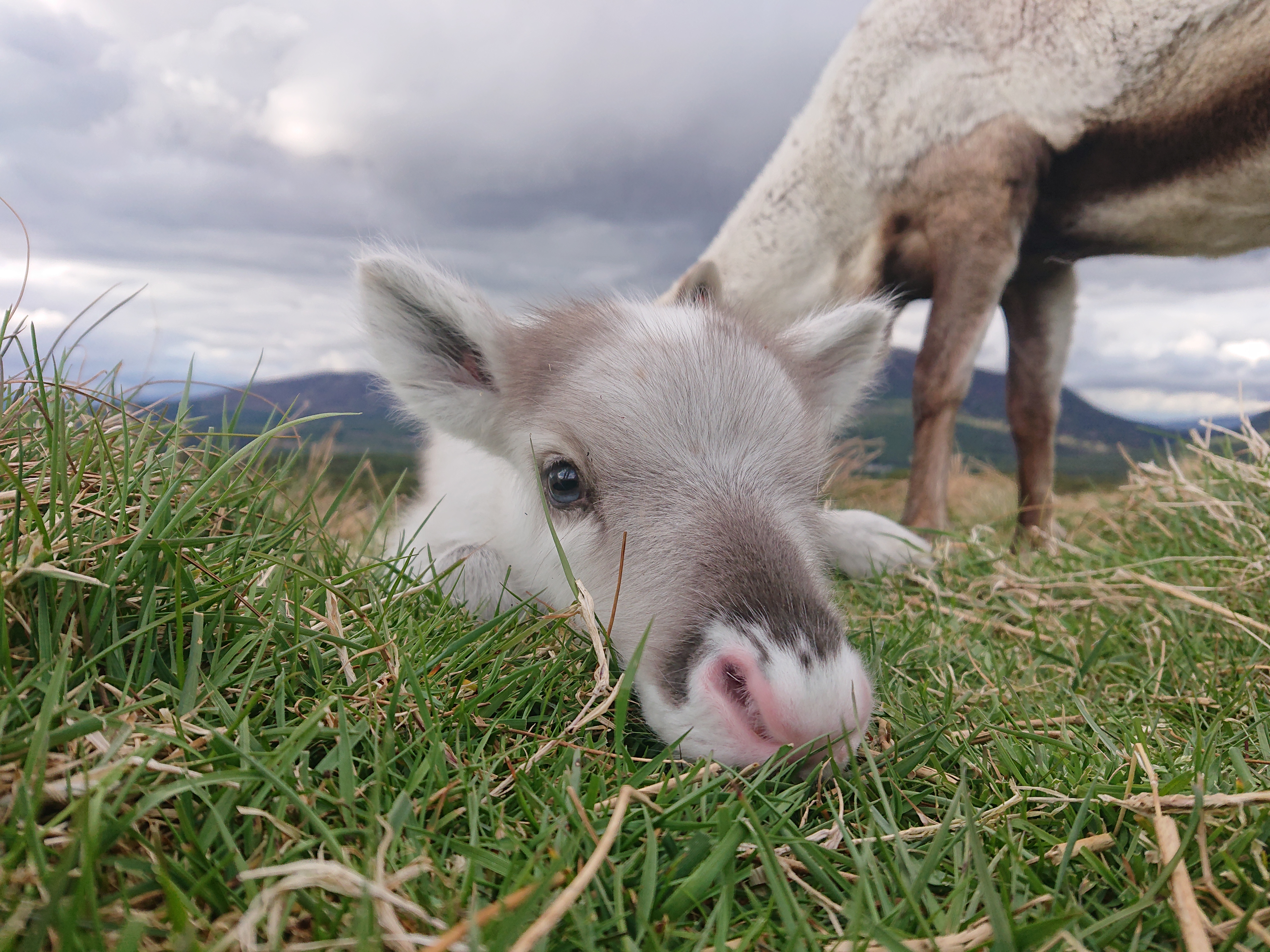
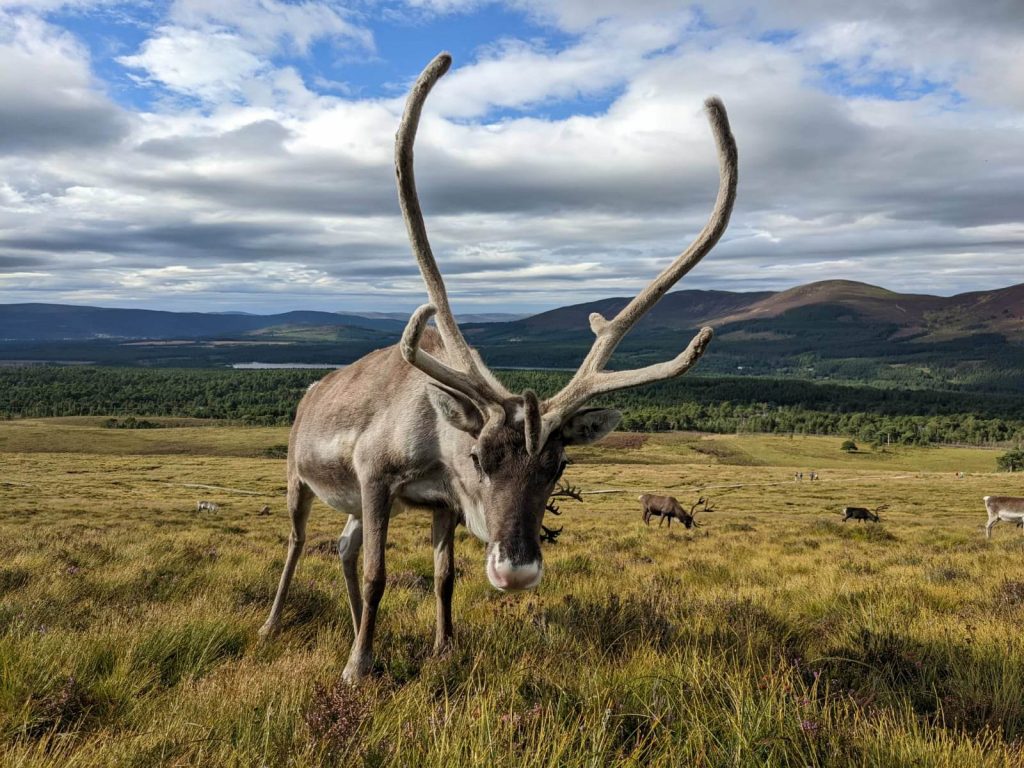
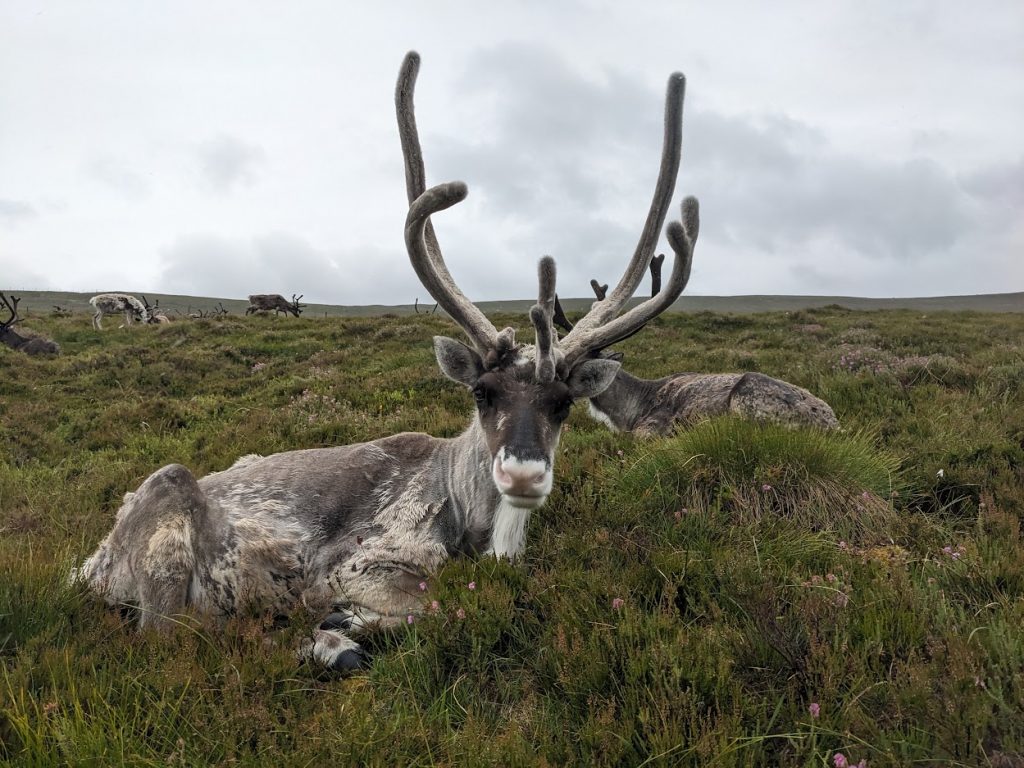
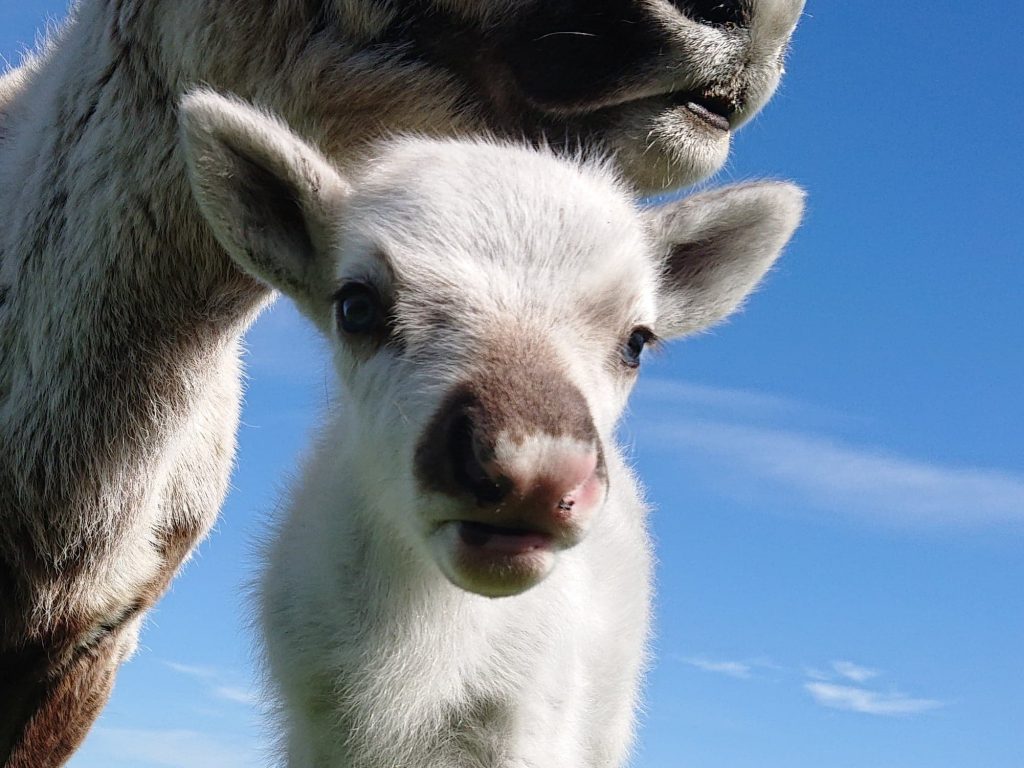
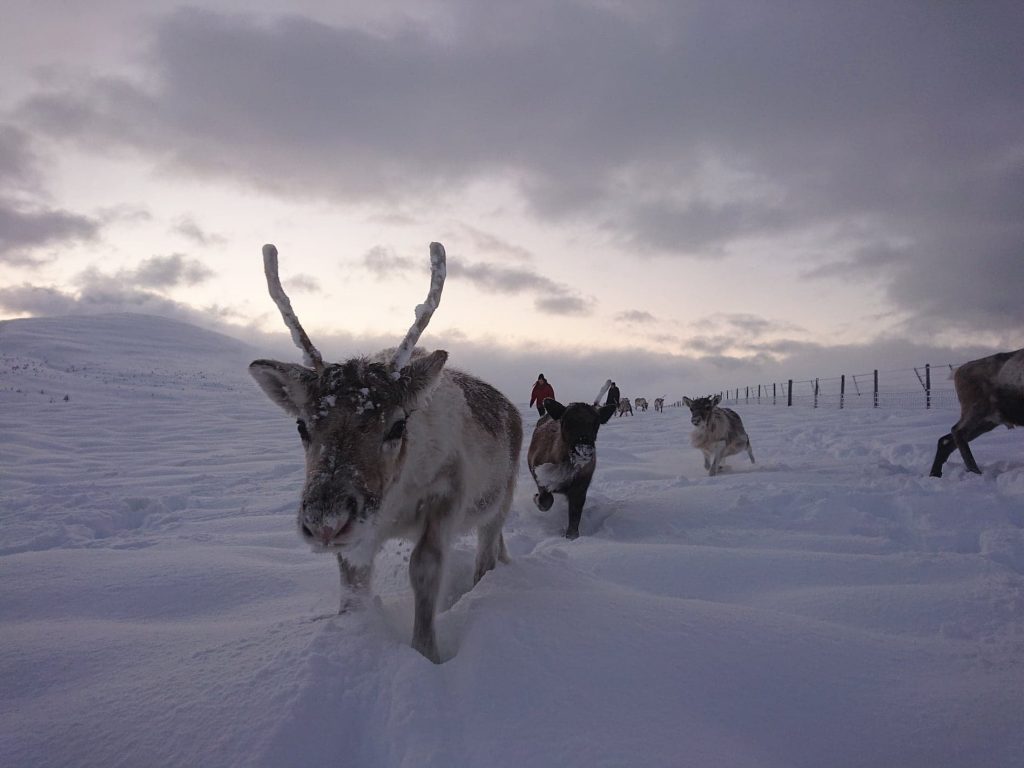
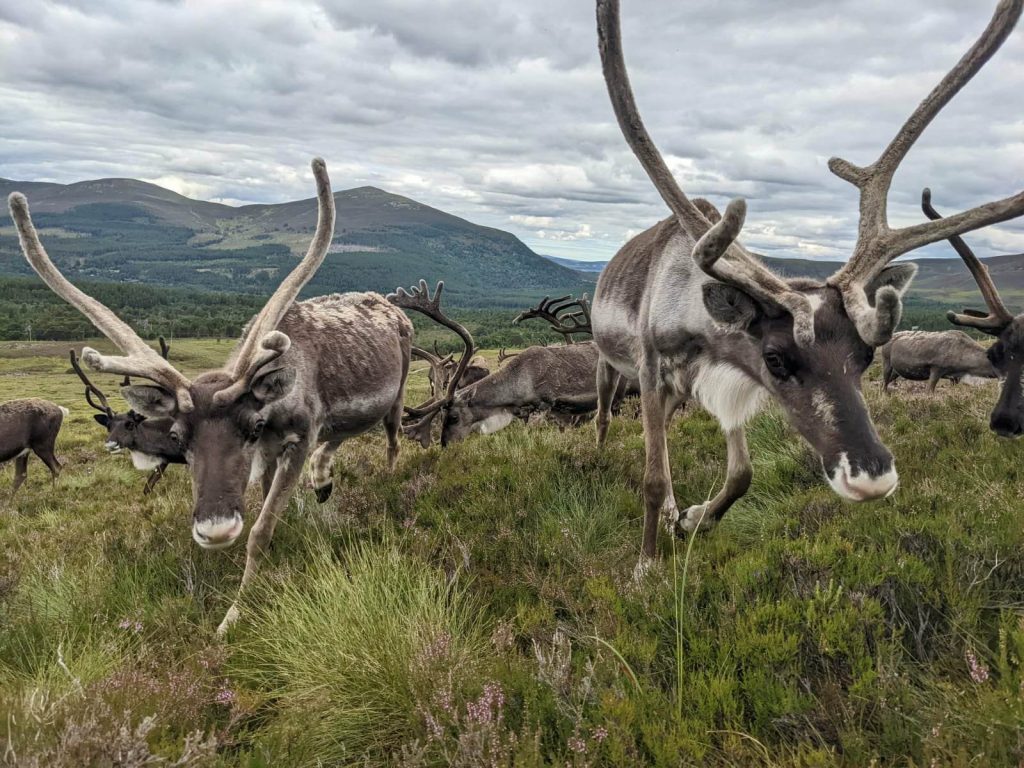
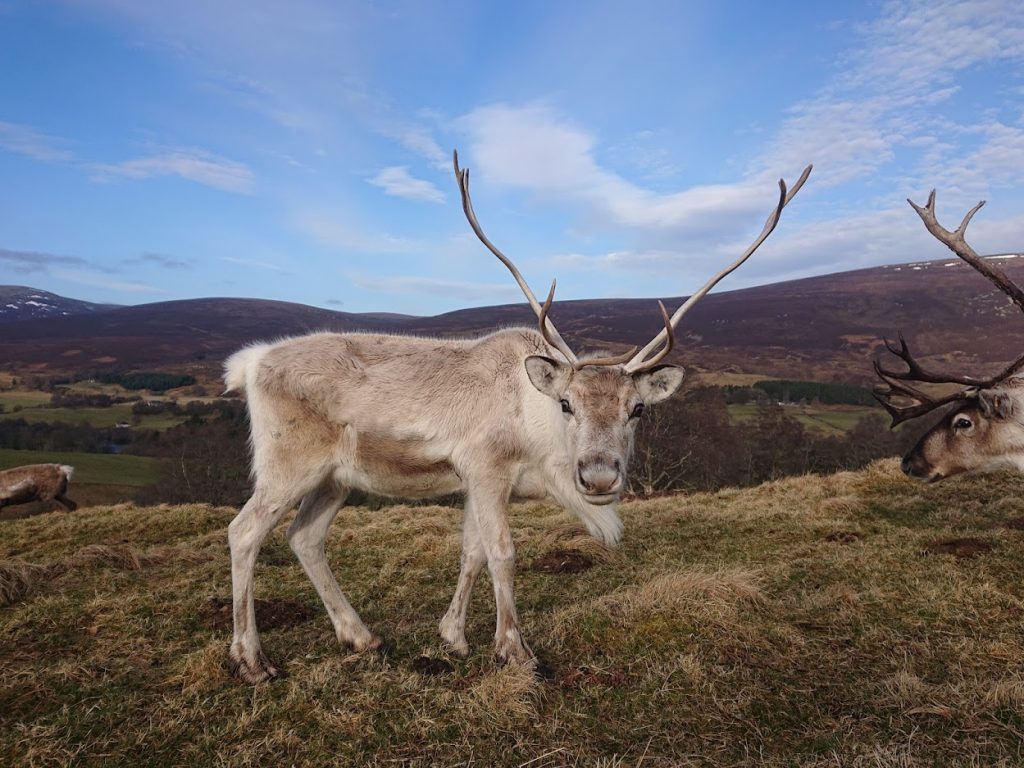
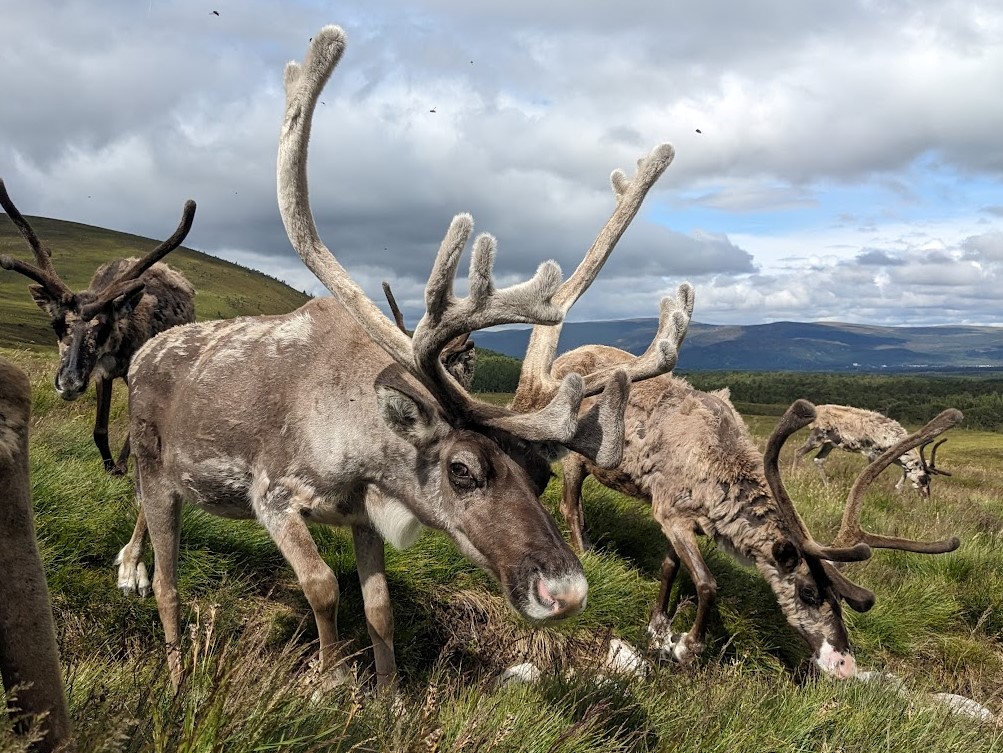
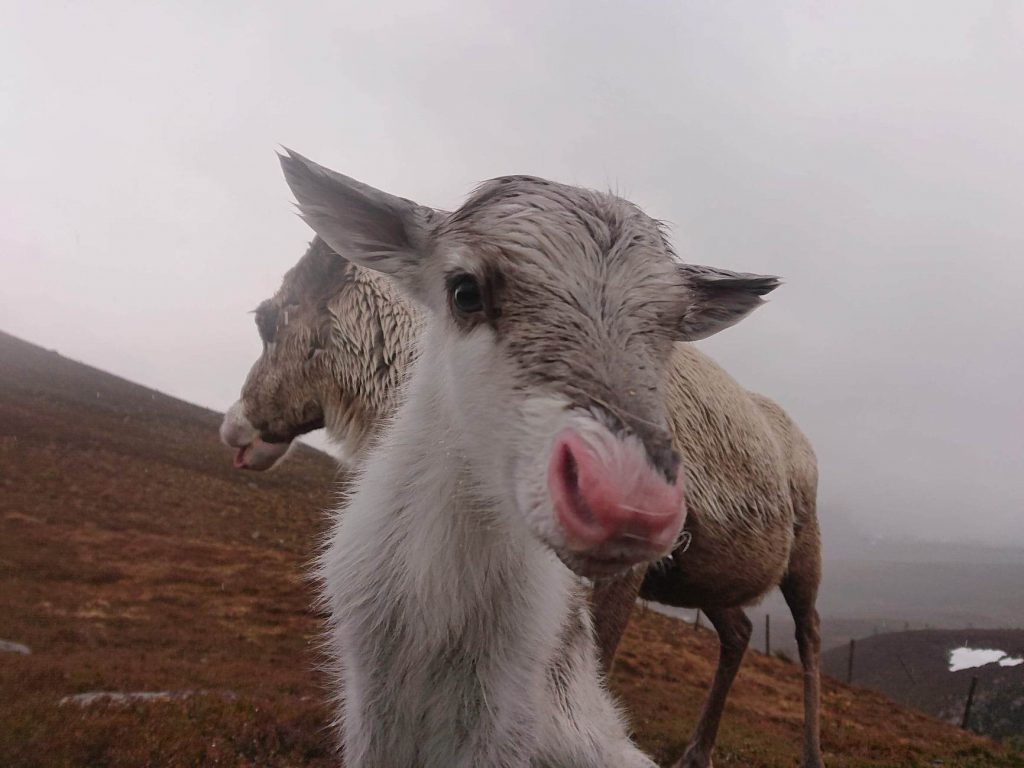
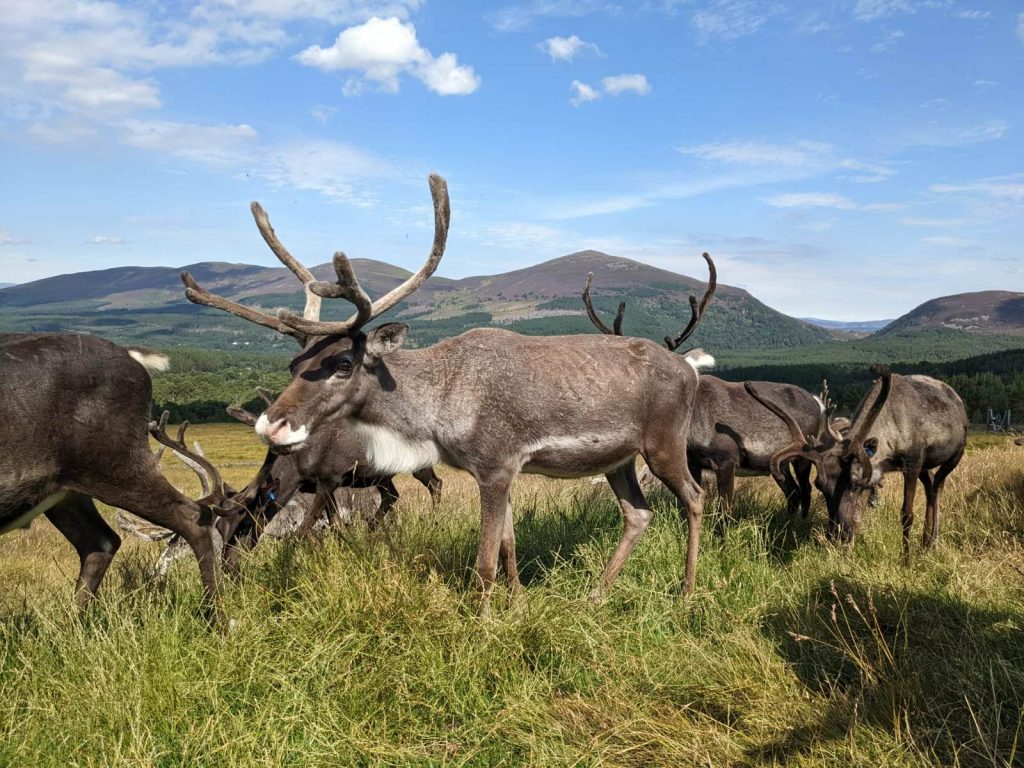
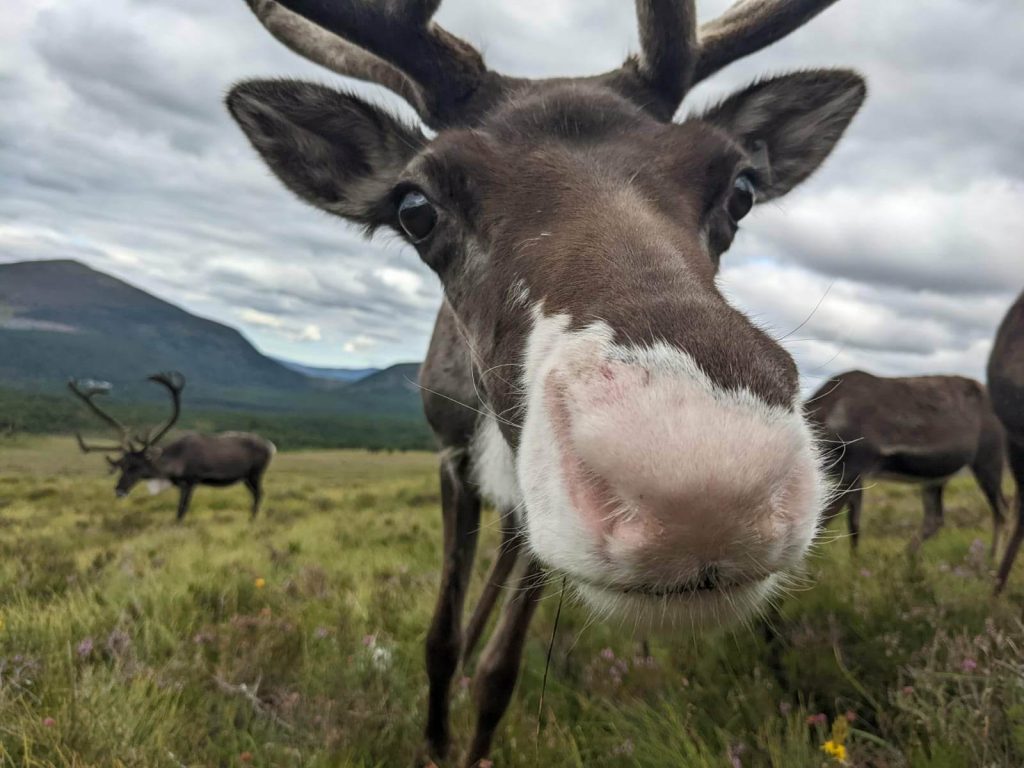
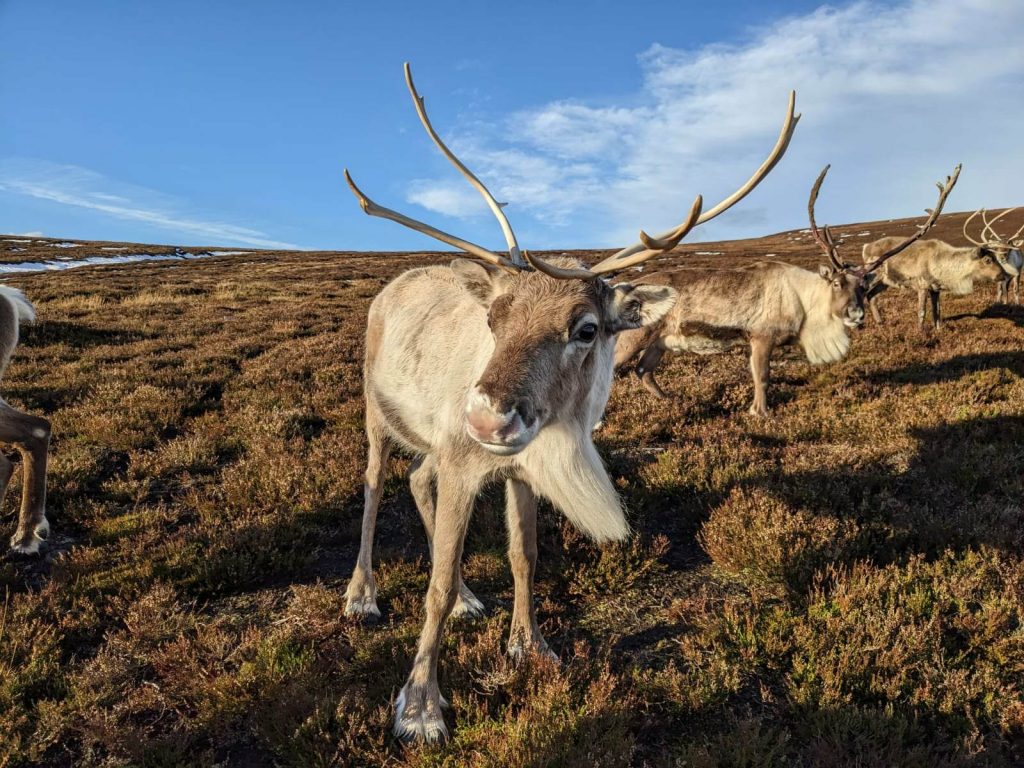
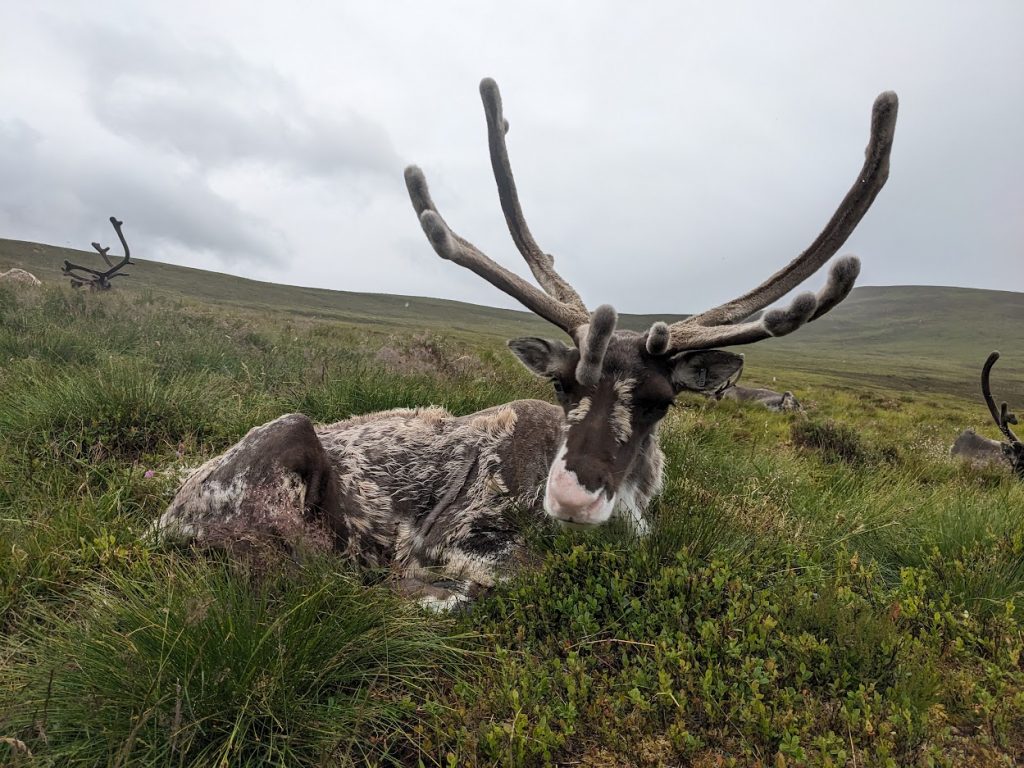
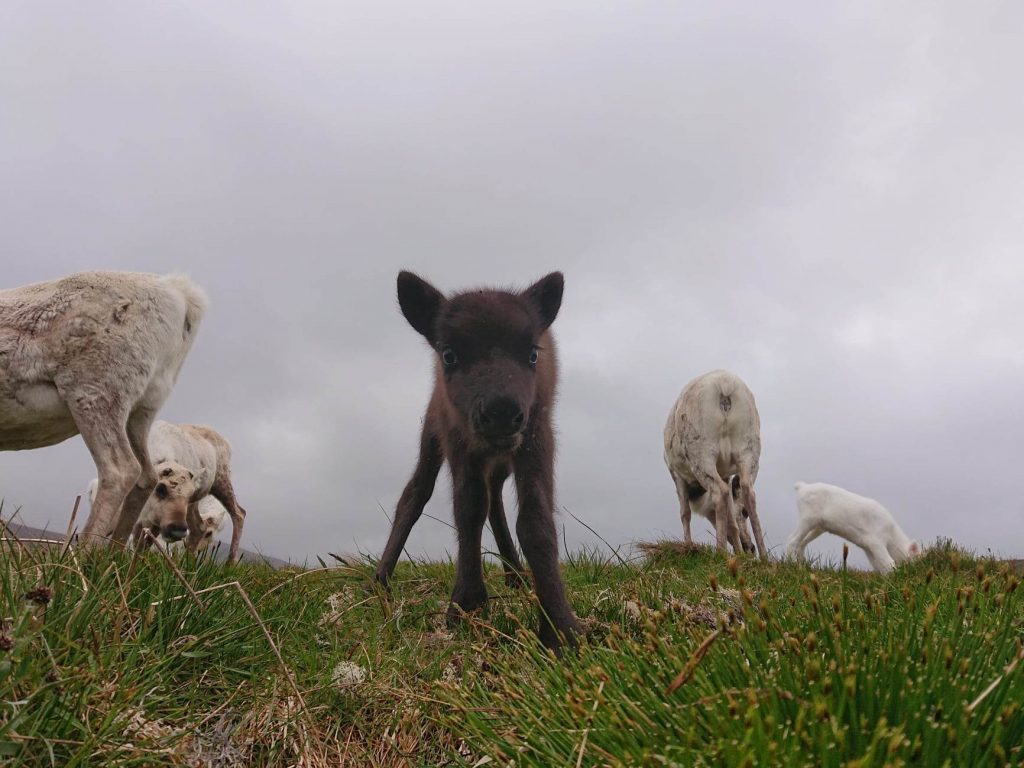
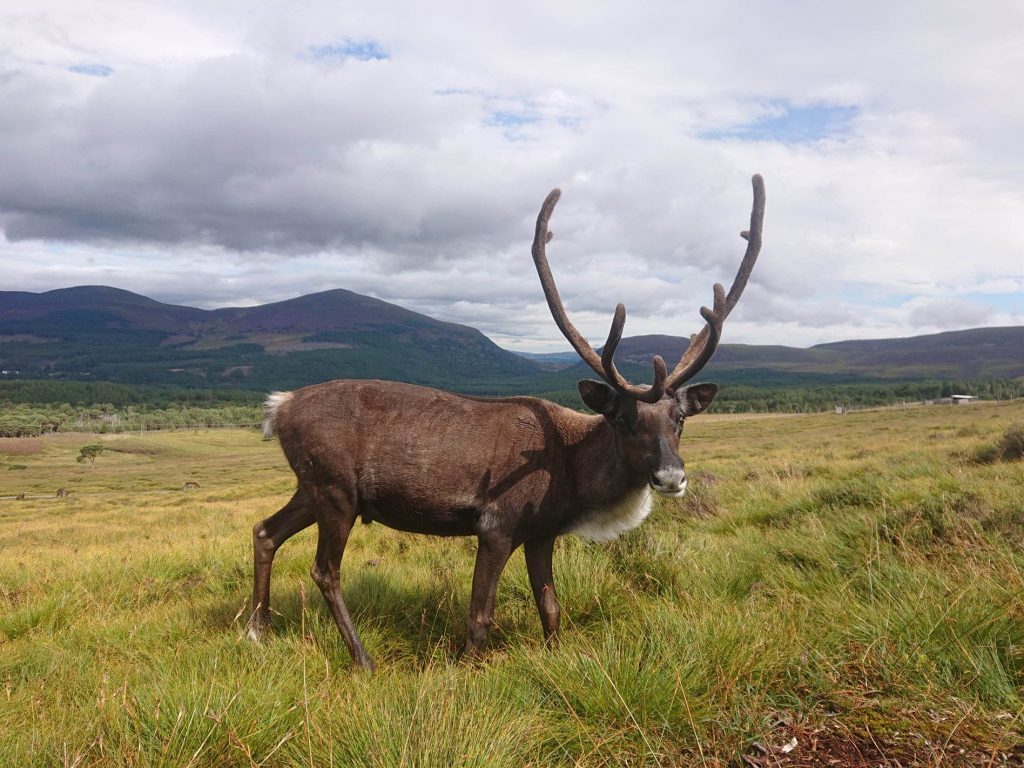
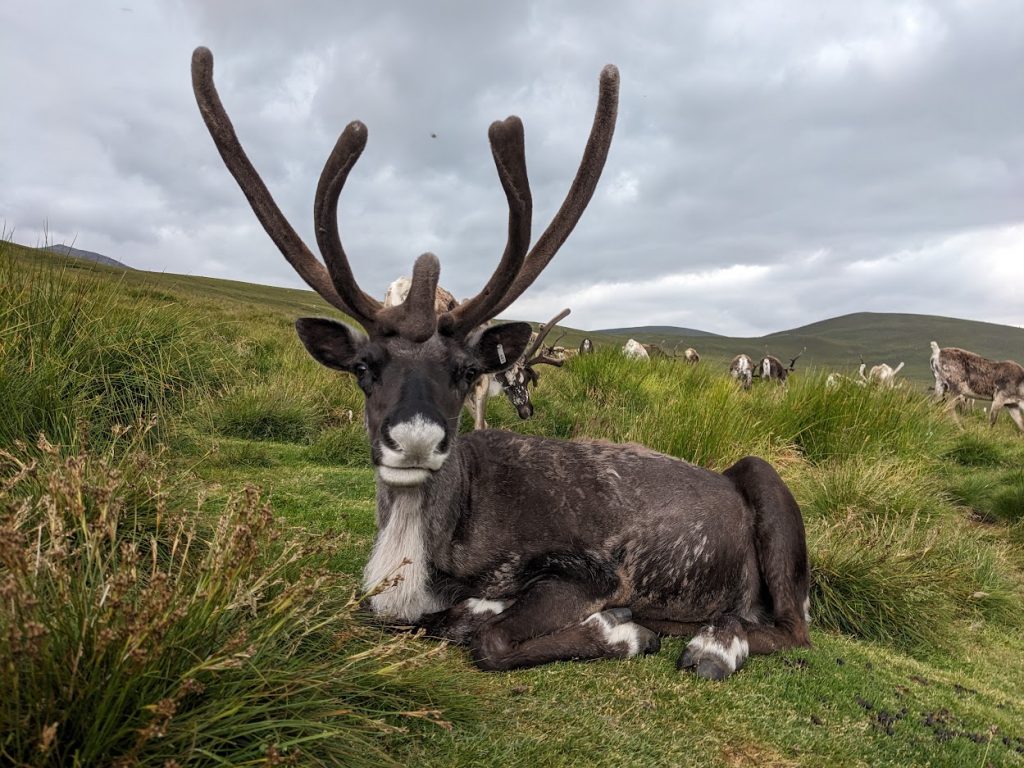
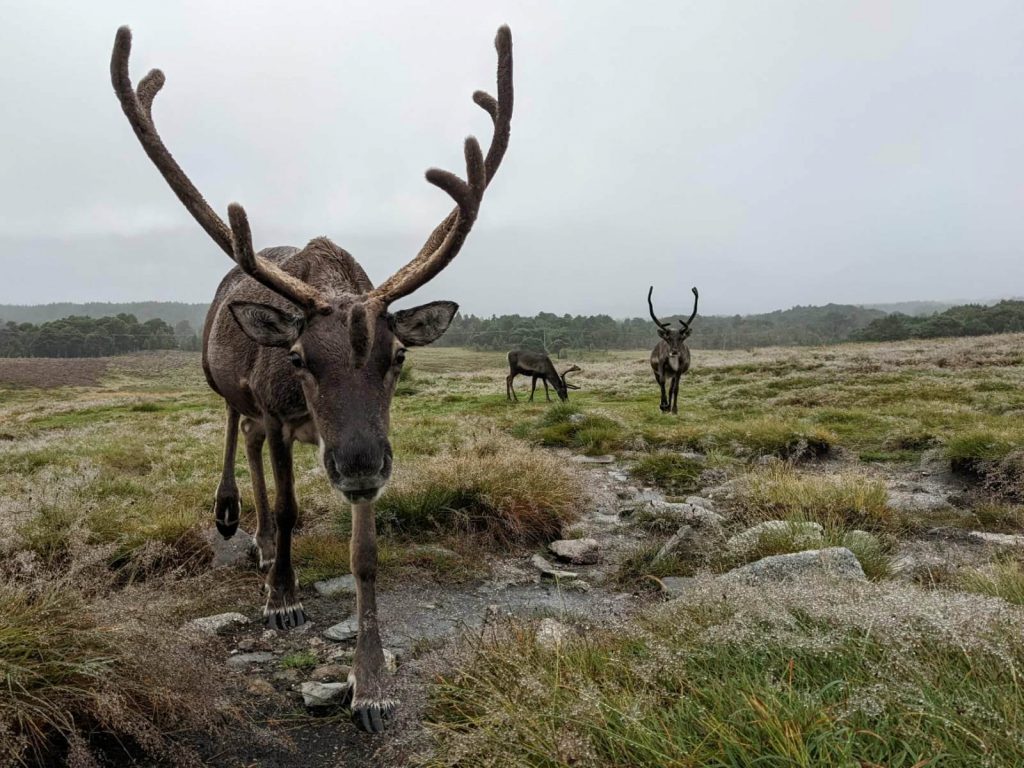
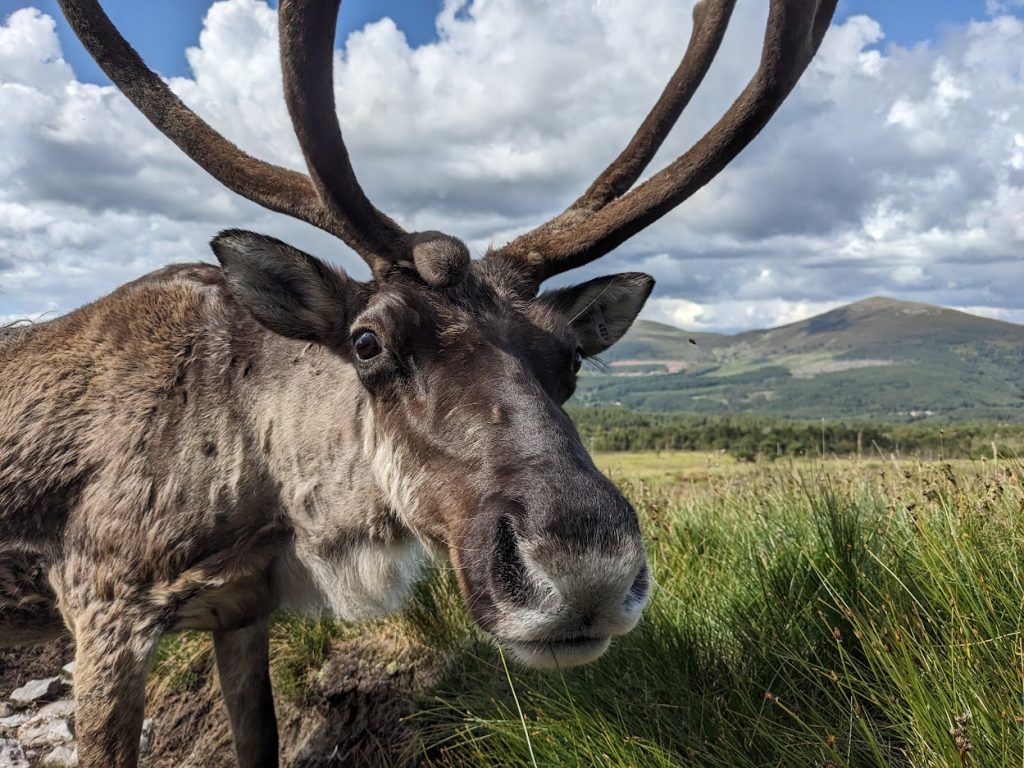
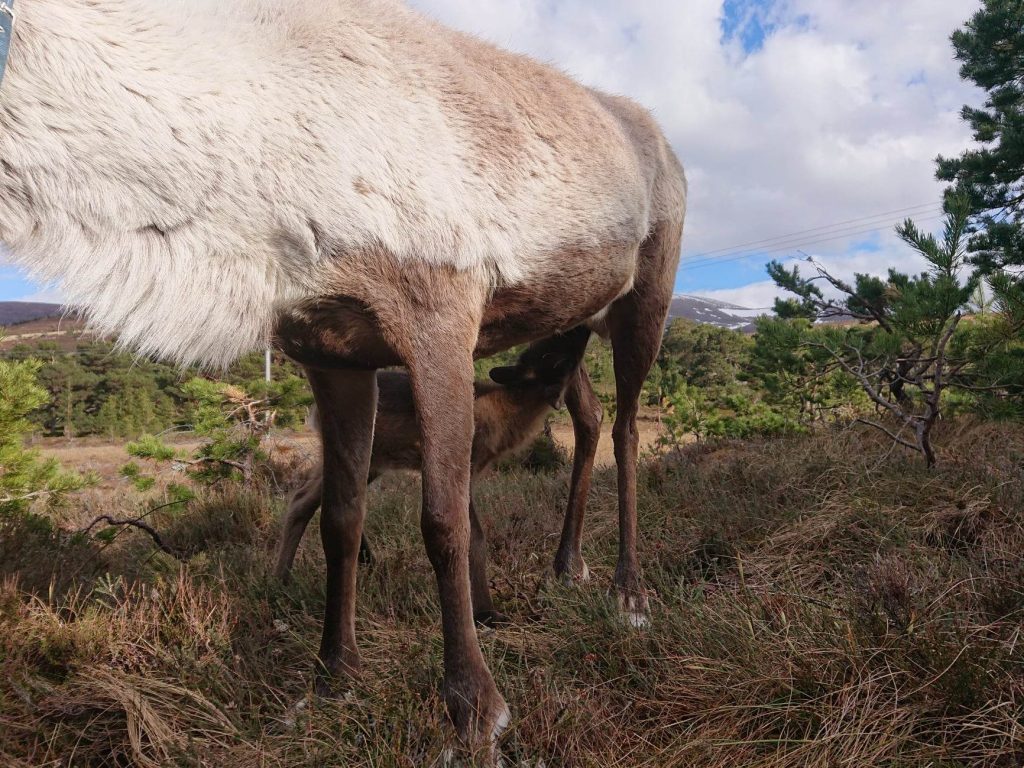
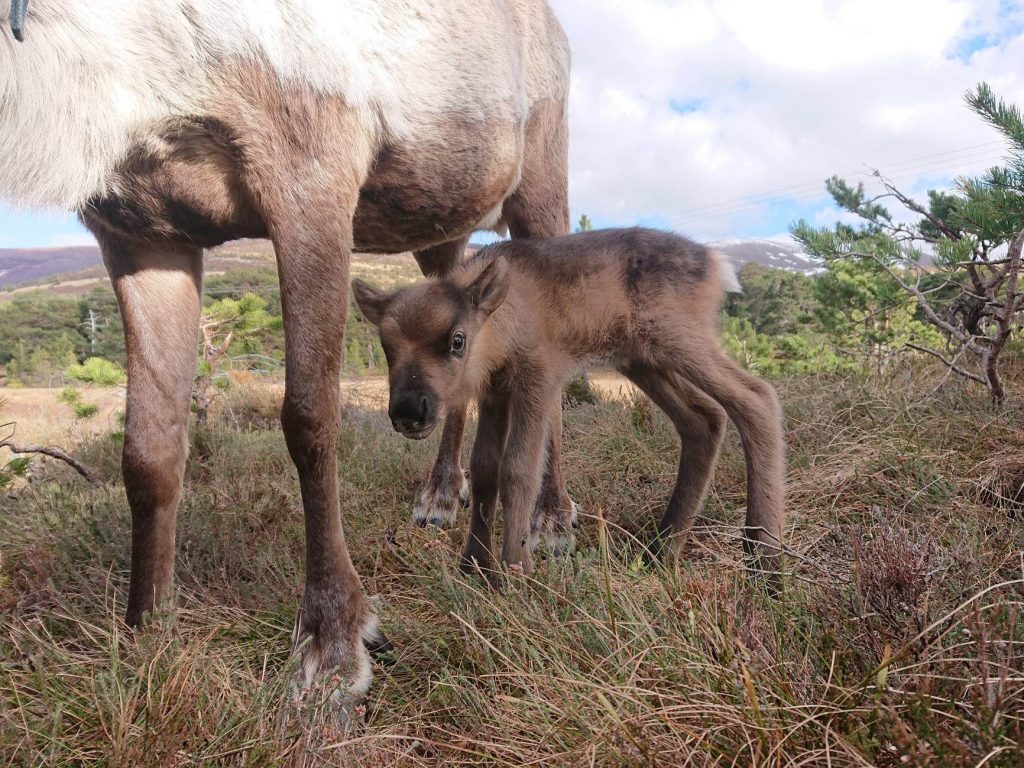
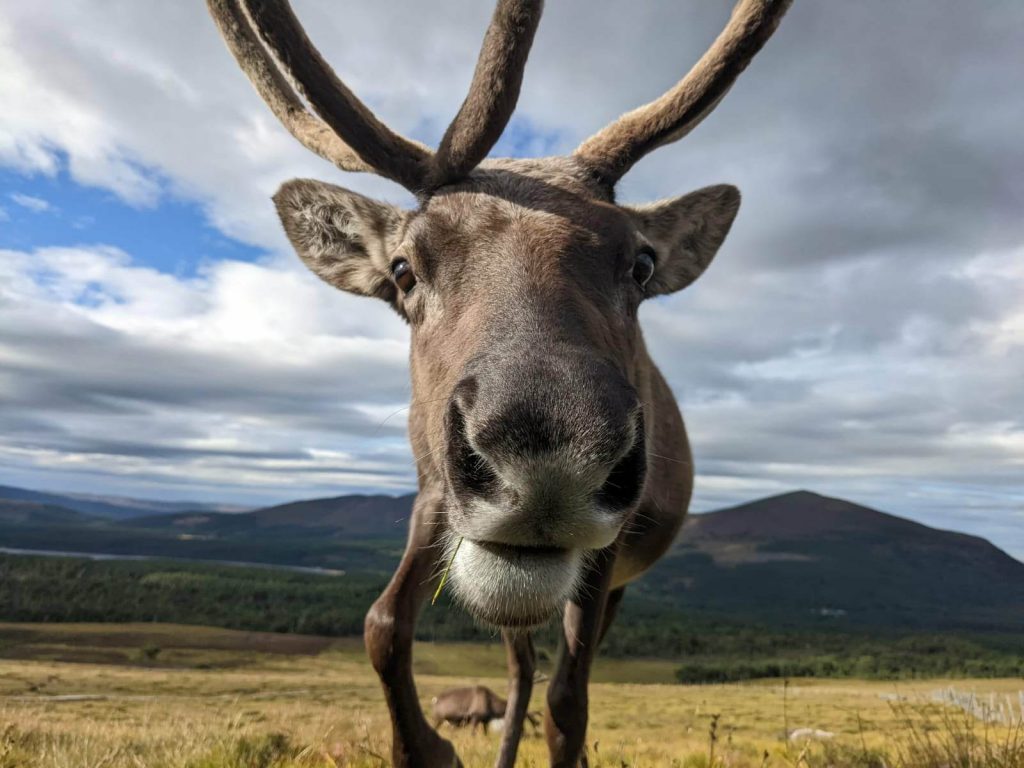
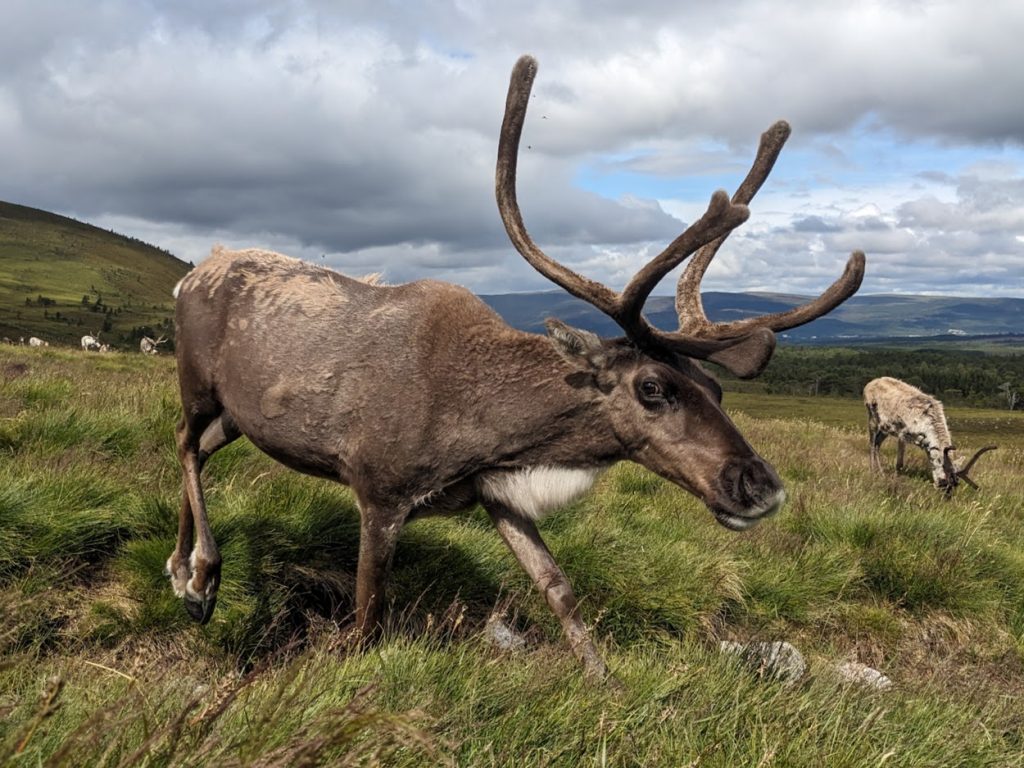
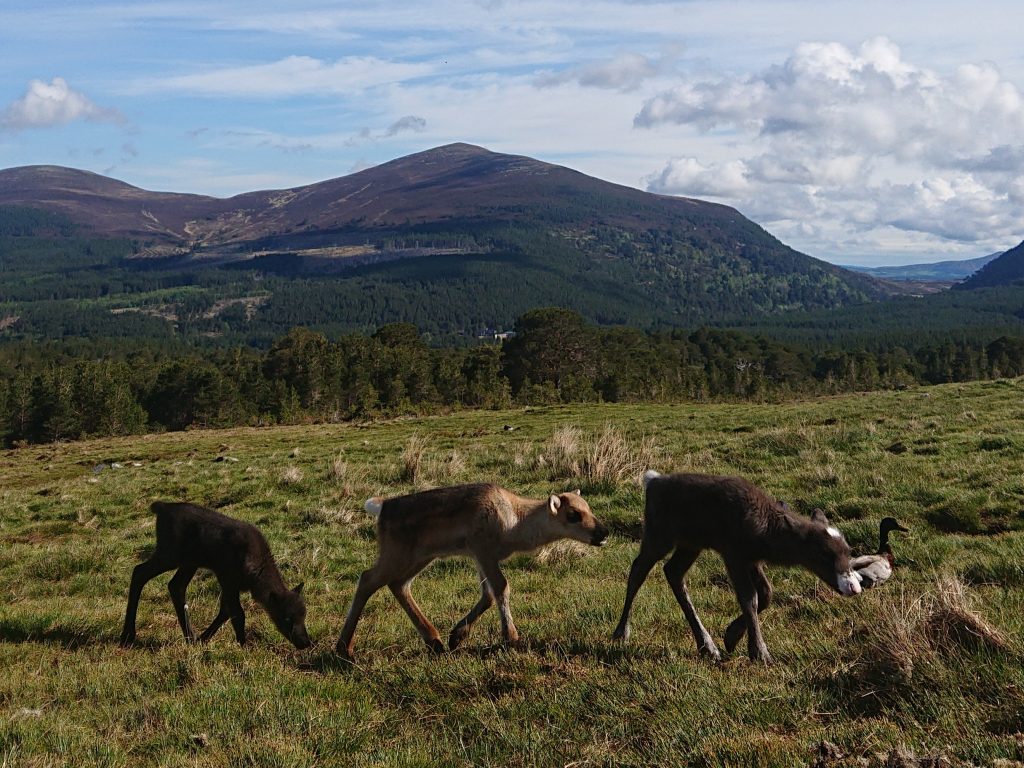
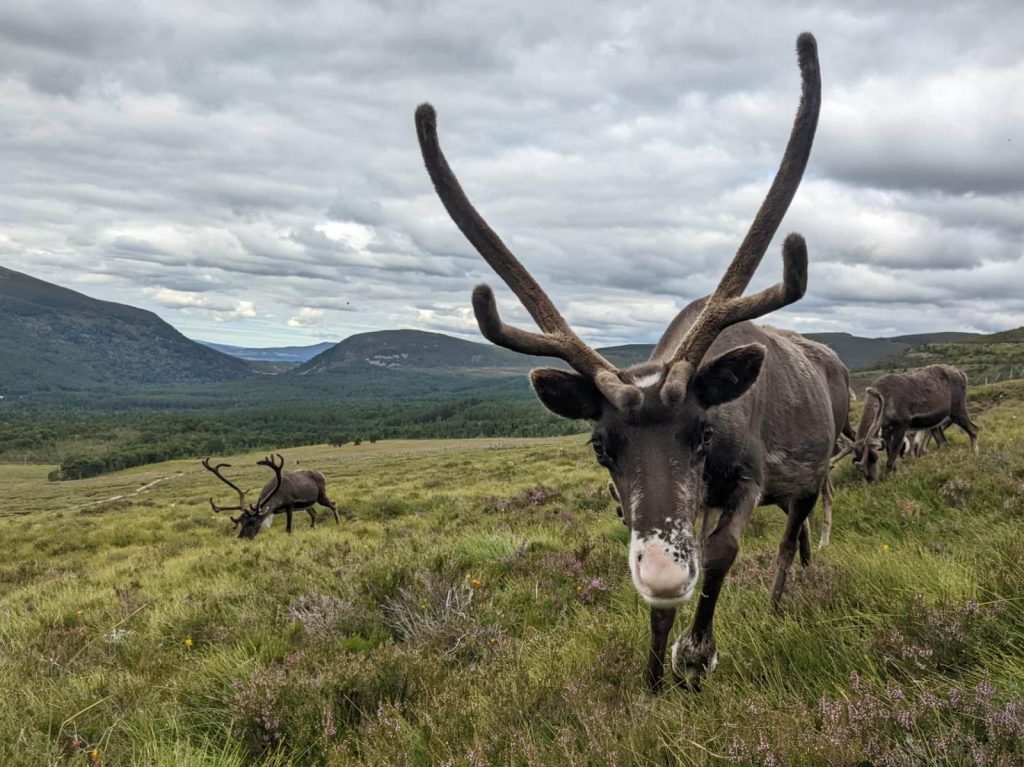
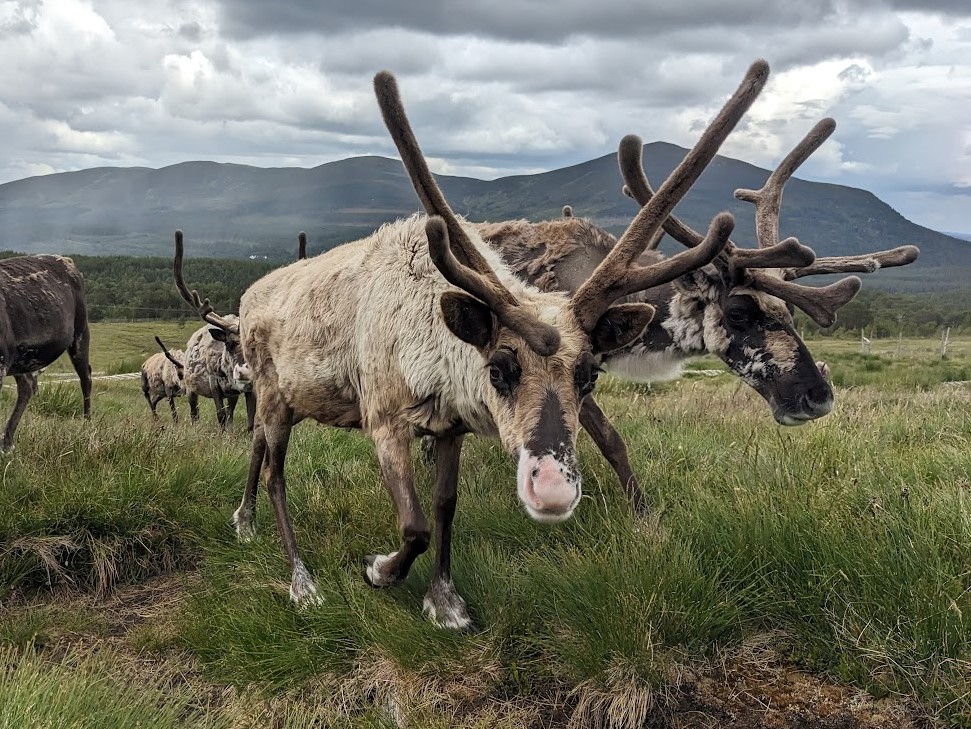
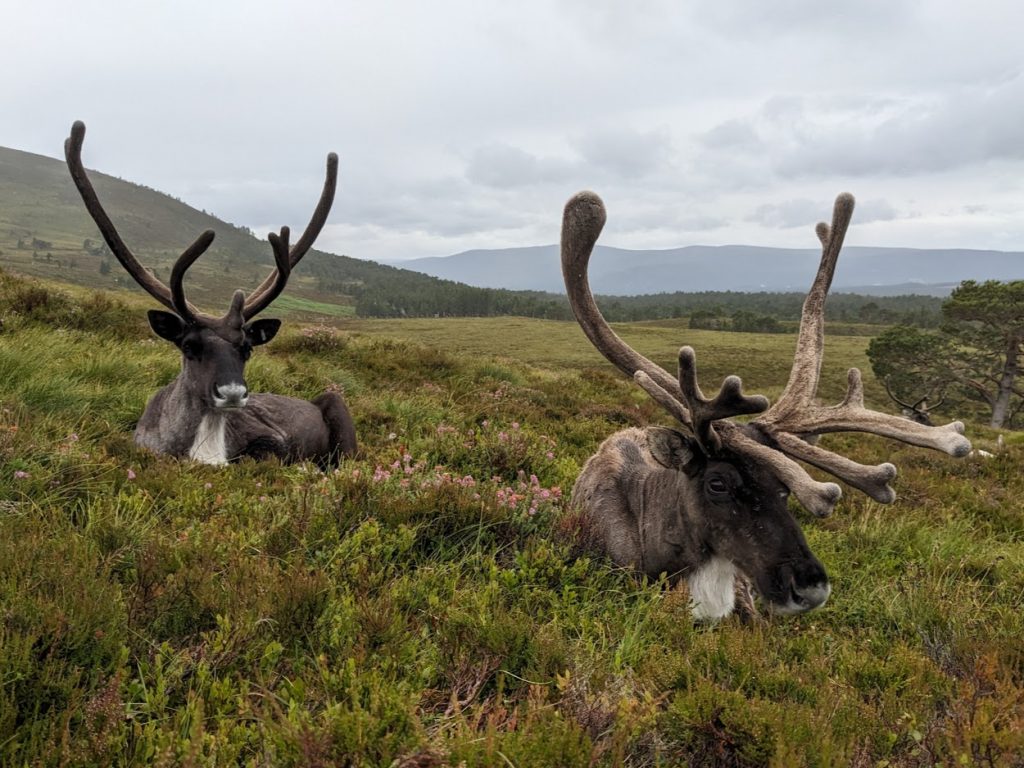
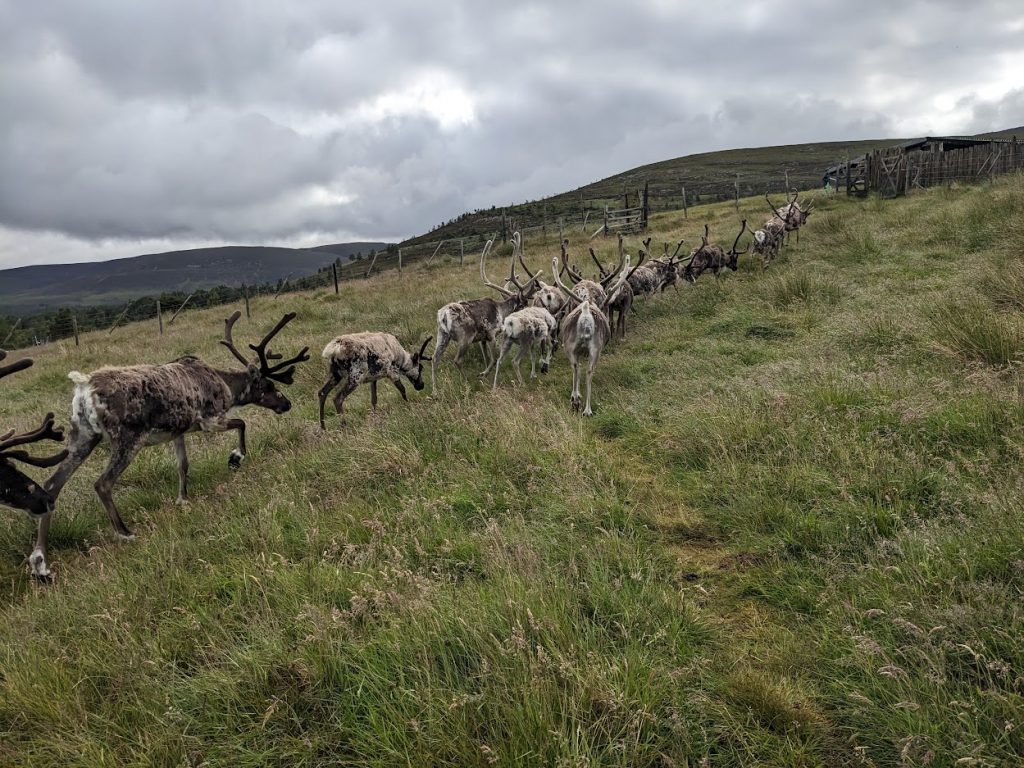
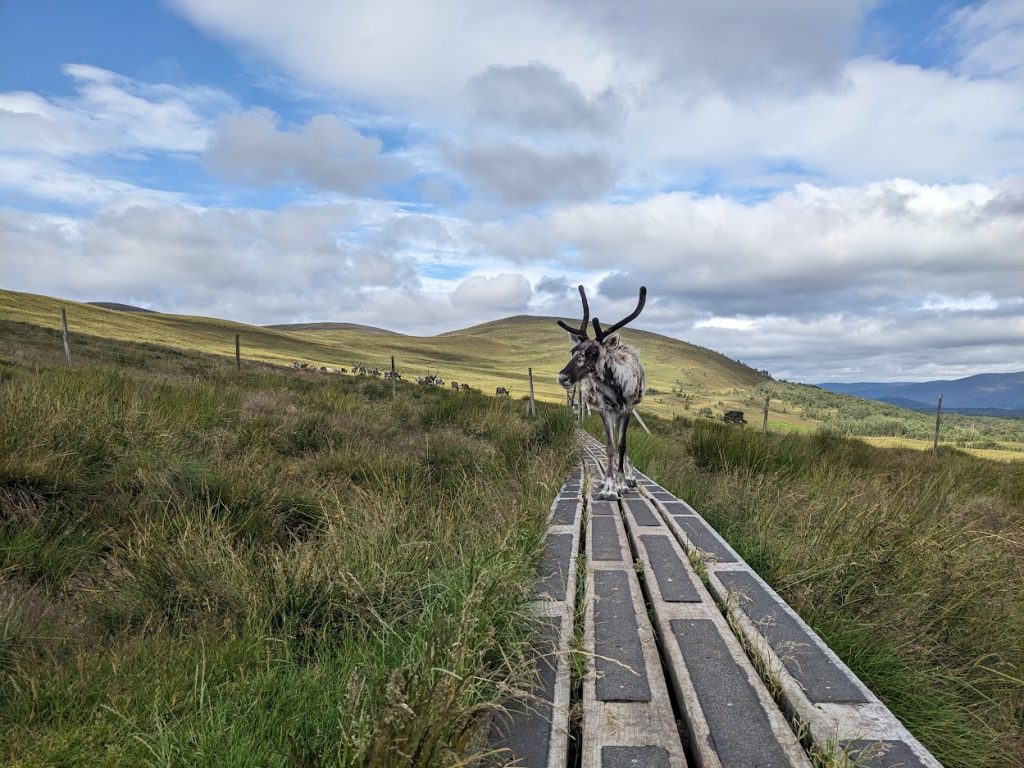
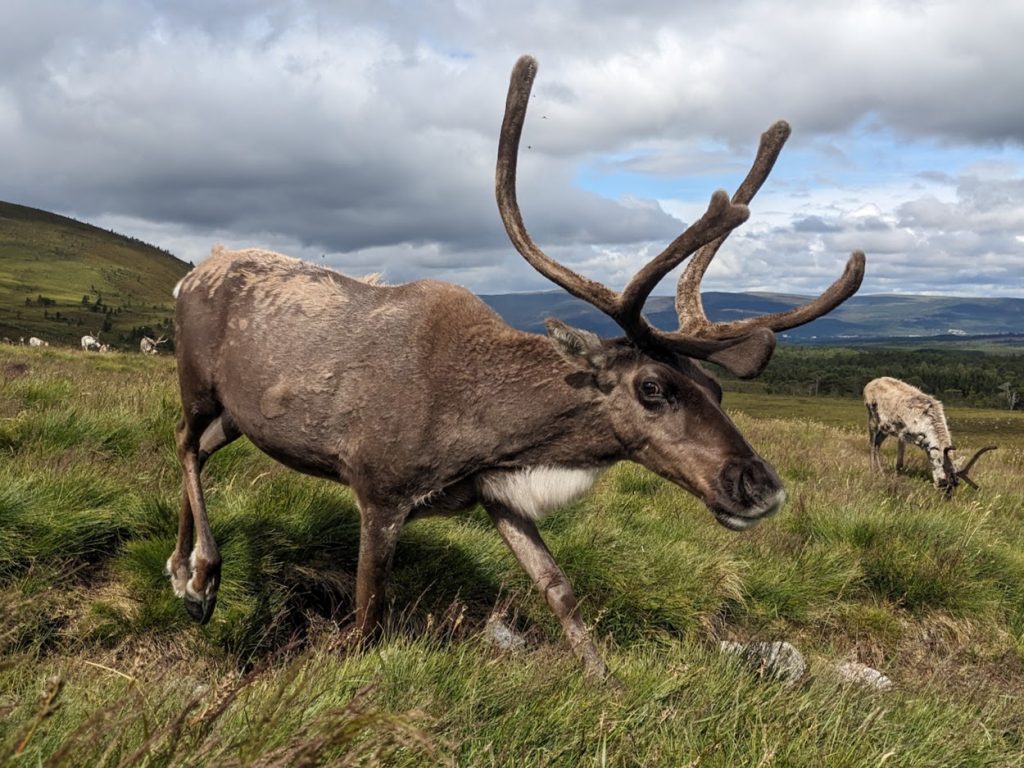
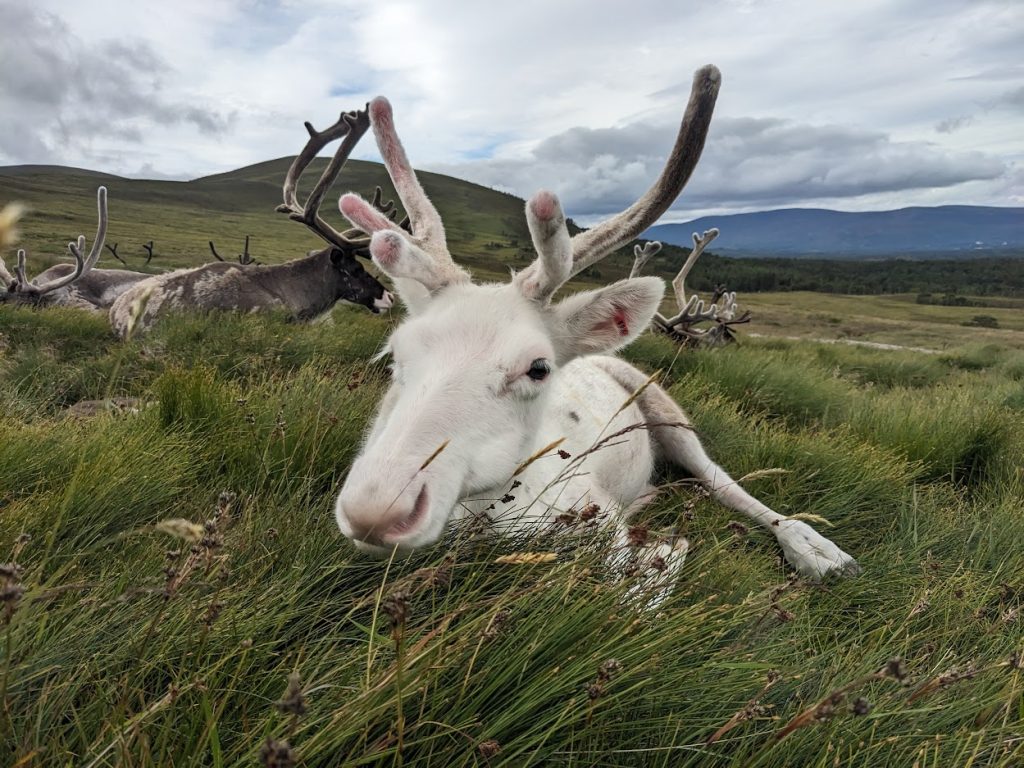
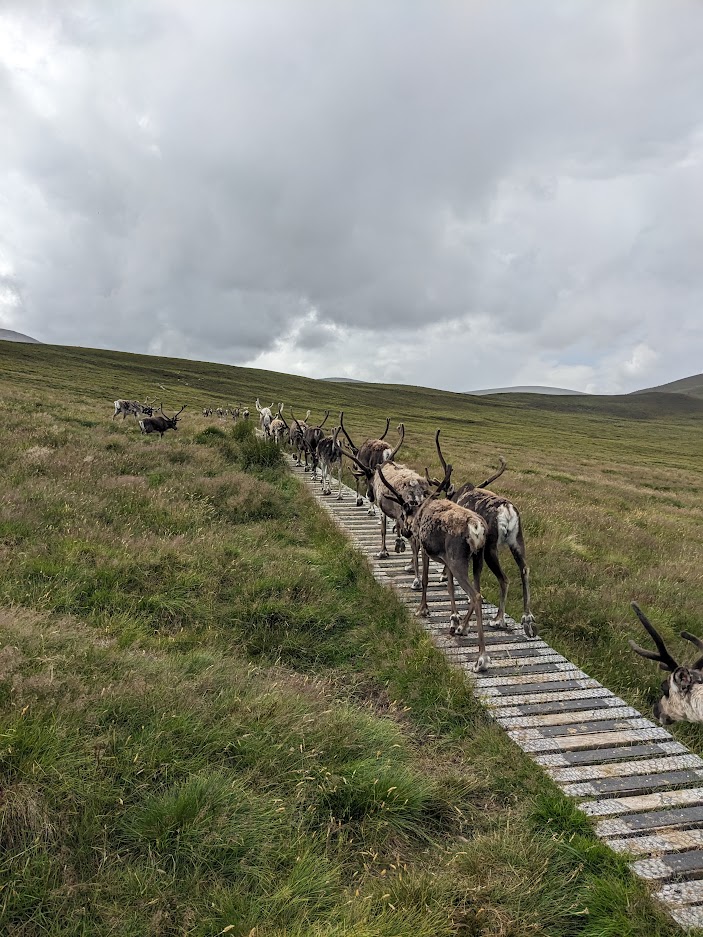
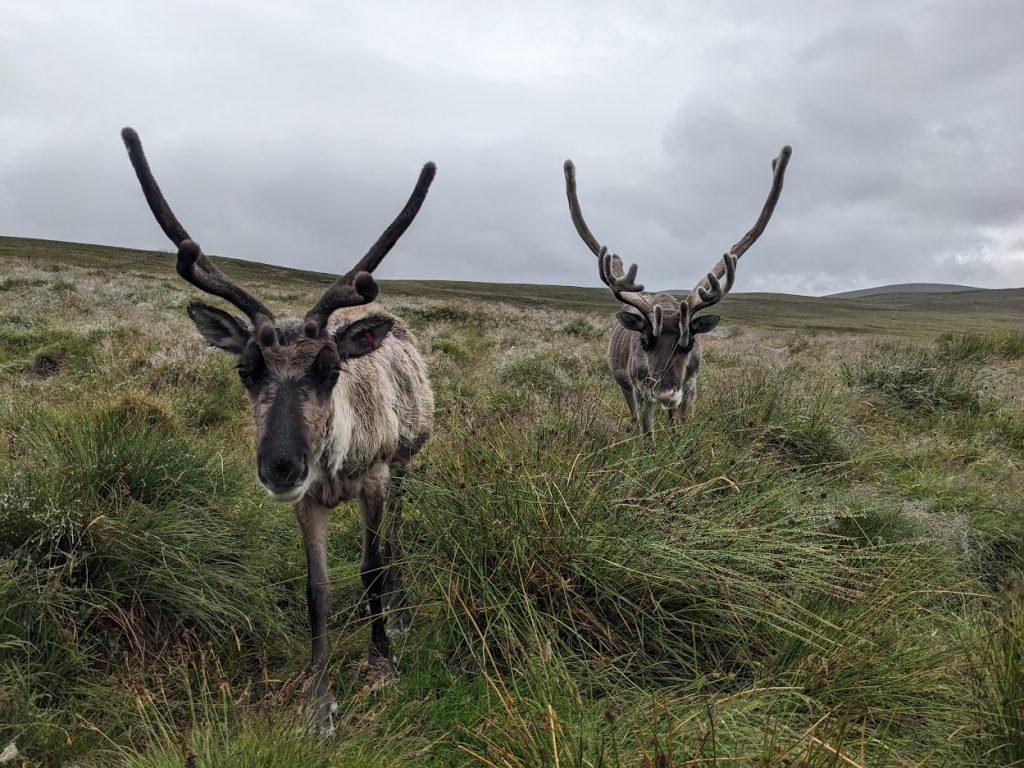
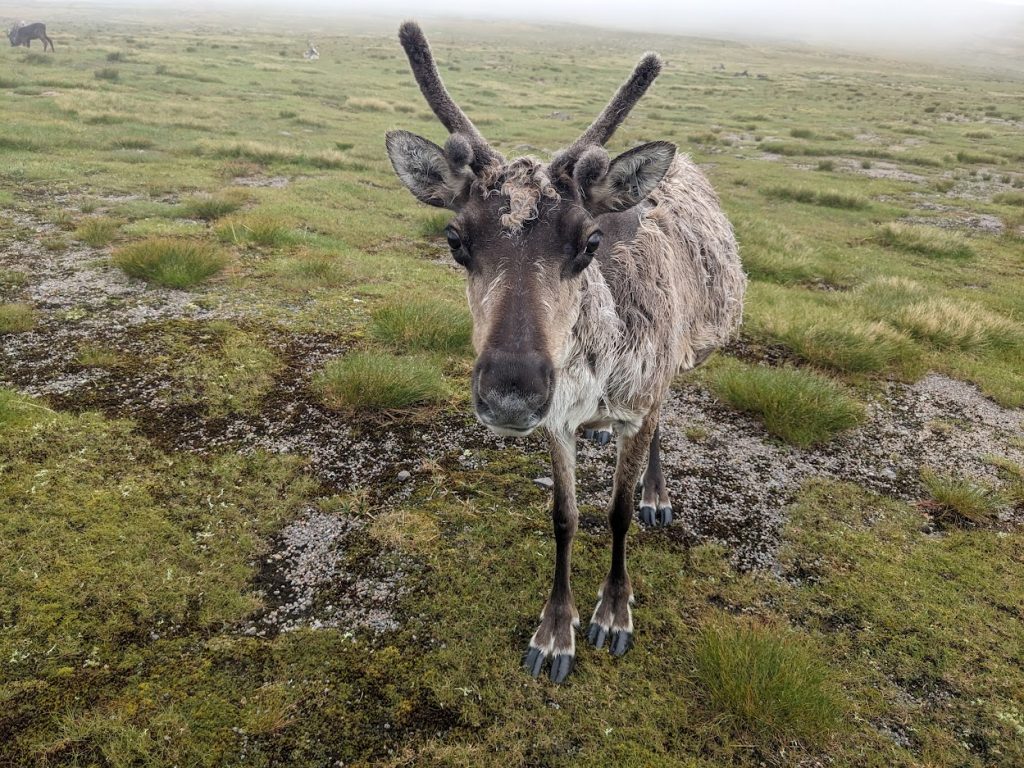
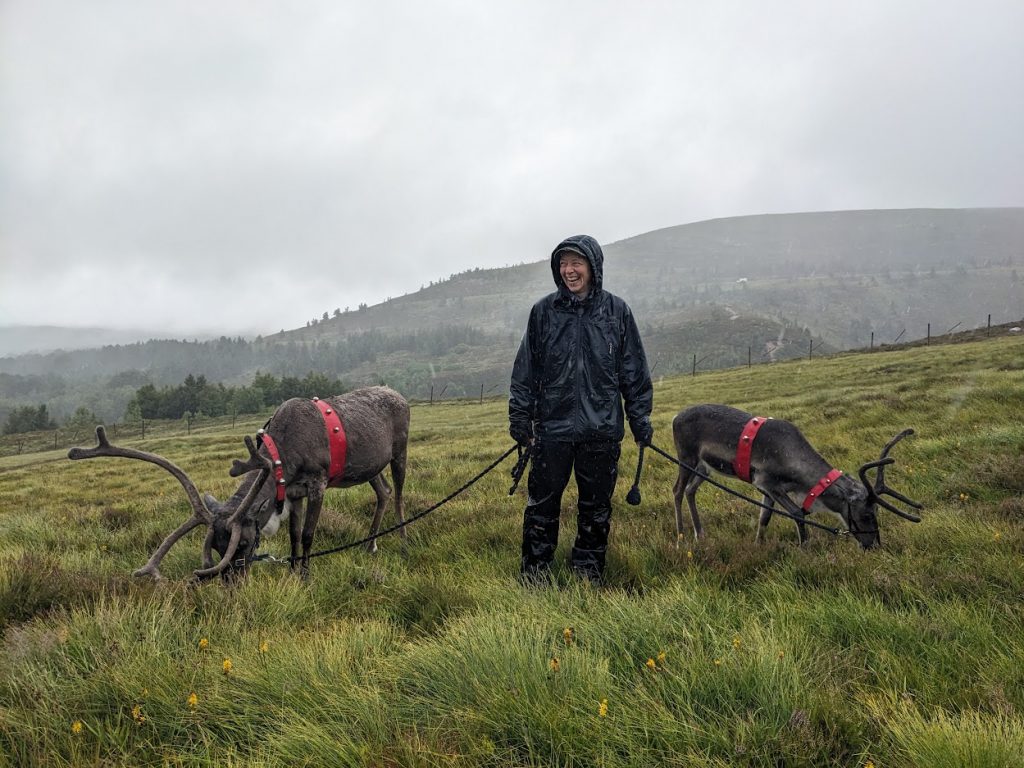
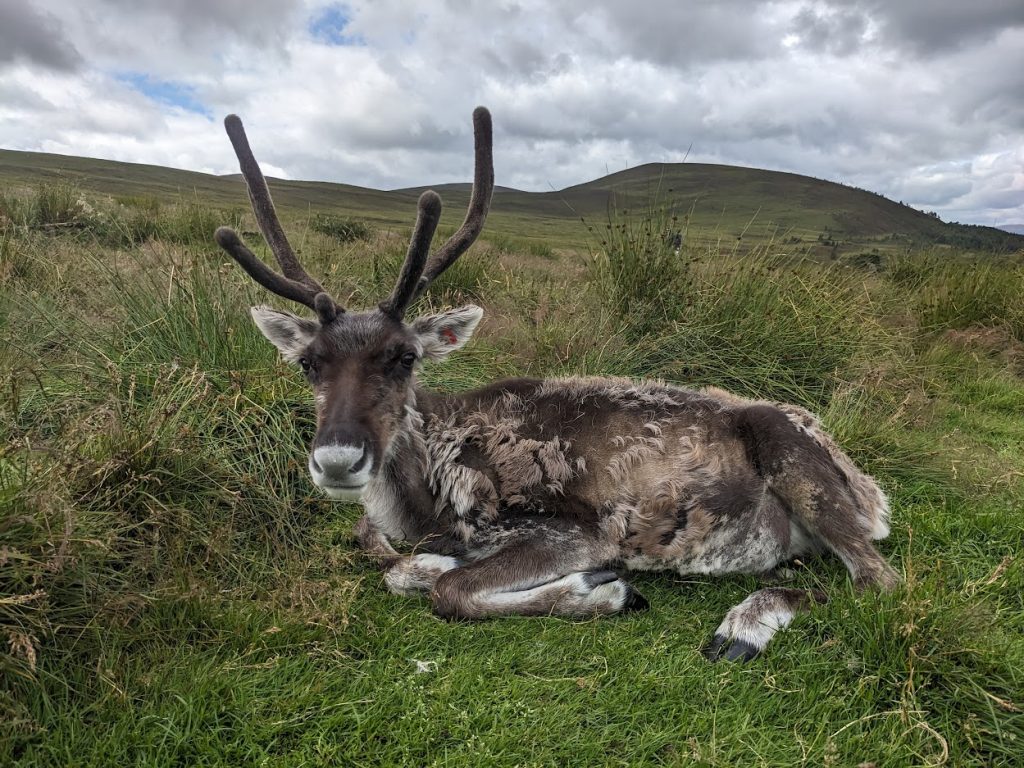
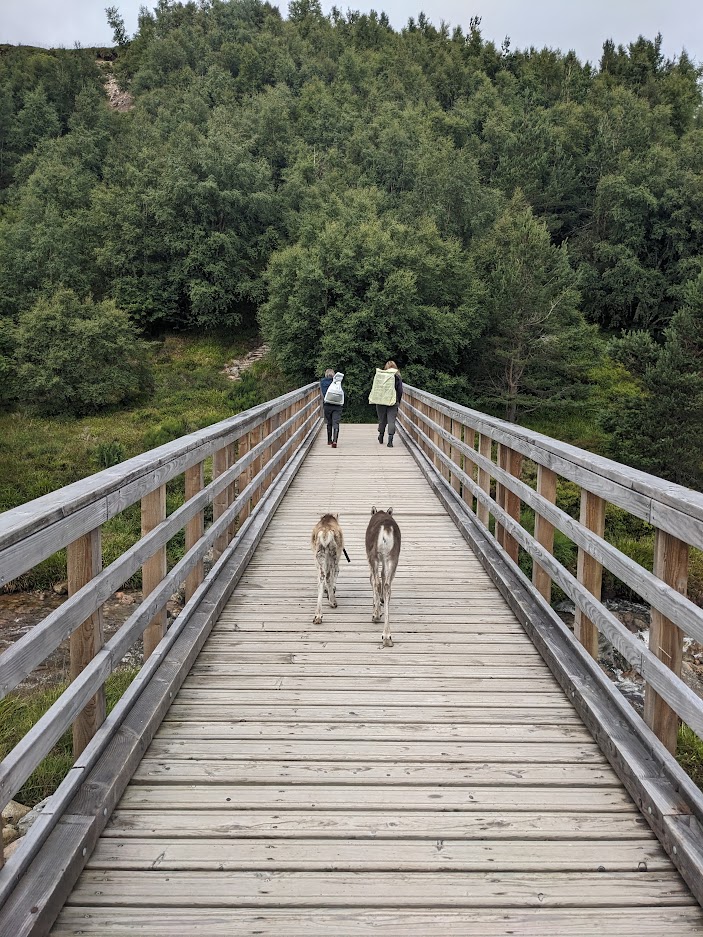
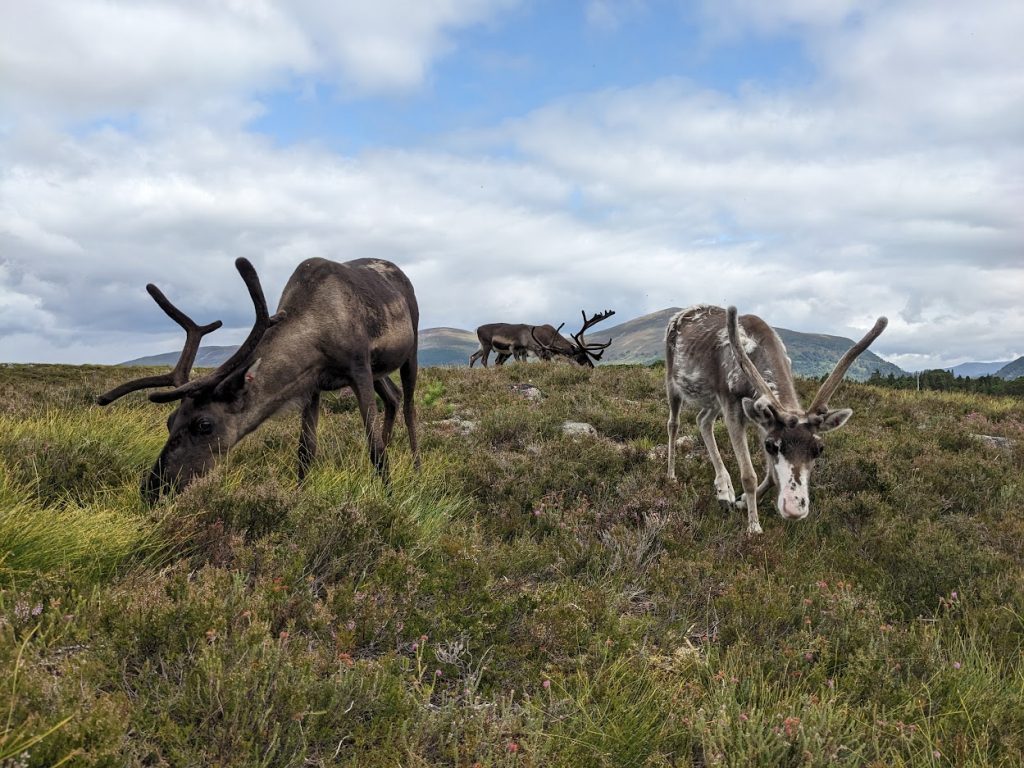
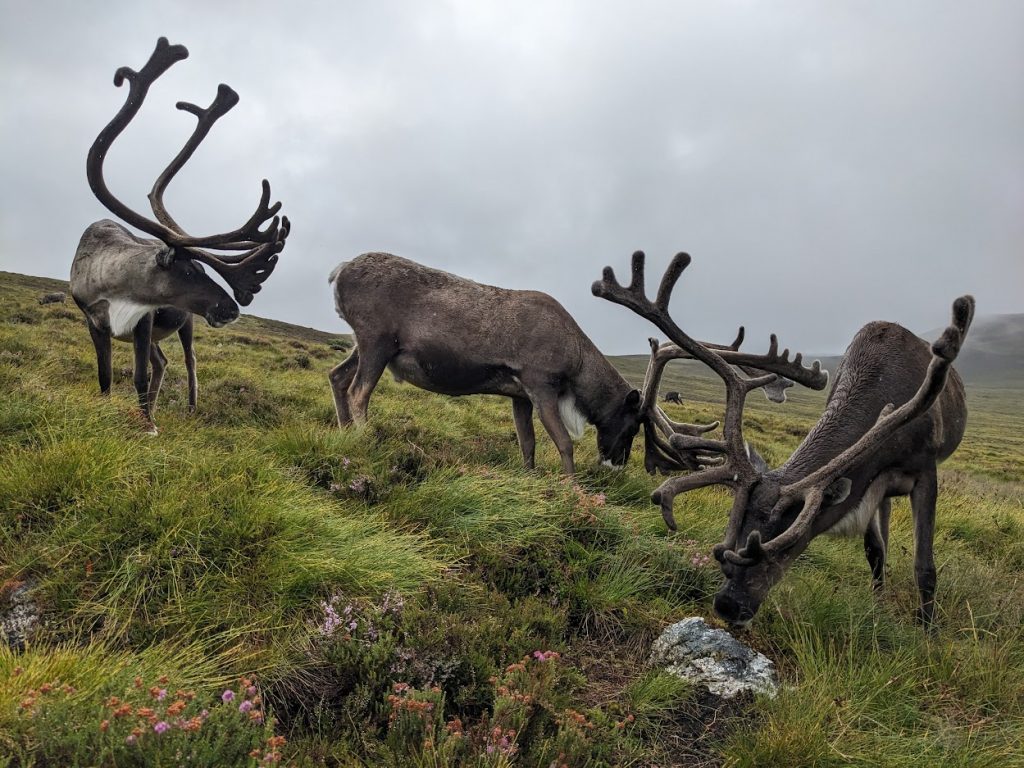
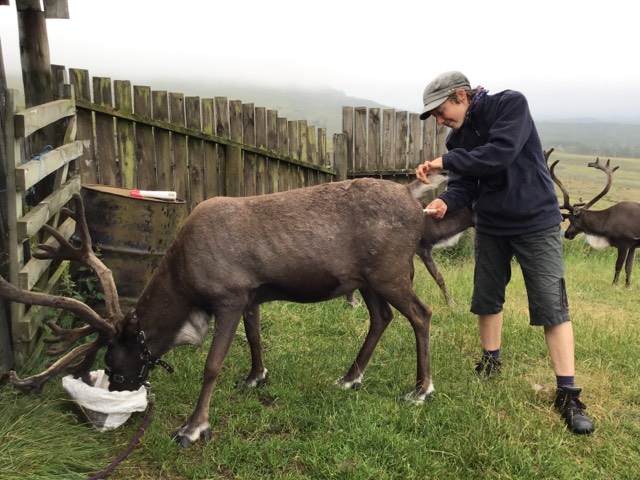
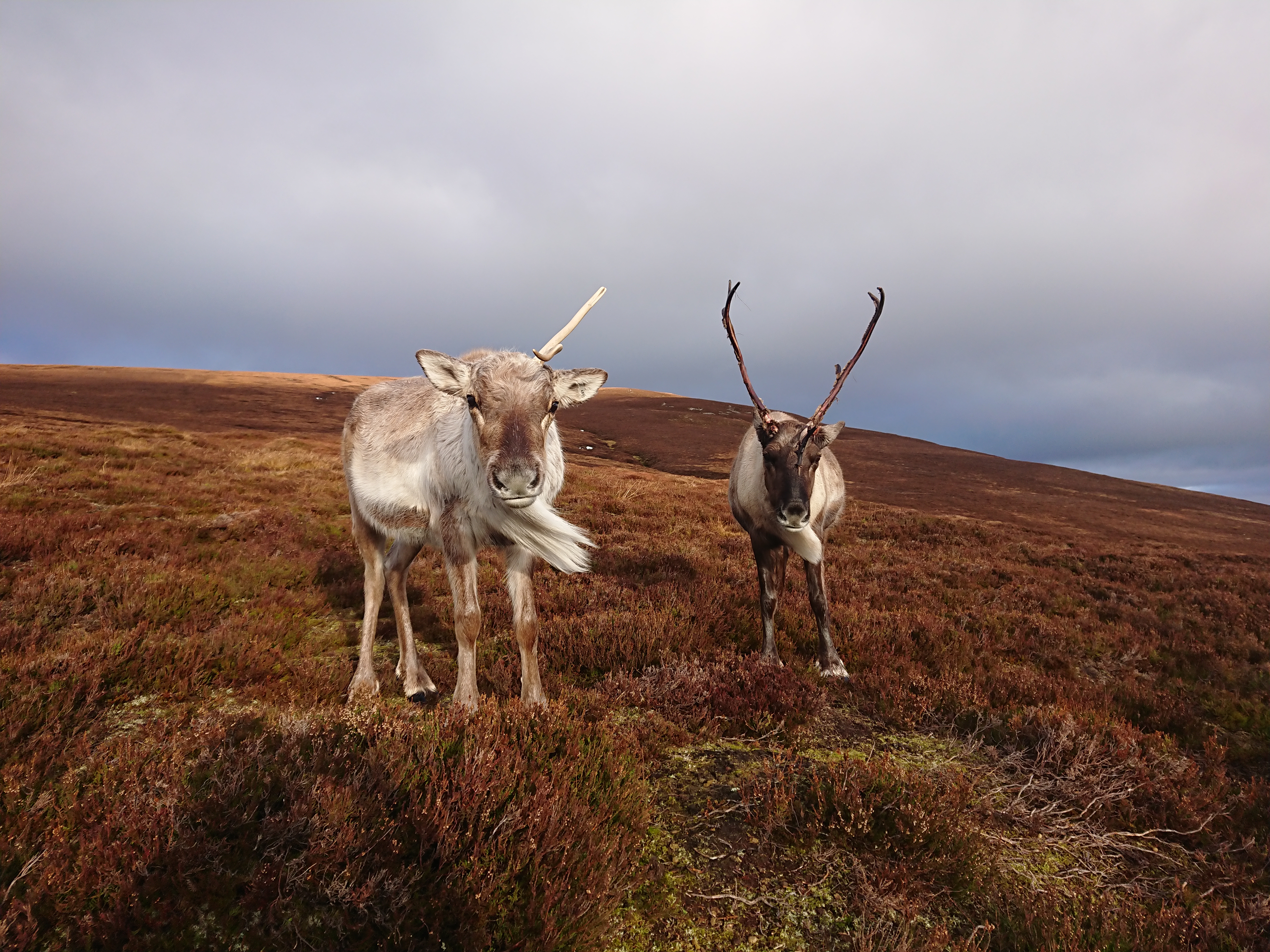
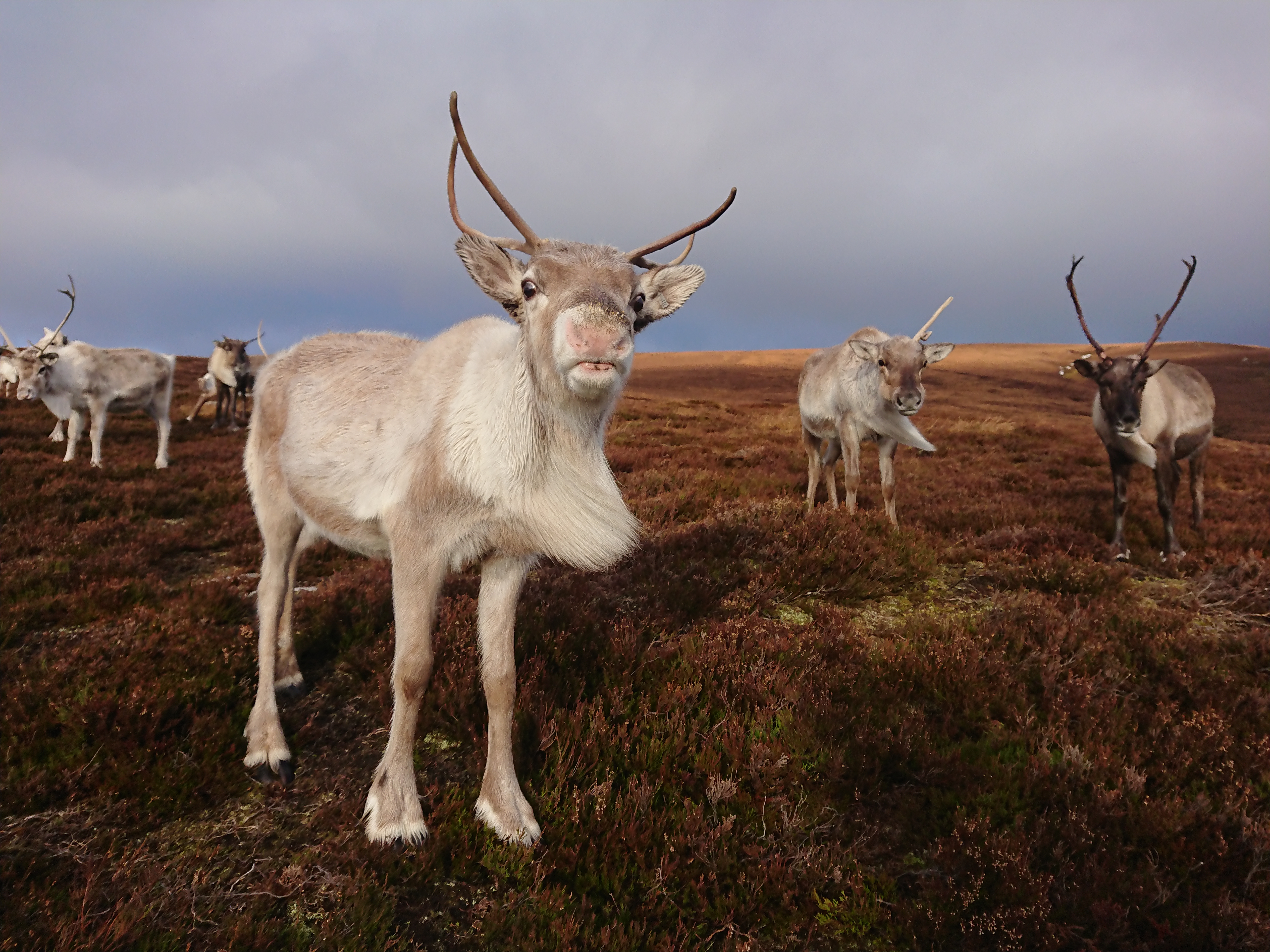
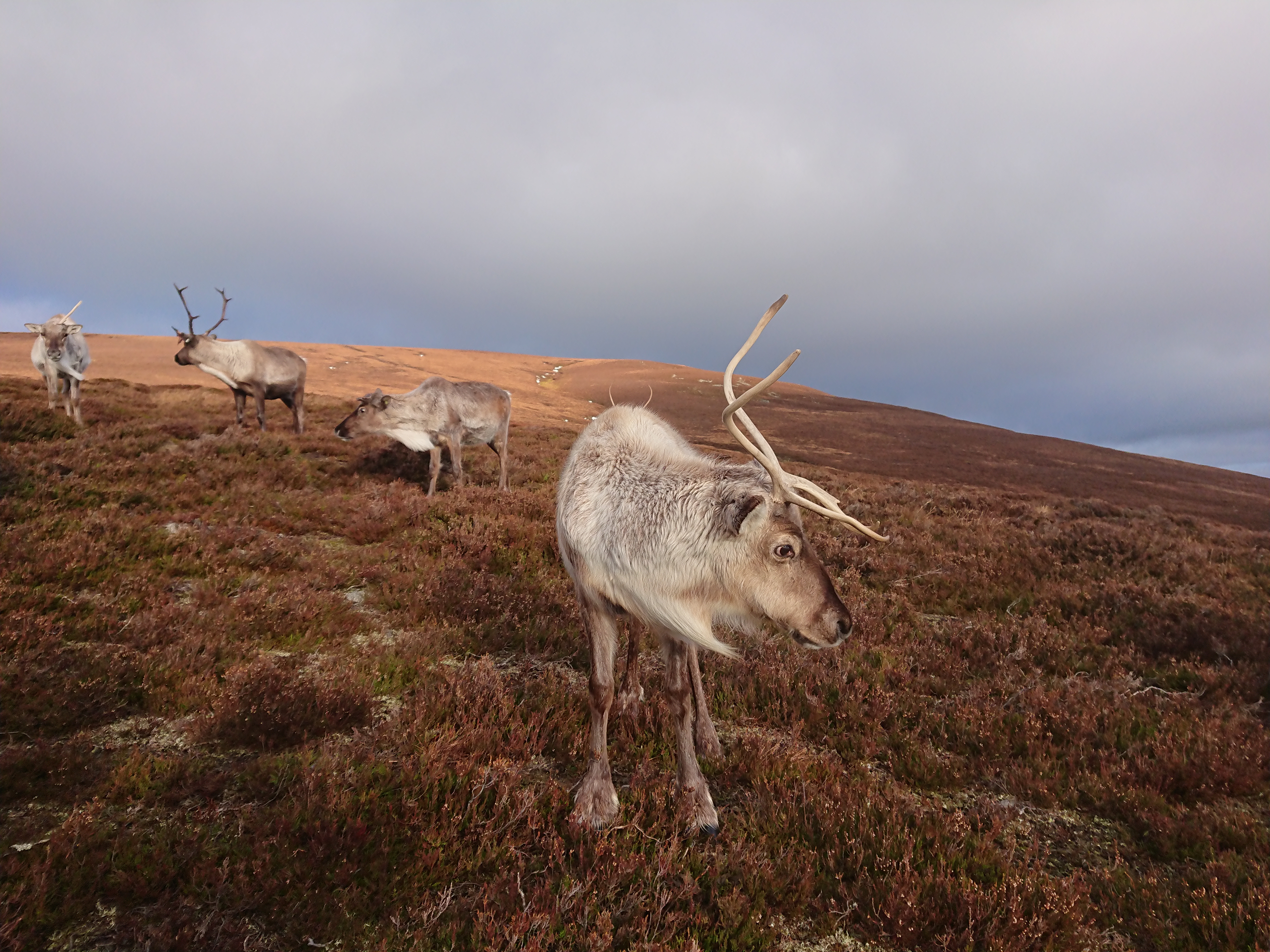
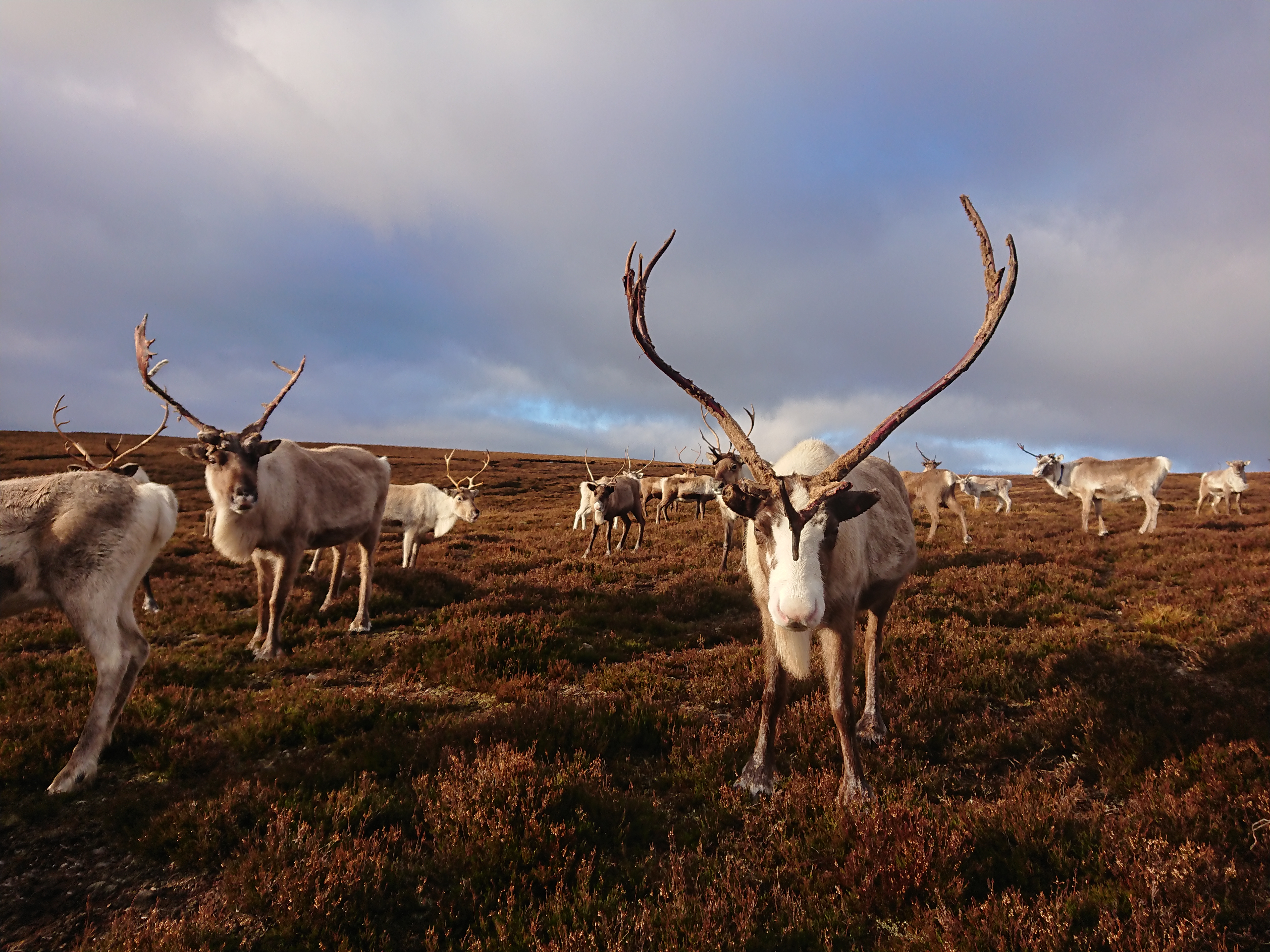
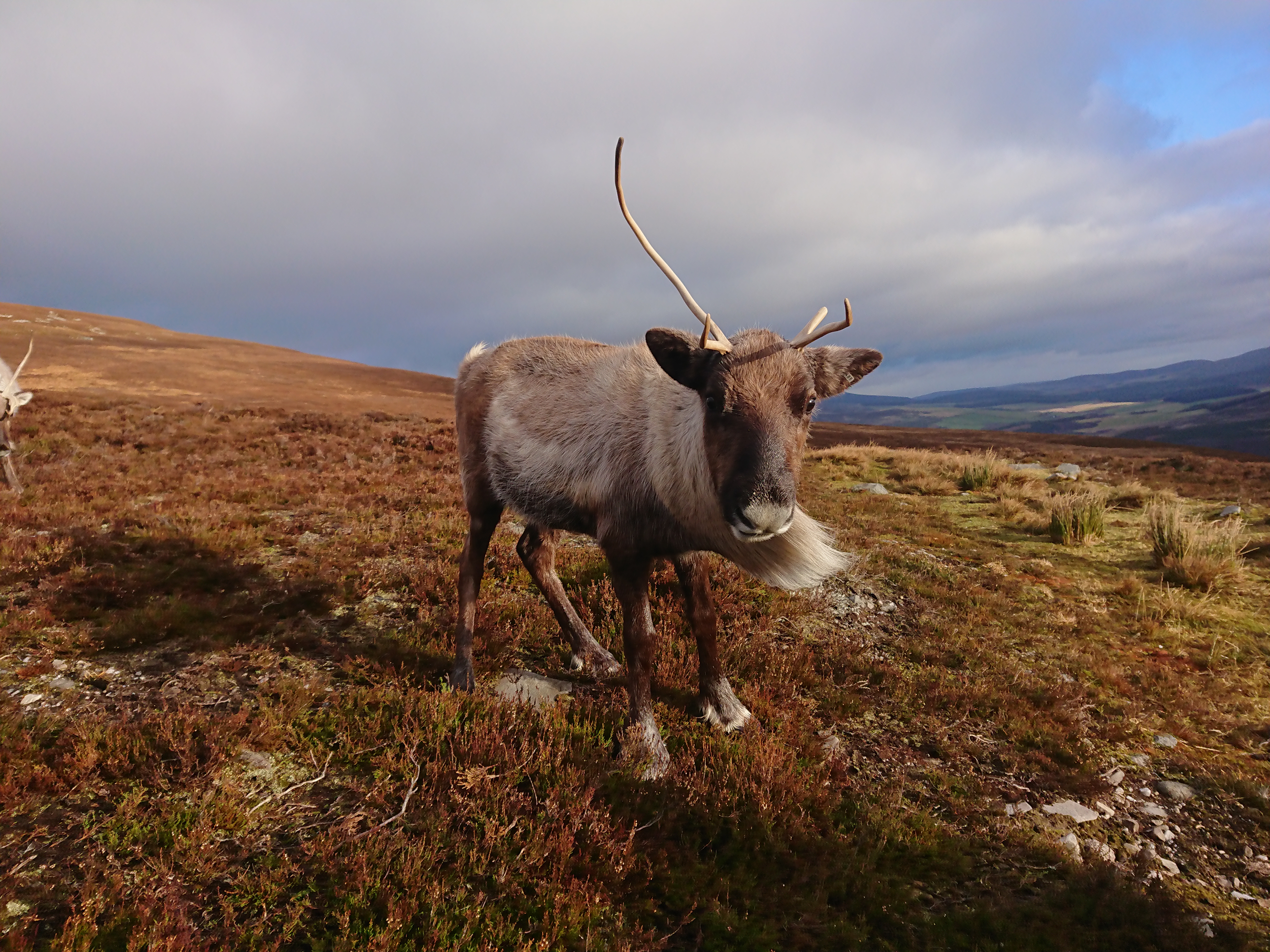
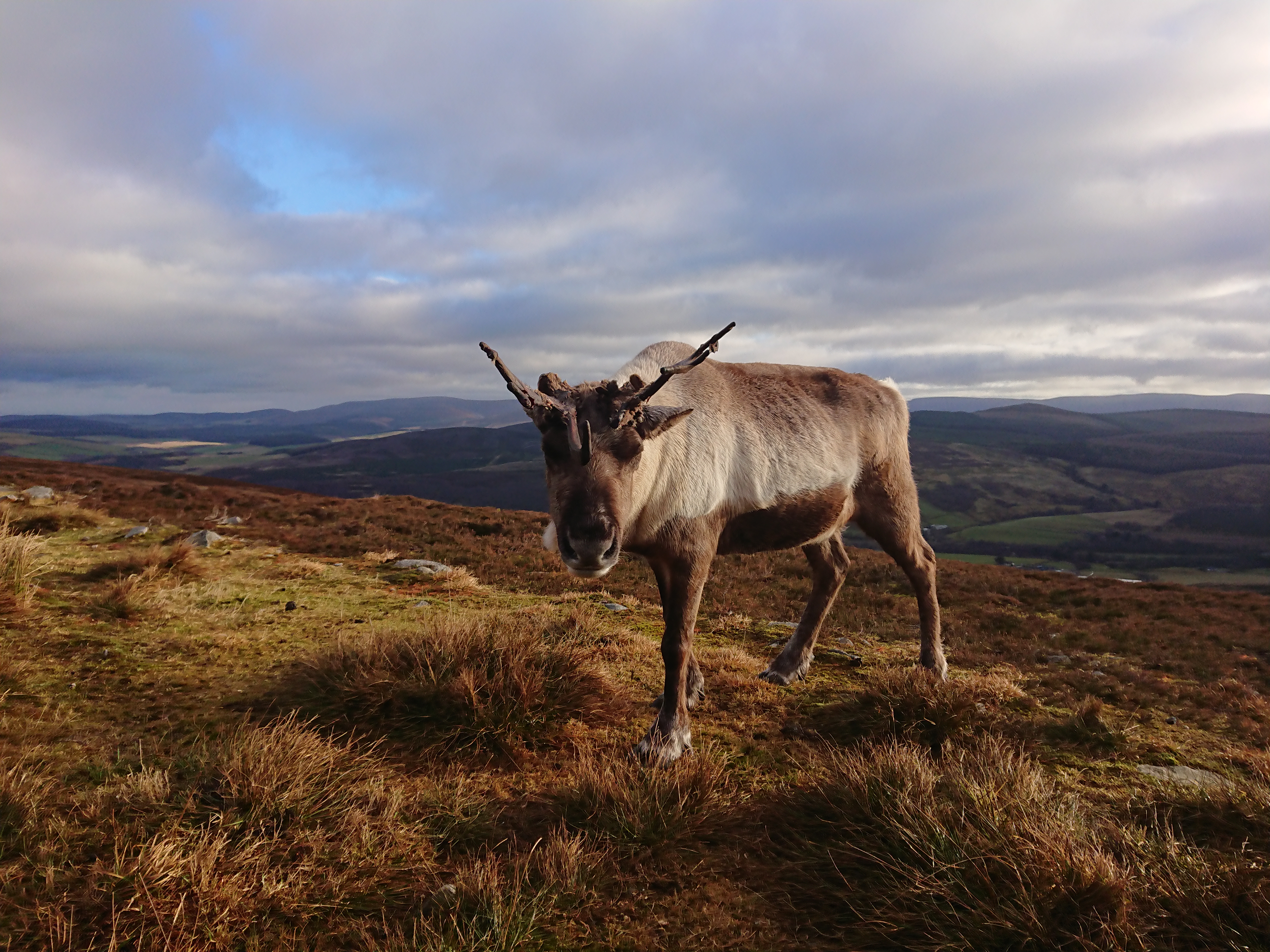
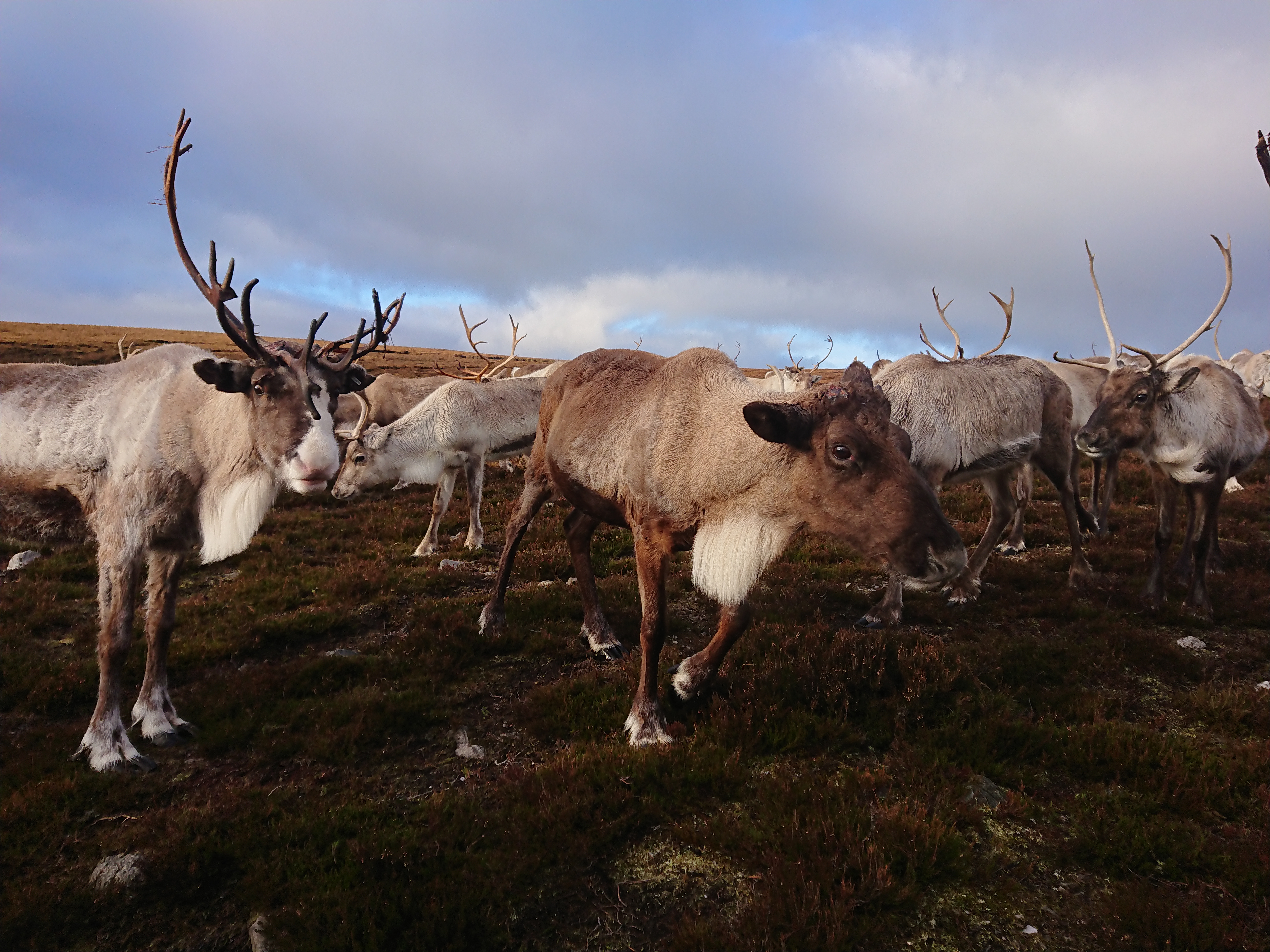
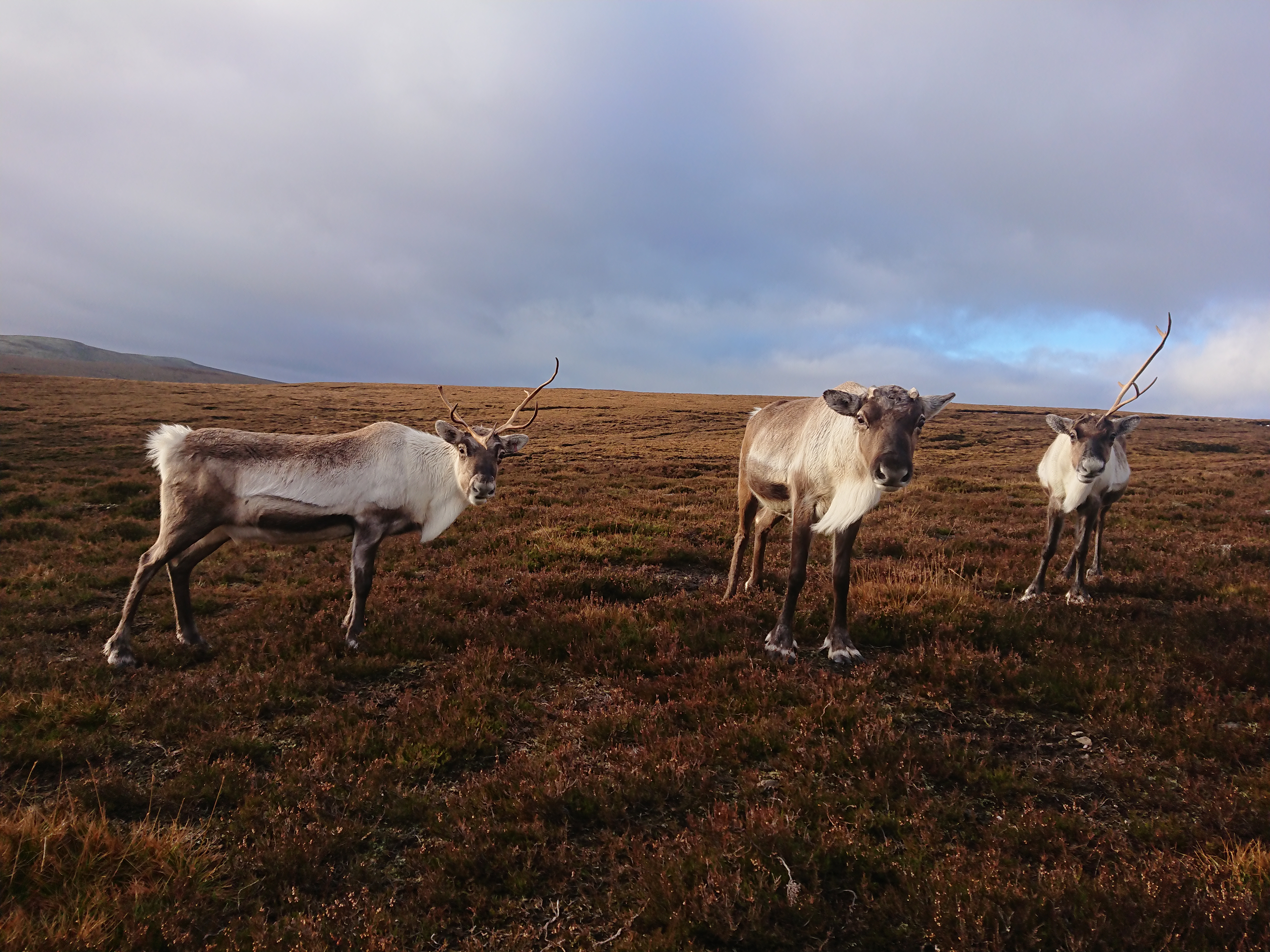
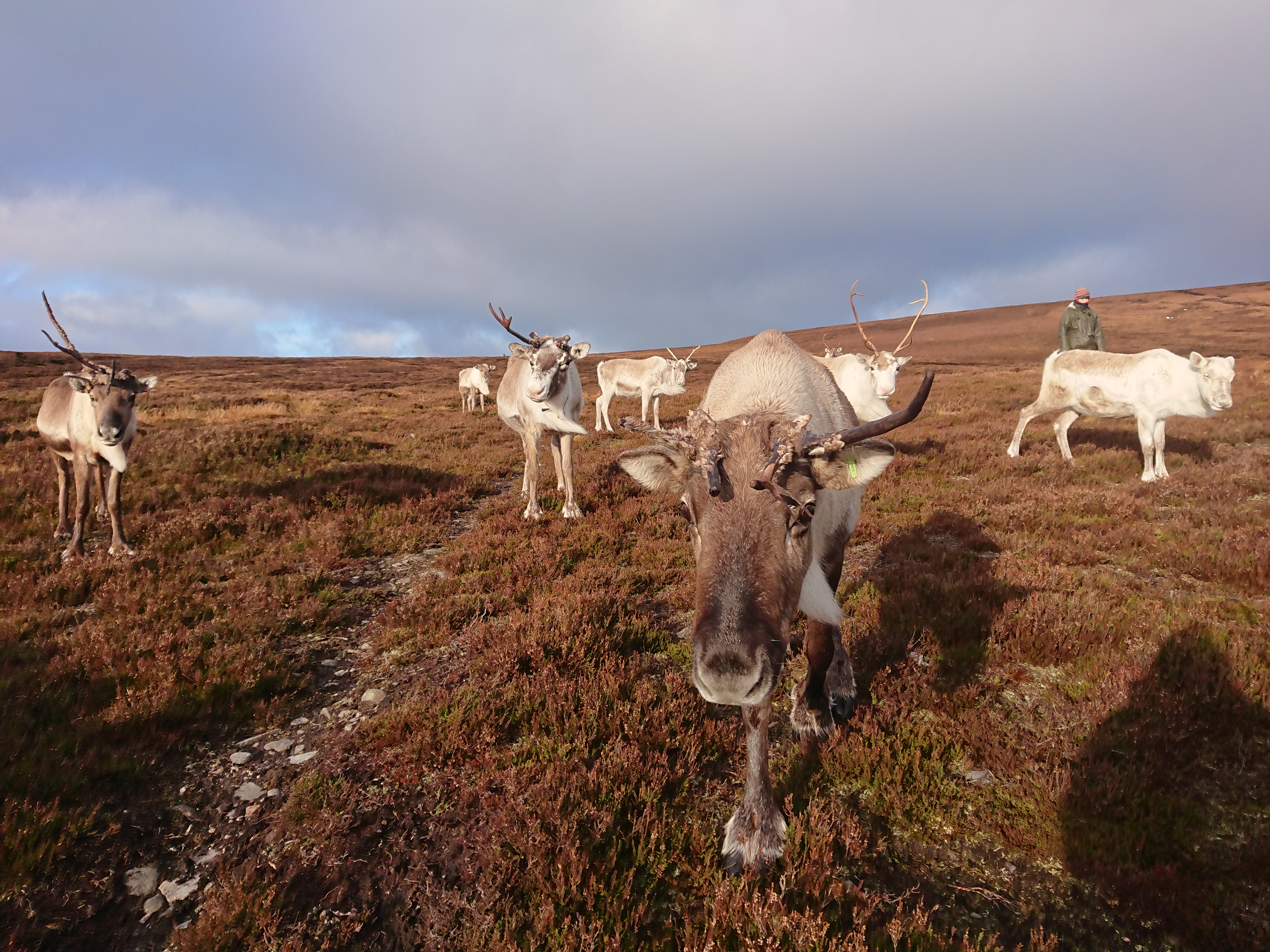
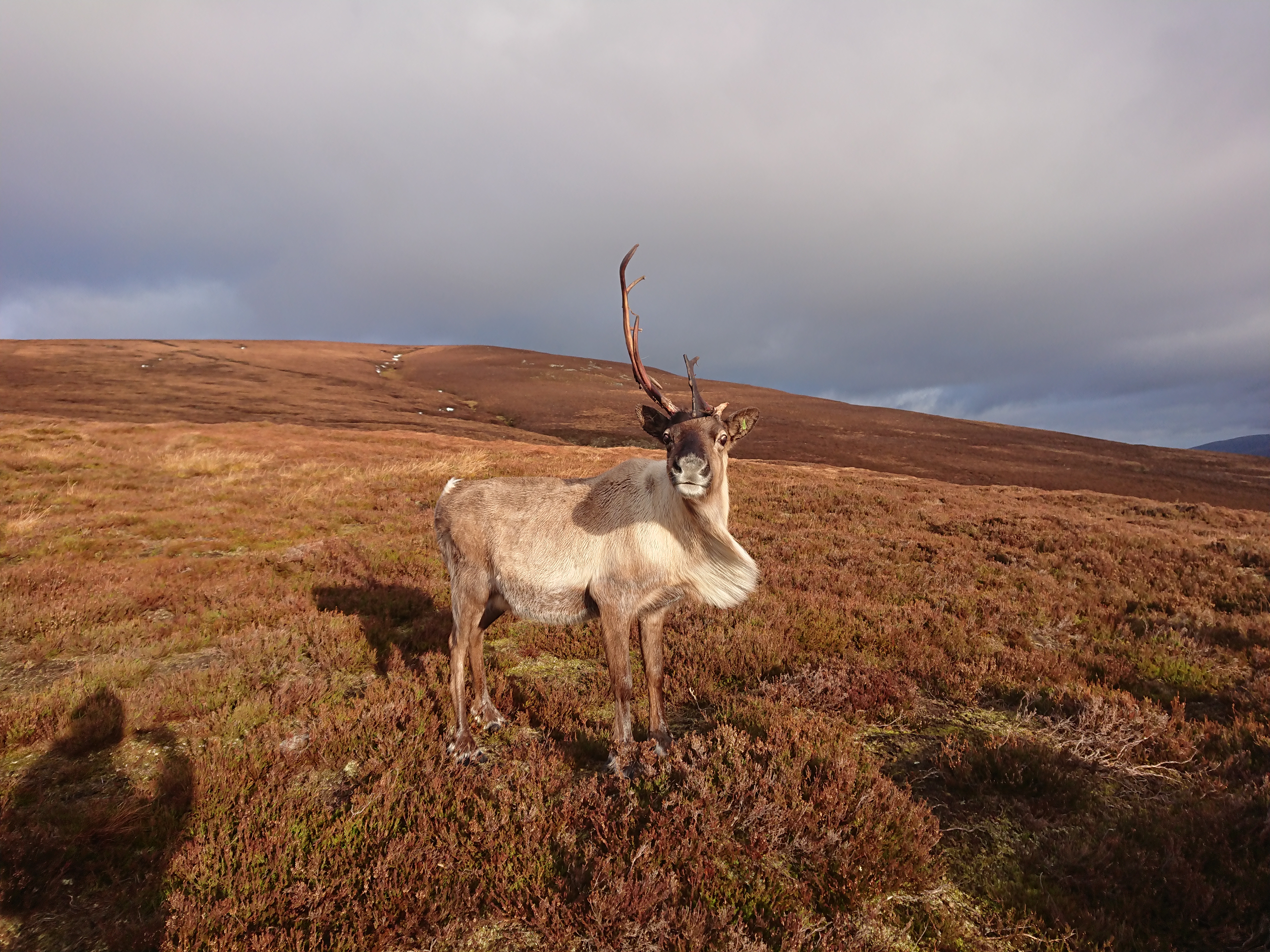
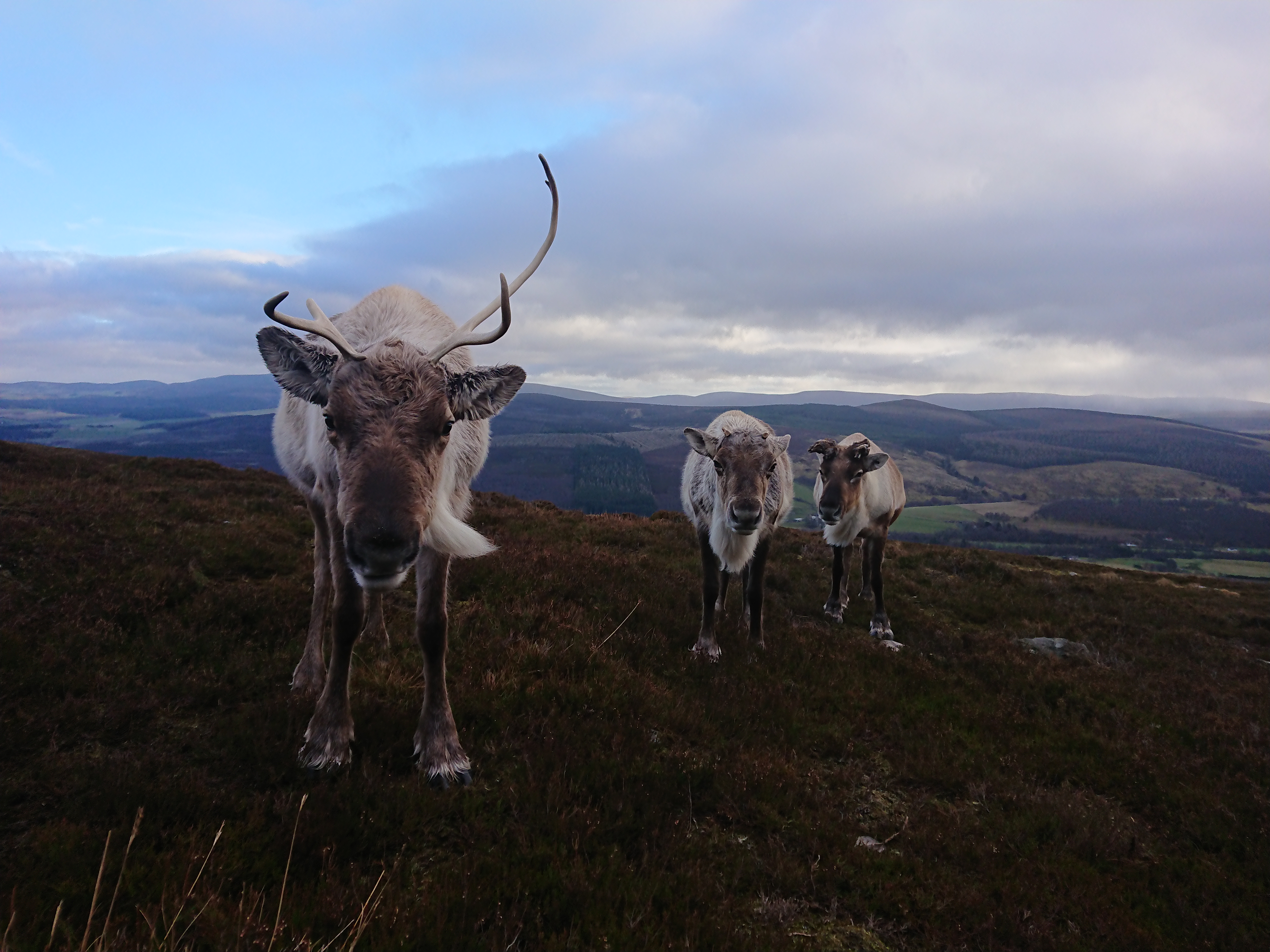
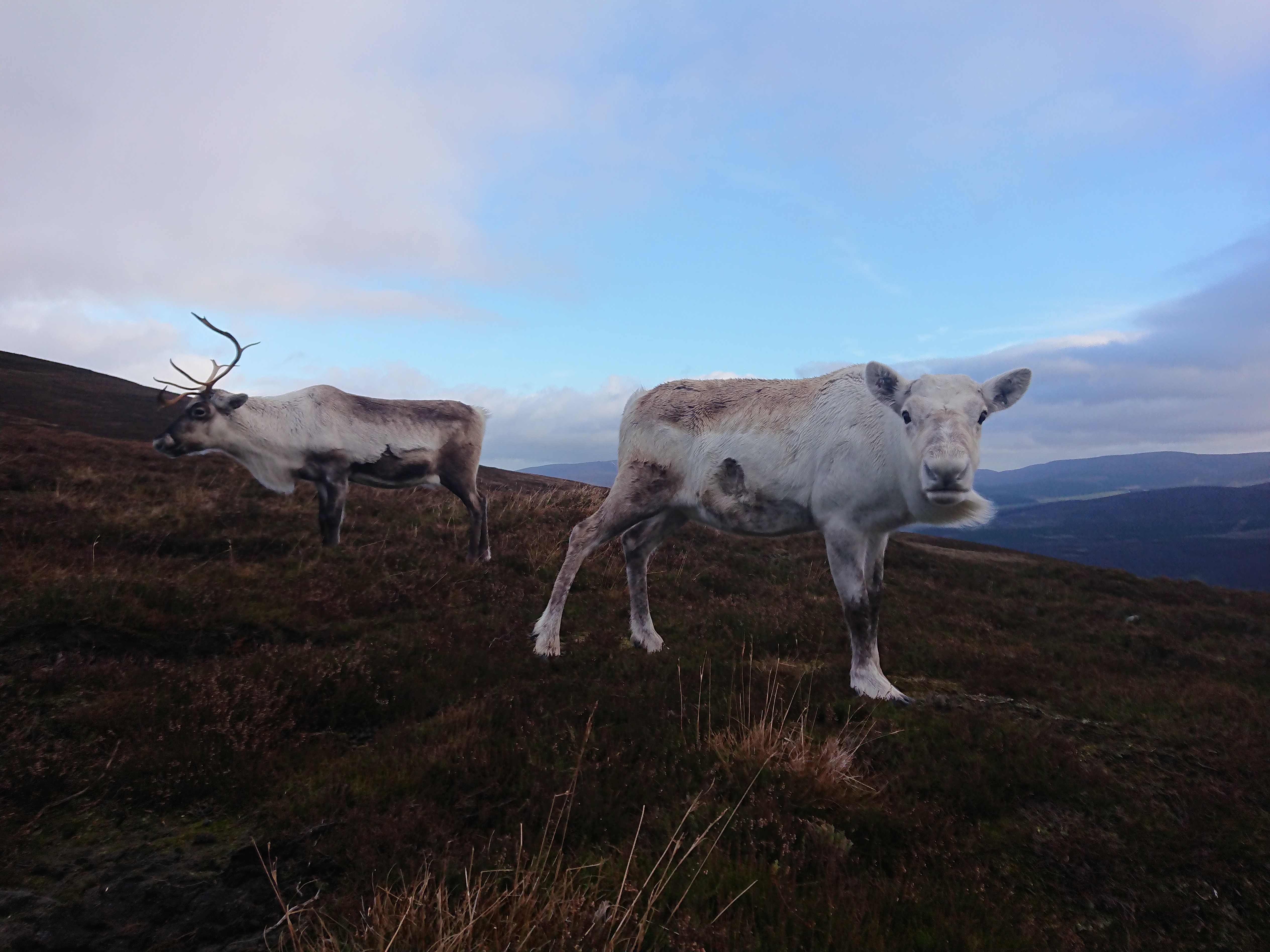
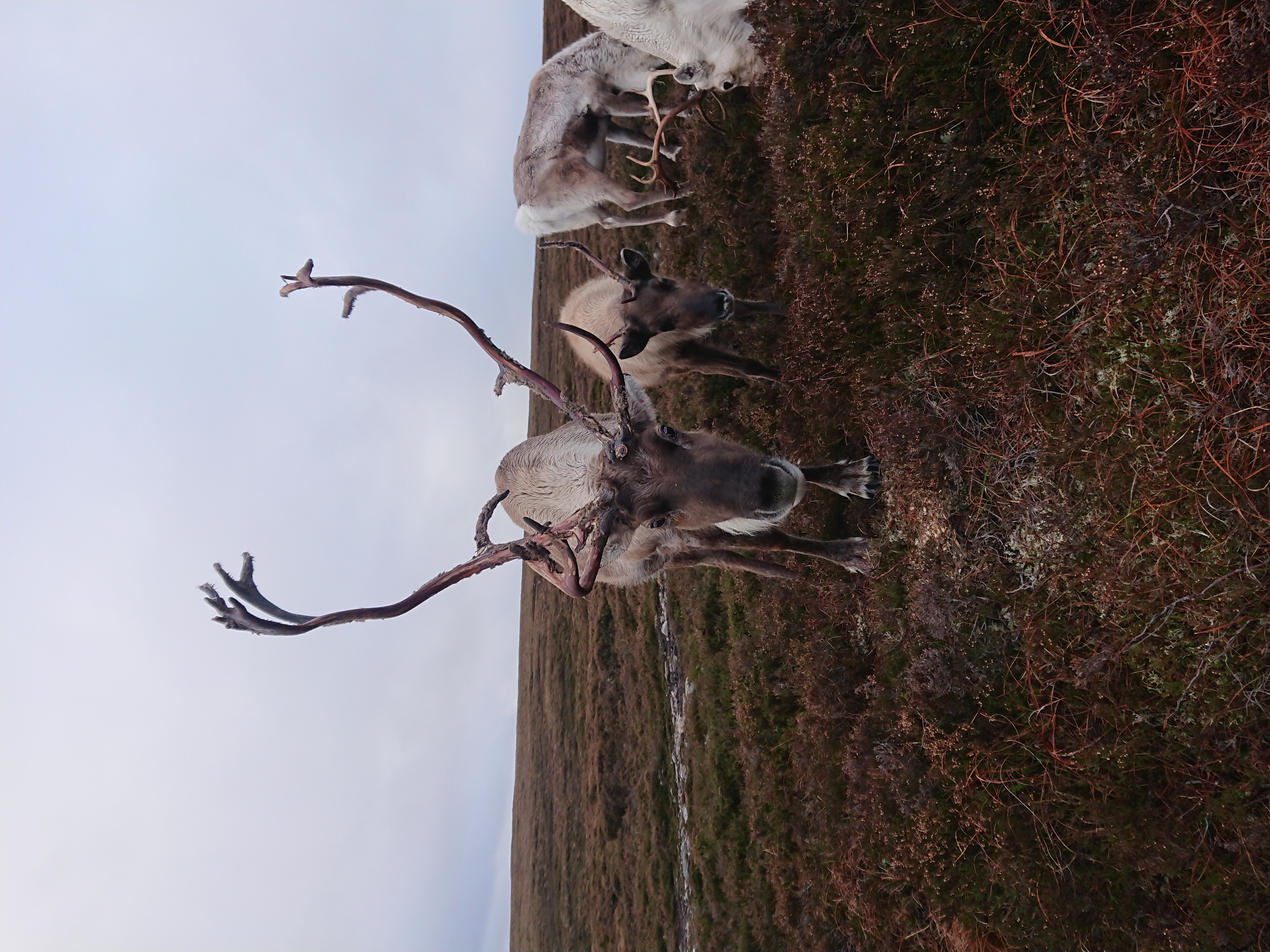
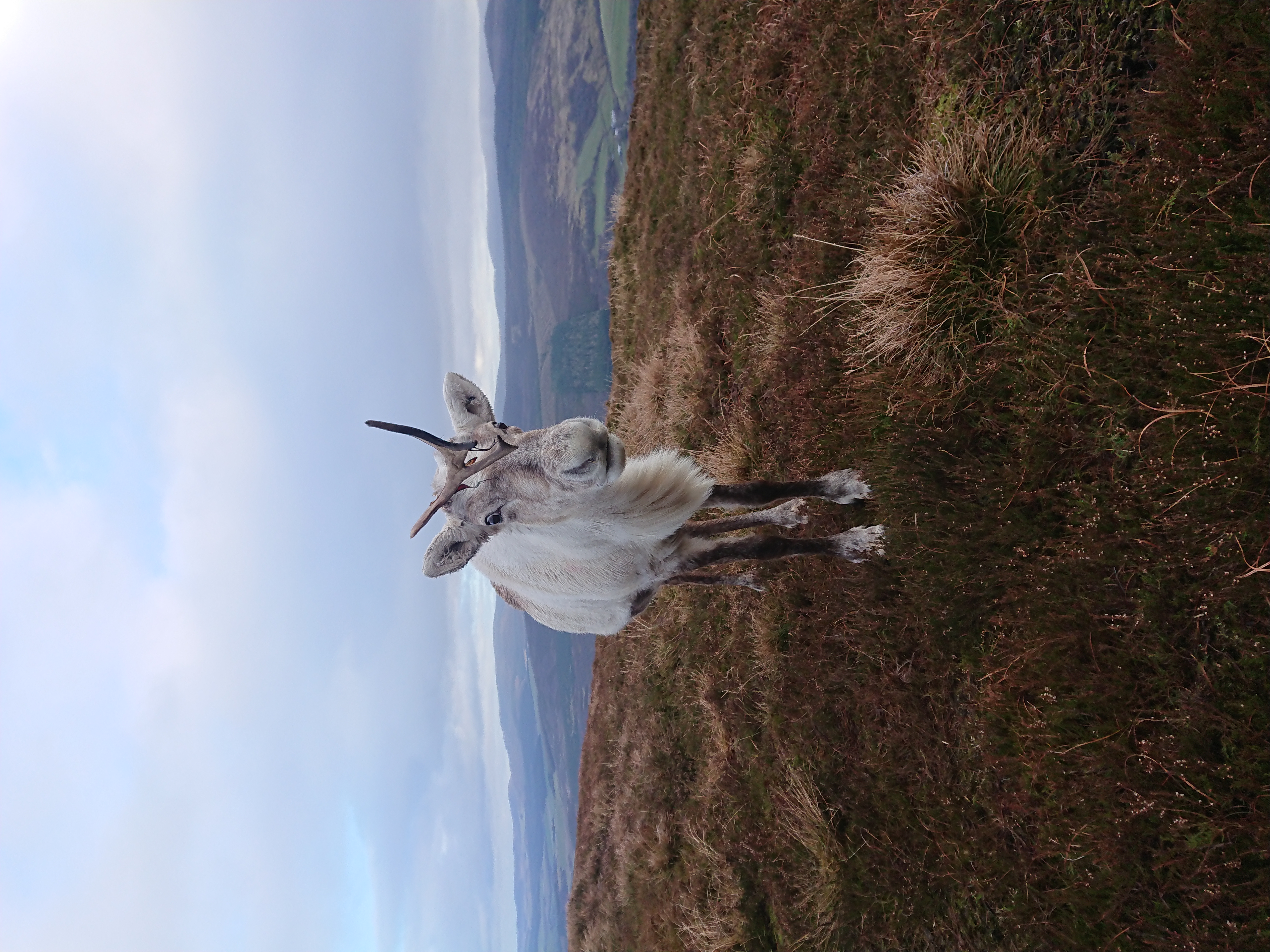
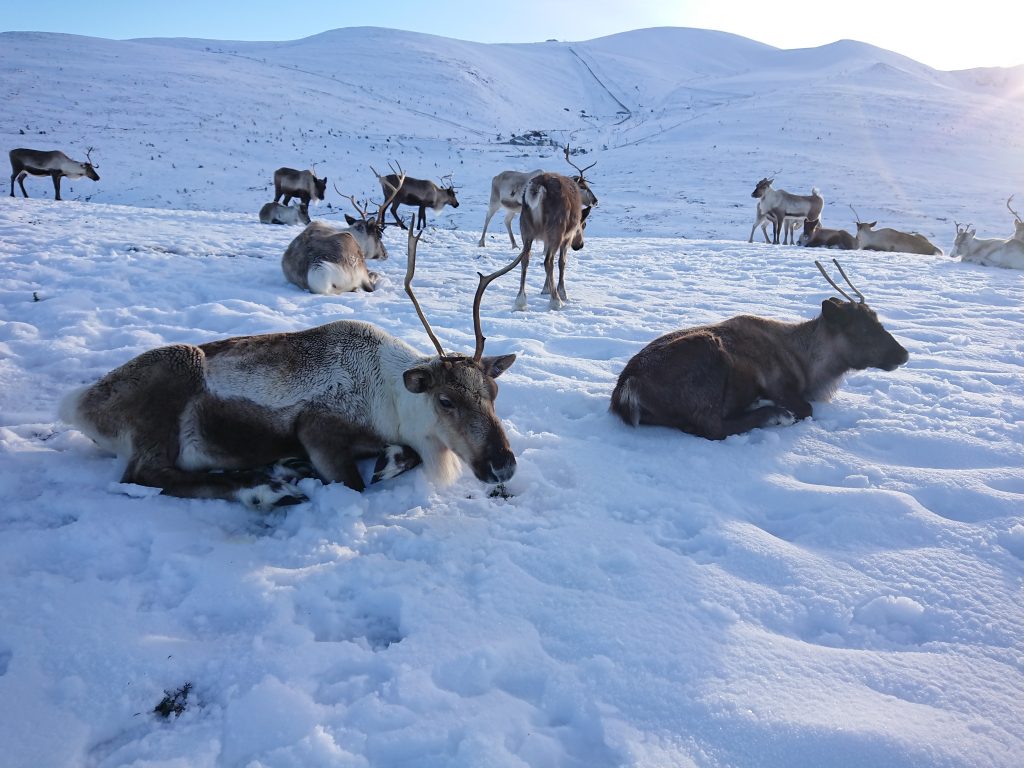
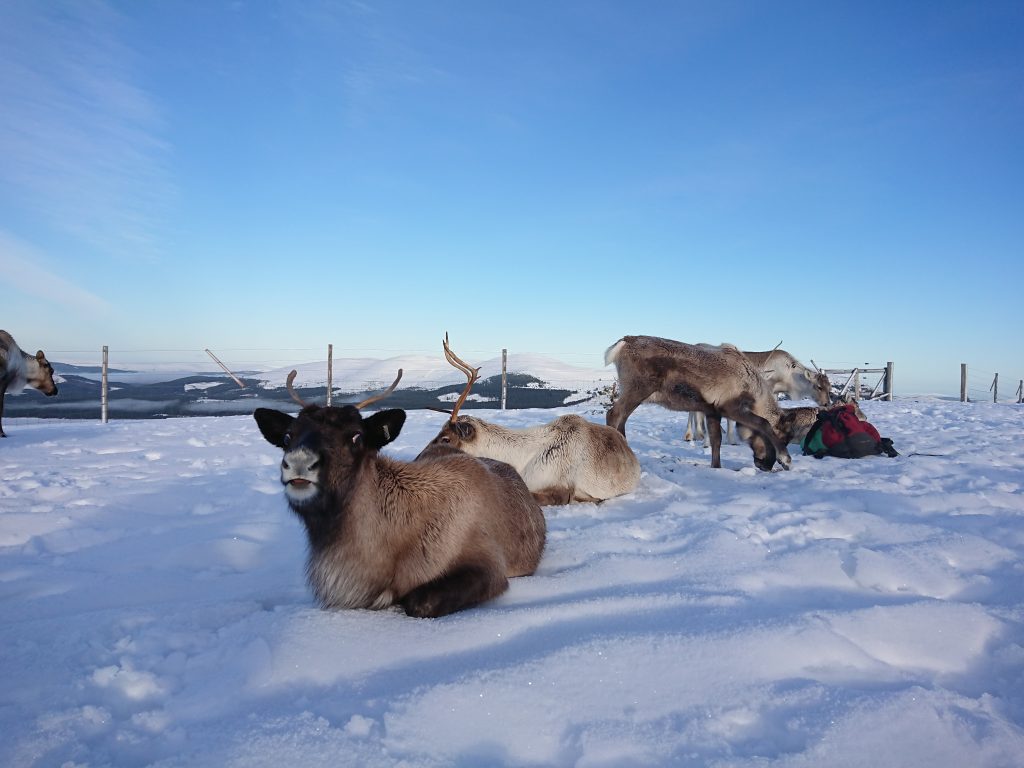
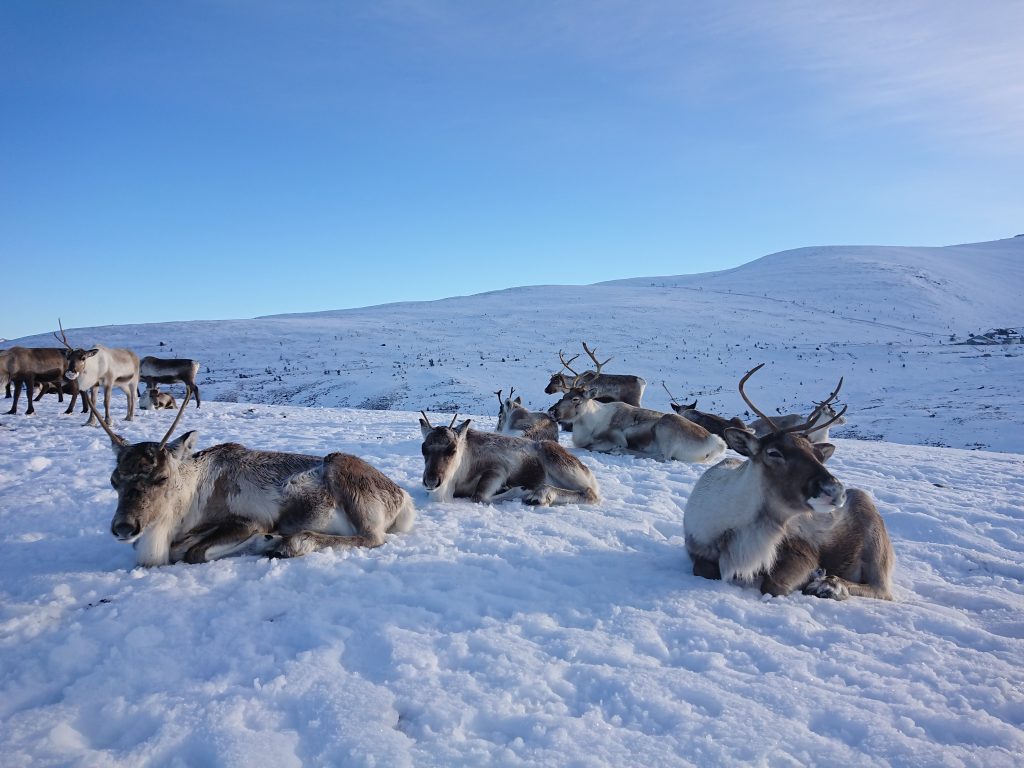
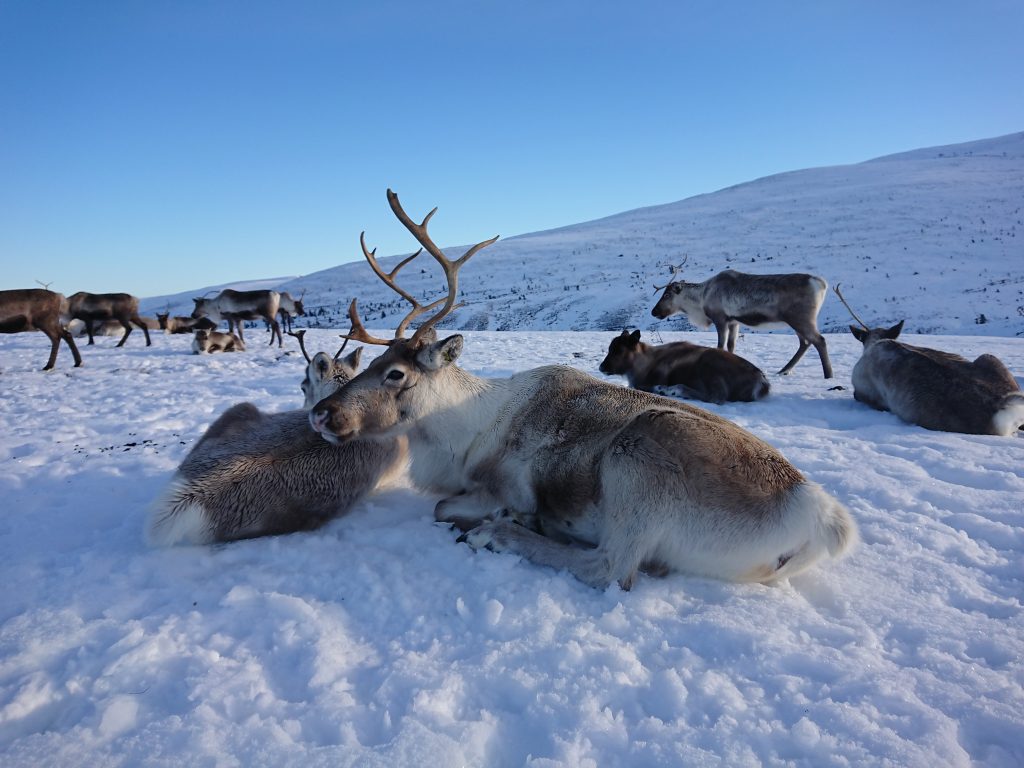
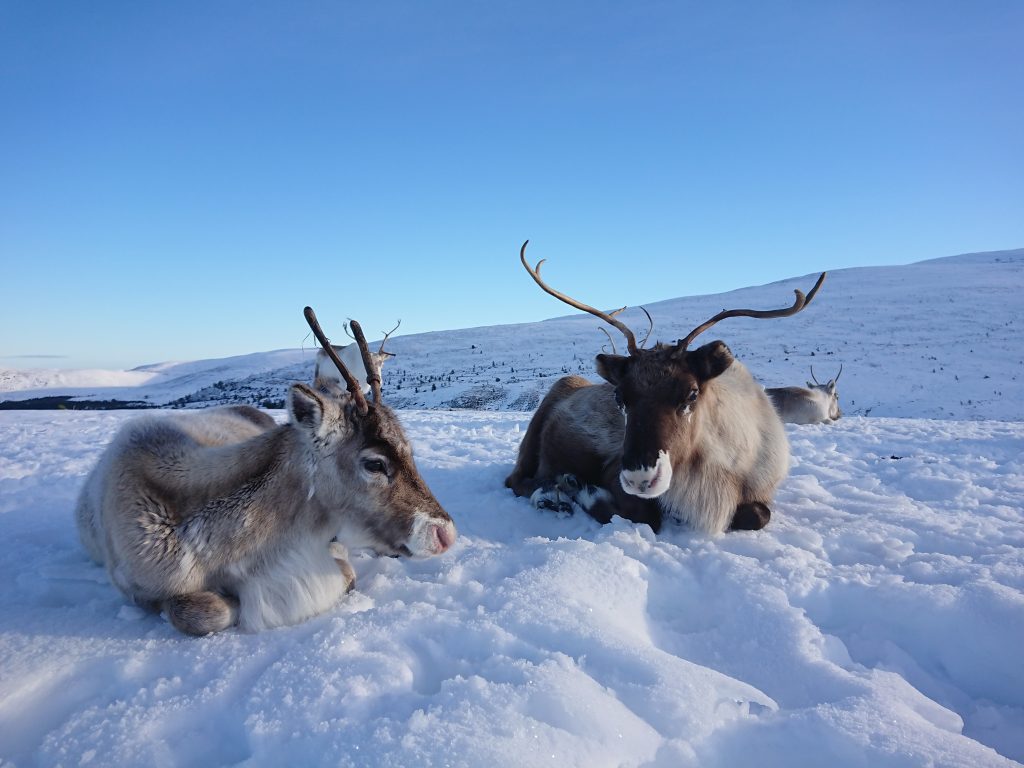
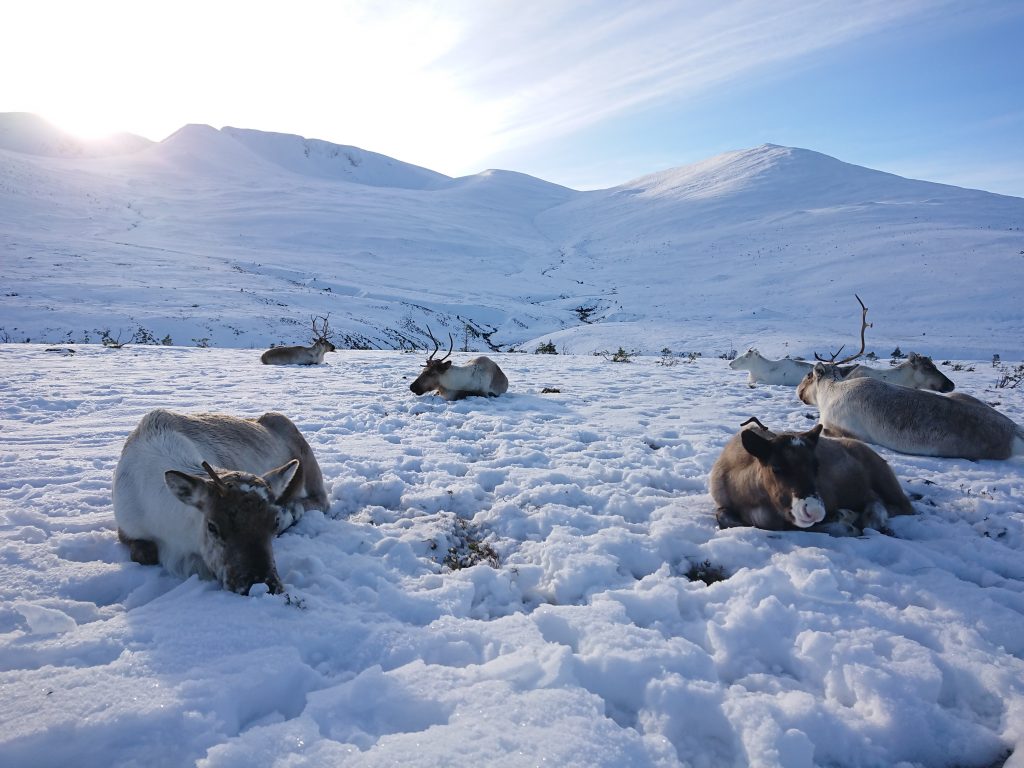
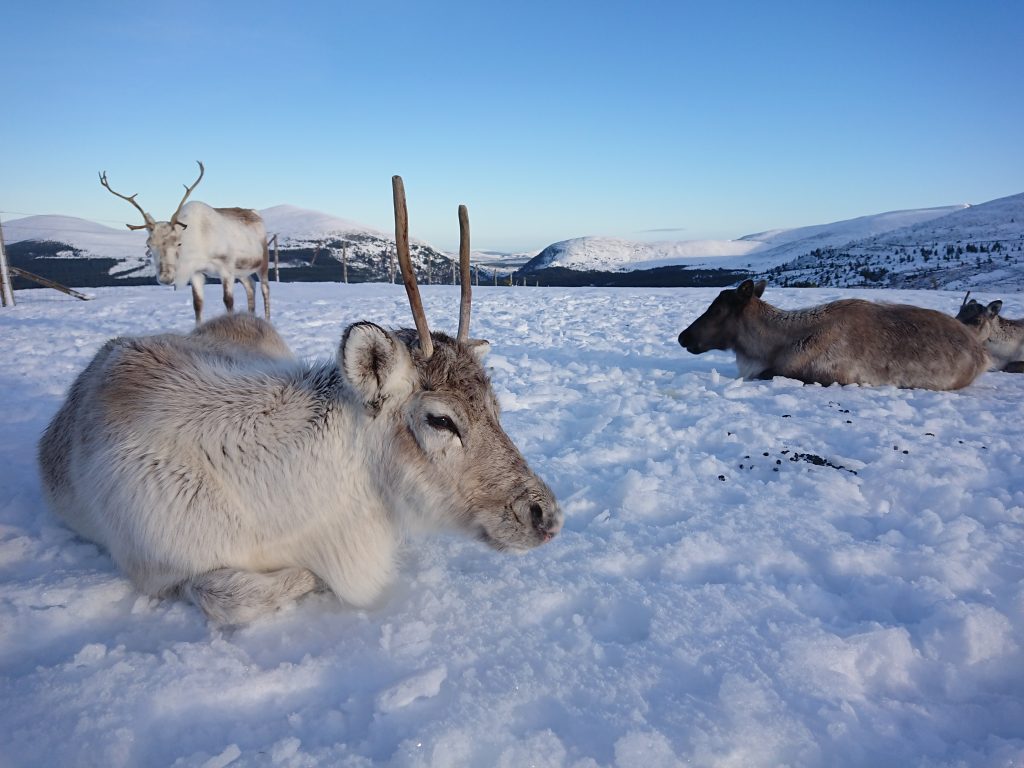
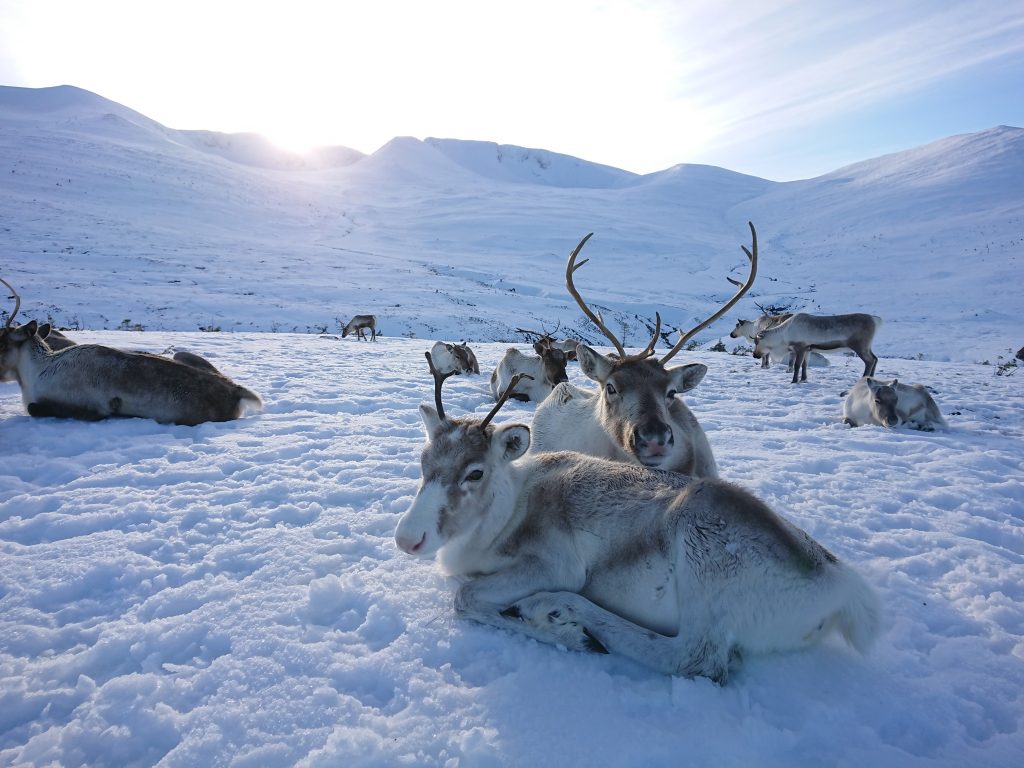
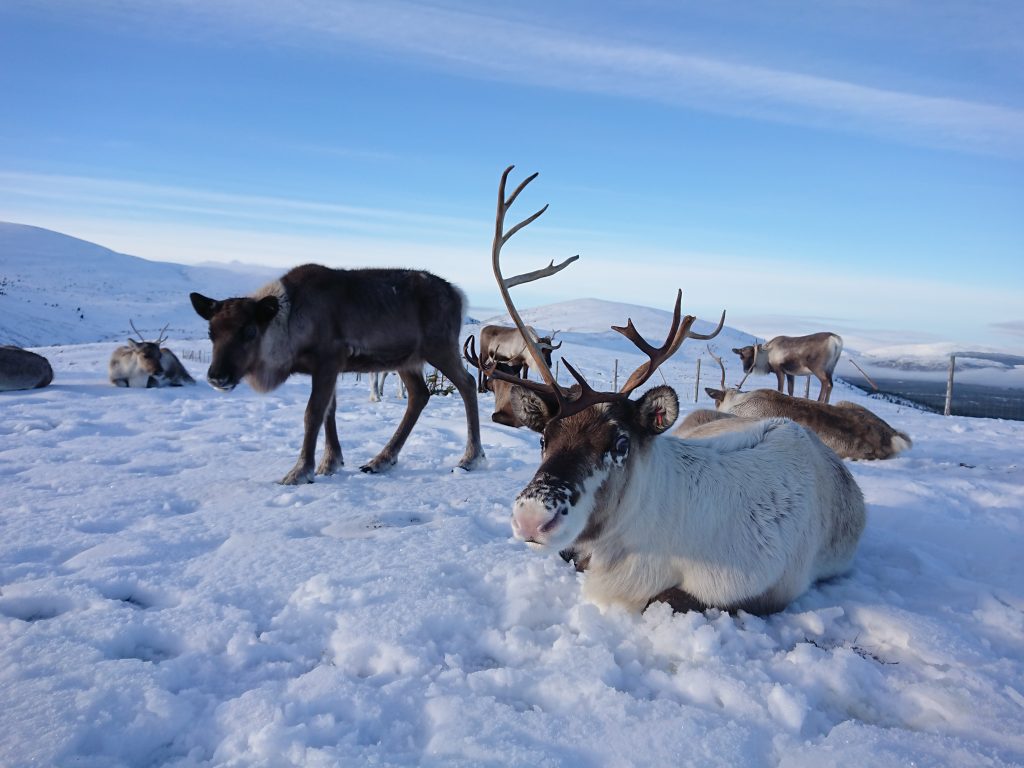
Here’s a selection of pics taken throughout the month, hopefully giving a snap shot of what we’ve been getting up to. It’s been full on with the rut taking place in the enclosure, our breeding bulls do now seem a bit less enthusiastic after a busy six weeks for them! We’ve also been bringing two calves at a time down to the Paddocks to halter train them. They usually spend around four days here in which we take them out on morning walks to get them used to seeing traffic, bikes, their own reflections in shiny windows and whatever else Glenmore can throw at us at 8am! Christmas sleigh training for our three year old Christmas Reindeer begins too. So far Adzuki, Haricot and Hemp have been trained and they’ve all been total pros. During the October holidays when our 11am Hill Trip sells out we’ve been putting on an afternoon Hill Trip too. Funnily enough, during the rain and wind of Storm Babet we did not require this attentional visit. But after the storm we’ve been treated to some gorgeous autumnal weather and the first decent snow on the hills of the season.
Amongst all of this we’ve also managed to get the October newsletter written, printed and sent out to our lovely adopters! Until it’s safely in the hands of our adopters I’ve left all calf names out of the blog.
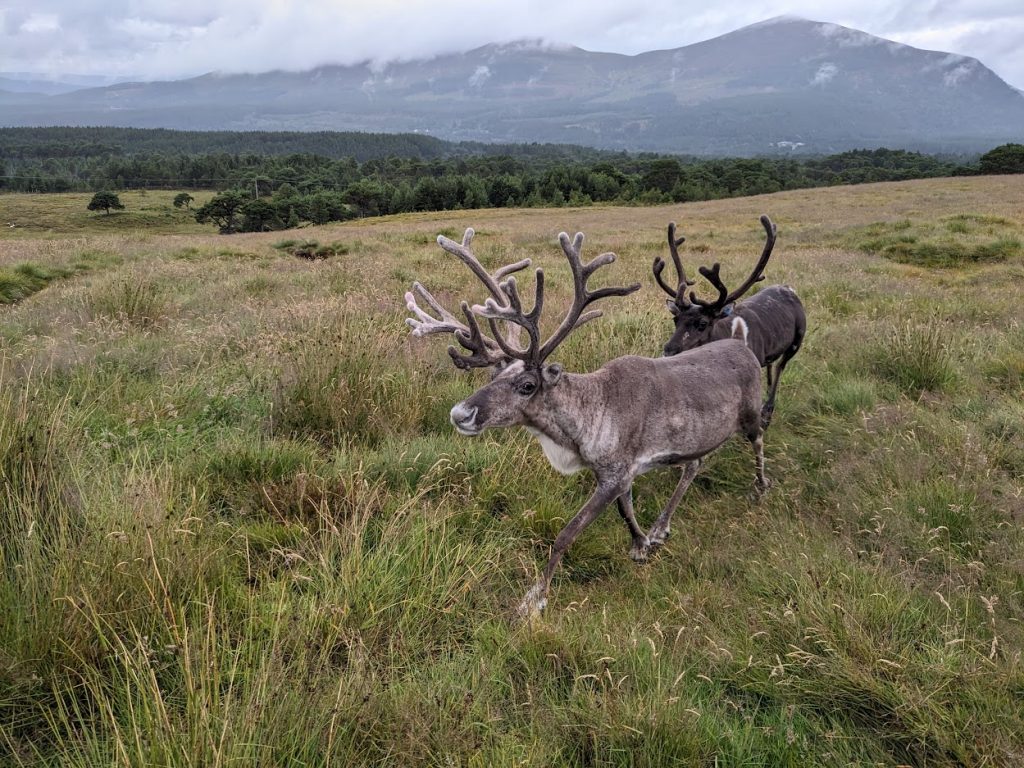
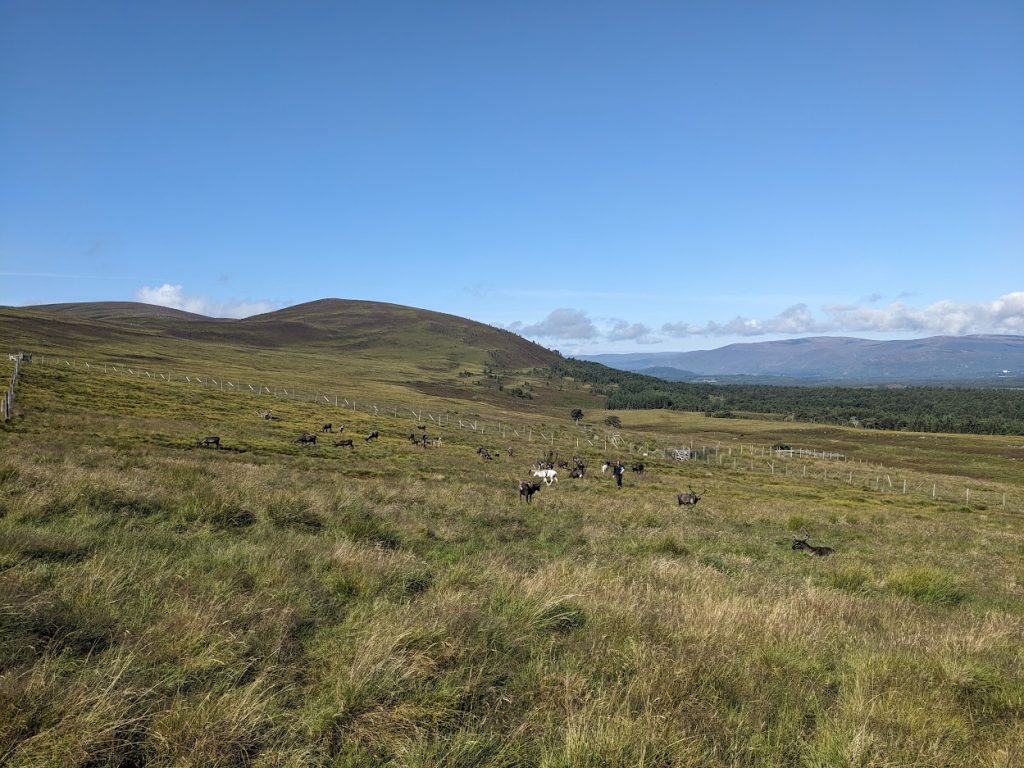
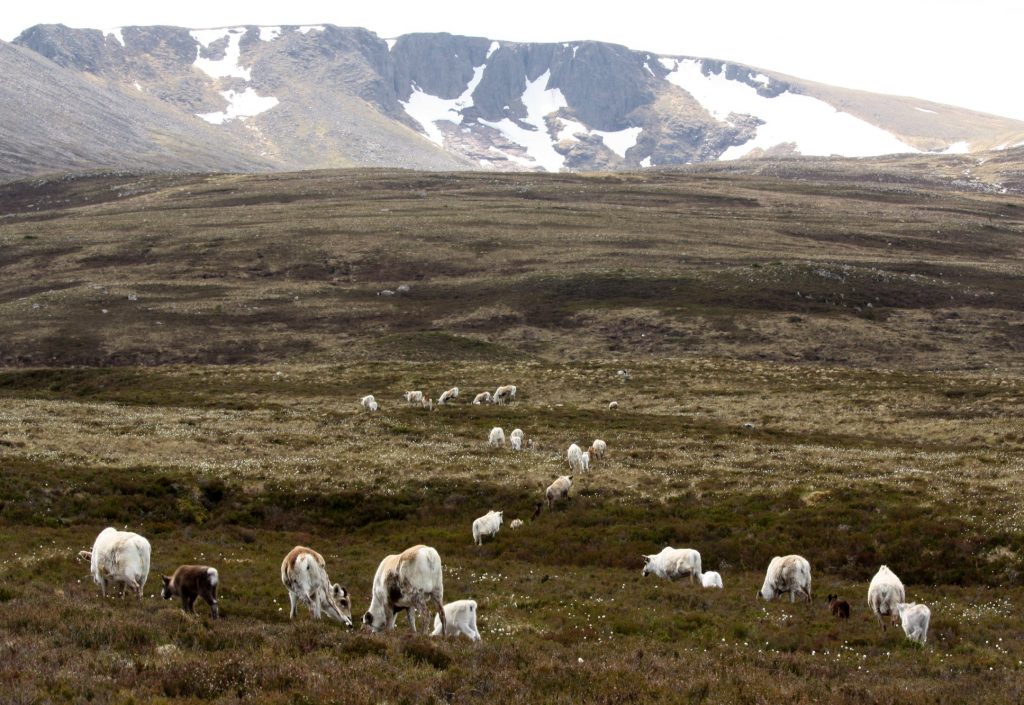
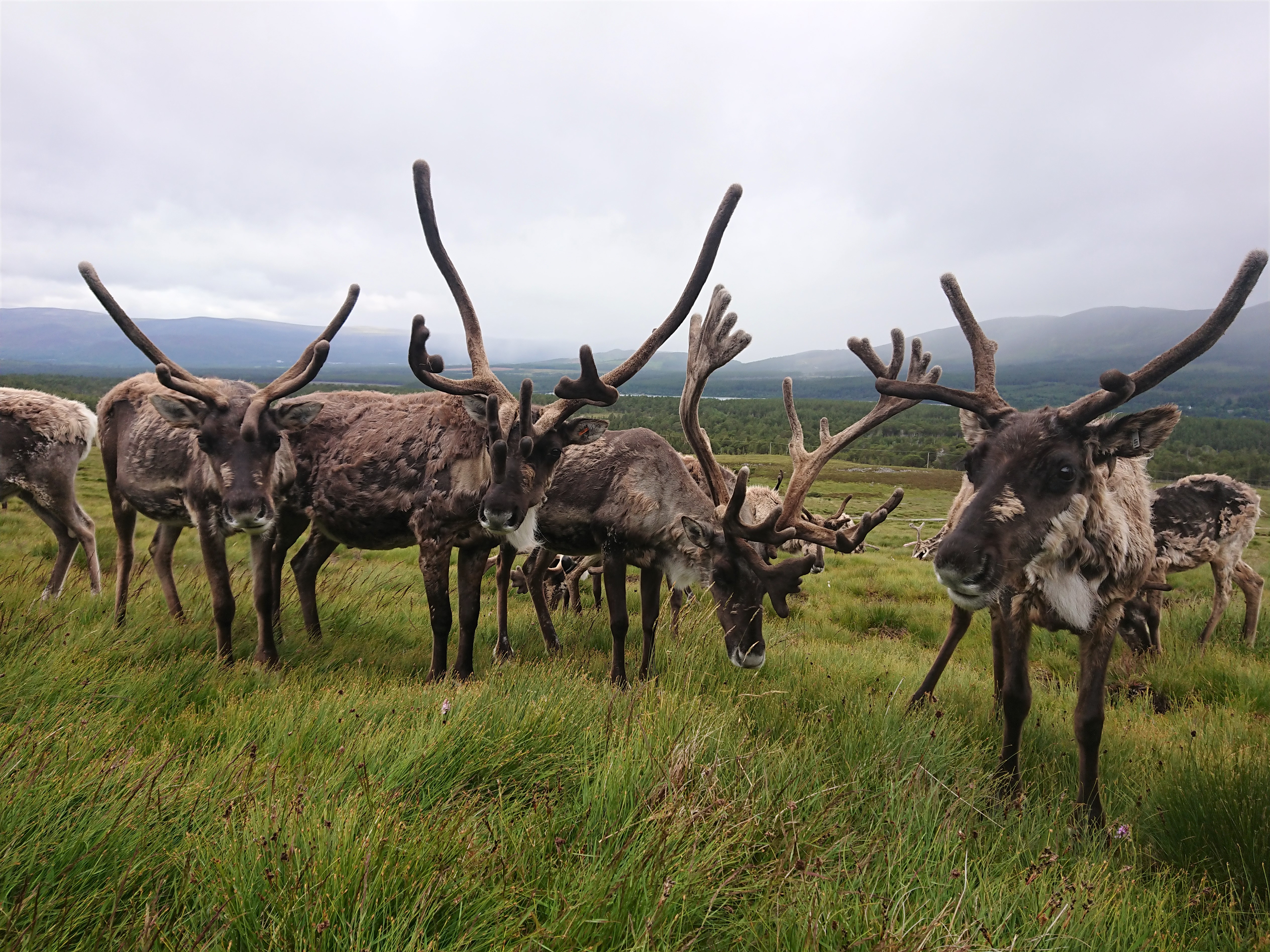
2nd of October – Sherlock watching over Bordeaux whilst she eats her breakfast.4th of October – Haricot puling the sleigh like a pro -his second time ever!5th of October- Olympic looking very handsome pulling the sleigh with very special cargo on board – Tilly and her grand children!7th of October – Fly looking very soggy on an incredibly wet day! She’s 16 and is now of of the oldest reindeer in our herd.7th of October – Emm, our wonderful volunteer, is here brightening up even the wettest of days, alongside Holy Moley and calf.10th of October – Druid, excellent at striking a pose!12th of October – Cicero and Lupin vying for their moment in the blog.13th of October – A morning at the farm to help Tilly feed the bulls. Here’s Busby, cheeky as ever!18th of October – Checking in with some of the cows in Sherlock’s breeding group. Here we have Pumpkin, Torch and Pip.19th of October – An incredibly wet Hill Trip. Gloriana and Borlotti closest to the camera with the herd behind, waiting for their lunch. 23rd of October – Blue skies!! Jenga, Sunflower and Feta posing beautifully.24th of October – Borlotti and her cute calf with a big pile of breakfast.26th of October – Ryvita, Sambar and Sika leading a lovely free range group of girls.
During the summer months it’s a good time of year to work on our reindeer handling for both reindeer and herders. With a fair few new faces this summer with seasonal staff picking up a few weeks here and there it’s not just good practice for the reindeer but really important that us herders know the best way to approach, put on halters, putting on harness and generally knowing how to act and move around the reindeer in close proximity.
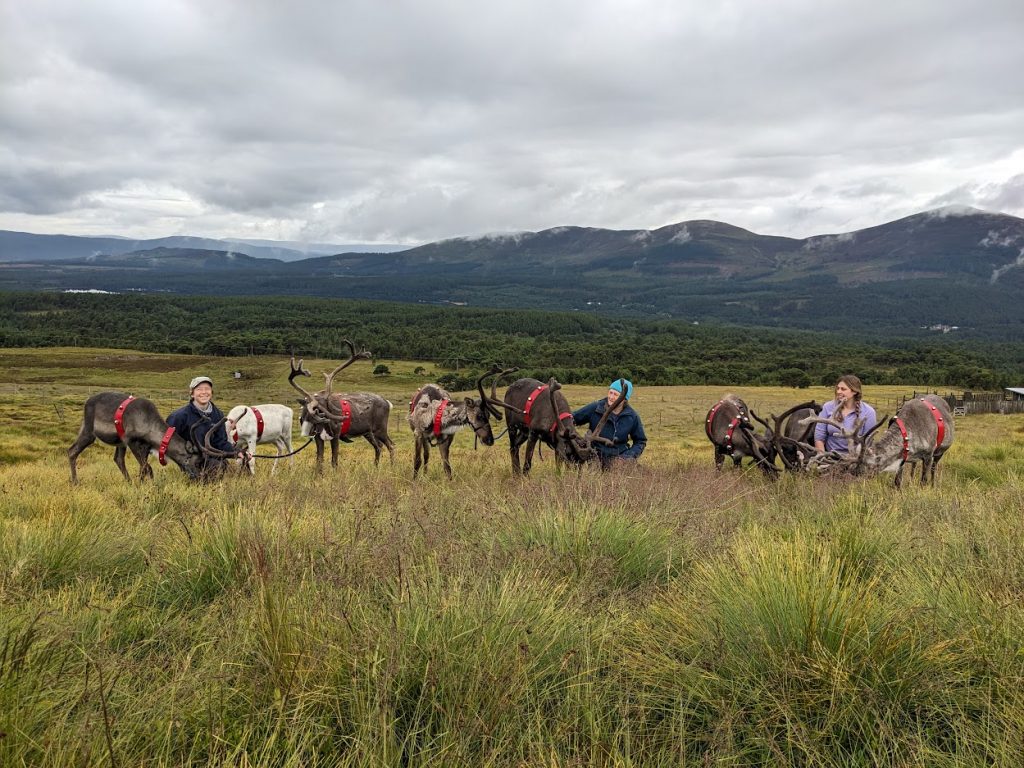
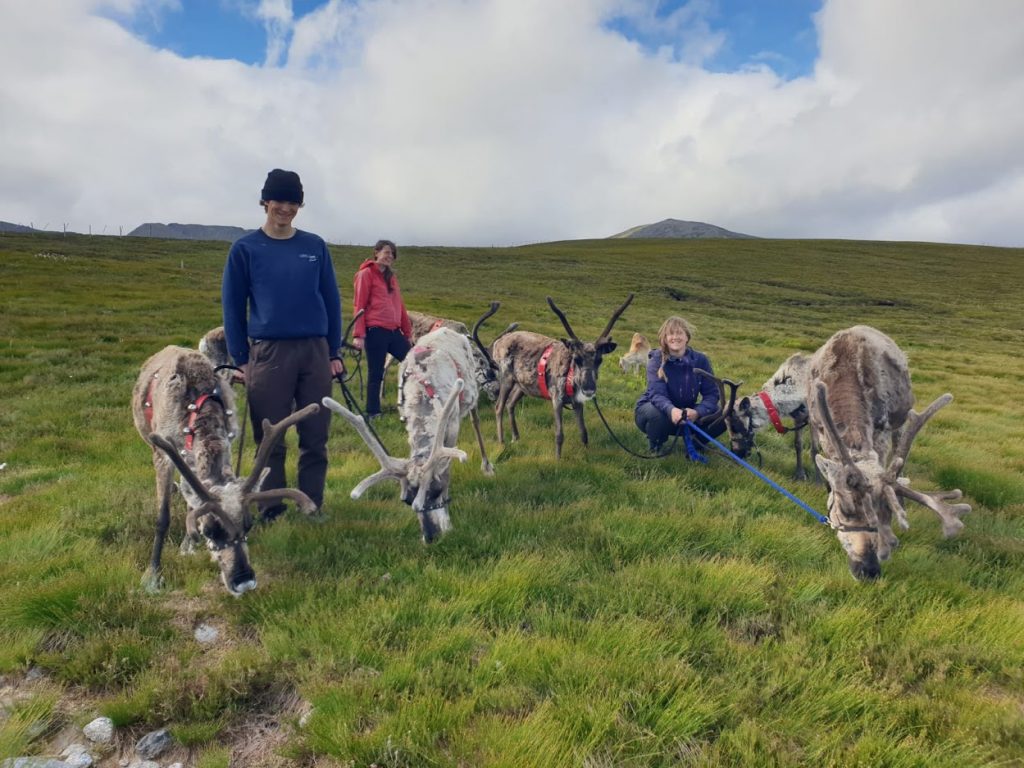
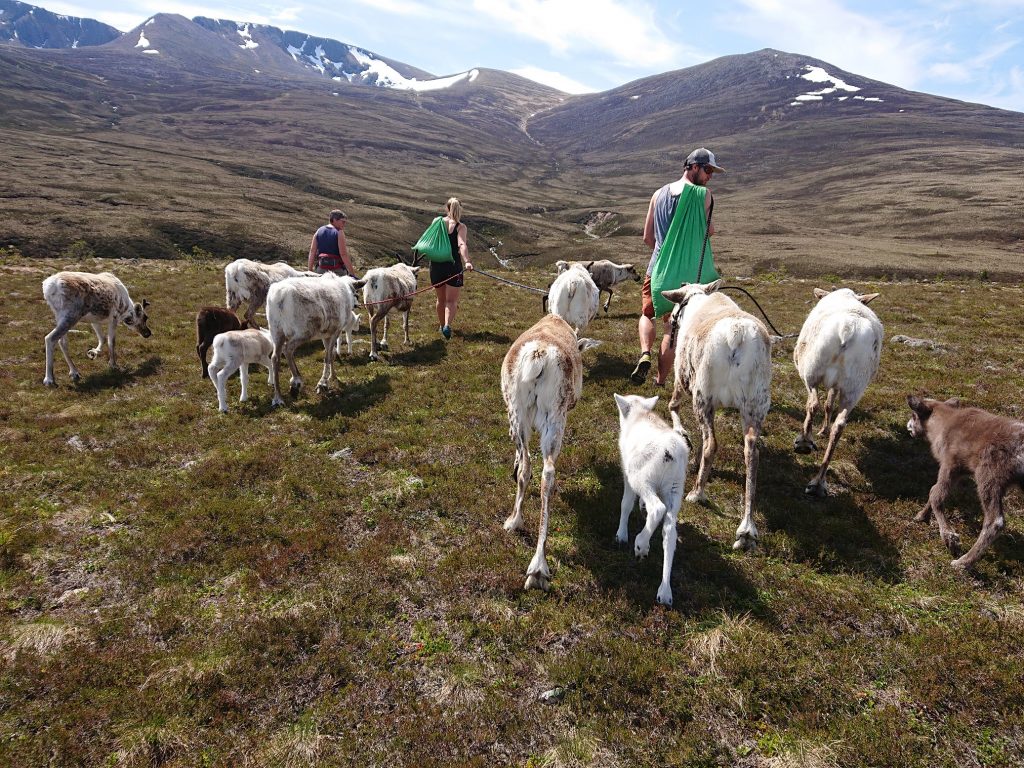
Andi, Hen and Hannah on a walk with a bunch of harnessed reindeer – some very experienced, others more new to this morning routine!
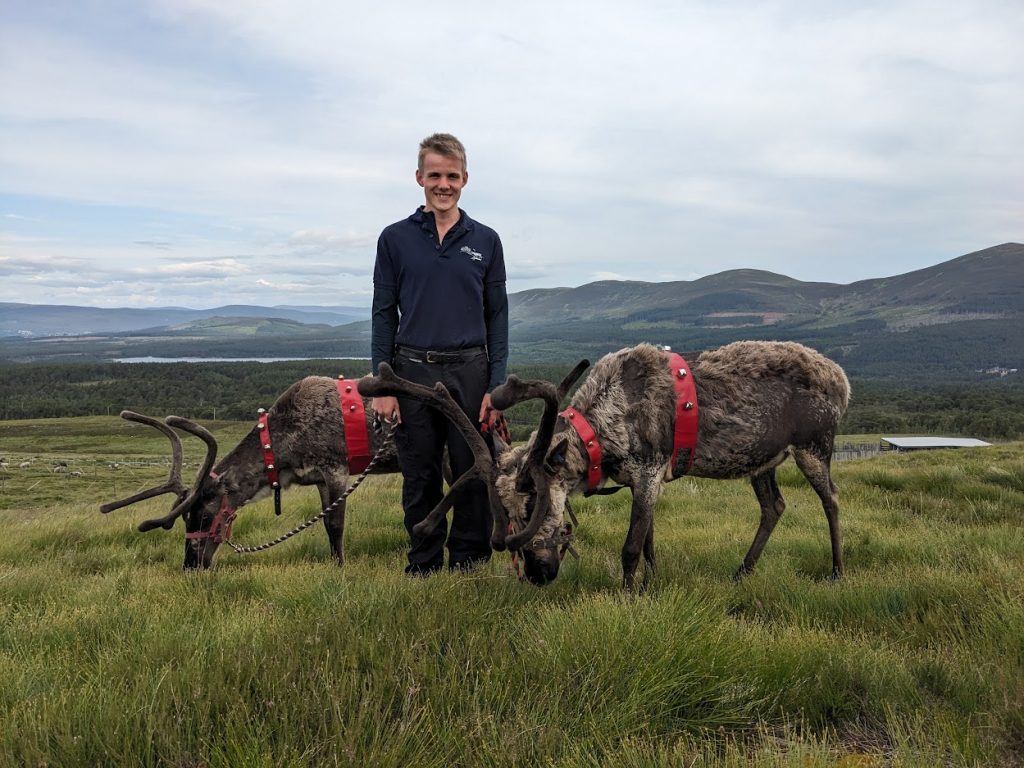
First of all we pick which reindeer will go through the ropes that morning then we split them off into a separate enclosure at their morning feed and bring them up to our shed on the hill. This is where we do all our handling, whether it’s taking temperatures, tending to unwell reindeer or doing a bit training where the reindeer have a halter on and wear a bit of harness. From our shed we can walk out into a quiet enclosure so they get a feel for wearing the harness while walking. Within the group of chosen reindeer there is always an ‘old boy’ who has done lots of training before so already knows the drill and therefore gives off the right vibes. We stand any newbies next to him so they have a calming influence. As well as being the role model to younger reindeer our older trained reindeer are good ones for new staff to learn how to put harness on as they don’t fuss or move around making it a lot easier to explain and learn. Some of our older boys who are trained are: Aztec, Dr Seuss, Poirot, Sherlock, Frost, Clouseau and Athens. We then train anything who is 1, 2 or 3 years old next to them. The 2 and 3 year old have of course done this for the past few years so it tends to be the yearlings who are a bit more twitchy doing it for their first summer. Of course as 5-6 month old calves they went out and about at Christmas so its not completely new to them.
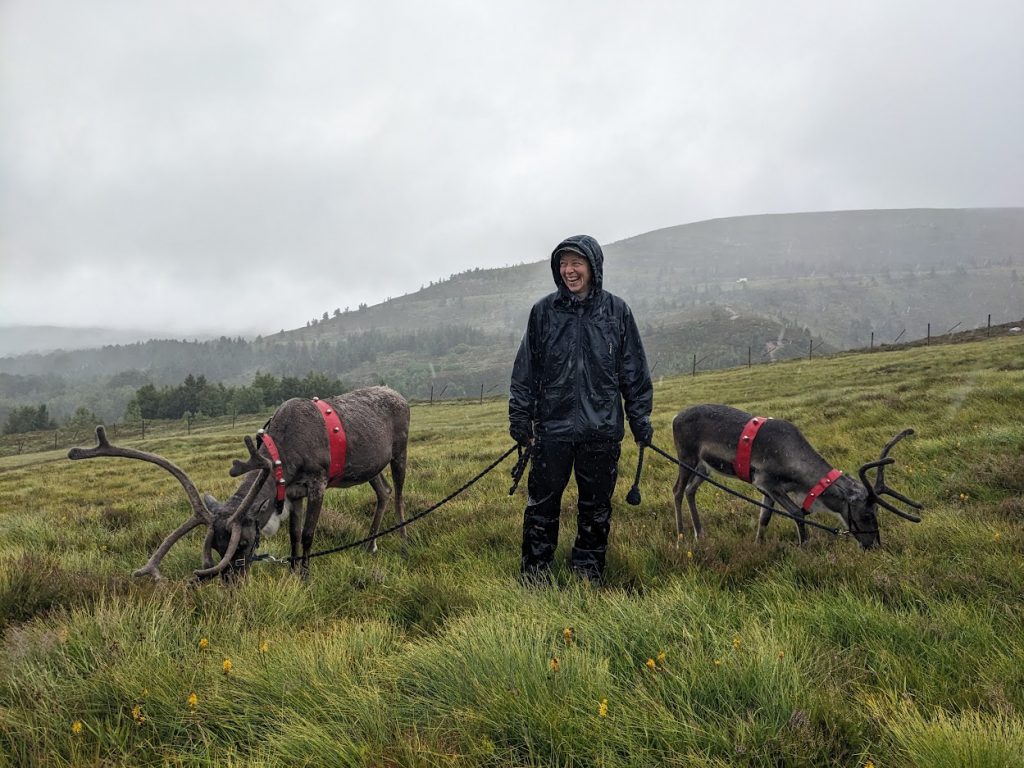
Cameron and happily, completely unfazed trainees – Jelly and Jester.Andi with Cicero and Scoop – training no matter the weather!Harry, Amy and Fiona with very scruffy reindeer – June 2022.
Once we put some harness on we walk them out into another enclosure to get used to it. Our two hand reared calves Winnie and Alba sometime join us for this little excursion each morning so they can get a bit of extra hill grazing. Being the size of a medium dog sometimes the young trainee reindeer forget that the calves are actually reindeer and decide to unnecessarily have a brief panic, before realising how silly they are worrying about a little reindeer calf… or two. It’s quite funny watching them work it out. The old boys are pretty savvy to the calves and just ignore them.
Working closely and being able to handle our reindeer is really important for them and us. As many of you know we run a Christmas tour through November and December so any extra handling prepares our reindeer for some of that work they do. We also handle our reindeer should they need any treatment, vaccines or antibiotics and the more used to this they are the less stressful the situation for both animal and human. Some take to it quicker than others, like us they all have their individual personalities and characters. We change our handling sometimes depending which reindeer it is you’re working with. It’s really important we know our reindeer so if there is one ‘off colour’ then it’s picked up quickly and dealt with.
Here are some photos of us training our reindeer in the summer and also in the autumn time when we are getting ready for our Christmas tour.
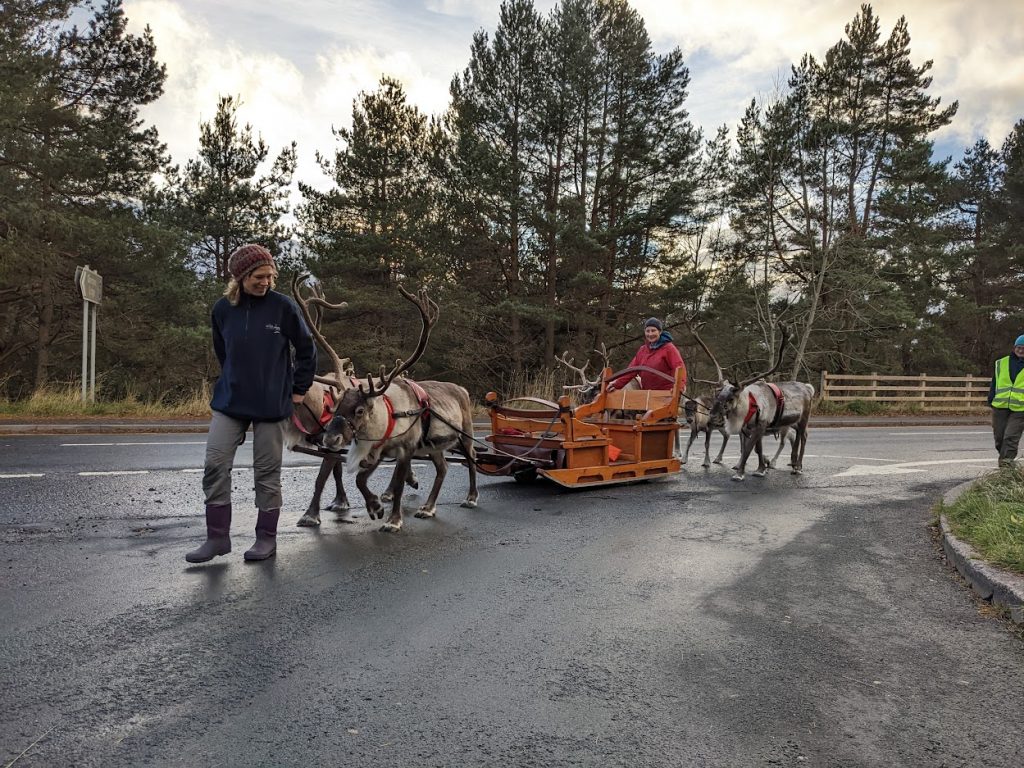
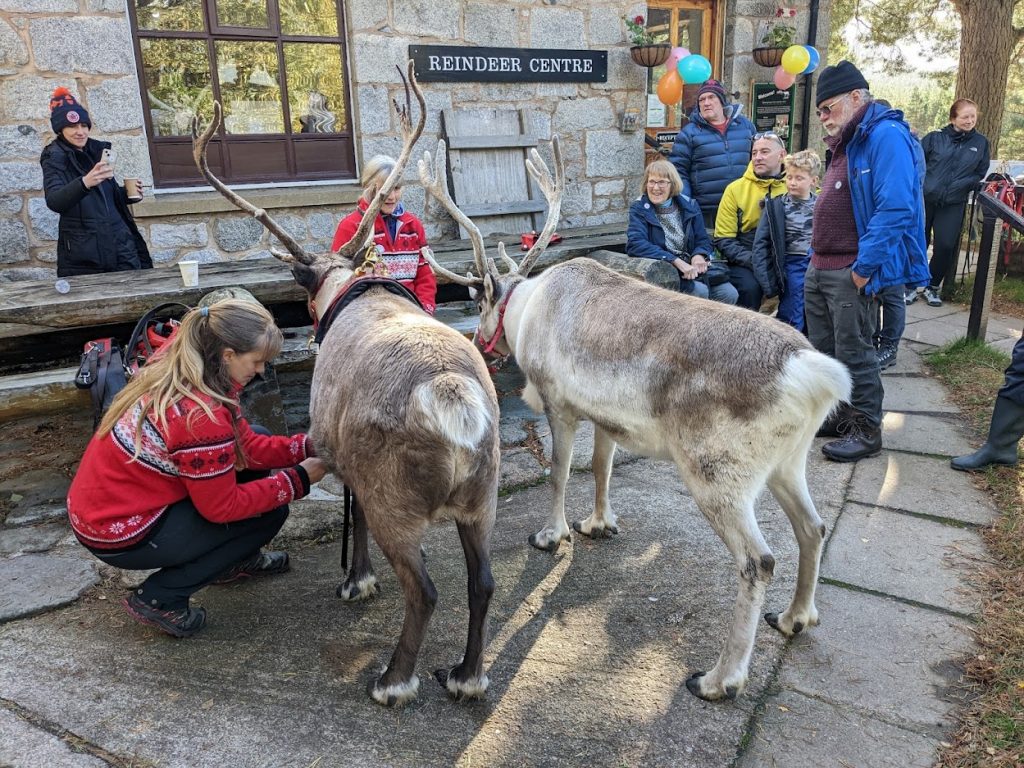
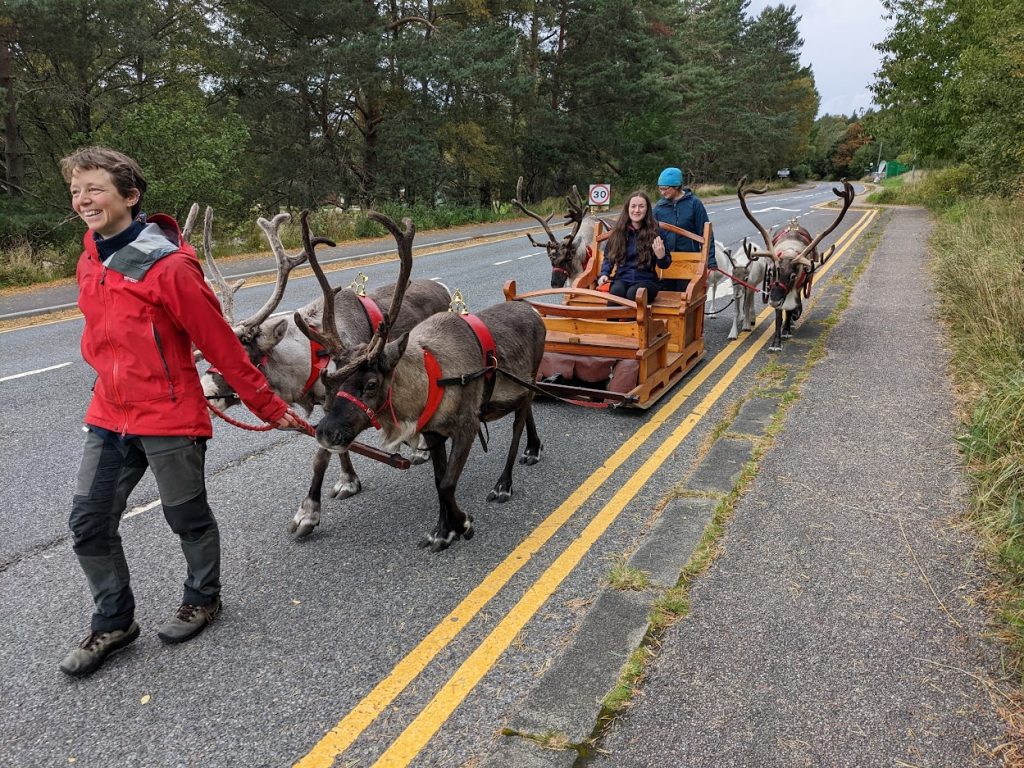
Lisette at the front of the sleigh with trainee Poirot in October 2022. Sheena at the back with Athens – also new to the job.A training display during our Adopter’s Weekend – October 2022. Fiona, harnessing Dr Seuss and Frost whilst Tilly holds them.Andi at the front of the sleigh with Svalbard and Druid. All three have done it lots before but a good refresher for everyone. October 2022.Ben and Poirot at the front. Poirot’s first time in trace but acting like he’s done it for years!Scolty and Frost – October 2021 – having a practice in Glenmore. Dr Seuss at the back. Mr Whippy wearing harness for the first time as a 5 month old calf – getting used to the feeling at a very young age.
I remember when we found Gazelle and Adzuki just after he was born how relaxed they both were. At the time Gazelle was twelve years old and had had many calves before so she was completely comfortable for us to hang out with her and her new-born calf. (Provided that we had brought her some food, which of course we had)!
New-born Adzuki.Fiona, Gazelle and Adzuki.
Adzuki is now one of the biggest of his age group. Adzuki was always fairly shy so we have spent quite a lot of time, and bribery, getting him used to us. It helps that he is from a greedy family! Adzuki grew a wonderful set of antlers as a two year old and after a winter free ranging he’s currently back in our enclosure and has grown a whole new set once again – even bigger!
Adzuki growing a beautiful set of antlers as a 2-year-old bull – summer 2022.Adzuki – summer 2023.
Haricot
Haricot was Ryvita’s last calf, and when he was born he was really wee. In fact as we waved the cows and calves off onto the free-range for the summer, I wasn’t totally convinced that we’d see him again. But we did, in fact by the end of the summer he looked totally great and was just as fat as any of the other calves. Ryvita however was looking a wee bit underweight, potentially due to having done such a fantastic job of raising Haricot, so we gave her some extra food all autumn. And of course, if Ryvita got extra food, so did Haricot! As a result, by Christmas, he was like a little barrel!!
A near miss for Haricot (if you don’t see it at first then look closer)!Haricot as a new born.Haricot in the snow as a calf with Lupin and Holy Moley coming up behind.
Haricot’s extra food that first autumn certainly stood him in good stead and he’s now a very handsome young reindeer. Here he is below with half brother Adzuki, you can certainly see the family resemblance!
Haricot and Adzuki. – summer 2022.Winter Haricot.Haricot – summer 2023.
Butter
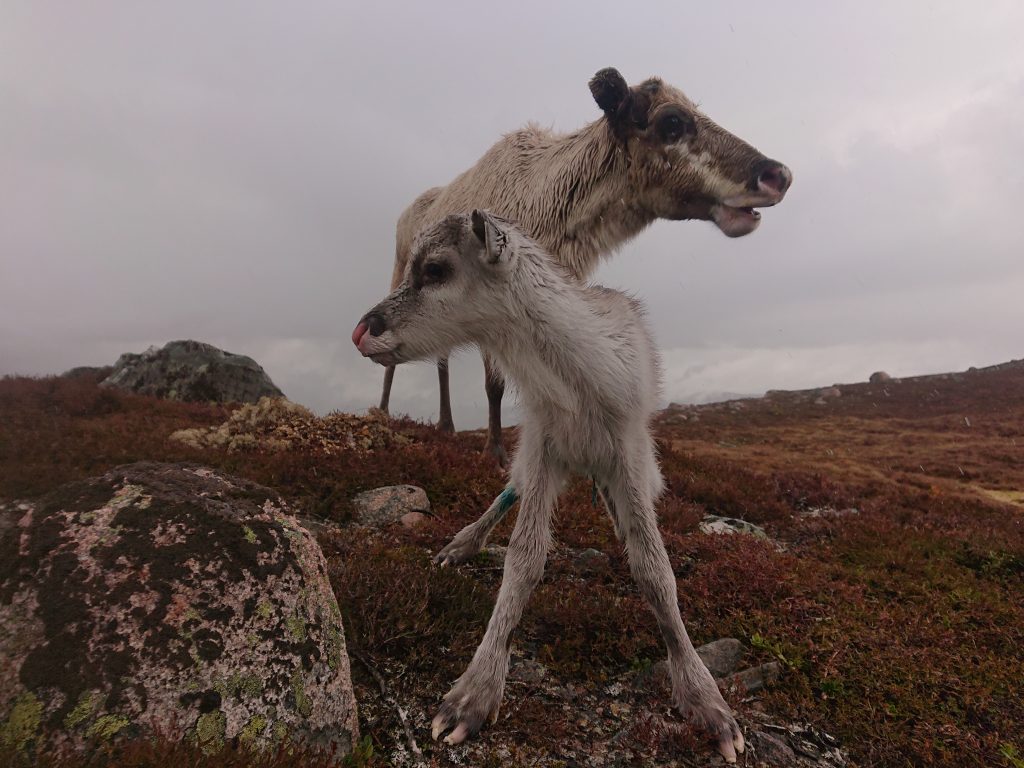
Now Butter came as a bit of surprise. His mum, Gloriana, had never calved (despite running with a bull each year) until the age of 8 when Butter was born! We found Butter on a super soggy day and he had big floppy ears. Butter spent all summer free-ranging and we didn’t see him much and then one day at the end of the summer Gloriana came running into the enclosure with no calf. She was grunting away and still had an udder full of milk suggesting that she’d only recently lost Butter, so we sent her back out to search for him. We didn’t see either of them for quite a while and then one morning, Gloriana showed up with Butter in tow. He was looking fairly skinny so we decided to name him Butter, after a butter bean, in the hope that he would grow to be ‘fat as butter’!!
New born Butter on a very soggy day!
Sure enough, fast forward almost three years and Butter is doing very well. He also got lots of preferential feeding that first autumn and as a result has done just as well as the rest of his age group! He is incredibly tame and can be pretty cheeky sometimes but it’s hard not to be fond of that white nose!
Butter looking smart in his summer coat.Butter showing us he hasn’t changed all that much – summer 2022.Butter free-ranging this past winter.Butter – summer 2023.
Lupin
Lupin was Marple’s first calf and when he was born he was really small; we wondered if maybe he was a little bit premature. But Marple did a great job, she took motherhood all into her stride and after the first few wobbly days he was charging around the enclosure after her! When they were free-ranging that summer and we headed up to find them Lupin would always come marching over to see us! He was one of the tamest and boldest free-ranging calves that I have seen!
Tiny wee Lupin.
Lupin is now a very handsome young reindeer. He’s not as tall as some of the others but he’s in great condition and grew a fantastic set of antlers both last year and this year. He’s not lost his confidence either, he’s very bold with both humans and reindeer, in fact I think last autumn he got fairly full of himself and was strutting around as if he was one of the big breeding bulls! Lupin had a wee sister born last year who we named Viennetta, and another (as yet unnamed) sister this year. Viennetta could not be more different from him as a calf. She’s very pale with a white nose and was one of the largest calves of last year!
Lupin in the hill enclosure last summer – 2022.Lupin – summer 2023.
Cicero
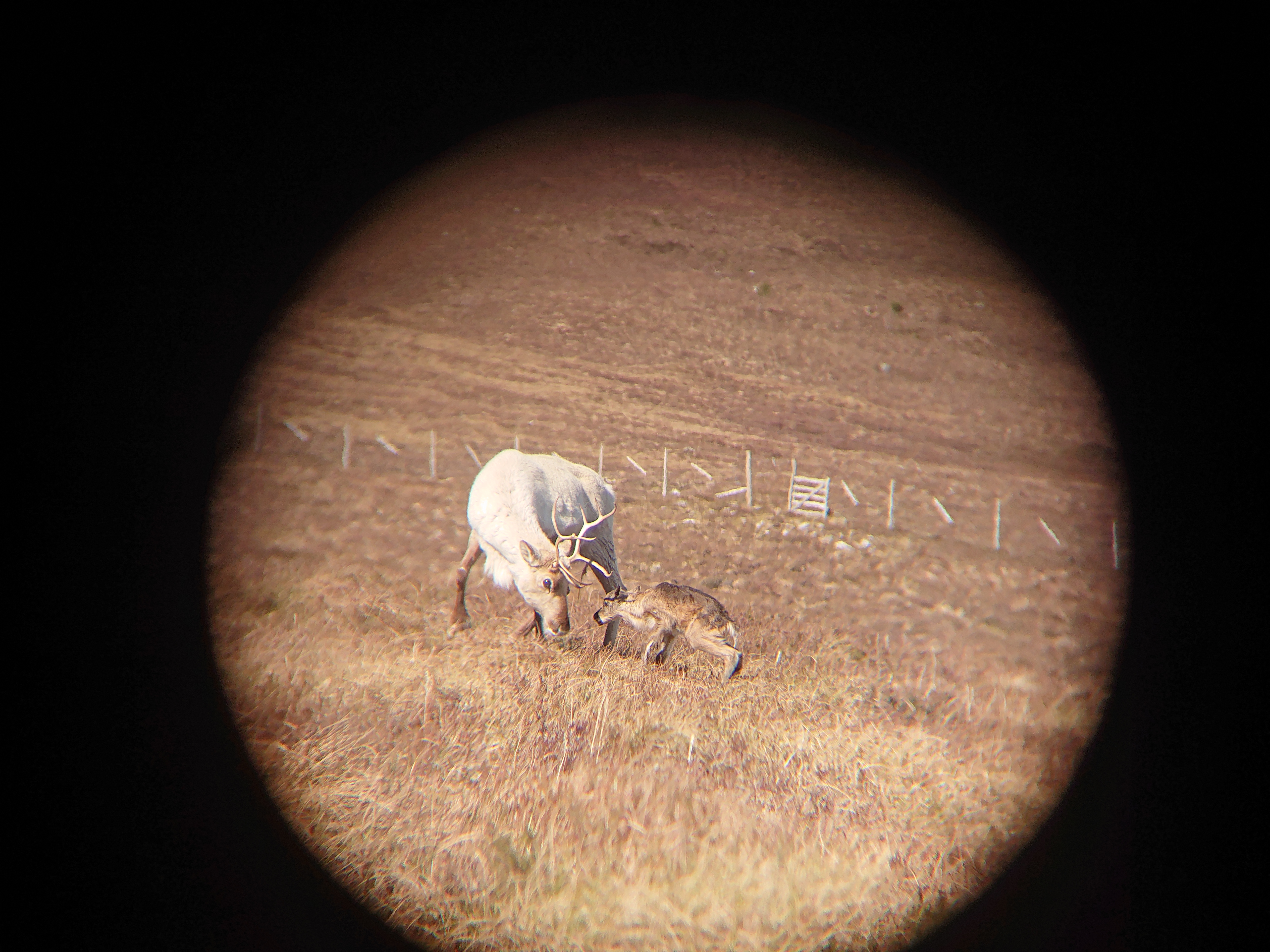
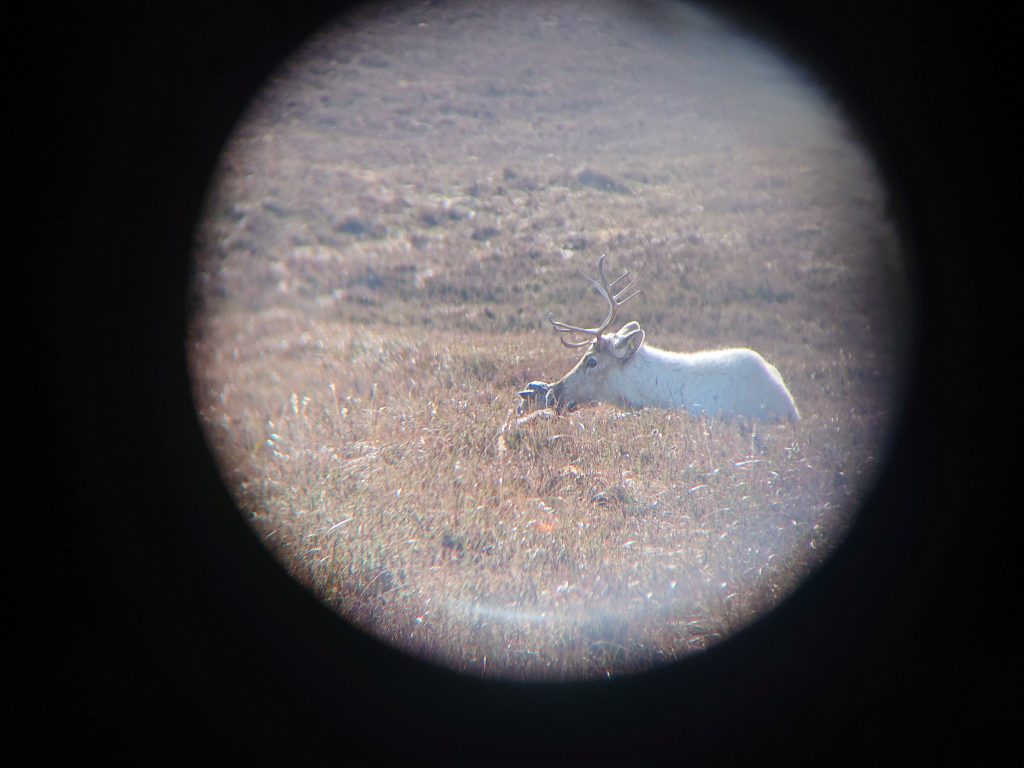
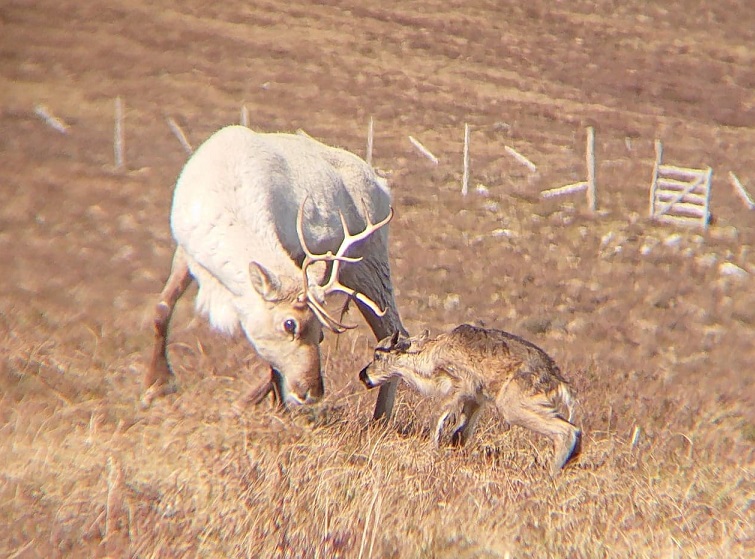
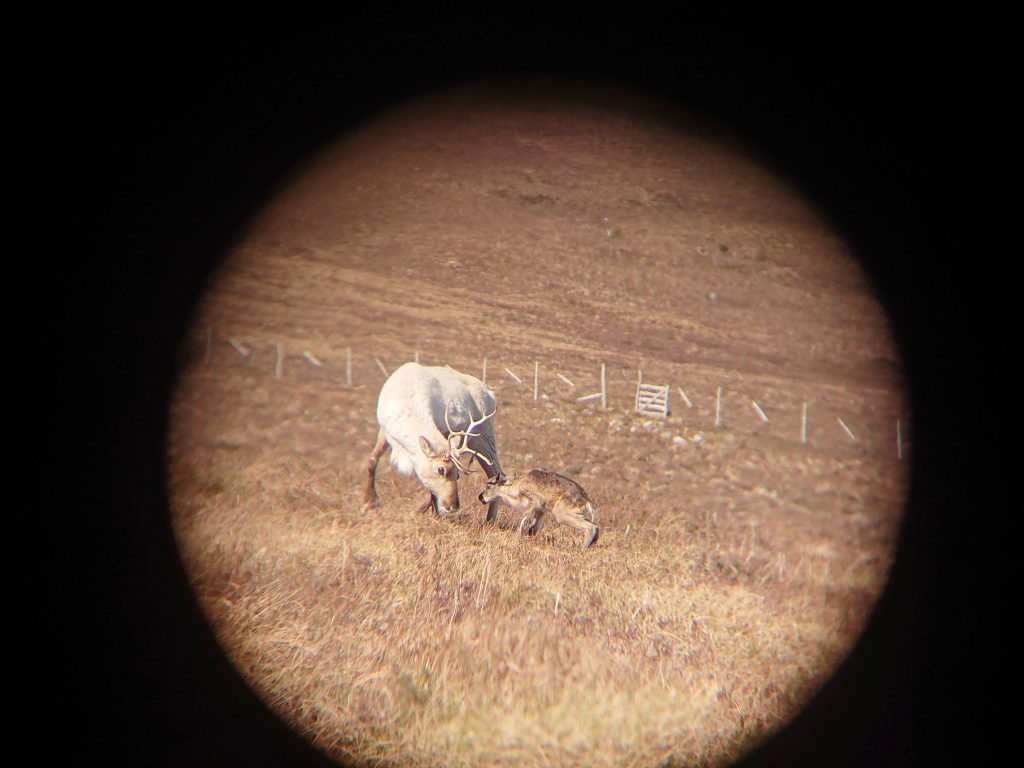
I had the great delight of finding Cicero’s mum, Brie, when she was mid-way through calving. I found a spot far enough away to not bother her and watched the whole process through binoculars. When I found her the calf’s front legs were already out and it didn’t take long for her to calve completely. It was totally amazing then to watch the first 20 minutes or so of Cicero’s life. First he was licked dry, then he had his first milk and then fairly soon afterward he took his first steps!
Cicero taking his first steps.
As Cicero has grown up he has certainly taken more after his dad (Houdini) then his mum (Brie). Brie is the smallest of all our fully grown reindeer and Cicero is the tallest of all the reindeer his age, I think he over took her in height by about a year old.
Cicero on a dreich day – summer 2022.Cicero – summer 2023.
Jelly
When Jelly was a couple of days old we noticed that he wasn’t suckling properly, after closer examination of Jenga, his mum, we realised that she had passed all of her afterbirth. Both the passing of her placenta and the production of milk are associated with the hormone oxytocin which is released as the reindeer is calving. After chatting to our vet we ended up giving Jenga a dose of oxytocin and kept a close eye on them for a couple of days to make sure he was suckling properly. After a couple of days they were happy and he was getting plenty of milk from mum, by the end of the summer he was in great form, one of the biggest calves.
Jenga and Jelly suckling.New born Jelly finding his feet.
Not much as changed since then, Jelly is still one of the biggest of the 2020 bulls, definitely with the biggest neck of all of them – what a chunk! Jelly can be a little dopey at times and this reminds me of that tiny wee calf wobbling about to get milk.
Jelly being a dude – summer 2022.Jelly – summer 2023.
Hemp
When Hemp was wee he was a beautiful slate grey colour with a white nose, much like his dad, Spartan. Whilst Spartan’s characteristics were showing up in many of the calves that year, note the white noses of Adzuki, Haricot, Borlotti and Chickpea, the family resemblance is strongest in Hemp.
Hemp leading the way.
Hemp has grown up into a lovely friendly young reindeer which is no surprise as he comes from a very tame family, on both his mum and his dad’s side. He’s incredibly greedy (which comes from his mother) and can be a little stubborn at times (which comes from his father).
July has been a good month with not a great deal of unusual things going on within the herd really – which is actually rather nice! The boys in the hill enclosure are generally eating lots and putting all their energy into growing lovely antlers and big bellies! Towards the middle of July the reindeer finally start to look themselves and some in particular look very smart in their short summer coats.
School holiday season is definitely upon us! We’ve got very busy with visitors, running three Hill Trips a day during weekdays and two on weekends. The Paddocks and Exhibition have also been popular and the reindeer here at the Centre have done a good job of ‘babysitting’ our two hand-reared calves (Winnie and Alba) overnight. They are now big enough to spend the daytime with the herd on the hill. This allows them to get some good exercise every day and lots of great grazing but they return each evening so they don’t miss out on their night time bottles of milk!
I’ve been lucky to see some of the free ranging females out on the hills too – all looked great and some stonking big calves out there. Well done mums, keep it up!
Hopefully the following photos will give more of an insight into what’s been going on this month.
3rd of July – Lupin and Bond relaxing after a Hill Trip.4th of July – The herd heading up to the shed for a routine temperature check. We try to do this around once a week at this time of year.5th of July – Sunny leading the herd through for their breakfast. What a good boy!6th of July – Jelly strutting his stuff.7th of July – 99 (named after the ice cream) is one of our leucistic reindeer. He was one of the first reindeer to moult into his smart summer coat and is in excellent condition.10th of July – The herd on the move.11th of July – Wafer and Haricot looking soggy after a wet morning. 13th of July – A hill walk on a day off and was lucky to bump into a herd of our free ranging cows and calves. This is three year old Turtle who was looking very well.16th of July – Cicero, Andi and Scoop on a VERY wet morning harness training. Both boys happily grazing not fazed by the situation and Andi is still smiling despite the downpour!17th of July – Sunny (last year’s hand-reared calf) still looking a bit scruffy!18th of July – Alba and WInnie on their way up to “Reindeer School” for the day. They spend the evenings and nights here at the Centre in the Paddocks and the day time on the hill with the herd – good grazing and exercise.20th of July – Yearlings Calippo and Kulfi.23rd of July – So much antler! Morse, Spartan and Kernel.25th of July – LX and Busby. I think they both thought they were missing out on their breakfast!26th of July – Blue skies above the hill enclosure! Summer returned for a day!
The spring here is extremely busy, as life at the Reindeer Centre revolves around the female reindeer and the calving season, and no day passes particularly peacefully – both for good and bad reasons. Herders scurry up and down the hill all day long, visitors arrive hopeful of seeing newborn calves, and there is almost always some sort of drama going on behind the scenes… Is that calf sucking properly? Was that reindeer looking a bit peaky this morning? Help – so-and-so has just calved and promptly turned feral… Why does that cow appear to have no calf – it was with her 5 minutes ago! There is never a day where I get to 5pm, and think ‘well, that was a boring one’.
Early June and the cows and calves head off to free-range for the summer, leaving behind a rather calmer state of affairs in our hill enclosure.
In contrast, June is a time to draw a few breaths and take stock. In the first week of the month the cows and their calves are led out on to the mountains and they head off to free-range themselves, and then calmness finally returns to our lives. While admittedly June does sometimes feel a bit lacking in excitement after the chaos of the previous few weeks, it also brings with it a welcome lull – generally all is quiet on the reindeer front, and all is calm at the Centre itself too.
June is scruffy reindeer month too – here’s Cicero, Morse, Kiruna and Fava looking… frankly, rather moth-eaten!
The spring tends to be a time when reindeer pick up more illnesses as ticks are more prevalent, but by the time we reach June this settles down a bit, and we have less occurrences of high temperatures and out-of-sorts reindeer. Us herders can therefore relax slightly – less worried that someone is about to expire unexpectedly. We do, of course, keep our vigilance levels as high all through the summer as through the spring, but June, July and August are undoubtedly a little calmer on the veterinary front. September brings with it a spike in ticks – and therefore illnesses – once again, but for now all is relatively quiet.
Regular temperature checks are done throughout the summer, to look for a tell-tale raised temp of a reindeer with a tick-borne fever.
As well as the reindeer influencing our level of busy-ness very variable throughout the year, the other major factor is our visitors. Being a tourism-based business, the number of people through our doors goes up and down like a yo-yo throughout the season, with spikes coinciding with school holidays. As the saying goes we ‘make hay whilst the sun shines’, soldiering on though hectic spells with millions of people around, but it is countered by the quieter periods. Our reindeer apparently consulted a calendar in organising their yearly cycle – as spells when we are busiest with the reindeer themselves (calving in May, the rut in September/early October, Christmas tour in November) tend to coincide with school term times. How considerate of them! Until… the Christmas holidays, when everything goes out of the window and reindeer chaos and visitor chaos collide. This is one of the reasons the Reindeer Centre closes for a few weeks each January – us herders are so frazzled that we need to recuperate.
But I digress. Back to June. All kids, in the UK at least, are still at school in June so it is one of the quieter months to visit – the afternoon Hill Trips in particular this year tended to be quite small. It felt a bit like ‘old times’ back before the area – and Scotland in general – became much, much busier with tourists. I started working here in 2007 and at that point Hill Trips with a dozen or less people were completely normal but in more recent years much bigger groups have become the norm – by 2019 we were occasionally taking tours of 70 or even 80 people. In 2020 however, we put a cap on the maximum number of people to 50 in an attempt to go for quality over quantity (as in a quality tour, as opposed to quality visitors), so now it never gets quite that crowded. But – speaking as a guide, at least – this June was wonderful. Busy morning tours but then smaller ones in the afternoon; I even did a tour with just 5 lovely visitors on one occasion. So peaceful! Plus it gave me time to catch up on all the office work that had been cast aside throughout May…
In the winter months, all of our adult male reindeer plus some of our cows roam free on the mountains over near Glenlivet. Tilly and the farm crew take care of their day-to-day feeding but occasionally one of us herders from the Glenmore base will pop over to help. Here is a random selection of photos from one of my recent visits:
Cicero and SliochButter, Cicero and SliochLegumeAnster, Emmental, Hemp, Dr Seuss and BorisLupinOld lad StrudelJonne, Mangetout, Bourbon and FavaSpy, Morse, and his granny PavlovaRubiks, Addax, Boris, Arta, Aztec, Cheer, Diamond (and Tilly in the background!)Druid the poser!Jelly, Kiruna and StenoaSpy and DiamondBingo and wee Cannellini, with Lulu to the rightLX
Don’t you ever wish you could just lie down and take a snooze if things are taking too long?? With their thick coats, that’s exactly what reindeer do – everywhere can be a bed! Here’s some shots of them having a snooze in the snow a few weeks ago…
Old lass Fonn and young Lima
Hi Lima!
Kernel, Cicero and his mum Brie
Wee Chickpea
Emmental with her calf Edamame
Butter with his mum Gloriana
Addax and her calf Hemp
Haricot
Emmental and her calf Edamame
Christie
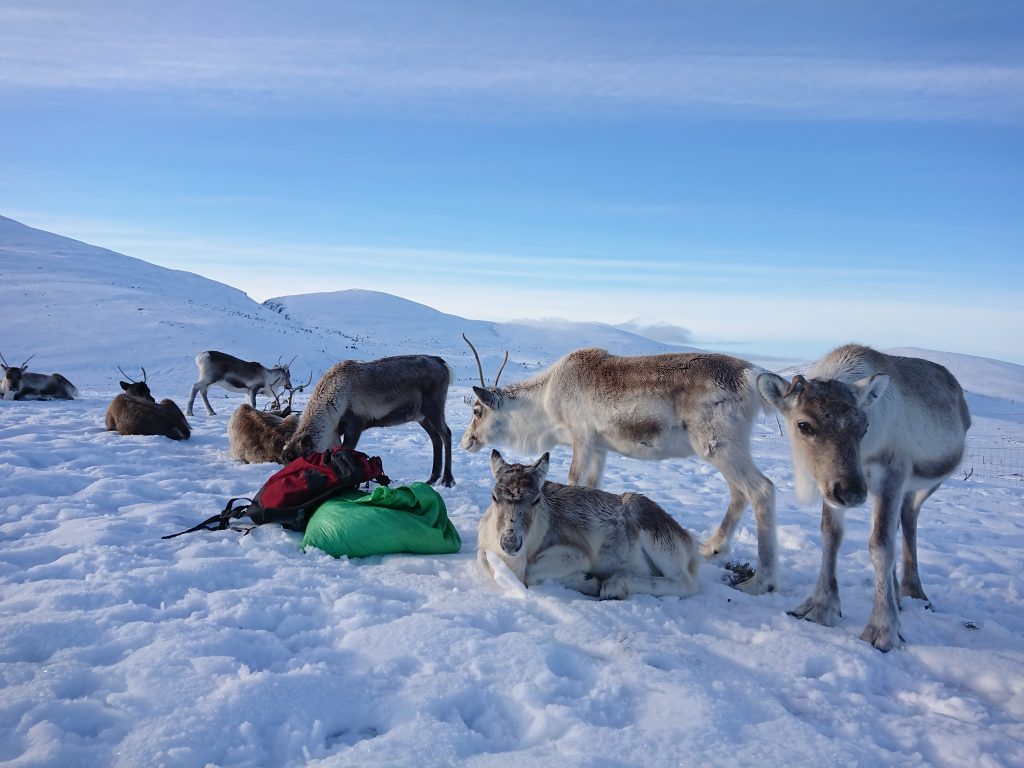
Guardians of the bag – Pumpkin, Ärta and Heinz, with Holy Moley lying down
This year I was lucky enough to spend May looking after all the cows and calves during calving season, whilst most of the country was in lock-down. This was my first calving season and I found it really fascinating to watch how the behaviour of the reindeer changed once they had calved. Especially for the first-time mums who were acting purely on instinct, which amazed me how strong that is! There were a couple of things that I noticed a few of the mum’s doing in the hours and days after they had calved which I thought might be interesting to read about.
Licking their calf dry
The very first job of a reindeer once she has calved is to lick her calf dry. This year some of our calves were born in the snow so they want to get dry as quick as possible so that their fluffy calf coat can keep them warm. I was incredibly lucky to be able to watch Brie calve this year, I watched through binoculars as she carefully licked all the placenta off the calf, Cicero, until he looked like all the other calves I had seen at a couple of hours old – fluffy rather than slimy.
Eating the placenta
Being an arctic animal, every bit of nutrition reindeer can get is very important – placenta included. We found Ibex and her calf Flax when she was a couple of hours old, by which point Ibex was obviously feeling peckish. I can’t say that it looked particularly appetising to me but then I’m not a mother, nor a reindeer!
Licking their calf’s bum
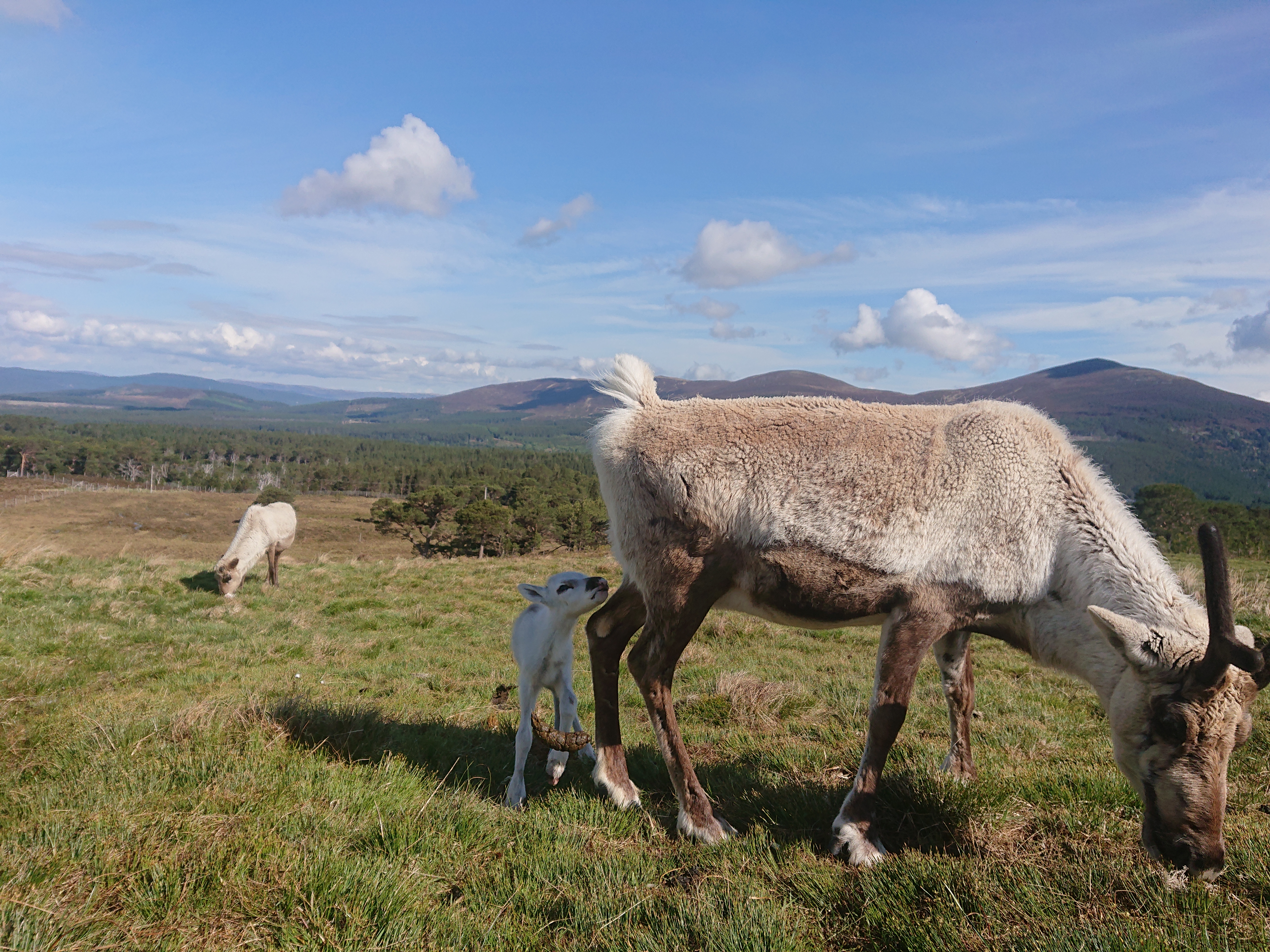
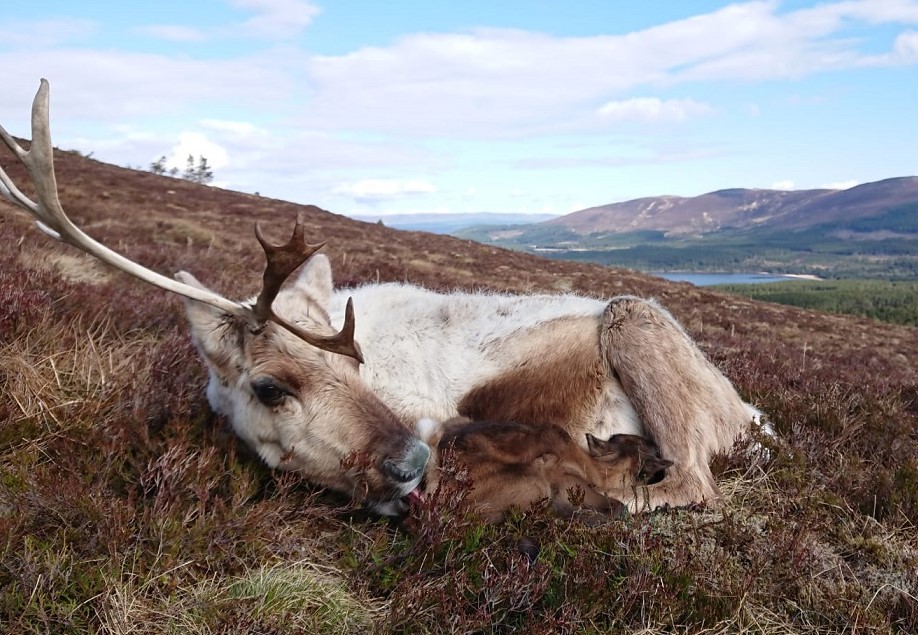
To stimulate the calf suckling the mother must lick her calf’s bum. This all works in a cycle because the cow licking the calves’ bum stimulates the calf suckling and the more that the calf suckles the more milk that the cow will produce! All resulting in a good strong calf. It’s also very important to help keep the calf clean, their very first poo can be very sticky and a couple of the mums – mostly the ones who had had many calves before – didn’t do a very good job of licking their calves bottoms meaning we had to do it instead (cleaning it, not licking it….)! I can’t really believe how something so smelly can come out of something so sweet, so I guess I can’t really blame the cows. When the calf is really young the mum will also lift her leg so that the calf can suckle whilst lying down, here is Pagan demonstrating both very well with her calf Pumpkin!
Teaching the calves to walk
The last thing that I found really interesting was the way that the mums get their newborn calves to start walking. As a prey animal it is very important that the reindeer are up on their feet as soon as possible. But how do they go from an incredibly wobbly newborn calf to the agile calves who can easily outrun me? The answer is lots of careful training from their mums. From when Cicero was about 20 minutes old, Brie started to stand up and walk a few metres away and wait for her calf to take a few wobbly steps over. The calf would then lie down exhausted for a while before she did the same again. Eventually the steps become less and less wobbly as the calves grow stronger.
This year was the very first time I had work during calving season, as until now, calving season had always been exactly the same time as exam season. I can very easily say that calving season this year was the happiest month of my life so far, so it has been very difficult to think of just 5 highlights. But here we go, these are my five favourite memories from calving season this year.
Finding the first calf of the year – Holy Moley
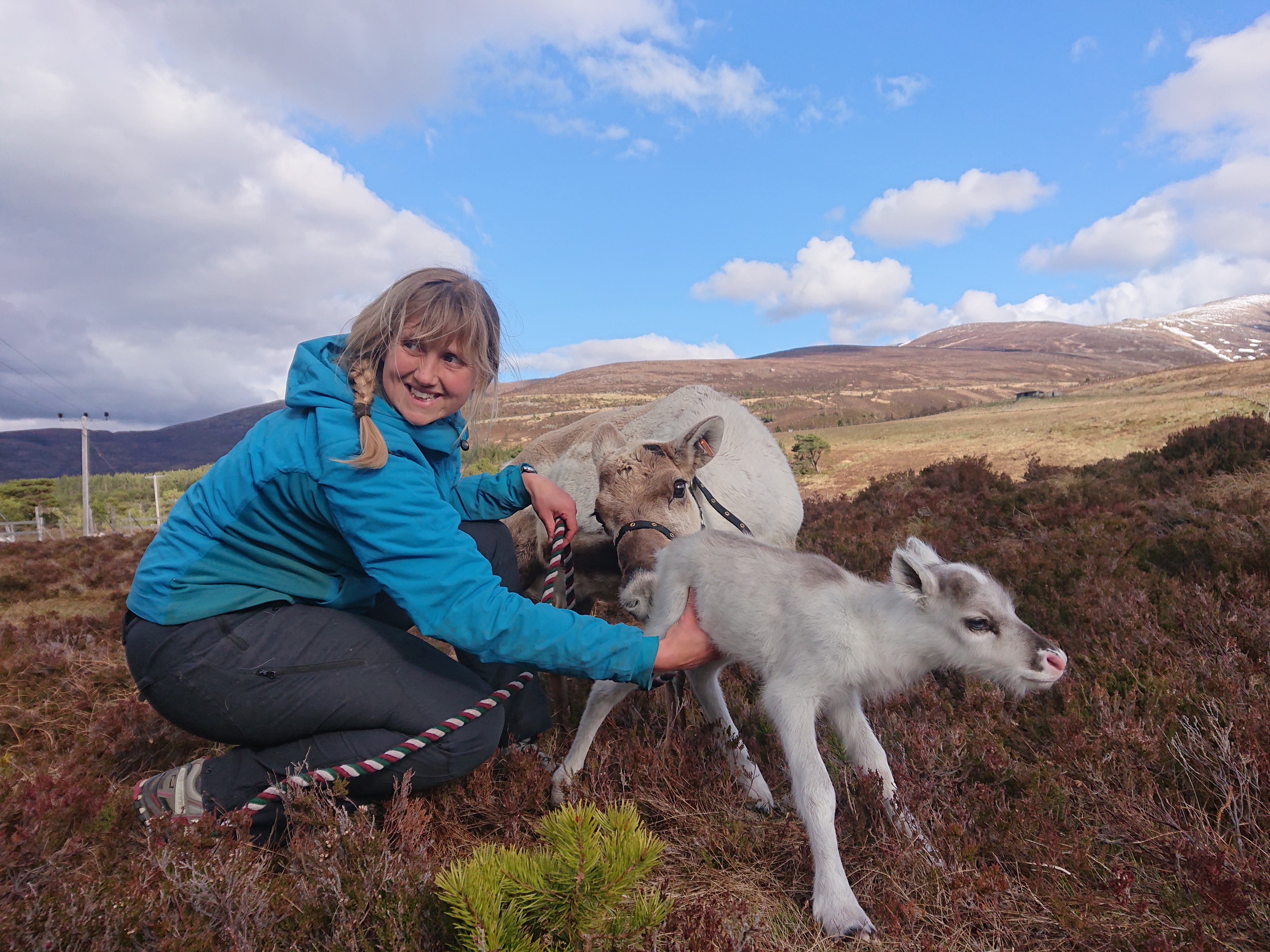
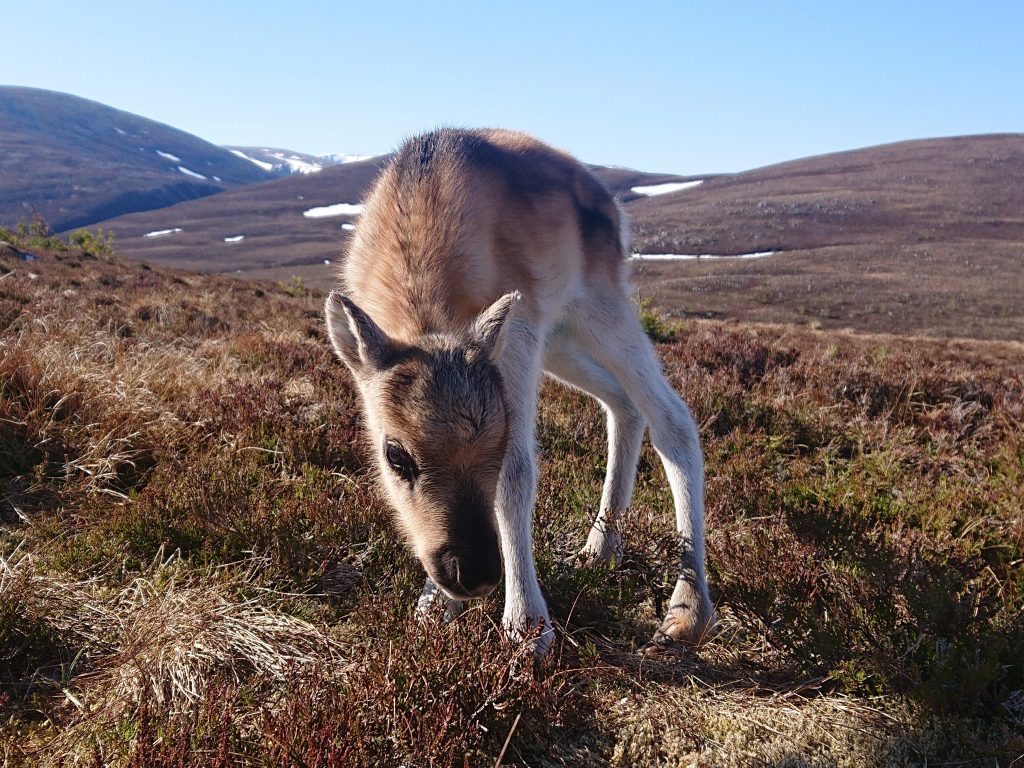
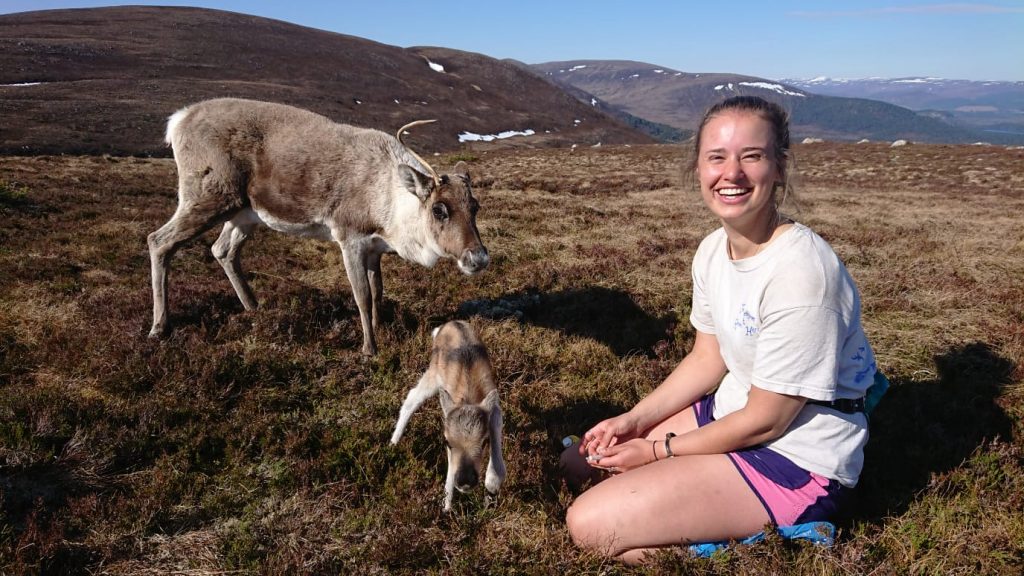
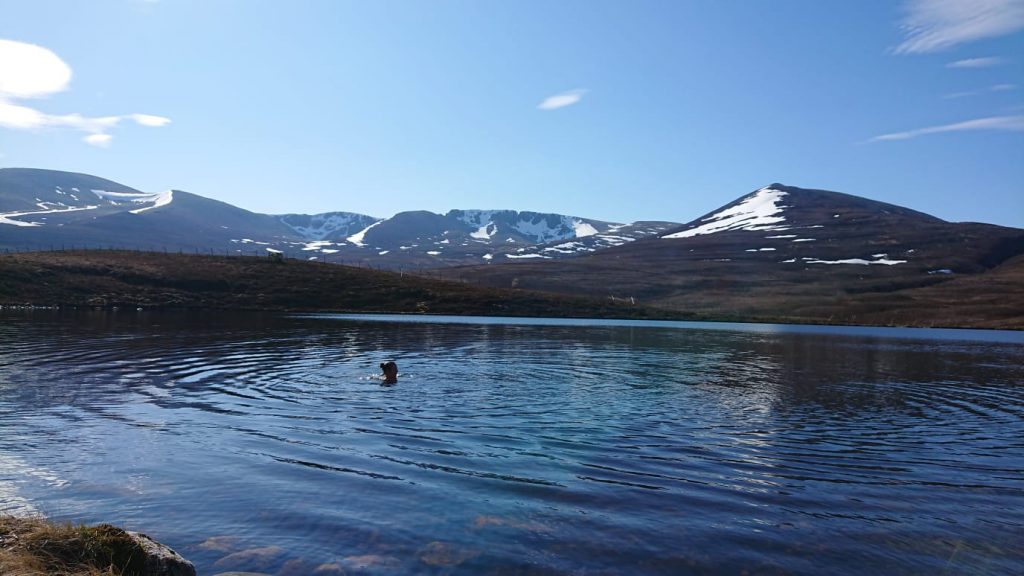
On Saturday the 25th of April, me and Fiona headed off around the enclosure to look for Galilee who was the first reindeer who had headed away from the herd to calve. It was much earlier in the year than the previous year, so I didn’t get my hopes up too much in case she was just ill or being a loner – Galilee can definitely be known to wander from the group. As me and Fi rounded the top of Silver Mount we caught a glimpse of Galilee, licking the ground. Fiona told me that this was a sure sign of her having calved, and as we got closer I could see the tiny calf on the ground. A new-born calf is barely recognisable compared to the calves I had seen previously in the summer and I can honestly say that Galilee’s calf is the most perfect thing I have ever seen. Galilee let us catch the calf and Fi show me how to treat the calf with an insecticide and some antibiotic spray on her navel. Galilee was very good but she clearly want us to leave her to bond with her calf uninterrupted. So we then fed Galilee and left them too it. The weather was even warm enough to cool off (and calm down from the excitement) with a quick dip in our own ‘private’ loch in the reindeer enclosure.
A quick dip in Black Loch!
Watching Brie calving
My second favourite calving memory has got to be watching Brie calve. One morning Brie was missing from the herd, from spying through binoculars we saw her but couldn’t tell if she had calved yet or not so I headed out to go and check. Once I got closer I realised that she had legs actually coming out of her back end – she was midway through calving. I sat down a little way away from her and watched the whole thing through binoculars. I watched the calf take his very first, incredibly wobbly steps and have his first milk.
Cicero’s first time up on his feet!
Finding Gloriana’s calf
Another favourite calving moment for me was finding Gloriana’s calf. Gloriana is an 8-year-old female who had previously never had a calf. I really fell in love with her during the 2015 rut. She was amongst a group of reindeer on Silver Mount however she was a bit of a loner from the group and used to sometimes follow me away from the herd once I had finished feeding them. Having never had a calf, we thought that she was infertile so imagine my delight when she started to develop an udder, the first sure sign that a reindeer is almost ready to calve. On one very wet and rainy day, Gloriana was missing from the herd. Andi and I headed out around the enclosure and found her on Silver Mount with a beautiful big male calf. Gloriana was a wee bit nervous but let us treat the calf with no problems. The next day however when we tried to bring Gloriana and her calf to a closer section of the enclosure, I couldn’t get anywhere near her. I think having a calf for the first time at 8 years old made her a bit of an overbearing mum, so it took us a couple of days to get near her again. She did eventually settle down and both her and her calf became more and more confident during the time they were in the enclosure.
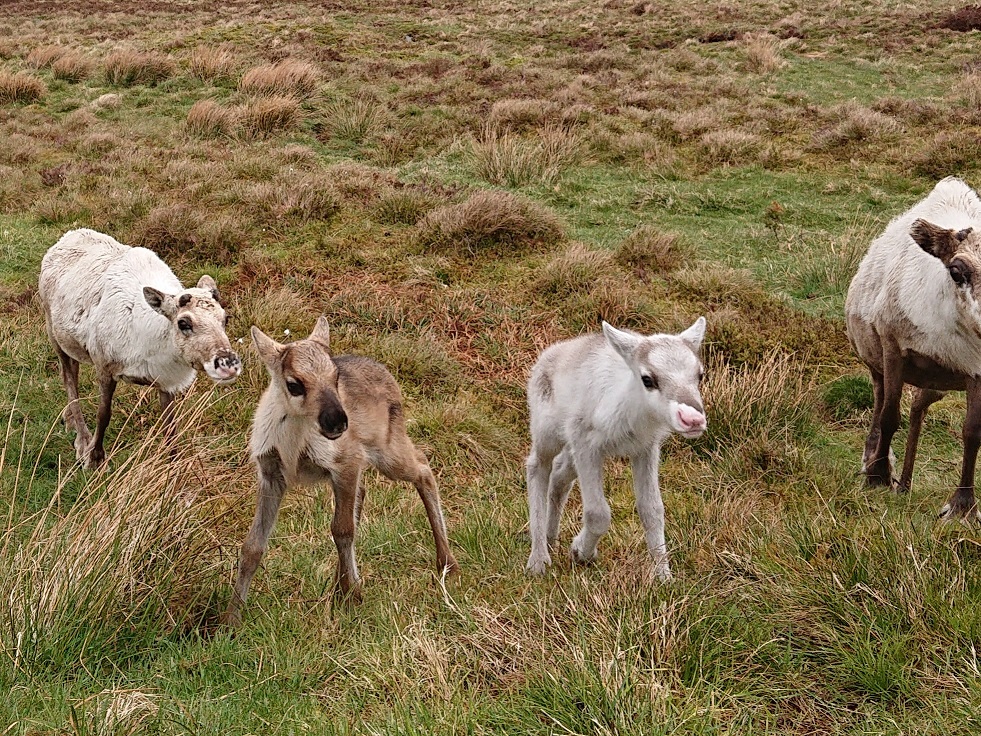
Gloriana’s calf Butter with the white nose, with his cousin, Fly’s calf.
Hanging out with an experienced mum
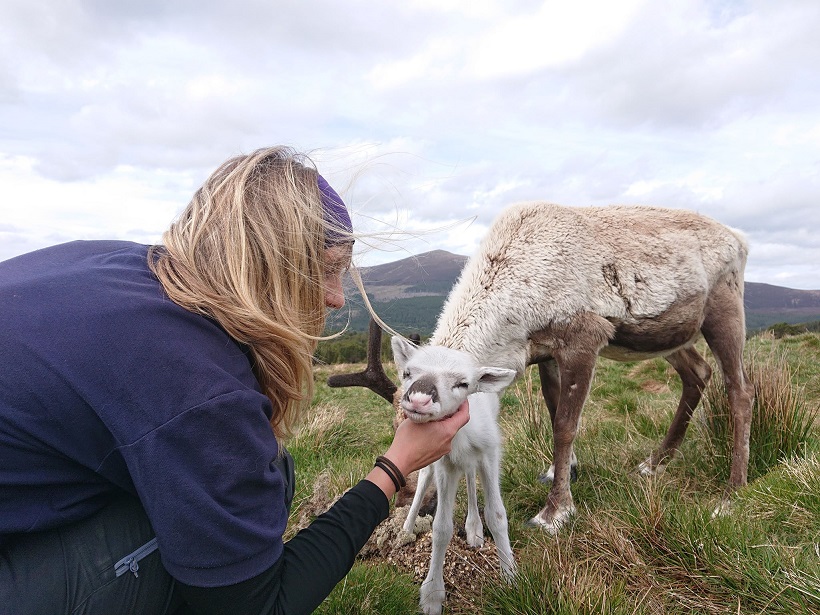
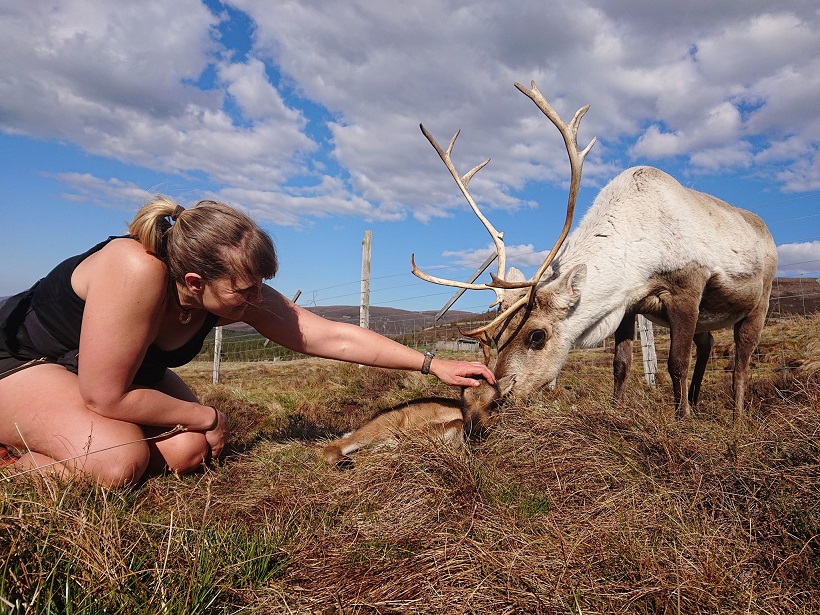
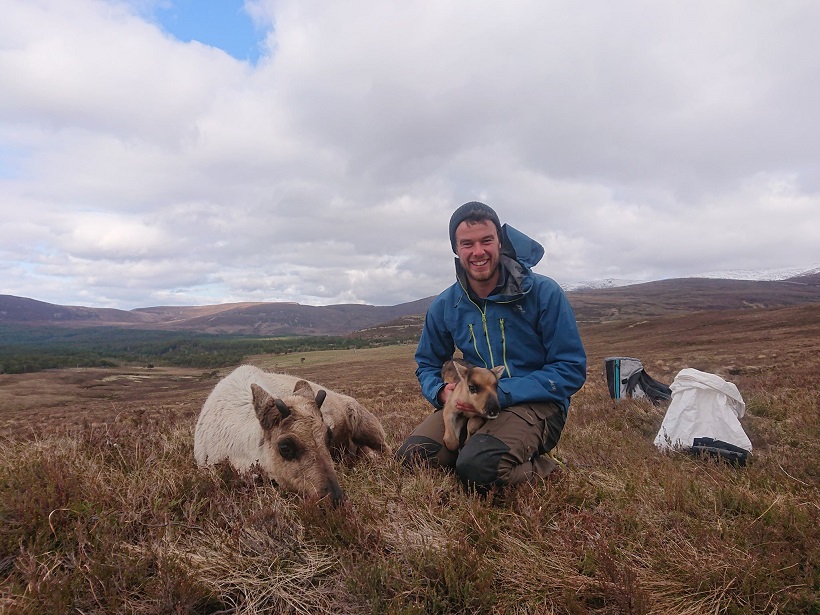
Okay so this calving favourite is not just one moment. A couple of times during calving I got to go out and find a cow and calf from a very tame and experienced mum. Usually once we find the calf we will catch it and treat it and then leave the cow and calf as soon as possible to make sure that we don’t upset the mum. However, some of the cows have had so many calves and are so used to people that they are perfectly happy to lie down with you and their new-born calf. The new-born calves are incredibly inquisitive and totally unafraid of humans. It is a really wonderful experience just hanging out with the new-born calves and their very relaxed mums.
A wee chin rub for Ryvita’s calf Haricot (not a strangling!!!)
Ibex and calf Flax!
Kipling and calf Pip with Joe
Sending the calves onto the free-range for the summer.
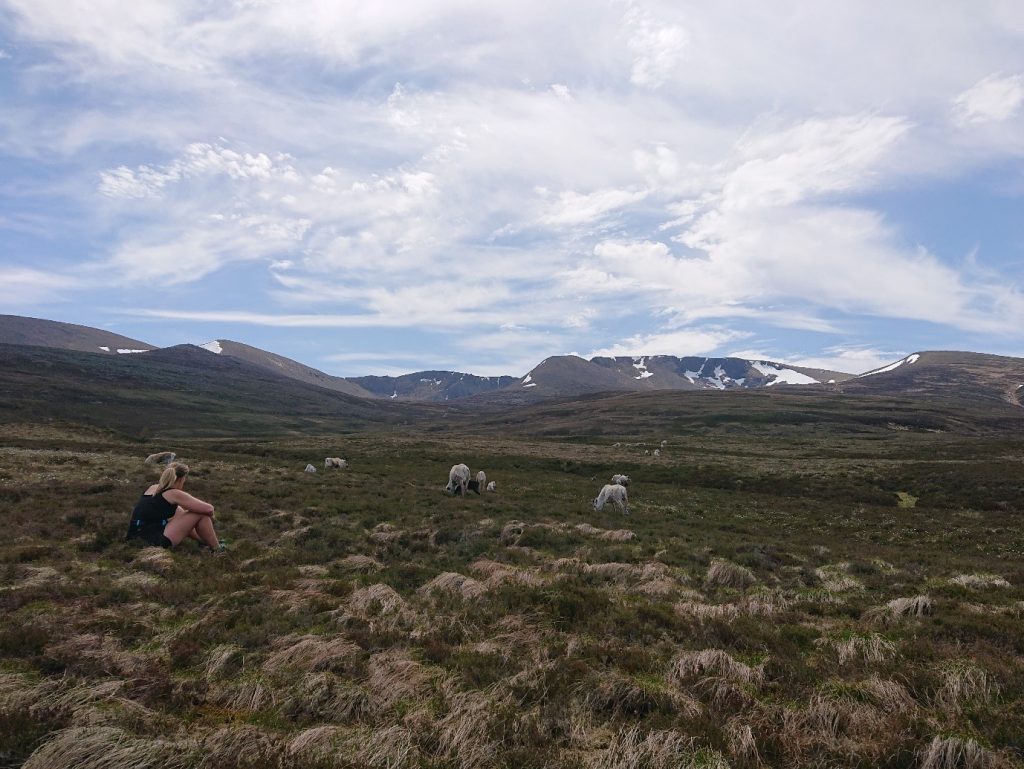
My final favourite calving memory was letting the calves onto the free-range for the summer. We walked out of the enclosure with some of the cows on halters and the rest following towards the hills. Having spent every day of the last 6 weeks or so with the cows and then the calves, letting them go onto the free-range for the summer where we would likely see them every couple of weeks at the most was both sad and wonderful. Definitely sad to not be seeing them every day but also very wonderful to know that they would spend the next few months of their lives in the very best place for them, the mountains.
Leading the herd out of the enclosure
Off they go…
Lotti, Joe, Fiona and a socially distanced Andi after a busy morning!